by Informed Pregnancy and Parenting Project | Feb 21, 2023 | Labor and Delivery, Podcast Transcripts
Elliot: Welcome to the Informed Pregnancy and Parenting Podcast. I’m your host, pregnancy-focused chiropractor, Dr. Elliot Berlin.
My returning guest today is a singer, songwriter, and mom. She has a thriving career and a growing family. Last time we talked, she was very pregnant and about to deliver. And we’re tuning in for the rest of the story. Christina Perri, welcome back to the podcast.
Christina: Hello, hello.
Elliot: I was just saying before we start recording, it’s amazing to see you.
Christina: I know! It’s great to see you, too.
Elliot: And we had quite the marathon of pre-birth episode on your own right. You’re just super entertaining to talk to. But then, there was all this in very intense journey that you’ve been on with one pregnancy that went great, and then when that ended in a first-trimester miscarriage, and then another one that ended in a late pregnancy loss. And just a big journey in so many different ways in terms of your own health and in terms of understanding, what potentially was causing the issues and also for your babies. And then, finding out about clotting disorders and that you have one and that a lot of people have them and don’t even know that they have them. And that’s one of the consequences is pregnancy loss.
You’ve been working hard, not just for yourself, but for others to get to the bottom of it, to try to help other people learn more about it, and to advocate for awareness and for testing. And it’s a huge kudos to you. A lot of people, I would probably, just get knocked down and never pick myself up and dust myself off and try again. You not only did that, but you’re constantly working to help other people along the way.
So, last time we talked to you, you were pregnant, and towards the end of your pregnancy. A lot has happened since for you. I’m pretty much the same as I was. So, first of all, I mean as the pregnancy got closer and closer to the end, one would wonder if that created anxiety for you.
Christina: Oh my gosh! You know, I don’t even know where to begin. I’m sitting here, we could definitely start with anxiety. It’s interesting I feel like I had my daughter a couple days after I talked to you, because I ended up going a bit early. So, I really last spoke with you at the plot twist, right at the top. And I was definitely anxious. And well let me say this, I definitely haven’t slept for eight weeks, okay. I think it’s so funny. I keep saying to Paul, my husband, “You know, if I committed a crime, I could get off with insanity. Because I’m not sleeping or like some form of Chinese torture to not sleep more than four hours at a time for 68 days, but who’s counting.”
Elliot: Yeah, I know.
Christina: No, I want to preface and say that because A, I might be scattered definitely more than last time. And B, I might forget what I’m saying. But anyway, I’m going to try to make sense. But I want to say I was at the height of my anxiety when I last spoke with you, and excitement you know. It was a mix of both because I just was excited to not be pregnant. And then, at the same time, I just really hoped that the baby was alive. And I think in hindsight now, I think it’s kind of funny because I said to everyone in my pregnancy, “My bar is so low. As long as the baby comes out alive, I’m going to be so chill. I’m going to be such a chilled new mom again.” And I, in fact, proved myself incredibly wrong. I was absolutely not chill. I’ll explain it all.
So, I want to say I wasn’t super anxious only because I was really communicative. You know, not just with the people in my inner circle, but with all my doctors. I felt really, really well seen and taken care of. And I just felt like we did the best we could during the whole pregnancy. We, as in the whole team. But definitely, me with just monitoring my anxiety and trying not to let it sort of win. And then, I will tell you at 37 weeks and four days, I took myself to Cedar-Sinai. First time, I pulled that card. So, basically, Dr. Kumetz said to me, my OB, “Any time you’re worried, come into the office. Anytime you’re worried about fetal movement, come in and we’ll monitor you.” And I was like, “I’m good. I’m good.” And to be fair, I was having extra fetal monitoring because of my history of stillborn. So, I was seeing a parentologist and my OB-GYN every two days.
So, I was very monitored and I just felt confident that the baby was alive up until October 20th. And for some reason, I just didn’t like the amount of times I felt her move that day. So, if you are a mom that has experienced any pregnancy loss after you know you feel the baby moving, you’re really counting every single time. You could say you’re not counting and that you’re chill, but you’re definitely more aware than your first pregnancy. So, to be honest, I was really keeping an eye constantly on how often I felt her moving. And it was the first time that I said, “You know what, Paul? I’m actually worried.” Now, I will say it could be because she was bigger. Her movements weren’t as dramatic, or she was just sleeping because she’s ready to go. There are things that like it could have been. But in that scenario, on that particular day after what I’ve been through, everyone said, “Just go. Just go to the hospital.”
So, it was 10 p.m. on October 21st, actually not 20th. And I went to Cedars-Sinai with Paul, and we didn’t bring everything. Because I was like, “Let’s just do the fetal monitoring. And then, go home and try to wait until Monday.” She was scheduled to be induced that upcoming Monday. So, I was only four days shy of my scheduled induction. And so, I was like, “Let’s just go and check out the baby, and then we’ll come home.” I also want to mention that for the first, I felt very brave at the hospital to ask for exactly what I wanted and needed. And I specifically ask the nurse to give me an ultrasound before she looks for the heartbeat. And I want to say that too for any other moms that have gone through this, or hopefully, you don’t but may go through this, I was very traumatized when Rosie died while they were looking for the heartbeat with the little monitor. You know, that they put on your —
Elliot: The little Doppler.
Christina: Yeah. And I said to Paul on the drive over, I was like, “Hey, I can’t survive that. I don’t think I can lay there and have them looking for her heartbeat and not find it.” So, Paul was sort of my knight in shining armor, really, the whole weekend. He was the one that said — because he’s better, he’s from Jersey. He’s better at being a little brass and whatever. And Paul, I call him “Paul, #2.” Because he’s a Gemini and his like number two personality will go, “No, don’t mess with my family.”
Elliot: I have three Gemini. So, this is great.
Christina: Oh gosh! You know, it is very real, that Paul #1 and Paul #2. But anyway, different podcast. So, he said, “Hey –” Well, we got there because you know they pulled out the thing right away. And he was like, “Hey, I’m sorry. We lost our last child and it’s really triggering to look for a heartbeat. Can you please bring in an ultrasound technician?” And they did. Like, within minutes. This guy came in and he immediately found her heartbeat. I could breathe.
Elliot: On an ultrasound?
Christina: On ultrasound. Then they hooked me up to the monitor and decided to do a whole non-stress test while I’m there. And while I’m there, they say, “Call your OB.” And then, a woman comes in who is a doula, like for the — I guess at Cedars; they have a doula who’s around that helps out.
Elliot: A midwife.
Christina: Midwife. So, she came in to talk to me. But Dr. Kumetz was like, “Look, you’re already there. This is your intuition. You felt something was off. You’re only four days away from induction. I recommend, let’s just do it.” And there’s a lot of things I struggle with when I think back and try to think of doing things differently. I’m not good at sometimes going back and thinking what could have been, or should have been, or would have been. I’m pretty guilty. I feel like everyone does that. And I do feel like — and this is just my trauma talking. I want to say I think I have a lot of trauma from what happened in the next five days. And I am going to do EMDR. I have yet to do it because I’ve just been in newborn land, but I think I’m traumatized. So, I still think I could have done it differently. But I feel like if I have this chat in six months, I might say I would never do it differently or I forgive myself for thinking I could do it differently. I’m going to get emotional.
It’s funny. I was kind of procrastinating talking to you because I was like, I really want to be put together. I want to be fine when I do my next episode. I want to be, “Oh, and here’s what was hard and here’s what I did to get through it.” Because I’m such an analytical person, and I wanted to talk to you, and I was so put together, and be like, “Here’s what I did to be better or to help myself.” And the truth is I’m still in it. I’m so in it. So, maybe it’s good that you’re going to get this really honest, raw version of me. And then, maybe we should do a part three, after the healing.
Elliot: First of all, a couple of thoughts through my mind. If you’re not ready, we don’t have to do it.
Christina: No. Please, I think it’s good. I actually think it’s better and more honest that I give this story in this place than the super healed version of me that I think will forget.
Elliot: I just want you to know it’s always you. Whatever you want is what we’ll do.
Christina: Thank you. I’m just like —
Elliot: And I will have you back in six months for next stage perspective, for the retrospective experience, yeah.
Christina: Okay, cool. I just want to say that because, honestly, this is my thing. I’m just honest all the time. And if I pretended I was fine, I wouldn’t be me.
Elliot: Wouldn’t be you.
Christina: Right. So, I think I had to forgive myself for choosing to induce when I did. And I think that I have to just let it go and I think I’ll eventually get there. We induced that night. The reason why I’m so disappointed too — because I have to say, I was disappointed in pretty much everything. I joke around now and say like, you know, because we had the worst experience with Rosie. Paul and I just thought we deserved to have a magical experience with Pixie. By the way, my daughter’s name is Pixie.
Elliot: So, beautiful.
Christina: The little pixie dust that we needed in our family, and oh, my God, there’s so much to her name. But, anyway, she is here and she is healthy and safe. And I am safe and healthy, and fine. I want to say that too. But the story is pretty traumatizing for me. My experience with it because I was so prepared. And maybe in my last episode, you can hear how I think, and how, of course, I was super prepared. I had everything lined up the way that I hoped it would go. And I had wiggle room for real life to happen, but I guess just not enough.
And what happened is, you know, I prepared for this birth. I was doing all this yoga, and doing all this meditating, and working with a doula who was so spiritual and feminine. And I just wanted this like super, feminine, goddess, strong, try not to do it with, you know, drugs. I wanted to just be present, wanted to meet my daughter in a way that was so different than my last experience. This was my intention, right? And I do think it is worth noting that women have this idea or ideal birth situation. And I’m sure with all the episodes you’ve done, I’m sure you’ve heard all of them. And most the time, it doesn’t go as planned. And I just feel a little silly for even thinking I could just plan it and have it be absolutely perfect. But I did certainly try.
And so, when I was at the hospital on October 20th, I called my doula and she was in Utah on a mountain at a retreat. She was standing naked under the moon and she was sending goddess vibes to me. And I was like, “Cool, cool, cool. But you’re not here.” And it was the only day she was like, “Just don’t have the baby on this day.” And I was like, “Yeah, of course. I’m not going to go early. We’re already inducing early.” Well, I did go early. And so, there I am at the hospital. And so, she’s not there and I’m like, “It’s fine. Paul’s here.” But, you know, I have to say, you know, it’s just a guy versus, I don’t know. You know, say that she’s like a fairy, you know, my doula. So, it was going to be — it’s a totally different thing. And so, I was like, “It’s okay. It’s okay.”
So, basically, they started inducing me. They gave me a balloon, which along with the balloon, they gave me Fentanyl. I mean, I’ve been sober 10 years and I’ve never had Fentanyl. I just want to say —
Elliot: Whoa. Well, can we back up a drop?
Christina: Yeah.
Elliot: Do you remember anything about your cervix check from before you started the induction?
Christina: I was two centimeters.
Elliot: Two? And soft, like a face?
Christina: I think so, yeah. Yeah, yeah.
Elliot: And do you know if the baby was kind of higher or lower in your pelvis?
Christina: I want to say lower.
Elliot: Okay. And there’s also you’ve had vaginal births.
Christina: Yeah, yeah. I had two twice before this. But I wasn’t induced like this before. This was my first experience this.
Elliot: I’m just saying seemingly a good candidate for induction. I have no idea where this is going to be. We’ve deliberately not talked. I know you’re holding on to a lot of emotions. I’m already getting a little weepy.
Christina: Oh, gosh.
Elliot: I wanted you to have a beautiful redeeming experience, too. And so, now I see, it’s not exactly like that.
Christina: No. But this is much important for me, to be honest. Because I feel like even in our Instagram-perfect world, I took the drugs. Do you know what I mean? I did immediately the thing I said I wasn’t going to do.
Elliot: So, I’m just thinking to myself, right. With Rosie, you had a fetal heartbeat in the morning.
Christina: Yeah. At 11:30 a.m., I was monitored, yeah.
Elliot: There was a complication in the Thrissur, right? A small hole that was too small.
Christina: No, it was a block in her intestines.
Elliot: So, a block that’s essentially like stuff can’t get through.
Christina: Yeah.
Elliot: And everything was good in the morning. And then, the afternoon or later that day, there was no heartbeat.
Christina: Yeah.
Elliot: Like, if you were concerned about the heartbeat even though it was there and it was good and it was four days early, I mean it just seems like you could look back and say, “Maybe we shouldn’t have done now that Pixie is here and healthy.”
Christina: You’re right. In that moment, there was no other choice.
Elliot: Yeah. And I don’t know where this is going to go. But I’m sad if you’re hard on yourself for that choice. Because you would have, in a flash, made the choice to induce with Rosie.
Christina: Yeah.
Elliot: Now that you know the outcome.
Christina: Yes, totally fair. Thank you. Thank you for saying that. I think because so many things went wrong. I think as a mom, I’d imagine maybe any mom would feel this way. I just keep going back in my brain, “Could we have done it different?’ And you are 1,000% right that there is no way we all wouldn’t have made that choice. Like the doctor, the midwife, Paul, me. You know, my body even. I was already dilated. It was definitely the right time. It’s just that because of what occurs in the next couple days in the story, it’s like, you know, was she ready. And the thing is, okay, what I think bothers me the most about inducing her early — and I did just talk to someone on Instagram about this who had a very public stillborn experience recently. And that’s only how we know each other because I reached out to her. And she was asking me a question and I said, “Look, you know, if I could do it differently, I think I wouldn’t have induced based on my history.”
Now, that’s maybe controversial because again, in the moment, we all would have chosen to take the baby out because it made the most sense. Because it was heightened. Everyone was a little bit worried. Even my whole pregnancy with Pixie, you know because of my history with Rosie, and even though yes in fact, I did have a stillborn at 34 weeks, and I do have a blood clotting disease, and I am on Lovenox and heparin, I didn’t have any complications with Pixie in reality. So, I sort of wish I got to carry her full term without the fear of what could happen. Now, again, you’re right. It’s easy to say now that she’s here. Because in the moment, you’re weighing your risk. So, it’s like, “Do I take the risk and see what she’s like at 40 weeks and potentially lose her before then? Or do we just take her out now?” And of course, we took her out now.
Elliot: It’s like Deal or No Deal. If you knew that the million dollars was in the case, you wouldn’t have settled for $36,000, right? But in that moment, nobody would have gone on. I understand the feelings of guilt, and remorse, and looking back and wanting to know, “Did I do the right thing?” But you did the right thing, 100%.
Christina: Well, thank you. Thank you for saying that. Honestly, I haven’t shared my story with anybody yet. So, I’m happy that it’s you because you’re making me feel better. And also, it is true. I really haven’t totally looked at it with a 2-month postpartum brain, you know. I’ve been sort of upset about it since it happened, but I’ve been traumatized. And then, I’ve been sleep deprived, you know. Now, I’m a little bit clear-headed than I was eight weeks ago. But I’m being totally honest. This is the thing that hurts the most is thinking maybe I did the wrong thing. But I’m glad I’m sharing it because, you know, either someone else feels this way or might feel this way. And I’m unbelievably grateful that she’s here and that she’s alive and she’s safe.
So, also in the moment, I have to say I couldn’t wait to get her out. Do you know what I mean? I wasn’t fighting them and being like, “No, I want to keep her in!” At that point, I was super uncomfortable. As you know, I had that pinch in the back of my SI joint. I was ready to be done being pregnant. And I thought —
Elliot: Was that why you went through the induction?
Christina: No. But I was definitely excited. I remember when we started inducing, I was like, “I’m so excited that she’s going to be here.” Because I do want her out rather than in if something’s wrong. I remember thinking that. But at the same time, I was not ready for what happened. And I don’t think anybody can be ready. And I’ll say this, I saw this really funny meme because I’m totally going to deflect with some humor. Because it’s pretty heavy, but —
Elliot: Great!
Christina: I saw a really funny meme online that was this guy — it’s a famous meme where it’s this guy with glasses and a flip phone, and he’s looking kind of upset. And the meme said, you know, it’s him on the phone with God. And he says, “Dear God. Hi! Can you not make me one of your strong soldiers in 2023? Thank you.” And I swear to you that resonates so deeply with me because I was already a part of the miscarriage club, and then I became a part of the stillborn club, and now I’m a part of the NICU mom club. And I honestly just want to stop joining clubs. I really just want to coast a little, and stop being so enlightened, and stop being given these experiences to grow, you know. I just want to chill for a second.
But I will say Pixie came out. I don’t know how much you want to get into the birth, it was kind of a blur. They gave me the Fentanyl, which by the way I hated. I was in the middle of talking to midwife, and I’m like did a lilla, lilla, lill. And then, I was like, “I am so sorry. I’m extremely high.” I don’t know what’s happening. It came on so fast. Some people call it like taking drugs at the hospital free lapse when you’re sober. Because it’s a free relapse, which is really not funny but it sort of is. And I know that they always say sober people are the only people that like surgeries because they get to go under, you know. But I didn’t like it. I really didn’t like the feeling.
Elliot: Was it a conscious choice? Because you had the other options, you know.
Christina: Yeah. I’m pretty sure I was like, “Sure. I’ll take the Fentanyl.” I was so disappointed and upset. Poor Paul, because he didn’t plan on being my support person. I mean, obviously, he planned on being in the room but we were like so ready to do this with Setha, and me, and him, and just this other vibe. And I kept crying because my ball —
Elliot: I see it behind you.
Christina: My birthing ball. I didn’t bring it because I thought the hospital would have one and they didn’t have a birthing ball.
Elliot: Since there’s COVID.
Christina: Yeah. And so, I just said gave up. I almost I want to say disassociated a little bit. And I will say this has to do with my trauma. So, I did birth Rosie and meet her. And as soon as we started the birthing process, I just couldn’t wait to get it over with. Like it was not something I wanted to enjoy. First of all, I didn’t even mention. So, we’ve got Paul, and in walks my nurse who happens to be a gorgeous man. And I was like, “I’m sorry. Hi. Are you here for me? Are you going to see my butt?” Like what? Literally looked like “Grey’s Anatomy.” Paul and I were laughing like, I mean if he ever heard this, he was so wonderful and lovely and a great nurse. But what? I wanted to have a feminine goddess.
Elliot: That’s the thing. Everything you described.
Christina: Supermodel man, and then, Paul. And I was just like, “Man!” I was like so sad! I was like, “What?” I just kept crying because it wasn’t what I wanted. And then, I was texting my mom group, okay. I think I mentioned before how paramount my mom friends are in our group chat. And they’re going, “Christina, you’re not upset about the birthing ball. You’re traumatized. You’re about to have a baby. You’re scared she’s not alive. This is not about the birthing ball.” And I’m like, “No, it’s about the birthing ball. I need my birthing ball.” Because I thought I was going to labor longer without the Epidural, or I thought I wasn’t going to take any drugs. And then, here I am on Fentanyl. I was kind of just like, “*** it!” Pardon my French.
Elliot: Oh, I speak French. I’m fluent.
Christina: Great! So, again, I just want to be the voice for the people that do exactly what they said they weren’t going to do. I mean, I just was like, “Yeah, sure. Okay, fine.” I just wanted it to be faster and over. And I will say, I did go fast. Within 11 hours, Pixie was here. And what happened, because she came down so fast. And because she came out so fast — because once I did the balloon, I was 5 centimeters, then they broke my water. I labored until 7 centimeters without an Epidural. But without a birthing ball, I was on the bed. I was just like, “Couldn’t do it.” They gave me an Epidural at 7 centimeters. I want to say within two hours, I was at 10. Like, it was fast. I mean this is my third birth, so I figured it was going to move kind of quick once the Pitocin kicked in, my body kicked in, you know, my own chemicals kicked in.
In [roles 00:23:40], in Dr. Kumetz, my doctor, and gorgeous guy. I think his name was Andre. Paul’s a stand-up comedian and he really wants to talk about it on stage, and I just refused to let him. But anyway, there we are. I’m 10 centimeters and I push. And then, I wanted to be squatting. I was on my back. I’m telling you, every single thing I wanted to do, I didn’t do or didn’t go my way, you know. I definitely wanted to get up and get on all fours, but I was like, you know, had the IV in my hand because my veins burst. I just want you to imagine just like a sitcom at this point. Everything that hopefully was going to go well, just didn’t.
Elliot: You couldn’t really script it.
Christina: Yeah, I know. And I was just going along with it just like I said. I didn’t disassociate in the most unhealthy way, I just sort of let go. Because I was like, “Ugh.” I couldn’t hold on. I certainly [unin 00:24:35]. I had two options, so I just went with it. And all of its bad vibes. I just didn’t like the vibe.
Elliot: So, is it both, you know? Is it like, “Hey, you’re giving birth now and last time this happened was really a tragedy.”
Christina: Yeah.
Elliot: And then, also more surface level, you had a vision on how you wanted this one to go.
Christina: A 100%. I think there is no way that I wasn’t the most traumatized — or no, I should say trauma response or triggered. Because I didn’t know I was being traumatized. A whole new trauma I was remembering, right? The body remembers. I was in that memory and in that triggered state of, “The last time I did, this my daughter was dead.” Yes. And the joy someone should feel when they take the baby out and give the baby to you. I didn’t feel it. I was terrified. I mean, I don’t think I was breathing. I don’t know when I breathed, honestly. And Paul was hysterical. And he was trying so hard not to be hysterical, by the way. He’s holding my leg and he’s in my face, and he’s crying. But he’s looking at me like, you know, “Push. Breath.” whatever. And I hardly remember it because you know I’m also terrified. And I just want it to be over. I just want it to be over. I just want it to be over. I think I pushed so freaking hard and fast because I just wanted it to be over. And she came out so fast that her body was still filled with fluid. So, she comes out covered in the goo. What’s that? Vernix?
Elliot: Yeah, the vernix.
Christina: They slapped her on my chest and she’s blue. I mean she was like really blue and white, and grunting. Grunt, grunt, grunt. So, those first seconds, right? I mean, obviously, she’s alive. She’s a girl. They put her on my chest. I’m sort of present for this. Paul’s hysterically crying. I’m not breathing, but she’s not breathing. So, they take her. So, I had her on my chest for maybe 45 seconds, maybe. Maybe less because she just wasn’t coming out. She went through the birth canal too fast.
Elliot: They take her out of the room or off your chest to the warmer?
Christina: Yeah. They take her to the warmer. Paul goes with her. I am staring at the warmer, right? The doctor is talking to me. I don’t know what she’s saying. I’m staring straight through her to the baby, to Paul, to the nurse because three other nurses came in the room at this point. An older lady was with the baby. The handsome guy was near me. And so, I’m staring through her that I’m looking. And Pixie is on the thing, and they’re watching her. They’re sucking, you know. They’re sucking with the bulb.
Elliot: Suction, yeah.
Christina: She’s breathing. She’s just grunting. Grunt, grunt, like crazy. I hear her grunting, grunting, grunting. So, they look at me and go, “Do you want to wait?” Because she might be okay. This is very normal for how fast she came out. She’s like, “You know, her lungs, whatever. She’s transitioning. Do you want to wait and see?” And I was just like, “No. Why would I want to wait?” Because then the NICU team came in. So, this must have been within five minutes, I’m not sure about time. But the NICU team came in and analyzed her, and said it’s up to me.
So, she must have just been on the borderline of she might work it out or she might not. And I was like, “Please take her. Please help her work it out.” I don’t know anyone who would have said, “No, let’s wait.”
Elliot: Not anyone in your shoes, for sure. Two things popped into my head. One is that I used to work in ambulances. I did volunteer ambulance. And I was in college, and there was a college kid, my age, who had called for abdominal pain and it was the craziest thing ever. So, I opened the door to his dorm room, and he was white as ghost, freezing cold. Kind of stuttering his last couple of words and went unconscious and we couldn’t save him.
But in the ambulance, on the way to the hospital, we’re trying desperately everything under the sun. And he had an artery eruption, and he bled out completely, and he had a disease that set him up for that. But I remember while we were working frantically to try to get IV started on him and give him a chance, the ambulance driver made a quick turn. It was in New York City. And I hit my head just over my eyebrow on the little shelf that comes down. And it was painful from the moment. I didn’t think twice about it. I never stopped working on this guy. And we got to the hospital and they tried for 20 minutes to bring them back and they just couldn’t.
I would say 10 years later maybe, I’m getting a massage and someone touches me on the eyebrow right there. And the second they touched that part of my eyebrow, the entire experience came back to me. The sounds, the smells, the emotions, all of it. And that was just my little eyebrow. I can’t imagine what’s stored up in your body. And when you have to do that whole thing again, I just can’t imagine, Christina, what that feels like on any level. Physically, emotionally. And again, I’m not a therapist. I’m not a trauma person. But just as a human being that you are just so strong and powerful for everything that you’ve done. Your kids are so, so lucky that you’re their mommy. That you’re so strong and powerful. And when you have a deck of cards in front of you, and you dealt a hand, you make the decisions you can with the cards in your hand.
Christina: Oh, thank you. Thank you, thank you.
Elliot: I don’t know what happens next, but let’s take a tiny little break so we can get some Kleenex.
Christina: Okay.
Elliot: So, we’ll be right back.
[break]
Elliot: Welcome back to the Informed Pregnancy Podcast. We’re talking to Christina Perri. Mama Christina.
So, you have this intense birth. And then, the baby’s gurgling in blue. And you have to make the choice. “Should we just keep her here and see what happens or send her off to the NICU?” So, you sent her off to the NICU. The other thing is I’ve been to birth many times with none of this history. When that happens, it’s a tough scary call. A lot of people, most people I would think, don’t want to be in that position, you know. But some people intuitively think that, “Hey! Put the baby on me. The love and the warmth of me versus an incubator or things like that.” And sometimes, it works great. It’s still a tense moment and scary even with no history.
Christina: Yes. And also, because I had only the experience with Carmella who was completely normal and healthy. And then, Rosie who is not alive. I definitely didn’t know the in-between, which is like a kid that needs a little help transitioning. So, I didn’t have that experience before. I didn’t know what that looked like. I didn’t know what it sounded like. I didn’t know anything at all. So, because I didn’t know, I just said, “Yes, please take her.” I don’t want to take any chances or I don’t know what is wrong, you know. And in my mind, I mean just from the conversation you had with me last time, you know I was very worried that Pixie was not going to be okay for multiple reasons. I thought, one, there’s my history of not just the blood clot, but the mold. And also, just any birth defects. I didn’t know. I didn’t know if I got pregnant too soon after my detox, and if I was ready. And there were so many variables that made me so scared when she came out and she wasn’t necessarily okay. And so, she goes away. I tell Paul, “Go with the baby.” Because he’s like, “Who do I take care of?” You know, we’re both pretty messy.
Elliot: So, it’s just you and the hot nurse?
Christina: Me and the hot nurse, yeah. Well, apparently my doctor was there for a little while and sewed me up because I had lots of stuff going on there, and I don’t remember. And then, she spoke with me, I don’t remember. And she leaves. And then also, the cute nurse leaves. And for 15 minutes, I was by myself.
Elliot: Like, literally, by yourself?
Christina: By myself.
Elliot: Oh, my goodness.
Christina: Yeah. I’m probably going to have to work through that in therapy, too. Because I remember not knowing what just happened. Here I am, “I’m not pregnant. I have no baby. No husband. No doctor. Like, where am I?” It was a very, very bizarre. Maybe it was five minutes, maybe it was ten. I don’t remember. But Andre, the beautiful man, comes in and realizes nobody’s in here with me. And he was sort of the hero of the day and ended up staying with me, and he kept checking on me every two minutes. He would leave two minutes, later come back. Pretended to do something, leave, come right back. I mean, I know he was not doing anything. I know he was just making sure that like —
Elliot: You’re okay. I mean, based on what I know about Andre, which is just what you told me in the past half hour, that’s how I would have written the script.
Christina: Yeah, yeah.
Elliot: He’s the hero who just comes in and, “Let me check the light bulb.”
Christina: Yeah, literally. So, “Where’d you go to school?” Like, literally was just trying to help me. And I was like, you know, probably malfunctioning and very visually. But at the same time, I got discharged and I got taken to a postpartum room. So, there was stuff we had to do. And then, he put me in a wheelchair and he wheels me to another floor and to my room, which is next to the NICU, which is then where I reunite with Paul. Paul’s been with Pixie, giving me updates. They put a tube down her throat and sucked everything out of her belly. Then they put an IV in her arm, and they did the whole shebang. I mean, so when Paul sent me a picture of her, she looked like they look in the NICU. Where she had the nose thing. She had a thing on her chin. She had all these monitors on her head, and her skin, and her arm. I mean, it was like I said, it’s a whole new club.
So, being all of a sudden a parent with a baby down the hall in a box, you know, that they’re working on and there’s no skin to skin, there’s no nursing, there’s no colostrum coming out, there’s no bonding that happens for the next four hours. They made me pee. They made me pump. They made me walk around. And then, they let me go to the NICU.
And I want to say, the next three days are a bit of a blur. But there was another angel in the whole story, and her name was Carol. Because here’s what I’m going to say, I don’t want to s*** on Cedar-Sinai’s, but I have to tell you — and I’m not even the person that sends food back when I don’t like it. It’s really hard for me to give a bad review, and I don’t know if it’s since the pandemic that they’re figuring things out and I don’t know if it’s because I was on a floor that wasn’t the postpartum floor. I was on the NICU floor in a room that was not a postpartum room. There are a lot of variables here. But I have to tell you that I was treated really badly. And I’m not even high maintenance or bougie when it comes to how I’m being treated. Obviously, I just had a kid. I’m really emotional. I don’t care about how big my room was, or how many nurses I had. I don’t care about that. I waited for 45 minutes to go to the bathroom. Nobody was helping me. I couldn’t get anybody to answer the phone. I couldn’t get escorted. There was a lot of things that felt really funny. And I just go immediately, I’m like, “Okay, Paul. We’ve got to get out of here. We need to talk to somebody. This doesn’t feel like the postpartum recovery I need for how emotional I am and for what we’re going through.”
So, they had a suite available. But I want to say I had to pay so much money to get in that suite only to be treated how I feel like everyone should be treated, if that makes sense.
Elliot: Yeah.
Christina: I even wrote to Cedar-Sinai and I told them my thoughts. I was very nice. I just said I just think everyone should have this level of care and not have to pay a giant amount of money for it. But I will say paying for the suite, I got a doula for the day. So, there was this woman named Carol who’s been there for 40 years. And man, did she hold me together. She knew that I was so scared. And she was like, I mean, she had 15 grandkids, and she had 10 children, and she just held me physically. She was helping me nurse. She was holding Pixie. She was helping with her cords. She didn’t leave my side. I mean, this woman didn’t leave my side for two days. And I just don’t think that that was actually her job. I think she was supposed to check on me and help me with nursing, as a lactation consultant or whatever. When I tell you she didn’t leave my side, like she took me to the bathroom. She held my hand. She was like — I can’t even thank this woman enough. She carried me through that whole week.
So, Paul and I were there. They kept Pixie. They got her stomach and breathing thing immediately resolved. But then, she had these two hematomas on her head that we’ve figured out her from the Pitocin and from her birth journey down the canal. And because of those hematomas, she was jaundiced. Now, I know every baby’s jaundiced, but she wouldn’t go down. Her levels wouldn’t go down because the blood vessels stayed put. So, in order for the jaundice to come out, the red blood cell count has to go down and it didn’t. So, they wouldn’t let her leave the NICU. Because now, and I will say in hindsight. When your baby goes to the NICU, the only great thing is they check for literally everything. So, you know that when the baby graduates the NICU, they’ve checked everything.
Elliot: [unin 38:31], yeah.
Christina: Yeah. Like, they can’t even sneeze. You know what I mean? They are going home with being monitored by a doctor every couple hours, and then a nurse every second, you know.
Elliot: Right.
Christina: So, that was the silver lining. And the only good thing about when we were discharged is we felt like Pixie was ready to come home. But they just kept finding things. So, it was at first, it’s her breathing and her grunting. And then, it was her hematomas on her head, and then it was her jaundice levels, and then they told us we could leave. And we told Carmella we were coming home with the baby, which by the way, just for a moment of joy, we got to FaceTime Carmella and show her little sister. Oh, she is so, so, so excited and so cute, and she just is obsessed with her.
And she said that she knew her name was Pixie all along. And what’s really funny is Carmella did look at me and wink at me when we were reading Peter Pan two weeks before the baby came. And we were reading this story of Peter Pan and it was a bedtime story and Wendy was saying you know, “We need to get to the pirates and bring the pixie dust.” And Carmella looked at me and winked. And I was like — And I said to Paul later, “Did you see that?” And he was like, “Yeah.” He was like, “What was that?’ And I was like, “I don’t know. Did we say the name, ever?” And he’s like, “No, we definitely didn’t.” So, Carmella is probably, you know, molecularly connected to this little girl so much. And she goes, “I knew it! I knew the name all along.”
And so, that moment was the joy that we needed. We’ve actually FaceTime Carmella every time. I did skin-to-skin every three hours. I was allowed to be with the baby and I’m not going to be with her the whole time. But every three hours, I was there feeding, changing her diaper, doing everything I could, and trying to sleep in between. Anyway, then they told us we could leave and then we couldn’t because of her jaundice levels. We finally got discharged. We brought her home. Carmella held her on the couch. It was like that, “Oh, my God!” That full circle thing, it was the best moment in my whole life. And you know, it’s kind of funny because it took three years to make Pixie. I kind of wanted I joked around about giving Pixie to Carmella and leaving. Say, “Here, I did it! I’m so tired. Here’s your sibling.” But truly, truly you know, I can’t even put into words the healing that occurred that day.
And I want to say that then the rest was fine, but the truth is it wasn’t. She was so jaundiced, she had to go on a bili bed in our house. And so, I couldn’t skin the skin or bond with her every minute. She had to be on the bili bed, that she wasn’t eating. But I tried my best. I had maybe three days that my milk was late. So, fortunately, it came in. I had the best lactation consultant ever. This woman named, Rosemary. Again, just an incredible human that found their way into my life and she walked me through getting Pixie off of the bottles from the NICU. And I think she was on formula for two or three days. And then, I was on to exclusively breastfeeding. So, proud of my body. I have been through so much with her because she really had a rough start to life. And now that I’m through it. And I feel like we were texting each week, there was something. It was like the jaundice week, and then there was she had a lip tie, and then we got that removed. And then, she had her tongue tie, and we got that released. And then, Carmella had RSV and was in a hotel.
Elliot: Oh, my goodness!
Christina: Quarantining for week five of her life. And then, she had just one thing after the other. So, much so, we were at the pediatrician 15 times already. She’s got more specialists than I do. She has her craniosacral therapist that she saw every single week of her life so far. She had a little bit of grunting issue. And I think they injured maybe her little flap when they were —
Elliot: Through the intubation.
Christina: Intubation, because she has this little popping that happens with her throat. I will tell you, bottom line — I do not want to sound like I’m complaining, it’s the last thing I want to sound like. I have a baby who’s alive. That was my only goal for 2023. I am so grateful she’s here. I am so grateful for the team of doctors, the NICU, my family, my husband’s family. I’ve flown my husband’s mom back and forth three times. I keep thinking we’re okay, and then I fly her back because we need more help. Everyone has shown up for me. Like, everyone in my whole life has gone out of their way to be there for me. And honestly, the whole year. I mean now that I’m through it, you know. I’m through this what I hope is on to the next chapter of my life. I hope that chapter ended and this one began. I really hope it’s new and it’s different. Like, the next five years, you know. It feels like the last five years were so hard and fruitful. I have two beautiful living daughters. But I am so torn apart and tired emotionally, you know. And now, I can heal. I think that’s the whole moral of the story, or the end of the bow on the present, or whatever. I think now, I can move on in the sense of move forward. And I guess there’s no “on.” I can move forward and I can be so grateful for my little family.
And now, I’m just dealing with fourth-trimester stuff. I’m cracking up. I’m exhausted. And I’m doing all the overnights. And Paul and I are trying to figure out her gas, and she’s colicky, and I’ve quit dairy and gluten and soy. These things feel very normal. I’m in it. I’m having you know challenges in regular new again mom. I’m hormonal, you know. I’m going through all the things. I don’t think I have postpartum depression right now. I feel okay. I feel like my head’s just sort of above water. But I know that it’s waves, and I know that I have to make it through all the waves and all the hormones as I regulate and I weigh as much as I did. Right before I had the baby, my body is not letting go of an ounce. It’s holding on for dear life while I’m breastfeeding. Some women just lose all this weight.
Elliot: Did that happen with Carmella, too?
Christina: Yeah. I kept all the weight until I stopped breastfeeding.
Elliot: So, I feel like it’s one or the other. Either they just suck everything out of you —
Christina: It’s genetic. I’m convinced. But you know, I didn’t bounce back. I don’t fit in any of my clothes yet.
Elliot: Oh, welcome to my world. I have a few more questions for you. We’re going to take a little break. But before we go to that break, when you set your head’s just above water, it reminded me of Jim Gaffigan. When he came out, I think it was his Mr. Universe. Especially when he came out and goes, “Oh, I just became a flower!” And everybody goes nuts, like huge applause. And he goes, for the fourth time, and then it’s dead silent.
Christina: Oh, my God.
Elliot: Yeah, not too much applause for the fourth baby. And he said, if you want to know what it’s like to have a fourth baby, just picture yourself drowning and someone hands you a baby. You know?
Christina: Yes! That is it!
Elliot: At least you’re just drowning.
Christina: Well, because also I have to say, you know, I thought I was going to be with a four almost five-year-old, going from one to two. Because everyone says the transition from one to two is the hardest. And I’m like, yeah. But Carmella is like 14. She’ll be fine. Oh, my God! The feelings in her are so big. And it’s funny because she’s obsessed with Pixie. But for a second at a time — because Pixie just sits there. And so, Carmella will come over and be like, “Hey, sissy!” And squeeze or chase, and then she’s like off and playing. And Pixie’s just like, “What happened? Who is that?” You know? And I know they’ll be friends soon. But right now, Carmella’s like, “Whatever.” She’s so upset with me and Paul, right? So, it was the transition with our time and spreading out our time. So, we have not had it easy with our toddler. And everyone goes through that.
And gosh, I just feel so lucky, too. Because, you know, when we lost Rosie, and I’m just watching all my friends have second, third kids, I was like I knew my family wasn’t done yet. I wanted still so badly to have this experience. So, I’m trying to remind myself of that when I’m not sleeping in the middle of the night, or when I’m frustrated, or when I feel I just want to go to Hawaii alone. I keep thinking, “Well, I’m just going to go on vacation real quick. I’ll be back in a couple weeks.” I keep feeling I need to get in the car and drive, or you know. I know these feelings I’ve had them before. And I will say I’m letting myself feel them, and I don’t feel guilty for feeling them. Because there’s this other brand new guilt that comes from like, “But your baby’s alive, and how could you complain about having a baby.” Well, it’s not so much complaining as it is sharing. But I’m letting myself have all the feelings.
I’m not saying I need to pretend. This is why I came on as messy as I am right now. This is why I wanted to document this with you, too. Because I refuse — sometimes, I want so badly to be the person on Instagram. With the perfect house, tidy rooms, and the organized cupboards, and the kid, and everybody’s smiling. And sometimes, we do look like that. And, you know, I have a really cute picture of Carmella and Pixie, both smiling. But all the moments in between are so messy. And the birth was so messy. And the postpartum was so messy. And I just felt like I deserved for it to be something different. And the truth is just that’s just not life. I don’t know. I said, I’m tired of being a strong soldier. I’m not going to lie. I’m handing in my gear or my fields and stuff. I’m fully, you know, I say that, of course, I won’t.
Elliot: You are such a strong soldier.
Christina: Thank you.
Elliot: And even the fact that you can sort of blend in a little bit of laughter with all the grief and all the guilt —
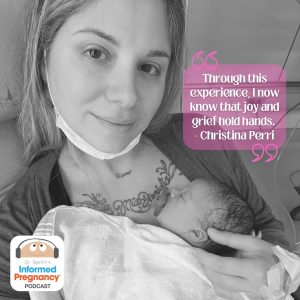
Christina: I found out, and I posted this the other day and so many people wrote to me just about this one phrase. Because I said that I learned that joy and grief hold hands. And I didn’t know that. I did not know that until I knew it. So, that has been this year, this whole year. This [unin 48:58] definitely the past five.
Elliot: Well, I mean this is going to be great for Paul. Because another similar thing is tragedy plus time equals comedy. So, it’s just a matter of how much time till his set gets really good.
Christina: Oh my God!
Elliot: Let’s take one more break. We’ll come back and wrap it up we’ll be right back.
[break]
Elliot: Welcome back to the Informed Pregnancy Podcast. So, now, we know the rest of the story. I mean, honestly, I think it’s a non-involved person. I can’t imagine anybody would make different choices than you made.
Christina: Thank you.
Elliot: And they’re so freaking hard to make. And it just shows so much strength you have to have been able to do it. And it’s human to go back in question and to think, “What if I had done this and not that?” And, you know, there’s even movies about that. What if I just took that door, not that door, you know? All of life would have been different. I’m grateful that you’re home with your family, with your husband, and your two girls. And that your neck is above water. Your head is above water, not underneath it. And I’m so grateful that you came to share while you’re still going through it. And it’s so, so hard but, you know, life is not Instagram. And if we don’t share and talk open and honestly about the struggles that we haven’t pretend like we’re doing great.
I think I put on my Facebook maybe two years ago, around this time of year is my New Year’s resolution, is to look like my Facebook profile. That guy is amazing. He’s first of all is 20 pounds lighter than I am, He is in the best relationship ever with his wife and family. I want to be like my Facebook guy. I guess now, he’s an Instagram guy. My Meta dude. Anyway, so you know, this is life. This is real life. And I can only pray and hope that you get the pendulum swinging even further the other way, not just being just above the surface, you know, with a living baby but having all the joys and peace that you deserve. So, here we are, how old is Pixie now?
Christina: She is two months old. Nine weeks.
Elliot: Okay. Nine weeks. And it sounds like you’re just getting a little breathing space.
Christina: Yes. I’m also just believing she’s here. I’ll tell you that much. I feel like I’ve been a bit in shock. I have been, you know, regular postpartum shock. Just remembering how crazy the fourth trimester is and feeling overwhelmed. And that causes a sense of survival mode, right? So, you’re in survival mode in the beginning. And I feel like that’s for everybody. But when you add in what I went through, and Paul, what Paul went through, we just kept waiting for her not to be okay. Especially because we came home from the NICU, and then because she had some health issues each week, I just kept waiting for someone to tell me she wasn’t okay and she was going to go away. And I had therapy for the first time this week. It was interesting. We talked about everything but the birth. Because that’s like we need our own session for that. But we talked about — we’re going backwards.
So, we started with where I am now and we’re going back. And that’s the first thing that my therapist said to me was like, “Can we just look at Pixie and believe that she is here. And she is so cute and she is obsessed with me.” Now, I remember Carmella. You know, loving me and bonding with me because we’re breastfeeding. And it’s just this beautiful thing but I don’t remember Carmella staring at me the way Pixie does. And when I hold Pixie, she also makes me hold her around her body, and then I also have to hold her finger, and she has to look up at me and make sure I’m there. So, we have this a little bit of extra bonding to do I think because of her experience, you know, going to the NICU first. And I wonder if other NICU moms have this experience where the bond might actually be a little deeper because we are doing extra to make up for it.
So, I also think, you know, it’s funny and it’s also exhausting that no one can soothe her as good as me. So, I get grandma trying, and Paul trying, and all the aunts trying, and all the friends trying. And then, the second she gets to me, she’s just quiet. She is just like my little buddy, and I am finally letting myself enjoy it. So, that sound, or I should say, because every week has been so different. So, the vibe of week nine really is this me, settling into believing that she is here and she is well, and in doing that, you know, I’m just madly in love with her and she is so in love with me. It’s insane! Everyone even says like, “I can’t get over how she looks at you.” She just is mommy’s girl. So, that is where we are at and she is healthy and safe.
Elliot: I love week nine.
Christina: Me, too. This is my favorite month.
Elliot: I mean, you know, it’s got to just get better and better and better. More of that less of what’s been happening up until now. And, you know, she’s probably going to get more sleep.
Christina: Yes. Yes, [unin 54:16] I’m reminding myself are temporary.
Elliot: And all the self-care, each piece will build you up know get to move around, and do some exercise. Try to find a decent chiropractor to visit, any of those things would be helpful for you.
So, I have a couple of questions. One is just recommendation-wise. If you’re my friend and you’re going through that, is there any right or wrong thing for you that would have felt right or wrong to say or to offer or to do? What did you need and want?
Christina: During which part?
Elliot: Like the post, the NICU, and then coming home. And even now, you said, mother-in-law’s coming back and forth because you need support. What kind of things could your friends do for you that would be helpful and supportive?
Christina: Great question. I feel like — so some things that people have done, my best friend came and just took Carmella out. So, it’s so interesting, I obviously care very much about the baby. But I care so much about Carmella’s emotions, and her transition, and not traumatizing her, or creating rifts in our relationship that we’re going to have to go back and work on. So, I’ve tried to make sure that Carmella is super loved and bonded, and having fun. I don’t want her to just be alone in her playroom. So, it meant so much to me to have people come over and play with Carmella, or swoop her up, put her in their car, and take her to Target or Starbucks, or any little adventure, meant the world to me, for my older baby. And then, for me. If anyone could just grab Pixie, so I could shower or eat or pee.
Elliot: You’re so demanding.
Christina: Yeah, I know. No, but this is what I remember of the fourth trimester with Carmella. It’s just the basic needs. I just want to do them first, and then, you know, I went and got a pedicure. Things like that will slowly trickle in now. And so, in the very beginning, what’s most helpful I think is food. People that cook for me, or brought food, or just fed me, and didn’t ask me what I wanted. That was a lot of Paul and his mom. And then, you know, I think a gentle congratulations. I love that language. So, many people said that to me when I got pregnant, even with Rosie because I had a miscarriage. And then, after we lost Rosie and then got pregnant with Pixie, a lot of people said a gentle congratulations to you and that means so much to me. Because it’s like I don’t want the big, crazy hoopla, you know. Especially because what we went through was hard in the NICU. It was very much about, “Hey, I love you. I see you. Are you okay? Do you need anything? What can I do?” And me going, “I’m okay. We’re okay. I need some more time,” a lot of that. Just a gentle check-in was the best thing.
Elliot: That’s really powerful. And something I think very tangible that is helpful for us, the people who could be there to support you, gentle congratulations. I think that should be a balloon. Yeah, a small one.
Christina: I need gentle congratulations, yes.
Elliot: I know you have to give back to your baby. And I just want to say again, how grateful I am, how inspired I am by you, how special you are, how lucky I am to have any kind of connection to have a relationship with you. And so is everybody around you. You’re just a super special person. I appreciate you.
Christina: I appreciate you, and thank you for this space. I feel like so much healing just happened in real-time in this conversation. Because it’s areas I haven’t yet kind of looked back on, and I will continue to do the work in therapy and trauma work to work through some of the stuff that might get stuck in my body. But honestly, the conversation we had right now definitely just worked out a lot of pain I think I’ve been holding on to and regret. So, I’m grateful to you.
Elliot: Yeah, me too. So, here’s what I have by way of follow-up. As I promised, I sought out a doctor who I respect a lot of. His name’s Dr. Nathan Fox and he’s an OB-GYN and a maternal-fetal medical specialist. And we have a very in-depth, but also broken down and easy-to-understand conversation about clotting disorders. What they are, the different types, how they kind of affect you, how they can be tested for, what the results might mean or not mean once you are diagnosed, and how treatment works.
And, for just as you saw the kind of clotting disorder that you have is treated extremely effectively with the protocol that you used very successfully. So, that’s Dr. Nate Fox on clotting disorders will come after our series of episodes here.
Then, I just interviewed a mom who is also super inspirational. She’s also a NICU mom. And she was in fashion and clothing, and she became a doula so that you know she could be there to help other people transition when it goes well, and also when it’s more complicated. And I think if you listen to that, you’re going to hear a lot of resonation for things that you went through that probably a lot of NICU parents go through. And then, I don’t know. So, six months down the road, we’ll check back in with you, perhaps together with my wife who’s a real therapist. And just kind of see how you healed and the not messy you. That the other, “Oh, not just the Paul #2. Christina #2!”
Christina: There you go!
Elliot: Instagram Christina, but it’s real.
Christina: The integrated Christina, that’s what it is.
Elliot: Integrated Cristina. I’m ready for that. Alright. And I can only assume, like I said, Paul’s comedy will get better, and he’ll have material, and your music will continue to be powerful and inspiring and moving. Just for my sake, tell me where we can find you online.
Christina: Sure. You can find me anywhere on Spotify, on Instagram @christinaperri. And I will say, I’ve already plugged my upcoming lullaby will be songs for Pixie. My third installment of my Lullaby series, and I’m working right now on the track list, which is adorable, and I’m going to make a Lullaby record just for her.
Elliot: Oh, I cannot wait. I cannot wait to hear that. I wonder if your other music will show up randomly on our Pandora for business several times a week. I get to have a little —
Christina: I love that. I tell people that’s me saying hi.
Elliot: I love it. Alright. I appreciate you. I’m going to go visit you online.
And for us, we have this whole new platform called Informed Pregnancy Plus. And anybody who wants to check it out, it’s @informedpregnancy.tv.
by Informed Pregnancy and Parenting Project | Feb 14, 2023 | Mental Health, Podcast Transcripts, Pregnancy
Elliot: Welcome to the Informed Pregnancy and Parenting Podcast. I’m your host, Dr. Elliot Berlin.
You have tuned into Part 2 of a two-part pre-birth episode. My guest today is Christina Perri, and we’re going to jump right in from New Year of 2020 when Christina had a beautiful husband, child, and was nine weeks pregnant at Disneyland and took an incredible picture of what was supposed to be amazing New Year. For none of us did it turn out like that and especially for you, what happens next?
Christina: Okay. So, I really enjoyed our trip, I have to say. We were there for a whole week. We were in Florida and 2020 came. And, as you know, the whole world thought it was going to be the best year ever. Everyone had really interesting, beautiful dreams about it. And I was pregnant, so I just thought this was going to be amazing. And we flew back to New Jersey. I want to say it was January 5th, and I went in for what would have been my 10-week checkup. But I went in at week 11. So, I must have been a smidge late for the appointment and there was no heartbeat.
So, I experienced my very first miscarriage. And the truth is this, there was a heartbeat at our 8-week checkout. So, I’m not sure at this point in time in my life what has happened. It was also so fast how I went from the doctor’s office where they told us that the baby had no heartbeat. They sent us right to the hospital for a DNC. That happened really fast. The OB said, “Do you want to do a testing on the embryo? I think it had stopped at 10 weeks.” So, they considered the little life an embryo, and they asked if I wanted to testing. And I was frazzled. And I remember being in shock and just saying, “No!”
Because here’s the thing, there’s something really beautiful about the advancement of how we talk about miscarriage now in 2022. But I’ve read so much about it now. The information is there now. The support groups are there now. But what I also know is that it’s one in four, and it’s so common. This is, you know, voices echoing in my head, “You’re not alone. You’re not alone. This is really common. This is really common. It’s not your fault. It’s not your fault. It’s not your fault.” So, I didn’t even think twice to do any testing. So, I said no.
And I don’t know if I regret that or not. I just wanted to point that out that it was offered to me and I said, “No, it’s fine.” Because I just thought this was just random. Like the randomness of it was the thing that carried me through. I’m not religious anymore. I don’t practice a certain faith. I have more of sort of a universal love kind of faith and a higher power in my sobriety. So, I didn’t lean on any faith to think it happens for a reason or not. That actually didn’t make me feel better. So, I just kind of went with, genetic abnormality. Completely random. Happens to one in four women. We’re going to move forward.” I was very sort of medical and scientific about it, if I’m being honest. That was the only thing that made me feel better.
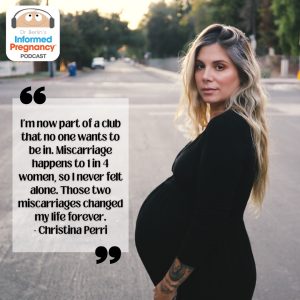
People made me necklaces with a Capricorn color because this was January 10th of 2020. That would have been their zodiac sign. I kind of rejected all of that and was just, “No, it’s random. It wasn’t my fault. It happens.” I’m now part of the club, right? It’s a humongous club. No one wants to be part of it, right? But I did not feel alone.
And I will say this is where the social media meets my story in the most beautiful way. So, social media is weird. The internet is weird. People, strangers knowing everything about your life is totally weird. And then, when you go through something like what I went through, I just want to note that I decided to share about it right away. We had a picture with Mickey Mouse holding a little onesie that said “baby,” and Carmella being like this, and Mickey Mouse being like this. And we have an announcement photo that I was six days away from posting. And so, I said that in my post. I said, “I lost the baby at 11 weeks and we were a week away from sharing it with the world.” And I thought I absolutely should share this, right? This was my first time not sharing about something vulnerable because I’ve been doing that my whole career. But this was my first thing to really qualify me into this world of infertility. This was the first thing. Because before that, everything had been just normal with Carmella.
So, now, all of a sudden, I posted this and I’ve never received more comments, love, direct messages, people reached out. It was bigger than my career. I’m not even going to lie. I didn’t know that this community was bigger than the community of people that listen to my music. Or maybe they’re the same thing. Maybe we’re all just growing up together, you know what I mean? Like, the women and the people who like my music, truthfully, might be in their 30s, all making babies. I don’t know. There was something that felt so authentic, you know? It didn’t feel like people out of the woodwork. It felt like my family reaching out. People that had been, you know, following my story or whatever. So, anyway, that happens. We go home, and Carmella is about to turn two. She truthfully did not understand the concept that there was a baby in my belly. Even though Carmella is pretty brilliant. We cried and held her in our little foyer.
I remember it happening. Our nanny, Meredith was there, who’s a huge part of the story. And our parents came. My mom and dad, Paul’s mom and dad, my brother and my sister-in-law. Everyone came to just cook and hang out with us. Because I was recovering now from whatever the DNC was. You know, they knock you out. I literally knew nothing what just happened to my body. I was flushed, had a fever for three days, but we were loved and supported through the whole thing. Like, the most warm love and messages, and flowers. We had a zillion flowers in the house, and it was really intense. It was like for how common it is, it really did feel like a loss. You know, I’m not going to lie. This was my first one. And sure, I had no idea what was coming later in my life, but I allowed it to be incredibly painful. I went to therapy. And three weeks later, everyone said, “Go back to work.” So, I had a trip to Nashville planned, and everyone said, “Go!” Because writing is so healing anyway. And that’s all I do is, you know, tell the truth and whatever. And so, I figured I would write a song about it and get a tattoo, which I did.
So, what’s interesting is this tattoo is a rose. I knew that we wanted to name that baby Rosie. So, I got this rose tattoo and I wrote a song called “Roses in the Rain,” which is maybe my favorite song I’ve ever written. And it’s on my Lullaby album and it’s on my new album. So, there’s two versions of it, one where Chris Martin of a small band called “Coldplay” is singing with me on my Lullaby record, and that’s a whole other story for another day. And then, one where Carmella is singing in a bridge and the trumpet, it’s very pretty in the album version. So, there are two versions of that song that I’m really proud of. The truth is, because everyone thinks I wrote that for Rosie, who then later comes into the story at the end of 2020. But this song was actually written about my experience with miscarriage and the little baby that we lost in January of 2020, who we didn’t get to know.
The day everybody went back to work, I remember it was a Monday. And I thought, “Wow! This is so strange.” Like, I just have to move on with my life, and I felt blown open. And so, I remember sitting with these two brilliant songwriters in Nashville named Ian Fetchick and Daniel Toshin. That was the last day because I was like, I told him on the first day, I wanted to write about it but I wasn’t ready. And then, on the last day of our week trip, we wrote this song. And I think it says it all, about grief and loss, without saying it too on the nose. You know, it’s more poetic.
Elliot: Yeah. You know what? We’ve been through miscarriage ourself several times. And also, I’ve been on that journey with so many people. And it just especially when you were ready to have the baby, you were excited for the pregnancy, even though it’s common, even though it was in the first trimester when it’s common, was towards the end of the first trimester, which I think is even harder. But it’s always hard. It’s always a loss, and I’m just glad you got a chance to process that with a kind of a wall of warmth and love around you, and that you made a song once again that will help other people. So, let’s go into break with a little bit of that and we’ll be right back.
[“Roses in the Rain” playing]
“Maybe in a little while,
I’ll put some coffee on.
Can’t stop wondering where the spirits go
when they are gone.
Maybe it was tomorrow,
but it felt like today.
You and I were walking.
You and I walking.
You and I were walking
through the roses in the rain.
Elliot: Welcome back to the Informed Pregnancy Podcast. We’re talking to Christina Perri. I feel like I’ve been talking to you for like 1,000 years.
Christina: I was waiting.
Elliot: I had to. I had to. And now, that’s going to be in my head for like 1,000 years.
Christina: They’re going to know maybe that’s how long we’ve actually been friends. We don’t even know.
Elliot: It could be. It feels like it.
Christina: I know.
Elliot: I will tell you that much, it feels like it. January 2020 started badly for you with a very tough experience. And then, probably a couple months after that, I was in the ICU trying to stay alive. And then, I recovered, thankfully. And then, you, you continue.
Christina: Yeah. After Nashville, I come home. We immediately go into the pandemic. I think it was late, at the end of February. But I want to say that while I was in Nashville, this is now a month after the miscarriage, I grew a very large cyst on my ovary. I was in excruciating pain in Nashville. Actually, flew home early because they weren’t sure if they needed to operate because it was 6 centimeters. And, apparently, it was the cyst that grows when you get pregnant. I forget the name of it, has a Latin name. And it grows with every pregnancy. But when you lose the pregnancy, it’s supposed to then shrink, and mine didn’t. It did the opposite and it grew very big and it hurt. I flew home and I had to get monitored for this.
Now, I’m only bringing this up because this was one of the, I don’t know, I think red flags that I really missed. But here I am now in 2020 and it starts out with a miscarriage, thyroid medication, a cyst on my ovary. They put me on birth control just to get it down. So, I didn’t need surgery. It went down. I went off the birth control and I immediately get pregnant.
I think it’s important to note that sort of chain of events. And then, May this is now the lockdown. I mean, a lot of people got pregnant in the lockdown. And I thought to myself, truthfully, getting pregnant is so actually difficult. As you get older, you realize that. That if I’m pregnant, I must be okay. Like, if my body got pregnant, I must be okay. The miscarriage must have been a random thing. The cyst is resolved itself. The thyroid thing freaked me out, and I had then put on about 10 pounds with the pregnancy that would not come off.
Now, it doesn’t sound like a lot, but for me, I just like have always been a similar weight. And if I wanted to lose weight very quickly, for a photo shoot or video shoot or whatever, I could just do a juice cleanse. And I get that might have been in my 20s, and now, I’m in my 30s. People are telling me, “Oh, you’re older.” But I had a weird feeling about it. I just want to say there was something about the fact that I didn’t lose an ounce. I mean, literally, the 10 pounds I put on with that pregnancy, it didn’t move from not eating carbs and working out every day, nothing. Like, nothing moved it.
So, again, I just want to point out, I think red flags that I missed. But I get pregnant. So, I’m like, “Well, it doesn’t matter now. I’m going to gain its ton of weight. So, just keep it moving.” So, May, June, July. August, September, October, okay. Completely normal pregnancy. I’m not going to lie. Every appointment — now, it was the pandemic, and it was emotionally hard, and the world was going through a trauma, but I went to every doctor’s appointment. This is my same doctor, by the way, who delivered Carmella, who did the DNC, who now is walking me through this pregnancy. This is now my third pregnancy. And everything’s normal, completely normal. Every doctor’s appointment, my blood work. I’m taking the thyroid medication. So, that my thyroid is normal. Everything is just normal. And, so normal that I’m working. I flew in my producers. She came to stay in our house in Montclair. And I will say at this point, I have now not left the house in Montclair for 168 days.
Elliot: Oh, wow.
Christina: Because of the lockdown. But we turn our house into like a preschool with a slide, and a paint wall, and Carmella is thriving. I feel like any two — now, she was 2 years old. Any 2-year-old was thrilled that their parents were home. So, Paul and I are trying to make it through our marriage, you know, it’s a different story. We’re just a little bit together, too much. But we tried to make it fun, you know? And honestly, I feel very grateful. We were healthy. We didn’t get COVID at that time. So, I know that experience was so different from so many people who lost so many people they loved. But we stayed in our little bubble because I was pregnant. We didn’t go anywhere. And that was maybe a terrible idea.
I flew my producer to New Jersey. I flew my engineer. Paul’s sister came to stay with us. We made a whole album. It was phenomenal. We had the best time. This is October of 2020. We’re in a studio in Montclair, New Jersey. Four girls making an album. It ended up being exactly what my third album is, which I love very much. So, I don’t want to take away from the joy of that. But I have to say I was pregnant. I was seven months pregnant and I had Carmella there at the studio and all these incredible women. And it really was a lovely reprieve from a really hard year, right? We thought January of 2020 was the hardest thing we were going to go through that year. Then the pandemic happened. We thought that was the hardest thing we’d go through that year. And we looked at making this album as a beautiful experience. And I go to my doctor’s appointment for my 30-week checkup.
Now, at this point, I have a high-risk doctor and my OB-GYN, because I’m considered high-risk from having not just the miscarriage actually, but the thyroid medication. It qualified me for extra scans, which I thought, “Well, that’s cool. Who doesn’t love an extra peace of mind?” So, I would go to this special doctor once a month for fetal monitoring, the anatomy scan, all that stuff. But you just get a little bit extra is what happens when you’re, you know, older and whatever.
So, I go in for my normal scan. We just finished the album. This is now November 10th of 2020. And I’m 30 weeks pregnant, and they find that the baby has a Thrissur of the gut. There’s a blockage. And they send me immediately to the hospital. So, this is trauma number one in the course of this week because Carmella wasn’t alerted to why we didn’t come home. We were at the hospital for three days. She was so traumatized from that. I remember almost worse than what happens later because we are so communicative with her. And then, all of a sudden we just weren’t there.
Elliot: Disappear.
Christina: So, that was really jarring for her. But we were really shocked. We didn’t know what was happening. And they told me I might spend the next six weeks in the hospital waiting for baby or she might come, which might be safer, or I might go home. It was very unclear. And that’s so unhelpful, you know? But at the time, it was just no one knew what was going to happen next. So, I’m in the hospital. Now, I’m seen by the specialists, the head of Lenox Hill Hospital. I’m seen by two other fetal specialists. One of them from Westchester came down, a fetal MRI specialist. We meet with the NICU. We meet with a surgeon. She said, “I’ve done 1,000 of these surgeries. Your baby’s going to be fine.” We then researched everything you could possibly research about atresia. There are five types of atresia. I knew about all five, what the outcomes would be, what would happen if she had 1, 2, 3, 4 or 5, how long we’d be in the NICU, roughly. We had ideas. I shared about it online. Thousands of moms reached out to me. “My kid had this. My kid had this.”
We were shocked, but we were like, “Okay.” Just constantly being given hope. It was not doom and gloom. It was, “Hey, this is a complication. We’re going to get through it.” And in my mind, I was, “Okay, but why is there an extra hole in her heart? And why is there fluid under her scalp?” There were other things also. I remember very clearly. But everyone was like, “We’re just going to get through this, and we’re going to weigh the risk. And your kind of going to come for fetal monitoring every two days.” And this is November 10th. She lived for 14 more days. Well, she died on November 23rd at night in utero. I went for fetal monitoring that morning. We broke every rule they have, every protocol they have. Because, apparently, you’re supposed to be good for about 24 hours unless something happens for 36 hours. So, her fetal monitoring was absolutely fine on that Monday morning.
Elliot: Just to clarify that point. When you see that everything looks good on that non-stress test. You know, it’s supposed to be some sort of near guarantee that everything’s going to be okay. And then, you do it again a couple of days later to buy yourself two more days.
Christina: Yeah, exactly. And we were driving in from New Jersey to Manhattan every two days and doing this. And we weren’t told that her dying was an option. I’m not going to lie. We were told that we would take her out at any moment if there was a hiccup. We were told, “She looks great. You look great. Just hang tight. Everybody’s okay.” You know what I mean? We were really told some helpful things. And the medicine science was there. It was like her fluid was great, her heart rate was great, her movement was great. And we went home. This was now between week 33 and 34 for me. We went home, and this appointment was 11:00 a.m. And I noticed she had stopped moving around 11:00 p.m. So, I’m not sure at what point she passed away, but I knew it, and my OB knew it in my voice. I said, “Oh, you know, I’m worried.” And she’s not moving. I’ve tried apple juice and, you know, every, every single pregnant mother’s fear, every single one. We all have the same fear at that point, you know.
So, we get in the car. We drive to Lenox Hill. I didn’t expect to see my OB. So, that made me nervous because she just showed up. They put me on the machine and it was, just honestly — I’m really sorry, this is going to make me emotional. It was like a bad movie where I’m looking at the ceiling because I can’t look at the nurse. Like, I remember her face. She couldn’t look at me. My OB had left the room for a minute. Paul was parking the car, and it’s just me and the nurse, and she’s looking for a heartbeat and there just wasn’t one there.
I’ll never forget that. It was like a time-lapse video then. Where the OB comes in, Paul comes in, everyone’s crying and or upset, or I’m so shocked, they can’t believe it. I’m just staring at the ceiling like I just was disassociated, I think is the word. I just couldn’t handle that. And I kind of come back into my body as what I know you know in psychology because I just really left basically because it was so hard. I’d later dealt with that in MDR, by the way, that exact moment. I come back in my body and I just say, you know, “How is she going to come out?” And, I remember my OB looking at me like, not like it was an odd question in that moment. Nothing is odd, you know? But I was just like such a “What are we going to do about this now” is so…
Elliot: Practical.
Christina: Yeah, practical. And Paul’s crying. And Dr. Manos is crying because she’s been working with us now for four years. Like, there was no, “No one saw it coming, but we did. But we didn’t.” It was very sad, you know? And we’ll say the next three days at Lenox Hill were beautiful for how sad they were. The nurses, unbelievable there. The people are unbelievable there. I’ll never forget the care that we had.
I don’t think it’s because of who I am, I think that that’s wonderful for anybody who goes through, you know, they put a picture on your door so that everyone knows when they come in — sorry. And we got through it. There’s a million things I can say about that experience. I was very present for it, but at the same time, I’m a human. I mean, they gave me like Ativan, just because this was the only time we laughed for three days, I’ll tell you. You know, at this point, I’m sober nine years. And Paul and I are in the hospital, and this is the worst experience I’ve ever had in our whole lives. And they give me an Ativan, they give me an epidural, they give me all these drugs because they don’t want me to feel anything.
And, apparently, I turned to Paul, just was like, “This narcotic or whatever they gave me was so good. Do you want one?” He just starts laughing. All the nurses start laughing, the doctors laughing. Like it was one of those moments — Paul’s like, “No, Christina. This is not a nightclub.” Like, you know, “I don’t think I can have one,” you know? And everyone was just laughing and I remember that so vividly because it was so sad. It was just the saddest thing of all time.
We chose to meet her. I also want to say people have a choice in that scenario to just go under, to have a C-section. I mean, Dr. Manos said she’d do anything. And I wanted so badly to not go through that, not give birth. And I’m so glad I did. I just want to say that because, obviously, I wish no one would ever have this experience ever. But if they do, I’m so glad I chose to give birth, hold her, meet her, and say goodbye. Because the other version of that would have been just to, you know. I don’t think now, I would have been glad about that choice because there’s something about meeting her, holding her, and having that, that was important, I think for us. And me and Paul are glad that we did that. And we have her little box.
They give you a box with the blanket that they put them in. And they have her little footprints. It’s a thing. And I’m proud of myself for getting through that with Paul. And we were there for two days. And I’m not going to lie, the one thing I thought about constantly was what we were going to tell Carmella. Because this is just so hard to do pregnant. Normally, I’m telling this story and I’m very composed, but I’m so pregnant. I just like, anyway. It’s just real. Telling Carmella was — oh, we thought about. Because we had the nursery, at this point, she’s almost 3. But she’s like 3 going on 10. She very much was aware at this point. And we’re in the hospital and I promised her the next time we’d go to the hospital and not come home, we would bring home the baby because we had had that experience 10 days before that. And she was scared to let us go to the doctor because she’s like, “Are you coming home this time?” Like, she had a little trauma.
Anyways, I’ll tell you this. I reached out to that community like never before. I follow six toddler specialists. Dr. Becky Kennedy, who’s the biggest rock star of all toddlers. “Big Little Feelings” is another one. They’re very popular and two beautiful women run that and carried us through that. And also Janet Lansbury, who wrote “No Bad Kids,” who’s like, literally, the rock star of just parenting in general, in my opinion. And I reached out to her because she kind of said, “If you ever need anything…” And this was like THE time to, you know, reach out to her. And Paul and I asked for a script. We were like, “What do we do? What do we say? This child, Carmella’s so smart. How do we do this?” And we practiced for a whole day what we would say, how we would say it. And we had, at this point, our families had shown up in our house. My mom says that her and Paul’s mom were too devastated to get Carmella from her nap. So, the reason why I love Meredith so much is because she was so tough and strong for all of us. She was amazing. And so, she was really helpful with being — She said she would go home from work each night and just sob in her mom’s arms. But she was so strong for us. And so, we told Meredith, you know, “We’re coming home.”
Meredith put her in her room, and our parents just waited downstairs. And so, I said, “We need to go straight to Carmella’s room. We need to get this over with. And then, we’ll see you. Because if we see you, we’re going to just lose it,” you know? So, we had this whole plan. It was so orchestrated. And I cared so, so much about Carmella. And we walk in, Carmella’s in her room. She’s playing and it’s joyful. She’s happy to see us. We’re hugging, you know, whatever. I don’t know how Paul and I kept it together, but we did and we said, “Carmella, we have to tell you something.” She’s only 2 and 3/4. And so, she’s playing like, “Okay, what is it?” And we said exactly what the doctor said, and the toddler specialist, and the social workers, and everyone we asked said, “Tell the truth.” And we were like, “Oh my God! How do you tell the truth to a 2-year-old?”
So, we said exactly what they told us to say, which was, “Carmella, you are healthy and your body works and you’re safe. Mommy and Daddy, our bodies work, we’re healthy and we are safe. And your baby sister was born and her body didn’t work and she died.” And that’s all we said. And I remember I said it’s so calm and so collected and not unemotional, but just really, really soft and gentle and not crying. She looks up and she processes it for a second. And we’re not breathing at this point, you know? I mean, literally, this is what she said. Her little brain just goes, “Don’t worry, mom and dad. You guys will have another baby, and their body will work.” And we just lost it. I’m not going to lie. We just held her and we cried, and she cried. We said, “Thank you.”
Here we are, thanking our child who comforted us. I said, “And Carmella, you’re going to see us all cry this week. We’re all going to cry. Mommy’s going to cry. Daddy’s going to cry. Momma’s going to cry and Popop. Grandma. Grandpa. We’re all very sad and we’re just going to get through together.” And she said, “Okay.” And she just help us, and I still — especially because I’m pregnant right now. Oh, my God, it’s crazy and just want a full circle, but that is what happened.
That is the story of November 24th, 2020. So, we named her Rosie, by the way. She was a girl. We walked through that, hand in hand. Together with me and Paul, and Carmella, and our families, and the whole world. I don’t think I’ve ever seen anyone more sad for us. Literally, I have very vivid memory because after we got back from the hospital, I didn’t take any medication. I was fully sober. I read all the messages and we had a florist. Our house was just — at one point, I put all the flowers in one room because I just was like, “This is just too much.” Like, I can’t handle the smell and the whole experience was, it was just surreal. I was pregnant for eight months, and then I just wasn’t. I just wasn’t pregnant. I just come home. And then, I go into the fourth trimester. My milk comes in. We have this beautiful soul that we’re taking care of. And so, she carried us through. I’m not going to lie. Those next months are weeks before we ended up moving to LA on January 1st.
So, from November 24th, we got through Christmas somehow. I don’t even remember, but everyone we’ve ever known. I mean, I’m talking to my kindergarten teacher, like literally, everyone I’ve ever known in my whole entire life reached out to us, sent us food, sent us flowers. It’s so touching. I’m crying because I’m so emotional, so intense to talk about, but I’m also so filled with gratitude. Now, here I am, almost two years out of it, that was an incredibly loving time in our life. As odd as that sounds, we were heartbroken, but we were carried through the whole thing by everyone. Not just our family, our town, our community, strangers we don’t even know. People were praying for us. People are still praying for us. Like, my mom, she’s a hairdresser. She cuts nun’s hairs. I think every nun in America was, you know, still have us on their prayer list. And it really was such an incredible healing after that experience because we allowed ourselves to be loved, supported, and taken care of.
And Carmella was the star of our lives at that point. Like our little north star that kept us together, you know. I just can’t imagine — I ache so deeply for families that go through that without having a little Carmella, do you know what I mean? Because I think we would have fallen apart, you know. Obviously, because we’re human and I can’t believe I didn’t get loathed. I’m not going to lie, you know. So, many people thought I would lose my sobriety. And also, I don’t think one person would have judged me if I decided to kind of shut it off, you know, or check out. Again, I think this really has to do with so much of my work. All of a sudden, I had so many tools, you know. That I was like, “Oh, wow! The deeper I feel this, the quicker it’ll pass.” I can’t escape this feeling or this experience. I can’t delete it. I have to feel it. I have to go through it. And then, I started to understand grief in a new way.
And then, I was like, “Oh my gosh! Grief is like a house.” It’s not an experience. It doesn’t come and go. You just go from different rooms. There’s the two weeks after Rosie died, we were in a room. And then, I kind of woke up and felt different and I was in a new room. I was like, “Hey, let’s go to Rockefeller and see the Christmas tree.” And that was a new room at the grief house. This is how I described it to people. Like, I felt like it was so wild how it blew me over. And how, truthfully, I’ll never be the same. Like, I will never be the same person. Paul will never be the same person. Even Carmella, who now is 4 1/2. She talks about death beautifully. And again, I don’t wish this experience on literally anyone, but we just felt it so deeply that we leaned into it so deeply that we learned from it. If that makes sense. Like so many people are were just taught to be so afraid of death and we have such weird language around it. And everyone looked at me like I was the Grim Reaper. I’m not even going to lie. I’d walk in the room and people would just didn’t know what, people would freeze because you have people who die. Like your parents or some tragic accident. But babies are just — the worst version. And some people can’t even look you in the eye.
Elliot: I can. And you know, there’s nothing to say.
Christina: Right? But that’s okay. I think nothing to say is better than sometimes saying other things. I’m not going to lie. Like the people that said, “I don’t know what to say,” and “I love you,” and “That’s the worst thing I ever heard of,” or whatever, “What can I do?” I learned so much. I feel like I could write a whole book about grief and what to say and what not to say. All of a sudden, I was like trying to comfort everyone else because everyone was looking at me. Again, like the Grim Reaper. Was the odd couple months where I just sort of laid low, because I was like, here I am, I’m walking in the room and I am bringing the worst, I don’t want to say vibe. But the grief just goes with you. So, I was the grief house, right? To walk in the room and I would just try to kind of level the feelings. It would just be so intense. So, we really just were forced to bond and stay home.
And again, it was a pandemic, and I don’t even know what happened. I know so many people will have terrible experiences in 2020. But my life was so blown open, and so crushed, and so fragmented, and so broken. And then, we moved to LA. And I honestly almost want to say, this is another episode of your show because the healing from this is its own amazing and fascinating I think experience. Because the day we landed in LA, January 1st of 2021, we moved to seek refuge from the pain, from the winter. I mean, if you imagine just like this little cocoon of ours in New Jersey, in this house with our families. And we love our families. We love being near them. But we just need the sunshine. I need the best holistic doctors there are. I needed my OB-GYN, Dr. Mary Kerr, who was a brilliant human I knew would help me get to the bottom of it.
I woke up in a brand new room in the grief house at the end of December and said, “I’m going to get to the bottom of this.” Everyone said that nothing was abnormal. We tested Rosie, her autopsy, my blood work, Paul’s blood work, my placenta. Everything came back normal. And I said, “I don’t believe any of this.” And I’m going to start an investigation and it’s going to help me heal. So, we moved to LA and I begin my own very secret, little —
Elliot: Investigation.
Christina: Investigation, yes, onto what happened.
Elliot: Okay. Again, just how powerful and courageous you are for having shared that. And I’m so sorry that you, and Paul, and Carmella experienced that and there aren’t words to say. But I do have this idea which is that after you have this baby. Maybe we’ll come back and do another double episode and have a longer chat about grief and healing from it at that time. Let’s take a break and find out what Erin Brockovich came up with when we come back.
[break]
Elliot: Welcome back. We are talking to Christina Perri. Okay, so Erin Brockovich. Your kind of had signs that something was up already. I don’t know, you sound hard on yourself about that. Because I think, I don’t know, how many people do you know maybe they don’t tell you that who have a thyroid that’s a little hyper or a little hypo, and don’t really give it too much thought, you know? Other than maybe I need to get more sunlight, more vitamin D, who knows. And a miscarriage in the first trimester, awful to go through. But, again, your part of a very large group of people who have that. I was a medic in New York City for a while. I’ve been working in healthcare for a long time. I don’t know that I’d put those together you know in [unin 02:54]. In retrospect, it’s a lot easier to see.
Christina: Yes. Well, I appreciate you saying that. Honestly, I am hard on myself. Because I wish more than anything I caught maybe a more obvious clue. So, I guess I’m saying health issues started to occur that I didn’t have before. And yes, honestly, they’re all pretty impossible to put together and solve until we solved it and I went, “Oh gosh! You know, they were there.” So, I do want to say you’re right, I am being hard on myself. I don’t think it was possible in the time and space that I was in to have noticed these things. And I truly, really only see most of them now in hindsight. So, I just being a perfectionist, and like someone who somewhat prides myself on health and being in the know of things, I just kind of wish I noticed things just selfishly because of what we went through. I wish I could have like, you know. I feel like, any mom would think this, I wish I could have saved my family from going through what we went through by noticing something. But really, truthfully, you are correct I don’t think that they all line up together and make sense until you start dissecting things and doing all the testing that I then started to do.
So, I’ll go into what happened. So, we moved back to LA on January 1st, 2021, and I truly was in a place where I was like, “Okay. Now, I’m ready to heal.” And I will say I have to credit my sobriety in the sense that I’ve always sort of been into the solution. I’ve learned that early on in AA that like you just have to go into the fire, into the flame, and ask the questions, be your own advocate. All those things were kind of instilled in me as an Italian girl from Philly, you know. I’m also very tough and I don’t take no for an answer, and it’s almost every quality. I’m a Leo. Every quality I ever had in my personality and in my spirit came together to help me get through this. And, truthfully, I also asked an enormous amount of help. So, I think that’s a big theme here, is that I constantly asked questions and asked for help. And I really put together a team of people, mostly women, around me to help me figure it out, but also get through it. So, in so many ways, and I’m sure you know with a wife who is a therapist, there were so many layers to this where I couldn’t necessarily skip over anything. So, if I was going to investigate medically what was going on with me, I definitely needed to do the emotional work too. Because all of it felt quite heavy.
And when I got to LA, I immediately felt, truthfully, the sunshine helped. Like, I just felt better. I was breathing easier. Physically, I mean. Whether I knew it or not, literally, I was breathing easier. It was just like a new chapter and I was like, “Okay. Obviously, I can’t delete what just happened. I’m going to move it forward. It’s been eight weeks since it happened, but I’m going to sit outside in the sun with Carmella, with Paul.” We have a pool here. We bought a house in the middle of the pandemic without knowing at all that it would be our house that we would move to. And we furnished it thinking we would put it up for Airbnb, and like how magical that this became like our refuge. It was just like a furnished house waiting for us. It felt very meant to be. So, we came here. We brought Meredith, our Nanny, our super nanny, my Mary Poppins. We bring her, and the very first thing I did was EMDR. Because I thought to myself — well, first of all, I almost got tricked into it.
My therapist came over her name is Bernie and she’s been my therapist at this point for about 10 years. Very sweet, very warm, very connected, amazing human being, knows me and my core. She comes over and she says, “Why doesn’t Meredith take Carmella for a walk so we have the house to ourselves.” And this is still a huge COVID spike in L.A. If you remember, January 2021. We actually never even went in the airport. We had a car pick us up at the plane because we traveled in the middle of a massive spike. So, we weren’t seeing people when we got here. So, Bernie came over. I think she had either just had COVID or maybe just been vaccinated. I think the vaccination had just come out or something. Anywho, she comes over and she sits on my floor in my bedroom. She tricked me in the sense that I was not ready to do EMDR. It had only been eight weeks since this had happened, and I thought we were just going to hold each other. I could cry, and it would just be a normal therapy session.
And what happened, I really just want to point out I think really helped me with the next six to nine months of my life, which was I went straight into what happened. I remember very vividly. What I love about EMDR is how visceral, I could feel the fabric, I could smell the hospital room. I was sitting outside the door. And interestingly enough, my therapist, Bernie, was in my sort of memory. And I was like, “I need you to help me go in the room. I couldn’t go in the room.” I was outside of a door. I thought this was profound. And she was there. I was even shocked when I saw her in my own, with my eyes closed. I’m like, “You’re here.” I’m like, “This is crazy!” She’d never been in any of my other flashbacks or I don’t know what you actually call those. But I said, “I think I need your help to open the door.” I think I need, I’m shocked. Because this is what she kept saying to me, “You’re shocked.” I’m like, “I’m not shocked. I remember every moment.” She’s like, “No, you’re in shock.”
And so, we went in to the room. It was me, it was Paul, it was Rosie, I was holding her. I mean, I walked through the whole thing with the vibrating things in my hands, and I cried and I screamed. I mean, literally, I’ve never done that in my life. She just said, “Scream. Just scream.” Because I was like, “So, I guess I was holding it all together,” you know. And I’m so glad Carmella went on a walk because I’m sure I would terrify to her from the bedroom screaming. But, again, I think it’s a really important work. I think that was the beginning of me being okay and moved that out of the way to get to the solution. So, I was really, really felt the pain; really let myself remember; really let myself go back to that moment I said I absolutely hated when I’m staring at the ceiling and she’s looking for the heartbeat. Walked through all that all over again with the support of my therapist and doing all the things she said. And I truly felt a healing occur. And then, from the EMDR and the therapy, I added in work with the doula. I had a postpartum doula who has recommended she was going to help me with my postpartum, with my pelvic floor, with my yoga. Like things to actually get my body better.
So, now, I’m working on the physical, right? The emotional, mental, the physical. I’m starting to align this, like I said, web of really, really gentle wonderful women. But the big one for me was going to see my OB-GYN, Dr. Mary Kerr, who was my OB for 10 years in LA when I was living here. I knew how brilliant she was, but she’s also very sweet and gentle with me. I knew she would take the time. Because this is also, I want to say really important to advocate for yourself in the medical world.
A lot of times, people don’t sit there and go through line by line with you, unless you ask. I was just really, at this point, I had nothing left to lose. I was in such a state of, you know, I’m just going to ask all the questions. I just want to know all the answers and I’m not afraid because I’ve already been heartbroken more than any human in my mind could be heartbroken. Do you know what I mean? So, it’s like, I just want to now understand. So, what’s crazy is I thought I would get some answers and I thought I would maybe find comfort in some of those answers I knew it would never change the past. But what I ultimately did find was a huge life-changing moment for me in three different parts.
One is right before we moved to LA, my best friend came over to our house in New Jersey and said, “I think you should test your house for mold.” I was like, “What?” She had just discovered she had mold poisoning. It was super random. And she was like, “Just rule it out. Just do the test. Like on your vents, do the blood test that goes with it. And then, you can at least know it’s not that.” And I was like, “Okay, sure. Fine.” That was the last thing I thought that would be a thing. But I did it because she’s my friend. So, this is where all this intervention started to happen where I was just sort of listening to everyone and saying, “Okay.” I was in such a surrendered place, so I’d test the house for mold. I test my blood for mold. We moved to LA. I do all these things. I’m meeting with these people. I meet with Dr. Mary Kerr, and I bring her a stack of paper with all of my history for the past two years. I had Carmella in New York. So, I had all Carmella’s stuff, my pregnancy with Carmella. Then the miscarriage, then the cyst on my ovary, then the whole pregnancy with Rosie, and then the death and the autopsy, and everything.
And Dr. Mary Kerr, being the angel that she is, cleared her whole day, I think. She’s out with me for two hours. We sat in her office. We cried together. I mean, her and I go way back. Also, I know her husband well. And so, it really was like a beautiful sort of healing. I just kept trying to put the pieces together by doing all the healing things, and this I knew was going to be a healing piece for me because she sees me, she hears me, and she’d explain it to me, and she’s brilliant. So, sat with her, we go through everything. And she says something that I’ll never forget. It was like a scene of a movie where everything goes quiet, and you just kind of hear a train coming or something. And I kept echoing over and over and over in my head what she just said, “You know, Christina. I have a hunch and they get mad at me when I do this…” And I’ll go back and dissect this with you. But she says, “They get mad at me when I do this, but I’m going to test you for a blood clot.” And I was like, “Okay.” And then, in my mind, I’m going, “Wait. Who’s ‘they’? What is this hunch?” And then, I’m thinking, “Well, surely it can’t be this.” I’m sure it’s really rare.” Also, I didn’t have any signs of a blood clot. I figured when you have a blood clot, your leg swells up, your arm swells up. These are things I understand of blood clots. And also, there was no blood clot in my placenta, which I seem to remember my OB checking.
So, I’m just like, “Okay.” We move on. I go home. I want to say a week later, I get two calls that changed my life forever. One is I get a call from the mold company that says that there is 37 types of bacteria mycotoxins and endotoxins that are created by molds. Black mold, specifically. But also, about 11 other types of mold. Because, apparently, there are endless types. All of it is in a chart and explained and emailed to me. I’m looking at all these sort of lines that you can either be yellow, orange, or red, right? Where this is my blood. They tested the house and the blood. And they both line up together that my house is filled with mold, but my blood is filled with mold. And it’s in the red on almost every single line.
Elliot: All the same strains?
Christina: Yes. The mycotoxins, specifically. And the black mold, and aspergillus penicillin, they’re all labeled. There’s so many different types, and my blood is off the charts. So, in that moment, I then realized that this is a massive piece of the puzzle, but I’m also blindsided. Like, I don’t even know what this means. I’ve never heard of this my whole life. The house was tested for mold before we bought it. This is a common thing I didn’t think could ever get sort of overlooked or whatever. So, this is the beginning of a journey, mold-related, I’ll leave that there. And then, I literally get a call from Dr. Mary Kerr the same week that says, I tested positive for anti-phospholipid syndrome, which is the blood clotting disease. One of seven that she believes was the cause of death for Rosie and the baby at 11 weeks. Because she said to me, after there’s a heartbeat, there’s a reason. She said it fits before — I’m referring to the miscarriage. If you have miscarried before you hear a heartbeat or see a heartbeat, a lot of times, it can be completely random abnormality. Just didn’t become viable, didn’t correctly develop, whatever.
After you hear a heartbeat or see a heartbeat, they’re really most of the time is something you can discover. Like a reason. So, I didn’t know that. And she’s then telling me on the phone that it’s because I had a blood clot. And then, I say, “Well, what does that mean?” And she says, “Oh, don’t worry, my darling. That means if you were pregnant again, we would put you on blood thinner and that you would be fine and your baby could be fine.” And so, I hang up with her and completely break down. I remember, at the realization of a couple things, one, “Oh, my gosh! I found it!” What relief!” Like, what relief. I found the reason why Rosie died, the baby died — I trust Dr. Mary Kerr, you know. It was an assumption for her because, obviously, we can’t go back in time and tell but she said I have the antibodies. That means I had a blood clot that’s most likely the reason. And I have this information that I had been searching for and hoping for. And then, at the same exact time, in the same breath, I am livid that it was avoidable. In the sense of “How did we not catch that?”
Like, all of a sudden, a million questions are running through my head, right? How did we not catch that? How many women have this? It must be rare. The only thing I could wrap my head around was this must be so rare, and I must be just incredibly unlucky or just this random occurrence, but I don’t think I am. I had a gut feeling that this was bigger than I could possibly understand, and that I should probably stop there and just be glad I figured it out. But I’m too me to do that. I am too much of a question-asker, a chase-the-truth, bold brave outspoken person, that all of a sudden I felt like Erin Brockovich. And I went, “Wait a second. Who were the ‘they’?” Oh, you know what I mean now? I feel like I’m in a mystery movie. And now, I have to solve how did this go overlooked without also going backwards and blaming anyone. Because I want to be really clear that everyone was following protocol. So, I also didn’t feel malpractice, I just want to say.
I think people get really nervous when people start investigating things or ruffling you know up the past. And I want to say when we had the five best doctors in New York City like in my hospital room, all confirming the same thing over and over again that I was okay, and that they would do this, and then I was listening to them. They were all consulting with each other. They all were asking me, and I was choosing the same thing. Like, nothing feels it was wrong. And I almost feel like we’d all make the same decisions again based on the information we had at the time. I just wanted to know what this all really meant and what I could do about it, and if there was anything to do for other women. Like, I had that intuition.
So, I immediately started to now put another story together. I go, “Well, okay. What’s this mold piece?” So, I started doing research talking to a ton of mold specialists, reading a bunch of things on mold. I will just say this, the things that started to happen to me only happened to me after I moved into that house. I want to be very clear that apparently out of those seven blood clotting diseases or syndromes that you can have and develop, you can also be born with them, you know. You don’t have to get them because of something. You can just be born, genetically, with the disposition. It can run in your family. You can have blood clots, whatever. I just don’t think that’s my story, I think. Because Carmella was healthy, and I was living in LA, and then living in New York, and I didn’t have any of the other things going on. I believe I developed the blood clotting condition from the mold. Again, I’m not a doctor. This is just my theory, my intuition. Because I also then realized that I had Sjogren’s syndrome, which came up later. Six different types of viruses in my body that I was combating against, which means my toxic bucket seemed to have overflowed. I was pregnant two times in that house, which means my immune system was compromised. And I was unable to fight mold like normal people who are healthy actually make antibodies to fight against toxins. So, I can go into that for hours, I will not. I’ll just say that it was an important piece of the puzzle for me, personally, because I think it explains how I got here from being very healthy to not being healthy.
Then, this is still January of 2021. I, very quietly, hit up my entertainment lawyer who’s been my lawyer for 12 years, who is lovely and his wife is an activist, and you know. I know he’s an entertainment lawyer, but I figured he had medical people in his office. And I said, “Hey, you know, this is information I just got. Just between us, would you please do some research for me? Ask your healthcare lawyers in your firm if they can do some research for me. I just want to know how rare this blood clotting condition or blood clotting conditions, in general. How rare it is, how common and how much it’s detected in pregnancy, and whatever.” I just had a couple questions. And so, this is really where my Erin Brockovich kicks in, because he calls me about two weeks later, and he’s in tears. And he says — which again, I kind of felt intuitively. He said, “I don’t know how to tell you this. But just in New York state alone,” which is where he is. He said, “the research came back my team came back to me and discovered that 55% of multiple miscarriages are due to one of the seven blood clotting diseases.”
Honestly, I knew it in my gut, but I was pretty blown away. And also, I was angry and activated and grateful almost that this information came to me. Because in that moment, I realized that I was going to make a massive change. I would spend the rest of my life doing it no matter how long it takes in honor of Rosie. Because she only got to live 34 weeks. And someone said to me in my healing journey, “What if Rosie was only supposed to live 34 weeks?” Like, “What if that wasn’t a mistake in her destiny? What if she was supposed to live that long?” She was supposed to get you, Paul, and Carmella out of a house that was poisoning all three of you. So, she was supposed to teach you just something that’s being overlooked in women’s health, right? It’s not intentional. Nobody’s trying to miss this. I’ve done so much research now and talked to so many doctors and so many people. There’s not been one human being that’s like, “No, I don’t want to save babies.” Like everybody wants for this to not be overlooked anymore.
But I have to say, it’s a huge piece of my healing with Rosie because I just believe that this is what her little life can do. Like, sometimes, I don’t like that narrative and I just wish she was here. You know what I mean? I don’t want to say that I think it was meant to be that she’s not here. I just think that because of what happened, I almost feel like most women don’t get to then turn their biggest tragedy into something so healing, so important, and so life-changing for other families and other babies that I feel I’m responsible. Like, I can do it. I was walking on the treadmill, I’m not even kidding, and I was crying. I was also like, “I can do this.” Like, I’m strong enough to do this, to sit in a room and present it in front of the American College of Obstetricians and Gynecologists. Like, I wore a little power suit, you know, covered my tattoos, and I presented a massive presentation to them of a year worth of research.
I was like, “This is all. I’m a singer. I’m not a doctor. I’m not going to pretend to be a doctor.” I didn’t go on TV right away I spent an entire year working to prove my point in so many ways, medically, I mean. Emotionally, duh! I got that. I got the story. All I have to do is start singing and I can make anyone cry, you know. I have brought the emotional part. I met with the doctors to bring the medical part. I met with my lawyers to bring the financial part. I met with the women who used to work in hospitals who knew about the test. Because all of a sudden, I’m saying, “Well, why aren’t we tested for this?” Well, “What does the test require?” “Oh, 1 cc of blood.” Okay. And, “What does it test for?” “All of them in one.” So, it’s just one blood clotting test that someone needs to do. It’s $42 if you don’t have insurance. It’s free if you have insurance. If you do it in the first-trimester prenatal screening, it is one of 13 tests that already happened. It’s absolutely no extra effort even, you know, for anyone. And every door I looked behind — first of all, every single person I met said yes. It instantly became an ally, right? I didn’t have to convince anyone. It sounds almost ridiculous that this has been overlooked where a woman has blood clotting antibodies for whatever reason, right? Whether it’s their history, their health, their environment, their whatever it is. But they’re not tested.
And I forgot to mention, the only time they’re tested is after two or three losses, which is why I go back to what Dr. Mary Kerr said. And I’ll never forget when she said, “They’d get mad at me when I do this.” Because I only had two. But from listening to my very long episode with you, so you can see just those two miscarriages changed my life forever, right? So, the depth of how important it would be to be able to stop families from having to go through what I went through, what Carmella went through, what Paul went through, what our families went through, what my body went through, right? Like, it doesn’t make any sense to me. I’m not even trying to do something that seems luxurious or extra. It’s like, no, it feels pretty basic. Like, “Hey, what if we just tested women for this in the first trimester? Because the solution is so simple. It’s just to take blood thinner.” So, this is what’s really cool about doing your show before birth and after birth, because I really hope this baby makes it in the next eight days when I deliver.
And if and when, you know, I’m knocking on wood, if she does make it here, the true difference, the really only difference, medically aside from lymphatic massages, and sitting in a sauna, and detoxing from mold, the best I could with diet and exercise and acupuncture, and things like that, and vitamins, you know, the only real difference that I’ve done now with this pregnancy is I’ve taken blood thinner every day. I took Lovenox shots every single day until 36 weeks. And I’ve switched to Heparin, and I take that twice a day. And so far, this baby’s alive. I’m oddly grateful for this experience because I cherish, literally, everything so much more. I also feel it’s important that this happened and I’m glad I could be of service. I had the time, the money to do it. I had the resources to do it. I reached out. Everyone showed up for me. Everyone met with me. Everybody gave me a chance. Everybody listened to me. I spoke as well as I could on the topic. And then, I passed the ball, you know. And said, “Okay, ACOG. It’s up to you now.” That’s their job. They make the protocols for All Women’s Health in the U.S.
And so, that sort of the story. I’m also in a little bit of a standstill with them where it’s taking a while. So, I’m now speaking out about it. This is also my part. So, I was quiet. I did things in their sort of way, and you know, hoped it would be quicker. It’s taking a while. So, I’m also using word of mouth, which is what women just do so great. And I speak to women, mothers, grandmothers, girls that want to be pregnant, girls that know people who are pregnant, families, men, dads, Paul’s, and allies. He tells everyone he knows. We just tell everyone, “Hey, if you’ve had loss or even if you haven’t, there’s no harm in asking your doctor for this blood test and just knowing. And then, maybe, the choice is yours if you want to take blood thinner.” Since there’s no side effects and there’s no harm in taking it. When you want to know if you have a antibodies that could make a blood clot, could not make a blood clot, maybe you’re totally fine, maybe you’re on the scale on the low end, maybe you’re on the high end. To put the choice into the woman’s hands is like my dream, and then to save millions and millions of babies along the way. That was a really long answer.
Elliot: Yeah. I mean, a couple of points here. Back when you were pregnant with Rosie and doing those non-stress tests every day, the clot is not really something that tests can pick up.
Christina: Right.
Elliot: Right? So, with the information that you had, everyone was following protocol. But it was the information that you didn’t have that would have almost definitely changed your decision to not leave Rosie inside longer, to get Rosie out earlier. And so, this is literally you know a life and death piece of information in your case. And again, to happen to someone who wasn’t going to just sit back and be broken entirely by it. But on the other hand, to be strengthened by it and to go out and empower other people with it. It’s just you. It’s the you I’ve known for less than a week. And the you I’m just so inspired by in a million different ways.
I mean, I hope that everyone this thing will also go out then and you know share this episode. My commitment to you is also I’m going to get an expert on and do an episode very soon about blood clotting disorders, and what they are, what the variations mean, how they’re tested, who gets tested, who can get tested even if it’s not been recommended for them, and what treatments look like. And, you know, I want to help also everybody’s your ally because you’re such a magnet.
Christina: Oh, thank you.
Elliot: And I want to make your experience and Rosie’s life, you know, as meaningful as possible and helpful as possible to other people. Right now, though, you’re pregnant and beyond 34 weeks.
Christina: Yeah.
Elliot: And the protocols with the clotting are to get induced to take blood thinners and switch blood thinners to ones that don’t stay in your system as long and they can do. So, that’s coming up very soon just a week.
Christina: I know. I’m terrified. Sometimes, I make it look so easy to be, I don’t know, not anxious or to be brave because I speak about. Like, I’m always talking about it, which I think also I learned in therapy. To make the implicit explicit, and that is how I get through it. But the truth is some days, I feel completely impossible. Some days, Paul breaks down and cries hysterically. If we’re not sure she’s moving, and then I have apple juice, and then it takes her a minute, you know. She’s probably sleeping. She’s probably like, “Why? Why are you bothering me?” I’m trying to give this baby in my uterus, but obviously — I say “belly” all the time to Carmella. I’m trying to give her her own story, you know what I mean? I really don’t want to put Rosie’s story on her. But to be pregnant after loss is probably the hardest thing I’ve ever been through. Obviously, after losing Rosie, but the amazing things that women go through. And obviously, partners. Paul’s right there with me. But the trauma’s in my body, you know.
And when we passed the 34-week mark, I mean I woke up the anniversary of the gestation of the day that Rosie died in my body in this new pregnancy, I woke up crying before I woke up. Like, my body remembered before I did, my brain. I cried that whole day, and I made room for it. And I just leaned on everyone I know. Again, I just never want to sound like I’m doing this alone. I’m asking everybody I know. I have my best friends. I have my mom friends. I have my internet friends that don’t even know, thousands of women who reach out to me. I’m not even kidding. And I do write them back. And I really hope they feel appreciated because I do appreciate them so much. I have this community and I’m grateful for it. I’m so deeply grateful for it because all I have to do is say one thing and I just get all these messages that say, “Me too! Me too! Me too! Me too!” So, I’m still in this terrible club, but I really do appreciate the ability to turn something tragic into something beautiful, and that’s it. Because I definitely don’t wish I went through this, you know. I’m so sad about it. I’ll be sad about it for the rest of my life. But I’m also so joyful at the same time to give Carmella a sibling.
I keep joking with Paul that I’m just going to hand the baby to Carmella. I’m done. I tried. I mean, for three years, I’ve been trying to give her sibling and she’s such an incredible human and I just want to see her have that. And have her little friend and Meredith. I want to just bring her back in the series. She’s flying here in three days. I’m flying her here just to, hopefully, go through this experience with us and hold a little baby who’s alive and heal. Because if you think about it, we really are coming around and the joy this little baby might bring us, she won’t even ever get to know. Like, how healing it could be in a week or so, you know, I’m still so nervous. But I dream of the moment that we’re all holding her and healing, you know, and honoring, thinking of Rosie. Obviously, she’s — oh, my gosh! She’s in our conversations all the time. We talk about her all the time. Carmella is so protective. And when people say to her, “Oh, you’re going to be a big sister.” And Carmella immediately goes, “I already am a big sister. My sister is in my heart.” Like, she’s a stranger on the street, that fast. She’s like almost offended, people don’t know.
Elliot: Wow!
Christina: So, she’s a special little girl. And I’m just hopeful that it all goes well. And I guess, we’re going to have to do the next episode to find out.
Elliot: Yeah. The special little apple doesn’t fall from this special little tree.
Christina: Oh, thank you!
Elliot: And I’m sure, the way you even just talk about him, Paul is also a special little tree. I just don’t know him personally yet, but it’s coming. I can’t again thank you enough. You’re so expressive and you do make it look easy. Like, I don’t see the fear in you. But I know it’s in there. And I’m just hoping that the next few days, you know, you get through them. And then, there’s calm and peaceful way as possible. And then, have an amazing beginning of the next chapter.
Christina: Yay! Thank you.
Elliot: Thank you. We agreed that’s the easiest way to find you online is @christinaperri on Instagram and click on the little link tree-like thing, and we have access to your whole world.
Christina: My whole world, yup. All of my records, and regular records, and I don’t know, whatever I’ve been up to.
Elliot: Yeah, and whatever you’re going to be up to. And then, for us, we’re easy to find too. We’re @doctorberlin on Instagram, D-O-C-T-O-R-B-E-R-L-I-N.
by Lyndal Redman | Feb 1, 2023 | Fertility, IP+ Filmmaker Spotlight, Pregnancy
“I met my husband later in life, although not so late that I thought we needed to talk about babies straight away. He already had children from a previous marriage so we took our time. We waited, we talked, argued and finally got to the point where we started trying.”
Informed Pregnancy+ is Dr. Elliot Berlin’s brand new multi platform streaming channel dedicated to pregnancy, postpartum and parenting. The Filmmakers Spotlight blog series features creators whose work is showcased on the channel. To learn more or sign up for a yearly or monthly subscription, click here!
 Having a child will be easy, you have time, it’ll happen. Protect yourself from getting pregnant they say… take the pill… use condoms… withdraw they say. Little did I know just how heartbreaking my journey to have a child would be.
I met my husband later in life, although not so late that I thought we needed to talk about babies straight away. He already had children from a previous marriage so we took our time. We waited, we talked, argued and finally got to the point where we started trying.
My husband was working FIFO (fly-in fly-out) at the time, and although he was away for 3-4 weeks at a time we were blessed with getting pregnant pretty quickly. Knowing the short window we as women have and the fact I was getting closer to 40 it was even more exciting.
We got our confirmation from the GP, and they told me I wouldn’t need a scan till later, my levels looked good. As it was my first pregnancy I didn’t question anything. My boobs got bigger, they were sore, all my symptoms and my body told me I was pregnant. So for the next 8 weeks we went blissfully about our business. We even started talking names. Eventually I requested a 12 week scan, just to make sure all was ok.
The morning of our first scan was a Tuesday. We spoke excitedly about the future as we headed to see our baby but once there – heartbreaking news, it was a non-viable pregnancy. In that moment my heart broke. That baby was wanted, loved already. Although I had a friend who had gone through a loss, nothing could have prepared me for the pain and grief I felt in that moment.
We rang my mum, we told those close to us. And at 2am in the morning I wrote a SMS to my friends who knew about the pregnancy with the news. I explained what had happened, then I told them not to contact me till later. I knew they cared, but the reminder of my loss would break my heart again.
Watch You Are Not Alone on Informed Pregnancy+ right now!
I thought it must have been something I had done… I worked too hard, got too stressed. I thought I had lost our baby. The next day I threw myself into work. I had back-to-back clients and because I didn’t know how to process everything, work meant I didn’t have to think about it. During a break, I rang my doctor, who hadn’t even looked at the scan yet, so I had to tell her about the miscarriage. She gave me the number of an obstetrician whose receptionist was rude and unhelpful. They didn’t have an appointment for 2 months, I was almost at breaking point when I pleaded with her to give me the number of someone who could help. I didn’t want to wait for it to pass naturally, how long would that be? Eventually I found someone who was understanding to help me get a DNC as quickly as possible.
Afterwards, I had to ring a client to cancel an appointment later that week. While on the phone she asked me if I was ok. I broke down and told her that we had lost our baby. I distinctly remember her saying, “oh I had one last year.” That was the start of a discussion I had with many other men and women in just a few days. They had all experienced loss, some of them multiple times.
A week later another very good friend of mine sent me a text message, one similar to mine, she too had lost her baby. It was in that moment that ‘You Are Not Alone’ was born. I thought, why don’t we talk about this, why is this something we suffer in silence? In pain? In grief? Why should we hold it in? I wanted to do something to help all those other women and their partners. So many people like me are going through this, but still feel so alone.
The production of the series was cathartic at times, and bloody hard at others. Just over a year after our first loss, we finally got pregnant again. Once again, excited was an understatement, but with a little more trepidation. It was super early – I was testing as soon as I was a day late. That week I headed on trip for work where I was to work a twelve hour day on the hottest day on record in full PPE on an iron ore barge.
Throughout the day I started spotting. It was hot and my body wasn’t coping. But when I rang the GP clinic they told me it was probably normal. The following morning it was more than a spot or two. I knew in my gut that this one wasn’t going to continue. I sat on the bed, took out my phone and recorded that moment. Part of me knew that if my documentary was going to happen I needed to record my journey. If I wanted others to tell me their stories, I needed to tell mine/ours too.
So I filmed moments along our journey – our journey to the ultimate joy of holding our beautiful child in our hands. Six months after our miracle was born we began filming the series proper. I watched as our wonderful subjects cried at the babies lost. I hugged them tight when we could (Covid was here) and I grieved again for ours. After a couple months of filming interviews I moved onto editing then finally the series was done. I hope that myself and the wonderful men and women who shared their stories will help someone on their own journey. My series “You Are Not Alone” is for those women, their partners, friends and families who have lost their baby, those who tried, suffered, grieved and yearned.
Check out Dr. Berlin on Instagram for all the latest news and updates!
With over 15 years experience working as an editor and camera person at some of this country’s leading television and media companies, I have had a wide range of experience.
My knowledge of video principles, technologies, and methodologies is sound through the previous positions I have held. I have excellent communication skills, which have developed through my previous roles and exercise daily through my current role. I am passionate about producing high quality video stories for any medium.
I was honored with a Commended in the Best Current Affairs and Highly Commended in the News Camera categories of the SA Press Club Awards for my documentary on the Kapunda murders for “Evil Up Close”
In 2015 I worked as a Field Producer for Channel 9’s Alysa and Lysandra to the Rescue and as an Associate Producer for Channel 7’s Seven Year Switch..
Most recently I worked as a Shooter/Producer for season two of Seven Year Switch, as well as documentaries for Moving Visuals, Singapore and WAG TVs ‘What on Earth’.
For more information check out redmanmedia.net.
by Nikki Spicer | Jul 13, 2022 | Labor and Delivery, Mental Health, Pregnancy
“In the months following Charlotte’s death, the other silence I was not prepared for was the silence of some of my family, friends, and coworkers. Those people who didn’t know what to say, so they said nothing. They didn’t mean to hurt me. In fact, they hoped their silence was helpful. They were afraid to say the wrong thing and upset me, so they said nothing at all.”
A Baby Girl
I was expecting a loud and joyous scene in the delivery room immediately after the birth of our first child, a daughter named Charlotte Victoria. We had been anticipating and preparing for this joy for months. Instead what we got was silence. Charlotte, a previously healthy and normal baby, had gotten her umbilical cord wrapped around her neck twice and perished ten days before her due date. Her death was so shocking, so earth-shattering that I’ll never fully recover. It was an event that tore the fabric of my soul to pieces.

The silence in the room was deafening. My husband, instead of laughing and gasping in amazement at his new daughter, was silenced by the weight of his grief upon seeing his firstborn child dead before she could live. The doctor was silent as she tried to deduce what went so horribly wrong. The nurse was silent as she tentatively held our perfect looking daughter and tried to convince us to hold her. I was silent as I tried to memorize every single feature of Charlotte’s face, to burn her image into my mind, even while I refused to hold her. I knew I couldn’t bring myself to bond with my child only to have her taken, not to the nursery, but to the morgue.
The Isolation of Grief
In the months following Charlotte’s death, the other silence I was not prepared for was the silence of some of my family, friends, and coworkers. Those people who didn’t know what to say, so they said nothing. They didn’t mean to hurt me. In fact, they hoped their silence was helpful. They were afraid to say the wrong thing and upset me, so they said nothing at all. They physically avoided me. They lost touch. They disappeared. I became a pariah because of my loss, because of my grief. Because what can you possibly say to help a woman who has lost her baby? Their silence only added to my grief, loneliness, and isolation.
Check out this related episode of The Informed Pregnancy Podcast: https://bit.ly/3oTV7KA
According to the Star Legacy Foundation website, “In the United States, nearly 24,000 babies are stillborn every year. Worldwide, there are more than 2.6 million stillbirths every year.” The loss of a baby, whether it is due to a miscarriage, stillbirth, or perinatal death, can affect a woman’s career, marriage, mental and physical health, and can leave a lifelong scar on her. The death of my only daughter affected every single aspect of my life in both the short and long term, and I know I’m not alone.
If you’ve lost a baby, I’m so, so sorry for your loss. I understand what you’re going through. You probably have many different feelings about this loss and that’s ok. I hope the deepest part of your grief only lasts a short time. The pain does eventually lessen; however, grief is circular, not linear. You may think you’re past a certain point in your grief only to revisit it again later. That’s ok too. You will eventually find your way back to a new normal, although you will never forget your little one. I still cried on Mother’s Day five years after Charlotte passed away even though I have two sons now.
Instead of Silence
If you know someone who has experienced a loss, please don’t be silent. Reaching out to that person may seem scary to you because you may not know what to say or how to make them feel better. You can start by mentally preparing yourself. The mother, father, or partner’s feelings may change daily or hourly depending on how he or she is feeling that day and what triggers may be in his or her environment. They may be fine one moment and cry the next. These feelings may go on longer than you expect them to. Please be patient with them. Their grief may not look the way you expect because everyone grieves differently. My grief was open and louder while my husband’s grief was more private and quieter.
You don’t have to give a big speech or a profound piece of insight, but please try not to accidentally minimize their loss or give platitudes. When people told me, “These things happen for a reason; At least she’s with God; You’ll see her again one day,” it only hurt me further.
Genuinely being there for that person will help the most. Whether you bring food to their house, do their laundry, write them a heartfelt note, spend quality time with them, or truly listen to their story, offering love and support can be one of the best ways to help a grieving person get through perhaps the worst moment in their life.
As a country and society, we can no longer accept miscarriage, stillbirth, or perinatal loss as taboo. So many “silent women” never share their story of loss out of shame, embarrassment, or fear of another person’s reaction. So many women are out there silently living with their grief. I want you to know: YOU ARE NOT ALONE.
Follow Dr. Berlin on Instagram to stay up to date on the Informed Pregnancy Project: www.instagram.com/doctorberlin
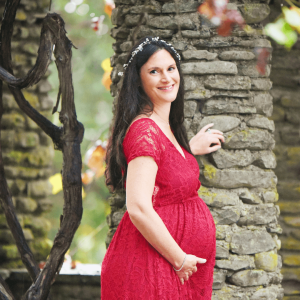
Nikki Spicer is a former Senior Project Manager, mother, and the author of, “Burying My Children: Breaking the Silence on Miscarriage and Stillbirth”. This riveting and very personal memoir about her journey through infertility, pregnancy related harassment, stillbirth, miscarriage, and gender disappointment is currently in need of a publisher. If you are interested in Nikki’s memoir or would like to reach out to her with your own personal story, please email nikkispicerbook@gmail.com.
