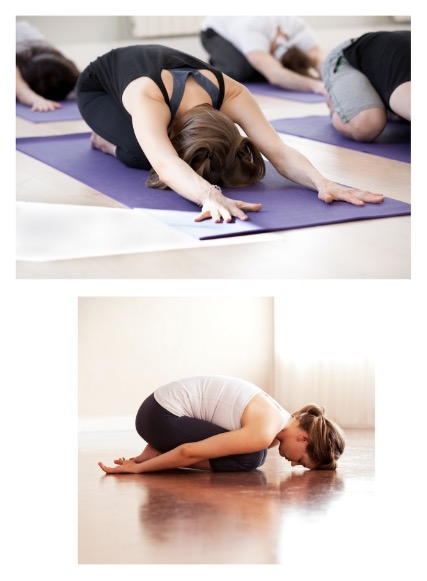
“Child’s Pose is a deeply relaxing, restorative yoga posture that helps release tension in the lower back, hips, and shoulders while cultivating a grounded, calm feeling. It also aids in digestion and can help ease discomfort in the abdomen. “
You’re pregnant! You’re excited! You’re in pain! Though I’ve never been pregnant myself, I know that it is a transformative and beautiful journey that can also come with its fair share of discomfort. Many expectant mothers experience various physical challenges including backaches, hip pain, swollen body parts, and general discomfort. Besides all of the mental health benefits that a yoga practice can bring, yoga offers a safe and effective way to alleviate pregnancy discomfort while promoting relaxation and overall well-being (exactly how you want to feel while carrying!).
My favorite thing about yoga is that it’s made for everyone, all shapes, sizes, physical ability or disability levels, ages, and genders. You don’t even really need any special equipment, an expensive mat, or $150 leggings. No one should feel like they can’t “do” it, because as long as you make it to the mat (or just your living room floor) and you breathe, congrats, you’re doing yoga.
Keeping conscious of your breath along the way is actually what makes the physical movement “yoga.” Point being, the breath brings life to the pose and also brings the greatest physical and mental benefits when combined with the pose. So don’t forget to breathe while you’re considering the following! Here are five yoga moves you can do RIGHT NOW that can help relieve pregnancy pain and discomfort.
1. Cat/Cow Pose
Cat/Cow pose is a gentle and soothing movement that helps to release tension in the spine and improve flexibility. It is especially beneficial for relieving backaches and increasing mobility in the pelvis.
How to do it:
Start on all fours with your hands directly beneath your shoulders and your knees hip-width apart.
Inhale deeply and gently arch your back, lifting your head and tailbone towards the ceiling. This is the cow pose.
As you exhale, round your spine upwards, tucking your chin towards your chest and pressing away from the ground through your hands. This is the cat pose.
Repeat this flowing movement, inhaling and exhaling with the corresponding pose. Continue for 5-10 rounds, gradually increasing the fluidity and depth of the stretches.
2. Bridge Pose
Bridge pose is excellent for relieving lower back pain, strengthening the legs, and opening the hips. It also encourages better blood circulation and helps reduce swelling in the legs and feet.
How to do it:
Lie on your back with your knees bent and your feet flat on the floor, hip-width apart.
Place a folded blanket or bolster under your sacrum (the triangular bone at the base of your spine) for support if desired.
Slowly lift your hips off the ground, pressing your feet down into the floor.
Support your lower back by keeping your hands flat with palms pressing into the ground or place them on your belly to let your hips, legs, and feet do more of the work.
Breathe deeply and hold the pose for 15 seconds to 1 minute, focusing on lifting your hips. Repeat as needed.
3. Child’s Pose
Child’s Pose is a deeply relaxing, restorative yoga posture that helps release tension in the lower back, hips, and shoulders while cultivating a grounded, calm feeling. It also aids in digestion and can help ease discomfort in the abdomen. This particular Child’s Pose description will set you up for the supported version of the pose which will accommodate the pregnant belly.
How to do it:
Start on your hands and knees, keeping your knees wider than hip-width apart.
Bring your big toes to touch, and sit back on your heels.
Place a bolster, pillow, or folded blankets in front of you between your knees and slowly lower your torso onto the support. The cushion should be long enough to allow you to rest your belly and your forehead on it.
Extend your arms forward or let them rest alongside your body, palms facing up to the sky.
Close your eyes and breathe deeply, allowing your body to relax and release tension. Stay for a few breath cycles.
TIP: for smaller bellies, having no cushion may be preferred.
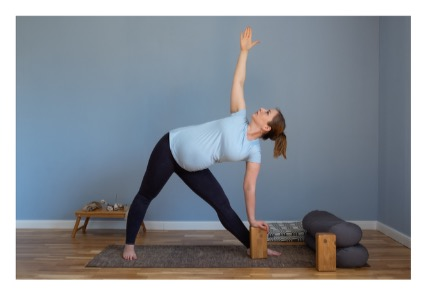
4. Triangle Pose
Triangle Pose is a standing pose that helps relieve lower back pain and strengthens the legs and hips. It also helps stretch the hamstrings, hips, and lower back.
How to do it:
Stand with your feet wider than your hips apart, keeping your toes pointing forward.
Turn your right foot out and extend your right arm overhead, while placing your left hand on your hip.
Slowly tilt your torso to the right side, reaching your right hand towards the floor or placing it on a block for support.
Turn your head to the left and up towards the ceiling or look straight ahead. Hold the pose for a few deep breaths and then repeat on the other side.
TIP: place a block in your practice space before attempting the pose so you can grab for it and use it if needed.
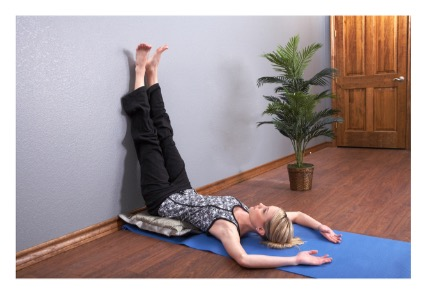
5. Legs-Up-the-Wall Pose
Legs-Up-the-Wall Pose is a restorative inversion pose that reduces swelling in the feet and ankles and improves circulation. Try closing your eyes once you get into position for maximum relaxation. This can be a tricky pose to get into, and ultimately, however you can safely put yourself in position is great.
How to do it:
With the goal of making an L shape with your body, start with your back flat on the floor, put your bum against a wall, and gradually lift your legs and feet to rest on the wall, feet going above your head.
You don’t necessarily need to be at a 90 degree angle unless that feels good to you.
Close your eyes and stay for a few minutes while breathing slowly in and out.
Practicing yoga during pregnancy can be immensely beneficial for alleviating pain and discomfort while promoting overall well-being. It also provides “you” time, where you can think and relax in peace. There are endless poses beyond these five that can relieve pregnancy related discomfort and I highly encourage you to explore more poses or maybe even a pregnancy flow (a series of poses put together like a little routine). During pregnancy, always remember to listen to your body, modify all poses as needed, and consult with your doctor or other healthcare professional before starting any new physical activity routine. Depending on which trimester you’re in, certain poses may or may not be recommended.
I truly hope these simple but powerful poses pique your interest in yoga and allow you to embrace the transformative power of the practice, but mostly I hope they help you with a more enjoyable pregnancy journey. Namaste.
Olivia is a former competitive gymnast and a certified yoga teacher living in Los Angeles. She found yoga in her late twenties and credits the practice as the single most impactful influence in her lifelong journey navigating major depressive disorder. She enjoys introducing yoga to others, fostering animals, and going thrifting. Also, naps.
Elliot: Welcome to the Informed Pregnancy and Parenting Podcast. I’m your host, Dr. Elliot Berlin. My guest today is a media professional and she is a mother of two, and her story to pregnancy and birth is quite interesting. Arista Ilona, welcome to the podcast.
Arista: Thank you. I’m happy to be here.
Elliot: I’m so happy you’re here. And, you’re going to have to listen to this episode all the way through. You probably do always anyway. But, we have an exciting announcement at the end of this one. But, before we get there, let’s start at the beginning. Where are you from originally?
Arista: I am a Los Angeles native. Born and raised, Southern California.
Elliot: How was that growing up in the City of Angels?
Arista: Honestly, it was normal for me. I think because it’s all I’ve ever known. But, when I talk to people who have not ever been to LA and they hear my stories, I’m realizing that it was quite different and definitely not normal to be in such a fast-paced environment and meeting and seeing just random celebrities here and there as I’ve grown up, or going to school with like, so and so, son or daughter. So, that was always something that wasn’t weird for me. Yeah, it’s I think been great. I love the sun. I cannot stand cold weather. So, I am forever damaged. Like, now, is currently flood watches and rain. I’m just like, “What do I do with myself?” I do not know how to operate in anything but the sun.
Elliot: I was looking at my office window today. I have a great view, and the trees are all just shaking back and forth. There’s a heavy downpour. It felt like I was in Miami. I don’t know where I am.
Arista: Yeah. That’s how I feel. I’m like, “What do I do?” I’m like ordering groceries to be delivered. I’m so dramatic. I can’t even go outside.
Elliot: Alright. You grew up in Los Angeles — and by the way, my wife and I were from New York, but like Staten Island, not the big city. And, when we came here, we assumed we were going to see celebrities on every corner. And, the other thing that’s interesting is that I’m face blind. So, even if I had a celebrity talking to me, I would have no idea who they are. So, we used to just make it up on the corner. Like, we’ll be at a red light and like, “Oh, look! There’s Britney Spears!” But, we’re just you know.
Arista: I love that. And, yeah, I actually just recently found that out. I never knew that about you. I had no idea.
Elliot: I only found out when I was 39.
Arista: Goodness.
Elliot: Also, I feel like you look different every time.
Arista: Yes.
Elliot: I don’t think it’s just me.
Arista: Doesn’t help, I know.
Elliot: Yeah.
Arista: Yeah. I cut my hair. I’m so sorry.
Elliot: No. It’s totally fine. I wouldn’t help anyway. But, for you, usually, have a rough generalized. Like, “Okay. This is what this person’s going to look like.” You could be a completely different person playing a prank on me, and I would have no idea.
Arista: Whoopsie! But, I am always wearing this necklace that has my daughter’s name, Aiya.
Elliot: That’s a clue. But, if you gave that to somebody else, then I would believe. Alright. Speaking of daughter, we got to get there. Let’s just talk a little bit. We said that you were a media professional. What was that trajectory like?
Arista: Wow. Oh, man. Let’s see. In a nutshell, I always knew that I wanted to be in the entertainment industry. My father worked at Warner Brothers for a very long time and worked his way up from being a limousine driver to a famous anchor, who we all know as Dallas Raines.
Elliot: Oh, wow.
Arista: Yeah. Who was on ABC-7 News. Funny enough that was one of my first places I landed as an intern. I got to go up to him and be like, “Hey, you knew my dad.” He totally remembered, and he actually carried me as a baby. So, that was super cool. I had a big love for broadcast journalism, and being a news anchor. I love Lauren Sanchez, and that was my whole vibe. And so, I kind of bounced around from ABC-7 to Entertainment Tonight, got to help a senior producer there, and was learning the ropes. I kind of quickly realized that it wasn’t my forte in the sense that I just didn’t want to know too much about celebrities in that sense. Like, who was dating who and all of that. I know that’s something that is very interesting for some people, but it just wasn’t the space that was lighting me up.
So, I ended up shifting to radio, and music was my other love. That got me through a lot of tough times growing up. And so, I decided to dive into the music space. And, luckily landed an internship at Clear Channel. KIIS FM, 102.7 KIIS FM, which was LA’s top 40 radio station. And then, 98.7 was the rock station. Still is, the alternative rock. They were the best of both worlds. That is basically like blending me in one, and I was like, “This is awesome.”
And so, I actually was there for three and a half years. I went from internship to them becoming a programming assistant, production, doing straight team, and I just worked my butt off and was going to schools, working like five jobs. It was a very hectic time. Very LA of me to be also working at a restaurant, and also at a radio station. I just made some connections and I always stayed in touch with the head director there. Shout out to Julie Pilat. To this day, I still know her. I was like 19 when I started, not to age myself. But, that was definitely like 15 years ago.
Elliot: I can do the math, but I won’t.
Arista: Yes. Let’s not. So, I landed there with her. I took a break briefly and moved to Oregon, Southern Oregon, randomly. Took a break for about two years. I was burnt out, not going to lie. I think I overdid it a bit. I need to reset and find a new inspiration. To be honest, Oregon kind of gave me that, and I wasn’t expecting it. But, it also gave me like the granola phase in my life. When I looked back at it. I was like the hippie girl. Oregon definitely brought that phase out of me. I suddenly became a yoga professional [unin] some thoughts. And then, was getting into aromatherapy essential oils, and met an amazing biodynamic farmer up there. Yeah, it was like a whole other side of me. Like, my very green thumb side came out at that time. And then, I missed my hometown. I missed LA. I was like, “Okay. I’m too young I think to be here.” And, even though I was working at a radio station there in Oregon, a very small one, I was like,” This is really slow.” Like, there’s no billboards.
Elliot: Yeah.
Arista: It was definitely the nurturing vibe I needed at the time, and very therapeutic. But, I was ready to come back. And so, long story short, I came back to LA. And then, got back in touch with Julie. She needed an assistant at that time again. But, this time, for a different company called Beats Music, which it wasn’t named at the time. It was a startup, and I was part of like the core team there that then got bought out by Apple. It was like the biggest streaming music history deal that you’ve ever heard of, and I was a part of that crazy acquisition and ended up at Apple for eight years.
Elliot: Wow. Looks pretty cool.
Arista: Yeah. And then, now, I’ve been recently at Netflix. But, also, still doing my own business on the side that’s really catered in helping people find secret presents on the go, which stems from motherhood, which I know will get into.
Elliot: Secret presents.
Arista: Yes.
Elliot: Wait. But, you also have Botanica.
Arista: Yeah, Botanica. Yes. So, that’s Ilona Botanica. And, that’s the oils which stemmed from like what I learned in Oregon, learning how to blend aromatherapy to kind of have like secret presents on the go, which seems like, “How is that even possible?” But, that’s something close and dear to my heart, which is about soul wellness as a whole. And, how can we integrate that presence in our life when we are moving so fast, especially as a mother, and just as a woman, and living in the city. These products that I make: the mist, and the body oils, and the bath oils, is something to encourage ritual as much as possible. Because I know that not everyone can go to a yoga retreat in India. Or, even honestly, it’s very difficult for me to make it to a yoga class. So, I decided to create some tangible item and product that was special for me that I could throw in my bag. Mist myself when I’m like in the car in traffic, or just needing a quick pick me up. And, that was something to like come back to myself and feel connected within, and essentially feeling at home wherever I go.
Elliot: It’s really great. And now, you help other people have those same experiences on the go.
Arista: Yeah.
Elliot: That’s really cool. You have kids?
Arista: I do, unexpectedly.
Elliot: Well, let’s talk about that. What does that mean? Because were you not planning to be a mom?
Arista: No. I was never really one of those girls I often hear like, “As a little girl, I always wanted to be a mom and play with dolls. I just knew that that was what I wanted.” I didn’t have that. I often felt a bit weird, or something was wrong with me that I didn’t have that initial plan I guess, or feeling. It was never really something that crossed my mind. And, I don’t know if that’s maybe because, growing up, witnessing my grandmother having a very, very hard time coming from Costa Rica to the States, and struggling very, very, very hardly. Grew up on food stamps, and Section 8, and it just wasn’t the American dream unfortunately that she thought that it was, for her, in particular. She didn’t have anybody. She was single a single mom of six, and didn’t have that masculine male support in her life. So, I never really saw it as being a positive, of having children, and getting married, and trusting that whole American dream with the white picket fence I guess, right?
And then, my mother also, not being married to my father and splitting up when I was very young. I guess I just never saw that model of like, “Hey, this is like a great thing to experience.” I think I was very scared very.
Elliot: Is your grandma from Costa Rica, your mother’s mother?
Arista: Yes.
Elliot: Okay. So, they split. So, was your dad not in the picture, or was he kind of…?
Arista: Yeah. My dad was like in and out. I like to call him a rolling stone. He loves like kind of being on the road, and being in the trees. That’s where I get my love for road trips, and the forest, and nature is from him. He was kind of like in and out.
I remember meeting him when I was 7. I know that he was in my life prior, but it was kind of choppy. And then, once, I was a teen, like 14 and up, then I remember seeing him a lot. We went on trips and all that. But, I think it was fairly hard for him to be in my life. I don’t know if it’s because of my mom, or what, it gets complicated. But, I know that he definitely tried when he could. I guess I just never felt safe.
Elliot: Your siblings.
Arista: Yeah. Half siblings from my dad’s side. So, I have three sisters and two brothers.
Elliot: Okay. That you grew up with or not really?
Arista: No.
Elliot: No. Okay.
Arista: I knew then. We would talk, but it wasn’t under the same roof.
Elliot: So, it really is Grandma, Ma, and you.
Arista: Yeah. And then, my aunts, my cousins, my oldest aunt who also came from Costa Rica. But then, my grandmother passed away when I was 14. And then, that was super devastating for me. I had to grow up fairly quick at that age, and kind of went into survival mode, to be honest.
Elliot: So, you paint a picture in which it’s like, I don’t know, to me, it just seems like understandable why that wouldn’t want to be having responsibility for kids, and wouldn’t want to be something that you would chase after.
Arista: Yeah.
Elliot: But, somehow, you have kids. Alright. Let’s take a little break. Because I feel like the story is just warming up, and I feel also compelled to remind the listener at home that we have a surprise announcement at the end of this episode with Arista Ilona. We’ll be right back.
[Break]
Elliot: Welcome back. We’re talking to Arista Ilona. Okay. So, you have this whole career thing going on. And then, you go off to Oregon. And then, you come back, semi-hippified.
Arista: The whole boujee.
Elliot: And then, Beats, Apple, Netflix. Somewhere along there, you change course, and you started having kids. What happened?
Arista: Yeah. So, what happened? Yeah, what happened? I still wonder that, but in a good way. I don’t know [unin].
Elliot: Okay. But, I know roughly what happened.
Arista: Yeah. So, yes, my oldest just turned 7.
Elliot: Happy birthday.
Arista: Yeah, thank you. Seven years ago, I got pregnant actually right before we launched Beats One Radio, which was so crazy. It was such a crazy time. Very, very hectic. I remember finding out, and I was like, “Oh, man. What am I going to do?” I remember my best friend, being the one that I was just talking to and like, “What do I do? What do I do?’ She was so understanding, and just calmed me. We would take walks. Because she was working with me at the office, and we would take walks together on our break. I would see a little Monarch butterfly fly by me, and I was still in my little hippie phase because I was still new to coming back to LA. I was like, “It’s a sign. I need to embrace motherhood and I have to do this.” I just feel something like this is going to transform something within me and it’s really scary. But, I feel I need to move towards it. I need to like, “Be scared and do it anyway.” And so, I did.
It definitely was scary. I remember calling my dad, and he was very supportive, and my mom. And so, I was almost in shock. Like, “Wow! Everyone is actually pretty happy and on board.” And so, even though I was like, “Oh, I just paid my car off, and it was only a 2-door car, and I had all these plans to meet, travel the world, and do all this crazy stuff.” Here is the curveball, but I felt it was going to really change me for the better.
Elliot: I have so many questions. Can you answer whichever ones you want to and not answer the ones you don’t? But, were you in a committed relationship?
Arista: What is the definition of that at that time? It probably was not.
Elliot: Okay.
Arista: I’m going to be honest. It was, “Hey. Oh, cool. You’re attractive. I’ll see you around.” I was going to events that he was throwing in Venice, California at the time by Venice Beach. We just were hanging out. And then, after three months, I ended up pregnant.
Elliot: As happens. How did you figure it out? Was it a big surprise?
Arista: Yes. It was a very big surprise, and I felt a lot of shame. Because I was somebody that was like, “If that ever happened.” Like, even though I didn’t think I’d ever become a mother. The planner in me was, “Well, if I did, I need to be engaged first, and we got to live together,” and all the perfect pieces that you think would make something be acceptable or okay, without getting the judgy eyes. But then, I was that girl that was, “Oh, no.” Unexpected pregnancy with somebody that didn’t even believe in marriage, and was kind of more open with his commitment, and that was very scary to be in at the same time of embracing an unexpected pregnancy.
But, the one thing that I do appreciate is the honesty and the transparency that he had with me in the beginning. It was something that we talked about, and that we decided to move forward. Like, “Hey, no matter what. We’re going to co-parent, right? We’ll be good co-parents to each other and for the child.” And so, yeah. I mean, it was navigating deep waters that I’d never had been in, right? But, I was always an open-minded person, and kind of just flowed with things, and embraced things in life that came my way because I saw it as an opportunity to grow. Like, on a spiritual level, as a person, too. And so, I was like, “Okay. This is what was presented to me, and I’m going to take responsibility.”
Elliot: What was your clue?
Arista: The Monarch butterflies.
Elliot: Oh, the butterflies.
Arista: I know that sounds so corny. But, yeah, it was at that time a very symbolic animal for me, or insect. I actually have a tattoo of a Monarch butterfly on my right arm, which I had a few months before I got pregnant. So, it was even more of a, “Hey, this is my own little sign.” My own little explanation for myself that once I got pregnant, I kept seeing them everywhere. And, when I wasn’t sure what to do, and I was having a conversation with her father, he actually told me that that day prior, there was a dead monarch butterfly that was at his doorstep. I was just kind of like, “Huh, that’s interesting.” I just took that as like, “No. I need to move forward and step into this as a woman.”
It’s so odd to look back at it now. Because at the time, I couldn’t put my finger on it. Obviously, you don’t know when you’re in it until you look back and you see, “Oh, wow.” I definitely changed and that definitely helped me in my life. Even though it was really scary and a really hard decision to make. Looking back, I wouldn’t have it any other way. It’s just amazing when you look back on your life. Especially, seven years, ten years ago, and you see how much it shaped you.
Elliot: Do you think the change started to take place when you decided to keep the baby, or when you gave birth, or through the act of parenting?
Arista: I think definitely when I gave birth and became a mother. Because the pregnancy, I felt great and I still was doing things. It kind of hits you, overnight. So, I didn’t really feel different until I had the baby in my arms. I was, “Whoa! Okay. This is real. Like, it’s real!”
Elliot: They say all the time that at your first birth, there’s two births simultaneously: the birth of the baby and the birth of the mother. It sounds like you really experienced that.
Arista: Yes. And, that’s a great way to put it. That’s exactly what it was.
Elliot: Speaking of birth, keeping a baby’s one thing, deciding to co-parent, also, another thing. But then, you have to get that kid out of you. As somebody who never thought about having kids, how did that thought process go?
Arista: I was very fascinated around the idea of a home birth. I know, I know. Before for all the judgees — They’re losing their mind listening to this. Yeah, a home water birth. I was fascinated with having a midwife and a doula. And, I still, to this day, think that it’s very important to have a doula, but also have a plan B, which I did not have. So, I was just very laser-focused on this home water birth, and I didn’t want to think about anything else. And then, I was definitely afraid of a C-section, so I wasn’t even going to touch that idea or think about it.
Elliot: Who did you have to support you? Who was going to be there?
Arista: It was going to be her father, my midwife, my doula, and two of my friends.
Elliot: Okay. Friends who had babies?
Arista: Nope.
Elliot: Okay. And, where did the idea of home birth work even — because almost everybody gives birth at the hospital? Where did you even come to see that idea?
Arista: I think it’s going to just blame Oregon. I’m going to blame the dose of hippie life where I started researching and hearing people talk about — was it Ina May?
Elliot: Oh, yeah.
Arista: I started hearing talks about that. And then, going down the YouTube rabbit hole of orgasmic birthing. And, I think I was just fascinated by it. I wasn’t, again, thinking of having children. I was just, “Well, interesting.” Because I was meeting a lot of families in Oregon and mothers. I was, “Oh, well. That seems like the rebel thing to do and that’s how I live my life sometimes.” It’s like, “I’m going to go the other way and try this other cool thing that’s different.” And so, that was the plan and that was a whole other layer.
Elliot: Did you do things that get sort of prepared mind and body for it? Or, just like, “Yeah, we’ll have a home birth.”
Arista: Yeah. I mean, I thought that I was prepared. I didn’t really know what I didn’t know until I was in it. I was like, “Okay. I’m not ready for this. This was kind of crazy idea.”
Elliot: How did it start?
Arista: I started cramping, had the good old mucus plug — just so gross. I was not prepared for that.
Elliot: Delicious.
Arista: What is this slug on my thigh? What is this?
Elliot: Oh, giant [unin] on you?
Arista: Yeah. I’m so grossed. And so, at that time, I was texting my doula, and I would have like, “Well, I think it’s happening.” They’re like, “That’s great.” I just started taking my time and wearing, I had this like sarong. This bright pink sarong from Hawaii, wrapped around me all pretty in the front but around my neck. And then, a couple hours into feeling I guess the slow contractions. I didn’t know then, but I know now that I had a panic attack.
Elliot: Oh!
Arista: Yeah. I totally blacked out.
Elliot: What?
Arista: Yes.
Elliot: Had you had panic attacks before?
Arista: No.
Elliot: You think that a lot of mist — you needed the mist.
Arista: Yes, exactly! That’s why I created them.
Elliot: Oh, my gosh.
Arista: Yeah. I had no idea —
Elliot: You don’t remember what happened, even now?
Arista: I barely. It’s so vague. I remember fragmented moments that are just kind of in and out. I remember the sounds, hearing things. I remember sensations. And then, little blips of the entire birthing experience, which I guess I was told lasted three days. I have no idea.
Elliot: Was there any pictures, or video, or anything like that?
Arista: Yeah there were. But, I did not watch any video.
Elliot: Still haven’t?
Arista: No. Uh-uh.
Elliot: Oh, my God. We need to watch it.
Arista: Oh, my gosh. I know. I remember seeing —
Elliot: Oh, my God. I want to do — I like a video episode with you where you watch your birth.
Arista: Oh, my gosh. No.
Elliot: Oh, my gosh. Yes.
Arista: Yeah. I mean, I remember —
Elliot: You still haven’t watched it?
Arista: No. Because I remember when he played it once, I was like, “No, no, no. Turn it off.” Like, just hearing me in pain, I was like, “Oh, I can’t.” I don’t even know who that is. It was just kind of traumatic, not going to lie. Maybe seven years now, I’m good.
Elliot: We’re just warming up in your story, but it sounds like you’ve come so far. Now, I’m so curious what your reaction will be if you watch it. Like, if things will come back to you or not or, “Okay, I digress.” Back to you. So, you blackout. And, on and off for three days, you can’t tell us too much because you don’t remember.
Arista: No. I just remember this one moment feeling in so much pain. In the beginning, I remember feeling shortness of breath, right? When the contractions were starting and I started feeling, “Oh, I can’t breathe! I can’t breathe!” I thought it was a sarong being too tight on my neck because it was wrapped around, and not in the back. And so, I, right away, just took it off. And then, I was just naked there. I was just, “Oh,” and I started freaking out. I told him I was, “I feel I’m going to pass out.” I just remember everything just the circle, zoning in and closing.
And then, next thing you know, I’m in the water tub. And then, I hear my midwife and my doula, and my friends in the background. They’re getting things prepared. But, I’m out of it. I’m not even really present. And so, I remember being in and out of the water. And then, them asking me to go into the shower. And then, going back in the water. And then, coming out of the water. And then, going on the floor and trying to do movement, and move my body. And then, another part where my midwife was like, “You know, you’re only dilated 6 centimeters, and I can’t feel her.” She had her hand up there, trying to feel and see where the baby is. And, I started getting worried at that point. And then, I needed a catheter.
And then, immediately, in that moment, I’m pooping myself. I’m like, “Why did I have this idea of a home birth?” In that moment, it’s like, “This is gross. I feel gross.” I personally was not enjoying it. And then, I just felt in so much pain. I was having back labor. And so, I remember her telling me, “The baby’s flipped.” I was in excruciating pain. And then, my friends were there. And then, they started trying to calm me by singing and playing the drum, and the sound bowl. I was just overstimulated. I was like, “None of this is helping me.” I thought it would. I had this idea of this super calming, relaxing zen vibe with the candles, and the dim lights, and the aromatherapy, and everything, right? It was just, “I don’t know, I can’t even focus.”
And so, it got to the point where I was on my back, and I was having contractions so much that’s where I could barely take a breath. I couldn’t count to three seconds. I was like, “Ugh!” It was just excruciating in my lower back, and I just started crying. I remember my midwife being, “It’s okay to stop here. Whatever you want to do, we can go. We can transfer. You know you’re tired. We don’t want anything to happen to the baby. Let’s make the call.”
My stubbornness was kicking. I was like, “No. I don’t want to give up.” This was the dream experience birth that I really wanted to try to have. But, at that point, I knew I’m spent. I’m exhausted. And so, we decided to transfer.
My doula drove us to the hospital. I remember getting up and they’re trying to help me, and I don’t know that feeling of walking with excruciating contractions, which is horrible. And then, I didn’t know what day it was. I saw the sun, but I was like, “Wait. It was nighttime when I went to labor. So, what is even happening?” It was just such a weird, weird experience for me to feel so out of touch. And then, being in the car in the back seat, and just every bump and every movement was just like, “Ah!” It just was hurting even more for me.
Finally, get to the hospital. I asked for an epidural right away, which is, of course, another thing that was like, “I’ll never get an epidural because I knew of all chemicals.” And so, I knew too much. And so, that also kind of made it really hard for me to accept the decisions that had to be made at that time with urgency. Because then, I felt I was hurting my baby.
And so, I was dealing with a lot of guilt, and a lot of second guessing myself, and just feeling I gave up. But, in the moment, I just needed relief. And so, once they gave me the epidural, I was like, “Oh!” There’s that breath. There’s that full breath and that feeling that I had been looking for. And then, I asked if I could try just give us a little bit more time. Used the peanut ball in between my legs to maybe see if I progress now that I have the epidural, and just give my body a little bit more time now that I’m relaxed. They let me for a little bit. But then, the OB came in and was like, “We got it. We got to get this baby out. Because it’s been a long time.”
Elliot: Because you said three days already.
Arista: Yeah.
Elliot: Is this an OB that you knew? Or, no, just a random–?
Arista: No. My midwife knew her. I had no idea. I’ve never met her before. She walked in with a leather jacket. Just super–
Elliot: [unin] OB?
Arista: Kind of like. But, I think she was from New York. Maybe it worked out. I just felt like, “Oh, man. This is kind of aggressive.” Not like the glowing light around.
Elliot: Yeah.
Arista: Like, the nurturing woman vibe that I was kind of foreseeing. The experience would be like, “Let me deliver your baby.” It’s like, “Oh, no.” It was like, “Nope, got to get her out. Let’s go.” The minute she walked out of the room after, she said, “We got to have a C-section.” She walked out. I just broke down the hardest deepest cry that I’ve ever experienced in my life. Similar to basically when my grandmother passed away.
Elliot: Oh, my.
Arista: I was devastated.
Elliot: What is the source of that devastation?
Arista: One, I am so scared of surgeries and hospitals. I was just really scared to go under. I was scared of dying. I don’t want to die.
Elliot: But, you don’t have to go under.
Arista: Well, yeah. But, you know what I mean?
Elliot: Not being in control? But, you already have an epidural.
Arista: Yes, exactly.
Elliot: But, I guess being kind of open is–
Arista: Yeah. It was just something I hadn’t prepared for. And so, I didn’t really know how I would feel and it just felt very scary.
Elliot: So, fear. But, there’s a lot of fear bubbling up for you. It’s so interesting. Because, in my mind, you’re this incredible badass. “I can do anything,” and you are. And so, I don’t know if you became that through experience or–
Arista: Definitely. I think that’s what, earlier, looking back, to see how much this shaped me to become so much more empowered. I had to go through that moment to get there. Because I was definitely younger, too. And, so much happens in seven years. Especially for me, because I’m always very proud of myself. Like, “You got to do better. You got to grow. You got to be a better than yesterday.” When they told me that, I was like, “Dang it!” Again, the plan didn’t go as planned. And so, I was just being hit left and right with things that were these curveballs that I didn’t feel ready for, but was just like, “Okay. Well, here is the surrender plate, right?” Here it is and the deepest of surrender that I will ever probably experience was in that moment.
And so, I’m under, and the lights are bright, and I’m feeling a little anxious. And, again, I don’t know what that time what that is, but I just have the shortness of breath and I’m trying to relax. And, next thing you know, baby’s out. She’s 8 pounds, 3 ounces, and healthy. They put her right on my chest and she latched on right away. It was such a beautiful experience. But, I was totally out of it. Like, my eyes were closed when she was on me. And so, I just see this slight smile of relief. Like, “Ah, yes. We’re there. Now, I can heal.” But, I wasn’t as alert as I had liked to be, right? The crying when you see your baby and all the pictures that you see. I was just out of it.
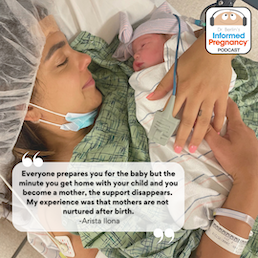
And so, at that point, I don’t know how much more you want to know. The hospital experience was great. I had a great team, baby was healthy, and I was healthy. And then, we get home and doing the breastfeeding, and tending to a C-section, which is not fun. I realized in that time like, “Wow! Everyone prepares you for a baby.” They say have the baby shower, and your baby registry, and you’ve got the doula.
Elliot: All that gear and the nursery.
Arista: Yeah. But then, the minute that you get home with your child, and you become a mother, suddenly, and for me, this is how it was, the support kind of disappears. There isn’t that continued, “Okay. Now is the time where you really got to eat well. You got to nourish your body, and your mind, and your spirit, and you got to not overwork yourself,” and all of that. There wasn’t really that reminder for me. And, that was where I was like, “There’s something missing here.” There’s a big gap in postpartum time where mothers, I feel, aren’t getting nurtured because I experienced that. I don’t have a big family. I didn’t have the aunts, and the cousins, and everyone coming, and rubbing my feet, and doing all this. And so, I had to bring least seek that out for myself.
Luckily, I found Bellibind, Princess, whom you know. She came. I mean, helped provide that care for me, which was so amazing. I realized in that moment like, “Wow! This is gold.” For someone that just got ripped open essentially, and brought a child into the world. And then, to be able to receive and feel that comfort was really special. And so, I ended up trying to find things like that, but it wasn’t until the seventh week mark with baby in being home that I knew I needed that because my C-section got infected.
Elliot: Oh, no.
Arista: Yeah.
Elliot: How did that present?
Arista: I remember it was a fleshy wound. I remember looking down and I had staples. I wanted stitches, and I don’t know what happened there. But, she ended up using staples. I’m pretty sensitive to metals. I know when I was younger, if I wore fake earrings or anything or even fake bracelets, I would freak out.
Elliot: My kids are like that.
Arista: Yeah. And so, I was maybe that was that. But, also, hospital germs. It could be so many things. I remember looking down, and I was in a lot of pain. But, again, I had nothing to compare it to. I thought that pain that I was feeling every time I had to go to the bathroom was just normal, and come to find, it wasn’t. And so, it was the infection that was brewing. And then, it was starting to pus. It’s super gross. It looked like my skin was eating itself, a flesh sheet. Yeah. It was very scary.
I sent a picture to the OB. She’s like, “Oh, my gosh. I have to rush you right away. You need to go see the specialist.” I’m like, “Wait. What?” Like, with a seven-day baby–
Elliot: Recovering from surgery.
Arista: You’ve got be kidding! And so, we’re rushing. We don’t even really have a car seat or anything. We’re trying to figure it out because we were kind of taking our time with all the gear stuff. So, we rushed to the specialist, and he sees, and he’s like, “Oh, I have to drain this.”
Elliot: Oh, no.
Arista: In his office.
Elliot: Oh, right there.
Arista: Right there. He’s like, “I have to take out three of the staples on the right side.” I’m like, “What?” He went in for it, and oh, that pain. Just more pain, more pain. It’s like, “Okay. Here we are.” And so, he drained it. And then, had to stuff it with gauze. He’s like, “So, you’re going to heal kind of weird. Like, it’s going to heal over the gauze. You can always come back and have cosmetic surgery for that area. But, this is the best we could do.”
Elliot: Oh, my goodness. Really?
Arista: Yeah. He’s like, “You’re going to have to have a nurse come every day and stuff that area with gauze. Clean it, take it out. They would roll the gauze, really small. Stuff it in there in between my skin.”
Elliot: Pack it.
Arista: It was just, “Ugh.” It was terrible. So, got home. And then, I deal with that. Have nurses come every day, and take care of that. And then, I got mastitis twice. Because I was really stressed and just over exerting myself. I wasn’t resting because, what is rest even when you are trying to breastfeed, and you’re up, and sleep deprived. I couldn’t sleep. That was really brutal.
Elliot: Okay. Just to recap. You’re like, “I’m not going to have kids.” And then, you get pregnant because of the butterfly. And then, you’re like, “I’m going to do a home birth.” And then, sort of blackout, panic for three days in labor. But, I will say this one word you used during that part of your story, four or five times, is “excruciating.” And then, after that, you said, “Then this happened. I got more painful.” I’m like, “What’s more painful than excruciating?” And then, a surgery, which also terrified you. And then, complications from surgery. So, that’s where we are in the story at this point in a nutshell. But, the story continues because now you have another baby and we’re going to get there. But, let’s take a quick break before we do.
[Break]
Elliot: Welcome back. We’re talking to Arista Ilona. And so, we just recapped the whole story before the break. And now, things have turned again because you have a baby. So, flash forward seven years. I mean, you could recap what happened there, but I’d love to get into this most recent pregnancy and birth.
Arista: Yeah. So, Sophia. She’s 9 months. She’s amazing. And, this pregnancy, after having Aiya, I was an only child and I didn’t want her to be an only child. So, even though it was, “Okay. I don’t know that I can do it again.” Once she turned five, I felt like myself again. Like, I felt I was coming back online but I had gotten pregnant when she was three, and unfortunately had a miscarriage.
Elliot: Oh. I’m sorry.
Arista: Six weeks.
Elliot: When Aiya was three?
Arista: Yes. And so, I had to take a pause. I was like, “I need to pause here.”
Elliot: So, that one was an intentional pregnancy?
Arista: That one was if it happens, it happens kind of thing.
Elliot: Oh, one of those?
Arista: Yeah. And so, I was so excited about it and I felt so happy. Because I was, “Oh, three years. That’s a perfect gap.” And, that happened on New Year’s.
Elliot: Oh, my goodness. It’s because you didn’t get a butterfly.
Arista: Exactly. Where was my butterfly?
Elliot: Obviously. Oh, sorry. That’s so hard. Especially, you, struggling to make the choice to get pregnant, then getting pregnant, and then losing it.
Arista: Yeah. And so, I was trying to figure out what happened there. My doctor had said, “Your progesterone levels were low.” And so, I was on a progesterone cream for quite some time. But also, just took a pause and took a step back. And then, fast forward to when I was five, got pregnant again, and lost that one, too.
Elliot: Oh, no.
Arista: Yeah. That one was at 8 weeks. I’m like, “What is going on?”
Elliot: Was that another if it happens, it happens?
Arista: Yes. And, that one, I didn’t feel very well. I don’t know even how to describe it today. But, I was stuck in bed for three days. I was crying. I was depressed. I didn’t feel myself. And so, I kind of had a feeling something was wrong, and I just didn’t know what. And then, when I started getting cramping — I was out at dinner with my best friend, I was bleeding. And so, I was like, “Oh, no. Not this again.” Because I knew it from the first time around, and yeah. And so, that was a bummer.
And then, Sophia came. We were actually in Hawaii. And, that one I think, we were definitely hoping and trying. But, Hawaii does that to you! If you’ve ever been, you feel so romantic, and just lovey, and there’s that island is so funny. We were like, “Okay. We’re on this island, and by ourselves, and so why not?” And then, I ended up pregnant. And, this time, I felt great and nothing was going wrong. I had a great pregnancy towards the end. I started feeling a lot of pain, and it was only when I had to go to the bathroom and pee. I just didn’t know what that was. I figured like, “Oh, maybe it’s for my C-section.” Like, the infection and the right side’s a little weak, and maybe the pressure from her is causing this weird pain. That in the middle of the night, I would wake up, and have to crutch over, and walk, and hold, and put pressure on my stomach to release the pee. And then, I would feel relieved.
Elliot: That does not sound normal at all.
Arista: Yeah.
Elliot: Is it something you talked to your doctor about?
Arista: I did, yeah. I did it. She didn’t really say much about it. She was like, “Oh. Well, you have one ovary. You had a cyst there in the past.” It wasn’t really discussed in detail.
Elliot: Because that’s not one of those things that you get like, “Oh, it’s just pregnancy.” That’s the standard answer for most things, but that’s not even one of those things that would warrant that answer. Does not sound something common in pregnancy. I don’t know where that’s headed. But, before we go down that path, did you have thoughts on how you wanted to deliver Sophia?
Arista: Yes. This time, because of what I went through with Aiya, I was full-on force hospital.
Elliot: Okay. Full-force hospital, with meds.
Arista: Yep.
Elliot: Okay. Since you had already been through a cesarean — I mean, because that’s the first choice usually. It’s just you got to think about is, “Now, am I going to try for a vaginal birth or go for a repeat the same?”
Arista: Yeah. I did want to try VBAC, which is vaginal birth after cesarean. But, I told my doctor I want to wait and see how the pregnancy progressed to see how things were going, and her placement, how I felt. And, she was totally on board with that. She was like, “Yeah. No problem.”
But then, as that pain was coming on around six, seven months, I started to get concerned. And, that was kind of my own mama intuition where I was like, “Well, I don’t know that I want to wait for my water to break having this pain.” Like, I just don’t want to have another crazy, scary convocation issue, where I rupture, and it could be even scarier, which is how would that even be possible from my first experience which was already scary. So, I wanted to try to dodge as much as I could from the unexpected. And, knowing that I’ve had a C-section before, I knew what to expect.
Elliot: Okay. So, it wasn’t that panicky?
Arista: Yeah, exactly.
Elliot: And, what’s, “I can’t have surgery.” But, also, just because you said, “What if I rupture?” People are not familiar with VBAC. Because during the original cesarean, there’s an incision made in the uterus itself to get the baby out, and that is repaired. The concern is what if during the throes of labor, the buildup of intensity during labor, the scar doesn’t hold it together it starts to separate or pop open, the medical term: uterine rupture. So, that was on your mind as well.
Arista: Yeah. And, I know what is it the amount you can wait is two years is recommended, right?
Elliot: Yeah.
Arista: Even though it was six years, I still was like, “I don’t know.”
Elliot: Yeah. It seems like those should have healed by then.
Arista: Yeah. Because of the infection, I just was like, “I don’t know. It might be a little weird in there.”
Elliot: A little weird in there. But, that’s what was on my mind. I mean, it’s the more topical incision didn’t heal well, how do we know that the one deeper down did?
Arista: Exactly. So, I went with my gut. And then, I decided to choose a date.
Elliot: That’s fun.
Arista: Delivery date, which was June 22nd. My dad was super happy because that’s his birthday.
Elliot: Oh, that’s my parents’ anniversary.
Arista: Nice.
Elliot: Wait a second. So, go with the delivery day for induction, or just you made the decision; repeat C.
Arista: Yes.
Elliot: You’re just feeling something strange in the neighborhood. Okay.
Arista: Finally, because it was starting to get a little bit more intense. As the pregnancy prolonged, the heavier she would get. The more that pain was starting to feel like sharp pains. I just was like, “Ah! It just doesn’t feel normal.” I remember having to put heating pads on it. I rested a lot. It was, “I probably shouldn’t be doing too much right now.” So, I was almost like putting myself on bedrest, to be honest. I just was kind of listening, not “kind of.” I was listening to my body in towards the end of the pregnancy because I just didn’t want anything to happen. Especially, because of the two previous losses.
So, we picked a date. And then, the day came. I remember just feeling I wanted to move really slow that day. It was like thunder storming and all that. I didn’t get the butterfly, but I had a thunderstorm.
Elliot: All nature. Nature’s talking.
Arista: Really? This is weird. It felt I was in the desert. So, we get to the hospital and we’re about 20 minutes late, and we got totally reprimanded. They were like, “Do you see the time?” I was like, “Okay, not today with your attitude.”
Elliot: What? Because you were 20 minutes late to your cesarean appointment?
Arista: Yeah. It was just this whole weird, just not very kind, and not how I want to start my day of going into a very intense surgery. I was like, “Hey, good morning to you too.”
Elliot: “Can I get you some coffee?”
Arista: Yeah, exactly. I was just like, “Okay, whatever.” Get into the room. And, I should clarify that this is a new partner, and it’s my husband, and he’s amazing. And so, it’s not the same person as the first pregnancy. I had split up.
Elliot: Was that the same for the two miscarriages as well?
Arista: Yes. I have a whole new life.
Elliot: A good support, and good support then as well.
Arista: Yeah. We’re in the room, and they’re like, “Oh, yeah. You are having small contractions.” I was like, “Yeah. I can feel that.” They were putting me on the belly monitor, and just waiting. And then, I get a call from my OB and she’s like, “You’re late. I can’t see you. And so, we’re going to have to schedule a different day.” I was like, “Okay.”
Elliot: What? They moved your birth?
Arista: Yep. She was like, “This is pushing all the births back, and my surgeries.” I was like, “Alright. Whatever.” I didn’t want to be stressed. I was like, “Everything for a reason.” And so, we went home, got sent home, and I’m like, “Okay, cool. So, my now rescheduled C-section is like three days from now. But, what if my water broke tonight or tomorrow?” I mean, it’s kind of one of those things where you’d have to be available. So then, it moved from the 22nd to the 24th, which was a Friday and it was a way better experience going back, like reset. So, we go back and this time, we’re even more prepared because my husband had his bags and everything ready. Like, this time it’s like, “Okay. Now, I really didn’t forget anything.”
Elliot: It’s a do-over.
Arista: Yeah, exactly. So, we’re there and I’m still a little nervous to do the C-section. It’s still scary. The lights and all of that. But, I’m not as scared because I knew what to expect, and I also trusted my doctor, and I chose her specifically for a reason. I knew she was the best for what I was wanting. We get there and have my husband next to me. And then, all of a sudden things started to feel a little weird as we’re in the operating room. It gets a little bit quiet. I’m like, “Oh, what is going on?” And, starting to feel a little of tugging. The anesthesiologist was like, “Are you feeling anything?” He could tell on my face that it was uncomfortable. I was like, “Yeah. I’m feeling burning.” He’s like, “Oh, you shouldn’t be feeling that.” And so, he upped the dose. And, in that moment, I didn’t know it, but they had found a ton of scar tissue that was all on my right side that had traveled up. I don’t know if she — she had mentioned maybe from the infection, but the scar tissue wrapped around my uterus and bladder.
Elliot: Oh, my gosh.
Arista: It’s twisted over towards the right.
Elliot: Like it pulled it?
Arista: Yes.
Elliot: Oh, my goodness. So, that’s what you were feeling when you would have to pee and things?
Arista: Yep. I was like, “Okay. Now, it makes sense.” And so, the scar tissue was all around. So, she’s like, “We have to take more time. Like, the C-section is there, but we need to take more time to scrape as much of this as we can out.”
Elliot: I’m glad she had time and didn’t have to reschedule you until Monday.
Arista: At that point, the partner that the doctor that was with her was not the one that was scheduled with her on the 22nd. She later had told me like, “I’m so glad you were late. Because if it was that day and we opened you up, might not have been able to really tend to we wanted to on this date with this doctor.” I was like, “Well, great. Everything for a reason.”
Elliot: I guess so.
Arista: Yeah. It all worked out. I had a great team and the nurses were amazing. They were doing that and she’s like, “You also had a window uterus,” which you know they could see the baby.
Elliot: Oh, through the scar you mean?
Arista: Yeah. It’s just that clear. She was like, “The minute I opened you up, I could just see her right there.”
Elliot: Okay. So, that’s what they’re saying. The scar thinned out so much like didn’t separate, but thinned out so much that you could essentially see through it.
Arista: Yes.
Elliot: Wow.
Arista: I was like, “Okay.” Well, I think I dodged a bullet, right? You don’t know, you’ll never really know, but I’m glad that I went with a decision that I went with based off of what I was feeling towards the end of my pregnancy. And so, she was born. She was what, 6? No, 7.1, 7 pounds and 1 ounce. Just cried. In that one, I was more alert and I immediately cried. And then, she pooped on me. So, that was cool.
Yes. I just had these extensions, and it was like I’m going to be like Jlo, and Halo. I had just done my hair that day, took a shower, was going to go in all cute into surgery. And, next thing you know, I’m like, “I feel wet down my neck.” And then, the nurse was like, “Oh, she pooped on you! Her first poop.” I’m like, “Okay. Can we wipe me down?” And, “Oh, that’s the…” What did she say? It’s some medical term. It’s vital poop, “It’s a good poop. It’s healthy for you.” Like, “That’s great. But, I don’t really need poop body washer.”
Elliot: You never know, that’s how those things get started. It sounds like, once again, you needed the mist.
Arista: Yeah. It’s going to come up with a line, just like baby poo lotion. Oh, my goodness.
Elliot: I guess I have that coffee that some animal–
Arista: Like that animal eats or something?
Elliot: Yeah, exactly.
Arista: No, thank you. So, that was hilarious and I call her “Poopsie” now. The anesthesiologist, she’s like, “Can someone wipe her down?” He was so concerned. It was so cute. But, yeah, just all of my extensions. There went that cute, planning to be cute. Just, nope. And then, she right away, latched on, and it was beautiful. Everything was so sweet and amazing. In the hospital, I was there for four or five days.
Elliot: How was recovery?
Arista: Recovery was great. I was more prepared this time. I had meals prepared. I had my dad’s wife make me amazing a banga soup from Mexico, and cocido soup, which was very, very soothing for me. We had my little food tray ready to go, and we set up our guest bedroom and had just a very womb-like experience together as a family. Aiya got to meet her baby sister, and it was really beautiful. I felt so supported. My mother-in-law came in from Florida. I had such, such a different experience than the first time around. It was not traumatic.
Elliot: Therapeutic?
Arista: Yes. I think also because I knew what I was getting into, but also having a supportive partner, and a family, and feeling like I arrived to the point like, “Ah, I get it now.” I get why this is such a sacred and beautiful mission for women, and also for men to step into the role as a father, and husband, and all of the things. I, in that moment, was like, “Wow! This is such a beautiful gift to be given and to take on. As hard as it is, there is that beauty to it.”
Elliot: What a journey.
Arista: Yeah. It’s still going, but it’s great.
Elliot: What a journey. Just the whole thing from childhood on up to today. Very, very intense powerful journey. I mean, what are your take-home messages from your own experiences?
Arista: Honestly, I’d say looking back or just overall? Like, if I could tell anything to my younger self, is don’t be so hard in yourself. There is no such thing as perfection. With my first pregnancy, the thing I kept telling myself was motherhood isn’t about perfection, it’s about transformation. That was kind of my own little mantra that I started repeating to myself, that I still to this day do. Because it is so telling. I think we were very, very hard on ourselves as women to get everything right, and to be the perfect mom, and to not have mom guilt, and to always be on, and then we put ourselves last. It’s just never-ending. It’s really not about any of that. It’s really on the deepest level of transforming all of the things that you thought was how it was supposed to be, and when everyone told you how to be, and how to do things. Transforming that into what you value, and what it is that is beautiful for you and your family, and how you’re creating your home life, and that’s okay. I just learned not to be so, so hard on myself with what everyone thought about my story, right? Because I had a lot of that shame in the beginning. To really transform that into something that was my soul wellness.
Elliot: Well, I think at this point, I need some wellness, too.
Arista: I got some for you.
Elliot: Thank you. Okay. We promised a little teaser at the beginning that we have a little announcement to make, and here it is. We started this new platform in Informed Pregnancy Plus with streaming video content, with the same mission as all the other Informed Pregnancy projects, which is to just expose, give you access to information, stories, anything that you can use to become more informed, more empowered, and make choices, and find support for the choices that you make.
Arista has agreed to do a series called “Empowered Mama,” and it’ll be kicking off next month from the time of this recording is April, which is a Cesarean Awareness Month. And, Arista has a whole series of interviews with women who had cesarean birth, and that’s going to be the first month of “Empowered Mama.”
Arista: I’m excited. Thank you so much.
Elliot: I am very excited. I mean, your own transformation. And then, just throw on to that your skills from all your years of radio, media, and entertainment. These are going to be powerful, powerful episodes, powerful stories, and they’re going to help a lot of people. So, look out for “Empowered Mama” with Arista Ilona on Informed Pregnancy Plus, which you can access at informpregnancy.tv, or through apps on Apple, Android, and Roku.
Arista, I appreciate you so much on so many levels. Thank you for being here. Thank you for sharing so openly. I can’t wait till we get to sit down with the team and plow through your old birth video number one.
Arista: Thank you. I’m so, so honored. I just feel so grateful to know you, and all the relief that you’ve given me in my pregnancies. And, to so many women, you’re amazing.
Elliot: Oh, thank you. Where can we find you online, besides Informed Pregnancy Plus?
Arista: Yes. On Instagram. It is @ilonabotanica. So, that’s I-L-O-N-A-B-O-T-A-N-I-C-A. I do have a personal page, it’s @AristaIlona. But, unfortunately, I got locked out of it. So, it’s that’s a whole other story. Yeah, it’s just @IlonaBotanica.
Elliot: @IlonaBotanica, that’s all we need. I’m going to go get some mist.
Arista: Okay. Thank you so much for sharing my story.
Elliot: Oh, my pleasure. And, at home, in addition to Informed Pregnancy Plus, you can find all of our media, the podcast, the blog, and the videos at informedpregnancy.com.
“In the context of in vitro fertilization (IVF,) several studies have indicated that women who receive acupuncture before the procedure tend to have higher success rates. This may be attributed to acupuncture’s ability to lower stress levels, which are often heightened in women undergoing IVF. Consequently, many IVF centers now incorporate it as part of their treatment plans.“
Since I was five years old, I’ve envisioned myself as a mother. One of my earliest childhood memories is holding my doll Dahlia, tenderly singing lullabies, nurturing her, dressing her in new clothes, rocking her to sleep, showering her with kisses, and pouring my love into her. It was the instinctual longing of a young girl, dreaming of the day when I would cradle my own baby in my arms, and experience profound joy and a sense of fulfillment. Countless women share this desire to become mothers, yet many face immense challenges to realize this cherished dream, just as I did.
In the United States, approximately one in eight couples may encounter infertility issues, however, there is hope. Acupuncture can help infertile couples to conceive. Scientists investigating the connection between acupuncture and fertility are uncovering compelling evidence that supports its effectiveness.
What is acupuncture?
Acupuncture, derived from ancient Chinese medicine, is a profound therapeutic practice that focuses on restoring balance and enhancing overall health and well-being. This traditional approach involves the delicate insertion of ultra-thin, sterilized needles into specific points in the body known as acupuncture points. By stimulating these points or pathways, the aim is to rectify any imbalances in the body’s energy flow.
Central to traditional acupuncture is the belief in the existence of an energy force called Qi, often referred to as the “life force.” It is believed that Qi flows through the body along intricate channels known as meridians. When this vital energy encounters blockages or disruptions, it can lead to various ailments and imbalances.
How does acupuncture improve fertility?
For both women and men, infertility is often linked to imbalances caused by factors such as hormones or stress. Acupuncture plays a significant role in addressing these imbalances by reducing stress hormones and triggering the release of endorphins, inducing a profound state of relaxation. Research has demonstrated that acupuncture can help improve fertility in several ways, including:
– Regulating the menstrual cycle
– Balancing hormones
– Enhancing blood flow to the reproductive organs
– Improving sperm count and motility
– Reducing the risk of miscarriage
– Alleviating stress and anxiety
– Enhancing the chances of successful pregnancy, particularly in women undergoing in vitro
fertilization (IVF)
Furthermore, acupuncture has shown potential in assisting with certain medical conditions that can impact fertility, such as polycystic ovary syndrome, endometriosis, and fibroids. However, perhaps one of its most significant advantages lies in its ability to address stress and anxiety.
When the cause of infertility is unknown, stress can become a key factor impeding pregnancy. Stress can adversely affect physical health, leading to irregular periods, inhibiting ovulation, and causing hormone imbalances. In men, it can reduce sperm count. All these factors combined can make it more challenging to conceive, creating a distressing cycle of stress and fertility difficulties.
Acupuncture has been proven to induce relaxation, alleviate stress, and reduce anxiety by triggering the release of endorphins, the body’s natural pain and stress-reducing hormones. When combined with herbal treatments, acupuncture can help restore hormone balance.
Case Studies
When Jessica came to my office, she was 33 years old and had experienced a second early miscarriage. It was evident that she was carrying a heavy emotional burden. I could sense her anger, frustration, and deep sadness. It broke my heart to see her in such a state. However, amidst her turmoil, there was a flicker of hope in her eyes.
To address Jessica’s concerns and prevent another miscarriage, I devised a special program that incorporated Chinese herbs. These herbs had shown promising results in similar cases, and I believed they could make a difference for her. But it wasn’t just about the herbs; we had to take a holistic approach. I wanted to ensure that Jessica’s body received the nourishment it needed, so we also focused on improving her diet. Additionally, I provided her with supplements to enhance the quality of her eggs.
Recognizing the importance of emotional well-being, I wanted to support Jessica in every possible way. Hence, I recommended acupuncture sessions for her, twice a week for six weeks. Since acupuncture has been known to have a calming effect on the mind and body, I hoped it would bring some relief to her troubled spirit. Week after week, I saw a gradual transformation in her demeanor.
After three long months of tireless effort and unwavering determination, she felt ready to embark on her journey to conceive once again. It was a nerve-wracking time for her, but deep down, she carried a glimmer of hope. And lo and behold, her hope turned into reality. Jessica successfully became pregnant and gave birth to a healthy baby boy, a testament to her resilience and the power of the treatment program we had embarked upon.
In the context of in vitro fertilization (IVF,) several studies have indicated that women who receive acupuncture before the procedure tend to have higher success rates. This may be attributed to acupuncture’s ability to lower stress levels, which are often heightened in women undergoing IVF. Consequently, many IVF centers now incorporate it as part of their treatment plans.
Sarah, a brave woman who sought my help at the age of 39 had high follicle-stimulating hormone (FSH) levels and low anti-mullerian hormone (AMH.) She was planning to undergo IVF, however, her reproductive doctor, aware of the potential benefits of complementary therapies, advised her to consult with me first. I could sense Sarah’s mixed emotions, a combination of excitement and trepidation. She wanted this IVF cycle to work, and so did I.
With Sarah, I designed a comprehensive program that included special herbs known for their ability to lower FSH levels. These herbs had a reputation for helping women like Sarah, and I had seen them work wonders in the past. But it wasn’t just about the herbs; we needed to optimize her overall health. So I recommended specific vitamins and nutrition to aid in reducing her FSH levels. Sarah’s commitment to following the program was commendable.
To complement the herbal and nutritional support, I felt that acupuncture sessions would be beneficial for her as well so she started visiting my clinic three times a week, looking for that extra boost of encouragement.
A few months went by, and Sarah’s determination never wavered. She diligently followed the program, taking each step with unwavering hope. And finally, her perseverance paid off. Sarah’s FSH levels dropped significantly and her AMH doubled, surpassing all expectations. It was a moment of triumph and validation for both Sarah and me.
With her FSH levels under control, Sarah could proceed with her long-awaited IVF cycle. The procedure went smoothly, and we were fortunate to obtain healthy embryos for transfer. Sarah underwent the transfer with a mixture of anticipation and cautious optimism. And to our utmost joy, her dream came true. Today, she cradles a healthy baby girl in her arms, a testament to her unwavering determination and the power of the treatment we had embarked upon together.
There’s truly nothing more precious than cradling your own baby in your arms, singing sweet lullabies to them, witnessing their first steps, and hearing their first words. The love experienced through raising children is unparalleled and brings immeasurable joy to our lives.
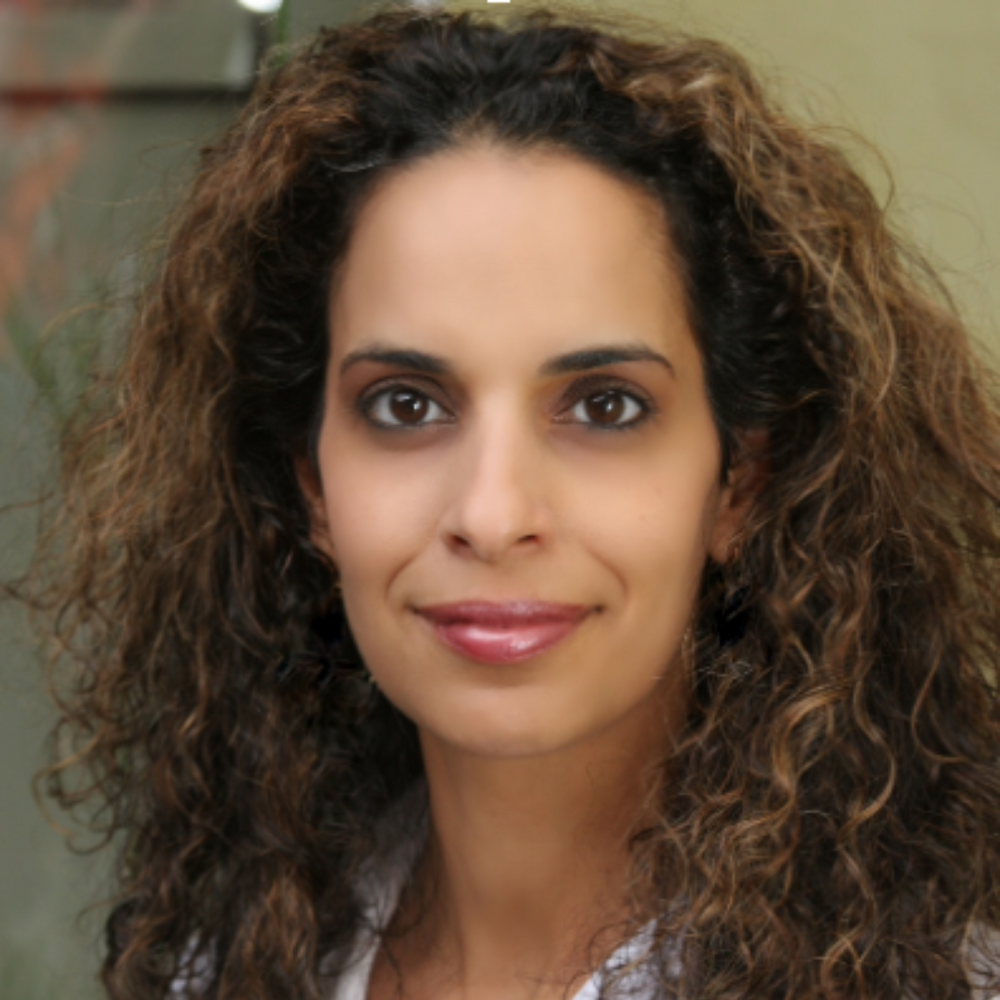
Gilli’s journey began with acquiring valuable skills that would shape her future path. Her dedication to healthcare led her to serve as a medic in the Israeli army after which she worked for two years in emergency care as well as labor and delivery at the prestigious Kaplan Hospital in Israel.
In 1995, Gilli earned her Doctorate from the Israeli College of Complementary Medicine in Naturopathic Medicine. Gilli’s quest for knowledge took her to the United States in 1996, where she pursued studies in Acupuncture and Chinese Herbal Medicine, ultimately obtaining a Master’s Degree in Traditional Oriental Medicine. She is certified by the State of California to practice Acupuncture and Herbal Medicine, boasting over 23 years of specialized experience.
Gilli’s unique Acupuncture style harmonizes her vast knowledge and techniques for the well-being of the body, mind, and spirit. Her expertise encompasses a wide range of symptoms and illnesses, including fertility issues, IVF, women’s health, pregnancy care, and more. Collaborating closely with Western Infertility Specialists, Gilli has achieved remarkable success rates with her fertility patients. Her treatment approach integrates Chinese herbs, diet therapy, and supplements to optimize results.
Gilli warmly welcomes you into her practice, where renewed comfort and healing await. Find out more at www.gilliwellness.com
“ I was shocked about this fact and realized that I was delivering the baby early using a vacuum because I was terrified that he or she could end up dying. It made me wonder if my choice to use a vacuum had been causing tremendous suffering for the baby during birth when they could have been born naturally, without intervention.“
Informed Pregnancy+ is Dr. Elliot Berlin’s brand new multi platform streaming channel dedicated to pregnancy, postpartum and parenting. The Filmmakers Spotlight blog series features creators whose work is showcased on the channel. To learn more or sign up for a yearly or monthly subscription, click here!
A Profession in Dire Need of Applicants
My father was very frail, and soon after I was born, he had to undergo medical treatment in a different location. I was raised by my uncle and his wife as their adopted child until my father opened an obstetrician-gynecologist clinic in Yokohama when I was in 2nd grade. In short, I was raised by four different parents, all with different personalities. My father was carefree and my father-in-law was very strict, it seems I have a similar personality to my biological father. So, I have had four different relationships with each of my four parents, and I feel that this experience from my childhood has benefited me as an obstetrician-gynecologist.
I entered Teikyo University’s newly established medical school, and despite the fact that he was an OB-GYN himself, my father never encouraged me to pursue a career in medicine. However, according to conversations I later heard from my mother, he was quite pleased that I had become a doctor. When I was in my sixth year of university, I talked to an assistant professor of obstetrics and gynecology about my desire to go into internal medicine, and he said to me, “Half of the world is women, right? Only an OB-GYN can see women all the way from babies to the elderly. And since there will probably be even fewer people becoming OB-GYNs in the future, it will be extremely rewarding to be one of the few.” I thought the assistant professor was right and decided to become one.
On January 5, 1989, when I was 34 years old, I opened my own practice, since my wife, who was the daughter of a general practitioner, was hoping to open one as soon as possible as well. Looking back, I am glad that I opened my practice while I was still young because being an OB-GYN requires physical strength to work night and day.
An Encounter with “Prenatal Memory”
When I was a student, I was taught not to get too emotionally involved in my work, and I was instructed not to cry even in stillbirths. I think it is true that if you don’t keep some distance as a doctor, you will not be able to maintain composure and control. If you get too involved with the patient, you may not be able to get a grip on your judgment. In that sense, obstetricians and gynecologists tend to have the qualities of artisans. With that being said, I always wanted to share the moment of happiness of the birth of a new life with my patients.
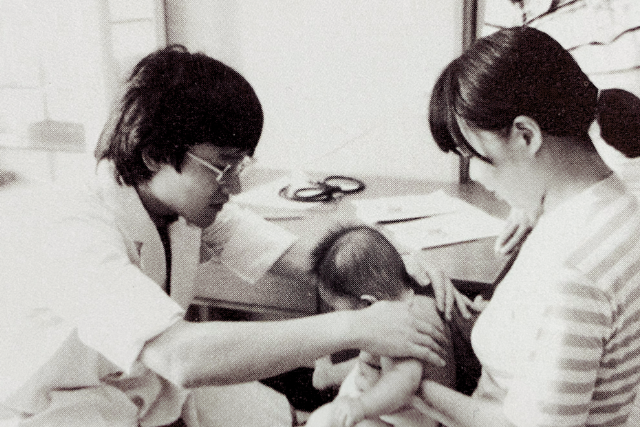
During infancy checkups at that time, there were several mothers per year who would appear in the examination room looking very depressed. According to data, about 40% of mothers suffer from maternity blues. I took various approaches, such as taking time to listen to the mother’s concerns during the checkups, giving advice on parenting, and offering psychological support, but none of them worked.
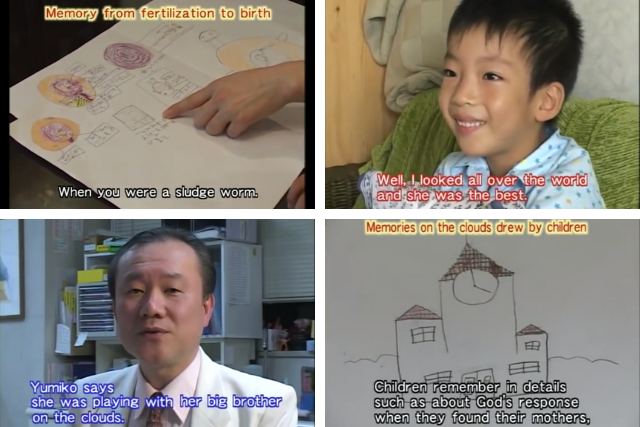
In 1998, a decade or so after opening my clinic, I became interested in Prenatal Memory after reading the book “Creating the Value of Life.” At first, I was somewhat skeptical, but when I talked to a midwife at my clinic about prenatal memory, I was surprised to learn that they already knew about it. As I continued my research on the topic, I found out that the baby hears the voices in their surroundings while they are inside the womb. I started promoting Kangaroo Care and the concept of Prenatal Memory in 1999.
Until then, there were about ten emergency cases per year that had to be taken to a major hospital. Also, data showed that I was performing about three times as many vacuum deliveries as the average hospital. I was shocked about this fact and realized that I was delivering the baby early using a vacuum because I was terrified that he or she could end up dying. It made me wonder if my choice to use a vacuum had been causing tremendous suffering for the baby during birth when they could have been born naturally, without intervention.
About a year after I learned about Prenatal Memory and decided to “Trust and let the baby do what it wants,” I took the data again and found that the rate of vacuum deliveries had dropped dramatically, to about one-fifth to one-tenth of normal hospitals, meaning that I hardly ever used them. In addition, I identified that various problems at the time of delivery dropped dramatically, and I rarely had to call an ambulance. Thus, I naturally began to avoid medical intervention as much as possible because I was committed to trusting the baby’s abilities. Based on this experience, I believe that the duty of a medical professional is to monitor and support the baby as much as possible so that he or she can be born as they desire.
Educating Parents
Furthermore, I began to actively convey information about Prenatal Memory to mothers and fathers to help them develop prenatal bonding by actively communicating with the baby in the womb. I would explain that from the moment of conception, when they see or hear something beautiful, for example, they should tell their baby, “It’s lovely.” When they go for a walk, say “Nice weather,” or when they have a good meal, “Yummy.” If you are too shy to say it out loud, you can say it in your mind and your feelings towards your baby will still be expressed.Practicing communication with your baby in the womb helps avoid complications during birth and creates a positive experience. As the mothers and fathers continue to communicate with the baby in the womb, they gradually become happier. As a result, once born, the babies smile more, cry less, and make more eye contact. I wanted as many people as possible to know about Prenatal Memory in the hope that nurturing prenatal bonding with the baby during pregnancy would increase happy births.
To Promote Prenatal Memory
In 1999, I began to research Prenatal Memory and present papers on the results of my research at academic conferences in Japan, and was featured in newspaper articles and on radio shows. I soon began presenting abroad in Chile and Kuala Lumpur. In 2005, my ,“Investigation by Questionnaire Regarding Fetal/Infant Memory in the Womb and/or at Birth” was published in the Winter issue of the Journal of Prenatal and Perinatal Psychology. Around the same time, I was interviewed by Fuji Television for an 11-minute documentary and the following year, I made a self-produced film called “Tainai Kioku – Prenatal Memory” which is currently streaming on Informed Pregnancy+.
Through books, magazines, radio, and lectures, Prenatal Memory has gradually gained attention. In 2013, a documentary film featuring my research titled “Prenatal Memories of Children” was originally released by director Norio Ogikubo. (English, Spanish, French, Chinese, and Korean subtitles are available) Currently, the audience has reached about 320,000 viewers, by screening and streaming the film not only throughout Japan but also overseas.
Unfortunately, my clinic is no longer handling deliveries. For this reason, I am now working about half the time at my clinic and spend the other half lecturing and actively traveling around to raise awareness of Prenatal Memory. I also founded the Japan Prenatal Memory Education Association and the instructors are teaching Prenatal Memory. The concept of Prenatal Memory is gradually spreading around the world.
Since Prenatal Memory is about consciousness, we start to realize that we do not only exist physically but as multi-dimensional entities with minds and souls. Therefor pregnancy is the best time to start communication to nurture a mindful person who can create a compassionate world for the future. If we can have relationships based on the concept of Prenatal Memory throughout the world, we will be able to recognize and respect each other’s characteristics.
Together, I believe we can build a peaceful world through Prenatal Memory.
Dr. Akira Ikegawa, MD is an OB-GYN, author, and lecturer who has an extensive background in the research of the concept of Prenatal Memory. He distributed about 3,600 questionnaires consisting of 85 questions in 2002 and 2003 and continues to interview people about Prenatal Memory. He guides expectant parents and practitioners on how to communicate with babies in the womb, and delivers lectures nationally and internationally about the extraordinary stories that he discovers from his research.
Elliot: Welcome to the Informed Pregnancy and Parenting Podcast. I’m your host, Dr. Elliot Berlin. My guest today is an acclaimed actress originally from Bombay, India, who has captured audiences worldwide with her performances and award-winning films such as “Slumdog Millionaire,” “Rise of the Planet Apes,” and the “Immortals.” In addition to her incredible acting skills and career success, she is also a passionate advocate for women’s rights and a dedicated humanitarian. Today, we’ll discuss her journey through motherhood, including some of the differences between Indian and American birth culture. Freida Pinto, welcome to the podcast.
Freida: Thank you so much, Doc. It’s so lovely to be on your podcast. I might have told you that the first time I heard of your podcast was through Mandy Moore. Because she had reposted some of the videos and I started going deeper and deeper and deeper down into your other episodes and guests, and I just found it so informative. I’m a very happy that you’re in my life and being very happy on many, many mother’s lives.
Elliot: Oh, thank you so much. That means the world to me. Especially coming from you, such a giver. Let’s start at the beginning. You’re from Bombay, what was that like growing up?
Freida: Very, very transformative. I can say that now, in retrospect. Because, obviously, when you’re a child, you’re not thinking about, “This is going to be actually a very important experience in my life,” growing up in a culture which is so diverse, so secular, we have all these various religions that coexist in India. We have different people of different classes that coexist in India, in Bombay specifically. I was too young to understand how that was going to shape me or inform how I look at the world, and how open I will be to different opinions and different people. It really shapes up tolerance.
So, I really do credit my upbringing, my childhood in India, in Bombay, to being the open person that I can be today. Even though we’re just surrounded by Indians. No other people from other countries. But there is a lot that is going on within that beautiful, big complex country and definitely complexity. What do you want to specifically know about my childhood? Because there’s so much to it.
Elliot: Well, I don’t know. You’re kind of an amazing person today, so I always wonder where that came from and how it was nurtured. Do you have siblings?
Freida: I do. I have an older sister who is four years older than I am. When we were growing up, I really looked up to her and wanted to emulate her. I wanted her used clothes. I was all about hand-me-downs. Don’t buy me new stuff. What my sister had, I wanted, and she kind of found that very annoying. I was a typical younger sister who was just like following her around everywhere, wanted to live in her shadow. She just found that like her little baby past, and she loved me for that. But she also wanted me away from her.
Like, siblings go through sometimes in their lives, we had moments where we were close, moments where we were not so close. And now, we’re inseparable. We’re like each other’s best friends. I rely on her for her wisdom and her perspective on life, which is different from mine, but also complementary, if that makes sense. I think I almost need someone like her in my life to make sense of what I am going through. I have great perspective, too. I would like to believe. We share that with each other. I think we’re just so bonded. We’re so close to each other.
Elliot: Did you guys leave India for travel?
Freida: Together? Yes, we did. We traveled much later in life outside India. We went to Barcelona. In fact, she was sending me pictures about this fun trip we had when we went to Barcelona. When I was nominated to the BAFTA, she traveled with me, with my mom, to London. That was a lovely experience. But I will tell you, India is such a diverse country. You can find this landscapes and scenes that you see in, let’s say Switzerland, or Morocco, Afghanistan, or the beautiful beaches of Southeast Asia. You can find a little bit of all of that in India.
And so, my parents made it a point that we traveled and really got to know our country. My mom’s brother was in the military, in the army, in the armed forces. And so, he was always posted somewhere in India, and we would go and visit him. From there, use that as an opportunity to see more of India. India is so diverse. I mean, there’s just so much to see. I still don’t feel I’ve seen it all. But my sister and I did make a lot of travels, trips, some vacations together within the country.
Elliot: How did you get into acting?
Freida: I think a part of it was that it was kind of ingrained in my DNA even before I knew it. I have a very dramatic godmother, my mom’s sister. My mom can be very dramatic, but it’s all not professionally used but somehow used in family life and everyday life. I think I inherited it from them.
And, my dad always says this. That if I became a doctor or an engineer, he’d be very worried for me because he just knew from the very beginning I wouldn’t be happy, that isn’t what I was cut out to do. They saw me being creative from the time I was really, really little. I should tell you, I was born in a middle-class family, born and raised as a good Catholic girl. I went to Sunday school. Part of the reason why I enjoyed going to Sunday school was not necessarily being immersed in religion or Catholicism, or any of that. It was really the extracurricular that I found to be very much part of it, which is I was allowed to write and perform my own play. I was always writing. I conducted the children’s choir.
Elliot: Oh, wow.
Freida: Yeah, I did that. I was very passionate about it. One of the things that I always — my sister actually reminded me and I feel like even before I knew it, it was already my life’s mission. I love watching other people shine. I love being part of that journey when someone is shining. I love being someone who either set up the foundation, or came while the foundation was already set, and just kind of mentored or set someone forward. I just love the activity of doing that. I think that has informed the producer in me without even knowing that it was I was already doing it. That was what I feel like I already had cemented my place in the creative world, in the producing world, very early on.
And so, acting happened, I think it was all about being in the right place in the right time. I started off as a model, wasn’t interested in it because no one wanted my opinion and I had a lot of them. I wanted to be part of the journey of creating a photograph, or creating a video. I was always told to just shut up and do the work, “Just do what you’ve been told. You’re a model. Just stand there and smile.” You know what? There’s a time and place for that, and maybe I had way too many opinions but I just knew that was not for me.
And then, I hosted a travel show and I traveled all over Southeast Asia. I traveled to the Fiji Islands for the first time, which is Asia Pacific, Singapore, Malaysia, Indonesia, Thailand. Like travel, travel, travel. Loved it so much. Just when that show was coming to an end after nine months, I literally felt, “Oh my God! This is the end of my life. What am I going to do next?” And then, started this six-month-long audition process for a little film that we did not know was going to be called “Slumdog Millionaire.” It was just a little film that I ran an audition for, and there were at least like 3,000, 4,000 other hopefuls all over the world old. And so, I really feel right place, right time, passion, manifestation, always wanted to do this. That’s where I landed. That’s the start of my career.
Elliot: Okay. The travel show around Asia sounds amazing.
Freida: It’s so good. So good. I don’t know! Sometimes, I really talk about [unin], but I really enjoyed it. I was like, “This is a pillar!” sometimes, there is really nothing to show. So, I just talk about a pillar. But, anyway, I really enjoyed it. It really opened my eyes. I traveled so much within India, and it really opened my eyes to culture to — again, respecting things that were different from how I was raised or who I was.
Elliot: You said six-month audition process.
Freida: Very long.
Elliot: What happens over six months?
Freida: Have you seen the film? Have you seen “Slumdog Millionaire?”
Elliot: I haven’t seen it.
Freida: Okay. You haven’t seen it. Okay. There are three age groups in the film. My character’s name is Latika in the film. There is a little Latika, and then a teenage Latika, and then — not adult Latika. Like, I wouldn’t say. I was like 14-year-old, 13-year-old Latika, and then a 17-year-old. I was supposed to be the 17-year-old.
But when we started the audition process, they auditioned me for someone even younger. They thought they were going to shift all the ages. You can only imagine the task that the casting director has upon her, and the entire team has upon them, to find the right children to teenager, to slightly older teenager, to kind of resemble each other. Don’t have to necessarily resemble each other, but feel like they’re part of the same story.
As frustrating as it was for me, because I was like, “I know you like me because I’ve been narrowed down to like the final 10. Just give me the part.” But, they have to find the older character first, and they had to find the main male lead first, and then match us all. It was like a jigsaw puzzle. We really had to put it all together. I feel like those six months auditioning for the film with Danny Boyle, wonderful, wonderful British director. I mean, literally, made me who I am today, was actually my acting course in a way. I was going in every time. They were throwing in new challenges, new hurdles. Also testing my patience. Also testing my level of commitment and dedication. I feel like it was like a mini acting school for me. I’ve never been to acting school, or drama school rather. This was like that course for me.
Elliot: Still today?
Freida: I still haven’t been there.
Elliot: That’s so interesting. So, on-the-job learning?
Freida: On the job learning, yeah.
Elliot: Wow. Okay. Growing up in India, were you inspired by any particular type of entertainment? What were you exposed to? What did you long for?
Freida: That’s a very good question. My father loved old films from the Indian cinema. The Indian film industry is kind of very robust. We have the typical commercial films. But then, we also have something that they call arthouse films, which gets like a negative connotation in India, that it is slow and boring, but it isn’t. They’re very, very well artfully done. But, those were the films that my father really exposed me to.
There’s this actress, who I still say is my role model. She passed away in 1984; Smita Patil. She was absolutely brilliant, absolutely brilliant. We might just have to check the age, edit 1984. I’m not entirely sure, but I think it is 1984. And so, Smita Patil, she was kind of a revolutionary of her time. She would play these female protagonist roles that were groundbreaking, that were bold, that were taking a stand, that was against the patriarchy. I just found it to be just so inspiring because that was not what we were necessarily always surrounded by growing up in India and cinema. But, the roles that she took on really informed that if I ever did something, I wanted to feel that got a role and that like it’s coming from deep within my body. It is matched with my instinct.
Those are the films that my father exposed me to. And then, when I went to college, I studied film and literature, which is one of my subjects when I was studying English literature. I was exposed to a lot of world cinema. And, [unin] became one of my favorite filmmakers. I still feel they, I still harbor the hope that one day I’ll get to work with him.
Elliot: Was it a conscious choice? Because it looks like most of your work is in the British and U.S. industry. Was it a conscious choice to not pursue Indian film?
Freida: Wasn’t a conscious choice at all. It was just about going with the flow, really keeping my eyes open to what was being presented to me. I really trust that there is a force that is greater than us. Some call it God, some call it the universe, call it whatever you might want to. But, I feel there’s a force and that this field of energy that we all feed off. If you kind of just stay committed to putting out what you really want to do, and then going with the flow, I think it just leads you to your — it shows, starts showing you the path. That’s exactly what I felt.
Because listen, “Slumdog Millionaire” was going straight to DVD. A lot of people don’t know this. This was the year of the recession, like Warner Brother was the studio that the film was going to be released under, our distribution angle. They were folding in, and we were going straight to DVD. This middle film was never going to be seen by anybody probably. And then, somehow, we got into the Toronto Film Festival. All of us actors, nobody knows us it. We’ve never done a movie before. We’re just literally nobody’s at this point in time. We walk down the red carpet. Again, a very funny story.
There was no press at the red carpet. Because they were like, “Who are these kids?” Like, “Why should we come and take their photographs?” We have to hire our own photographs and basically stage our own red carpet. And then, release those photos because we had nothing. It was all done in the most playful, innocent way because we were not thinking of the coming stars. We were just happy that the film finally got a chance, that people were going to watch it. We got a standing ovation at the end of the movie. From then on, it was non-stop. That just made me realize that if I don’t seize the opportunity and go with the flow, then this one will be gone too. Just stay open and just go with the flow, and that’s how it happened. There was no conscious decision to be part of Hollywood. There was no conscious decision to just do British cinema or not to Indian cinema. It was just going with the flow.
But, I will tell you when I was very, very young, I would have this vision that I was on a world stage. Now, I don’t know what that really meant. Because my Sunday school teacher asked me the question like, “What do you want to be when you grow up?” Typical question you ask every kid. I said something like, “I want to stand on the world stage, and I want what I do to make a difference.” That’s all I remember, and I don’t know why I said that. She still reminds me that I did. I actually remember that I did say that. So, yeah, just following my path.
Elliot: You’ve only grown from there. Before we jump into your new role as a mother, do you have a favorite role that you played and something on your wish list that you hope to do?
Freida: Yeah. One of my favorite roles that I played was this TV show called, “Gorilla.” It was on Showtime and Sky Atlantic in the UK. It came at a time when I — various reasons. I think the role was beautifully written, super radical, very required. It was also very misunderstood when the TV show came out. It felt like I was taking away roles from other people, from other communities, but actually that wasn’t true. There was a lot of true inspiration behind the character that I played.
However, despite the backlash the show got, I realized how proud I was of the role. That no amount of backlash could make me not feel proud of it, or no amount of backlash to make me regret it. That just made me realize, I had grown in my profession. That I was fully committed and that I was fully taking responsibility. I went into it with my eyes open, and I walked out of it with my eyes even more open.
Elliot: Wow, that’s so powerful. That’s so powerful. Wow! What a distance from when you were modeling, and they were just like, “Shut up and…”
Freida: “Shut up and pose!”
Elliot: Yeah. And then, what about aspiration? Something you’d like to do.
Freida: Yes. Something I’d like to do. There’s a lot that I would like to do. But I think, from the point of view, I do a lot of drama. I should just say that. I do a lot of drama. I’ve attempted comedy, and I do like it. But, one thing that I’m really hoping to do is a really memorable rom-com. Because there are many rom-coms, right? There are many, many rom-coms. A memorable rom-com would be “Bridget Jones Diary.” I’m really hoping to do a memorable one.
Elliot: Well, I’ll watch that.
Freida: Yeah, I know you will.
Elliot: I always feel bad because I don’t really watch TV and movies because of my face blindness. When a character comes out, and then goes away, and comes out, I’m like, “Who’s that?” Every time. Every time. It’s the most annoying thing for me or for anybody around me. It’s like hard work to try to follow things. But, I will watch your memorable rom-com.
Freida: Okay.
Elliot: Let’s take a little break. When we come back, we’ll find out how you got from there to motherhood, and how that’s going. We’ll be right back.
[Break]
Elliot: Welcome back. We are talking to Freida Pinto. Okay. Now, you don’t live in Bombay anymore. Where do you live now?
Freida: I live between Los Angeles, California and Austin, Texas now. I do go back to Bombay every now and then. It’s been a few years. Actually, I’m going back next week. I’m so excited.
Elliot: Oh, wow. How nice.
Freida: I haven’t gone back in I think almost three years now. Because of the pandemic, I didn’t travel much. And then, I had a baby. So, I didn’t travel much. Home now is between Los Angeles and Austin.
Elliot: How do you like U.S. living?
Freida: I do love it quite a lot. I feel this is my home, and I don’t know where else I would be at this point. The two cities I mentioned have an equal measure, hold importance in my heart, and my growth, and my friendships, and my friends who have become family. Also, Austin, I particularly chose for peace of mind. I love Los Angeles, but I couldn’t be here all year round. There is a certain frenetic energy that I enjoy, but I can also feel very anxious in that frenetic energy all the time. I need to escape every now and then.
Elliot: Need the recharge.
Freida: The recharge, exactly. The recharge. The rethinking what creativity really means. I feel I can do that in more quiet spaces, quiet places. I will say I’ve been talking about the American dream quite a lot. Especially, after this year’s Oscars even more so. There is still in my mind and in my heart, I do believe, that this is still the land of opportunity. It is still unfair in many, many ways. In many ways. And, no country is perfect, neither is India. No country is perfect. But, this country still presents a lot of opportunity. I also believe hard work always pays off.
Elliot: I think that’s true. Oh, everything that you just said, I agree with. How did you meet your partner?
Freida: I met my partner when I was filming in New York. I was filming this TV show called “The Path.” My co-star, Aaron Paul, the loveliest person ever. He loves love. He loves the idea of love. He wants all his friends to be in love, and I was not in love at that point in time. I was living in New York for the first time. It was actually a dream, by the way. I always wanted to live in New York. But, for some reason, I was always working and traveling. And so, L.A. became home base. And then, this travel, this TV show presented its opportunity for me to live in New York. I was living my best single life, going on non-committal dates, and truly enjoying life. And then, Aaron decides to kind of put a little twist to my single life.
He goes, “What kind of guy do you want to date? You see, I feel like you go on a lot of dates. What kind of guy do you want to date?” I was like, “Aaron, don’t match me. Don’t set me up. I am not ready for that. I also don’t want to do that. Because what if this person you know you set me up with, ends up being a d-bag? And then, I have to come back to set and look at your face for the next six months. Don’t do it. Don’t do it. Don’t do it.” He’s very stubborn, and I’m so glad that he’s stubborn, and so full of heart. He introduced me to his best friend, Cory. Because the two things I said was — because he said, what kind of a person you want, right? I just had to kind of shut him up. And so, I just said, “Someone who operates from a place of spontaneity, and someone who just loves travel and culture.” I just left it at that. There you go. The next thing you know, he’s introducing me to his very adventurous friend, Cory, who’s traveled to more than 68 countries.
Elliot: Holy cow!
Freida: Yeah. More than 68 countries. Has literally has a truck and a tent attached to his truck, loves to camp, almost never says no if there’s a plan. Yes, he’s in. It’s amazing that I just said it, and he just knew it. [unin] matchmaker really, really well. Thank you, Aaron Paul.
Elliot: Aaron Paul needs an app.
Freida: He does. He does!
Elliot: Oh, that’s so cool. Okay. And then, how long have you guys been together now?
Freida: We’ve been together now for about 4.5, 5 years. Actually, five years. Have been married for 2 years, yeah.
Elliot: Congratulations.
Freida: Thank you very much.
Elliot: Like, starting a family. Was motherhood, parenting, family something that you had thought about either as a kid or teenager or when you started to date? And, together, how did that come up for you and what kind of thoughts did you have on it together?
Freida: When I was a kid, for sure, I thought of myself having a wedding, and I would get married, and I thought of myself having kids. Most of these things I thought would happen when my mother had kids, which was around the age of 26. I was born when my mom was 30. So, I thought somewhere in the 20s, all of this would happen. But, my gosh, Doc! The 20s are so confounding, and I would never want to be anywhere in my 20s again. Teenage years, great. I wouldn’t mind going back there. Thirty is great. I wouldn’t mind going back there as well, because I’m almost towards the end of my 30s. I’m looking forward to the 40s. But, oh my God!
Elliot: You don’t hear that a lot.
Freida: I am looking forward to my 40s. I hear it gets even better. I mean, I feel better every single day. But, the 20s were really not good.
Elliot: In what way though?
Freida: I really did not know who I was in my 20s. I was really trying to figure things out. I was always left confused. I felt like I had good instincts, but could never really reach out to them. Also, a huge thing happened in the 20s, which is my career. I struck this pot of gold in “Slumdog Millionaire,” and life just changed very dramatically. There was a lot of adjusting to do in my 20s. I actually stopped thinking about kids, and marriage, and all of that stuff. I was somewhere in my late 20s, early 30s, in a very toxic relationship, and I needed to get out of it. Somehow, I found myself going deeper and deeper into it.
And then, a year and a half later when I got out of it, which is when I went to New York, I was like, “Don’t get me anywhere close to the idea of a relationship that could turn into a marriage, and don’t get me anywhere close to the idea of children.” I just ran away from it. I was like, “It’s not for me. It’s not for me.”
My sister kept saying that to me. She goes, “You know, it’s a good phase that you aren’t. Just be in it. Think about it. But also, don’t make final decisions in this phase because I think you’re going to change your mind when you meet someone you really want to partner up with.” Well, that was Cory, who was very sure he wanted to be a dad. Very, very sure. All he wanted to do was be a dad.
On our very first date, I will never forget, it was a lunch date. Because I don’t do dinner dates and drinks if I’m meeting someone for the first time. I do lunch and coffee, which I know is so unromantic for a lot of people, but whatever. That’s how I do it.
Elliot: I don’t know. It seems pretty L.A.
Freida: Yeah. Does it?
Elliot: Does to me.
Freida: Okay, good. Maybe somewhere deep down, I’ve become very L.A., and I don’t realize it. Anyway, I had lunch with Cory in New York. After the lunch, he texts me, “You know we’re going to get married, right? And, I’m going to marry you.” Whoa! I don’t want to ever speak to this person again, but how very interesting as well. I was both attracted and put off at the same time. Let’s say he was right, he was right. He knew it. As I’ve been continued dating Cory and realized that this man doesn’t trigger my anxiety, does not make me feel like, “I have to be on. I don’t have to always be on. I can just be myself.” That’s when I realized, I wasn’t something different for the first time.
Elliot: Wow! That’s pretty powerful, too. You have all these like powerful milestones.
Freida: I think about all of them in retrospect. I think about things now in the moment, because I’m also a mom. I think it has really kind of harnessed my ability to really tap into my instinct and feel confident about it. But, a lot of things I do think of in retrospect as well, “Oh, that happened for a reason. I can see the picture now.” I didn’t see it back then or in that moment. I knew something magical was happening, but I see how it all played out. It’s kind of beautiful. I think some of my stories come from that. The stories that I want to tell.
Elliot: Yeah. What you now.
Freida: Yeah.
Elliot: Once you decided on kids, did pregnancy come easy?
Freida: Pregnancy came very easy. But, the first pregnancy did not stick, and that wasn’t easy at all.
Elliot: Miscarriage.
Freida: A miscarriage, yeah.
Elliot: I’m so sorry.
Freida: Thank you. I never thought that I would ever have a miscarriage. I’m sure most women don’t think that way. But, more so, because as a woman who gets pregnant, you think health is paramount — and, yes, all of that is paramount. Like, you’ve got to be healthy. You’ve got to be rested. All of that stuff is important. But there are other things that are not in your control, and that design is also dependent on what is going on internally and what is going on with the conception. The pregnancy that I had was defined as a triploidy, which is a chromosomal abnormality. The pregnancy wasn’t going to stick anyway. I was in my 12th week. That’s when we couldn’t find the heartbeat, and it completely destroyed me. In that moment — well, I do want to share this because I think it’s very important.
No matter how knowledgeable, or informed, or wise you think you are, I feel somewhere deep down in the DNA of every woman is ingrained some level of guilt, some level of self-blame, and some level of shame. The first thing that came out of my mouth when nurse practitioner is trying to find the heartbeat and she couldn’t find it and she said, “Oh, mama. I can’t find a heartbeat.” She held my hand and the first thing that came out of my mouth was, “Is it because I exercised too hard?”
Elliot: Oh, my goodness.
Freida: I don’t even know how I put that in my head. I couldn’t even stop it. I just blurted it. The next thing I said was, “Is it because I took my thyroid medication too late?” None of it was connected to why I miscarried, but that’s how we all think. Well, it took me a while to come out of it. Luckily, and unluckily for me, I was filming. I was, literally, in the middle of filming a high-octane thriller.
Elliot: Oh, my goodness.
Freida: Where I had to scream, and cry, and then be scared, and run. I had an emergency DNC. This was all in Albuquerque. I found the most amazing MFM in Albuquerque, who supported me, Dr. Ruma. I feel like that was a very eye-opening experience for me. Really, really eye-opening. Because I was not only going through — the pregnancy was actually very hard, the first pregnancy. I always had a lot of back pain. I was very, very nauseous. I could barely eat. It’s always super tired. I did not connect any of that to, “Oh, the pregnancy won’t last.” Because a lot of women have difficult pregnancies, and they go on to have healthy babies.
Elliot: Especially, that part of the pregnancy.
Freida: Correct. I didn’t think of it. I didn’t make much of it. I think it was very eye-opening. Because what I experienced during the months following the miscarriage was very much a little bit like postpartum. Hair loss, hemorrhoids.
Elliot: Physically like postpartum.
Freida: Physically like postpartum. I wasn’t even thinking postpartum, because why would anyone be thinking postpartum when you get pregnant? You’re thinking about the joy of the pregnancy and the discomfort that you might be feeling with the pregnancy. But, you don’t ever think of postpartum. It really opened my eyes to: A, how misunderstood the postpartum journey is. Because it kind of almost hits early on in a miscarriage if you end up going through it. But also, we’re never prepared for it. Never prepared for it.
Elliot: You know what’s so super interesting to me, obviously, miscarriage is pretty common. I only say that now you know, that miscarriage is pretty common, especially in the first trimester. Although, 12 weeks is very hard. The reaction that you had is pretty typical of what I see. A lot of not just sadness, but “What did I do wrong?” More often than not, it’s almost like your body did something right, which was to identify this is a non-compatible with life pregnancy, self-criminate, and get ready to start again. But, what I never thought about until this moment is the postpartum element after a miscarriage. I never thought about that. It makes so much sense.
Freida: It makes a lot of sense. I had someone really important in my life at that point who held my hand through it all. Her name is Elisa Biddy, and she’s written two books. The first one’s called “The Woman Code,” and the second one’s called “In the Flow.” It’s all about hormones, and it’s all about what happens with your body through your menstrual years. But then, also around pregnancy, and then postpartum, and then finally, menopause and beyond. And so, I kind of really reached out to her. I told her I’m experiencing something that I never thought I would experience. I’d never had hemorrhoids. The miscarriage, the emergency DNC that followed that then led to other gut issues, which by the way was also made worse because I was filming night shoots. Eleven continuous nights right after the miscarriage. It was brutal. Absolutely brutal.
No one knew I was pregnant. Hence, no one — just a few people knew that I had a miscarriage because I had to take one day off. I just had to take one day off. And then, I came back. And then, there were these running scenes and whatnot. I had excessive bleeding actually after my emergency DNC, which is why I had to take the one day off. Because I was in the hospital getting bags of blood. It was also now on a mental level, very traumatizing. Because I wanted to mourn, but at the same time, I just wanted to get my job done. I just felt like this was my responsibility. I cannot let down an entire production. And, I also looked at it as a way to escape the pain.
But, when it all got done, when we finally ended up filming, ended up wrapping the movie, I went back to Austin and I just started eating anything and everything I could. Things that were self-sabotaging, things that just felt good at that moment, and that also affects how your body heals. I learned that the hard way and I don’t regret doing any of that. But, it took me a month and a half to recover from what I was putting myself through.
Elliot: I just can’t even know how hard that is to go through just by itself. But then, to just have to like be so on and on camera.
Freida: Full camera.
Elliot: On camera and active. As if nothing happened and surrounded by people who have no idea that this is what you’re going through.
Freida: I remember that my costume — I had to tell my costume department, the head of the department. I had to tell her because I had to wear these pads to absorb the blood loss, which means the way my clothes would fit would also look weird. And so, I had to tell her. The way that the three women from the department stepped in and held me so close. Because most of the project was surrounded by mostly men, and I do not know who to reach out to. I finally told Alexandra, one of our female producers, but I also told the costume department. Gosh, it just makes me so emotional. The way they held space for me every single day just made me feel like I wasn’t alone. Even though it felt like a very lonely experience, I felt like that space was hell for me. The other person I actually want to credit is actually my trainer, Patrick Murphy, who actually introduced me to you as well.
Elliot: Yeah.
Freida: He also held space for me. Because I had to kind of physically stay active in some way shape or form for this film. He tailored and changed everything about my workout routine to just help my body cope through what it was going through. I think all of those elements really came together for me. Last, but not the least, Cory. He literally drove down back from Austin. This was all during the pandemic. Drove back from Austin, stayed with me, and really, really took care of me.
Elliot: Wow. I’m so sorry that you had that difficult experience. I’m glad for you that you were able to find support. It sounds like some really solid support. I’m grateful to you for sharing because, as I say it all the time, it’s a conversation that needs to be had and isn’t had on a wide enough scale. So, thank you. Let’s take another little break. When we come back, we’ll find about your recent pregnancy, birth, and postpartum. We will be right back.
[Break]
Elliot: Hey, welcome back to the podcast. We’re talking to Freida Pinto. Okay. Now, you have a child. How was your pregnancy, your second pregnancy, through the trimesters?
Freida: My second pregnancy wasn’t — again, getting pregnant wasn’t difficult either. Partly, I credit that to my brain that operates like a scientist at times. Which is with my first pregnancy and also my second pregnancy, I tracked everything from ovulation days, and I knew which phase of my menstrual cycle I was, and I was very much on top of it, and very, very in tune with my body. After the miscarriage, after I took about a month and a half to really kind of heal my body and prepare my body once again, it really didn’t take me very long to get pregnant again. I was pregnant four months after my miscarriage, and I was on another film set.
Elliot: Oh, great.
Freida: In Ireland. This time, in a corset.
Elliot: How do you do that?
Freida: I was shooting a period film that I was also producing. I was trying to get this film off the ground for four years. Finally, it happened and I also got pregnant at the same time. Again, on the first day of filming, I literally knew I was pregnant and did not tell anybody. I did tell my co-star. Like, I was saying it changed my perspective on early sharing, my miscarriage. This time around, it was largely a female-driven project as well. I took a lot of people into confidence, and I told them. I also told them I was very nervous and very scared because the miscarriage experience had marred me a little bit, scarred me a little bit, and had made me very anxious. I had enough support from the very beginning.
By the way, this time around, I did everything differently. I did not do any kind of early screening. I just went with my gut, and think. I did call Dr. Ruma from Albuquerque far too many times just to tell him I was scared and nervous. He really encouraged me to just stay with my instinct. He was like, “You’re going to be fine. What has to happen will happen, but you’re going to be fine.” And, it was!
Apart from the bloating, I realized now that one of my biggest tell-tale signs that I’m pregnant is really not my pregnant tummy, it’s my bloating. I bloat immediately when through both these pregnancies, and it was wonderful. I did not have the back pain that I had last time I had. The mild nauseous feeling. I managed to eat bland food through it all. I managed to work out through the entire first trimester with Patrick Murphy. It was a very largely different experience. It baffled me how four months prior to this pregnancy, the previous pregnancy was riddled with so much more pain and discomfort. Like I said, in this movie I was in a corset. Somehow, I got through it and I got through my entire first trimester filming this movie called “Mr. Malcolm’s List” in Ireland. Not a single screening, just keeping myself as healthy as I could. Keeping myself active. Keeping my brain as calm and my mind as calm as I possibly could. That was my first trimester.
Elliot: Did you work through the other trimesters?
Freida: I walked through my second trimester as well.
Elliot: Not in a corset?
Freida: Not in a corset. In a Christmas movie, which you don’t want to see — it was not a pregnant character. But, I had already signed on to the movie. And then, I told the director that, “Hey, you might want to recast me. Because my character — because I’m pregnant, and I’m more than happy to shoot while I’m pregnant. I don’t have an issue shooting while I’m pregnant, but I will be showing somewhere through the filming of this period and this movie.” They were like confident. They could shoot it in ways that you not see my pregnant. Actually, I do believe that you see my pregnancy a little more in “Mr. Malcolm’s List” than you see in the second one.
Elliot: Really?
Freida: Yeah. Because I was so bloated in the first one. Not a lot of people knew that I did have to somehow slip it into the producers, and then the DOP found out, and was trying his best to shoot without like– Also, you don’t think someone is going to be looking pregnant in their first trimester. I feel like my corset did push out at certain points. I was like, “God, release the corset!”
Whereas, the second one, we just can’t shoot certain angles and it was out there in the open. Everyone knew I was pregnant, but it was fun. I had so much fun. I was shooting in London. By the way, all during the pandemic. So, there was a level of fear, which is, “Oh, my God. I don’t want to get sick. I don’t want to be ill.” But, at the same time, there was this excitement that I get to stay active and I get to do the thing I love and make these memories with the child who is soon going to be born.
Elliot: First credits.
Freida: First credit. My gosh, yeah. He was in every film I did
Elliot: What were your thoughts during pregnancy? What influenced your thoughts on how to give birth?
Freida: I think that’s again, a very, very good question. After the miscarriage, my focus had actually shifted from preparing for the trimesters, to preparing for the postpartum journey. That became something that took a lot of importance in my planning head because of what I had experienced. But, because of what I had constantly was told by my American mother friends, that their postpartum journey was brutal, that they had pelvic floor dysfunction, that the doctors didn’t listen to them. And then, they would start sharing their birth stories to me and telling me how certain interventions were forced on them, or they were made to feel scared, that this intervention was required. And so, I kind of backtracked a little bit and I said to myself, “Now, I need to plan what this birth is going to look like, along with the postpartum journey.” I read a book called a “Guide to Childbirth,” by Ina May Gaskin, who is I guess Tennessee’s most acclaimed midwife. I would say America’s most acclaimed midwife.
The first 60 pages of the book are all about various women who have had their babies with phenome gaskin, all of their birth experiences, and how varied they all were. Some of them were having their first child, and some of them were having a V-back, and some of them were having the third child. It was insane how different and vastly different each woman’s experience was. I really took that all in. I absorbed all of that. I sat with all of the stories and started envisioning what I would want my birth to be like.
Now, I did choose Austin to be the place where I would give birth. I did choose a hospital where I would give birth. But, I was very clear to myself, my doctor, and my husband, that I wanted to labor as much as possible at home, in the comfort of my home. I was also very clear that I had a birth intention. I don’t want to say birth plan. Because you can have a plan, but then sometimes, something else might happen which might shift your plan and you just have to stay open to how best you can use this newly thrown curveball into your plan and still make it your own. And so, I had intentions. With intentions, you can mold around it.
My intention was I want to have an unmedicated birth. I wanted to labor on my hands and knees because that’s my most comfortable position. I have a lower back issue, a chronic lower back condition and I wanted to push on hands and knees if the doctor would allow it. Because I know that Western-trained OB-GYNs are not necessarily trained in any other position other than being on the back. I was aware of all of this. I had read all of this in Ina May Gaskin’s book, but I would advocate for myself and my husband and my postpartum doula would advocate for me as much as possible. I will say that 98% of my intentions were met by myself, and by my doctor, and by everyone surrounding me. The 2% that I kind of felt like take the path of least resistance. You are about to push this baby out is when the doctor did not allow me to push on my hands and knees. She put me on my back because I did not have an epidural, and in her mind that would have been the better way to go.
Anyway, path of least resistance, I could hear Cory really advocating for me. “No, she wants to go hand and knees. That feels better for her.” I could hear Jillian, my postpartum doula. I looked at both of them, looked at my doctor, and in the state of like trance-like state, I was like, “We’re not going to argue right now. Because I don’t see her changing her mind and this might turn out into an argument. I will make this as comfortable as possible for me on my back, and let’s go for it.” Rumi came, 10 days early kicking and screaming, six hours of labor.
Elliot: Six?
Freida: Six.
Elliot: Wow. Okay.
Freida: I had a very Hollywood kind of laboring experience. They say you’re water almost never breaks? I had my water break all over my carpet.
Elliot: Oh. At least you’re home.
Freida: At least I’m home. Exactly. I had all of that happen. I was like, “Oh! You told me this almost never happens. It all happens in a hospital, where someone kind of breaks your bag of water.” But, my body did it for itself.
Elliot: Okay. Why was unmedicated important to you?
Freida: It was important to me because, throughout my life, I’ve had this one kind of — I don’t know. It’s not a mantra really, but it’s just something that I believe in. A belief that I want to experience, and feel everything, and be very aware of what I’m feeling, and experiencing, and be very present. I’m also aware of my threshold for pain. I have high pain tolerance. I was aware of that as well. And so, going into it, I knew it was also a mind-of-a-matter kind of thing, and that I was doing pretty well with my yoga and my breathing techniques. I was also inspired by the things that I read in Ina May Gaskin’s book. I kind of really wanted to enjoy what my ancestors enjoyed. If it was written for me.
Elliot: In the end, you did that. What were the sensations that you had?
Freida: I will never forget. I won’t be able to recreate that pain in any which way. I don’t even want to call it pain, because it’s even higher than pain. It’s not painful, it’s out of this world. But, the pressure that I felt in my abdomen, it was almost like it zapped the air out of my body. It literally was like I couldn’t breathe. Like, I was winded. Every time a contraction came by. I remember that it just like put me in this trance-like phase where I was not moaning very loudly. It was just like [whispers]. Like, my breath was just taken away from me and I was finding deeper and deeper and deeper places to go to find new air. Like, almost creating an imaginary lung for myself, two imaginary lungs outside of my body.
It was a very out-of-body experience. I will say this, which is a kind of scary to say it sometimes, but I will say. I will do pushing a baby out without an epidural any day over breastfeeding. Because the initial days of breastfeeding were possibly the most confusing, it almost like kind of demoralized me at times, because it was so difficult. Well, in the end, I breastfed Rumi for 16 months. I still miss them sometimes. But, the initial days of breastfeeding, God! I wasn’t prepared for it.
Elliot: Okay. That brings me to my next question, because I know you were concerned about postpartum. I mean, with breastfeeding being that much of a struggle, that can be helpful on top of everything else that happens postpartum. What was your general postpartum experience? A: how was it and how was it compared to what you thought it would be? And then, B: how did you deal with breastfeeding struggles?
Freida: Yeah. Along with reading Ina May Gaskin’s book, I had read another book by Kimberly Ann Johnson called, “The Fourth Trimester.” Now, I’m not a lot about reading books. And then, because you can’t put a mother in a book, you can’t put a baby in a book. Everyone has their own individual experiences. But, culturally, I come from India, so I was already informed with the wisdom and the knowledge of age-old practices from Ayurveda, and how you help with the postmodern journey, and help mothers cope with the postpartum journey. I knew I could create a postpartum sanctuary for myself, for the physical healing, which will then also have its benefits on mental healing and just taking time to yourself, et cetera.
I had my mom with me from India. I had my postpartum doula. I also had support from my ayurvedic consultant here in Los Angeles. In many ways, I felt like I was cocooned into a space of a lot of warmth, and nurturing, and nourishment. Food-wise, I always say, it’s really important. The first meal that you have at the hospital, or after you’ve given birth, yeah, go out. Do whatever you want to. Just make sure that you’re nourishing your body.
My first meal was a warm broth with chicken and vegetables and rice, and I just wanted it to be that way and felt so nourishing. But then, as I progressed — and my first three months was brilliant, by the way. Brilliant, because I had so much care. But, the breastfeeding journey, I don’t think I could ever be prepared for that. I had done a lactation course just to help myself, understand what I was going through.
But, Rumi had his own plan. He wanted to have a very shallow, interesting latch that only made my nipples hurt and bleed. And, in the middle of the night, feeding. When I would hear him crying and he’d be brought to me, my toes would just curl from the pain I knew I was about to experience. I would literally sit in bed and cry there. “I don’t want to give up. I want to keep going. But why is it so hard? Why is this so hard?” Everything else is — my body is finding its way to come back. And “come back,” by the way. Not snap back to what it was before, but find its place to heal. But, why was breastfeeding so hard? It took me about two months to figure out our little compatibility with breastfeeding. Rumi and I really struggled. I mean, he struggled because I was always in pain, but he got fed. He was properly fed. No problem. But, it was very hard, for sure.
Elliot: This is a warrior mentality that you’re going to get through it. It sounds to me like I would quit.
Freida: If someone wants to quit because it’s really hard, then so be it. There’s nothing wrong in it. Everyone needs to choose what is right for them. I just have a “don’t give up mentality,” which is sometimes doesn’t work in my favor, by the way. In this case, it works out just fine. Because sometimes, it’s okay to give up. It’s really okay to give up. You don’t kind of become a smaller person or a weaker person because you’ve given up. You’ve made a choice for yourself. And, that in itself, is a very strong thing to do.
Elliot: Oh, Freida, you just made me feel a lot better about my hypothetical mom yourself, struggling with postpartum and giving up. A couple more questions as we’re tapering down here. Number one, your postpartum cocoon that you created, sounds very much like how things might have been a century or two ago, where you are just surrounded by people from your family, your village, whatever that is for you, nurturing you, supporting you, and helping you. It sounds like that kind of really worked for you. Would you sort of compare Indian birth culture to U.S. birth culture? Are there things that we can learn from and improve here?
Freida: Yeah, so much. So much because they’re vastly different. There is a very go, go, go competitive comparative “foster is better” mentality here in the United States. Snapback, still, get match again. Like, it’s just very depressing when a woman has just gone through this complete body-opening transformative experience and is then asked to just shut down and pretend like nothing happened, and just get back to work. And so, I feel like on a big high-level level. Policy change is very much required. I mean, six weeks of paid leave will not cut it. In some cases, that doesn’t even exist. As we all know that, that doesn’t even exist.
On a policy level, there’s a lot that needs to be done. On a more familial level and a more community level, I think understanding what that postpartum journey is for a mother, for a new mom, or for a second, third, fourth-time mom is very important. Family members need to understand what they’re walking into. The expectation to just snapback is something that they have to realize is something that the society and the system has put on us, but it is not natural. It is in no ways natural at all. Sorry if you can hear Rumi crying. Can you? If you can’t, it’s fantastic.
I feel making space for a new mom. One of the things I always say, baby showers are huge in this country and people love doing big celebrations on finding the gender of the baby and whatnot. If we can spend our money for our friends, our family members, on helping them access things like a postpartum doula. Because those things are expensive and policy change, as I’m talking about it, insurance doesn’t cover that. It’s brutal. It’s absolutely brutal. It’s expensive. It’s not lost on me that I speak from a place of privilege, that I can actually have access to these things because my money can pay for it, even though my insurance doesn’t. Education about what your body is going through. Basically, helping the mother through meal trains, or subscribing them to some kind of a meal service, helping them have access to a pelvic floor therapist. The first 30 days if possible to really help the mother just rest and recover because a nourished mother is equal to a nourished baby. So, instead of spending money on a new fancy crib, and lots and lots of newborn clothes, which quite frankly the baby never wears. I’ve now seen that. Your baby is in a nappy or a diaper the whole time, so don’t spend the money on that.
Spend on the things that are far more important, which is put the mother first. Put the mother first. I could go on and on, but there’s books and books available out there. I really highly recommend reading Kimberly Ann Johnson’s book, “The Fourth Trimester.” I also recommend reading Ina May Gaskin’s book. There’s information out there on how we can help moms. By the way, if I have to plug in something that I am working on, I have the chief impact officer of a brand a company called “Anya,” where we are providing verified information from resources like ayurvedic consultants, acupuncturists, chiropractors, pelvic floor therapists, OB-GYNs, postpartum doulas, all on their website for free. The subscription is for products. All of that information is available. Not Dr. Google. Go away from Dr. Google. Dr. Google is damaging.
Elliot: Dr. Google speaks so many languages. Alright, Freida. Thank you so much. This has been an incredible episode. I learned a lot. I really appreciate you sharing your personal journey with us. Where can we find you online?
Freida: On my Instagram account, which is @freidapinto. F-R-E-I-D-A Pinto. I don’t do anything. I don’t tweet, and I’m not on Facebook. I’m not a big social media person. But, if I have something important to say, I always find my way to put it out there.
Elliot: Okay. Well, I’ll look for you there on Instagram. One thing I wanted to tell you is we are doing on Informed Pregnancy Plus, a video streaming platform, a series called “Baby Book Nook,” which is a video reviews of books related to pregnancy, parenting, and postpartum. Two of the books on our list are “The Fourth Trimester” and Ina May’s “Guide to Childbirth.” We’ll have them up there pretty soon, and those are two great recommendations from you. We’ll be covering them. Thanks again. At home, if you want to find us online, you can visit informpregnancy.com.
Elliot: Welcome to the Informed Pregnancy and Parenting Podcast. I’m your host, pregnancy-focused chiropractor, Dr. Elliot Berlin.
My guest today is a TV actress who has battled endometriosis. She’s now pregnant and expecting her first baby very soon. We’re going to talk about career, endometriosis, pregnancy plans for birth. And, I’m super curious about a condition that she has called aphantasia which has some similarities to my weird prosopagnosia. Stay tuned. Natalie Dreyfuss, welcome to the podcast.
Natalie: Hi! I’m so excited to be here.
Elliot: I’m so excited you’re having contractions.
Natalie: I know. It caught me on a good day.
Elliot: On a crampy day. Amazing. We’re going to get into everything. Well, let’s start at the beginning. Where are you from originally?
Natalie: I am from Los Angeles.
Elliot: Did you leave and come back, or are you still here?
Natalie: I’m still here.
Elliot: You didn’t travel around.
Natalie: No. I’m a rare native.
Elliot: Seriously. First of all, I thought everybody was a transplant. But I have been to the East, the North, the South, Midwest. I like it here best.
Natalie: Yeah. I’m definitely not attached to it. I would be happy to live somewhere else eventually. But it’s interesting to be born in LA and raised in LA. Strange town.
Elliot: And watch everybody [unin]?
Natalie: Yeah. It’s like being out of a city of broken dreams. I was just in it. I was just placed here. I didn’t come here. It’s an interesting place to grow up.
Elliot: You were cast in this dream.
Natalie: Yeah. It’s a little bit of like a lonely city.
Elliot: You act. How did you get into that?
Natalie: I’ve avoided it as long as I could really. When you’re from LA, I think you make that choice pretty early to either stay far away or get into it. I was a ballerina growing up, and then I actually taught preschool for a little while. And then, I missed performing art. So, a friend said, “You should take an acting class. It’s really fun. You love games. It’s a bunch of games.” I was like, “Ugh! No.” But, I did and I ended up really falling in love with it. It was so different for me than ballet was. It was just as unique as you can be. That’s the best way to go.
Elliot: And your feet could be flat on the ground.
Natalie: Yeah. It’s not a torture chamber. Ballet was just like you have to fit this mold and you’re never going to fit it, and acting’s the opposite. I got pretty hooked. It was later in my life. That was 21, 22.
Elliot: That’s how I feel about airline seats.
Natalie: How do you feel about airline seats?
Elliot: It’s like you have to fit this mold and you’re never going to fit it.
Natalie: Right. That is ballet.
Elliot: So much in common. Did you start ballet a little, little?
Natalie: I did, yeah. I was in ice skating first. I was probably 5. And then, into ballet.
Elliot: Ice skating.
Natalie: Yeah. I chose all these strange solo sports.
Elliot: Especially, from Los Angeles. It doesn’t seem so native.
Natalie: Yeah. But, I was oddly graceful as a kid. I would win the competitions and stuff, and found myself in dance. I think about now, I’m like, “What a weird kid.” I just had this longing and grace for a 5-year-old, 7-year-old. I was like, “What is that?” Just falling in love with classical music and just this bittersweetness of this child, I don’t know. It’s so interesting to think about as an adult, but I got really far in that career and took it too seriously. And then, once I was injured, I danced on that injury for a long time. Eventually, it was, “Okay. No one’s happy here. I got to get out of here.” But, I had dedicated–
Elliot: [unin]
Natalie: Yeah. I dedicated so much of myself to ballet that I had no real education. I dropped out of everything. And so, I just always loved babies. I went to a preschool, walked in, and was, “I’m great at this. Can I just be here for a couple years?” They were like, “No. That’s not how this works.” But, they let me be a TA for a while and I started hanging out with the kids. I feel they really saved me.
Elliot: It’s probably mutual.
Natalie: Yeah. I hope so. I hope those kids remember me. I’ve just always been sure about wanting kids and feeling like that was what I was meant to do.
Elliot: First of all, do you watch ballet, or do you appreciate other people doing ballet, or you enjoyed doing it yourself?
Natalie: It’s pretty painful, honestly. Because it was just such a traumatic life and there was so much that went into that. Really, I couldn’t get back into a ballet class as an adult. I couldn’t really enjoy it anymore. So, watching it is kind of like, “Oh, it hurts a little bit.” But, I’ve got to do some ballet on my series that I work on. Once I found out that I could do it, they kind of wrote it into my character. So, that was the first time that those two worlds had collided, which is really cool.
Elliot: Yeah. My ice skating world collided with a lot of people.
Natalie: Oh, I bet.
Elliot: I did not have fun memories of ice skating. Okay. So, you take an acting class. So, curious what kind of games. Was there anyone that sticks out in your head that was like, “That was a fun game,” or a purposeful exercise?
Natalie: In acting class?
Elliot: Yeah.
Natalie: Oh, my gosh! There’s so many. I still, to this day, get so addicted to games like catchphrases or code names. Where you’re on a team, when you’re working together, and you get to play in each other’s mind. You’re like, “Oh, I bet this person thinks like that. I’m going to preemptively decide how to get them to say what I want them to say or affect them in a certain way.” There was a lot of games like that in acting class.
Elliot: Hmm. Sounds like you could be on “Survivor.”
Natalie: It just felt so fun. I don’t know physically, but mentally.
Elliot: Mentally. There should be “Mental Survivor.”
Natalie: I don’t know that you or I are equipped for that, but try.
Elliot: I don’t know, but I’m definitely not equipped for the other “Survivor.”
Natalie: Me either.
Elliot: From those classes, how did you get your start and build your way up?
Natalie: Because I was born here and born around this business, I just had a good attitude about it. I didn’t really want anything from it. I didn’t crave fame, or success, or any of that. Auditioning, it just put me in a good position where I really was, “I’m good at this, so take it or leave it.” I came in with a lot of confidence because there wasn’t a lot to lose for me. I really just knew I wanted to be a mom, and that this was kind of a way to make money to do that, and I enjoy it. I enjoy it for reasons that are probably different than other actresses.
Elliot: Ooh, do tell.
Natalie: I like the teamwork part. I like being on a set, and being a really great teammate. Where I fall on the team, I don’t care that much. If it’s in front of the camera or not, or directing, or whatever it is, I just like to be a really great cog in the mechanism of making something with a bunch of people. I like to bring a lot of really positive, really grateful happy energy to a set because all sets could use it. So, anyone that’s worked with me knows me as the girl that is happy to be there.
Elliot: The positive one.
Natalie: Appreciative. It’s like, “Oh, good. The girl that likes to be here is coming today. Great!”
Elliot: I was happy around craft services. But outside of that — I was a theater major. Anytime we had a production, I loved two things about it. One is that puzzle piece. You’re a piece of a puzzle. You’re a piece of an orchestra. One musician has a bad note, one instrument goes south, the whole well-tuned orchestra sounds funky. And then, also the live audience, their response. The interplay with the live audience was, for me, that was almost therapeutic. Having that instant gratification.
Natalie: Yeah, me too. I fell in love with multicamera comedies, because they’re live audience. And so, it was the best of both worlds.
Elliot: Oh, yes.
Natalie: Television, but live. It was so fun. That was always my dream was to continue on that path. I mean, after COVID, we’ll see what that looks like. But, that’s where I really shine.
Elliot: That’s a win-win. I didn’t even think about that.
Natalie: Oh, it’s so fun. It’s the best schedule, too. It’s such a fun schedule because you’re rehearsing all week, and then you shoot on Fridays. It’s just like a big play every Friday. And then, you drink and have fun afterwards, and then do it all again on Monday. It’s a good time.
Elliot: You’re selling it well, I’m going to say that, Natalie. Okay. So, you’ve always wanted to have kids. Now, it sounds like your wish is coming true here in the not-too-distant future. Where’s your partner from? How did you guys meet?
Natalie: I found a lovely Canadian man. Yeah, I love Canadians. We met 10 or 12 years ago, and then we started dating six years ago. On our first date, we went and had a drink together. I knew he was a writer. He sat down and started telling me how much he wanted kids, and how much family meant to him, and how this business doesn’t really mean anything to him. I just did not buy any of it. I was like, “You’re such a writer. Who told you my story? Are you selling me right now?” I did not buy it. He’s handsome and sweet, and Canadian. I was like, “What is going on? Who is this? This is going to be a problem.” And so, I brought in reinforcements. I was like, “Guys, come meet this guy. This makes no sense. I think he’s lying about everything.” Or he’s the perfect person, I don’t know.
Elliot: To find mine.
Natalie: Yeah. It was really scary. I have dated in LA for too many years to fall for this. We laugh about it all the time. Because, now, we’re having this little baby girl and we talk about that date a lot, and how much we spoke about this on that day.
Elliot: On your first date?
Natalie: Yeah. It was our first date. We talked so much about having babies together. Not necessarily together, but what it meant for each of us.
Elliot: That you each wanted to have children.
Natalie: Yeah. That it was number one. In LA, you don’t really hear that. Everyone looks at me like I have two heads because I care more about having a family than a career. But, I get in other parts of the world that’s not crazy, but Los Angeles it is. So, I just couldn’t believe I’d met a man who felt this way. Every other guy I dated had said a lot of stuff like, “Yeah, yeah. One day, I’ll totally want that.” I’m like, “Okay. Well, you’re 45. So, let me know when you are ready.” I think it was really meant to be that I ended up with this person that cares so much about this. The pregnancy has been so fun because he’s made it so fun.
Elliot: I have to meet him. He’s sweet.
Natalie: Yeah. He’s a really classically Canadian nice person.
Elliot: I can’t stop saying, but does he say “aye”?
Natalie: Oh, yeah. I say it now. Well, he’s French Candian. But he doesn’t say, “a boot.” But he does say, we both go, “Oh, that’s crazy!”
Elliot: Alright. So then, since six years ago, you had this conversation about having kids. Did you plan when you were going to have kids?
Natalie: Yeah. We actually went through a breakup right before the pandemic, which I didn’t think we would make it back from. And, 2020, man! It just changed me, changed all of us. My life really just took a weird turn for the last couple of years. It was super, super challenging. We broke up in November of 2019. By the time March came around, nothing really dramatic happened between us. It was just a decision. And then, we both were like, “So, we’re going to be there for each other, right?”
During this, we live five minutes away from each other. We’re not going to not take care of each other. So, we spent a lot of time together in the pandemic just making sure we were in a bubble. Who do you want to watch movies with? It’s the person you’ve been watching movies with for three years and feel comfortable with. I really feel like it brought us to a different place in our relationship. But, I was traveling a lot because I was shooting in Canada. I did five 14-day quarantines. So, I did two and a half months in a room by myself.
Elliot: Per exposure?
Natalie: Yeah. Because every time you go to Canada, you have to quarantine 14 days.
Elliot: You have to quarantine? Oh, wow!
Natalie: In a hotel room. You can’t open the windows, can’t open the door. They leave food at your doorstep and walk away. Mentally, it really broke me. It actually broke me.
Elliot: Fourteen days is a long time.
Natalie: Yeah. I know. And five of them? It was intense. And so, I really felt like I needed comfort so much when I was home and I was scared of everybody. I had this autoimmune disease. I took it really seriously. I was also working, and so grateful to be working. So, I was completely isolated. He agreed to really isolate with me. We took it very, very seriously. It really brought us together, and put us on this new path towards eventually having this conversation of, “Are we ready to try and have a baby?” We had that conversation, and this little miracle showed up.
Elliot: I love the silver linings.
Natalie: Yeah. It was a crazy path, honestly. I listened to your podcast so much. Seems you took my phone and saved a bunch of episodes. I got super addicted to this podcast. I just loved it. I started listening to a bunch of my friends have been on it. It’s a small town. I just kept thinking, I’m like, “Wow! What is my story? When he asks me, ‘How did I get here?'” I just started thinking about the last couple of years, and this path to this baby, and wow! It was interesting to think about what I was going to say when you asked me. I haven’t really reflected on it too much because it’s all happening so quickly.
Elliot: Oh, I love it in real-time.
Natalie: Yeah. It happened definitely in real-time. Just hearing other people’s stories and their paths to pregnancy, and what this has been so far even before this baby gets here. How much it’s changed everything. I’ve done a lot of reflecting in the last couple of days.
Elliot: I’m glad I can help.
Natalie: Thanks.
Elliot: What were you shooting in Canada?
Natalie: I work on a show called, “The Flash.”
Elliot: Barry Allen.
Natalie: Barry Allen.
Elliot: It’s all my 12-year-old talks about.
Natalie: That’s so sweet.
Elliot: Barry Allen. Barry Allen. He got everybody in our family to watch “The Flash.” Not just an episode. He would sit down even for the ninth time of Season 1, Episode 1 with a family member who’s visiting from another town, and be like, “You got to watch Flash with me.” Watch all those episodes all over again until they were all caught up.
Natalie: That’s awesome.
Elliot: So, at least, something came out of your five 14-day quarantines.
Natalie: Yeah. I really worked hard for this job.
Elliot: He appreciates you.
Natalie: Yeah. It was a really great experience. They’re done now. I wasn’t able to make it for the final season, but I am so super grateful for all the time I got to spend with them. It’s a great show to be on.
Elliot: I hope somebody else was the cheerful person after you left.
Natalie: I know. They know me as the person that loves to be there.
Elliot: Alright. Now, let’s take a break. When we come back, we’re going to find out about your pregnancy. We’ll be right back.
[Break]
Elliot: Welcome back. We are talking to Natalie Dreyfuss. Very pregnant. Beyond 37 weeks. So, in the zone. Could happen any minute. Well, let’s start at the beginning. You have endometriosis. When did you find out about that?
Natalie: I’ve always had a really tough GI system, and it’s been called lots of things over the years. But, I have struggled a lot of autoimmune stuff and been to a million different doctors and specialists. It was a weird one because it’s invisible and very hard to diagnose. It took a long time to get a formal diagnosis. And, really the only way to do that is to open you up in the core.
And so, my plan was always to wait until six months before I was going to try to get pregnant before I did that surgery. I ended up not having to do that. I was able to get pregnant and much, much faster than I thought I would be able to. We tried once and she showed up. I could not believe that. My whole life, I just thought this is going to be a huge long journey for me and I was really prepped for that, and that is not what happened. I feel like, “Oh my God!” Miracles showed up. That’s so crazy.
Elliot: What were your endometrial symptoms like?
Natalie: Really severe chronic pain, daily pain. Not just like menstrual pain. There’s two days a month where I really can’t move during my cycle. I have what I believe to be endo on my colon. And so, it causes extreme motility, and spasms, and cramping. Really fun symptoms every day. It kind of mirrors stuff like Crohn’s, and colon cancers, and stuff, but I’ve been scoped for all that stuff a million times. The only difference is it’s every day. There’s not flare-ups. I’ve been on a lot of medications and I’ve tried a million different healing modalities.
Eventually, in the last couple years, I took a real left turn and started doing some somatic stuff and trauma stuff, and finally started looking into that. I do feel like there was some really beautiful stuff that came out of that.
I’ve gotten to live the last nine months with no endo. It is the best I can eat whatever I want. No pain. It’s the coolest experience to just have a normal life for a couple nine months.
Elliot: Your pregnancy is helping with the symptoms.
Natalie: Yeah. It’s amazing.
Elliot: Maybe this is why you didn’t realize but, internally, you always wanted to have a lot of babies.
Natalie: I think there’s probably many reasons, but that’s definitely one.
Elliot: Contributing factor.
Natalie: Yeah. Being able to eat is a real bonus.
Elliot: I mean, I’m really glad that you — I guess, the opposite of the typical reputation that pregnancy gets is making you achy and uncomfortable. For you, it’s the opposite.
Natalie: Yeah. I think I didn’t realize what my life would be without endo. And so, being able to experience it for the past nine months has just been so transformative.
Elliot: Would surgery be at all corrector for you?
Natalie: The surgeries are tough. You can remove. It does grow back. It’s abdominal surgery, which takes quite a while to recover from. I was playing a superhero on TV, like in a tight suit. There wasn’t a lot of abdominal surgery time to recover. And then, after it grows back, it’s only a few months of relief.
They say that pregnancy can have lasting positive effects, and it’s different for every person. There’s just not enough information about it. Basically, I just want to be pregnant forever.
Elliot: Are there certain things — I mean, now, you’re at the very end. But, highlights about the pregnancy about things that you felt and things that your body has done or changes that took place that are highlights for you either on the ups or down highlights?
Natalie: Yeah. I made this decision that getting pregnant and staying pregnant was going to be a huge challenge in my life, and I braced for this huge challenge for years and years. And, to make this decision to try and to have this happen on my first try and come so easily and come so quickly and stay with me and make it past that 12-week mark, I just feel like miracles happen. You just don’t know what you’re bracing for. I was so convinced that I was on this really tough path and I’m trying to really keep that with me before this labor and before being a parent is just like you don’t know. You don’t know what’s coming and you don’t know what to be bracing for and you can’t predict how good things can just show up for you.
Elliot: It’s really sweet to hear. Maybe a reward from the universe for all your positivity on set.
Natalie: I do bring a lot of positivity. I’m like, “Guys! There’s free food here. What are you so mad about? Let’s have a good day.”
Elliot: I could see it not being as boring with your energy there. Okay. What kind of things have you been doing to take care of yourself mind, body otherwise during your pregnancy?
Natalie: I’ve met a really amazing group of people. Yourself included. In this world of birth and labor, and all these practitioners, it’s such a cool world. I got to you through Britta Bushnell, who’s been such an amazing little angel throughout my pregnancy journey.
Elliot: “Transformed by Birth.”
Natalie: Yeah. I love her book so much. I got really overwhelmed at the very beginning of my pregnancy with how much information. I just had never really researched pregnancy and birth. I was like, “Oh my God! Where do I start?” Someone in a mommy group said, “You should read Britta’s book. I think it’s really a nice middle ground of making you feel like you’re not going to set yourself up to be disappointed or fail in some way, if like there’s a certain way you get attached to wanting to do this.”
I think, to take care of myself mentally and spiritually, I have really followed that path and really wanted to just give myself the opportunity to be transformed by this birth, and meet some incredible people on the way through chiropractic like you, or pelvic floor therapy, or my incredible doctor, and I have to become birth obsessed. It’s a rabbit hole. You get sucked in. And then, I’ve been listening to your podcasts and stuff. It’s just so fun. I feel it’s going to be such a big part of my life forever now.
Elliot: Well, I think you attract things from the universe. It happens to be in Los Angeles where pretty tight-knit — I feel like we’re pretty tight-knit in the birth community. I just feel super blessed to work with colleagues that are so good at what they do and so dedicated to what they do, and so into the process, and then make a living at it versus how can I milk some money out of it. Britta has been on the podcast a couple of times and her episodes are so popular. Even people who had never met her. Just the pearls of wisdom that she has from her depth of background in so many different areas. And then, your OB is also a friend of mine. She’s wonderful. How did you guys connect?
Natalie: I was actually with a different OB and I had a pretty scary experience, and I just felt really dropped. I felt like I’ve been through a lot of medical trauma stuff. I really followed my instincts and was like, “You know what? I know I’m 32 weeks into this, but this just isn’t the right place for me. I need to find something else.” And, it’s hard to find someone at 32 weeks. Nobody wants to start seeing you.
So, I called everyone I knew and I asked Britta for help to find a new OB. When I met Dr. Perlow, I just knew right away that this was going to not only change my birth experience but also my endo experience. She’s an incredible woman that cares so much about women’s care, and she taught me a lot about advocating for myself. She was really proud of me for leaving and being ballsy about it, and just knowing that that wasn’t the right doctor for me. I’m standing up for myself. I got pretty mad at this. I definitely stood up for myself, and was like, “This isn’t okay. You can’t treat people like this,” and walked away. So happy it was like this weirdly dramatic experience, but it brought me to this incredible woman. I just feel like she’s going to be in my life forever.
Elliot: I feel like if ever you had to switch at 32 weeks, Dr. Perlow’s amazing to switch to. Because she’s so available and spends so much time with you. Anyway, that it’s not like you’re only going to spend five minutes a week with her.
Natalie: I know. She’s taking care of me like I’ve never felt in my life.
Elliot: When I met you, your baby was not head down.
Natalie: She was breeched.
Elliot: She was breech. When did you find out about the breech?
Natalie: I was breech at 34 weeks. It turned out that’s why I was having pre-term labor contractions. And, when I got to Dr. Perlow, she knew right away. She was like, “Your baby’s breech.” Why didn’t they catch this? And so, basically, she took it really seriously right away and wanted me to do all the Spinning Baby stuff, and come see you. I took it really seriously and was trying everything I could to help her turn. And then, seeing you, I was so grateful because you really put my mind at ease that she was going to do it. They were like, “I believe she’s going to do it.” I was like, “Oh, I hope she does.” And then, I saw you one time and she turned the next day.
Elliot: Oh, that’s amazing! I would never say that if I didn’t think it was true, but just all the different factors that you had going on in your particular case really seemed like she was going to end up head down. I’m really glad for you that she’s in your back on track.
Natalie: Yeah. It’s also just changed my back problems so much. I didn’t realize how hard it was to carry her around when she was breech. It’s hard now for different reasons.
Elliot: The pressure is someplace else.
Natalie: Exactly.
Elliot: Okay. Let’s take a little break. When we come back, we’ll talk about your intentions for birth, but also this crazy thing called aphantasia. We’ll be right back.
[Break]
Elliot: Welcome back to the Informed Pregnancy Podcast. We are talking to Natalie Dreyfuss. Okay. You’re going to have your baby in a minute. But, right before you do that, let’s talk about this. We’re having a conversation and I don’t even know exactly how it came up. You’re like, “Oh, I have aphantasia.” I’m like, “What is that?” And, you tell me what it is, and I thought I was weird because I have prosopagnosia, which means I’m face blind. I can never picture somebody’s face in my mind. I can’t describe it. Every time I see a face, it’s a new one every time. And then, you tell me, “Oh! Well, this is what aphantasia is.” What’s aphantasia?
Natalie: Aphantasia is a blind mind’s eye. It’s the inability to conjure images.
Elliot: Right. First of all, how did you even realize you have it? Because who knows that you’re not seeing things the way other people are when they close their eyes and try to imagine.
Natalie: Yeah. It definitely is something I had no idea. I was living this totally unique human experience until I think two years ago. I saw it on social media. It was going around like a test. It was a really simple test. It just said, “Picture a purple apple.” And then, it started asking you questions about what you were seeing. Whether it was the shade of it, or if there’s light hitting it. I was like, “What are you talking about?” I’ve never seen a purple apple. I know purple and I know apple, but I can’t bring up an image of those things and then describe it to you. I’m like, “What are you talking about?” And, they showed a graph of things you might see and there’s a huge spectrum, and mine is an abyss. I see black. I see nothing.
So, I started to look into what this meant. I was like, “I really think that this makes a lot of sense for who I am.” So many parts of my life start to fall into place. It’s such a weird thing because it really is a unique human experience. You had mentioned to me. You were like, “Yeah. I have face blindness.” I was, “I have mind’s eye blindness. I love weird neurological things. Let’s talk about it.” It’s so fascinating.
Elliot: Yes. Must be serious at some point. We must do a series on this. Here’s what’s crazy though. You told me about it, and I was so fascinated. Because I’ve spent the past — now, it’s about 10 years since I know about my face blindness. Just telling people about it, and they’re always like, “Oh, tell me more. It’s so fascinating and curious.” I’ve seen people diagnosed after having a conversation with them because they had no idea what it was and they said same face blindness is about 1.5%. So, 1.5 out of every 100 people might have it. It’s also a spectrum. Aphantasia seems actually a little bit more common, more like 4 or 5%.
I was just so fascinated. I went home. I was sitting by my computer, and I was reading all about it. It was like, “Picture a rainbow,” and I closed my eyes and I’m like, “Okay.” All these other things, I was like, “Yeah. I can do that.” And then, I was like, “Wait a second. Can I do that?” I didn’t realize until I had to hold up a bottle of Aquafina in front of my face, look at it, see it, and then close my eyes and try to visualize it. I realized I have the abyss. I just have like a black screen with little shades of lighter darkness moving around, but I don’t see that bottle at all. I can describe it. I can tell you the label, roughly how much of the bottle the label takes up the shades of the color on there. But, it’s a logical description. It’s not a visual description. I’m not describing what I’m seeing. I’m describing what I know the bottle to be.
And now, I’ve taken a bunch of people — literally, since meeting you and you’re telling me that, I’ve taken at least 100 people. I’m like, “Close your eyes. Picture a rainbow. Can you see the rainbow? Do you see the colors? What’s the second color down? Can you turn the rainbow upside down? Now, it’s on its back. What’s the second color down now from the top?” And, some people just see it. You can tell in living color, like the highest 4K, whatever. They can see everything. You could ask them to pivot three degrees to the right, and they can tell you what that looks like. Some people grasp with it. Some people see real rainbows. Some people see cartoon rainbow. But then, I do your test, about the purple apple, and then you can really tell. People like, “Wait a second. I’m not seeing the apple.” And just describing the apple, it’s really interesting. The diagnosis only came around like 10 years ago or something like that.
Natalie: There’s not a lot of research about it. But, they have some really interesting TED Talks about it. It does go hand in hand with face blindness quite often, which is why I thought of it when you said that. I was like, “Oh, I have this thing.” And, sometimes, it goes hand in hand with face blindness. I don’t have face blindness, but I couldn’t describe my mother’s face too. Like, I know it. I know that she has blue eyes and white hair, and I could describe her to you. But, it’s not because I’m conjuring the image of my mom. And then, just looking at it and describing that image to you.
Elliot: You’re dealing with your mom what I do with the Aquafina bottle.
Natalie: Yeah. I mean, that was one of the tests I found online. It was, “Picture someone’s face that you should know inside and out,” like have no problem bringing up an image of because you stare at it all the time. And then, they ask you like, “Which direction is it facing?” It just gets me every time because I’m like, “No direction, what?”
Elliot: Yeah. It’s weird. It’s right there, it’s just–
Natalie: I don’t know. It’s just there. I’m like, people have Netflix in their heads. They go to sleep at night, they close their eyes, and they have Netflix in their head. I’m so jealous. I’m so mad that I see an abyss.
Elliot: You’re a dreamer.
Natalie: I do dream. It’s interesting. Because your mind is hungry for images. So, when you dream, you do see a bunch of images. It’s just in your waking life, when you’re trying to conjure an image, you’re not able to do that. It’s really weird and it affects me, specifically in really specific ways that I always just felt a lot of shame around. I was telling you I get lost all the time, I don’t have a mental map. Because I can’t picture the route home until it’s there. I’m driving up to it, I’m like, “Is it left?” Just weird stuff like that. I’m a very on-it, responsible girl. So, it’s weird to me that I’m lost all the time, or that I can’t seem to ever stay organized when I really want to. But a drawer is my nemesis. I close a drawer and it’s like, “Well, who knows what’s in there until we open it again.”
Elliot: You can’t picture what’s in the drawer?
Natalie: Right? You have to kind of memorize–
Elliot: How it’s laid out?
Natalie: Yeah. Things like labels are such a relief. Like, “Ah, put a label on it.”
Elliot: There’s some kind of agnosia there for you, too. Topographical agnosia. Like, Oliver [unin]. He didn’t have GPS, so he could never figure out how to get home unless he took the same exact route every single time.
Natalie: Oh, yeah. I definitely have some of that. What’s weird is that I told my mom this and she was like, “This makes a lot of sense about you.” And she also said, “What did you think directors were doing?” You’ve been in this business for a long time, “What did you think directors were doing?” I was like, “I genuinely thought they were just getting a bunch of people together that are good at their department, and then saying I basically want something like this. And then, just seeing what happens.” She was like, “What? No, they see it in their heads and they get people that are good at that thing, and they put them together so they can have these images come to life.” I’m like, “What?!” That’s insane. Because to me, I was just like, “Oh, get someone that’s great at lighting. And then, explain to them what you want the feel of the film to be. And then, see what they do.”
Elliot: Wow! We launched this platform, Informed Pregnancy Plus, with video and films and content also in the same demographic as our podcast. But, one of the things I’m putting together is a library of guided imagery meditation. Even though it’s a video platform, I was really just going to have obscure shapes on there. Just things that if you’re watching on TV, that’ll just help your mind zoom out. But, after our aphantasia conversations and discoveries, I’m actually doing it differently. I’m going to put in things like when I’m trying to have you visualize things. I’m going to try to have those things on the screen at that moment. So that if you’re not able to, if there is no mind’s eye, you can open up your eyes and be brought to that place is my hope.
Natalie: Yeah, that’s great. I have that on Headspace. The meditation app will show you cartoons of different, really big concepts that they simplify and kind of make cartoons out of. It always is just such a great way for me to understand a concept that’s complicated is just to see it played out in front of me because that’s not something that I’m able to do.
Elliot: Yeah. I don’t dream. Once in a blue moon, I’ll have a dream. But, all I’ll remember about the dream is there were no faces.
Natalie: Right.
Elliot: So, I don’t even know who the dream was about.
Natalie: Yeah. I definitely don’t have faces in my dreams either.
Elliot: That’s weird. I don’t know.
Natalie: Sometimes, I see colors.
Elliot: You see colors in your dreams.
Natalie: For sure, I see colors. Because I will remember them when I wake up. I’m like, “Oh, yeah. That was a colorful dream.” I know I see something. It’s an interesting thing to be an actress from this perspective because I feel like it really helps me be better at my job. Because I’m not like married to some image of what I’m supposed to be doing, or how I see the scripts playing out. So, when I get to set, I’m so malleable. Because you know if you explain to me basically what you want, I’m like, “Okay, great. I’ll show you that in a million different ways and you can choose your favorite.”
Elliot: And never the same way twice.
Natalie: Yeah. And, I’m not going to be mad if it’s different from what’s in my head, which is very difficult for a lot of actors to let go.
Elliot: Yeah. [unin]
Natalie: I’m hoping it helps with my birth as well, is that I don’t have this image of how it’s supposed to go.
Elliot: I actually find, as a doula, that being a doula for actors, experienced actors, is unique happening in itself. Because you take direction really well. Especially also, you have had such intense pain in your life, physical pain. I don’t know, I think those two could actually work in your favor. And, with the direction, it’s sort of like the Britta’s stuff where if your conscious mind is starting to go in one direction, somebody who you trust around you could potentially help you fairly easily move to a different take, a different perspective on what’s happening in that moment. I just find even with coaching and breathing, if that’s what somebody wants when I’m out of birth, that actors take it really well. You’re great with direction. Hopefully, that will serve you. I’m glad you brought that up. Because that’s our last little thing to talk about right here before you go have your baby. What are your intentions for birth?
Natalie: Like you said, Britta’s book has really shaped my intentions. I love that she talks about making pregnancy, and birth, and labor, and new parenthood a real meaning-making experience. She talks a lot about rites of passage. I had to make all these decisions. I got pregnant, and that’s like, “Okay. You have to make all these decisions. Where do you want to give birth and how do you want to do it? Do you want to do drugs? Do you want to do this? Do you…?” I’m like, “I don’t know. I don’t know anything about this stuff.”
And so, you fall down all this information rabbit hole, and then your Instagram figures out that you’re pregnant and starts showing you a million different things. Suddenly, I’m inundated with information. I’m like, “Oh, my God! Okay. If I just have enough information and the right information, then I can really nail this, to have this incredible experience with my birth.” And, when I finally found her book, I was like, “Okay. This is all about letting go of having these goals, and these really rigid ideas of what you want to do, and how you want it to go, and really like allowing this experience to be wild and unpredictable. That being a meaning-making experience and a rite of passage is just letting go of an idea of like, “This is what it has to be,” and just being open to this unknown and this incredibly uncomfortable feeling of just having such mystery of I have no idea what’s about to happen, and I don’t know what it’s like to have a child, and I don’t know what it’s going to be like, and what it’s going to feel like, and how much it’s going to hurt, and I don’t know if I’m doing it right. And, having that be the meaning-making experience is just allowing this uncertainty.
I wrote down a lot of intentions that she helped me shape and stuff. My intentions are stuff like, “I want to labor strongly with focus and attention to what is needed in the moment. I want to ask for help when I need it. I want to be tender with myself when I hit a moment that I wasn’t expecting or surprises me in a way I don’t like or I intend to be connected to this love that’s around me and the support that’s around me. I have a great team. Just to allow that in and just a lot of permission, give myself permission to feel like an animal. Giving myself permission to be impolite or anti-social, if that feels right. Or practice receiving help, which is not my strong suit. So, just really, to the best of my ability, receiving some help when I need it or refusing it when I don’t. And, just see what happens. I just want to meet each moment for exactly what it is. I intend to be at home for as long as I can. I hope to make it to 7 or 8 centimeters. I see the physiological benefit of getting that labor train going.
And, if I can do it with as much presence as possible and not numbing out physically, I’d like to do that. But, if it feels like I’m — I think you said this on one of the episodes I listened to. But, you said something like, “Being in pain and suffering are two different things.” That really stuck with me. I wrote that on my board and stuff that the pain is not going to deter me, but I don’t want to suffer. And, if I’m suffering, I’m going to ask for help.
Elliot: Yeah. I think I found some Penny [unin]. There’s a difference between pain and suffering. Pain is “ouch,” and suffering is a negative emotional response to “ouch.”
Natalie: Yeah. I don’t want to be putting myself through trauma, for the sake of proving something to myself or just getting through and being tough. That’s very much who I am. I was raised in ballet, of course. I deal with a lot of pain in my life. So, I was really like, “Oh, my God! I could be so transformed with how I deal with pain if I could prove to myself. You could do anything.” I just let a lot of that go. I think being tender with myself is much more challenging, allowing other people to be there for me and receiving help, that’s really challenging. I’m just going to try to do less. I’m just not effort so much and just allow, which I think is going to be mentally difficult for me. Because I’m like, “What do I do? Okay. I got it. Just tell me what to do. Give me directions. I love directions.”
Elliot: I will say that those birth intentions sound beautiful and practical, and they make sense for you.
Natalie: Yeah. I just want to meet each moment with what it’s going to be and not get married to some idea, which helps that I don’t have images because I have no idea what’s coming.
Elliot: Well, the image that comes to my logical mind at this moment is kind of like a hot air balloon. You’re taking up on this beautiful flight. And, if you’re very rigid about the direction you’re taking exactly where you’re going to land, you’re going to have a bad trip. But, roughly, where you’re taking off and roughly where you’re landing and you let the journey reveal itself.
Natalie: Yeah. It doesn’t sound like you have aphantasia because that was really cool image.
Elliot: Thanks. It’s only because over the summer, I did my first hot air balloon. I was like, “Don’t we want to be going that way?” They’re like, “We’ll get back there.” And then, we landed in the parking lot of a fast-food restaurant. It was practical.
Natalie: So, all roads lead to something delicious.
Elliot: Yeah. Red Lobster, was it something like that?
Natalie: That sounds great.
Elliot: Well, I’m so grateful for you for coming on and sharing. And, just grateful to even know you and work with you. I think you’re fantastic. I have learned so much from you, even about myself. And for that, I’ll always be grateful. I’m excited to hear how your journey goes, how your flight goes. And maybe, you’ll land at a Wendy’s, who knows?
Natalie: One can only hope.
Elliot: Now, only in the meantime, where can we find you online?
Natalie: You can find me on Instagram, @nataliedreyfuss.
Elliot: How did you come up with that?
Natalie: I don’t know. I’m so creative.
Elliot: It’s really kind of phenomenal that it was available.
Natalie: I imagined it.
Elliot: Finally! @nataliedreyfuss on Instagram. We’re @doctorberlin, D-O-C-T-O-R-B-E-R-L-I-N. At home, thanks for listening to our podcast. If you’re curious and you want to check it out, and you want to see the all-new Informed Pregnancy Plus, I would head over to informpregnancy.tv. That’s informedpregnancy.tv.