
by Hayley Oakes | Mar 15, 2023 | Labor and Delivery
“I like to encourage clients to take note of the cord immediately after the baby is born as one can visually see the cord change from being full of blood and pulsating to white and drained within a few minutes. Also in this time, they will notice their baby start to darken and/or pink in color receiving a healthy amount of oxygen.”

The heart of my work as a midwife (and mother of two) is educating and informing clients about their options surrounding care in pregnancy, labor, birth and postpartum. This runs the gamut of discussing the pros and cons of out-of-hospital birth vs hospital birth to my recommendations for nursing bras.
Once a client is halfway through the third trimester (week 34), we discuss postpartum options and their preferences. Two hot topics surrounding the immediate postpartum period (aka the fourth stage of labor) are cord blood banking and delayed cord clamping.
What is cord blood banking?
Cord blood banking is the process of collecting blood from the umbilical cord immediately after the baby is born for storage and potential future use of umbilical stem cell treatment.
Cord blood banking can be beneficial if an immediate family member has a current health condition in which they could benefit from stem cell treatment. There is ongoing research about the vast treatment opportunities for diseases such as lymphomas, leukemias, Alzheimer’s, diabetes, heart disorders, autism and over 100 more conditions.
However, it’s not completely risk-free. Firstly, collecting and storing cord blood in a private bank is costly. One can expect to pay a few thousand dollars for the initial collection and then an annual fee of a couple hundred dollars. This is a lot of money for a very low likelihood of your child needing to use their cord blood. Secondly, and more importantly, it involves clamping and cutting the cord early — before a baby has received 100% of their oxygen-rich, red blood cells from the placenta.
During the final stage of labor when the baby has descended into the pelvis, they shunt about a third of their blood volume back to the placenta to help fit through the vaginal canal. Once the baby is born, the placenta immediately sends the blood back to the baby via the umbilical cord. This process can take up to 10-15 minutes. Honoring this physiological process is called delayed cord clamping.
Delayed cord clamping is the act of waiting to cut and clamp the cord until the cord has visually stopped pulsating and/or the placenta has been delivered.
The moment a baby is born, their respiratory and cardiac systems are altered in an instant. Waiting to cut the umbilical cord allows the baby to receive oxygen from two sources while undergoing that transition. They are breathing room air utilizing their lungs for the first time and receiving oxygen rich blood cells via the umbilical cord. I like to encourage clients to take note of the cord immediately after the baby is born as one can visually see the cord change from being full of blood and pulsating to white and drained within a few minutes. Also in this time, they will notice their baby start to darken and/or pink in color receiving a healthy amount of oxygen.

Another benefit of delayed cord clamping is decreasing the risk of childhood anemia, which can affect a child’s growth and development.
So, if one is a healthy candidate for cord blood banking (remember: a sibling or immediate family member with a current health condition that could benefit from stem cell treatment), and they would like to do delayed cord clamping, is this an ‘either/or’ situation? Not entirely!
My recommendation is to wait at least 90-120 seconds before the cord is cut. See this incredible TED talk about the benefits of waiting just 90 seconds. Then the remaining blood in the cord can be collected and stored.
There are so many options surrounding the childbearing journey and hopefully some clarification about a couple of these choices can make the decision-making process that much easier.
 Hayley Oakes is a licensed midwife based in Los Angeles offering integrative pre- and postpartum care. She has been attending births since 2010 as a doula, midwife assistant, apprentice and midwife, witnessing and supporting birth in all settings: home, birth center and hospital. Hayley is the host and creator of Milk Trails — a podcast dedicated to the out-of-hospital birthing experience. In February 2019, Hayley became a mother herself and welcomed her second child in January 2022. As a midwife, educator and mother, she is committed to supporting childbearing folks in having a safe and satisfying pregnancy, birth and postpartum experience to help grow healthy, happy babies.
by Jessica Diggs | Jan 11, 2023 | Labor and Delivery, Pregnancy
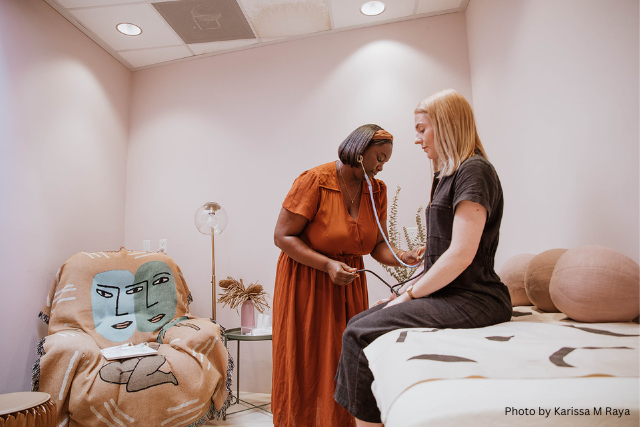
“Understanding that pregnancy is not just a physical transition but one that affects every aspect of your life, a midwife creates time to dive into how the pregnancy is going. You are seated in a comfy chair and genuinely asked “how are you coping with this pregnancy?” A midwife plans to spend 30 to 60 minutes providing childbirth education, checking in on your whole pregnancy experience and answering any questions you may have.”

Depicting what a midwife is and does is quite difficult. The answer is a combination of who they are and how they care for their patients/clients. The role and responsibilities listed in their job description does not encompass their day-to-day tasks nor the true essence of their care. Midwives practice the midwifery model of care; offering equitable care, an ethical lens, and a trauma-informed approach to healthcare. The heart of a midwife centers their deep respect for the intricacies of pregnancy, birth, postpartum and all reproductive events.
Simply put, a midwife is a skilled clinical provider who specializes in low-risk reproductive events like pregnancy and physiological birth. Yet, midwifery care is so much more than supporting a pregnancy or attending a homebirth. Choosing to become a midwife is beyond understanding the risks of childbirth. A midwife is someone who trusts the body, can identify abnormalities and acknowledges how all areas of life affect reproductive health. Thus, they incorporate nutrition, movement, stress-management, bodywork, and trauma-informed care alongside their clinical competency of reproductive health.
Midwives are present in all settings of maternal care. From administrative roles, global initiatives, homebirth and abortion clinics. They can bring the essence of midwifery care to any situation. Although they do not perform surgeries or specialize in high-risk reproductive health, midwives do collaborate with obstetricians and MFMs (maternal fetal specialists) all the time to ensure continuity of care in all circumstances.
Enjoying this post? Check out this classic Informed Pregnancy Podcast episode featuring Jessica Diggs!
The basic components of the clinical side of midwifery care may not be new to many. However, unless you have experienced the compassion and attentiveness that is woven into the art of being a midwife, it is hard to envision how different “care” truly is with a midwife.
To capture this, let’s paint the picture of a typical prenatal appointment in a midwifery practice. Understanding that pregnancy is not just a physical transition but one that affects every aspect of your life, a midwife creates time to dive into how the pregnancy is going. You are seated in a comfy chair and genuinely asked “how are you coping with this pregnancy?” A midwife plans to spend 30 to 60 minutes providing childbirth education, checking in on your whole pregnancy experience and answering any questions you may have. Time is then spent holding space for the answer and offering practical solutions. There are many new bodily sensations that may be concerning or just uncomfortable, so midwives share local resources for bodywork through their trusted community.
As rapport is built, you may ask more questions at each appointment. The midwife may even have a talking point relevant to your gestation period or share information about an upcoming prenatal test or procedure. Offering you and your support person(s) time to think about your preferences and ask more questions until you can make an informed decision.

In the remaining time, the clinical magic happens. Your blood pressure and pulse is taken, your baby’s position and heart rate is assessed, and any applicable lab work may be collected.
By comparison, for a typical OB visit, you may spend 30-60 minutes waiting to be seen only to experience 5-7 minutes of facetime with your actual provider. A lot of factors play into this truth, in defense of my OB friends, but we can all agree that the obstetrical system can be improved.
In my humble opinion, midwifery care is the gold standard for maternal care. It is care that centers compassion, trust, and an informed experience. You can choose a midwife for any birth setting or work with an OBGYN who truly embodies a midwifery spirit.
Don’t miss out! Follow Dr. Berlin for all the latest Informed Pregnancy!

Jessica is a Licensed Midwife working in a solo practice in Los Angeles. She’s been a doula and reproductive health educator since 2012. The training, her mentors, and ultimately, her first birth as a doula honed her interest in reproductive justice and empowering education. Jessica supports people and families through well-person care, home birth services, and conception support. When she’s not talking about birth and bodies, she loves hosting dinner parties, eating, and devouring a good book.

by Ana Paula Markel | Sep 13, 2022 | Labor and Delivery, Pregnancy
**This is a repost of a classic Informed Pregnancy Project article.
“Doulas are not only for mothers planning an all-natural birth, but for mothers planning or investigating all kinds of birth choices. The doula movement is all about options, information and nonjudgmental support. Doulas are hired for all scenarios, including scheduled cesareans.”

In the days before modern medicine and hospitals, laboring women would often be supported by other ‘wise women’ in their communities, who held and passed along the knowledge needed for the next generation to assist women during the process of labor and birth. These women were among the earliest ‘doulas’ – women whose sole role was to provide comfort, encouragement and wisdom during a woman’s labor and birth. The idea of the modern doula began to gain popularity from the studies of Dr. Marshall Klaus and John Kennel during the 1980s, which clearly showed the benefits of the presence of a doula during the labor process. DONA International was founded in 1992, and the role of the doula became a legitimate profession, with prospective doulas required to complete extensive training and assist in multiple births before becoming certified. In the past 20 years, one birth at a time, doulas have secured their role as an instrumental component in the birth team. People commonly think of doulas and midwives as having similar tasks, when in reality the midwife is a licensed care provider in charge of the mother and baby’s health while the doula’s focus is on supporting and promoting an environment of calmness and confidence in the mother.
As reported in many studies, the presence of a doula has many health benefits (less medical interventions, faster labors, easier breastfeeding) and the presence of a doula also highly increases birth satisfaction for the new mother. Doulas are not only for mothers planning an all-natural birth, but for mothers planning or investigating all kinds of birth choices. The doula movement is all about options, information and nonjudgmental support. Doulas are hired for all scenarios, including scheduled cesareans. In current maternity care, women often feel rushed during OB visits and sometimes are too self-conscious to share concerns, questions or fears with medical personnel. This is one of the gaps that doulas can fill.
One of the greatest benefits of hiring a doula is that doulas are well-read, informed and trained in medical terms, and understand routine hospital protocols along with the risks and benefits of various medical interventions. Doulas do NOT make medical decisions for their clients, but they do help clients to make informed decisions. In all up-to-date facilities across the country, doctors and nurses welcome the presence of a calming and professional doula. There is no role confusion; doulas are not there to take over the care of the woman, but to add to it. Doulas and nurses complement each other. During the process of hiring a doula, mothers should not feel shy to interview as many doulas as they feel they need to find their ‘match.’ An interview should be free of charge and commitment and usually last around one hour.
Some of the important points for a family to consider in hiring a doula are:
- How much experience does she have?
- How many births has she attended?
- Is she a mother herself?
- How many births does the doula take a month?
The answers to these questions may mean different things to different mothers-to-be. A mother may feel comfortable with a newer doula based on a personality match, and hiring the most experienced doula is not always the best fit for all families. The last question in the list is a very important one. Obviously, a doula willing to “book” 8 births in a typical month is much more likely to need to send a back-up doula to your birth than a doula who only schedules 3 births. A busy schedule may also affect when the doula joins a laboring woman, or how tired your doula is when she joins you for your birth.
- Is the doula certified?
- If so, by what organization?
DONA International is not the largest, but is by far the most respected doula organization worldwide. DONA has been training and certifying doulas for the past 22 years in 23 countries. If a doula is not certified, ask her to read and practice according to the DONA code of ethics and scope of practice, easily found at www.dona.org.
• How many prenatal visits will the doula provide prior to the birth? And after the birth? Not all doulas have a set schedule of visits, but the majority will do two prenatal meetings that last around 2 hours each, and one postpartum visit that lasts around 1 hour. The prenatal meetings can often substitute for a public birthing class.
Need more Informed Pregnancy? Click to listen to a popular podcast episode!
• When does the doula join the labor? Some doulas come when mothers first call; others come when labor is more established. Mothers should think about what they want and the doula should be willing to adjust to that, not the other way around.

• How much does a doula charge? This is a difficult question, as prices vary a lot. A more experienced doula will usually charge more, as will a doula with more services to provide (for example, prenatal yoga, nutrition help, or postpartum doula services – like doing laundry, watching the baby while you nap, or helping you and your newborn perfect your ‘latch’ for nursing.) In Los Angeles, doulas can charge anywhere between $500 and $3000. Some doulas work on a sliding scale, and most of the national organizations will help women to find doulas at no cost or low cost. The idea is that every woman that wants a doula should have one. Insurance companies are also starting to reimburse for doula services, so ask your insurance provider if a doula’s services are covered by your plan.
To find a doula in your area, please go to www.binibirth.com.
Need more guidance? Check out these workshops available through Berlin Wellness!

Ana Paula Markel is a childbirth educator, doula trainer, practicing doula and volunteer in international birth organizations. She is also the mother of four children. In 2008 Ana founded BINI Birth, a center in Los Angeles dedicated to the childbirth education field, doula training, parenting classes and green pregnancy retail.
