
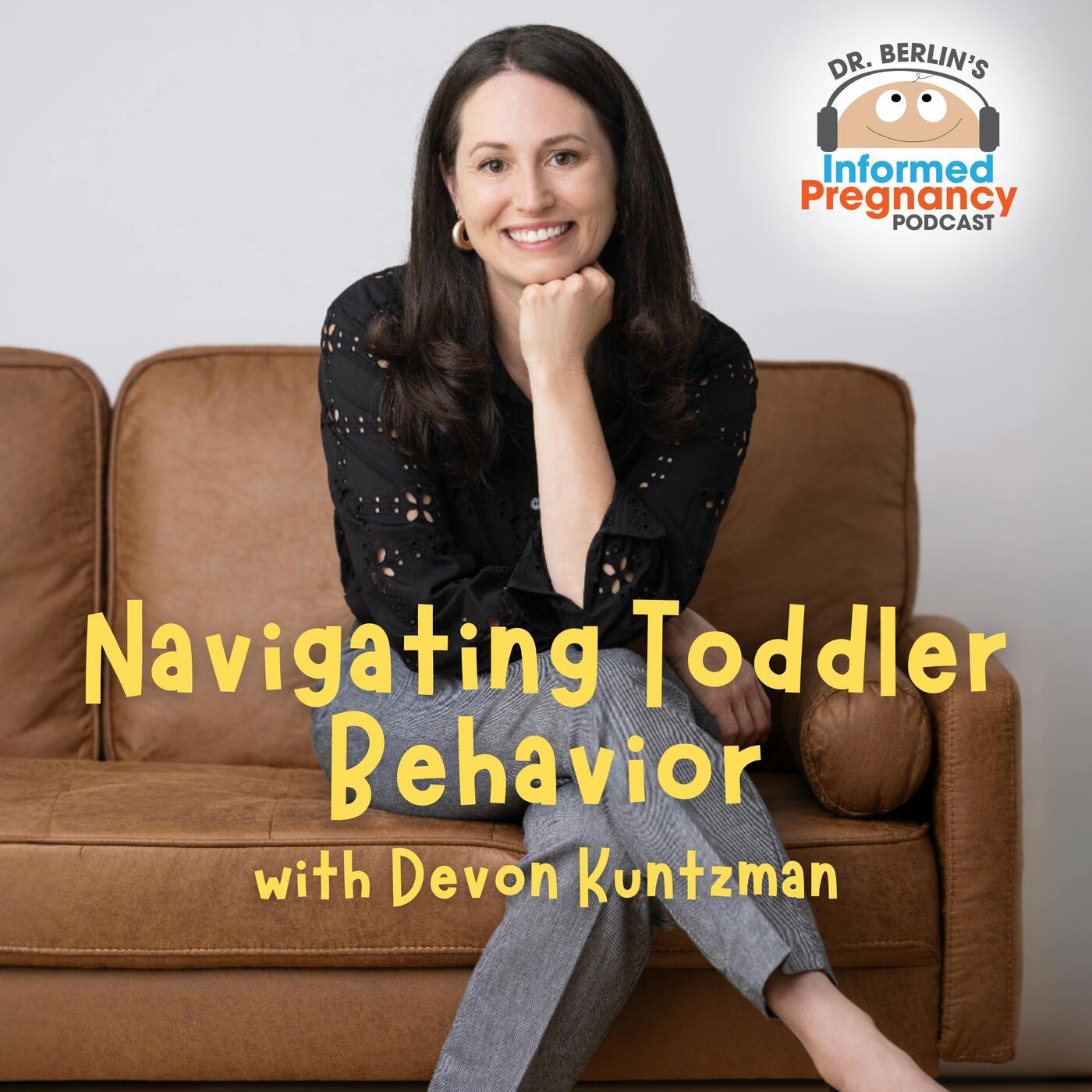
January 14, 2026 · 45 minutes · Episode 494
About this episode
Intense meltdowns are part of the parenthood experience. As toddlers test our limits, our nervous systems activate and we begin wondering if we’re terrible parents. Child development and child behavior specialist Devon Kuntzman discusses how parents can better navigate and understand those moments, reframe their child’s behavior, and work toward helping them build long term emotional resilience.
Connect with the guest:
Grow with us on IP+! Informed Pregnancy Media presents two all new intimate short-form video series following Garrett and HeHe’s real-time pregnancy journeys as they prepare for an empowered birth and postpartum experience. Each episode features weekly updates with personal photos and videos to help bring these raw stories to life, a visually dynamic guide through each mother’s emotional and physical experiences.
Keep up with Dr. Berlin and Informed Pregnancy Media online!
Learn more about your ad choices. Visit megaphone.fm/adchoices
See Privacy Policy at https://art19.com/privacy and California Privacy Notice at https://art19.com/privacy#do-not-sell-my-info.
Key quotes
“toddlerhood is not terrible, and kids are not terrible, and all behavior is communication.”
“practice makes progress, not perfection”
“my child is having an emotional release. It's an emotional poop.”
“But it's never a failure to listen to your needs and your child's needs.”
“My child is having a hard time, not giving me a hard time.”
Related episodes
- Ep. 493 In Conversation with Esther Friedman Schwartz
- Ep. 514 Before Baby #4 with Kara Sutton
- Ep. 500 The Unexpected with Dr. Elliot Berlin Part 1
- Ep. 520 Before Birth with Kea-Sophie Stack
Transcript
AI-generated transcript with speaker labels — may contain errors, especially names and medical terms. Dr. Elliot Berlin, DC appears in blue; Devon Kuntzman in orange.
Dr. Elliot Berlin, DC [0:00] This episode is made possible in part by support from our guest, helping us to bring you quality content that is both entertaining and informative. If you have a toddler, you know this moment. You're trying to get out the door, get through the grocery store, or make it to bedtime, and suddenly your child melts down loud, intense, maybe very public. And no matter how patient you want to be, you can feel your nervous system building up into fight-or-flight mode. We all struggle at times to keep our cool as our toddlers test our limits, and when that happens, sometimes it leaves us wondering, is this normal? Am I doing something wrong? Why does this feel so personal? Am I a horrible
[0:44] parent, and am I screwing up my child for life? Today's conversation is for those moments. My guest is a child development and toddler behavior specialist who helps parents understand what their toddlers are really communicating during big emotional moments, those tantrums, the power struggles, the emotional explosions that so often get labeled as bad behavior. With a background in psychology, child development, and professional coaching, and years of hand-on experience supporting families both professionally and as a parent herself, she helps parents reframe toddler behavior, stay grounded during meltdowns, and build long-term emotional resilience in those young children. And if you've ever walked away
[1:26] from a toddler meltdown feeling guilty, ashamed, or like you failed, this conversation is for you and for me. I'm pregnancy-focused chiropractor Dr. Elliot Berlin, and you're listening to the Informed Pregnancy and Parenting podcast. Devin Kunzman, welcome to the podcast. Thank you so much for having me. I'm mad at you. My kids are currently teenagers and older, and I needed you when they were little toddlers, but better late than never. I still feel like some of the things I'm going to learn today probably still apply to parenting older kids. Let's get into the background and foundation. Before we get to the work that you do now, let's start with where you came from originally. You spent a lot of years
[2:22] working with toddlers professionally as a nanny. Tell me about that.
Devon Kuntzman [2:27] Yes. So some people say that I've lived many lives. I spent a long time as a nanny for high-profile families all over the world. And in the middle of that, I took a little hiatus, and I was the executive director of a foundation that had a farm and an orphanage on a hillside in Rwanda. So I've had the pleasure of working with kids and toddlers from all walks of life all over the world. And one thing that I found to be universally true, which took a while for me to truly understand, and once I figured it out, I felt like I needed to sing it from the rooftops, was that toddlerhood is not terrible, and kids are not terrible, and all behavior is communication. And when we start to understand what a kid's behavior is
[3:16] trying to tell us, then a whole new world opens up, and we can shift from a place of thinking this child is being bad to how can we help this child who's having a hard time right
Dr. Elliot Berlin, DC [3:27] now. It's been said that toddlers are like cave people with a very primitive language, and I think that it's a clarifying point, because if you actually encountered cave people today that didn't have language like we do, and they were trying to communicate things, a lot of that communication would be frustrating for them, and a lot of that communication would seem aggressive to us in response. So I love the fact that you see the behavior as communication. I think that is probably fundamentally, if we can see it like that as parents, that's already a ginormous shift into how we receive it and how we respond to it.
Devon Kuntzman [4:10] It absolutely is. I have videos go viral all the time on Facebook and Instagram, and I have people who say, well, why would a toddler think that hitting is communication, or why would a young child think that biting is communication? And I think that we just forget as adults with our fully mature brains, and we're just looking at everything through a logical lens, we don't remember what it was like to be one, two, three years old, not have the words to really express what we're thinking and feeling, not having the life experience and the skills that we need to cope. Then when we start to try to put ourselves in a child's shoes, we start to realize, oh, yeah, that must be really hard to have a lot of
[4:56] thoughts and feelings and feel like no one around you can understand you.
Dr. Elliot Berlin, DC [5:01] I think my brain would naturally go the other way and say, wait a second, I crave the life of the one-year-old. Whenever I make noise or I'm hungry, somebody feeds me. Whenever I'm tired, somebody puts me down for a nap. There's always somebody there to entertain me. That's the life. What do you have to complain about? But it's actually much, much more complex and difficult than that. When people say, well, I guess we should start at the beginning. When do these toddler things start to show up?
Devon Kuntzman [5:34] Yes. Everyone is very surprised and caught off guard sometimes when toddler behaviors start anywhere between nine months and 15 months. I generally say toddlerhood is ages one to five. One and two-year-olds are young toddlers, three and four-year-olds are older toddlers, and five-year-olds are transitioning from toddlerhood into the school age years. But people are always surprised when their nine-month-old might start refusing diaper changes. Their 11-month-old might start experimenting with hitting. Maybe they have a 12-month-old that just learned to walk and you say something and they run the opposite direction laughing. These moments we all have. What I find time and time again is that
[6:19] toddlerhood happens much faster than parents anticipate. Then they're left wondering, wait, how do I handle these behaviors that are popping up right now? What do I do in these moments? How much in advance of that do you think it's important for a new parent to start planning for it? Well, it depends. Absolutely, we need to know how to care for babies and know how to meet babies' emotional needs and developmental needs because babies aren't just like a little blob just sitting there. They have a whole rich internal world that they rely on us to meet all of their needs beyond just their physical and emotional needs but also their developmental needs
[7:03] and having conversations with your partner before you get to toddlerhood and starting to read a book. When you're starting to get out of that fourth trimester, when you're maybe hitting the five, six-month range with your baby, that's a good time to start thinking about, okay, how do we want to parent together when we're faced with challenges and behaviors? What do we think is our parenting philosophy? What is our discipline philosophy? What are the education gaps? Where are the gaps in being on the same page? This is a great time to pick up a book like Transforming Toddlerhood to start understanding the basics of toddler development and behavior and how to navigate those behaviors in a developmentally
Dr. Elliot Berlin, DC [7:51] smart way. Yes, and I think the book is brilliant. You're a book, Transforming Toddlerhood, and I will want to get into the structure of it and the best way to read it and consume it and apply it. Well, if the toddler behaviors start at nine months already and then all of a sudden you have a one-year-old and the challenges that come with that, but then it feels like all the years left to toddlerhood get these names, like terrible twos and tyrannical threes and whatnot. What do you think we're getting wrong when we refer to it that way?
Devon Kuntzman [8:27] Yeah, and I want to tell everyone, don't get me wrong, I'm a toddler mom too, and I have a three-and-a-half-year-old, and about a month before he turned three-and-a-half, like a switch flipped, and I'm like, oh, this is where the word three-nager comes from. Yes, we're in that three-nager phase, I get it. However, when we use these words in a serious way to describe a child, what we're missing is the fact that a lot of the behaviors that drive us nuts or that we don't understand or that we feel frustrated about because they challenge our sense of control and get in the way of our agenda are actually developmentally appropriate behavior, and toddlerhood is a very critical developmental
[9:09] period because the majority of brain development happens. The foundation of your child's brain is being built between ages zero and five, and so this period is critical for laying the groundwork for emotional resilience and just resilience in general, and so if we are constantly telling ourselves that this is a terrible period of time and our child is terrible, then we are missing out on opportunities for learning growth and connection that will carry
Dr. Elliot Berlin, DC [9:42] our children through developmentally for many years to come. I remember somebody saying,
Devon Kuntzman [9:48] what's the difference between a three-year-old and a two-year-old, and they said it's the terrible two with one year of experience. But that's the thing. I really love this, though, because what this does get right is the fact that toddlers have very little life experience, so for us, we know what to expect when we go to the store, when we go to a family member's house, or just what to expect when we're feeling down or frustrated, but toddlers have very little life experience, and of course at three, they have one more year of life experience than at two, but I love this because it's great to remember kids have very, very little life experience, and as a result,
[10:32] are lacking a lot of skills and brain maturation to be able to deal with the things that just
Dr. Elliot Berlin, DC [10:37] seem like nothing to us as adults. It's fascinating to me the spectrum of work that you did as sort of a nanny for high-profile clients off to an orphanage, and I wonder how that already must be a huge complement of foundation for the work that you're doing, and I wonder in my mind, you must see similarities across the spectrum that you can draw from, whereas there are also differences across the spectrum, but also how that all changed when you became a parent yourself and it became very real and practical for you.
Devon Kuntzman [11:12] Yeah, you know, I started this work at Transforming Childhood in 2018 before I was a parent myself, and it took me a long time to become a parent, and there were challenges along the way, right? Supporting so many parents while struggling to start a family myself, and one thing that I have learned through all of the experiences, including my own journey to becoming a mom and being a mom myself, is that when we have empathy for what other people are going through, it can just open the door to making life so much richer and so much easier because we stop fighting against the things that are frustrating to us. We stop pushing against the things that we don't understand, and we start embracing them,
[11:59] and when we accept the reality of what's happening in front of us, whether it's our toddler melting down, whether a child is yelling at us or something like this, then when we can start to be like, okay, this is what's happening, get curious about it, and think about where do we go from here to move forward, it makes everything easier, and I really believe that the beginning stages of that happen with empathy because it allows us to soften, and instead of fighting against what's happening and trying to shut it down, it allows us to accept it. Now, I don't mean to say that we're condoning, you know, whatever, like an unsafe behavior or something like that, but it helps us say, okay, here we are,
[12:43] and becoming a mom myself, there are times, right, where my child is crying and no one wants to hear their child cry. It's so hard, right? We just want our kids to be happy, and at the same time, it's not our job to make kids happy because we can't control another person's feelings and emotions. It's our job to support our child's feelings and emotions to set boundaries that keep them safe and keep them healthy, and to teach them the skills that they need to be successful in life. And so, you know, I'm a human being too, and there's moments where I'm like, gosh, it'd be easy just to threaten my kid that they're not going to have X, Y, and Z, or to bribe my kid with X, Y, and Z to get
[13:31] this, you know, tantrum to stop. But in the end, we have to think about, okay, what are we creating long term, and how can we be consistent in that path? But we're all human beings, and, you know, we're all going to have moments where we're like, oh, this is so challenging, how do we make it stop?
Dr. Elliot Berlin, DC [13:49] I think that when you buy an electronic, let's say a big flat-screen TV, it often comes with a very thick book of how to take care of it, how to keep it healthy, how to give it longevity. And then you have a kid, and it doesn't come with a manual, and it's just like, here, good luck, you know? And thankfully, there are people who spend their life studying, learning, and giving resources to the rest of us, and I think that transforming toddlerhood is an incredible resource that can help fill in the gap for that missing manual that didn't come with our children. We're going to take a little break. When we come back, we're going to look at some of the most common misunderstandings about toddler behavior. We'll be right back.

Dr. Elliot Berlin, DC [14:48] Welcome back. We're talking with Devon Kunzman, author of Transforming Toddlerhood. In this segment, I want to explore some of the biggest misunderstandings parents have about toddler behavior, the ones that tend to make these moments harder than they need to be. So Devon, when parents first come to you for support, what's something they're often assuming about their toddler's behavior that you find yourself gently helping them
Devon Kuntzman [15:11] rethink? Yes. There's a lot of things that people are thinking about their behavior. I think the biggest thing is that their toddler is being bad. And when we think a toddler is being bad, that leads us to like the next logical thing is we need to stop the bad behavior. What punishment or consequence does my toddler need to make this behavior stop? It's kind of like a long train of thought there. And so when I'm talking to parents, what I'm trying to help parents understand is that your toddler's behavior is not good or bad. It is. So for example, we could say like, stop being so bad. But really what happened was your toddler threw a toy. So calling behavior good or bad is a judgment that we place on the behavior and
[16:01] interpretation, which makes sense because our brains want to categorize things to make sense of them. However, whenever we are labeling behavior, then we start to really relate to our child and that behavior as something to fix or a problem. When really what's happening beneath the behavior, the feelings, emotions, the needs, the brain development, all the things, the developmental needs, the sensory needs, the basic needs, those are the things that need the attention to truly transform the behavior. So I want parents to know that your child's behavior is communication. It's telling us that your child is having a hard time in that moment. And when
[16:46] we get curious about what the root of that behavior is, what it's trying to tell us, then we can truly transform it. Another common myth is, or what parents think about behavior is that their child is doing it to them on purpose, right? Or maybe your child hits you and then they laugh, or they're having a tantrum and then you give in and then they immediately stop. What we have to understand is that toddler behavior is strategic. Toddlers are reliant on us to meet their needs, their physical and emotional needs. And so most of their behavior is looking to how they can get those needs met. And toddlers learn very quickly what the path of least resistance is and the easiest way to get their needs and desires
Dr. Elliot Berlin, DC [17:35] met. I love organization. I love how in the first segment you're like, okay, let's define it. Toddlerhood is zero to five years and then we sub-define it and break it down into the first and second year, the next category and the third category. And so it makes a lot of sense that, you know, when an activity is happening and I have no training, nobody said, here's how you be a parent. I want to categorize it to even just to understand it and know how to deal with it and react to it. And sometimes those categorizations actually set us back instead of forward. But I think that even parents who are thoughtful, even parents who are well-informed and even with these ideas in mind, these moments can become so triggering
[18:16] for us. What's happening inside the parent when these things happen?
Devon Kuntzman [18:21] Yes, they can become so triggering because, you know, we can't help it, but we're human beings. Some days we'd love to just be robots, right? Just to be able to turn off all of our own feelings and emotions and needs and just program ourselves to act and be and feel a certain way. But that's really just not possible. We're human beings just like our kids and we have our own feelings, emotions and needs. And oftentimes we have also our own experiences, our own childhoods. And when we are parenting our kids, it brings up a lot of stuff from our own childhoods. And either we end up kind of repeating the same things that we experienced and how our parents parented us, or we tend to say, oh, I don't want to do that.
[19:09] So then we're like, okay, I'm going to do it differently. But then we kind of just end up doing the opposite, which may kind of look like a lack of boundaries and more on the permissive side. But in the end, when we get triggered, we are going into the stress response into this automatic way of reacting. And that doesn't make you a bad parent. It makes you a human parent. And it's also an opportunity to start looking at how can I disrupt my stress response? How can I calm and soothe my nervous system? How can I ground myself in the heat of the moment so I can stay steady at my emotional equilibrium and not tip over the edge?
Dr. Elliot Berlin, DC [19:56] You know, the stress response is an animalistic survival response, right? You know, I don't know. It seems to me like some animals out there just like eat their baby when they can't handle it anymore. It was not recommended, highly inappropriate for humans. But it does sort of sometimes feel like that inside, like there's a survival element. I need this to stop right now for my own survival. And there's a second piece. I sometimes think my favorite comedians are the ones who talk about the things that we all observe but don't talk about. And I think that there's an element of when these meltdowns happen in public, the fact that you sometimes feel like there's a spotlight on you and everybody around you is
[20:42] judging you. And that kind of adds fuel to that animalistic survival response.
Devon Kuntzman [20:48] Oh, absolutely. When we feel like we're under a microscope, it puts even more pressure on us and ups our feelings of, you know, embarrassment, of fear that just drives that stress response and staying in survival mode. And so that's the challenge. You know, parents are like, gosh, I wish I was more calm. I said I wasn't going to lose my temper today. And then look, an hour into parenting, being awake this morning, I lost it. But we're up against biology. We're up against like the innate biological response inside of us. And so what we need to know is that it takes a lot of practice and practice. I always say here at Transforming Childhood practice makes progress, not perfection. So we have to practice
[21:35] new responses. We have to practice calming ourselves down. We have to practice creating new habits and new neural pathways and connections to create that change. And that's also why the first five years is so beautiful because our brains are so malleable then. And we know that we can always change our brains. There's this thing called neuroplasticity. Our brains can always change. But the older we are, the harder it gets. And so we are just up against our own biology as we go to make these changes. So if it feels hard to stop yelling and it feels hard to make these changes, you're not alone and you're not a bad person. Like you're just a human being with this innate biology that you're up against.
Dr. Elliot Berlin, DC [22:19] I think that talking about comedy, but I do do stand up comedy. Something you said that resonates with me a lot is practice makes progress. I thought for sure you're going to say practice makes perfect. But Stephen Wright once said they say practice makes perfect, but then they told me nobody's perfect. So I stopped practicing.
Devon Kuntzman [22:37] Oh, see, we don't want to stop practicing. But that's what happens because we get into this mindset of like all or nothing, this dichotomous mindset. And it's normal because we live in such a fast paced world full of instant gratification. So if we can't jump from A to Z in one big leap, we get frustrated because we just want to get at the end result. But really, what we have to do is we have to hit all the stepping stones along the way, go from A to B, B to C, C to D. And that's how we eventually get to the outcome we're looking for with just about everything in life. And so we have to remind ourselves that that happens through practice. But it's very easy to feel discouraged when we practice once or twice.
[23:18] We don't get all the way to Z and then we stop practicing because we think we failed. But you didn't fail. You're in the process of learning.
Dr. Elliot Berlin, DC [23:26] Sometimes comedians are my philosophers in life. I love it. Um, so, you know, you mentioned that the idea we label is the behavior as bad and wanting it to end as soon as possible. It sounds like there's a reframe here and the goal is not necessarily to make it end immediately. Like that shouldn't be necessarily the number one goal.
Devon Kuntzman [23:48] Yeah. What we want to do is teach kids skills, teach kids skills of self-control. And this comes down to defining what discipline is. Oftentimes discipline is kind of mixed up with punishments. But punishment and discipline are different things. Punishments are something we do to someone to teach them a lesson. Whereas discipline is teaching skills that we need for self-control. So then we have to start thinking about, okay, we have a kid. Do we want to teach our child to look outside of them every time things, they start getting like revved up and wait for them to run into a boundary. Now, of course, as parents and caregivers, we have to set boundaries and
[24:33] the younger your child is, the more repetition they need with boundaries and learning skills for them to get it. Right. But at the same time, if you are always the one going out of punishment when your child's behavior goes sideways, then we're not teaching kids this internal compass that they need to notice their dysregulation, notice these behaviors and make better choices. Or oftentimes some kids will, quote unquote, make better choices, but really they're doing it out of fear, fear of punishment. So now we're creating this anxiety inside versus teaching kids to make better choices by learning that self-regulation and self-control. So here at Transforming Childhood, when we think about
[25:20] healthy, developmentally smart discipline, we're talking about creating connection, setting limits and following through and teaching skills. Having all three of these elements is what helps us as parents be successful in guiding our children in a way that helps them learn and grow through all of the challenges. That's an element that seems to come up again
Dr. Elliot Berlin, DC [25:43] and again in your work, the long-term lens, thinking about the long-term outcomes of the actions that we take now. I want to take another little break. When we come back, we're going to get really practical throughout some of those real-life moments and kind of discuss strategies for how to deal with them. Don't go anywhere. We'll be right back. Okay. Welcome back. We're about to get real with Devin Kunzman. I mean, we all have these situations with our kids. I even have them with older kids. We all do. My mom probably still has it with me. And it starts with the very little kids. So let's get practical with real-life scenarios. We talked a little bit about the public meltdown and it happens.
[26:33] It happens at the grocery store while you're in the parking lot at the airport, the dreaded airport. Everything feels amplified. Like you said, you're under a microscope. When a kid melts down in public, where do you want parents to focus first? Yes. I'm sitting here
Devon Kuntzman [26:48] laughing because I'm just, you keep mentioning airport. I'm thinking, gosh, I could do a whole episode on airports and all of my toddler trials at airports. There are so many of them, but where do I want parents to start? What we want to do whenever we're faced with any type of challenging behavior is start by establishing safety. And that is physical safety that leads to the emotional safety. And this is really relevant during a tantrum, because if your child's having a tantrum, you want to make sure that they're safe, right? That they're not going to fall out of like a shopping cart, that they're not going to roll into something and have it come crashing down on them, that they're not banging their head on
[27:29] the floor. If they are, we're putting a pillow there or a hand or we're picking them up. We want to create that physical safety or if they're hitting us, we're taking a step back because whenever our physical safety or our child's physical safety is threatened, that's going to send us deeper into survival mode and amp us up even more. So once we've established that physical safety, we can say, this is not an emergency. I am safe. My child is safe. Yes, they might still be screaming and you're fighting against that perceived threat where your brain saying, wait, wait, wait, this is still an emergency. I hear crying, but you're telling yourself in an effort to disrupt that stress response.
[28:07] This is not an emergency. I am safe. My child is safe. And then you focus on grounding yourself, taking some deep breaths, doing something that you know will help you, whether it's taking like out of your bag, some essential oil and smelling it, counting, closing your eyes and taking a deep breath, whatever you need to do to ground yourself. Because when it comes to a tantrum, less is more. Making sure our child's safe, keeping ourselves calm so we can share our calm with our child because emotions are contagious and our nervous system is kind of like the hub for the family. And then from there, we want to uphold any limits that we set. Because remember,
[28:48] if we backpedal on the limit that we set just to make the crying stop, which will happen sometimes because we're all human. But if that becomes predictable, we're going to be reinforcing the tantrums and then tantrums will become a preferred way of communicating, which we don't want to do. And then really, we want to help our child move forward. And when you're out and about, sometimes that might look like having to maybe leave and abandon your cart, go outside, help your child have its change of scenery and calm down. It might be going to a dressing room if you're somewhere like Target, where you can just have a moment where eyes aren't on you to help your child calm down if you're feeling
[29:23] that pressure. If it's at home, it might be turning on some music, but you could even turn on some music on your phone at the store. Just something to help your child move forward. It might be getting out a box of magnetic tiles and starting to build a tower. And then your child realizing that once that they're not going to get another cookie from the pantry because you've set that limit and moved on, then they're going to come start playing with you. So really in a tantrum, it's more about our actions. It's not so much about talking and so much. Less is more in these moments as our child is kind of coming to the top of their tantrum and then coming down the other side. And the biggest thing to remember
[30:04] to help yourself stay calm in these moments, my child is having an emotional release. It's an emotional poop. They're getting rid of all the things that they don't need, all the feelings and emotions that are bottled up. They're letting that go so they can come back to their
Dr. Elliot Berlin, DC [30:22] emotional equilibrium. I appreciate the connection and brings it into real life, but also the poop blowout at the airport and the grocery store. No fun either. What you just said is like, I think orange juice concentrate. I'm going to have to listen to what you just said probably three or four times. If I was the kind of host that made little clips for Instagram, I would probably cut everything you just said into three or four things that I myself and that our audience can listen to again and again and again. Number one, the meltdown. Just because it doesn't feel safe inside because your fight or flight system kicks in, which feels like danger, just reminding yourself that I am safe
[31:06] and my child is safe can seemingly disarm that fight or flight response and take you away from sort of an animalistic response into a more thoughtful cognitive neocortex type response that other animals don't have the capability of doing. Then that opens up the door for you to do something to get grounded. The essential oil, the deep breath, the taking a second because you know your child is safe, to bring yourself down even further into a more thoughtful place. Also, giving in as a just understanding that giving in is going to reinforce that as the new means of negotiation and that if you support that idea, if you keep loosening your boundaries because you want the meltdown to end, you're just encouraging more meltdown.
[31:56] Those I think three points that you made there are incredible and powerful and can be game changers. And then one other thing you said is, you know, maybe at some point you just leave Target, you know, and whoever wants to leave Target. But I think that to me that might have felt like I failed if I have to leave Target. I was just thinking that whenever
Devon Kuntzman [32:18] you said it and I was listening to you say it, I was like, Gosh, parents might think that they failed if they had to leave Target. But really what's happening here is that you are taking care of yourself and your family. And sometimes something is too much and it's okay for something to be too much at that moment. That doesn't mean that you fail. It means that you're listening to yourself and your limits, you're listening to your children and their limits, and you decide what's best for your family. And it might be that you leave Target for five minutes, you go to the car, everyone calms down, you come back in, or it means that you come back an hour later or the next day. But it's never a failure to
Dr. Elliot Berlin, DC [32:57] listen to your needs and your child's needs. I think that also, you know, sometimes I talk a lot with my clients about the birth plan being a flowchart. You know, it's not just page one. Page one is pick the most natural birth I want to have, whatever that means for me. Maybe it's squatting in a strawberry field and just having my baby with nobody around me. Maybe it's having a C-section or anything in between. But wherever you start, that's just page one. Sometimes practical things come up that you can't control the baby's breach, you know, or the placenta sitting on top of the cervix or other things like that. Then you move down your flowchart
[33:32] and it doesn't mean you failed. In fact, sometimes I think it's a sign of strength to be able to make that decision to leave your preferred plan behind in light of the new data that you have and go with the one that makes more sense now. So like that's what it feels like to me, leaving Target might be, I had a plan today, this wasn't it, but this is a conscious choice because with the information I have now, the situation on the ground has changed a bit and
Devon Kuntzman [33:58] I'm reacting to it in a very appropriate way. Yeah, and that analogy really makes sense to me because I was that parent who had a plan and had a pregnancy that had another plan, right? And then you have to readjust. And that's what you learn from parenting. And that's what's so amazing is that we can even start learning those parenting lessons before a baby has even arrived, right? Of where we need to surrender, where we have opportunities to be flexible, to, you know, still keep our larger goals, but understand that there's more than one way to get to the same outcome. And I think that's a big thing in parenting right now is like, oh, there's a right way and then everything else is wrong
[34:39] and I'm failing. But no, there's so many ways that are developmentally smart and healthy and effective to get to the same outcome. There isn't just one right way. That makes
Dr. Elliot Berlin, DC [34:49] sense. I love one of the reframes that you teach. My child is having a hard time, not giving me a hard time. It totally changes the paradigm. And instead of, I remember Stephen Covey talks about the paradigm shift all the time. You know, a kid, if you're on the subway train and a guy gets on and two kids are running up and down the subway train screaming and knocking over someone's coffee and someone's newspaper and you're not doing anything. And as a passenger, I might get really upset and frustrated. What kind of parent are you? And, you know, then you might say something and then he says, you know, I'm so sorry. You know, my wife just passed away and I don't really know how to handle it. Neither do the kids. All of
[35:28] a sudden it switches from, I'm angry at you to, oh my goodness, what can I do to help you? How can I support you? It's just a paradigm shift. And that one thing, my child is having a hard time, not giving me a hard time, at least in my mind, helps create a powerful
Devon Kuntzman [35:43] paradigm shift. Yeah, it really does. And also it's a powerful paradigm shift for being out in public and seeing that parent at the airport or on an airplane with a toddler melting down or a baby that's screaming or seeing the parent at the grocery store that just gets their child, you know, maybe like a candy bar from the checkout section, you know, we and we're like, oh, or why I can't believe they're just giving them a screen at the restaurant and they're just completely, you know, just not even present, something like this. And you know, it just shows us that we are seeing everyone else just a glimpse of their lives. And so talking about my Instagram, like, okay, let's normalize supporting parents instead of
[36:32] judging parents and tearing them down because we don't agree with their decisions. We are only seeing a glimpse, one little snapshot of other people's lives, yet we're passing judgment on them. We don't know how their day's going, what's happening in their family. And if we did, we probably would have a lot more empathy for them. Devin, I'm curious what you think
Dr. Elliot Berlin, DC [36:52] about Dr. B's airplane travel kit with babies and maybe even toddlers. I always tell parents this one thing when they get really nervous about traveling with their baby for the first time. I'm like, here's my suggestion on the kit. Number one, you bring yourself, if you're breastfeeding, or bring milk. Number two, bring Hershey's miniature chocolate bars. And number three, bring earplugs. So when you're traveling, you get on the plane with the baby and usually they don't really care where they are as long as they can get milk. So either from you or from a bottle. Number two, right when you get on the plane, you give everybody Hershey's miniature chocolates, all the people around you.
[37:33] And then they think you're great. And then number three, if your kid is melting down and crying and screaming, you just take out your canister of earplugs and start giving them to the people around you. And it's a paradigm shift. Instead of hating you and your child, now they feel bad for you and they want to help and they, you know, take out their phone and try to entertain your kid or other things like that. Yeah, I think what's so interesting
Devon Kuntzman [37:54] is that when parents do something like this, they start to realize that people actually do want to help. And that's probably the biggest thing to think about when it comes to these big meltdowns in public moments where we're feeling like embarrassed or bad or shameful because of, you know, what's happening with our child is that we are typically our own worst enemy, our own worst like judgment that humans are curious by nature. So humans are almost always going to look, but oftentimes we're projecting what we're telling ourselves about our parenting on to those people and thinking that's what they're thinking of us. When you might say something to this person on the plane, they may be like, oh, I didn't even
[38:37] hear anything. I'm using my noise, canceling headphones, watching a movie, you know, or there might be someone else that's like, oh gosh, I remember those days. Do you need any help? Right. And so it's just important to keep in mind that people can surprise us. And we typically are harder on ourselves than anyone else's.
Dr. Elliot Berlin, DC [38:56] It's great to think about. As we're wrapping up here, I know that many of our listeners
Devon Kuntzman [39:01] are pregnant and already have a toddler at home. It's a difficult transition. Help us out. Yes. So I think that what you want to remember is that there's going to be ups and downs. There's going to be moments when your toddler is super stoked about the baby. And there's going to be moments that your toddler says, I want the baby to go back to the hospital or put the baby back in your belly or something like this. That does not mean that your toddler does not love the baby. It means your toddler is wondering where their place is in the family. Now that things have changed, they're wondering, do you still see me? Do you still love me? What is my role here? And it's common for toddlers to have these big feelings and emotions.
[39:42] So if your toddler starts, you know, maybe using baby talk or wanting a bottle to be more like the baby, don't be alarmed. This is just them trying to figure out how do I share my parents with this new sibling? Because we have to remember that toddlerhood is a very egocentric developmental period where toddlers are thinking about themselves because they're becoming their own individual for the first time. And so it can be challenging to share a parent's attention with a new baby, but that doesn't mean that it's not possible and that there isn't love there. So the one thing that I recommend is to not blame the baby for, you know, X, Y, and Z, why you can't do X, Y, and Z. So instead of saying,
[40:31] I can't play with you right now, I have to feed the baby. What you might say is, I love playing with you. I can play with you in 10 minutes. Let's set this timer. Okay, here's some books to read or here. What are you going to do? I'm feeding the baby. And then we're going to play magnet tiles or build a train together, something like this, right? And so just that simple reframe, what I call this turning a no into a not yet can make a huge difference and really have a positive impact on the sibling relationship and sibling
Dr. Elliot Berlin, DC [41:07] bonding. I love how impactful your taglines are. They're really not just the tagline, there's a lot of depth behind them. Yeah, I just remember, I guess two points of view. Number one, I think I'm the younger of two siblings and we're in our 50s. I think my brother is still getting used to the fact that he has to share me with the parents. And then also, I remember my little angel, my little teary hole just turning into a little devil when we brought home a new baby. And it took a while to get into his perspective and understand what was going on for him. So those are powerful tools. Devin, I've learned a lot from you today and there's more to learn from you. You have, first of all, the book,
[41:48] tell me about transforming toddlerhood, how it's structured, what we can expect to get out of
Devon Kuntzman [41:53] the book. Yes. Well, this book I wrote because I know there's a huge problem with parenting books for kids ages one to five, or basically after you get out of pregnancy and infancy, is that all of the parenting books had very long chapters that you had to read a long chapter to be able to get to a concept or to figure out what your question to your answer, not knowing if you're really going to get that answer or not. So I basically wrote the what to expect for toddlerhood, where it's 45 short chapters divided into five sections, the toddler parent, and then the toddler explained the physical toddler, the emotional toddler and the social toddler. And inside you're going to find challenges like what to do when you feel like
[42:38] your parenting partner is not on the same page, how to know your role in parenting, how to set limits effectively, what to do with crying, what to do with a new sibling, conflict, tantrums, potting, sleep. I have a chapter on every single challenge that you might face in toddlerhood with scripts, tips and FAQs to help you get the tools you need fast and implement it. So you could read it cover to cover, but you can also use it as a quick reference guide to get the help you need when you need it. Amazing. What other tools are there at Transforming Toddlerhood? So at Transforming Toddlerhood, you can find me on Instagram. And with my website, I have a membership that's opening very soon that's going to have
[43:24] all of the parenting tools that you need in one place to really overcome any challenge that you have with your toddler. What's the website? Transforming Toddlerhood.com. Perfect. Devin,
Dr. Elliot Berlin, DC [43:38] thank you so much for joining me and for sharing. I'm no longer mad at you. I learned a lot. And hopefully in the not too distant future, I'll be able to apply these things to grand toddlers. And I know our audience at home has learned a lot. So thank you again at home. Thanks for listening to Informed Pregnancy. For more pregnancy and parenting information just like this, visit us online at InformedPregnancy.com.
Want more pregnancy + parenting? Start your FREE TRIAL of Informed Pregnancy+ and get access to all our curated pregnancy and parenting content — original series, iconic birth films like The Business of Being Born, prenatal workouts and more.

0 Comments