
May 15, 2026 · 37 minutes · Episode 500
About this episode
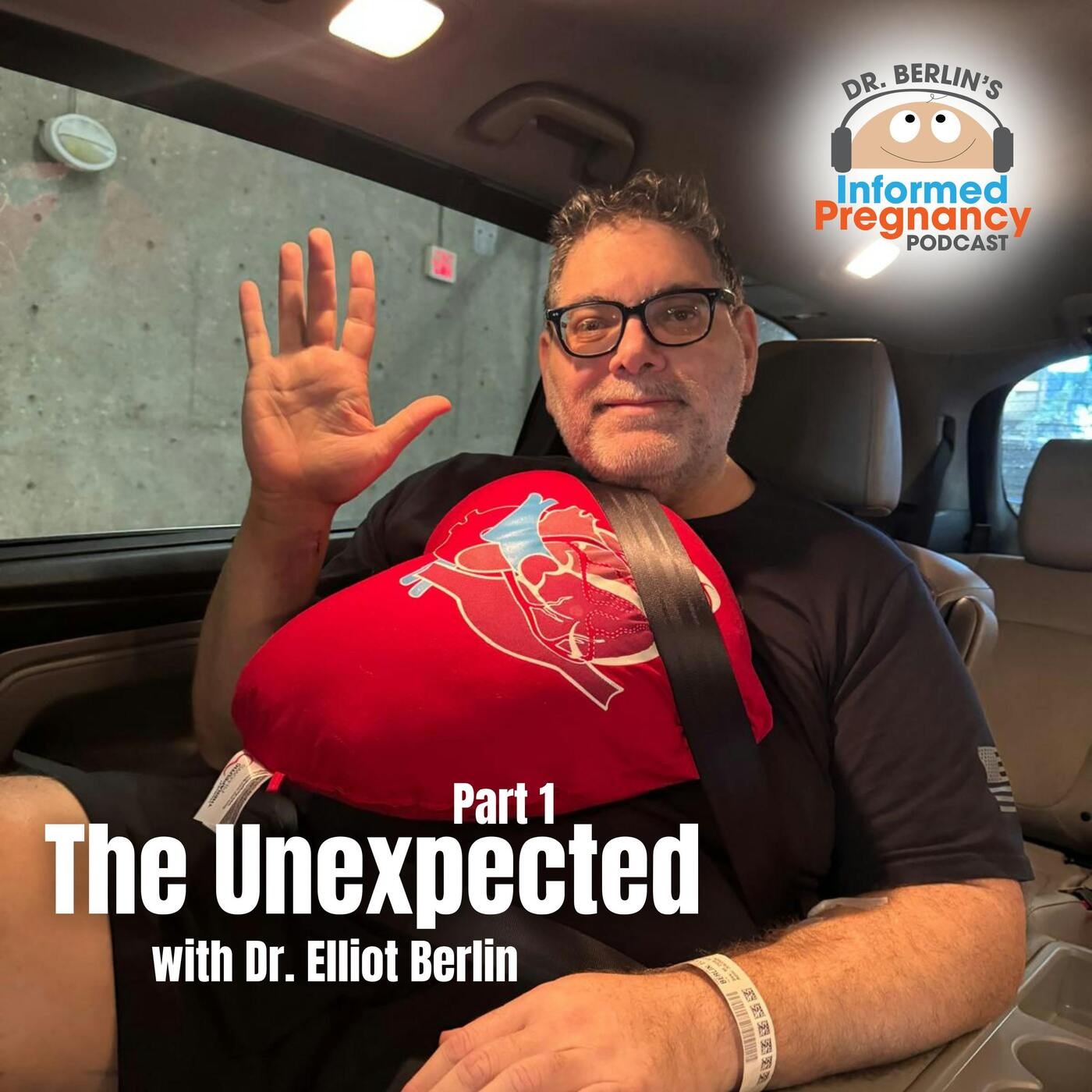
In a special 500th episode, Dr. Berlin opens up personally to discuss a recent unexpected major medical episode with guest host Jenna Pastuszek.
Connect with the host:
Grow with us on IP+! Informed Pregnancy Media presents two all new intimate short-form video series following Garrett and HeHe’s real-time pregnancy journeys as they prepare for an empowered birth and postpartum experience. Each episode features weekly updates with personal photos and videos to help bring these raw stories to life, a visually dynamic guide through each mother’s emotional and physical experiences.
Keep up with Dr. Berlin and Informed Pregnancy Media online!
Learn more about your ad choices. Visit megaphone.fm/adchoices
See Privacy Policy at https://art19.com/privacy and California Privacy Notice at https://art19.com/privacy#do-not-sell-my-info.
Key quotes
“And then my heart rate was 160 plus. And that's at rest. I hadn't turned on the machine yet.”
“Something's wrong. Like that guy came out so panicked. I don't know what it is exactly, but I'm in trouble here.”
“It became real to me that I could have had a heart attack, could still have a heart attack.”
“I just felt like a ticking time bomb.”
Related episodes
- Ep. 523 Chiropractic Care for Mothers & Babies with Dr. Estefania Magallanes
- Ep. 518 Yoga & Mindful Motherhood with Liberté Chan
- Ep. 517 Change of Plan with Kayce-Perkins Katz
- Ep. 511 Identity in Fatherhood with David Arell
Transcript
AI-generated transcript with speaker labels — may contain errors, especially names and medical terms. Dr. Elliot Berlin, DC appears in blue; Jenna Pastuszek in orange.
Dr. Elliot Berlin, DC [0:00] So, I was like, what do we do for our 500th podcast episode? It's gotta be something big, something different, something interesting, and it just doesn't come together in time, so we made this placeholder until we could find something awesome, and I even did this shtick on social media where I took AI and I made me pregnant as if this episode is due, but it's not coming, and we did a blessing way, and I did my inversions off the couch and acupuncture with too many needles, and I was eating all these dates, and there was all this pressure, and we were getting close to a great guest, and then all of a sudden, I had my own very big surprise experience,
[0:41] and going through it, it was a medical experience, going through it, I realized how challenging the current medical climate is, our system is for people going through it. That's why we put together Informed Pregnancy Media, that's why we do the podcast, why we have the blogs, why we have the streaming, and all the documentaries, and I just realized how much more important it is than I thought it was, and it became clear to me that I am actually the 500th episode, probably a two-part series, but who wants to hear me interview myself, so I reached out to my amazing, funny friend who's been a guest on the podcast before, Jenna Pastasek, and I'm turning over the microphone
[1:25] to Jenna, you're listening to the Informed Pregnancy podcast, I am not your host.
Jenna Pastuszek [1:31] I am.
Dr. Elliot Berlin, DC [1:32] Elliot Burling, your guest.
Jenna Pastuszek [1:35] Mya, the tables have turned, leaving the Informed Pregnancy podcast in the hands of moms everywhere. My name is Jenna Pastasek, and I am a proud two-time guest on the Informed Pregnancy podcast, and long-time listener of the series, and also a client of Dr. Elliot Berlin, the one, the only. And right before his own medical event happened in March, there I was on his table getting ready to be adjusted, and we were talking about this upcoming 500th episode, and we were spitballing ideas for a way to make it special and unique for the listeners, and to celebrate the podcast's legacy, and little did we know just what might happen, and what we might get to talk about today.
[2:25] So, very excited to welcome to the show, the one, the only, Dr. Elliot Berlin.
Dr. Elliot Berlin, DC [2:44] Well, Jenna, thank you for having me on my own podcast.
Jenna Pastuszek [2:47] You're so welcome.
Dr. Elliot Berlin, DC [2:48] Thank you for sharing the microphone and the stage.
Jenna Pastuszek [2:52] So, let's dive in. And I sort of wanna frame this episode like a pregnancy journey, if you will. And so, I thought it might be fun to start it pre-pregnancy, what was happening, what was your life like?
Dr. Elliot Berlin, DC [3:07] Life was great. Pre-pregnancy, life was good. I mean, I was working a lot, I would say, in the peak of my career. Obviously, my main thing is the wellness services that we provide at my practice, personally. A combination of chiropractic and massage for all stages, fertility, pregnancy, postpartum, newborns, parenting. And that's what I do specifically, and our wellness center offers a lot of other services along those lines, like counseling, which my wife does, but also acupuncture and massage and craniosacral therapy. And we do Abhyanga, you know, Indian energy healing and lymphatic massage and all sorts of physical therapy, both orthopedic and pelvic floor.
[3:53] And it takes a lot. It takes a lot to run that ship and it takes a lot to do my own care. I like to try to provide very good care, so I spend a lot of time with patients and charting takes a long time. I was working a lot. Some would say, my wife and kids, too much. Perhaps even my doctor would say too much, and they're not wrong. I was working a lot. Now, I used to be a doula also, so on top of that, I used to run out in the middle of the night and go support people in labor, which was really a wonderful trip and a magical thing to be a part of. But I had stopped doing that because it was too crazy. I wasn't sleeping at all. But pre-quote unquote pregnancy here,
[4:28] we have four kids. They each have different needs. They're incredible kids. I was just spread really thin and getting really fat.
Jenna Pastuszek [4:37] Getting really fat. Okay, so not prioritizing your own personal.
Dr. Elliot Berlin, DC [4:41] Yeah, I was eating too much. I wasn't exercising at all. I wasn't sleeping. I was caffeinating myself to be the Energizer Bunny. It wasn't good. I will say the one thing is I went to the doctor and he's like, dude, you're pre-diabetic. Something's gotta change. So I went for the easy one. I took Manjaro for six months, lost 30 plus pounds. And my A1C, my blood sugar overview, got really healthy. I went from being pre-diabetic to being envied. People were like, wow, you got a really good A1C. So that was one thing that I was doing. But it's definitely in some ways I was cheating the system.
Jenna Pastuszek [5:19] Okay, so not feeling your best, but also too busy to even notice.
Dr. Elliot Berlin, DC [5:24] Yeah.
Jenna Pastuszek [5:25] So would you say aside from the pre-diabetic diagnosis, was there anything else that your doctors had sort of warned you of or made you aware of before this health incident?
Dr. Elliot Berlin, DC [5:37] For years since I was maybe 20 years old, they've noticed I had high triglycerides. My cholesterol itself wasn't terrible, but components of the cholesterol were off. And I had non-alcoholic fatty liver disease, just the beginnings of it. Actually, if we're gonna use the pregnancy analogy, he went and the lab numbers were off for my liver. So he sent me to get an ultrasound. And the place I went, every other person was pregnant, like clearly nine months pregnant. And it was me sitting with my belly in the waiting room with their bellies in the waiting room. And even when I went in and she was doing the ultrasound, I couldn't help it. I'm like, can you tell the gender?
[6:19] What is the sex of this baby? It was just weird. But yeah, determined that I had non-alcoholic fatty liver disease, which means I don't drink. So I was just eating too much of the wrong junk and my liver wasn't able to process at all. So those things were there. I probably fell through the cracks a little bit on the medical system. Was not taking a statin despite that lipid panel being not quite right. And my blood pressure was a little high. So I was taking medication for blood pressure for several years. And it was normal with the medication, but I fell through the cracks partially. I don't think I had a doctor who was really on the ball that well.
[6:57] And partially that was my choosing. And partially I feel like even in my own practice, like men, obviously now I do a lot of pregnancy work, but I see the whole family. Like if partners wanna come in, if fathers wanna come in, I'll take care of them. I generally see women will wake up, something doesn't feel quite right. And I'll get a phone call 20 minutes later. Hey, when can I get in to fix this? Men will deal with it for like 12 to 15 years. They come in if they're peeing blood and coughing up blood and can barely walk. And they say, oh, I just thought it would go away by itself. And I'm definitely, if I'm gonna characterize people, obviously we're not all the same, but I'm in that group.
[7:35] I didn't like going to medical doctors. I went far fewer times than I should. And that definitely made it harder for my doctor to be on top of things. So I am definitely guilty there.
Jenna Pastuszek [7:45] I will say in defense of women having to advocate for themselves as a pregnant person at about 32 or 33 weeks, I broke my leg. And for six or seven weeks, all of my medical providers just told me that I was suffering from swollen ankles because it's a pregnancy thing. So after multiple failed attempts at telling people when something felt wrong, finally they did an x-ray and found that I did in fact have a non-displaced fibular fracture on my right side. So there is something to what many people speak about about women feeling like nobody's listening to them at the doctor. And so that's probably why you're used to having your patients insist that you listen to them
[8:29] and insist that they get in.
Dr. Elliot Berlin, DC [8:31] I like it. Like if you're feeling something, then you have a billion sensors I don't have. So I might have some textbook knowledge, but you have the billion sensors. And so it's really together, if I'm listening to you and you're listening to me, that's usually how we get to the bottom of things the fastest and get the best results. I was thinking even more so if we have multiple providers working together, like there are certain obstetricians that I work really well with and they also are listening and sharing. And if we're open to each other as a team, we can usually diagnose and treat things a lot better than if we're just speaking and not listening.
Jenna Pastuszek [9:09] Yeah, and I actually think that tying this all together with what you were talking about of overworked, underslept, undernourished, really, because you're not prioritizing nutritious foods, for example, just simply because you don't have time. It's hard to hear those sensors going off in your body if and when something is wrong because you are choosing to ignore the symptoms because you're just unable to hear them at that time.
Dr. Elliot Berlin, DC [9:38] Right, and then on top of that, my sort of distaste for medicine and doctors, I just want it to be something else. I ignored things for too long.
Jenna Pastuszek [9:47] So you had some irregular labs that you mentioned. And then you also had a one concerning number that was your heart rate.
Dr. Elliot Berlin, DC [9:59] Oh, so that is what was like, I don't know if that's pre-labor. That was like at the very end. I would love to tell you all about that after we take a quick commercial break. Let's be right back.

Dr. Elliot Berlin, DC [10:22] Welcome back to the Informed Pregnancy Podcast with your host, Jenna Pastuzek.
Jenna Pastuszek [10:27] I love the sound of that. Thank you. Our guest today is the one, the only Dr. Elliott Berlin, founder of this podcast.
Dr. Elliot Berlin, DC [10:33] Yes. Okay, so before the break, you asked me one unusual number. Here's what happened at the very end, before the big event. I told you like my A1C was pre-diabetic. I took the GLP-1. I've lost weight without doing any exercise. And two things happened. We had Shabbat, and on Shabbat we don't drive. So I walked to synagogue, it's a 20 minute walk, fine. It's up to industrial flights of stairs. I climbed the stairs and when I got to the top, I was like, oh, I feel my heart working hard. It was not chest pain, it was not palpitations. It was just like noticeable. My heart is working hard, I'm out of shape. And then we had the meal at a friend who walks a lot faster than I walk.
[11:16] And halfway through the walk, I was like, there it is again. I feel my heart working, but he walks a lot faster than I walk. So I'm just pushing myself to keep up with him. It did not feel dangerous at all, just noticeable. So that's Saturday night. I said, I've done all this work, lost this weight, got my blood sugar out of the diabetes territory. Why don't I start doing some cardio? Get some exercise. I was like, if I could just force my butt onto the treadmill for 25 minutes, one time, I bet that would get the ball rolling and I would be motivated to do more. We got to my treadmill, which is outside in my backyard, under an overhang, but outside.
[11:54] And for the first time, I like blow off all the dust. And then I put my hands on the sensors, which is the handle bar, but it gives you your heart rate. And then my heart rate was 160 plus. And that's at rest. I hadn't turned on the machine yet. Normal is more like 60 to 90, something like that, at rest. 160, if you're terrified, maybe makes sense. Or if you've just done an intense workout, even then it would be a little high. So I thought, oh, the sensors got rusty or something outdoors. It's the sensors fault, yeah, yeah. Yeah, of course. I do it two or three times and it's 160 every time. So I do two things. One is I decide to do a slow 25 minute walk.
[12:37] Again, no chest pain, no palpitation. Nothing's wrong, except my heartbeat seems to be beating very quickly. And at the same time, I decide to order a pulse oximeter on Instacart from Target so I could double check. I do my 25 minute workout, I feel fine. I get off the treadmill, drink some water, cool down, put my finger in the pulse ox, and it's actually a normal heart rate, just 60. So I was like, oh, that stupid treadmill scared me for no reason. And I went to bed. The next morning, Sunday morning, as part of my overworking, I went to the office to see two patients and I saw them, but then I had this nagging feeling like, is my heart beating fast again?
[13:16] So I stuck my finger in the pulse oximeter and it was over 160 again.
Jenna Pastuszek [13:21] And you just happened to bring it with you because somewhere in your brain, you were like, I should just carry this pulse ox around.
Dr. Elliot Berlin, DC [13:27] I really, I did. I was like, I'm not totally convinced it's a rusty sensor. But then again, it said 60. So I was just like, let's have it. At 160, again, now I have confirmation from two devices. I reached out to my primary care physician and to my blessing, he got back to me right away. And he said, go to the emergency room, the local one here, Cedars-Sinai. And I went there. Sunday, some of my kids were home. We don't want to scare them. So my wife and I agreed.
Jenna Pastuszek [13:58] So what did you do? Did you call your wife from the office and say, listen, I…
Dr. Elliot Berlin, DC [14:02] Yes, I called my wife from the office. The office is very close to the house. I, A, didn't want to have my car at the hospital because if they were to admit me, it would be a whole spiel. And B, I remember going in with COVID, which was totally different over five years ago. The only things I got to keep around me were the things I happened to bring with me. So I was like, let me go home for two minutes and get some things that are important to me if I'm gonna be in the hospital, even for a day. So I went home, got all my stuff. We decided that she'll stay home because my kids were home. We didn't want to freak them out. And so I took an Uber to the hospital.
[14:38] And I've never been treated so quickly at a hospital. They took me in immediately, did an EKG. They saw that the atria, the two upper chambers of my heart, were beating very, very quickly. So it's called atrial fibrillation, quick and inefficient. They don't really have enough of a oomph to squeeze all the blood from the upper chamber to the lower chamber. But the lower chambers, the ventricles, which are far more important, and they're the ones that bring blood to the whole body, they were sort of compensating and they were beating at a effective rate and an effective mechanism. So the issue wasn't like you're having a heart attack. The issue is the upper chambers are going crazy
[15:16] and that blood that doesn't get fully pumped could coagulate and then parts of those coagulated blood could shoot up to your brain or other areas and cause a stroke. That's really what they were worried about in the moment. It was sort of like, why is your atria doing that? But also let's make sure you don't have a stroke. So they put me on blood thinners. Within 10 minutes, they started an IV, took labs, did a chest x-ray, did a secondary EKG. They were moving very quickly. My doctor came to the ER on that Sunday morning, probably half an hour after I got there. I'm so grateful to him. And he said, you need to have a cardiologist. I'm gonna assign you one.
[15:52] And then that cardiologist came to the hospital to see me. And he's like, some things don't look quite right. We're gonna admit you so we can do more testing and figure out why your heart rate is so high. And he said, but sometimes that atrial fibrillation just works itself out and you're going to just have a normal heart rhythm again, so.
Jenna Pastuszek [16:12] Okay, well, hold on. I have a few questions that you.
Dr. Elliot Berlin, DC [16:14] Fire away, make yourself loose.
Jenna Pastuszek [16:15] Okay, so first of all, those AFib machines in a hallway, you know that you get trained, some people get trained to use. Would this have helped you in this circumstance?
Dr. Elliot Berlin, DC [16:30] I don't know which ones you mean, but there are a lot of devices now.
Jenna Pastuszek [16:34] Those little white boxes that you can get.
Dr. Elliot Berlin, DC [16:37] Oh, no, no, that's a DFib.
Jenna Pastuszek [16:39] Oh, DFib, okay.
Dr. Elliot Berlin, DC [16:40] Yeah, that's not for what I have. That's if your ventricles aren't doing their job.
Jenna Pastuszek [16:45] So that's like a shock to wake them up to do the job.
Dr. Elliot Berlin, DC [16:48] Yeah, one of the rhythms is ventricle fibrillation. If the ventricles are just going crazy and not pumping effectively, not on a good rhythm, then you could defibrillate it. But generally, you're not real conscious when that happens because you have no good blood flow.
Jenna Pastuszek [17:01] Okay, my second question is I wanna go back to, you know, similar to when you arrive at the hospital and you're in labor and you're like never come to the hospital before, you know, you've never been in labor before, perhaps it's your first kid. What are you feeling when you get to the emergency room? Are you feeling stressed? Are you feeling nervous? Are you feeling calm? What's your demeanor like?
Dr. Elliot Berlin, DC [17:23] I am a little bit stressed and nervous and also confident that I'm doing the right thing. Like I need to do this now. Again, I didn't have any pain. I didn't have any palpitations. I didn't have any signs like sweaty, like all of a sudden I'm real sweaty. I'm breathing fine. I didn't have the sense that I was having a cardiac emergency, but I felt like something is off. And once I put on that pulse ox and I confirmed that my heart was beating like very fast, I couldn't not be aware of it anymore. And then once they gave me a room at the hospital, you're just looking at the monitors right in front of you. And I'm like closing my eyes, taking deep breaths,
[18:08] trying to do my vagal stimulation, trying to get my meditation going to meditate away my atrial fibrillation. But I think every time I opened my eyes and I saw that it was still like a hundred plus, that just sent me back into making it even faster, like triggering my autonomic nervous system into fight or flight mode.
Jenna Pastuszek [18:27] Would you say that the staff was, you did mention that your doctors came on a Sunday to the hospital. Would you say that the other support staff who you were dealing with immediately were?
Dr. Elliot Berlin, DC [18:37] The room was tough. First of all, I will say, I was in the ER, you have a little ER room for yourself and probably the first doctor that came in, it's a lot of technicians and nurses and things. The first doctor came in, she's like, Dr. Berlin? I said, yeah. She goes, oh my God, I love your podcast. I'm not even kidding. I was like, oh, thank you so much. I'm gonna have to make sure she listens to this episode.
Jenna Pastuszek [19:05] Yeah, yeah.
Dr. Elliot Berlin, DC [19:06] Everyone, the nurses were great, the technicians were great. Honestly, the people that came in to check the supplies and make sure there was enough supplies were so kind and respectful. It was great. Everyone there was wonderful.
Jenna Pastuszek [19:20] Were you worried being there by yourself?
Dr. Elliot Berlin, DC [19:23] Not so much. I mean, with the connectivity, being able to FaceTime or call or text or WhatsApp, my wife and other family members, even my friends, I didn't feel alone. Like I reached out to my friends, I'm like, ugh, atrial fibrillation, they don't know what it is. They're giving me heparin, a blood thinner, to try to prevent a stroke. But I was like, say a little prayer for me. Something's up. And so I didn't really feel alone. And at that time, even the cardiologist wasn't all that freaked out. He's like, we gotta figure out why you're having atrial fibrillation and make sure you don't have a stroke. But because they didn't like the EKG, they didn't love the chest x-ray,
[19:59] he wanted to do more testing. He's like, we're just gonna admit you for overnight to do more testing.
Jenna Pastuszek [20:04] And at that point, were you bumming because you knew you had to cancel your entire schedule the next day?
Dr. Elliot Berlin, DC [20:08] I was so panicked about my schedule. See, yeah. You're in my head, you're 100% right. I was like, wait, like for overnight, for like just Monday? And I even texted my message. I'm like, ugh, I have a little doctor visit. Just cancel my Monday. I'll be back on Tuesday, you know, probably. I was, and I was calculating like, wow, that's gonna be a hit. Not working one day.
Jenna Pastuszek [20:30] Now, are heart problems in your family?
Dr. Elliot Berlin, DC [20:34] Okay, so that is an excellent question. My mother has the high blood pressure that I got. My father, when I was 19 and he was 48, just dropped out of heart attack. And his may have been somewhat induced by a medical mix-up, but it wasn't the medical mix-up by itself. And his brother, my uncle, was young 50s when the same thing happened. Just died from a heart attack. So definitely runs in the family. Good chance, my father had some things that I had and never had the chance to diagnose and treat them. And perhaps my uncle too, I don't know. But yeah, it's in the family. And that's also, that's in the back of my mind, like part of the confidence
[21:16] that I should be here doing this right now and not ignore this.
Jenna Pastuszek [21:20] And you have a background as an EMT, don't you?
Dr. Elliot Berlin, DC [21:23] Yeah, I've seen a lot of people go through real cardiac emergencies, real heart attacks, all levels. And does it always look the same? No, it doesn't always look the same. I mean, sometimes they code, you know, the heart just stops working altogether. And sometimes it's the pain and the pressure and there's no relief from it. Or sometimes they're just very calmly walking themselves into the ER like you did. Yeah, usually not actually having a heart attack, but I wasn't having a heart attack. That's right. I just had some atrial fibrillation. So that's why I was sort of nervous, like what is this? And also knowing that I've neglected myself for a long time,
[21:59] and also knowing the cardiac history in my family, those things made me nervous, but also confident, like, don't ignore this, take care of this, take it seriously. And the way I was treated when I got to the hospital, also, I had such good care, it made me, again, confident, like these people are gonna help me, they're gonna figure out what I need and make sure I get it.
Jenna Pastuszek [22:19] Okay, so after you get over the fact that you have to cancel your entire Monday and potentially let people down and not be able to aid other people who are in pain, then what happens?
Dr. Elliot Berlin, DC [22:30] So I get into a room, it's kind of a weird room, it's definitely not a private room, there's no bathroom. You have roommates separated by curtains and there's, I guess, four bays for patients and one central monitoring station around them. And they're like, you're just here for monitoring, so this'll do. I'm like, okay. And I'm on this IV heparin, and the next thing I think to do, and but my family can come, but also their families can come, so it's like really quiet. And you're just much too aware of what everyone around you is going through. I guess they're aware of what you're going through. And the next thing that happens is an echocardiogram,
[23:09] it's basically an ultrasound of the heart. And the cardiologist did not like what he saw in there. I'm gonna fast forward to get through the story, but this all unfolds over about a day and a half. So then he orders a CAT scan of the arteries of the heart with contrast. And it's a lot of contrast, so they have to start a bigger IV in a bigger vein to be able to shove all that contrast through. They have like a pump that just flushes into your body all at once. And so I'm still by myself, and I get transported. It's kind of funny, you gotta wait for the transport people to come and call it Uber, like U-B-E-R, Americans here. I was like, oh, to my wife,
[23:51] I'm like, Uber is here, gotta go, U-B-R. And then they took me down, and they first did some CAT scans without the contrast. And then even that guy, that technician was so good at telling me what to expect and made me breathe and relax at the right times, and they pumped that contrast through. And he's like, it's gonna feel like you just downed a big shot of Jack Daniels or something like that. And then just you feel the heat come all the way down your body, from your throat down into your toes. It was weird. But then he very quickly did the, while the contrast was moving through, he did the CAT scan of my coronary arteries. And Jenna, I have never,
[24:31] I've seen a lot as a medic, I have never seen someone as panicked as when that guy came out from behind the little wall. He was sweating. And he was like, I could feel his heartbeat moving quickly. Like, wait a second, you're not having a heart attack, right? Or you didn't just have a heart attack? Or have you ever had a heart attack? Have you ever had stents put in your arteries? And I was like, no. And then I'm like, what do you see? And he's like, oh, I'm not really allowed to tell you. Oh, great. I'm like, well, you're not hiding it very well. That point made me kind of nervous. In fact, when he put me in the waiting area for UBER to come transport me back
[25:07] to my little semi-room. He was concerned about the timing of the UBER, yeah. I was concerned about the timing. And I called my wife and I'm like, baby. I got to cancel my Tuesday, yeah. Yeah, I've got to cancel Tuesday for sure. But also I was like, something's wrong. Like that guy came out so panicked. I don't know what it is exactly, but I'm in trouble here. Something's wrong. I wrote to my friends, pray harder. It's not working. It's not working. Something's really going on. I really did. I'm like, keep praying. I needed the test didn't go as well as I had hoped. And we made a plan for my wife to come to the hospital because it was clear things were ratcheting up.
[25:46] And so yeah, from that point forward, I was a bit freaked out.
Jenna Pastuszek [25:51] Okay, and on that note, it feels like we should leave a cliffhanger and go to a commercial break. I guess we'll be right back. Welcome back to the Informed Pregnancy podcast where today we are not talking about informed pregnancy. We are talking about Dr. Elliott Berlin's medical mishap of March, 2026.
Dr. Elliot Berlin, DC [26:21] Informed cardiology. Yeah, so that guy was freaked out. That guy was freaked out. My wife came, the cardiologist came. And he said, look, your coronary arteries at least two of them are very blocked and one is moderately blocked. And so the next thing he wanted is that cardiac catheterization. That's where they take some sort of instrument and insert it in your lower body and weep their way through the arteries up until your coronary arteries.
Jenna Pastuszek [26:50] So it's not really a surgery or is it?
Dr. Elliot Berlin, DC [26:53] It's a procedure.
Jenna Pastuszek [26:54] Procedure, sure.
Dr. Elliot Berlin, DC [26:56] And they can either go in through your groin, which is kind of traditional, or they can go in through an artery in your wrist, which is newer. They just tell you those are the two options and prepare for both, depending on what the procedureist would like to do.
Jenna Pastuszek [27:09] Great.
Dr. Elliot Berlin, DC [27:10] So they leave a little mystery in your mind. And the goal is twofold. It could be diagnostic. It's the best way to see the coronary arteries, what is going on with these arteries. And if they find partial blockages, they could insert a stent, a little kind of piece of material that will hold open the artery and allow blood flow to go through, even though it's partially occluded. And they said, if we're just doing diagnostics, it'll take about 20 minutes. But if we start to put in stents, then it'll take more like 90 minutes to two hours. Okay, I know what to expect. I go in there. They went in through the wrist in case inquiring minds want to know.
[27:46] And also incredible staff, keeping me very relaxed and calm and aware of what to expect.
Jenna Pastuszek [27:55] Are they laughing at any of your jokes?
Dr. Elliot Berlin, DC [27:57] Yes, thankfully they are. Nobody else recognized me from the famous podcast, but I did have one other. Well, I went to do an escape room at the Universal City. I walked in there and she's like, wait a second, I know that voice. Berlin? I was like, yes. And she's young. She was like 21. She doesn't have kids. She's just like, I don't know how, one of my friends turned me on to your podcast. I listen every week. I'm like, you'll be ready when the time comes. So they do the procedure, I would say 10 to 15 minutes into it. He's like, I can't do any stents. Everything's just way too blocked.
Jenna Pastuszek [28:33] He says that out loud while you're in this procedure.
Dr. Elliot Berlin, DC [28:36] Yeah. They give some medicine to make you, I think I got fentanyl or propofol, something. I was like semi there, semi out of it. I recall the whole thing, but not totally clearly. I just remember him saying, I'm referring you for a surgical consult. And then they wheel me back to my room and I share this scary news with my wife. I cried a little bit right then and there. Like it became very real for me. I put a fire under my friends. I'm like, come on, guys.
Jenna Pastuszek [29:09] So you were crying in that moment because why?
Dr. Elliot Berlin, DC [29:13] It became real to me that I could have had a heart attack, could still have a heart attack.
Jenna Pastuszek [29:19] Yeah.
Dr. Elliot Berlin, DC [29:20] Didn't have to be alive right now. Could have been over already. But I'm in the right place at the right time and we can deal with this. But also I think on the other side of it, wow, coronary artery bypass surgery, cardiothoracic surgery, that's huge.
Jenna Pastuszek [29:38] Right.
Dr. Elliot Berlin, DC [29:39] And also I'm gonna have to cancel
Jenna Pastuszek [29:40] at least through Wednesday. Right.
Dr. Elliot Berlin, DC [29:44] I mean, that thought went through my mind.
Jenna Pastuszek [29:47] Yeah.
Dr. Elliot Berlin, DC [29:47] Thankfully my wife and I both work and we both have good jobs, but we support ourselves on both of us working. So how long will I be out of work? I originally thought maybe a day. That was honest. I thought maybe a day, maybe two days, maybe a week. Now it's like maybe months.
Jenna Pastuszek [30:03] The parallels are interesting because with pregnancy it's one of those things that you really have to learn to relinquish control because you can't always choose your due date. You can't choose when you go into labor. You can't choose if there is something wrong with the pregnancy and then you have to go into the hospital and do bed rest for a few weeks, like all of those things as well. And so coming to terms with the fact that at the end you're just not really sure what life is going to look like and when things do need to stop. And so my dad had cart surgery a few years ago and he had a few months notice. And so he was able to sort of project into the future.
[30:45] And while that was useful for planning, I also think that that wasn't useful in terms of mindset and mentally because he was really overwhelmed with this for a really long time before the surgery. Whereas with you, I don't think an emergency situation is necessarily better, but it is truncated where you have to go through all of the emotional aspects of acceptance quite quickly because there's nothing else you can do except die if you don't do what you need to do.
Dr. Elliot Berlin, DC [31:14] You're right about that. I think even you'll see in just a minute, like even if I had to wait a few days, I might've gone mentally crazy because I just felt like a ticking time bomb. And I started to think through what will the surgery be like? What will recovery be like? Will it be successful? I hear my patients all the time talk about the struggle of taking maternity leave. It's different for everyone, but people who run a company, like if they started a company and run a company, it's like they already have a baby that they have to walk away from.
Jenna Pastuszek [31:45] Yeah.
Dr. Elliot Berlin, DC [31:46] And then you can only walk away for so long.
Jenna Pastuszek [31:48] Yeah, and make sure it runs smoothly while they're away
Dr. Elliot Berlin, DC [31:50] and try to dedicate enough time to this new baby, this new family unit, the growing family, and also not neglect the company. And I see all the time people struggling just a regular employment job. How long can I take away before I need to go back financially? But maybe I'm not ready to go back. And sometimes they go back too soon and that's not good either. So on that level, it was something I could relate to. I'll never be able to relate to pregnancy and birth, but some of the experiences here gave me a little taste of what some of those struggles are like.
Jenna Pastuszek [32:24] So tell me about this overnight scramble
Dr. Elliot Berlin, DC [32:26] to find a surgeon. Well, 20 minutes after I got back to the room, I only got to cry very quickly.
Jenna Pastuszek [32:33] You got to shed one single tear.
Dr. Elliot Berlin, DC [32:34] One tear. And then the nurse in that, I got a real room with a bathroom and everything. The nurse in that area was not my favorite. Energy-wise, you're gonna have some that you resonate with better than others. She was a little bit colder, less accommodating. There's certain things that I wanted and she was just like, no. But 20 minutes after we got there, a PA came by from a cardiothoracic surgeon's office and she's like, your cardiologist referred you to us and the doctor will stop by in the morning. Now it's like 9 p.m. I was like surprised that they even had somebody to come by. She's like, the surgeon will come by in the morning. It was a Tuesday night.
[33:16] We're gonna try to get the surgery done by Friday.
Jenna Pastuszek [33:19] What?
Dr. Elliot Berlin, DC [33:20] And I was like, is that quick? Is that slow? Like, am I gonna die before that? Like, what's the deal? I mean, they did have me on all sorts of stabilization medications and whatnot. It was a lot to process. I could not really sleep that night at all. It was physically uncomfortable and mentally uncomfortable. At 6 a.m., the surgeon came by. Now the other thing is at 9.30, we started texting everybody we know who's a doctor or who's affiliated with the hospital or whatever. Like, I didn't wanna just go to any coronary artery surgeon. Who's the best?
Jenna Pastuszek [33:53] Yeah, of course.
Dr. Elliot Berlin, DC [33:54] And I sort of was panicking that we're gonna get all these different recommendations and not enough time to really explore any of them. But one thing that was really amazing is pretty much everybody who wrote back was like, this guy, I'll say his name is Dr. Ismailian. They're like, he's amazing. He's the best. And that's who had come by. And so that was a little reassuring. And at 6 a.m., Dr. Ismailian himself walked into the room, very hard to make him smile, by the way. Very serious dude, which is, I guess, fine for you. That's what you want for a heart surgeon. But it did become a little mission of mine. Could I get him to full smile? Could I get a little chuckle out of him?
[34:36] I was successful twice in our whole relationship so far.
Jenna Pastuszek [34:39] Yeah, more so than me and my dad's surgeon
Dr. Elliot Berlin, DC [34:41] who I got to laugh zero times. Oh, really?
Jenna Pastuszek [34:44] Heart surgeons, they're just tough, yeah.
Dr. Elliot Berlin, DC [34:46] Yeah, yeah.
Jenna Pastuszek [34:48] I mean, they do cut up hearts for a living,
Dr. Elliot Berlin, DC [34:50] so they're heartbreakers, if you might. You want them, like, you don't have to laugh. But it was gratifying. Like, if I get him to laugh twice, maybe I can get back into stand-up comedy. So he came by at 6 a.m., Wednesday morning, and he introduced himself. And he said, did you have breakfast yet or anything to eat today? And I said, no, and he said, don't. We're gonna try to do it today.
Jenna Pastuszek [35:13] Whoa.
Dr. Elliot Berlin, DC [35:14] Also, sort of scary and sort of relief at the same time. More relief, actually, than scary.
Jenna Pastuszek [35:18] Yeah.
Dr. Elliot Berlin, DC [35:19] And that's it, he was able to work it out so that we can do it that morning.
Jenna Pastuszek [35:23] Now, how long were you in surgery?
Dr. Elliot Berlin, DC [35:25] I was in surgery for about six hours,
Jenna Pastuszek [35:27] five to six hours. And what did they do?
Dr. Elliot Berlin, DC [35:30] Ah, you know what? That could be a whole nother episode. Stay tuned for part two of the Informed Pregnancy Podcast, celebratory 500th episode where we are interviewing the one, the only Dr. Elliott Berlin about his latest medical journey and what he learned that pregnant women everywhere can appreciate. Yeah, any medical patient anywhere. I definitely learned a lot. We'll be back for part two.
Want more pregnancy + parenting? Start your FREE TRIAL of Informed Pregnancy+ and get access to all our curated pregnancy and parenting content — original series, iconic birth films like The Business of Being Born, prenatal workouts and more.

0 Comments