
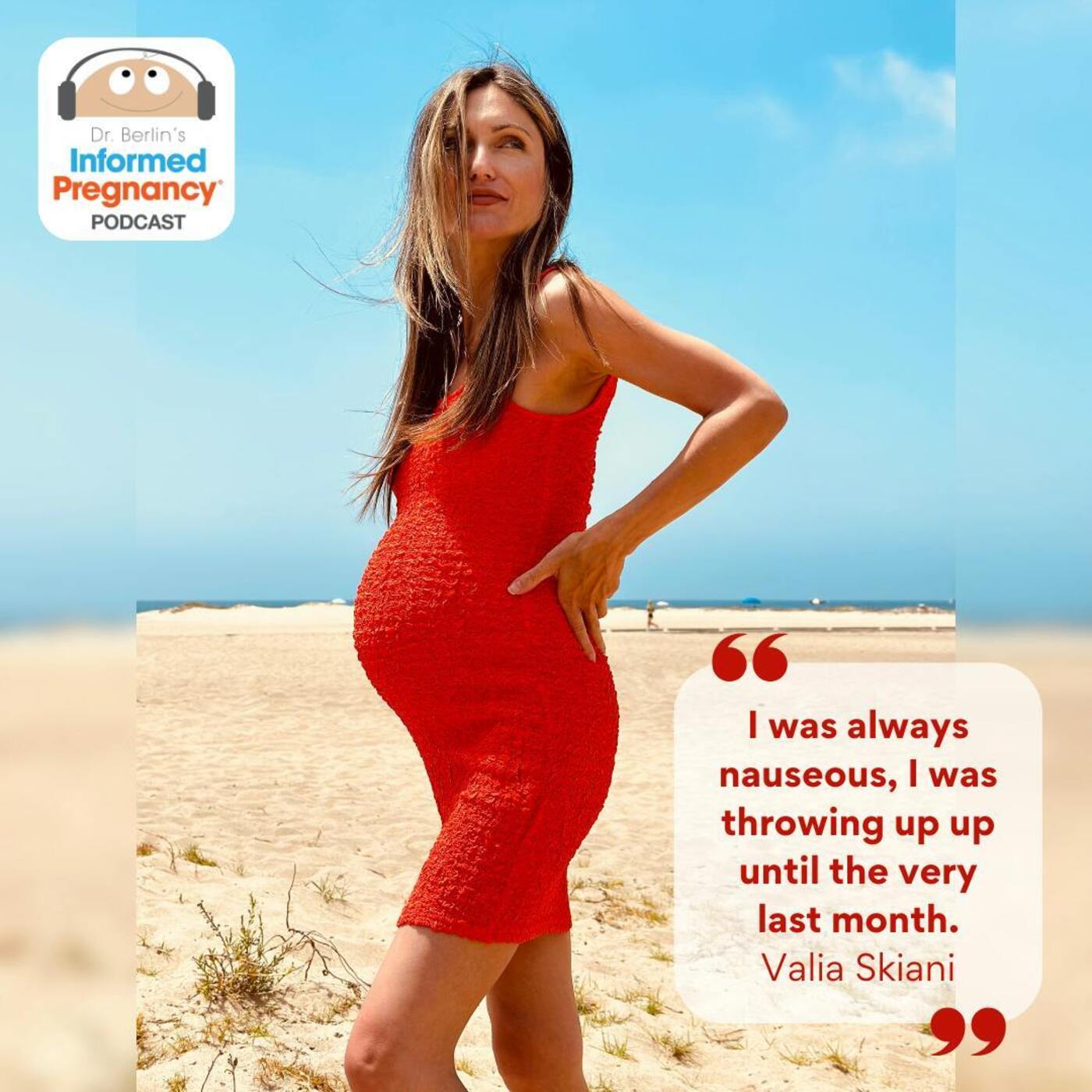
May 2, 2024 · 42 minutes · Episode 405
About this episode
Valia Skiani is a financial quantitative researcher originally from Greece. She joins the podcast to talk about her two very different birth experiences.

Connect with Valia online: @valiask
Key quotes
“And after that, when I post two times, I just saw my baby. And then the moment she was born, I was like, "I had no pain, nothing." It was such a relieving feeling. It was so great. It was amazing.”
“He said, "You are the perfect candidate." I mean, he explained all the risks, but he also said that we never had to use the forceps and we never had to be in a situation where we would put your baby into risk. If we see that this is the case, then you're going to go into an emergency C-section, which is going to be a little bit more traumatic than a scheduled C-section, but you're still going to have your baby, most likely no side effects. But he also said, "You are the perfect candidate because you don't have any health issues. You had a birth before, it's not like your first one, and the baby's position is perfect because she was like Frank Britt, so the feet were up and her butt was in my uterus.”
“So this is when my husband was very concerned, and although I really trust, I just saw him three days ago, I felt like I would trust him 100%. It's just that because he said that and my husband was there and all of my family were like, "You shouldn't risk it," I felt like there's not a lot of support to say, "Okay, I'm going to risk it." And I don't even know if it's a risk. I think I agree with the art of delivering breeds, but it's just something that's very rare, but if you know how to do it, then it's so much better than doing a C-section.”
“But with my C-section, I could tell something was going on. I had a surgery. I had the surgery, I had the baby, then it took maybe two hours for the trembling to go away and then start to feel myself again. And I couldn't feel the feeling of, "Oh, I just had the baby, so happy." That's what happened with my first one.”
“And I feel like if I could have the same experience as my second one, if I had vaginal delivery, I feel like both her and me would be in a more relaxed position that now that was very forced. I feel like there was a lot of force to take her out, do whatever they do, all the surgery and everything that's going on, and then show her to me, take her away, do whatever they have to do. With my first one, she was out of my belly, out of my vagina, come back to me, and that was it.”
Related episodes
- Ep. 403 BellydanceBirth® with Maha al Musa
- Ep. 402 Perinatal Mental Health with Dr. Jill Garrett
- Ep. 397 Rachel Gerrol: After Birth
- Ep. 400 Ina May Gaskin on Midwifery
Transcript
AI-generated transcript with speaker labels — may contain errors, especially names and medical terms. Dr. Elliot Berlin, DC appears in blue; Valia Skiani in orange.
Download PDF of the Transcript
Dr. Elliot Berlin, DC [0:36] Welcome to the Informed Pregnancy and Parenting Podcast. I'm your host, pregnancy focused chiropractor, Dr. Elliot Berlin. My guest today works as a financial quantitative researcher. She comes from Greece and she's here to talk about her two birth experiences, very different, one from the other. Velia Skiani, welcome to the podcast.
Valia Skiani [0:56] Thank you so much.
Dr. Elliot Berlin, DC [0:58] It's great to see you again.
Valia Skiani [1:00] Nice to see you too.
Dr. Elliot Berlin, DC [1:02] Okay, so let's quickly, just to build a little profile here, because you have these two interesting birth stories and very, very different, like I said in the opening. Before we get into the experience, let's find out about you. Where are you from originally?
Valia Skiani [1:17] So I'm from Greece. I came to the US and started as a student in Columbia University in New York. And then with COVID, we just moved to LA and maybe five months after I got pregnant. So we've been here since then.
Dr. Elliot Berlin, DC [1:38] Look at that. Okay. And what is a financial quantitative researcher?
Valia Skiani [1:44] So we are engineers mostly. I'm an electrical engineer. We are building more of machine learning models and quantitative models that are used in finance. So it could be, my husband is a algorithm trader, so everything is automatic. I am more working on recommendation systems for sales. So in finance, in JP Morgan, we have a lot of sales team and they use models that we build to figure out what their clients are interested in.
Dr. Elliot Berlin, DC [2:21] Oh, it sounds complex.
Valia Skiani [2:24] It's not as complex as it sounds.
Dr. Elliot Berlin, DC [2:26] Oh,
Valia Skiani [2:26] Really?
Dr. Elliot Berlin, DC [2:26] Okay.
Valia Skiani [2:27] It uses data. As long as you have data to go into their models and you're confident that your models are working great.
Dr. Elliot Berlin, DC [2:35] Well, it sounds like a lot of math at the very least.
Valia Skiani [2:38] There's a lot of math, that's true.
Dr. Elliot Berlin, DC [2:39] Yeah. How did you meet your husband?
Valia Skiani [2:43] So we met in New York because he was interviewing for Goldman Sachs. We both were coins at Goldman Sachs for a while, but I actually knew of him through my dentist who lives in Greece and we are from the same place in Athens. It's like a small town in the suburbs, but we both live there. I didn't know him before. We went to the same school, but we're five years apart, so we never overlapped.
Dr. Elliot Berlin, DC [3:11] Not really cohorts at that time.
Valia Skiani [3:14] Yes.
Dr. Elliot Berlin, DC [3:14] Yeah. So you knew of him?
Valia Skiani [3:16] I knew of him and I met him in New York while he was about to graduate and I was maybe on my second or third year, and I let him in a conference where there were a lot of companies that were hiring. It's more like of a career fair. And I think two or three years later, he joined Goldman Sachs. So he was in New York and then we were friends for a while until I joined Goldman Sachs. And then –
Dr. Elliot Berlin, DC [3:48] Wait a second.
Valia Skiani [3:49] He didn't help. He did help me with the interviews, but he didn't really refer me because I think he thought I wasn't good enough.
Dr. Elliot Berlin, DC [3:58] Oh, really? And now look at us. Yeah. So you waited till you –
Valia Skiani [4:03] We ended up in the same company and then I think two years later we were really good friends. We were going out and then two years we said, okay, maybe we start dating. And that's how it happened.
Dr. Elliot Berlin, DC [4:16] Wow. Okay. So now you have two kids.
Valia Skiani [4:18] Yes.
Dr. Elliot Berlin, DC [4:19] How old are they at this time?
Valia Skiani [4:21] So the first one is three years and three months. The second one is almost eight months.
Dr. Elliot Berlin, DC [4:31] You got your hands full.
Valia Skiani [4:33] Yeah.
Dr. Elliot Berlin, DC [4:34] Yes, you do. Okay. Let's talk about pregnancy. Well, I guess fertility. Was fertility easy for you or challenging?
Valia Skiani [4:42] So we never planned about it. I was always saying to my mom, "I don't have any kids." And even my husband, I was saying, "If you are marrying me because you want to have kids," I didn't know if I can have kids. I was never like –
Dr. Elliot Berlin, DC [4:55] If you can have kids?
Valia Skiani [4:57] Yes. I was always married. Why wouldn't you? Because sometimes I would go to my doctor and they were like, "You're a bit underweight. Maybe you'll have to take some vitamins if you want to have kids." Because they were asking, "Are you married? Are you dating?" I'm going to be married. I had a visit to my doctor before I had my wedding in Greece, and she was like, "If you want to have kids, you should try to get some vitamins and blah, blah, blah." I'm like, "I'm not sure. I don't even know if I want to have kids right now." I was thinking, okay, I want to visit places and travel around the world and all this stuff. So I was never planning for it.
[5:40] I was never trying even after I was married.
Dr. Elliot Berlin, DC [5:43] So I guess fertility was easy for you, it sounds like.
Valia Skiani [5:46] It was a concern, to be honest. It's just that because it was a concern, I never wanted to think about it because I thought maybe if I try to have kids, I'm not going to be able to, so I don't want this to be a burden for me because it's not my priority.
Dr. Elliot Berlin, DC [6:02] And it wasn't for your husband either a priority?
Valia Skiani [6:04] I think he would say, yes, I want to. But every time he was talking about it, even if I don't, it's fine. It wasn't his priority and it wasn't the reason why he was like, okay, I want to marry you. He didn't say, I want to have kids with you. So I never thought that it's a burden.
Dr. Elliot Berlin, DC [6:25] How long into the marriage before the first pregnancy?
Valia Skiani [6:29] So we got married 2019 in August, end of July actually. And I found out I was pregnant in May 2020. This was after COVID. It was a very weird situation because –
Dr. Elliot Berlin, DC [6:44] Right after COVID.
Valia Skiani [6:45] Right after COVID because we had planned our honeymoon. We went to Bali and Thailand. We had planned all this and then boom, on March they said no travel anymore.
Dr. Elliot Berlin, DC [7:00] No going anymore. Okay. So literally just as some things are starting to open back up, you find out you're pregnant. And was it a surprise? How did you find out?
Valia Skiani [7:10] Yeah, it was a surprise because I used to have issues. I was never on time with my period, so I wasn't even thinking of taking a test until two or three weeks after I was like, oh my God.
Dr. Elliot Berlin, DC [7:25] Wow. Okay. Big surprise.
Valia Skiani [7:27] Yes, because we were not planning it. We were not scheduling anything. So it was really a surprise.
Dr. Elliot Berlin, DC [7:34] How was the various stages of pregnancy for you with your first baby?
Valia Skiani [7:39] So as I said, the first month, I didn't even realize. Month two and three were a little bit hard because I was feeling like I didn't have any energy at all, but I was feeling nose use, but I was not throwing up or anything. I just felt weird. It wasn't my regular energy level. And then I was working from home. I didn't have to go to the office, which was great. And I could just take my time. If I had to rest, I would take a couple of minutes and then go back to my meetings. But then after the third month, so when I was in my second trimester, it was totally fine. I had no issues at all. Everything was very normal up until the very end.
Dr. Elliot Berlin, DC [8:25] Okay. The very end I guess is right before you give birth. Why don't we take a little break? We'll come back and find out what you had in store for birth and what actually happened. We'll be right back.

Dr. Elliot Berlin, DC [10:09] Welcome back. We're talking to Valia Skiani. And all right, first baby, a little surprise there, a happy surprise. And first trimester, a little sluggish, then you're feeling great until the very end. Now, did you have a plan or a vision or an intention for how you wanted your birth to go?
Valia Skiani [10:30] No, no plan at all. I was just waiting. I thought actually that, so my husband's birthday is on the 24th of December and my due date was January 10. So I was thinking, okay, maybe she comes before my husband's birthday or even on my husband's birthday. They have the same Zodiac sign. So I was very much prepared. Every day I was like, "Okay, maybe I'll give birth today." And there was nothing to worry about because I didn't have any other kids. We didn't have anyone to worry about right here. It's like, okay, if I am ready to give birth, I'm just going to go to the hospital.
Dr. Elliot Berlin, DC [11:12] Okay. And so you're giving birth at a hospital within OBGYN. Had you though about or planned one way or the other to be on the more natural side or the more medicated side?
Valia Skiani [11:24] I always wanted to be on the medicated side, so I was like, "Okay, if I'm in pain, I'm going to have an OBGYN."
Dr. Elliot Berlin, DC [11:32] Okay, great. So what happened at the end? You said it got interesting at the end.
Valia Skiani [11:36] So what happened is that my OB was actually out of the office because I think she had a family emergency, and I actually had to go to the office and say, okay, because my amniotic fluid was running low throughout the pregnancy, sometimes I had to go back to the office and check just in case there was something. And every time it was like, "Okay, you have to just drink more water." But at the very end, it was really running low. So when my OB was out, I had someone who's helping her to check and they were like, "Okay, maybe you are actually running low." So I had one of the doctors in the office, eventually Dr. Kadz, who's great, to come and check.
[12:21] So the day I went, he said, "Okay, let's put you on a monitor just to see if the baby's okay." Then they check the fluid and they're like, "Okay, you're probably going to be induced because you're running low with your fluid. You have to go into an induced labor." And he was explaining me what the whole process would look like and the stuff, but I never thought about it because I said, "Okay, maybe it's probably going to be like my water breaks, I'm just going to go to the hospital." So I never thought about it and I didn't expect it to take so long. So he said, "Do you have your stuff packed?" I went back home, I took my stuff, I went to the hospital, and I was pretty fine about it.
[13:09] I thought maybe for a few hours they induce me and then I'm done, but it wasn't the case.
Dr. Elliot Berlin, DC [13:16] Oh, you really didn't look into it too much.
Valia Skiani [13:20] Yeah, I hadn't researched at all. And even my friend was abused. She was induced, but she had her water broke before that. So it took maybe eight hours, but mine took 26 hours or something.
Dr. Elliot Berlin, DC [13:35] Oh, wow.
Valia Skiani [13:36] Yeah. So I went in Monday.
Dr. Elliot Berlin, DC [13:37] That's more typical, I would say, with the first baby.
Valia Skiani [13:39] Yeah. So when I was doing it and after I was done, it was like, "That's so long." But everybody talked about after the fact, they were like, "Yeah, that's typical. This is what happens when you're induced." So I went on Monday afternoon around three. They prepped me everything, and I gave birth. So I was actually in labor on Tuesday around 5:00, and then 5:11 I gave birth because the baby was ready to go.
Dr. Elliot Berlin, DC [14:11] Oh, it was very quick once you started pushing.
Valia Skiani [14:12] And I just pushed one or two times, done. So it was very easy. The process before that, it was you're induced, you're in pain. I was in pain for a couple of hours. They gave me some medication, then I had the epidural, then I had the balloon. So I did a lot of things that I didn't know of, but they weren't like… I felt it's okay. And then when I was about to give birth, well, there was an instance around noon where the doctors came and was like, "The baby's head is not exactly right. They should turn a little Bit." I'm like, "What happens if they don't? Whatever happens, you're going to have your baby today." So they basically said, "Even if they don't turn, you're going to have a C-section and you're going to have your baby."
[15:03] So this is when I freaked out. But an hour or two hours later, another doctor came in. She said, "Okay, the baby's position is fine. It's going to be like, we're going to try for a natural delivery." And after that, when I post two times, I just saw my baby. And then the moment she was born, I was like, "I had no pain, nothing." It was such a relieving feeling. It was so great. It was amazing. And then even after that, even when we had to go out of the hospital two days later, we're begging the doctors to say, "Can we just go? Can we go home?" And I felt so great. I had no pain. The nurses would come every now and then taking the baby, taking me, and everything was totally fine.
[15:52] So apart from the fact that I was not expecting the one-day delivery, after that, it was great.
Dr. Elliot Berlin, DC [15:59] Okay. So with your second pregnancy, also a surprise.
Valia Skiani [16:04] Yeah, maybe bigger surprise than the first one.
Dr. Elliot Berlin, DC [16:07] The biggest surprise, you were thinking about maybe not having another baby and then another surprise. So pregnant again though, you now know more about the experience of delivery or at least some of the things that they look for at the end or what the hospital is like or what the different interventions are like. Before you got to the end, did you have any thoughts on this one, how you'd want to do things similarly or if there were things you wanted to do differently?
Valia Skiani [16:40] From my experience for the first one and with all my friends having the second one, they were like, "Okay, the second one is so easy. It's going to be much easier than the first one." They all said, "You don't have to worry about it. It's so great. Your first one is going to have a little sibling and blah, blah, blah." So okay, fine. But I had one issue that I had it throughout my pregnancy. I was always nauseous, so I was throwing up up until the very last month, and I lost a lot of weight. I didn't gain any weight, almost like I had one or two kilos.
Dr. Elliot Berlin, DC [17:17] Oh, wow.
Valia Skiani [17:20] It wasn't really just nausea, feeling like I had to throw up. It was more like I couldn't take on a lot of food. And at the very last minute, because the baby was breached, I could feel that there was a lot of pressure in my stomach because I don't know, maybe I think it was because of the baby. Maybe it was the pregnancy, but it could be because of the position.
Dr. Elliot Berlin, DC [17:44] Well, that would've been earlier in the pregnancy.
Valia Skiani [17:48] Yeah.
Dr. Elliot Berlin, DC [17:49] But there is a whole thing, we have a whole episode on this too called hyperemesis, which is –
Valia Skiani [17:54] I think I had that. It wasn't diagnosed.
Dr. Elliot Berlin, DC [17:58] Right. And a lot of people don't get it diagnosed. There's a foundation called the HER Foundation, HER, and they really have great support resources and tools to help you figure out if that is what you have and to get support for it. And unfortunately, you didn't know about that, but at least maybe we can help other people. But it sounds like maybe you had hyperemesis anyway.
Valia Skiani [18:19] I think I had that, yeah.
Dr. Elliot Berlin, DC [18:20] Hyperemesis is almost definitely caused by hormones that the placenta produces and an overproduction of a satiety hormone. We're still trying to get to the bottom of it, but something like that is where the clues are leading at this time. So I'm really sorry that you had that, but in terms of birth, you were just sort of expecting, oh, this one will be quicker and easier because it's my second.
Valia Skiani [18:43] Yeah, I was thinking it would be easy, but I think when I had my anatomy scan, which was around 26, 27 weeks, the baby was breeds. So they said, "She's breeds, but she's probably going to be turning." So the moment I went to my doctor, it's like, "Yeah, but 36 weeks, most likely it's going to turn, but if you want to try something," because I was reading online, I was breached as well. I was a breed.
Dr. Elliot Berlin, DC [19:11] Me too. Me too.
Valia Skiani [19:13] So I was trying to see what else I could do. And then there's a chiropractor that can go to you.
Dr. Elliot Berlin, DC [19:22] I how they recommend me.
Valia Skiani [19:23] Yes. And then there were all these other things that you can do online, do some positions. And I tried most of these, but the moment I saw that she was breeds, I had the feeling that she's not going to turn. Really? If this is the position right now, I just feel because my OB was very confident that she was going to turn. She was like, 97% of the babies are going to turn. But for some reason, I felt like, I mean, my baby was not like, there's a little space anyway, but it's petite.
Dr. Elliot Berlin, DC [19:59] And you also didn't grow that much. You didn't, the baby did, but you didn't grow that much because of the nausea and vomiting throughout the pregnancy.
Valia Skiani [20:08] Yes,
Dr. Elliot Berlin, DC [20:08] Yes.
Valia Skiani [20:09] But I was, although I felt that the baby wouldn't turn, even with some of the exercises and with the chiropractor, but I thought that with a version, I was thinking, okay, with a version, she's going to turn. I was very, very certain that if nothing works by this time, that with a version where they try to turn it, it's going to turn.
Dr. Elliot Berlin, DC [20:34] So going into the hospital and literally the doctors physically trying to manipulate the baby's position, which is pretty intense generally.
Valia Skiani [20:44] Which I didn't know again because I did my research, I saw some videos and everybody looked pretty chill. Let's go tend the baby. And then I had the experience where it was literally as if I was going to birth. I was going to give birth that day. I was going to the operation room and they said, "Do you need any medicine?" I said, "Yes, yes, I would like some." And it's like, "Yeah, I don't think you need…" They give you some medicine where you start to tremble because –
Dr. Elliot Berlin, DC [21:19] Oh, terbutaline.
Valia Skiani [21:20] Yes. It's like you drink a lot of three or four cups of coffee. But then I said, "Yeah, I want to have some medicine so I don't feel anything." And they said, "If we see that you don't tolerate, maybe we'll give you then." And so they started trying to turn the baby. They said, "I don't think this is going to turn," because there wasn't a lot of space and my belly was very tight. So they were like, "I don't think this is going to turn." And I was there for four hours and it felt like I'm going to go into labor that day.
Dr. Elliot Berlin, DC [21:57] Wow. Okay. So it didn't work, which then leaves you very few options. Let's take a break and when we come back, we'll get the rest of the story and find out what options you had and how it went. Welcome back. We're talking to Valia Skiani, and what an interesting story. Okay. I guess the moral of the story so far is listen to the Informed Pregnancy Podcast or do some kind of research about what options you have and what things will be like so that you could make informed choices and be supported in your choices. So you find out your breach, your maternal instinct says this baby's not going to turn on its own, and you do a bunch of things to try to help and they don't work.
[22:43] And then towards the very end, I guess around 37 weeks, you do the external cephalic version where the doctors try to manually force your baby over into a head down position, and that doesn't work either. Now you only have a couple of weeks to go, and generally the option that is given to you is really just one, to schedule a C-section sometime before your due date.
Valia Skiani [23:10] Exactly.
Dr. Elliot Berlin, DC [23:11] So tell me what kind of options were presented to you or what kind of decisions you had to make.
Valia Skiani [23:18] So before the ECV, as I said, I was very confident it's going to work. And we have a friend who's from Greece and he's an OB, and he said, "Most of the times, especially if you had the birth before, it's going to work. It's going to turn." So when this didn't actually work, I had been looking into the regular breast delivery with breach babies, which is – Oh, vaginal breach birth. Yes.
Dr. Elliot Berlin, DC [23:44] Yeah.
Valia Skiani [23:44] And then the risks that there are, and then also when actually people are taking that responsibility. And so because I was about to give birth to Cedars, I saw that there's Dr. Brock who is doing the vaginal breach deliveries, and he's done a lot of that, and he's the only one who can take that on. And even my OB said that, yes, he's the one that does it. So I said, "Okay, since this didn't work, and I was hoping, and I was very hopeful that it would work, the ACV," I said, "Okay, why?" Because when I went to my OB the next day, she said, "Okay, let's schedule a C-section." So I said, "I want to see Dr. Brock before I can schedule a C-section for next week, but then I want to see Dr.
[24:30] Brock just to see what he has to say." So I went to my OB on Tuesday and she said, "Let's schedule your C-section." And then I went to Dr. Brock on Wednesday. Apparently I was lucky to have an appointment. He said, "You are the perfect candidate." I mean, he explained all the risks, but he also said that we never had to use the forceps and we never had to be in a situation where we would put your baby into risk. If we see that this is the case, then you're going to go into an emergency C-section, which is going to be a little bit more traumatic than a scheduled C-section, but you're still going to have your baby, most likely no side effects. But he also said, "You are the perfect candidate because you don't have any health issues.
[25:19] You had a birth before, it's not like your first one, and the baby's position is perfect because she was like Frank Britt, so the feet were up and her butt was in my uterus. So it was the position where the doctor would actually think that I can take that risk because if the feet are facing down, apparently even Dr. Brock was saying, if that was the position of the baby, I wouldn't say that it's a safe vaginal delivery." So I was very confident after this appointment, and he said they had two centimeter relation. So he said that you could be in birth in a few hours, in a few days, or even in a few weeks, because I was concerned, "Is that the case that I'm going to be in birth in the next day or so?"
[26:07] I said, "No, it could be the case that it's going to be coming." So I told my husband, okay, he said this and this and that. I'm very confident that I trust him. He said, "Call me if you go to the hospital and I'll let you know what you have to do." So on Friday, although I was having an appointment with someone else in your business, they gave me an appointment with you, and this is the time where I saw you, and then you introduced me to the podcast and all the things that I can listen to and some of the research. I had read some of it, but not all of that. And then I started reading, I listened to podcasts. So literally Saturday that I was about to give birth, I was listening to the podcast of people gave birth vagina with Dr.
[26:57] Baroque and all this stuff. So I wasn't sure if I was in labor. My husband, my mom who's visiting because I want to help, and my older one were visiting in Pasadena, visiting the gardens over there. And I was at home all by myself listening to both us. And then I called him like, "I think I may have contractions because I never experienced that before."
Dr. Elliot Berlin, DC [27:21] Oh, right, because you were induced with your first.
Valia Skiani [27:24] Yes.
Dr. Elliot Berlin, DC [27:25] And you had an epidural, so you didn't really feel them.
Valia Skiani [27:28] Exactly. I felt the induced contractions where it was very frequent. I could feel the pain, but I never felt the actual contractions where you are in labor. So I told them, "I think I may have to call the doctors." And I literally called my OB and Dr. Brock. So Dr. Brock was like, "Up until the time where you have very frequent contractions, if you want to do the vaginal breach delivery, you have to go the very end and I'm going to be on call." I had his number. He was very, very nice. With my regular OBs, she was like, "If a baby's breeds and you're going to do a C-section, you have to come now." So we decided to go to the hospital and figure out what we're doing.
[28:10] Both of the doctors were on call, so I was in the practice and my doctor was on leave that time I delivered my first one. So eventually Dr. Katz, who's really nice, delivered my first one. He was the one on call on that day. So he came over and he said, "I wouldn't risk that," because my husband was concerned. He was like, "Would you do it?" Because he said, "If you do with Dr. Brock, then we are out of the picture. You do it with Dr. Broke."
Dr. Elliot Berlin, DC [28:39] It's a totally different practice.
Valia Skiani [28:41] Yes.
Dr. Elliot Berlin, DC [28:41] Same hospital, different practice.
Valia Skiani [28:42] Yeah. Yeah. So he's like, "If you're doing with Dr. Brock, we are out of the picture, you do your own thing." And then my husband was like, "Would you deliver breeds with all and all this stuff?" He's like, "I wouldn't risk it with my family." So this is when my husband was very concerned, and although I really trust, I just saw him three days ago, I felt like I would trust him 100%. It's just that because he said that and my husband was there and all of my family were like, "You shouldn't risk it," I felt like there's not a lot of support to say, "Okay, I'm going to risk it." And I don't even know if it's a risk. I think I agree with the art of delivering breeds, but it's just something that's very rare, but if you know how to do it, then it's so much better than doing a C-section.
Dr. Elliot Berlin, DC [29:33] One might say that there's no way that's risk-free to get that baby out.
Valia Skiani [29:39] Even if you do a regular delivery, they're not breeds, there's always a risk.
Dr. Elliot Berlin, DC [29:44] Even head down both ways carry risk and benefit. With breach, both options carry risk and benefit. The risks and benefits are different from person to person, both you and your baby, and lots of different factors. It's not your first vaginal birth. The baby is in a Frankfridge position, which is generally considered safer and easier to deliver. You're already dilating, you're already in labor. That's different than somebody else who let's say hasn't had a baby vaginally yet, that's not in sort of an ideal position that's sealed up, meaning no effacement, no dilation, no stationary. It's just a different story. Not everybody's the same. And so the risks and benefits change from scenario to scenario.
[30:29] And even then, what risks a person wants to take for what benefits they get is a very personal choice. It's different from person to person. I mean, your husband asked the doctor, "Would you feel comfortable doing this for your family?" And the doctor said no, which is I'm sure a very honest and genuine answer.
Valia Skiani [30:50] Yeah, because he wouldn't do it for his patients. So that's the thing.
Dr. Elliot Berlin, DC [30:56] I believe for him –
Valia Skiani [30:57] Half of the OBs in Cedar saying, "I'm going to do it," and then half of them, "Oh no, I'm not going to do it," then fine. But if you know there's only one –
Dr. Elliot Berlin, DC [31:06] Only one. They deliver 9,000 babies a year and only one of the doctors there does breach birth offers that option.
Valia Skiani [31:13] Exactly.
Dr. Elliot Berlin, DC [31:14] And that is true. But also I think part of it is that I believe that he for himself, for his own family, if you were his daughter in the same position and he has nothing to do with the delivery, just giving an opinion, I think that his opinion is those benefits are not worth whatever risk there is there. And that's what he also told you. Now, somebody else might say the exact opposite. I bet Dr. Brock, for example, would say the exact opposite, but it doesn't really matter at the end of the day what I feel or what they feel or anybody else feels. It matters what you feel. And with the same exact, if I told you you had a 1% chance of this bad thing happening, 85% chance of a great vaginal delivery and maybe almost a 15% chance that it's going to turn into a C-section, how you process that and what you decide you want to do with that could be entirely different than the same exact scenario for a different person.
[32:12] They might say, "I don't want to take a 1% risk for this benefit." Another person will say, "There's no way I'm having a C-section if I have a 99% chance of X, Y, or Z." So that's why we tell these stories. It sounds like to me that you ended up in this situation with very little time and not so much previous information about breached birth options. And you were leaning towards doing the vaginal birth with Dr. Brock who felt like you were an excellent candidate and that your family was nervous about it and leaned and pushed with the doctor who happened to be right there in front of you and they were kind of pulling away for –
Valia Skiani [32:53] I feel like if it wasn't him that he delivered my first one, maybe I would be like, "Okay, fine, I'm going to go with Dr. Brock." But because he delivered my first one, I felt like, okay, maybe it's –
Dr. Elliot Berlin, DC [33:04] You had a relationship with any.
Valia Skiani [33:06] Yes.
Dr. Elliot Berlin, DC [33:07] And you had a good experience.
Valia Skiani [33:08] The C-section is not my first. I never had the surgery before.
Dr. Elliot Berlin, DC [33:14] No, I'm saying you had a good experience with your first baby,
Valia Skiani [33:17] With that doctor. Yes, exactly.
Dr. Elliot Berlin, DC [33:18] That same doctor, so why not trust? I mean that lends to, okay, he steered us right the first time. Okay. So in the end of the day, you had a C-section. It sounds like you didn't have support for the choice that you were leaning towards from the people around you.
Valia Skiani [33:34] Yeah. I mean, if I insisted, it was my choice end of the day, but it's just like if everyone says, "Oh, you shouldn't do it, you shouldn't do it." Yeah, but that's an incredible amount
Dr. Elliot Berlin, DC [33:43] Of pressure.
Valia Skiani [33:43] I would be the one saying, "I'm going to do it," and then something happens, I would be like –
Dr. Elliot Berlin, DC [33:48] You'd never forgive yourself, and they wouldn't either.
Valia Skiani [33:50] Yes. Yeah.
Dr. Elliot Berlin, DC [33:52] Okay. So you had the C-section, now you've had a induced vaginal birth and you've had a cesarean birth. How did they compare for you?
Valia Skiani [33:59] So I didn't expect that the C-section would be so bad because –
Dr. Elliot Berlin, DC [34:05] In what way?
Valia Skiani [34:06] I felt you would feel nothing up until the time they give you the baby, then you're in the operation room, then you can see the baby, you have it with you, then you go out, you're fine, which is what happened with my vaginal delivery. With the C-section, I started trembling. The whole time I was trembling, I didn't know that that's something that happens. And even my sister had a C-section three or four months ago, she has had the same feeling because it's a much stronger epidural because you have to be numb. So I would still feel that something is happening with my belly and all the stuff. And when they brought the baby over, it wasn't the same as the natural birth because when I had the natural birth, the moment she was out and I had an epidural anyway, I would feel nothing.
[35:02] I was so happy like, "Oh, the baby's here with the C-section." I was in their room and they were doing stuff on my belly. I had the baby coming over. They had to take it away immediately. It's not the same experience, but I have to say that there are lots of friends I have that they had a much worse natural birth delivery than my first one. I think my first one, although it took a little bit longer, it wasn't that hard. It wasn't that bad. So maybe that's why I'm comparing against that. But with my C-section, I could tell something was going on. I had a surgery. I had the surgery, I had the baby, then it took maybe two hours for the trembling to go away and then start to feel myself again.
[35:52] And I couldn't feel the feeling of, "Oh, I just had the baby, so happy." That's what happened with my first one. It was more like, "Oh my God, I had to have a surgery. I'm trembling. I'm on medication. I have to have the baby. The baby's crying." Even the baby looked different because my first one looked very… It didn't look like she had some hard time. I think for the second one, it looked like she went through some shock. Maybe that's in my head. It's just that the first one, the second one were very different. And I feel like if I could have the same experience as my second one, if I had vaginal delivery, I feel like both her and me would be in a more relaxed position that now that was very forced.
[36:43] I feel like there was a lot of force to take her out, do whatever they do, all the surgery and everything that's going on, and then show her to me, take her away, do whatever they have to do. With my first one, she was out of my belly, out of my vagina, come back to me, and that was it. Then she was in her…
Dr. Elliot Berlin, DC [37:06] Yeah. I think that this is your experience and it sounds like –
Valia Skiani [37:11] Yeah, there were lots of people that really like… They had a very good experience with C-section.
Dr. Elliot Berlin, DC [37:16] I have a lot of patients who are surprised because they really don't want a C-section and then they end up having one and they're like, "Oh, that wasn't too bad." But of course, any vaginal birth can go well or not well. Any cesarean birth can go well or not well. And even if they both go well, it could be an experience that you enjoyed or didn't enjoy or preferred or don't prefer. It's just very personal. But what I hear you saying is, because your first one anyway was induced and medicated, but with that, it sounds like the process of bringing the baby out vaginally and then just holding the baby and bonding and having some medication in you, but still being very present just was a stark contrast to having surgery, having someone pull the baby out of you abdominally, and then not being able to just immediately start bonding and snuggling with your baby was a difference that you didn't particularly enjoy.
Valia Skiani [38:13] Yeah, that's true. But it's also, it could be because I was fixed that I'm going to have a vaginal breast delivery, so I didn't really want to have the C-section. And I think I agree with your… I think what really strikes me and it still is in my mind is what you have said, that if you have a door, if you're in a room and you have a door out, it's best to use the door to go out rather than just making you call.
Dr. Elliot Berlin, DC [38:42] Cut a hole in the sheet rock.
Valia Skiani [38:44] So I feel like I have this feeling that this is true if it's possible. I trusted that even with Dr. Brock, it might not be possible. It could be that I do end up with a C-section and might have been worse than the schedule one where you go and you're going to have your baby now and it's more like of an emergency one. Okay, we have to do it now and it might be a little bit more shocking. But on the other hand, I feel like if it's possible to just deliver it naturally, which has been happening for a lot of years before the C-section was there, my husband's mom, my mother-in-law has delivered the first one, breached with the feet going down, not even front.
Dr. Elliot Berlin, DC [39:28] Oh, wow. Okay.
Valia Skiani [39:30] And then he's had another two. So I don't think… I mean, there is a risk. Yeah, I see that and no epidural.
Dr. Elliot Berlin, DC [39:39] Wow.
Valia Skiani [39:40] Because it was back in the days.
Dr. Elliot Berlin, DC [39:42] Well, that's when I was born also. They didn't even know I was breached until I started coming out.
Valia Skiani [39:46] Yeah, and I was breached. My mom was like… See how the doctor said, "Okay, we're going to do a C-section." And then with second one, my sister was fine, but they said, "Because you've had a braids delivery before, now you have to do another C-section."
Dr. Elliot Berlin, DC [40:03] Right, so that's what I was going to tell you. If you have another surprise baby – I hope
Valia Skiani [40:07] I won't.
Dr. Elliot Berlin, DC [40:10] Yeah, you never know. You never know with you two.
Valia Skiani [40:13] Oh, no. If I have another baby, I'm definitely going to do vaginal delivery.
Dr. Elliot Berlin, DC [40:18] Yeah, and then you'll be with Dr. Brock again because he's the V-Back king.
Valia Skiani [40:22] I think, but even most doctors would do the V-Back now.
Dr. Elliot Berlin, DC [40:25] A lot of doctors do V-Back. Most is hard to say. They used to be harder to come back.
Valia Skiani [40:30] It's more frequent than the vaginal braids.
Dr. Elliot Berlin, DC [40:33] Here in Los Angeles, there are huge swaths of the country where you can't find a doctor who will support it. And the other doctors in your practice, they do VBAC all the time. Dr. Brock sort of has his reputation as the VBAC king.
Valia Skiani [40:47] Yeah, I would hope that Dr. Brock would do the ECP because he said he's very successful.
Dr. Elliot Berlin, DC [40:52] He's the best aesthetic. He does so many. He does so many because people switch to
Valia Skiani [40:58] Him.
Dr. Elliot Berlin, DC [40:59] Well, no, we can look back and learn from it. And then it sounds like you have, but also by coming on here and sharing, give perspective to other people who might end up in the same position.
Valia Skiani [41:10] Yeah, I think that it's possible and I don't think there's so much risk. And if you read, because I have a PhD, I've written scientific papers, so if you read the papers around it, it's so risky. It's just a little bit riskier than doing when the baby's in the right position.
Dr. Elliot Berlin, DC [41:26] Right. But the stats that we have don't really look deeply into selection.
Valia Skiani [41:30] Because it's like 3%, right? It's very low. It's overall. It's very likely that you're going to have breached babies. And that's because they were like, "Okay, if you have this situation and we don't have a lot of stats around it, we're going to go with the safest."
Dr. Elliot Berlin, DC [41:44] We have the study from 2001, and in the study there wasn't a whole lot of selection then. So it wasn't like, "Okay, in this group of people who have frank breach babies who've already had a birth, what is the risk or benefit of a vaginal breach versus a cesarean breach?" And that's where I think we run into trouble because some people are such a good candidate for vaginal breach delivery that they may very well be a much better candidate than they are for a cesarean bridge delivery. But that's for a whole nother episode. I am so grateful to you for joining me today and sharing your very personal stories. Congratulations to you and your surprise pregnancies and I guess your surprise births.
[42:24] And who knows if there's another one, we definitely have to start podcasting early. Hopefully not. Hopefully not.
Valia Skiani [42:31] Maybe I'll see you at the office soon.
Dr. Elliot Berlin, DC [42:34] Yeah, you don't have to get pregnant to come to the office. Anytime you want to. Valia, thank you again for joining me at home. Thanks for listening to the Informed Pregnancy podcast. For more pregnancy and parenting information just like this, visit us online at informedpregnancy. com.
Want more pregnancy + parenting? Start your FREE TRIAL of Informed Pregnancy+ and get access to all our curated pregnancy and parenting content — original series, iconic birth films like The Business of Being Born, prenatal workouts and more.
