
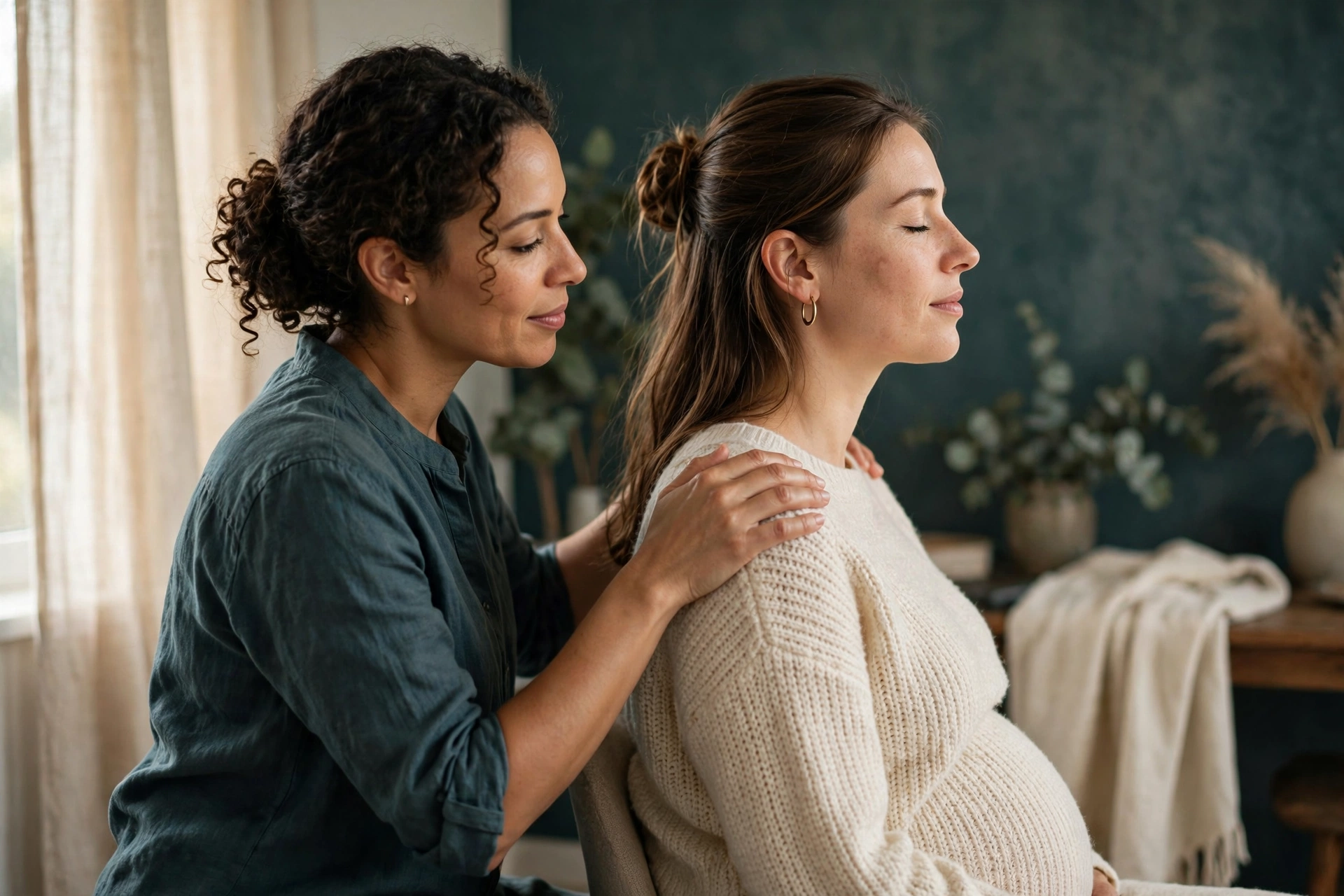
“Birth doulas are often described as providing educational, emotional and physical support during labor, birth and postpartum. I would also add advocacy into that mix, frequently partnered with training in trauma-informed care and anti-racism…”
What is a doula? Interestingly enough, this question can be difficult to answer directly, and for many reasons. Some would say a doula is an advocate, while others would sum up a doula’s role as “witness.” Some might describe doulas as comforting, soft, and supportive, while others might hire a doula because they want a fierce, bulldog defender or tough-loving coach.
There is also the word’s problematic origin—“doulē” which is Greek for “female servant” or “female slave”—and the fact that some people might want to take a step away from this etymology. In fact, “doulas” as we know them in the modern western world have been called many things: In ancient Greece, “maiai” (meaning “great” or “mother”) would attend births, taking on both the role of a doula and a midwife. Supporters or guides of birth might be called “birth attendants” or “wise women” in places like South America or Africa. Some doulas in North America prefer to call themselves “birth coaches” or “birth keepers.” There are many times I see my work as a doula as “companioning,” a term I borrowed from Dr. Alan D. Wolfelt’s keynote at an Association of Death Education and Counseling conference in Chicago.

And yet another element spicing up the answer to this question is the definition of a doula as a “guide through transition.” These days, we see doulas helping people through many different transitions: In addition to birth and postpartum doulas, there are death doulas, adoption doulas, abortion and loss doulas, divorce doulas, and the list goes on. As a person passionate about cycle education and empowering women to have healthier and happier periods, I’ve considered also taking on the title of “period doula.”
But I was asked to write for Dr. Berlin’s blog, which gives me the hunch that many of you are here to learn more about birth doulas and what exactly we do. Birth doulas are often described as providing educational, emotional and physical support during labor, birth and postpartum. I would also add advocacy into that mix, frequently partnered with training in trauma-informed care and anti-racism (critical elements of our work, considering over 50% of women will experience sexual violence involving physical contact in their lifetimes and BIPOC birthing people are 2-4 times more likely to die in childbirth compared to their white counterparts.)
Often we meet with parents early in their pregnancy journey (sometimes even before) and help them navigate the ins and outs of prenatal care and birth plans or preferences. As their due window approaches, we equip them with comfort measure tips, self advocacy tools, and the risks, benefits, pros and cons of any option they may consider. We are there as family-centered support, a listening and affirming ear, and a comforting, warm touch. We protect and preserve the “labor bubble” by keeping the lights dim, encouraging privacy, and mediating where needed.
Many of us are also nerds. I’ve heard it said that “OBs are surgery and high risk experts, midwives are physiological birth experts, and doulas are labor experts.” We’ve got tools in our pockets for an asynclitic baby, a sunny side up baby, a baby stuck too high in the pelvis, a stalled labor, and the oh so dreaded back labor. But don’t rush to put us in the “crunchy only” box just yet, because we’ve got other cards up our sleeves—Doulas can assist with productive epidural positions and acupressure, or help clients advocate for a family-centered cesarean birth, too.
All this said, doulaship is not a regulated profession. There are certified doulas and doulas who choose not to certify. There are doulas who choose to only attend hospital births and doulas who specialize more in physiological or out of hospital birth. There are doulas who will pray for you and doulas who will push you, and doulas who will do both! This is why it’s important to think about why you want a doula and how you see one supporting you.
Meet with 3-4 doulas and ask them prepared questions. It is important to find a doula who feels like the right fit for you—not just the one who knows the right maneuvers, but the one whose presence alone makes you feel how you want to feel as you bring your baby into the world.
And while we’re discussing what you might want in a doula, it might be important to point out a few things that doulas do not do: We do not do anything medical like take vitals or perform cervical exams. We do not replace midwives. We do not replace your partner. We cannot promise a perfect birth or a birth exactly how you planned it. And lastly but actually very importantly, we cannot have your baby for you. Instead, we strive to equip you to birth positively and confidently.
Midwife Ashley Booth Young once said “Although the popularly desired outcome is ‘healthy mother, healthy baby’, I think there is room in that equation for happy, non-traumatized, empowered and elated mother and baby.” And I think that encapsulates the united goal of doulas beautifully.
Need some questions to ask potential doulas? Here are a few to help get you started:
1. What got you into birth work and why do you do what you do?
2. Do you work with a back-up in case you can’t attend my birth, and can I meet them ahead of time?
3. I’m particularly nervous about ____ happening. Can you walk me through how you would support us if it were to happen?
4. What do your services include?
5. How would you describe your practice in one (or three) words?
About the author: Eryn Shaffer Davidson is a doula based in Waco, Texas. She is certified through Carriage House Birth and is also training to become a childbirth educator with Evidence Based Birth. Beyond birth work, she is passionate about empowering women through the entirety of their reproductive journeys, and could go on for too long about how periods shouldn’t hurt and how contraceptive options extend far beyond the pill.
An avid Informed Pregnancy Podcast listener, she is driven by the desire to see women fear birth less, and instead experience joy, support and clarity in their bodies and their choices. She dreams of a world where the evidence-practice gap is a little smaller, and collaboration between home birth and hospital providers is the norm. When she’s not at a birth, you can find her working with production company Stork Films, reading the latest Evidence Based Birth article, detoxing in a hot yoga class, or watching Grey’s Anatomy (seasons 1-8 only.)
All photos courtesy of Eryn Shaffer Davidson
