by Sallyann Beresford | Mar 29, 2023 | Family and Relationships, Labor and Delivery
“(B) enefits – What are the benefits of the recommendations given?
(R) isks – What are the risks of the recommendations – to me and/or my baby?
(A) lternatives – Are there any alternatives to consider before making my decision?
( I ) nstincts – What are my instincts telling me?
(N) othing – What if we wait a while and do nothing at this time?”
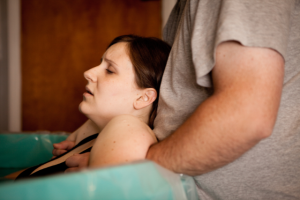
I’m sure you have already considered who might be at the top of your guest list when it comes to choosing your birth partner. Their role is essential to you and the process, so you should both become acquainted with the possibilities of their support and understand what can be achieved when a partner feels well prepared. You may also plan to invite a doula, family member or friend to be part of your team. Whoever you choose, remember that part of their job will be to help you feel calm and relaxed – so avoid inviting anyone who stresses you!
Here are my 5 top tips to prepare your partner, so they feel ready to offer the right support for the birth you are planning.
1) Birth Planning Sessions
I recommend you arrange at least one or two birth planning sessions with your partner and anyone else that will be supporting you, to take place around 32 and 36 weeks. If you are attending an antenatal course together, schedule one to take place before the start of the course, and the other once it is complete. Book these appointments into your schedule in advance to ensure that you are free from all distractions.
During these sessions, openly discuss your thoughts and preferences about giving birth. If you identify any gaps in your knowledge, this is the time to address them.
Here are some potential questions to guide your discussion:
- What are your wishes or preferences for this birth?
- What are your worries or concerns?
- What do you think might irritate you?
- What birth management techniques do you want to try or avoid—breathing and relaxation, hypnobirthing, comb, stress balls, tens machine, acupressure, Entonox (gas), epidural, opioids?
- What comfort measures or important tasks can your birth partner help you with during labor and birth—touch or massage techniques, hypnobirthing, cold or warm washcloths, documentation (photos or videos), communication with people outside the birthing area?
- What are your preferences regarding the following: monitoring of the baby, vaginal examinations, induction of labor (including cervical sweeps), abdominal birth (c-section), optimal cord clamping, placenta encapsulation, feeding the baby, skin-to-skin contact, vitamin K?
- If it becomes necessary, how would you like your birth partner to advocate for you?
- What do you need to know about them and their needs during the birth?
At your second session, I recommend you talk through your birth plan and pack your
birth bag together. This will help your partner understand what is available for
them to use on the day and what each item is for.
2) Be Honest!
Be really honest with your birth partner about your personality style and how you feel it may influence your labor. What are your strengths? What do you think are areas where you might struggle and need more support? Do you find it easy to relax and let go of control? Perhaps you already know that you don’t want to be touched. Or maybe you have a really clear idea about them supporting you with techniques such as hypnobirthing. Now is the time to tell your birth partner how you want to be cared for in labor and give details about the ways to uphold your wishes. If you keep forgetting to breathe, for example, how would you like them to remind you? Do you want them to breathe with you, would you prefer them to count your breaths, or just tell you to ‘breathe?’ Are you happy for them to touch you, or do you want to not be touched at all? Are you particularly annoyed when they look at their phone? How would you feel if they were constantly making jokes and trying to entertain you when you would prefer a quiet, relaxing environment? Watch birth videos online and observe the birth partner’s behavior to see what you like, and conversely what you don’t. Once they have a clear idea of their role, you can feel confident they will take great care of you.
3) Safety Word
Once you have implemented tip one and two, you can then introduce the idea of a ‘safety word’. Just as it sounds, this is a code word that you can have in place to protect you and your birth partner throughout labor. This is such a useful tool to have in your toolbox. In principle, having a safety word in place gives you the added security of knowing that if at any stage during the birth process you have a moment of doubt or something I fondly refer to as ‘a wobble’, your partner won’t instantly want to rescue you, but is more likely to support you through that moment. During that confidence dip, they can show you how much they believe in you, without the fear of making a mistake. If you do decide to use your safety word, you are clearly indicating that you would like to switch from Plan A – the set of preferences you shared with them in the prenatal period – to Plan B or C. A safety word allows you to vocalize as much as you want throughout the experience, without them switching to ‘fix it’ mode – a common trait with partners. This tool reminds anyone supporting you, that whilst nothing is set in stone, you are keen to ensure that you only deviate away from your plan A, if you decide you want to do so!

4) Advocacy – How to use your BRAIN
Sometimes, during pregnancy, labor and the postpartum period, the need may arise for you or your partner to ask questions regarding your options. Whilst recommendations can be made by your care providers at this time, nothing can happen to you without your consent. The BRAIN acronym helps you gain additional information. Ask your care provider any or all of the following questions, and then ask them to give you and your partner some privacy before you share your decision.
(B) enefits – What are the benefits of the recommendations given?
(R) isks – What are the risks of the recommendations – to me and/or my baby?
(A) lternatives – Are there any alternatives to consider before making my decision?
( I ) nstincts – What are my instincts telling me?
(N) othing – What if we wait a while and do nothing at this time?
If for any reason you need to ask your care provider additional questions, these might include:
- Is this your personal opinion or an evidence-based recommendation?
- Please can you show me the evidence?
- What are the actual statistics that are relevant to me and my situation?
5) The Ultimate Birth Partner – Being Not Doing!
Lastly, the best possible birth companion is someone who truly understands the concept of being present with you in labor without feeling the need to do anything at all. If labor is progressing, they can sit close by and quietly observe. As a doula myself, I like to adopt a ‘less is more’ approach and try not to be too active. What is important is to ensure that your birth partner meets all your physiological needs. So, ensure they have access to plenty of your favorite snacks and drinks, they know what positions you like and feel comfortable with, they understand how to prepare the environment to facilitate the right hormones for birth – making you feel safe and loved, and encourage them to stay calm and quiet which can help to raise your oxytocin levels. Typically, only an occasional confident smile or kind word is required to remind you that your birth partner is nearby if you need them. If your birth partner can stay out of your eye line, you won’t feel too observed and less likely to be tempted to engage in conversation. You can then relax and get into the birthing zone more easily. This helps you to produce more and more oxytocin – the hormone required to dilate your cervix. The more oxytocin you produce the quicker your labor is likely to be.

Sallyann Beresford is a UK based doula and birth educator with over 20 years of experience supporting pregnant women and their partners. She is the author of two best-selling books: Labour of Love – The Ultimate Guide to Being a Birth Partner and The Art of Giving Birth – Five Key Physiological Principles. Sallyann has also designed a range of birth planning journals to help pregnant women document their pregnancy and explore their feelings in preparation for a really positive birth experience. In addition, she produces her own popular weekly podcast – The Ultimate Birth Partner Podcast.
Website www.birthability.co.uk
Instagram @theultimatebirthpartner
by Hannah Gill | Mar 1, 2023 | Cesarean and VBAC, Labor and Delivery
“Ten minutes and a few contractions passed and Julie asked if I would feel comfortable moving to the squat bar. In my head, I thought she was crazy. There was no way I could support my body in a squat but with help from Scott, Julie, and our nurse, I repositioned and it was the best decision I made.”
My second birth experience was as different from my first as night is from day, both physically and mentally. I spent over a year preparing, I hired a doula, and I healed from the trauma of my first birth. Therapy helped tremendously in working through my postpartum depression, postpartum anxiety, and birth trauma. Simply having my experience and feelings validated lifted weight from my chest. Fear releasing and hypnosis practice also helped me prepare my mind. I knew it would be necessary to forgive myself and be at peace with my cesarean before I could fully surrender to birth again.
I woke up at 40+2 weeks with heavy bleeding. After talking to my husband, doula, and OB, I decided to head to triage for monitoring. Upon arrival, I was 3cm dilated and having irregular, unnoticeable contractions. My OB wanted to see if the bleeding was caused by a placental abruption or an intense bloody show. Luckily baby and I were both in stable condition and the bleeding eventually stopped. We had planned to return home because I wanted to labor there as long as possible but I had already dilated another centimeter and my contractions started to become more regular, so we stayed.
Dr. Alyssa Berlin’s The AfterBirth Plan course is now streaming!
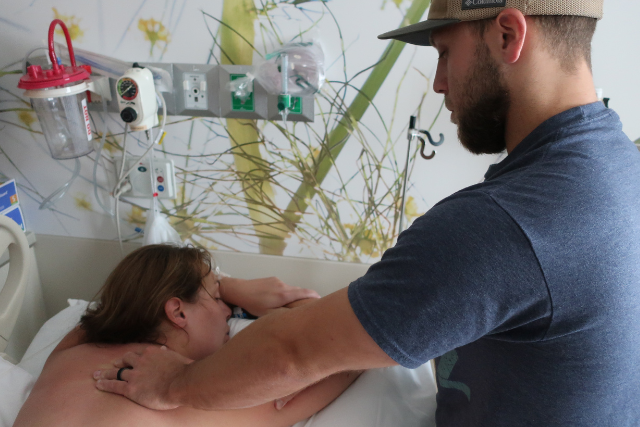
Once admitted, I got my first round of IV antibiotics since I was positive for Group B Strep. My contractions quickly grew in intensity and frequency and my water broke as I dilated to 5cm. While I was still in the right mindset, I sent a quick text to my doula, telling her to head to the hospital. At this point, I felt that I had to go to the bathroom. Laboring on the toilet felt like the most natural position to be in and after 45 minutes it was clear that I was transitioning. I began shaking and sweating as Scott massaged my shoulders and used a wet washcloth to cool me down. Out of breath, I told him I wanted an epidural but he knew how badly I wanted to stay unmedicated and encouraged me to wait for Julie to arrive for support.
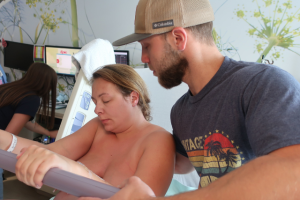
When Julie finally walked into the bathroom I immediately told her I needed an epidural but thankfully, she suggested a position change instead. I moved to the shower and hung around Scott’s neck as Julie sprayed warm water onto my back. I felt the need to bear down as my body instinctively pushed. Julie suggested I go to the bed and get on my hands and knees. Still pushing, I positioned myself on hands and knees, holding onto the incline of the bed. It was a relief to be able to rest my head between contractions. Ten minutes and a few contractions passed and Julie asked if I would feel comfortable moving to the squat bar. In my head, I thought she was crazy. There was no way I could support my body in a squat but with help from Scott, Julie, and our nurse, I repositioned and it was the best decision I made.
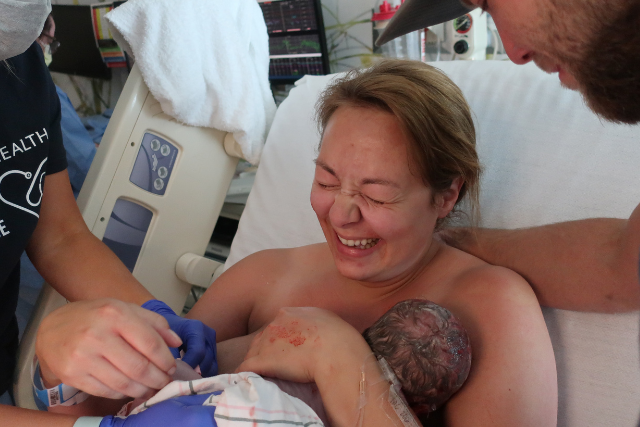
In five intense minutes, our daughter was born, just under five hours from the first contraction I
felt. She came down and through the birth canal so quickly, there was no time for head molding so her head was perfectly round. Every bit of pressure and discomfort I felt disappeared as I pulled her to my chest with tears of pure bliss streaming down my face. I had done it. I had the unmedicated VBAC I so badly wanted and it was the most rewarding and beautiful thing I have ever done.
After the pregnancy and birth experience I had and the relationship I developed with my doula Julie, I knew I had to become a doula too. Through training I was able to experience birth from a completely different perspective, one that opened my eyes to how unique each person’s experience is. So now, not only can I help educate women on their options in pregnancy, birth, and postpartum, but I can also help support them as a doula during labor.
Many people may be shocked to hear that I am thankful for the way both of my births unfolded. Although extremely difficult, my first birth brought me my son and a learning experience about taking charge of my health choices. My second birth brought me my daughter and helped me find the strength and power I have as a woman and a mother. Both experiences together lit a fire for a passion inside of me that I never knew existed.
Follow Dr. Berlin for updates on pods, blogs, streaming and more!

Hannah Gill is a VBAC mom of two, birth and postpartum doula, birth educator, and owner of Ebb and Flow Birth Co. She has a passion for helping support women through cesarean and VBAC births and throughout the postpartum period. She believes women deserve to be respected and supported in their pregnancy, birth, and parenting choices. You can find out more about Hannah and her services at ebbandflowbirthco.com and over on Instagram@ebbandflowbirthco.
by Hannah Gill | Feb 22, 2023 | Cesarean and VBAC, Labor and Delivery
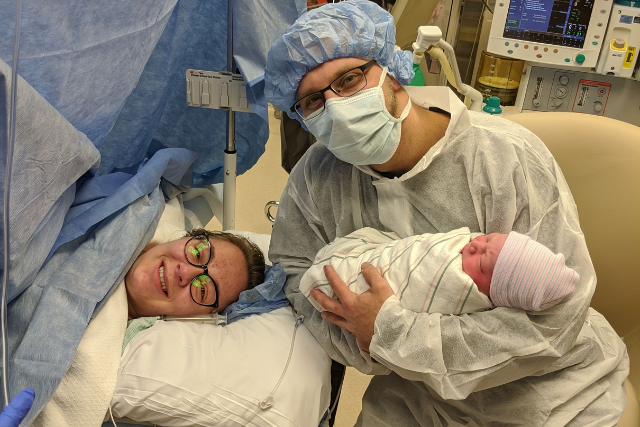
“The anesthesiologist gave me something for the pain and whatever it was, I began to doze off. The next thing I remember was hearing my husband Scott say, “Babe it’s a boy!””

Going into my first pregnancy, I thought I was doing all the “right things” to prepare. I read all the books and blogs, took a hospital childbirth course, and played twenty questions with my OBGYN. The majority of my work experience at that point was in healthcare, so I favored a medicalized approach. I simply followed the mainstream checklist of what you should do for birth, unaware of all the options I actually had.
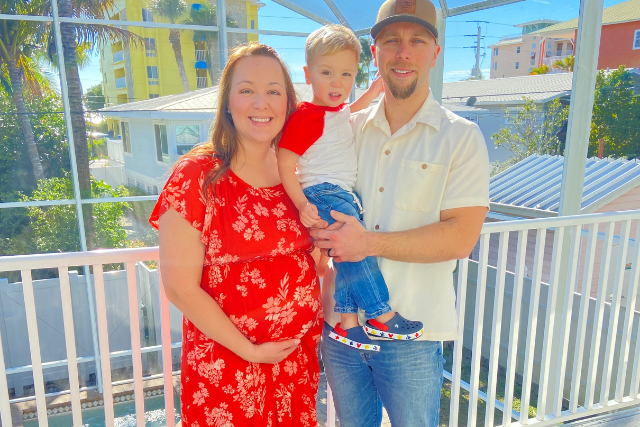
My pregnancy was rough and I spent the majority of the 40 weeks vomiting but still somehow gained sixty pounds. The only other “complication” was gestational thrombocytopenia which meant there was potential I would risk out of epidural criteria. As the end of my third trimester approached, I was ecstatic to finally meet my baby, not knowing that birth and postpartum would shatter my entire being and make way for a rebirth I never saw coming.
My labor plan was to be unmedicated and at the time and I felt more prepared than ever. It wasn’t until five weeks postpartum from a traumatic cesarean, drowning in breastmilk and feelings of failure, that I realized how unprepared I truly had been. To put it simply, I was naïve. The notion that I could end up with a cesarean never even crossed my mind because I thought, “That only happens in emergencies which only happen to people with unhealthy or complicated pregnancies.” I’m pretty sure I glossed over that entire section in my birth education workbook.
Stream movies, shows, courses and more on Informed Pregnancy+!
When labor began, I panicked. My contractions started out extremely intense and were only 5-7
minutes apart. That was not the gradual build-up I had read about. I was immediately anxious and overwhelmed. As soon as I got to the hospital and got the okay for my platelet levels, I asked for an epidural. I was disappointed that I gave in so quickly but the disappointment faded as my body relaxed and I was able to rest. The epidural was so strong I couldn’t even feel pelvic pressure and after four hours of pushing, I opted for a cesarean. I was speechless, trying to hold myself together while my mom cried and kissed my forehead. I had no idea what my body and mind were about to go through.
Surgery started and immediately I felt more than “just some pressure,” as they had described. I was in full-blown pain. The anesthesiologist gave me something for the pain and whatever it was, I began to doze off. The next thing I remember was hearing my husband Scott say, “Babe it’s a boy!”. I don’t remember my son Hudson’s first cry or meeting him for the first time. I spent the next few hours in the recovery room hypotensive and on the verge of passing out from postpartum hemorrhage. I was unable to hold Hudson but Scott helped him latch and feed while the nurses worked to stabilize me.
During the transfer to the postpartum ward Scott went home to shower so it was just me, Hudson, and my dad. Switching beds is the moment I remember more vividly than any other. I was flat on my back, looking up at the ceiling as they began to move me. Counting to three, they slid me over from one bed to another and I let out a scream I never want to hear myself make again. As tears poured down my face and I tried to catch my breath, I noticed my dad out of the corner of my eye. He was facing away from me – his hand on Hudson’s bassinet – wiping away his own tears. I had never felt so scared and out of control in my entire life. It was at that moment I knew I could never go through this again.
Shortly after, I began to research what had gone wrong and specifically, what I had done wrong. I felt that my body had failed me and my baby. Soon though, I realized it wasn’t my fault. I made the best decisions I could with the information I had but I didn’t know what I didn’t know. Ultimately, this process helped me plan for a vaginal birth after cesarean (VBAC) and start my journey to become a childbirth educator. My goal became to create a birth course that truly gave people information about all of their choices when it comes to pregnancy, birth, and postpartum.
…Stay tuned for Part 2 coming next week!
Check out Hannah’s episode of The Informed Pregnancy Podcast!
Hannah Gill is a VBAC mom of two, birth and postpartum doula, birth educator, and owner of Ebb and Flow Birth Co. She has a passion for helping support women through cesarean and VBAC births and throughout the postpartum period. She believes women deserve to be respected and supported in their pregnancy, birth, and parenting choices. You can find out more about Hannah and her services at ebbandflowbirthco.com and over on Instagram @ebbandflowbirthco.
