
January 5, 2023 · 36 minutes · Episode 321
About this episode
CEO and Founder of Ebb and Flow Birth Co. and mother of two Hannah Gill shares her two vastly different birth stories, her journey to becoming a birth educator and doula, and her passion for helping educate and support families through pregnancy, childbirth, and postpartum.

Learn more about your ad choices. Visit megaphone.fm/adchoices
See Privacy Policy at https://art19.com/privacy and California Privacy Notice at https://art19.com/privacy#do-not-sell-my-info.
Key quotes
“Decided to not really start trying but not not try in 2019 when I got diagnosed with PCOS”
“And we got pregnant literally the first time.”
“It was very borderline, so it wasn't officially hyperemesis because it wasn't like constant”
“little bit, but I don't remember my baby being born basically.”
“I said, Julia, I need an epidural.”
Related episodes
- Ep. 399 All About VBACs with Meagan Heaton
- Ep. 510 Preparation Matters with Nina Spears
- Ep. 512 The Fourth Trimester with Eboni Nash
- Ep. 355 Rumer Willis: Before Birth
Transcript
AI-generated transcript with speaker labels — may contain errors, especially names and medical terms. Dr. Elliot Berlin, DC appears in blue; Hannah Gill in orange.
Download PDF of the Transcript
Dr. Elliot Berlin, DC [1:13] Welcome to the informed pregnancy and parenting podcast. I'm your host pregnancy focus carprector. Dr. Elliot Berlin today We're speaking with an operation supervisor for a biotechnology company working in biotherapeutics by day and birth work by night and we're gonna compare her to birth experiences Hannah Gill, welcome to the podcast Hi, dr. Berlin. How are you doing? I'm doing amazing. What a Combination of night and day by the way, I picture based on my own introduction I picture you're going into a phone booth when somebody's in labor and putting on a superhero outfit and Flying over to save the day, but let's talk about the meeting where you're from originally and what's this biotech business?
Hannah Gill [2:18] So I was born in Kansas City, Missouri But I've spent the majority of my life in Indiana with a brief stint in Nebraska and then back to Indiana
Dr. Elliot Berlin, DC [2:27] Okay, which part of Nebraska?
Hannah Gill [2:29] Tekema Very very that sounds like not very many people. No population was less than my high school It's about our north of Omaha. So it's very small. So a gas station and a saloon Basically, everyone knows everyone and everyone's related. Oh boy People know my business All right, and then where did you go to school so undergrad I went to IU Bloomington in Indiana and then for grad school, I did IU POI, which is Indianapolis University Purdue University and you studied Undergrad human biology and then my master's is in forensic biology. Where's that mean in English forensic biology? So forensic science what a lot of people see on CSI, but it's nothing like that. Okay, because
[3:18] It's very fabricated on TV. Oh, the processes take much longer than that. Oh, it doesn't take 45 minutes to figure it out And most of the time there's not an answer. Oh
Dr. Elliot Berlin, DC [3:29] That's even worse and no commercial breaks though, which is nice. Okay, and then where to meet your hubby
Hannah Gill [3:37] And we I started dating in high school. So we've been together since I was 15 and he was 17
Dr. Elliot Berlin, DC [3:42] Wow, did you know? Did we know what like in high school did that feel like this was gonna be a forever? Yeah, probably Really? Wow, that's very special. How cool All right, and then kids was that was like hey now we should have kids since we've been dating forever
Hannah Gill [3:59] yeah, we always wanted to have kids we got married in 2016 and Decided to not really start trying but not not try in 2019 when I got diagnosed with PCOS
Dr. Elliot Berlin, DC [4:12] Were you having symptoms or were you trying to get pregnant? Yeah
Hannah Gill [4:15] so I Stopped birth control the year prior and I had been on birth control since I was basically started my period like a lot Of women are and I stopped birth control in 2018 because I was just over it I was tired of being on it so long and I was tired of the side effects Yep, the film and then after that I started having two periods a month instead of one So then I went to my OBGYN because I said this is obviously not normal and they did an ultrasound and some blood testing and Found like the string of pearls or whatever they call it for PCOS and then my testosterone levels were super super high So that's how I got diagnosed. I don't have like the traditional PCOS symptoms besides those two things. Oh
Dr. Elliot Berlin, DC [4:56] So only the diagnostics you didn't feel PC
Hannah Gill [5:00] Right. So I don't have like the insulin resistance or anything like that.
Dr. Elliot Berlin, DC [5:05] Oh, metabolic X syndrome.
Hannah Gill [5:08] Right. Right. And the only symptoms I was having was the two periods a month.
Dr. Elliot Berlin, DC [5:12] Wow.
Hannah Gill [5:13] With high testosterone, which is like… Yeah, I've had acne my whole life. So I just assumed it was just who I was, but it was apparently part of my PCOS.
Dr. Elliot Berlin, DC [5:22] Sometimes I have low testosterone. I feel like I'll take some of yours. Can we do that?
Hannah Gill [5:30] Take away, please.
Dr. Elliot Berlin, DC [5:31] Yeah. Okay. So then PCOS, and how do you treat that?
Hannah Gill [5:38] So I decided not to treat it because I decided you can get back on birth control to help. And I was like, no, I don't want to do that. I don't want to be on birth control anymore. So my OB-GYN said, well, it could take you a while to get pregnant or it could be really fast. It just depends. And we got pregnant literally the first time.
Dr. Elliot Berlin, DC [5:54] Oh, the first time that you were off birth control?
Hannah Gill [5:57] I mean, no. The first time not preventing.
Dr. Elliot Berlin, DC [6:01] Okay. So after the pill, you were doing something else to block?
Hannah Gill [6:04] Yes.
Dr. Elliot Berlin, DC [6:05] So you were ready. You said, let's try and see what happens.
Hannah Gill [6:07] Yeah. I said, well, it could take a while. It could be fast. So let's just not prevent and let's just see what happens. And it was literally the first time.
Dr. Elliot Berlin, DC [6:15] How was your pregnancy?
Hannah Gill [6:16] Awful. Not awful.
Dr. Elliot Berlin, DC [6:18] Oh, no.
Hannah Gill [6:19] I'm not horrible, but I was sick the entire nine months with my first pregnancy.
Dr. Elliot Berlin, DC [6:23] Sick, nauseous, or also throwing up?
Hannah Gill [6:25] Vomiting all day.
Dr. Elliot Berlin, DC [6:27] So hyperemesis?
Hannah Gill [6:28] It was very borderline, so it wasn't officially hyperemesis because it wasn't like constant all day every day. But the majority of my first trimester was constant all day. And then the second and third trimester, it was three to four times a day, but it never ended after the first trimester.
Dr. Elliot Berlin, DC [6:43] That sounds hyperemesis to me. First of all, did it stop as soon as the baby was born?
Hannah Gill [6:47] Oh, yeah.
Dr. Elliot Berlin, DC [6:48] Yeah. So it does sound like hyperemesis because we have a couple episodes about hyperemesis. One with Amy Schumer discussing her experience with pregnancy and hyperemesis, and then one with a few doctors. But what the doctor said is that they're kind of nailing it down to hormones created by the placenta, a satiety hormone that makes you feel full all the time in excess production so that anything you eat makes you feel like overful, like you've had too much, like you have to get rid of it. So a little bit sounds like that. But there's a foundation called the HER Foundation, H-E-R, and they have great resources for people who are struggling like that during pregnancy.
[7:27] And one of them is an app where you can kind of input your symptoms and then send it to your doctor to get a better handle on whether that's hyperemesis or not. So I was already grateful that you did the podcast, but now another chance to help people who experience pregnancy like that.
Hannah Gill [7:46] Agreed, because I was never diagnosed with it, so.
Dr. Elliot Berlin, DC [7:50] Was there a plan for birth?
Hannah Gill [7:52] Yes, so I had planned to do an unmedicated hospital birth, and I just took the basic hospital birth class and then an advanced labor birth class, is what they called it, to kind of help you get through it without medication.
Dr. Elliot Berlin, DC [8:06] Also at the hospital?
Hannah Gill [8:07] Yes, but it was after looking back at my experience and what I know now was not very helpful. It was a very fast, just like quick and dirty type of class on here's some comfort measures, but it didn't really help prepare me.
Dr. Elliot Berlin, DC [8:21] Sometimes the hospital birth class feels like how to be a good patient at a hospital.
Hannah Gill [8:26] Oh, yes, I agree. Which I know now.
Dr. Elliot Berlin, DC [8:29] Yeah, I usually recommend if you want to do something that's a little out of the box for a typical hospital birth to do a non-hospital birth class.
Hannah Gill [8:39] No one I knew had ever birthed outside of a hospital, and the majority of people I knew did not birth unmedicated. So I just thought, oh, you go to an OB, go to a hospital, and that's how it is. I didn't know what a birth center was. I had never even heard of a doula at that time, or, and I didn't know anyone had a home birth, so I just kind of took the route that I do best, and that's what happened.
Dr. Elliot Berlin, DC [9:01] All right, well, let's take a quick little break, and when we come back, we'll see how that birth went. Don't go anywhere. We'll be right back.

Dr. Elliot Berlin, DC [10:37] Welcome back to the podcast. We're talking to Hannah Gell. Okay, so first pregnancy, boom, right out of the gate, and horrible motion vomiting all the way through. But then you took a hospital birth course on childbirth and you did an extra class for unmedicated childbirth. And how did your labor start?
Hannah Gill [10:56] So I didn't really feel like the gradual build up a lot of people talk about. It was more of as soon as my contractions started, they were extremely intense and five minutes apart. So
Dr. Elliot Berlin, DC [11:06] Wow, okay, what time of day was that?
Hannah Gill [11:08] About 530 in the morning.
Dr. Elliot Berlin, DC [11:10] Okay, so boom. And so I assume it woke you up?
Hannah Gill [11:14] Yes, I had gotten up to go to the restroom and then try to go back to sleep. And that was not happening. So I decided to get in the shower to see if that would calm anything. And it definitely did not.
Dr. Elliot Berlin, DC [11:26] Meaning just progressed?
Hannah Gill [11:28] It just kept getting worse and worse as far as the pain goes. So my husband was already at work at this time. And I just called. Yes, he goes he leaves for work around 5am.
Dr. Elliot Berlin, DC [11:38] Holy moly. Okay. So before he left, nothing.
Hannah Gill [11:43] No, it was not until he left, of course. And then a half an hour later, rage. Okay. And then he came back. Yeah, so I gave him a call at work. I actually texted him first. And I said, Hey, I'm starting to have contractions. They're really intense. I'm gonna try to get in the shower, but I'll let you know how things go. And I started using that contraction timer and I said, go to the hospital. So I called him on like the work line because he wasn't answering the cell. And I told them I said, get him home now, please. And he got home and I was on the birth ball. And he's like, what am I supposed to do? I said, just grab the bags. Let's just get going. And of
[12:18] course, by this time, it was getting close to rush hour around where we are. And I was not looking forward for about 30 minutes from the hospital. So it was only you're in a small town with 200 people. Oh, yes. Yes. Rush hour would be like rush minute. Yes. So the
Dr. Elliot Berlin, DC [12:39] drive to the hospital was pretty rough with having to wait in traffic, but with that kind of intensity, especially in the front seat, backseat front seat, like buckled in like or on your hands and knees.
Hannah Gill [12:52] At first I was buckled in and then I got unbuckled, took my coat off because I was sweating, rolled the window down. And mind you, this was December and it was freezing. But so my husband was cold. I was like sweating. So no, I was buckled in at first. And then it was just like bracing myself and holding onto the door and trying to breathe through my contractions.
Dr. Elliot Berlin, DC [13:11] I mean, it sounds like a caged animal.
Hannah Gill [13:14] Yes. That's exactly how it felt.
Dr. Elliot Berlin, DC [13:16] I'm probably getting in trouble for saying that, but that's what it just sounds like you need to have space and get out of
Hannah Gill [13:21] there. And I was vomiting my entire labor too. So in the car.
Dr. Elliot Berlin, DC [13:26] Yeah. What happened when you got to the hospital?
Hannah Gill [13:30] So they had me sign all those fun forms as I'm breathing through my contractions and then got me into triage and I was only three centimeters.
Dr. Elliot Berlin, DC [13:41] Okay. Yeah. Had you been checked before?
Hannah Gill [13:44] Yeah. So my first pregnancy, I did get checked the day before I went into labor. I was two centimeters and I had my OB do a membrane sweep.
Dr. Elliot Berlin, DC [13:54] Oh, okay. You think that contributed to the morning events?
Hannah Gill [13:58] Okay. Yes. I think so because it was much more intense than I had expected. So maybe the sweep kind of escalated that.
Dr. Elliot Berlin, DC [14:05] Was there like any blood after the sweep?
Hannah Gill [14:07] Nope.
Dr. Elliot Berlin, DC [14:09] Okay. So three centimeters only in your words, three centimeters.
Hannah Gill [14:14] Yes. Well, cause I had been to the day before and with how intense my contractions were, I was expecting it to be way further along. So that was kind of, yeah. And they did check my platelets. I did not mention I had gestational thrombocytopenia where your platelets are low.
Dr. Elliot Berlin, DC [14:30] We do have a whole episode on gestational thrombocytopenia with Dr. Nate Fox that was triggered by Mandy Moore, who had it with at least her first pregnancy. Wow. So does that mean were you borderline epidural or?
Hannah Gill [14:44] I was borderline. So I wasn't as low as where you absolutely know for sure you can't have it. It was always really borderline. And for my hospital, when they checked it, it was like right at the level. So that's why I decided, okay, I'm just going to get it because who knows in a couple hours I may. not be able to anymore. So I just went ahead and got it because my contractions were so intense and I was right on that level. So I got an epidural right away.
Dr. Elliot Berlin, DC [15:08] I mean, it also sounds like with the intensity and the progress, like your mind might have been easily persuaded anyway.
Hannah Gill [15:15] Oh, yes. It was all mind game. Yeah, for sure.
Dr. Elliot Berlin, DC [15:19] Okay. So did it work?
Hannah Gill [15:21] The epidural? Yes, it worked wonderfully and I took a nap.
Dr. Elliot Berlin, DC [15:24] Okay, great. And how did the rest of that labor progress?
Hannah Gill [15:29] So I progressed very quickly. I got my epidural around eight or nine o'clock, started pushing around one o'clock.
Dr. Elliot Berlin, DC [15:37] So four hours. And this is 1 p.m. So really not that long after your entire labor started.
Hannah Gill [15:42] Right.
Dr. Elliot Berlin, DC [15:43] Okay, how was pushing?
Hannah Gill [15:45] I pushed for four hours.
Dr. Elliot Berlin, DC [15:48] Did the epidural start to wear off? Did they turn down?
Hannah Gill [15:51] No, the epidural was so strong, I could not even tell I was pushing.
Dr. Elliot Berlin, DC [15:55] Oh, wow. That's crazy.
Hannah Gill [15:56] Which is part of the problem.
Dr. Elliot Berlin, DC [15:59] Oh, four hours of that.
Hannah Gill [16:01] Yes, so four hours of that.
Dr. Elliot Berlin, DC [16:03] What position?
Hannah Gill [16:05] Just like the semi reclined position.
Dr. Elliot Berlin, DC [16:07] You couldn't get into like hands and knees or stuff like that?
Hannah Gill [16:10] I didn't know that was an option at the time. So yeah.
Dr. Elliot Berlin, DC [16:14] Well, if you could go back in time, listen to this episode. All right, so pushing on your back with your pelvis closed, numb from the chest down. And then holding your breath, counting for 10 seconds, push, push, push, push, push, that type of thing. So the coach pushing that everyone hears about.
Hannah Gill [16:36] Yeah.
Dr. Elliot Berlin, DC [16:37] Okay. And in the four hours, was the baby handling it?
Hannah Gill [16:40] Well, I assume. Yeah, there was one brief decel, but they didn't make a big deal about it. They just had me put some oxygen on and rest for a minute.
Dr. Elliot Berlin, DC [16:48] Okay. And then what happened?
Hannah Gill [16:51] So we figured out that baby was most likely asyncletic the way he was coming down. And we didn't know if it was a boy or girl at this time, just a side note. So the way the baby was coming down, just kept coming down, going back up, coming down, going back up. So after those four hours, I opted for a cesarean.
Dr. Elliot Berlin, DC [17:09] Okay. Asyncletic essentially means not lined up with the runway very well. So all that pushing is not really coming down, it's just flexing the head sideways and then as soon as you stop pushing, the head flexes back up. Always recommend seeing a baby carpenter after a labor like that, by the way. Okay. So how was the cesarean for you?
Hannah Gill [17:34] It was not great. Like I actually felt a lot more than I expected to. So they gave me…
Dr. Elliot Berlin, DC [17:39] Oh great. You didn't feel your pushing, but you felt your abdominal surgery.
Hannah Gill [17:43] Right. So I was like basically screaming and telling my husband, I need something else. This hurts really bad. I can feel a lot. So they gave me some additional medication through the epidural, whatever they give you that's extra. And I kind of dozed off for a few minutes, I think. I don't know if I fell asleep or what they gave me just kind of knocked me out a little bit, but I don't remember my baby being born basically.
Dr. Elliot Berlin, DC [18:05] I was afraid you were going to say that.
Hannah Gill [18:07] Yeah. I don't remember hearing him cry. The first thing I remember is my husband saying, babe, it's a boy because we didn't know. I was just so out of it and so loopy that I don't really remember much of it all.
Dr. Elliot Berlin, DC [18:20] I'm so sorry.
Hannah Gill [18:21] Thank you.
Dr. Elliot Berlin, DC [18:22] I mean, I appreciate the sentiment there and I know it's hard for a lot of women who have that experience. I know a lot of people go through it, especially if they're having to be put under general anesthesia too.
Hannah Gill [18:33] Thankfully, I didn't have to do that, but…
Dr. Elliot Berlin, DC [18:35] Well, it sounds like you're pretty close.
Hannah Gill [18:37] It was pretty close. Yeah. I mean, I just had the epidural, so I didn't need general, but they did give me… I don't know what they gave me additional to help with the pain, but I kind of dozed off for a little bit.
Dr. Elliot Berlin, DC [18:46] For a key moment.
Hannah Gill [18:49] Yes.
Dr. Elliot Berlin, DC [18:51] How was your recovery?
Hannah Gill [18:52] So in the actual recovery room, I went hypotensive and I hemorrhaged really bad. So I was on the verge of completely passing out because my blood pressure was so low and I had a lot of blood loss. So during that process, I was kind of out of it, but my husband was trying to help my son nurse at the same time. But I was shaking and I couldn't really hold him. So he was helping him do that.
Dr. Elliot Berlin, DC [19:16] Oh, this begs the question. Did he get any pictures or video of the baby coming?
Hannah Gill [19:22] Not of him actually coming out, but like in the operating room, we got some photos of him on like the warmer thing and then…
Dr. Elliot Berlin, DC [19:30] I was saying, anything to fill in the blanks of when you were out?
Hannah Gill [19:33] Not really. They got a picture of us all three together in the OR, but I don't really remember that being taken. I just see the picture.
Dr. Elliot Berlin, DC [19:42] OK, so something from…
Hannah Gill [19:45] Yeah, something.
Dr. Elliot Berlin, DC [19:46] That you can look at. OK, and then recovery at home. Wait, so did you have blood transfusions?
Hannah Gill [19:52] I did not have to get transfusions. They just said it was more than they would like to see from a historian, but not enough to get a transfusion.
Dr. Elliot Berlin, DC [20:00] related to the thrombocytopenia?
Hannah Gill [20:03] I don't know. I guess it could be. That would make sense. I don't know if it was that, or I know that if you, I guess pushing for a long time, your uterus doesn't.
Dr. Elliot Berlin, DC [20:11] Yeah. Okay. How was your home recovery?
Hannah Gill [20:15] It was pretty rough. Um, I was on quite a bit of pain postpartum at the hospital and at home, and I didn't really feel comfortable doing much of anything for several weeks. And I think it was a lot of emotional pain as well as physical.
Dr. Elliot Berlin, DC [20:29] So on the physical side at the incision.
Hannah Gill [20:33] Yeah. And in my abdomen in general.
Dr. Elliot Berlin, DC [20:36] Are you athletic?
Hannah Gill [20:38] I was before I got pregnant. Yeah. Not as much during my pregnancy or postpartum.
Dr. Elliot Berlin, DC [20:43] My observation and seems to fit people more than people who are less, you know, in tune with the body.
Hannah Gill [20:51] Right. And I've heard that the tension, if your muscles are tighter can cause a lot of issues too. So if you are athletic and you have really tense muscles and they're not relaxed, it can cause some issues.
Dr. Elliot Berlin, DC [21:03] Well, again, in my observation, clinically in the office, one of the things that we see is if you're strong and also tight and combination of strong tight creates a rigid environment and if the baby's not lined up well with the runway, then it's a bit harder to maneuver in that static environment. And that's where you end up spinning your wheels a lot in labor. But the cool thing about that is if you can do something and get rid of that tension, the excess tightness, the dysfunctional shortness and all you have is the strength then it goes the other way. That's those are like the most powerful births I've ever seen. And then emotionally, how are you feeling?
[21:44] You said that was also uncomfortable.
Hannah Gill [21:47] Yeah, I was really just kind of thrown off and shocked by my birth experience and I ended up with postpartum depression and anxiety and had to go to therapy to help talk through that which was extremely helpful. I recommend it to anyone that needs it. So it was a rough postpartum physically and mentally for sure.
Dr. Elliot Berlin, DC [22:06] And did lactation go well for you?
Hannah Gill [22:09] Yeah, he actually nursed great breastfeeding was wonderful and we breastfed for a year.
Dr. Elliot Berlin, DC [22:13] So, oh, okay. At least there's some things that did go. Yeah. And you're aware that you wanted them to go. I guess looking back, would you have done anything specific differently?
Hannah Gill [22:28] I probably would have waited on the epidural or if I would have known at the time gotten a doula for that birth, but I didn't know what a doula was. I didn't know that was a thing. So that's probably what I would have done differently. And then I also would have I didn't mention this but they did break my water at nine centimeters. I asked them to break it because I didn't know any different and I feel like he could have gotten a better position if my water wasn't broken.
Dr. Elliot Berlin, DC [22:52] Yeah, it's hard to hard to know but one wonders for sure. And just getting back to the hyperemesis before we move on to your next baby. Was it like literally that same day that it stopped?
Hannah Gill [23:07] Yeah, I wasn't sick at all. I was sick all through labor and that I wasn't sick at all afterwards.
Dr. Elliot Berlin, DC [23:11] Were you hungry?
Hannah Gill [23:12] I was hungry. I think the only other thing that made me sick was my pain meds postpartum. Yeah, that made me sick until they got the right one.
Dr. Elliot Berlin, DC [23:20] And this is when you start going to phone booths and helping other people in labor. Tell me about that.
Hannah Gill [23:25] So I started out with childbirth education first.
Dr. Elliot Berlin, DC [23:28] Okay, becoming a childbirth educator.
Hannah Gill [23:31] Yes. Not a specific method. I just wanted to become an out-of-hospital specifically because of how my experience with my birth class and how I did not enjoy it and I thought well there needs to be better options for people because that wasn't great. So I just started to do that first and then I did not get into doula work until after the birth of my second.
Dr. Elliot Berlin, DC [23:55] Oh, wow. Okay. Wow. That sounds like a excellent place to take a quick break and let's find out about the second pregnancy and birth and the doula work. We'll be right back. Welcome back. We're talking to Hannah Gill and let's talk about baby number two. So was that planned?
Hannah Gill [24:24] Yes, the second was planned for sure.
Dr. Elliot Berlin, DC [24:27] Super fast again.
Hannah Gill [24:28] Took two cycles, but still relatively fast.
Dr. Elliot Berlin, DC [24:30] So pretty darn fast, especially people get very nervous with PCOS that it's always going to take a while. How was your second pregnancy?
Hannah Gill [24:39] So the first trimester was extremely rough for about 17 weeks. Again, borderline probably this time was actually hyperemesis. Again, I wasn't diagnosed, but I did it up in the hospital with fluids because I couldn't keep anything down and had to take time off work. So the first trimester was rough, but then it got better after that this time. at work is usually don't get the answer anyway even though you're not there okay
Dr. Elliot Berlin, DC [25:07] so well you said 17 weeks does that mean it got better yes after 17 weeks it got
Hannah Gill [25:13] it got better I was still nauseous here and there and had random bouts of vomiting but nothing nearly like my first right so it sounds like the
Dr. Elliot Berlin, DC [25:22] first part of your second pregnancy was worse than the first pregnancy yes but then it got a lot better than the first pregnancy so interesting how it works who knows and then what was your plan for this one so this time I
Hannah Gill [25:37] originally wanted to do a birth center but it is illegal to be back in Indiana and a birth center really yes it's out they made V back outside the scope of practice of a birth center yes it's not allowed that's weird I
Dr. Elliot Berlin, DC [25:53] know I didn't know it was a thing until I looked into it I could see insurance not wanting to cover it but to out what seems strange yeah it's a little
Hannah Gill [26:04] drastic just like restrictive in a free country okay yeah so after figuring that out I thought well let's go the route of home birth but the closest midwife to me would not take the first V back after she would only take the second V back after cesarean so the closest midwife to me that would take me on was about two hours away and I didn't feel comfortable driving that far for appointments so everywhere else was out of my service area unfortunately okay so I decided to stay with my OB that did my cesarean because she was great as far as supporting me through that and she was completely on board with me having to be back that's
Dr. Elliot Berlin, DC [26:46] cool and hired a doula as well okay and did you have the thrombocytopedia again I did yes okay so that was still a question mark in terms of how that
Hannah Gill [26:58] might affect you yeah so I just completely planned to not have an epidural and didn't even think of it as an option in my mind just in case I think the thrombocytopenia kind of risks you out of the out of hospital birth anyway yeah it does depend on the level I believe right yeah mine were never that low I don't think in the second yeah they were low in the second but it was more of just risking you out of an epidural versus
Dr. Elliot Berlin, DC [27:24] out of hospital if you're low enough to risk out of an epidural you're probably too low for Humber yeah potentially I think so it's my guess it's not my area of expertise but anyway anything else that popped up
Hannah Gill [27:36] during that second pregnancy I had a marginal cord insertion with my placenta okay and that was the only other weird thing so they just did a couple extra ultrasounds just to make sure baby was growing okay but maybe it was always fine cool how did that labor start so again it was fast and furious but when I went into the hospital I didn't know I was in labor I just had some excessive bleeding that was concerning interesting so where is this in relation to your due date I was two days past my due date okay I was a week early with my son the first was there a sweep on the second no I did not have any cervical checks and no sweeps oh wow okay so
Dr. Elliot Berlin, DC [28:18] then you just start bleeding a bench you go to the hospital yeah no
Hannah Gill [28:23] contractions though no contractions okay so I get to the hospital and they put me on the monitor they want to check make sure it's not a central abruption or anything like that and I was three centimeters at that time and they said well how about we actually I was probably closer to four so they wanted to sit me on the monitor because I wanted to labor at home as long as possible so I plan to go home if we could because I wasn't having contractions and they wanted to monitor me for about an hour just to see if I made any progress and in that hour I dilated another centimeter so we just decided to stay at the hospital at that time okay so now
Dr. Elliot Berlin, DC [29:01] you're like five ish mm-hmm no idea where that blood was going from no
Hannah Gill [29:06] they said it just kind of trickled off it didn't happen a lot they said it could have been a partial abruption it could just been part of like a bloody show that was more intense so yeah okay how did labor progress so it was a whirlwind but we got to the hospital around eight I progressed extremely quickly and my entire labor was five hours and how was the intensity so it was still pretty intense but I had done a hypno babies course so I was pretty good at staying relaxed and then my husband was very helpful as well but they were really intense when they picked up the first ones were very gradual but then right around transition obviously they got super
[29:56] intense were you playing to stay unmedicated Yes. Yeah. So I was playing no epidural whatsoever. Unless it was absolutely needed.
Dr. Elliot Berlin, DC [30:06] And was the team around you, the hospital staff supportive?
Hannah Gill [30:10] Yes. So the nurse we had was super supportive. I was up and moving. I was on the toilet and the shower. She was great about letting me do my thing and I had wireless monitors. They try to keep them on as best as possible, but I was moving so much, it didn't really work.
Dr. Elliot Berlin, DC [30:26] Okay. And then how does that birth?
Hannah Gill [30:29] And so my doula almost didn't make it because it was so fast. And I was texting her throughout the process on like how I was doing. And I texted her around right when my water broke, which was a little after five centimeters, I was GPS positive. So I did have to get around of antibiotics, but we should explain
Dr. Elliot Berlin, DC [30:48] that group B strap is a type of bacteria that can sometimes colonize in the birth canal, generally in the United States, everyone gets swabbed for it somewhere around 37 weeks. And if you're positive, then the general recommended treatment is IV antibiotics during labor, usually every few hours, so you have the GBS. There's also an episode on group B strap positive with Rebecca Decker from evidence-based birth. And she goes into a lot more detail about what it is and if there is anything that you can do to prevent it and other potential treatments. Oh, check it out. Okay. So you have GPS, are you getting your IV antibiotics?
Hannah Gill [31:32] And I was up and moving after that, but my water did break around five ish centimeters and right after my water broke is when things really, really picked up and I, where were you when it broke, I was still in the bed because I had just got down to my antibiotics and then after that, I basically got up and went to the toilet and sat there for an hour.
Dr. Elliot Berlin, DC [31:53] Was it a big old gush?
Hannah Gill [31:55] It wasn't a huge gush, but it was quite like, it wasn't like obviously a gush, but it was a ton of fluid that came out. Yeah. Okay. It wasn't like, Oh, did I just pee a drop? It was like, Oh no, it was like, this happened.
Dr. Elliot Berlin, DC [32:06] Okay. All right. Sitting on the toilet with people around you or did you just
Hannah Gill [32:10] My husband was with me in the bathroom while I was on the toilet, getting me wash cloths for my face, rubbing my shoulders, that type of thing, and so I was on the toilet for at least an hour and that's when I started transitioning.
Dr. Elliot Berlin, DC [32:24] What is the dilation station?
Hannah Gill [32:28] So my contractions were on top of each other at that point, like one back to back to back. And that's when my doula walked in and I told her her name's Julie. I said, Julia, I need an epidural. She said, well, let's maybe try to switch positions, get off the toilet. So we moved to the shower at that point, which was extremely helpful. Uh, warm, warm water. It was warm at first. It was way too hot and it was really sensitive on my back and I had to wait till it cooled down. So I was leaning over the sink counter until I could get in.
Dr. Elliot Berlin, DC [32:59] And I was the intensity in your back. Was it like more?
Hannah Gill [33:03] No, it was in my pelvis. Like I felt like I was pushing. Basically my husband got the shower with me and I was hanging on him around his neck and then my doula was behind me, putting the water on my back.
Dr. Elliot Berlin, DC [33:15] Sounds dreamy.
Hannah Gill [33:16] Yeah. And I started basically bearing down and pushing in the shower. And the nurse was like, yeah. And the nurse was like, well, maybe we should move to the bed. Yeah.
Dr. Elliot Berlin, DC [33:26] Did you?
Hannah Gill [33:27] Um, we did eventually move to the bed. I was very reluctant to do so, but we moved to the bed and I got on hands and knees to start my pushing process.
Dr. Elliot Berlin, DC [33:35] Was that instinct or is that planned?
Hannah Gill [33:38] So my doula suggested it because I had a partial cervical lip. So she said with the position of the lip that being on hands and knees would kind of help push that away.
Dr. Elliot Berlin, DC [33:48] Cervical lip, just a piece of the cervix. It's not quite out of the way yet for the baby to pass through more easily. Okay. And were you starting to push?
Hannah Gill [33:58] Yes. So I was pushing at that point. I pushed on hands and knees for about 10 minutes. And then my doula suggested switching to a squat position to kind of help baby come down more.
Dr. Elliot Berlin, DC [34:08] Did you have a squat bar?
Hannah Gill [34:10] Or we had a squat bar and I was very reluctant to move to that as well because I was just exhausted and it was great to lean on the back of the bed and I said, there's no way I can hold myself up in a squat. So I had the squat bar and then my husband supported me as well. I'm behind you. I'm kind of on the side, like holding my back up so I wouldn't fall backwards a little bit.
Dr. Elliot Berlin, DC [34:31] So, uh, how long was pushing?
Hannah Gill [34:34] So it was a total of 15 minutes.
Dr. Elliot Berlin, DC [34:37] Oh my goodness.
Hannah Gill [34:37] Yeah. Hands and knees. And then as soon as I moved to a squat position, it was maybe two contractions and it was out. She didn't have any head molding or anything. She came out so fast through.
Dr. Elliot Berlin, DC [34:49] Did that surprise you?
Hannah Gill [34:51] It did because pushing was like the one feet I wanted to get past because it was so long with my son that I was pushing. And it was intense and I just felt like she had just shot out.
Dr. Elliot Berlin, DC [35:06] Wow. Uh, what was going through your mind at that point?
Hannah Gill [35:09] First of all, we didn't know if it was a girl or boy again. So I wanted to first find out if it was a girl or boy, but it was just so intense and I thought, okay, if I could just get her out, then there's no chance I'll have a C-section. I just wanted to get her out. I just wanted to get past that. But yeah, the ring of fire was brutal.
Dr. Elliot Berlin, DC [35:26] Oh, really? For how long did that last? Would you say?
Hannah Gill [35:29] Just probably 30 seconds.
Dr. Elliot Berlin, DC [35:31] Okay. 30 second ring of fire. How was your recovery?
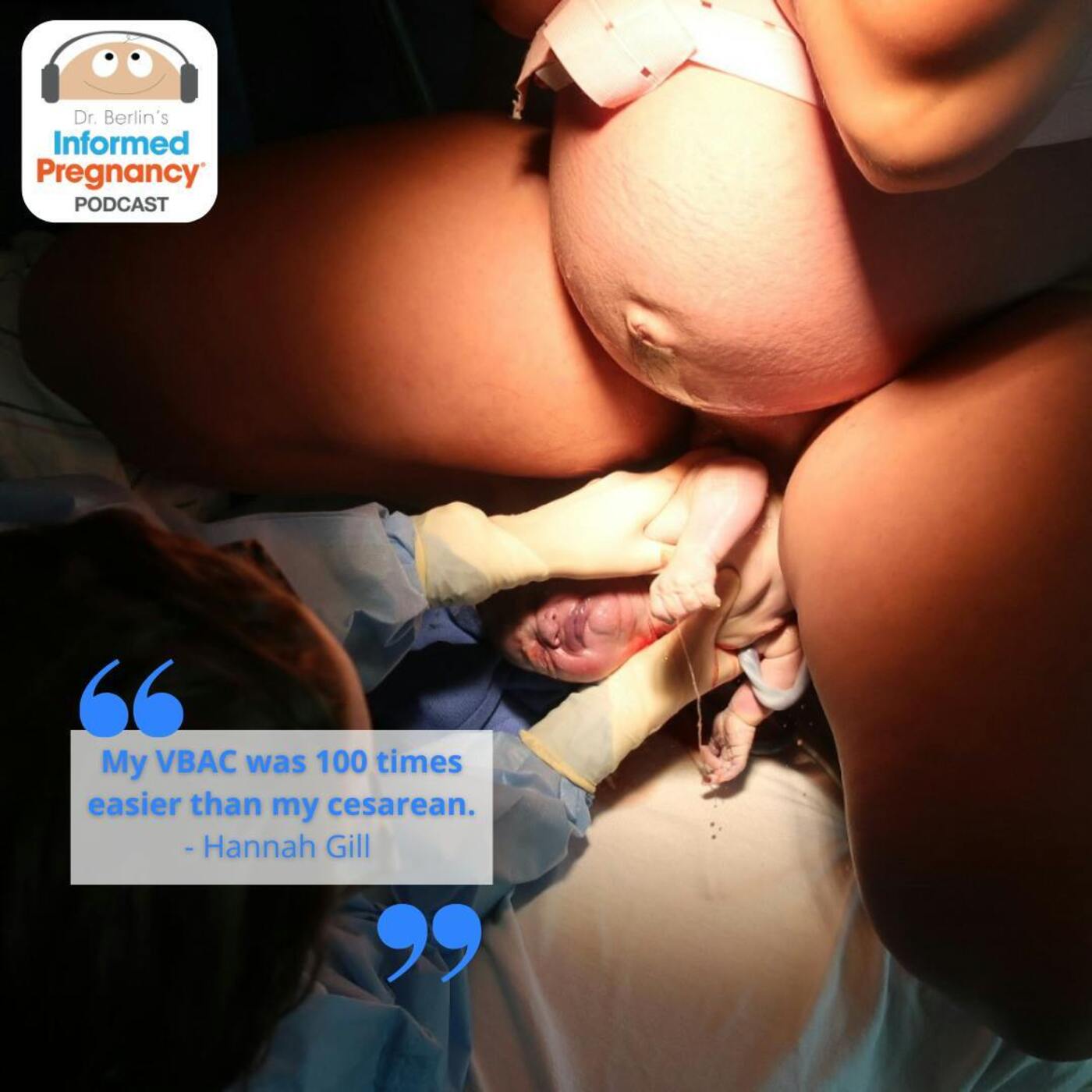
Hannah Gill [35:36] It was great. So I just had a slight second degree tear just because she did come out so fast and I didn't control the pushing to slow it down much at all, but I had a little bit of a retained placenta as well, so it took a little bit for them to really get all that out. And then I did ultrasound to make sure I actually had to get more of it removed several weeks later. Well there, but overall recovery from the VBAC was a hundred times easier than a C-section mind and body, mind and body. Yes.
Dr. Elliot Berlin, DC [36:11] Well, congratulations.
Hannah Gill [36:13] Thank you.
Dr. Elliot Berlin, DC [36:14] I know you worked hard for that. And what an intense journey from beginning to end, even just finding out that you had PCOS and the question marks that that brings up. What would you do with a third pregnancy for the birth?
Hannah Gill [36:29] 100% at home birth, as long as I'm able to.
Dr. Elliot Berlin, DC [36:32] Cause now you can, uh, the second VBAC now that you have a quote unquote proven pelvis, right?
Hannah Gill [36:38] But as long as my platelet levels are fine and everything checks out, I would 100% want to have a home birth.
Dr. Elliot Berlin, DC [36:44] You just have to do another episode in a couple of years. Before we go, tell me about your new nightlife.
Hannah Gill [36:51] Yeah. So I am a childbirth educator, birth and postpartum doula. I am owner of ebb and flow birth co. Is what my business is called. So I do doula support for postpartum at birth and I'm in Indianapolis in that area, so I'm really liking it so far. I just started doula work. I've only had one birth for my birth support, but I have a child with education classes lined up as well.
Dr. Elliot Berlin, DC [37:18] Is that what you named your kids? Ebb and flow?
Hannah Gill [37:22] No, no, they're Hudson and Marley.
Dr. Elliot Berlin, DC [37:25] Oh, Hudson and Marley. I thought they were going to be like Evan and Florence. Hannah, thank you so much for joining and for sharing your story and for now the amazing work that you do supporting others, tell me where we can find you online.
Hannah Gill [37:41] So Instagram is at ebb and flow birth co no underscores or anything like that, and then my website is ebb and flow birth co.com.
Dr. Elliot Berlin, DC [37:50] Amazing. And we're over there on the Instagram as well at Dr. Berlin D O C T O R B E R L I N. I got.
Want more pregnancy + parenting? Start your FREE TRIAL of Informed Pregnancy+ and get access to all our curated pregnancy and parenting content — original series, iconic birth films like The Business of Being Born, prenatal workouts and more.
