by Parijat Deshpande | Dec 28, 2022 | Health Conditions, Pregnancy
“The difference between pregnancy and any other time of life is that you are in a body that is constantly changing. That means that the context of your risks, as well as the level of risk and what the potential treatment plan could be, is always changing. Staying up to date with what your providers think is critical.”

Although we are fortunate to have a plethora of resources for many aspects of pregnancy, when it comes to high-risk pregnancy, the conversation often stalls and the resources dwindle. Even our statistics are lacking, making it easy to ignore the reality of high-risk pregnancy in the United States both publicly and privately.
The clearest measurement of high-risk pregnancy that we have is from UCSF identifying 8% of all pregnancies as high-risk ones, a number which is expected to be much higher when we factor in additional indicators of risk such as age and history of chronic illness. Yet, even just 8% should be enough to cause concern. Although the majority of pregnant people go on to have low-risk pregnancies with no complications, we have to be prepared for how to support the 8%+ that don’t. All pregnant people should have access to resources to know how to support their own pregnancies should they find themselves living through a high-risk one.
What Is High-Risk Pregnancy?
High-risk pregnancy is a broad term that encompasses any pregnancy at risk of developing maternal and/or fetal complications. Diagnosing a pregnancy as high-risk doesn’t guarantee complications or even necessarily mean that there will be adverse outcomes; it simply identifies that the pregnant person is at risk of developing certain complications during pregnancy and therefore warrants added monitoring depending on the specific circumstances. Just like the broader umbrella of pregnancy experiences, high-risk pregnancies can also look vastly different from one person to the next.
Who Is at Risk?
The range of people who are at risk of high-risk pregnancy is wide and often includes anyone who is underweight, overweight, or a teenager. In the United States, it’s also qualified as anybody who is pregnant over the age of 35. Other indicators of risk include:
- Alcohol or substance use
- Smoking during pregnancy
- Carrying multiples
- History of hypertension, diabetes, epilepsy, thyroid disease, asthma, cardiovascular disease, blood disorders, and cancer
- Previous experience of pregnancy complications, preterm delivery, stillbirth, or recurrent pregnancy loss
Follow Dr. Elliot Berlin for all the latest Informed Pregnancy news and content!
Can I Mitigate My Risk?
Mitigating risk is possible and it starts with surrounding yourself with the best possible care team who can identify how your risk might impact your overall health and your pregnancy health.
If you think you are going to be high risk for any reason, set up a relationship with a maternal-fetal medicine specialist before you’re pregnant or as soon as you know you’re pregnant. You may never need their services but it’s important to be established as a patient before you need those services. This will help you make appointments sooner in case you end up needing their care during your pregnancy.
Second, it’s important to be on top of your care plan so you always know what your medical team is recommending and why. This includes understanding what options or alternative solutions they’re encouraging and which ones they’re discouraging you from and why. During this time, you want to know exactly what your provider is thinking and why they’re thinking it. Leave nothing unsaid so you can make genuinely informed decisions for your pregnancy.
At every step of the pregnancy, ask what else you can do to lower your risk. This can be before you’ve developed a complication and certainly after you’ve developed one. Sometimes you will hear there’s nothing you can do. If this happens, make sure your team is a complete team—that you have specialists who are looking at your health from a variety of different angles to make sure that all your bases are being covered. For example, if you are at risk of or have hypertensive disorders during pregnancy or prior to pregnancy, you want to have a really solid cardiovascular specialist on your team. If you have a thyroid disorder, then you want to make sure you have an endocrinologist on your team whose sole focus is managing your thyroid condition during pregnancy. Rounding out your team also includes having an integrative health strategist who can look at your health from a trauma-informed and neurobiological perspective which is often missed in traditional medical care. This will ensure that you have a whole health perspective on your care plan and reduce the risk of preventable errors.

Although it can sound overwhelming, you want to make sure that, at every stage of the process, you understand the impact of your risk, what it means for your pregnancy to be at risk for various complications, how those complications might impact your health and the baby’s health, and what the potential treatment plan is. The difference between pregnancy and any other time of life is that you are in a body that is constantly changing. That means that the context of your risks, as well as the level of risk and what the potential treatment plan could be, is always changing. Staying up to date with what your providers think is critical.
A high-risk pregnancy is a category that simply means you will likely need extra monitoring for some portion of your pregnancy. It does not at all imply that something will go wrong. The more involved you are in your care plan, the earlier you prepare for your future pregnancy, and the more you care for your body from all angles in preconception and during pregnancy, the more you’re equipped to support your body through a healthy high-risk pregnancy.
Check out another Informed Pregnancy post by Dr. Nate Fox, MD!

Parijat Deshpande is an author, speaker and the CEO of a global, boutique company dedicated to reducing pregnancy complications and ending preterm birth. On a mission to end the high-risk pregnancy crisis, she has served and supported hundreds of women through her programs, one-on-one work and bestselling book, Pregnancy Brain: A Mind-Body Approach to Stress Management During a High-Risk Pregnancy.

by Dr. Brandie Elizabeth Keates | Dec 21, 2022 | Health Conditions, Infant Care and Breastfeeding
“The chiropractor looked like a combo of Buddha and Santa Claus. He had the biggest smile and a calm demeanor. He asked if he could examine my daughter, and she teetered up to him like an old friend. The doctor explained something I hadn’t considered: the weight of the cast and unevenness of having a cast on her tiny leg created an issue in her lower back which was throwing off her gait.”

When you found out you were pregnant, one of the joys was joining other expectant parents in groups to commiserate and give each other support. After some time, you start seeing posts about someone taking their little one to the chiropractor. Wha?
Your mind goes back to your college sports career where you had a chiropractor to keep you at your best for playing, but a baby?
I know I thought the same. After my one-year-old child broke her leg and wore a cast up to her hip, she had a significant, adorable waddle that caused people to stop me in the store and ask what was wrong with my child.
After orthopedics suggested rebreaking her leg, putting it in a brace, or injecting it with Botox, someone asked if I had ever considered taking her to a chiropractor. I looked at them like they had two heads; I pictured them cracking my child like they would for an adult and thought it wouldn’t be safe for my child’s tiny spine.
But after seeing four orthopedic doctors, I had no other options so I conceded and made the appointment. I viscerally remember sitting in the parking lot of the clinic with hot tears going down my face. I held my baby’s chubby hand and cried to her father that we were “just gonna go listen. He’s not gonna touch her.”
The chiropractor looked like a combo of Buddha and Santa Claus. He had the biggest smile and a calm demeanor. He asked if he could examine my daughter, and she teetered up to him like an old friend. The doctor explained something I hadn’t considered: the weight of the cast and unevenness of having a cast on her tiny leg created an issue in her lower back which was throwing off her gait. He explained how he would apply a gentle force and asked for our permission. We consented so long as it wouldn’t hurt her and he assured us it wouldn’t. When he had finished the adjustment he set her back on the floor. Just like a fawn, she wobbled a bit and the took a normal step without a limp. I was speechless. This moment set my life on a completely different trajectory. I became a chiropractor myself because it was truly amazing.
Chiropractic care is amazing for a myriad of conditions and many parents see it as a way to improve their child’s wellness. Chiropractors have had great success treating infants’ musculoskeletal conditions like torticollis, latching issues (jaw tightness), sports injuries, and overloading injuries (such as backpacks). There is also anecdotal evidence for successful chiropractic treatments of colic, reflux, ear infections and overall wellness.

Stay up to date on Informed Pregnancy content – blogs, podcasts, and streaming at your fingertips!
It’s important to understand the difference between adult chiropractic and chiropractic care for your child. Here are some considerations for finding the best chiropractic care for your child:
1) Consent extends to the patient and everyone in the room. The chiropractor should assure everyone in the room that they will not proceed without consent, including that of the child. If your child is not feeling it at the moment, you or your child should not be rushed – you should be encouraged to go take a walk, get a snack, or reschedule for a time your child is on board.
2) Children’s joints are not the same as those of adults. The chiropractor should discuss how the treatments are modified for children and explain what they will do BEFORE they do it.
3) A child doesn’t need a heavy treatment plan. If your chiropractor gives your child a treatment plan that’s longer than a month with more than 2 visits per week, this is a red flag. Children’s nervous systems and structures do not need a lot of treatments. The treatment plan should also include markers to gauge if you are getting the results you want. While healing takes time, you want to see some glimmer of hope early on.
4) Chiropractors are NOT trained to treat emotions, talk about stopping medications, or to tell you not to vaccinate your child. Ultimately, they should NOT override your pediatrician’s recommendations. If there is an issue, your chiropractor should call your child’s pediatrician to discuss their case.
A pediatric-trained chiropractor is a powerful member of your child’s healthcare team who can safely and naturally help keep your child well.
Need a few more minutes alone in the bathroom? Check out a few more posts here!

Dr. Brandie Keates has been a practicing chiropractor for 20 years. She opened her own practice in 2003, right after graduating from Cleveland Chiropractic College. Since struggling with her own difficult pregnancy in 2006, she has been using her knowledge of sports medicine to help pregnant and postpartum patients and their children find safe, effective pain relief. In 2018, she published “What You Don’t Expect When You’re Expecting,” a guide to helping women overcome pregnancy pain. Since then, she’s lectured on pediatric chiropractic care, pregnancy chiropractic care, and consent in chiropractic care. Today, her practice, Experience Chiropractic, is booming; a majority of her patients are pregnant or postpartum. Her mission is to educate and empower women and their healthcare providers.

by Dr. Michelle Tsai | Dec 14, 2022 | Labor and Delivery, Pregnancy
” If your cervix is dilated, your physician may offer you a membrane sweep, which is basically a bit of a massage of the baby’s head. This is not harmful to you or your baby. The membrane sweep feels like a longer cervical check; this can be uncomfortable but should not be painful. This can cause your body to release your own hormones to lead towards labor naturally.”
Congratulations on your pregnancy! Once you are past 37 weeks, baby is considered full term, and your doctor may offer you a pelvic exam at an OB visit. There is no strict recommendation on when (and if) cervical exams are done at the end of pregnancy – I personally do not routinely perform cervical or pelvic exams unless there is a good reason (exams can be uncomfortable, especially during this time in pregnancy!). If you are having any signs of early or prodromal labor (what I like to call “pre-prelabor” – your body is releasing hormones called prostaglandins to make change towards the big day), your doctor may check your cervix. And, of course, if you are having signs of labor (tightening/cramping of your abdomen every 5-10 minutes for one hour or leakage of fluid like your water bag broke), your physician may check your cervix to see if you are indeed in labor. Labor is defined as contractions that start opening up the cervix; you may be contracting painfully without your cervix opening just yet. This is called prodromal labor.
A cervical check has several parts to it. Dilation, or how open your cervix is, is the one that many patients think is the most important, however the other parts of the exam are just as important. We evaluate the cervix also for effacement (how “thinned out” it is) and baby’s station (where the baby’s head is in relation to mom’s pelvis), as well as position (where the cervix is in relation to the front and back of your body) and consistency (how much the cervix has softened). Even if your cervix has not yet dilated, if it has softened and thinned out, this can be a sign of labor.
Are you exSTREAMly interested in pregnancy and labor? Check out Dr. Berlin’s new streaming channel!

The cervical exam generally can be uncomfortable but should not be painful. It can feel like a bit of cold pressure. After the exam you may have some cramping and even some small spotting (generally a bit of pink/red on wiping with toilet paper), this is normal and expected with any cervical exam especially later in pregnancy. You should not have any heavy vaginal bleeding – if you have bleeding filling up a pad or pantiliner, please kindly contact your physician.
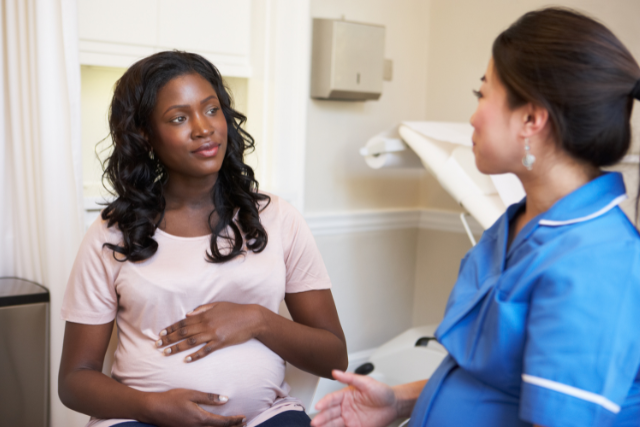
If your cervix is dilated, your physician may offer you a membrane sweep, which is basically a bit of a massage of the baby’s head. This is not harmful to you or your baby. The membrane sweep feels like a longer cervical check; this can be uncomfortable but should not be painful. This can cause your body to release your own hormones to lead towards labor naturally. If you are nearing your due date and not having any signs of labor, this can be a very natural way to help your body along, without medications for induction of labor. This is an especially helpful tool especially if you are trying for a trial of labor after cesarean section, as if you go into labor on your own, it can increase the rate of success of a vaginal delivery. Of course, every patient’s situation can be quite different, and it is always a good idea to discuss with your physician what is best for your individual situation. Best of luck and congratulations on your new addition to the family!
Follow Dr. Berlin and The Informed Pregnancy Project for all the latest news and updates!

Dr. Michelle Tsai grew up in LA’s San Gabriel Valley and received her bachelor’s degree at the University of California – Berkeley. She taught English in Asia for a year prior to attending medical school at Virginia Commonwealth University. She completed her residency training at the University of Hawaii in Honolulu and moved to the San Francisco Bay Area to open her own private practice.
Dr. Tsai is currently an assistant professor of OB/GYN at UCLA. She is the director of the UCLA Marina Del Rey OB/GYN office which is opening in 2023. She divides her time seeing patients in the office, performing gynecologic surgeries, delivering babies, teaching medical students and residents, and serving as an independent contractor in the community for the underserved. When she is not working, she enjoys spending time with her husband and miniature schnauzer Sadie, as well as traveling, exercising, and trying out new restaurants in her community. They welcomed their first child in October 2020.
by Jayne Ann Osborne | Dec 7, 2022 | Family and Relationships, Health Conditions, Parenting and Child Development, Pregnancy
” During that time, I had a lot of time to think. Perhaps too much time. Sometimes the thoughts were heavy and difficult to endure. Sometimes the thoughts were questions I would try to work through. One such question began as a plague and ended as a treasure.”
Pregnancy is difficult for everyone in one way or another. For me, “difficult” came as a medical diagnosis of a pregnancy disorder called “hyperemesis gravidarum.” My pregnancies were awful. I experienced extreme nausea and vomiting all the way to 40 weeks with each of my four children.
As hard as my pregnancies were, physically and emotionally, they were also quite difficult for the rest of my family. I knew, going into the pregnancy with our youngest child, that I needed to try to prepare myself and the kids for what was to come.
As the nausea and vomiting began to hit in the summer of 2021, I tried to explain to my three little ones that I was going to be very sick for a very long time. I tried to help them understand that we were making this sacrifice to help their little sibling come into the world. I tried to explain that everything would be worth it in the end.
They nodded and tried to understand. But some things you just can’t fully understand until you actually go through it.
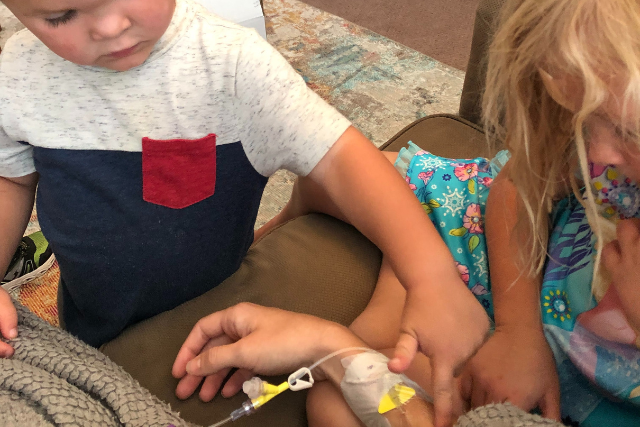
The weeks wore on. I got more and more sick. I got so sick that I was almost completely bed bound for months. I lived on IV fluids and the angelic, helping hands of family and friends.
During that time, I had a lot of time to think. Perhaps too much time. Sometimes the thoughts were heavy and difficult to endure. Sometimes the thoughts were questions I would try to work through. One such question began as a plague and ended as a treasure.
What does it mean to be a mother when you are too sick to do any actual mothering?
Thoughts swirled in my head as I watched other people run my life. They were needed, and oh so appreciated, and at the same time, I was devastated. At first, my little ones would come to the bedside for the usual things – a sandwich, TV time, a game, a tattle etc. However, moving at all would trigger vomiting. Even the sensation of speaking – the vibration in my throat – would trigger vomiting. I would redirect the kids to ask Dad, or Grandma, or Natalie (our summertime babysitter). Eventually my children stopped asking me for anything, and their needs were met without me.
I felt worthless. I felt useless. I knew this was how it had to be, but it was so hard.
Who am I to my children when I can’t do all the mothering things? What use am I when any functional adult can make a sandwich? Am I really so replaceable?
These thoughts were relentless, and yet they didn’t sit right within me. They didn’t feel like the truth.
I began asking the same questions, but now with a sense of curiosity.
Who am I to my children when I can’t do all the mothering things?
What do I have to offer that is unique to my role as their mother?
Am I replaceable? Or is there something more to our mother-child relationship, outside of the things I can and can’t do?
Enjoying this post? Check out more!
Eventually, I began to come to a deeper understanding of what it means to be a mother. That understanding has made all the difference in the world.
What I can and cannot do is not who I am. What I can and cannot do fluctuates – it can change based on impermanent circumstances.

There is nothing in this world that can change who I am to my children. Being their mother is forever. There is no sickness, no injury, not even passing from this life can change the fact that I am their mother. No matter what state I am in, physically or otherwise, who I am will never change. Who I am as their mother will always matter in a special, unique, irreplaceable, permanent way.
I believe that now, all the way down to my bones. I believe it about myself, and I believe it about you.
Who you are is the most important thing. What you can do is just a bonus.
Follow Dr. Berlin to stay entertained and informed!

Jayne Ann Osborne is a stay-at-home mother of four, and a four-time hyperemesis gravidarum survivor from Salt Lake City, Utah. Her experiences in pregnancy led her to write and illustrate the children’s book, “When Mommies Get Sick.” Her book serves as a guide to help children understand what to expect and how to help during times and/or seasons of maternal illness. Jayne Ann is passionate about helping mothers find joy through intentional parenting, no matter what life throws their way. Her blog and collection of published books can be found at www.life-onpurpose.com.

by Angelica M. Ortiz | Dec 6, 2022 | Health Conditions, Pregnancy
** This is a repost of a classic Informed Pregnancy Article
” Some signs and symptoms that should always trigger a call to your medical provider include any sign of dehydration, dizziness, dark-colored or infrequent urination, vomit containing blood, fever, abdominal or pelvic cramps, inability to retain food or drink, or a decrease in weight greater than five pounds.”

Nausea and vomiting aren’t the most desirable pregnancy symptoms, however, they are fairly common. Between 50 and 90 percent of women experience some degree of nausea, with or without vomiting during pregnancy. Typically nausea will subside by week 14, but symptoms can continue longer depending on the severity. Although it is often referred to as ‘Morning Sickness’ these symptoms are more likely to be present throughout the day.
Severe cases of nausea and vomiting are referred to as Hyperemesis Gravidarum. This diagnosis is given when vomiting and nausea are occurring daily and in some cases, several times each day. During Hyperemesis Gravidarum a person may lose more than five percent of their pre-pregnancy body weight.
Less severe cases of nausea and vomiting in pregnancy usually do not require medical treatment. However, medical advice should be sought if you are concerned or would like to explore medication to help with the symptoms. Some signs and symptoms that should always trigger a call to your medical provider include any sign of dehydration, dizziness, dark-colored or infrequent urination, vomit containing blood, fever, abdominal or pelvic cramps, inability to retain food or drink, or a decrease in weight greater than five pounds.
Follow Dr. Berlin for all the latest updates!
There is no single explanation for the cause and severity of nausea and vomiting. Factors believed to play a role include genetics, previous pregnancies with nausea, gastrointestinal issues when not pregnant, or having multiples. For people who experience nausea in the morning and then feel better the rest of the day that may be caused by the peak of a hormone called Human Chorionic Gonadotropin (HCG) also referred to the ‘The Pregnancy Hormone.’ HCG is the hormone that urine based pregnancy tests are looking for; when it is detected the test reads positive.

If you are experiencing symptoms of nausea and vomiting there are some changes you can make to try and ease the nausea. Overeating or hunger can cause cause nausea. Eating well balanced meals and snacks throughout the day can minimize the symptoms. Studies have shown that ginger helps to diminish nausea when compared to a placebo. Ginger chews are widely available and might make a good snack. Avoiding triggers, such as food and odors that make you nauseous. The iron in your prenatal vitamin may be upsetting your stomach but taking it at night will make nausea less noticeable. Your provider may also suggest a prenatal vitamin with no iron until the symptoms are behind you. Vitamin B6 is thought to help in decreasing nausea. After eating, try taking a walk before laying down. Smelling fresh lemon, mint, or orange or using an oil diffuser with these scents may also be useful as it not only combats nausea but can also enhances mood and emotional balance, cover offensive odor, and boost the immune system. Many women have also found relief through acupuncture. If you find other tips and tricks that help ease your symptoms, share them with us at info@informedpregnancy.com.
Check out the brand new Informed Pregnancy+
Angelica M. Ortiz is a former pregnancy focused chiropractor and current life coach based out of Denver Colorado. You can find more information at ohmyourlife.com
