by Informed Pregnancy and Parenting Project | Mar 14, 2023 | Health Conditions, Labor and Delivery, Podcast Transcripts
Elliot: Welcome to the Informed Pregnancy and Parenting Podcast. I am your host, pregnancy-focused chiropractor, Dr. Elliot Berlin.
You’ve tuned into the after episode of about before and after birth story. My guest today is from northern Italy. She’s a muralist and sign painter. Her first pregnancy went well. But after the birth, she started to feel some awful tailbone pain. Turns out it was broken. She just had her second baby, and we’re going to see how the pregnancy and birth differed. Valentina Trentini, welcome back to the podcast.
Valentina: Thank you for having me.
Elliot: Congratulations!
Valentina: Thank you!
Elliot: All right. So, we talked a bit in the first episode about all sorts of things. How you met your husband, that you didn’t like him. But then, you met him again, and you did like him, and you had babies together. Your first pregnancy, and your birth and how afterwards. If I remember correctly, you said you injured your tailbone during a snowboarding competition first.
Valentina: Yes, when I was 18.
Elliot: When you’re 18. And then, after you gave birth, it felt similar but nobody believed you.
Valentina: Yes, correct. Absolutely. It was horrible.
Elliot: Eventually, eight months of recovery later, you finally started to feel like yourself again after seeing an Italian osteopath.
Valentina: Yeah, absolutely. After like three sessions with her, it went back in place and the pain went away. Thank goodness. Because it was almost eight months of pain.
Elliot: It was such a critical eight months trying to take care of your newborn.
Valentina: Yeah. The first eight months, it was really terrible. I wouldn’t go back in time again and do that all over again.
Elliot: And even though you’re one of the world’s nicest people, and we need more of you, the planet made it difficult for you to have your next baby.
Valentina: Yes. I lost three babies between my older daughter and my current daughter. It was not fun. I went through a lot of pain and a lot of anxiety. I was really discouraged, but everything turned out fine. Thank goodness. I was really lucky.
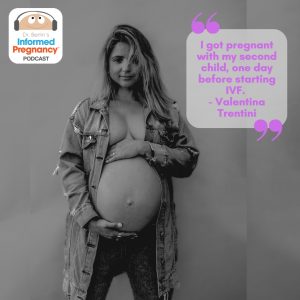
Elliot: I mean, if you were finally doing IVF, and then right before you went in for your injections, you found out you were pregnant.
Valentina: Right the day before.
Elliot: Yeah.
Valentina: The day before I found out I was pregnant. I took two different tests to make sure that I was really pregnant.
Elliot: In your case, I probably would have taken 20. In your fertility testing, did anything ever come up as a reason why too much [unin 02:58] pregnancy?
Valentina: Absolutely not. Both me and my husband were completely fine. Nothing happened. Nothing at all. We were completely normal. And we never had a single problem. Even the fertility doctor was like, “I have no idea why you’re having these recurring miscarriages. But it’s kind of let’s say normal at your age because you’re past 35. And it can be kind of normal.” Nothing came up.
Elliot: During your pregnancy, understandably, you had some anxiousness, some fears. Did you have those in your first pregnancy?
Valentina: No. My first pregnancy, I was super chill. I was never anxious. I never had a single doubt. Like even with that doctor at the beginning told me, “Oh, you’re pregnant,” and was four weeks pregnant what he told me when we found out. He was like, “Well, we need to wait until eight weeks, we’re going to talk. And in four weeks, if something happens, it’s kind of normal.” I was like, “What can happen? Nothing is going to happen.” In my mind, I was like, “Well, I’m pregnant. I want to have a baby and it’s going to be done.”
Elliot: It’s going to happen.
Valentina: Yeah.
Elliot: So, this anxiousness that started to kick in, was that related to what?
Valentina: Well, at the beginning, I was anxious that I was going to have a miscarriage early. In the middle of it, I was anxious that my baby would have had a brain damage. And toward the end, I was anxious that I would have had a stillbirth. I think that when my brain started to understand that everything was going well, my brain was finding something wrong. Because I think that the pain that I went through with the three miscarriages was too much for me that my brain was trying to like put me in a safe place and be like, “Okay. Something is going to happen. You need to be prepared if something is going to happen.”
Elliot: Expect the worst.
Valentina: Yeah.
Elliot: Literally. I guess during pregnancy would say expecting the worst.
Valentina: Yeah.
Elliot: How did you deal with that anxiousness during the pregnancy?
Valentina: I did a lot of therapy. I was seeing my therapist every week. I was doing with you, a lot of sessions. And I was doing acupuncture, and I was doing a lot of physical exercises because I was trying to release all the stress and all the anxiousness. But it never went away. It was always in the back of my mind and my head. I was dealing with it. Like, living with it. Living with the fear, that living with the anxiousness, living with all these horrible feelings that I was trying to be happy and enjoy the pregnancy. Now, looking back at my pregnancy, everything was perfect. I never had a single problem. But it was a very hard nine months. I felt like I was holding my breath for nine months. That’s what I was feeling.
Elliot: You’re also concerned about that tailbone.
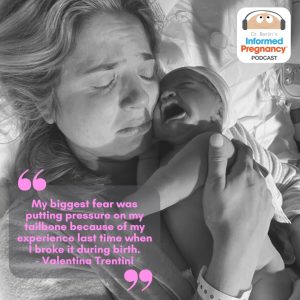
Valentina: Yeah. That was one of my biggest fear. At a certain point, I started to ask my doctor if I should have had a C-section instead of vaginal birth. Because I was like, “Maybe I have less chance of breaking my tailbone with a C-section.” My doctor is amazing. He was like, “Let me talk to a specialist that is a good friend of mine and ask him what you should do.” And even the specialist was like, “I will not do it if I were you.” My doctor was like, “I would not recommend that you have a C-section. Because yes, you’re going to recover in two months instead of eight.” But at the same time, it’s still like a major surgery. It’s still like something that your body is going to have to go through, and there can be complications, and you never know.
Elliot: And, of course, there’s a chance that your tailbone wouldn’t break.
Valentina: Yeah.
Elliot: All right. How was the very end of your pregnancy?
Valentina: The very end of my pregnancy was — I was still very anxious. But, actually, I started to feel a little bit more at peace. Because I was just counting the days. I was still thinking, “Oh, my God. I’m going to break my tailbone. I’m going to be in pain for so long.” But, at the same time, I was like, “Okay. We’re very close to giving birth. The baby’s still fine. She still kicks.” It was a mix of feelings. I was in a glass of emotions.
Elliot: When in the 40-week count there, and how did your labor start?
Valentina: The labor started when I was 39 weeks, 38 or 39? I think 39, yeah. Because I was six days early. I didn’t sleep that well the night before. My husband had a sore throat. He kept me up all night, and I was like, “Well, great. I cannot sleep.” Then I kind of like woke up at 7 a.m. I was like, “Something is like hurting.” I was like, “Oh, maybe it’s a contraction.” I started to time them, and I was like, “Oh, yeah. I’m having contractions.” I called my sister-in-law. She came from Oregon to help me and be in the room with me. I was like, “Okay. I think it’s time.” I told my husband and he was like, “Well, it’s 7 a.m. I need to go to work. Do I have a couple of hours?”
Elliot: Oh, wow!
Valentina: I was like, “No more. Not more than a couple of hours.” So, then, I called him at 9:30. I was like, “Why! They’re three minutes apart. I think it’s better if you come home right now.”
Elliot: Wow! Three minutes apart.
Valentina: Yeah. Let’s say, three to four minutes. Most of the time, there were three minutes apart.
Elliot: Also, what did they feel like?
Valentina: It was weird. Because with my first pregnancy, I was at home for seven hours and I just remember the worst part, the painful, painful part. This time, it was not bad. I was like, “Wow! This is actually not painful. So, I can do everything without an epidural. Like, this is easy.” I started to feel like contractions in my back, and I think that the adrenaline kicked in. I was just so happy. I wasn’t in that much pain.
Elliot: You were home with your sister-in-law?
Valentina: I was home with my sister-in-law, with my mother-in-law, with my niece and nephew, and my daughter.
Elliot: Oh, my goodness. It’s a big crowd of [unin 09:23].
Valentina: Everybody was around?
Elliot: Yes. And then, I was like, “Well, I looked at my daughter.” I was like, “Mimi, mommy is going away for two days. I’m coming back, and I’ll bring you a sister.” She was like, “Okay, mommy. I’m going to see you in two days.” I was like, “Okay.”
Elliot: She’s 4 years old?
Valentina: She’s 4.5, yes.
Elliot: Okay. So, she understands?
Valentina: Oh, yeah. She fully understands, big time.
Elliot: Well, let’s take a quick break. When we come back, we’ll find out what happens when you head to the hospital. We’ll be right back.
[break]
Elliot: Welcome back to the Informed Pregnancy Podcast. We’re talking to Valentina Trentini. She is in our story now in labor, a long journey to get there, and a lot of heartache and anxiousness going into it. But labor starts. Surrounded by a lot of family, except for your husband, who’s at work, and it’s not too intense. And you decide though to go to the hospital. Is that because the pattern changed?
Valentina: Because my doctor was like, “When you’re like less than five minutes apart, just come to the hospital. Just don’t stay home. We’re going to check. And then, if you need to go back home, we’re going to send you back home. If not, we’re just going to keep you here.” But the good thing is that I got there, I opened the door of the room where you check-in, and my doctor was there. It was the day that he was on call.
Elliot: Oh, wow. How nice.
Valentina: Yeah. I was the happiest person. It was amazing because a week before, he told me like, “Well, if you give birth on Friday or on Monday, that’s when I’m on call.” Actually, I went into labor on Friday. So, I got there. He checked on me. He was like, “Well, you’re 3 centimeters dilated. Usually, we keep you in the hospital at 4 to 5. But, I know you. I know you know your body. So, if you tell me that you prefer to stay here, I’m going to keep you here.” I was like, “I think that it’s changing really fast.” He was like, “Okay. Stay here.”
Elliot: Three centimeters. I mean, how was that news to you? Is that what you expected?
Valentina: No. I thought that I was more than that. But I was like, “Something is changing so fast.” The contractions are going so fast, and they’re more intense now that I was like, “Oh, I’m going to dilate faster than everyone thinks.” Actually, less than an hour later, I was at 5.5.
Elliot: [unin 11:55] quick.
Valentina: Yeah. I was screaming, and everyone got into the room. They were like, “Are you giving birth right now?” I was like, “No. Just in a lot of pain.”
Elliot: Okay. But your husband’s with you now?
Valentina: Yes. My husband was with me.
Elliot: Anybody else with you?
Valentina: I mean, his sister?
Elliot: Oh, your sister-in-law came also.
Valentina: Yes.
Elliot: Okay.
Valentina: The two of them.
Elliot: All right. When it got a lot more intense, do you remember where you felt it, and what about it was more intense?
Valentina: Actually, I was in the room, in the waiting room. I don’t know how you call it in English, but it’s like the room —
Elliot: Triage.
Valentina: Yeah. Triage, thank you. That one. When I was in the triage, the contraction started to get closer and closer together and very, very intense. But the thing is they had to put the monitor on my belly, and they had to monitor the baby for 20 minutes in a row. They didn’t tell me, so I kept moving because I was in a lot of pain.
Elliot: Restarting the count?
Valentina: Yes. So, every time, they were like, “No. We have to redo it. We have to redo it.” I was like, “No!” I was like, “Give me an epidural. I can’t deal with this anymore. I need an epidural right now.” And so, they put me in the room. And within an hour, they gave me an epidural. Thank goodness. I was in heaven. I was so happy. So, so happy.
Elliot: Did the first time you tell me the epidural slowed everything down for you?
Valentina: Yes. That’s what I think happened the first time. My doctor thinks that that was not the epidural. Because the epidural actually accelerated everything.
Elliot: Yeah. Speed things up.
Valentina: But I think that the first time the fact that my body was in shock. I was in so much pain, and my body just shut down. My body was like, “I can’t deal with this anymore. You need to relax. You need to rest for a little bit, and then we can continue to do this.” So, this time actually, the epidural, I was like 5.5, 6 when I got the epidural. And then, within like a couple of hours, I was already at 8. Everything was going perfectly.
Elliot: Fast-moving train.
Valentina: Yeah.
Elliot: Now, at this point, is there any of that anxiousness, or you feel calm? Is there any concern, talk about how to protect your tailbone for what’s coming next?
Valentina: At that point, I started to like see all the nurses coming in. All the nurses. The two nurses that I was assigned to, and the midwife, and my doctor. We all talked about, “Okay. Last time, I broke my tailbone. What can we do for this not to happen again?” The nurses were incredible. They were seriously amazing. They were all super understanding. They were like, “Okay. When it’s time to push, you’re going to push on your side, and you’re going to push on your hands and knees. We’re going to try to like not put any pressure on your tailbone.”
Elliot: Nice.
Valentina: That was my biggest fear, and I told them. They were seriously very understanding, and they were very sweet with me. To the point that I was talking to the nurse because she was asking me the questions, routine questions. She asked me, “Are you anxious, or any bad thoughts that you had during the pregnancy?” I was like, “Well, I’m scared that I’m going to have a stillbirth. But, you know, that’s me.” I try to put make a joke about it because I was kind of uncomfortable. Because every time that you tried to tell something like this to someone, they are very uncomfortable with you saying that.
Elliot: Sure.
Valentina: And she stopped. She walked around the bed because I was on my right side, and she was behind me. She looked at me in the eyes and she was like, “This is a different pregnancy. Nothing is going to happen to you. I’m here for you. Anything you need, you tell me. I’m here for you.”
It was the first time in almost two years that someone in the medical field really talked to me on a human level. And really made me feel comfortable. She was listening to me. She didn’t just say like, “Oh, yeah. You know, it’s fine. Everyone thinks that.” Or like she really thought that something was wrong, and she needed to tell me that she was there for me. It was amazing actually. And so, that really calmed me down. Then my doctor came in. It was like around 2 p.m. He was like, “Well, I don’t have any nurse right now to be with me, like to start to push, and I have two emergency C-section.”
Elliot: Oh, my goodness!
Valentina: Yeah. He was like, “Would you be comfortable to wait a little bit?” I was like, “I am on vacation. I have my epidural. I am not in pain. I have my bed. Don’t even worry about it. Do what you have to do, and come back when. If it’s time, I’m going to let you know.” And then, at 5 p.m., I was ready. And then, at 5:30, we started to push. I actually pushed on my side. And like last time, the pushing part was amazing. I felt empowered. I felt strong. I felt like, “Oh, my God! I can do this. This is really what I’m good at.”
Elliot: You’re a pusher.
Valentina: Yeah, I’m a pusher.
Elliot: Because of the epidural, how much could you feel or not feel?
Valentina: I felt everything.
Elliot: Did they deliberately turn it down?
Valentina: No. Because with Kaiser, they give you the remote so you can push the button and give yourself as much epidural as you want. But after a certain point, they tell you, “Okay. You’re almost there. You cannot push the button anymore. No more epidural because we need you to feel a little bit.”
Elliot: Yeah. You felt a lot.
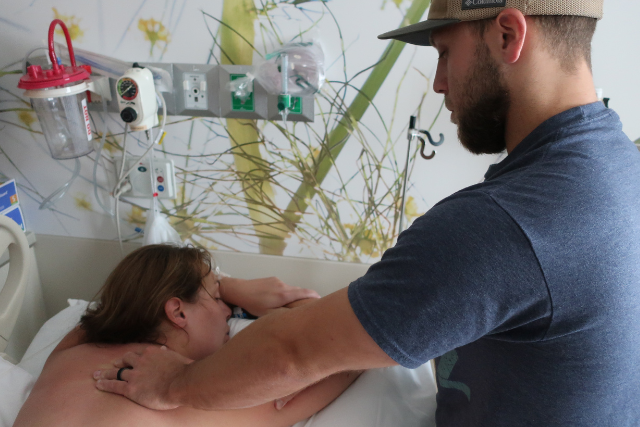
Valentina: I felt a lot. Actually, when I was on my side, I was feeling more. So, she wanted me to go on my hands and knees because the baby wasn’t turned in an ideal position. The nurse, actually, she was amazing because she asked my husband and his sister to be on both sides. And then, you have this blanket and to wrap this blanket on my belly.
Elliot: A rebozo.
Valentina: Yes. She was like, “I saw this midwife doing it to another patient. Let’s see if this works with you.” They rub my belly for like, I would say five minutes. Something like that. And the baby turned. She was like, “Great. The baby just turned. You can be on your back, and then we can push her out.”
Elliot: Oh, wait a second. Did you feel the baby turn?
Valentina: I don’t remember that.
Elliot: Okay.
Valentina: I was like so in the moment that I don’t know if I felt a baby turn.
Elliot: Two more questions. One is because you said you could feel a lot with the epidural kind of wearing off. What sensations did you feel?
Valentina: Pain. Pain on my right side. Because she was pushing on my right side.
Elliot: Oh, like in your right hip?
Valentina: Yeah. The right hip, back, and a little bit in the front was where I was feeling it the most.
Elliot: That’s interesting. Because in pregnancy, you kind of had some discomfort there.
Valentina: Yeah, that’s true.
Elliot: Okay. So, then, the baby rotated into a better position. Do you still feel the pain at that point? And also, is it only with a contraction or you feel it all the time?
Valentina: I was feeling it all the time. But I knew that she was so close to coming out that it wasn’t a problem. And then, actually, when I was on my back, I thought that the nurse was giving me a perineal massage. I almost told her, “No massage. I don’t want that massage.” And I saw her that she wasn’t even close to me. I was like, “Oh, that’s the baby’s head.”
Elliot: The baby gave you a perineal massage.
Valentina: Yeah. The best part was that my sister-in-law told me, “Oh, I see some eyes. Oh, I see a chin. Oh, I see some shoulders.” And when she was telling me that, I was feeling everything. I was feeling the shoulders coming out. I was feeling everything coming out. It was like, with my daughter, I wasn’t feeling that, with my first daughter. That was incredible. I was like, “This is amazing!” It was seriously the most amazing feeling in the world.
Elliot: Wow, that’s great! A lot of people talk about burning during that time. Did you not feel burning?
Valentina: No. I felt a lot of pressure because her head was halfway out, and they kept her there for what felt an eternity. But, for sure, it was a few seconds. But, when she was coming out, I wasn’t feeling pain or burning sensation, nothing. I was just feeling her coming out.
Elliot: Literally, her body parts coming through you into the world.
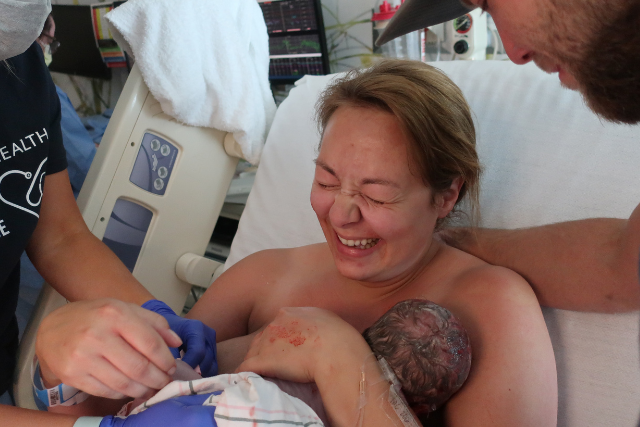
Valentina: Yeah. And then, when they put her on me, I just asked everyone if she’s breathing, is she alive. “Is she breathing? Is she alive?” That’s what I was asking everyone.
Elliot: I mean, emotionally, how did that feel? When they put her on your chest and you were there, and she was healthy.
Valentina: I felt like a giant rock that was not on my shoulders anymore. I felt light. I felt this relieved. I felt that I could breathe. I remember that I was breathing, like deeply breathing. I was like, “Okay, she’s here. It’s done. It wasn’t that bad.” My head did everything. I was just relieved. I was seriously relieved and happy that I could breathe.
Elliot: All right. Let’s take one more break. When we come back, I have a few more questions about what happens next in the moment and after you get home. We’ll be right back.
[break]
Elliot: Welcome back to the Informed Pregnancy Podcast. We’re talking to Valentina Trentini.
Okay. A long, long road to get to that beautiful finish line. It sounds like a really gorgeous finish line for you. And also, sounds like the weight that had been sitting on you for nine months, on your shoulders, released as soon as the weight’s sitting on your pelvis is also released. You talked about how during pregnancy, the game plan was to sort of be on your side or all fours. But it sounds like when you actually push the baby out, you were on your back.
Valentina: Yeah.
Elliot: Was there a conscious change in choice?
Valentina: No. At that point, I was in the hands of the nurse and the doctor. I was just trusting them. Because they won my trust, and I was like very comfortable with them. The nurse was like, “Don’t worry. Even if you push, the last push is like on your back, everything is going to be fine. Nothing is going to happen to your tailbone. I promise you, we’re going to do everything we can for you not to be in pain anymore.” So, I just trusted them.
I think that I was feeling that everything was right. Because I could feel more than with my first daughter. I think that my body knew what was going on, and I knew what I was doing. That’s why I was like, “Okay. You want me on my back, I’m just going to be on my back.”
Elliot: Nice. How is your placenta delivery?
Valentina: It was fine. Even with my first daughter, it came out right after. They didn’t have to do anything. I didn’t even get any stitch. No stitching. Nothing.
Elliot: No tearing?
Valentina: Nothing. It was clean, perfect.
Elliot: Were you worried about what would happen on the epidural totally wore off?
Valentina: Yes, absolutely. When I started to feel way more. When I started to feel my legs again, I was like, “Oh, my God. Is everything fine? Am I in pain? No, I’m not in pain.” So, that’s great. Actually, they wanted to give me Motrin, the painkiller, for the pain. I didn’t even take it. I was not in pain. I was happy that I was not in pain. Very happy.
Elliot: Okay. So, no tailbone injury.
Valentina: Nope. Thank goodness, nope.
Elliot: All that worry.
Valentina: For no reason.
Elliot: And like you said, I think it was your nervous system trying to protect you.
Valentina: Yeah. I think that your mind is so powerful. I was in so much pain during the miscarriages. Three miscarriages in a year, it’s a lot for anyone.
Elliot: Yeah. I mean, one is scary.
Valentina: Yeah. The problem is that not being able to talk to anyone, and not being able to have a lot of support. Yeah. I had my therapist, and I had you, and my acupuncturist. But, other than that, none of my friends had to go through that. None of them. So, it can feel lonely. That’s why I think that my mind was like, “Okay. Let’s have a plan for the second pregnancy. Let’s find something that for sure it’s going to be wrong. Believe that it’s going to be wrong. So, then, if it’s going to be wrong, you’re going to be protected.”
Even if something goes wrong, it’s not that because you’re prepared it’s going to be less painful. Actually, it’s even worse. I was telling myself during my miscarriages, “See, I told you. You should have prepared yourself for like the worst. So, then when the worst was coming, you could have been prepared and not be in pain.” But then, you’re in so much pain anyway, and it’s really bad.
Elliot: Well, I’m sorry that you had all that pain and suffering, emotionally and physically. I can only imagine how much more you are excited to hug your little baby and to hear those cries, 24/7, whenever they happen. Just squeeze a little harder. How is postpartum and the house, having a toddler and a newborn at the same time?
Valentina: Well, it’s very hard. I think that she’d never prepare for this. I’m very lucky because my daughter, she’s 4.5 and she understands everything that is going on. Actually, she’s not really jealous about her sister. Actually, she’s super happy. She wants to cuddle her, and kiss her, and be with her all the time. But still, she’s still a toddler and she still wants my attention. And a newborn requires a lot of attention.
So, I have help. I’m really lucky that I have help. With my first daughter, I didn’t have anyone. I was home alone with her, and it was very, very hard. I promised myself that if I would have another daughter, another child, I would ask for help, which is the most important thing right now for me. Yeah, it’s great. It’s actually everything I wanted. It’s very tiring. It’s very hard. But I’m very happy. She’s here. Then, everything went well, and the pain is gone. That’s what I’m happy for.
Elliot: So, happy to hear that. What are you doing for your self-care now in the postpartum phase?
Valentina: I take long walks, which is what I really needed the most. I work in my studio, which is very relaxing. That’s my space. That’s my time. Nobody comes in my studio. I paint and I relax. For me now, that this is working and it’s the most important thing for me right now. I’m going to go back to therapy, for sure. Because I really need it. Because I think that the trauma is still there. I really need to deal with it, even if I’m feeling good.
Elliot: Sure.
Valentina: Yeah, painting is what makes me feel happy and relaxes me. So, that’s what I’m doing right now.
Elliot: I’m going to get paid for it.
Valentina: Yeah. Not bad.
Elliot: Are you still back to hanging off at bridges, and ropes, and things painting giant murals and banners?
Valentina: Well, now, no. Not yet. But now, I’m going to paint a couple of vintage cars. A couple of Porsche. I’m going to — what do I have again? I have another, some coffee shops, and some gold signs that I have to paint, which is very awesome. I love painting that stuff.
Elliot: I guess, my last question for you is does your family feel complete now, or do you see yourself expanding again in the future?
Valentina: That’s a good question. I’ve always wanted to have three kids, with my husband. When I met my husband, I was like, “I’m sure I want three kids with him.” I think that now, my family feels complete. I don’t know if I want to go through pregnancy again. Because it took a big toll on my mental health. For now, I’m fine. For now, I have two beautiful daughters and I couldn’t be happier. I don’t know. Maybe in six months, I’m going to tell you, “Well, I want to have another kid.” But I don’t think so. I think that holding my breath for nine months was enough for me.
Elliot: Yeah.
Valentina: To say, “No, I don’t want to go through that again.” Never say never, but that’s what I feel right now. I don’t think that that’s my path.
Elliot: Yeah. I mean, it’s good that you feel associated, but that also that you have an open mind. So, nothing’s final.
Valentina: Yeah. Nothing is written in stone. But I told my husband, “If you want another kid, maybe we’ll get a dog.” Maybe the dog is going to complete the family. I don’t know. We’ll figure it out. But I think that for now, we’re fine. We’re happy. It’s a happy ending. It was a very horrible story that has a happy ending, and I’m very lucky and very grateful that I can say that.
Elliot: I’m so happy for you. You’re the nicest person and very passionate. Every time I talk to you, I get hungry for pasta and pizza.
Valentina: Me, too, actually.
Elliot: Valentina, thanks so much for joining me and for sharing your story. Tell us again where we can find you online.
Valentina: You can find me @brushettasigns on Instagram, and brushettasigns.com. If you want to see my signs, and my murals, and my art, you can go there and I share everything. Every week, there is a different project.
Elliot: I can’t wait to go take a peek. I’ll see you there. At home, thanks for listening to our podcast. If you want more content like this, I would go to informedpregnancy.com.
by Informed Pregnancy and Parenting Project | Mar 7, 2023 | Podcast Transcripts, Pregnancy
Elliot: Welcome to the Informed Pregnancy and Parenting Podcast. I’m your host, pregnancy-focused chiropractor, Dr. Elliot Berlin.
Today, I’m talking to an Italian-American artist, painter — we’re going to find out more about that; and soon to be mother of two, and her experiences with her first birth where she fractured her tailbone. And then, secondary, infertility and now, pregnant and about to have a kid, Valentina Trentini. Welcome to the podcast.
Valentina: Hi. Thank you for having me.
Elliot: How many weeks are you with this kid?
Valentina: Thirty-eight and half.
Elliot: Thirty-eight and a half. So, we have plenty of time?
Valentina: Yes.
Elliot: All right. Let’s start at the beginning. Where are you from originally?
Valentina: I’m from Bologna in Italy, in the north. And then, I moved here about 10 years ago for work.
Elliot: Welcome.
Valentina: Thank you.
Elliot: What’s it like in northern Italy?
Valentina: It’s like a crazy part of Italy because it’s not mellow and chill, like the rest of Italy. It’s fine. The food is great. The wine is amazing.
Elliot: When you say “Italy,” I gain weight every time.
Valentina: Yeah.
Elliot: Just thinking about what the food could be like. What brought you to the U.S.?
Valentina: Ten years ago, I received an offer, a job offer, as a store manager for an Italian shoes company. They were opening a new store in L.A., so they asked me to manage the store. I was like, “Why not? I always wanted to live in L.A.” They accepted and I moved here. I didn’t have any friends. I didn’t know anyone. And then, slowly but surely, I started to meet tons of people. Now, I’m here.
Elliot: Did you meet your husband here?
Valentina: Yep. I met my husband here in L.A. at a photography exhibition.
Elliot: Oh, wow. Okay. You’re also an artist.
Valentina: Yeah. I’m a muralist and a sign painter.
Elliot: How did you get into that?
Valentina: I’ve always been very artistic since I was a kid. And then, I went to art high school, and then I became a graphic designer. And then, when I moved here and when I was working at the store, I got a little bit bored. I was like, “Let me do something more artistic.” I started to learn calligraphy on my own on the side. And then, I wanted to do something more, and be more and more artistic. And then, I found about sign painting and murals, and that’s how I got into it.
Elliot: It’s so amazing to me because I have a hard time with big pictures in general. It’s incredible to me. I couldn’t make anything like that even in a small space. But to map it out, and plan it, and get all that, it’s incredible. We’re going to have to put up some of your beautiful artwork on the socials when this comes out.
Valentina: It’s very fun. It’s very, very fun.
Elliot: And then, how you met your husband is kind of fun. How did that come about?
Valentina: I met him at a photography exhibition at the Sunset Marquis here in L.A. And then, I didn’t like him at all. I was with my best friend. He was with his best friend. He was talking, and I just geared up and left, because I was like, “This guy is not interesting.”
Actually, a month later, my best friend was like, “Oh, you need to start dating. You need to download this app. It’s called ‘Hinge.’ It’s friend of your friends on Facebook.” I was like, “Okay. Let’s do it.” Italians at the time we’re not really into dating apps, but I did it anyway. The first person I saw in the app was him, and I texted him. I was like, “I know you.” He was like, “No. I don’t think we know each other. But do you want to hang out?” I was like, “Okay.” And then, after five minutes into our dinner, we realized that we talked a month and a half before, and we laughed. And then, we live like we lived together and we’ve been together for like eight years.
Elliot: Look at that? Love at second sight.
Valentina: Yes, absolutely.
Elliot: That could be a whole book. Okay. Kids, did you talk about kids early on? Was there a decision, “Hey, this is a good time we talked about it.”
Valentina: We talked about it around like a year, year and a half since the start of the relationship. We wanted to have kids, and we started to like try to have kids. We tried like for like three to four months. No more than that, and then I got pregnant, basically, right away. Never had a problem with that pregnancy. Never had a like — nothing. Everything was perfect. The first pregnancy was amazing.
Elliot: What was your form of birth control before that?
Valentina: I took a pill for like 15 years, 17 years. I started very early when I was 14 because I had acne and that was the only thing in Italy that the urogynecologist was prescribing you to treat it. I continued to take it for 17 years. It was a lot.
Elliot: Dual purpose.
Valentina: Yeah. It wasn’t that great. I wasn’t feeling that good. That’s why when I met my husband, like when I was around 30, 32, I stopped. I was like, “This is too much. I don’t want to continue anymore.”
Elliot: Was that when you started to have kids or before that?
Valentina: No. It was before that. It was like, let’s say eight months, 10 months before that.
Elliot: Okay. After that, you said, “Let’s have kids.” And then, three months after that, you got pregnant?
Valentina: Yeah.
Elliot: Something like that. What did you do for the 10 months to prevent pregnancy?
Valentina: We use a condom, and [unintelligible 06:04].
Elliot: Did you have regular cycles?
Valentina: Yeah, very regular. I’m like a Swiss clock. That’s what we say in Italy. When you’re on point every month of 28 days, I get my period and it’s, “Oh, I was getting my period.” It was always five days. No more than five days.
Elliot: Wow! That sounds more German than I am.
Valentina: Yes.
Elliot: So, then, you get pregnant. How was that first pregnancy?
Valentina: It was amazing. I was very relaxed. I was very calm. I really, really enjoyed it. I was still working, but I was going to the pool every day to do laps, and I really, really enjoyed it. It was very easy. Very, very easy pregnancy.
Elliot: You sound European.
Valentina: Yeah.
Elliot: Okay. What happened was like for birth, did you have a particular plan? A thought on how you wanted it to go? Did you do any prep?
Valentina: I did. Because I lost my mom in 2014, I moved here and I didn’t have anyone here. I just had my husband’s family. I decided to have a doula to help me navigate through like late stage of pregnancy, and then birth, and then postpartum. It was very, very helpful. We decided, “Oh, maybe let’s not get an epidural if I can. Let’s stay at home as much as I can until my water breaks.” My plan was stay home as much as you can, don’t get an epidural, basically, go with the flow, and see how it goes. But, of course, births never goes to plan.
Elliot: Okay. How did it start?
Valentina: I woke up at 2 a.m., excited to have contractions and actually they were pretty close together. Called my doula I would say like around 4:00. Because I was like, “Oh, maybe it’s not that bad.” Like, I could handle it. And then, she showed up at 4:00. She was like, “Your contractions are very, very close together. You should have called me before.” But I was like, “I could handle it. No big deal.” And then, we stayed home until 9 a.m. I was at home until 9 a.m. And then, at 9 a.m., I was like, “I cannot take it anymore!” I was having a hard time breathing and my contractions were not minutes apart anymore. They were next to each other.
Elliot: No breaks.
Valentina: No breaks at all. I was done. I got to the hospital and I couldn’t take it anymore. I was in a lot of pain. I think my body went in complete shock because of the pain. The doctor was like, “If you don’t want to take it get an epidural, don’t do it. Because you’re two hours away from giving birth.” But for me, I reached my limit.
Elliot: Do you remember where the pain was, that was sort of overwhelming you?
Valentina: I think it was in my back.
Elliot: Your lower back.
Valentina: Yeah, in my lower back. I couldn’t even stand straight. I think that the fact that I was overwhelmed by the contractions and I was having a hard time breathing, that for me, was like a little bit too much.
Elliot: Sure.
Valentina: I started to get scared.
Elliot: How was the epidural for you?
Valentina: When they put the needle in, I didn’t even feel it. I was like, “This is the dream.” But then, a little bit, they give you a remote that I could control the dosage of the epidural. I think I got too much because I was in a lot of pain.
Elliot: What kind of pain from too much epidural?
Valentina: When I got to the hospital, the pain was unbearable for me. I think that…
Elliot: Oh, you’re saying you overdid it with the epidural because of that.
Valentina: Yes. I did overdo with the epidural. I think I made a mistake because I couldn’t feel my left leg anymore. My right leg, I could still feel it. But for me, my body was in shock, it just shut down. I went to the hospital that I was 7 and 1/2 centimeters dilated.
Elliot: Wow.
Valentina: My body was like just shut down. My body was like, “I cannot do this anymore. You need to relax. You need to stop.” It’s just becoming too much.
Elliot: So, labor stopped happening?
Valentina: Labor stopped. I completely stopped for 10 hours.
Elliot: Was that like restful for you, at least? Recovery-wise?
Valentina: I could rest a little bit. I was very lucky, if I have to be honest. Because I was at the Kaiser hospital, and they offered you a midwife during the day. My midwife was really good. She was very, very, very, very, very amazing. She was like, “I’m not going to call the doctor. I want you to have a vaginal birth. I don’t want to give you a C-section.” Because by the time that I got to the hospital, they broke my water two hours later. I was for a few hours in the bed with my water.
Elliot: On the clock?
Valentina: Yeah. Seriously. She was like, “I have the feeling that you need to be alone for a little bit.” So, everyone went out, left the room. I was alone. I had put some music on. I started to breathe. Around, well, let’s say 40, 45 minutes later, she came back. She was like, “Well, you’re there. We’re almost 10 centimeters. We start pushing now.”
Elliot: Okay. So, you didn’t need to augment your labor with like Pitocin?
Valentina: They did. It didn’t work.
Elliot: Oh, it didn’t work.
Valentina: Nothing worked.
Elliot: You just had to wait for your body to be ready again?
Valentina: Yeah.
Elliot: How was pushing?
Valentina: Pushing was actually the best part of everything.
Elliot: How do you mean?
Valentina: It was easy. It felt very natural. It felt like, “Okay, I got this.” Actually, it felt like 10 minutes. I thought 10 minutes went past. The doctor came in. I was like, “What do you mean the doctor is already here? It’s just 10 minutes.” They’re like, “No, honey. You’ve been pushing for an hour.” I was like, “Oh, okay!”
Elliot: Still kind of quick for a first birth.
Valentina: It wasn’t bad. I felt empowered. I was like, “I got this.” That was really good.
Elliot: Was the epidural turned down? Could you feel things?
Valentina: I actually could feel things because I stopped like giving myself epidural I think two hours before.
Elliot: You stopped adding on?
Valentina: Yeah. I could feel it because also the doctor, when the head came out, left the head like halfway?
Elliot: Yeah.
Valentina: She was like, “I’m going to leave her here for like a second because I don’t want you to rip.” I was like, “Okay. We got this. It’s fine.” After a little bit, I couldn’t take it anymore. It was like very painful, but that prevented me from tearing.
Elliot: You didn’t tear or just a minimal tear?
Valentina: Nothing. Not even a stitch.
Elliot: All right. Well, let’s take a little break because something didn’t go exactly according to plan. Let’s take a little break and come back and find out what that was all about.
[break]
Elliot: Welcome back to the podcast. We’re talking to Valentina Trentini. You have the baby, pushing was easy. But then, what happened afterwards?
Valentina: What happened was they put me in a different room, and the epidural started to slowly leave my body.
Elliot: Meaning, you start to feel everything again?
Valentina: Yes. I started to feel everything again. I was starting to feel this like super sharp pain in my lower back and in my tailbone. I told everyone. I was like, “There is something wrong. There is something wrong. My tailbone is hurting really bad.” Everyone didn’t believe me. Not a single person believed me. They were like, “No. You just gave birth. You don’t know what it is.” “I know my body, and the pain is different.”
Elliot: Can I just go back a second before that? Because you do seem to know your body really well. Some people do more than others, or some people are a little more connected than others. There’s a lot of noise and clouding around. Sometimes, we’re not so in tune. But in terms of your connection with your body, were you, prior to pregnancy, healthy? Did you exercise and were you like a worker outer? Were you a healthy eater?
Valentina: I’ve always been very healthy. I’ve always been a very active person. I was a snowboarder through my teenage years until I was 25. Previous to that, I was a gymnast. I always eat very healthy. Italians are like, we eat a lot of pasta and pizza but we’re healthy people.
Elliot: Because you drink a lot of wine.
Valentina: Yeah. Because we drink a lot of wine.
Elliot: I was a gymnast one time when I tried to go ice skating, but that’s a whole [phonetic 14:23].
Valentina: For me, I knew the pain. Because when I was 18, during a snowboarding competition, I broke my tailbone. I knew the pain. I knew how bad it is and I knew exactly where the pain is. I got really upset when nobody was believing me.
Elliot: I also wonder, did you tell them that you had a previous tailbone injury and this is what it felt like? They still weren’t buying it?
Valentina: Yes, I did. The thing is I don’t think that anyone would actually think that I would break my tailbone during giving birth.
Elliot: No. It does happen. It’s kind of rare, but it does happen. Especially if you have a previous fracture, and you know what it feels like. Again, you’re someone who has always been athletic and in touch with your body, so why not believe you? Okay. So, then, nobody did anything to help treat it?
Valentina: No. I went to my previous gynecologist. She was like, “Oh, I’m going to assign it to a physical therapist.” But the regular physical therapist, they don’t know what to do. They were giving me exercises. I was like, “This is not an exercise for the kind of pain. This is something different.” So, I went through like a physical therapist here for like six to eight months, and nothing happened. Nothing. I couldn’t hold my baby. I couldn’t sleep on my side. I couldn’t sleep on my butt. I couldn’t sleep. Period. When I was sitting down, I was feeling my tailbone popping in and out which was the worst thing.
Elliot: Painfully?
Valentina: Painfully, yeah. I was hearing it. I was hearing like, “Pop!”
Elliot: All right. Can I ask a question? When you entered snowboarding, was there anything specific you did for recovery then?
Valentina: No.
Elliot: They will just be going to let it heal?
Valentina: Yeah. Basically, when I went to the hospital, they were like, “We can put you a cast from your neck to your knees, and just you stay in a cast for like a month in a house. But if not, there is nothing you can do about it.”
Elliot: Well, I’ve never even heard of that. That’s crazy.
Valentina: “Thank you, no.” I was 18, so it was like 20 years ago. Maybe things have changed.
Elliot: You pushed through it and just deal with it.
Valentina: Yeah.
Elliot: Yeah, maybe we have a better remedy today, I don’t know.
Valentina: Hopefully.
Elliot: And then, the physical therapist that you were seeing here in the U.S. was not a specialist, not a pelvic health physical therapist.
Valentina: Not a specialist. I didn’t even know. If I have to be honest, I didn’t even know that you can see a specialist for your pelvic floor for that specific area. I didn’t know, and nobody told me. Not even my doctor told me. That’s why she’s not my doctor anymore.
Elliot: I mean, not being able to hold your baby. You’re such a passionate mama, that must have been really challenging.
Valentina: It was. It was really challenging because I couldn’t do anything. I really couldn’t do anything. Not only I broke my tailbone, but the bone was not in place. So, for me, it was like a struggle. I struggled for eight months, then it’s a very hard recovery.
Elliot: That was such a long time, and it’s such a painful situation, physically. But then, emotionally, those eight months or the months you want to be doing everything for your baby. I’m so sorry. How did you eventually resolve?
Valentina: I finally decided to take my baby, went to Italy to visit my family for like a vacation for two weeks. I saw this physical therapist and osteopath. She’s treating my family for years, and she was amazing. Three sessions with her and my tailbone went back in place. Still hurting, but at least it was in place and I could like sit. I could do everyday stuff. It was very painful.
Elliot: What did she do?
Valentina: Basically, she started to massage all the muscles around my vagina. Because the muscles were so tight that they were holding everything.
Elliot: Your pelvic floor muscles.
Valentina: Yes. If I have to be honest, that’s the only thing I remember because it was so painful. I just remembered after the third session, I could walk. I could put tight jeans on and bend over, and not feeling pain. It was a little bit like I could feel it, but I was not in pain anymore after eight months.
Elliot: Those pelvic floor muscles run like a hammock from behind your pubic bone in the front to in front of your tailbone in the back. When it’s super tight like that pulling so hard, it’s very difficult to recover. It sounds like she went internally to find those muscles and release them manually. And then, you could start to heal.
Valentina: Yeah, that’s exactly what it was.
Elliot: Here, that’s a specialty, pelvic health physical therapy. All right. Then you recovered, and at what point did you start thinking, “Yeah, let’s do this again.”
Valentina: I started to think about it two years later. During the pandemic. It was 2020, September, I got pregnant again.
Elliot: Right when you started trying?
Valentina: I started trying like — even then, it was two, three months.
Elliot: Okay.
Valentina: And then, I got pregnant. It always been kind of easy for me to get pregnant.
Elliot: It’s a gift. Everybody has some things that come easy to us and other things that we struggle with.
Valentina: Yeah.
Elliot: Thankfully, at that time, it was a gift.
Valentina: Yeah. But after that, I had my first miscarriage. I was five and a half weeks, which was very traumatic because I didn’t understand what was going on.
Elliot: Okay. Before we jump into that, I have a few questions, if you don’t mind. Number one, you were trying to get pregnant; how did you find out that you were pregnant?
Valentina: I was taking tests all the time.
Elliot: Did you have your cycle back, your German Swiss clock cycle?
Valentina: Oh, yeah. I started to get my cycle back after my daughter was five months. A perfect cycle at five months.
Elliot: Wow. Okay. My cycle’s been off kilter since the first baby came. The male punctuation is real. Okay. You figured out you were pregnant. You must have figured out somewhere around four weeks.
Valentina: Yeah. Because with my first daughter, I found out that I was pregnant with her at four weeks. Because I wanted a gynecologist for a regular checkup, and they were like, “You’re pregnant,” without checking you.
Elliot: Surprise.
Valentina: I was like, “Okay.” I did that. I took a test, and I was positive right away.
Elliot: Excited?
Valentina: Very excited. Because me and my brother are four and a half years apart, and I wanted to have my kids a little bit closer.
Elliot: But then, you said you miscarried at five and a half weeks. About a week and a half later five.
Valentina: Yes. Five and a half weeks, I miscarried. I found out on a Thursday or on a Tuesday, more or less. Five days later, I found out that I was having a miscarriage.
Elliot: How did you figure it out? What was happening?
Valentina: In the morning, I saw a little bit like pink when I went to the bathroom. I was like, “Well, it’s normal to have a little bit of pink in urine when you’re at the beginning.” I was like, ” I don’t want to you know pay too much attention.” Went out with a friend. And then, when I came back home in the afternoon, I went to the bathroom again and I was like, “This is a lot of blood. I need to go to the hospital right away.”
And then, when I went to the hospital, they were amazing with me. They were super understanding, very nice. I did all the tests that they had to do. They did also an ultrasound to see if something was still inside my uterus, which was the most painful thing. Yeah, that’s how.
Elliot: Oh, it’s a vaginal ultrasound?
Valentina: It’s a vaginal ultrasound, Yeah.
Elliot: But it sounds like more than physically, it was emotionally painful for you.
Valentina: It was really because I never expected it. Nobody ever really talked about miscarriages. You also feel that there is something wrong with you. I did something wrong, and that’s why I had a miscarriage, which is not your fault. But at the same time, everyone always talk about how amazing pregnancy is and how great this time is, but they don’t ever talk about the worst part of it, which is like when you have a miscarriage, what you’re going to do? You feel very lonely. Very, very lonely.
Elliot: Yeah. It’s unfortunate. I think it’s starting to change a little bit. But still, so many people have miscarriages. It’s sort of a natural part in the early phase. A natural part of having kids, your body has to figure out is this compatible or not. It sort of puts an end to the ones that aren’t going to be compatible, or they just aren’t compatible and don’t thrive. It doesn’t mean you did anything wrong at all. In some ways, it means you did something right.
Like, if two kids eat something that’s toxic, and one of them turns green and throws up and the other one doesn’t, the one who turned green and got rid of it is going to be healthier than the one who did it right. They’re going to struggle down the road. But it just is not talked about very often.
Right now, it’s interesting we just put up on Informed Pregnancy Plus, a series out of Australia called “You Are Not Alone.” It is all about miscarriage and how lonely people feel and trying to get the dialogue going so that you don’t have to be alone when that happens.
You didn’t have to do anything surgical there, right?
Valentina: No.
Elliot: Because your body expelled the baby naturally.
Valentina: Yeah. Thank goodness, yes.
Elliot: Did you just pick up the pieces and say, “Let’s try again”?
Valentina: I just think, yeah. I was like, “Okay. This can happen. It’s fine. Let’s just like try again in a month. Like in a couple of months, and let’s see how it goes.” Actually, a couple of months later, I was pregnant again. If I have to be honest, we didn’t really try. It was like one time, and I was pregnant again. I was like, “Okay. Let’s see how this goes.” But we were in 2020, in the middle of the pandemic. And then, when I called the hospital, they were like, “Oh, you can have an ultrasound at 12 weeks. We don’t see anyone before 12 weeks now.” I was like, “Okay.” I’m going to wait the 12 weeks. But then, I knew that something was wrong because my body wasn’t really doing its thing. My breast wasn’t really sore. I don’t know, there was something off. I knew that there was something off.
When the 12 weeks in, I want to get an ultrasound. The first thing that the doctor told me, which was a nurse practitioner actually. It was not even a doctor. She was like, “Well, there’s something wrong. You’re having a molar pregnancy.” I was like, “What are you talking about? I don’t even know what that is.” She explained to me that it happened soon, one in a thousand. Basically, the fetus is not growing, and I had to have a DNC, like a surgery.
Elliot: Yike. What was that like?
Valentina: I did not understand what she was saying. My brain was just not functioning. I was like, “Okay. She said something, but I don’t understand.” This was the biggest trauma I ever had. Which is like seeing in that little computer all these like roots, what I call them “roots” in my uterus. It looked like that a tree was growing and all these roots were in my uterus, and it wasn’t clean. It was like pretty traumatic to see. To the point that every time I had an ultrasound after that, I always like looked at the screen and like panic because I didn’t want to see that ever again.
Elliot: Wow.
Valentina: I was supposed to have a surgery three days later. But then, with COVID again, everything was delayed. Three days later, Christmas Eve, we got COVID all of a sudden after eight months of not seeing anyone. On a Monday, I was supposed to have my surgery. What happened is that I had to call in the hospital and be like, “Okay. I have COVID. My husband has COVID. I’m still negative, but I don’t think it’s okay, it’s appropriate for me to come.” They were like, “Okay. We’re going to call you in two weeks.” I was like, “I don’t think I have two weeks. I feel that there’s something that has to be done right now.” They’re like, “Okay. We’re going to call you tomorrow.” But actually, nobody ever did.
A week went by, and at 3 a.m. on a Sunday, I started to have contractions like I was nine months pregnant. It was painful. I was losing tons of blood. Then at 8 a.m. to five hours later, I decided to go to ER. I called the hospital, and they were like, “Run to the ER. We’re going to tell them. Even if you’re positive for COVID, we’re going to tell them. They’re going to take care of you.” I ran to the ER. Thank goodness there was nobody. I was the only one in ER. They’ve been in a separate room. I had three nurses and a doctor. Who is now my gynecologist, which is the best person I ever met in my life. He was like, “We need to like give you an emergency DNC because you’re in so much pain that three doses of morphine didn’t do anything.” That’s what happened.
Elliot: Wow. That’s so intense on so many levels and also complicated by the pandemic. Did you turn out to be positive?
Valentina: Oh, yeah. I turned out to be positive. I had COVID. When he told me, “You have COVID.” I was like, “What is going to happen?” He was like, “I’m going to take care of you. It’s just that I have to put you in a different room.” Because at the time, it was like a surgery room for COVID patients, a surgery room for non-COVID patients. That’s how it worked at the time.
But the most scary part was they took me down to the ultrasound lab. The person who does the ultrasound asked me to stand up. When I stood up, all this blood came out and I saw her scared. I was like, “Oh, my gosh! Something is wrong.” I was alone, completely alone. Not a single person with me because nobody could come in.
Elliot: So, hard. Not even your partner?
Valentina: Nobody. Not a single person.
Elliot: He was positive anyway. But even if he wasn’t, I don’t think they were letting them in at that time.
Valentina: No. I’ve seen 2020, nobody could go in.
Elliot: Obviously, you’re pregnant now, 38 and a half weeks. Still, so heartbreaking to hear. Let’s take a little break and find out what happened after that. We’ll be right back.
[break]
Elliot: Welcome back to the podcast. We’re talking to Valentina, and wow! After the first time, you just got pregnant quickly and had a great pregnancy, great birth, a rough postpartum. Then your first pregnancy was a five-and-a-half-week miscarriage. A couple months later, you got pregnant with a molar pregnancy. That’s because of the pandemic, you didn’t get treated right away. You had a very intense DNC. And now, you’re pregnant. Everything’s going great, but there was more in between.
Valentina: Yeah. For six months after I got my molar pregnancy, I got shot every month and everything went fine. Then in August 2021, I got pregnant again. Everything seemed fine. Even then, we didn’t even try. It happened once. All my friends got pregnant. Like, “Oh, we did it once and we got pregnant.” I was like, “Well, it doesn’t really work like that for me.” But, actually that time, it worked for me.
Elliot: When you said, he did it once, was that like a conscious choice. “Let’s see if we can get pregnant again”?
Valentina: Yeah. Let’s say, yes. It’s just that we really wanted to have another kid. We’re like it doesn’t matter if we use contraception or not because we want another kid. Actually, it worked out pretty well. But then, around nine weeks, I got another miscarriage. We heard the heartbeat at seven and a half weeks. I went back in at nine, and no heartbeat.
Elliot: So, somehow I thought everything was good.
Valentina: Yeah. And then, nine weeks, gone.
Elliot: Does they have any idea why?
Valentina: No. My doctor was like, “Listen. Because of your age, because of everything that happened to you, this can happen. It happens to one in four women.” It was like, “Actually, I have the feeling that it happens in one in three.”
Elliot: They don’t always get reported.
Valentina: Yeah.
Elliot: Do you want to say your age?
Valentina: Yeah. I’m 38. I was 37 at the time.
Elliot: Pretty young.
Valentina: Yeah. But I think the [unintelligible 20:53].
Elliot: Over 35, I get it. But also, you also have to take into account you are a super healthy person. Even though your age is over 35, which I don’t think is a magic number, your clinical health profile is very good. You don’t have diabetes. You don’t have hypertension. You don’t have obesity. There’s a lot of great things working in your favor.
What’s going on your mind at this point? That’s three strikes, so to speak. I’m just thinking, emotionally, each time, is it harder to pick up the pieces and try again?
Valentina: I think that by the third time, I was exhausted. I looked at my doctor and I was like, “I’m not even going to try anymore.” I remember him saying, “You should not say that. This happens. But you never know. Because after a few miscarriages, 80% of the women get pregnant and they have a full-term pregnancy.” Actually, he was right. But, at the same time, when you’re in the moment, you’re like everything is happening to me. I’m alone. Everyone is getting pregnant really easily and is keeping the babies. You always think that you’re the only person in the entire world that is going through that, which is not true. But, at the same time, that’s what you feel like because there is no support available or you have to really look for it and search for it.
Elliot: Yeah. It’s not obvious, but it’s there. What’s your courage talking about it so openly and freely and passionately. Hopefully, that’ll help change that landscape for people.
Valentina: I really hope so.
Elliot: Especially, since you always change the landscape with your artwork.
Valentina: Yeah.
Elliot: Thank you very much. All right. Now, you’re pregnant.
Valentina: Yeah.
Elliot: How did this pregnancy come to be?
Valentina: This was the hardest pregnancy. Very anxious pregnancy. I have to be honest, I didn’t enjoy it. I enjoyed from 30 weeks to 35 weeks. I was very happy. Now, I’m 38 and a half and I’m exhausted. The pregnancy was very, very, very hard because it took me six months, not that much, to get pregnant again. I went to this fertility doctor. She’s amazing. We found out that I got hit by secondary infertility, which I have three follicles left. She had the feeling that these follicles were in great shape. We started this treatment with this hormone that is called DHA.
Elliot: Yeah.
Valentina: It wasn’t easy because I had to take pills for six months. It took a toll on my body. But everything is fine now. But I think that since day one that I found out that I was pregnant — because the other front story is that I got pregnant the day before starting IVF. On a Monday, I was like, “Let me take a test just in case.” Because tomorrow morning, after starting the medicine, the injections for the IVF, because that’s what the route that we wanted to take. Then I was like, “Well, I’m pregnant. Let me take another test. Well, I’m pregnant again.” Okay!
Elliot: Nobody ever trusts the first test.
Valentina: Well, if I had another one, I would have taken it.
Elliot: That should come as a 10-pack.
Valentina: Yeah. So, what happened is that I got pregnant. But since day one, I was like very, very anxious. Very anxious. It was not easy. Again, there’s no support if you are just at the hospital. Even the nurses, they don’t know how to talk with you. They just assume that you’re at the happiest person on Earth because you’re pregnant, which I wasn’t because I was just a nerve-wrack.
Elliot: Is it different in Italy?
Valentina: In Italy, it’s different just because we have our doctor since we are babies. It’s very hard for us to like change doctors, especially like the family doctor or gynecologist. You have them for like 20 years until they retire, or until you want to change because you found someone that you like more. But the thing is my best friend’s mom was my gynecologist for 20 years, and she’s always been a gynecologist. Here, I had to change to five different gynecologists because of health insurance.
Elliot: So, you don’t develop that kind of relationship.
Valentina: No, you’re just a number.
Elliot: You don’t know each other very well.
Valentina: No. You’re just a number. You’re just a patient that shows up at 10 a.m. in the office, that’s it. You’re no more than that, and that I think is the hardest part. I, personally, feel very lucky because my gynecologist doesn’t make me feel like I’m a number. He really cares about me, and really listens to what my body is telling me. He listens, and that’s the most important thing for me.
Elliot: Two questions, because you’re going to come back and share this birth story with us on the other side. Two questions. One is, what are some of the things you did to help you conquer the anxiety during pregnancy? It sounds like it was running high. The other one will be, what are you doing to prepare for this birth, especially in light of your tailbone injury last time?
Valentina: Well, I did and I’m still doing a lot of therapy. Once a week, I talk to my therapist about all my anxiety because it’s really helping me a lot. Since day one, I wanted to have a good team of physicians and people that could help me. I found, like for me, what is the best acupuncturist, the best chiropractor, which is you, or the best gynecologist.
For me, the most important thing is I cannot be in control of this pregnancy, but I can be in control of other stuff. For me, being control of the team that is taking care of me is very important for my mental health. That’s for me is the most important thing. It can happen that my tailbone is going to break again.
But this time, I’m seeing a doula every week and we’re doing Pilates together and pelvic floor exercises to strengthen my pelvic floor even more. Hopefully, this time, I’m going to be able to push in a different position that is not on my back. Hopefully, if I get an epidural, they’re going to allow me to get a walk-in epidural, so I can feel my legs and still try different positions. If not, I need to see what’s going to happen when I’m in the delivery room. But I got my donut pillow, just in case if I’m on my back. I feel stronger and I feel better this time because this time I took all these steps to make my body feel stronger. To make my body feel like, “Okay. We can do this. It doesn’t have to happen again. Let’s see how it goes.” But I’m pretty positive that this time, it’s not going to happen.
Elliot: Okay. Well, you’ve been through a lot. Hopefully, when the pendulum swings in your favor, it swings at least as far, if not further than when it was against you. And, hopefully, have a really beautiful birth and no injury.
But now, you know there is pelvic health physical therapy in the U.S. I know you’re very close to the end. It just occurred to me though you might even want to do a visit before your birth. Because while you’re strengthening your pelvic floor, if it’s too tight going in, they could also release it a bit so that you’re strong but not tight. And maybe that added layer of function could be helpful for you.
All right. I feel super blessed that I ever got to meet you and hang out with you. The energy that it comes shooting out of you, just the passion for life and maternal energy is so inspiring. Especially after you’ve been through all these hardships. I just thank the universe for somehow crossing our paths and just honored to play a tiny role in your epic journey here and look forward to hearing the rest of the story on the other side.
Valentina: Thank you. Very grateful to all of you.
Elliot: I hope you get your power back.
Valentina: Thank you.
Elliot: You’re in the middle of the power outage. Valentina, where can we find you and your beautiful artwork online?
Valentina: You can find me @brushettasigns on Instagram, and that’s where I have all my artwork.
Elliot: Oh, my goodness. Bruschetta just makes me so hungry.
Valentina: Yeah, that’s what it’s there for.
Elliot: I’ll check you out, @brushettasigns on Instagram. We’re over there too, @doctorberlin, D-O-C-T-O-R-B-E-R-L-I-N.