“Isoimmunization can happen with any bleeding during pregnancy, including miscarriage, ectopic pregnancy, termination of pregnancy, and even with a motor vehicle accident or procedures during pregnancy such as amniocentesis/chorionic villi sampling or external cephalic version.”
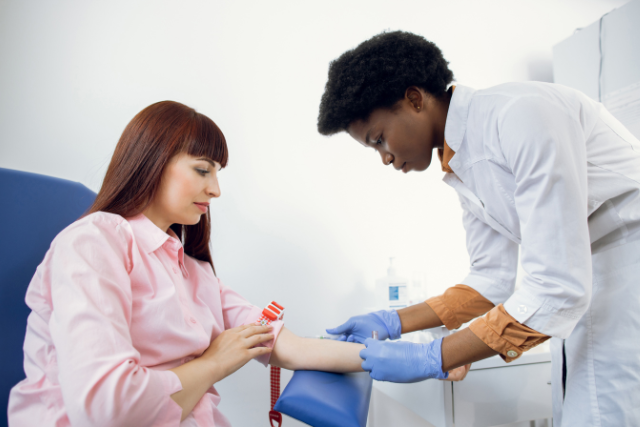
Congratulations on your pregnancy! Whether this is your first or fifth pregnancy, you may never cease to be surprised by how much blood work and testing there is – did they really need that sixth vial of blood? And what are they looking for? One of the first lab tests your doctor may order for you is a blood type and Rh type test.
You may have heard of the different blood types, but have you ever heard of an “Rh negative” blood type? Many patients find out for the first time during pregnancy what their blood type is, including if they have an Rh negative blood type. What is the Rh factor and why is this important in pregnancy?
The Rh factor is a protein that is found on the surface of red blood cells. If you have an Rh negative blood type (like O negative), it means you do not have this protein on the surface of your red blood cells. This is important as we often do not know the blood type of your baby until after birth. An exception to this would be if your partner also has an Rh negative blood type (it does not matter if it is the same ABO blood type as yours,) which would mean your baby is also Rh negative. If you are Rh negative and your partner does not know his blood type or has a Rh positive blood type, you are at risk of isoimmunization.
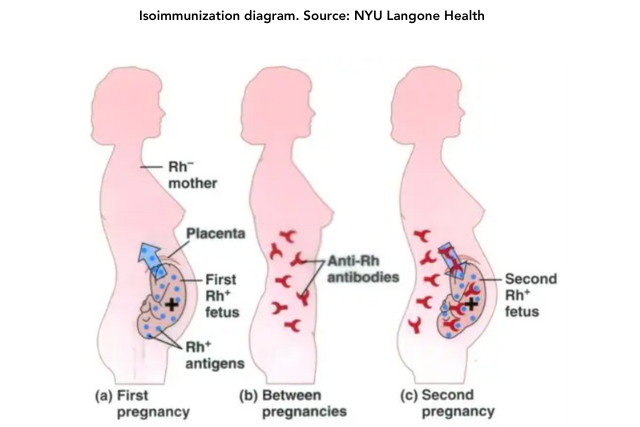
Any time there is bleeding during pregnancy, the baby’s red blood cells can cross into mom’s circulation. Most often this happens at the time of delivery. If mom is Rh negative and baby is Rh positive, mom’s immune system will recognize the baby’s blood cells as a foreign body and create antibodies to attack these cells. As a result, in the future, if there are again “foreign” cells detected in mom’s circulation, the immune system will attack these cells. This can affect your future pregnancies.
Let’s look at an example. Mom is Rh negative and had an episode of first trimester bleeding. Her system has been sensitized to the baby’s Rh positive blood cells, and antibodies that have been made against the baby’s blood cells can cross the placenta to attack fetal blood cells. This can cause serious anemia in the baby and endanger the baby’s life. Rh incompatibility can also cause jaundice in a newborn.
Isoimmunization can happen with any bleeding during pregnancy, including miscarriage, ectopic pregnancy, termination of pregnancy, and even with a motor vehicle accident or procedures during pregnancy such as amniocentesis/chorionic villi sampling or external cephalic version.
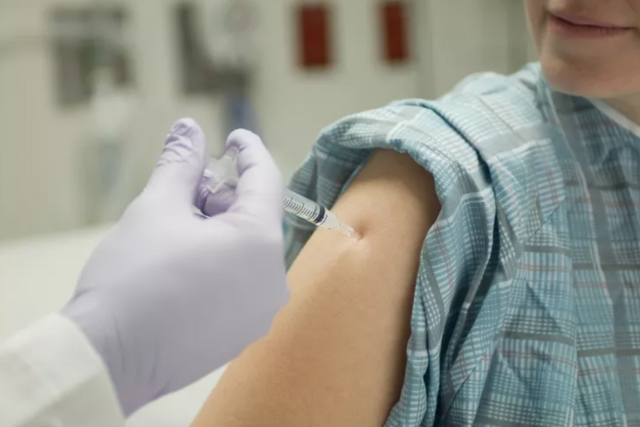
Luckily, these complications can be prevented. The goal of treatment is to stop mom’s body from making Rh antibodies in the first place. To prevent complications in your pregnancy, if you have an Rh negative blood type, your doctor will offer you an injection called Rhogam (Rh immunoglobulin), which prevents your body from developing Rh antibodies. Rhogam is generally given around 28 weeks of pregnancy and again after delivery, if your baby is Rh positive (baby’s blood type is easily detected after birth!). Each pregnancy and delivery of an Rh-positive baby requires a repeat dose of Rhogam. If you have any invasive procedures done during your pregnancy (like an amniocentesis), your doctor will likely offer you a Rhogam injection at that time as well.
Problems do not usually occur during an Rh-negative mom’s first pregnancy with an Rh-positive baby, as it takes time to develop antibodies against the Rh-positive blood cells. The development of antibodies puts a future pregnancy at risk. If you have any questions in regards to your blood type and if you need Rhogam, please discuss with your OB-GYN. Congratulations again on your upcoming addition to your family!
Dr. Michelle Tsai grew up in LA’s San Gabriel Valley and received her bachelor’s degree at the University of California – Berkeley. She taught English in Asia for a year prior to attending medical school at Virginia Commonwealth University. She completed her residency training at the University of Hawaii in Honolulu and moved to the San Francisco Bay Area to open her own private practice.
Dr. Tsai is currently an assistant professor of OB-GYN at UCLA. She is the director of the UCLA Marina Del Rey OB/GYN office which is opening in 2023. She divides her time seeing patients in the office, performing gynecologic surgeries, delivering babies, teaching medical students and residents, and serving as an independent contractor in the community for the underserved. When she is not working, she enjoys spending time with her husband and miniature schnauzer Sadie, as well as traveling, exercising, and trying out new restaurants in her community. They welcomed their first child in October 2020.
“Child’s Pose is a deeply relaxing, restorative yoga posture that helps release tension in the lower back, hips, and shoulders while cultivating a grounded, calm feeling. It also aids in digestion and can help ease discomfort in the abdomen. “
You’re pregnant! You’re excited! You’re in pain! Though I’ve never been pregnant myself, I know that it is a transformative and beautiful journey that can also come with its fair share of discomfort. Many expectant mothers experience various physical challenges including backaches, hip pain, swollen body parts, and general discomfort. Besides all of the mental health benefits that a yoga practice can bring, yoga offers a safe and effective way to alleviate pregnancy discomfort while promoting relaxation and overall well-being (exactly how you want to feel while carrying!).
My favorite thing about yoga is that it’s made for everyone, all shapes, sizes, physical ability or disability levels, ages, and genders. You don’t even really need any special equipment, an expensive mat, or $150 leggings. No one should feel like they can’t “do” it, because as long as you make it to the mat (or just your living room floor) and you breathe, congrats, you’re doing yoga.
Keeping conscious of your breath along the way is actually what makes the physical movement “yoga.” Point being, the breath brings life to the pose and also brings the greatest physical and mental benefits when combined with the pose. So don’t forget to breathe while you’re considering the following! Here are five yoga moves you can do RIGHT NOW that can help relieve pregnancy pain and discomfort.
1. Cat/Cow Pose
Cat/Cow pose is a gentle and soothing movement that helps to release tension in the spine and improve flexibility. It is especially beneficial for relieving backaches and increasing mobility in the pelvis.
How to do it:
Start on all fours with your hands directly beneath your shoulders and your knees hip-width apart.
Inhale deeply and gently arch your back, lifting your head and tailbone towards the ceiling. This is the cow pose.
As you exhale, round your spine upwards, tucking your chin towards your chest and pressing away from the ground through your hands. This is the cat pose.
Repeat this flowing movement, inhaling and exhaling with the corresponding pose. Continue for 5-10 rounds, gradually increasing the fluidity and depth of the stretches.
2. Bridge Pose
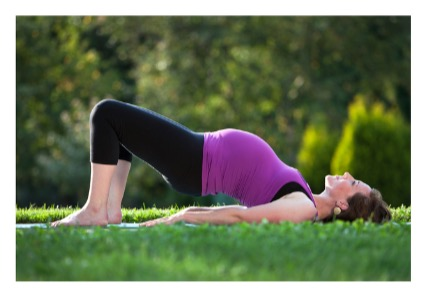
Bridge pose is excellent for relieving lower back pain, strengthening the legs, and opening the hips. It also encourages better blood circulation and helps reduce swelling in the legs and feet.
How to do it:
Lie on your back with your knees bent and your feet flat on the floor, hip-width apart.
Place a folded blanket or bolster under your sacrum (the triangular bone at the base of your spine) for support if desired.
Slowly lift your hips off the ground, pressing your feet down into the floor.
Support your lower back by keeping your hands flat with palms pressing into the ground or place them on your belly to let your hips, legs, and feet do more of the work.
Breathe deeply and hold the pose for 15 seconds to 1 minute, focusing on lifting your hips. Repeat as needed.
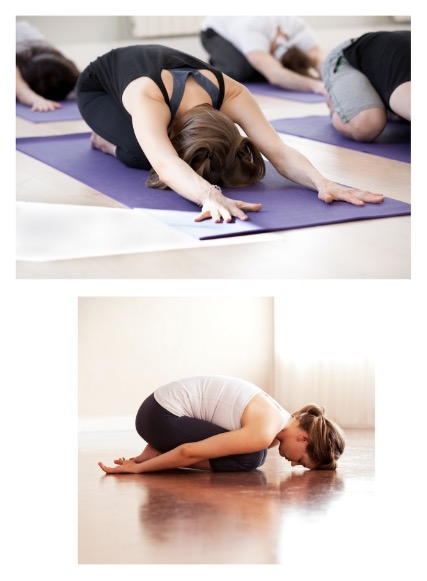
3. Child’s Pose
Child’s Pose is a deeply relaxing, restorative yoga posture that helps release tension in the lower back, hips, and shoulders while cultivating a grounded, calm feeling. It also aids in digestion and can help ease discomfort in the abdomen. This particular Child’s Pose description will set you up for the supported version of the pose which will accommodate the pregnant belly.
How to do it:
Start on your hands and knees, keeping your knees wider than hip-width apart.
Bring your big toes to touch, and sit back on your heels.
Place a bolster, pillow, or folded blankets in front of you between your knees and slowly lower your torso onto the support. The cushion should be long enough to allow you to rest your belly and your forehead on it.
Extend your arms forward or let them rest alongside your body, palms facing up to the sky.
Close your eyes and breathe deeply, allowing your body to relax and release tension. Stay for a few breath cycles.
TIP: for smaller bellies, having no cushion may be preferred.
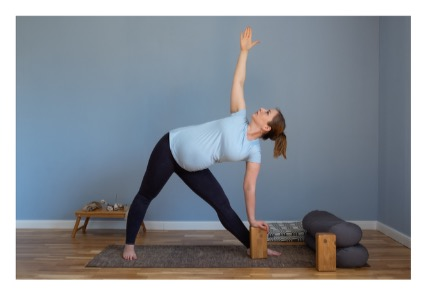
4. Triangle Pose
Triangle Pose is a standing pose that helps relieve lower back pain and strengthens the legs and hips. It also helps stretch the hamstrings, hips, and lower back.
How to do it:
Stand with your feet wider than your hips apart, keeping your toes pointing forward.
Turn your right foot out and extend your right arm overhead, while placing your left hand on your hip.
Slowly tilt your torso to the right side, reaching your right hand towards the floor or placing it on a block for support.
Turn your head to the left and up towards the ceiling or look straight ahead. Hold the pose for a few deep breaths and then repeat on the other side.
TIP: place a block in your practice space before attempting the pose so you can grab for it and use it if needed.
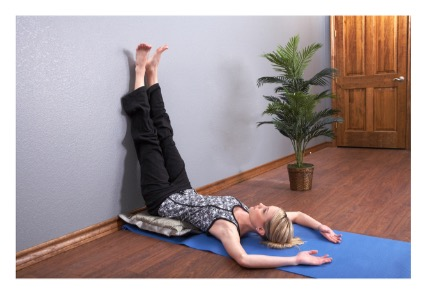
5. Legs-Up-the-Wall Pose
Legs-Up-the-Wall Pose is a restorative inversion pose that reduces swelling in the feet and ankles and improves circulation. Try closing your eyes once you get into position for maximum relaxation. This can be a tricky pose to get into, and ultimately, however you can safely put yourself in position is great.
How to do it:
With the goal of making an L shape with your body, start with your back flat on the floor, put your bum against a wall, and gradually lift your legs and feet to rest on the wall, feet going above your head.
You don’t necessarily need to be at a 90 degree angle unless that feels good to you.
Close your eyes and stay for a few minutes while breathing slowly in and out.
Practicing yoga during pregnancy can be immensely beneficial for alleviating pain and discomfort while promoting overall well-being. It also provides “you” time, where you can think and relax in peace. There are endless poses beyond these five that can relieve pregnancy related discomfort and I highly encourage you to explore more poses or maybe even a pregnancy flow (a series of poses put together like a little routine). During pregnancy, always remember to listen to your body, modify all poses as needed, and consult with your doctor or other healthcare professional before starting any new physical activity routine. Depending on which trimester you’re in, certain poses may or may not be recommended.
I truly hope these simple but powerful poses pique your interest in yoga and allow you to embrace the transformative power of the practice, but mostly I hope they help you with a more enjoyable pregnancy journey. Namaste.
Olivia is a former competitive gymnast and a certified yoga teacher living in Los Angeles. She found yoga in her late twenties and credits the practice as the single most impactful influence in her lifelong journey navigating major depressive disorder. She enjoys introducing yoga to others, fostering animals, and going thrifting. Also, naps.
Elliot: Welcome to the Informed Pregnancy and Parenting Podcast. I’m your host, Dr. Elliot Berlin. My guest today is a media professional and she is a mother of two, and her story to pregnancy and birth is quite interesting. Arista Ilona, welcome to the podcast.
Arista: Thank you. I’m happy to be here.
Elliot: I’m so happy you’re here. And, you’re going to have to listen to this episode all the way through. You probably do always anyway. But, we have an exciting announcement at the end of this one. But, before we get there, let’s start at the beginning. Where are you from originally?
Arista: I am a Los Angeles native. Born and raised, Southern California.
Elliot: How was that growing up in the City of Angels?
Arista: Honestly, it was normal for me. I think because it’s all I’ve ever known. But, when I talk to people who have not ever been to LA and they hear my stories, I’m realizing that it was quite different and definitely not normal to be in such a fast-paced environment and meeting and seeing just random celebrities here and there as I’ve grown up, or going to school with like, so and so, son or daughter. So, that was always something that wasn’t weird for me. Yeah, it’s I think been great. I love the sun. I cannot stand cold weather. So, I am forever damaged. Like, now, is currently flood watches and rain. I’m just like, “What do I do with myself?” I do not know how to operate in anything but the sun.
Elliot: I was looking at my office window today. I have a great view, and the trees are all just shaking back and forth. There’s a heavy downpour. It felt like I was in Miami. I don’t know where I am.
Arista: Yeah. That’s how I feel. I’m like, “What do I do?” I’m like ordering groceries to be delivered. I’m so dramatic. I can’t even go outside.
Elliot: Alright. You grew up in Los Angeles — and by the way, my wife and I were from New York, but like Staten Island, not the big city. And, when we came here, we assumed we were going to see celebrities on every corner. And, the other thing that’s interesting is that I’m face blind. So, even if I had a celebrity talking to me, I would have no idea who they are. So, we used to just make it up on the corner. Like, we’ll be at a red light and like, “Oh, look! There’s Britney Spears!” But, we’re just you know.
Arista: I love that. And, yeah, I actually just recently found that out. I never knew that about you. I had no idea.
Elliot: I only found out when I was 39.
Arista: Goodness.
Elliot: Also, I feel like you look different every time.
Arista: Yes.
Elliot: I don’t think it’s just me.
Arista: Doesn’t help, I know.
Elliot: Yeah.
Arista: Yeah. I cut my hair. I’m so sorry.
Elliot: No. It’s totally fine. I wouldn’t help anyway. But, for you, usually, have a rough generalized. Like, “Okay. This is what this person’s going to look like.” You could be a completely different person playing a prank on me, and I would have no idea.
Arista: Whoopsie! But, I am always wearing this necklace that has my daughter’s name, Aiya.
Elliot: That’s a clue. But, if you gave that to somebody else, then I would believe. Alright. Speaking of daughter, we got to get there. Let’s just talk a little bit. We said that you were a media professional. What was that trajectory like?
Arista: Wow. Oh, man. Let’s see. In a nutshell, I always knew that I wanted to be in the entertainment industry. My father worked at Warner Brothers for a very long time and worked his way up from being a limousine driver to a famous anchor, who we all know as Dallas Raines.
Elliot: Oh, wow.
Arista: Yeah. Who was on ABC-7 News. Funny enough that was one of my first places I landed as an intern. I got to go up to him and be like, “Hey, you knew my dad.” He totally remembered, and he actually carried me as a baby. So, that was super cool. I had a big love for broadcast journalism, and being a news anchor. I love Lauren Sanchez, and that was my whole vibe. And so, I kind of bounced around from ABC-7 to Entertainment Tonight, got to help a senior producer there, and was learning the ropes. I kind of quickly realized that it wasn’t my forte in the sense that I just didn’t want to know too much about celebrities in that sense. Like, who was dating who and all of that. I know that’s something that is very interesting for some people, but it just wasn’t the space that was lighting me up.
So, I ended up shifting to radio, and music was my other love. That got me through a lot of tough times growing up. And so, I decided to dive into the music space. And, luckily landed an internship at Clear Channel. KIIS FM, 102.7 KIIS FM, which was LA’s top 40 radio station. And then, 98.7 was the rock station. Still is, the alternative rock. They were the best of both worlds. That is basically like blending me in one, and I was like, “This is awesome.”
And so, I actually was there for three and a half years. I went from internship to them becoming a programming assistant, production, doing straight team, and I just worked my butt off and was going to schools, working like five jobs. It was a very hectic time. Very LA of me to be also working at a restaurant, and also at a radio station. I just made some connections and I always stayed in touch with the head director there. Shout out to Julie Pilat. To this day, I still know her. I was like 19 when I started, not to age myself. But, that was definitely like 15 years ago.
Elliot: I can do the math, but I won’t.
Arista: Yes. Let’s not. So, I landed there with her. I took a break briefly and moved to Oregon, Southern Oregon, randomly. Took a break for about two years. I was burnt out, not going to lie. I think I overdid it a bit. I need to reset and find a new inspiration. To be honest, Oregon kind of gave me that, and I wasn’t expecting it. But, it also gave me like the granola phase in my life. When I looked back at it. I was like the hippie girl. Oregon definitely brought that phase out of me. I suddenly became a yoga professional [unin] some thoughts. And then, was getting into aromatherapy essential oils, and met an amazing biodynamic farmer up there. Yeah, it was like a whole other side of me. Like, my very green thumb side came out at that time. And then, I missed my hometown. I missed LA. I was like, “Okay. I’m too young I think to be here.” And, even though I was working at a radio station there in Oregon, a very small one, I was like,” This is really slow.” Like, there’s no billboards.
Elliot: Yeah.
Arista: It was definitely the nurturing vibe I needed at the time, and very therapeutic. But, I was ready to come back. And so, long story short, I came back to LA. And then, got back in touch with Julie. She needed an assistant at that time again. But, this time, for a different company called Beats Music, which it wasn’t named at the time. It was a startup, and I was part of like the core team there that then got bought out by Apple. It was like the biggest streaming music history deal that you’ve ever heard of, and I was a part of that crazy acquisition and ended up at Apple for eight years.
Elliot: Wow. Looks pretty cool.
Arista: Yeah. And then, now, I’ve been recently at Netflix. But, also, still doing my own business on the side that’s really catered in helping people find secret presents on the go, which stems from motherhood, which I know will get into.
Elliot: Secret presents.
Arista: Yes.
Elliot: Wait. But, you also have Botanica.
Arista: Yeah, Botanica. Yes. So, that’s Ilona Botanica. And, that’s the oils which stemmed from like what I learned in Oregon, learning how to blend aromatherapy to kind of have like secret presents on the go, which seems like, “How is that even possible?” But, that’s something close and dear to my heart, which is about soul wellness as a whole. And, how can we integrate that presence in our life when we are moving so fast, especially as a mother, and just as a woman, and living in the city. These products that I make: the mist, and the body oils, and the bath oils, is something to encourage ritual as much as possible. Because I know that not everyone can go to a yoga retreat in India. Or, even honestly, it’s very difficult for me to make it to a yoga class. So, I decided to create some tangible item and product that was special for me that I could throw in my bag. Mist myself when I’m like in the car in traffic, or just needing a quick pick me up. And, that was something to like come back to myself and feel connected within, and essentially feeling at home wherever I go.
Elliot: It’s really great. And now, you help other people have those same experiences on the go.
Arista: Yeah.
Elliot: That’s really cool. You have kids?
Arista: I do, unexpectedly.
Elliot: Well, let’s talk about that. What does that mean? Because were you not planning to be a mom?
Arista: No. I was never really one of those girls I often hear like, “As a little girl, I always wanted to be a mom and play with dolls. I just knew that that was what I wanted.” I didn’t have that. I often felt a bit weird, or something was wrong with me that I didn’t have that initial plan I guess, or feeling. It was never really something that crossed my mind. And, I don’t know if that’s maybe because, growing up, witnessing my grandmother having a very, very hard time coming from Costa Rica to the States, and struggling very, very, very hardly. Grew up on food stamps, and Section 8, and it just wasn’t the American dream unfortunately that she thought that it was, for her, in particular. She didn’t have anybody. She was single a single mom of six, and didn’t have that masculine male support in her life. So, I never really saw it as being a positive, of having children, and getting married, and trusting that whole American dream with the white picket fence I guess, right?
And then, my mother also, not being married to my father and splitting up when I was very young. I guess I just never saw that model of like, “Hey, this is like a great thing to experience.” I think I was very scared very.
Elliot: Is your grandma from Costa Rica, your mother’s mother?
Arista: Yes.
Elliot: Okay. So, they split. So, was your dad not in the picture, or was he kind of…?
Arista: Yeah. My dad was like in and out. I like to call him a rolling stone. He loves like kind of being on the road, and being in the trees. That’s where I get my love for road trips, and the forest, and nature is from him. He was kind of like in and out.
I remember meeting him when I was 7. I know that he was in my life prior, but it was kind of choppy. And then, once, I was a teen, like 14 and up, then I remember seeing him a lot. We went on trips and all that. But, I think it was fairly hard for him to be in my life. I don’t know if it’s because of my mom, or what, it gets complicated. But, I know that he definitely tried when he could. I guess I just never felt safe.
Elliot: Your siblings.
Arista: Yeah. Half siblings from my dad’s side. So, I have three sisters and two brothers.
Elliot: Okay. That you grew up with or not really?
Arista: No.
Elliot: No. Okay.
Arista: I knew then. We would talk, but it wasn’t under the same roof.
Elliot: So, it really is Grandma, Ma, and you.
Arista: Yeah. And then, my aunts, my cousins, my oldest aunt who also came from Costa Rica. But then, my grandmother passed away when I was 14. And then, that was super devastating for me. I had to grow up fairly quick at that age, and kind of went into survival mode, to be honest.
Elliot: So, you paint a picture in which it’s like, I don’t know, to me, it just seems like understandable why that wouldn’t want to be having responsibility for kids, and wouldn’t want to be something that you would chase after.
Arista: Yeah.
Elliot: But, somehow, you have kids. Alright. Let’s take a little break. Because I feel like the story is just warming up, and I feel also compelled to remind the listener at home that we have a surprise announcement at the end of this episode with Arista Ilona. We’ll be right back.
[Break]
Elliot: Welcome back. We’re talking to Arista Ilona. Okay. So, you have this whole career thing going on. And then, you go off to Oregon. And then, you come back, semi-hippified.
Arista: The whole boujee.
Elliot: And then, Beats, Apple, Netflix. Somewhere along there, you change course, and you started having kids. What happened?
Arista: Yeah. So, what happened? Yeah, what happened? I still wonder that, but in a good way. I don’t know [unin].
Elliot: Okay. But, I know roughly what happened.
Arista: Yeah. So, yes, my oldest just turned 7.
Elliot: Happy birthday.
Arista: Yeah, thank you. Seven years ago, I got pregnant actually right before we launched Beats One Radio, which was so crazy. It was such a crazy time. Very, very hectic. I remember finding out, and I was like, “Oh, man. What am I going to do?” I remember my best friend, being the one that I was just talking to and like, “What do I do? What do I do?’ She was so understanding, and just calmed me. We would take walks. Because she was working with me at the office, and we would take walks together on our break. I would see a little Monarch butterfly fly by me, and I was still in my little hippie phase because I was still new to coming back to LA. I was like, “It’s a sign. I need to embrace motherhood and I have to do this.” I just feel something like this is going to transform something within me and it’s really scary. But, I feel I need to move towards it. I need to like, “Be scared and do it anyway.” And so, I did.
It definitely was scary. I remember calling my dad, and he was very supportive, and my mom. And so, I was almost in shock. Like, “Wow! Everyone is actually pretty happy and on board.” And so, even though I was like, “Oh, I just paid my car off, and it was only a 2-door car, and I had all these plans to meet, travel the world, and do all this crazy stuff.” Here is the curveball, but I felt it was going to really change me for the better.
Elliot: I have so many questions. Can you answer whichever ones you want to and not answer the ones you don’t? But, were you in a committed relationship?
Arista: What is the definition of that at that time? It probably was not.
Elliot: Okay.
Arista: I’m going to be honest. It was, “Hey. Oh, cool. You’re attractive. I’ll see you around.” I was going to events that he was throwing in Venice, California at the time by Venice Beach. We just were hanging out. And then, after three months, I ended up pregnant.
Elliot: As happens. How did you figure it out? Was it a big surprise?
Arista: Yes. It was a very big surprise, and I felt a lot of shame. Because I was somebody that was like, “If that ever happened.” Like, even though I didn’t think I’d ever become a mother. The planner in me was, “Well, if I did, I need to be engaged first, and we got to live together,” and all the perfect pieces that you think would make something be acceptable or okay, without getting the judgy eyes. But then, I was that girl that was, “Oh, no.” Unexpected pregnancy with somebody that didn’t even believe in marriage, and was kind of more open with his commitment, and that was very scary to be in at the same time of embracing an unexpected pregnancy.
But, the one thing that I do appreciate is the honesty and the transparency that he had with me in the beginning. It was something that we talked about, and that we decided to move forward. Like, “Hey, no matter what. We’re going to co-parent, right? We’ll be good co-parents to each other and for the child.” And so, yeah. I mean, it was navigating deep waters that I’d never had been in, right? But, I was always an open-minded person, and kind of just flowed with things, and embraced things in life that came my way because I saw it as an opportunity to grow. Like, on a spiritual level, as a person, too. And so, I was like, “Okay. This is what was presented to me, and I’m going to take responsibility.”
Elliot: What was your clue?
Arista: The Monarch butterflies.
Elliot: Oh, the butterflies.
Arista: I know that sounds so corny. But, yeah, it was at that time a very symbolic animal for me, or insect. I actually have a tattoo of a Monarch butterfly on my right arm, which I had a few months before I got pregnant. So, it was even more of a, “Hey, this is my own little sign.” My own little explanation for myself that once I got pregnant, I kept seeing them everywhere. And, when I wasn’t sure what to do, and I was having a conversation with her father, he actually told me that that day prior, there was a dead monarch butterfly that was at his doorstep. I was just kind of like, “Huh, that’s interesting.” I just took that as like, “No. I need to move forward and step into this as a woman.”
It’s so odd to look back at it now. Because at the time, I couldn’t put my finger on it. Obviously, you don’t know when you’re in it until you look back and you see, “Oh, wow.” I definitely changed and that definitely helped me in my life. Even though it was really scary and a really hard decision to make. Looking back, I wouldn’t have it any other way. It’s just amazing when you look back on your life. Especially, seven years, ten years ago, and you see how much it shaped you.
Elliot: Do you think the change started to take place when you decided to keep the baby, or when you gave birth, or through the act of parenting?
Arista: I think definitely when I gave birth and became a mother. Because the pregnancy, I felt great and I still was doing things. It kind of hits you, overnight. So, I didn’t really feel different until I had the baby in my arms. I was, “Whoa! Okay. This is real. Like, it’s real!”
Elliot: They say all the time that at your first birth, there’s two births simultaneously: the birth of the baby and the birth of the mother. It sounds like you really experienced that.
Arista: Yes. And, that’s a great way to put it. That’s exactly what it was.
Elliot: Speaking of birth, keeping a baby’s one thing, deciding to co-parent, also, another thing. But then, you have to get that kid out of you. As somebody who never thought about having kids, how did that thought process go?
Arista: I was very fascinated around the idea of a home birth. I know, I know. Before for all the judgees — They’re losing their mind listening to this. Yeah, a home water birth. I was fascinated with having a midwife and a doula. And, I still, to this day, think that it’s very important to have a doula, but also have a plan B, which I did not have. So, I was just very laser-focused on this home water birth, and I didn’t want to think about anything else. And then, I was definitely afraid of a C-section, so I wasn’t even going to touch that idea or think about it.
Elliot: Who did you have to support you? Who was going to be there?
Arista: It was going to be her father, my midwife, my doula, and two of my friends.
Elliot: Okay. Friends who had babies?
Arista: Nope.
Elliot: Okay. And, where did the idea of home birth work even — because almost everybody gives birth at the hospital? Where did you even come to see that idea?
Arista: I think it’s going to just blame Oregon. I’m going to blame the dose of hippie life where I started researching and hearing people talk about — was it Ina May?
Elliot: Oh, yeah.
Arista: I started hearing talks about that. And then, going down the YouTube rabbit hole of orgasmic birthing. And, I think I was just fascinated by it. I wasn’t, again, thinking of having children. I was just, “Well, interesting.” Because I was meeting a lot of families in Oregon and mothers. I was, “Oh, well. That seems like the rebel thing to do and that’s how I live my life sometimes.” It’s like, “I’m going to go the other way and try this other cool thing that’s different.” And so, that was the plan and that was a whole other layer.
Elliot: Did you do things that get sort of prepared mind and body for it? Or, just like, “Yeah, we’ll have a home birth.”
Arista: Yeah. I mean, I thought that I was prepared. I didn’t really know what I didn’t know until I was in it. I was like, “Okay. I’m not ready for this. This was kind of crazy idea.”
Elliot: How did it start?
Arista: I started cramping, had the good old mucus plug — just so gross. I was not prepared for that.
Elliot: Delicious.
Arista: What is this slug on my thigh? What is this?
Elliot: Oh, giant [unin] on you?
Arista: Yeah. I’m so grossed. And so, at that time, I was texting my doula, and I would have like, “Well, I think it’s happening.” They’re like, “That’s great.” I just started taking my time and wearing, I had this like sarong. This bright pink sarong from Hawaii, wrapped around me all pretty in the front but around my neck. And then, a couple hours into feeling I guess the slow contractions. I didn’t know then, but I know now that I had a panic attack.
Elliot: Oh!
Arista: Yeah. I totally blacked out.
Elliot: What?
Arista: Yes.
Elliot: Had you had panic attacks before?
Arista: No.
Elliot: You think that a lot of mist — you needed the mist.
Arista: Yes, exactly! That’s why I created them.
Elliot: Oh, my gosh.
Arista: Yeah. I had no idea —
Elliot: You don’t remember what happened, even now?
Arista: I barely. It’s so vague. I remember fragmented moments that are just kind of in and out. I remember the sounds, hearing things. I remember sensations. And then, little blips of the entire birthing experience, which I guess I was told lasted three days. I have no idea.
Elliot: Was there any pictures, or video, or anything like that?
Arista: Yeah there were. But, I did not watch any video.
Elliot: Still haven’t?
Arista: No. Uh-uh.
Elliot: Oh, my God. We need to watch it.
Arista: Oh, my gosh. I know. I remember seeing —
Elliot: Oh, my God. I want to do — I like a video episode with you where you watch your birth.
Arista: Oh, my gosh. No.
Elliot: Oh, my gosh. Yes.
Arista: Yeah. I mean, I remember —
Elliot: You still haven’t watched it?
Arista: No. Because I remember when he played it once, I was like, “No, no, no. Turn it off.” Like, just hearing me in pain, I was like, “Oh, I can’t.” I don’t even know who that is. It was just kind of traumatic, not going to lie. Maybe seven years now, I’m good.
Elliot: We’re just warming up in your story, but it sounds like you’ve come so far. Now, I’m so curious what your reaction will be if you watch it. Like, if things will come back to you or not or, “Okay, I digress.” Back to you. So, you blackout. And, on and off for three days, you can’t tell us too much because you don’t remember.
Arista: No. I just remember this one moment feeling in so much pain. In the beginning, I remember feeling shortness of breath, right? When the contractions were starting and I started feeling, “Oh, I can’t breathe! I can’t breathe!” I thought it was a sarong being too tight on my neck because it was wrapped around, and not in the back. And so, I, right away, just took it off. And then, I was just naked there. I was just, “Oh,” and I started freaking out. I told him I was, “I feel I’m going to pass out.” I just remember everything just the circle, zoning in and closing.
And then, next thing you know, I’m in the water tub. And then, I hear my midwife and my doula, and my friends in the background. They’re getting things prepared. But, I’m out of it. I’m not even really present. And so, I remember being in and out of the water. And then, them asking me to go into the shower. And then, going back in the water. And then, coming out of the water. And then, going on the floor and trying to do movement, and move my body. And then, another part where my midwife was like, “You know, you’re only dilated 6 centimeters, and I can’t feel her.” She had her hand up there, trying to feel and see where the baby is. And, I started getting worried at that point. And then, I needed a catheter.
And then, immediately, in that moment, I’m pooping myself. I’m like, “Why did I have this idea of a home birth?” In that moment, it’s like, “This is gross. I feel gross.” I personally was not enjoying it. And then, I just felt in so much pain. I was having back labor. And so, I remember her telling me, “The baby’s flipped.” I was in excruciating pain. And then, my friends were there. And then, they started trying to calm me by singing and playing the drum, and the sound bowl. I was just overstimulated. I was like, “None of this is helping me.” I thought it would. I had this idea of this super calming, relaxing zen vibe with the candles, and the dim lights, and the aromatherapy, and everything, right? It was just, “I don’t know, I can’t even focus.”
And so, it got to the point where I was on my back, and I was having contractions so much that’s where I could barely take a breath. I couldn’t count to three seconds. I was like, “Ugh!” It was just excruciating in my lower back, and I just started crying. I remember my midwife being, “It’s okay to stop here. Whatever you want to do, we can go. We can transfer. You know you’re tired. We don’t want anything to happen to the baby. Let’s make the call.”
My stubbornness was kicking. I was like, “No. I don’t want to give up.” This was the dream experience birth that I really wanted to try to have. But, at that point, I knew I’m spent. I’m exhausted. And so, we decided to transfer.
My doula drove us to the hospital. I remember getting up and they’re trying to help me, and I don’t know that feeling of walking with excruciating contractions, which is horrible. And then, I didn’t know what day it was. I saw the sun, but I was like, “Wait. It was nighttime when I went to labor. So, what is even happening?” It was just such a weird, weird experience for me to feel so out of touch. And then, being in the car in the back seat, and just every bump and every movement was just like, “Ah!” It just was hurting even more for me.
Finally, get to the hospital. I asked for an epidural right away, which is, of course, another thing that was like, “I’ll never get an epidural because I knew of all chemicals.” And so, I knew too much. And so, that also kind of made it really hard for me to accept the decisions that had to be made at that time with urgency. Because then, I felt I was hurting my baby.
And so, I was dealing with a lot of guilt, and a lot of second guessing myself, and just feeling I gave up. But, in the moment, I just needed relief. And so, once they gave me the epidural, I was like, “Oh!” There’s that breath. There’s that full breath and that feeling that I had been looking for. And then, I asked if I could try just give us a little bit more time. Used the peanut ball in between my legs to maybe see if I progress now that I have the epidural, and just give my body a little bit more time now that I’m relaxed. They let me for a little bit. But then, the OB came in and was like, “We got it. We got to get this baby out. Because it’s been a long time.”
Elliot: Because you said three days already.
Arista: Yeah.
Elliot: Is this an OB that you knew? Or, no, just a random–?
Arista: No. My midwife knew her. I had no idea. I’ve never met her before. She walked in with a leather jacket. Just super–
Elliot: [unin] OB?
Arista: Kind of like. But, I think she was from New York. Maybe it worked out. I just felt like, “Oh, man. This is kind of aggressive.” Not like the glowing light around.
Elliot: Yeah.
Arista: Like, the nurturing woman vibe that I was kind of foreseeing. The experience would be like, “Let me deliver your baby.” It’s like, “Oh, no.” It was like, “Nope, got to get her out. Let’s go.” The minute she walked out of the room after, she said, “We got to have a C-section.” She walked out. I just broke down the hardest deepest cry that I’ve ever experienced in my life. Similar to basically when my grandmother passed away.
Elliot: Oh, my.
Arista: I was devastated.
Elliot: What is the source of that devastation?
Arista: One, I am so scared of surgeries and hospitals. I was just really scared to go under. I was scared of dying. I don’t want to die.
Elliot: But, you don’t have to go under.
Arista: Well, yeah. But, you know what I mean?
Elliot: Not being in control? But, you already have an epidural.
Arista: Yes, exactly.
Elliot: But, I guess being kind of open is–
Arista: Yeah. It was just something I hadn’t prepared for. And so, I didn’t really know how I would feel and it just felt very scary.
Elliot: So, fear. But, there’s a lot of fear bubbling up for you. It’s so interesting. Because, in my mind, you’re this incredible badass. “I can do anything,” and you are. And so, I don’t know if you became that through experience or–
Arista: Definitely. I think that’s what, earlier, looking back, to see how much this shaped me to become so much more empowered. I had to go through that moment to get there. Because I was definitely younger, too. And, so much happens in seven years. Especially for me, because I’m always very proud of myself. Like, “You got to do better. You got to grow. You got to be a better than yesterday.” When they told me that, I was like, “Dang it!” Again, the plan didn’t go as planned. And so, I was just being hit left and right with things that were these curveballs that I didn’t feel ready for, but was just like, “Okay. Well, here is the surrender plate, right?” Here it is and the deepest of surrender that I will ever probably experience was in that moment.
And so, I’m under, and the lights are bright, and I’m feeling a little anxious. And, again, I don’t know what that time what that is, but I just have the shortness of breath and I’m trying to relax. And, next thing you know, baby’s out. She’s 8 pounds, 3 ounces, and healthy. They put her right on my chest and she latched on right away. It was such a beautiful experience. But, I was totally out of it. Like, my eyes were closed when she was on me. And so, I just see this slight smile of relief. Like, “Ah, yes. We’re there. Now, I can heal.” But, I wasn’t as alert as I had liked to be, right? The crying when you see your baby and all the pictures that you see. I was just out of it.
And so, at that point, I don’t know how much more you want to know. The hospital experience was great. I had a great team, baby was healthy, and I was healthy. And then, we get home and doing the breastfeeding, and tending to a C-section, which is not fun. I realized in that time like, “Wow! Everyone prepares you for a baby.” They say have the baby shower, and your baby registry, and you’ve got the doula.
Elliot: All that gear and the nursery.
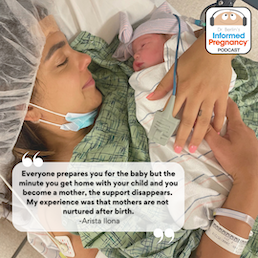
Arista: Yeah. But then, the minute that you get home with your child, and you become a mother, suddenly, and for me, this is how it was, the support kind of disappears. There isn’t that continued, “Okay. Now is the time where you really got to eat well. You got to nourish your body, and your mind, and your spirit, and you got to not overwork yourself,” and all of that. There wasn’t really that reminder for me. And, that was where I was like, “There’s something missing here.” There’s a big gap in postpartum time where mothers, I feel, aren’t getting nurtured because I experienced that. I don’t have a big family. I didn’t have the aunts, and the cousins, and everyone coming, and rubbing my feet, and doing all this. And so, I had to bring least seek that out for myself.
Luckily, I found Bellibind, Princess, whom you know. She came. I mean, helped provide that care for me, which was so amazing. I realized in that moment like, “Wow! This is gold.” For someone that just got ripped open essentially, and brought a child into the world. And then, to be able to receive and feel that comfort was really special. And so, I ended up trying to find things like that, but it wasn’t until the seventh week mark with baby in being home that I knew I needed that because my C-section got infected.
Elliot: Oh, no.
Arista: Yeah.
Elliot: How did that present?
Arista: I remember it was a fleshy wound. I remember looking down and I had staples. I wanted stitches, and I don’t know what happened there. But, she ended up using staples. I’m pretty sensitive to metals. I know when I was younger, if I wore fake earrings or anything or even fake bracelets, I would freak out.
Elliot: My kids are like that.
Arista: Yeah. And so, I was maybe that was that. But, also, hospital germs. It could be so many things. I remember looking down, and I was in a lot of pain. But, again, I had nothing to compare it to. I thought that pain that I was feeling every time I had to go to the bathroom was just normal, and come to find, it wasn’t. And so, it was the infection that was brewing. And then, it was starting to pus. It’s super gross. It looked like my skin was eating itself, a flesh sheet. Yeah. It was very scary.
I sent a picture to the OB. She’s like, “Oh, my gosh. I have to rush you right away. You need to go see the specialist.” I’m like, “Wait. What?” Like, with a seven-day baby–
Elliot: Recovering from surgery.
Arista: You’ve got be kidding! And so, we’re rushing. We don’t even really have a car seat or anything. We’re trying to figure it out because we were kind of taking our time with all the gear stuff. So, we rushed to the specialist, and he sees, and he’s like, “Oh, I have to drain this.”
Elliot: Oh, no.
Arista: In his office.
Elliot: Oh, right there.
Arista: Right there. He’s like, “I have to take out three of the staples on the right side.” I’m like, “What?” He went in for it, and oh, that pain. Just more pain, more pain. It’s like, “Okay. Here we are.” And so, he drained it. And then, had to stuff it with gauze. He’s like, “So, you’re going to heal kind of weird. Like, it’s going to heal over the gauze. You can always come back and have cosmetic surgery for that area. But, this is the best we could do.”
Elliot: Oh, my goodness. Really?
Arista: Yeah. He’s like, “You’re going to have to have a nurse come every day and stuff that area with gauze. Clean it, take it out. They would roll the gauze, really small. Stuff it in there in between my skin.”
Elliot: Pack it.
Arista: It was just, “Ugh.” It was terrible. So, got home. And then, I deal with that. Have nurses come every day, and take care of that. And then, I got mastitis twice. Because I was really stressed and just over exerting myself. I wasn’t resting because, what is rest even when you are trying to breastfeed, and you’re up, and sleep deprived. I couldn’t sleep. That was really brutal.
Elliot: Okay. Just to recap. You’re like, “I’m not going to have kids.” And then, you get pregnant because of the butterfly. And then, you’re like, “I’m going to do a home birth.” And then, sort of blackout, panic for three days in labor. But, I will say this one word you used during that part of your story, four or five times, is “excruciating.” And then, after that, you said, “Then this happened. I got more painful.” I’m like, “What’s more painful than excruciating?” And then, a surgery, which also terrified you. And then, complications from surgery. So, that’s where we are in the story at this point in a nutshell. But, the story continues because now you have another baby and we’re going to get there. But, let’s take a quick break before we do.
[Break]
Elliot: Welcome back. We’re talking to Arista Ilona. And so, we just recapped the whole story before the break. And now, things have turned again because you have a baby. So, flash forward seven years. I mean, you could recap what happened there, but I’d love to get into this most recent pregnancy and birth.
Arista: Yeah. So, Sophia. She’s 9 months. She’s amazing. And, this pregnancy, after having Aiya, I was an only child and I didn’t want her to be an only child. So, even though it was, “Okay. I don’t know that I can do it again.” Once she turned five, I felt like myself again. Like, I felt I was coming back online but I had gotten pregnant when she was three, and unfortunately had a miscarriage.
Elliot: Oh. I’m sorry.
Arista: Six weeks.
Elliot: When Aiya was three?
Arista: Yes. And so, I had to take a pause. I was like, “I need to pause here.”
Elliot: So, that one was an intentional pregnancy?
Arista: That one was if it happens, it happens kind of thing.
Elliot: Oh, one of those?
Arista: Yeah. And so, I was so excited about it and I felt so happy. Because I was, “Oh, three years. That’s a perfect gap.” And, that happened on New Year’s.
Elliot: Oh, my goodness. It’s because you didn’t get a butterfly.
Arista: Exactly. Where was my butterfly?
Elliot: Obviously. Oh, sorry. That’s so hard. Especially, you, struggling to make the choice to get pregnant, then getting pregnant, and then losing it.
Arista: Yeah. And so, I was trying to figure out what happened there. My doctor had said, “Your progesterone levels were low.” And so, I was on a progesterone cream for quite some time. But also, just took a pause and took a step back. And then, fast forward to when I was five, got pregnant again, and lost that one, too.
Elliot: Oh, no.
Arista: Yeah. That one was at 8 weeks. I’m like, “What is going on?”
Elliot: Was that another if it happens, it happens?
Arista: Yes. And, that one, I didn’t feel very well. I don’t know even how to describe it today. But, I was stuck in bed for three days. I was crying. I was depressed. I didn’t feel myself. And so, I kind of had a feeling something was wrong, and I just didn’t know what. And then, when I started getting cramping — I was out at dinner with my best friend, I was bleeding. And so, I was like, “Oh, no. Not this again.” Because I knew it from the first time around, and yeah. And so, that was a bummer.
And then, Sophia came. We were actually in Hawaii. And, that one I think, we were definitely hoping and trying. But, Hawaii does that to you! If you’ve ever been, you feel so romantic, and just lovey, and there’s that island is so funny. We were like, “Okay. We’re on this island, and by ourselves, and so why not?” And then, I ended up pregnant. And, this time, I felt great and nothing was going wrong. I had a great pregnancy towards the end. I started feeling a lot of pain, and it was only when I had to go to the bathroom and pee. I just didn’t know what that was. I figured like, “Oh, maybe it’s for my C-section.” Like, the infection and the right side’s a little weak, and maybe the pressure from her is causing this weird pain. That in the middle of the night, I would wake up, and have to crutch over, and walk, and hold, and put pressure on my stomach to release the pee. And then, I would feel relieved.
Elliot: That does not sound normal at all.
Arista: Yeah.
Elliot: Is it something you talked to your doctor about?
Arista: I did, yeah. I did it. She didn’t really say much about it. She was like, “Oh. Well, you have one ovary. You had a cyst there in the past.” It wasn’t really discussed in detail.
Elliot: Because that’s not one of those things that you get like, “Oh, it’s just pregnancy.” That’s the standard answer for most things, but that’s not even one of those things that would warrant that answer. Does not sound something common in pregnancy. I don’t know where that’s headed. But, before we go down that path, did you have thoughts on how you wanted to deliver Sophia?
Arista: Yes. This time, because of what I went through with Aiya, I was full-on force hospital.
Elliot: Okay. Full-force hospital, with meds.
Arista: Yep.
Elliot: Okay. Since you had already been through a cesarean — I mean, because that’s the first choice usually. It’s just you got to think about is, “Now, am I going to try for a vaginal birth or go for a repeat the same?”
Arista: Yeah. I did want to try VBAC, which is vaginal birth after cesarean. But, I told my doctor I want to wait and see how the pregnancy progressed to see how things were going, and her placement, how I felt. And, she was totally on board with that. She was like, “Yeah. No problem.”
But then, as that pain was coming on around six, seven months, I started to get concerned. And, that was kind of my own mama intuition where I was like, “Well, I don’t know that I want to wait for my water to break having this pain.” Like, I just don’t want to have another crazy, scary convocation issue, where I rupture, and it could be even scarier, which is how would that even be possible from my first experience which was already scary. So, I wanted to try to dodge as much as I could from the unexpected. And, knowing that I’ve had a C-section before, I knew what to expect.
Elliot: Okay. So, it wasn’t that panicky?
Arista: Yeah, exactly.
Elliot: And, what’s, “I can’t have surgery.” But, also, just because you said, “What if I rupture?” People are not familiar with VBAC. Because during the original cesarean, there’s an incision made in the uterus itself to get the baby out, and that is repaired. The concern is what if during the throes of labor, the buildup of intensity during labor, the scar doesn’t hold it together it starts to separate or pop open, the medical term: uterine rupture. So, that was on your mind as well.
Arista: Yeah. And, I know what is it the amount you can wait is two years is recommended, right?
Elliot: Yeah.
Arista: Even though it was six years, I still was like, “I don’t know.”
Elliot: Yeah. It seems like those should have healed by then.
Arista: Yeah. Because of the infection, I just was like, “I don’t know. It might be a little weird in there.”
Elliot: A little weird in there. But, that’s what was on my mind. I mean, it’s the more topical incision didn’t heal well, how do we know that the one deeper down did?
Arista: Exactly. So, I went with my gut. And then, I decided to choose a date.
Elliot: That’s fun.
Arista: Delivery date, which was June 22nd. My dad was super happy because that’s his birthday.
Elliot: Oh, that’s my parents’ anniversary.
Arista: Nice.
Elliot: Wait a second. So, go with the delivery day for induction, or just you made the decision; repeat C.
Arista: Yes.
Elliot: You’re just feeling something strange in the neighborhood. Okay.
Arista: Finally, because it was starting to get a little bit more intense. As the pregnancy prolonged, the heavier she would get. The more that pain was starting to feel like sharp pains. I just was like, “Ah! It just doesn’t feel normal.” I remember having to put heating pads on it. I rested a lot. It was, “I probably shouldn’t be doing too much right now.” So, I was almost like putting myself on bedrest, to be honest. I just was kind of listening, not “kind of.” I was listening to my body in towards the end of the pregnancy because I just didn’t want anything to happen. Especially, because of the two previous losses.
So, we picked a date. And then, the day came. I remember just feeling I wanted to move really slow that day. It was like thunder storming and all that. I didn’t get the butterfly, but I had a thunderstorm.
Elliot: All nature. Nature’s talking.
Arista: Really? This is weird. It felt I was in the desert. So, we get to the hospital and we’re about 20 minutes late, and we got totally reprimanded. They were like, “Do you see the time?” I was like, “Okay, not today with your attitude.”
Elliot: What? Because you were 20 minutes late to your cesarean appointment?
Arista: Yeah. It was just this whole weird, just not very kind, and not how I want to start my day of going into a very intense surgery. I was like, “Hey, good morning to you too.”
Elliot: “Can I get you some coffee?”
Arista: Yeah, exactly. I was just like, “Okay, whatever.” Get into the room. And, I should clarify that this is a new partner, and it’s my husband, and he’s amazing. And so, it’s not the same person as the first pregnancy. I had split up.
Elliot: Was that the same for the two miscarriages as well?
Arista: Yes. I have a whole new life.
Elliot: A good support, and good support then as well.
Arista: Yeah. We’re in the room, and they’re like, “Oh, yeah. You are having small contractions.” I was like, “Yeah. I can feel that.” They were putting me on the belly monitor, and just waiting. And then, I get a call from my OB and she’s like, “You’re late. I can’t see you. And so, we’re going to have to schedule a different day.” I was like, “Okay.”
Elliot: What? They moved your birth?
Arista: Yep. She was like, “This is pushing all the births back, and my surgeries.” I was like, “Alright. Whatever.” I didn’t want to be stressed. I was like, “Everything for a reason.” And so, we went home, got sent home, and I’m like, “Okay, cool. So, my now rescheduled C-section is like three days from now. But, what if my water broke tonight or tomorrow?” I mean, it’s kind of one of those things where you’d have to be available. So then, it moved from the 22nd to the 24th, which was a Friday and it was a way better experience going back, like reset. So, we go back and this time, we’re even more prepared because my husband had his bags and everything ready. Like, this time it’s like, “Okay. Now, I really didn’t forget anything.”
Elliot: It’s a do-over.
Arista: Yeah, exactly. So, we’re there and I’m still a little nervous to do the C-section. It’s still scary. The lights and all of that. But, I’m not as scared because I knew what to expect, and I also trusted my doctor, and I chose her specifically for a reason. I knew she was the best for what I was wanting. We get there and have my husband next to me. And then, all of a sudden things started to feel a little weird as we’re in the operating room. It gets a little bit quiet. I’m like, “Oh, what is going on?” And, starting to feel a little of tugging. The anesthesiologist was like, “Are you feeling anything?” He could tell on my face that it was uncomfortable. I was like, “Yeah. I’m feeling burning.” He’s like, “Oh, you shouldn’t be feeling that.” And so, he upped the dose. And, in that moment, I didn’t know it, but they had found a ton of scar tissue that was all on my right side that had traveled up. I don’t know if she — she had mentioned maybe from the infection, but the scar tissue wrapped around my uterus and bladder.
Elliot: Oh, my gosh.
Arista: It’s twisted over towards the right.
Elliot: Like it pulled it?
Arista: Yes.
Elliot: Oh, my goodness. So, that’s what you were feeling when you would have to pee and things?
Arista: Yep. I was like, “Okay. Now, it makes sense.” And so, the scar tissue was all around. So, she’s like, “We have to take more time. Like, the C-section is there, but we need to take more time to scrape as much of this as we can out.”
Elliot: I’m glad she had time and didn’t have to reschedule you until Monday.
Arista: At that point, the partner that the doctor that was with her was not the one that was scheduled with her on the 22nd. She later had told me like, “I’m so glad you were late. Because if it was that day and we opened you up, might not have been able to really tend to we wanted to on this date with this doctor.” I was like, “Well, great. Everything for a reason.”
Elliot: I guess so.
Arista: Yeah. It all worked out. I had a great team and the nurses were amazing. They were doing that and she’s like, “You also had a window uterus,” which you know they could see the baby.
Elliot: Oh, through the scar you mean?
Arista: Yeah. It’s just that clear. She was like, “The minute I opened you up, I could just see her right there.”
Elliot: Okay. So, that’s what they’re saying. The scar thinned out so much like didn’t separate, but thinned out so much that you could essentially see through it.
Arista: Yes.
Elliot: Wow.
Arista: I was like, “Okay.” Well, I think I dodged a bullet, right? You don’t know, you’ll never really know, but I’m glad that I went with a decision that I went with based off of what I was feeling towards the end of my pregnancy. And so, she was born. She was what, 6? No, 7.1, 7 pounds and 1 ounce. Just cried. In that one, I was more alert and I immediately cried. And then, she pooped on me. So, that was cool.
Yes. I just had these extensions, and it was like I’m going to be like Jlo, and Halo. I had just done my hair that day, took a shower, was going to go in all cute into surgery. And, next thing you know, I’m like, “I feel wet down my neck.” And then, the nurse was like, “Oh, she pooped on you! Her first poop.” I’m like, “Okay. Can we wipe me down?” And, “Oh, that’s the…” What did she say? It’s some medical term. It’s vital poop, “It’s a good poop. It’s healthy for you.” Like, “That’s great. But, I don’t really need poop body washer.”
Elliot: You never know, that’s how those things get started. It sounds like, once again, you needed the mist.
Arista: Yeah. It’s going to come up with a line, just like baby poo lotion. Oh, my goodness.
Elliot: I guess I have that coffee that some animal–
Arista: Like that animal eats or something?
Elliot: Yeah, exactly.
Arista: No, thank you. So, that was hilarious and I call her “Poopsie” now. The anesthesiologist, she’s like, “Can someone wipe her down?” He was so concerned. It was so cute. But, yeah, just all of my extensions. There went that cute, planning to be cute. Just, nope. And then, she right away, latched on, and it was beautiful. Everything was so sweet and amazing. In the hospital, I was there for four or five days.
Elliot: How was recovery?
Arista: Recovery was great. I was more prepared this time. I had meals prepared. I had my dad’s wife make me amazing a banga soup from Mexico, and cocido soup, which was very, very soothing for me. We had my little food tray ready to go, and we set up our guest bedroom and had just a very womb-like experience together as a family. Aiya got to meet her baby sister, and it was really beautiful. I felt so supported. My mother-in-law came in from Florida. I had such, such a different experience than the first time around. It was not traumatic.
Elliot: Therapeutic?
Arista: Yes. I think also because I knew what I was getting into, but also having a supportive partner, and a family, and feeling like I arrived to the point like, “Ah, I get it now.” I get why this is such a sacred and beautiful mission for women, and also for men to step into the role as a father, and husband, and all of the things. I, in that moment, was like, “Wow! This is such a beautiful gift to be given and to take on. As hard as it is, there is that beauty to it.”
Elliot: What a journey.
Arista: Yeah. It’s still going, but it’s great.
Elliot: What a journey. Just the whole thing from childhood on up to today. Very, very intense powerful journey. I mean, what are your take-home messages from your own experiences?
Arista: Honestly, I’d say looking back or just overall? Like, if I could tell anything to my younger self, is don’t be so hard in yourself. There is no such thing as perfection. With my first pregnancy, the thing I kept telling myself was motherhood isn’t about perfection, it’s about transformation. That was kind of my own little mantra that I started repeating to myself, that I still to this day do. Because it is so telling. I think we were very, very hard on ourselves as women to get everything right, and to be the perfect mom, and to not have mom guilt, and to always be on, and then we put ourselves last. It’s just never-ending. It’s really not about any of that. It’s really on the deepest level of transforming all of the things that you thought was how it was supposed to be, and when everyone told you how to be, and how to do things. Transforming that into what you value, and what it is that is beautiful for you and your family, and how you’re creating your home life, and that’s okay. I just learned not to be so, so hard on myself with what everyone thought about my story, right? Because I had a lot of that shame in the beginning. To really transform that into something that was my soul wellness.
Elliot: Well, I think at this point, I need some wellness, too.
Arista: I got some for you.
Elliot: Thank you. Okay. We promised a little teaser at the beginning that we have a little announcement to make, and here it is. We started this new platform in Informed Pregnancy Plus with streaming video content, with the same mission as all the other Informed Pregnancy projects, which is to just expose, give you access to information, stories, anything that you can use to become more informed, more empowered, and make choices, and find support for the choices that you make.
Arista has agreed to do a series called “Empowered Mama,” and it’ll be kicking off next month from the time of this recording is April, which is a Cesarean Awareness Month. And, Arista has a whole series of interviews with women who had cesarean birth, and that’s going to be the first month of “Empowered Mama.”
Arista: I’m excited. Thank you so much.
Elliot: I am very excited. I mean, your own transformation. And then, just throw on to that your skills from all your years of radio, media, and entertainment. These are going to be powerful, powerful episodes, powerful stories, and they’re going to help a lot of people. So, look out for “Empowered Mama” with Arista Ilona on Informed Pregnancy Plus, which you can access at informpregnancy.tv, or through apps on Apple, Android, and Roku.
Arista, I appreciate you so much on so many levels. Thank you for being here. Thank you for sharing so openly. I can’t wait till we get to sit down with the team and plow through your old birth video number one.
Arista: Thank you. I’m so, so honored. I just feel so grateful to know you, and all the relief that you’ve given me in my pregnancies. And, to so many women, you’re amazing.
Elliot: Oh, thank you. Where can we find you online, besides Informed Pregnancy Plus?
Arista: Yes. On Instagram. It is @ilonabotanica. So, that’s I-L-O-N-A-B-O-T-A-N-I-C-A. I do have a personal page, it’s @AristaIlona. But, unfortunately, I got locked out of it. So, it’s that’s a whole other story. Yeah, it’s just @IlonaBotanica.
Elliot: @IlonaBotanica, that’s all we need. I’m going to go get some mist.
Arista: Okay. Thank you so much for sharing my story.
Elliot: Oh, my pleasure. And, at home, in addition to Informed Pregnancy Plus, you can find all of our media, the podcast, the blog, and the videos at informedpregnancy.com.
“In the context of in vitro fertilization (IVF,) several studies have indicated that women who receive acupuncture before the procedure tend to have higher success rates. This may be attributed to acupuncture’s ability to lower stress levels, which are often heightened in women undergoing IVF. Consequently, many IVF centers now incorporate it as part of their treatment plans.“
Since I was five years old, I’ve envisioned myself as a mother. One of my earliest childhood memories is holding my doll Dahlia, tenderly singing lullabies, nurturing her, dressing her in new clothes, rocking her to sleep, showering her with kisses, and pouring my love into her. It was the instinctual longing of a young girl, dreaming of the day when I would cradle my own baby in my arms, and experience profound joy and a sense of fulfillment. Countless women share this desire to become mothers, yet many face immense challenges to realize this cherished dream, just as I did.
In the United States, approximately one in eight couples may encounter infertility issues, however, there is hope. Acupuncture can help infertile couples to conceive. Scientists investigating the connection between acupuncture and fertility are uncovering compelling evidence that supports its effectiveness.
What is acupuncture?
Acupuncture, derived from ancient Chinese medicine, is a profound therapeutic practice that focuses on restoring balance and enhancing overall health and well-being. This traditional approach involves the delicate insertion of ultra-thin, sterilized needles into specific points in the body known as acupuncture points. By stimulating these points or pathways, the aim is to rectify any imbalances in the body’s energy flow.
Central to traditional acupuncture is the belief in the existence of an energy force called Qi, often referred to as the “life force.” It is believed that Qi flows through the body along intricate channels known as meridians. When this vital energy encounters blockages or disruptions, it can lead to various ailments and imbalances.
How does acupuncture improve fertility?
For both women and men, infertility is often linked to imbalances caused by factors such as hormones or stress. Acupuncture plays a significant role in addressing these imbalances by reducing stress hormones and triggering the release of endorphins, inducing a profound state of relaxation. Research has demonstrated that acupuncture can help improve fertility in several ways, including:
– Regulating the menstrual cycle
– Balancing hormones
– Enhancing blood flow to the reproductive organs
– Improving sperm count and motility
– Reducing the risk of miscarriage
– Alleviating stress and anxiety
– Enhancing the chances of successful pregnancy, particularly in women undergoing in vitro
fertilization (IVF)
Furthermore, acupuncture has shown potential in assisting with certain medical conditions that can impact fertility, such as polycystic ovary syndrome, endometriosis, and fibroids. However, perhaps one of its most significant advantages lies in its ability to address stress and anxiety.
When the cause of infertility is unknown, stress can become a key factor impeding pregnancy. Stress can adversely affect physical health, leading to irregular periods, inhibiting ovulation, and causing hormone imbalances. In men, it can reduce sperm count. All these factors combined can make it more challenging to conceive, creating a distressing cycle of stress and fertility difficulties.
Acupuncture has been proven to induce relaxation, alleviate stress, and reduce anxiety by triggering the release of endorphins, the body’s natural pain and stress-reducing hormones. When combined with herbal treatments, acupuncture can help restore hormone balance.
Case Studies
When Jessica came to my office, she was 33 years old and had experienced a second early miscarriage. It was evident that she was carrying a heavy emotional burden. I could sense her anger, frustration, and deep sadness. It broke my heart to see her in such a state. However, amidst her turmoil, there was a flicker of hope in her eyes.
To address Jessica’s concerns and prevent another miscarriage, I devised a special program that incorporated Chinese herbs. These herbs had shown promising results in similar cases, and I believed they could make a difference for her. But it wasn’t just about the herbs; we had to take a holistic approach. I wanted to ensure that Jessica’s body received the nourishment it needed, so we also focused on improving her diet. Additionally, I provided her with supplements to enhance the quality of her eggs.
Recognizing the importance of emotional well-being, I wanted to support Jessica in every possible way. Hence, I recommended acupuncture sessions for her, twice a week for six weeks. Since acupuncture has been known to have a calming effect on the mind and body, I hoped it would bring some relief to her troubled spirit. Week after week, I saw a gradual transformation in her demeanor.
After three long months of tireless effort and unwavering determination, she felt ready to embark on her journey to conceive once again. It was a nerve-wracking time for her, but deep down, she carried a glimmer of hope. And lo and behold, her hope turned into reality. Jessica successfully became pregnant and gave birth to a healthy baby boy, a testament to her resilience and the power of the treatment program we had embarked upon.
In the context of in vitro fertilization (IVF,) several studies have indicated that women who receive acupuncture before the procedure tend to have higher success rates. This may be attributed to acupuncture’s ability to lower stress levels, which are often heightened in women undergoing IVF. Consequently, many IVF centers now incorporate it as part of their treatment plans.
Sarah, a brave woman who sought my help at the age of 39 had high follicle-stimulating hormone (FSH) levels and low anti-mullerian hormone (AMH.) She was planning to undergo IVF, however, her reproductive doctor, aware of the potential benefits of complementary therapies, advised her to consult with me first. I could sense Sarah’s mixed emotions, a combination of excitement and trepidation. She wanted this IVF cycle to work, and so did I.
With Sarah, I designed a comprehensive program that included special herbs known for their ability to lower FSH levels. These herbs had a reputation for helping women like Sarah, and I had seen them work wonders in the past. But it wasn’t just about the herbs; we needed to optimize her overall health. So I recommended specific vitamins and nutrition to aid in reducing her FSH levels. Sarah’s commitment to following the program was commendable.
To complement the herbal and nutritional support, I felt that acupuncture sessions would be beneficial for her as well so she started visiting my clinic three times a week, looking for that extra boost of encouragement.
A few months went by, and Sarah’s determination never wavered. She diligently followed the program, taking each step with unwavering hope. And finally, her perseverance paid off. Sarah’s FSH levels dropped significantly and her AMH doubled, surpassing all expectations. It was a moment of triumph and validation for both Sarah and me.
With her FSH levels under control, Sarah could proceed with her long-awaited IVF cycle. The procedure went smoothly, and we were fortunate to obtain healthy embryos for transfer. Sarah underwent the transfer with a mixture of anticipation and cautious optimism. And to our utmost joy, her dream came true. Today, she cradles a healthy baby girl in her arms, a testament to her unwavering determination and the power of the treatment we had embarked upon together.
There’s truly nothing more precious than cradling your own baby in your arms, singing sweet lullabies to them, witnessing their first steps, and hearing their first words. The love experienced through raising children is unparalleled and brings immeasurable joy to our lives.
Gilli’s journey began with acquiring valuable skills that would shape her future path. Her dedication to healthcare led her to serve as a medic in the Israeli army after which she worked for two years in emergency care as well as labor and delivery at the prestigious Kaplan Hospital in Israel.
In 1995, Gilli earned her Doctorate from the Israeli College of Complementary Medicine in Naturopathic Medicine. Gilli’s quest for knowledge took her to the United States in 1996, where she pursued studies in Acupuncture and Chinese Herbal Medicine, ultimately obtaining a Master’s Degree in Traditional Oriental Medicine. She is certified by the State of California to practice Acupuncture and Herbal Medicine, boasting over 23 years of specialized experience.
Gilli’s unique Acupuncture style harmonizes her vast knowledge and techniques for the well-being of the body, mind, and spirit. Her expertise encompasses a wide range of symptoms and illnesses, including fertility issues, IVF, women’s health, pregnancy care, and more. Collaborating closely with Western Infertility Specialists, Gilli has achieved remarkable success rates with her fertility patients. Her treatment approach integrates Chinese herbs, diet therapy, and supplements to optimize results.
Gilli warmly welcomes you into her practice, where renewed comfort and healing await. Find out more at www.gilliwellness.com
“ I was shocked about this fact and realized that I was delivering the baby early using a vacuum because I was terrified that he or she could end up dying. It made me wonder if my choice to use a vacuum had been causing tremendous suffering for the baby during birth when they could have been born naturally, without intervention.“
Informed Pregnancy+ is Dr. Elliot Berlin’s brand new multi platform streaming channel dedicated to pregnancy, postpartum and parenting. The Filmmakers Spotlight blog series features creators whose work is showcased on the channel. To learn more or sign up for a yearly or monthly subscription, click here!
A Profession in Dire Need of Applicants
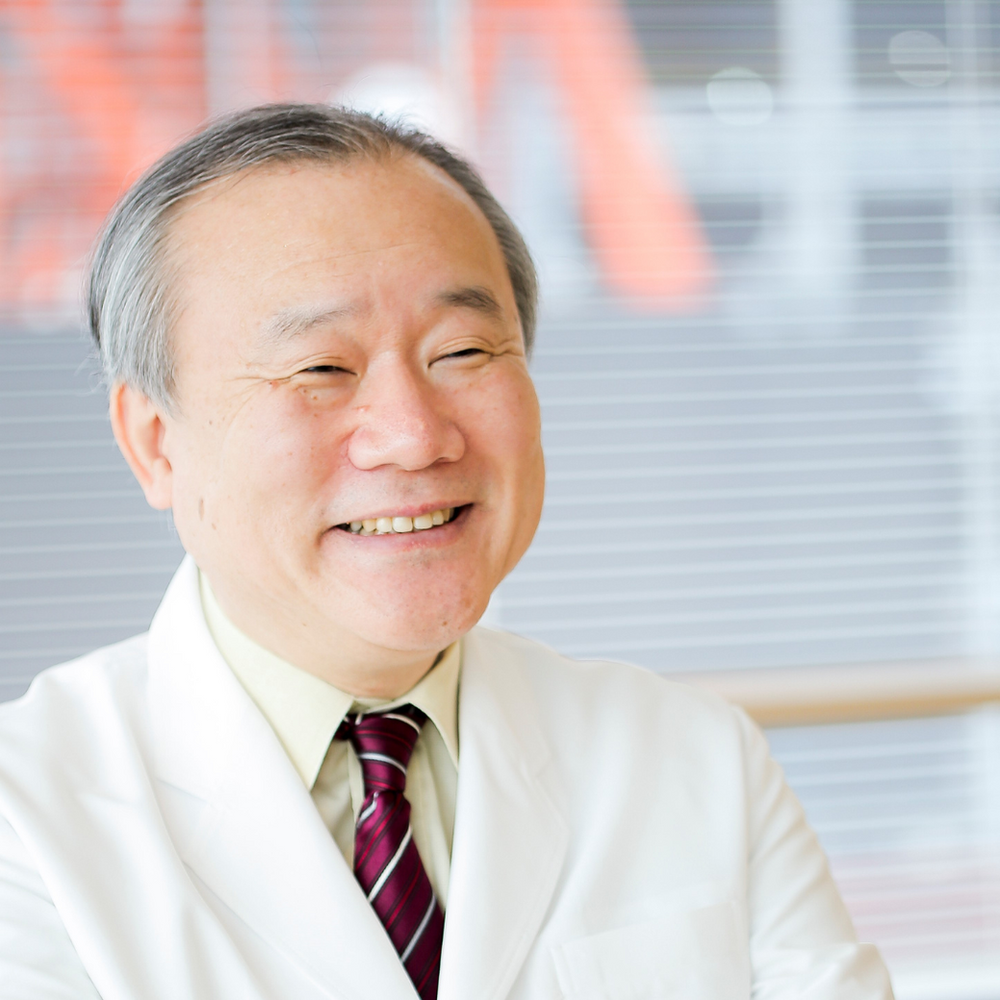
My father was very frail, and soon after I was born, he had to undergo medical treatment in a different location. I was raised by my uncle and his wife as their adopted child until my father opened an obstetrician-gynecologist clinic in Yokohama when I was in 2nd grade. In short, I was raised by four different parents, all with different personalities. My father was carefree and my father-in-law was very strict, it seems I have a similar personality to my biological father. So, I have had four different relationships with each of my four parents, and I feel that this experience from my childhood has benefited me as an obstetrician-gynecologist.
I entered Teikyo University’s newly established medical school, and despite the fact that he was an OB-GYN himself, my father never encouraged me to pursue a career in medicine. However, according to conversations I later heard from my mother, he was quite pleased that I had become a doctor. When I was in my sixth year of university, I talked to an assistant professor of obstetrics and gynecology about my desire to go into internal medicine, and he said to me, “Half of the world is women, right? Only an OB-GYN can see women all the way from babies to the elderly. And since there will probably be even fewer people becoming OB-GYNs in the future, it will be extremely rewarding to be one of the few.” I thought the assistant professor was right and decided to become one.
On January 5, 1989, when I was 34 years old, I opened my own practice, since my wife, who was the daughter of a general practitioner, was hoping to open one as soon as possible as well. Looking back, I am glad that I opened my practice while I was still young because being an OB-GYN requires physical strength to work night and day.
An Encounter with “Prenatal Memory”
When I was a student, I was taught not to get too emotionally involved in my work, and I was instructed not to cry even in stillbirths. I think it is true that if you don’t keep some distance as a doctor, you will not be able to maintain composure and control. If you get too involved with the patient, you may not be able to get a grip on your judgment. In that sense, obstetricians and gynecologists tend to have the qualities of artisans. With that being said, I always wanted to share the moment of happiness of the birth of a new life with my patients.
During infancy checkups at that time, there were several mothers per year who would appear in the examination room looking very depressed. According to data, about 40% of mothers suffer from maternity blues. I took various approaches, such as taking time to listen to the mother’s concerns during the checkups, giving advice on parenting, and offering psychological support, but none of them worked.
In 1998, a decade or so after opening my clinic, I became interested in Prenatal Memory after reading the book “Creating the Value of Life.” At first, I was somewhat skeptical, but when I talked to a midwife at my clinic about prenatal memory, I was surprised to learn that they already knew about it. As I continued my research on the topic, I found out that the baby hears the voices in their surroundings while they are inside the womb. I started promoting Kangaroo Care and the concept of Prenatal Memory in 1999.
Until then, there were about ten emergency cases per year that had to be taken to a major hospital. Also, data showed that I was performing about three times as many vacuum deliveries as the average hospital. I was shocked about this fact and realized that I was delivering the baby early using a vacuum because I was terrified that he or she could end up dying. It made me wonder if my choice to use a vacuum had been causing tremendous suffering for the baby during birth when they could have been born naturally, without intervention.
About a year after I learned about Prenatal Memory and decided to “Trust and let the baby do what it wants,” I took the data again and found that the rate of vacuum deliveries had dropped dramatically, to about one-fifth to one-tenth of normal hospitals, meaning that I hardly ever used them. In addition, I identified that various problems at the time of delivery dropped dramatically, and I rarely had to call an ambulance. Thus, I naturally began to avoid medical intervention as much as possible because I was committed to trusting the baby’s abilities. Based on this experience, I believe that the duty of a medical professional is to monitor and support the baby as much as possible so that he or she can be born as they desire.
Educating Parents
Furthermore, I began to actively convey information about Prenatal Memory to mothers and fathers to help them develop prenatal bonding by actively communicating with the baby in the womb. I would explain that from the moment of conception, when they see or hear something beautiful, for example, they should tell their baby, “It’s lovely.” When they go for a walk, say “Nice weather,” or when they have a good meal, “Yummy.” If you are too shy to say it out loud, you can say it in your mind and your feelings towards your baby will still be expressed.Practicing communication with your baby in the womb helps avoid complications during birth and creates a positive experience. As the mothers and fathers continue to communicate with the baby in the womb, they gradually become happier. As a result, once born, the babies smile more, cry less, and make more eye contact. I wanted as many people as possible to know about Prenatal Memory in the hope that nurturing prenatal bonding with the baby during pregnancy would increase happy births.
To Promote Prenatal Memory
In 1999, I began to research Prenatal Memory and present papers on the results of my research at academic conferences in Japan, and was featured in newspaper articles and on radio shows. I soon began presenting abroad in Chile and Kuala Lumpur. In 2005, my ,“Investigation by Questionnaire Regarding Fetal/Infant Memory in the Womb and/or at Birth” was published in the Winter issue of the Journal of Prenatal and Perinatal Psychology. Around the same time, I was interviewed by Fuji Television for an 11-minute documentary and the following year, I made a self-produced film called “Tainai Kioku – Prenatal Memory” which is currently streaming on Informed Pregnancy+.
Through books, magazines, radio, and lectures, Prenatal Memory has gradually gained attention. In 2013, a documentary film featuring my research titled “Prenatal Memories of Children” was originally released by director Norio Ogikubo. (English, Spanish, French, Chinese, and Korean subtitles are available) Currently, the audience has reached about 320,000 viewers, by screening and streaming the film not only throughout Japan but also overseas.
Unfortunately, my clinic is no longer handling deliveries. For this reason, I am now working about half the time at my clinic and spend the other half lecturing and actively traveling around to raise awareness of Prenatal Memory. I also founded the Japan Prenatal Memory Education Association and the instructors are teaching Prenatal Memory. The concept of Prenatal Memory is gradually spreading around the world.
Since Prenatal Memory is about consciousness, we start to realize that we do not only exist physically but as multi-dimensional entities with minds and souls. Therefor pregnancy is the best time to start communication to nurture a mindful person who can create a compassionate world for the future. If we can have relationships based on the concept of Prenatal Memory throughout the world, we will be able to recognize and respect each other’s characteristics.
Together, I believe we can build a peaceful world through Prenatal Memory.
Dr. Akira Ikegawa, MD is an OB-GYN, author, and lecturer who has an extensive background in the research of the concept of Prenatal Memory. He distributed about 3,600 questionnaires consisting of 85 questions in 2002 and 2003 and continues to interview people about Prenatal Memory. He guides expectant parents and practitioners on how to communicate with babies in the womb, and delivers lectures nationally and internationally about the extraordinary stories that he discovers from his research.