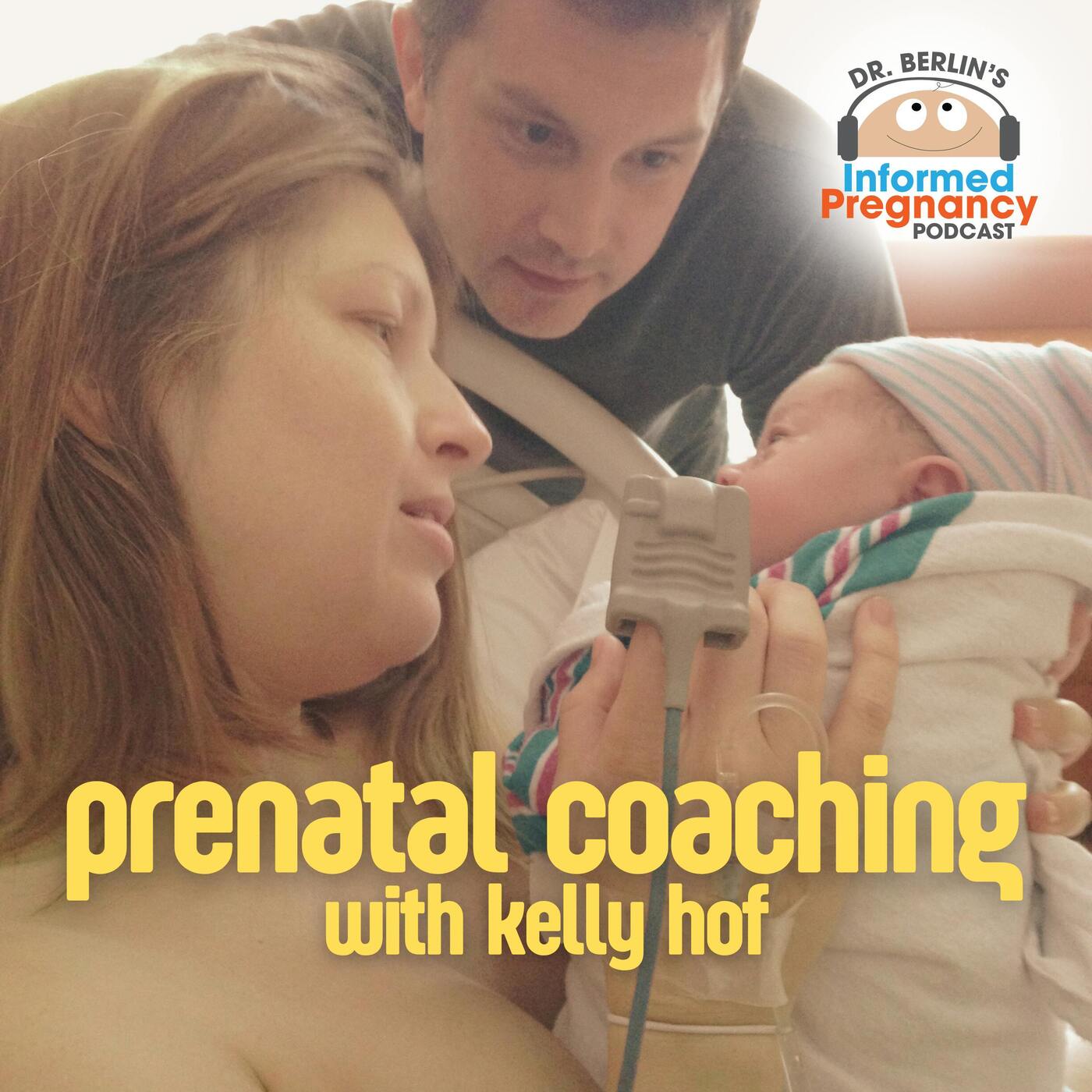
Influenced by experiences with both traumatic and empowering births, labor and delivery nurse and prenatal coach Kelly Hof joins the podcast to discuss her medical journey both personally and professionally, including information and guidance on prenatal coaching.
Informed Pregnancy Media and Mahmee present an all new podcast! One Way or a Mother is a new narrative podcast from Dr. Elliot Berlin, DC. Each season is an intimate story of one woman, one pregnancy, and all of the preparations, emotions, and personal history leading up to the birth. Episodes feature the expectant mother along with her family, doctors, and birth work team.
AI-generated transcript with speaker labels — may contain errors, especially names and medical terms. Dr. Elliot Berlin, DC appears in blue; Kelly Hof in orange.
Dr. Elliot Berlin, DC[1:00] My guest today is a labor and delivery nurse, prenatal coach, and podcast host whose professional path was shaped by firsthand experience of both traumatic and empowering births. After an early career stint in the Dominican Republic and an intense medical journey of her own, she turned her insights into a mission to help parents build agency and reduce trauma during childbirth. I'm pregnancy-focused chiropractor Dr. Elliot Berlin, and you're listening to the Informed Pregnancy Podcast. Kelly Hoff, welcome to the podcast.
Kelly Hof[1:47] Hi, so good to see you again.
Dr. Elliot Berlin, DC[1:50] It's great to see you, and I have so much to learn from you, and there's a lot to pack into this little episode. Yeah. I mean, I think you do incredible work, and you have incredible perspective, both as a professional and someone who has been through the system more than once. And I want to learn from you. So let's just go a little background. Where are you from and what do you do?
Kelly Hof[2:12] Well, I'm from Kansas. Not there anymore.
Dr. Elliot Berlin, DC[2:16] Not there anymore.
Kelly Hof[2:19] Yeah, so I grew up in a medical family and naturally ended up in a medical environment, and I am currently a labor and delivery nurse. I also work in maternal fetal medicine. I've been in all aspects of obstetrics, but currently doing labor and delivery in maternal fetal medicine. And my passion is prenatal coaching.
Dr. Elliot Berlin, DC[2:39] Okay, so how did you get into nursing? What was the path?
Kelly Hof[2:45] Well, I was either gonna be a doctor or a nurse. My dad's a doctor, my mom's a nurse, and my brother's a nurse, incidentally. So I started medical school, as one does.
Dr. Elliot Berlin, DC[2:57] Yeah, that's true, who hasn't?
Kelly Hof[3:00] And through a series of health issues, I decided that the universe was telling me not to continue in medical school, and ultimately took some time off to heal and get my life together, and decided nursing was a better path for me because ultimately I would have more work-life balance and be able to pursue other passions, including be with my family. So I'm not sad that I went into nursing.
Dr. Elliot Berlin, DC[3:28] Did you finish school before you started your family?
Kelly Hof[3:32] Yes, I did. It was like boom, boom, boom. So I finished, I graduated, took my boards, my brother got married, then I got married, then I got my license, and then we moved to New York City, and then I tried to find a job in an apartment. And all that happened between May and October.
Dr. Elliot Berlin, DC[3:50] And then at some point a baby.
Kelly Hof[3:52] Oh yeah, and then I had a baby. Yeah, that was a year later, almost a year later.
Dr. Elliot Berlin, DC[3:57] Okay, so let me ask you this about nursing school. Are you exposed in school to all sorts of different fields of medicine?
Kelly Hof[4:04] Well, kind of. The nursing school that I went to, they really were very hands-on. However, I had a lot of experience from before. So I started in the Dominican Republic doing family planning. I worked as an interpreter as well. So I was involved in like surgeries and medical groups that came to the Dominican Republic from the United States. So I got to see a whole lot of things, like orthopedic surgeries, all sorts of surgeries. Sometimes they let me scrub in, so all sorts of things. Came back and started being a medical interpreter, saw every aspect of medicine, then went to medical school and nursing school. So by the time I got there, I'd seen a lot.
Dr. Elliot Berlin, DC[4:43] Ah, got you. And so when you were looking for a job where you're looking for a particular field of nursing, or you just take what they give you?
Kelly Hof[4:50] You take what they give you, but I wanted something in either pediatrics or in obstetrics. And what I got was Mother Baby, so it was the postpartum unit in New York.
Dr. Elliot Berlin, DC[5:01] Oh, okay. So that's where you're working when you…
Kelly Hof[5:04] Had my first.
Dr. Elliot Berlin, DC[5:05] During your first pregnancy?
Kelly Hof[5:06] Yeah.
Dr. Elliot Berlin, DC[5:07] Okay, so you're already working in the hospital setting in baby making.
Kelly Hof[5:13] Mm-hmm.
Dr. Elliot Berlin, DC[5:15] Essentially. How was your pregnancy, your first pregnancy?
Kelly Hof[5:18] Hard. I was working nights, so…
Dr. Elliot Berlin, DC[5:22] Oh, wow.
Kelly Hof[5:23] Yeah. I waddled into the hospital.
Dr. Elliot Berlin, DC[5:25] Yeah. Oh.
Kelly Hof[5:27] Yeah, it was rough. I felt supported because I knew what the aftermath looked like. So I took care of moms that had been in vaginal and cesarean births, and I took care of their babies, and I kind of felt like I knew it all. And I had people pulling for me during the pregnancy, helping me through it. My OB worked with me, so he would be on labor and delivery and come down in the morning and be like, how you feeling? And I'd be running to the bathroom to puke.
Dr. Elliot Berlin, DC[5:54] So… Oh. Wait, did you have nausea throughout the pregnancy?
Kelly Hof[5:58] So much. Both pregnancies. I didn't just have nausea. I threw up both pregnancies the whole time.
Dr. Elliot Berlin, DC[6:03] Oh, so like hyperemesis.
Kelly Hof[6:05] Kind of. It was like once a day, but just felt like crap the whole day. So I guess you could call it a hyperemesis. No one ever said that. They gave me Zofran and I sucked it up, but… Yeah, it probably was.
Dr. Elliot Berlin, DC[6:15] Sounds hyperemesis-y to me.
Kelly Hof[6:17] Looking back on it, yes, I fully agree with that.
Dr. Elliot Berlin, DC[6:21] Yeah, I mean, it's a fine line.
Kelly Hof[6:23] It really is.
Dr. Elliot Berlin, DC[6:24] Did you have a plan for how you wanted your birth to go?
Kelly Hof[6:28] Well, I took a Bradley course because I thought that my husband was going to be like all hands-on and helping and stuff. Turns out he's a little squeamish, so…
Dr. Elliot Berlin, DC[6:37] Ah, okay.
Kelly Hof[6:38] Got a doula.
Dr. Elliot Berlin, DC[6:39] Okay.
Kelly Hof[6:41] As recommended by the Bradley course. And I could have done more preparation, but I kind of felt like I knew it all because of the field I was working in. So…
Dr. Elliot Berlin, DC[6:52] It's your office.
Kelly Hof[6:53] I mean, it felt like it, but I really wasn't working that closely with the people that ended up being in the room with me in my delivery, and things got a little crazy. I also didn't really appreciate the role that dehydration might take in the birth experience.
Dr. Elliot Berlin, DC[7:11] Eww. Okay. One might expect you would struggle a little with dehydration throwing up every day.
Kelly Hof[7:18] That and being a nurse, yeah, and like not having time to drink that much on your 12-hour shifts. And I delivered in summer in New York. And in New York, you don't have like central air unless you're a millionaire, so… H-A-W-T, what?
Dr. Elliot Berlin, DC[7:35] It was.
Kelly Hof[7:38] So…
Dr. Elliot Berlin, DC[7:39] How did it go down?
Kelly Hof[7:40] Well, fun story. My daughter is very, very into theater and singing, and it's very fitting that I started having those different contractions on the night that I went to go see my friend play Roxy Hart in Chicago on Broadway. And as the curtain went up, the contractions got weird.
Dr. Elliot Berlin, DC[8:02] Oh, wow. I thought you were like, as the curtain went up, the water came down.
Kelly Hof[8:07] That's what I was afraid of. I was there with my parents. They came to watch me at 39 weeks and wait till I popped. So I was like, we're gonna have to do some things because I don't want to be stared at for an entire week. And we went to this show and I was like, guys, I'm gonna need to sit on the aisle seat because I'm just kind of feeling like I might need to roam to the bathroom. But really what I wanted was to angle my knees away from the guy's head in front of me in case there was an accident.
Dr. Elliot Berlin, DC[8:37] You're so thoughtful.
Kelly Hof[8:38] I know. I'm always thinking ahead. And it was intense, but it was like contraction. And then my daughter moved so much in between. It was almost like she was dancing with the music. It was such a surreal experience. And the contractions went on like every 10 minutes overnight through the next day. And then they got weirder the next night around the same time. So I took my dog to the dog park with my dad because it's New York, right? You have to take your dog to the dog park to take them to the bathroom. And the dog park is like the happening place in the evening. And a friend of mine who had delivered her baby about six months before saw me. She's like, it's getting close.
[9:23] And I was like, yeah. And she also saw that I was acting weird. And like every once in a while stopping to breathe, she's like, oh, are you having like early? I was like, yeah, it's probably just prodromal. And then a dog came and peed on me. Like straight up, beelined to me, lifted his leg on my skirt.
Dr. Elliot Berlin, DC[9:43] He did not put his knees to the side of the chair in case.
Kelly Hof[9:45] No, he did not. It was very intentional. It was after he had like circled me for a little bit. And she said, oh, you're really in labor. That dog knows what's going on. And I was like, okay, okay, yeah.
Dr. Elliot Berlin, DC[9:58] Is that some sort of remedy?
Kelly Hof[10:00] I guess, cause she had her dog with her. And she said that her dog was very like overprotective during her labor. And she was like, this dog is marking its territory right now and is claiming you. And I was like, oh, okay. She's like, yeah, go hydrate, get everything ready. You know, like get your mind ready, texture doula. And I did. And it was a hard walk home. I'm not kidding. It was, yeah, I was in labor.
Dr. Elliot Berlin, DC[10:29] That is quite the prelude. First Broadway. Broadway then dog peed. Peed on by the dog. One can only wonder what happens next.
Kelly Hof[10:38] Yeah.
Dr. Elliot Berlin, DC[10:39] A little break and when we come back, we'll get the rest of your birth story. Welcome back. Welcome to Kelly Hopp. Okay, so you go to the theater and then you get peed on. What could possibly go wrong? How did the birth unfold from there?
Kelly Hof[11:04] Well, it got more intense, obviously. And my doula came to the house and we ended up in the shower with the water basically aimed right on my belly. And we managed, and I have no idea what happened as far as time, but we managed until in the wee hours of the night. And my neighbor next door drove us to the hospital, which was a very intense four block ride.
Dr. Elliot Berlin, DC[11:28] Okay, a couple of questions. When you say we ended up in the shower, how many of us were in the shower?
Kelly Hof[11:33] I was the only one in the actual shower.
Dr. Elliot Berlin, DC[11:34] Okay, they were just freaking in. Cause sometimes your husband's in there, some of the doulas bring a speedo.
Kelly Hof[11:39] My husband was off freaking out. My cat and my dog were watching me and the doula was in there supporting me.
Dr. Elliot Berlin, DC[11:44] Gosh, why did the neighbor drive you?
Kelly Hof[11:47] Because she had a car with a handicap plate on it. So she parked right in front of the building and she was so thrilled to have this job. She was like, ready.
Dr. Elliot Berlin, DC[11:56] Four blocks, how long does that take?
Kelly Hof[11:58] I mean, like five minutes. She drove me to the door, but this was like a really important thing for her. She was really excited.
Dr. Elliot Berlin, DC[12:04] I'm glad you could help.
Kelly Hof[12:06] I was so happy because it was like
Dr. Elliot Berlin, DC[12:08] three o'clock in the morning, I think. That's why five minutes.
Kelly Hof[12:12] Right.
Dr. Elliot Berlin, DC[12:12] And then, so you get to the hospital and are you as far along as you thought?
Kelly Hof[12:17] Well, I found out about an hour later, I was six centimeters, but there was no room in the end when we got there. I was in the waiting room for a very long time, didn't even get triaged, and I ended up in the PACU next to a mom who had just had a C-section, trying to labor naturally on a stretcher.
Dr. Elliot Berlin, DC[12:33] Oh my goodness, because that's the only space they had?
Kelly Hof[12:36] Mm-hmm. And I worked there.
Dr. Elliot Berlin, DC[12:37] PACU, oh right, your office, literally.
Kelly Hof[12:40] Yes.
Dr. Elliot Berlin, DC[12:41] Post-anesthesia care unit, PACU.
Kelly Hof[12:43] Right, yeah.
Dr. Elliot Berlin, DC[12:44] I mean, just because that's where there's a bed. These are people coming out of surgery and you're trying to have a natural birth. Wow, okay, so how does that go?
Kelly Hof[12:52] Well, it didn't go well. I was dehydrated and I did not have an IV and I didn't realize that the dehydration was leading to tachycystally. So I was contracting very, very close together and not getting enough breaks in between. And then ultimately I asked for an epidural and I don't recall ever getting an IV before the epidural, I recall getting it afterwards when I passed out. I may have the wrong memory, but that's how I remember it going down and I really thought it was weird at the time. I was like, why am I getting stuck in the arm for an IV now after I've gotten the epidural and I'm passing out? My blood pressure went down. I remember before I passed out,
[13:32] I looked at the machine and it said 80 over 40. And I also heard my daughter's heart rate dropping and a whole bunch of people came running in the room. I blacked out a little. When I woke up, one of the residents that I knew and worked with was touching my belly and he said she's in tetany, not tachycystally. So by then they had recorded a very long contraction which I overheard them saying something along the lines of 10 minutes. So at the same time that I was passing out, I was having a tetanic contraction and they gave me tributylene to stop my labor and get me caught up with hydration and blood pressure and all that stuff.
Dr. Elliot Berlin, DC[14:14] Okay, so we took a medicated time out.
Kelly Hof[14:16] Correct.
Dr. Elliot Berlin, DC[14:17] You kind of put everything on pause. You're talking about the difference just for English speakers, the difference between having a lot of contractions very, very close together versus tetany which is just one big contraction that never stops happening. And so we made that stop medically and had a chance to hydrate you, give you a little bit to rest. And then it has not a very long half-life so over time that medicine wears off and then the uterus gets back to its job hopefully on a better rhythm. Did you have a better rhythm?
Kelly Hof[14:52] No.
Dr. Elliot Berlin, DC[14:53] Oh, great.
Kelly Hof[14:54] We're snot.
Dr. Elliot Berlin, DC[14:55] I said hopefully.
Kelly Hof[14:57] What ultimately ended up happening was not only did I not have a great rhythm but we didn't know it but my daughter's cord was wrapped around her neck and she had a two-vessel cord. So all of those things, the tachycystally, the contractions that were too close together, not giving enough space for the oxygen to go back into the uterus and into the placenta into my daughter, that one long contraction and also the cord around her neck were making it really hard for her to get oxygen. So they offered me a C-section and at the time that they offered it, her heart rate strip looked good. And I asked if we could try something else before we went for the C-section.
[15:39] So they started me on low-dose pitocin and got me finally into a good rhythm. What ultimately happened was benign neglect. So they said, we have another delivery that we're gonna step into. And when we come back, we'll see where you're at. And it took a lot longer than they thought. And when they got back, I was ready to push.
Dr. Elliot Berlin, DC[15:59] So- Oh, okay. There you have it. Yeah. I guess we should explain also the two-vessel umbilical cord. Usually there are three, one and two arteries and sometimes you just have one artery. And so it could maybe impact the amount of circulation that the baby gets. So we had all these things that were potentially making it a little harder for the baby to get everything they needed for the rigor of labor. But thankfully somebody had a long labor and you guys had time to work it out and ready to push.
Kelly Hof[16:32] Yeah.
Dr. Elliot Berlin, DC[16:32] Did the pushing go okay at least?
Kelly Hof[16:34] Oh, I pushed for 20 minutes and-
Dr. Elliot Berlin, DC[16:36] Oh, very quick.
Kelly Hof[16:37] It popped out.
Dr. Elliot Berlin, DC[16:38] Good things come to people who wait.
Kelly Hof[16:40] Right. Her heart rate was going down while I was pushing. It was nerve wracking. The doctor said to me, I'm going to make room for the baby. And we know it. I thought it was the fun stretching that one might do to help the baby come out.
Dr. Elliot Berlin, DC[16:56] Stretching with the scissors?
Kelly Hof[16:58] There was scissors involved, yes. And I didn't find out until later.
Dr. Elliot Berlin, DC[17:01] So you didn't realize what was gonna happen? You didn't realize that's what they meant?
Kelly Hof[17:05] No.
Dr. Elliot Berlin, DC[17:06] Oh, so not a very clear informed consent.
Kelly Hof[17:09] No. I'm sorry. Yeah, and it took me a while to kind of reconcile what happened. I was shocked when I went up to, like fast forward to postpartum and they told me I'd had an episiotomy and I didn't realize it. But the steps, and we can talk about this as we progress to the next labor, because it's part of how I kind of healed for my next labor. But learning what happened helped me understand it and come to terms with why it happened. But she was born floppy and blue.
Dr. Elliot Berlin, DC[17:38] Oh, no.
Kelly Hof[17:39] No. She asked me to reach down and pull her out. I didn't feel like I could maneuver that far. So I declined and then she handed me my baby. And when she handed me my baby, I felt like I couldn't hold on to her because she didn't have any muscle tone and her head was flopping towards me and it terrified me. So we had the NICU team there because she had the two vessel cord and her heart rate had been going down. And I simply sent her to the NICU team and it took her what felt like forever to cry. But they gave her nine, nine Apgar's. So my understanding is that she probably cried within that first minute or at least according to their time. And then everything was pretty much fine
[18:24] after that physically. They don't make it easy on you.
Dr. Elliot Berlin, DC[18:28] They don't. What was the recovery like?
Kelly Hof[18:31] Harder than I thought it would be. I had pain for about nine months after that. Now a resident sewed me up. So I'm not sure if that had anything to do with it. When my doctor looked at me at the six week postpartum visit, he said that there was still some granulation tissue internally that was left there. So essentially the area that they had sewn up hadn't fully healed. And they told me that I had a second degree laceration internally and then the episiotomy. So I'm not sure. That doesn't completely make sense to me, but that was what was in my chart. So I can only imagine that it was that internal tear that was hard to sew up and that was hard to heal.
[19:13] And he said that I may need some silver nitrate treatment at some point, but we ended up not needing it. And then I almost got to the point where I went to pelvic floor physical therapy for that pain. And then it just miraculously went away in like nine months.
Dr. Elliot Berlin, DC[19:27] Yeah. Lucky.
Kelly Hof[19:29] Yeah.
Dr. Elliot Berlin, DC[19:30] All right. So then you had another baby. How long had you been?
Kelly Hof[19:33] So my daughter was three and a half when my son was born. And I had by then gone back and obtained my medical records. I'd also become a labor and delivery nurse. So completely fresh perspective. And I had a team that knew about my previous birth and was ready for my do-over. That was everybody's goal was to give me my do-over. I got to choose the date. I had an induction because I wanted to be able to make sure my daughter had childcare and that my husband was gonna have time off. And I wanted to deliver on a Friday so that my FMLA would kick in on a Monday because nurses, they don't seem to quite understand how nurses' schedules work. So I was like, let's just make it easy.
[20:15] And after learning the rationale behind the episiotomy and talking to my doctor about what it might look like for the next birth, I was confident that the team I'd chosen for my OB-GYNs, so it's a four-woman group, that they would be able to repair whatever damage occurred and potentially try to fix whatever scar was still there. So if you could have an induction as similar to the natural vaginal birth as possible, like I did, it was like almost mirror image once we got that labor started. I ultimately got the epidural about the same time, around eight centimeters. I passed out.
Dr. Elliot Berlin, DC[20:58] What are you doing?
Kelly Hof[21:00] My friends came running in with the turbutylene. It was the whole thing. But I had been hydrated up to that point and I was on pitocin before that, but it felt like deja vu. And my son's heart rate kept going down, especially after the epidural. But what was happening was I was just dilating really fast. So I went from eight centimeters to nine centimeters to 10 centimeters, and then the heart rate went down for a couple of minutes and then came back up.
Dr. Elliot Berlin, DC[21:30] Three vessels?
Kelly Hof[21:30] No, but he definitely had the cord around his neck. So.
Dr. Elliot Berlin, DC[21:34] Wait, so he had all three vessels?
Kelly Hof[21:36] He had all three, yeah.
Dr. Elliot Berlin, DC[21:38] Okay, but he also had cord.
Kelly Hof[21:39] Yeah. So I was so numb from the epidural when I started pushing, that I felt like I couldn't really feel what was going on and I felt really out of control. And the NICU team was there because his heart rate was doing all that funky stuff. And so I asked if they could do a vacuum because I was just like, I'm done. I've been trying for 45 minutes and I didn't feel like I was doing anything, even though they said that I was making progress, was tapped out. And so she said, sure, she put the vacuum on. She said, you know, this means that I'm gonna have to cut an episiotomy. At that time, my son is six years old and it was the practice in that hospital
[22:19] with that particular practice to cut an episiotomy for vacuums. Not everybody's doing that anymore, but at that time, that was the norm. So I was like, fine, do it. I trust you to sew me up. And she put the vacuum on very lightly, very easily and slowly guided his head out after the episiotomy and like he came out screaming. It was perfect. I ugly cried because I had a baby that was live and kicking that I could hold on to. And yeah, it was bad. Like I could not control it to the point where my husband was like, are you okay? Like, I'm just so happy. And my nurses that I picked, I got to pick my nurses. They were like, she's just happy that her baby's crying
[23:02] and I was like, what she said. So it was perfect. It was beautiful. I felt so supported and the recovery was fine. I hardly had any pain.
Dr. Elliot Berlin, DC[23:14] Okay, so that's two similar births experiences, but there are differences. Like how would you describe the differences from your experience?
Kelly Hof[23:24] Well, I felt informed and I felt supported and I felt in control. I felt like I knew what was going on the whole time and I could make good decisions based on what was going on. Whether or not there are the decisions that I wanted to make previously, like I would have preferred to not have a vacuum and an episiotomy, but I asked for it because I felt out of control and I knew that that would bring me back into control and I was willing to sacrifice a small part of my body to make sure that my baby came out without the trauma that I'd experienced in the previous birth, like the emotional trauma.
Dr. Elliot Berlin, DC[23:56] Yeah. Well, those stories are pretty powerful and you always say mom can do anything, it's true. And what you guys do never ceases really to amaze me like just how powerful and strong and durable you are in your ability to do the things necessary to make us and deliver us and bring us into this world and then raise us. And your stories are just more examples of that. I would love to take a break when we come back. I'm really curious how those experiences have impacted your work that you do as a labor and delivery nurse and also the work that you do in coaching and your cool podcast, The Birth Journeys podcast. We'll be right back.
Dr. Elliot Berlin, DC[24:52] Welcome back. We're talking to excellent human, Kelly Hopp. Okay, so you made the two kids and you brought them in different ways and you're a labor and delivery nurse. So you've had the experiences and you know, people come in wanting all sorts of different things. Sometimes it goes how they want. Oftentimes it doesn't go how they want. How did your experiences kind of influence the work that you do, both in terms of labor and delivery nurse at the hospital and the coaching work that you do?
Kelly Hof[25:20] Well, the first thing that I noticed was between the two births with similar kind of outcomes, I felt understanding what was happening to my body and feeling like I was an active participant versus somebody that was getting told what needed to happen was what made my second birth experience so much more positive than my first birth experience. And I wondered if there was a way that I could help moms have that information ahead of time. But then I started learning as I started going down the little rabbit holes that it wasn't just about information. It was about having the confidence in the ability to communicate and the ability to kind of find your happy place
[26:05] while you're in the labor space and be able to be in tune with your body and be able to kind of do that labor bubble thing where you block out all of the potential negativity, distractions, anything that could be going on. And I started searching for ways that I could bring that to moms before birth because it's too hard to do it when they're in the hospitals. And I found that a lot of the moms that had come in with a doula tended to look to the doula for advice. And I wondered if we helped moms get to a place where the doula was just there to kind of support and not necessarily help them drive the car, you know, like where they were able to have the questions and be able to engage briefly
[26:58] in conversation if necessary or communicate their desires, if that would be a better outcome. And for the moms where I've been able to actually have coaching sessions with them, where we talked about how we wanna feel in the birth space, how we wanna communicate in the birth space, what it would look like to take something where it didn't exactly go as planned, but be able to pivot without having that be a negative experience and still feel like you're in the driver's seat and also maintain your calm, how that would have such a more positive outcome than relying on either your birth team or like meaning your midwife, OB-GYN, nurse, or doula to kind of be your voice.
[27:46] And I've seen a lot of the spectrum. I see moms that come in very confident and they're rattled when they hear something that needs to happen that they didn't want or they suddenly feel like they don't understand what's going on. And I've seen moms that come in and they have the verbiage, they have the words to communicate either because, you know, that's their profession is communicating and deescalating and, you know, having those skills. And I wondered if maybe we could just go to the point where I taught that. So I teach the words that we use in the hospital and I teach the words that we use as nurses to try to deescalate situations and I help moms get to kind of the heart
[28:28] of what they're trying to say instead of feeling like they're objecting to something. So if somebody says, you know, I think in order to get this birth on track, we might need to start a little bit of Pitocin. We talk through how to make that not, first of all, not triggering. And then second of all, be able to use the language to gain information and share your feelings without feeling like you're going against the recommendations of the doctor or midwife. If that makes sense.
Dr. Elliot Berlin, DC[28:59] Makes a huge difference.
Kelly Hof[29:01] I think, yeah. I think the way that we speak to each other makes a big difference. And it's hard when you're in that space and you feel you're so vulnerable. First of all, when you're in labor and delivery, it's not the time to start to learn how to stand up for yourself. And it's not even really standing up for yourself. It's just standing in your power. And I feel like there's this shift that has to happen when we're in that kind of vulnerable situation where you don't want to feel triggered. You want to feel empowered. And it's really, really hard to feel that way if you haven't done the prep work. And I've seen moms that instead of doing the prep work
[29:40] rely on their birth team. And what I see in the end is moms that don't know what just happened to them. And that's what causes trauma in my opinion.
Dr. Elliot Berlin, DC[29:47] So you also have a podcast.
Kelly Hof[29:51] Yeah.
Dr. Elliot Berlin, DC[29:52] And you also work with moms privately. Tell me about the platforms.
Kelly Hof[30:00] So the podcast, the Birth Journeys podcast, I started to really gain an understanding of other people's birth experiences. So I was coming from a medical perspective and I was just really curious what it was like for a doula to give birth or what it was like for someone to give birth at home or in a birth center. And I really felt like I couldn't truly help moms without understanding all the different perspectives. Because from the hospital, I see moms come in and we have recommendations and some of them want some of the things we recommend and some of them don't. And from the medical perspective, it just seems strange that you wouldn't want what we have to offer.
[30:42] So I started getting curious and I started interviewing moms and the first two years of the podcast was essentially just me interviewing moms about their birth stories to normalize all different types of birth so that I could understand it so that my listeners could understand it. And I was hoping that other labor nurses would chime in or listen in and understand it. And many of my colleagues did actually and they've had an eye-opening experience along with me learning how people feel going into birth and why they make the choices that they make and how they might've been helped in preparation for birth.
Dr. Elliot Berlin, DC[31:17] Yeah, what you said really is interesting and I've talked about it on the podcast before. I will, in my earlier days for sure, like somebody would come in and have exactly what I treat and I was like, oh yeah, I have this remedy for you and it's great at treating that. And they're like, yeah, I don't want that. Right, then why are you here? I don't know, I think you do want that. That's what you came in here for, like this is what I do all day, every day and it's gonna help you. And it's a constant lesson that my job is to sort of explain what I know and what we can do and how I think it'll help them. And at the end of the day, respect whatever decision they make regarding the care.
[32:03] They might say, I want that, great, we do it. And they might say, I don't want that and it's nothing personal against me. It's just for all the reasons that are part of their decision. They've weighed the options and they've chosen to not do it. Sometimes they'll do eight out of 10 things but not the two that I think are gonna be most helpful. And it's just my job to present and help them make an informed choice and then support whatever choice it is that they make even if it's not the choice that makes sense to me or that I would do. And that's one of the things I think I just see like as a doula, I would see in labor and delivery is sometimes practitioners in the hospital,
[32:43] doctors, nurses who are just doing what they think is the absolute best thing to do, the best quality of care, the same thing they would do for their own family and nothing nefarious, nothing dark-hearted. It's just like, I wanna help you. I wanna give you the best possible care and really just being perplexed and confused and not understanding why somebody wouldn't want that. And so when you said that, it definitely triggered my own personal experiences and I could see how valuable that could be to any of us, any practitioner, especially in the birth space but in general, and then also especially in the hospital setting where you are just trying to do what you
[33:22] are trying to do what your experience tells you is the best thing to do. And sometimes you have to take a step back and not do it or shift gears. And having a platform like yours, a podcast like yours could really help people understand why what goes into the thinking and the decision-making of somebody who's not going down the path that you are recommending.
Kelly Hof[33:45] Yeah, well part of it's funny and I had a guest that I have interviewed a couple times point out the change that has how I've evolved as a person from the beginning of the podcast to now. And she pointed out how a lot of what I was trying to do was help people understand why they might be offered things in the hospital. But what's happened is I've switched to help people understand why people make the choices that they make and how autonomy and agency is so important and that our job as nurses, doctors, people offering interventions in the hospital isn't necessarily to just shove the intervention in their face. It's to understand the reasoning
[34:29] behind why they may not choose that intervention and respect someone's agency and autonomy but also kindly communicate if they really believe that they're making the wrong choice and work together to get to the outcome that everybody wants. That's really hard to do in such a stressful environment.
Dr. Elliot Berlin, DC[34:50] Yeah, there's a lot of pressure from various sides. I wouldn't envy your job.
Kelly Hof[34:57] Don't either.
Dr. Elliot Berlin, DC[34:58] Yeah, it's a tough job. I mean, I'm so grateful to nurses. I always have been, even when I worked in emergency rooms and ambulances as a medic, but after COVID, it almost killed me and the nurses saved me. And after all the work I do in labor and delivery, I mean, the nurses are the heroes of the day to me, but it's still a job I don't, it's such a pressure. And it's really heroic what you do. I wanna just, as we're winding down, find out more about your coaching.
Kelly Hof[35:32] Well, you can go to kellyhoff.com and you can click on my coaching program, which there's various places on that main website that you can click on it. And the packages that I offer will be outlined. Usually I, so I have two packages, you can do it. You can do three sessions an hour each, or you can do six sessions an hour each. And it just kind of depends on where you are in the birth process and what your past experience is. If you're a second time mom, you may just need the three sessions and we just kind of talk about what happened last time, what you would like to see happen, how you wanna feel and communicate in the birth space. And it's very, very tailored to whatever somebody needs.
[36:11] So I wouldn't just do a blanket statement of saying, this is what everybody needs. I usually do like a call where we kind of determine what would be the best option, but usually between three and six sessions is sufficient to get to the point where moms feel like they're gonna show up for themselves as the best version of themselves and be confident and calm in the birth space.
Dr. Elliot Berlin, DC[36:34] Thank you, Kelly. Thank you for coming on. Thank you for sharing your personal birth stories and your expertise. I learned a lot from you.
Kelly Hof[36:44] Thank you, I learned a lot from you.
Dr. Elliot Berlin, DC[36:46] I can relate to you in certain ways and you've made me think I'll be up all night. One more time, where do we find you online?
Kelly Hof[36:53] It's kellyhoff.com. It's K-E-L-L-Y-H-O-F as in Frank, just the one F.com. Just one F.
Dr. Elliot Berlin, DC[37:01] Leave off the last F for famous.
Kelly Hof[37:04] We are very simplified in this family. Three letters.
Dr. Elliot Berlin, DC[37:08] kellyhoff.com. Thank you again and at home. Thanks for listening to the Informed Pregnancy podcast. For more pregnancy and parenting information just like this, visit us online at informedpregnancy.com.
Want more pregnancy + parenting? Start your FREE TRIAL of Informed Pregnancy+ and get access to all our curated pregnancy and parenting content — original series, iconic birth films like The Business of Being Born, prenatal workouts and more.
Podcast host, birth educator, and midwife trained mother Katelyn Fusco returns to the podcast to discuss all things home birth, including her own third experience.
Informed Pregnancy Media and Mahmee present an all new podcast! One Way or a Mother is a new narrative podcast from Dr. Elliot Berlin, DC. Each season is an intimate story of one woman, one pregnancy, and all of the preparations, emotions, and personal history leading up to the birth. Episodes feature the expectant mother along with her family, doctors, and birth work team.
“What I've learned about birth stories is that they do hold so much gold if we're willing to go back and really look through them.”
“You can be upset and in pain about it forever. And another choice is to grieve it and feel those feelings and also take the lessons and go on to do something beautiful.”
“There is no birth that is without risk, whether you are in the hospital, whether you are at home.”
“The idea is not home birth. The idea is safe birth.”
AI-generated transcript with speaker labels — may contain errors, especially names and medical terms. Dr. Elliot Berlin, DC appears in blue; Katelyn Fusco in orange.
Dr. Elliot Berlin, DC[0:00] Welcome to the Informed Pregnancy Podcast. I'm your host, Pregnancy-Focused Chiropractor Dr. Elliott Berlin. My guest today is back for her second visit, and so much has unfolded since she last joined us. She's a birth educator, midwife-trained mama, and the powerful voice behind the Happy Home Birth Podcast. We're catching up with her on her third home birth experience, diving into birth processing and storytelling, and clearing the air on some of the biggest misconceptions about home birth. I'm Pregnancy-Focused Chiropractor Dr. Elliott Berlin, and this is the Informed Pregnancy Podcast. Caitlin Fusco, welcome back to the podcast.
Katelyn Fusco[0:50] Dr. Berlin, what an honoring intro there. Thank you so much for having me.
Dr. Elliot Berlin, DC[0:56] Well, my pleasure. Last time I spoke to you, almost a couple of years ago now, you were eminently due with your third baby, and you had two very different birth experiences prior to that. If you could do like a one to two minute recap on the two births that had happened previously, then we'll jump in and find out how number three went.
Katelyn Fusco[1:16] Beautiful. Sounds great. So it's interesting because, you know, I've had three home births, but they are so vastly different. And with my first birth experience, you know, I was working as a student midwife at the time. So kind of receiving care and providing care all at once. And that was just such an interesting buzzing time that birth was very long. And I did a lot of manipulating. I tried to get labor started, even though I knew, you know, I knew that's not what you do. But that's definitely what I did. And yeah, it led to a very long, very intense labor. But once I did actually give birth, once my daughter kind of decided to hop on down into my pelvis,
[2:01] she was out within 10 minutes. So that was a pretty shocking experience.
Dr. Elliot Berlin, DC[2:06] Wow.
Katelyn Fusco[2:06] Yeah, it was pretty wild. And so it did make me wonder, well, what is that second birth going to be like? You know, she kind of had cleared the way. And once she got into the pelvis, it was fast. And lo and behold, that second birthing experience was very precipitous, I think two and a half hours from start of true active labor to finish. And what was so special about it was that in the time between that first and second birth, I had spent a lot of time learning how to be in the moment, how to be present. And I felt like that would really help me if I did have a short labor to be present and in the moment. I'd interviewed enough people between then and now to know that sometimes those precipitous births
[2:50] can feel like a train just has come through. And for me, I wanted to be able to experience every single moment. So that is how that unfolded. And it was a beautiful experience. And I felt like I was truly able to soak it in just a really peaceful, lovely birth.
Dr. Elliot Berlin, DC[3:06] Does that put pressure on the third one?
Katelyn Fusco[3:08] Oh, that's such a great question. No, I can honestly say I really especially it was four years between my second birth and my third birth. And I feel like four years of growth and maturing in motherhood and learning that things do not always unfold the way that you want them to or expect them to served me well because I wasn't holding on too tightly to one specific outcome.
Dr. Elliot Berlin, DC[3:35] Okay, that makes sense. And it's sort of mind flexible of you.
Katelyn Fusco[3:40] Well, well, thank you.
Dr. Elliot Berlin, DC[3:43] So, yeah, last time we spoke to I think you were probably just about two weeks out from giving birth. How did round three go?
Katelyn Fusco[3:49] Oh, man, it truly was a beautiful experience. I'm so grateful for all three of my births and the way that they have been exactly what I needed even without knowing that was exactly what I needed in this birth experience. You know, I know that we went into my pregnancy some with our last conversation, but there was a big question mark as to how I wanted to go into that birth. You know, I had a care provider, a midwife who is fabulous and she's highly trained. She's a nurse midwife. And also she just trusts birth and she trusts women's bodies. She's that beautiful balance of I trust birth and if something goes differently than expected, I can take care of it.
[4:34] And I just love that in a care provider. How special is that?
Dr. Elliot Berlin, DC[4:38] Very grounding.
Katelyn Fusco[4:39] Yes. And so for the first, you know, number of weeks of my pregnancy up until I don't think I reached out to her until I was 20 weeks pregnant, I was trying to decide am I going to have a midwife? There was this feeling kind of in my gut of what would it be like if it were just myself and my husband and my family. But then we got around that time and I thought, you know what, I really love this person too and I would love to have eyes on me and I would love the female bonding of that experience of having a midwife and a care provider who, like I said, trusts the body. And so I went to see her. We talked and she kind of knew that there was a question of, you know,
[5:15] when would I call her? Of course, I was planning on calling her at some point, but would I call her when I was at the beginning of labor? Would it be right when I'm starting to push? Would it be immediately postpartum to ask her to come over? And she was comfortable. If that's the decision I wanted to make, then she was supportive of that. And so what ended up happening was the morning that I went into labor, I noticed that around 10 o'clock I was kind of having some contractions that were different. Now I had prodromal labor with this baby. This was the first time that I'd ever experienced that and God bless. You know, isn't it so interesting how each new experience gives you
[5:54] just this new layer of compassion towards others? Because I had not experienced that before and wow, what a mind-bending experience.
Dr. Elliot Berlin, DC[6:04] I wonder if we can explain what that is for the audience.
Katelyn Fusco[6:07] Absolutely. So what would happen was every night I would go to sleep or I would try to go to sleep and then these contractions would start and they would feel like true labor contractions and they would have rhythm and they wouldn't stop for quite a while and it wasn't that they were, you know, five minutes apart every single time, but it was just enough to keep me awake for a good bit of the night. And I think that's what's so exhausting about it is, you know, we're anticipating this exciting thing going into labor and we're not sleeping because these contractions keep coming and then they'll kind of fizzle out in the morning where then I'm jumping into motherhood of having two children
[6:50] that are here and need my attention and all of the other things that are going on while waiting for, you know, the true labor to start, which also gives you the question of when is it true labor? Am I going to know when it's true labor at this point because this feels like true labor.
Dr. Elliot Berlin, DC[7:06] And this is on your third. It's not like your first time around the block. I would say that prodromal labor sometimes looks to me like the car is in neutral and you're stepping on the gas and you hear all the revving, but you're not going anywhere. And then eventually it like clunks into drive and then boom, it takes off.
Katelyn Fusco[7:23] Yep.
Dr. Elliot Berlin, DC[7:23] So yeah, it could be very depleting.
Katelyn Fusco[7:27] It sure can. So that's what I had been experiencing. But I will say this day when the contractions were going on at 10 a.m. I thought, okay, I think this is the day, you know, something kind of clicked into gear. The pattern is different. One, because it is during the day, it's not in the evening and through the night. This is during the day. These aren't as close together right now, but there is a different feeling to them. And a lot of times I do feel like the prodromal labor, you know, sometimes we can feel like it's not doing anything. It's such a waste of time. And that is not the case. You know, there is something going on and that prodromal labor is getting the baby into the right position.
[8:04] It's getting our uterus toned and ready. So being able to let go and trust, all right, something's happening, even if it's not labor all the way, can help that situation. But this day, labor contractions kind of started. And I remember calling my mom and asking her to come over just to help me get things cleaned up, you know, one final clean before the baby arrives. So she came over. She helped me clean my house. She was on her hands and knees mopping my floors. Thank you Kit so much for that. And then it got to be about, I think it was around 430 and my mom was like, Hey, do you want me to take the kids over to my house for now? I'll feed them dinner and then I'll bring them back home tonight
[8:44] and put them to bed, you know. And I said, OK, I guess so. But you're 30 minutes away. So she lives 30 minutes away. I really did want my kids to be present for the birth. I was like, you're 30 minutes away. And I just feel like this might go really fast once it actually starts. And she was like, I will come as soon as you call. I will be there. Don't worry about it. I'll come as soon as you call. So I said, OK, 430, my kids are, you know, wheeling out of the driveway and headed off 30 minutes down the road. And as soon as everyone left and my husband was home, as soon as everyone left, the contractions really started.
Dr. Elliot Berlin, DC[9:24] As often happens.
Katelyn Fusco[9:25] Yeah, exactly. It was like they're gone. Here we go. I can focus inward at this point. And so I did. I went into my room and it's interesting in my previous birth the previous precipitous quick birth. I wanted to be upright the whole time. So standing, I was holding my arms around my husband's neck and kind of squatting down, but very upright. With this birth, I noticed that I wanted to lie down on my side. And so I did that and laid there for, I mean, really it couldn't have been that long because the whole experience was very short. But it seemed like I was laying there for quite some time. And I remember laying on my side and having this very,
[10:06] very intense contraction and thinking, wow, that was very powerful. And yet somehow in my mind, I still felt like we had a lot of time left. You know, why? I don't know why, but that is where I was. You know, this just started. We've got time. So another really cool thing was that my husband and I had both been trained in craniosacral fascial therapy just a couple of months prior. Yeah, the Gillespie approach. And so he was actually able to do some CFT on me throughout the labor, which really was just such a beautiful experience. I was laying on the bed and he was, you know, at my occiput and doing these fascial releases. And then a contraction would come
[10:48] and I would just put my hands on his hands and have him stop. And I would just lay there and have this contraction. It's just so interesting to have gone from, you know, so vertical in the previous birth to so horizontal in this birth. And that went on for a little bit. And then finally it clicked. You know what? I think I'm in active labor. I think this is active labor. So I went ahead and sent my midwife a text just letting her know, hey, just so you know, I think that active labor has actually started. I will keep you updated. I'll let you know if I need anything and what I want. So she thumbs up the message. And as soon as I get the little thumbs up message back,
[11:28] I start feeling so nauseous. I mean, just so nauseous. And then it hits me. Oh, I think I've miscalculated. Oh, no. I think I'm about to start. And then I threw up and then I felt a very strong urge to push.
Dr. Elliot Berlin, DC[11:49] Oh, wow.
Katelyn Fusco[11:50] So my midwife was 45 minutes away. There was no way she was making it even if I had told her in that moment, please come on right now. But we didn't even think to do it. My husband, he had just filled up the birth pool. So I hopped into the birth pool and he was kind of asking me like, what do you want me to do? Do you want me to call her? What do you need from me? And I was just like, no, we're doing this. Everything's fine. Everything feels good. And it was just this deep intuitive sense of this is how it is supposed to be this time. This is how I want this. This feels so right. And it feels so, so powerful. This is the experience. So right after I had sent my midwife that text
[12:31] and then felt that nauseous feeling, my husband had called my parents and let them know, bring the girls back right now. Please bring them on. And spoiler alert, they did not make it by a long shot.
Dr. Elliot Berlin, DC[12:43] Oh, there goes all my questions about having your kids at the birth.
Katelyn Fusco[12:46] Yeah, sorry about that.
Dr. Elliot Berlin, DC[12:47] Just X those out.
Katelyn Fusco[12:49] So they're called. They're supposed to be on their way. Of course, there was holdups all around. So I'm in the birth pool and I just remember feeling like, oh man, I'm at the pinnacle. I am right here and it's all about to happen. And there's nothing that can be done about it. You know, I can't get off of the ride at this point. Here it is. Here we go. And feeling so calm in that and good about that. So my husband had set up a GoPro, you know, just kind of situated it so we could have the birth recorded. And that's always so fun to look back at. I remember leaning over the birth pool, which is really how I did that with my first birth as well.
[13:29] Just kind of leaning over and he's holding my hands. And I remember just the intensity that came on as my body began to push. I've had the fetal ejection reflex very strongly with all three births, especially the first and third. Just such a strong fetal ejection reflex. And I remember looking at my husband and I wasn't vocalizing very much, but I remember these tears that just started streaming down my face, just at the intensity of all of it. It just was such a strong, powerful, intense moment. And then our baby came out and he was born in call. And it was so neat. It was just such a neat thing. And so I pulled him up out of the water. I pulled the amniotic sack off of him
[14:19] and just held him to my chest and he was pretty quiet. I don't know what his Apgar score would have been, but he was not just like screaming and he wasn't all over the place immediately. It took him a minute to come around. And I do think that part of that was that he was still in the amniotic sack. There was all of this fluid around him and then there was fluid inside. And so I did feel very instinctively to just put my mouth over his mouth and nose and kind of suck everything out that was there, which was very unforgettable taste.
Dr. Elliot Berlin, DC[14:50] Oh, probably texture.
Katelyn Fusco[14:54] Yeah, it had to go there though. And then he very quickly started to pink up and was moving around and would give out a little cry here and there. And it was just truly, I wouldn't trade any of my births for anything. And something about just myself and my husband there was just so beautiful. So we did reach out and let my midwife know, hey, the baby's here. She was like, what? I just talked to you. Like, what? Then she asked, do you want me now? Do you want me to come a little bit later? And we opted for having her come the next morning. This was at 7.30 at night.
Dr. Elliot Berlin, DC[15:30] Oh, wow, so you had the first night?
Katelyn Fusco[15:33] Yeah, yep.
Dr. Elliot Berlin, DC[15:34] Well, you guys. Just the two of them.
Katelyn Fusco[15:35] But now with your other kids around. The kids, they did come back. So I'll get there. And I will say another really cool thing that happened was my placenta came out very quickly, very easily. There was minimal bleeding. It was just such a lovely experience with no complications. And I know that that is not how labor unfolds every single time. I'm fully aware of that. So I feel so grateful and so blessed to have had that experience and for it to have gone so beautifully. And then my daughters did get there a good hour after, I think, 30 minutes to an hour, probably closer to an hour. They came in and they saw their baby brother and they were so excited.
[16:15] And it really was just so beautiful. I thought I wanted them there, and I did. But having them come in soon after and get to meet him while we were still in the height of that oxytocin rush, they got to see their little brother. And that was a beautiful experience as well.
Dr. Elliot Berlin, DC[16:31] I'm so happy for you. And it's interesting that you had the sort of thought early on before you even hired the midwife. Like, do I even want a midwife there? Almost put out that intention that maybe you don't. In the end, you didn't.
Katelyn Fusco[16:46] And you know what's so beautiful about that provider is I did get a little unsure towards the end. And it wasn't like an intuition unsure. It was like a, I don't know, should I? Is this right? Is this wrong? Is there something wrong about doing this? And it was her who reminded me, really, I think it was at 39, my 39-week appointment. She was like, Caitlin, you do remember when you came to me that you were kind of not sure if you were going to have me come, right? And I was like, yeah. And she was like, OK. Just wanted to make sure that you, you know, just want to remind you that you are, I trust you. I trust your decision making. And I'm very grateful to her for that reminder.
[17:28] And it almost gave me, which I don't need permission, but it did give me the permission to be like, OK, yeah, that is what I wanted. And I do feel, I feel called to this in a way. And what's really neat, and I think that's really a great reminder for others, is it doesn't always feel that way. For example, I would like to have another child at some point, and I already know I want her there for that one. I want a midwife at my next birth. I love that experience. So it really was just a deep, intuitive sense and knowing that for this birth, for whatever reason, that was an experience that my husband and I wanted and perhaps needed to have.
Dr. Elliot Berlin, DC[18:07] I really appreciate you sharing that story. It's powerful and beautiful. And also brings me to the idea of sharing your birth story, thinking about your birth that you've had, processing the birth that you've had, and telling it over, and if there's value in that. And also, since it was a home birth, and in your case, a home birth unattended by a child birth professional other than yourself, that I think brings up for a lot of people thoughts and concerns about birthing at home. And there's probably some really powerful misconceptions that people have about home birth that are either based on just fears or stories that they've heard but haven't really thought it through
[18:53] or asked the questions that would help them have a better view of the real pros and cons, risks and benefits inherent in that choice. So I'd love to take a little break. When we come back, I would love to get into those two topics with you. One about processing your birth and sharing the story. And misconceptions about home birth will be right back.
Dr. Elliot Berlin, DC[19:23] Welcome back, we're talking about Caitlin Fusco who now has three children. And it sounds like maybe down the road, there could be more. I love that you thought about your birth and seemingly processed it and shared it with us. And I know that you do birth work with other people and that you share stories on happy home birth. Tell me about your thoughts on that after birth. I think a lot of people just don't consciously think about it, they process it however they do on an unconscious level and leave it there. But what do you think about the idea of going back and processing your birth and sharing it with other people?
Katelyn Fusco[20:00] Well, I think that birth is just so meaty. There's so much to it. It's almost like a parable. There's the surface level of what happened. This happened, and then this happened, and then this happened. And then as you go, you see there are all of these deeper themes and these experiences that relate to these other parts of your life and that turn out to be these catalysts for change or for building you up. So what I've learned about birth stories is that they do hold so much gold if we're willing to go back and really look through them. And for me, I like to process things quickly. I like to write down what happened quickly so that I don't forget all the details.
[20:46] Because gosh, it does get so fuzzy if we don't just kind of write it down or speak it out relatively soon. Some of the details from my first birth, I went back and just read what I had written down. I was like, I completely forgot that that happened. That's an interesting story.
Dr. Elliot Berlin, DC[21:02] Wow, that was really fascinating. You know, I do that also. Like, when we tell stories on this podcast, sometimes right after the birth, just recorded too, that are within a week of having the baby, I have people come back and listen to it and be like, whoa, I don't remember any of that. And so that's a great point you forget. I don't know if it's by designer because you get busy, but you forget.
Katelyn Fusco[21:24] Yep, and there is something really special about that. I kind of think about the podcast episodes, especially with my second and third because they were very, very quickly after their births. My husband and I would record the episode and it's kind of like, for the future, you can go back and hear what it was like when you were born. And you know, we were just a couple of days in and this was the story of your birth. So it was just so full with emotion and with detail. So yeah, that really is beautiful. But even if that's not the case, so let's say that you're listening and you gave birth five years ago, you don't have all of the details, but you're kind of curious about this idea of,
[22:01] okay, well, you know, why is my story important? What is inside of my story that can help me in the future? You can still do this with what you remember. And you also, if you take the time to sit down and write it out, I bet you will remember a lot more than you think and you will most certainly remember the parts that are important for whatever type of transformation is there waiting for you. So my thoughts on birth and storytelling are that it is a means for growth for us. Like I said, you're looking back and then also being able to take an experience that perhaps did not go the way that you expected. Perhaps it was just downright seemingly awful.
[22:43] You know, it's just totally different from what you wanted it to be and thinking about how you feel in that moment. It makes sense that you feel really upset about that. It makes sense that this hurts. But when we are able to look at our story with that ability to kind of pull our perspective back and look at the experience and kind of ask ourselves, well, what did I learn from this? How has this changed me for the good? And we start asking these questions with a positive lens. Wow, you know, you really can take even the most upsetting experiences and turn them into something that changes you as a mother, as a human, for the better, forever.
Dr. Elliot Berlin, DC[23:27] Do you think there's benefit in that for the child as well?
Katelyn Fusco[23:31] There has to be. I mean, you know, to know, well, really just becoming the most integrated, to integrate all of this experience as a mother and, you know, as a family, because, you know, of course dads are going through this. Like the partner is there. They're experiencing things as well. But to take a story and to integrate it and to find this wholeness and peace with it, it's a very lovely way to be able to parent as this child grows up. And one thing that I've noticed, and maybe you've noticed this as well, Dr. Berlin, with the birth stories that you've heard and shared is I've interviewed people who, whether they just had their birth very recently
[24:12] or whether it's years down the line, when they share their story, it becomes clear that there's still a lot of pain and a lack of processing that has happened. And perhaps the podcast itself becomes this opportunity for them to actually process their story. And sometimes that can be really fascinating and beautiful. And other times I've noticed like, wow, there's still a lot of trauma here.
Dr. Elliot Berlin, DC[24:41] Absolutely. Yes.
Katelyn Fusco[24:43] But isn't it interesting how someone else could have a story that, you know, when you look at what happened, it's like, well, that's actually way harder. Like that's a really hard situation that you went through. But there's this level of internalizing and processing and integrating that's happened where that story that, you know, on paper, if you just look at the events, it sounds pretty rough. When they tell it, it's beautiful and it's inspiring and it's empowering. And so then moms hear the story of something going differently and it's like, oh, wow, but it wasn't all that bad for them. Yes, there were bad parts. There were really hard parts,
[25:19] but look at who this person is now. And so I think that there is so much beauty in storytelling as a therapeutic means to work as a therapy, but also to take the time to tell the story and then look at what you said and look at how these events unfolded, pull back and then think, okay, are there other ways to think about this? And what are the lessons that are here that I can take on? And I don't have to sit in the pain of this forever. You know, that's a choice that you can make. You can be upset and in pain about it forever. And another choice is to grieve it and feel those feelings and also take the lessons and go on to do something beautiful.
[26:01] And I think about, you know, how many people have become doulas, the most wonderful doulas or midwives or birth workers after having their own experience that did not go the way that they expected.
Dr. Elliot Berlin, DC[26:13] Absolutely. You just said something really powerful too, which is that if you don't process it, you could end up sitting with that inside your kind of emotional reservoir for life, occupying a lot of space and kind of keeping you sometimes really in a fight or flight mode because of the unresolved trauma that you hold onto. I find that sometimes people don't want to process because it makes them feel sad. And there's either a self-imposed guilt or a sometimes intended or unintended guilt from people around them by feeling that if I'm sad, then I'm not grateful for especially a healthy baby or a healthy me. And I think it's really important to stress
[27:04] that two things can be true at the same time. You are quite grateful and happy for having a baby, having a healthy baby and being healthy yourself. And at the same time, be sad or grieving an experience that you didn't have or an experience that you had that you didn't want. And when people say, oh, just be happy because you have a healthy baby, that's sometimes while in tension, they want you to be happy, but also be aware and be okay with the fact that you can be doing both at the same time.
Katelyn Fusco[27:36] Yeah, well, and it's kind of like this idea of we'll just bypass everything. You really cannot get to the place of deep happiness and understanding without actually looking at what has happened, really looking at the experience, seeing it for what it was and grieving any parts that need to be grieved, even if you had a beautiful home birth. You know, you could have a beautiful home birth and then there were still some things that occurred that you think, oh, I didn't really like that. I didn't expect that or that actually really scared me. Okay, let's look at those things and let's see them for what they are. We can't just bypass it.
Dr. Elliot Berlin, DC[28:12] I've come from your own story, kind of interesting that you already know for your next birth. Should there be another one that you would like the midwife to be there that has to do somewhat related to processing the experience you had?
Katelyn Fusco[28:25] I do think that another huge aspect of that is just intuition and really being able to lean into whatever I'm hearing, whatever I'm feeling. I'm going to trust that. I'm not going to just, well, I had a free birth and so now I have to only have free births and free birth is the only way to go. I don't feel that way at all. And in fact, I would be completely comfortable with if something is different or awry, changing my plans and going to the hospital if need be. I think the flexibility of feeling your intuition, pairing that with knowledge and education provides, at least for me, it provides me with making decisions from a place of peace, whatever those decisions need to be.
Dr. Elliot Berlin, DC[29:14] Totally. Well, you've really definitely laid out the benefits and possible importance of processing your own birth experience either on your own or with help, and also some of the joy and benefits of sharing that with other people. I appreciate that. And it's what we both do. It's what you do on Happy Home Birth and it's what we do here on Informed Pregnancy. And people really seem to enjoy, among our most popular episodes are the stories where somebody just shares their personal experience and how it went from them and what they learned from the experience. What they can glean from it for themselves and then also share with other people. So again, thank you for sharing your story
[29:54] and thank you for the platform in which you share many other stories and help people process their experiences. Now, speaking of free birth and home birth, we have a whole episode of free birth and now we have your story on free birth as well. And we do get a lot of questions. I will say one thing. One film that people seem to really like who consider free birth or home birth in general is These Are My Hours. And that is, I didn't think it would be, one of the most popular films on Informed Pregnancy Plus. A lot of people watch the business of being born in some old classic, but I think less people were aware of These Are My Hours and it's a great film.
[30:32] It's just a really pure raw look at birth at home. In her case, she does have a birth team there, but they are not right around her by design. They're in case she needs anything or wants anything. And she kind of narrates what it's like in the different phases of the experience of childbirth the way it was undisturbed many years ago for humans and the way it still is for most animals. So with that said, I know there are a lot of questions people have about home birth and sometimes concerns or fears about home birth that are sometimes rooted in things factual and sometimes not. So when we come back and I pick your brain about some of the misconceptions about home birth,
[31:12] we'll be right back. Welcome back, we're talking about three-time home birth mama and happy home birth host, Caitlin Fusco. Let's talk about home birth. I know that I come from a very medical background. I was planning to be a medical doctor. I was an EMT working in ambulances and emergency rooms. And then at some point I took a little turn away from drugs and surgery as a primary form of healthcare and got involved in chiropractic and massage. But when I first got into the birth world, which was sort of an accident by coming through the fertility world where my wife and I had our own personal struggle, you know, people would say things like home birth.
[31:59] I'm like, what? That's crazy at home, you know? And then I'm like, who would even be there? Oh, a midwife, that sounds like witchcraft. So I also assumed it was only for the very, very, very tiny number of, you know, vegan, Prius driving hippies, tree huggers, you know, those kind of people. And then when I got into this field and I see a whole bunch of people come through that are not that, some are, some aren't, but, you know, lawyers and doctors even doing home birth, it really kind of blew my mind. So I thought, okay, there's more to learn here. And you do, the knee-jerk reaction from people when they hear about somebody doing a home birth
[32:39] does seem to be like very strongly critical, like, oh my goodness, that's so irresponsible. Tell me about home birth, why it's safe, what are some of the pros and cons, and what are the misconceptions that people have?
Katelyn Fusco[32:53] Well, I think, gosh, one of the biggest concerns is, you know, when it comes to safety is birth is so dangerous. If you do that at home and something goes wrong, everybody just dies immediately. And there's a really, if we think about the media and what we see portrayed as birth from the media, from TV shows, movies, it does seem scary. That does seem like a really scary thing to try to do at home. If we think about the way that birth unfolds in the hospital, you know, a lot of times there are a lot of cascades of interventions. There's so many interventions that then you might think, well, that's good that you're in the hospital because you had to have all of these things.
[33:36] And if you hadn't had all of these things, well then, you know, your baby could have been hurt or you could have been hurt. It could have been a terrible situation. So all of that is coming from this conception that that is the way that birth always unfolds and that's the way that it has to unfold. The bigger question is, okay, well, but what if we didn't have all of the people around? What if we didn't have all of these interventions going on? How would birth unfold if it were generally untouched? How would birth unfold if it were undisturbed, like in These Are My Hours? Would it be just so, so scary every single time? And what's very clear and what makes sense anyway,
[34:22] just for the fact that, you know, we are a highly populated group of mammals. You know, we've survived for a long, long time. Birth seems to work pretty well, especially when we're not just, you know, moving things around and doing things just because that's what we've been trained to do. So the first thing that, you know, you have to question is, you know, is it really super duper dangerous? And the answer to that, if we're looking at, you know, research is that no, no. When you are birthing undisturbed and without all of these interventions, birth is not generally super dangerous. It's not like it's way, way riskier than giving birth in the hospital.
[35:09] And there is research to show that. There is research to show that low risk, which is like 90% of moms, low risk pregnancies are safe at home. So first we have to just wrap our minds around that. And then you have to ask questions like, okay, well, who's there? So, okay, a midwife. Well, what is a midwife? What kind of care provider is this? Are they just some witch? Or, you know, is there some level of training? And of course there is a variation of what type of care provider you can select. You know, is this a certified nurse midwife? Is this a certified professional midwife? Are they a licensed midwife? You know, this or that. But if we're working with somebody
[35:53] who has experience in birth and who knows what the body is doing physiologically on its own, wow, well then they will know when something is awry. And that is what I think is just such a special difference between the home birth and midwifery model of care compared to maybe more typical obstetrics is when you are in the obstetric mindset it's looking at all the things going wrong. It's just constantly expecting things are gonna go wrong and so we're gonna do this intervention and that intervention because things are gonna go wrong. Whereas with midwifery it's we believe that things are going to go right and we are expecting for things to go right.
[36:35] And we are watching for if there are signs that something is wrong or something is going in a way that's unexpected so that at that time we can address it. There's also a big difference in the prenatal care in terms of how we are preparing for the birthing experience itself. You know, when it comes to obstetrics a lot of times you're not really getting a lot of childbirth education beforehand besides like, hey, this is, you know what an epidural is and this is how it'll work and don't shake your baby. And then, you know, you gotta watch the video, you know. And then with midwifery or, you know, with this home birth care there's a lot more focus on preparation.
[37:22] And that can be physical preparation, nutritional preparation, mental and emotional preparation. What are the things that you're worried about? What are you scared about? What things do we need to be dealing with and clearing now so that when you enter this laboring experience you are entering it in this unfettered state, this safe, calm state. So those are big differences, you know when we're going into the hospital all these bright lights, all of these people that's very likely a fight or flight scenario. When you are in your own home with the lights dim with your spouse, with this person that you've come to know over the last 10 months who cares for you and perhaps a doula, you know
[38:07] all of the comforts of your own home it's a very different feeling than what you would expect in the more traditional model. And then the question of, okay well what are the things that could go wrong? What do you see happening? And what happens when those things go wrong? Like I said, there's a lot of preemptive care with home birth so midwives are, you know they're checking your baby's heart tones. They're checking your blood pressure. They're checking your temperature. They're checking things and monitoring things that are all clues that are telling a story of what's happening inside. So let's say that we do get a number of high blood pressure readings back to back.
[38:45] Okay, that's something that we want to check out or you know, fetal heart tones. If the heart tones are dipping and deceling, okay these are the times that we can talk and say hey look, this is what's going on. This would be a good time for us to transport to the hospital where you know, there's more in depth stuff that you may need. And so the vast majority of transports from the home to the hospital are non-emergent. They're usually, everybody's getting in their own car and you know, putzing on over and these things are caught before there is some big rough thing that's occurring because there are typically signs and symptoms. There are warning flags.
[39:31] The other thing is that you know, sometimes there can be more bleeding than expected postpartum. That's one of the big things that people worry about. Like you know, what about a postpartum hemorrhage? And the thing that's important to know is there are ways to number one, prevent that with diet and with homeopathics and not necessarily completely prevent it but to offset that. But number two, many midwives carry medications for hemorrhage. So there are these things in place that are very protective for the mother and baby. Another question is, you know, what if something's wrong with the baby? And most midwives, certified midwives, are trained in neonatal resuscitation.
[40:11] So if baby needs help, when you know, first arriving needs help breathing, they're able to help support that.
Dr. Elliot Berlin, DC[40:17] I remember when I went to my first birth as a birth worker, a home birth, my first home birth and the midwife team was coming in. So it's also not just usually one person, it's at least two. They brought in all this equipment and it looked like an episode of MASH, maybe I'm dating myself, that all these different duffel bags full of medical equipment and they seemed quite prepared to handle a lot. And that was their just in case equipment.
Katelyn Fusco[40:45] Yep, and that does give us this understanding of it. It is important to consider who it is that is your care provider and to ask questions about their, you know, how do you treat this? How do you treat that? What's your policy regarding this? You know, to know how it is that they function and operate and are you comfortable with that? I think that one thing that's important to recognize is that birth is not without risk. There is no birth that is without risk, whether you are in the hospital, whether you are at home, whether you are in the creek in Montana, like there are inherent risks with birth. So the question is what risks are you comfortable with
[41:23] and making a decision based off of that?
Dr. Elliot Berlin, DC[41:26] I also really like something that you said, which is something that I noticed. When you're at a home birth, you're generally with a midwife that you've spent a lot of time with. They know the whole you. They know you as an organism, not just like what's in your pee and stuff like that. And I'm not knocking, or at least not entirely knocking the medical system. I think there's a lot that needs work. The system's a bit broken. None of the systems are perfect, but that system is set up to spend a few minutes with you getting some vital pieces of data points and moving on to the next patient. Whereas the midwife system is set up to really get to know the organism.
[42:07] How are you mentally? How are you physically? How is your relationship? How are you emotionally? How is your nutrition? And because they have such a feeling for you as an organism, and because they're present when you're in labor for a large part of your labor, just being in your presence, being in your energy, seeing you, seeing your skin tones, hearing how you're talking, they oftentimes are able to realize something is not the same much, much earlier than you can from a monitoring station down the hall from where someone who you have never met before is laboring while you're monitoring two or three people. Again, I don't mean to entirely knock the system.
[42:46] I'm just saying when you think about safety for someone who's low risk and healthy and in labor, and those are the two scenarios. I've just seen things be picked up sooner at home. And the idea is not home birth. The idea is safe birth. And midwives are not going to sit around waiting for that pink flag to see if it's going to turn into a red flag or turn into a white flag. Then you transport to have the medical safety net at the hospital. And I think that sometimes that actually makes it more safe even though you're not at the hospital. And then the other thing is I tell people all the time, you got to give birth where you feel safe. That's my observation as a male doula
[43:26] who never has to squeeze much out of my pelvis. But as an outsider, I'm just looking in, you could see the difference between giving birth in fight or flight or giving birth under the direction of oxytocin or under the direction of adrenaline. And sometimes you're just at home having a great rhythm and an otherwise great birth and things are progressing nicely and she's riding those waves beautifully. And then all of a sudden you get to the hospital and something changes. Now it's intolerable. Now I can't handle it. Now labor starts to stall and you're not making progress or the cervix starts to swell or things like that. That's all of a sudden a shift
[44:04] from oxytocin to adrenaline which is in large part because of the setting. So if you don't live far from a hospital and you're laboring and you've got lots of oxytocin and it's driving labor in a very beautiful and productive way that's wonderful. And then all of a sudden you get to the hospital and it slows everything down and makes things much more challenging. What is the benefit of doing that? Maybe there is one and you'll choose to do that benefit for that downside or maybe there isn't one. And one other observation I had is when I lived in Nebraska for the year it was clear to me that those little hospitals and towns like Lincoln, Nebraska
[44:39] which is a big town compared to that part of the country but even smaller towns let's say a little further away where they only have 200 births a year, 300 births a year that's less than one a day. They don't have a surgeon and an anesthesiologist sitting by waiting around to go into an emergency C-section. So it could take 25, 35 minutes to get a team together just to get a surgical birth going on there. If you live five minutes from a major hospital that does have a team ready at all times then if you would need to transport even something more urgent than a typical transport you could very realistically be in surgery faster from your home birth
[45:20] than somebody let's say in a small town in Nebraska. And you don't see people have a knee-jerk reaction like you're having the baby in Nebraska. Is that safe? What if there's an emergency? And so why do we have it with home birth near a large hospital that always has teams on standby and not with a smaller hospital that rarely has teams on standby? So I think the conversation is helpful for someone who's not all that exposed to the idea of home birth. I think that if you really have a very black and white picture in your mind that this is safe and this is dangerous period you need to look further. But at the end of the day people need to explore the options
[46:02] and give birth where they feel safe.
Katelyn Fusco[46:05] Absolutely. I mean, it really is. It's so beautiful to be able to at least know what the options are to hear the information and then ask yourself, okay, well, you know, where is the right place for me? If you're going to be scared the whole time that you are giving birth at home don't give birth at home. Don't do that. You know, if you are going to feel safer feel more comfortable in the hospital setting well, guess what? That is where you're going to be safer. So really being able to know yourself know what risk feels like the best risk for you. Go for it.
Dr. Elliot Berlin, DC[46:42] Caitlin, I appreciate you in so many different ways even in just this one episode of our podcast sharing your powerful birth story thinking through with us the idea of processing your birth and maybe considering sharing your birth and now this conversation on home birth it's like three episodes in one. You're an amazing guest and I appreciate you and I'm inspired by you and I know our audience will be too. Where can we find you online?
Katelyn Fusco[47:07] Oh gosh, the podcast Happy Home Birth that's our main platform. You can find that on any of those podcasting apps we're on Instagram at happy home birth podcast and we do have childbirth education specifically for home birth mothers. So that's happy home birth Academy and the home birth collective. You can find that all within the podcast and all at my happy home birth.com.
Dr. Elliot Berlin, DC[47:29] Awesome. And one thing that we talked about is these are my hours which does stream on informed pregnancy plus but also we have a powerful episode of it on episode 103 of the informed pregnancy podcast with the filmmakers and also it's a rare dual episode that we did jointly with the crew from Dr. Stu's podcast. So we have Dr. Stu and Bliss, midwife Bliss and the crew from these are my hours. If this conversation has sparked any interest in home birth or free birth I would recommend checking out both that episode 103 and the film. These are my hours at home. Thanks for listening to the informed pregnancy podcast. If you'd like more pregnancy and parenting information just like this
[48:12] will visit us online at informedpregnancy.com
Want more pregnancy + parenting? Start your FREE TRIAL of Informed Pregnancy+ and get access to all our curated pregnancy and parenting content — original series, iconic birth films like The Business of Being Born, prenatal workouts and more.
After becoming a mother, Khyati rediscovered the traditional Indian practice of infant massage. As the practice turned from a personal healing tool to her life’s work, she had no idea how things would change after her daughter woke up screaming in pain the very same night she finished her training. From aiding in sleep and digestion to newborn bonding, infant massage might just be the tool you didn’t know you needed. Her mini massage course is available now on Informed Pregnancy+.
Informed Pregnancy Media and Mahmee present an all new podcast! One Way or a Mother is a new narrative podcast from Dr. Elliot Berlin, DC. Each season is an intimate story of one woman, one pregnancy, and all of the preparations, emotions, and personal history leading up to the birth. Episodes feature the expectant mother along with her family, doctors, and birth work team.
“the massage routine that took less than five minutes literally cleaned her out and she slept beautifully the rest of the night”
“And that's why I recommend to all my families have a postpartum plan because the birth is incredibly important and critical. Yes, but it's the wedding day and then you have the first year of marriage and that's your first year of postpartum.”
“And then culturally, we also believe the first 40 days can impact the first 40 years.”
“Last year when they came out with the postpartum depression pill was around the same time another study came out and found that massaging your baby is just as effective without any of the side effects.”
“So America is considered touch deprived. We are hungry for loving touch.”
AI-generated transcript with speaker labels — may contain errors, especially names and medical terms. Dr. Elliot Berlin, DC appears in blue; Khyati Desai-Seltzer in orange.
Dr. Elliot Berlin, DC[0:00] Today's guest traded a career in affordable housing for a mission rooted in her own postpartum experience and cultural heritage. After becoming a mother, she rediscovered the traditional Indian practice of infant massage, and what started as a personal healing tool quickly became her life's work. She had no idea that the very night she completed her training, her daughter would wake up screaming in pain, and what happened next changed everything. She's here to share how a simple, ancient practice can dramatically improve sleep, digestion, and bonding in newborns, and why it might just be the most powerful tool parents aren't using. I'm pregnancy-focused chiropractor Dr. Elliot Berlin, and you're listening to the Informed
[0:44] Pregnancy Podcast. Kiati Desai-Seltzer, welcome to the podcast.
Khyati Desai-Seltzer[1:04] Thank you, Dr. Berlin. It's great to be here.
Dr. Elliot Berlin, DC[1:07] It's an honor to have you, and I'm very excited to learn from you. Let's jump in at the beginning. Where are you from originally, and what do you do for work now?
Khyati Desai-Seltzer[1:17] Yes, I'm originally from India, from the northwestern state of Gujarat, where baby massage has been practiced for thousands of years. And what do I do now? I have two businesses. One is to support postpartum mamas through baby massage and belly binding. And in my second business, I am consulting with affordable housing organizations in how to engage residents in a meaningful, authentic way.
Dr. Elliot Berlin, DC[1:44] Wow. I wish you were doing something more meaningful. Okay. Wow. Those are both really important things. So let's start in the beginning. You were born in India, but raised in the U.S.?
Khyati Desai-Seltzer[1:57] Correct. Yes. We came here when I was about two, so I've spent my entire life here, but I'm very well connected and rooted to my Indian identity.
Dr. Elliot Berlin, DC[2:06] Welcome to the United States.
Khyati Desai-Seltzer[2:08] Thanks.
Dr. Elliot Berlin, DC[2:09] And I mean, how did you get into, because I mean, the housing would be a career that's very fulfilling in itself. How did you get into infant massage?
Khyati Desai-Seltzer[2:18] It's a great question, and I won't lie and say that my parents were happy that I went to college and grad school and then left all of that to do baby massage, which is so common in India and just we take it for granted. And all babies are massaged regardless of their socioeconomic background. So a lot of times the women who come to the home to massage are not even educated. And so for them, for my parents to have their daughter, they brought to America for opportunity and went to school and grad school. And now she's letting all that go to do baby massage was probably still something that was a sore spot for them. Yeah. A little bit of getting used to for them.
[2:55] Absolutely. But, you know, I have always in the last 20 years of my adult life wanted to be of service to the community. And I did that through nonprofits, different types of nonprofits from housing and homelessness to domestic violence. And I really found my niche in housing. And then I was really passionate about instead of serving people and doing to them that really I wanted to engage them in a meaningful way. And so that really took hold at the organization I was at and became a model. And, you know, we were doing great work. And then it just became so much about, you know, the politics and the bureaucracy and all the administrative stuff that I felt like I was no
[3:34] longer leaving my daughter at the time who was to to do something meaningful to change my part of the world. Now I was just, you know, enwrapped in all this unnecessary stuff that happens in organizations sometimes. So I left because I realized I was a shell of the person I used to be, and I didn't want to be that kind of mother. And so I thought that I was going to find the next nonprofit job after a three month hiatus. But what I found was myself reading a magazine article about baby massage. It was an Indian magazine. And so I said, yeah, of course, baby massage. We've done this with my nieces and nephews. My mom became massage my baby. It's part of our culture. Like it's great,
[4:13] but it's a nice thing to do. I wonder if families in America know about it. And so I went to our trusty Google and sure enough, there was a training coming up. So I took it, you know, mostly out of curiosity, but also thinking, wow, if families in America knew about how amazing this tool was, like how we could transform their health and their happiness. Then I went into the training and I was among NICU nurses and physical therapists, massage therapists, just really confident, talented people that were there learning
Dr. Elliot Berlin, DC[4:43] something that I frankly took for granted. Wait till I tell your parents who the child was. Such a disappointment. Then I learned about the science behind it because when something
Khyati Desai-Seltzer[4:55] is cultural, you don't really know the why behind it. You just know that you do it. And so I became even more sort of enamored by it. And then like you said, on day two of the training, as serendipity would have it, my daughter woke up screaming of gas pains. And just that day I learned the gas colic routine. And so I thought in that moment, do I do this? What if it doesn't work? What if I look stupid? You know, all the things that run through our minds. And we doubt ourselves, but my husband said, well, it can't hurt. And so I did the routine in less than five minutes. Dr. Berlin, she had an explosive diaper so much so like it was too much to
[5:32] get wiped. So we just jumped in the shower and got cleaned up. And then it came back out. She had another diaper. We got back into the shower. She had another diaper, which we were able to contain with wipes. But like the massage routine that took less than five minutes literally cleaned her out and she slept beautifully the rest of the night. And so it was in that moment that I was looking at my hands and wondering, wow, what did I just do? That I felt a sense of empowerment, but a sense of also like, hey, this is not just something nice that we do culturally. There is a real art and science to it. And it can really save people a lot of heartache
[6:08] and time and money and doctor's visits if they knew how to do this.
Dr. Elliot Berlin, DC[6:12] You know, it's really interesting. I got into healthcare after seeing when I was seven years old, after seeing a CPR class where in New York City, we walked into a building and lobby, they were teaching the CPR class. And I was like mortified. I was like, what are they doing that poor woman with no arms and no legs? And when they taught me, when they told me you could use your body to be literally somebody else's heart and lungs for a little while until they can get advanced medical care. And that's something you could teach to a seven-year-old kid. Like it's very powerful. You could do in the way you talk. I mean, I use my hands all day, every day and try to heal people and try to have a positive effect on people.
[6:53] And I am amazed sometimes and just grateful for the gift. But this is something that every parent can do in such a powerful way for their own children. We're going to talk a lot about it in the third segment, but just as a little teaser for people listening who have little kids with colic or gas or difficulty sleeping, can you briefly explain how the infant massage
Khyati Desai-Seltzer[7:18] is so helpful? Yeah. I mean, body work is just amazing. The work that you do massage, you know, reiki, all these wonderful things. We in the West, we don't give it the credit that it deserves. I think it's starting to change. But in the Eastern part of the world, massage is seen as a way of staying healthy, preventing disease. And I can talk all day about it, but there are a few ways, right? So one is that you're calming the nervous system. And so we know that there's birth trauma, the postpartum experience, even the in uterine experience. All of that affects baby and mama. And if there are things that have made baby anxious or upset, that can disrupt the nervous system. We know that their digestive system
[8:01] is still maturing, but there's also a nervous system component there. When you're massaging baby, not only are you doing the techniques to help move, like if there's a gas colic issue, you're helping move the matter and helping them eliminate, but you're also releasing feel good hormones and decreasing the stress hormones, right? So now we're increasing oxytocin release. We're decreasing cortisol. And when you're doing that, both mom and baby or partner and baby are benefiting. And so now you're doing actual strokes to move matter. You're calming the nervous system. You're increasing feel good hormones, decreasing cortisol. It's sort of like a perfect package of everything you need.
Dr. Elliot Berlin, DC[8:37] You've already covered the fight or flight response. We're all walking around somewhat with our nervous systems as if we're being chased by a tiger. And it's very depleting for us. And it has very specific effects because when your body does feel like it's in danger, but the steps that it takes are not random. They're very specific. It does certain things to your eyes, to your blood flow, to your digestion. And one of the things that does your digestion is just shut it off because you don't need to have good digestion when you're running from a tiger. And so it also affects the reproductive system because you don't need that either when you're running from a tiger. And you see all these symptoms that if you could shift
[9:17] that thermostat on the autonomic nervous system from I'm endangered to I'm not in danger, or I'm not in grave danger at least, then the effects that take place are very strong and very visceral. The body does it itself. And one of them is big on digestion, just that alone. And then the second thing you said is like moving the matter physically through the body. So when we do the digestive massage, not on pregnant people generally, but somebody who struggles sometimes with constipation. And they'll come into the office and we do a gentle abdominal massage, digestive massage. It's the same thing. I've had people like run off the table and go right into our bathroom and spend quite some time there and
[9:55] come out and be like, I'm a new person. And that's what you're essentially doing for your baby at home. Although at this moment, it seems like it would be great if we had a diaper sponsor. Let's take a little break. But before we do it, like I said, we're going to share in our notes because we have so much to learn from you have so much to teach us. We'll share in our notes where listeners can find you. And we'll talk about it at the end. We'll give them links to your resources. And also I'm very excited to share that you have a holistic infant mini massage course streaming on informed pregnancy plus, which we're very grateful for and very excited about. And people can check it out, especially if you're
[10:33] already subscribed to get a little taste of the wealth of information that's available.
Dr. Elliot Berlin, DC[10:39] We're going to take a quick break and we'll be right back. Welcome back. We are talking to Kyati Desai-Seltzer. All right. So you mentioned you at the point that you started making this change in your career. You had a two-year-old. How was your journey to motherhood?
Khyati Desai-Seltzer[11:04] Like everyone else is full of unexpected twists and turns and all the things that you think that you're going to do or not do. You come face to face when you have a baby and you realize how little you knew before you had that baby. So, you know, I've been fortunate in terms of my health and in terms of getting pregnant with both of my children. I did have a miscarriage between the two. So I had a little bit of a struggle there, but I was fortunate to be able thank you, to get pregnant with my first daughter relatively easy. And I had a pretty good pregnancy, you know, typical things like heartburn and all the aches and pains. But my daughter had different plans. So I was actually supposed to be birthing with the GW
[11:48] midwives. That was the compromise my husband and I came to.
Dr. Elliot Berlin, DC[11:53] Midwives in the hospital setting?
Khyati Desai-Seltzer[11:55] Exactly. Yep. And it's a pretty rigorous process to be accepted. They want to make sure that you're in good health, all of those things. But my daughter decided to be a breech baby. And so, so we did all the things. I had a great team, but we did chiropractic, we did moxibustion, I did some acupuncture spinning babies. We even did the ECV, the virgin technique in the hospital, but she was determined not to move. And so we had
Dr. Elliot Berlin, DC[12:27] Any ideas why?
Khyati Desai-Seltzer[12:29] You know, I don't think that they knew. She's a stubborn child. So that's why. I don't know that they necessarily were able to tell like the cord length or things like that. To be honest, and this is a whole nother conversation, but I think, you know, our modern day lifestyle of sitting all day at a computer, which is what I was doing at the time, I didn't have enough room for her to move, I'm assuming, just sitting all day. And so there are things that we did culturally, and in many cultures that people just moved all day. And so women, I think, were better equipped to labor, things like squatting, which is done very frequently, even to sweep or mop or to prepare different
[13:10] foods. Like you were always in these like positions that opened your pelvis and things like that, that I think helped you prepare for labor. And so my assumption is that that she didn't have enough space. And so we switched from the midwives at GW to the OB, and I had her at 42 weeks. I did have a doula, and the doula, of course I was devastated, but the doula helped me advocate for a gentle cesarean. And so for those of you who have to have a C section, like you can make it, you know, not as traumatic. Some 68% of women will report that they have a traumatic birth. And I think part of that is just we don't know what we have choice in, and we assume everything that is given by the providers, what we have to do.
[13:55] And so my doula, something she mentioned, like you can ask them not to tie your hands down, right? And I did, and they said, okay, just don't touch your IVs. So there was something as simple as that, or having a clear drape so we could see the baby come out, or letting the father announce the sex and gender of the baby. So things like that you can advocate for, which made it not as traumatic for me. Of course, I had birth disappointment, but it wasn't trauma. That's a really interesting way to phrase it, birth
Dr. Elliot Berlin, DC[14:21] disappointment. And I found, because they used to really strap everybody down, both arms, both legs. And I found our patients, like even sometimes just having one arm free, that's such a huge difference for the physical, mental, and spiritual experience.
Khyati Desai-Seltzer[14:36] Yep. And so not everybody wants a clear drape, but it's nice to know if you have the option
Dr. Elliot Berlin, DC[14:40] that you can literally see the baby emerging from your body. Yeah. And immediate skin to
Khyati Desai-Seltzer[14:44] skin and all those things like that makes a huge difference on your postpartum, right? And sometimes it affects breastfeeding relationship. It has a lot of implications. And so if we can keep it as close to nature intended, the better. I think that comes from mom and baby. In that moment, the providers are thinking of like a live mom and baby, but that's just like, for me, is the minimum. That's like the baseline. That shouldn't be the goal.
Dr. Elliot Berlin, DC[15:10] Yeah. I mean, that's everybody's on the same page with that goal. Right. Exactly. But there's so much more to the experience. Absolutely. I have a question for you. Before we get to what postpartum was like, I'll jump ahead. So you have another baby, child, I guess. Yes. And how was the second experience?
Khyati Desai-Seltzer[15:27] The second experience, and I should also note that I had my girls at 35 and 40. So if anybody is concerned about AMA, as one wise OB told me, it's more important how healthy you are than your age. And I have been privileged and fortunate to have a good team of people to advise me on how to live a healthy life.
Dr. Elliot Berlin, DC[15:48] We have a fairly awesome episode of our podcast called Pregnancy Over 35. And it's with Dr. Emiliano Chivito, who says exactly what you just said. Basically, and he's an OB-GYN and he's an MFM. He's a high risk guy. He basically said every single person has a clinical health profile and there are a lot of data points in that profile. One of them is your age. It's the one you can't change. But the more the other data points are near the green zone in the healthy region, the less that particular data point matters. So if you're a healthy weight and you have a healthy blood sugar and you have a healthy blood pressure and all those other things, then age is okay. It's a data point,
[16:28] but it really doesn't affect your overall picture that much.
Khyati Desai-Seltzer[16:31] That's a great point, because so many people are fearful of having babies. And there is a
Dr. Elliot Berlin, DC[16:37] lot of fear mongering, but you can have healthy babies and healthy pregnancies even later in life. So at 40, you're pregnant again and you have two choices. You can have a vaginal birth after cesarean or a repeat cesarean. Those are your choices. As I know them, what was your choice and how did it go?
Khyati Desai-Seltzer[16:55] So it was not a point of discussion in my home. I had decided to have a home birth and have a beat back. Okay. They call it an H-back.
Dr. Elliot Berlin, DC[17:04] Yes, that's right. H-back, right?
Khyati Desai-Seltzer[17:06] The baby doesn't come out of your house. Yeah. So I think at first it's like an attempted vaginal after cesarean, but it was successful. And it was also January of 2021, so still COVID time. And I really appreciated having a midwife and my same doula be able to come to my house for the visits because I then had a four-year-old. So I never had to leave home. For the gestational diabetes exam, I didn't have to drink that nasty drink again. I could have real food. My midwife gave me a menu. I ate food. She came back and tested. Everything was fine. I think we only went to the hospital to find out the sex of the baby, but otherwise it was all at home, which was really great. And it was nice for my
[17:52] daughter to be part of the experience. I was helping her watch birth videos so that when the time came, she wasn't freaked out by what was happening. And so we actually had what my doula called an efficient labor. I think it was about six to seven hours long.
Dr. Elliot Berlin, DC[18:07] Oh, that's very good. Especially for your first labor.
Khyati Desai-Seltzer[18:10] Right. Although she was, I think, sunny side up, so her face was facing my back. So I back labored. Oh my gosh. It was like somebody taking a baseball bat to your lower back for just hours. Only there was a decent chiropractor in the room.
Dr. Elliot Berlin, DC[18:30] Right. Exactly. That would have been really nice to have somebody come home and say,
Khyati Desai-Seltzer[18:33] let's change this. Well, at least luckily with that, it was fairly short. Yes. Yeah. And she was born around 6.30 in the morning and my four-year-old was also
Dr. Elliot Berlin, DC[18:43] somehow awakened on her own at the time and was able to be there to see her sister
Khyati Desai-Seltzer[18:47] being born. So that was really special. It was that moment when the baby came
Dr. Elliot Berlin, DC[18:51] through you for the first time. What was that like for you?
Khyati Desai-Seltzer[18:53] You know, it's an out-of-body experience. It's visceral. It's primal. It's just the wildest thing that you can imagine. And I think right before that happened, and what do they call it? The ring of fire or something, when you are like, I can't do this anymore. I'm done. I got to go. When my doula and midwife- I got to go. I'm out of here. You guys have a good time without me. Wrap this up. I got to go. And so they said they knew when I sort of fell to my knees and almost like a surrender that that was the moment that baby was going to come. And so, you know, funny thing, I also remember thinking, wow, this is so hard. I'm going to have chocolate cake when I'm done. Oh, I'd say that when I'm on the treadmill.
[19:36] And it wasn't just a slice. It was the entire chocolate cake after I have this baby.
Dr. Elliot Berlin, DC[19:42] I might be Indian. I don't know. I feel like we're siblings.
Khyati Desai-Seltzer[19:46] Oh my gosh. That's what I thought about during labor, but it was a wild experience,
Dr. Elliot Berlin, DC[19:50] but I would do it again. Postpartum. How was your postpartum
Khyati Desai-Seltzer[19:54] support both times? Postpartum with my second daughter, you know, and both times I had my mom visit, which is very common culturally. So she came through four to six months. My husband had some paternity leave, which I know is also a privilege here because I had learned so much between the two girls' births being in this business, right? Like I had learned from chiropractors and pelvic floor therapists and sleep consultants. Like I just felt much more equipped than like just random Googling in the middle of the night. And that's why I recommend to all my families have a postpartum plan because the birth is incredibly important and critical. Yes, but it's the wedding day and
[20:30] then you have the first year of marriage and that's your first year of postpartum. And then culturally, we also believe the first 40 days can impact the first 40 years. And so everything then- Well, we can put it like that. Right? It's critical, but our families here do not, the society doesn't honor them after they have a baby and then they have self-imposed this like no, only baby matters. And so things like belly binding, which is a beautiful Eastern practice as well, they're not doing because they don't have time or baby massage. They don't see the value of it. So there's a lot of education and like culturalization we need to do because we have
[21:07] these amazing practices from around the world that could help our families avoid all the things that we see from postpartum depression and anxiety to, you know, even gas colic, pelvic floor issues. Like we have tools to prevent those, but it's like, how do you match that? And so for me and both of my breastfeeding experiences were also different with my first, both of them were challenging, but my second had a tongue tie and we worked with the lactation consultant and ENT did the release and she still never latched. So I exclusively pumped for seven months. Wow. Which was-
Dr. Elliot Berlin, DC[21:40] Each one get, my wife always says each child brought a special little gift for her.
Khyati Desai-Seltzer[21:44] They were, oh really? Yes. That's a beautiful way to say it's a special little gift. You can have the home birth you wanted, but I'm going to never latch, even though it's COVID and you're here all day to feed me. No, I'm going to make you pump.
Dr. Elliot Berlin, DC[21:56] And that's like, what a warrior you are because it's double work. You got to pump
Khyati Desai-Seltzer[22:00] and then feed, pump and feed. I know I was so angry. I'm still angry at her.
Dr. Elliot Berlin, DC[22:06] An angry warrior. Right, exactly. All right. Everything you just said about postpartum rings so true and it's almost like, you know, I did it. I had the baby, however you did it, you did it. I grew this baby. I got through the nine months. I got the baby out of my body, brought the baby into the world. And it's just like, I pictured that moment. It's like, Hey, what do you want to do now? I want to go to Disneyland now. And now it's like, start the hard work starts now. And there is not a whole lot of focus or care on the mom in general. And I noticed this even more. So you had both experiences, but after a C section, like not only did you just do all that, but you had fairly intense abdominal
[22:44] surgery. Yes, we have it down to a science. Yes, it's pretty reliable and predictable, but it's still a lot on your system. And there's a lumpy heel for it. And we're just sort of like, here, go home and oh, you know, here's a couple of guidelines. You got this. Yeah. See you in six weeks. Yeah, it's six weeks. It's like, oh, okay, really? All right. Anyway, you do incredible work postpartum and I want to learn more about it. And let's take a quick break. When we come back, we'll learn about the work that you do and the resources that are available to anybody anywhere. Welcome back. I'm learning so much from Kyati Desai-Seltzer. Okay. So you had these two babies, two very different experiences, both with birth and postpartum.
[23:32] I really want to get into the work that you do, the powerful postpartum work that you do. What's your biggest takeaway from your own experiences on postpartum? Like,
Khyati Desai-Seltzer[23:41] how could we make it better for other people? So many ways. I mean, we need a whole system change, but we know that will take time. And if you are expecting mama right now and you want to know what can I do, there is a whole lot. The first thing that you should know is that it's not just important for you to eat well and have some movement, which are super important, but your mental and emotional state are just as critical. If you're familiar with the field of epigenetics, what you are experiencing, everything. So what you see, what you taste, what you hear, what you feel, all of those, your baby is experiencing as well. And there's a purpose, an evolutionary purpose. They want to be ready for the
[24:20] world they're going to be brought into. But if you are stressed and anxious and sad and angry, which are going to happen, those emotions will come up. All of that is going to be fed into baby and baby's going to think, okay, I need to be anxious because mom is anxious, which means the world I'm being born into creates anxiety. Now, we can't completely avoid stress. We know that, but if we can be mindful of how much we take in and what we do when we are stressed. So with my second child, with my first child, I didn't know about this, even though culturally they told me and I wasn't as mindful of my emotions with my first baby. Her toddler tantrums were out of control.
[25:02] And somebody had told me about the connection to the in uterine experience. And then I read an article about how they're connecting toddler tantrums to mom's in uterine experience, which just blew my mind. Again, everything is our fault, but you know, it was like, wow, like three years later, two years later, this is what's manifesting. Because if you think about us in terms of energy, right, whatever stress I had, it went to my baby. They had nowhere to go. And so that came out at some point. With my second child, because I knew this and was more mindful of this thing called conscious pregnancy, I was stressed because frankly, it was COVID, deep COVID. My father-in-law was sick and dying. My mother-in-law's husband
[25:43] was sick and dying, you know, financial things, obviously, because businesses had to close due to COVID. So we had enough stress. And I was taking care of a four-year-old being pregnant. And that four-year-old was going to virtual pre-K, which is, I don't even know how it's a thing. But I had plenty of stressors, right? But I just became more conscious of like, okay, this is my problem. This is not my baby's problem. And I will work through it. So mommy was stressed today, but I'm going to take a walk or I'm gonna, you know, it's okay, I'm gonna, you know, read a little, I'm gonna meditate so that even if that stress was there for a moment, then I'm telling her, she's okay. She is safe. We're going to figure
[26:23] this out. And all of that, you know, they've said that the taste of amniotic fluid changes when mom is stressed. They're finding like, you know, deep stressful hormones in the umbilical cord, like it is a thing. It's just not talked about as much by our mainstream providers. And so my advice would be, if you're expecting, manage your emotional mental stress. If you can surround yourself with people who will care for you and love on you and take care of you, like expect that and demand that of them because they really are affecting how this baby will be born and your postpartum experience.
Dr. Elliot Berlin, DC[26:55] Yeah, that's really great advice. And I think also there was a time where there was so much more support built in to the pregnancy, to the birth, to the postpartum experience. And we don't have it as much anymore. Now it's sort of more professional people that we hire, but they're not around us the same way and they're not attached the same way. And so we're sort of floating on our own a bit more and that makes it a little harder to manage things like stress and some of the other emotions that come along with anything that comes up in life, but also during pregnancy and maybe even heightened by the pregnancy. I would also say that it's not like you should necessarily freak out
[27:34] if you feel stressed. It's okay. You know, it's just the normal part of life. Babies need to be exposed to normal part of life. It's like, we don't have to shush them for everything or medicate them for everything. They can feel life. You know, not feeling anything is a flat line. That's not life at all. And there are studies that indicate actually some stress is very helpful for the growth of the baby, just like when you stress your bones and they grow better. It's just managed stress, not to let things go festering for too long or unsupported. Really glad you brought that up. Let's dig into the work that you do. What do people come to you for?
Khyati Desai-Seltzer[28:09] Most commonly, the three issues we see in the first year, of course sleep, right? The holy grail. We know that we are going to be sleep deprived and then we are in it and it feels like torture. And to be honest, I know there's a lot of debate around to sleep coach and sleep trainer not, and obviously there are pros and cons to each of those. But I think the crux of the issue is, again, we're blaming families, but it's the fact that they're raising a baby on their own without mom, grandma, aunt there. And so if those support systems were there, which they have been traditionally in many cultures, then it's okay if you have mom waking up at night and somebody else is taking care of them during the day. But when you
[28:47] have two people who are also working and doing chores and household and other kids to be sleep deprived for that long, that's just unrealistic and now you're affecting mom's mental health. And so I think sleep is definitely a big one and massage can help because 15 minutes before bedtime, they release melatonin. So now they're sleeping deeper and longer. And we obviously, again, talked about the nervous system, releasing oxytocin, all of those are good for sleep. And then the second biggest issue we see is anything related to digestion. Most babies, some 60, 70% will have some version of gas, colic, reflux and constipation. And I think these things
[29:27] we're seeing more widely based on our lifestyle, based on what life is in America. Some countries are like, what is colic? Which is surprising to me. And colic is actually, they haven't found a known cause of it. But digestion and sleep are the two main things I see in the first year that people come to me for. And then the third thing that they don't necessarily know offhand, but it's really good for immunity, colds, congestion, things like that. But one month of massaging your baby regularly increases the white blood cells they're creating. So now they're better able to fight off infections. And there's so many other benefits of massage, but sleep and digestion are the first two. And that's what you're
[30:07] facing in that first year, what they come to me for.
Dr. Elliot Berlin, DC[30:10] How often do you recommend people massage their babies?
Khyati Desai-Seltzer[30:14] Every day, if possible, at least 10 minutes. And if you want to do more than 10 minutes a day, great. But if you can do 10 minutes, you know, even if you're not even seven days a week, it's five to six times a week, you will see the benefits. Just like eating healthy and exercising, you just don't want it to be something you do once a week or once a month. You want it to be a regular, consistent habit.
Dr. Elliot Berlin, DC[30:34] And it's interesting. I think you alluded to this earlier. But when you do it, the benefits are not just for the baby.
Khyati Desai-Seltzer[30:41] Correct.
Dr. Elliot Berlin, DC[30:41] A person doing the parent, especially doing the massage, is also getting all sorts of benefits.
Khyati Desai-Seltzer[30:46] That's right. So they found and they've studied grandparents massaging their grandbabies. And then they had the grandparents receive their own massage. And they found that they actually released more oxytocin when they're massaging their grandkids than rather when they're receiving massage. And so there is this wonderful benefit, this mutually beneficial practice. Last year when they came out with the postpartum depression pill was around the same time another study came out and found that massaging your baby is just as effective without any of the side effects. Now, obviously, if you have a predisposition to mental health or it's very severe, right, like that's a different story.
[31:23] But for most of us who have some level of anxiety, baby blues, depression, you can address that with some of the tools we mentioned from baby massage to belly binding, which are both shown to really help mama's mental health.
Dr. Elliot Berlin, DC[31:37] What are some of the misconceptions that people have about infant massage?
Khyati Desai-Seltzer[31:41] Oh, I love that question. I think the biggest thing that really is just sometimes so frustrating for me is that it's sort of a nice thing to do. And maybe I was guilty of that too before I took the course and learned about the science and the nuances. But we see in the West, we see massage as something you treat yourself to when it's your birthday. It's Mother's Day. I'm going to get a massage as opposed to in the East where it's like maybe they're getting it weekly a couple of times a week, they have back pain or headaches or they have a cold and they're getting massage. And like I said, all babies in India, regardless of their socioeconomic background, get massage.
[32:16] So it's not just babies who are privileged, even babies who are living in slums, the mama or the aunt or the grandmother is massaging them. So why would people who are poor massage their babies, right? Because it is part of their health. And so one of the biggest misconceptions I come across in America is that one, it is a nice to have. It's not necessary and critical. And then the second is that it can't help the things that we are talking about today. Like people, you know, it's America. So we want to go for the pill or the medication, the quick fix. And it's not that massage doesn't help right away. Like I mentioned in my story, but there's this thinking
[32:52] that the holistic practices take longer and, you know, you're struggling in postpartum. I get it. You want a solution yesterday, but people are quick to discount all of these techniques and go for, you know, let me see the doctor and get the kid on antacid or a Pepsid. And I learned the hard way that my daughter who was prescribed that at age one, when my second daughter had reflux, they said, okay, she's got silent reflux, which, you know, of course I didn't know. And so I said, okay, are you going to prescribe Zantac? And they said, oh, no, no, we found that that causes cancer. They don't prescribe that anymore. So I was living giving that to my daughter for
[33:28] six months every single day. And so this time I declined and said, I'm going to do what I do. And they did massage and I did homeopathy. And overnight we resolved her reflex overnight. We got with teething and all these things without medication.
Dr. Elliot Berlin, DC[33:41] And not only does it sometimes work as quickly, like your double diaper story, but oftentimes the holistic, even when it takes a little bit longer to work, it lasts a lot longer because you're sort of getting to the source of the issue rather than the symptom.
Khyati Desai-Seltzer[33:56] That's right.
Dr. Elliot Berlin, DC[33:57] All right. So what are the things, you're local in the D.C. area, so what are the things that you do there and the offerings that you have and what are the things that the rest of us are not so fortunate to be right around you, what's available to us?
Khyati Desai-Seltzer[34:12] So in the DMV, I provide in-person individual and group classes. And I do that both for infant massage. So it's a three to four week series where we cover the entire body and all the issues we talked about. And then I also do belly binding, which is a Malay practice where mama is buying in those cultures, somebody comes to the home just like in India and they bathe you and they feed you and they do steaming for you and they bind you every day for 40 days. And so if you think about it, if you were cared for in that way by other loving women, how would you show up as a mother? How would you show up as a wife or as a daughter? Because you were cared for so intimately
[34:49] and beautifully, then you're now able to care for other people. So that is what I'm able to provide in-person, which I love. And to note, I love babies. I love to be around babies and toddlers. I would love to massage them all myself, but I don't. I actually teach on a baby doll to not interfere with the bonding process and so that the parents feel empowered. Like when she is done, I know exactly how to help my baby if they're teething or if their immunity needs some support or they're gassy or colicky. So I don't actually do the massage. And then for my families that are not local, I have two courses, a holistic baby massage course again, which is the whole
[35:25] body. And then I have a mini course on just gas colic. If you're like, I need to get to this right away. I need help now. Then both of those are available on demand for a lifetime so that if you miss a stroke, you have another child. And the other thing to know, we won't have time to talk about this, I know, but we really recommend that you massage baby past infancy into toddlers and pre-Ks and school-aged children because touch is the first sense that develops in utero. It's the last sense that leaves our bodies and it's the only sense we can't live without. But in America, it is woefully neglected. And so they found where there is less touch, there is more violence and
[36:03] aggression. And unfortunately, we see that in our communities every day. So America is considered touch deprived. We are hungry for loving touch. We've just gone from, you know, the opposite of predatory touch is not no touch. It's loving touch, right? So even if you think you say your baby doesn't like touch or maybe a baby had a negative experience, we want to get them used to loving touch and not sentenced to a lifetime of no touch. And so as our kids get older, they are going to be seeking this out because touch makes us feel safe. It regulates our nervous system, all the things we talked about. And so when we don't get that at home subconsciously, we seek that out in
[36:42] relationships. So we're looking at tweens and teens who are now looking for relationships where they can cuddle and they can hug the things that we need as humans. But when we have parents modeling and demonstrating that every day or a few times a week, it really changes the relationship and how they show up in the world, their sense of confidence, because we need to tell our kids we love them, but even more so we need them to feel that we love them with our touch. And so whatever you learn with your infant can be used with your toddlers and your preschoolers. It's the same strokes. You're just not going to have a cute diapered baby on the floor.
[37:18] You'll have your team coming home from football or your daughter, you know, after soccer practice and they need a foot massage or a shoulder massage. And then even for men to demonstrate that in a country where men aren't encouraged to show touch in a loving way outside of a football field or basketball court really changes how kids see like this is what a healthy relationship looks like.
Dr. Elliot Berlin, DC[37:40] Cathy, thank you so much for sharing and for your passion. It comes through in every word that you say. And you know, I know that a lot of people sort of instinctively, you know, massage their kids, massage their babies, but being able to draw from your formal teachings just gives us so much more that we can work with. And I'm looking forward to watching your videos. You know, my kids, my youngest is 15 at this point. So it's never too late. Yeah, I'll tell them when I get home tonight. Where can we find you and your offerings online?
Khyati Desai-Seltzer[38:15] Yeah, so you can find me at vianainfitmassage.com. That's v-y-a-n-a in fitmassage.com. I'm also on Instagram, Facebook, and Pinterest as well as YouTube. So you can find some videos and other resources on those outlets.
Dr. Elliot Berlin, DC[38:31] Beautiful. Thank you again, and at home thanks for listening to the Informed Pregnancy podcast. If you enjoyed this episode, share it with your friends, leave us a review in your podcast app, and for more pregnancy and parenting media just like this, visit us online at informpregnancy.com.
Want more pregnancy + parenting? Start your FREE TRIAL of Informed Pregnancy+ and get access to all our curated pregnancy and parenting content — original series, iconic birth films like The Business of Being Born, prenatal workouts and more.
Leading pediatric allergy dietician and researcher Dr. Carina Venter joins the podcast to discuss how to better understand and prevent food allergies through early nutrition. Topics include how diet during pregnancy and infancy can help reduce allergy risk, which foods to focus on, and why diversity matters more than restriction.
Informed Pregnancy Media and Mahmee present an all new podcast! One Way or a Mother is a new narrative podcast from Dr. Elliot Berlin, DC. Each season is an intimate story of one woman, one pregnancy, and all of the preparations, emotions, and personal history leading up to the birth. Episodes feature the expectant mother along with her family, doctors, and birth work team.
AI-generated transcript with speaker labels — may contain errors, especially names and medical terms. Dr. Elliot Berlin, DC appears in blue; Dr. Carina Venter in orange.
Dr. Elliot Berlin, DC[1:00] Today's guest is a leading pediatric allergy dietician and researcher whose work has shaped how we understand and prevent food allergies through early nutrition. In this episode, we'll explore how diet during pregnancy and infancy can help reduce allergy risk, what foods to focus on, and why diversity matters more than restriction. We'll also learn how recent science is being translated into simple, real-world tools for families looking to make informed health choices from the very beginning. I'm pregnancy-focused chiropractor, Dr. Elliot Berlin, and you're listening to the Informed Pregnancy Podcast. Dr. Karina Venter, welcome to the podcast.
Dr. Carina Venter[1:58] Thank you, and thank you for having me here.
Dr. Elliot Berlin, DC[2:01] I am honored to have you here and to talk about a topic that I admittedly don't know very much about, but I'm very curious and would love to learn more. Let's start with the beginning. What's your background? Where did you train?
Dr. Carina Venter[2:15] So I'm a dietician, and I studied in South Africa, as you can probably hear from my accent. I studied to be a dietician at the University of the Free State, which is in Bloemfontein, right, right in the middle of the country. Following from after I got my degree, we moved to England, where I then did a postgraduate diploma in allergy, and that was followed by doing a PhD in allergy and immunology. I lived on an island just off the coast of England called the Isle of Wight for 20 years, where I also had my two children. And so from the island, you have to take a boat, and it takes you about an hour and a half to get from the island to London, or about 20 minutes to get to the University
[3:02] of Southampton, where I did my PhD. I was then recruited to a Cincinnati Children's Hospital, where I worked in a particular disease or a particular presentation of food allergy, which is referred to as eosinophilic esophagitis for two and a half years. And then I was recruited to Children's Hospital Colorado or the University of Colorado, where I'm now professor of pediatrics, and I work both clinically with children with food allergy, but my research really focused on how nutrition in pregnancy and nutrition in early life can help us to prevent all allergic diseases, including food allergies, eczema, asthma, and seasonal allergies or allergic rhinitis
[3:47] during childhood.
Dr. Elliot Berlin, DC[3:48] Wow, that's even more than I was expecting to learn about. So now I'm even kind of more excited to see what I'll learn today. What sparked your connection to allergy in the first place? What drew you towards allergy?
Dr. Carina Venter[4:03] You know, it's an interesting question because studying in South Africa, we had bigger problems at the time, now about 25 years ago, than food allergies. And so a lot of my training was actually focused on looking after children and adults with burns, children and adults with TB or tuberculosis, and we also have a huge problem with diabetes. And that really was my interest at the time and what I learned a lot about. But growing up as a child, I had two of my children's had presentations of food allergies. One of them is referred to as food protein-induced enterocolitis syndrome, where people don't get anaphylaxis, but they get this projectile vomiting
[4:48] from being allergic to a food. Another sister of mine had more of the enteropathy kind of presentations of food allergy. And our whole family has got either asthma or seasonal allergies, allergic rhinitis. And so when I moved to the England and I got the opportunity to work in a world famous allergy research center on the Isle of Wight, that was an opportunity I grabbed with both hands. And that led to my post-graduate diploma and then my PhD in allergic diseases and immunology.
Dr. Elliot Berlin, DC[5:21] Wow, so it's personal for you.
Dr. Carina Venter[5:23] It really is personal. And you know, just getting back to pregnancy and we will probably talk about that a little bit more. But when I was pregnant and when my sisters were pregnant, there really wasn't actually any good advice on how to prevent allergic diseases in children. And so in our family, we also have, you know, some of our nieces with multiple food allergies, which I now know how to prevent. But at the time, I didn't know how to best direct myself and my sisters to prevent allergic diseases in their children.
Dr. Elliot Berlin, DC[5:58] Is there a practical reason why the allergy research center was on the island?
Dr. Carina Venter[6:05] Yes, so the Isle of Wight is very close to my heart. Like I said, both my children were born there. But the beauty about the Isle of Wight is that people grow up on the Isle of Wight. Then they leave the island and they go to what they call the mainland, which is mainland England, where they study. They normally then meet, you know, their partners, get married, move back to the island where their children are raised. And then when the children get to 18, 19 years of age, they leave the island, go to the mainland. And then eventually after their studies, getting married, they come back. So we do a lot of what we call transgenerational research.
[6:45] And so we can actually look at how nutrition intake changed over different generations. We can look at epigenetic changes, microbiome changes, which is very unique to the Isle of Wight. We actually published studies looking at changes and prevalence of allergic diseases, which nobody can mimic because, you know, some studies are done in China, some done in America, some done in Australia. But the Isle of Wight is one of the only places in the world where we can look at differences over time in the exact same population. And that's really why it is such a famous allergy center.
Dr. Elliot Berlin, DC[7:23] Wow, that makes perfect sense. All right, so I am excited to learn more about allergy, but I'm also nervous because it seems like a lot and seems complicated, but I'd like to break things down into, I guess, sort of a pun, easier to digest bits of information. So where would I start if I was looking to understand how allergies work, how they form?
Dr. Carina Venter[7:49] So the majority of allergies really have one common denominator or one common characteristics, and that is that we make IgE. Now, I can explain that very well. The reason human beings make IgE is because in the past, when we got parasite infections, we made IgE to kill parasites. And so it's just the type of immune system that's really geared for parasite destruction. But as we are now not really getting, you know, exposed to parasites that often, the immune system is sort of like thinking, oh, I'm getting lazy, what can I do? I'm gonna cause allergies. And so, you know, whether you have asthma, whether you have seasonal allergies, whether the child or yourself may have eczema
[8:34] or atopic dermatitis, as some people call it, or the majority of food allergies, it's just really a presentation of the fact that you make too much IgE. And if we know how to switch that off, we will see a lot more allergies.
Dr. Elliot Berlin, DC[8:49] Okay, so IgE is an immunoglobulin, that's the IgE, and a specific type of immunoglobulin that is category E, let's say, IgE.
Dr. Carina Venter[9:00] Yes, IgE is, yeah, it's immunoglobulin E. It's a particular type of immunoglobulin. I mean, it really is the total IgE. So the more IgE's you make, whether it is to grass or to peanuts or to egg, if we start adding them all up and we get your total IgE count, that's normally a very good indicator that you're going to have allergic diseases. And then, of course, you know, we can then look to see which IgE's are you making. And so if you're making IgE to horse, you're probably gonna be horse allergic. If you make IgE to grass, you're probably gonna be grass allergic. And then if you make IgE to foods, there is where the big caveat comes in. Only 50% of people, give or take,
[9:42] I'm rounding off now, that makes IgE to a food will actually be allergic to a food. We don't understand why the other 50% still make IgE, but they're not allergic. And the reason I'm highlighting that is that is because even if you go on all the different kinds of social media where there's allergists with a count, they will tell you that one of the worst things we can do is to do blood tests in a baby and say this baby is making IgE's to 10 specific foods and therefore the kid's now allergic to the foods and need to avoid it. You really need to work with an allergist to try and tease out which of the IgE's clinically means that the kid's allergic
[10:22] and which of the IgE's are there, but they're not to be worried about because, you know, you can't actually tolerate the food.
Dr. Elliot Berlin, DC[10:29] Okay. So if I'm going just for a basic understanding of immunoglobulins, these are proteins, right, that your body makes in response to something that comes into the body that's foreign and let's say a virus or a bacteria or in this case a parasite and your body wants to mark it and say this doesn't belong here and to sort of inactivate it to prevent it from having negative effects on the body. Right, so that's why we make them in the first place. Is that accurate?
Dr. Carina Venter[10:59] That is accurate. And I think I can use, you know, a lock and key analogy to explain what that happens. We have mast cells, which are cells with all these granules that causes blood vessels to open up and us to go bright red and get hives and our lips to swell, but the mast cells have two locks on them and that's normally called the two IgE's and these IgE's get unlocked when either a parasite or an allergen that they can recognize go past them, bind to them and unlock the mast cell. So that's basically what happens is we make IgE, they sit on the mast cells and they're just waiting for either a parasite or a peanut or an egg to come past, they bind to it, unlock
[11:47] and that's when we get symptoms of allergic disease or we kill the parasite.
Dr. Elliot Berlin, DC[11:52] Okay, that makes sense to me. So if we had the parasite, it would protect us.
Dr. Carina Venter[11:57] It will protect us and there are some studies now in the world that really infest people with parasites to see if they can actually reduce the prevalence of allergies either in their population or even reduce the severity of allergic symptoms in that particular individual.
Dr. Elliot Berlin, DC[12:15] Interesting. So if I can picture these sort of motorcycle gangs riding around the bloodstream looking for parasites, if they don't find any parasites, like you said, we're not really exposed to parasites very often anymore, but if they find something, they can attack.
Dr. Carina Venter[12:31] Yes.
Dr. Elliot Berlin, DC[12:31] And so that sometimes becomes like protein on food.
Dr. Carina Venter[12:36] Yes.
Dr. Elliot Berlin, DC[12:37] And so then I'll eat that food and all of a sudden I get this major attack against that food.
Dr. Carina Venter[12:43] Correct. If we think that if you eat that allergen or that food during pregnancy, during infancy, we also make, I'm trying to think now, perhaps like a doorstop or a block and that's called IgG. So we talked about IgE causing the allergies, but if we eat a lot of something, we can make IgG and that can then actually bind with the mast cells so that we actually eating the allergen but it leads to a favorable reaction and that is really why it's so important that really right from the start in pregnancy and infancy, we expose the pregnant woman or the baby to the allergen so that we make a lot of these IgGs which is going to stop this whole cascade of IgE
[13:30] that's going to be produced, bind to the mast cell and then cause all these allergic reactions because the IgG will then actually take the place of the IgE on the mast cell and that's a much more friendly reaction or really no allergic reaction to be honest.
Dr. Elliot Berlin, DC[13:46] Okay, amazing. I'm gonna need a second to digest all of this. Let's take a quick break and when we come back, we'll dig deeper into the IgG, the immunoglobulin G reaction. Don't go anywhere, we're just getting started.
Dr. Elliot Berlin, DC[14:12] Welcome back, I am learning so much from Dr. Karina Venter. Okay, so food allergies have to do with a buildup of immunoglobulin E in the body but there are things that you can do to work with the immune system kind of rules of engagement to make our bodies not so sensitive, not so attacking of food and give us those allergic reactions and allergic diseases really. And one of them is you said we can sort of expose ourselves in a way that makes us produce immunoglobulin G, IgG, right and immunoglobulin G is kind of the most common immunoglobulins in the body and there are like long-term immunity generally speaking. I think people became a lot more familiar
[15:00] with immunoglobulins and IgG after COVID and we're all testing to see what kind of immunity we had and then also these crustal placenta, is that true?
Dr. Carina Venter[15:09] Yes, it does and the baby can swallow that too. So the whole process of IgG in pregnancy is very complex really because I think the overall message from studies done now probably about 20 years ago and actually the majority of the studies came from Southampton in the United Kingdom where I did my PhD really shows that the best thing you can do in pregnancy is to expose the mom to the allergens providing she's not allergic herself of course, so she can make IgG, it can cross the placenta, the baby can swallow it and then that will hopefully help to have less allergic babies.
Dr. Elliot Berlin, DC[15:49] So that if there's peanut protein then it's the IgG that's gonna interact and not cause symptoms for us.
Dr. Carina Venter[15:57] Yes, but the other thing about pregnancy also is that pregnancy really is an allergic condition and the reason pregnancy is allergic condition because if it was the other kind of immune presentation which is autoimmune, we would all naturally lose our babies and so it's an allergic condition and we have more of these allergy cells which is referred to as TH2 cells and then what happens is when the baby is born, babies are born with more of these TH2 cells because they're just now coming out of the womb where there's a lot of TH2 cells and so the thing that needs to happen is when that baby is born, we need to try and switch off or dumb down or reduce the TH2 cells as quickly
[16:48] and as well as we can into more TH1 cells which are the cells that doesn't cause or don't cause allergies so that we can have a balance and babies don't become allergic. So there's really two things we need to address in pregnancy. The one is we want to give mom allergens to eat so we have sufficient IgG to the allergens but we also want to help mom and baby that we have that switch happening at birth from the TH2 cells which are our friendly cells in pregnancy but after pregnancy, they're our allergy-producing cells and so this is really why we say and we can talk more about that, C-sections may help, may not help to switch TH2 off but perhaps a natural delivery can.
[17:36] We think that perhaps breastfeeding can help to reduce the TH2 cells but my research, of course, has focused on how can nutrition help to make that switch from an allergic condition to a more non-allergic condition very early on in life so we don't have babies that grow up with all these allergic diseases.
Dr. Elliot Berlin, DC[17:56] Okay, so if I understand correctly, during pregnancy, these TH2, these T-helper 2 cells are good for mother, good for baby but then after the birth, both mom and baby need to get a switch away from TH2 cells because if it remains high, it's going to create problems for us.
Dr. Carina Venter[18:17] Yes, especially baby. It's especially baby where we need to reduce the TH2 cells so they don't grow up to have allergic diseases.
Dr. Elliot Berlin, DC[18:26] So is there something to do during pregnancy to get ready for that transition or is during pregnancy more focused on producing IgG antibodies?
Dr. Carina Venter[18:36] Yeah, you know, probably about a few years ago, I would have said to you, well, really the only thing we know is about allergen intake. We understand so little about overall nutrition in pregnancy but I've recently published data and also a collaborator of mine from Spain published data where we showed that actually overall maternal diet, so having a diverse diet with lots of different fruit and vegetables and whole grains and plant-based foods can actually beneficially change mom's gut microbiome which also can affect baby's gut microbiome and that can help with down-regulating the TH2 cells. So I've recently published data to show that what mom eats in pregnancy,
[19:22] if she has a healthy diet, can beneficially change the baby's gut microbiome at one month to look exactly like a baby that was born vaginally and breastfed even if the baby was born by C-section because it does happen to many of us. It happened even to myself even though it wasn't really part of my plans or the baby was not breastfed. I think in short what I'm trying to say is, if you have a healthy, varied or diverse diet during pregnancy and things don't go the way you want, you may end up with a C-section or breastfeeding may not go as well as you planned, that can still actually help to make your baby's gut microbiome look like as if all these things fell in place.
Dr. Elliot Berlin, DC[20:09] Well, that's really important. As you mentioned, not everybody has a choice and some people aim for a vaginal birth and have a cesarean birth or even if you choose a cesarean birth, it's good to know that there are ways to help the microbiome especially as it pertains to helping the baby not develop these food allergies. So I'm gonna leave science, the immunological science behind us a little bit at this point and move forward into more practical matters because ultimately what we wanna learn is how can we take measures, seemingly pretty simple measures to help our babies not develop either food allergies or allergic conditions. And then after birth,
[20:49] and it sounds like you're saying one of the most important things is the diet during pregnancy for it to be diverse. Can you expand on that a little bit, practically speaking?
Dr. Carina Venter[20:58] Yeah, you know, diverse is a nice word for really just saying eat a varied diet. And so the more variety of fruits you eat, the more variety of vegetables you eat, the more variety of whole grains you eat, and also plant-based proteins, that role for animal-based proteins should you choose to eat those during pregnancy, but keep it varied. And so rather than just having apples and banana, have apples, berries, different color berries, some bananas, have some pineapple. I know that many pregnant women who struggle with nausea don't like to eat cooked or vegetables, but then have some cold raw vegetables, have some carrot sticks, have some different kinds of lettuce and salad leaves.
[21:49] Don't just stick to the iceberg. In terms of grains as well, don't just have the white rice, have the brown rice, have some couscous, have some wild rice. So the more different kinds of things we eat, and the American gut study beautifully shown that if we can eat three zeros, so 30 different plant-based foods a week, that is really our best chance of having a very diverse and healthy gut microbiome. And I know we have moved on from immunology, but I do wanna say just one more thing. When we have this very diverse diet, we actually produce more of the regulatory immune cells, and these cells are actually just saying to the whole of the immune system,
[22:30] doesn't matter what type of immune system, let's just all calm down, and let's just all be happy. And so that's really why we want this healthy, diverse microbiome, is so that the immune system is just completely in peace as much as possible. So my research, once again, particularly showed that if we have varied vegetables, and the more vegetables we eat, and also fermented foods, the women particularly ate yogurt, but other fermented foods such as kombucha or kimchi would probably play the exact same role. That is when we have a more diverse gut microbiome that is associated with beneficial changes to the baby's gut microbiome as well.
Dr. Elliot Berlin, DC[23:12] Is it old science to think like, I don't want my kid to be allergic to peanuts, so I shouldn't eat peanuts while I'm pregnant?
Dr. Carina Venter[23:19] Definitely, it is a big discussion we still have in clinics all the time. But once again, my data was part of the data set that was used to say, actually we've made a big mistake by telling pregnant women and young babies not to eat the allergens because we think it may cause allergic disease. And so if you want to prevent allergies in your babies, the answer to food allergy is eat the allergen. If you don't want food allergies, make sure you have that allergen or whichever allergens in your diet as well as your baby's diet.
Dr. Elliot Berlin, DC[23:53] Okay, and allergen just for the record is the food that people are allergic to. So a little bit of sort of unconventional thinking, meaning you would probably naturally think if I don't have the allergen, I'm not gonna get the allergy, but research is showing the opposite. If I do have the allergen, if I expose to the allergic food early on, then I'm less likely to develop the allergy to that food.
Dr. Carina Venter[24:19] Correct, correct.
Dr. Elliot Berlin, DC[24:20] Okay, well that's a little mind blowing and I love that you gave us practical advice for during the pregnancy, eating a diverse and giving so many examples of a diverse diet. I would love to know what to do once the baby comes out. Let's take a little break and when we come back, we're gonna talk about infant nutrition. All right, I'm continuing to learn things that are not intuitive from Dr. Karina Venter. Okay, so we talked a little bit about pregnancy and diet during pregnancy. What about after the baby comes out? I guess first for a breastfed baby, their nutrition is going to be based on mom's nutrition. So is the diverse diet still the recommendation here?
Dr. Carina Venter[25:14] Definitely, but we have to start, well, if that's the mother's choice, we always recommend that we start feeding babies with breast milk or human milk. There's good evidence that suggests that feeding babies human milk reduce the prevalence of eczema or atopic dermatitis or asthma. The evidence for preventing food allergy is not that clear, but irrespective of that, we're always going to want to feed babies human milk because it really is like an immunological soup, giving babies all the immune cells that they need, especially for that first few months of life. But then when the baby starts eating and babies are developmentally ready to eat at different stages,
[25:59] some babies are developmentally ready at four months, some six months. I have some babies, they come into my clinic, they're four months old. They're almost sitting without any support, they're looking around, they're interested in everything around them, that baby's ready to eat. Then I have babies in my clinic that come in at six months, they're happy breastfed babies, they're still really babies. They're less interested in what's going on and even if you open a wrapper, they're not really even going to look because they're happily fed. That baby will probably start eating around six months. But irrespective of whatever time the baby's ready to eat,
[26:37] we have to start introducing the allergens straight away and we have to get to a diverse diet straight away. So again, my data from England showed that babies who had a diverse diet by six months of age, and so these babies were the babies that were ready to eat. With each additional food, we gave them by six months. We reduced the risk of food allergies by 30%.
Dr. Elliot Berlin, DC[27:01] That's huge.
Dr. Carina Venter[27:03] And then when we actually looked at the food allergens these babies ate in their first year of life, with every additional food allergen we gave them, we brought the risk of food allergies down by about 11%. And so just as the mom, eat the allergens. Don't be scared. You don't want a food allergy, make sure you get the allergen into your diet and also keep the diet diverse. You know the good old days where babies were fed baby rice for a month and then a bit of banana and then a bit of apple. And the AAP used to say wait three to five days between each new food. It doesn't exist anymore. The AAP actually now categorically say that new evidence suggests multiple foods
[27:48] can be fed in one day. And so really we can do apple, banana, oatmeal, egg, peanut butter, literally one new food after the other every day to get that baby's diet as diverse as possible. Not being scared of food and not being scared of food allergens.
Dr. Elliot Berlin, DC[28:08] Is there sort of a guideline on how to expose the babies to all these different foods?
Dr. Carina Venter[28:15] That's a very good question. So the National Institute of Allergy and Infectious Diseases or in short, NIAD, we published a guideline now about eight years ago. I was one of the authors of that and there's also a parent handout. But the NIAD guidelines really just focus on the fact that you have to give peanut, about two gram of peanut protein, which is like a heap teaspoon or two level teaspoons of peanut butter two to three times a week. Following from that, we had the American Academy and the American College guidelines as well as the Canadian guidelines. I'm a co-author of that too, where we said, well, not only do you have to give peanut two to three times a week,
[28:57] you also have to get the egg in two to three times a week and then don't wait with the other allergens. We didn't name each allergen by name, but we just said, don't wait. And then the dietary guidelines from America came out about two years ago where again, we said, make sure babies have a diverse diet, get the peanut in and don't wait with the other allergens. So there's no guidelines really that gives us any advice on how to introduce each allergen, and what the amounts are and which are the most important allergen. But I'm very pleased to say that I helped with the production of a handout on how to introduce allergens into your infant's diet.
[29:41] So if you sign up to the website, again, www.letsgrowhappy.com and you sign up with your email, you will get a copy of our booklet, How to Introduce Allergens into Your Baby's Diet. And this has been extensively reviewed by world renowned allergists from Stanford, UNC Chapel Hill, Children's Colorado, and also the author of the Leap in the Eat studies, which informed us about the importance of early introduction of allergens into the infant's diet. In the next week, we will also provide information on how to address the pregnancy diet during pregnancy.
Dr. Elliot Berlin, DC[30:23] These are incredible resources and brand new, so very cutting edge.
Dr. Carina Venter[30:28] Yes, I'm very, very excited. We've really worked on it for months and it's readily available now to help you introduce allergen into your baby's diet.
Dr. Elliot Berlin, DC[30:37] It sounds just really, because the advice is good based on the newer science, but I know it can drive people crazy, like how to do it. So now there's a guideline, and both for infant nutrition and for what to eat during pregnancy. And I really, what strikes me in my mind about the pregnancy is what you said before, you know, you have the ideal, let's say for the gut health to have a vaginal birth and to breastfeed, but things that you do during pregnancy, the way you eat during pregnancy, if I understood you correctly, can really help set you up with a microbiome that will give your child an advantage no matter how they're born. And also, you know,
[31:16] if they're formula fed or human milk fed.
Dr. Carina Venter[31:19] Definitely. And you know, I also want to get back about the fact that in the children, we showed that every additional food bring risk down. Unfortunately, we don't have that for pregnancy. I'm currently analyzing data to see if it's true, but I would have thought the same would be true. And the reason I want to bring this up is because many women, you know, do have nausea during pregnancy and their food variety may be limited. But when I work with women like that, and that also included myself, I always say every food counts. So if we can have five foods rather than four, that's great. If we can have 10 foods rather than eight, that's great. If you are not affected by nausea,
[32:03] then you know, please feel free to eat a very balanced, very, very diet. But if nausea is a problem, just try and include one new food every week just to increase your variety as much as you can.
Dr. Elliot Berlin, DC[32:18] I would love to learn a little bit more about Grow Happy because in addition to the research and the guidelines, you have products that make it fairly easy.
Dr. Carina Venter[32:28] Yes. I think you can't see my face, but you could probably hear me smile. If ever I could have helped to create a dream product for early introduction of allergens, that would be Grow Happy. I have spent 20 years looking at, you know, diet diversity in infancy and also in pregnancy. And I've also looked for the last 20 years at the importance of eating allergens during pregnancy and infancy. And so in Grow Happy, we've put the two together. We make it easy to introduce allergens. We have four nut butters and an egg butter. So we have five butters in total. And every butter comes with a mixture of fruit and vegetables so that we actually introduce
[33:15] allergens in the context of a diverse diet. So in total, we have 16 plant-based foods in the range. And so the allergens are peanut, cashew, walnut, egg, and sesame. So it really is, you know, three nut butters, a seed butter and the egg butter. We have worked very hard to make sure that we chose the best nut butters, the best sesame seed butter, and also an egg that contains all the important, you know, allergens or the proteins in the egg that babies should be getting. And then we created this range of diverse fruit and vegetables. We put it all in little packets or sachets. You can just scoop it up, mix it with a bit of water or a little bit of breast milk or infant formula,
[34:03] and then feed it to your baby from a spoon. We don't have spouts because, you know, feeding baby's pouches directly from the spout actually doesn't help to teach babies to eat. So there's no spout. You have to just open the packet, mix it with a bit of fluid, and then feed it to your baby from a spoon. As babies should be eating.
Dr. Elliot Berlin, DC[34:25] Wow. First of all, congratulations if we go back on the journey with you from having allergic sisters to where you've come today. It seems like it was a personal passion for you and all the work that you've done has now culminated into a very practical system of support for new parents and new babies. So congratulations to you on that. Dr. Venter, I really want to thank you for coming and sharing your expertise with me. I learned a lot as I hoped I would and I knew I would, and there's more to learn. So where can I and others find you online?
Dr. Carina Venter[34:59] So I think the best way if you wanted to contact me, especially regarding the Let's Grow Happy range is to just go onto the website. There is a contact us function and you can click on that and then contact me and I will get back to you very soon.
Dr. Elliot Berlin, DC[35:16] Thank you. And at home, thanks for listening to the Informed Pregnancy podcast. If you found today's episode helpful, share it with a friend and leave us a five-star review. For more pregnancy and parenting information just like this, visit us online at informedpregnancy.com. I got a.
Want more pregnancy + parenting? Start your FREE TRIAL of Informed Pregnancy+ and get access to all our curated pregnancy and parenting content — original series, iconic birth films like The Business of Being Born, prenatal workouts and more.