
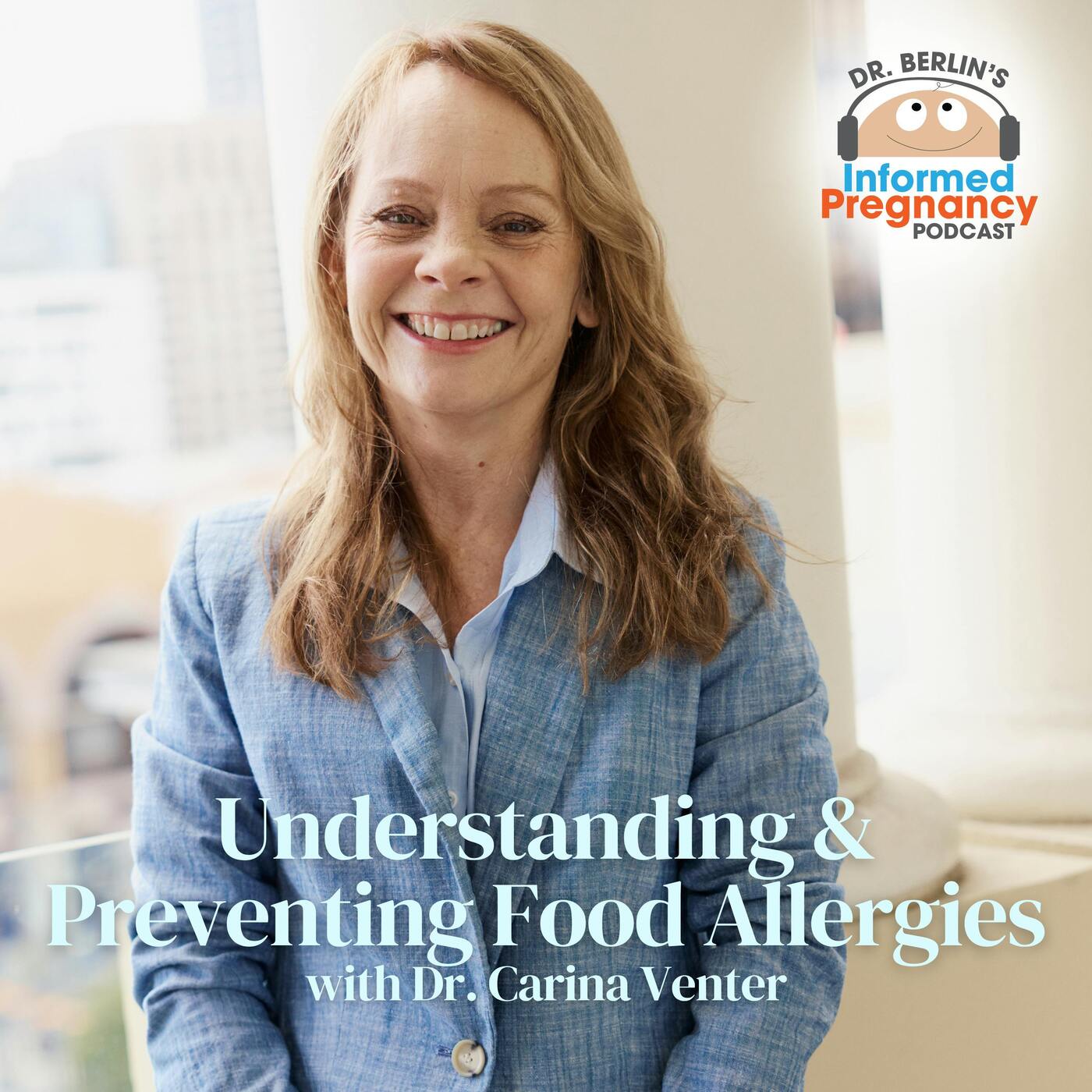
August 7, 2025 · 35 minutes · Episode 471
About this episode
Leading pediatric allergy dietician and researcher Dr. Carina Venter joins the podcast to discuss how to better understand and prevent food allergies through early nutrition. Topics include how diet during pregnancy and infancy can help reduce allergy risk, which foods to focus on, and why diversity matters more than restriction.
Connect with the guest:
Informed Pregnancy Media and Mahmee present an all new podcast! One Way or a Mother is a new narrative podcast from Dr. Elliot Berlin, DC. Each season is an intimate story of one woman, one pregnancy, and all of the preparations, emotions, and personal history leading up to the birth. Episodes feature the expectant mother along with her family, doctors, and birth work team.
Start listening to Episode 1: I Should Have Died featuring Arianna Lasry
Keep up with Dr. Berlin and Informed Pregnancy Media online!
Learn more about your ad choices. Visit megaphone.fm/adchoices
See Privacy Policy at https://art19.com/privacy and California Privacy Notice at https://art19.com/privacy#do-not-sell-my-info.
Key quotes
“the immune system is sort of like thinking, oh, I'm getting lazy, what can I do? I'm gonna cause allergies.”
“And so if you want to prevent allergies in your babies, the answer to food allergy is eat the allergen.”
“because it really is like an immunological soup, giving babies all the immune cells that they need, especially for that first few months of life.”
“With each additional food, we gave them by six months. We reduced the risk of food allergies by 30%.”
“I always say every food counts. So if we can have five foods rather than four, that's great.”
Related episodes
- Ep. 470 Carlson Young: After Birth
- Ep. 469 Carlson Young: Before Birth
- Ep. 500 The Unexpected with Dr. Elliot Berlin Part 2
- Ep. 480 Twins with Lauren Gaba Flanagan
Transcript
AI-generated transcript with speaker labels — may contain errors, especially names and medical terms. Dr. Elliot Berlin, DC appears in blue; Dr. Carina Venter in orange.
Dr. Elliot Berlin, DC [1:00] Today's guest is a leading pediatric allergy dietician and researcher whose work has shaped how we understand and prevent food allergies through early nutrition. In this episode, we'll explore how diet during pregnancy and infancy can help reduce allergy risk, what foods to focus on, and why diversity matters more than restriction. We'll also learn how recent science is being translated into simple, real-world tools for families looking to make informed health choices from the very beginning. I'm pregnancy-focused chiropractor, Dr. Elliot Berlin, and you're listening to the Informed Pregnancy Podcast. Dr. Karina Venter, welcome to the podcast.
Dr. Carina Venter [1:58] Thank you, and thank you for having me here.
Dr. Elliot Berlin, DC [2:01] I am honored to have you here and to talk about a topic that I admittedly don't know very much about, but I'm very curious and would love to learn more. Let's start with the beginning. What's your background? Where did you train?
Dr. Carina Venter [2:15] So I'm a dietician, and I studied in South Africa, as you can probably hear from my accent. I studied to be a dietician at the University of the Free State, which is in Bloemfontein, right, right in the middle of the country. Following from after I got my degree, we moved to England, where I then did a postgraduate diploma in allergy, and that was followed by doing a PhD in allergy and immunology. I lived on an island just off the coast of England called the Isle of Wight for 20 years, where I also had my two children. And so from the island, you have to take a boat, and it takes you about an hour and a half to get from the island to London, or about 20 minutes to get to the University
[3:02] of Southampton, where I did my PhD. I was then recruited to a Cincinnati Children's Hospital, where I worked in a particular disease or a particular presentation of food allergy, which is referred to as eosinophilic esophagitis for two and a half years. And then I was recruited to Children's Hospital Colorado or the University of Colorado, where I'm now professor of pediatrics, and I work both clinically with children with food allergy, but my research really focused on how nutrition in pregnancy and nutrition in early life can help us to prevent all allergic diseases, including food allergies, eczema, asthma, and seasonal allergies or allergic rhinitis
[3:47] during childhood.
Dr. Elliot Berlin, DC [3:48] Wow, that's even more than I was expecting to learn about. So now I'm even kind of more excited to see what I'll learn today. What sparked your connection to allergy in the first place? What drew you towards allergy?
Dr. Carina Venter [4:03] You know, it's an interesting question because studying in South Africa, we had bigger problems at the time, now about 25 years ago, than food allergies. And so a lot of my training was actually focused on looking after children and adults with burns, children and adults with TB or tuberculosis, and we also have a huge problem with diabetes. And that really was my interest at the time and what I learned a lot about. But growing up as a child, I had two of my children's had presentations of food allergies. One of them is referred to as food protein-induced enterocolitis syndrome, where people don't get anaphylaxis, but they get this projectile vomiting
[4:48] from being allergic to a food. Another sister of mine had more of the enteropathy kind of presentations of food allergy. And our whole family has got either asthma or seasonal allergies, allergic rhinitis. And so when I moved to the England and I got the opportunity to work in a world famous allergy research center on the Isle of Wight, that was an opportunity I grabbed with both hands. And that led to my post-graduate diploma and then my PhD in allergic diseases and immunology.
Dr. Elliot Berlin, DC [5:21] Wow, so it's personal for you.
Dr. Carina Venter [5:23] It really is personal. And you know, just getting back to pregnancy and we will probably talk about that a little bit more. But when I was pregnant and when my sisters were pregnant, there really wasn't actually any good advice on how to prevent allergic diseases in children. And so in our family, we also have, you know, some of our nieces with multiple food allergies, which I now know how to prevent. But at the time, I didn't know how to best direct myself and my sisters to prevent allergic diseases in their children.
Dr. Elliot Berlin, DC [5:58] Is there a practical reason why the allergy research center was on the island?
Dr. Carina Venter [6:05] Yes, so the Isle of Wight is very close to my heart. Like I said, both my children were born there. But the beauty about the Isle of Wight is that people grow up on the Isle of Wight. Then they leave the island and they go to what they call the mainland, which is mainland England, where they study. They normally then meet, you know, their partners, get married, move back to the island where their children are raised. And then when the children get to 18, 19 years of age, they leave the island, go to the mainland. And then eventually after their studies, getting married, they come back. So we do a lot of what we call transgenerational research.
[6:45] And so we can actually look at how nutrition intake changed over different generations. We can look at epigenetic changes, microbiome changes, which is very unique to the Isle of Wight. We actually published studies looking at changes and prevalence of allergic diseases, which nobody can mimic because, you know, some studies are done in China, some done in America, some done in Australia. But the Isle of Wight is one of the only places in the world where we can look at differences over time in the exact same population. And that's really why it is such a famous allergy center.
Dr. Elliot Berlin, DC [7:23] Wow, that makes perfect sense. All right, so I am excited to learn more about allergy, but I'm also nervous because it seems like a lot and seems complicated, but I'd like to break things down into, I guess, sort of a pun, easier to digest bits of information. So where would I start if I was looking to understand how allergies work, how they form?
Dr. Carina Venter [7:49] So the majority of allergies really have one common denominator or one common characteristics, and that is that we make IgE. Now, I can explain that very well. The reason human beings make IgE is because in the past, when we got parasite infections, we made IgE to kill parasites. And so it's just the type of immune system that's really geared for parasite destruction. But as we are now not really getting, you know, exposed to parasites that often, the immune system is sort of like thinking, oh, I'm getting lazy, what can I do? I'm gonna cause allergies. And so, you know, whether you have asthma, whether you have seasonal allergies, whether the child or yourself may have eczema
[8:34] or atopic dermatitis, as some people call it, or the majority of food allergies, it's just really a presentation of the fact that you make too much IgE. And if we know how to switch that off, we will see a lot more allergies.
Dr. Elliot Berlin, DC [8:49] Okay, so IgE is an immunoglobulin, that's the IgE, and a specific type of immunoglobulin that is category E, let's say, IgE.
Dr. Carina Venter [9:00] Yes, IgE is, yeah, it's immunoglobulin E. It's a particular type of immunoglobulin. I mean, it really is the total IgE. So the more IgE's you make, whether it is to grass or to peanuts or to egg, if we start adding them all up and we get your total IgE count, that's normally a very good indicator that you're going to have allergic diseases. And then, of course, you know, we can then look to see which IgE's are you making. And so if you're making IgE to horse, you're probably gonna be horse allergic. If you make IgE to grass, you're probably gonna be grass allergic. And then if you make IgE to foods, there is where the big caveat comes in. Only 50% of people, give or take,
[9:42] I'm rounding off now, that makes IgE to a food will actually be allergic to a food. We don't understand why the other 50% still make IgE, but they're not allergic. And the reason I'm highlighting that is that is because even if you go on all the different kinds of social media where there's allergists with a count, they will tell you that one of the worst things we can do is to do blood tests in a baby and say this baby is making IgE's to 10 specific foods and therefore the kid's now allergic to the foods and need to avoid it. You really need to work with an allergist to try and tease out which of the IgE's clinically means that the kid's allergic
[10:22] and which of the IgE's are there, but they're not to be worried about because, you know, you can't actually tolerate the food.
Dr. Elliot Berlin, DC [10:29] Okay. So if I'm going just for a basic understanding of immunoglobulins, these are proteins, right, that your body makes in response to something that comes into the body that's foreign and let's say a virus or a bacteria or in this case a parasite and your body wants to mark it and say this doesn't belong here and to sort of inactivate it to prevent it from having negative effects on the body. Right, so that's why we make them in the first place. Is that accurate?
Dr. Carina Venter [10:59] That is accurate. And I think I can use, you know, a lock and key analogy to explain what that happens. We have mast cells, which are cells with all these granules that causes blood vessels to open up and us to go bright red and get hives and our lips to swell, but the mast cells have two locks on them and that's normally called the two IgE's and these IgE's get unlocked when either a parasite or an allergen that they can recognize go past them, bind to them and unlock the mast cell. So that's basically what happens is we make IgE, they sit on the mast cells and they're just waiting for either a parasite or a peanut or an egg to come past, they bind to it, unlock
[11:47] and that's when we get symptoms of allergic disease or we kill the parasite.
Dr. Elliot Berlin, DC [11:52] Okay, that makes sense to me. So if we had the parasite, it would protect us.
Dr. Carina Venter [11:57] It will protect us and there are some studies now in the world that really infest people with parasites to see if they can actually reduce the prevalence of allergies either in their population or even reduce the severity of allergic symptoms in that particular individual.
Dr. Elliot Berlin, DC [12:15] Interesting. So if I can picture these sort of motorcycle gangs riding around the bloodstream looking for parasites, if they don't find any parasites, like you said, we're not really exposed to parasites very often anymore, but if they find something, they can attack.
Dr. Carina Venter [12:31] Yes.
Dr. Elliot Berlin, DC [12:31] And so that sometimes becomes like protein on food.
Dr. Carina Venter [12:36] Yes.
Dr. Elliot Berlin, DC [12:37] And so then I'll eat that food and all of a sudden I get this major attack against that food.
Dr. Carina Venter [12:43] Correct. If we think that if you eat that allergen or that food during pregnancy, during infancy, we also make, I'm trying to think now, perhaps like a doorstop or a block and that's called IgG. So we talked about IgE causing the allergies, but if we eat a lot of something, we can make IgG and that can then actually bind with the mast cells so that we actually eating the allergen but it leads to a favorable reaction and that is really why it's so important that really right from the start in pregnancy and infancy, we expose the pregnant woman or the baby to the allergen so that we make a lot of these IgGs which is going to stop this whole cascade of IgE
[13:30] that's going to be produced, bind to the mast cell and then cause all these allergic reactions because the IgG will then actually take the place of the IgE on the mast cell and that's a much more friendly reaction or really no allergic reaction to be honest.
Dr. Elliot Berlin, DC [13:46] Okay, amazing. I'm gonna need a second to digest all of this. Let's take a quick break and when we come back, we'll dig deeper into the IgG, the immunoglobulin G reaction. Don't go anywhere, we're just getting started.

Dr. Elliot Berlin, DC [14:12] Welcome back, I am learning so much from Dr. Karina Venter. Okay, so food allergies have to do with a buildup of immunoglobulin E in the body but there are things that you can do to work with the immune system kind of rules of engagement to make our bodies not so sensitive, not so attacking of food and give us those allergic reactions and allergic diseases really. And one of them is you said we can sort of expose ourselves in a way that makes us produce immunoglobulin G, IgG, right and immunoglobulin G is kind of the most common immunoglobulins in the body and there are like long-term immunity generally speaking. I think people became a lot more familiar
[15:00] with immunoglobulins and IgG after COVID and we're all testing to see what kind of immunity we had and then also these crustal placenta, is that true?
Dr. Carina Venter [15:09] Yes, it does and the baby can swallow that too. So the whole process of IgG in pregnancy is very complex really because I think the overall message from studies done now probably about 20 years ago and actually the majority of the studies came from Southampton in the United Kingdom where I did my PhD really shows that the best thing you can do in pregnancy is to expose the mom to the allergens providing she's not allergic herself of course, so she can make IgG, it can cross the placenta, the baby can swallow it and then that will hopefully help to have less allergic babies.
Dr. Elliot Berlin, DC [15:49] So that if there's peanut protein then it's the IgG that's gonna interact and not cause symptoms for us.
Dr. Carina Venter [15:57] Yes, but the other thing about pregnancy also is that pregnancy really is an allergic condition and the reason pregnancy is allergic condition because if it was the other kind of immune presentation which is autoimmune, we would all naturally lose our babies and so it's an allergic condition and we have more of these allergy cells which is referred to as TH2 cells and then what happens is when the baby is born, babies are born with more of these TH2 cells because they're just now coming out of the womb where there's a lot of TH2 cells and so the thing that needs to happen is when that baby is born, we need to try and switch off or dumb down or reduce the TH2 cells as quickly
[16:48] and as well as we can into more TH1 cells which are the cells that doesn't cause or don't cause allergies so that we can have a balance and babies don't become allergic. So there's really two things we need to address in pregnancy. The one is we want to give mom allergens to eat so we have sufficient IgG to the allergens but we also want to help mom and baby that we have that switch happening at birth from the TH2 cells which are our friendly cells in pregnancy but after pregnancy, they're our allergy-producing cells and so this is really why we say and we can talk more about that, C-sections may help, may not help to switch TH2 off but perhaps a natural delivery can.
[17:36] We think that perhaps breastfeeding can help to reduce the TH2 cells but my research, of course, has focused on how can nutrition help to make that switch from an allergic condition to a more non-allergic condition very early on in life so we don't have babies that grow up with all these allergic diseases.
Dr. Elliot Berlin, DC [17:56] Okay, so if I understand correctly, during pregnancy, these TH2, these T-helper 2 cells are good for mother, good for baby but then after the birth, both mom and baby need to get a switch away from TH2 cells because if it remains high, it's going to create problems for us.
Dr. Carina Venter [18:17] Yes, especially baby. It's especially baby where we need to reduce the TH2 cells so they don't grow up to have allergic diseases.
Dr. Elliot Berlin, DC [18:26] So is there something to do during pregnancy to get ready for that transition or is during pregnancy more focused on producing IgG antibodies?
Dr. Carina Venter [18:36] Yeah, you know, probably about a few years ago, I would have said to you, well, really the only thing we know is about allergen intake. We understand so little about overall nutrition in pregnancy but I've recently published data and also a collaborator of mine from Spain published data where we showed that actually overall maternal diet, so having a diverse diet with lots of different fruit and vegetables and whole grains and plant-based foods can actually beneficially change mom's gut microbiome which also can affect baby's gut microbiome and that can help with down-regulating the TH2 cells. So I've recently published data to show that what mom eats in pregnancy,
[19:22] if she has a healthy diet, can beneficially change the baby's gut microbiome at one month to look exactly like a baby that was born vaginally and breastfed even if the baby was born by C-section because it does happen to many of us. It happened even to myself even though it wasn't really part of my plans or the baby was not breastfed. I think in short what I'm trying to say is, if you have a healthy, varied or diverse diet during pregnancy and things don't go the way you want, you may end up with a C-section or breastfeeding may not go as well as you planned, that can still actually help to make your baby's gut microbiome look like as if all these things fell in place.
Dr. Elliot Berlin, DC [20:09] Well, that's really important. As you mentioned, not everybody has a choice and some people aim for a vaginal birth and have a cesarean birth or even if you choose a cesarean birth, it's good to know that there are ways to help the microbiome especially as it pertains to helping the baby not develop these food allergies. So I'm gonna leave science, the immunological science behind us a little bit at this point and move forward into more practical matters because ultimately what we wanna learn is how can we take measures, seemingly pretty simple measures to help our babies not develop either food allergies or allergic conditions. And then after birth,
[20:49] and it sounds like you're saying one of the most important things is the diet during pregnancy for it to be diverse. Can you expand on that a little bit, practically speaking?
Dr. Carina Venter [20:58] Yeah, you know, diverse is a nice word for really just saying eat a varied diet. And so the more variety of fruits you eat, the more variety of vegetables you eat, the more variety of whole grains you eat, and also plant-based proteins, that role for animal-based proteins should you choose to eat those during pregnancy, but keep it varied. And so rather than just having apples and banana, have apples, berries, different color berries, some bananas, have some pineapple. I know that many pregnant women who struggle with nausea don't like to eat cooked or vegetables, but then have some cold raw vegetables, have some carrot sticks, have some different kinds of lettuce and salad leaves.
[21:49] Don't just stick to the iceberg. In terms of grains as well, don't just have the white rice, have the brown rice, have some couscous, have some wild rice. So the more different kinds of things we eat, and the American gut study beautifully shown that if we can eat three zeros, so 30 different plant-based foods a week, that is really our best chance of having a very diverse and healthy gut microbiome. And I know we have moved on from immunology, but I do wanna say just one more thing. When we have this very diverse diet, we actually produce more of the regulatory immune cells, and these cells are actually just saying to the whole of the immune system,
[22:30] doesn't matter what type of immune system, let's just all calm down, and let's just all be happy. And so that's really why we want this healthy, diverse microbiome, is so that the immune system is just completely in peace as much as possible. So my research, once again, particularly showed that if we have varied vegetables, and the more vegetables we eat, and also fermented foods, the women particularly ate yogurt, but other fermented foods such as kombucha or kimchi would probably play the exact same role. That is when we have a more diverse gut microbiome that is associated with beneficial changes to the baby's gut microbiome as well.
Dr. Elliot Berlin, DC [23:12] Is it old science to think like, I don't want my kid to be allergic to peanuts, so I shouldn't eat peanuts while I'm pregnant?
Dr. Carina Venter [23:19] Definitely, it is a big discussion we still have in clinics all the time. But once again, my data was part of the data set that was used to say, actually we've made a big mistake by telling pregnant women and young babies not to eat the allergens because we think it may cause allergic disease. And so if you want to prevent allergies in your babies, the answer to food allergy is eat the allergen. If you don't want food allergies, make sure you have that allergen or whichever allergens in your diet as well as your baby's diet.
Dr. Elliot Berlin, DC [23:53] Okay, and allergen just for the record is the food that people are allergic to. So a little bit of sort of unconventional thinking, meaning you would probably naturally think if I don't have the allergen, I'm not gonna get the allergy, but research is showing the opposite. If I do have the allergen, if I expose to the allergic food early on, then I'm less likely to develop the allergy to that food.
Dr. Carina Venter [24:19] Correct, correct.
Dr. Elliot Berlin, DC [24:20] Okay, well that's a little mind blowing and I love that you gave us practical advice for during the pregnancy, eating a diverse and giving so many examples of a diverse diet. I would love to know what to do once the baby comes out. Let's take a little break and when we come back, we're gonna talk about infant nutrition. All right, I'm continuing to learn things that are not intuitive from Dr. Karina Venter. Okay, so we talked a little bit about pregnancy and diet during pregnancy. What about after the baby comes out? I guess first for a breastfed baby, their nutrition is going to be based on mom's nutrition. So is the diverse diet still the recommendation here?
Dr. Carina Venter [25:14] Definitely, but we have to start, well, if that's the mother's choice, we always recommend that we start feeding babies with breast milk or human milk. There's good evidence that suggests that feeding babies human milk reduce the prevalence of eczema or atopic dermatitis or asthma. The evidence for preventing food allergy is not that clear, but irrespective of that, we're always going to want to feed babies human milk because it really is like an immunological soup, giving babies all the immune cells that they need, especially for that first few months of life. But then when the baby starts eating and babies are developmentally ready to eat at different stages,
[25:59] some babies are developmentally ready at four months, some six months. I have some babies, they come into my clinic, they're four months old. They're almost sitting without any support, they're looking around, they're interested in everything around them, that baby's ready to eat. Then I have babies in my clinic that come in at six months, they're happy breastfed babies, they're still really babies. They're less interested in what's going on and even if you open a wrapper, they're not really even going to look because they're happily fed. That baby will probably start eating around six months. But irrespective of whatever time the baby's ready to eat,
[26:37] we have to start introducing the allergens straight away and we have to get to a diverse diet straight away. So again, my data from England showed that babies who had a diverse diet by six months of age, and so these babies were the babies that were ready to eat. With each additional food, we gave them by six months. We reduced the risk of food allergies by 30%.
Dr. Elliot Berlin, DC [27:01] That's huge.
Dr. Carina Venter [27:03] And then when we actually looked at the food allergens these babies ate in their first year of life, with every additional food allergen we gave them, we brought the risk of food allergies down by about 11%. And so just as the mom, eat the allergens. Don't be scared. You don't want a food allergy, make sure you get the allergen into your diet and also keep the diet diverse. You know the good old days where babies were fed baby rice for a month and then a bit of banana and then a bit of apple. And the AAP used to say wait three to five days between each new food. It doesn't exist anymore. The AAP actually now categorically say that new evidence suggests multiple foods
[27:48] can be fed in one day. And so really we can do apple, banana, oatmeal, egg, peanut butter, literally one new food after the other every day to get that baby's diet as diverse as possible. Not being scared of food and not being scared of food allergens.
Dr. Elliot Berlin, DC [28:08] Is there sort of a guideline on how to expose the babies to all these different foods?
Dr. Carina Venter [28:15] That's a very good question. So the National Institute of Allergy and Infectious Diseases or in short, NIAD, we published a guideline now about eight years ago. I was one of the authors of that and there's also a parent handout. But the NIAD guidelines really just focus on the fact that you have to give peanut, about two gram of peanut protein, which is like a heap teaspoon or two level teaspoons of peanut butter two to three times a week. Following from that, we had the American Academy and the American College guidelines as well as the Canadian guidelines. I'm a co-author of that too, where we said, well, not only do you have to give peanut two to three times a week,
[28:57] you also have to get the egg in two to three times a week and then don't wait with the other allergens. We didn't name each allergen by name, but we just said, don't wait. And then the dietary guidelines from America came out about two years ago where again, we said, make sure babies have a diverse diet, get the peanut in and don't wait with the other allergens. So there's no guidelines really that gives us any advice on how to introduce each allergen, and what the amounts are and which are the most important allergen. But I'm very pleased to say that I helped with the production of a handout on how to introduce allergens into your infant's diet.
[29:41] So if you sign up to the website, again, www.letsgrowhappy.com and you sign up with your email, you will get a copy of our booklet, How to Introduce Allergens into Your Baby's Diet. And this has been extensively reviewed by world renowned allergists from Stanford, UNC Chapel Hill, Children's Colorado, and also the author of the Leap in the Eat studies, which informed us about the importance of early introduction of allergens into the infant's diet. In the next week, we will also provide information on how to address the pregnancy diet during pregnancy.
Dr. Elliot Berlin, DC [30:23] These are incredible resources and brand new, so very cutting edge.
Dr. Carina Venter [30:28] Yes, I'm very, very excited. We've really worked on it for months and it's readily available now to help you introduce allergen into your baby's diet.
Dr. Elliot Berlin, DC [30:37] It sounds just really, because the advice is good based on the newer science, but I know it can drive people crazy, like how to do it. So now there's a guideline, and both for infant nutrition and for what to eat during pregnancy. And I really, what strikes me in my mind about the pregnancy is what you said before, you know, you have the ideal, let's say for the gut health to have a vaginal birth and to breastfeed, but things that you do during pregnancy, the way you eat during pregnancy, if I understood you correctly, can really help set you up with a microbiome that will give your child an advantage no matter how they're born. And also, you know,
[31:16] if they're formula fed or human milk fed.
Dr. Carina Venter [31:19] Definitely. And you know, I also want to get back about the fact that in the children, we showed that every additional food bring risk down. Unfortunately, we don't have that for pregnancy. I'm currently analyzing data to see if it's true, but I would have thought the same would be true. And the reason I want to bring this up is because many women, you know, do have nausea during pregnancy and their food variety may be limited. But when I work with women like that, and that also included myself, I always say every food counts. So if we can have five foods rather than four, that's great. If we can have 10 foods rather than eight, that's great. If you are not affected by nausea,
[32:03] then you know, please feel free to eat a very balanced, very, very diet. But if nausea is a problem, just try and include one new food every week just to increase your variety as much as you can.
Dr. Elliot Berlin, DC [32:18] I would love to learn a little bit more about Grow Happy because in addition to the research and the guidelines, you have products that make it fairly easy.
Dr. Carina Venter [32:28] Yes. I think you can't see my face, but you could probably hear me smile. If ever I could have helped to create a dream product for early introduction of allergens, that would be Grow Happy. I have spent 20 years looking at, you know, diet diversity in infancy and also in pregnancy. And I've also looked for the last 20 years at the importance of eating allergens during pregnancy and infancy. And so in Grow Happy, we've put the two together. We make it easy to introduce allergens. We have four nut butters and an egg butter. So we have five butters in total. And every butter comes with a mixture of fruit and vegetables so that we actually introduce
[33:15] allergens in the context of a diverse diet. So in total, we have 16 plant-based foods in the range. And so the allergens are peanut, cashew, walnut, egg, and sesame. So it really is, you know, three nut butters, a seed butter and the egg butter. We have worked very hard to make sure that we chose the best nut butters, the best sesame seed butter, and also an egg that contains all the important, you know, allergens or the proteins in the egg that babies should be getting. And then we created this range of diverse fruit and vegetables. We put it all in little packets or sachets. You can just scoop it up, mix it with a bit of water or a little bit of breast milk or infant formula,
[34:03] and then feed it to your baby from a spoon. We don't have spouts because, you know, feeding baby's pouches directly from the spout actually doesn't help to teach babies to eat. So there's no spout. You have to just open the packet, mix it with a bit of fluid, and then feed it to your baby from a spoon. As babies should be eating.
Dr. Elliot Berlin, DC [34:25] Wow. First of all, congratulations if we go back on the journey with you from having allergic sisters to where you've come today. It seems like it was a personal passion for you and all the work that you've done has now culminated into a very practical system of support for new parents and new babies. So congratulations to you on that. Dr. Venter, I really want to thank you for coming and sharing your expertise with me. I learned a lot as I hoped I would and I knew I would, and there's more to learn. So where can I and others find you online?
Dr. Carina Venter [34:59] So I think the best way if you wanted to contact me, especially regarding the Let's Grow Happy range is to just go onto the website. There is a contact us function and you can click on that and then contact me and I will get back to you very soon.
Dr. Elliot Berlin, DC [35:16] Thank you. And at home, thanks for listening to the Informed Pregnancy podcast. If you found today's episode helpful, share it with a friend and leave us a five-star review. For more pregnancy and parenting information just like this, visit us online at informedpregnancy.com. I got a.
Want more pregnancy + parenting? Start your FREE TRIAL of Informed Pregnancy+ and get access to all our curated pregnancy and parenting content — original series, iconic birth films like The Business of Being Born, prenatal workouts and more.

0 Comments