
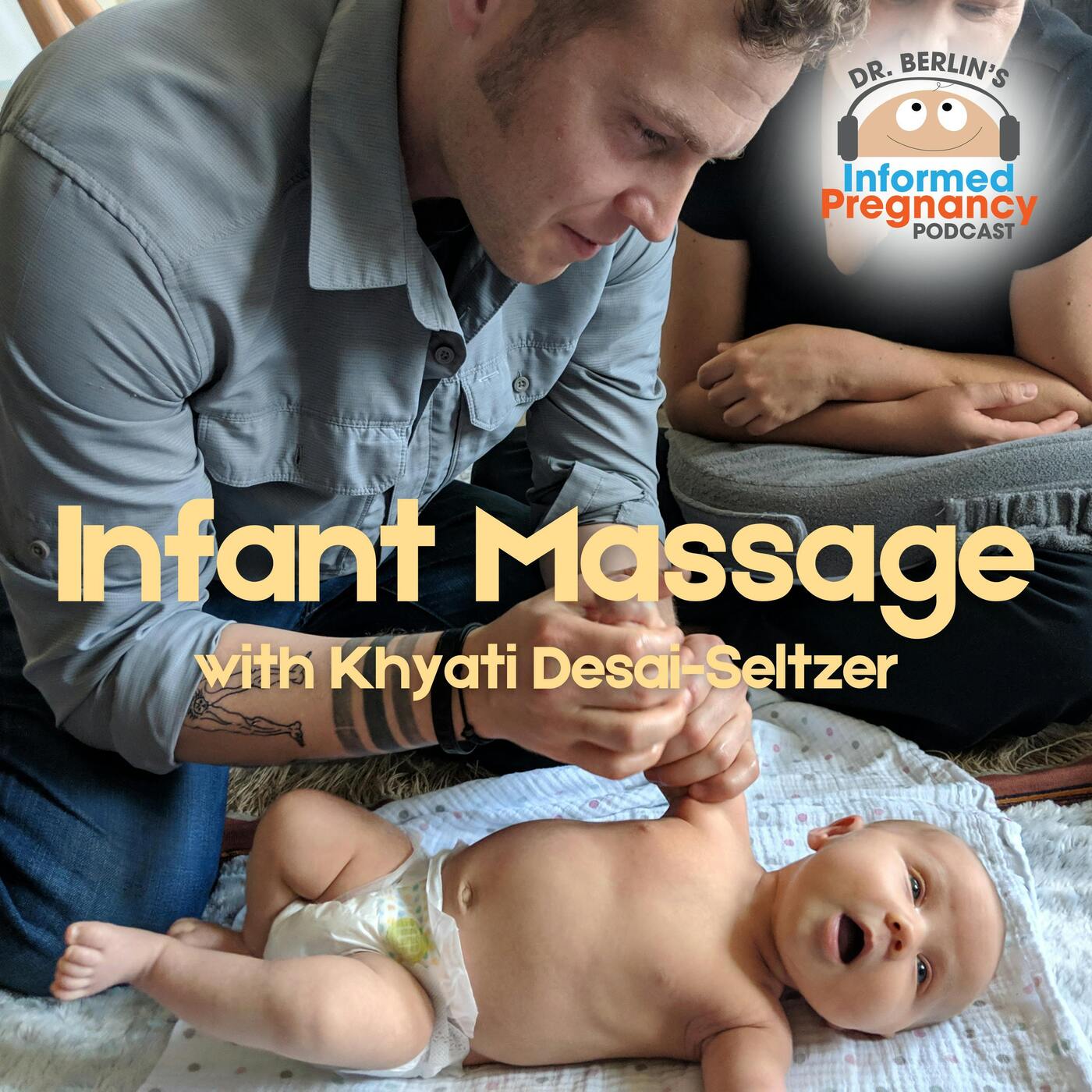
August 14, 2025 · 39 minutes · Episode 472
About this episode
After becoming a mother, Khyati rediscovered the traditional Indian practice of infant massage. As the practice turned from a personal healing tool to her life’s work, she had no idea how things would change after her daughter woke up screaming in pain the very same night she finished her training. From aiding in sleep and digestion to newborn bonding, infant massage might just be the tool you didn’t know you needed. Her mini massage course is available now on Informed Pregnancy+.
Connect with the guest:
Holistic Infant Massage: A Mini Course available on Informed Pregnancy+
Informed Pregnancy Media and Mahmee present an all new podcast! One Way or a Mother is a new narrative podcast from Dr. Elliot Berlin, DC. Each season is an intimate story of one woman, one pregnancy, and all of the preparations, emotions, and personal history leading up to the birth. Episodes feature the expectant mother along with her family, doctors, and birth work team.
Start listening to Episode 1: I Should Have Died featuring Arianna Lasry
Keep up with Dr. Berlin and Informed Pregnancy Media online!
Learn more about your ad choices. Visit megaphone.fm/adchoices
See Privacy Policy at https://art19.com/privacy and California Privacy Notice at https://art19.com/privacy#do-not-sell-my-info.
Key quotes
“the massage routine that took less than five minutes literally cleaned her out and she slept beautifully the rest of the night”
“And that's why I recommend to all my families have a postpartum plan because the birth is incredibly important and critical. Yes, but it's the wedding day and then you have the first year of marriage and that's your first year of postpartum.”
“And then culturally, we also believe the first 40 days can impact the first 40 years.”
“Last year when they came out with the postpartum depression pill was around the same time another study came out and found that massaging your baby is just as effective without any of the side effects.”
“So America is considered touch deprived. We are hungry for loving touch.”
Related episodes
- Ep. 470 Carlson Young: After Birth
- Ep. 480 Twins with Lauren Gaba Flanagan
- Ep. 500 The Unexpected with Dr. Elliot Berlin Part 2
- Ep. 483 Empowering Education in Childbirth with Sarah Lavonne
Transcript
AI-generated transcript with speaker labels — may contain errors, especially names and medical terms. Dr. Elliot Berlin, DC appears in blue; Khyati Desai-Seltzer in orange.
Dr. Elliot Berlin, DC [0:00] Today's guest traded a career in affordable housing for a mission rooted in her own postpartum experience and cultural heritage. After becoming a mother, she rediscovered the traditional Indian practice of infant massage, and what started as a personal healing tool quickly became her life's work. She had no idea that the very night she completed her training, her daughter would wake up screaming in pain, and what happened next changed everything. She's here to share how a simple, ancient practice can dramatically improve sleep, digestion, and bonding in newborns, and why it might just be the most powerful tool parents aren't using. I'm pregnancy-focused chiropractor Dr. Elliot Berlin, and you're listening to the Informed
[0:44] Pregnancy Podcast. Kiati Desai-Seltzer, welcome to the podcast.
Khyati Desai-Seltzer [1:04] Thank you, Dr. Berlin. It's great to be here.
Dr. Elliot Berlin, DC [1:07] It's an honor to have you, and I'm very excited to learn from you. Let's jump in at the beginning. Where are you from originally, and what do you do for work now?
Khyati Desai-Seltzer [1:17] Yes, I'm originally from India, from the northwestern state of Gujarat, where baby massage has been practiced for thousands of years. And what do I do now? I have two businesses. One is to support postpartum mamas through baby massage and belly binding. And in my second business, I am consulting with affordable housing organizations in how to engage residents in a meaningful, authentic way.
Dr. Elliot Berlin, DC [1:44] Wow. I wish you were doing something more meaningful. Okay. Wow. Those are both really important things. So let's start in the beginning. You were born in India, but raised in the U.S.?
Khyati Desai-Seltzer [1:57] Correct. Yes. We came here when I was about two, so I've spent my entire life here, but I'm very well connected and rooted to my Indian identity.
Dr. Elliot Berlin, DC [2:06] Welcome to the United States.
Khyati Desai-Seltzer [2:08] Thanks.
Dr. Elliot Berlin, DC [2:09] And I mean, how did you get into, because I mean, the housing would be a career that's very fulfilling in itself. How did you get into infant massage?
Khyati Desai-Seltzer [2:18] It's a great question, and I won't lie and say that my parents were happy that I went to college and grad school and then left all of that to do baby massage, which is so common in India and just we take it for granted. And all babies are massaged regardless of their socioeconomic background. So a lot of times the women who come to the home to massage are not even educated. And so for them, for my parents to have their daughter, they brought to America for opportunity and went to school and grad school. And now she's letting all that go to do baby massage was probably still something that was a sore spot for them. Yeah. A little bit of getting used to for them.
[2:55] Absolutely. But, you know, I have always in the last 20 years of my adult life wanted to be of service to the community. And I did that through nonprofits, different types of nonprofits from housing and homelessness to domestic violence. And I really found my niche in housing. And then I was really passionate about instead of serving people and doing to them that really I wanted to engage them in a meaningful way. And so that really took hold at the organization I was at and became a model. And, you know, we were doing great work. And then it just became so much about, you know, the politics and the bureaucracy and all the administrative stuff that I felt like I was no
[3:34] longer leaving my daughter at the time who was to to do something meaningful to change my part of the world. Now I was just, you know, enwrapped in all this unnecessary stuff that happens in organizations sometimes. So I left because I realized I was a shell of the person I used to be, and I didn't want to be that kind of mother. And so I thought that I was going to find the next nonprofit job after a three month hiatus. But what I found was myself reading a magazine article about baby massage. It was an Indian magazine. And so I said, yeah, of course, baby massage. We've done this with my nieces and nephews. My mom became massage my baby. It's part of our culture. Like it's great,
[4:13] but it's a nice thing to do. I wonder if families in America know about it. And so I went to our trusty Google and sure enough, there was a training coming up. So I took it, you know, mostly out of curiosity, but also thinking, wow, if families in America knew about how amazing this tool was, like how we could transform their health and their happiness. Then I went into the training and I was among NICU nurses and physical therapists, massage therapists, just really confident, talented people that were there learning
Dr. Elliot Berlin, DC [4:43] something that I frankly took for granted. Wait till I tell your parents who the child was. Such a disappointment. Then I learned about the science behind it because when something
Khyati Desai-Seltzer [4:55] is cultural, you don't really know the why behind it. You just know that you do it. And so I became even more sort of enamored by it. And then like you said, on day two of the training, as serendipity would have it, my daughter woke up screaming of gas pains. And just that day I learned the gas colic routine. And so I thought in that moment, do I do this? What if it doesn't work? What if I look stupid? You know, all the things that run through our minds. And we doubt ourselves, but my husband said, well, it can't hurt. And so I did the routine in less than five minutes. Dr. Berlin, she had an explosive diaper so much so like it was too much to
[5:32] get wiped. So we just jumped in the shower and got cleaned up. And then it came back out. She had another diaper. We got back into the shower. She had another diaper, which we were able to contain with wipes. But like the massage routine that took less than five minutes literally cleaned her out and she slept beautifully the rest of the night. And so it was in that moment that I was looking at my hands and wondering, wow, what did I just do? That I felt a sense of empowerment, but a sense of also like, hey, this is not just something nice that we do culturally. There is a real art and science to it. And it can really save people a lot of heartache
[6:08] and time and money and doctor's visits if they knew how to do this.
Dr. Elliot Berlin, DC [6:12] You know, it's really interesting. I got into healthcare after seeing when I was seven years old, after seeing a CPR class where in New York City, we walked into a building and lobby, they were teaching the CPR class. And I was like mortified. I was like, what are they doing that poor woman with no arms and no legs? And when they taught me, when they told me you could use your body to be literally somebody else's heart and lungs for a little while until they can get advanced medical care. And that's something you could teach to a seven-year-old kid. Like it's very powerful. You could do in the way you talk. I mean, I use my hands all day, every day and try to heal people and try to have a positive effect on people.
[6:53] And I am amazed sometimes and just grateful for the gift. But this is something that every parent can do in such a powerful way for their own children. We're going to talk a lot about it in the third segment, but just as a little teaser for people listening who have little kids with colic or gas or difficulty sleeping, can you briefly explain how the infant massage
Khyati Desai-Seltzer [7:18] is so helpful? Yeah. I mean, body work is just amazing. The work that you do massage, you know, reiki, all these wonderful things. We in the West, we don't give it the credit that it deserves. I think it's starting to change. But in the Eastern part of the world, massage is seen as a way of staying healthy, preventing disease. And I can talk all day about it, but there are a few ways, right? So one is that you're calming the nervous system. And so we know that there's birth trauma, the postpartum experience, even the in uterine experience. All of that affects baby and mama. And if there are things that have made baby anxious or upset, that can disrupt the nervous system. We know that their digestive system
[8:01] is still maturing, but there's also a nervous system component there. When you're massaging baby, not only are you doing the techniques to help move, like if there's a gas colic issue, you're helping move the matter and helping them eliminate, but you're also releasing feel good hormones and decreasing the stress hormones, right? So now we're increasing oxytocin release. We're decreasing cortisol. And when you're doing that, both mom and baby or partner and baby are benefiting. And so now you're doing actual strokes to move matter. You're calming the nervous system. You're increasing feel good hormones, decreasing cortisol. It's sort of like a perfect package of everything you need.
Dr. Elliot Berlin, DC [8:37] You've already covered the fight or flight response. We're all walking around somewhat with our nervous systems as if we're being chased by a tiger. And it's very depleting for us. And it has very specific effects because when your body does feel like it's in danger, but the steps that it takes are not random. They're very specific. It does certain things to your eyes, to your blood flow, to your digestion. And one of the things that does your digestion is just shut it off because you don't need to have good digestion when you're running from a tiger. And so it also affects the reproductive system because you don't need that either when you're running from a tiger. And you see all these symptoms that if you could shift
[9:17] that thermostat on the autonomic nervous system from I'm endangered to I'm not in danger, or I'm not in grave danger at least, then the effects that take place are very strong and very visceral. The body does it itself. And one of them is big on digestion, just that alone. And then the second thing you said is like moving the matter physically through the body. So when we do the digestive massage, not on pregnant people generally, but somebody who struggles sometimes with constipation. And they'll come into the office and we do a gentle abdominal massage, digestive massage. It's the same thing. I've had people like run off the table and go right into our bathroom and spend quite some time there and
[9:55] come out and be like, I'm a new person. And that's what you're essentially doing for your baby at home. Although at this moment, it seems like it would be great if we had a diaper sponsor. Let's take a little break. But before we do it, like I said, we're going to share in our notes because we have so much to learn from you have so much to teach us. We'll share in our notes where listeners can find you. And we'll talk about it at the end. We'll give them links to your resources. And also I'm very excited to share that you have a holistic infant mini massage course streaming on informed pregnancy plus, which we're very grateful for and very excited about. And people can check it out, especially if you're
[10:33] already subscribed to get a little taste of the wealth of information that's available.

Dr. Elliot Berlin, DC [10:39] We're going to take a quick break and we'll be right back. Welcome back. We are talking to Kyati Desai-Seltzer. All right. So you mentioned you at the point that you started making this change in your career. You had a two-year-old. How was your journey to motherhood?
Khyati Desai-Seltzer [11:04] Like everyone else is full of unexpected twists and turns and all the things that you think that you're going to do or not do. You come face to face when you have a baby and you realize how little you knew before you had that baby. So, you know, I've been fortunate in terms of my health and in terms of getting pregnant with both of my children. I did have a miscarriage between the two. So I had a little bit of a struggle there, but I was fortunate to be able thank you, to get pregnant with my first daughter relatively easy. And I had a pretty good pregnancy, you know, typical things like heartburn and all the aches and pains. But my daughter had different plans. So I was actually supposed to be birthing with the GW
[11:48] midwives. That was the compromise my husband and I came to.
Dr. Elliot Berlin, DC [11:53] Midwives in the hospital setting?
Khyati Desai-Seltzer [11:55] Exactly. Yep. And it's a pretty rigorous process to be accepted. They want to make sure that you're in good health, all of those things. But my daughter decided to be a breech baby. And so, so we did all the things. I had a great team, but we did chiropractic, we did moxibustion, I did some acupuncture spinning babies. We even did the ECV, the virgin technique in the hospital, but she was determined not to move. And so we had
Dr. Elliot Berlin, DC [12:27] Any ideas why?
Khyati Desai-Seltzer [12:29] You know, I don't think that they knew. She's a stubborn child. So that's why. I don't know that they necessarily were able to tell like the cord length or things like that. To be honest, and this is a whole nother conversation, but I think, you know, our modern day lifestyle of sitting all day at a computer, which is what I was doing at the time, I didn't have enough room for her to move, I'm assuming, just sitting all day. And so there are things that we did culturally, and in many cultures that people just moved all day. And so women, I think, were better equipped to labor, things like squatting, which is done very frequently, even to sweep or mop or to prepare different
[13:10] foods. Like you were always in these like positions that opened your pelvis and things like that, that I think helped you prepare for labor. And so my assumption is that that she didn't have enough space. And so we switched from the midwives at GW to the OB, and I had her at 42 weeks. I did have a doula, and the doula, of course I was devastated, but the doula helped me advocate for a gentle cesarean. And so for those of you who have to have a C section, like you can make it, you know, not as traumatic. Some 68% of women will report that they have a traumatic birth. And I think part of that is just we don't know what we have choice in, and we assume everything that is given by the providers, what we have to do.
[13:55] And so my doula, something she mentioned, like you can ask them not to tie your hands down, right? And I did, and they said, okay, just don't touch your IVs. So there was something as simple as that, or having a clear drape so we could see the baby come out, or letting the father announce the sex and gender of the baby. So things like that you can advocate for, which made it not as traumatic for me. Of course, I had birth disappointment, but it wasn't trauma. That's a really interesting way to phrase it, birth
Dr. Elliot Berlin, DC [14:21] disappointment. And I found, because they used to really strap everybody down, both arms, both legs. And I found our patients, like even sometimes just having one arm free, that's such a huge difference for the physical, mental, and spiritual experience.
Khyati Desai-Seltzer [14:36] Yep. And so not everybody wants a clear drape, but it's nice to know if you have the option
Dr. Elliot Berlin, DC [14:40] that you can literally see the baby emerging from your body. Yeah. And immediate skin to
Khyati Desai-Seltzer [14:44] skin and all those things like that makes a huge difference on your postpartum, right? And sometimes it affects breastfeeding relationship. It has a lot of implications. And so if we can keep it as close to nature intended, the better. I think that comes from mom and baby. In that moment, the providers are thinking of like a live mom and baby, but that's just like, for me, is the minimum. That's like the baseline. That shouldn't be the goal.
Dr. Elliot Berlin, DC [15:10] Yeah. I mean, that's everybody's on the same page with that goal. Right. Exactly. But there's so much more to the experience. Absolutely. I have a question for you. Before we get to what postpartum was like, I'll jump ahead. So you have another baby, child, I guess. Yes. And how was the second experience?
Khyati Desai-Seltzer [15:27] The second experience, and I should also note that I had my girls at 35 and 40. So if anybody is concerned about AMA, as one wise OB told me, it's more important how healthy you are than your age. And I have been privileged and fortunate to have a good team of people to advise me on how to live a healthy life.
Dr. Elliot Berlin, DC [15:48] We have a fairly awesome episode of our podcast called Pregnancy Over 35. And it's with Dr. Emiliano Chivito, who says exactly what you just said. Basically, and he's an OB-GYN and he's an MFM. He's a high risk guy. He basically said every single person has a clinical health profile and there are a lot of data points in that profile. One of them is your age. It's the one you can't change. But the more the other data points are near the green zone in the healthy region, the less that particular data point matters. So if you're a healthy weight and you have a healthy blood sugar and you have a healthy blood pressure and all those other things, then age is okay. It's a data point,
[16:28] but it really doesn't affect your overall picture that much.
Khyati Desai-Seltzer [16:31] That's a great point, because so many people are fearful of having babies. And there is a
Dr. Elliot Berlin, DC [16:37] lot of fear mongering, but you can have healthy babies and healthy pregnancies even later in life. So at 40, you're pregnant again and you have two choices. You can have a vaginal birth after cesarean or a repeat cesarean. Those are your choices. As I know them, what was your choice and how did it go?
Khyati Desai-Seltzer [16:55] So it was not a point of discussion in my home. I had decided to have a home birth and have a beat back. Okay. They call it an H-back.
Dr. Elliot Berlin, DC [17:04] Yes, that's right. H-back, right?
Khyati Desai-Seltzer [17:06] The baby doesn't come out of your house. Yeah. So I think at first it's like an attempted vaginal after cesarean, but it was successful. And it was also January of 2021, so still COVID time. And I really appreciated having a midwife and my same doula be able to come to my house for the visits because I then had a four-year-old. So I never had to leave home. For the gestational diabetes exam, I didn't have to drink that nasty drink again. I could have real food. My midwife gave me a menu. I ate food. She came back and tested. Everything was fine. I think we only went to the hospital to find out the sex of the baby, but otherwise it was all at home, which was really great. And it was nice for my
[17:52] daughter to be part of the experience. I was helping her watch birth videos so that when the time came, she wasn't freaked out by what was happening. And so we actually had what my doula called an efficient labor. I think it was about six to seven hours long.
Dr. Elliot Berlin, DC [18:07] Oh, that's very good. Especially for your first labor.
Khyati Desai-Seltzer [18:10] Right. Although she was, I think, sunny side up, so her face was facing my back. So I back labored. Oh my gosh. It was like somebody taking a baseball bat to your lower back for just hours. Only there was a decent chiropractor in the room.
Dr. Elliot Berlin, DC [18:30] Right. Exactly. That would have been really nice to have somebody come home and say,
Khyati Desai-Seltzer [18:33] let's change this. Well, at least luckily with that, it was fairly short. Yes. Yeah. And she was born around 6.30 in the morning and my four-year-old was also
Dr. Elliot Berlin, DC [18:43] somehow awakened on her own at the time and was able to be there to see her sister
Khyati Desai-Seltzer [18:47] being born. So that was really special. It was that moment when the baby came
Dr. Elliot Berlin, DC [18:51] through you for the first time. What was that like for you?
Khyati Desai-Seltzer [18:53] You know, it's an out-of-body experience. It's visceral. It's primal. It's just the wildest thing that you can imagine. And I think right before that happened, and what do they call it? The ring of fire or something, when you are like, I can't do this anymore. I'm done. I got to go. When my doula and midwife- I got to go. I'm out of here. You guys have a good time without me. Wrap this up. I got to go. And so they said they knew when I sort of fell to my knees and almost like a surrender that that was the moment that baby was going to come. And so, you know, funny thing, I also remember thinking, wow, this is so hard. I'm going to have chocolate cake when I'm done. Oh, I'd say that when I'm on the treadmill.
[19:36] And it wasn't just a slice. It was the entire chocolate cake after I have this baby.
Dr. Elliot Berlin, DC [19:42] I might be Indian. I don't know. I feel like we're siblings.
Khyati Desai-Seltzer [19:46] Oh my gosh. That's what I thought about during labor, but it was a wild experience,
Dr. Elliot Berlin, DC [19:50] but I would do it again. Postpartum. How was your postpartum
Khyati Desai-Seltzer [19:54] support both times? Postpartum with my second daughter, you know, and both times I had my mom visit, which is very common culturally. So she came through four to six months. My husband had some paternity leave, which I know is also a privilege here because I had learned so much between the two girls' births being in this business, right? Like I had learned from chiropractors and pelvic floor therapists and sleep consultants. Like I just felt much more equipped than like just random Googling in the middle of the night. And that's why I recommend to all my families have a postpartum plan because the birth is incredibly important and critical. Yes, but it's the wedding day and
[20:30] then you have the first year of marriage and that's your first year of postpartum. And then culturally, we also believe the first 40 days can impact the first 40 years. And so everything then- Well, we can put it like that. Right? It's critical, but our families here do not, the society doesn't honor them after they have a baby and then they have self-imposed this like no, only baby matters. And so things like belly binding, which is a beautiful Eastern practice as well, they're not doing because they don't have time or baby massage. They don't see the value of it. So there's a lot of education and like culturalization we need to do because we have
[21:07] these amazing practices from around the world that could help our families avoid all the things that we see from postpartum depression and anxiety to, you know, even gas colic, pelvic floor issues. Like we have tools to prevent those, but it's like, how do you match that? And so for me and both of my breastfeeding experiences were also different with my first, both of them were challenging, but my second had a tongue tie and we worked with the lactation consultant and ENT did the release and she still never latched. So I exclusively pumped for seven months. Wow. Which was-
Dr. Elliot Berlin, DC [21:40] Each one get, my wife always says each child brought a special little gift for her.
Khyati Desai-Seltzer [21:44] They were, oh really? Yes. That's a beautiful way to say it's a special little gift. You can have the home birth you wanted, but I'm going to never latch, even though it's COVID and you're here all day to feed me. No, I'm going to make you pump.
Dr. Elliot Berlin, DC [21:56] And that's like, what a warrior you are because it's double work. You got to pump
Khyati Desai-Seltzer [22:00] and then feed, pump and feed. I know I was so angry. I'm still angry at her.
Dr. Elliot Berlin, DC [22:06] An angry warrior. Right, exactly. All right. Everything you just said about postpartum rings so true and it's almost like, you know, I did it. I had the baby, however you did it, you did it. I grew this baby. I got through the nine months. I got the baby out of my body, brought the baby into the world. And it's just like, I pictured that moment. It's like, Hey, what do you want to do now? I want to go to Disneyland now. And now it's like, start the hard work starts now. And there is not a whole lot of focus or care on the mom in general. And I noticed this even more. So you had both experiences, but after a C section, like not only did you just do all that, but you had fairly intense abdominal
[22:44] surgery. Yes, we have it down to a science. Yes, it's pretty reliable and predictable, but it's still a lot on your system. And there's a lumpy heel for it. And we're just sort of like, here, go home and oh, you know, here's a couple of guidelines. You got this. Yeah. See you in six weeks. Yeah, it's six weeks. It's like, oh, okay, really? All right. Anyway, you do incredible work postpartum and I want to learn more about it. And let's take a quick break. When we come back, we'll learn about the work that you do and the resources that are available to anybody anywhere. Welcome back. I'm learning so much from Kyati Desai-Seltzer. Okay. So you had these two babies, two very different experiences, both with birth and postpartum.
[23:32] I really want to get into the work that you do, the powerful postpartum work that you do. What's your biggest takeaway from your own experiences on postpartum? Like,
Khyati Desai-Seltzer [23:41] how could we make it better for other people? So many ways. I mean, we need a whole system change, but we know that will take time. And if you are expecting mama right now and you want to know what can I do, there is a whole lot. The first thing that you should know is that it's not just important for you to eat well and have some movement, which are super important, but your mental and emotional state are just as critical. If you're familiar with the field of epigenetics, what you are experiencing, everything. So what you see, what you taste, what you hear, what you feel, all of those, your baby is experiencing as well. And there's a purpose, an evolutionary purpose. They want to be ready for the
[24:20] world they're going to be brought into. But if you are stressed and anxious and sad and angry, which are going to happen, those emotions will come up. All of that is going to be fed into baby and baby's going to think, okay, I need to be anxious because mom is anxious, which means the world I'm being born into creates anxiety. Now, we can't completely avoid stress. We know that, but if we can be mindful of how much we take in and what we do when we are stressed. So with my second child, with my first child, I didn't know about this, even though culturally they told me and I wasn't as mindful of my emotions with my first baby. Her toddler tantrums were out of control.
[25:02] And somebody had told me about the connection to the in uterine experience. And then I read an article about how they're connecting toddler tantrums to mom's in uterine experience, which just blew my mind. Again, everything is our fault, but you know, it was like, wow, like three years later, two years later, this is what's manifesting. Because if you think about us in terms of energy, right, whatever stress I had, it went to my baby. They had nowhere to go. And so that came out at some point. With my second child, because I knew this and was more mindful of this thing called conscious pregnancy, I was stressed because frankly, it was COVID, deep COVID. My father-in-law was sick and dying. My mother-in-law's husband
[25:43] was sick and dying, you know, financial things, obviously, because businesses had to close due to COVID. So we had enough stress. And I was taking care of a four-year-old being pregnant. And that four-year-old was going to virtual pre-K, which is, I don't even know how it's a thing. But I had plenty of stressors, right? But I just became more conscious of like, okay, this is my problem. This is not my baby's problem. And I will work through it. So mommy was stressed today, but I'm going to take a walk or I'm gonna, you know, it's okay, I'm gonna, you know, read a little, I'm gonna meditate so that even if that stress was there for a moment, then I'm telling her, she's okay. She is safe. We're going to figure
[26:23] this out. And all of that, you know, they've said that the taste of amniotic fluid changes when mom is stressed. They're finding like, you know, deep stressful hormones in the umbilical cord, like it is a thing. It's just not talked about as much by our mainstream providers. And so my advice would be, if you're expecting, manage your emotional mental stress. If you can surround yourself with people who will care for you and love on you and take care of you, like expect that and demand that of them because they really are affecting how this baby will be born and your postpartum experience.
Dr. Elliot Berlin, DC [26:55] Yeah, that's really great advice. And I think also there was a time where there was so much more support built in to the pregnancy, to the birth, to the postpartum experience. And we don't have it as much anymore. Now it's sort of more professional people that we hire, but they're not around us the same way and they're not attached the same way. And so we're sort of floating on our own a bit more and that makes it a little harder to manage things like stress and some of the other emotions that come along with anything that comes up in life, but also during pregnancy and maybe even heightened by the pregnancy. I would also say that it's not like you should necessarily freak out
[27:34] if you feel stressed. It's okay. You know, it's just the normal part of life. Babies need to be exposed to normal part of life. It's like, we don't have to shush them for everything or medicate them for everything. They can feel life. You know, not feeling anything is a flat line. That's not life at all. And there are studies that indicate actually some stress is very helpful for the growth of the baby, just like when you stress your bones and they grow better. It's just managed stress, not to let things go festering for too long or unsupported. Really glad you brought that up. Let's dig into the work that you do. What do people come to you for?
Khyati Desai-Seltzer [28:09] Most commonly, the three issues we see in the first year, of course sleep, right? The holy grail. We know that we are going to be sleep deprived and then we are in it and it feels like torture. And to be honest, I know there's a lot of debate around to sleep coach and sleep trainer not, and obviously there are pros and cons to each of those. But I think the crux of the issue is, again, we're blaming families, but it's the fact that they're raising a baby on their own without mom, grandma, aunt there. And so if those support systems were there, which they have been traditionally in many cultures, then it's okay if you have mom waking up at night and somebody else is taking care of them during the day. But when you
[28:47] have two people who are also working and doing chores and household and other kids to be sleep deprived for that long, that's just unrealistic and now you're affecting mom's mental health. And so I think sleep is definitely a big one and massage can help because 15 minutes before bedtime, they release melatonin. So now they're sleeping deeper and longer. And we obviously, again, talked about the nervous system, releasing oxytocin, all of those are good for sleep. And then the second biggest issue we see is anything related to digestion. Most babies, some 60, 70% will have some version of gas, colic, reflux and constipation. And I think these things
[29:27] we're seeing more widely based on our lifestyle, based on what life is in America. Some countries are like, what is colic? Which is surprising to me. And colic is actually, they haven't found a known cause of it. But digestion and sleep are the two main things I see in the first year that people come to me for. And then the third thing that they don't necessarily know offhand, but it's really good for immunity, colds, congestion, things like that. But one month of massaging your baby regularly increases the white blood cells they're creating. So now they're better able to fight off infections. And there's so many other benefits of massage, but sleep and digestion are the first two. And that's what you're
[30:07] facing in that first year, what they come to me for.
Dr. Elliot Berlin, DC [30:10] How often do you recommend people massage their babies?
Khyati Desai-Seltzer [30:14] Every day, if possible, at least 10 minutes. And if you want to do more than 10 minutes a day, great. But if you can do 10 minutes, you know, even if you're not even seven days a week, it's five to six times a week, you will see the benefits. Just like eating healthy and exercising, you just don't want it to be something you do once a week or once a month. You want it to be a regular, consistent habit.
Dr. Elliot Berlin, DC [30:34] And it's interesting. I think you alluded to this earlier. But when you do it, the benefits are not just for the baby.
Khyati Desai-Seltzer [30:41] Correct.
Dr. Elliot Berlin, DC [30:41] A person doing the parent, especially doing the massage, is also getting all sorts of benefits.
Khyati Desai-Seltzer [30:46] That's right. So they found and they've studied grandparents massaging their grandbabies. And then they had the grandparents receive their own massage. And they found that they actually released more oxytocin when they're massaging their grandkids than rather when they're receiving massage. And so there is this wonderful benefit, this mutually beneficial practice. Last year when they came out with the postpartum depression pill was around the same time another study came out and found that massaging your baby is just as effective without any of the side effects. Now, obviously, if you have a predisposition to mental health or it's very severe, right, like that's a different story.
[31:23] But for most of us who have some level of anxiety, baby blues, depression, you can address that with some of the tools we mentioned from baby massage to belly binding, which are both shown to really help mama's mental health.
Dr. Elliot Berlin, DC [31:37] What are some of the misconceptions that people have about infant massage?
Khyati Desai-Seltzer [31:41] Oh, I love that question. I think the biggest thing that really is just sometimes so frustrating for me is that it's sort of a nice thing to do. And maybe I was guilty of that too before I took the course and learned about the science and the nuances. But we see in the West, we see massage as something you treat yourself to when it's your birthday. It's Mother's Day. I'm going to get a massage as opposed to in the East where it's like maybe they're getting it weekly a couple of times a week, they have back pain or headaches or they have a cold and they're getting massage. And like I said, all babies in India, regardless of their socioeconomic background, get massage.
[32:16] So it's not just babies who are privileged, even babies who are living in slums, the mama or the aunt or the grandmother is massaging them. So why would people who are poor massage their babies, right? Because it is part of their health. And so one of the biggest misconceptions I come across in America is that one, it is a nice to have. It's not necessary and critical. And then the second is that it can't help the things that we are talking about today. Like people, you know, it's America. So we want to go for the pill or the medication, the quick fix. And it's not that massage doesn't help right away. Like I mentioned in my story, but there's this thinking
[32:52] that the holistic practices take longer and, you know, you're struggling in postpartum. I get it. You want a solution yesterday, but people are quick to discount all of these techniques and go for, you know, let me see the doctor and get the kid on antacid or a Pepsid. And I learned the hard way that my daughter who was prescribed that at age one, when my second daughter had reflux, they said, okay, she's got silent reflux, which, you know, of course I didn't know. And so I said, okay, are you going to prescribe Zantac? And they said, oh, no, no, we found that that causes cancer. They don't prescribe that anymore. So I was living giving that to my daughter for
[33:28] six months every single day. And so this time I declined and said, I'm going to do what I do. And they did massage and I did homeopathy. And overnight we resolved her reflex overnight. We got with teething and all these things without medication.
Dr. Elliot Berlin, DC [33:41] And not only does it sometimes work as quickly, like your double diaper story, but oftentimes the holistic, even when it takes a little bit longer to work, it lasts a lot longer because you're sort of getting to the source of the issue rather than the symptom.
Khyati Desai-Seltzer [33:56] That's right.
Dr. Elliot Berlin, DC [33:57] All right. So what are the things, you're local in the D.C. area, so what are the things that you do there and the offerings that you have and what are the things that the rest of us are not so fortunate to be right around you, what's available to us?
Khyati Desai-Seltzer [34:12] So in the DMV, I provide in-person individual and group classes. And I do that both for infant massage. So it's a three to four week series where we cover the entire body and all the issues we talked about. And then I also do belly binding, which is a Malay practice where mama is buying in those cultures, somebody comes to the home just like in India and they bathe you and they feed you and they do steaming for you and they bind you every day for 40 days. And so if you think about it, if you were cared for in that way by other loving women, how would you show up as a mother? How would you show up as a wife or as a daughter? Because you were cared for so intimately
[34:49] and beautifully, then you're now able to care for other people. So that is what I'm able to provide in-person, which I love. And to note, I love babies. I love to be around babies and toddlers. I would love to massage them all myself, but I don't. I actually teach on a baby doll to not interfere with the bonding process and so that the parents feel empowered. Like when she is done, I know exactly how to help my baby if they're teething or if their immunity needs some support or they're gassy or colicky. So I don't actually do the massage. And then for my families that are not local, I have two courses, a holistic baby massage course again, which is the whole
[35:25] body. And then I have a mini course on just gas colic. If you're like, I need to get to this right away. I need help now. Then both of those are available on demand for a lifetime so that if you miss a stroke, you have another child. And the other thing to know, we won't have time to talk about this, I know, but we really recommend that you massage baby past infancy into toddlers and pre-Ks and school-aged children because touch is the first sense that develops in utero. It's the last sense that leaves our bodies and it's the only sense we can't live without. But in America, it is woefully neglected. And so they found where there is less touch, there is more violence and
[36:03] aggression. And unfortunately, we see that in our communities every day. So America is considered touch deprived. We are hungry for loving touch. We've just gone from, you know, the opposite of predatory touch is not no touch. It's loving touch, right? So even if you think you say your baby doesn't like touch or maybe a baby had a negative experience, we want to get them used to loving touch and not sentenced to a lifetime of no touch. And so as our kids get older, they are going to be seeking this out because touch makes us feel safe. It regulates our nervous system, all the things we talked about. And so when we don't get that at home subconsciously, we seek that out in
[36:42] relationships. So we're looking at tweens and teens who are now looking for relationships where they can cuddle and they can hug the things that we need as humans. But when we have parents modeling and demonstrating that every day or a few times a week, it really changes the relationship and how they show up in the world, their sense of confidence, because we need to tell our kids we love them, but even more so we need them to feel that we love them with our touch. And so whatever you learn with your infant can be used with your toddlers and your preschoolers. It's the same strokes. You're just not going to have a cute diapered baby on the floor.
[37:18] You'll have your team coming home from football or your daughter, you know, after soccer practice and they need a foot massage or a shoulder massage. And then even for men to demonstrate that in a country where men aren't encouraged to show touch in a loving way outside of a football field or basketball court really changes how kids see like this is what a healthy relationship looks like.
Dr. Elliot Berlin, DC [37:40] Cathy, thank you so much for sharing and for your passion. It comes through in every word that you say. And you know, I know that a lot of people sort of instinctively, you know, massage their kids, massage their babies, but being able to draw from your formal teachings just gives us so much more that we can work with. And I'm looking forward to watching your videos. You know, my kids, my youngest is 15 at this point. So it's never too late. Yeah, I'll tell them when I get home tonight. Where can we find you and your offerings online?
Khyati Desai-Seltzer [38:15] Yeah, so you can find me at vianainfitmassage.com. That's v-y-a-n-a in fitmassage.com. I'm also on Instagram, Facebook, and Pinterest as well as YouTube. So you can find some videos and other resources on those outlets.
Dr. Elliot Berlin, DC [38:31] Beautiful. Thank you again, and at home thanks for listening to the Informed Pregnancy podcast. If you enjoyed this episode, share it with your friends, leave us a review in your podcast app, and for more pregnancy and parenting media just like this, visit us online at informpregnancy.com.
Want more pregnancy + parenting? Start your FREE TRIAL of Informed Pregnancy+ and get access to all our curated pregnancy and parenting content — original series, iconic birth films like The Business of Being Born, prenatal workouts and more.

0 Comments