
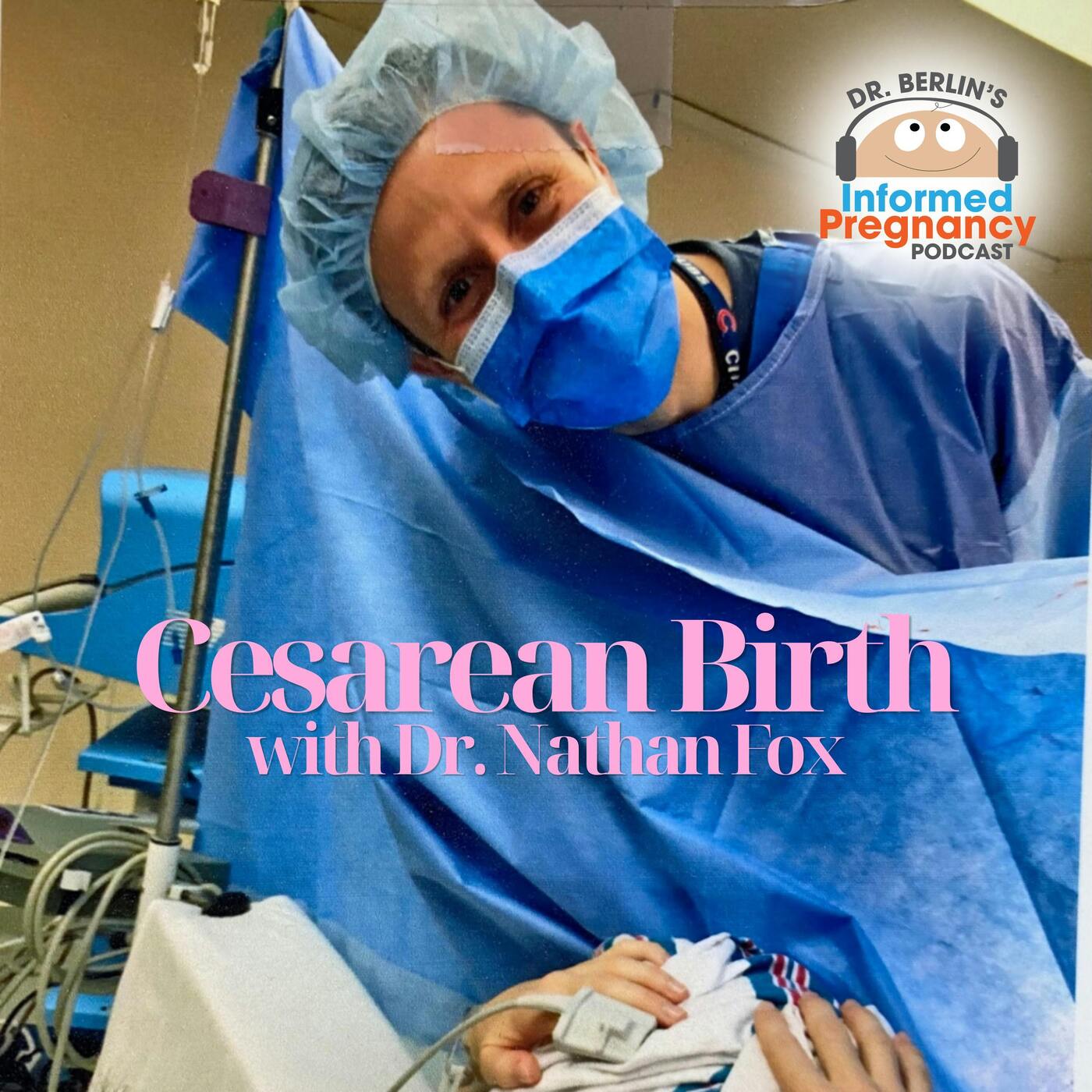
August 6, 2026 · 50 minutes · Episode 513
About this episode
Board certified obstetrician and maternal fetal medicine specialist Dr. Nathan Fox has made a career helping women navigate routine and high risk pregnancies, delivering thousands of babies and tackling the most complicated situations in obstetrics. He returns to the podcast to discuss cesarean section births including how and when the decision is made, common reasons for this type of birth, what happens in the operating room, and what recovery should look like.
Grow with us on IP+! Informed Pregnancy Media presents two all new intimate short-form video series following Garrett and HeHe’s real-time pregnancy journeys as they prepare for an empowered birth and postpartum experience. Each episode features weekly updates with personal photos and videos to help bring these raw stories to life, a visually dynamic guide through each mother’s emotional and physical experiences.
Keep up with Dr. Berlin and Informed Pregnancy Media online!
Learn more about your ad choices. Visit megaphone.fm/adchoices
See Privacy Policy at https://art19.com/privacy and California Privacy Notice at https://art19.com/privacy#do-not-sell-my-info.
Key quotes
“At the end of the day, what I tell people is the important thing is not what the C-section rate is, but are you under the care of someone or a group of people who are good doctors or midwives? Are they wise? Are they patient? Do they explain things well? And if that's the situation, if you need a C-section, you will feel confident that it was recommended for the right reasons and you're doing it, that it's an overall good decision.”
“it's major abdominal surgery, it's a bigger surgery than having your gallbladder out, it's a bigger surgery than having your appendix out, it's a bigger surgery than donating a kidney.”
“But a gentle c-section is, it's almost the default now where you're trying to make it as it's surgery, right? It's surgery, you can't get around it, like it's a major abdominal surgery, but to try to make the experience either as pleasant or as less unpleasant as possible.”
“And so what that means is I'll usually, you know, if she's okay with it, hold her hand, put my hand on her shoulder, talk to her, keep her focused, say, here's what's happening. Here's what's gonna happen.”
“So it has to be individualized to the person, just sort of the facts on the ground, but also people's wishes and their attitudes and their understanding is going to be different.”
Related episodes
- Ep. 505 Relinquishing Control with Parul Somani Part 1
- Ep. 514 Before Baby #4 with Kara Sutton
- Ep. 500 The Unexpected with Dr. Elliot Berlin Part 1
- Ep. 495 Postpartum with Amanda Nordelius & John Russell
Transcript
AI-generated transcript with speaker labels — may contain errors, especially names and medical terms. Dr. Elliot Berlin, DC appears in blue; Dr. Nathan Fox in orange.
Dr. Elliot Berlin, DC [0:00] My guest today is a board-certified obstetrician and maternal fetal medicine specialist who has spent decades caring for women through both routine and high-risk pregnancies. He's delivered thousands of babies, helped families navigate some of the most complicated situations in obstetrics, and is also the host of one of the most respected women's health podcasts in the country. Many of our listeners have heard him on our show before, where we've discussed topics like prenatal genetic testing, preeclampsia, thrombophilias, external cephalic version, and more. He has a unique ability to explain complex medical topics in a way that's practical, reassuring, and easy to understand.
[0:38] Today we're talking about cesarean birth. Nearly one out of every three babies in America is born by C-section, yet most parents don't learn much about them until they're suddenly facing one themselves. Sometimes that conversation happens weeks before delivery, sometimes it happens during labor, and sometimes it comes completely out of nowhere. What are the most common reasons someone needs a cesarean section? What choices can still be made once that decision is reached? What actually happens in the operating room? And perhaps, most importantly, what should recovery look like in the hours, days, weeks, and months afterwards? I'm pregnancy-focused chiropractor Dr. Elliott Berlin,
[1:19] and you're listening to the Informed Pregnancy Podcast. Dr. Nathan Fox, welcome back to the podcast.
Dr. Nathan Fox [1:40] It's great to be here. It's great to see you. You look terrific,
Dr. Elliot Berlin, DC [1:43] my friend. Welcome back. Thank you so much. You're welcome back anytime. Let's do another one tomorrow. My pleasure. What's going on? Nothing. It's always great to talk to you. You're one of the most refreshing guests because you're so knowledgeable and so calm. And as I said in the introduction, you have a really wonderful way of explaining things that will make a listener or a patient feel confident, heard, understood, and give them all the information they need to move forward in whatever choice they're trying to make in the best way. So today we're talking about C-sections. My understanding is you've done a few. I have, and I appreciate the intro. And
Dr. Nathan Fox [2:24] let's see how well I make people feel reassured when we're done. Maybe you're going to have a C-section. We talked about a VBAC,
Dr. Elliot Berlin, DC [2:32] vaginal birth after coronary artery surgery. We can do it. Thank you. So I'm extra interested in hearing what you have to say today. Okay. Before we talk about the surgery itself, let's talk about some reasons why someone would be recommended to have a cesarean versus vaginal birth. Yeah. So there's probably two buckets
Dr. Nathan Fox [2:53] of why someone would get recommended to have a C-section. And the second bucket has two buckets within it. So it's like one and then two A and two B. The first bucket is it's known before the due date or before labor or before the end of pregnancy that a C-section is preferred compared to even trying a vaginal delivery. So for example, something like a placenta previa where the placenta is blocking the cervix. And we know that that is life-threatening. If a woman were to labor with that, then so we recommend the C-section. Or for example, sometimes with breech babies, and we discussed this, that in the past we would deliver them vaginally and now most people deliver them by C-section. But that would be,
[3:41] for example, a reason why someone would recommend a cesarean without even laboring or trying to labor. There are other reasons on that list, but basically that's the first bucket where during the course of prenatal care or even going into pregnancy, it's known that for this particular person, for you, it's safer, we think, for you and the baby to have a C-section than it is to try to labor. And that's sort of like high-level bucket number one. Even if we don't talk them through in detail, what are a couple of the other things on that list? So there are certain prior surgeries one might have had, like certain fibroid removals like myomectomy or certain kinds of C-section, like a classical
[4:24] C-section or something like that, where it's not safe to be back. So those would be reasons. One of the controversial ones is if the baby's measuring very large, are you better off having a C-section or better off trying to deliver vaginally? So that itself is a complicated discussion, but it is possible that someone might recommend it. Sometimes if someone's having twins or triplets and they're not in the right position, they'll recommend a C-section for that reason. Those would probably be the main reasons.
Dr. Elliot Berlin, DC [4:52] Like STD, cord issues?
Dr. Nathan Fox [4:55] Cord issues, not so much unless there's something called the vasoprevia, which is pretty rare. That could be one reason. STDs, I mean, if someone has an STD, then they're probably going to recommend a C-section or a C-section or a C-section. herpes, we'll usually recommend a C-section to prevent the baby from getting it. It's unusual So that's one of the reasons. because, I mean, a lot of people have been exposed to genital herpes, but they have an active one at the time that you're in labor. And also, typically for those women, the plan is to deliver vaginally, but if at that time they coincidentally have an active herpes lesion, then we will, you know, recommend the C-section instead. But over the course of pregnancy,
[5:33] you wouldn't say to someone going into pregnancy, for example, who has a history of herpes, oh, you can't try to labor. We would say as long as you don't have an active lesion, you can labor. It's a different bucket. And then also a funic presentation. So that's where the cord is in front of the head. It's also pretty rare, and you wouldn't verify that again until the very end of pregnancy, because it can move out of the way, even in early labor can move out of the way. So again, that wouldn't be one where we would necessarily be talking about it for weeks and weeks, but maybe that's between the
Dr. Elliot Berlin, DC [6:05] buckets, I would say. Okay. Maybe three more between the buckets would be, because I guess depends where and to the degree, but is C-section on the table as an option for early preeclampsia, for colostasis, for IUGR? So, you know, generally it depends on the
Dr. Nathan Fox [6:24] circumstances, meaning if someone needs to be delivered early for a medical reason, and then there's a decision, is it better to induce your labor or do a C-section? There might be a reason where you would say a C-section is better, although generally, for all those reasons, you could induce labor. Sometimes if there is growth restriction and the baby's in real dire straits, and we don't think the baby's going to tolerate labor, then we might say it's not worth trying. But again, if someone has colostasis, it's not like the plan is, oh, therefore you need a C-section. It might turn into a situation where you need one, but I would say that's the exception. Okay. More buckets. So the other big
[7:02] bucket is someone who is in the process of trying to deliver vaginally, where we say, hey, we need to change plans, and now the better plan is to do a C-section. The reason I said there's two A and two B is because there's sort of two general reasons why for someone in labor we might say, hey, I think we should switch plans. The first one, and both of them have a lot of gray to them, right? And there's a lot of art in determining if it's happening or not. And the first one is related to concerns over the baby. For example, things like with fetal heart rate monitoring, or we're concerned that somehow the baby's not going to tolerate the labor and is going to somehow get harmed during labor. So that's a
[7:43] reason why it might be recommended. Part of the reason it's very complex is because interpreting fetal heart rate monitoring and making that determination is difficult and notorious that we're going to recommend more C-sections than are necessary because we don't always know which of these, let's say I'm making these numbers up, but let's say for every 10 C-sections I recommend in labor for that reason, only one of the babies truly, truly needed it. Meaning had we let them all labor, nine would have been fine and one would not have been. Again, I'm making these numbers up, but it's hard to know which one of those 10. So sort of what's your threshold? At what point of concern do I need to be in order
[8:27] to recommend the C-section is a complicated topic, varies from doctor to doctor, and this is part of the reason we spend years training to do it in a way where we are recommending it enough that babies don't get harmed, but not recommending it too much that we're doing C-sections and everybody. And that is a very tough balance. And that's sort of like the first of those two buckets. And the second of those two buckets is related to a concept where if the labor is taking too long, one of the words is protracted, one of the words is stalled, one of the words is arrested. Like some sort of labor dystocia is another word for it, where basically the labor is taking so long and is moving so slowly or hasn't progressed
[9:10] that at a certain point we're like, hey, maybe it's safer not to proceed indefinitely and to do a C-section instead. And again, that's also very great because what is that? What is the number for that? How much time do you wait? It depends on a lot of factors. There's a lot of different interpretation to that. I mean, if you wait forever, all the babies are going to come out vaginally, but if it's going to take four to five days, it may not be the safest thing for the mother and the baby. And how do you make that determination? When do you make that determination? Sort of where are the areas we can give back and forth? And that again, takes years and years of training and
[9:45] experience to do it in a way where you're trying to recommend it enough that you're keeping everyone well, but not recommending it too much that you're doing a C-section for everyone. I can see that being a very difficult balance and also very different from patient to
Dr. Elliot Berlin, DC [10:01] patient, taking into account their input as well.
Dr. Nathan Fox [10:05] Yeah. All of those situations require input because different people have different, number one, they themselves are situations different. Every fetal heart rate monitor tracing is different. Every labor curve is different. Every human body is different. Every baby is different. Like all of these things are different. So it has to be individualized to the person, just sort of the facts on the ground, but also people's wishes and their attitudes and their understanding is going to be different. And some people might have a very low threshold and say, Hey, I don't want to take any risk whatsoever. If there's any blip in the radar, let's just do a C-section.
[10:41] And other people are like, Hey, I really want to push it as far to the line as you can go because I really, really want that vaginal birth. And maybe I'm willing to take a little bit of extra risk compared to the woman next door. And that's fair, right? And so you have to sort of work with people, you know, try not to let them make decisions that are going to get them harmed, but there's definitely leeway in both of those decisions to try to talk to people and come to an understanding that everyone's comfortable with.
Dr. Elliot Berlin, DC [11:07] During my doula days, I've had more than one occasion where I had a client in labor and things would take taking a while, but you could see on the monitor the other two tracings of patients that that nurse was caring for so that she can see, you know, her other clients when she's in another room. And I've had people be like, you know, turn it competitive. Wow, look at those contractions. I'm going to pull ahead. I'm going to get this baby out for you. Yeah, I don't know what sparked me to think that, but okay, one in three is roughly the cesarean rate currently in the United States. Do you think that is a healthy number? Should we strive for higher or lower,
[11:50] or is that a good place to be?
Dr. Nathan Fox [11:53] So I don't know is the right answer. And I think that there's a lot of talk about how many C-sections are being done. A lot of people say it's too many. The problem is that may or may not be true. The problem is no one knows what the right number is. I mean, if you look at places around the world that have very, very low C-section rates, they have actually high infant morbidity and mortality. Meaning there is some number of C-sections you should be doing in order to maximize health for the newborns, right? That's at the expense of doing C-section on the mother, obviously, which is a trade-off. But what is the upper limit of normal? Like what should it be?
[12:38] We don't know. People give all these numbers out and they say this is good, this is good, but it's not based on solid science. That's number one. Number two, you have to be very particular what you're talking about. So the overall C-section rate in a population is also gonna be related to the risks of that population. So for example, people ask me like in my practice, what's my C-section rate? First of all, I don't know. Second of all, it might be different because I take care of maybe women who are on average older and there's a higher risk of C-section as you get older or maybe they're more likely to have prior C-sections or medical problems or issues with the baby
[13:14] as compared to someone who takes care of only young, healthy, multiparous patients where their C-section rate is gonna be very, very low. So does that mean that I practice differently from the other doctor? No, we just have different groups of patients who come to see us and so C-section rates will vary a lot based on the population being looked at. So one of the things that has been sort of created to try to level the playing field is something called an NTSV, which is an acronym for Noliparis, first baby. T is for terms, so full term. S is for singletons, so not twins. And V is for vertex, meaning head down. So you take what is your C-section rate
[13:56] in first time moms who are full term with a head down baby. And to say, okay, that's sort of like trying to compare apples to apples. And people have talked about what the C-section rate should be in that population. And people say the goal is somewhere in the 20 to 25% range, but again, I don't know, is that the right number? Should it be lower? Should it be higher? I'm not really sure. At the end of the day, what I tell people is the important thing is not what the C-section rate is, but are you under the care of someone or a group of people who are good doctors or midwives? Are they wise? Are they patient? Do they explain things well? And if that's the situation,
[14:40] if you need a C-section, you will feel confident that it was recommended for the right reasons and you're doing it, that it's an overall good decision. Versus if you're under the care of someone who you don't feel as wise or don't feel as patient or don't feel they really know what they're doing, then no matter what happens when they recommend a C-section, you're always gonna second guess, was it the right reason? Was it appropriate? Did I not need it? on an individual level, that's the more important thing, that if people end up needing a C-section, they feel that it was done for the right reason, and they were comfortable with it, and they were part of that decision. And so there's no regret over it. They feel like this
Dr. Elliot Berlin, DC [15:19] was the right thing for me personally. I think that's a really smart way to look at it. And I might add one piece, which is, are they on the same page with you in terms of important things? So you could have a very wise doctor, but a doctor is a person too, and they also have decisions to make, and there are certain things that are in their comfort zone and feel like doing that is going to be giving good care, and doing something else is not going to be giving their best care. And also certain things liability-wise that they may be comfortable or not comfortable doing. And that doesn't make them a better or worse doctor, but it might make them a better
[15:53] or worse fit for you. So all the things that you said, plus that. I'm going to take a little Welcome back. We're talking to Dr. Nathan Fox and getting great information about cesarean birth. Okay, so someone is going to have a c-section. Maybe they have months of warning and notice and time to think about it. Maybe it's happening in the moment. Are there specific decisions they can still make as to how the cesarean is done? Are there choices and options or is it one size fits all? Yeah, there are choices and options
Dr. Nathan Fox [18:07] potentially. A lot of this is going to vary based on who's the doctor doing the c-section, what hospital. Is it scheduled versus emergent in nature? And there's a whole wider range of things in between that. So some of those things will depend. If you know you're going to be having a c-section, if you're in that bucket number one, these are things you can discuss in advance, obviously. Or even if not, because you might end up in bucket number two because you don't know, these are things you can discuss in advance. And just to touch on something you said at the end of the last segment about being on the same page as the person taking care of you, I think the conversations like this are best had earlier
[18:51] in pregnancy. I mean, finding a doctor, I tell people it's like dating, right? Like you could be a good person, the other one could be a good person, and you sit at dinner together and you talk and you're like, we're not a good fit for each other, right? God bless, good luck to you. You'll find someone and do well. The same is true with doctors, right? You could have a great person who's a patient and a great person who's a doctor, and they're not a good fit for each other. Or you may be surprised that someone is a good fit for you. And these are things you sort of find out just the same way you'd find out in dating. You talk to the person, you listen to the person, you get a good sense, are we a good
[19:23] fit? And assuming you think they're a good fit, you can ask questions about this. Hey, what does happen for C-section with you? Do I have choices? Things like that. So if you know you have a scheduled C-section, one of the choices might be, when am I doing it? What day of the week am I doing it on? Am I doing it in the morning, in the afternoon, the evening? Who is the doctor? Who's going to operate on me? Sometimes these are options that are available to you. Who's going to come in the operating room with me? Right? Do I want it to be my spouse, my partner? Do I not want it to be that person? Are they going to pass out and I'd rather have my sister come in with me or my doula come in with me or whoever it
[20:00] is? Is there an option for how many people can come in with you? Are you limited to one person? Can you have two? Can I play music? So can I play my own? Can I wear headphones? Do I have to wear a hospital gown? I mean, there's all these types of things that you can ask about sort of going into the room. Once you're in the room, typically things go pretty, for the most part, according to protocol, because we're trying to do it in a way that's safe, that's sterile, minimizes the risk of bleeding and infection. And that's why you sort of limit certain variation in how we operate. There are some things that might be available, like in our hospital, there's an option for like, they can drop the drape, or there's like a
[20:46] clear drape, so that if you want to see the baby coming out of your belly, you can. Other people don't want to do that. And there's an option for sometimes the anesthesiologist to put the heart monitor stickers on your back instead of on your front if you want, you know, less wires on your front. There are some cool, I've never heard of that. Yeah, there's a concept, I don't know, something called the gentle c-section. Have you heard of this? Yes. Yeah. So in our practice, I say if you want, you can have certain doctors deliver you the non-Jewish ones, and then it'll be a Gentile c-section. But a gentle c-section is, it's almost the default now where you're trying to make it as
[21:24] it's surgery, right? It's surgery, you can't get around it, like it's a major abdominal surgery, but to try to make the experience either as pleasant or as less unpleasant as possible. And so giving people some of the experience of a vaginal birth, seeing the baby, trying to get the baby on them like you would in a vaginal birth, maybe even if their arms are available to have them hold the baby a little bit. Certainly, if they're not up to holding a baby while they're having surgery on them to just have the baby nestled up against them, or if the partner's there, the partner can hold the baby. And these are generally available to people unless obviously there's a concern with the baby and the pediatricians are
[22:03] working with the baby, but generally those things are available. For the majority of people having a c-section, the anesthesia is going to be such that you're awake, right? It's a spinal or epidural. And so being awake gives you the opportunity to ask questions while it's happening. Is everything okay? What are you doing right now? What step are you on? And most of the surgeons are very comfortable talking to the patients during the operation. Obviously, if I have to focus on something and concentrate, I'll say, hey, listen, I need a couple of minutes. I'm, you know, I'm very focused here, but otherwise we're happy to talk and answer questions that people have. It also gives people an opportunity to hear the
[22:37] baby, to hear the cry and to see the baby, right? Whereas if you're under general anesthesia, you're put to sleep. You don't have those memories and experiences, which most people
Dr. Elliot Berlin, DC [22:46] obviously really cherish afterwards. It's a weird surgery because you're generally awake for it. And so it's got to be a surreal feeling to have your belly cut open and have your baby pulled out while you're awake. It's also surreal for the doctor because we

Dr. Nathan Fox [23:03] don't normally operate on people who are awake, right? That's true. It's one of the things where I always, when I'm outside and I'm scrubbing, if there's a med student, I'll always say to them, like, have you been in a C-section before? And I'll feel like, remember, they're awake, right? Like the things we say, they hear. So you don't say things like, whoa, never seen that before. Or like, oops, like there's things you just don't say, you know, during a C-section, you have to be very, very careful because they're there with you, right? They're present in the room and fully alert and awake and have a partner with them. And so it's just a different tone in the room. It's nice,
Dr. Elliot Berlin, DC [23:40] actually. It's quite pleasant. I want to spend the rest of this segment talking about what actually happens during a cesarean to better prepare someone who might go through it. First of all, the people in the room, who's in the room from the medical side?
Dr. Nathan Fox [23:56] The way we do it is there's two surgeons, at least sometimes a third person. If maybe there's a learner, like a med student or a resident or something like that, someone like that, excuse me. So there's at least two surgeons. There's at least one anesthesiologist, sometimes two. There is someone called a scrub tech, who is the person who scrubs it on the operation and helps us like hands us the instruments and takes them back from us. There's usually someone called a circulator nurse. That's a nurse who is in the room, not scrub, that like helps get things and sets things up and helps with the suction and sort of manning the room, so to speak. Then there's frequently another person
[24:36] or set of people there for the baby, whether that's a nurse, a pediatrician, or a combination of the two depends on the circumstances. That tends to be it on a routine basis. In the operating room, there may be more people if more people are needed, but there's more than one baby coming out. There might be more people for the babies, obviously. So those are the people in the room, plus obviously the patient herself, plus the person who's with her and if they allow two people, maybe two people with her. And possibly allow one person with you.
Dr. Elliot Berlin, DC [25:06] separate the patient from their partner for prep. Is that something you do too?
Dr. Nathan Fox [25:11] We wait until we're ready to start. And the reason is, number one, we don't like someone in the room when they're placing the spine over a epidural because that's the time where people can get loosey and pass out and we don't want two patients, we just want one. And then number two, when we're getting people prepped, it's very disconcerting to see a loved one lying on an operating room table. You know, they're not fully clothed, they're lying there, the room is kind of scary. And so we like to get everything set up and prepped with all the drapes on. And so basically the patient is completely covered except, I don't know, from her chest and up
[25:45] and her arms. And so it's not as frightening to see a loved one in that circumstance. Similarly, if someone's having general anesthesia and they're asleep, we usually don't let someone in the room with them and that is very scary to see, to see a loved one with a tube in their throat and, you know, on a machine, it's just understandably freaks people out. And so that's not really the best situation to have someone in the room with you. And so we wait until everything's ready to go and then we usually bring a partner in before we start.
Dr. Elliot Berlin, DC [26:12] From feedback from our patients on the other side of that coin, some of them don't want their partner in the room during that time where they are, you know, maybe vulnerable and comfortable. And other ones actually would much more prefer to have their partner with them during that time just to have support during what is the precursor to their potentially, you know, scary event, all the prep that's happening. Oftentimes we do get that feedback. Man, I don't know why they kicked my partner out. That's when I needed them the most.
Dr. Nathan Fox [26:44] Yeah, I think that's fair. There are logistical reasons also because we're trying to get the field to a sterile field and they'd have to sort of sit in the corner and this and so I think that's a fair feedback and criticism, but there are legitimate reasons for it. What I try to do personally to mitigate that is, you know, while all the people are doing the setup, usually I assign one person to sort of act as the surrogate partner, so to speak. Frequently it's just me, right? I'll let everyone else do all the work. And so what that means is I'll usually, you know, if she's okay with it, hold her hand, put my hand on her shoulder, talk to her, keep her focused, say, here's what's happening.
[27:22] Here's what's gonna happen. When she's getting her spinal epidural if it wasn't in place, I'm usually the one who she leans on, you know, and I hold her while she's having it done just so no one feels alone during that time period. Again, I'm a lousy substitute for someone's loved one, but I'm better than nobody, I would say. And so just to keep people, you know, calm and comfortable and I think they appreciate that it's one of the surgeons and I can answer questions for them and always reassure them, we're taking good care of you, everything's going fine, your baby's good, you're good. And so to try to mitigate that so people don't feel A, alone,
[27:57] or B, that they're just being sort of manhandled, you know, like they don't count or anything like that, which is an understandable feeling people could get.
Dr. Elliot Berlin, DC [28:04] First person perspective on my surgery three months ago, the team in there was incredible at helping me feel calm and relaxed going into surgery. Of course, I got to go to sleep, which is one of my favorite things anyway, so.
Dr. Nathan Fox [28:20] Now, you know, my experience, the kindest thing and most effective thing you could do to someone before they go to sleep is right before they go to sleep, you hold their hand and you say, we're gonna take really good care of you, you're gonna be okay. That is a very reassuring thing for people rather than just you're awake, you're asleep.
Dr. Elliot Berlin, DC [28:35] It's very comforting and just very human and very helpful. Okay, you mentioned two different kinds of anesthesia, the spinal and the epidural, what's the difference?
Dr. Nathan Fox [28:46] From the patient end, very little. In both situations, you're sort of hunched over and they're putting a needle in your back first to numb up the skin and then they, after that's numbed up, they sort of push a longer needle into your back. That part doesn't hurt like sharp pain, it's just pressure and then in the spinal, it goes directly into the spinal cord, they inject medicine and then they pull everything out. Gives you a very dense block for two to four hours or something like that and it's enough to do surgery. We do C-sections with it. An epidural is what people get in labor where they sort of stop the needle before the spinal cord and then they thread a catheter in
[29:23] and so the catheter sits just outside the spinal cord and sort of bathes the spinal cord in numbing medicine. That takes a little bit more time to gear up and to get very numb but it can last for much longer. You can leave that in for days. So that's why we use it in labor because it can last for a very, very long time. For a C-section, usually people would choose an epidural either because they already had one in labor so they use that or if we think the C-section might take a longer time than an hour or two. The anesthesiologists will usually leave in an epidural and if someone's having a very complicated C-section they think it's gonna take three or four hours,
[29:59] usually they'll leave an epidural in. But from the patient's side, you wouldn't be able to tell which one.
Dr. Elliot Berlin, DC [30:05] getting. They feel the same experience-wise. Right. I guess seemingly with the epidural, you also have more choices if you want to increase or decrease? In labor, yes. For a C-section, you don't want to decrease. You want to be fully numb. Full stop. Okay. Yeah. Which is
Dr. Nathan Fox [30:19] interesting though, because when I say fully numb, you don't feel pain. One of the weird things people experience during a C-section is you still feel us touching you. You feel touching, you feel pulling, you feel pressure, as if someone's pinching your skin and pulling it left and right and up and down, but you don't feel sharp pains. People describe a very strange experience. If anyone's ever had a cut on their arm and they get stitches, it's the same thing. You see them sticking a needle in your skin and sewing up your skin, and it's weird, and you feel it, but it doesn't hurt. I've never had a C-section done to me, but that's what people describe to me, how I would describe it back. It's that concept.
[31:00] You still feel touch. You know something's happening, but it doesn't hurt.
Dr. Elliot Berlin, DC [31:04] Right. That's how they describe it to me as well. Tugging and pulling, but the mind can run away with that because you know what's really happening. They sometimes feel like, I'm going to feel like I'm getting cut open, but they never do. Speaking of which, they're all numb and ready to go. What is happening mechanically? What do you do?
Dr. Nathan Fox [31:27] Basically, we're making an incision in the belly and the skin. Most often, that incision is low down and what we call transverse, which is side to side. Usually, it's around just under where the top of someone's underwear would sit, like their bikini line, we call it, maybe the top of the hairline. That incision, we make with a knife or what we call a scalpel. Then from there, there's several layers in one's body in order to get to the uterus. There's always fat under the skin. Even if you're skinny, there's fat under the skin. Then we get to something what we call a fascia, which is basically like a canvas, like a rough canvas that holds everyone's belly in place. We cut
[32:07] through that. Then underneath that are the muscles, like your belly muscles, your abs that we have to separate. Then once we do that- You said separate, but not cut? You do to separate them. If they're not already separated, a lot of people have that in pregnancy, you will cut them to separate them. That cut on the muscles is made up and down so that the muscles fall apart to your left and to your right. Are these the rectus muscles? Correct, that's correct. Okay, so my six pack. Yeah, your six pack becomes two, three packs basically. Then underneath that is something called the peritoneum, which is a very fine saran wrap layer around your belly. Then we open
[32:44] that and then we're looking at your uterus. How long would you say that takes? Five to 10 minutes if it's your first C-section, pretty quick. If it's not your first C-section, it could be longer, could be much longer in theory, but usually five to 10 minutes. Because of scar tissue? Yeah, because of scar tissue. Then once we see the uterus, we're going to make an incision on the uterus. Again, most often that incision is also going to be low down on the uterus side to side. We call that a low transverse incision. That's the kind of incision where one could potentially V back afterwards versus if for some reason we had to make an incision up down on the uterus, what we call a classical incision. That is something,
[33:26] the type of incision where someone could not V back afterwards. Again, that's a rare type of incision, but occasionally it has to be done. And then the incision on the uterus, and then right after that, we basically make it wide enough and deliver the baby through that incision.
Dr. Elliot Berlin, DC [33:40] Do you break the water with your scope?
Dr. Nathan Fox [33:42] Yeah. So after you go through the uterus, there's another bag of water inside the uterus that we break that water bag. And then the baby comes out, we clamp and cut the cord. And then the baby usually goes to the nurse or pediatricians first, and then hopefully soon thereafter to the parents. And then after that, the patient, they're usually focused on the baby. And then that's when we start working quickly. We have to take the placenta out, stop the bleeding, close the uterus up. Once the uterus is closed up, then we can more take our time again, because the bleeding is usually stopped or slowed down significantly by that point.
Dr. Elliot Berlin, DC [34:15] How do you not accidentally cut the baby?
Dr. Nathan Fox [34:19] We do not accidentally cut the baby. It does happen from time to time that the baby will get a cut. It's rare. It does happen. It's more common in emergency C-sections, or if the uterus is very, very thin. It's obviously something we try to avoid 100% of the time. When it does happen, the babies tend to be fine. They either get a little bandaid or rarely, I mean, rarely they would need stitches, but that's extremely, extremely rare. Usually it's just a very like scratch. Again, it's always rare, but when it happens, it's usually not such a horrible thing for the baby. And then for us, then we just have to go backwards steps and close either all of the layers we opened, and different people do it
[34:58] differently. Some people just close some of the layers they opened and let others close on their own. I'm a little bit more old school over. close you mean with stitches? Yeah so like I sew the peritoneum, not everyone does that. I sew the muscles back together, not everybody does that. And those stitches dissolve? All the stitches internally dissolve, correct. And then when we get back to the skin layer, different people do it differently. Some people close the skin with these surgical staples that stay in for like four to five days and then get removed in the office. A lot of people, myself included, close the skin with absorbable sutures that don't need to be removed and they just stay in and dissolve on their own. Start to
[35:42] finish I tell people c-section is 30 to 60 minutes. It'll feel a lot longer because there's prep time in the room there's cleaning up afterwards so for loved ones in a waiting room somewhere I tell them expect it to be two plus hours but the actual surgical time is probably 30 to 60 minutes. I have a couple more questions for this segment. Number one, do you take the uterus out? So there is something to call exteriorize the uterus where after the baby is born in order to close the uterus you can just leave it inside the body and close it. Sometimes you can pull out the top of the uterus so it sits on the mom's belly and then close it that way. I've done it both ways it sort of depends on the anatomy
[36:23] which way's easier. That is something that people do not want to see themselves, the uterus sitting on their belly, but for the med students it's pretty cool to see to see an organ sitting outside someone's body. As long as they don't comment on it. Yeah we do put it back in. That would be a big miss not to do that.
Dr. Elliot Berlin, DC [36:41] Are there different types of stitching for the uterus and is one or the other better for future pregnancies or the hope of a vaginal birth?
Dr. Nathan Fox [36:51] The main thing that people talk about is doing one layer or two layers where you either close the uterus in sort of one running stitch or you do it in one and then a second. The data on that is weak. I think some of the data suggests that if you do a two layer closure it sort of heals a little bit stronger and makes the chance of V-back or a safe V-back better. Whether that's actually true probably depends a lot on how people do their one layer closure and how people do their two layer closure. It's hard to study surgical technique in a real comprehensive way because each surgeon is going to do it slightly different and may have different skills and so you can compare people who had one layer to two layer but
[37:33] it's hard to control for who their surgeon was. So I typically close with two layers not 100% of the time but that's sort of my default. I don't know if that's what most people do in the country. I think yes but I don't know that to be a true fact.
Dr. Elliot Berlin, DC [37:45] You're pretty thorough with the stitching. Old people tend to sew more but even when I was
Dr. Nathan Fox [37:52] young that's how I was trained to do it also. I was trained by old people I guess.
Dr. Elliot Berlin, DC [37:56] All right two more quick questions on this segment. They're both about choice. One is some people want delayed cord clamping. They kind of want as much of the blood from the placenta to get into the baby before you clamp the cord. Is that an option for c-section?
Dr. Nathan Fox [38:12] Generally yes. It depends on how the baby's doing, how much bleeding is going on and things like that. Delayed cord clamping, there's good data that it's helpful in pre-term babies and full-term babies the data is not as strong meaning for most full-term babies it doesn't really matter and so it's just sort of what I found is for most people it's just something that someone told them they should do or they found online but is it-
Dr. Elliot Berlin, DC [38:35] Some podcast.
Dr. Nathan Fox [38:37] Yeah whatever. I mean for pre-term babies there's good data to support that it helps them it lowers the chance of anemia things like that for full-term babies it's fine like whatever but it's it's probably not as as valuable in that sense but we do it if people want it and we try to do it as sort of a routine at c-section again there's other variables compared to vaginal delivery like how much bleeding is she having how's the baby doing that sometimes limits our ability to do it for a long time but we try to do it as long as we can if that's what the parents want.
Dr. Elliot Berlin, DC [39:05] Last procedural question. Do you strap down arms and legs and if so is it all of them or is there a choice there as well?
Dr. Nathan Fox [39:14] For legs we do strap them down because people have no control over their legs they're completely numb and we don't want them sort of falling off the table like slipping and so the legs we definitely strap down the arms for c-sections at least in our situation we do not strap the arms down that's really meant for people who are asleep the reason people's arms get strapped down in surgery is mostly because they're asleep and you don't want their arm just like slipping off the board and like dangling off the side of the table so you sort of secure them but for people who are awake that's obviously a pretty scary thing to be tied down for surgery obviously so we don't do that
[39:51] in our hospital people's arms are free they do lie them out like out to the side like in t-position just because you know there's an ivy in there and there's a thing and we need access but they can move their arms freely typically during a c-section when they're awake if they were
Dr. Elliot Berlin, DC [40:08] Makes sense. All right, let's take a quick break. When we come back, we'll talk about recovery from a cesarean birth. Welcome back. We're talking to Dr. Nathan Fox, very valuable, helpful information doc. I think one of the things that I hear feedback wise is I have the C-section and then my doctor is like, I'll see you in six weeks and there's not a ton of information about how to recover from this surgery. It's a very common surgery. It's a very safe surgery but it's also like an abdominal surgery and I think for some reason when you have other types of abdominal surgery, there's a lot more instruction on how to take care of yourself and a lot of people rally around you but in this case everybody's like
[40:59] focused on the baby. What is recovery like? What should someone expect to feel? What restrictions are there in the few days after the cesarean and the weeks and months to follow?
Dr. Nathan Fox [41:12] Yeah, so a few things. The reason we don't normally see people for six weeks is not because it's more convenient for us, it's because it's more convenient for the patients. Meaning most people would prefer not to have to schlep into their doctor's office, particularly if they have a newborn unless they have to. So we usually, we want to see everyone in six weeks and what I tell people is if you need to be seen between zero and six weeks, we'll see you the same day. We used to see everyone in two weeks and we realized that was a waste of time because they'd come in, they'd schlep in, they're in pain or come to our office and would say, you're good, go home and they'd
[41:43] be like, what the hell, why did I come in for this? So that's why we see people six weeks. You know, recovery from a c-section, again full disclosure, I've never had a c-section. I have a wife who's had a c-section, I have a daughter who's had a c-section, I have many patients who've had c-section, so I have some understanding of it although I won't say I've experienced it. It is a balance between on the one hand, it is a common operation, it is a safe operation and people typically recover well and do perfectly fine on the one hand and on the other hand, it's like you got hit by a truck and I think that you're correct that sometimes that part is not properly advertised to people. Having a c-section is no joke,
[42:23] it's major abdominal surgery, it's a bigger surgery than having your gallbladder out, it's a bigger surgery than having your appendix out, it's a bigger surgery than donating a kidney. It is a major abdominal surgery and it hurts afterwards and so I think that for most people, the recovery, what I tell them is the first two weeks are rough, predominantly for pain and after two weeks, you'll usually feel around 80-ish percent of who you were beforehand, 80, 90, 70, somewhere in that range. Maybe you feel pretty good, you could get out of the house, you could go somewhere but you don't feel normal. It takes two months to feel normal. Some people are blessed and they feel normal at five weeks, other people it takes 12 weeks but
[43:10] I tell people expect it to be two months till you feel normal and during those first two weeks, again, the primary issue is pain and as you said, not only recovering from surgery, you have a newborn. Most people who have surgery aren't saying, oh, by the way, take care of this newborn, feed this kid every three hours, don't sleep, don't eat. It's very, very hard. Because of that, people will often require more help than they might otherwise, whether that's family, friends, whether that's hired help, whether that's professional help, lactation consultants or whoever it might be but people, there's no shame in needing help after a C-section for yourself or for taking care of your baby.
[43:52] People should take the pain medicines that they need in order to be as functional as possible. By functional, get out of bed, take a shower, go to the bathroom, be able to feed yourself, stuff like that. It's hard to take enough pain medicine that you have no pain but you want to do that and you're balancing because the stronger pain medicines like narcotics, people are worried that they're going to get addicted which doesn't happen much after C-section fortunately but also they have side effects. They make people drowsy, they make people constipated, they make people nauseous so we try to get people off narcotics as soon as we can without them suffering and then focus a lot on things like NSAIDs like ibuprofen which is
[44:31] Motrin or Advil and Tylenol and so that happens. People are off narcotics somewhere between two and seven days after a C-section I would say and then they're on the Tylenol, Motrin for usually a couple of weeks, give or take. It increases with time, people can usually shower after a day or two which feels delightful for Motrin.
Dr. Elliot Berlin, DC [44:53] Yeah, let's go back because the first few days are usually in the hospital after a C-section.
Dr. Nathan Fox [44:57] Yeah, two to four days, yeah.
Dr. Elliot Berlin, DC [44:59] Two to four days. How soon till they can get up and start walking around?
Dr. Nathan Fox [45:03] Either the same day or the next day.
Dr. Elliot Berlin, DC [45:06] Okay. And then shower, you say, maybe a day or two later as well?
Dr. Nathan Fox [45:11] Yeah, we usually let people shower the next day. They have to be able to stand, obviously, unless there's a seat in the shower, and then there's some issues with the wound. But usually after 24 hours, we're okay with the wound getting wet.
Dr. Elliot Berlin, DC [45:22] What do they do, instructions for when they get home, for the wound itself, but also limitations, like you talked about taking care of a newborn, can they bend, lift, hold, and feed the newborn, or are there modifications?
Dr. Nathan Fox [45:34] For the wound, we generally, there are fortunately not a lot of instructions. By the time they go home, there's usually nothing covering the wound except for maybe these little pieces of tape we call starry strips. Some people use glue. Again, if you had staples, the surgeon's gonna wanna take them out at some point, but if you went home with stitches, like we do it, you don't have to do anything. I tell people you can shower, it can get wet, soap can get on it. Don't scrub it, not like anyone would, and then just pat dry it with a towel. It does not need to be covered. I tell people New York City Air has all you need to heal this thing. Maybe where you are, California air is good.
[46:10] And then after about two weeks, we tell people they could pull the little pieces of tape off, and again, everything else is out. So there's no, I say no potions, no lotions. There's nothing you need on the wound afterwards.
Dr. Elliot Berlin, DC [46:20] So not a fan of silicone?
Dr. Nathan Fox [46:22] It's not that I'm not a fan. I don't recommend it routinely. Someone wants to do it, they can, but I don't know if it makes it any better. They usually heal pretty good. The wound, they're low down in the belly, they're across. They tend to heal nicely. Some people keloid in general, but the wound usually looks pretty good afterwards. In terms of restrictions, we tell people after all births, not just the C-section, usually don't have sex for X amount of time. Not like most people after C-section are clamoring to have sex sooner after. In terms of activities, we tell them not to lift anything too heavy. They can lift their baby, their baby bag,
[46:55] things like that, but nothing crazy. Not to do anything that hurts, right? And I tell them for activity to start slow, like they could start with walking, and as long as what they're doing doesn't hurt them that much, then it's generally safe. So people start with walking, and once they can do walks, they do long walks, and then they do longer walks. Most people are not hitting the gym in the first four to six weeks after a C-section. That's pretty unusual.
Dr. Elliot Berlin, DC [47:19] What about picking up the baby?
Dr. Nathan Fox [47:22] Picking up the baby's fine. Nothing's gonna happen if they pick up the baby. And the concern is not that the wound is gonna blow open if they lift something. It's just, it's gonna hurt, and this, and we don't want people to suffer. And so we tell them to try to increase their activities slowly.
Dr. Elliot Berlin, DC [47:38] Right, but sometimes they also have a toddler who's gonna be one to pick up the baby.
Dr. Nathan Fox [47:42] Yeah, you have to sort of see how you feel. Sometimes you don't have a choice. Sometimes you can sit and let the toddler sit on your lap, but you have to be careful they're not kicking you in the belly because it'll just hurt. Again, they're not gonna do anything to you that's gonna harm you. It can be very painful, and you don't want to do something that's gonna end up causing a lot of pain.
Dr. Elliot Berlin, DC [47:58] Okay, is there anything specific to do if they're hoping to have a vaginal birth in the future, or does it really matter?
Dr. Nathan Fox [48:05] There's some evidence that they should wait a certain amount of time to let the uterus heal. Exactly how much time that is is debatable. For most people, as long as you wait like nine to 12 months before getting pregnant again, that's usually fine. Most people are not timing their kids closer than that, but if they were thinking of it, it's something they want to talk to their doctors about particularly if they had a C-section because sometimes doctors will let them be back if it's after X amount of time, but not let them if it's within a certain amount of time. So again, on average, I would say most people are not getting pregnant within the first nine months of their baby being born,
[48:40] in which case that timing is fine, in my opinion. If you're thinking about doing it earlier than that and you're planning on being back, I would definitely speak to your doctor first.
Dr. Elliot Berlin, DC [48:48] Are there any restrictions on driving
Dr. Nathan Fox [48:50] right after they get home? I usually tell people if you're on narcotics, you shouldn't be driving. I usually tell people it's not wise to drive for the first couple of weeks, just because if you get like a bout of pain, it can affect, you know, you're driving, maybe you're gonna turn the wheel, or sometimes your reaction time is slow after surgery. So I tell people usually the first two weeks, it's better to have someone drive you. That's not a hard rule. There's probably someone who's okay to drive it 13 days and someone who's not okay to drive it three weeks, but that's sort of like as my baseline, it's probably not wise to drive in the first two weeks.
Dr. Elliot Berlin, DC [49:21] Do you recommend an abdominal binder?
Dr. Nathan Fox [49:24] Only if it makes someone feel better. It doesn't always. Not necessarily, it doesn't always. Some people, they feel better with it. Some people, they feel worse with it, but it's enough. One day.
Dr. Elliot Berlin, DC [49:31] I will have a long conversation with you about all the work we do for cesarean scar remediation and low level laser therapy and also manual work. But I don't wanna take up any more of your time today. You've been very generous with both your time and as I said at the beginning, you're really explaining things in a wonderful way. Certainly people who listen to this episode all the way to this point are gonna want more. Dr. Nathan Fox, where can we find you online? And tell me just very briefly about your podcast.
Dr. Nathan Fox [50:02] Yes, so you can find me on… I guess my practice website, mfmnyc.com. Probably the better place to go is our podcast, which is called The Healthful Woman, W-O-M-A-N. We also have a website, healthfullwoman.com. We've done hundreds of podcasts, like you were in the same space, and I think there's a lot of overlap in our philosophies, and I think a lot of people who enjoy your podcast will probably enjoy mine, and vice versa. And yeah, or otherwise just, you know, walk around the upper east side of Manhattan and look for the guy with the Cubs' backpack, and you'll find me.
Dr. Elliot Berlin, DC [50:39] And you also just recently co-wrote a book.
Dr. Nathan Fox [50:42] Yes, Emily Ostroni co-wrote a book called The Unexpected. It's about a pregnancy after a pregnancy. We have a whole chapter on V-back and pregnancy after C-section and after other various complications of pregnancy. And so yeah, thank you for a plug on that,
Dr. Elliot Berlin, DC [50:56] appreciate it. Thank you so much for joining me in at home. Thanks for listening to the Informed Pregnancy podcast. For more pregnancy and parenting information just like this, visit us online at informedpregnancy.com.
Want more pregnancy + parenting? Start your FREE TRIAL of Informed Pregnancy+ and get access to all our curated pregnancy and parenting content — original series, iconic birth films like The Business of Being Born, prenatal workouts and more.

0 Comments