
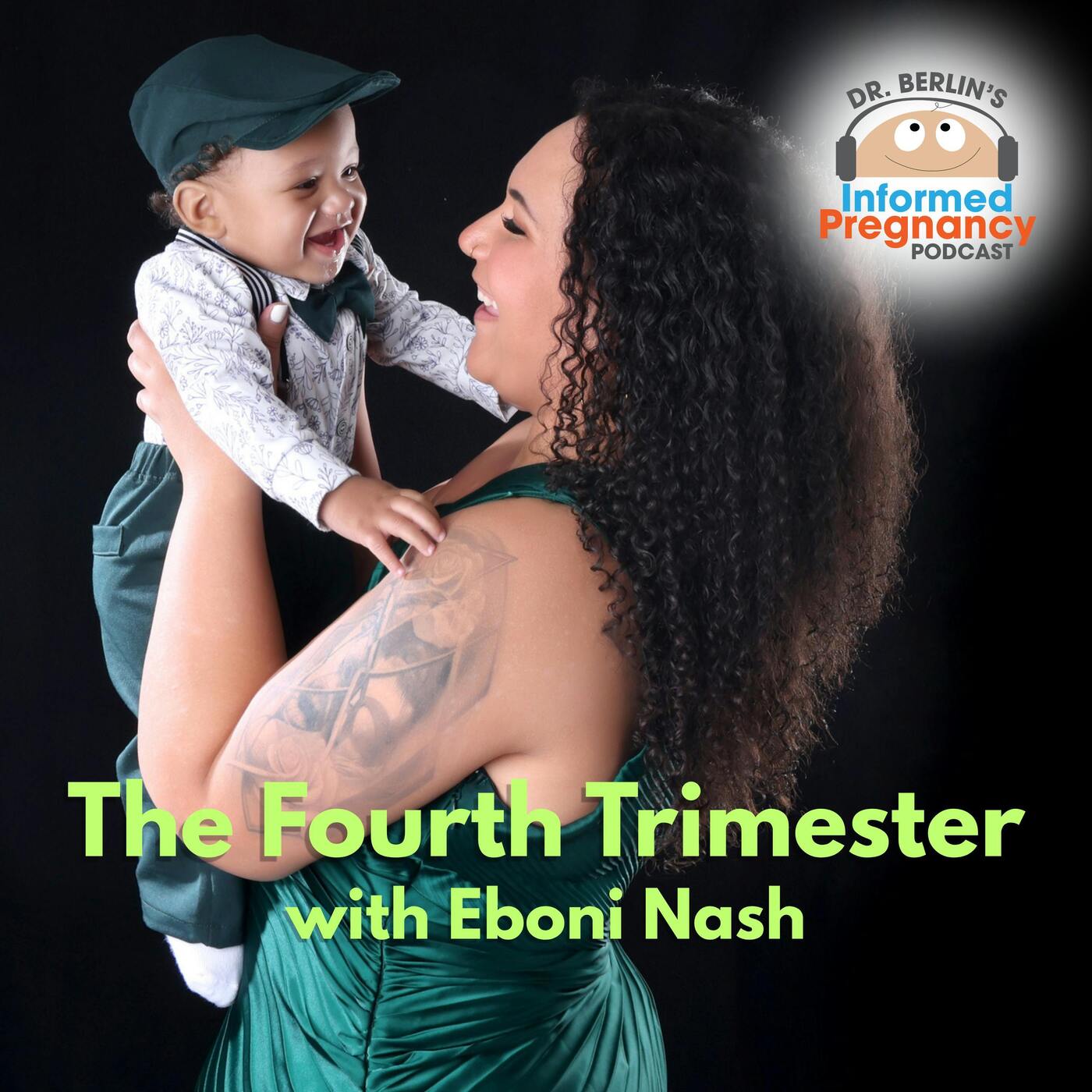
July 30, 2026 · 33 minutes · Episode 512
About this episode
How can society better support people during life’s most vulnerable moments? After working in justice centered philanthropy, motherhood unexpectedly changed things for Eboni Nash. She’s the director of development at 4th Trimester, an organization helping new moms and growing families find care and community.
Connect with the guest:
Grow with us on IP+! Informed Pregnancy Media presents two all new intimate short-form video series following Garrett and HeHe’s real-time pregnancy journeys as they prepare for an empowered birth and postpartum experience. Each episode features weekly updates with personal photos and videos to help bring these raw stories to life, a visually dynamic guide through each mother’s emotional and physical experiences.
Keep up with Dr. Berlin and Informed Pregnancy Media online!
Learn more about your ad choices. Visit megaphone.fm/adchoices
See Privacy Policy at https://art19.com/privacy and California Privacy Notice at https://art19.com/privacy#do-not-sell-my-info.
Key quotes
“I saw a mom holding a baby and I was like, if anyone understands me, it's going to be this organization.”
“Becoming a mom and losing your mom, you lose a lot of that pass on grace.”
“We really believe postpartum care is essential health care. We believe that providing financial stability is postpartum care. And we believe parenting is essential labor that must be supported.”
“It's really okay to just be you. Every little piece of you is very much okay. And it's okay to just be enough in motherhood. You don't have to strive to be perfect.”
Related episodes
- Ep. 516 Doing It All with Sarah Olin
- Ep. 493 In Conversation with Esther Friedman Schwartz
- Ep. 514 Before Baby #4 with Kara Sutton
- Ep. 500 The Unexpected with Dr. Elliot Berlin Part 1
Transcript
AI-generated transcript with speaker labels — may contain errors, especially names and medical terms. Dr. Elliot Berlin, DC appears in blue; Eboni Nash in orange.
Dr. Elliot Berlin, DC [0:00] My guest today has spent her career asking how institutions and communities can better support people during life's most vulnerable moments. After working in justice-centered philanthropy, motherhood unexpectedly changed the course for her and her own career. Today she's the director of development at Fourth Try, a non-profit helping new moms and growing families find care, resources, and community when they need it most. I'm pregnancy-focused chiropractor Dr. Elia Berlin, and you're listening to the Informed Pregnancy Podcast. Ebony Nash, welcome to the podcast. Hi, thank you. My pleasure. I'm so excited to talk to you and learn more. Before we get into motherhood
[0:55] and your own seismic shift, let's start at the beginning. Where are you from originally? I'm originally from a really small town in Colorado called Eads, Colorado. About 600 people
Eboni Nash [1:07] live there. Are there any institutions? Is there the proverbial red light? Is there a saloon, a gas station? There is a gas station. I think we have two now. There's no red lights. I think there's maybe 14 streets. Very small, small town. What is that like growing up in such a small town? It's cozy. I would say it's slow compared to Los Angeles life. Very slow. You know your neighbor. You know what they drive. You know the house they live in. Your math teacher might also be your softball coach during the summer. I would say it's cozy. It's a really cozy way of growing up. Do people have animals and stuff? That kind of small town? Yeah. Actually, I raised several goats, I think, at a time. Maybe a hundred or so goats
Dr. Elliot Berlin, DC [1:56] at a time. It's kind of just what people do. FFA, 4-H, farming, just being involved. Sports is big in that community. You obviously flew the coop. Is it something like when you grew up in that size town, you just can't wait to get out to a bigger city? Or did you leave begrudgingly? I think it was really I just couldn't wait to get out and
Eboni Nash [2:19] experience life. I definitely had some learnings to do in a different space. I wanted to learn about different culture. I think diversity was a big one. Not very diverse in a small town. So being a black and indigenous woman growing up in a small town, I wanted to experience what it was like to be around others as well. People more like you. So where did you go? I actually didn't go far. I went to Hastings, Nebraska. I went there for track and field in college. So I did get a full ride scholarship to go do track and field there. What did you study? I did a really interesting track. I started off doing a major in psychology and then I ended up adding on two more majors. So I triple majored. I did psychology, religion
[3:06] and criminology were my three. Yeah. First of all, three is well, but what a powerful combination. What kind of led to that combo? I think it was very organic. I was trying to decide what part of psychology I really liked. I liked the criminology part. I am a child of an incarcerated parent. So I always felt the need to learn more about the system. And then I took religion because I went to a liberal arts school and it was a requirement to kind of double dabble in the degrees. And so I took a religion class and felt very interested in medieval Christianity and just the creation overall of the church. And yeah, I decided to combine them all three and they've worked out really well so far. Well, okay. I'm going to
[3:50] find out later where you go with that. But did all three influence what you're doing now? Did they kind of work as a trio united? Yeah, I think so. I ended up going to get my masters at Harvard Divinity School and there I was able to study a little bit about black liberation theology and institutional structures. So I learned that the church had a hand in the creation of almost everything we experience today. So the creation of the economic system, the prison system, school, taxation, pretty much everything that we experience on a day to day, the church had a hand in it. And I really enjoyed learning how it started and also how it's changed and influenced hardships or benefits for some people today.
[4:36] Right. I mean, does that combination help you see the flaws in the system? Definitely. I think so. I think especially liberation theology, you learn how the system specifically oppressed a certain subset of individuals. So black liberation theology, I studied on the culture of the black and African diaspora, but then also like the women's theology, queer theology, things like that. You learn about how the system shifted to better support one over another body of people. Yeah. I mean, you have a lot of potential tools at your disposal coming out of that type of training and what path did you take it? Yeah. I actually saw that money was less about good and bad, but really it was the
[5:20] mobilizer of morale and value. And so if you have a lot of money, you can do really good things with it. And if you have a lot of money, you can also choose to redo really bad things with it. So I decided to go down the pathway of development and realize that by appealing to people and creating community with individuals, we can start fixing the systems one after another through the reallocation of money. And is that what you were doing work-wise? Yeah. That's actually what I started. I started development honestly in 2015 and I've been part of the development philanthropic track ever since then. So a little over 10 years now. Tell me more about it. What does that mean?
[6:00] I've started working with organizations and supporting very small. My first start, I started in college and I started working with food insecurity organizations, raising money to get food to children in middle schools and high schools that were food insecure. I then moved into the reentry and carceral space. I found that to be a passion of mine since I am a child of an incarcerated parent helping organizations that help currently informally incarcerated people get money. Also talking to people and educating them on why this is a good thing to invest into and how their money would support further correction and stop something that is so cyclical and hurting people day to day. So prison system,
[6:43] food insecurity, I've helped several different organizations do incredible things just through the power of grant writing and appealing to donors. After all of your study and your work in the field, did you have a better understanding of having an incarcerated parent? Absolutely. I think especially going into school, I held like a resentment of just growing up with just my mom as a single parent. And I resented my dad for a lot of things, but I also had a sore spot in my heart with the system. Then after doing a little bit of studies and doing a little bit of deep dive at the history of the system and the many things that can get someone wound up in the position that my dad was, I started to empathize with it a lot more
[7:28] and realized that there is something I can do to help people who might be in the same situation or who aren't there yet, but could see themselves going into the same place. So I dedicated a lot of my time, my studies and my effort in helping create and restructure systems that can better support people who might have found their place like mine.
Dr. Elliot Berlin, DC [7:48] That's powerful, right? So you're helping really the whole family, essentially the whole community when you do that. Up until this point, you've been building a career around helping other people and communities, and then life became a little more personal when you became a mother

Dr. Elliot Berlin, DC [8:04] yourself. Let's take a little break and we'll be right back. Welcome back. You're listening to the Informed Pregnancy Podcast and we're talking to Ebony Nash. Okay, so you're doing all this incredible work and now you're in Hastings, must be huge compared to where you grew up, but also not a very big town. I wonder because my wife is a psychologist and she did her internship at University of Nebraska-Lincoln and a lot of the issues that students were dealing with on campus is the adaptation to now being in such a big city and we had come from New York City, so it was like such a tiny city to us. Did you have any difficulties getting into bigger and bigger cities? Not so much until I moved to Boston. I had to learn about
[9:06] public transportation and that was scary, but once I did it, I felt like I could
Eboni Nash [9:12] pretty much accomplish anything. Amazing. Okay, so then what happens from where we left off in our story to you becoming a mom? So yeah, I moved back to Colorado during COVID. My mom, my sister and her kids lived with me during that time and then I was teaching in the Colorado prison system with an organization out there and I taught about 140 men over two years and so that was really exciting, but then I found myself in California and that's where my boyfriend's from and I decided that that is where life was leading me and during the move into California, I found out I was pregnant. Not expected, but also not surprised to find out I was pregnant, but I was pretty far along when we found out I was pregnant.
[9:56] Oh wow, how far along? About five and a half months, maybe six months. That is definitely far along for the first notice. Yeah, so pretty far along and I was with a new employer and that was also quite scary. Doing similar type work? Doing similar type work for sure. I moved to California to work with a very large organization
Dr. Elliot Berlin, DC [10:18] that also worked in the prison carceral space. Okay, so it's scary I think for most people to ever tell, you know, the company you're working for, hey I'm pregnant. It shouldn't be, but it is, but also to be like I'm pregnant and I'm doing three months.
Eboni Nash [10:35] Yeah, definitely. I had a moment and I think my moment was more in the combination of telling my employer, telling my mom, figuring out what to do with a baby in a new space, in a new community and understanding what that means for me in the next 45 months. Right, so did you have a plan for where you wanted to give birth, what you wanted birth to look like? I had a plan that then changed. I thought I really wanted a water birth. I was like that's so beautiful. I see it online and I think I skipped ahead a lot of steps. I started, you know, wanting to do the gender reveal and the baby shower and I wasn't sure about insurance and how much it was going to cost
[11:16] and I think I personally did everything in a very last minute space. I think a lot of it was just making sure my baby was healthy. A lot of it was understanding financially, am I in a space to do this? And then also informing the family that I felt wanted to know and should know. And then understanding that my boyfriend and I are in a new house, a new community, a new position in our relationship and now what does this mean for us? It was very quick. Yeah, just a lot of time to react to everything. So how did you end up doing your birth? So I ended up going to a hospital. My water broke which was beautiful. It was exactly on my due date. So yeah, he's a very punctual
[12:03] little boy. Yeah, so I actually didn't know that my water broke. I ended up calling the nurse one morning because I felt some cramps and then felt like maybe my water broke but it wasn't as dramatic as movies show. So I called to just make sure and she did confirm I should go in. I went into the hospital and everything seemed pretty smoothly in the beginning. I called my mom and my sister and they got on a flight to come out to see me. I was in the hospital. I was about to eat my salad for lunch. Everyone was real calm. They said it would take a while and my family left to go get dinner and then all of a sudden they couldn't get, I think it's the heart rate of my son, they couldn't get a reading on it anymore.
[12:47] Yeah, it was really scary and unfortunately they did end up having, after all this effort, they did have to end up rushing me into an emergency C-section. And at that point, I think they were trying to wait as long as they could for my boyfriend to show up. So I remember just being in the OR waiting and then all of a sudden they got his heart rate back and then they had a few more minutes, so maybe like five to ten minutes, and they were able to rush my boyfriend in and we still proceeded with the C-section. All right, but you both got to be there. So you had support from him. How long ago was that?
Dr. Elliot Berlin, DC [13:21] That was on, let's see, maybe like a year and two months ago. Okay. Well, congratulations. Thank you. Kind of fresh. How did you think motherhood would be and how is it in comparison to how you thought
Eboni Nash [13:34] it would be? Oh man, I thought motherhood, honestly, I think I had a little bit of experience living with my nieces and nephews. They grew up with me. My niece and nephews lived with me since they were one years old. So I got a little bit of a glimpse of what parenthood would look then, but I think that my experience postpartum shifted a lot of how I thought parenthood would be. I thought it was going to be a lot, maybe easier than what it was, and I guess I didn't realize how much of the in-between I was missing as a mom initially. So it was a lot different, I would say. I wonder on what level is it physical, emotional, spiritual, all of the above? I think it was all of the above. As soon as I became a mom,
[14:22] I felt like something inside me changed completely. I stopped focusing so much on the external, and I was very focused on the internal. I constantly worried for my son, making sure that he was okay, maybe that he was connected to me. I had a really hard time breastfeeding. Unfortunately, my mom passed away as soon as I had my son, not long after. Thank you. And that really, I think that threw me into a hard postpartum experience for me. I spent the first two months of my son's life in a different state. We flew when my son was five days old to Colorado. We slept in a bed that wasn't mine. I didn't have any of his things that I got from a baby shower nearby. I just didn't have what I assumed to be the glorious
[15:08] postpartum experience that I would have thought to have. And I also wasn't afforded a paid maternity leave. So I did have to return to work very quickly after I gave birth, which was quite hard. I went to work nine days later. Oh my goodness. That is extremely, almost like I had a patient who wanted to give birth picking strawberries in the field, and she did. But I can't imagine them just going back to picking strawberries. And I went back to work remotely, which wasn't as bad, but then at the same time handling the death of my mom, packing her house up, moving everything, sleeping on an air mattress. During the recovery of a C-section and trying to feed my baby, I think it just put me in a really hard
[15:59] mental space. Something I didn't address for quite a few months in, about five months in,
Dr. Elliot Berlin, DC [16:04] I didn't actually address postpartum depression. It's really hard. I think also hard in the moment to realize it's happening. It's a hard transition for everyone. So it's hard to realize when it's crossing a threshold. For sure. What kind of support, now that you can look back at it, would have made those few months better?
Eboni Nash [16:26] Yeah, that's a great question. I think in that time I was in survival. I was suppressing a lot, and I was just getting day by day trying to make sure everyone was taken care of. My son, my boyfriend, the family, my mom's arrangements. And I think support in that moment could have came in a few different ways, but I think immediately back to giving birth. And I felt how rushed I felt as a mom. My legs are numb and I'm holding my son and no one's around me to support. I felt like I could have maybe used a couple more doctor's appointments following up and maybe a little bit more instruction on take your prenatals. I didn't know to take my prenatals after I gave birth. So I felt like I could have used a little
[17:09] bit more nurturing when it came to caring for myself while also caring for everybody. Becoming a mom and losing your mom, you lose a lot of that pass on grace. So I feel like support there could have been used a little bit more for me.
Dr. Elliot Berlin, DC [17:26] Yeah, that makes sense. What a challenging mental transition to go through emotional becoming a mom and losing a mom at the same time. And it's true. They say all the time, it takes a village and there used to actually be a village where you had all your support people. And we've lost a lot of that. We don't live with the family on the family property anymore. And all the other people, like you mentioned in your small town, you know, all your neighbors and what car they drive. I thought they also kind of pitch in when it's time for a baby to kind of help out. I picture the olden days where the grocer was someone who would check in on your kids when they would stop by and other things like that. We don't have
[18:10] that anymore. At work, you went back to work right after having your baby and going through all of these transitions at the same time. You had taken on a new position, an exciting position, kind of like a leadership position. How does all that change after this difficult
Eboni Nash [18:27] postpartum? Yeah, it's a great question. It was difficult. I think I had such an incredible staff. I was the head of my department. My staff was very supportive of me. But then what I realized was because I was suppressing so much of my emotions, my demeanor changed a little bit. And I become very protective. I became a very protective person. I became protective, not just of my family and my son, but of my team, of my space, of my department. And it shifted the way that I positioned myself a little bit at work. And I tried my best to be as transparent as possible, but also I felt like I was building resentment because I didn't get time with my son. I didn't get time at home. I didn't get time
[19:13] to be a mom or to know what that's like to be a mom. And unfortunately, things raveled out to where I actually ended up getting terminated from my job pertaining to things very similar way to being postpartum and a new mom in a workplace that didn't cater to it well. So I ended up losing my job the week of Thanksgiving. Oh my gosh, out of all the
Dr. Elliot Berlin, DC [19:34] times. That's just so crazy in every sense. And it's something I see every day, women struggling with going back to work and having this, they describe having this animal instinct saying, I want to be around the nest. I want to be taking care of my baby, taking care of me home. And then society sort of is pulling them back to hunting and gathering, getting back to work and oftentimes feeling like they're not able to do either one to the degree that they want to that they feel good about. And that sometimes further adds to feeling sad or depressed. But sometimes the hardest seasons end up pointing us towards something unexpectedly good. And in your case, it eventually led you to fourth try.
[20:21] Let's take a little break and we come back. I really want to learn more about this organization and your role. We'll be right back. Welcome back to the Informed Pregnancy podcast. Okay, Ebony, I mean, crazy story. Any one of those things is, you know, moving to a new big city state, finding out that you're pregnant, but also finding out that you're more than halfway through having a birth that at once was envisioned as a water birth and turned into an urgency section, losing your mom and then losing your job. That's a lot for any person. But you've pulled yourself out of all of that and you just have a great energy about you. And seemingly it opened a new door for you, the fourth try.
[21:22] How did you first discover fourth try? Honestly, while I was in my fourth trimester,
Eboni Nash [21:27] so that's fun to say, but I was thinking about what to do. It's the holidays, unemployed with a new baby, first ones without mom. And I knew I had to do something and I knew I needed to get back in the workforce, but I was scared because I'm not the same person I was. I felt like a completely new person. And also I lost a lot of confidence in being able to be an executive worker, like an executive staff member while also being a mom to the best of my abilities. But I decided to get out there and I was searching through jobs and I saw fourth trimester, but really what caught my eye was the logo. I saw a mom holding a baby and I was like, if anyone understands me, it's going to be this organization.
[22:10] And that was before I even knew what they were talking about or their mission. But I knew that mom and the baby and the logo was calling for me. So I clicked it, I applied, I sent it off with such hope and then went into the holidays. Following the holidays, I was able to have my first phone call with the board chair and it unlocked so much excitement for me because talking to somebody who understood what it's like to be a new mom in a new community and to now have this newfound passion that I didn't know entirely too much about, but I knew it was a passion. It was an incredible opportunity to talk to her about it. What was the hiring process like?
[22:54] It was super quick and super intentional is what it was like. I had a phone conversation with the board chair and then I was invited to have coffee with the team. And to be completely honest, in between that, the phone call and my invitation to join for coffee, I ended up emailing the board chair and withdrawing my application. And I think it's a posture syndrome. It came back up. But in this form of motherhood, I had what I thought was solid daycare. And then I had what I thought to be family support around, not to mention also my boyfriend and I care for his grandmother. She has dementia and she lives with us. And in one week, everything kind of crumbled to the point that
[23:42] if I had a job, I would not be a reliable person. And I thought to myself that if one thing is for sure, I want to be respectful of this new employer. And I want them to know that I don't think that I can be the person that they think I can be. So I withdrew my application. And then the response of me withdrawing my application was totally hear you totally see you. We understand we're not pressuring you, but please come meet us for coffee still. Oh, wow. And I did. That's so thoughtful. So you got the job. I did. Now that we've been talking about a little bit, what is fourth try? What do they do and what is your role? Yeah, fourth trimester is a nonprofit organization based in Pasadena,
[24:29] California, that's working to transform the postpartum experience for mothers and birthing people, primarily in California, but they also started in along the US or Mexico border. And they do this by providing practical support, emotional care, economic assistance and advocacy to be sure that no parent navigates the fourth trimester alone.
Dr. Elliot Berlin, DC [24:51] So very relevant to me. Super relevant to you. And like I think super relevant in general. I think that the fourth trimester, which we're saying essentially the 13 weeks after you have a baby, are a time where people need extra support and sometimes they're just not thought of at all and have less support than they even had during the pregnancy. So it sounds like an
Eboni Nash [25:15] incredible goal. What's your role? I serve as the director of development. I'm the very
Dr. Elliot Berlin, DC [25:21] first director of development. So identifying new funding pathways, donors, establishing fundraisers and helping us grow and scale the organization is what I support with.
Eboni Nash [25:33] Wow. And can you tell us about a person or a family who fourth trimester helped and how your help changed the postpartum trajectory for them, the experience for them? Absolutely. We have so many families that have come to us and shared their experience with us and how our support has transformed their overall parenting experience. But specifically, over the last year and a half, we've been working with families impacted by the wildfire, the Eaton fire that took place in January of 2025. And we've been helping these families support with diapers and formula and just essential hygiene material. We had one specific mom who shared with us that she hasn't had to buy a single diaper since she was getting
[26:23] support for us. So for the over two years, she hasn't had to buy diapers for their children and that has allowed her to financially reinvest in places that are most meaningful for her family. Getting back from the wildfire, finding things that she enjoys like buying a bicycle is more of her mental health support. So specifically providing care in that space. But then we also have families who we've connected with doulas who didn't know what a doula was, much like I didn't, who have really found safety, security and love through the community of doula support that we have here at fourth trimester. I think a lot of our families, they can come from so many different areas of their life where the systems
[27:05] aren't designed to support them in their in their moment. So they could be undocumented families excluded from social safety nets or they suffer from no child care or lack of transportation or lack of access to culturally sensitive care specifically in their language. And these are all things that we help support with at fourth trimester
Dr. Elliot Berlin, DC [27:23] specifically. Sounds really necessary. And like it can really change any one of those things can really change the experience for somebody in a positive way. As you continue your role of development, what kind of things are on the kind of vision board for fourth trimester for
Eboni Nash [27:42] the future? Absolutely. It's super exciting. Well, I think first off, we really would like to help share education and help share our vision and our pillars of interest with the community. So we really believe postpartum care is essential health care. We believe that providing financial stability is postpartum care. And we believe parenting is essential labor that must be supported. And so through those three pillars, we are launching a new program called RISE, which stands for Resources for Income Shelter and Empowerment. And it's a program where we are focusing on unconditional direct cash assistance for our mothers during pregnancy and then postpartum up to one year. And so we're very excited for this program, not just
[28:27] to be as a form as a pilot to inform us more of the needs, but also to show and display community impact so we can provide system change and provide community based outcomes that then we're hoping flow into government support and funding in the future. Are there ways for me or for people listening to pitch in and help out? Absolutely. There's so many ways to pitch in and help out, whether it's monetarily supporting our mission. You can also provide support. We have monthly care closets where we invite volunteers and families to come in and help us deliver these essential items to our families. And you can find those through by going through our website and filling out the info form where we can get back to you
[29:12] about those opportunities. There's also just understanding and sharing information with our community. I think personally, especially in development, the easiest way to get funding where it needs to be is to share your perspective and to share information with the community that might not have it. So information is the number one way to get our legislators to vote correctly for our community. And I think especially amongst each other, talking and discussing these types of instances and these types of needs helps it become unaware. And something that they're aware of really is the postpartum experience. Now that you've been talking about where can we find 4th Trimester Online? Our website is really easy. So it's 4,
[29:59] the number four. So 4thTri.org. That's our website. And you can easily go on there and check out some of our programs, our impact report, and then also contact us if you'd like to get involved, learn more, or if you have anyone that could be connected to us for
Dr. Elliot Berlin, DC [30:15] service or support. So interesting. We're randomly, and we've been working on this project for a while, about finishing production on a web series called The Fourth Try, spotlighting different things that people can do after they have a baby for mind, body, and spirit healing. So I'm glad to see that all the different puzzle pieces that make up community are doing their part. And hopefully we'll come together in a way that makes a picture that is much more supportive of postpartum health. If you had one thing that every new parent could take away from your story or this episode, what would you want them to
Eboni Nash [30:55] know? Honestly, the one thing that I felt the most throughout this entire experience was it's really okay to just be you. Every little piece of you is very much okay. And it's okay to just be enough in motherhood. You don't have to strive to be perfect. You don't have to strive to be everything at once for everybody. Being yourself is absolutely the best you can be. And it's the best you can be for your little one, for your community, for your employer. Just being honest and being yourself lowers expectations. So yeah, don't lose yourself, really. Try not to lose yourself. And if you feel like you're losing yourself, find the little pieces that ground you,
Dr. Elliot Berlin, DC [31:40] and that will help you get through day by day. Ebony and Nash, thank you so much for joining me today. Thanks for sharing your powerful story and for the work that you're doing. And at home, thanks for listening to the Informed Pregnancy podcast. For more pregnancy and parenting information just like this, visit us online at InformedPregnancy.com.
Want more pregnancy + parenting? Start your FREE TRIAL of Informed Pregnancy+ and get access to all our curated pregnancy and parenting content — original series, iconic birth films like The Business of Being Born, prenatal workouts and more.

0 Comments