
January 13, 2022 · 57 minutes · Episode 264
About this episode
As we enter the third year of Covid-19, pediatrician and author Dr. Jay Gordon discusses the current state of the pandemic and why this vaccine is different than all other childhood vaccines.

Learn more about your ad choices. Visit megaphone.fm/adchoices
See Privacy Policy at https://art19.com/privacy and California Privacy Notice at https://art19.com/privacy#do-not-sell-my-info.
Key quotes
“But I still think that vaccines given judiciously do more good than harm. But we've never done it judiciously.”
“I mean if you have the facts you can present it to parents and the vast majority of parents choose to get virtually all vaccines when you mandate you get a whole different kind of pushback and you polarize like crazy”
“And anybody who tells you that this vaccine is completely safe and risk-free is lying to you. But I continue to feel that the only way out of this is to vaccinate our way out of it. And I recommend the vaccine for anybody who's eligible.”
“We now have a disease that I think merits taking the risk of a vaccine. So I believe that the vaccine is necessary to end the pandemic or at the very least to make the pandemic manageable and turn this into an endemic illness, which comes around, but does not cause anywhere near as much death and destruction.”
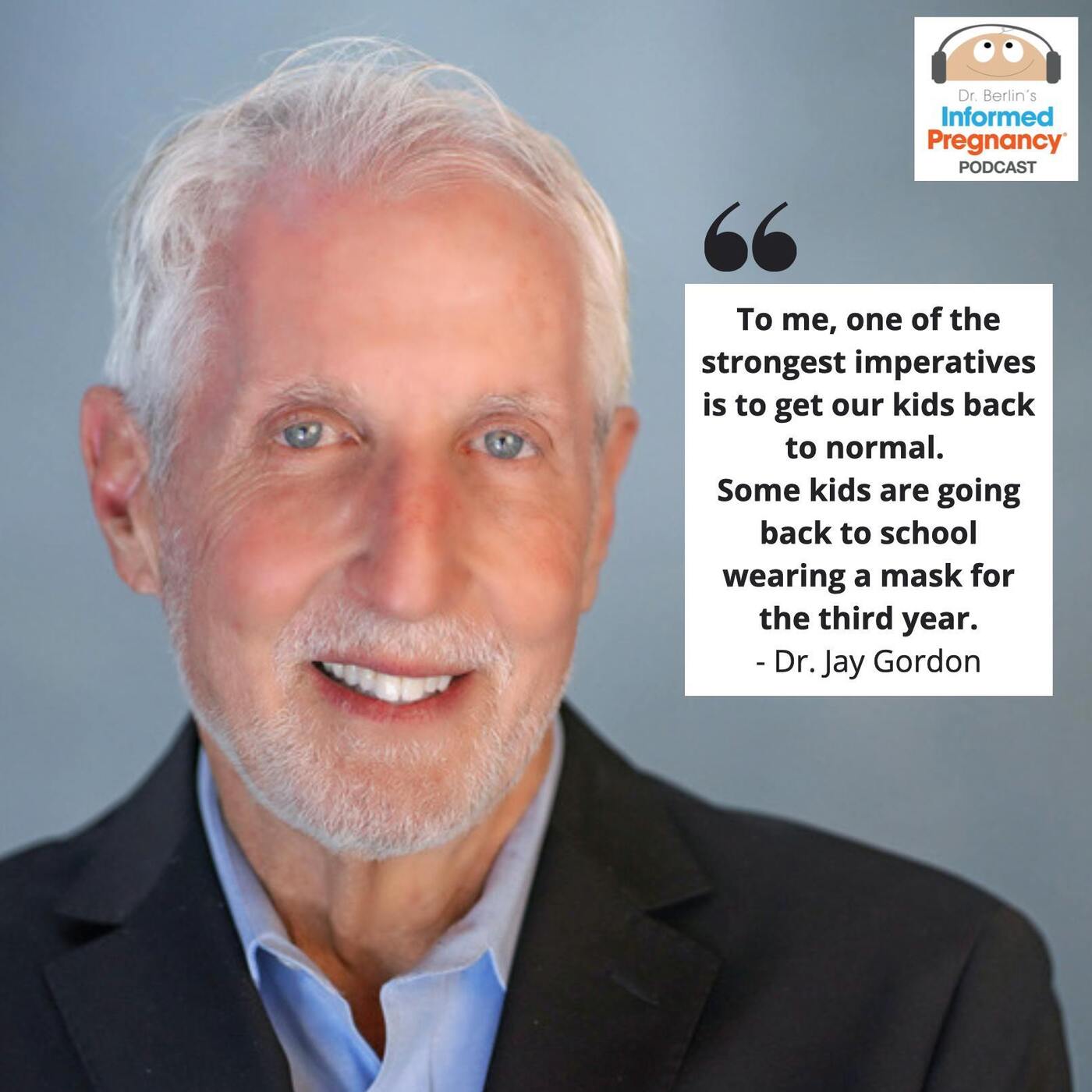
“But to me, one of the strongest imperatives is just to get our kids back to normal. Normal, some kids have never had normal and they're two years old now.”
Related episodes
- Ep. 5 The Fact About The Vax – Part 3
- Ep. 4 The Fact About The Vax – Part 2
- Ep. 3 The Fact About The Vax – Part 1
- Ep. 196 Jaundice and Other Newborn Concerns – Dr. Princeton Ly
Transcript
AI-generated transcript with speaker labels — may contain errors, especially names and medical terms. Dr. Elliot Berlin, DC appears in blue; Dr. Jay Gordon in orange.
Download PDF of the Transcript
Dr. Elliot Berlin, DC [1:37] Pregnancy and parenting podcast. I'm your host dr. Elliott Berlin at the time of this recording. We are transitioning into the year 2022 it has been two full years since the first reported cases of kovat 19 in the United States to date Nearly a million people have died from or with kovat 19 in the United States alone at this time Infection rate remains high even in areas where vaccine rates are high The newest and heavily mutated variant of the virus has been named after the Greek letter Omicron and it's spreading like wildfire At a time when the world could be uniting against a common enemy us versus the virus The pandemic seems to be having the opposite effect
[2:20] every aspect of the worldwide outbreak seems to be hyper politicized driving even more polarity between already divided people and Sparking passionately heated arguments debates and a windfall of skewed inaccurate or simply false information In this episode, we're going to explore the nature of the current coronavirus pandemic and very specifically talk in detail about the vaccine Effort, which has been the topic of intense debate serious friction and occasional hostility My guest today is a distinguished pediatrician in the Los Angeles area after completing his residency at Children's Hospital of Los Angeles He took a year to serve as senior fellow in pediatric nutrition at Sloan Kettering Institute in New York City
[3:05] In addition to treating little patients for many many years He has written several books and magazine columns and as a sought-after contributor on pediatric wellness Dr. Jay Gordon welcome back to the podcast
Dr. Jay Gordon [3:20] Thank You. Dr. Berlin a pleasure to be here
Dr. Elliot Berlin, DC [3:22] Thank you very much for donating your time to address the covered vaccine today in this very hyper polarized world we're constantly pushed to choose between two false binary choices or We're labeled into one of two false binary categories You previously appeared on our podcast for a three-part series on childhood vaccinations called the facts about the vats at the time You made the case for informed choice when it comes to parents deciding which vaccines to give their children and when Because you were not a proponent of force-feeding every single vaccine to every child on the Academy schedule You were labeled an anti-vaxxer, even though I have a picture of you getting a vaccine before you went to Africa
[4:01] I think it was now you're an advocate for the COVID vaccine and Because of that you're looked at as having jump ship to the extreme vaxxer side in reality all of us including you Have always been somewhere in the middle in today's discussion I'd love to start with defining some of the terminology So there's a little demystification of the language use coronavirus a coronavirus co Capital V is a large family viruses that cause illness ranging from the common cold to significantly more severe diseases The novel coronavirus jumping anytime if I'm off base here a novel coronavirus is a new strain that hasn't been previously seen in humans Sars as I are as stands for severe acute respiratory syndrome
[4:44] Initially referred to the coronavirus that was found to be very harmful to humans first identified in China in 2002 And then spreading around the world infecting about 8,000 people from 29 different countries and territories and resulting in about 774 death deaths until it was contained in 2004. SARS-CoV-2 is the SARS-Coronavirus-2, and it stands for Severe Acute Respiratory Syndrome, Coronavirus-2. It's genetically related to the coronavirus that caused the SARS outbreak between 2002 and 2004, and it's the current virus in our pandemic. COVID-19, COVID stands for CO for coronavirus, VI for virus, D for disease, 19 referring to the year in which the outbreak began. And then would love to also
[5:30] talk about the difference between epidemic, pandemic, and endemic. Epidemic is a widespread occurrence of an infectious disease in a localized community at a certain time. Pandemic is when that epidemic spreads across a larger region, generally across several continents or worldwide. And then endemic is sort of what happens after the pandemic. A pandemic can end with infectious diseases being largely contained or completely eradicated, either naturally and or through the use of vaccines, or with the disease becoming constantly maintained at a baseline level in a particular area. So, for example, malaria is said to be endemic to tropical areas. Polio is endemic in a few countries where its spread has
[6:08] not been contained. Finally, the difference between quarantine and isolation. Quarantine is people who are not currently sick, not known to be infected, but may have been exposed to someone who has a communicable disease, and the goal is to isolate them from others to help stop the spread. Isolation happens when a person is infected with a communicable disease and separated from people who are healthy, also to stop the spread of the infection. I have a million topics I want to talk to you about, like how SARS-CoV-2 virus originated, what was happening in the very early days of the epidemic and eventually pandemic, what treatments we found to work or not work, the therapeutics that are now in
[6:46] development, some of which are gaining emergency use approval. I'd love to pick your brain about COVID testing, antigen rapid tests versus PCR, how to keep kids and parents healthy, thoughts on quarantine and isolation, school closures, and more. But this episode is about getting to the heart of the conversation on vaccines, and I'm going to try to stay focused on that topic. Before we get to COVID-19 vaccines specifically, can you start by telling me your thoughts on vaccines in general? Well, okay, as you know, I've always
Dr. Jay Gordon [7:15] given vaccines in my office. I always get vaccines. I left behind the usual CDC AAP schedule about 40 years ago just because it didn't make sense. It's expedient, it's profitable, but it never made sense to me to give six vaccines to a two-month-old baby or to give a hepatitis B vaccine to a baby at birth. And it certainly doesn't make sense to me to coerce or mandate polio vaccines in the year 2022 in America. But I still think that vaccines given judiciously do more good than harm. But we've never done it judiciously. We continue to coerce because we do, we always have. And I still feel the same. I mean, right now, I can't write medical exemptions. The new law is forbidden. If you write more
[7:57] than five medical exemptions, then you're automatically investigated. And any medical exemptions I've previously written are invalidated. And I don't know how Sacramento is going to count my medical exemptions. But what I would love to do is to write medical exemptions for polio vaccines for everybody and defend it. Everybody. But I can't. I mean, that would be a little bit false bravado. I can't do it. But I still give vaccines.
Dr. Elliot Berlin, DC [8:20] The exemptions in California are based only on medical reasoning, right?
Dr. Jay Gordon [8:25] Right. Not just medical. The progression of the laws over the past six or seven years was to obliterate personal beliefs exemptions. It used to be that you'd walk up to the counter at kindergarten and sign a piece of paper that said because of personal beliefs, I'm not going to give my child vaccines or haven't given these vaccines. Then they turned it into a personal beliefs exemption that the doctor that I had to sign and all pediatricians signed it for some reason, but it led to good discussions. The next law created a situation where there was only medical exemptions, no personal belief exemptions, medical and religious exemptions. But it was completely at my
[8:59] discretion. I would discuss it with the parents and they would talk to me about adverse reactions in the family or strong family history of autoimmune phenomena, which I thought was reason to at the very least pause decline vaccines initially, give them on a different schedule. But as of January 2021, medical exemptions are only issued by a committee in Sacramento and they are adhering strictly to CDC criteria, which are very rigid. If you have a seizure after a vaccine, you don't have to get that vaccine, but you still get other vaccines. If your two older brothers had terrible reactions to vaccines that has nothing to do with the next baby. So the science is really lacking,
[9:41] but there's nothing that I can do about it. And there are still doctors who are telling patients you can get medical exemptions. I think there are doctors who for all I know are bending the rules, but anyway, we have a bad law right now and what my office does and what we've always done. And the only thing we can continue to do is to be flexible and to give vaccines you know one at a time or two at a time to wait until a child is somewhat older but California like a few other states has become a no shots no school state and soon the COVID vaccines will be added to that list of no shots no school.
Dr. Elliot Berlin, DC [10:17] Yeah so they're going to add it to a list we currently have somewhere around 70 doses of 16 vaccines that are given to kids between the birth and the age of 18 and we're just adding to that you don't have them you can go to school all right let's get a little bit more into the COVID vaccine vaccinations are supposed to give you some kind of immunity to a virus how does
Dr. Jay Gordon [10:38] it work? Well when the immune system is challenged whether it's challenged by strep or by coronavirus 19 or by influenza virus the immune system responds it produces antibodies initially immunoglobulin m over a few days and then immunoglobulin g which is a longer lasting set of antibodies and then there are other soldiers recruited from the white blood cell family the t cells which create the ability to neutralize the virus the next time you see it that can be done if you get coronavirus 19 in your nose or if you get vaccinated and that immunity lasts for a known duration for measles for measles it looks like the immunity from vaccination lasts forever for COVID we don't know it looks like it might be much
Dr. Elliot Berlin, DC [11:27] short-lived. Let's talk about natural immunity for a second so when I got chickenpox as a kid and then they told me I'd never get it again there was no vaccine so in that case does the
Dr. Jay Gordon [11:41] natural immunity practically last forever? For a few illnesses again measles and probably chickenpox it probably is lifelong immunity there are people who get two or three cases of chickenpox so that immunity looks a little less durable a little less long lasting than measles immunity. You're talking about from natural exposure? From getting the disease itself.
Dr. Elliot Berlin, DC [12:01] Okay and how does that compare to getting the vaccine? Well measles vaccine looks like it
Dr. Jay Gordon [12:07] creates this extraordinarily long-lived immunity almost nobody gets a second case of measles on the other hand in America almost nobody gets measles which is another thing that I've always asked parents to consider and experts to consider the fact that we now have a situation in America where measles doesn't pose a large problem to American children now my least favorite of the conventional vaccines is the measles mumps rubella vaccine for a few reasons firstly combining those three viruses into one shot again was expedient and the immune system chooses it doesn't form equal levels of protection against measles mumps and rubella and when I do blood tests for kids on the way to college so that they can skip the second MMR
[12:50] probably half of them have no mumps immunity because we shouldn't have combined it and then there's a larger question do you really have to get an MMR well if everybody took that attitude we would have larger measles outbreaks no question we already have mumps outbreaks because of the ineffectiveness when we combine the MMR but all these things should be discussed rather than mandated I mean if you have the facts you can present it to parents and the vast majority of parents choose to get virtually all vaccines when you mandate you get a whole different kind of pushback and you polarize like crazy yes and an already polarized world another triple is the d-tap or t-dap and I don't know the occurrence rate of diphtheria I've
[13:37] never met anybody who had it well I saw somebody in the emergency room at children's hospital about 42 years ago who had diphtheria that was one of the boat people one of the boat people I must have missed it because I was five okay so the d-tap or the t-dap it's got diphtheria tetanus and pertussis pertussis is a disease you can get it's not common but it would be much more common if we didn't have vaccination tetanus is an extremely rare disease in America I think we average about 30 or 40 cases a year and I don't think that there's much diphtheria left in America there's diphtheria throughout the rest of the world and as with the polio vaccine we
[14:16] hold up a beacon to the rest of the world but it may not be worth holding up that beacon regarding the polio vaccine and the diphtheria component of the d-tap just can't be removed because it appears to make the vaccine take better there would have to be a billion dollars worth of new testing done to show that the pertussis tetanus vaccine worked as well as the pertussis tetanus diphtheria vaccine so we're stuck with the diphtheria component
Dr. Elliot Berlin, DC [14:43] literally okay those childhood vaccines forever but I really want to dig into the covid vaccine and what we know and where we're headed let's take a quick break it won't be right

Dr. Elliot Berlin, DC [17:12] slash Dr. Berlin for up to 30% off. Welcome back to the Informed Pregnancy podcast. We're talking to Dr. J. Gordon. Okay. We talked about natural immunity versus vaccine immunity. With the vaccines, we have a new choice here to make with the coronavirus. It's mRNA versus the Johnson & Johnson vaccine. What's the difference between them?
Dr. Jay Gordon [17:40] Oh, okay. The conventional way of making vaccines was either to take a small fragment of inactivated virus or to synthesize a fragment of the virus and attach it to a carrier and inject it. And that produced immunity. The polio vaccine, the term live virus vaccine is inaccurate. A virus is never alive. A virus is a piece of code. The conventional way of vaccinating is to take a small amount of the virus or bacteria and inject it and let the immune system be fooled, producing antibodies and then producing T-cells also. That's again, conventional. The mRNA technology, which is about 30 years old, takes a different course completely. Messenger RNA is what DNA sends out into the periphery
[18:29] of the cell to tell the muscle cell to make more muscle cells or the messenger RNA in the hair cells tells the hair cells to make more hair cells. What was discovered again, some 25, 30 years ago was that perhaps we could change the messenger RNA and instead of having the muscle cells produce more muscle cells, we could convince it to produce anti-tumor cells or of all things, perhaps it could produce fragments of a virus fooling the immune system. And that's what the mRNA vaccines do. Messenger RNA is created to produce the spike protein. Everybody's seen pictures of the coronavirus 19. There are spikes. It's a small fragment of the virus. We have created code messenger RNA, which is then protected with a lipid
[19:18] coating, a fatty coating and injected into the muscle cells. It gets into the muscle cells and it goes to the protein making machinery and it teaches that machinery to produce spike protein. And the spike protein is read by the immune system and it produces antibodies against the spike protein, which you really don't need because it's fake. It's a vaccine, but those antibody producing cells then become memory cells, memory B cells and the T cells produced also retain memory. And the next time that you are challenged by coronavirus 19 or by the second vaccine or the third vaccine, those memory cells remember quickly and produce antibodies which neutralize coronavirus-19.
[20:06] When you acquire natural infection, when you get coronavirus-19 in your nose and everybody will, when you could have had two or three or four vaccines like I've had and the virus still gets into your nose and the immune system, the so-called naive immune system with no prior immunity, no vaccines, no prior illness can take five to 10 days to create antibodies, which is a heck of a long time if you're 80 years old with COVID. The vaccine creates a response which might be 10 minutes or it might be a day. So an infection occurs in your nose. Again, my nose with my vaccines looks the same as a nose without vaccines. The virus gets into your nose creating an infection.
[20:47] That infection will then proceed to disease in your body and the antibodies which are produced by the memory cells stop that process, which is why people who are vaccinated or people who've had COVID previously usually get a milder case that is not invariable.
Dr. Elliot Berlin, DC [21:07] Are the antibodies that are produced by the body after exposure, are they more specific to the virus? Meaning it sounds like with the mRNA or even the conventional vaccines, you're trying to sequence a recognizable part of this virus, but if you're exposed, does your body do a better job at making the antibody more specific to the entire virus?
Dr. Jay Gordon [21:32] Well, today there is a publication that shows that natural acquired, disease acquired immunity may be better than. Tomorrow will be another piece of research saying, no, no, no, vaccine acquired immunity is much, much better. We know so much less than we pretend to know. I was mentioning too, before we started recording, I have to make things up on a daily basis. How many days? Five, seven, 10 is better, five. What it looks like to me is that vaccine acquired immunity is either far more durable or at least somewhat more durable than disease acquired immunity. As you may know, the newest variant, they're calling it a strain actually, they refrain from using the word strain for a long time.
[22:21] The newest strain, Omicron, is eluding prior immunity, both from the vaccine and from illness. It's not completely eluding immunity, but it's eluding immunity.
Dr. Elliot Berlin, DC [22:33] I wonder though, if it depends on the severity of the infection.
Dr. Jay Gordon [22:38] Keep wondering. Nobody knows. I mean, that's the problem is that we are trying to convince people that we know things that we really don't know. We don't know how long the vaccines last. We don't know how long immunity lasts from the illness. We don't know if a mild case, and I read a clever little post somewhere online. It said, when the public hears a mild case of COVID, they think about hot chocolate and three days off from work. When a doctor hears about a mild case of COVID, they think, oh good, we won't have to use a ventilator. And maybe that that mild case of COVID only causes a mild case of long COVID or a mild case of cardiac damage.
[23:16] We don't know. I was a participant in phase three research, okay? When a vaccine or any other medication is invented, it is tested pre-clinically, unfortunately on non-human primates, on monkeys. I have to put that aside because I'm an animal rights advocate, but I know that it's done. So the pre-clinical phase, we inject the monkeys with the vaccine candidate. We see if they produce antibodies and whether or not they die. It worked. Phase one research on the COVID vaccines and on other vaccines consists of about 25 very, very brave people. You give them the shot. You draw blood to see if they produce antibodies and if the antibodies last and you hope that nobody dies and nobody died.
[23:55] Phase two research. It's about 500 very brave people and you adjust the dose. The lower the dose, the fewer the side effects and you hope that nobody dies. It worked great. Phase three, which is what I was in for Pfizer BioNTech is about 30,000 people, not quite so brave, but still a little bit brave, half of whom get a placebo, which was just plain saltwater saline solution and half of whom get the actual vaccine candidate. They draw our blood every two to eight weeks. They measure antibodies. They have us fill out a symptom diary and phase three was supposed to proceed, I think to about a hundred cases detected and it went very rapidly to closer to 200
[24:41] and 90% of those cases, 95% of those cases were in the people who received the placebo. It was supposed to be a two year piece of phase three research. It was called off of course and that's where you get the 95% number during that phase three, which was sizable 30,000 people. Almost everybody who got COVID had received the placebo. Now, when I put my arm out in August of 2020, I didn't flip a coin. I had spent only about 40 years of my career opposing new vaccines hastily given, opposing the schedule and so on. But looking at the pandemic, it struck me that we weren't getting out of this. Herd immunity has always referred to a vaccine. In the history of humans,
[25:27] we have never had naturally acquired herd immunity to anything. In the history of humans, we've eradicated one virus, smallpox. It took 200 years and 20 different vaccines. So at that point, and it wasn't an act of massive bravery, it was just kind of common sense and opportunism, I volunteered for the study because I didn't see any other way out of this besides a vaccine. Now, it's a risk benefit discussion with anybody with whom you wanna talk, it's risks and benefits. The risks to a new vaccine for your six-year-old child or for your 60-year-old self or whomever it is, there's a risk involved. As you know, people die from taking Tylenol every year,
[26:05] not very many, thank God, not very many. But it's a risk benefit analysis. And anybody who tells you that this vaccine is completely safe and risk-free is lying to you. But I continue to feel that the only way out of this is to vaccinate our way out of it. And I recommend the vaccine for anybody who's eligible. The problem that I've seen, and I've just seen it the past couple of weeks, is that there are some people who shouldn't get vaccines. They have some genetic issue or prior vaccine history, which strongly suggests that they may have real problems with any vaccine in the future. And it is they who depended on herd immunity to whooping cough or to polio or to measles,
[26:49] and they still rely on it. It's not a very large number of people, but they're out there. And the trouble is that we've really muddied the waters, and it's hard to sort through and figure out who those people are. But it was kind of striking, and it's just been the past couple of weeks that I realized, you know, I'm recommending this shot for every eligible six-year-old kid or 16-year-old kid or 60-year-old adult, but gotta probably tamp it down a little bit and look a little bit harder. Now, I don't really wanna talk to anybody who believes that they're chopped up worms or that there's a chip in there or that this is a plot. It's not. But I certainly respect people who want to discuss
[27:28] whether or not their prior reactions to vaccines make them less likely to have a good reaction to this vaccine. You know, if I had to pick a number, picking it right straight out of my ear, I would say 99% of people can safely get the mRNA vaccines. Johnson & Johnson vaccine had some problems, but I don't really believe that it's a dangerous vaccine. It's certainly a much less effective vaccine. The Novavax vaccine, you know, the mRNA vaccines program the cells to produce spike and the immune system reads the spike. In essence, the Novavax vaccine has the spike. It has that protein in there. It kind of skips a step. The immune system reads that spike and produces antibodies.
[28:09] It's a much more conventional vaccine. A reasonable argument against the mRNA vaccines is how much spike is produced? How much spike is exactly the right amount and how much is too much? Could spike protein cause inflammation of cardiac muscle? You know, the myocarditis discussion was always a little bit bogus to begin with. Myocarditis is extremely rare with the vaccine. You know, if we could anticipate a world without COVID come May 2022, June, no COVID. It went away, it was great, we won. I would say, wait, you know, I don't wanna produce all that spike and if you've got the lifestyle that allows you to stay, and you're not a high-risk 75-year-old person,
[28:54] okay, I respect your right to wait and to keep yourself isolated. Damn it, stay isolated. But we're not gonna have a world without COVID. It's gonna be the fifth coronavirus of winter, okay? We have coronavirus HKU1, coronavirus OC43, coronavirus, I forgot the other two names. Those coronaviruses produce 30% of the colds and coughs that kids get. We're now going to have coronavirus 19, which slides right in there creating colds and coughs for the rest of our lives. If you are a very vulnerable person, influenza or maybe even coronavirus HKU1 can cause damage. So in a world where coronavirus will always be with us, I think that we have to do our best
[29:35] to protect vulnerable people by vaccinating as many people as possible. But like I said, I don't like mandates.
Dr. Elliot Berlin, DC [29:44] We'll get into that in just a second. You sparked so many questions. First of all, in your phase three clinical trial, did you ever find out if you were a placebo or a vaccine recipient?
Dr. Jay Gordon [29:54] Oh, I sure did. I got my first shot on a Saturday at noon and I had no reaction at all. And one of my friends who was at a different facility had 102 fever after her first shot. And I thought, oh damn it, I got the placebo after all that trouble.
Dr. Elliot Berlin, DC [30:08] You got some saline.
Dr. Jay Gordon [30:09] And I went back three weeks later, and I said to the guy, said you know, if it weren't unethical, I might have skipped this trip out to Burbank in 102 degree weather. And he said, I'm glad you came. And I said, what do you mean you're glad I came? He said, nothing, I'm glad you came. I got the shot Saturday at noon, the second shot, and on Sunday I had like 102 fever and I couldn't lift my arm and I was dancing around the house and my wife thought I was crazy. I said, I got the shot.
Dr. Elliot Berlin, DC [30:34] So in the end, both times you got it? Yeah, both times. You didn't get one and then the other.
Dr. Jay Gordon [30:38] I mean, I just didn't have a reaction. Right, to the first one, as many people seem to know. And then six months after that, Pfizer and probably Moderna offered a third vaccine. I got it instead. I just got it from a local place. That was March of 2021. Nine months later, based on just a tiny bit of science and a feeling, I got my fourth vaccine two weeks ago on a Tuesday. And I had no reaction to either the third or the fourth vaccine.
Dr. Elliot Berlin, DC [31:10] So are you getting a full dose each time or is there a booster dose?
Dr. Jay Gordon [31:15] The first three vaccines were Pfizer because I wanted my vaccine on a particular day. The local pharmacy only had Moderna. I said, sure, I'll take the Moderna because it looks like there may be some benefit to mixing and matching as it's called. I had no reaction. The Moderna booster, I believe, is half of the original. The Pfizer, I believe, is the full dose.
Dr. Elliot Berlin, DC [31:35] Okay. I was going to ask you about mixing and matching. It sort of feels like one of those, my first chemistry kit that you do at home. How much research could there be on people who got two of these in one of those or two of those in one of these or mix it with the J&J?
Dr. Jay Gordon [31:48] So little research. And the science behind getting the fourth one as a Moderna, we just don't have it. I mean, Saturday Night Live did a little piece on it where they just said, you know, we are now in the winging it phase of the pandemic. It's kind of like, I don't know, what do you think? One of my funniest moments listening to the radio, because all the radio stations have experts on for an hour every morning. And I was listening to one of the local NPR stations and they had Dr. Schreiber, who's the head of infectious disease somewhere. And she was giving great answers. Somebody called in and said, I just finished a short course of steroids,
[32:23] which may have been poison or asthma. I don't know. And she's asked Dr. Schreiber, the head of whatever it is everywhere. She said, I think I should wait a couple of weeks before getting my COVID vaccine. And Dr. Schreiber said, that sounds like a good idea. And I thought, what? I asked you. I didn't ask you to validate that I got a good idea. I mean, by the way, that was a good answer. If you're somewhat immunosuppressed by steroids, wait till you get your vaccine. But that's where we are. It's kind of like, I don't know, what do you think? We've progressed a little bit in knowledge about some things, but let me tell you that scientists are making things up every day.
[33:00] And the CDC is still politicized and makes a lot of decisions based on economics. I mean, the recommendation of shortening the quarantine to five days and isolation to five days without any testing at the end of it was not motivated by science and most responsible scientists, whether you're talking about Twitter or on the news, went crazy. They said, this is ridiculous, but it's expedient. It's going to get people back to school and back to work sooner. It's going to cause a lot more cases of COVID, but somewhere somebody decided that was worth it. We're not going to have a lockdown, but we're going to run out of people to run restaurants and to run hospitals.
[33:40] We've already lost 20% of healthcare providers during the pandemic. They quit or died. And there are a lot of sick doctors and nurses and chiropractors right now too.
Dr. Elliot Berlin, DC [33:51] Yeah. And then there's other people who are either burnt out or companies are just shutting down because of overall employee shortage to begin with. And this certainly doesn't help. Two other things that you mentioned that sparked a question for me. Number one is, how did we get rid of the original SARS in 2002 to 2004?
Dr. Jay Gordon [34:11] It's a great question. The original SARS, SARS-CoV-1, if you evaluate viruses in terms of intelligence, it was a dumb virus because the first day you had it, you had 104 degree fever and you were really sick. And we just tell you to go to your room or go to the hospital. So it didn't spread. I mean, as soon as you had it, we knew that you had something bad and you were isolated. A SARS-CoV-2, if you admire viruses, is a great virus. I mean, as you know, you can walk around for 10 days, contagious as can be with no symptoms, no fever, nothing. At a certain phase, and I don't know if we're in the same phase. I think we're in the same phase. About 50% of transmission is coming from people who aren't sick.
[34:50] They don't look sick. So it's a great virus.
Dr. Elliot Berlin, DC [34:54] But then also pre-vaccines, we also had infectious disease. How did we get through it? before we had vaccines?
Dr. Jay Gordon [35:02] We didn't. There's some good evidence that the first time you get certain viruses, you not only can get an upper respiratory infection, nose, throat, sinuses, but there's a chance with coronavirus HKEU-1 of getting pneumonia, not a big chance. But it appears that the subsequent exposures to coronavirus HKEU-1, you mostly get a bad cold. So either the virus is changing sufficiently or our immune system is changing sufficiently so that continued exposures to these viruses are relatively harmless. You know, unless you're again, a vulnerable 80 or 90 year old person, in which case you can die from the flu. But we still have the flu every year. That could lead to the argument,
[35:45] maybe we should just let her rip. I actually talked to a doctor a month or two ago who said, you know, we should just let her rip. You know, I come back to March, 2020 where everybody very cleverly said we had to flatten the curve and you sounded like you were informed. What does flatten the curve mean? It means not filling up the emergency rooms this week. Instead, let's see if everybody's gonna get COVID. Okay, to speak to your point, everybody is going to get coronavirus 19 in their noses and get COVID. If you have prior immunity, you're probably going to get a mild disease. If you don't have prior immunity, you have, you know, whatever the number is,
[36:20] a 10 times greater chance of ending up with serious illness, hospitalization, death, 10 times or so. So we'll get through it one way or another. But the other problem is that the longer that this virus is allowed to live in India, Pakistan or Rwanda, the more likely it is to mutate into variants or mutate into strains that are worse or more contagious or more deadly. And again, Omicron is either a milder virus or appears milder because so many people have prior immunity. Not quite sure which.
Dr. Elliot Berlin, DC [36:56] Hard to tell, right? But it seems like people who have no previous immunity are also not getting severe acute respiratory syndrome in large numbers. While we've been talking, I've gotten three texts from people with new cases. Yeah. Three. Boop, there's four. Okay, hang on one second. Let's take a little break and come back for one more segment. We'll be right back. Welcome back to the Informed Pregnancy and Parenting Podcast. We're talking to Dr. Jay Gordon. You mentioned mutations. How do they work?
Dr. Jay Gordon [38:34] Every time that a virus replicates, it changes a little bit. I believe that coronavirus 19 has 30,000 base pairs. Almost every mutation is not to the virus's advantage. So that variant, that strain just goes away. If however, as happened with Delta, the variation made the virus somewhat more sticky in its attachment to the cell, that variant is going to win. At the beginning of July, 2021, there were these ominous announcements saying that by the end of July, 90% of COVID is going to be Delta variant, which is kind of like saying, if you watch the Olympics, isn't it surprising that the fastest runners always win the race? It was not surprising.
[39:15] Delta was not some strange variation. It was just more fit. That's the technical term is fitness. And I've told people over and over again, it looks like Delta is about the best that coronavirus can do. Of course, I was just so wrong. There were, I don't know, three or four different mutations in Delta and there are almost 50 mutations in Omicron. And the theory there, the thought is that in a person with a very compromised immune system, possibly somebody who has AIDS and coronavirus 19 just lived with them for a month or six months and mutated and mutated and just got better and better at eluding immune system defenses and then got out. And that's Omicron is a variation, a variant rather,
[39:58] with the ability to elude an awful. lot of our immune defenses. Who knows what's coming? Yes. Also, they clearly didn't take that person out. Meaning, if they were able to live for that period of time, then they couldn't fight it off, but they also didn't die.
Dr. Elliot Berlin, DC [40:13] They didn't die from it. You know, scientific speculation to speculation, nonetheless. And now we're hoping that Omicron is the best or the worst that coronavirus 19 can do. Because Omicron is spreading like wildfire. I think yesterday New York State had 85,000 cases reported. That doesn't include all the ones that aren't reported. If it is indeed milder, even for people unvaxxed, then are we creating more immunity in the herd?
Dr. Jay Gordon [40:40] Yes. Oh, yes. This could be part of our way out of it. We don't know that for sure. For all we know, Omicron creates immunity that lasts three and a half weeks. Or maybe Omicron creates immunity that lasts for years. Like I said, we don't know.
Dr. Elliot Berlin, DC [40:55] We have so much science and technology that we kind of want answers yesterday. But really, if you look at the timeline, we have an incredible amount of progress in a very short period of time, scientifically. But, you know, everybody wants answers we don't have.
Dr. Jay Gordon [41:10] Yeah. And so what I'm telling people is maintain the same level of caution that you maintained a year, year and a half ago. Be very, very cautious. Okay? There was a time in June of 2021, where it looked really good. You know, it looked like we were on our way out of it, then they removed all the mask mandates. 50% of people were vaccinated and 100% of people took their masks off. And we ended up with a Delta disaster. And right now, it's very possible that Omicron will stay mild, that almost everybody who gets Omicron ends up with mild disease and a real boost in immunity. But the gigantic unknown involves firstly, long COVID. I mean, you and I probably both know people who, six weeks or six or 12 months
[42:01] later, are still very adversely affected by COVID with brain fog or with decreased energy. So there's long COVID to think about. And then other mysteries for all we know, and this is anti-vaccine speculation, but it's, what if the vaccine three years from now creates gigantic problems and that every child who got it ends up with decreased hearing? That's not going to happen. If I thought that were a realistic possibility, I wouldn't recommend the vaccine. But the same thing could be true of mild Omicron COVID. Maybe every single person who got a mild case ends up with a small amount of cardiac damage. So the smartest thing to do is decide how much risk you want to take. If you decided whatever,
[42:45] I'm just going to live my life. And if I get Omicron, I get it. Okay. The trouble is that it kind of adversely affects my life because I'm considerably older than all of my little patients. And I'm older than most of the parents in my practice. If COVID gets into my family, it could be dangerous. Now, for a long time, I thought, well, if I get COVID, I'll just go get monoclonal antibodies. Monoclonal antibodies are just synthesized antibodies against coronavirus. Instead of waiting for your body to create them, we have synthesized them. You get a 20 or 30 minute IV or subcutaneous infusion and it neutralizes and you feel better within an hour. But the monoclonal antibodies have
[43:27] stopped working. There's one brand, Satrovamab, which still works. And boy, is it hard to get. So we're right in between monoclonal antibodies not working and having the pills, which probably will work fairly well, but we're not a hundred percent sure of that
Dr. Elliot Berlin, DC [43:43] in the real world. In terms of the informed choice, the risk benefit analysis, generally we look at three things, necessity, effectiveness, and safety. It sounds to me like, and I don't mean to put words in your mouth, you're saying that out of all the times a vaccine in my lifetime was super important, this is one of the times where you feel it's most necessary.
Dr. Jay Gordon [44:08] Elliot, as I emailed you prior to this, we didn't tell the truth to people about vaccines. We said they're a hundred percent safe and you need every single one of them and you have to get them at two months and four months and six months of age. We lacked so much candor in our discussions about vaccines. And now I think we really have something important to say. It's funny because I've been saying this for 20 years. I said, well, someday I might have to come to you and say, well, there've been three cases of meningitis in your child's kindergarten classroom. Now's the time. And you may not believe me. Well, that's happened. We now have a disease that I think merits taking the risk of a vaccine.
[44:44] So I believe that the vaccine is necessary to end the pandemic or at the very least to make the pandemic manageable and turn this into an endemic illness, which comes around, but does not cause anywhere near as much death and destruction.
Dr. Elliot Berlin, DC [45:00] So the necessity seems pretty clear, at least in your mind. And you also feel strongly about the safety. Even though we don't have the longest-term results, you feel generally people should get it, and they're safe getting it if they are eligible. So adults, children, during pregnancy and breastfeeding?
Dr. Jay Gordon [45:20] I tremendously respect reluctance about a brand new vaccine in a perfectly healthy six-year-old. I have a ton of science regarding the COVID vaccine during pregnancy and the benefits to the mother and the baby. But I've got that science that bumps right up against a pregnant woman's instincts while she's carrying that baby. And I can tell you that the majority of pregnant women to whom I have spoken, and it's not a large number, have declined getting the vaccine while they're pregnant. If you get the vaccine while you're pregnant, not only is your risk category down, but the baby is protected against COVID. I've seen a lot of new vaccines. I've been in business, you know, for 40-some years.
[46:03] And every time, I've probably seen a hundred new vaccines, and I've said the same thing every time. This vaccine could protect your child against a very dangerous illness. And over the next five years, let's talk about whether or not you should get it. Five years. And now I'm saying to people, hey, we invented this vaccine last Thursday. Every kid should get it. I understand the reluctance. I think that the weight of science and social responsibility and so on argues in favor of everybody who can get in that vaccine. But I understand the reluctance. You know, people ask me, how could you have changed so much? Firstly, I didn't change. Everything else changed. I still
[46:38] feel the same way about a polio vaccine. And against men, I feel the same way about mandates. And I feel the same way about two month olds getting six vaccines. I feel exactly the same way that hasn't changed. There's a doctor who has been telling people that he said he's got inside information that I was paid off. And my answer is, yeah, I got probably three, $400 for being in phase three research. And the other thing is I said, you know, that the medical board of California came to Dr. Gordon and said, you better support this vaccine or else. For the first time in a long time, the medical board and I are sort of on good terms. I mean, I've appeared before the medical board of California a few times,
[47:17] mostly about vaccine issues. But no, the medical board didn't threaten me. And my opinion about the vaccine was not changed by the might've been as much as $500 that I've received. So yeah, this is the time. This is the time to get vaccinated.
Dr. Elliot Berlin, DC [47:32] Exactly. So when it comes to necessity, high safety, high effectiveness. Is there a question mark there? Meaning like, why are we needing boosters every 10 weeks?
Dr. Jay Gordon [47:45] Because the immunity isn't as durable as we had hoped. It's just that simple. See, we blew it again at the very beginning of vaccination. We said you get the vaccine and you won't get COVID. What we should have said is get the vaccine and you're very unlikely to get a serious case of COVID because there are very few vaccines. There might only be one, the HPV vaccine, which creates what's known as sterilizing immunity, where the virus actually just bounces off of you. Every other vaccine, including the polio vaccine, still allows you to become infected. But the antibody and T cell response is so rapid that the infection in your nose or your gut doesn't progress to disease. So we blew it again. Now,
[48:24] we also should have said, you know, it looks like two vaccines will be good, but we might need a third or a fourth. And we could have done that based on the science that we have. When you give the COVID vaccines three weeks apart, two things happen. Basically, one of them is great. Two weeks after that second shot, you get 95% immunity. I mean, it's great. But the other thing is that you've given the vaccine to an immune system, which is far from quieted down. So the response is good. But in some ways, the immune system looks around at the B cells producing antibodies and said, you know, I'm sort of good. But if you wait six more months, you now have a very quiet immune system
[49:04] and you get what looks like a 10 to 20 fold boost in memory B cells and in T cells and just in generalized immunity. How long is that going to last? Best guess, we're going to need a COVID vaccine probably once a year. Okay. At some point, people will say, you know, no, thank you. You know, the flu shot is notorious for not matching the flu of the season. The flu shot misses more often than it hits well. Okay. I've gone back and forth. I mean, at one point I said to people, well, we sure don't want to get flu this year because that'll get mixed into everything else. And then I realized firstly, we may not have much flu. And secondly, the flu shot looks like a major mismatch again. So I have no enthusiasm
[49:47] for the flu shot. And I never have. And we're probably going to need a COVID vaccine booster
Dr. Elliot Berlin, DC [49:52] again next year or maybe sooner. Yeah. Or maybe sooner. You mentioned briefly that the vaccine. and everything around it has also been politicized. What role do you think that plays in people's hesitancy?
Dr. Jay Gordon [50:07] Oh, huge, huge. You know, it started with our former president who said, we don't wanna let experts determine what's going on. Geez. So suddenly wearing a mask became a sign of being weak. Regarding COVID as a serious problem became a sign of being weak. You know, the only reason or the main reason that Trump survived was that he immediately got everything from remdesivir to monoclonal antibodies to just full court press in the hospital. You know, and we've had some fairly high profile deaths of politicians, but yeah, it's gotten politicized. How do you politicize masks? You know, I mean, Bobby Kennedy Jr. is an old friend. I mean, he's one of my heroes
[50:50] for getting mercury out of the waterways, for opposing mercury in vaccines, as controversial as that may be. But when he starts railing against masks and elevated carbon dioxide levels and decreased oxygen levels, it flies in the face of everything we know about masks and oxygen and CO2. That doesn't happen. Now, what does happen is that when kids wear masks, it has educational consequences, social, emotional, developmental consequences. Another reason for my oversized enthusiasm about vaccinating kids is that I gotta get the masks for fall of 2022. My feeling is that if we mess this up now, the kids are going back to school in masks that we're liable to have another variant
[51:36] or maybe even continuing Delta and Omicron that just don't allow us to safely open schools without masks, as it is. Look what's happening in the first week of January, 2022. Some schools are not opening. Some schools have gone back to distance learning, so. And I'm not 100% sure if I'm gonna be able to take my vacation. That should be the worst part. And you know something? I gotta tell you that my selfish motivation is very clear. I wanna go skiing. Our ski trip is at the end of February. Our major trip to Italy is in May. All of these things are up in the air. But the other thing that's up in the air is whether or not I can return to my normal practice
[52:15] where I talk about bike helmets and broccoli and. I mean, that's been missing. I mean, I've had to do a lot of managing of anxiety and then guessing, guessing. I mean, there've been a lot of times in my career when I've said, I don't know, but let me ask the dermatologist or I don't know, let me ask the chiropractor. And now what I'm saying is I don't know and nobody knows. Nobody knows.
Dr. Elliot Berlin, DC [52:39] And that's not fun. All right, one more question here and it goes back to something else you said, which was you're not really in favor of mandates. I think that part of the politicization of the whole vaccine issue is trying to force people to do the vaccine. Nobody really loves to be forced. It takes away the element of informed consent. And as more and more people both get and transmit the virus, even if they're vaccinated, more and more people say, if there is a social responsibility, if the reason I'm getting the vaccine is to create herd immunity, regardless of how much I need it or how much it's gonna help me, does that kind of begin to wane
[53:26] as we see the virus not really being stopped by the vaccine from spreading to person to person the way we thought it would? And now are we more just saying to a person, look, if you get the vaccine, you're much more likely to get a severe case of COVID. But shouldn't that be almost entirely a personal choice? If you get the vaccine, you're less likely to get a severe case. Yeah, so I mean, we went from saying everybody's got to get the vaccine or we're not gonna get herd immunity, we're not gonna get out of this thing. Now the message is to people who are unvaccinated seems to have changed too. Yeah, you might still get the virus. You might still spread the virus
[54:03] even if you don't have any symptoms, even if you've been vaccinated. But if you get COVID, you're most likely gonna have a non-severe case if you've been adequately vaccinated. Whereas if you haven't, you have a much higher chance of getting a severe case. If that's true, does it take away some of the pressure on people to get the vaccine in order to help others? Meaning if they still can be contagious with the vaccine, does it take away that social element and make it more of a personal choice?
Dr. Jay Gordon [54:35] I think both of them are still in play because we don't know the consequences of a mild case of COVID. We seem to know the consequences of not slowing the spread, which would be, again, businesses closing, schools not opening. So I think both of them are in play. And again, for years, excuse me, decades, what I've said to people at the two month checkup is your child is due for these six vaccines. And my personal strong feeling is that it's. not in his best interest to get these six vaccines today. The discussion of public health, let's schedule another hour to discuss public health right now. We're just gonna be talking about your child's health.
[55:11] As the child got older, went to kindergarten, I say, you know, the issue of public health comes into play a little bit. I'm still completely focused for this one hour on your child's health. Is it in his best interest to get all of the kindergarten vaccines at once? I don't think it is. Is it in the best interest of public health for him to get all those vaccines? It might be, but that's not what our hour is set for. Right now we're talking about just his health. With COVID, the calculation shifts and I think that both personal considerations and public health considerations are huge right now. And if I had to talk about just one thing, it wouldn't be protecting your grandmother
[55:50] or even protecting your good old doctor. It would be trying to get your kids back to normal life. You know, right now things are so abnormal. I mean, for the longest time, there was a cliche. People say, well, it's traumatic for kids to wear a mask. And the answer is, well, it's not as traumatic as being admitted to the hospital. Yeah, that's true. But right now it's traumatic to go into your third year of school wearing a mask. You know, it's hard to read cues and it's hard to develop normally emotionally. So to me, that's one of the strongest imperatives. That and not dying personally and being able to take a vacation. But to me, one of the strongest imperatives
[56:28] is just to get our kids back to normal. Normal, some kids have never had normal and they're two years old now.
Dr. Elliot Berlin, DC [56:34] Isn't that strange? I was thinking about it the other day. If I'm hearing you right, you still feel like there's strong benefit to individuals in getting vaccine with very little risk. There's strong benefit on the population of getting vaccinated with very little risk, but you don't feel like it should be forced upon people.
Dr. Jay Gordon [56:55] Exactly, exactly. But somebody said to me, you've got a six-year-old who is going to first grade and there are two classes they've decided to make it. One class is made up of only vaccinated kids and the other class is only kids who are unvaccinated. To which one do you wanna send your first grader? Yeah, I'm going with the vaccinated kids, thanks. And by the way, when you say very little risk, it's all relative. And again, we can't calculate it now.
Dr. Elliot Berlin, DC [57:21] Right, we don't have enough data in general, but it's also relative. Exactly, what I might consider risky is totally different than what somebody else might consider risky.
Dr. Jay Gordon [57:30] And the other thing is when I got my shot, I calculated I was maybe the 900th person to get the Pfizer shot. Maybe I was 3,000th, I don't know. But you will be the two or three billionth. Your child will be the 10 millionth child to get the vaccine. We have a lot of data. At the present time, we haven't had serious adverse reactions in children. We haven't had any. That can't possibly continue as we give millions and millions of more vaccines. We're gonna see some bad reactions that occur one out of two million times. It's got to happen.
Dr. Elliot Berlin, DC [58:02] Are these reported on the VAERS,
Dr. Jay Gordon [58:04] the Vaccine Adverse Events Reporting System? I'm not sure exactly where the data come from. I used to love VAERS during my anti-vaccine days. I was never anti-vaccine. I loved VAERS. Okay, look at all of these adverse reactions. Anybody's allowed to call in. I can call in and say, I got the shot and three of my toes fell off. And that report sits right next to a genuine adverse reaction to a vaccine. So VAERS just not as reliable as it used to be. And something we didn't address, and just for a second, the tests aren't as reliable as they used to be. We now are better off relying on symptoms. If it walks like a duck and quacks like a duck, it's a duck.
[58:44] If you were exposed significantly to somebody two days ago who had COVID, and now you have a cold and 101 fever, I am far less interested in your test. In the old days, like 2019, if you brought a kid with a cold to a birthday party, you would get a lot of dirty looks from people. So if you've got symptoms and exposure to COVID, and you got a negative test, I'm ignoring the negative test completely. And I'm telling you, you probably have COVID stay home for five days, test again and again, which of course ignores the issue of not having enough tests.
Dr. Elliot Berlin, DC [59:17] You know what? I really appreciate everything you've said today. I learn from you every time I talk to you. Your perspective is unique, and I'm grateful that you shared it with us. Dr. Gordon, where can we find you online?
Dr. Jay Gordon [59:30] Well, you know what? My favorite medium now, honestly, is Twitter. I enjoy Twitter. Facebook is difficult. I enjoy Twitter. I have a website, drjgordon.com, which I don't use very much at all. I should, but I post a lot on Twitter, jgordon, M-D-F-A-A-P.
Dr. Elliot Berlin, DC [59:47] That's what I would have guessed.
Dr. Jay Gordon [59:49] I'm easy to find.
Dr. Elliot Berlin, DC [59:50] All right. Thank you again for your time and your information.
Dr. Jay Gordon [59:53] Elliot, thank you again for the opportunity.
Dr. Elliot Berlin, DC [59:56] Hopefully you'll be back because there's a lot more topics here. And that doesn't- seem to be going away quickly. At home, thanks for listening to our podcast. You can find a great deal of useful information on our Instagram page, I hardly ever use Twitter, by clicking on the link in the bio at Dr. Berlin. That's D-O-C-T-O-R-B-E-R-L-I-N.
Want more pregnancy + parenting? Start your FREE TRIAL of Informed Pregnancy+ and get access to all our curated pregnancy and parenting content — original series, iconic birth films like The Business of Being Born, prenatal workouts and more.
