
October 22, 2026 · 48 minutes · Episode 524
About this episode
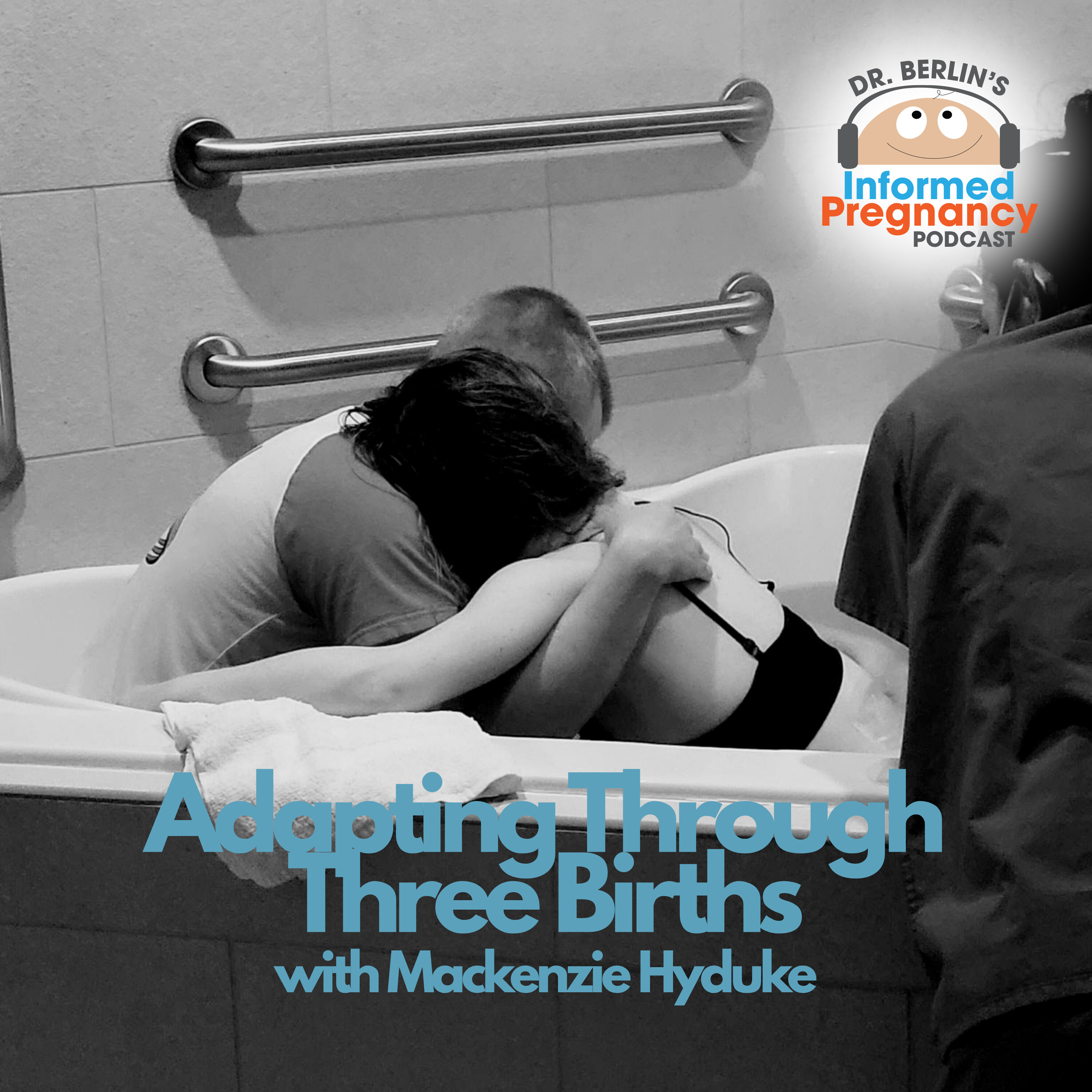
Military spouse and stay-at-home mom Mackenzie Hyduke discusses her three pregnancy and birth experiences including learning to advocate for yourself, building your village, and learning adaptability when very little in life stays put.
Connect with the guest:
Grow with us on IP+! Informed Pregnancy Media presents two all new intimate short-form video series following Garrett and HeHe’s real-time pregnancy journeys as they prepare for an empowered birth and postpartum experience. Each episode features weekly updates with personal photos and videos to help bring these raw stories to life, a visually dynamic guide through each mother’s emotional and physical experiences.
Keep up with Dr. Berlin and Informed Pregnancy Media online!
See Privacy Policy at https://art19.com/privacy and California Privacy Notice at https://art19.com/privacy#do-not-sell-my-info.
Key quotes
“we're moving, I am always at home. I am always there for everything. I am always peak stability for my kids, no matter what else is going on.”
“and I wasn't really in my head enough to ask for clarification, to advocate for myself.”
“And the shower was like the peak for me. That was the best. Nothing has ever compared to the shower for coping strategy for me.”
“But I actually said a quote that I think you have said many times before that there's a difference between intensity or pain and suffering. And I said, I'm suffering.”
“They were such angels. They were amazing. I don't know if I would have done it, if they had not come in. I told them, like, they saved my birth. There's no question. They made me feel so heard and they were so encouraging. They were amazing.”
Related episodes
- Ep. 502: Three Different Births with Emilia Davis
- Ep. 493 In Conversation with Esther Friedman Schwartz
- Ep. 514 Before Baby #4 with Kara Sutton
- Ep. 510 Preparation Matters with Nina Spears
Transcript
AI-generated transcript with speaker labels — may contain errors, especially names and medical terms. Dr. Elliot Berlin, DC appears in blue; Mackenzie Hyduke in orange.
Dr. Elliot Berlin, DC [0:00] My guest today never expected to become a military spouse or a stay-at-home mom, but through three pregnancies, three very different birth experiences, and repeated moves around the world, she learned just how much the people around you can shape your experience of birth and postpartum. She joins me today to talk about giving birth while repeatedly rebuilding the village, learning to advocate for yourself, and becoming adaptable when very little in life stays put. I'm pregnancy-focused chiropractor Dr. Elliott Berlin, and you're listening to the Informed Pregnancy Podcast. Mackenzie Hajduk, welcome to the podcast.
Mackenzie Hyduke [0:52] Thank you so much for having me.
Dr. Elliot Berlin, DC [0:54] My pleasure. I have so much to learn from you. I want to jump right in. Let's start before pregnancy and birth. Where did you grow up, and what did you imagine your adult life might look like?
Mackenzie Hyduke [1:04] I grew up right outside the Washington, D.C. area in Maryland, in Silver Spring, for anyone who knows Maryland well. I went to school in D.C. and was an only child, very close with my parents. Always expected, went to sort of a high-achieving school, and always expected to get a graduate degree. I don't know about go the corporate route, but do something high-powered and really focus on my career from a very young age.
Dr. Elliot Berlin, DC [1:39] Sounds driven.
Mackenzie Hyduke [1:40] I was very driven, yes. And my parents are both driven people.
Dr. Elliot Berlin, DC [1:46] Did you know graduate degree in what field?
Mackenzie Hyduke [1:49] No.
Dr. Elliot Berlin, DC [1:50] Okay.
Mackenzie Hyduke [1:51] I just assumed I would get a graduate degree from when I was very little.
Dr. Elliot Berlin, DC [1:56] How did things change?
Mackenzie Hyduke [1:58] Things didn't really change until I met my husband. I remained sort of career-focused while dating him, and do plan to go back to work one day, meaning work outside the home. I met him when I was going into my last year of college, and did indeed go on to get a master's in social work, which I am very proud of, and I'm very glad that I have, and will use someday. When we were dating, I think my priorities started to shift a little bit. He is in the military, and I knew that life would look like a lot of moves. And one thing that has been very important to me about being a stay-at-home mom is that if my husband is away, no matter where we live, no matter how frequently
[2:53] we're moving, I am always at home. I am always there for everything. I am always peak stability for my kids, no matter what else is going on. And so I think that started to kind of enter the framework of what is going to really matter to me in these years where they're small, and where my husband is still in the military. And we wanted at least a few kids, and that sort of started to enter my mind as something I was thinking about as well. Family had always been very important to me, but I had never thought about my future as a mom until I was really with him, and that just clarified a lot of things.
Dr. Elliot Berlin, DC [3:34] Still fairly young, just finishing college.
Mackenzie Hyduke [3:37] Yeah, so I met him when I was 21, and we didn't start having really serious conversations until, I would say, two years into dating because he would be moving at the three-year mark. And so we started to have serious conversations about where do we see this relationship going? What do we want our lives to look like?
Dr. Elliot Berlin, DC [3:59] And you had talked about having a few kids. You're an only child, and does he have siblings?
Mackenzie Hyduke [4:05] He is the eldest of five.
Dr. Elliot Berlin, DC [4:08] OK, so were you going for an average?
Mackenzie Hyduke [4:13] You could say that. We did have three. It ended up being an exact meet-in-the-middle situation. We may have a fourth down the line. I need a little bit of a gap, and we'll kind of see what happens. But yeah, that actually, I said three and he said five, and so our goal was four. But we both, for now, think that three is right for us. So we'll see. Yeah, we'll see.
Dr. Elliot Berlin, DC [4:40] So you decided to move forward with it. Where was that initial move to?
Mackenzie Hyduke [4:45] Yes, when we had been dating for about three years, he moved to South Korea. And both of us felt pretty strongly about not getting married just because he was moving, which is a really valid choice that a lot of military families make because of insurance, because… will only pay for you if you're married. And it was a really big leap to go not married. I had to just sort of show up in South Korea, hope that I could get a job on base so that I could get an ID card. We really had to sort of wing it, but we were not ready to get married yet. We wanted to live together. But yes, we were very serious and we moved to Korea and we spent a year there in Seoul. What was the first year like? Were you able
[5:32] to get what you needed? It was an amazing year. We lived together for the first time in a studio size office or quarters apartment. We got to explore a lot. We had a lot of more serious conversations about what we wanted our life to look like. And yes, we got engaged maybe a month after we moved. Oh, congratulations. Thank you. Where did you go from Korea? We went to Oahu, Hawaii. Oh, that doesn't sound horrible. It was lovely. The experience of COVID lessened the loveliness a bit, but it was truly amazing. And that didn't start until we'd been there for a year and a half, two years. So we got a lot out of it before we were inside a lot.
Dr. Elliot Berlin, DC [6:23] And it was a beautiful place to be outside during COVID. Yeah, patients that went to Hawaii just for COVID to be able to just be outside. They were working remotely anyway. Yes. But then you got married during COVID? We got married right before COVID. So our
Mackenzie Hyduke [6:42] seventh anniversary is actually tomorrow. We got married in October of 2019. So right before COVID.
Dr. Elliot Berlin, DC [6:49] Okay. The last wedding before everything got shut down.
Mackenzie Hyduke [6:53] Pretty much. I feel very lucky. Then did you have a pregnancy during COVID? I did. So we had a wedding slash honeymoon baby and COVID hit about 17, 18, 19 weeks. We took a very short trip to another island right as it was kind of starting abroad and was actually probably here, but it was not really a thing yet. And my husband's a physician and my husband was reading about it before it became popular to be worried about it and was worried about it. And I asked my OBs late February, 2020, is it okay for us to go on this plane? Do we need to cancel? And they said, Oh, it's fine. And we went and we were the only people with masks. We were nervous, but we managed to get
[7:52] this last trip in, which was lovely. And then came home and then in March, of course, everything shut down, which was very, very stressful for everyone, obviously. But there was a lot of added stuff with being pregnant. I was very worried about having him in the delivery room. I was very scared for the baby. It was a hard thing, I think, especially in a first pregnancy when you've never done it before and you have fairly low knowledge and confidence and experience with what's happening in general to then have a pandemic. Yeah, it sounds like a lot going on all at once, especially finishing grad school on top of that. Yes, I finished up when I was about
Dr. Elliot Berlin, DC [8:34] three months pregnant with him. A lot of balls in the air. Let's take a little break. When we come back, we'll find out how that pregnancy went and how your first birth went. Don't go anywhere. We'll be right back.

Dr. Elliot Berlin, DC [10:20] Welcome back to the Informed Pregnancy Podcast. We're talking to Mackenzie Hajduk. OK, you went from sort of a stable graduate school degree into let's get married, move to Korea as a military family, and then move to Hawaii, then get engaged, get married. Pandemic breaks out, you're pregnant, you're finishing grad school. But I guess now you're in your second trimester at this point in the story and need to think about birth. So did you have thoughts at that time?
Mackenzie Hyduke [10:56] Yes. So I had picked an OB who was very popular on island, very well known for kind of delivering midwifery sort of care, actually. He was the only OB in his practice. He delivered all the babies. He spent a lot of time with all his patients. So sometimes you would wait a lot. But the idea was you got phenomenal care. And I did have a great experience with him. And I just automatically assumed hospital, automatically assumed epidural, although I had a lot of time on my hands because of COVID. And I actually started listening to your podcast during that time, among some others. And the door opened to interest in unmedicated labor. But I was thoroughly unprepared
[11:41] and didn't really have, I didn't have strong feelings about it, I'd say. So pretty standard approach to my first birth.
Dr. Elliot Berlin, DC [11:51] OK, as that came around, it sounds like you like the OB. How was the experience of the birth?
Mackenzie Hyduke [11:58] Yes, so he was great. I had some low-ish fluid leading up to the end of my pregnancy. I ended up coming in with genuine oligohydramnios, very low fluid at 39 plus 4, I believe it was. I had an appointment. I had been having some NSTs. And I had tried to do a couple of sweeps to avoid induction because I really wanted to try to. But ultimately, that wasn't what happened. I was induced with Pitocin at 39.4 in the evening. I started at a 2 to a 3, and either 70% or 80% a face. So I had a fairly good head start after about a week of prodromal labor, which had been.
Dr. Elliot Berlin, DC [12:44] We should explain some of these terms. OK. So oligohydramnios, your amniotic fluid was lower than they're comfortable with. Membrane sweeps, they tried to kind of irritate the bag of fluid and see if it can cause contractions for you to get labor started. What did you just throw out there? Prodromal labor. Prodromal labor, so they got your labor kind of. I kind of describe prodromal labor as the car's in neutral. You're stepping on the gas. The engine is revving. You're using a lot of resources, but nothing's really happening. You're not progressing. Hasn't shifted into drive yet.
Mackenzie Hyduke [13:18] Yes. All of my Braxton tics have also always had a fair amount of sensation to them, and they felt like that. But they were every three to five minutes apart for like a solid week straight, fortunately. And it turns out I have them with every pregnancy, sweeps or not. Yeah, and a lot of it.
Dr. Elliot Berlin, DC [13:38] So. I'm in draining, energy draining. It sounds like it would be.
Mackenzie Hyduke [13:42] It was extremely draining before the first baby, because I didn't really know what was going on. I was paying a lot of attention to it. With the later ones, I just expected it, and it really did not faze me. But I was emotionally, it was a lot the first time. I was very stressed about it. Yeah.
Dr. Elliot Berlin, DC [14:02] And how did you kind of get out of that? And also during that time, what kind of support did you get about what was happening or what options might be?
Mackenzie Hyduke [14:11] So my OB told me that that's pretty much what he thought was going on. He said, don't come in until it's unbearable. Which saved me a trip to the hospital. I never went in. So I didn't have a go all the way down there, which is a 45 minute drive to Honolulu. We lived on the North Shore. It's a haul. I did not do that. But I don't know. I mean, I wasn't interacting with a lot of community at the time. I would talk to my mom on the phone and really just kind of waited out. I was trying to stay inside in the air conditioning, drinking just tons of water to keep my fluid up. It was a highly stressful period. And the way I got out of it was just the Pitocin.
[14:57] They started me at a two and told me, expect 24 to 36 hours. That's probably what it's gonna be. It took seven. It was a very quick first induction. Yes, they started me at a two, they raised the pitocin about every half hour by two and I only ever ended up at a six and my water broke. I started having some more reliable contractions and my water broke and there was just a zero to 60 situation. Felt like nothing to getting hit by a train. Every contraction, the pitocin was super, super intense. I had listened to enough podcasts that I knew pitocin would likely be more intense than a spontaneous contraction and I, after a few hours, with really fairly minimal coping strategies,
[15:55] said I would like an epidural. They checked me, I was about a four to a five. This was maybe at 10.30 at night after the induction had started at six. The anesthesiologist came in, turned all the lights on, had a boombox blaring. I was having contractions about one minute apart, lasting a minute long, really just back to back. It was very, very intense and I knew that that was not typical for four centimeters to have back to back contractions. So I just said, okay, let's get some pain relief, receive the epidural and fairly quickly had some relief, but then also fairly quickly it wore off on one side. So I had a brief period where I felt a lot better
[16:44] and then it started to wear off and at the same time, my baby started having some decelerations and that was really distressing to me because I didn't understand the difference between decelerations that were okay and decelerations that were concerning. And when I called the nurse to basically ask for either an epidural fix or replacement or whatever it was exactly that I needed and also to ask her about the decelerations and to be checked because I could feel a lot of pressure and they had told me if you feel a lot of pressure, let us know. So there was a lot going on all at once and she was really very dismissive of all of it, unfortunately.
[17:31] She told me, we just checked you half an hour ago and you were a four and a half. There's no way that you feel your baby's head. She completely didn't answer my epidural concerns and she said about the baby's heart, he's fine. We would be in here if he wasn't and I wasn't really in my head enough to ask for clarification, to advocate for myself. And so she left and I spent about another half an hour in kind of a holding pattern debating what to do with my husband. We were reading medical journals about decelerations, trying to figure out what was, yeah, it was a lot. And then my OB came about after that half hour, came to actually deliver the baby
[18:13] of a fourth time mom who was like next door and heard what was going on with me, came in, checked me, said, yeah, you're complete and had the nurse be replaced with someone else. He was really upset with her for which I was quite grateful to be advocated for. So yes, and then I started pushing and had my son 40 minutes later and he was healthy. He was six pounds, 15 ounces. He was healthy, but I felt immediately very, very weird. Really not how I expected to feel. I was kind of a mix of terrified and numb. Like all of the happy feelings that I thought I would have were really, really low. And all of the like just intensity and panicky stuff was really heightened.
[19:11] And I had been very emotionally connected to my pregnancy. So I just immediately knew there was something wrong is what I would say. And I did, I went on to have immediate onset postpartum depression. And I have always sort of associated it with the birth experience to a degree. I don't know if Pitocin doesn't interact well with me. I know that you don't get the same kind of endorphin rushes between contractions that you do with spontaneous labor. But the whole thing just was so not what I expected and really made me kind of think in a different direction going forward. I wanted to avoid pretty much everything that I had experienced.
Dr. Elliot Berlin, DC [19:53] I'm sorry you had that negative element to your first birth. I'm also grateful that you were both ended up healthy, but it sounds like it could have been better handled. I also want. because oxytocin has an effect on the brain that's very powerful, that's very calming and mood enhancing and pleasure enhancing that pitocin doesn't have. It just drives the gas pedal on the uterus just like oxytocin does, but doesn't give you the benefit on the other side. Okay, so flash forward, how long till the next pregnancy?
Mackenzie Hyduke [20:29] So we moved to Washington state when my first was almost one and then conceived my second when the first was 18 months old.
Dr. Elliot Berlin, DC [20:39] Okay, and it sounds like you learned lessons from your first birth that you wanted to take with you to the second. What were those lessons and how did you incorporate them?
Mackenzie Hyduke [20:50] So I listened to a lot more podcasts. I learned a lot about pitocin and induction and exactly what you were talking about, how it affects the brain and the emotional connection to labor. I decided that I wanted to pursue midwifery and there actually, I chose where I wanted to give birth before I even conceived. I picked a doula before I conceived. I went about it very, very differently. There's a hospital in Tacoma, Washington that has a midwifery birth center that's attached but not affiliated with labor and delivery. So midwives who also work in L&D will work there but there's no epidurals. It's just all midwives. It's a very different approach.
[21:36] They have queen beds. Yeah, baths in all the rooms. It's beautiful. They set up votives for you when you're coming in. So yes, and I set my mind. I said, I really don't want anything that I had with the first birth and I became super passionate about trying to have an unmedicated labor and delivery without really anything in my system. That was the goal.
Dr. Elliot Berlin, DC [22:02] Well, how did that go?
Mackenzie Hyduke [22:05] So it went great. At 40 plus two, I went in and I did have a fluid scan and my fluid was great.
Dr. Elliot Berlin, DC [22:14] Awesome, already. So. That's a better start.
Mackenzie Hyduke [22:17] Yeah. Yes, I was very happy about that. I went in at 40 plus two and because it was part of a hospital system, the midwife basically said to me, I have to say the word induction. I'm obligated to, and we don't need to talk about it anymore. And I did ask for a suite because I had already had almost two weeks of prodromal labor and I was at a three. Okay. So I said, I doubt this is gonna irritate my uterus anymore. I was having prodromal contractions three minutes apart. If I was awake, I could feel them. Fortunately, I could sleep through them. So I went for that. And the next day, woke up and had like some bloody show, some signs, but I was very not trusting in my body.
[23:07] I just thought I'm never going to go into labor. My body can't do this. And then that night, 40 plus three, I woke up at about 1130 having, they just felt a lot more substantial. They were the same three to four minutes apart, same time interval, but I could feel my body was doing more. And I was shaking like crazy and couldn't really sleep through them. So I labored a little bit and then called the birth center pretty quickly because I was nervous after a seven hour first time induction that I would give birth in the car, which I really didn't wanna do. So I kind of had a mental block being at home and I really just wanted to get into the space.
[23:56] And I just sort of labored not really progressing at home for a couple hours and then went in at 2 a.m. And indeed, as we drove into the parking lot, I had like my eye mask on. As we drove in, I had my first contraction where I really had to like moan and vocalize. And when they checked me, I was a five and a hundred percent effaced. And that was the start of what like really felt like true labor to me when I was able to get settled. We got into the room and my doula mostly helped me with counter pressure and like position changes. So about every half hour, we would switch to a new position because I would get bored and I would need to do something else.
[24:39] And then got in the shower after a while of laboring out in the room. And the shower was like the peak for me. That was the best. Nothing has ever compared to the shower for coping strategy for me. And, you know, I had done some hypnobirthing learning. So I was using some in for four. transitioned in the shower and then got out to try to give birth in the tub, which I actually then hated. Yeah, I got too hot. I sort of wish I had stayed in the shower, was so out of it. I was in, I mean, a laborland trance, unlike anything else I'd ever experienced or had ever experienced. With my third, I didn't quite hit that zone again. My waters had stayed intact, which I think played a big role in the sensation. I was really
[25:43] honestly underwhelmed until I was pushing him out and it turned out he had a nuchal fist. It like didn't compare to the pitocin with my first at a four, even when I was transitioning. I was in such a meditative state with the counting and my contractions were super regular. So it was really easy to kind of get in the zone and the vocalizing. And yeah, I started pushing and it turned out that my bag of waters was still intact. And I asked my doula, will it hurt more? And she said, yes. And I said, but will it be faster? And she said, yes. So I had them break it. And he was born after 20 minutes of pushing and three hours after we got to the birth center with a nuchal fist. And he was a lot
[26:33] bigger than my first. He was eight pounds, three ounces. So that was very exciting.
Dr. Elliot Berlin, DC [26:37] Healthy. Well, every couple of minutes in this episode, I want to say congratulations. Congratulations again. Nuchal fist, meaning the hand was right up by the head and they delivered together. So a little bit challenging there. Throughout your description of this birth, one thing that rings through is just, it was sort of like, I wanted to do this. So that's what we did. And I asked, can we do this? And it already sounds a lot different than the first birth where it was sort of like, you were just being told what you can and can't do and when. Let's take a little break. We'll recap those two. And then there was another baby we need to find out about. We'll be right back. Welcome back. We're talking to Mackenzie
[27:28] Hajduk. Okay. Two very different birth experiences. Overall, not thrilled with how the first one went. How did you feel after the second one? What did you learn from it?
Mackenzie Hyduke [27:38] And did you feel like you found the formula? Yes, it was truly amazing. Still the greatest moment of my life. The most amazing experience of my life. It was like my marathon. That was my marathon. Like my big goal. I was so proud. I felt the birth high was indescribable. I mean, I felt a complete 180 from how I felt after I had my first. What you said about me really directing everything was so true. I always forget this because it was so calm in the room. I had a hemorrhage, not a severe one, but I had a hemorrhage after he was born. And they were so calm and still said, you're bleeding a little more than we'd like. May we give you a shot of pitocin in the thigh, please? Yes. And I said yes. And it was just,
[28:31] it was so peaceful. I didn't even realize that that meant that I was hemorrhaging until after. And then of course, I felt pretty bad. I didn't have to have a transfusion, but the experience was so, I don't even think of that as having been a scary thing because of how it was handled. They were so peaceful. I led everything. I asked for everything. It was amazing. And it really, A, it gave me so much confidence in my body, in myself as a mother. It really changed how my postpartum experience was. I developed so much more confidence in my ability, in my intuitive abilities. It was a really transformational moment. And yes, I felt like, oh, I have the formula, but of course we moved. So I didn't get to then have
[29:23] the same place. Flash forward again, where are you living and how much later is this? How much time has elapsed? So we moved when my second was about a year and a half old and we moved to the DC area. So where I'm from, yes, this was intentional. I said I would like one baby near my family because yes, as we'd sort of discussed at the beginning, I have recreated a village with friends and I mean, really extraordinary communities throughout our time moving around, but I had always felt like I would really like to experience something. there, and cousins, and I was really hopeful that that would be a meaningful experience. So we moved back to Maryland and conceived. I actually had, we started trying a little earlier,
[30:24] but I had two back-to-back chemical pregnancies right before conceiving my third son. They're all boys. Oh yeah. And they have very different temperaments, but one of them has the energy of about five children. Yeah. Yes. So yes, we have three boys and ultimately my third son, Rex, was conceived when my second was two years and maybe two or three months old. Okay. How old is Rex now? His birthday was July 25th of 2025. So he's 14 months now.
Dr. Elliot Berlin, DC [31:02] 14 months. Okay. So what kind of birth options were available to you there?
Mackenzie Hyduke [31:08] So I wanted the exact same thing I had in Washington and it did not exist in DC. So there was no like attached birth center. And I thought about a home birth for a little bit. And I kind of wish that I was the type to mentally have a home birth, but I knew that I would be so like obsessed with what my other kids were doing. I'm very, very loud in labor like the whole time, including the only way that I can seem to successfully push out a baby is screaming at the absolute top of my lungs. Yes. I was told in my first birth that I was wasting a lot of energy with my face, but actually when I started screaming was the only time I got him out. So that works for you. Yes, it does. And I was not prepared
[32:03] to be screaming and also worrying about my kids. So I knew we wouldn't do home and I thought about a birth center, but ultimately I just wasn't comfortable enough with how far it was from a NICU. The transfer time would not have allowed me to relax. And I knew that relaxing would be the most important thing to an unmedicated birth. So I chose a hospital in DC that has a fairly good reputation for being, you know, physiological birth friendly and again found a doula and sort of went from there. And they do have midwives, although not enough to guarantee you a midwife during labor. Yes. Possible midwife. Maybe midwife. Yes. So should I get into how that birth started? Sure. Okay. So yes, that was also a pretty
[32:59] uncomplicated pregnancy. And I had even more prodromal labor this time. It seems like my body likes to, yeah, this time it was, I think almost three weeks, but I really developed the ability, especially after the second to just completely tune it out. My doula was traveling and I started having it. And that was the only time I was nervous was because she was too far away and I really wanted her to be there. So that was the only time the prodromal labor made me nervous, but we got to 40 weeks and I had an appointment and I was less dilated to start this time. I was a one and I did again ask for a sweep. And that night at 8.30 PM, I stood up and my water broke. So a new start to labor for me. And I sort of immediately
[33:51] said to my doula, oh no, I won't have a cushion this time. I was disappointed that my water had broken because I really loved, I felt like having the bag of waters intact for my second had made a difference in sensation. So I spent a couple of hours at home trying to really get my contractions going. I tried to shower, I tried to sleep, I tried the ball, multiple different things. Did you feel like it was more intense without the cushion? Yes. Okay. Very much so, but I also ended up having, there was a lot of fear in this birth because of some interactions with staff. So it's hard to say if I was having more of a psychological reaction or if actually
[34:39] the cushion made a big difference. He was seemingly in kind of a weird position, which made some things more challenging. Do you know specifically what the position was? No, no, no one really told me he was extremely low. I have pictures. I have never seen a baby this low. He was extremely low. And just based on the contraction pattern, I ended up having a very, very, very and like a lot of double peaking, a lot of two minute or longer contractions toward the end. And I think the theory is sort of that maybe he was kind of geegocked and having to reroute based on that. But it was really just my doula in the room for a while.
Dr. Elliot Berlin, DC [35:24] What were the interactions that stressed you out?
Mackenzie Hyduke [35:27] So we got to the hospital around midnight. I just decided to go because I thought mentally I would not relax and really let it kick off until I got there, which was right. So we got in and I was having contractions. They were just not very strong. And it was the end of July, so probably brand new residents. And I was told that they needed to check my cervix to feel whether my water had broken, even though I was a third time mom who had absolutely my water had broken. There was no question. I was like-
Dr. Elliot Berlin, DC [36:02] So back to not being listened to.
Mackenzie Hyduke [36:04] Yes, exactly. I mean, it was so obvious and I intentionally wore a pad and kept it for them. I said, I have a pad that you can test. I don't want to have my cervix checked because my water's broken and I don't have an established contraction pattern. I can guarantee you as a third time mom that my water's broken. She kept asking me and then sent in her attending who also kept asking me. And then they, again, both repeatedly tried to insist that I start Pitocin, even though I said, I had my last baby in about three hours. If I could just have some peace, I'm pretty sure my labor would really get going. It's been four hours since my water broke.
[36:49] I'm not sure why that's necessary. And they just kept asking. And eventually I asked them to completely leave me alone, which they did. And then my labor really started, but it was just stressful. Like there were a lot of things. Listening to the heart rate monitor again, they had it on me continuously for a while and listening to his heart was surprisingly really like triggering of some stuff with the first. I had not, yeah, I had not expected it, but I had really intermittent Doppler monitoring for my second automatically. And I ended up having to ask for it with the third and just listening to the heart, I was like borderline. He was fine, but really kind of panicky
[37:33] and had to ask them to turn the sound off so that I didn't have to hear it. And it was really stressful, just remembering the experiences with the first. And there was a parallel with them just not really paying any attention to what I was saying. And I felt like, oh, at this point, I'm a third time mom. Like I have a ton of experience. Aren't we gonna listen to me now? Yeah, so, but they did leave and that helped.
Dr. Elliot Berlin, DC [37:58] How did it end?
Mackenzie Hyduke [37:59] So it was my hardest labor. It was really, really hard. I had him at 8.35 the next morning. So it was also my longest. I was very, very close to getting an epidural. Like I said, really intense, difficult to predict contraction pattern that was really all over the place with a lot of double peaks and stuff like that. And so I wasn't able to get into the same kind of trance that I was with my second. And that was kind of disorienting. But amazingly, an hour and a half before I had him, two midwives came on shift to take over for the OB and the resident who I'd had. And they had an entire labor and delivery ward to take care of, but somehow didn't leave my side.
[38:47] Came in, took over the room, completely changed the energy in the room, had me try some different positions. The tub in the room had actually broken part way through my labor. So I was now, yeah, yeah. There were actually, there were amazing nurses trying to bail hot water from the sink for me. I mean, they were angels, but eventually they basically said, this is not gonna be an option. And I'd already been in the shower for hours. So I was really kind of at a breaking point towards the end. And I said, I need you to check me one more time. If I've progressed, I'm gonna keep going. But if I haven't, I'd like you to get the anesthesiologist to get an epidural,
[39:27] which I was really, really upset about because of just associations of how different the first two had been. I really wanted that same experience. But I actually said a quote that I think you have said many times before that there's a difference between intensity or pain and suffering. And I said, I'm suffering. And I mean, I had been really screaming, like had no control over my sounds for hours. And my husband was, told me later, like he thought I was pushing the whole time. He was panicked that the baby was gonna be born into the toilet. Like, it was really intense. And they checked me.
Dr. Elliot Berlin, DC [40:02] And you're a scream writer to begin with.
Mackenzie Hyduke [40:03] Yes, yes. just push now. And she said, I bet you can get rid of this. And I did. And he was born 15 minutes later and like all of a sudden it was over. And I mean, those mid, one of the midwives cried. They were such angels. They were amazing. I don't know if I would have done it, if they had not come in. I told them, like, they saved my birth. There's no question. They made me feel so heard and they were so encouraging. They were amazing.
Dr. Elliot Berlin, DC [40:42] Again, congratulations. Thank you. And a big one, like, you know, having attended birth, like the aftermath of what you just described is so emotional for everyone. Sometimes they're like, Hey, Dr. B come take a picture. And I'm like, thank goodness I don't wear mascara because it would be running all down my face. It can be so emotional. So you've had three really different birth experiences. And I wonder from two things. Number one, how was postpartum after that? Because they were different from the first two. And then I'll tell you my other
Mackenzie Hyduke [41:14] two questions. So that was, I would say actually my best postpartum. I was not necessarily as blissful. I was in a little bit of shock. I was immediately probably actually the most proud of that one because I had had to handle more and had really had to advocate for myself kind of strongly. And there's no way that I would have ever done that as a first time mom. And so I was really, really proud and I felt really strong. Having my mom around in particular was wonderful and made a really big difference to be able to lean on family as well as my husband, who's always been an amazing support. That was the only postpartum where I didn't have any like postpartum depression at any point, which was a beautiful gift.
[41:59] I'm so grateful for it. What do you attribute that? Is it the family support that you had? I think it was a mix of things. Yeah. I really think it was a mix of both. I think having family support around knowing that I had another person who I could call, my husband can't always just leave work. He can't just take the day off if someone's having a bad day. So if I'm not around other family, I know like I have to, this is on me. And knowing that I could also call my mom who works, but was just super present or my dad, if I really needed help in a pinch was like having a safety net, which was so nice and I think helped mentally. But also I think the experience of having had multiple babies and done that like hormonal,
[42:52] all of those ups and downs provided a lot of perspective and made me feel not quite so doom and gloom. If I was going through a hard phase, I knew it would be done and then it would be a new phase. And that experience was big for me.
Dr. Elliot Berlin, DC [43:08] I wonder after the three different experiences you had, if you could summarize your learnings, like what you learned from them, like if there were to be a fourth, what would you take from those three into the fourth? And also by the same token, somebody who's listening, who may be having their first or second, who can learn from your experiences, what would the take home lesson be?
Mackenzie Hyduke [43:33] So I was really attached with when having my third, I was really attached to this idea that it would be like my second, that if I prepared the same, if I was the same person, if I did all the same thought work, mental work, physical work ahead of time, that I would have the same experience. I was really attached to this idea, even though I was in a different place. And of course, rationally, I knew that was not true, but emotionally that I was very sort of tied up in that. And ultimately, the biggest lesson that I've kind of learned is your babies are going to do different things. The staff is going to do different things. You're going to maybe do different things. Your body's going to do different things that
[44:15] you can't predict, that you can't plan for, no matter how much like really important prep you've done, that there's going to be unpredictability and that A, your prep will help you with those moments of unpredictability. But also like your attitude is so enormous, like the attitude that you bring to your birth, like your commitment to yourself and your mentality. You have control over your mentality, no matter what is happening and what changes. And if you have that mentality and you have your attitude, and I mean, this goes for life too and motherhood, but that you have the ability to influence that always, what you're going to do and how you're going to approach the situation.
[45:02] So if I did go on to have a fourth, I the same, but that birth can be really beautiful and that you can have a say in how you handle it and how you handle the like curve balls along the way. And that that maybe makes more of a difference than everything going exactly according to plan.
Dr. Elliot Berlin, DC [45:23] I vote for Los Angeles if there's a fourth.
Mackenzie Hyduke [45:27] I don't think he could ever get stationed in Los Angeles, unfortunately, but that would
Dr. Elliot Berlin, DC [45:32] be great. I guess my last question really is about that. Really, as a military family, you're always moving and you're always having to rebuild that village from the ground up. So as sort of somebody with a lot of experience starting over, finding resources again for someone else who's maybe doing this for the first time, where do you start with that? And how do you assemble that group?
Mackenzie Hyduke [45:59] So it's been the first time when we moved to Hawaii, I not being a mom, I was way more kind of lackadaisical about it. But now when we get to a new place, I am basically saying yes to everything. If I meet someone and they invite me somewhere, I say yes to pretty much everything. We are building a community from the second we hit the ground. I ask for women's numbers. I say yes to everything that we possibly can. If one of my kids makes a friend, we are always immediately trying to build a community and show up for others and also have others in our environment. And I have it really fairly easy as a military spouse with my husband being a physician. I mean, I have friends who their husbands do other
[46:51] things where their husbands have been gone so much more and for so much longer than my husband has. But during the times where he has been gone, having that village in particular of other military spouses has been so incredible and such an unexpected gift that I like I used to be really I was not a very social kid. I wasn't very socially savvy. Can't picture it. I didn't pour. Thank you. But I didn't I don't I think it was maybe a bit of the only child thing. I was you know, yeah, didn't pour a ton of energy into that. But that has become like such a huge part of what's important
Dr. Elliot Berlin, DC [47:33] to our family. Okay. Wow. Thank you so much for sharing that entire journey. There's a lot of elements there and it's a lot of experience that you have. So the fact that you're sharing it with me and with the audience really gives perspective that sometimes is hard to come by and I really appreciate it. Mackenzie, where can we find you online? So I am at my handle on Instagram
Mackenzie Hyduke [47:58] is just Mackenzie. Hi, Duke. M-A-C-K-E-N-Z-I-E-H-Y-D-U-K-E. And my account is private and I like post a lot of pictures of my kids which is why it's private. But if you message me, I will happily accept especially if there's any military spouses who want to talk. I would love to connect with you or any
Dr. Elliot Berlin, DC [48:19] other moms. You go being social again. Thank you again. And at home, thanks for listening to the informed pregnancy podcast. For more pregnancy and parenting information just like this, visit us online at informed pregnancy.com.
Want more pregnancy + parenting? Start your FREE TRIAL of Informed Pregnancy+ and get access to all our curated pregnancy and parenting content — original series, iconic birth films like The Business of Being Born, prenatal workouts and more.

0 Comments