
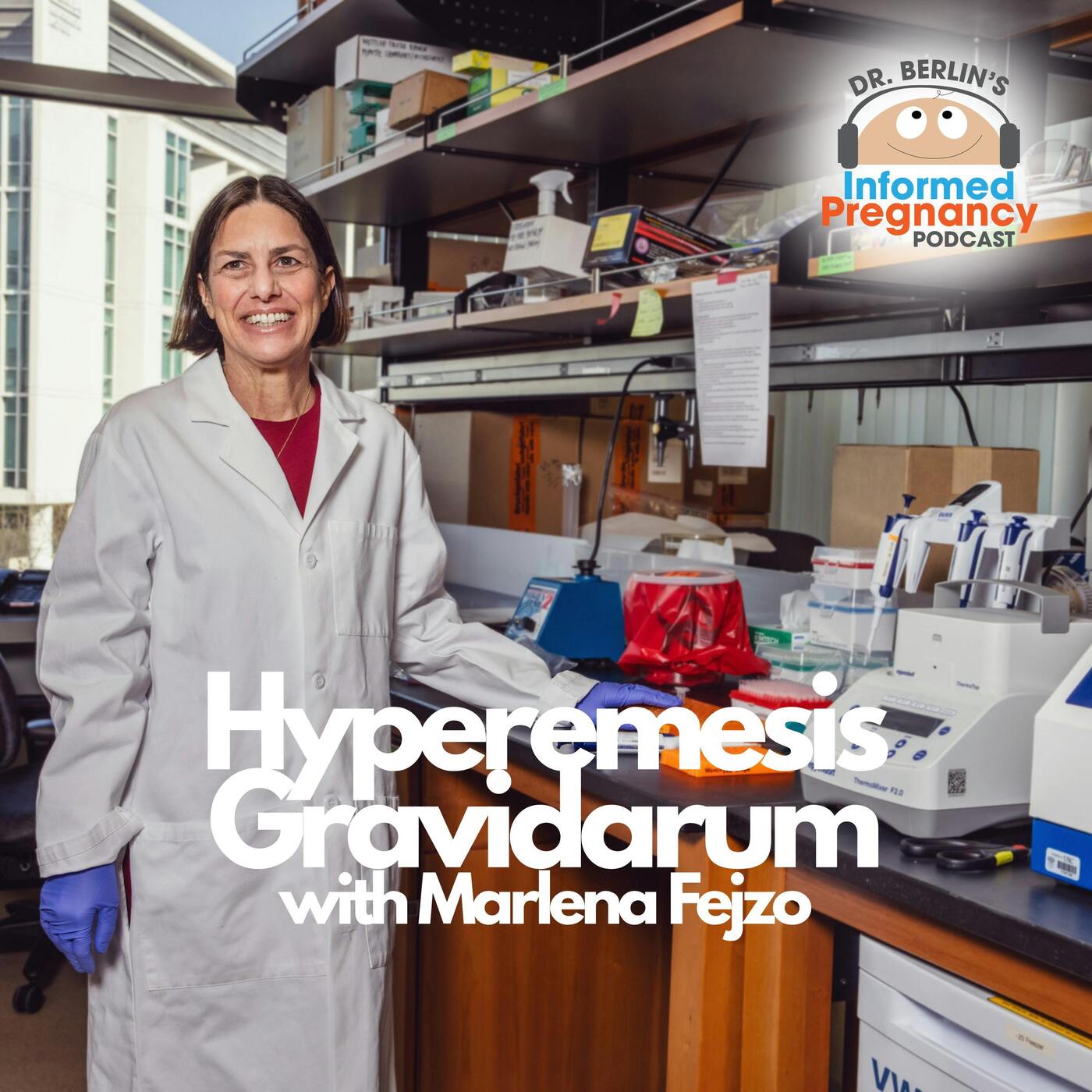
October 8, 2026 · 33 minutes · Episode 522
About this episode
After her own experience with hypermesis gravidarum, clinical professor and leading researcher Marlena Fejzo discusses her own pregnancies and how she built on her own background in genetics and women’s studies to find out what causes the condition and how it may be prevented.
Connect with the guest:
Grow with us on IP+! Informed Pregnancy Media presents two all new intimate short-form video series following Garrett and HeHe’s real-time pregnancy journeys as they prepare for an empowered birth and postpartum experience. Each episode features weekly updates with personal photos and videos to help bring these raw stories to life, a visually dynamic guide through each mother’s emotional and physical experiences.
Keep up with Dr. Berlin and Informed Pregnancy Media online!
Learn more about your ad choices. Visit megaphone.fm/adchoices
See Privacy Policy at https://art19.com/privacy and California Privacy Notice at https://art19.com/privacy#do-not-sell-my-info.
Key quotes
“I got so weak that I had to use a buzzer to communicate. I couldn't even speak anymore. So yeah, so I think I was starving.”
“So it's not a choice. A lot of people will say, oh, I had that, but I just powered through it. No, this is not a choice. You really can't. You're unable.”
“And people with hyperemesis, they often have a genetic predisposition to producing lower levels of this hormone prior to pregnancy. And so when it rises rapidly in pregnancy, they generally are hypersensitive to it.”
“Yes, finally, I hope that we can convince people with our now biological knowledge about the etiology that it is not a made up condition for attention or a psychological condition.”
“So right now we have just initiated a clinical trial to test a medication called Metformin to raise the levels of GDF-15 prior to pregnancy in people with a history of hyperemesis”
Related episodes
- Ep. 493 In Conversation with Esther Friedman Schwartz
- Ep. 514 Before Baby #4 with Kara Sutton
- Ep. 505 Relinquishing Control with Parul Somani Part 1
- Ep. 500 The Unexpected with Dr. Elliot Berlin Part 1
Transcript
AI-generated transcript with speaker labels — may contain errors, especially names and medical terms. Dr. Elliot Berlin, DC appears in blue; Marlena Fejzo in orange.
Dr. Elliot Berlin, DC [0:00] Severe nausea and vomiting in pregnancy is often dismissed as something people simply have to endure, but for some it can become a serious and even devastating medical condition. Today's guest knows that experience both personally and professionally. After facing hyperemesis gravidarum in her own pregnancies, she turned her background in genetics and women's health towards understanding what causes the condition and how it might one day be prevented. She is a clinical professor of population and public health sciences in the Center for Genetic Epidemiology at the Keck School of Medicine of UFC and one of the leading researchers studying hyperemesis.
[0:40] I'm pregnancy-focused chiropractor Dr. Elliot Berlin and you are listening to the Informed Pregnancy Podcast. Dr. Marlena Faso, welcome to the podcast.
Marlena Fejzo [1:06] Thank you for having me.
Dr. Elliot Berlin, DC [1:07] Welcome back, I should say. You've been on before, and this topic I feel like can't get enough air time. It's really important to talk about it. I think that there's not enough conversation around it, not enough people know, and even not enough doctors really talk about it and address it. So the more we can spread information about it, I think the better off people who struggle with it will be. Before we get to that, let's start at the beginning. You grew up in Los Angeles. What was your growing up like here?
Marlena Fejzo [1:38] I had a really charmed childhood. I have three siblings and my parents were great. They taught us all kinds of different things. They really wanted us to be well-rounded. We played tennis and went skiing and hiking and we went to concerts. We all learned musical instruments.
Dr. Elliot Berlin, DC [2:03] What do you play?
Marlena Fejzo [2:05] I play the flute. He used to play in quotes, I should say. We had a really full childhood. We went to museums. My parents taught us about art. It was a nice childhood. I grew up not just with the family, but cousins. My mom always liked to have people over, so we always had a very full house.
Dr. Elliot Berlin, DC [2:29] What did your parents do and did it influence what kind of work you ended up doing?
Marlena Fejzo [2:35] Not at all. My dad was a judge and my mother was a German professor, so I definitely picked a different field than them. As far as education, my parents were very interested in us having a good education and knowing that education is very important. My dad definitely encouraged me to stay in school as long as I could. He said that after that, when you have a job, it can get tedious. When you're learning, it's always interesting.
Dr. Elliot Berlin, DC [3:10] Did you always see yourself in health sciences?
Marlena Fejzo [3:14] I kind of wavered around. As a child, I was interested in animals and science. A lot of girls are interested in animals, but I was a little bit more than most. I had different jars of all the different phases of the butterfly from caterpillar, cocoon butterfly that I had in front of our house, and then I would expose them to different elements and see if it changed the outcome of whether it turned into a butterfly or not. So I took it a little bit further than most children. I do remember in sixth grade at an assembly, one of the parents, I think, who was a doctor passed around a lung from a smoker and a lung from a non smoker. And that had a huge impact on me.
[4:03] I remember at that point thinking, I want to be a scientist and try to understand what causes cancer, lung cancer. And I did do cancer research for 20 years in addition to my hyperemesis research. But then in junior high and high school and even in college, I pursued other possibilities and thought about other possibilities of different careers before my junior year in college when I took a genetics class and I just found genetics fascinating. I was actually an applied math major in college, but it was in my junior year that I took genetics and decided that that's what I wanted to do.
Dr. Elliot Berlin, DC [4:44] What about genetics pulled you away from mathematics?
Marlena Fejzo [4:48] I just found it so fascinating that there was sort of this secret code inside of you that could make a human being or an animal. And I just found it completely fascinating, genetics. And it had a more human element to it than mathematics. So I thought I'll try to apply to grad school in genetics and if I don't get in, then the next year I'll apply for mathematics. But I did get in and so.
Dr. Elliot Berlin, DC [5:18] What was grad school like in that field?
Marlena Fejzo [5:21] It was really an exciting time in graduate school because of the human genome project. And it was also kind of tedious as well compared to how it is now as far as genetics is concerned. But then we got to really learn the basics of, you know, genomic sequencing and firsthand in the lab rather than just sending it out like people do now. So, yeah, it was a very exciting time. And my mentor, Cynthia Morton, was doing a project on women's health, which was the genetics of uterine fibroids. And so that really resonated with me to be able to focus on a genetics project for my Ph.D. that was in women's health and much needed. So at that time, they didn't even know or a lot of people didn't even believe
[6:13] that uterine fibroids or Lymeomas could be genetics. So it was an interesting project.
Dr. Elliot Berlin, DC [6:19] Yeah, sounds very interesting. Then you moved from uterine fibroids to breast cancer research.
Marlena Fejzo [6:25] Yes. So for my postdoc, I went to UCSF and worked on the genetics of breast cancer. And I did that for a few years. And there were many people working on that. So it wasn't as much of a needed field as, for example, fibroids and hyperemesis, but it was still very interesting to me. Yeah. So I did that for a few years. And then I did a second postdoc in multiple sclerosis at UCLA, which also disproportionately affects women.
Dr. Elliot Berlin, DC [6:57] And these choices deliberately because you want to be in women's health.
Marlena Fejzo [7:03] I did have a stronger interest in focusing on women's health issues. You know, I'm a woman scientist and I felt like there was a need for more research in the areas of women's health. So, yes.
Dr. Elliot Berlin, DC [7:19] Well, now you're knee deep in one that really needs attention. Let's take a little commercial break and find out how you got involved in hyperemesis. We'll be right back.

Dr. Elliot Berlin, DC [7:40] Welcome back. We're talking to Dr. Marlena Fezo. Okay. A lot of background pulling you from not being a judge or a German professor to maybe math, but then women's health, genetics. And now you work in hyperemesis. We're going to describe what that is and really get into a lot of detail about it. But before we get there, how did hyperemesis become something that you were interested in?
Marlena Fejzo [8:09] Yeah, so I had never heard of hyperemesis. And I got pregnant when I was doing my post-doc in San Francisco. At that time, I was very sick. I missed eight weeks of work. I lost 15 pounds and I was only 105 pounds to start. And I went for IV fluids twice, but I was not given any medication or any diagnosis at that time.
Dr. Elliot Berlin, DC [8:34] Was it just something that they had seen in other people and didn't really have anything to treat or even any information?
Marlena Fejzo [8:43] No, they just gave me IV fluids and sent me home. When I called the doctor's office, the nurse told me, don't worry about it. The baby's getting everything it needs from you. If you can't take your prenatal vitamins, that's fine. Yeah, so not really treated. And I did get better in that pregnancy in the second half of my pregnancy and had a pretty easy rest of my pregnancy and delivery after that.
Dr. Elliot Berlin, DC [9:12] How many weeks did it last for you?
Marlena Fejzo [9:16] It lasted, I think, from six weeks. I was home for eight weeks and then was able to go back to work, but was still not feeling great at work. I had to just eat by myself. I couldn't go to the lunchroom without vomiting for a few weeks, but I was able to work. And then after 20 weeks, I started to be able to kind of eat normally and gain the weight back and gain weight in pregnancy.
Dr. Elliot Berlin, DC [9:43] Wow, that's pretty intense. Again, like you said, starting at a relatively low weight and then losing weight as you're getting more pregnant. Was it scary?
Marlena Fejzo [9:53] Yeah, it was very scary. I was lucky because my little brother was in graduate school at Berkeley at the time and he would come over on the bar to San Francisco in the middle of the day to check on me while my husband was at work and he would just read the paper. He said I was completely green and he would read the newspaper to me to try to get me through until lunchtime. And then he would just put a little tiny thing of food next to me and I would try to eat it and then tell him, take it away, take it away before vomiting and he would take it away. But that kind of got me through those weeks and I'm really grateful to him. But yes, it was very scary and I didn't know what it was.
Dr. Elliot Berlin, DC [10:32] Didn't come in contact with anybody else who had it?
Marlena Fejzo [10:36] No, I was pregnant at a relatively young age compared to my friends. So I just really didn't know. I didn't have other friends that were pregnant. And so I just didn't know.
Dr. Elliot Berlin, DC [10:50] Thankfully, the second half of your pregnancy sounds like it was better.
Marlena Fejzo [10:54] Yeah, it was fine. It was great, actually.
Dr. Elliot Berlin, DC [10:57] After you delivered your first, were you nervous to have another one because of that first experience?
Marlena Fejzo [11:03] Yes, I was very nervous, but I just held on to that saying that, you know, there can be huge variation from one pregnancy to the next. And I just hoped that it would be better. I didn't think it could be worse. But unfortunately, in my second pregnancy, it was much worse.
Dr. Elliot Berlin, DC [11:24] Did it start earlier or just come on more intensely?
Marlena Fejzo [11:28] It started around the same time, but it was much more intense. So in the first pregnancy, I could eat a little bit of something every day. But in the second pregnancy, I could not eat or drink anything. I couldn't even move without violently vomiting. So it was really torture. I just had to lay completely flat on my back. And still, if I turned to my side, I would start violently vomiting. I couldn't sit up. I couldn't get up to go to the bathroom or brush my teeth.
Dr. Elliot Berlin, DC [12:01] Wow, that's so intense.
Marlena Fejzo [12:04] Yeah, it was like being paralyzed.
Dr. Elliot Berlin, DC [12:06] I think someone listening could start to realize that's different than nausea and vomiting of pregnancy.
Marlena Fejzo [12:12] Yeah, it was very severe and really, really terrible.
Dr. Elliot Berlin, DC [12:19] And at this time, is it the same medical team that you're with?
Marlena Fejzo [12:23] No. So at this time, I was down in Los Angeles and I had a new doctor. This doctor did diagnose me right away. And he put me on IVs at home and home health care. So I wasn't in the hospital, which at first seemed like it would be a good idea because, you know, I had a two and a half year old at home. But I really should have been in the hospital because he didn't know how severe I was.
Dr. Elliot Berlin, DC [12:53] Are the IVs just helping with hydration or you're getting nutrition?
Marlena Fejzo [12:58] So it started off just with IVs. There was probably glucose in the IV. But yeah, I didn't start on nutrition. I couldn't eat anything and didn't keep anything down for, I think, eight weeks before I started. First, my doctor put me on seven different medications at once to try to get me to be able to eat finally and nothing helped. And so then he put me on TPN, which is like kind of a feeding tube that goes into your vein. And yeah, and started me on that total parenteral nutrition. But it was too late. So I ended up losing the pregnancy in the second trimester.
Dr. Elliot Berlin, DC [13:44] I'm so sorry. Meaning, had you started nutrition earlier, things might have turned out differently?
Marlena Fejzo [13:51] I think so, because with the nutrition, once I started on the nutrition, I felt sort of the strength to deal with the daily suffering. Whereas without it, I just was getting weaker and weaker. I got so weak that I had to use a buzzer to communicate. I couldn't even speak anymore. So yeah, so I think I was starving.
Dr. Elliot Berlin, DC [14:18] How long ago was this?
Marlena Fejzo [14:21] This was in 1999.
Dr. Elliot Berlin, DC [14:23] And were there any other resources made available to you?
Marlena Fejzo [14:28] No.
Dr. Elliot Berlin, DC [14:29] Like any kind of support group or sources of information about hyperemesis?
Marlena Fejzo [14:35] There was only one source online, which was a woman who had terminated her pregnancy due to HG. And she was, I think, Catholic. And so it was very devastating for her. And she created a website that had a little bit of information. So I think I had emailed her a little bit back and forth at the time, but that was it.
Dr. Elliot Berlin, DC [15:03] Is that what led you to study hyperemesis?
Marlena Fejzo [15:06] Yes, so during that time, my doctor had told me that I was just, my parents were taking turns taking care of me during the day when my husband was at work because I was getting fluids and I needed a bed pan. I couldn't get up. And so they had to come to change the bed pan and the medications. And so they were recently retired. And he told me that I was trying to get attention from them. And I was concentrating my symptoms to get attention. And he told me even that he had done a study on this that showed that people with hyperemesis were infantile and trying to get attention from their mothers. I never found that study. I imagine that the idea came from the fact
[15:55] that a lot of women with hyperemesis end up moving back home to have their mothers take care of them. And, but that's, it's a cause and effect where he's saying the effect is actually the cause. So, but I didn't have the energy to argue with him at the time, but afterwards when I recovered, I did find the first gene associated with uterine fibroids and I did have a PhD in genetics from Harvard. So I decided to go ahead and focus on trying to find the real cause.
Dr. Elliot Berlin, DC [16:33] Well, we've come a long way. Let's take another break and we come back, catch us up on what we know now. We'll be right back. Welcome back. We are talking to Dr. Marlena Faso about hyperemesis gravidarum. First of all, you've discovered a lot. Your research has been invaluable. One thing just before we get into the details is how many people does hyperemesis affect? What percentage of pregnancies?
Marlena Fejzo [17:12] Yeah, so that's a great question. The publications show a huge range and it probably depends on how it's defined and whether it's diagnosed. So about 2% of people or one out of 50 pregnant women are hospitalized for this in the US or go to the emergency room for it, but there may be many more people that actually have it depending on the diagnosis. So we know that 20 to 30% of women actually ask for medications or are prescribed medications for nausea and vomiting of pregnancy. So yeah, it's really a range.
Dr. Elliot Berlin, DC [17:58] Is there a preferred diagnosis that you use?
Marlena Fejzo [18:02] I like to use a definition that was created by many stakeholders in the field through several conferences. And it is a definition that we are all agreed upon that is that you can't eat or drink normally. You can't perform your daily activities. So it's not a choice. A lot of people will say, oh, I had that, but I just powered through it. No, this is not a choice. You really can't. You're unable. Normally, you can't perform your daily activities. You become dehydrated and have electrolyte abnormalities. So you're going to need IV fluids. And people generally end up losing weight instead of gaining weight in pregnancy. So they require treatment.
Dr. Elliot Berlin, DC [18:56] For someone who doesn't know much about genetics, what do we now think actually causes hyperemesis?
Marlena Fejzo [19:05] Yeah, so we've done several genetic studies and all of them have pointed to this gene called GDF15 that codes for this hormone, also called GDF15, that is the greatest risk factor for hyperemesis. So that gene codes for a protein that is involved in causing appetite loss and in higher levels, nausea and vomiting. And everybody has it, whether you're male or female and whether you're pregnant or not. And what it does is to, we think, tell you that when you're in some kind of sensitive state, so any of your organs are not in great condition, this hormone will be produced and it will tell you that you are more likely to survive if you rest and recover
[20:09] and avoid going out and searching for food. And so in the case of pregnancy, the placenta produces huge amounts of this hormone early in pregnancy. And people with hyperemesis, they often have a genetic predisposition to producing lower levels of this hormone prior to pregnancy. And so when it rises rapidly in pregnancy, they generally are hypersensitive to it. And we believe that it rises in pregnancy probably as an evolutionary mechanism to keep women from avoiding foods that might be dangerous to the early development of the fetus and to avoiding in the times when we had to search for food, getting eaten by a predator or attacked or eat something poisonous that could affect the fetus.
[21:10] And so that's what we believe it evolved to do. And we probably don't need that anymore.
Dr. Elliot Berlin, DC [21:18] Interesting. So one thing, it sounds like I heard you say that it's not necessarily the level of GDF-15, but the increase, I guess, for this person in GDF-15, meaning two people, it sounds like, could have the same level. One would have a much stronger reaction if they normally have lower levels than someone who's more used to having it circulating.
Marlena Fejzo [21:43] Exactly. So you can think about it, for example, if it's really hot outside and your house is air conditioned, then when you go outside, it's gonna feel really hot. Whereas if you don't have air condition, you're preconditioned to the hot weather. And when you go outside, it's not gonna be such a shock to the system.
Dr. Elliot Berlin, DC [22:04] Is there an understanding of why some people have the air conditioning on, so to speak, and other people don't?
Marlena Fejzo [22:11] Yeah, so basically we know it's due in part to genetics. So some women have a variation in their GDF-15 gene that makes them have lower levels of this hormone circulating in their blood when they're not pregnant. Then the placenta comes along and shoots it up. Exactly.
Dr. Elliot Berlin, DC [22:33] Okay, does this kind of put to bed the idea that HG is psychological?
Marlena Fejzo [22:39] Yes, finally, I hope that we can convince people with our now biological knowledge about the etiology that it is not a made up condition for attention or a psychological condition.
Dr. Elliot Berlin, DC [22:53] If it is a genetic and somebody has this condition in a pregnancy, does it mean they're more likely to have it in every pregnancy?
Marlena Fejzo [23:03] Yes. So one of the, actually the greatest risk factor for hyperamesis is having it in a previous pregnancy. So you're very likely to have it again if you had it in a previous pregnancy.
Dr. Elliot Berlin, DC [23:17] Is it more likely to be worse? Like in your case, it was much worse sounding the second time.
Marlena Fejzo [23:24] Yeah, no, it can vary from one pregnancy to the next. And that may have to do with the genetics of the father and the placenta and how much GDF-15 it produces. And it may also have to do with your pre-pregnancy health. So we know that if you have certain health conditions prior to pregnancy, like I said, it's a stress response hormone where if some part of your body is under stress, it rises so you may, in addition to genetics, increase the levels of it or have increased levels of it or different levels of it from one pregnancy prior to one pregnancy to the next based on your health.
Dr. Elliot Berlin, DC [24:09] Now that you have an understanding of what's behind hyperemesis, are there ideas on how to control it or treat it?
Marlena Fejzo [24:18] We have ideas that we are testing out. So right now we have just initiated a clinical trial to test a medication called Metformin to raise the levels of GDF-15 prior to pregnancy in people with a history of hyperemesis and see if we can use that to desensitize them to hyperemesis in pregnancy with the knowledge that Metformin is a drug that we already know results in increases in your circulating levels of GDF-15.
Dr. Elliot Berlin, DC [24:57] Okay, so you're trying to kind of turn off the air conditioning.
Marlena Fejzo [25:02] It's something like that.
Dr. Elliot Berlin, DC [25:04] You're trying to sensitize them to the GDF-15 so that when the placenta comes along and makes it, it's not such a stark difference.
Marlena Fejzo [25:12] Yeah, so we wanna raise their levels slowly before and then hopefully then during pregnancy they will already be used to it and will not have such a severe response.
Dr. Elliot Berlin, DC [25:25] Where's the trial now?
Marlena Fejzo [25:28] So the trial is all over the United States but the treatment group, they have to be living in California and come to the study site for three visits and to receive the medication. So if you're living in another state, you would be on the comparator arm and that comparator arm will not be receiving the drug. But it's very important that we have people on both sides of the trial, the treatment and the comparator arm to understand how well it works.
Dr. Elliot Berlin, DC [26:01] And these are for people who have already had a pregnancy and had been diagnosed with hyperemesis?
Marlena Fejzo [26:07] Exactly, so everybody in the trial should have had a history of hyperemesis in a previous pregnancy and be planning to conceive. And we will be opening a second trial site in Birmingham, Alabama at the morning sickness clinic there hopefully by January.
Dr. Elliot Berlin, DC [26:29] Okay, coming up soon. Do we have a way to predict for somebody who hasn't had a pregnancy yet, a way to predict who might be, it's not such a small number, two out of a hundred, who might be susceptible?
Marlena Fejzo [26:44] Yeah, so that's a really good question and we are working on that simultaneously because obviously if the trial is successful, then we will want people to take metformin before pregnancy who are at risk, but we don't want everybody who's planning to conceive to take a medication if they don't need it. So we are working on developing a test to predict it, but it's not available yet.
Dr. Elliot Berlin, DC [27:13] Okay, what will the mechanism be? The mechanism for testing, what are we looking at?
Marlena Fejzo [27:19] So it's in development now in the research phase at USC. So we are looking at a combination of some clinical factors, some non-genetic and genetic factors and some biomarkers. We want to develop the best test possible. So we have a preliminary test now that is working pretty well, but we want to add some things in and get it as predictive as possible before we have it available for everybody.
Dr. Elliot Berlin, DC [27:52] For someone who's listening right now who's pregnant and vomiting, you know, vomiting a lot, what would you want them to know about the difference between morning sickness and hyperemesis? When is it something that needs medical attention?
Marlena Fejzo [28:08] Yeah, so it's really when you are not able to perform your daily routine, you can't eat or drink normally, you're getting dehydrated and you're losing weight. Even if you're not losing weight, there are medications that you can get started on so that that doesn't happen. So I would talk to your doctor if you have any of those factors.
Dr. Elliot Berlin, DC [28:35] Are there things you wish that every obstetrician, midwife, emergency room physician understood about HG?
Marlena Fejzo [28:44] Yeah, I mean, I still get people saying, even doctors saying or teaching that, you know, it's psychological or it's caused by HCG, which were sort of the old historical teachings about it or they were theories. But, you know, if you've listened to this podcast, I hope I've convinced you that the main cause is this hormone GDF-15. HCG is also produced with the maternal and paternal genetics, and yet there is no genetic component that we found linking HCG or its receptor to hyperemesis. So I think it's really time to put that theory to rest and focus on GDF-15. I also wanna say that in addition to the prevention trial that we have that there is an ongoing clinical trial
[29:41] using antibody to treat the symptoms in pregnancy by blocking the activity of the GDF-15 hormone that's going on in the UK and Australia now. And so I'm hopeful that there will be ways to not just prevent it, but also treat it better based on drugs that target the root cause in the future.
Dr. Elliot Berlin, DC [30:04] It sounds like the work that you're doing is invaluable and, you know, I'm really sorry that you had the experience you had, but it takes someone strong to have that experience and then dedicate their entire career to making sure that others don't suffer that way. I didn't mention earlier, but you did complete your family eventually with two more babies.
Marlena Fejzo [30:29] Yes, so I was able to complete my family. Like I said, I came from a big family and I always wanted a big family as well. I love babies and children. And so I was fortunate in that I was able to have a surrogate and have twin girls after my son. So, yeah, so I have three children. They're all grownups now, but.
Dr. Elliot Berlin, DC [30:51] Yeah, it goes very quickly. Where can somebody go for reliable information and support if they are concerned about having hyperemesis?
Marlena Fejzo [31:03] Yes, so I strongly recommend visiting the Her Foundation website, hyperemesis.org. They have excellent resources for clinicians and for families going through this. So I definitely recommend going there. And there you can get the updated information. There's also support groups, online support groups, so you can get support and see other people going through it. So yeah, it's a great resource.
Dr. Elliot Berlin, DC [31:35] Dr. Fezo, thank you so much for the important work that you're doing and also for coming back to share the most recent updates. Every time I talk to you, it seems like you're making a lot of progress on understanding the condition and finding out ways to figure out who it's going to affect and treatments. And I think it sounds like we're getting very close to some major breakthroughs.
Marlena Fejzo [32:00] Yes, I hope so.
Dr. Elliot Berlin, DC [32:02] I appreciate you. At home, thanks for listening to the Informed Pregnancy podcast. For more pregnancy and parenting information just like this, visit us online at informedpregnancy.com. I got it.
Want more pregnancy + parenting? Start your FREE TRIAL of Informed Pregnancy+ and get access to all our curated pregnancy and parenting content — original series, iconic birth films like The Business of Being Born, prenatal workouts and more.

0 Comments