
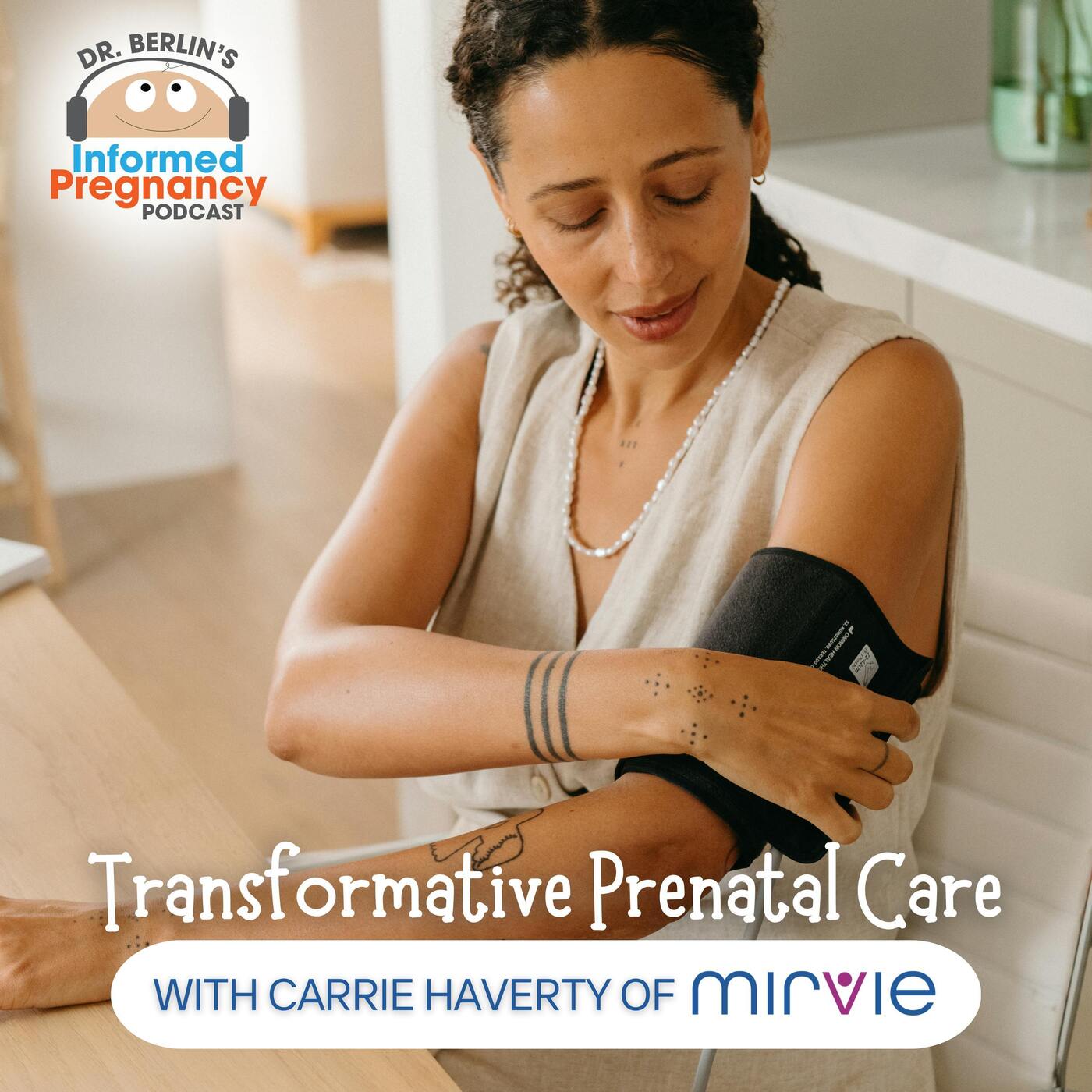
July 17, 2025 · 46 minutes · Episode 468
About this episode
What if you could understand your pregnancy risks before you face them? Carrie Haverty is a mother and maternal health pioneer who has worked in high-risk OB clinics, exploring reproductive genetics and technology that’s transforming prenatal care. She discusses Mirvie‘s offerings to improve outcomes for families, including one that can detect preeclampsia months before symptoms present.
Connect with the guest:
Informed Pregnancy Media and Mahmee present an all new podcast! One Way or a Mother is a new narrative podcast from Dr. Elliot Berlin, DC. Each season is an intimate story of one woman, one pregnancy, and all of the preparations, emotions, and personal history leading up to the birth. Episodes feature the expectant mother along with her family, doctors, and birth work team.
Start listening to Episode 1: I Should Have Died featuring Arianna Lasry
Keep up with Dr. Berlin and Informed Pregnancy Media online!
Learn more about your ad choices. Visit megaphone.fm/adchoices
See Privacy Policy at https://art19.com/privacy and California Privacy Notice at https://art19.com/privacy#do-not-sell-my-info.
Key quotes
“That the primary is to listen and understand what women and their families want and need. And that's always true. That's always at its core. In terms of the technology that they're”
“it just becomes, you know, an expensive PDF sitting in an electronic health record somewhere”
“that can say, hey, based on this biology, not based on what you look like, we can say, you are at high risk and you should be doing these things. Or very importantly,”
“She was healthy. Baby was healthy. She felt she was in control. And she even said her doctor told her, quote, this is the best case of preeclampsia I've ever seen.”
“You know, women, especially pregnant women, we deserve to have the best technology and to be able to take advantage of that, to have all the information possible so that we can have”
Related episodes
- Ep. 470 Carlson Young: After Birth
- Ep. 480 Twins with Lauren Gaba Flanagan
- Ep. 466 A Before & After Birth Story with Aimee Carrero: Part Two
- Ep. 500 The Unexpected with Dr. Elliot Berlin Part 2
Transcript
AI-generated transcript with speaker labels — may contain errors, especially names and medical terms. Dr. Elliot Berlin, DC appears in blue; Carrie Haverty in orange.
Dr. Elliot Berlin, DC [0:00] What if you could understand your pregnancy risks before they actually happen? My guest today is a parent, a healthcare innovator, and a pioneer in maternal health whose journey spans years of working in high-risk OB clinics, diving deep into reproductive genetics, and now developing technology that's transforming prenatal care. We'll explore the real stories, science, and inspiration behind a powerful new tool designed to improve outcomes for millions of families, including one that can detect preeclampsia months before symptoms begin. I'm Pregnancy-focused chiropractor Dr. Elliot Berlin, and you're listening to a sponsored episode of the Informed Pregnancy podcast
[0:44] brought to you in collaboration with Mirvi. Carrie Heverty, welcome to the podcast.
Carrie Haverty [1:05] Thank you so much, Dr. Berlin. It's such a pleasure to be here. Oh, my goodness. I met you and I learned so much from you in one hour that I'm like, why did I go to grad school? Likewise. I was so impressed by my visit to your practice and learning so much about how you take care of our pregnant patients in such innovative and caring ways. It's really awesome to see.
Dr. Elliot Berlin, DC [1:25] Oh, thank you. I mean, it's definitely teamwork. And you have created something that I didn't even think was possible. And I kept grilling you with questions because I'm like, no, but is this really? Really? And I'm excited to now share both you and it with our audience. But let's get to your roots. How did this all start? How did you become interested in genetic counseling?
Carrie Haverty [1:47] Oh, gosh, that goes a little bit far back in my academic career. I was actually in college and a sociology major. I was pre-law. I wanted to do advocacy work for women and children. And I took a genetics for dummies kind of class for my breath requirement for science. It was very intentionally for non-science majors. And I fell in love with it. And I had a really interesting and progressive professor who did a lot of genetic work with fruit flies, but was very, very interested in the human impact of genetics, not just the science of it, but like why it matters, what people do with the information. And he told us about the field of genetic counseling. And that is the ultimate in
[2:31] terms of how genetics impacts patients' lives, people's lives, human lives, because it's all about how we bring in genetic information to incorporate into our personal decision-making for our health, our care of our families and our family's healthcare decisions and understanding the complex science behind it, but also how that informs the decision-making and the personalization of that information so that we're taking it in and actually incorporating it into our life and into how we think about it and how we move forward with the information. So it really that incredible melding of hardcore science and hardcore humanity together. And I just fell in love with it and immediately went and figured out how to become an
[3:13] added genetics major. And this was far enough ago that I wrote a letter to the National Society of Genetic Counselors to get more information about what I needed to do to become a genetic counselor. And I am a very proud genetic counselor and still boarded and licensed. I have been a genetic counselor for over 25 years now. Wow, you must be getting the hang of it.
Dr. Elliot Berlin, DC [3:33] Hopefully. You mean you wrote a letter like with pen and paper?
Carrie Haverty [3:38] I believe I typed it, but yes, I put it in an envelope with a stamp. That's a technological leap forward. Exactly, exactly.
Dr. Elliot Berlin, DC [3:46] So did you switch from a sociology major or did you add to it?
Carrie Haverty [3:49] I added to it. And actually a sociology major has been incredibly helpful too. It really is interesting to think about how science impacts all of our lives as a society, how we make decisions collectively, how it impacts policy and other areas too. So really the majors ended up being really complimentary. So did that and then I backed it up with a psych
Dr. Elliot Berlin, DC [4:12] minor just to, you know, keep me busy. Why not? I mean, but that also really plays in very importantly with the kind of work that you do. 100%. 100%. Yeah. So did you go straight from all the education into, because I mentioned in the opening, you worked in a high-risk OB clinic. Was that right after school? While I was still in college,
Carrie Haverty [4:37] I knew I wanted to be a genetic counselor, but was still an undergraduate. I started working at a community health clinic. This was a free clinic. It really served people who didn't have otherwise access to good health care. It was specifically around women's health. So we did a lot of counseling around birth control options, pregnancy testing, pregnancy options, pregnancy care, end of pregnancy care, all sorts of different areas of women's health. I saw a lot of teenage girls and I saw a lot of farm workers that were coming through the community where I went to college and who didn't have continuous health care. But of course we're a reproductive age and wanted to know how to best plan for their
[5:18] families to start pregnancies, to avoid pregnancies and keep themselves healthy. And that really opened my eyes to just how complex the field is of pregnancy health. And it just lit a fire in me. And when I applied to graduate school for genetic counseling, I wrote about it. When I went to grad school and was learning to become a genetic counselor, I always chose as much as possible to be in the reproductive health clinics, the prenatal health clinics, and it just has always been my love. So my first jobs out of grad school were in reproductive health, working in high-risk OB clinics, and using genetic counseling and the power of understanding genetics and the science of it
[5:57] to help patients be really engaged and happy and healthy patients to understand what was going on, what their options were, and to be able to move forward to have the healthiest
Dr. Elliot Berlin, DC [6:09] possible. It's always been there for me. Yeah, I can hear the passion for it still 25 years later. Are you in that type of clinic working with them before they conceive
Carrie Haverty [6:21] on strategies or once they already have an embryo going? All of the above and after they have a baby too. So I would see patients who were planning a pregnancy who maybe came in because they were concerned about a family history or because of history in their past pregnancy. I would see them during a pregnancy if something came up during an ultrasound evaluation or a blood test that brought up concern or maybe they didn't know they were pregnant and they were taking a medication that they were concerned could have affected their pregnancy. And then I'd see them afterwards in pediatric clinics too, when they were trying to figure out if they had a baby that had challenges,
[6:58] trying to figure out what was going on there, how to best help their child, and what that would mean for future pregnancies as well. So it's really all of the above. We don't just separate these out. This all impacts everything and impacts the whole family too. So what kind of technology did you have available back then to help you in your goals and your work? Well, again, I've already admitted to writing a letter and putting a stamp on it. So I will continue that. At its core, the primary technology is listening. That the primary is to listen and understand what women and their families want and need. And that's always true. That's always at its core. In terms of the technology that they're
[7:45] listening to or that's influencing and impacting their decision, that's certainly changed a lot over time. I mean, genetics and the technology, the science of it, clinical development has rapidly progressed over the last several decades and it's going to continue. There's no end in sight in that. And that's exciting because what we didn't know two decades ago, I look forward to thinking, oh my gosh, what are we going to be able to do and solve and treat and prevent in the future is just super exciting. A lot of us have read recent headlines around gene therapy and how successful that has been. And that was a complete science fiction when I was in grad school and early in my career.
[8:28] And now we're sequencing genes. We're understanding what's going on with the DNA. We're developing treatments targeted to specific changes in that DNA that's unique to that particular individual, whether we're talking about treating cancer, whether we're talking about treating conditions that people are born with, all of the above. It's super exciting. And we've just barely scratched the surface of the power of genomics. And that's why this field is so exciting to me and why I love being able to use it in places like MeRV. It's really innovative. We're using now RNA, which I can talk a little bit more about, not just DNA, but really harnessing the whole power of genomics is pretty thrilling.
Dr. Elliot Berlin, DC [9:06] Now, just like you're sitting here today and postulating on all the things that we might be able to do in the future, you, 20 years ago, must've had similar hopes and dreams for the gaps that existed in the work you were trying to do then. What kind of things did you dream of and are they available today?
Carrie Haverty [9:27] Yeah, some are and some aren't, shockingly. We were struggling to identify which mutations or changes, variants in genes cause certain inherited conditions that we could see were passing through families. We knew they were happening, but we couldn't figure out what it was in the genetics and the DNA that was causing it. And for a lot of those things, we have figured that out. We now have next generation sequencing. We can sequence genomes. We can look for those changes and identify those changes in that particular family that's causing that particular condition, which is very exciting and amazing to have so much more known about, especially things that used to be considered rare disease.
[10:08] But when you have a lot of rare diseases, they're not that rare anymore. Rare really adds up to be quite common. And that's awesome. There's an amazing number of things that are quite common that we still don't understand. And that's where it's tricky. We still don't understand. Obviously, work for a company that's talking a lot about preeclampsia affects one in 12 people. That's pretty common during pregnancy. And yet we do not have a clear understanding of why that is happening in that person and not in that person, or what exactly we can do to prevent it and how it might be different. But I take a lot of heart in how much evolution and advance we've had in areas like oncology and cardiology,
[10:49] where we just said, oh, you have breast cancer because there's a lump of tissue in your breast that shouldn't be there. And now we don't do that. We say, oh, you've got this cancer that's identified by this particular change in the tissue. And we know exactly what we can do to target it, to treat it, and to prevent it from happening again. That's an amazing advance. And there's no reason why we can't do that with other things, too.
Dr. Elliot Berlin, DC [11:11] So when did you switch from more of a clinical genetic counselor to more of an innovator?
Carrie Haverty [11:17] Yeah. I spent about 15 years working in the clinic in direct patient care. I loved direct patient care. I never burnt out on it. People do because there's good reasons for that. But I loved it. It was always such a privilege to be that intimately involved in a patient's life and to help them understand what's going on with their own biology and their own pregnancy and then take their own values, their own experiences, their own needs, and move forward in their lives. Whether it was the outcome they wanted or not, they're still moving forward and they're moving forward empowered, informed. Just such a huge privilege. So I never got sick of that. I never burnt out on that. But I was
[11:56] sick of some of the pace of innovation because there were exciting things happening, new science advances happening, and they just took forever for me to actually be able to use them bedside with a patient. And that gets wearing after a while when you go to conferences and you see these exciting things being presented up on a stage and you're like, wow, that's so cool. I might be retired before I ever get a chance to use this with patient. And that was a little frustrating. So the pace of change was frustrating, especially when you work in women's health, because it's always like the least funded, the least understood, we're under resourced, under researched. I mean, women weren't involved
[12:38] in studies until I was partway through college before that became common to include women in clinical studies. Isn't that? And if you talk about pregnant women, it's much later than that. So we just have far less data around anything in terms of how it impacts women's biology, let alone pregnant women, which is a whole other thing. So in the interest of being protective, it just ended up being paternalistic and limiting. And so it's not any surprise that we are behind other specialties in medicine in terms of what we know and understand and what kind of tools and technologies have been developed in advanced. How did you jump over? I started talking to people. I just started talking to anybody that I knew that was working
[13:25] in an area of interesting technology, gene sequencing companies, innovative laboratories, education companies that were using online education tools and just anybody that was doing anything where they weren't directly caring for patients, but they were directly impacting patient care and just asking them, what do you do? How do you do this? What does that look like? And then I started talking to companies that I liked and that I really admired how they did things and what kind of science that they were doing and the rigor and quality of the work that they were doing and how they were willing to be innovative. And I got a chance to be a product manager at a company called Council.
[14:05] And that was 11 years ago now. So I was given a chance by somebody who knew what genetic counseling was and what genetic counselors could do and saw the transferable skills and willing to give me a chance to help me build the products that I wanted to use when I was in clinic and felt confident that I would be able to learn some of the technical things on the job, but fundamentally had the skills to deliver. And that was amazing experience. So for the last over decade now, I've been building products primarily in the women's health space, mostly pregnancy health related and all very innovative and kind of cutting edge areas. So I don't get to see direct patients. Yeah, I don't get to see patients directly
[14:46] anymore. And honestly, if somebody told me tomorrow care, you've got to go back and start counseling patients and person in a hospital again, I'd happily do it. But I do know that I've impacted a lot of patients care and that's very gratifying.
Dr. Elliot Berlin, DC [14:58] We talked about in the opening that there is a product now that can detect preeclampsia during pregnancy months before the symptoms arrive. And I really want to learn more about that test and I'm going to really push you for answers because it's very fascinating. Kind of blew my mind. Let's take a little break and we come back.

Dr. Elliot Berlin, DC [15:17] We will discuss the encompass test. Welcome back. We're talking to Carrie Haverty from Mirvi and we were just getting up to all your history from your excitement in sociology and the things that you wanted to do and how you got on the track of genetics and I don't know, you have like 12 majors and minors and then got into clinical care, high risk OB practice and then really got a passion for innovation and creating change and switched over to that field. Now you're working at a company called Mirvi and you guys have created an incredible test called the encompass test. Tell me about
Carrie Haverty [16:09] encompass. Yes, encompass test. So we just launched encompass and it is available now at encompass test.com. It is a combo of three items. It is a blood test that provides a personalized risk assessment in terms of whether somebody is at high risk or low risk for the most severe forms of preeclampsia. It is combined then with an evidence-based action plan so people know what to do with that information and then all of that is supported by a responsive virtual assistant that uses SMS text-based to provide personalized education and tools to track things like medication or blood pressure monitoring with responsive alerts when somebody needs to get follow-up care depending on those
[16:56] results. So all of that combined is what we consider encompass and that's because it's not enough just to give somebody a test result. They have to know what to do with it and they have to be enabled to do something with it. If we just have a test result that everyone ignores, it just becomes, you know, an expensive PDF sitting in an electronic health record somewhere and that's not helpful for anybody. So we incorporate all of that into encompass and as you said, the entire purpose of that is to identify those whether somebody is at high risk or low risk for preeclampsia months in advance of symptoms. So instead of just waiting to see if you get symptoms and then reacting to those hopefully in time
[17:37] to have a good outcome to the pregnancy, we have now a window of opportunity where we can institute this preventive action plan and reduce or mitigate the risk of developing preeclampsia at all particularly in the preterm period so that we can have our healthiest pregnancies possible. So let's start at the beginning and then I have so many questions for you. Please. For anybody who's listening who doesn't know what is preeclampsia, let's start there. That's a good place to start. So preeclampsia is a condition that occurs involving high blood pressure. It's a new onset of blood pressure after 20 weeks of pregnancy. So in the second half of pregnancy, it's often a
[18:17] company's arise in protein or protein in the urine and it can also cause other organ damage, causes problems to the liver, the kidneys, the neurological system. It can have a lot of nasty effects and unfortunately the only way to stop it is to deliver the pregnancy, to have the baby and placenta delivered. It's surprisingly common. One in 12 pregnancies in the U.S. have preeclampsia and that number is increasing. It's almost doubled in the last 10 to 15 years and there's no end in sight to that. So it's a significant issue that I am sure many listeners have direct personal experience with or know somebody who has. When do the symptoms generally start to show up? It can be anywhere in the
[19:03] late second and third trimester, sometimes mid in the second trimester. The challenge of course is that you can't tell if you have high blood pressure unless you're measuring your blood pressure. You can start having symptoms like a headache that won't go away, pain in your abdomen. It can cause fluid retention so you have puffy ankles and face and fluid in other parts of your body. But a lot of these are really non-specific and not uncommon, just unrelated to high blood pressure. So it's challenging for folks to rely just on symptoms and that's the thing. It's reactive. It's just waiting until these things happen and then hoping that you know enough to pay attention to them, that they're
[19:47] obvious enough that you would pay attention to them and that you have a care team or care center that is knowledgeable enough and aware enough to respond to any symptoms that
Dr. Elliot Berlin, DC [19:57] you report. Even monitoring blood pressure seems to be not so straightforward. The little machines that people use at home, I just see wide discrepancy even if someone were to use a decent machine and take three readings in a row. You know, a big discrepancy between those three readings and then oftentimes even if those line up with each other, discrepancy with the reading they get at the doctor's office. And so it's not the easiest thing to track.
Carrie Haverty [20:26] Correct. Absolutely right. In fact, there are certain machines that are validated to use during pregnancy. So just any machine you buy off the shelf at a big box store or online may not be actually validated to use in a pregnant person. So you really have to know what you're looking for. Other things that can affect that is the size of the cuff. You can't just put on any old cuff size around your arm. It really should be measured. So you know that you're getting the right size cuff and then just having good guidance and instruction and some experience on how to measure your blood pressure at home. So there's value in doing that at home, but it can't just be done willy-nilly. It really does require some
[21:07] coordination and guidance with your care team and knowledge on that. So it is tricky. If the symptoms normally show up later in pregnancy, at what point can you do Encompass? So the blood draws between 18 and 22 weeks of pregnancy. So right in the middle of pregnancy, that's around the time when most people are getting a detailed ultrasound done to look at the anatomy of the baby, to look at the brain and the heart and the arms and the legs and all the different organ systems. There's usually an ultrasound around that time. So that's around the same time that we would do the Encompass blood test. We have it set up so that when people request Encompass, they can do that at any time in the first half of their
[21:47] pregnancy. And then we coordinate for a at-home blood draw to be done by a licensed mobile phlebotomist that can come to their home or place of business, get their blood drawn in that window of time that's exactly the right one for them so that we're sure that we're testing during the right time window. Okay. So 18 to 22 weeks is the zone. And why that time period? One wonders. Yes. So a couple reasons. One, the placenta is large enough that it's actually contributing signals to the mother's blood. So we're just drawing regular blood draw from mom. We're not doing anything fancy. It's just a couple tubes of blood. And in that blood though are signals from the RNA, from her body, but also from the
[22:34] placenta, from the uterus, from the baby itself. All of those things are floating around in the maternal blood and we can draw without putting her or the baby at risk and get a lot of great information about what's going on biologically in the pregnancy itself. But in order to do that, the pregnancy has to be far enough along for us to actually see those signals. It's also a good time to get a blood draw done because again, we're past the first trimester. They know a little more about what's going on with their pregnancy. They might be getting this big ultrasound done. So it's a good time to get the blood drawn for that too. And most importantly, it's still early enough in pregnancy where
[23:12] we can institute an evidence-based action plan that can help reduce the chance of developing preeclampsia, especially preterm preeclampsia. So it's still early enough that we can institute these things that can help people have the healthiest pregnancy possible. Every time you answer, I have more questions. Okay. So let's define preterm preeclampsia. Great question. Preterm preeclampsia is preeclampsia that starts before 37 weeks of pregnancy. So a term pregnancy is called 40 weeks. Usually we say nine months, nine and a half months, et cetera, but 40 weeks from the first day of their last period is a typical term pregnancy. Anything after 37 weeks though is considered term.
[23:53] Anything before 37 weeks is called preterm. We used to call this premature birth or premature labor. Preeclampsia, when it starts before 37 weeks, if the symptoms are significant enough that there's concern about the health of the baby or the mother, and most often it's actually for the mother, although it does impact the baby's health as well, then that pregnancy is going to be delivered early. So if people develop preeclampsia at 32 weeks, at 28 weeks, at 34 weeks, they're going to have a preterm delivery. And in fact, a leading cause of preterm birth is preeclampsia because it means that we have to go in and induce a delivery or have a C-section done and people end up with a preterm birth. And that's actually one of the
[24:41] most shocking experiences of people's lives. When they go in for a routine visit at the doctor's office and they have no symptoms, they're just there to step on the scale and pee in a cup and get their cuff on and their blood pressure checked. And then all of a sudden they're being whisked over to the labor and delivery ward and delivered all within hours of that happening can be really quite shocking. And one of the outcomes that we want to try and avoid by being able to give people a chance to reduce their risk of developing preterm preeclampsia and a much better opportunity to be monitoring for any kind of onset of it.
Dr. Elliot Berlin, DC [25:19] So you said you're looking for RNA. Yes. For people who are not super biologically inclined, what is the difference between DNA and RNA? And why is this test specific for RNA? What does that matter?
Carrie Haverty [25:34] Yes. Great question. Thanks for the opportunity to answer it. So DNA is super stable. It's why we have our blueprints, our genetic blueprints are stored in DNA because it's very, very stable. It lasts for millennia. I mean, we can pull DNA out of frozen skeletons in the tundra and still identify the DNA sequence of what's going on in there. It's meant to be stable. It's meant to be static, super powerful when you're looking for things that are unchanging over time. RNA is the reflection of which genes are turned on or off and at what volume in any given time point. So while we have all of our genes in our DNA in every cell, we don't use all of them all the time. So if I have a gene that makes a protein that's
[26:25] specific to my brain, I'm probably not going to have that gene turned on in my skin cells or in my heart cells. RNA is the way we reflect that. RNA tells us what is actively being used in that tissue at that given point in time. So by its very nature, it's extremely dynamic. What we know though in pregnancy is that while RNA changes a lot during pregnancy, because pregnancy's a really biologically dynamic time period, you can hardly imagine a more interesting time biologically in anybody's body than pregnancy, while it's very dynamic, it's very predictable. Certain genes need to turn on and off and be expressed at a certain volume at a given time for things to progress normally. And we identified at Mirvi, we did
[27:13] a huge study that was published in the journal Nature in 2022 that demonstrated what that kind of typical pattern is or what that molecular clock should look like in terms of that RNA. Now that we know what that looks like, we can look for deviations or changes in that pattern to identify when things are not going as planned, even months before there's any clinical symptoms that you could measure or signs that you could evaluate.
Dr. Elliot Berlin, DC [27:40] That is pretty clear. Thank you. I learned something from you just now, and it also kind of opens up the picture of not just this test for preeclampsia, but how you can be looking for a lot of different things. Absolutely. Now, are certain people more or less at risk for preeclampsia? Do we have information about that? And if so, then would those people still need to do the
Carrie Haverty [28:06] test? Great question. I think everyone can benefit from more information. And in my experience, people tend to feel more empowered the more they know about what's going on with their bodies. But I will say that we have started by focusing on those where there is the least amount known. So in terms of who's at increased risk for preeclampsia, we know folks that have a high risk preexisting condition are at increased risk for preeclampsia already. Those include things like having had preeclampsia in the past pregnancy, having chronic hypertension. So you already have high blood pressure before you got pregnant. People who have type 1 or type 2 diabetes are at increased risk.
[28:47] Folks that have significant renal disease are at increased risk for preeclampsia. And then there's a couple of autoimmune disorders like lupus and antiphospholipid antibody syndrome that also are associated with an increased risk for preeclampsia. That's a seemingly long list. It's actually a relatively small percentage of the overall pregnant population. Most pregnant people don't have those conditions, but those that do should know that they're at increased risk for preeclampsia and should be told that ideally before they get pregnant or as early as possible in their pregnancy so they can institute an action plan that can help reduce their risk of preeclampsia and have the healthiest pregnancy
[29:27] possible. Okay, so that's a small percentage of the pregnant population that we know are at increased risk. Even though not all of those people are going to develop preeclampsia, they should be given preventive action plans that they can help reduce their risk. The majority of people in the U.S. but also in the world don't have one of those conditions and don't have a good way of trying to identify if they're likely to go on to develop preeclampsia or not. We have tried in the U.S. and actually in other parts of the world, have tried to use things like personal characteristics or demographics to predict who's going to go on to develop preeclampsia. Using things like weight reflected
[30:09] by BMI, using things like race. We know that Black women experience preeclampsia more frequently than non-Black women do. Things like age, being over age 35 has been associated with preeclampsia risk. Things like how you got pregnant, whether or not you used IVF, whether or not it's your first pregnancy. We've tried to use all of these things that aren't actually medical conditions. They are personal characteristics and demographics, and they don't do a good job of identifying who is at risk for preeclampsia. When we remove those who have preexisting high risk conditions, diabetes, prior preeclampsia, chronic hypertension, when we take those folks out,
[30:51] we see that there's certainly an association with these other things like age, weight, race. But when we take those folks out and just look at those folks who we're concerned about, supposedly because of their age when they got pregnant, how they chose to get pregnant, whether or not it's their first pregnancy, etc., we actually see that those things are no longer predictive of preeclampsia. Even though we have guidelines right now that say, if you're over 35 and you have a high BMI, you're at high risk for preeclampsia. If you take out the folks that have chronic hypertension and renal disease and diabetes, that's actually not the case. That just shows us how our guidelines and the tools that we have
[31:31] to use just aren't sufficient to do a good job. Nobody really likes to be told to take medication based on what they look like or how they chose to get pregnant. That turns out to be for good reason because they're not very predictive. That's why we need to do a better job understanding the underlying biology and leveraging that knowledge to develop tools that can say, hey, based on this biology, not based on what you look like, we can say, you are at high risk and you should be doing these things. Or very importantly, you're at low risk. No matter what people say, your risk is actually very low. For the Encompass test, if you have a negative result, it's 99.7% unlikely to have preeclampsia.
Dr. Elliot Berlin, DC [32:15] Wow. So that was my next question. Very reassuring. That's pretty accurate.
Carrie Haverty [32:20] So you've got a population of folks that are told all the time, oh, because of your age, because of your weight, because of your race, you've got to worry about these things, you've got to do these things. And then when we can say, well, based on the actual biology of what's going on, it's very unlikely that you would develop any kind of preterm preeclampsia.
Dr. Elliot Berlin, DC [32:37] That's really cool. It's a game changer. It's a game changer. Because so many decisions are made based on what we think might happen if, and there's very little data to support that. So you end up sort of being pigeonholed in a lot of different ways that you don't need to be because we don't know, but now we know.
Carrie Haverty [32:55] Right. Yeah. And no fault to the clinicians and folks who have developed these guidelines over time, because honestly, they didn't have anything better to look at. So it's a little bit of a like, well, let's try this and see how it works. Well, we know it doesn't work because we see that the rates of preterm preeclampsia in particular, which is the most severe kind, keep going up year after year after year. And we can't keep doing the same thing and expect a different outcome. We really do need to dive into the biology and use better tools and technology so that we can focus care on those that actually need it. Instead of trying to tell everybody that they're at increased risk, we can zero in
[33:32] on those folks who truly are at high risk and give them an opportunity to reduce their risk. And as important, tell those folks, hey, you're not at high risk. In fact, you're at low risk. And so maybe you can spend more time focusing less on preeclampsia and more on something else that's relevant to your pregnancy care. Maybe you have a history of postpartum depression, and that should be something that you spend more time working with your care team on. Maybe there's something else going on in your life that needs more support and care than your risk for preeclampsia. And that just allows for this tailoring of care, which I think clinicians and patients and their care and support teams
[34:10] have just been eager for, for so many years. And with a little luck, we'll soon be able to
Dr. Elliot Berlin, DC [34:15] test for those things as well. So you can really narrow down where to worry or where to not worry. Exactly. And how to plan accordingly, which is going to be my next question after the break. And once you find out that maybe you are at risk for preeclampsia, what do you do with that information? Don't go anywhere. We'll be right back. Welcome back. We are talking to Carrie Heverty from Mirvi, and we're talking about Encompass, a test that helps you detect your risk for preeclampsia or lack thereof early in the pregnancy. So we ended the last segment by really understanding how this test is and why it's important. If you find out that you are at higher risk for preeclampsia,
[35:06] and let's say the second or third trimester, what do you do with that information?
Carrie Haverty [35:10] Yeah. The great thing is that we know that there's already things that are available now that can help reduce the risk for developing preeclampsia. If you know you're at high risk, a group of experts got together a couple of years ago and did a full review of all the published literature in terms of things that had been reported to reduce the risk of preeclampsia. One of the things that's most talked about is aspirin, taking low-dose aspirin religiously at night and every day has been shown to be effective at helping to reduce the risk for preterm preeclampsia. Monitoring your blood pressure at home so that if the blood pressure does go up, you know what's normal for you,
[35:48] and you know what's not. But there's other things too that don't require prescription. Things like regular exercise, quality of sleep, things like vitamin D intake, all have been shown to reduce the risk for preeclampsia. This is one of the things that's important as part of Encompass is in addition to the test result, we provide this preventive action plan that incorporates things around education around signs and symptoms to watch for, but also what are the actions that you can take to reduce your risk for preterm preeclampsia and how to monitor for those things if they were to occur. And all of that, I'm so happy to say that this evidence review that was done just recently a
[36:31] couple years ago incorporated experts in high-risk OB, but also incorporated midwives, incorporated patients who were survivors of preeclampsia, incorporated people who were patient advocates, incorporated people who work at insurance companies and were payers, incorporated nutritionists and other researchers. So it was a really diverse group of experts that looked at this evidence and put together this really well-thought-out action plan that is evidence-based, expert-reviewed, and really accessible to use if you know you're at high risk for preeclampsia. And that's the big if. So it sounds like finding out early can be quite beneficial. Can you share a story, a specific story, maybe your own story or
[37:18] another one that you're aware of that kind of illustrates why early detection makes a difference? Yeah, we actually had a patient who did the Encompass test and she found out she was at high risk. And she told us that she decided to take this very seriously and she jumped on her action plan. She changed her exercise routine. She used aspirin with the support of her clinical care team. She used low-dose aspirin at the right dosage, taking it daily. She was able to monitor her blood pressure at home. She evaluated her nutritional intake so she could optimize that to help reduce her risk for preeclampsia. All of these things. She did not develop preterm preeclampsia. She did start having some symptoms during term later
[38:05] in pregnancy. So she was no longer preterm, but she started having some mild symptoms closer to her delivery date. She talked to her doctor about it. She was brought in. They knew about the Encompass test results and they knew what was normal for her. And they said, yeah, you're starting to have some mild symptoms of preeclampsia. And she ended up delivering and she had a term baby that did not go to the NICU. Baby went home with her on time. She was healthy. Baby was healthy. She felt she was in control. And she even said her doctor told her, quote, this is the best case of preeclampsia I've ever seen. And so it's the kind of situation where it's a little bit mixed, right? Do I wish she hadn't
[38:47] had preeclampsia at all? Of course, but she didn't have preterm preeclampsia. She did not have a preterm birth. She completely attributed her outcomes to the fact that she was knowledgeable about what she needed to do to give herself the healthiest pregnancy possible and considered it a very healthy and positive outcome, which is great. And we compare that to somebody, you know, we have a patient advisory council at Mirvi and one of our patient advisors, the male partner, his wife developed preeclampsia while they were on a baby moon. So she started having symptoms where she was getting visual changes, headache, like scary symptoms, and ended up having to have a rather urgent
[39:29] delivery at 32 weeks unexpectedly. It did save her life and her son's life and he's fine now, but she still has some impacts from it. She had pretty severe postpartum hemorrhaging, which is also a risk when preeclampsia is involved in very scary experience. And, you know, we don't know if her name's Michelle. We don't know if Michelle's experience would have been different if we'd known for sure in advance, because we can't take the same person and run the same experiments on them. But you have to think like the difference in those two stories is just dramatic. You know, what could have been better for Michelle, you know, had she had the opportunity to take control of the things that we know can help reduce the risk for
[40:09] preeclampsia. And that's really the hope, right, is that there's fewer unexpected preterm deliveries, that there's more empowerment, that patients have more opportunity to know about their own biology so that they can be engaged and powerful patients for their own health care
Dr. Elliot Berlin, DC [40:27] and that of their baby. I mean, you described what a doctor has said is the best case of preeclampsia that they've seen, and then also probably one that's far from the best case of preeclampsia. And so obviously we're aiming for, if anybody is at risk, that they have the best possible outcome. And it seems like finding out early can be quite helpful for that. So with that in mind, walk me through the process like I'm pregnant. I'm in my first trimester, I'm getting close to my maybe second trimester, I'm getting close to the 18-week mark. What would I do to get myself tested for preeclampsia, for risk of preeclampsia?
Carrie Haverty [41:02] Yeah, so it doesn't have to be done at 18 weeks. So what we encourage people to do is when they're still in the first trimester to investigate and to look at it, go to encompasstest.com. It's a very simple form on there to fill out to request and purchase Encompass. Then that sets up a portal, a patient portal that's secure so that we have a way to communicate directly with you, both through this patient portal and through text. And based on that, we will set up your phlebotomy or your blood test at the right time for you to get drawn. So even if you purchase the test at 14 weeks, we will begin working with you. We will send you the kit that has information, education, and everything that's needed for your blood draw.
[41:50] We'll set you up for your mobile phlebotomy. We have a month to do it and we can do it whenever in there that's convenient for you and wherever is convenient for you. Get your blood drawn. About 10 days later, you'll get a notification that your results are ready and you log into that portal. It's all mobile friendly so everything can be done with a cell phone, with a smartphone. You'll get your results that includes your status if you're increased risk or decreased risk, as well as that evidence-based action plan and all of that throughout the process from the moment you order the test until several weeks after you deliver, we support you with this customized and responsive virtual assistant via text messaging
[42:32] to make sure that you have your questions answered, that you understand the best practices around when to take your aspirin and how to check your blood pressure, tips and tricks around diet and exercise and nutritional supplements, all of those things combined throughout the process. And that's all customized based on your test results, based on your responsiveness to questions that we ask you and based on the timing, how far along you are in your pregnancy. Sounds pretty simple. It's supposed to be. It sounds like you kind of hold our hand through the process, which is also great. Absolutely. Yes. We have a wonderful support team that are all
[43:10] former LND nurses or nurse practitioners with a lot of experience to answer questions. That could be something technical like I forgot my password or something simple, but also as like, oh, I've got this high-risk result. What do I do now? And they can walk you through that action plan. Well, Carrie, that sounds great. And also just on a personal note, it sounds like you really made the leap from clinical care to innovative technologies and you're innovating. Yes, I am. And it's good. It does feel good. It does feel good. You know, women, especially pregnant women, we deserve to have the best technology and to be able to take advantage of that, to have all the information possible so that we can have
[43:53] the healthiest pregnancies possible. And we're behind other areas of medicine and other areas of clinical care. And this is an opportunity to leapfrog ahead and give women the tools that they need to move forward and make the best decisions around their care for them and their families. Well, it's exciting that we have it for preeclampsia. I imagine there are other things on the burner at Muirvy. What's coming down the pike? For sure. Yeah. Well, we've already published some data around prediction of spontaneous preterm birth. I mentioned preeclampsia is a leading cause for preterm birth. That's true. But those are medically indicated preterm births. There's also spontaneous preterm births that happen. And
[44:29] that's an area that we're definitely exploring. We've also presented data recently around growth restrictions. So babies that are born very small, unexpectedly small, that can have other issues and challenges as well. So those are two areas that we're very interested in. And again, that there aren't currently good tools in existence to predict when those things are going to happen. So similar to preeclampsia, they end up happening as a surprise and not just a surprise to the patient, but these are also surprises to the care team that are trying to take care of them. So this is helpful for everyone. So yeah, this is just the beginning. Yes, for sure. Yeah. So stay tuned. This is just the first step along the way,
[45:10] beginning with Encompass to predict preeclampsia, but we're looking at lots of areas.
Dr. Elliot Berlin, DC [45:16] Wow. Carrie, thank you so much for coming and sharing and for the work that you're doing.
Carrie Haverty [45:20] Where can we find Mirvi online? Well, you can look at mirvi.com if you want to read some more about our research. But specifically, if you want to
Dr. Elliot Berlin, DC [45:27] check out Encompass, the best place to go is encompasstest.com. Thank you so much. And at home, thanks for listening to the Informed Pregnancy Podcast. For more information about pregnancy and parenting just like this, visit us online at informedpregnancy.com.
Want more pregnancy + parenting? Start your FREE TRIAL of Informed Pregnancy+ and get access to all our curated pregnancy and parenting content — original series, iconic birth films like The Business of Being Born, prenatal workouts and more.

0 Comments