
November 6, 2025 · 32 minutes · Episode 484
About this episode
Francesca Fondevila is a postpartum care provider and the founder of Mother Bones, a boutique in home practice offering nourishment, bodywork, and ritual support for new moms. She discusses postpartum as not only a recovery period but as a transformative passage of becoming.
Connect with the guest:
Informed Pregnancy Media and Mahmee present an all new podcast! One Way or a Mother is a new narrative podcast from Dr. Elliot Berlin, DC. Each season is an intimate story of one woman, one pregnancy, and all of the preparations, emotions, and personal history leading up to the birth. Episodes feature the expectant mother along with her family, doctors, and birth work team.
Start listening to Episode 1: I Should Have Died featuring Arianna Lasry
Keep up with Dr. Berlin and Informed Pregnancy Media online!
Learn more about your ad choices. Visit megaphone.fm/adchoices
See Privacy Policy at https://art19.com/privacy and California Privacy Notice at https://art19.com/privacy#do-not-sell-my-info.
Key quotes
“It felt very empowering. I felt like, holy cow, look what I did.”
“The baby was out. And now I felt like, who's this? What happened to this person, me?”
“I bring together the science of postpartum recovery with the art of nourishment and beauty.”
“your child wants the whole version of their mom, not fragments of them”
“think about how you might want to feel during the time and prepare for it and put steps in ahead of time”
Related episodes
- Ep. 470 Carlson Young: After Birth
- Ep. 486 Care for the Modern Mother with Margot Del Rey
- Ep. 483 Empowering Education in Childbirth with Sarah Lavonne
- Ep. 480 Twins with Lauren Gaba Flanagan
Transcript
AI-generated transcript with speaker labels — may contain errors, especially names and medical terms. Dr. Elliot Berlin, DC appears in blue; Francesca Fondevila in orange.
Dr. Elliot Berlin, DC [0:00] My guest today is a Los Angeles-based postpartum care provider and founder of Mother Bones, a boutique in-home practice offering nourishment, bodywork, and ritual support for new mothers. She sees the postpartum period not simply as recovery, but as a transformative passage of becoming. I'm pregnancy-focused chiropractor Dr. Elliott Berlin, and you are listening to the Informed Pregnancy Podcast. Francesca Fandavilla, welcome to the podcast.
Francesca Fondevila [0:40] Thank you. I'm so excited to be here.
Dr. Elliot Berlin, DC [0:43] I'm so excited to learn from you, because I feel like you have so much knowledge and interestingness to share about postpartum, based partially on your own experience and now based partially on the expertise from the work that you do. Before we jump into that, let's start at the beginning, so we can get a better sense of who you are. Where are you from originally?
Francesca Fondevila [1:03] I'm from Los Angeles. Heard of it? I grew up in Hancock Park, and I went to school in the valley.
Dr. Elliot Berlin, DC [1:12] 818?
Francesca Fondevila [1:13] Mm-hmm.
Dr. Elliot Berlin, DC [1:14] Mm-hmm. So, you know, as a younger person starting to think about what kinds of things you like to do, where were your energies focused? What did you think was going to be your career path?
Francesca Fondevila [1:28] Well, I was always very creative. I was an illustrator. I did embroidery art. I had a jewelry line, and I made clothes and sold clothes places.
Dr. Elliot Berlin, DC [1:43] Wow.
Francesca Fondevila [1:44] Yeah. And I've also always loved cooking for people and, like, entertaining and hosting parties.
Dr. Elliot Berlin, DC [1:51] Wow. I needed people like that in my life, because I like eating and being entertained. So creative. I mean, I think the first time I met you, just this huge creative energy came off of you, so it sounds like I nailed that one. And then what you currently do, mother bones, very interesting, unique attention for new moms who, in my opinion, don't get nearly enough attention. So I love what you're doing. But that kind of sparked a little bit from your own journey of pregnancy and postpartum. So let's talk about your, you have one child so far.
Francesca Fondevila [2:28] Yeah.
Dr. Elliot Berlin, DC [2:29] How old?
Francesca Fondevila [2:30] She's going to be four in February.
Dr. Elliot Berlin, DC [2:31] Ooh, wow. Okay. We're going to flash back a little bit to the days of just after COVID when you were pregnant. What kind of approach did you take to your own pregnancy? More medical, more holistic, something in between? And what shaped you taking that approach?
Francesca Fondevila [2:52] I definitely went with a holistic approach. Right before I got pregnant, I read Lily Nichols' book, The Real Food for Pregnancy, which was an eye-opener and… I love out-of-the-box thinkers.
Dr. Elliot Berlin, DC [3:07] Yeah.
Francesca Fondevila [3:08] And not just thinkers, but research, like real information that is not grossly outdated. If you haven't read Lily Nichols' book, I strongly recommend it. Yeah, it's so good. I sent it to multiple people. Men, I think everyone would benefit from reading the book.
Dr. Elliot Berlin, DC [3:27] Okay. That's an approach to eating during pregnancy, healthier eating. And what about the care provider? Are you more of a medical doctor or more of a midwife?
Francesca Fondevila [3:38] So around the same time, I stumbled on a really old podcast with Dr. Stuart Fishbein in it, and that also blew my mind. It was the first time I really listened to someone explain the options for birth and how people used to do it, what you can do now, the effective interventions, and various aspects like that.
Dr. Elliot Berlin, DC [4:03] Right, it's kind of interesting. I still encounter so many people who don't know that there are even options. Like, the assumption is you must give birth in a hospital with a medical doctor and drugs. And there are so many more options. And where were you headed before that podcast with doctors? Were you already pregnant at that point?
Francesca Fondevila [4:22] No.
Dr. Elliot Berlin, DC [4:23] Oh, so this is pre-pregnancy.
Francesca Fondevila [4:25] Pre-pregnancy, but right before. So, okay, I hadn't thought about my pregnancy before getting pregnant. It happened very quickly.
Dr. Elliot Berlin, DC [4:34] That's a blessing.
Francesca Fondevila [4:35] Yes.
Dr. Elliot Berlin, DC [4:36] If you wanted it.
Francesca Fondevila [4:38] Yeah, of course. And then reading Lily Nichols' book, some other books, and then listening to Dr. Stu's podcast, I had an epiphany. So I didn't pivot from wanting a medical birth to a home birth. My coming into pregnancy came at the same time as my learning these other options and they were just no-brainers for me.
Dr. Elliot Berlin, DC [5:03] What'd you pick?
Francesca Fondevila [5:04] I had a medicated home birth.
Dr. Elliot Berlin, DC [5:06] Okay. So you were under midwifery care the whole time?
Francesca Fondevila [5:10] Yes. I actually got to see Dr. Stu. I saw him.
Dr. Elliot Berlin, DC [5:13] Oh, wow.
Francesca Fondevila [5:14] It was lovely. And he said I didn't need him.
Dr. Elliot Berlin, DC [5:17] Oh.
Francesca Fondevila [5:18] And then he moved to Utah. Yeah. But I actually got to see him two other times before he moved to Utah.
Dr. Elliot Berlin, DC [5:23] Oh, that's cool.
Francesca Fondevila [5:24] Yeah. He's really, really, really lovely, lovely man.
Dr. Elliot Berlin, DC [5:27] Yeah. I mean, we have a couple of episodes you can search and he has his own podcast, Dr. Stu's podcast, that you can search. And he's in our documentary film, Heads Up! The Disappearing Art of Vaginal Breach Delivery, because to him, that option should never have been taken away. And he's an avid not just supporter of your type of birth, but he goes around the country and now around the world teaching people, providers who are intellectually curious what it's like to attend a vaginal bridge delivery and how to do it safely. So he's real champion for rights when it comes to those things. So midwifery care. Now, was there any, you know, I think a lot of people think about child
[6:05] birth as a very intense experience, perhaps a painful experience, sometimes an experience that could have medical repercussions, complications, and then they get really nervous about delivering with either no drugs or no hospital. Did you have any of those thoughts or it was like, oh, this makes perfect sense to me?
Francesca Fondevila [6:23] No, it made perfect sense to me. I have a very high tolerance for it was still painful. Don't get me wrong. But I'm not someone that anticipates pain and gets overly scared. I'm much more affected by emotional disturbances than physical.
Dr. Elliot Berlin, DC [6:38] I mean, that makes sense. I think emotional pain is more painful than physical pain, generally speaking. Yeah. And so emotionally you felt safe and comfortable at home.
Francesca Fondevila [6:49] Yeah, very much.
Dr. Elliot Berlin, DC [6:51] Who was present at your birth besides you and your partner?
Francesca Fondevila [6:55] Well, my midwife wasn't present.
Dr. Elliot Berlin, DC [6:57] OK, then. Well, this is a story. Who was supposed to be present at your birth?
Francesca Fondevila [7:02] My midwife, I had a doula, but it was during COVID. I think maybe we've met once before and I didn't have questions for her. I wasn't overly concerned or worried that something would go wrong or I knew it would be painful, but I didn't have a lot of questions for her. So anyways, she did come. My husband texted her.
Dr. Elliot Berlin, DC [7:27] Let's start at the beginning. So in a nutshell, how did your labor start and progress?
Francesca Fondevila [7:33] It was my first day of maternity leave at my old job, my first day off. And we were watching The Sopranos and my water broke. And it was around 10 p.m. And I texted Stacey, my doula, Stacey Blackwell. Very lovely. Yeah. And I was like, I think I'm just going to try to rest and go to sleep because, you know. And then I tried and I couldn't. And around 1130, I decided to measure my contractions on the phone. And they were a minute apart. Very quickly.
Dr. Elliot Berlin, DC [8:09] Yeah.
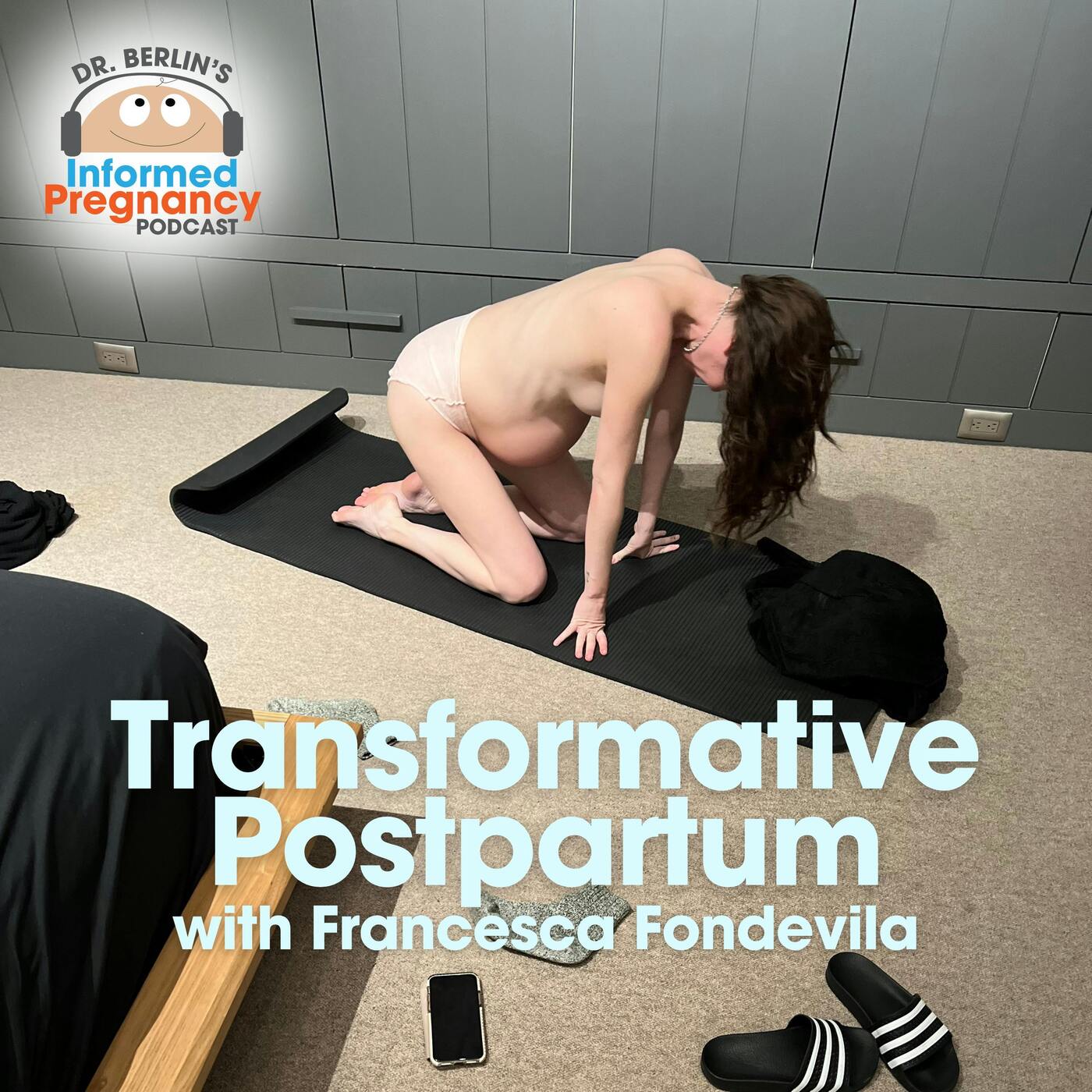
Francesca Fondevila [8:10] So it was just like, oh, my water broke. Yeah. My water broke to, oh, my God, huffing a candle, putting combs in my fingers, in my hands, like because someone said you can't feel pleasure and pain at the same time. So I went and woke my husband up. And then I got on all fours on the floor of our bedroom. And I didn't leave there until she came out. And one of the pictures I sent you was me on all four yoga mats.
Dr. Elliot Berlin, DC [8:36] Yeah, we'll put it on the carousel. I saw the picture. I'm like, what is going on here? OK. So you're at home on your yoga mat on all fours, like having mega surges and water broken. Are you at all nervous at that point since there's, I mean, Stacey got there?
Francesca Fondevila [8:53] Stacey got there, but again, with all due respect, I was like, who's this? OK. That's how I kind of felt a little bit. I felt like that a little bit. I think she was trying to take pictures. I didn't want to hear the sound of the camera clicking. Yeah, because she's also a photographer. Yeah. OK. She tried to run a bath for me. I didn't want to hear the water running. I wasn't scared. I was just like, how am I going to do this for 24 hours because I thought I was going to be in labor. I thought I was going to be one of those people that labor forever. And it just went from zero to like I didn't have anything in between. Like my water broke. I tried to rest and my contractions were a minute apart.
Dr. Elliot Berlin, DC [9:33] Your luxury sports car zero to 60 in two seconds.
Francesca Fondevila [9:37] Yeah. And so it was more of a I don't know how I'm going to do this because it was so intense.
Dr. Elliot Berlin, DC [9:45] OK. And are there any things in that moment that are soothing to you?
Francesca Fondevila [9:50] It was so fast. I really don't remember a lot of it, too.
Dr. Elliot Berlin, DC [9:53] OK. So how long from 10 p.m. water breaking to where we are right now on the mat? Not wanting to hear any noise no matter what. Wondering how you're going to get through the next 24 hours.
Francesca Fondevila [10:05] It was probably 12 something in the morning. It's just a little two to three hours.
Dr. Elliot Berlin, DC [10:11] OK. And at that point, your doula is there and you've already notified your midwife. And are they on the way?
Francesca Fondevila [10:18] I remember Stacey putting my midwife on the phone and like under me. And I was like I think I said don't come yet because I didn't know.
Dr. Elliot Berlin, DC [10:30] Because in your mind 24 more hours.
Francesca Fondevila [10:32] Yeah.
Dr. Elliot Berlin, DC [10:33] Don't get here too early.
Francesca Fondevila [10:34] Yeah. And then at some point, I think Stacey does call her and say like come here now because the baby started coming out.
Dr. Elliot Berlin, DC [10:45] OK. Now in total suspense. So let's take a break. And we're going to get the rest of that story when we come back. OMG. We're back with Francesca Fundavilla. And OK. You went from like a person that would just give birth at a hospital. Seeing Dr. Stu changing your mindset. Giving birth at home with a midwife is the plan. Go into labor with your water breaking through. Sopranos of course. How dramatic. And then three hours later, you're on the yoga mat. You're not totally like in your own world, not wanting to hear anything at all. And sort of thinking, OK, first baby, it's going to take a while, which is typically true. And sort of telling your midwife, hey, not yet.
[11:36] We don't need you. And then all of a sudden, last thing you said before commercial was, oh, the baby's head started to come out.
Francesca Fondevila [11:42] Yeah.
Dr. Elliot Berlin, DC [11:43] First of all, what did that feel like?
Francesca Fondevila [11:45] Insane. Like I felt like I was going to throw up kind of, but not like I had something to come out. But like the contractions felt like that to me. The intensity. The intensity of them. And then feeling her head come out was wild. But again, I think my memory of it is not the best because it went so quickly.
Dr. Elliot Berlin, DC [12:10] Yeah, you're on a different planet. OK, so the head comes out and it's you, your husband and your doula. What happens? What do you guys do?
Francesca Fondevila [12:20] She filmed it. So we have it on film.
Dr. Elliot Berlin, DC [12:22] Oh, gee.
Francesca Fondevila [12:23] Yeah. No sound, though. And yeah, the head comes out. It's out for maybe a minute, maybe. And then the rest of the body comes out and then my husband grabs her and hands her to me. And then my midwife comes running in.
Dr. Elliot Berlin, DC [12:41] Oh, wow. So almost made it. And are you still on that yoga mat?
Francesca Fondevila [12:47] Yep.
Dr. Elliot Berlin, DC [12:48] Oh, wow. OK. Probably time for a new yoga mat.
Francesca Fondevila [12:52] Yeah, but I do still have it.
Dr. Elliot Berlin, DC [12:53] Oh, you do?
Francesca Fondevila [12:54] Yeah. I cleaned it.
Dr. Elliot Berlin, DC [12:56] All right.
Francesca Fondevila [12:57] Good cleaning agents.
Dr. Elliot Berlin, DC [12:58] Yeah. Wow. OK. I mean, are you happy with that experience?
Francesca Fondevila [13:03] It's interesting. I have varying feelings about it every year. Again, I don't have a lot of memory of it. It went so fast. Like I hear other stories of like women laboring. I didn't really have a labor.
Dr. Elliot Berlin, DC [13:17] No. Does the video bring you back into it or does it feel just surreal like it's somebody else?
Francesca Fondevila [13:22] No, it feels surreal. It feels a little surreal. And I think I was in a certain level of shock. I never felt scared. Just how am I going to do this for so long? And oh, my gosh, it's happening. And oh, my gosh, it happened. And then I was like… Which is heaven. Yeah, but like so happy to see her. Like it was like, oh, my God, I'm so happy to see her.
Dr. Elliot Berlin, DC [13:48] And how big was she?
Francesca Fondevila [13:51] Seven pounds something, I think.
Dr. Elliot Berlin, DC [13:53] Wow. I only say that because you're very small.
Francesca Fondevila [13:56] I am small. I mean, I was six pounds, 15 ounces when I was born and my mom had to have a C-section. There's air quotes going on. You guys can't see. And maybe she did. I wasn't… Well, I was there, but…
Dr. Elliot Berlin, DC [14:10] That's right. You were there. Yeah. Good point. So you were healthy. Were you at 40 weeks?
Francesca Fondevila [14:17] She was 10 days early.
Dr. Elliot Berlin, DC [14:18] Okay. So 38 and changed. That's a healthy weight. You're just small. And this baby just seemingly slid out of you with no effort whatsoever. So that's where the wow came from.
Francesca Fondevila [14:30] She's also already half my height. I have four years old.
Dr. Elliot Berlin, DC [14:34] Yeah. Did you tear?
Francesca Fondevila [14:37] I had minor inner labia tear, minor. And my midwife offered to sew it up. It's fine. Skid marks.
Dr. Elliot Berlin, DC [14:45] Yeah. Okay. So that's an interesting birth story. Not exactly how you planned it. In some ways, people's dream. When I ask people, how do you want your birth to go? They're like, quick and easy. Not that that was easy, but it was quick.
Francesca Fondevila [14:58] It felt very empowering. I did. I felt like, holy cow, look what I did. I felt on top of the world afterwards. But I know that's also adrenaline, I think, still coursing through me. And it was. I am proud of it. But then I think in retrospect, there were times I've looked back and I wish I had more memories of it. I wish I had people around me that I felt like my husband was there. But I really cultivated such a strong relationship with my midwife. Again, it went so quickly. I don't know if I would have still blocked her out on some level because I felt so sensitive to sound.
Dr. Elliot Berlin, DC [15:39] Is something a little alone about it? I hear that. And sometimes there's no time for a transition. No build-up. Boom, it's just here. I definitely hear people with precipitous labor sometimes bemoaning the fact that it was too fast. And of course, people have a very long labor, can't relate. But I understand that. I think there's a sweet spot.
Francesca Fondevila [16:00] Yeah.
Dr. Elliot Berlin, DC [16:01] That's like just a train moving through you all at once. Especially for the first, it's not all that common. OK, so did you have thoughts on what postpartum would be like? The immediate postpartum, the extended postpartum?
Francesca Fondevila [16:15] No.
Dr. Elliot Berlin, DC [16:16] Just one?
Francesca Fondevila [16:18] I did read the first 40 days. I read some of that and probably…
Dr. Elliot Berlin, DC [16:22] I make an appearance in there.
Francesca Fondevila [16:24] Oh, amazing. And probably some other things. But I really loved being pregnant. I loved pregnancy so much. And my birth was so fast. I really thought that was the hard stuff and everything else would sort itself out.
Dr. Elliot Berlin, DC [16:39] Sounds like postpartum wasn't the easiest. What happened? No.
Francesca Fondevila [16:43] I went from feeling super high and on top of the world, not in like a manic way, in a grounded way. And I also remember my husband and I were laughing because I was like, people talk about the sleep deprivation. What are they talking about? It's so easy. You just wake up every couple of hours. But then after a couple of weeks of that, you feel the effects of it. And I just think I felt a bit of shock that I was having such a hard time. I felt really disconnected from my body, which was very uncomfortable for me and painful, especially since I loved being pregnant so much and I worked hard to have a good relationship with myself. What do you think was fueling that?
[17:32] I think hormonal, for sure. Nervous system out of whack. And I went from seeing my midwife and spending an hour with her almost every week to you go from all these compliments and all this love and this and that to then everything goes really quiet. And then people are only asking or talking about the baby.
Dr. Elliot Berlin, DC [17:57] Oh, that's true. I have heard people say that also. And I find that right. I mean, my clients say sometimes things along those lines that I'm not even seeing anymore.
Francesca Fondevila [18:10] Yes. And I didn't have any close friends. I had a couple, but I would ask them certain things and they didn't really remember what it was like to have a newborn. I couldn't find someone that resonated with me at all with struggles, which were also very painful to feel any struggles or fears and anxieties. I couldn't even talk about it with people and the amount of shame and sadness and guilt I felt.
Dr. Elliot Berlin, DC [18:42] Because you had a healthy baby?
Francesca Fondevila [18:44] Because I thought I did everything right. Because I loved pregnancy and I thought that was hard. So many women say, I just can't wait for the baby to be out. The baby was out. And now I felt like, who's this? Who's this? Wait a minute. What happened to this person, me? I was not prepared for those feelings and the sense of isolation I had. Does that make sense?
Dr. Elliot Berlin, DC [19:09] Yeah. I've also heard people say when I was pregnant, I get on a bus and a bunch of people stand up. Do you want my seat? And now I'm postpartum and I'm weak and I'm depleted and nobody even sees that I got on the bus. And that's just strangers on the bus. But I think it's also true with family and friends.
Francesca Fondevila [19:27] Very much so.
Dr. Elliot Berlin, DC [19:29] Yeah.
Francesca Fondevila [19:30] It's really important that you're saying that, I think. Yeah. Even with family, they really wanted to know when I would be going back to work and wanted all these things from me pretty quickly. And I didn't even know where to begin to ask for help because I didn't even know what I needed because I felt so dysregulated.
Dr. Elliot Berlin, DC [19:55] I feel like you had challenging birth in a way that most people don't, but still challenging. And then challenging postpartum in a way that perhaps many people do, but don't talk about. And so I'm really not just glad that you're talking about it. I'm sorry that you experienced it, but you're kind of one of those people that has an experience like that and you don't let it knock you down. You let it make you stronger and then also go pick yourself up and try to prevent other people from having that experience.
Francesca Fondevila [20:27] Well, yeah, because I know, especially more recently with Cultivating Mom Friends, I've had all these deep conversations that no one, even my friends that prepared for postpartum, energetically, physically, all this stuff, were still caught off guard with it. I just think it's really hard to talk when you're going through it at the time. It was so near impossible for me to talk to anybody about the struggles I was going through because I felt so connected to my baby. I loved being a mom. I was so excited, but I was just struggling in a lot of emotional pain. I think it's quite possible to feel multiple things at once.
Dr. Elliot Berlin, DC [21:13] Of course.
Francesca Fondevila [21:15] Yeah, and I am outspoken about it because I do think it's really important and I don't think enough women talk about it, and I want there to be more communication about this stuff.
Dr. Elliot Berlin, DC [21:26] Yes, you're outspoken and you've also taken a lot of action to support other people going through the postpartum journey. Let's take another little break. When I come back, I want to learn more about Mother Bones. Based on what I know already, I sort of want to have a baby so I can get some Mother Bones care on the other side. We'll be right back.

Dr. Elliot Berlin, DC [21:47] Welcome back. We are talking to Francesca Fondavilla and the founder of Mother Bones. So you had a bit of a challenge with your birth, a surprise and a challenge with your birth, a take-you-by-surprise postpartum experience that I think a lot of people have. And now you've taken your intense creative energy and your recognition of the need for some solutions and you've put together some incredible things in Mother Bones. Tell me all about it.
Francesca Fondevila [22:31] So Mother Bones is a continuation of care, the bridge between the medical or the birth and the maternal. I bring together the science of postpartum recovery with the art of nourishment and beauty. Meals, warmth and touch, which rebuild the body, ceremony and beauty, which restore the spirit.
Dr. Elliot Berlin, DC [22:57] I mean, it sounds incredible. It is an intense mind, body and spirit experience, that transition. I always tell people my sense of postpartum is that it's rocky terrain. Yeah. And, you know, when you go driving on rocky terrain, you could have an incredible experience if you're in the right vehicle. But if you take your little family sedan off-roading on, you know, rocky terrain, it's not going to be a fun experience and you're not going to want to do it again. So I think that the rocky terrain is just there and what you do with it is kind of up to you. And I think most people don't even have a thought like, oh, maybe there should be a plan or something
[23:41] I should do for myself and to take care of me. In fact, I hear a lot of art clients express even coming in for their body work, even if they're hurting, you know, if something got popped out of place during a birth or something like that. Yeah, I want to come in, but I really, I don't have time for me. I got to, you know, take care of the baby. I'm like, I just want you to know anything that you do to take care of yourself is also taking care of anybody else who depends on you. And I don't know, that message doesn't seem to resonate. Naturally, it has to be sort of explained. And so everything that you mentioned there sounds incredible, and especially as a combination of services.
Francesca Fondevila [24:18] Yeah, so what you said, I was having a conversation with a friend today and we were talking about this, this upcoming podcast, and she brought up that she hates this phrase when people tell you to put your life mask on before anyone else is. Oh, on the airplane. Because when you're a new mom, a lot of times you don't even know how to do that. And it doesn't mean that you have to be in a dire state or anything, but your nervous system, your body gets rocked during birth, even if your mind doesn't fully recognize it. And it's very hard to put yourself first. It's just insanely hard. And I know that firsthand too, with my own experience, that I refused to do it.
[25:05] And I suffered greatly for it. And I wouldn't take it back, but at the end, your child wants, they want the whole version of their mom, not fragments of them, because you're sacrificing yourself so much.
Dr. Elliot Berlin, DC [25:23] What ultimately helped pull you through?
Francesca Fondevila [25:26] This is complicated and kind of hard, I think, for me. So we spoke earlier about, I'm a pretty holistic person. I had a holistic birth, and my approach to things are pretty in that direction. But I'm not black and white. That being said, I thought I would breastfeed until my daughter was 18, 19 years old. I really believe that formula was poison. And to not breastfeed her is a very selfish thing to do, because you bring this child into the world. It is the best thing for them. So you need to sacrifice and do that. And I knew, and I couldn't verify this with anybody. I've tried to talk to doctors or whatever. I'm feeling really badly, and I think it's tied to the breastfeeding.
[26:21] I don't think it's that EMDR thing or whatever. Deemer. Deemer, it's not just anxiety with the letdown. I feel completely disconnected from my body. And again, I think this was also just so painful for me, because this thing I thought I would love so much, I didn't. I put up with things. I tough things out, you know? So I breastfed for six months, and then at six months, I was so emotionally unwell. I started giving her kendomil formula, and that was actually really around five months. I started doing that and weaning, and weaning was easy, and I started to feel significantly better. And I knew it. I knew the whole time. And this is, again, I don't have the science behind it.
[27:10] I don't have the medical anything behind it. For whatever reason, maybe it's too little or too much progesterone for my body type, but there was so much shame around this. I couldn't admit it to anybody for over a year that I gave my daughter formula, and I stopped breastfeeding at six months.
Dr. Elliot Berlin, DC [27:29] And especially after five, six months, you gave during the most optimal times, the most necessary times, you gave pure breast milk. I think that everything that you're sharing here is, again, really important, because I think a lot of people will just suffer through it, or maybe will not suffer through it. Well, let's say you formula even at a month or so, and feel really guilty about it, and I think it's unfortunate there's nothing to feel guilty about. I think that everything that you do to you, collectively, mothers, do to give us life, you know, I see every day sacrifices, sacrifices during pregnancy, the various stages of pregnancy, sacrifices during birth and postpartum,
[28:11] and the way you give everything, mind, body, spirit, everything, for us to be able to exist, to be birthed, to be nurtured, and to be brought into, you know, older childhood and adulthood is insane. Like, just to be extremely… I'm in awe every day, and I've been doing this for 20 years. I'm still in awe all the time. And just should feel celebrated, and you should feel that same awe about yourself, everyone who does this. You deserve it. I mean, it's just… You see sometimes award shows and the crazy things that they give awards for. Everyone who has a baby should get the greatest award. So, I'm really sorry you had that experience. I'm sorry that it was hard for you
[28:56] and you wanted to like it and love it, and it wasn't something that you enjoyed loving. I'm hard that you had to really work hard to plow through it to get to where you got, and I'm hard that you felt guilty giving it up. I wish there's somehow we could go back and change that and make these experiences as joyous as you want them to be.
Francesca Fondevila [29:15] Yeah, but at the same time, I took this experience, and I've spent time reflecting on it and meditating on it, and it has fueled how I show up for myself now and how I know to show up for other mothers. That's the other thing. Your brain rewires when you get pregnant and have a baby and give birth, and it's a complete rewiring of your brain. So, it doesn't have to even get that far as to like… And it can get further for other women of like the amount you disregard yourself, but it happens really frequently, and even if it's not at like such a dire space or place, it's worth addressing these things immediately, like addressing you need to regulate your nervous system,
[30:02] addressing the need to slow down and to receive. Yeah.
Dr. Elliot Berlin, DC [30:07] I much more power… I didn't know your story really until we just talked about it, and it turned out to be a much more powerful episode than I thought about with you. So, thank you for doing it, but sharing so openly and honestly what was a very difficult journey for you in many ways, and a joyous journey in other ways. Your whole life now is supporting people in postpartum, so for our audience listening, many of them are pregnant, many of them just getting to the postpartum stage. What advice would you give if you could pick something? What would you tell someone so that they have a better postpartum experience?
Francesca Fondevila [30:46] To think about how you might want to feel during the time and prepare for it and put steps in ahead of time, whether that's finding support or having food collected or talking to family members and friends to kind of have something set up for you.
Dr. Elliot Berlin, DC [31:00] That's great advice. Thank you so much for the work that you do and for educating me today. I love to learn in general, and I love learning from you. Where can we find you online?
Francesca Fondevila [31:14] My Instagram handle is underscore mother underscore bones underscore, and my website is mother-bones.com.
Dr. Elliot Berlin, DC [31:25] Mother-bones.com. I'm going to go check it out and see what kind of cool things in there. One thing, I love your branding.
Francesca Fondevila [31:32] Thank you very much.
Dr. Elliot Berlin, DC [31:33] But, of course, it makes sense because you're super creative. It's very cool. You've got to go check it out. Francesca, thank you so much for joining me for sharing. And at home, thanks for listening to the Informed Pregnancy podcast. For more pregnancy and parenting information just like this, visit us online at informedpregnancy.com.
Want more pregnancy + parenting? Start your FREE TRIAL of Informed Pregnancy+ and get access to all our curated pregnancy and parenting content — original series, iconic birth films like The Business of Being Born, prenatal workouts and more.

0 Comments