
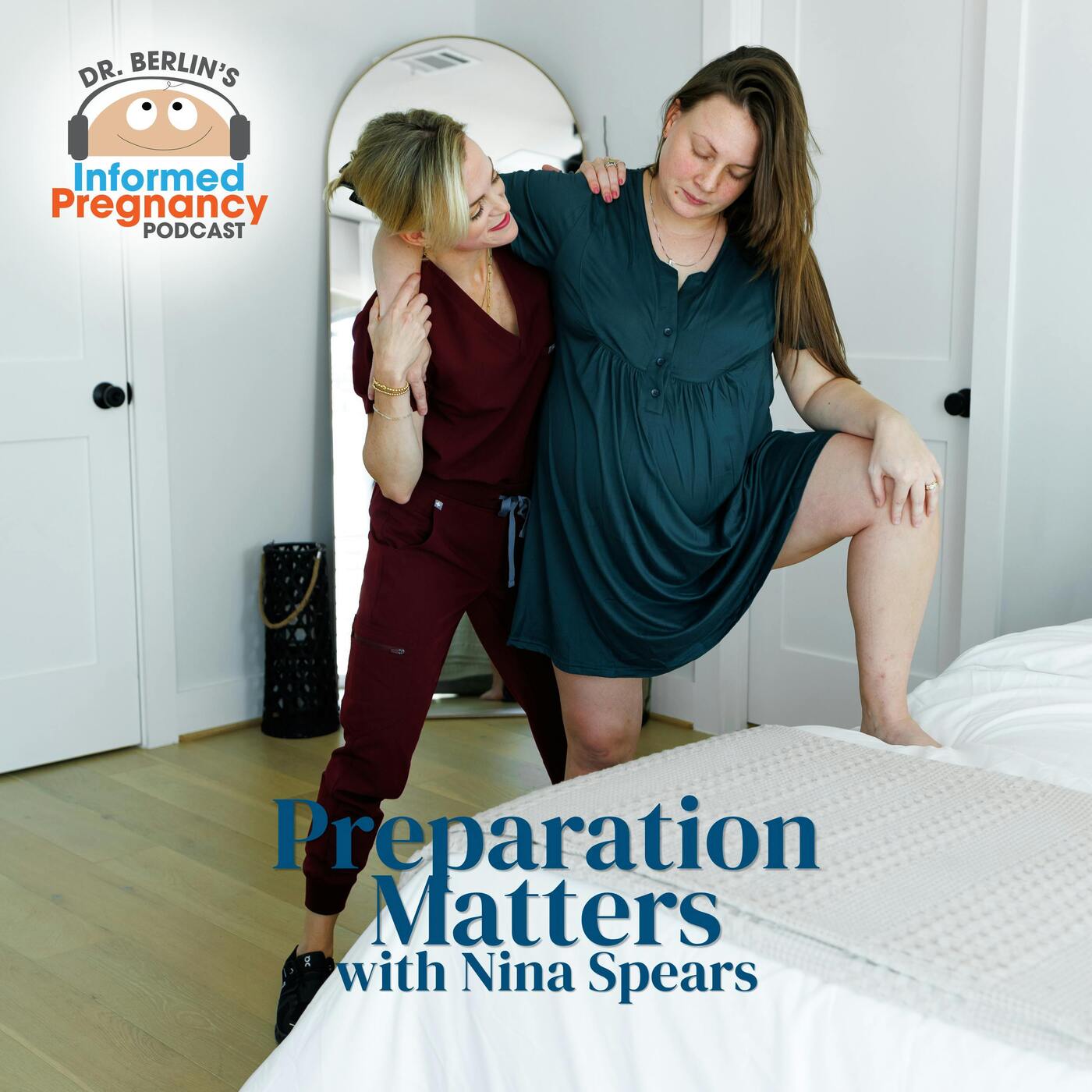
July 16, 2026 · 42 minutes · Episode 513
About this episode
Nina Spears is a baby planner, doula, educator, and founder of Baby Chick who works with pregnant and postpartum people. She discusses why preparation matters but control is an illusion, including one of the most important birth skills of all.
Connect with the guest:
Grow with us on IP+! Informed Pregnancy Media presents two all new intimate short-form video series following Garrett and HeHe’s real-time pregnancy journeys as they prepare for an empowered birth and postpartum experience. Each episode features weekly updates with personal photos and videos to help bring these raw stories to life, a visually dynamic guide through each mother’s emotional and physical experiences.
Keep up with Dr. Berlin and Informed Pregnancy Media online!
Learn more about your ad choices. Visit megaphone.fm/adchoices
See Privacy Policy at https://art19.com/privacy and California Privacy Notice at https://art19.com/privacy#do-not-sell-my-info.
Key quotes
“Well, there's two. One, it's education and two is support. That's to me what you need.”
“This is your body and your baby and your birth. You shouldn't just allow someone else to fly this plane. You need to be the pilot.”
“All you need is a healthy baby. No, we need a healthy mom. Yes, we need a healthy baby, but we need a healthy mom.”
“Turn down those lights. Don't use that thinking brain. Let go. Be only surrounded by the people you feel safe and supported and that you will be undisturbed and surrender.”
Related episodes
- Ep. 493 In Conversation with Esther Friedman Schwartz
- Ep. 514 Before Baby #4 with Kara Sutton
- Ep. 520 Before Birth with Kea-Sophie Stack
- Ep. 508 Oral Health During Pregnancy with Dr. Bernard Baseri
Transcript
AI-generated transcript with speaker labels — may contain errors, especially names and medical terms. Dr. Elliot Berlin, DC appears in blue; Nina Spears in orange.
Dr. Elliot Berlin, DC [0:00] Today's guest has spent years helping women prepare for one of the most important transitions of their lives. As a baby planner, doula educator, and founder of Baby Chick, she's guided countless families through pregnancy, birth, postpartum, and early parenthood. But one lesson stands out above all the others. Preparation matters, but control is an illusion. Many expecting parents, especially high-achieving Type A personalities, you know who you are. Who am I kidding? I know who I am. Approach birth the same way they approach everything else in life. Research harder, plan better, prepare more. So what happens when birth has its own plans? Today we're talking
[0:39] about how to prepare deeply without becoming attached to a specific outcome, why flexibility may be one of the most important birth skills of all, and how to find confidence in uncertainty. I'm pregnancy-focused chiropractor Dr. Elliot Berlin, and you're listening to the Informed Pregnancy Podcast. Nina Spears, welcome to the podcast. Thank you so much, Dr. Berlin. It's a pleasure. Thank you for having me. I want to find out because you have such a great energy for doula-ship and for everything birth, like supporting, coaching, encouraging, inspiring. And you also are one of the few, I think, who did it before you had your own children. How did you get started in this field? Completely on accident. Mad zero idea. I was
Nina Spears [1:37] going to get into this field whatsoever. I had graduated college, and right after college, I thought, okay, I need a big girl job. So I was in sales and realized that was not my calling. I mean, I did well, but I just felt like I wasn't helping people. I come from a line of helpers. My mom is a nurse. My father is a retired surgeon. So I guess that kind of does run in my blood. And I just thought, well, what do I like? I need to get a job of, you know, something that I'm going to love. And I was like, I love babies. Maybe I'll figure it out. Well, my sales partner, she was pregnant. And so I watched, we shared an office, I watched her prepare for her baby. So I thought there's something to that. And then worked at a boutique
[2:22] at a baby boutique to figure out my life. I was still pretty young and the beginning of baby, pretty much. And then I realized when I was working at that baby boutique, that all of these women that were coming in and I've worked at the front desk, they were asking like, which breast pump, which stroller, all of this stuff. And I was like, man, these women have no idea what they're doing. And I thought, gosh, you know, just like they have wedding planners that help you plan to have like a smooth engagement in a beautiful wedding. Like, why don't we have baby planners? Dr. Billin, I thought I was like a genius. I thought I created like this whole new job. And then I did a Google search and realized, oh, there's
[3:00] certification for this. So then I got certified as a baby planner. And then one of my clients, I started, you know, you build a relationship with these people throughout their pregnancy. And one invited me to her birth and she had a doula. And oh my God, I like cried. I thought it was the most amazing thing. You either think it's the most disgusting thing you've ever seen or like the most beautiful thing. I thought it was the most beautiful thing. And I just never looked back. I was like, I need to be a doula. And that's how it all started. I was 24. Wow. So pretty young. And doula kind of is oftentimes on the more holistic side of totally sounds like from your roots, your parents are more allopathic,
[3:43] more on the medical side. Absolutely. My father thought, I mean, I love you, dad, if you listen to this, I truly do. But he did say like, you're being selfish and you're putting yourself at risk for wanting a home birth. And I was like, you know, you may be really good at knees and hips, but you do not know anything about birth. And I think I do, and I think I know exactly. And so I was like, I know it's best for me and I know it's not best for everybody, but I know what I think is best for me. And I'm going to do what I think is best for me and my child. So, you know, that's the doula in me now advocating for myself and my needs went totally different direction. Yeah. Well, you have a twin brother. I do.
Dr. Elliot Berlin, DC [4:26] And he's got severe autism. And I know you've described yourself as his advocate and his voice growing up. For sure. And now you're advocating for yourself, but you're also advocating for all your clients. Do you think that experience with your brother paved your road for
Nina Spears [4:40] advocacy? Absolutely. Oh my goodness. Yeah, it definitely made me who I am today. I mean, my brother, he's pretty much nonverbal. He's verbal in the sense that he can repeat things. He knows certain words that are appropriate, but he can't really formulate sentences and that sort of thing. So I, as a young child, I had to speak for both of us. We had that twin thing. I just knew what he was thinking and what he wanted and what he was trying to get out. So my parents definitely turned to me sometimes to be like, what is he trying to say? And so yeah, I think that has absolutely made me super empathetic to people and being an advocate
Dr. Elliot Berlin, DC [5:19] for sure. So yeah, absolutely. Some sort of tiny level. I think every parent wishes they had that for kids who are not verbal yet, like little, you know, six month old, what do you want? Just tell me. This is what they want. Exactly. You're a giver of information as a doula. You're an educator and you're also a childbirth educator. And a big part of that, like you said, I think a lot of people get to pregnancy without much information. And it's not just about which stroller and which gear to buy, but even about options during pregnancy, options for childbirth, options for postpartum, and honestly options throughout parenthood. So part of the role is to give them information, but then sometimes people struggle from having
[6:04] too much information. For sure. Where is the balance? Oh gosh. Where is the balance? Because
Nina Spears [6:11] you're right. When people are like, Nina, what's like the one thing that I really need throughout my pregnancy? I'm like, well, there's two. One, it's education and two is support. That's to me what you need. But you're right. We're in unprecedented times where there's just so much information with social media, with AI. There's just so many opinions, so much information. And I think where we need to get to is finding the resources that resonate with us, with our values and with our goals and what we feel is right for our families and sticking to that. So you find informed pregnancy podcast, you start listening and you say, you know what? This is where I'm going to start getting my information rather than trying to hear from
[6:55] Susie down the street from all this different information. You can listen, sure, but like sometimes can just be too much and then cause more anxiety, more stress, and then more expectations for something. So my kind of boundary is like, find the resources that you know are evidence-based that are supportive of what your goals are and follow that path. So then that way you still are informed, but not so overwhelmed. That's really interesting. I stopped doing doula
Dr. Elliot Berlin, DC [7:24] work before AI became a thing, but I know I use AI as like my lawyer, my doctor, my everything, my therapist. And I know that people must be using AI as their doula, which probably has some pros and probably has some cons to it. But knowing that birth is so deeply individual and so deeply intimate, it's hard to see AI replacing an actual physical human doula. And also it's sort of weird, even when I use it as my lawyer, sometimes sort of weird where they get their information from or how they hallucinate. And I guess you don't want a machine hallucinating advice to you during such an important time. Well, I was going to say,
Nina Spears [8:08] Dr. Berlin, haven't you seen now there's like definitely AI doulas that you can hire. And you're right though. I mean, it is such an interpersonal relationship. There's just so many different nuances that can happen. I just think there's this new AI doula that they interviewed 5,000 different doulas and got all this information and you can now use this for support. And I'm like, you know what, that doula is not going to be able to do a double hip squeeze or be able to rub your feet or be able to talk you down from certain things or your partner from certain things. While some of that information is super helpful, I mean, a lot of it, it's not just informational, it's the emotional and the physical support
[8:50] that you're missing out on too. And I don't think a robot can really replace that.
Dr. Elliot Berlin, DC [8:54] I'm thinking of a million ways a doula can't be AI. And in one of them is my clients are like, how do I know I have the right doula? And one of the things they generally say to look for is when they walk in the room, you should automatically feel your nervous system downgrade into a sense of feeling calm. And it's hard to do that with chat GPT. So I don't know, some people are getting pretty calm with a little reliant on their AI. It doesn't do comforting touch. There's just so many things. Oftentimes your doula knows all the staff at the hospital, which can be very helpful and things like that.
Nina Spears [9:27] Yes, totally.
Dr. Elliot Berlin, DC [9:27] All right. Let's talk about type A people, people who are very successful, women who really crush it in their fields. And they come to childbirth and sometimes it's a little extra challenging for them. Why? Absolutely. So you are describing my
Nina Spears [9:43] typical client. They are usually just crushing it with their career, their high powered, definitely just achievement oriented, productive type A. And they love a good checklist, they love chatting with me every other week to go over what they need to be doing. But really talking to them about how they are not the only ones that are writing this story, that there is a baby that's involved and has a say to a lot of this and that we have to kind of let go of certain things like we can become informed and understand what the options are because who knows what comes our way. And then that way, if something does happen, you can make the choice that you feel is right for you. But we can't feel like we're dictating
[10:29] how things are going to go. We have to be able to relax in what some people will call their feminine and allow things to flow because when we're so rigid on how things are going to go, gosh, that can lead to a lot of disappointment and frustration and also fear because oh my goodness, all of a sudden it's not panning out the way that
Dr. Elliot Berlin, DC [10:48] they thought it was going to look like. I think that anybody who's listening now, who is a planner, who loves those checklists, who likes to be in control of everything, me as well, both of us, it's really important to listen to what Nina is saying right now because I really see this humble a lot of people in birth and sometimes as a hard lesson and it doesn't have to be a hard lesson. And sometimes it starts with fertility actually. The instructions for getting pregnant are not that challenging and then you'll sometimes see even someone calculate their cycle down to the second I must be ovulating at this moment. We come home from work now, we have to make this baby,
[11:28] and then it doesn't happen. And it's like, right, there's a lot more going on than the number of things we understand and the number of things we can control. And that happens a lot in the whole reproductive cycle. What's one thing that you think women generally think that they can control but they can't really control when it comes to childbirth? Gosh,
Nina Spears [11:48] all of it? Well, then a couple of things. Yeah, a couple of things. Gosh, the things that they think that they can control. They really think that one thing, they hire me as their doula and sometimes I have to remind them that I am not some magical fairy. I do not just wave my magic wand just because you hired a doula doesn't mean you're going to have a certain experience. And I think that they think, oh, by hiring you, I am taking control and I'm going to have this exact birth. And I'm like, yes, you are definitely increasing your chances to having a more favorable outcome and us achieving those goals and visions that you have for yourself, but I am not magic. And we have
[12:35] to work together. We have to see how things unfold. We don't know if you have a short umbilical cord. We don't know how baby is going to tolerate contractions. We don't know a lot of things. We have to kind of see how things go. So I think something that they think, if I check all of these boxes and do exactly what I'm supposed to do, then I'm going to have one plus one equals two. This is just the outcome that I'm going to get. And realizing that you can still do all that prep work and things can still turn and look a little different. So I think realizing that a good birth experience doesn't necessarily have to look a certain way. It's really about how informed you feel, how supported you feel,
[13:17] how respected and heard. So I think the big thing is like, ah, I did everything I was supposed to do or everything they thought they were supposed to do. And I'm like, okay, well, you said you went to a childbirth class. What type of childbirth class was it? Was it like a two hour class? What did we learn? And also, there's so many different things that people are like, oh, wait, but I ate really, really well. I did all the dates. I did all these things. Dr. William, they really think that certain things will lead to a certain outcome. And I'm like, yes, those things definitely increase your chances, but it doesn't always work out exactly how you plan. And the power in this is recognizing, okay,
[13:59] if something deviates from what I'm hoping will happen, what is plan B, C, D? And how do I feel good about that? How do I want to be supported in those moments? Because that's when we can just not feel so just stuck on one path. We can really let go and see how the path unfolds.
Dr. Elliot Berlin, DC [14:19] It's not fair because you're very knowledgeable. You have a lot of experience, both professionally and personally, and you have great energy and confidence. So it seems like you should have a little fairy stick and could make things go the way your clients wanted to. But you're absolutely right. Everything you said is none of those things are bad things to do. They're all helpful. So it's not like don't do them, but don't expect that just because you do them, things are going to go super smooth and just the way you picture. I always tell my clients a birth plan is a flowchart. And on page one, you put your vision of the most natural birth you might want to try, you might want to experience. But this is page one. There's
[15:00] a whole flowchart. If something happens like the baby's breech before you even start or you get placenta previa or things like that, before you even start birth, you're already down to other pages. And the same thing can happen at any point in labor. And so it's important to be flexible. This is great information. We're going to take a break. When we come back, we're going to talk about what happened when all of Nina's professional experience met her own labor and delivery experiences and why expertise

Dr. Elliot Berlin, DC [15:26] doesn't exempt anyone from the lessons birth has to teach. We'll be right back. Welcome back to the informed pregnancy podcast. We're talking to Nina Spears and we're going to get personal. Okay. So we talked about the fact that you attended births before having your own children. Sometimes when I am a doula for a doula, that's the hardest client on the planet or for a midwife. Those are challenging clients because they know so much and it's so hard for them to turn off their knowledge brain and sink into the older animalistic part of the brain that controls childbirth in the most magnificent way. So having been a doula, what are some things that that experience that you had prior to
[16:18] having your own childbirth, your own pregnancy and birth, some things that were sort of helpful because you have that knowledge experience and background or maybe that worked against you?
Nina Spears [16:29] Absolutely. So I had two home births and with my first one with my son, I had my two midwives,
Dr. Elliot Berlin, DC [16:36] my doula, my videographer, my husband and my mom and my two dogs. It was a party.
Nina Spears [16:43] Big cast of characters. It was. It certainly was. And I actively remember telling myself, relax your jaw, release your shoulders, loosen your hands. You've been in this position for too long. You need to move. And I thought, oh, I'm like one of my love languages is touch. I love a good hug. I love holding someone's hand. That's how I just convey, oh, I love you. And I thought for sure, oh, I'm going to definitely want massage. I also had gotten my license in massage therapy and got certified in prenatal labor, labor induction, postpartum and an infant massage instructor. So I'm very big on touch. So I thought, oh, I'm definitely going to want to be massaged. No. In labor, as soon as someone started
[17:30] rubbing my back, I was like, whoa, whoa, whoa, too much stimulation. There's so much going on. I could only handle just like counter pressure, not even like firm counter pressure. Just put your hand on me. And that is it. I've heard people say like not enough air traffic controllers for all the sensations going on. A thousand percent. That's exactly how I felt. It was just way too much.
Dr. Elliot Berlin, DC [17:53] Oddly, the United States is having the same problem. Okay, back to you.
Nina Spears [17:59] No worries. Yes. So I thought for sure, I thought I knew exactly what I was going to want and need and how it was going to help me. But then when I realized, okay, I need to stop using my thinking brain and start like doing what I tell my clients to just completely remove my thoughts from it and let myself go and surrender. I was able to really let things move forward and allowing myself to again, because I am such a type A person and I can do it kind of girl, I wasn't letting the people around me do the job that they needed to do. But eventually I was like, okay, I need to let go and accept the help that's around me. And that's when really things started going extremely fast. I'm not saying that works for everybody.
[18:47] So listeners, I'm not saying that that's going to be your experience, but at least for me, that was like, okay, I need to do what I'm telling my clients, but also like let go of the control. Because as soon as I can let go of this control, I can allow my body to
Dr. Elliot Berlin, DC [19:00] do what it needs to do. That's very interesting, because I'm thinking back to one doula in particular who just could not shut off that part of her brain for a long time. And eventually she just went into the restroom. And she also did have a bunch of people around. She went into the restroom. She's like, I have to pee. And then she didn't come out for like a long time. So I checked on her, are you okay? And she's like, yeah, I'm great. And like that was just, it was the lights were off. She's just sitting on the toilet for probably an hour and a half. That's where her mind was able to zone out everything around her and go deep inside and let the animal part of the brain
[19:39] do its thing. And things picked up very, very quickly and smoothly from there. So that makes sense. The educated part of the mind is really supposed to shut off. You're not supposed to think through things too much. And I think that goes back to what we were talking about before, too much information versus not enough information. There's got to be a happy medium where you have enough to give you an idea of what to expect and confidence on how to get through it, but not so much that you can't shut it
Nina Spears [20:06] off. And I think the problem is, is that whenever you're feeling quote unquote pain and you're uncomfortable, you just are trying to think, how can I solve this problem? But the thing is, this isn't a problem to solve. You have to let it unfold. And we're just so quick. Oh, I'm uncomfortable. This hurts. This is hard. How do I get through this? The way to get through it is to get through it and to let go. That's not our mindset. Generally, I was just walking through the drug store the other day and it's mind blowing how many different drugs we have for how many different discomforts. So our mindset is there's got to be something to make this go away. For sure. That's why 98% of women get epidurals, which I'm not
[20:49] knocking them. If you want one, great. Let's become informed when you're making that decision and what that looks like and all of that. But yeah, absolutely. People are like, wait a second. And it really trips them up because whenever I ask my clients, Dr. Berlin, okay, you want an epidural. Great. What is your plan if it doesn't work? And they're like, wait,
Dr. Elliot Berlin, DC [21:10] that's a thing that can happen. Right. That's terrifying for most people, that idea. You kind of described after COVID or deep enduring COVID, I was attending a lot more home birth and it wasn't necessarily people who were home birthers. They just didn't want to be at the hospital. They don't want to be where everybody who had COVID was hanging out. They don't want to deal with all the restrictions like who you couldn't bring anybody with you. You have to wear a mask, things like that. But when people give birth at home that aren't really home birthers, they seem to need a lot more support. And so there was always a pretty big cast of characters. And I remember going on the late side to one of these home births
[21:50] with it was a giant house with I think the biggest doormat I had ever seen in my life still to this day. I've not seen a bigger doormat, but there was no room for my shoes on it because there were already so many people there. Like that whole cast, there was her and her sister and her mom and her husband obviously and her midwife and her midwife assistant and her birth photographer and her doula and her big car director guy. And there were other people and it was just like this giant cast. And for her, it worked out great. She wanted all that support. It was a cohesive group. Everybody worked really well to support her in the ways that she really wanted and needed. But it sounds like in your case,
[22:30] you felt like in the end that was overkill for you.
Nina Spears [22:33] It was a bit a bit overkill, but my mom realized that she could skedaddle. She could get out of the room real quick. I think it was too much watching her daughter go through that. So she wasn't really there. So really the only people in the room were my midwife, my doula, my husband and the photographer. So it does sound still like a good amount of people. But I mean, the photographer felt like I couldn't even really tell that she was there. She would just, I don't know, make herself known every now and then. But they have an incredible way of being a fly on the wall. Totally. Yeah. And so use the flash in a way that's not in your face. And yeah, it's an art. It truly is. So I felt like what I had actually was really,
[23:18] really good and helpful. But with my second birth, it was extremely fast. And Dr. Berlin, I don't know what it is, but I had a very fast birth with my first one. I think I labored for only five to six hours, but I pushed for three. That's a long story. But with my daughter, I just knew, okay, if that was my first one, second babies typically come a lot faster. I just am going to limit. I don't think I need as many people because I don't think everyone will make it. And I told myself that, that that's what was going to happen. And I'm not saying, again, that like, oh, meditate on something and it's for sure going to happen. But I really did tell myself that. And I did get that type of experience with my
[24:00] daughter. Let's talk about home birth for a second, because you had been to surely lots of different birth settings before you had your first baby. Why did you choose home birth? Well, I live in Houston, Texas, which we are the largest medical center in the world. And also growing up with a surgeon as a father, I mean, listening to the latest operation at dinner is like normal. So I have been around hospitals forever. And truthfully, 98% of my clients have their babies in hospitals. I have seen so much. And because our doctors, they see so much high risk. I just was like, I want to limit the possibility of getting caught up in the system. I may have an amazing nurse and I
[24:46] picked an awesome doctor if I needed to get transferred. But I just knew that the type of experience that I wanted, I knew that I needed to be at home. And for sure, I can say without a doubt, Dr. Berlin, that if I had given birth to my son in the hospital, my first born, I would have for sure had a C-section, at least at my hospital here in Houston. Maybe if I lived in the Pacific Northwest where they're a little bit more relaxed and I hear such amazing things about different hospitals in different parts of the country and world. But yeah, I know that here I would have had a very different experience. I'm really
Dr. Elliot Berlin, DC [25:23] grateful that I made that important choice. Is it because of the long pushing? Absolutely. Okay. Was your husband into home birth? No. I wonder for yourself how that worked out. But then also how do you, because I see that oftentimes a woman will want a home birth and her partner's not into it, how did it work for you and what do you recommend in that case? Absolutely. Well,
Nina Spears [25:47] I'm a strong woman. I know what I want and I'm going to go after what I want. It's my body. I understand that you need to feel comfortable, but also this is happening to me and I feel safest here. And also I guess I have an advantage that my husband also at the end of the day is like, you are an expert in this field. I need to listen to the expert if that is what you feel is best. I will respect it. I mean, I still remember sitting in the car with him when we were engaged or maybe we were dating. We weren't even engaged yet, but I said, if we decide to get married and have kids, I'm just letting you know, I will be having our babies at home. And he turned to me, we were sitting in the car.
[26:26] He turned to me and he goes, why do you have to be so weird? And I immediately came back with, I'm not weird, you're weird. You're the one that's brainwashed by media and blah, blah, blah. I completely went off. And he was just like, okay, we'll deal with that when we have to cross that bridge. So when we crossed that bridge, I was like, by the way, we are having these babies at home. And he was like, okay, I trust you. You are the expert and this is your body at the end of the day. And what I did for people who don't have that unfair advantage of studying all this and working with women in labor, I just think that if that's what you want, you need to, again,
[27:08] advocate for yourself. You need to show them why this is a good option for you, why you're a good candidate and the benefits to it. Now, oh my gosh, Dr. Berlin, if we had another baby, my husband is like, oh, home birth all the way. I don't have to drive you to the hospital. I don't have to sleep on that uncomfortable couch. I don't have to deal with beeping stuff. I can just go to the kitchen and make myself whatever I want. I can sleep in my bed. He thinks it's the greatest thing. He's like, this is great. I don't have to worry
Dr. Elliot Berlin, DC [27:36] about any of that. That's funny. I remember Jim Gaffigan, my comic idol there. They had their babies at home and he said, people always think there's some sort of laziness involved. Like, oh, I didn't want to put on pants. I was going to say, my husband thinks that's, no, I know, but I think that laziness is actually a big selling point. It's a selling point. Save money on gas. Okay. So once we're talking about husbands, before we take one more break, partners in general, what do you see their role? I think a lot of time partners are like, what am I supposed to be doing here? Like, it wasn't very long ago where husbands and partners weren't even allowed into labor and delivery and now all of a sudden we're
[28:19] like the coach. It's a big responsibility and I think, you know, men especially tend to be problem solvers. If you see your loved one experiencing pain, we want to jump in with some sort of solution and remedy. For sure. But there's not always a solution or a remedy. So what would you say the ideal support role could be for a partner? I think that the ideal
Nina Spears [28:43] support person, if you want to have an active job of fixing something, then you need to be almost like the gatekeeper and the communicator because she shouldn't have to be using her thinking brain during this laboring time. So you're also having your own experience. You're becoming a dad or a mom, whatever you identify as. I just am saying that, golly, you're also having a moment watching someone that you love dearly go through something so life-changing and then also having to all of a sudden be this expert on how to advocate and know which positions to go into and knowing what the different alternatives, the benefits and risks for each one, that is a heavy load to carry. And if you're up for that, let's do it. Let's get you prepared.
[29:27] Let's go through the classes. I have met some amazing partners who have done a fantastic job, but you're right. A lot of dads, it's like when women, we go to our husbands and start complaining about something, we're not complaining for you to fix it. We're just complaining so you can just listen and give us a hug and say, it's going to be okay. You're doing a great job. Literally, that fixes everything. It's really a strong lesson for us. It is. So in labor, it's the same thing. You do not need to fix it. It's just holding her hand, being there, being constant support and making sure that you are not far away from her, letting her know that you're in this together, that you're saying what she needs to
[30:09] hear, that she just feels like she's not going through it alone. I think that's the biggest thing. And then like I just said before, being the advocate for her, if you guys have worked through your birth plan together, if you know what's really important to her, speaking up so she doesn't have to, be her voice, because those are the biggest things
Dr. Elliot Berlin, DC [30:26] I think that partners can do. That's really good advice. Thank you. We talked earlier about my vision of the birth plan as being a flow chart and sometimes even when you have that vision and you know that you could end up moving down the flow chart to a plan that's different than your ideal vision, page one, it can become pretty stressful during and even afterwards processing that birth can be a challenge. So when we come back, I want to talk about I think what's sometimes one of the hardest realities in childbirth and parenthood, which is what happens when the plan changes and how you can move forward without feeling like you've failed. We'll be right back.
[31:15] Welcome back. We're talking to Nina Spears from Baby Chick. And yeah, oftentimes you hear a lot of people say I did all this planning or I did all this prep work, and I wanted a certain birth and it didn't go that way. And I think sometimes you end up left feeling really shaken by the experience, sometimes sad about the experience you didn't have. And it's hard to process. How do you prepare for that? I think that's a really tough thing to
Nina Spears [31:41] prepare for because yes, morning your birth plan is a real thing. That's something that some women do have to go through. And especially if you ended up needing a surgical birth, I've had a lot of women say, I felt like then birth happened to me rather than I was the active participant in that. And that can be really hard to go from, oh, I thought I was going to be giving birth to this happened to me. And that's why I think having these conversations during pregnancy, I know that people are like, oh, but if I start talking about it, it gets into my subconscious and then that could potentially happen. And I'm like, yeah, but what if it does happen and you don't have the tools, physically, emotionally,
[32:22] and the information to really feel like I did give birth, I did the best that I could in these under whatever circumstances that were presented to me. And, you know, I still had a beautiful birth. It just didn't look the way that I thought it would. And I will say I don't want to like minimize. Yes, I understand that there's obstetrical violence. I understand that there's a lot of things that can happen that are beyond our control. But the things that you can control are making sure that, gosh, like I said, the two things that I tell people, information and support, getting your information from the trusted resource that you want, but also the support,
[33:01] making sure that the people who are around you, including your medical team, are all on the same page, that they understand what you want, how you want to be cared for, and realizing, oh, if someone in that moment doesn't feel like they are the right person for my team, maybe it's not the right nurse, whatever, speaking up and saying, okay, I need different support. Maybe I need a different person to step in. So I think that when something, if you do have a birth that didn't unfold the way that you wanted to, one, I really hope that you're then getting the support afterwards that maybe you didn't receive during your birth. Because again, gosh, I feel that not enough people plan for their postpartum than they do
[33:43] for their birth. And I am so big on, birth plans are really good and important, but golly, a postpartum plan is something that I also require every single one of my dual clients to make, because understanding what kind of support that is available to you and what you could need for your recovery, physically, emotionally, mentally, spiritually, whatever that looks like, I think that's just as essential. My son's 22 and I'm still not sure I got the
Dr. Elliot Berlin, DC [34:08] postpartum down, Pat. You're not wrong, that is a very underserved area for preparation and care. We're working at Informed Pregnancy on a web series called The Fourth Try, all about things you can do to support yourself mentally, physically, and spiritually during that 12 weeks after the baby comes. And we can probably do a whole other episode of the podcast just on postpartum. I think you sometimes get into this other side of the coin where it's like, when someone realizes that they can't control birth, it's sort of like, why should I prepare or do all these things anyway? It's just going to go how it wants to go.
Nina Spears [34:49] Yes, it's kind of like that. Oh, I see on social media, Dr. Rowland, and it drives me crazy. Here's my birth plan. It's like, don't die and get an epidural, don't die and have a healthy baby. And I'm like, cool, that's the bar. That is the bar that we are setting. That's really sad. That's really sad. No, we need to have a higher expectation for that, for ourselves, for the people around us. You deserve more than that. And while I understand that, yes, we cannot completely control everything that's going to happen in birth, I will say that I know for a fact that if I had had my baby in a hospital with a different care provider, I would have had a very different birthing experience. But because I made sure to get the medical team
[35:36] that I felt comfortable with and the doula that I wanted and all of that, I know I had a different experience because of it for the better. So not always can we lead to a better outcome. And I hate to say better, but like a different outcome, because at the end of the day, there isn't just one thing that's a perfect outcome. We can have a beautiful birth experience if we are also making sure that we are listening and taking care of and respecting the mother throughout the whole process, that this is collaborative care, that she is feeling informed in her choices. She's giving informed consent throughout the whole process that things aren't just happening to you. This is your body and your baby and your birth. You shouldn't just
[36:19] allow someone else to fly this plane. You need to be the pilot. So that's something that, you know, this is a huge moment that you are now becoming a mother. You are no longer this maiden. You are now a mother to this child. Like, don't you want to take power in that and make the choices and feel like I did what I could to bring my baby into the world the best that I could? You know, I think that that's really powerful work and we need to
Dr. Elliot Berlin, DC [36:44] start raising that bar for moms. Do you think, because we talk a lot about Instagram and what the algorithm serves you, and then somehow the algorithm knows the second you conceive and starts serving you things all about pregnancy, birth, and postpartum, like if there's one thing you could erase from social media, that message that people are getting about their birth, is there anything in particular that you think is a toxic message
Nina Spears [37:11] that would be great to get rid of? Oh gosh, yeah. I think what I just said that, oh, all you need is a healthy baby. No, we need a healthy mom. Yes, we need a healthy baby, but we need a healthy mom. And what does that actually look like? And having the bar so low of just don't die, like, come on, women deserve better than that. Oh, absolutely. So whenever I see that and then women are like, yeah, like, okay, I get it. Yes, we do want you to live and we do want you to have a healthy baby, but you deserve more than that. And that's okay to admit and that's okay to push for. And don't you want better for the next generation? We need to do the work now to improve things. That would be the messaging for sure.
Dr. Elliot Berlin, DC [37:55] I think that it's really cool that you are a home birther and 98% of your patients or your clients are hospital birthers and you give them so much positivity, love, and support, even though it's different than how you would do it. And one of the things I see on the internet and social media is people are so diehard in their way. There's only one right way to give birth. And if you're a home birther, it's like, it has to be home birth, has to be without drugs, or on the opposite, you must get an epidural. You don't have to be a hero who you're trying to impress, or maybe c-section is the best way to go. It's so easy and you don't have to do anything and think about it. And I think the truth is there's a right way for every person
[38:40] and there's no wrong way to give birth. So it's our message at Informed Pregnancy is to explore the options as if they're all good options and then you'll start to feel which is the right option for you or the right series of options for you and then you can start formulating that flow chart birth plan. I wonder if you could sit down with every pregnant woman 60 seconds before their labor begins. Is there something that you would say to them to get that journey started on a good path? To get that started on a good path I would say
Nina Spears [39:13] turn down those lights. Don't use that thinking brain. Let go. Be only surrounded by the people you feel safe and supported and that you will be undisturbed and surrender. Let go of what you think is going to happen. Listen to your body. Allow yourself to accept help and support and you can do it. Whatever that looks like, you can do it. That's so powerful. I think if
Dr. Elliot Berlin, DC [39:38] you listen to that message once or twice and really take it in, that's so powerful for setting the journey and start to finish no matter which options you chose or what birth is ahead of you that is really sound advice. Tell me a little bit about your company Baby Chick. Absolutely. So
Nina Spears [39:56] maybe you know but a lot of people are like Baby Chick. What is this farm animal that she's referring to? Well actually my client her husband way in the beginning of my career he was like oh you're that chick that Baby Chick that works with all these parents around here and I'm like ah yes I'm the Baby Chick. So our company is named after my moniker the Baby Chick and we are a resource for expecting in new parents mainly moms to help them through their pregnancy birth postpartum and parenting journeys. So we have our website, our social media, our podcast. I now have a new book the Baby Chick Guide to Positive Pregnancy that is out June 30th. We have our course that really helps women prepare for birth. It's called my pregnancy
[40:43] and birth prep challenge and it helps you with nutrition, exercise, education, partner support because I believe in a holistic look at taking care of the woman and preparing her for birth and postpartum. So yes and you can find all that information on baby-chick.com.
Dr. Elliot Berlin, DC [40:59] Baby-chick.com. I will definitely go check it out because you are a wealth of wonderful information and positivity. Nina thank you so much for joining us on the podcast today. Oh thank you so much Dr. Berlin. I hope we'll have you back again to talk about postpartum. I would love. At home thanks for listening to the informed pregnancy podcast. For more pregnancy and parenting information just like this visit us online at informedpregnancy.com.
Want more pregnancy + parenting? Start your FREE TRIAL of Informed Pregnancy+ and get access to all our curated pregnancy and parenting content — original series, iconic birth films like The Business of Being Born, prenatal workouts and more.

0 Comments