
by Eryn Shaffer Davidson | Mar 2, 2025 | Cesarean and VBAC, Labor and Delivery, Pregnancy
“Birth doulas are often described as providing educational, emotional and physical support during labor, birth and postpartum. I would also add advocacy into that mix, frequently partnered with training in trauma-informed care and anti-racism…”
What is a doula? Interestingly enough, this question can be difficult to answer directly, and for many reasons. Some would say a doula is an advocate, while others would sum up a doula’s role as “witness.” Some might describe doulas as comforting, soft, and supportive, while others might hire a doula because they want a fierce, bulldog defender or tough-loving coach.
There is also the word’s problematic origin—“doulē” which is Greek for “female servant” or “female slave”—and the fact that some people might want to take a step away from this etymology. In fact, “doulas” as we know them in the modern western world have been called many things: In ancient Greece, “maiai” (meaning “great” or “mother”) would attend births, taking on both the role of a doula and a midwife. Supporters or guides of birth might be called “birth attendants” or “wise women” in places like South America or Africa. Some doulas in North America prefer to call themselves “birth coaches” or “birth keepers.” There are many times I see my work as a doula as “companioning,” a term I borrowed from Dr. Alan D. Wolfelt’s keynote at an Association of Death Education and Counseling conference in Chicago.
And yet another element spicing up the answer to this question is the definition of a doula as a “guide through transition.” These days, we see doulas helping people through many different transitions: In addition to birth and postpartum doulas, there are death doulas, adoption doulas, abortion and loss doulas, divorce doulas, and the list goes on. As a person passionate about cycle education and empowering women to have healthier and happier periods, I’ve considered also taking on the title of “period doula.”
But I was asked to write for Dr. Berlin’s blog, which gives me the hunch that many of you are here to learn more about birth doulas and what exactly we do. Birth doulas are often described as providing educational, emotional and physical support during labor, birth and postpartum. I would also add advocacy into that mix, frequently partnered with training in trauma-informed care and anti-racism (critical elements of our work, considering over 50% of women will experience sexual violence involving physical contact in their lifetimes and BIPOC birthing people are 2-4 times more likely to die in childbirth compared to their white counterparts.)
Often we meet with parents early in their pregnancy journey (sometimes even before) and help them navigate the ins and outs of prenatal care and birth plans or preferences. As their due window approaches, we equip them with comfort measure tips, self advocacy tools, and the risks, benefits, pros and cons of any option they may consider. We are there as family-centered support, a listening and affirming ear, and a comforting, warm touch. We protect and preserve the “labor bubble” by keeping the lights dim, encouraging privacy, and mediating where needed.
Many of us are also nerds. I’ve heard it said that “OBs are surgery and high risk experts, midwives are physiological birth experts, and doulas are labor experts.” We’ve got tools in our pockets for an asynclitic baby, a sunny side up baby, a baby stuck too high in the pelvis, a stalled labor, and the oh so dreaded back labor. But don’t rush to put us in the “crunchy only” box just yet, because we’ve got other cards up our sleeves—Doulas can assist with productive epidural positions and acupressure, or help clients advocate for a family-centered cesarean birth, too.
All this said, doulaship is not a regulated profession. There are certified doulas and doulas who choose not to certify. There are doulas who choose to only attend hospital births and doulas who specialize more in physiological or out of hospital birth. There are doulas who will pray for you and doulas who will push you, and doulas who will do both! This is why it’s important to think about why you want a doula and how you see one supporting you.
Meet with 3-4 doulas and ask them prepared questions. It is important to find a doula who feels like the right fit for you—not just the one who knows the right maneuvers, but the one whose presence alone makes you feel how you want to feel as you bring your baby into the world.
And while we’re discussing what you might want in a doula, it might be important to point out a few things that doulas do not do: We do not do anything medical like take vitals or perform cervical exams. We do not replace midwives. We do not replace your partner. We cannot promise a perfect birth or a birth exactly how you planned it. And lastly but actually very importantly, we cannot have your baby for you. Instead, we strive to equip you to birth positively and confidently.
Midwife Ashley Booth Young once said “Although the popularly desired outcome is ‘healthy mother, healthy baby’, I think there is room in that equation for happy, non-traumatized, empowered and elated mother and baby.” And I think that encapsulates the united goal of doulas beautifully.
Need some questions to ask potential doulas? Here are a few to help get you started:
1. What got you into birth work and why do you do what you do?
2. Do you work with a back-up in case you can’t attend my birth, and can I meet them ahead of time?
3. I’m particularly nervous about ____ happening. Can you walk me through how you would support us if it were to happen?
4. What do your services include?
5. How would you describe your practice in one (or three) words?
About the author: Eryn Shaffer Davidson is a doula based in Waco, Texas. She is certified through Carriage House Birth and is also training to become a childbirth educator with Evidence Based Birth. Beyond birth work, she is passionate about empowering women through the entirety of their reproductive journeys, and could go on for too long about how periods shouldn’t hurt and how contraceptive options extend far beyond the pill.
An avid Informed Pregnancy Podcast listener, she is driven by the desire to see women fear birth less, and instead experience joy, support and clarity in their bodies and their choices. She dreams of a world where the evidence-practice gap is a little smaller, and collaboration between home birth and hospital providers is the norm. When she’s not at a birth, you can find her working with production company Stork Films, reading the latest Evidence Based Birth article, detoxing in a hot yoga class, or watching Grey’s Anatomy (seasons 1-8 only.)
www.eryndavidsondoula.com
All photos courtesy of Eryn Shaffer Davidson

by Dr. Elliot Berlin | Apr 5, 2023 | Family and Relationships, Labor and Delivery
“It’s amazing how dogs can sense that something special is happening when labor starts. Dogs, being highly sensitive creatures, pick up on the changes in their owners’ behavior and can become quite inquisitive about what is happening.”

As a pregnancy-focused chiropractor, birth bodyworker, and labor support doula, I have been fortunate to witness a lot of different birth experiences. Over the years, I have come across many different scenarios, but one of the most interesting and heart-warming experiences that I have encountered is when family dogs are present during childbirth.
It’s amazing how dogs can sense that something special is happening when labor starts. Dogs, being highly sensitive creatures, pick up on the changes in their owners’ behavior and can become quite inquisitive about what is happening. In my experience, dogs have had different reactions during childbirth, ranging from being oblivious to acting like little doulas. Some become very protective guard dogs, while others get very anxious. Here is a closer look at each of these reactions I have observed.
Oblivious Dogs
The first type of dog reaction that I have seen is when the dog is oblivious to what is happening. These dogs don’t seem to notice or care their owners are in labor and go about their daily routines as if nothing is happening. These dogs might lay down and go to sleep or play with toys while their owners are in the midst or even peak of labor.
At first, this type of reaction might seem a bit odd. However, upon closer examination, it’s clear these dogs are very comfortable with their owners and are not alarmed by the sounds or smells associated with childbirth. They might even be used to their owners making noises during exercise or other strenuous activities, so they don’t pay much attention to it.
Little Doula Dogs
The second type of dog reaction that I have seen is the dog that acts like a little doula. These dogs are highly attuned to their owners and seem to know exactly what to do to provide comfort and support. They might lay down next to their owners or put their paws on their owners’ bellies or lick their faces, providing warmth and a sense of calm. I was particularly impressed by a tiny little dog that was clearly part of the labor support team in a beautiful birth shared on the episode of our podcast called Miss America Homebirth.
These dogs might even sense when their owners are about to give birth and will alert others in the room. I have seen dogs change their bark or whine just before the baby arrives.
Protective Guard Dogs
The third type of dog reaction that I have seen during childbirth is the dog that becomes very protective. These dogs might become territorial, barking and growling at anyone who approaches their owners. They might even try to block the door to keep people out.
While this type of reaction might seem alarming, it is actually quite natural. Dogs are pack animals and they sometimes see their owners as part of the pack. Naturally they want to protect their pack members from harm, and see childbirth as a potentially dangerous situation.

Anxious Dogs
The fourth type of dog reaction that I have seen is the dog that becomes very anxious. These dogs might pace back and forth or whine, unable to settle down. They might be nervous about the new smells and sounds associated with childbirth, or they might be picking up on the stress of their owners.
It’s important to remember that dogs are highly sensitive creatures and can pick up on their owners’ emotions. If you have an anxious dog, it might be a good idea to have a plan in place to help them feel more comfortable during the labor process. I was even at a birth one time where a golden retriever was on the treadmill for an hour to burn off some of that anxious steam.
Dogs can have a wide range of reactions during childbirth. Some dogs are oblivious, while others act like little doulas. Some become very protective guard dogs, while others get very anxious. No matter what type of reaction your dog has, it is important to remember that they are part of your family and most want to be with you during this special time.

Dr. Elliot Berlin is an award winning prenatal chiropractor, childbirth educator, labor support bodyworker, and co-founder of Berlin Wellness Group in Los Angeles, California. Dr. Berlin graduated Summa Cum Laude from Life University of Chiropractic in Atlanta, Georgia and the Atlanta School of Massage.
His separate schooling in massage therapy, bodywork, and chiropractic form the backbone of his innovative techniques for pre and post natal wellness care. Unique ‘Chirossage’ sessions soothe and relax tight, painful muscles and restore motion to restricted joints. These 30 to 45 minute treatments effectively address most pregnancy aches and pains in just a few visits and promote healthy, comfortable, and functional pregnancy and an ideal environment for labor and delivery.
Dr. Berlin’s Informed Pregnancy® Project aims to utilize multiple forms of media (podcast, YouTube series, documentaries, and online workshops) to compile and deliver unbiased information about pregnancy and childbirth to empower new and expectant parents to make informed choices regarding their pregnancy and parenting journey.
Dr. Berlin lives in Los Angeles with his wife, perinatal psychologist Dr. Alyssa Berlin, and their four fantastic kids.

by Sallyann Beresford | Mar 29, 2023 | Family and Relationships, Labor and Delivery
“(B) enefits – What are the benefits of the recommendations given?
(R) isks – What are the risks of the recommendations – to me and/or my baby?
(A) lternatives – Are there any alternatives to consider before making my decision?
( I ) nstincts – What are my instincts telling me?
(N) othing – What if we wait a while and do nothing at this time?”

I’m sure you have already considered who might be at the top of your guest list when it comes to choosing your birth partner. Their role is essential to you and the process, so you should both become acquainted with the possibilities of their support and understand what can be achieved when a partner feels well prepared. You may also plan to invite a doula, family member or friend to be part of your team. Whoever you choose, remember that part of their job will be to help you feel calm and relaxed – so avoid inviting anyone who stresses you!
Here are my 5 top tips to prepare your partner, so they feel ready to offer the right support for the birth you are planning.
1) Birth Planning Sessions
I recommend you arrange at least one or two birth planning sessions with your partner and anyone else that will be supporting you, to take place around 32 and 36 weeks. If you are attending an antenatal course together, schedule one to take place before the start of the course, and the other once it is complete. Book these appointments into your schedule in advance to ensure that you are free from all distractions.
During these sessions, openly discuss your thoughts and preferences about giving birth. If you identify any gaps in your knowledge, this is the time to address them.
Here are some potential questions to guide your discussion:
- What are your wishes or preferences for this birth?
- What are your worries or concerns?
- What do you think might irritate you?
- What birth management techniques do you want to try or avoid—breathing and relaxation, hypnobirthing, comb, stress balls, tens machine, acupressure, Entonox (gas), epidural, opioids?
- What comfort measures or important tasks can your birth partner help you with during labor and birth—touch or massage techniques, hypnobirthing, cold or warm washcloths, documentation (photos or videos), communication with people outside the birthing area?
- What are your preferences regarding the following: monitoring of the baby, vaginal examinations, induction of labor (including cervical sweeps), abdominal birth (c-section), optimal cord clamping, placenta encapsulation, feeding the baby, skin-to-skin contact, vitamin K?
- If it becomes necessary, how would you like your birth partner to advocate for you?
- What do you need to know about them and their needs during the birth?
At your second session, I recommend you talk through your birth plan and pack your
birth bag together. This will help your partner understand what is available for
them to use on the day and what each item is for.
2) Be Honest!
Be really honest with your birth partner about your personality style and how you feel it may influence your labor. What are your strengths? What do you think are areas where you might struggle and need more support? Do you find it easy to relax and let go of control? Perhaps you already know that you don’t want to be touched. Or maybe you have a really clear idea about them supporting you with techniques such as hypnobirthing. Now is the time to tell your birth partner how you want to be cared for in labor and give details about the ways to uphold your wishes. If you keep forgetting to breathe, for example, how would you like them to remind you? Do you want them to breathe with you, would you prefer them to count your breaths, or just tell you to ‘breathe?’ Are you happy for them to touch you, or do you want to not be touched at all? Are you particularly annoyed when they look at their phone? How would you feel if they were constantly making jokes and trying to entertain you when you would prefer a quiet, relaxing environment? Watch birth videos online and observe the birth partner’s behavior to see what you like, and conversely what you don’t. Once they have a clear idea of their role, you can feel confident they will take great care of you.
3) Safety Word
Once you have implemented tip one and two, you can then introduce the idea of a ‘safety word’. Just as it sounds, this is a code word that you can have in place to protect you and your birth partner throughout labor. This is such a useful tool to have in your toolbox. In principle, having a safety word in place gives you the added security of knowing that if at any stage during the birth process you have a moment of doubt or something I fondly refer to as ‘a wobble’, your partner won’t instantly want to rescue you, but is more likely to support you through that moment. During that confidence dip, they can show you how much they believe in you, without the fear of making a mistake. If you do decide to use your safety word, you are clearly indicating that you would like to switch from Plan A – the set of preferences you shared with them in the prenatal period – to Plan B or C. A safety word allows you to vocalize as much as you want throughout the experience, without them switching to ‘fix it’ mode – a common trait with partners. This tool reminds anyone supporting you, that whilst nothing is set in stone, you are keen to ensure that you only deviate away from your plan A, if you decide you want to do so!

4) Advocacy – How to use your BRAIN
Sometimes, during pregnancy, labor and the postpartum period, the need may arise for you or your partner to ask questions regarding your options. Whilst recommendations can be made by your care providers at this time, nothing can happen to you without your consent. The BRAIN acronym helps you gain additional information. Ask your care provider any or all of the following questions, and then ask them to give you and your partner some privacy before you share your decision.
(B) enefits – What are the benefits of the recommendations given?
(R) isks – What are the risks of the recommendations – to me and/or my baby?
(A) lternatives – Are there any alternatives to consider before making my decision?
( I ) nstincts – What are my instincts telling me?
(N) othing – What if we wait a while and do nothing at this time?
If for any reason you need to ask your care provider additional questions, these might include:
- Is this your personal opinion or an evidence-based recommendation?
- Please can you show me the evidence?
- What are the actual statistics that are relevant to me and my situation?
5) The Ultimate Birth Partner – Being Not Doing!
Lastly, the best possible birth companion is someone who truly understands the concept of being present with you in labor without feeling the need to do anything at all. If labor is progressing, they can sit close by and quietly observe. As a doula myself, I like to adopt a ‘less is more’ approach and try not to be too active. What is important is to ensure that your birth partner meets all your physiological needs. So, ensure they have access to plenty of your favorite snacks and drinks, they know what positions you like and feel comfortable with, they understand how to prepare the environment to facilitate the right hormones for birth – making you feel safe and loved, and encourage them to stay calm and quiet which can help to raise your oxytocin levels. Typically, only an occasional confident smile or kind word is required to remind you that your birth partner is nearby if you need them. If your birth partner can stay out of your eye line, you won’t feel too observed and less likely to be tempted to engage in conversation. You can then relax and get into the birthing zone more easily. This helps you to produce more and more oxytocin – the hormone required to dilate your cervix. The more oxytocin you produce the quicker your labor is likely to be.

Sallyann Beresford is a UK based doula and birth educator with over 20 years of experience supporting pregnant women and their partners. She is the author of two best-selling books: Labour of Love – The Ultimate Guide to Being a Birth Partner and The Art of Giving Birth – Five Key Physiological Principles. Sallyann has also designed a range of birth planning journals to help pregnant women document their pregnancy and explore their feelings in preparation for a really positive birth experience. In addition, she produces her own popular weekly podcast – The Ultimate Birth Partner Podcast.
Website www.birthability.co.uk
Instagram @theultimatebirthpartner

by Hayley Oakes | Mar 15, 2023 | Labor and Delivery
“I like to encourage clients to take note of the cord immediately after the baby is born as one can visually see the cord change from being full of blood and pulsating to white and drained within a few minutes. Also in this time, they will notice their baby start to darken and/or pink in color receiving a healthy amount of oxygen.”

The heart of my work as a midwife (and mother of two) is educating and informing clients about their options surrounding care in pregnancy, labor, birth and postpartum. This runs the gamut of discussing the pros and cons of out-of-hospital birth vs hospital birth to my recommendations for nursing bras.
Once a client is halfway through the third trimester (week 34), we discuss postpartum options and their preferences. Two hot topics surrounding the immediate postpartum period (aka the fourth stage of labor) are cord blood banking and delayed cord clamping.
What is cord blood banking?
Cord blood banking is the process of collecting blood from the umbilical cord immediately after the baby is born for storage and potential future use of umbilical stem cell treatment.
Cord blood banking can be beneficial if an immediate family member has a current health condition in which they could benefit from stem cell treatment. There is ongoing research about the vast treatment opportunities for diseases such as lymphomas, leukemias, Alzheimer’s, diabetes, heart disorders, autism and over 100 more conditions.
However, it’s not completely risk-free. Firstly, collecting and storing cord blood in a private bank is costly. One can expect to pay a few thousand dollars for the initial collection and then an annual fee of a couple hundred dollars. This is a lot of money for a very low likelihood of your child needing to use their cord blood. Secondly, and more importantly, it involves clamping and cutting the cord early — before a baby has received 100% of their oxygen-rich, red blood cells from the placenta.
During the final stage of labor when the baby has descended into the pelvis, they shunt about a third of their blood volume back to the placenta to help fit through the vaginal canal. Once the baby is born, the placenta immediately sends the blood back to the baby via the umbilical cord. This process can take up to 10-15 minutes. Honoring this physiological process is called delayed cord clamping.
Delayed cord clamping is the act of waiting to cut and clamp the cord until the cord has visually stopped pulsating and/or the placenta has been delivered.
The moment a baby is born, their respiratory and cardiac systems are altered in an instant. Waiting to cut the umbilical cord allows the baby to receive oxygen from two sources while undergoing that transition. They are breathing room air utilizing their lungs for the first time and receiving oxygen rich blood cells via the umbilical cord. I like to encourage clients to take note of the cord immediately after the baby is born as one can visually see the cord change from being full of blood and pulsating to white and drained within a few minutes. Also in this time, they will notice their baby start to darken and/or pink in color receiving a healthy amount of oxygen.
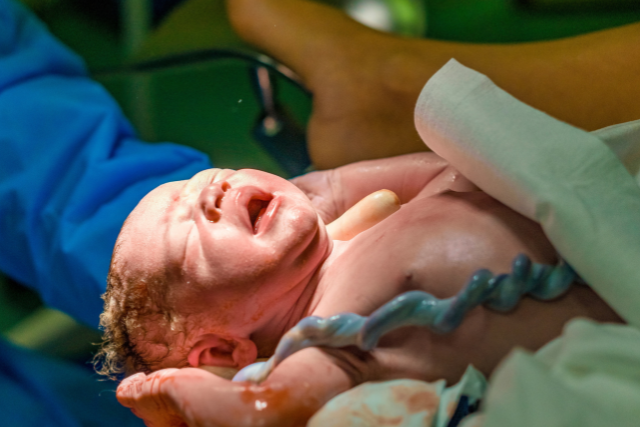
Another benefit of delayed cord clamping is decreasing the risk of childhood anemia, which can affect a child’s growth and development.
So, if one is a healthy candidate for cord blood banking (remember: a sibling or immediate family member with a current health condition that could benefit from stem cell treatment), and they would like to do delayed cord clamping, is this an ‘either/or’ situation? Not entirely!
My recommendation is to wait at least 90-120 seconds before the cord is cut. See this incredible TED talk about the benefits of waiting just 90 seconds. Then the remaining blood in the cord can be collected and stored.
There are so many options surrounding the childbearing journey and hopefully some clarification about a couple of these choices can make the decision-making process that much easier.
 Hayley Oakes is a licensed midwife based in Los Angeles offering integrative pre- and postpartum care. She has been attending births since 2010 as a doula, midwife assistant, apprentice and midwife, witnessing and supporting birth in all settings: home, birth center and hospital. Hayley is the host and creator of Milk Trails — a podcast dedicated to the out-of-hospital birthing experience. In February 2019, Hayley became a mother herself and welcomed her second child in January 2022. As a midwife, educator and mother, she is committed to supporting childbearing folks in having a safe and satisfying pregnancy, birth and postpartum experience to help grow healthy, happy babies.
by Hannah Gill | Mar 1, 2023 | Cesarean and VBAC, Labor and Delivery
“Ten minutes and a few contractions passed and Julie asked if I would feel comfortable moving to the squat bar. In my head, I thought she was crazy. There was no way I could support my body in a squat but with help from Scott, Julie, and our nurse, I repositioned and it was the best decision I made.”
My second birth experience was as different from my first as night is from day, both physically and mentally. I spent over a year preparing, I hired a doula, and I healed from the trauma of my first birth. Therapy helped tremendously in working through my postpartum depression, postpartum anxiety, and birth trauma. Simply having my experience and feelings validated lifted weight from my chest. Fear releasing and hypnosis practice also helped me prepare my mind. I knew it would be necessary to forgive myself and be at peace with my cesarean before I could fully surrender to birth again.
I woke up at 40+2 weeks with heavy bleeding. After talking to my husband, doula, and OB, I decided to head to triage for monitoring. Upon arrival, I was 3cm dilated and having irregular, unnoticeable contractions. My OB wanted to see if the bleeding was caused by a placental abruption or an intense bloody show. Luckily baby and I were both in stable condition and the bleeding eventually stopped. We had planned to return home because I wanted to labor there as long as possible but I had already dilated another centimeter and my contractions started to become more regular, so we stayed.
Dr. Alyssa Berlin’s The AfterBirth Plan course is now streaming!
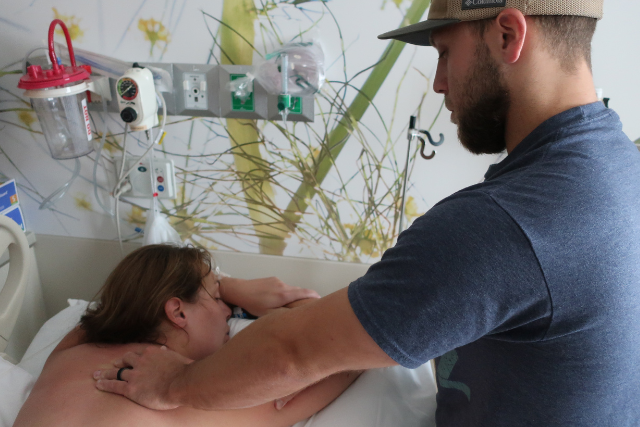
Once admitted, I got my first round of IV antibiotics since I was positive for Group B Strep. My contractions quickly grew in intensity and frequency and my water broke as I dilated to 5cm. While I was still in the right mindset, I sent a quick text to my doula, telling her to head to the hospital. At this point, I felt that I had to go to the bathroom. Laboring on the toilet felt like the most natural position to be in and after 45 minutes it was clear that I was transitioning. I began shaking and sweating as Scott massaged my shoulders and used a wet washcloth to cool me down. Out of breath, I told him I wanted an epidural but he knew how badly I wanted to stay unmedicated and encouraged me to wait for Julie to arrive for support.
When Julie finally walked into the bathroom I immediately told her I needed an epidural but thankfully, she suggested a position change instead. I moved to the shower and hung around Scott’s neck as Julie sprayed warm water onto my back. I felt the need to bear down as my body instinctively pushed. Julie suggested I go to the bed and get on my hands and knees. Still pushing, I positioned myself on hands and knees, holding onto the incline of the bed. It was a relief to be able to rest my head between contractions. Ten minutes and a few contractions passed and Julie asked if I would feel comfortable moving to the squat bar. In my head, I thought she was crazy. There was no way I could support my body in a squat but with help from Scott, Julie, and our nurse, I repositioned and it was the best decision I made.
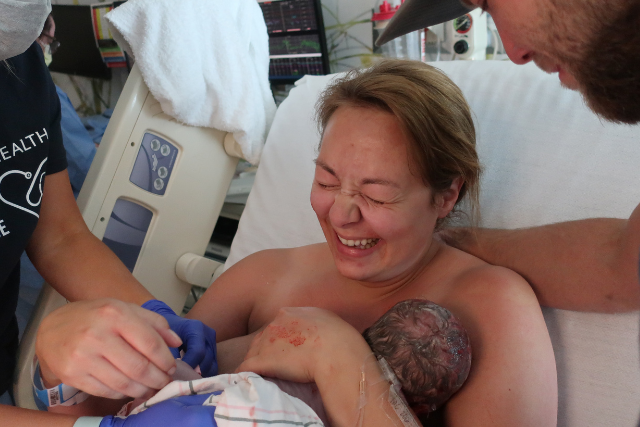
In five intense minutes, our daughter was born, just under five hours from the first contraction I
felt. She came down and through the birth canal so quickly, there was no time for head molding so her head was perfectly round. Every bit of pressure and discomfort I felt disappeared as I pulled her to my chest with tears of pure bliss streaming down my face. I had done it. I had the unmedicated VBAC I so badly wanted and it was the most rewarding and beautiful thing I have ever done.
After the pregnancy and birth experience I had and the relationship I developed with my doula Julie, I knew I had to become a doula too. Through training I was able to experience birth from a completely different perspective, one that opened my eyes to how unique each person’s experience is. So now, not only can I help educate women on their options in pregnancy, birth, and postpartum, but I can also help support them as a doula during labor.
Many people may be shocked to hear that I am thankful for the way both of my births unfolded. Although extremely difficult, my first birth brought me my son and a learning experience about taking charge of my health choices. My second birth brought me my daughter and helped me find the strength and power I have as a woman and a mother. Both experiences together lit a fire for a passion inside of me that I never knew existed.
Follow Dr. Berlin for updates on pods, blogs, streaming and more!

Hannah Gill is a VBAC mom of two, birth and postpartum doula, birth educator, and owner of Ebb and Flow Birth Co. She has a passion for helping support women through cesarean and VBAC births and throughout the postpartum period. She believes women deserve to be respected and supported in their pregnancy, birth, and parenting choices. You can find out more about Hannah and her services at ebbandflowbirthco.com and over on Instagram@ebbandflowbirthco.
