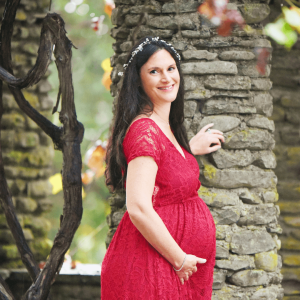
“Yoga is beneficial at every age and stage of life, but can be especially grounding during seasons of change. The practice helps us slow down, listen to our bodies, shift our gaze inwards, and take good care. It generates compassion and connection and can support the release of stuck energy and emotions.”
Big Changes
The process of growing and birthing new life into this world can be transformational and deeply meaningful for many folks. The months spent preparing for a baby’s arrival are often filled with celebration, family, glowing skin, new products, tiny clothes, and special moments. But while all this is wonderful and tempting to focus on, the reality is that becoming pregnant is a major medical change for a woman, one which involves significant physical, social, mental and emotional transformations. And such changes in one’s body, environment, and lifestyle can be the source of stress, anxiety, and the provocation of new or existing mental health conditions.
Unfortunately, one in five women experience increased stress, anxiety, depression, bipolar disorder, or other mental health conditions during the perinatal period, and 75% of women experiencing symptoms go untreated (Maternal Mental Health Leadership Alliance). It’s important to note that 40% of Black mothers experience mental health conditions and are twice as likely as white mothers to suffer (MMHLA). Adverse mental wellbeing not only impacts maternal health, but can significantly affect fetal health. Increased anxiety, stress, and depression are linked to neurodevelopmental delays, low birth weight, and even premature birth (Corrigan, L., Moran, P., McGrath, N.). This is why comprehensive and preventive care is extremely important. Expecting mothers need tools, resources, and support to navigate their changing bodies and mental landscape.
Yoga Can Help
Although I am not certified in prenatal yoga specifically, my years of teaching experience and research have taught me that yoga is a fantastic tool for both physical and mental prenatal support and is safe to do, or try for the first time, during pregnancy. Yoga is beneficial at every age and stage of life, but can be especially grounding during seasons of change. The practice helps us slow down, listen to our bodies, shift our gaze inwards, and take good care. It generates compassion and connection and can support the release of stuck energy and emotions. The physical and mental practice incorporates breathing techniques, somatic movements, and body awareness to generate equilibrium. Many experience the “yoga high” after completing a session, and interestingly, there is science to explain this.
Check out this related episode of The Informed Pregnancy Podcast: https://bit.ly/3Su4w9z
Mind-body exercises like yoga can significantly reduce cortisol levels and quiet one’s mind, leaving them more connected to themselves, their body (and baby), and the present moment. Consistent practice reportedly results in improved stress levels, sleep, quality of life, and autonomic nervous system functioning, all of which can help relieve physical pain, emotional turmoil, and support a shorter, less painful labor or birth experience. This can increase the likelihood of a healthy baby and a healthy mom (Corrigan, L., Moran, P., McGrath, N.).
Mental and Emotional Benefits
Many expecting mothers come to me for yoga hoping to prepare their bodies for labor; they’re experiencing tight hips, shoulders, low back pain, general fatigue and discomfort, and want to feel they’ve done all they can do to prepare for childbirth. But what I typically notice during my sessions is that while women are benefiting physically from yoga, they’re experiencing the mental and emotional shifts just as much. Planning for a baby can be overwhelming, and beyond that, hormones are fluctuating at an all time high. Expecting moms may feel unusually tender, emotional, and uncentered. Having time to get quiet, slow down, tune in, and connect can offer women an essential reprieve from the list of to do’s and what if’s running through their minds. Our physical health is closely connected to our mental health; building mental resilience through a practice like yoga can help sustain you during physically challenging moments.
In order to ensure this connection happens, I like to start prenatal yoga sessions with a short meditation. A few minutes to consciously arrive in the practice can help one land in their body. From there, I typically guide clients through a brief breathing exercise. Box-breathing, where you inhale, hold, and exhale for the same amount of time (I usually cue 4 seconds), regulates the autonomic nervous system, creating a sense of calm (healthline). Once connected to their breath, I begin incorporating small movements before getting into the heart of the practice.
Starting pregnancy yoga
For women who have developed a consistent practice prior to becoming pregnant, it’s safe to continue (under doctor’s guidelines) a mostly regular practice, with a few exceptions. But if you’re trying yoga for the first time while pregnant, take it slow and easy. Yin Yoga or a slow-flow style class will give you all the benefits I’ve described above, without putting too much stress on your body. It’s also important to be aware of how you’re feeling each day you step onto your mat – if you’re slightly dehydrated you may become light headed with a lot of movement, so it’s best to stick to seated postures. You’ll likely find a range of do’s and don’ts when it comes to prenatal yoga. In general, avoid twists in the first trimester and anything that compresses or strains your lower abdomen throughout pregnancy. Take time to find an instructor that you trust and vibe with, and always check in with your body to honor your needs for that day.
Remember, a yoga instructor is just that – a yoga instructor. You know your body best and may even have heightened intuition while pregnant. Give yourself trust and grace, and always check with your healthcare provider before trying new exercise.
For more help with preparing for baby before baby comes, check out The AfterBirth Plan by Dr. Alyssa Berlin, an online course you can take at your own pace: https://informedpregnancy.teachable.com
Natalie is a certified vinyasa yoga instructor and integrative nutrition health coach living in Los Angeles, CA. Interested in bridging the current medical system with the holistic health world, Natalie is pursuing a Master’s in Public Health where she will focus her studies in community health, mental health, and maternal and reproductive health.
Alongside her love of yoga and mindfulness, she enjoys running, swimming, reading on the beach, and cooking meals with friends and family. Learn more about her work by visiting her website: nataliepulvino.com.
Citations:
Corrigan, L., Moran, P., McGrath, N. et al. The characteristics and effectiveness of pregnancy yoga interventions: a systematic review and meta-analysis. BMC Pregnancy Childbirth 22, 250 (2022).
“In the months following Charlotte’s death, the other silence I was not prepared for was the silence of some of my family, friends, and coworkers. Those people who didn’t know what to say, so they said nothing. They didn’t mean to hurt me. In fact, they hoped their silence was helpful. They were afraid to say the wrong thing and upset me, so they said nothing at all.”
A Baby Girl
I was expecting a loud and joyous scene in the delivery room immediately after the birth of our first child, a daughter named Charlotte Victoria. We had been anticipating and preparing for this joy for months. Instead what we got was silence. Charlotte, a previously healthy and normal baby, had gotten her umbilical cord wrapped around her neck twice and perished ten days before her due date. Her death was so shocking, so earth-shattering that I’ll never fully recover. It was an event that tore the fabric of my soul to pieces.
The silence in the room was deafening. My husband, instead of laughing and gasping in amazement at his new daughter, was silenced by the weight of his grief upon seeing his firstborn child dead before she could live. The doctor was silent as she tried to deduce what went so horribly wrong. The nurse was silent as she tentatively held our perfect looking daughter and tried to convince us to hold her. I was silent as I tried to memorize every single feature of Charlotte’s face, to burn her image into my mind, even while I refused to hold her. I knew I couldn’t bring myself to bond with my child only to have her taken, not to the nursery, but to the morgue.
The Isolation of Grief
In the months following Charlotte’s death, the other silence I was not prepared for was the silence of some of my family, friends, and coworkers. Those people who didn’t know what to say, so they said nothing. They didn’t mean to hurt me. In fact, they hoped their silence was helpful. They were afraid to say the wrong thing and upset me, so they said nothing at all. They physically avoided me. They lost touch. They disappeared. I became a pariah because of my loss, because of my grief. Because what can you possibly say to help a woman who has lost her baby? Their silence only added to my grief, loneliness, and isolation.
According to the Star Legacy Foundation website, “In the United States, nearly 24,000 babies are stillborn every year. Worldwide, there are more than 2.6 million stillbirths every year.” The loss of a baby, whether it is due to a miscarriage, stillbirth, or perinatal death, can affect a woman’s career, marriage, mental and physical health, and can leave a lifelong scar on her. The death of my only daughter affected every single aspect of my life in both the short and long term, and I know I’m not alone.
If you’ve lost a baby, I’m so, so sorry for your loss. I understand what you’re going through. You probably have many different feelings about this loss and that’s ok. I hope the deepest part of your grief only lasts a short time. The pain does eventually lessen; however, grief is circular, not linear. You may think you’re past a certain point in your grief only to revisit it again later. That’s ok too. You will eventually find your way back to a new normal, although you will never forget your little one. I still cried on Mother’s Day five years after Charlotte passed away even though I have two sons now.
Instead of Silence
If you know someone who has experienced a loss, please don’t be silent. Reaching out to that person may seem scary to you because you may not know what to say or how to make them feel better. You can start by mentally preparing yourself. The mother, father, or partner’s feelings may change daily or hourly depending on how he or she is feeling that day and what triggers may be in his or her environment. They may be fine one moment and cry the next. These feelings may go on longer than you expect them to. Please be patient with them. Their grief may not look the way you expect because everyone grieves differently. My grief was open and louder while my husband’s grief was more private and quieter.
You don’t have to give a big speech or a profound piece of insight, but please try not to accidentally minimize their loss or give platitudes. When people told me, “These things happen for a reason; At least she’s with God; You’ll see her again one day,” it only hurt me further.
Genuinely being there for that person will help the most. Whether you bring food to their house, do their laundry, write them a heartfelt note, spend quality time with them, or truly listen to their story, offering love and support can be one of the best ways to help a grieving person get through perhaps the worst moment in their life.
As a country and society, we can no longer accept miscarriage, stillbirth, or perinatal loss as taboo. So many “silent women” never share their story of loss out of shame, embarrassment, or fear of another person’s reaction. So many women are out there silently living with their grief. I want you to know: YOU ARE NOT ALONE.
Nikki Spicer is a former Senior Project Manager, mother, and the author of, “Burying My Children: Breaking the Silence on Miscarriage and Stillbirth”. This riveting and very personal memoir about her journey through infertility, pregnancy related harassment, stillbirth, miscarriage, and gender disappointment is currently in need of a publisher. If you are interested in Nikki’s memoir or would like to reach out to her with your own personal story, please email nikkispicerbook@gmail.com.
Mom, Author, ENT surgeon, and Breastfeeding expert Dr. Linda Dahl sheds light on all things breastfeeding. Sharing her own breastfeeding challenges and how it’s helped her create a unique approach to helping women at any stage of their breastfeeding journey.
This podcast has been brought to you in part by LMNT electrolyte drink mix. You can get a free sample pack with every order at drinklmnt.com/berlin .
“And then ultimately I failed and I lost my milk and it was very emotionally traumatizing for me.”
“I mean, I told him, yeah, whatever. You know, I just kept seeing the babies because it was incredible and it was healing every single time to watch, you know, moms who were going through what I had gone through, you know, to be able to heal that suffering so quickly and so safely for their babies that, you know, there's nothing they could have said that would have made me stop.”
“And it turns out that the problem, if babies don't have tongue tie, if they can't nurse, usually the problem is that they can't gape,”
“But the truth is the opposite is true. Most of the time, if breastfeeding is not working, it's the mechanics of the baby that causes all those other things.”
“Absolutely. And thank you for being the first person who's ever said that.”
AI-generated transcript with speaker labels — may contain errors, especially names and medical terms. Dr. Elliot Berlin, DC appears in blue; Dr. Linda Dahl in orange.
Dr. Elliot Berlin, DC[0:12] Welcome to the Informed Pregnancy and Parenting Podcast. I'm your host, Pregnancy-focused carpenter, Dr. Elliott Berlin. My guest today is a mom, an author, an ENT surgeon, and a breastfeeding expert currently developing a new paradigm in breastfeeding to help assess baby and mother's breastfeeding experience. Dr. Linda Dahl, welcome to the podcast.
Dr. Linda Dahl[0:57] Hi, Doc. Thanks for having me.
Dr. Elliot Berlin, DC[1:00] Oh, I cannot wait to learn from you. You have such an interesting background on where you came from and what you experienced and where you headed and where you are now and are still heading. So that's a mouthful. Let's start at the beginning. Where are you from originally?
Dr. Linda Dahl[1:15] I was born in Texas, but I grew up mainly in Minot, North Dakota.
Dr. Elliot Berlin, DC[1:19] Okay. What was that like? Because is anybody else there? Is that where the Rushmoors or is that South Dakota?
Dr. Linda Dahl[1:24] That's yeah, the Dakotas get mixed up all the time. So South Dakota is the more famous of the Dakotas. North Dakota has the Badlands, but very little else. And then it had fracking for a moment, which is now famous for fracking. I guess despite the fact that it's pretty desolate and flat and freezing, it was made even more bizarre by the fact that my parents are immigrants from Syria, the country, you know, long before the war. They chose Minot, North Dakota. I have no idea why. So I ended up growing up in this very tiny farm town that was frozen 90 miles from the Canadian border. Syrian immigrant parents. So it was very interesting.
Dr. Elliot Berlin, DC[2:03] So not a huge Syrian community.
Dr. Linda Dahl[2:06] Basically, nobody. No Syrian community. No. And it was hard, you know, because we traveled a lot. We lived in Jordan when I was seven and I knew there was a world out there. So I knew living in North Dakota, there was a lot more to the world. So, you know, it affected my perspective on living there and on my parents. And I just kept saying, I just have to make it till I can get out of here and then I'll go out into the rest of the world. It'll be fine. And that's what happens.
Dr. Elliot Berlin, DC[2:32] Sometimes I wish I was in the middle of no place in North Dakota.
Dr. Linda Dahl[2:36] Sometimes until the wintertime comes and then you don't want to be.
Dr. Elliot Berlin, DC[2:40] Right. I would probably just hibernate like a giant bear.
Dr. Linda Dahl[2:43] Yeah. And sometimes the snow drifts would close us into the house. We couldn't leave the house.
Dr. Elliot Berlin, DC[2:49] Like you couldn't open your door.
Dr. Linda Dahl[2:50] We couldn't open the door.
Dr. Elliot Berlin, DC[2:52] Wow.
Dr. Linda Dahl[2:53] Because it's all planes. Yeah, it's planes. It's flat. So there's nothing to buffer the snow drifts. You know, we'd have, have a really bad snowstorm. It would sometimes block up the door and then it would go into deep freeze. It would get to 80 below zero. So there was, you couldn't leave the house literally.
Dr. Elliot Berlin, DC[3:09] So lucky.
Dr. Linda Dahl[3:11] Just talking about it.
Dr. Elliot Berlin, DC[3:12] I've been talking about it. I felt trapped when I'm in Hawaii. Yeah.
Dr. Linda Dahl[3:17] You'd like it in North Dakota.
Dr. Elliot Berlin, DC[3:19] I don't think I'd like it anymore. I just, I wanted some quiet for a minute, but I'll just go into my meditation room. Okay. Now you're not there anymore. Where do you live now?
Dr. Linda Dahl[3:28] I live in New York city now, and I've been in New York for 24 years.
Dr. Elliot Berlin, DC[3:33] Are you multilingual?
Dr. Linda Dahl[3:35] Not really. My parents wanted us to grow up Americans. They gave us American first names and they only spoke Arabic when they were trying to tell each other secrets or swear at us. So no, I trained in the Bronx. I learned, you know, enough Spanish to get by medically, but that's it.
Dr. Elliot Berlin, DC[3:53] So mostly English. Okay. So when did you start thinking medicine?
Dr. Linda Dahl[3:59] I wanted to be a costume designer and my father decided medicine basically when I and all my sisters both came out of the world and he ended up with two of us, two doctors. So we were told from the moment we understood words that we were going to go to medical school. So it was really more that than anything, but I really loved costuming and art and I got into medical school in college. And then I gave up my acceptance to do costuming for a couple of years and then reapplied and ended up going back to medical school at the university of Minnesota.
Dr. Elliot Berlin, DC[4:30] Minnesota. Cause you were used to the cold.
Dr. Linda Dahl[4:33] Cause I was used to the cold and it was a huge city in Minneapolis. It was diverse compared to North Dakota.
Dr. Elliot Berlin, DC[4:39] Okay. So then now you're an ENT, your nose and throat surgeon. How did you choose that specifically?
Dr. Linda Dahl[4:48] It was when I went to medical school, I didn't even know what it was as a specialty, but it really combined all of my favorite parts of the body and it was more complex. You know, the anatomy was more complex than anything I could understand as a medical student. So I knew it would keep me interested. And I also loved that it was one of the rare specialties where I could take care of people of every age. So from babies who are newborn to, you know, people at the end of their life and combinations of people, pregnant women. I mean, it's kind of like being a family practice doctor, but I could also do surgery, but it's just above the clavicles.
Dr. Elliot Berlin, DC[5:23] Above the clavicles. You seem like the neighbor. Everybody would go to for a little.
Dr. Linda Dahl[5:29] Thanks. That's what I feel like even in New York city.
Dr. Elliot Berlin, DC[5:33] That's a lot of neighbors in New York city. It's a lot of neighbors. Okay. So is your practice even as it goes ENT, do you have a specific approach to ENT or to medicine in general?
Dr. Linda Dahl[5:47] Uh, I think that my approach to medicine is much more holistic. I mean, naively, when I went to medical school, I thought it was really just about healing prevention and healing and really bringing the body back to, you know, its natural ability to take care of itself and heal itself, but you know, in my naivete, I didn't realize that medical school is medicine and surgery, like giving people drugs and cutting things out of them. So, you know, I went through medical school and residency, which is very hard for me, I think more so than most other people. But when I went into practice, I knew I couldn't be part of a hospital system. And if I was going to be able to practice in a way that worked
[6:25] for me, I would have to be on my own. So I've been in solo practice most of the time, but I really have an integrative approach to ENT and I, I take care of the whole person, um, but the ear, nose and throat are the way it's just my entrance into the body. So that's kind of how I, you know, have to figure out what's going on with them. But most of the time, the answer to what's happening, what's wrong, the reason they're coming in to see me is much bigger than just their ears, noses and throats.
Dr. Elliot Berlin, DC[6:52] You mentioned the full spectrum of age, of life, newborns all the way through end of life. What specifically do little babies and infants come to see you for?
Dr. Linda Dahl[7:05] Now they specifically come to see me for difficulty breastfeeding. And that started, um, I was hired by a group of pediatric ear, nose and throat doctors right out of residency. And I had just given birth to my daughter who was six months old and she couldn't breastfeed. And I went through, you know, I think what most women go through when they have trouble breastfeeding, you know, losing the milk and the pain and trying to get help from doctors, but not really getting any help from anybody. And then ultimately I failed and I lost my milk and it was very emotionally traumatizing for me. So I joined this practice and a lot of the referrals to them
[7:39] were for babies that couldn't breastfeed. And I immediately took an interest and kind of took over all those babies and found ways to help them breastfeed.
Dr. Elliot Berlin, DC[7:47] Okay. So that's kind of how I started by talking about the unusual path that you took to get to where you are, which we're just warming into. And then the unusual practice that you have now and how you can even help people who are not in New York city. Let's take a little break. When we come back, we'll find out more.
Dr. Elliot Berlin, DC[8:18] Welcome back to the informed pregnancy podcast. We're talking to Dr. Linda. Okay. So you said your residency was harder for you than most. Why is that?
Dr. Linda Dahl[8:28] Well, I think I had a harder time compartmentalizing. I really just got very connected to the patients and their suffering and it was hard for me to, you know, look at everything as objectively, I think as most doctors and I think too, like a lot of, you know, allopathic doctors. I read a statistic once that 90% of doctors come from other doctors. So I think there's a way to go through the training where you kind of protect yourself, but also think of the patient as a separate, you know, person, and they kind of objectify them a little bit, but I was just very bad at doing that. So it was emotionally really hard for me. I mean, I cried every time my patients passed away,
[9:07] you know, I was advocate for them in a way that was, you know, kind of irritating to the other doctors in the hospital. So it was really much more personal for me.
Dr. Elliot Berlin, DC[9:15] Yeah, it sucks to have a big heart, especially if you're going to be a surgeon, bad idea. You know, when I was much younger, I worked in ambulances and emergency rooms and started when I was 17 and 18 and at that point I felt so invincible. Like it's almost like very disconnected from patients emotionally. First of all, you don't get to develop a relationship with them. It's like, hello, emergency, stabilize you and pass you off. But, you know, even when really terrible things were happening, I think it was the opposite for me in my mind. It was just like, I got to be the best plumber. I could be on this plumbing unit and do the best job I can.
[9:55] And it wasn't until later that I started to get a little bit more attached. Uh, we did lose a patient who was the same age as me, a 21 year old. And it was a little traumatic for me. And then after that, I had a much harder time. That's the point I was trying to make. So that's when I could start to relate to you and how much more difficult it is when you do care and you get attached and, you know, now you're not just a plumber.
Dr. Linda Dahl[10:17] Yeah. And it really, you know, it never went away. It never got easier for me. So when I would see the mothers that were suffering, when they would come in, I think I was more willing to, you know, go outside of my comfort zone and go outside of my specialty's comfort zone to try to come up with solutions for them because it is really hard to watch people suffer. Sure.
Dr. Elliot Berlin, DC[10:40] You have a baby in the heat of your medical training. Was that a conscious choice?
Dr. Linda Dahl[10:50] Oh, no, not at all. I watched the other females in surgical practice, there were very few of us, but I watched them go through pregnancies. And I knew absolutely certainly that I was not going to go, and I was married at the time and it was a surprise, you know, to be honest, I was actually applying for plastic surgery fellowships and I found out I was pregnant and then I knew that that wasn't going to happen. Yeah. So it was definitely not planned.
Dr. Elliot Berlin, DC[11:16] I would have guessed plastic surgery for you because, well, just cause you want to do costumes and it's sort of like the ultimate.
Dr. Linda Dahl[11:24] True, true. I'm grateful that I don't do that now.
Dr. Elliot Berlin, DC[11:31] So, I mean, I imagine pregnancy during residency must've been insane. And then, I mean, it seems hard on both sides, like it would mess with your progress in your intense training medically, and then also be a bit hard to carve out time to take care of yourself while during the pregnancy, take off time for birth and, you know.
Dr. Linda Dahl[11:54] Well, they only gave us six weeks of leave and that's because you only got six weeks off of residency, no matter what the reason was. And if you missed more than six weeks, you had to repeat the whole year. So that was very hard. And so I had to work until the day I gave birth, which was 10 days overdue. It was enormous. The delivery was so traumatizing and awful, but the hardest part of all was having to leave her after six weeks.
Dr. Elliot Berlin, DC[12:20] I assume you had already done OB rotations.
Dr. Linda Dahl[12:22] No, I didn't do OB rotations as a resident. I did them as a medical student.
Dr. Elliot Berlin, DC[12:27] Yeah.
Dr. Linda Dahl[12:28] So I kind of knew earlier than that.
Dr. Elliot Berlin, DC[12:30] Yeah. Yes. So you had experience with delivery of other people. I'm sorry to hear that was a very tough experience for you. Did you have sort of a loose plan formulated going in?
Dr. Linda Dahl[12:41] Oh yeah. I had a great plan. I mean, I was also very active. I'd run ultra-marathons. I was like very physically fit. I could take pain and I was prepared to have a natural birth. I didn't want pain medicine. I was, you know, ready to go, but unfortunately I found out later, I had a placental abruption and like her cord was wrapped around my daughter's neck. So it went very quickly. So for my first contraction to full dilation, I think was like less than two hours when I started pushing a first baby. So nobody believed I was actually going to have the baby. They kept trying to discharge hospital. I'm just like, this is labor. And they kept saying, didn't you
[13:18] take Lamaze? I was just like, there was no break between contractions. It was just like one after the other. Then my water broke and then they took me seriously. And it was actually thanks to an in-house OB obstetrician who trained in Canada because he knew how to use forceps. And when she was starting to crown, her heart rate went all the way down. So he just came in with forceps and just, you know, we got her out of it. That's how she was born from the first contraction to her birth was in three hours. It was really fast.
Dr. Elliot Berlin, DC[13:47] Is that a lot of tearing?
Dr. Linda Dahl[13:49] That was horrifying. No pain medicine. I mean, and it wasn't like forceps. I don't know. People realize it's not about pulling the baby out. It's about ripping you open so the baby can come out.
Dr. Elliot Berlin, DC[13:59] Yeah. So that's what I'm saying. You must've had a lot of tearing.
Dr. Linda Dahl[14:01] Oh, it was, yeah, it was layers and layers, but everything healed and it was, you know, I think more emotionally terrifying than physically later.
Dr. Elliot Berlin, DC[14:10] I mean, it was practically your neighbor from 90 miles north of growing up.
Dr. Linda Dahl[14:15] That's true. I was lucky for that. Thank you for making that connection. I never really did. Well, Dr. Bebbington, Dr. Bebbington, that was his name is my savior.
Dr. Elliot Berlin, DC[14:26] So is it that we don't really train on forceps that much anymore? It's more about the vacuum now or?
Dr. Linda Dahl[14:32] I think it's more about the vacuum now. Yeah. And there's no way the vacuum wouldn't have worked for her because the residents were trying it and my obstetrician didn't believe I was in labor. So she wouldn't even come in. So the residents begged this, you know, in-house obstetrician to come deliver my baby. And it's funny when he came in, I thought he was the anesthesiologist and I thought, oh great, I'm going to get the epidural. Like, no, no, I'm going to do the opposite of that.
Dr. Elliot Berlin, DC[14:57] Yeah. And then placental abruption just since you mentioned it. So that's where the placenta becomes traumatized or starts to…
Dr. Linda Dahl[15:06] It detaches too fast. Pulls off the wall too quickly. Yeah, it pulled off the wall too quickly.
Dr. Elliot Berlin, DC[15:12] Boy, that sounds scary, dangerous, physically and emotionally not comfortable.
Dr. Linda Dahl[15:18] And then to go from that into not being able to breastfeed was just, it was very hard. And then during a time when I didn't really have time or space or money or support to really, you know, make it any better than it was.
Dr. Elliot Berlin, DC[15:31] Right. I mean, six weeks seems like a slim margin when everything goes just perfect.
Dr. Linda Dahl[15:36] Yeah. And, you know, and it was like that for all the female residents.
Dr. Elliot Berlin, DC[15:40] Okay. Breastfeeding was challenging for you. Do you know why?
Dr. Linda Dahl[15:44] I now know why because I figured it out. I mean, I've been in practice now 19 years, but it took me 11 years in practice to finally understand the dynamics of breastfeeding and really understand why it didn't work for me.
Dr. Elliot Berlin, DC[15:59] Before we get to like the diagnosis, let's say, what were the mechanics of it? Not working. Were you not making milk? Were you not able to latch? Was the baby?
Dr. Linda Dahl[16:08] Yeah. I mean, it's all interrelated. Right. So for the first four weeks, she was attached to me 24 seven. And if she wasn't nursing, she was sleeping or crying. And I remember I couldn't go for more than an hour away from her because she was awake, she was eating or she was nursing and it was extraordinarily painful and you know, lots of trauma. And I thought she was getting milk. She seemed like she was getting milk, but she was hungry all the time and it was hard to interpret her cues. You know, people use the terms cluster feeding and, you know, your colostrum comes in, you know, I could kind of deduce from all the information I have that maybe this was normal.
[16:43] And I kept, you know, asking my pediatrician and my obstetrician, is this normal? Is this what it's supposed to be like? And everybody kept saying, oh yeah, it's fine. It's fine. You definitely have enough milk and this is just what it's like, you know, it was a lot of, you know, kind of hand waving and denial. And then after four weeks, I went to a breastfeeding group. I went to the Upper East side. I was in the Bronx at the time and, you know, I watched all the other women breastfeeding. It was very different than what I was experiencing. I mean, they were just, you know, and the babies were huge and the lactation consultant weighed my daughter and it turned out
[17:15] she lost weight and was getting almost nothing from me. And by that point, my milk supply had dropped so precipitously that when I did start pumping, I was only making about two ounces a day from both sides.
Dr. Elliot Berlin, DC[17:28] Wow. But they didn't have a diagnosis for you?
Dr. Linda Dahl[17:31] Nope. Not only did they not have a diagnosis, I was mostly just met with denial. Oh, you have enough milk, but you don't have enough. I don't have enough milk. We'll give her formula, but you could still breastfeed her because you have enough milk. It was cheerleading, you know, to keep me going, but with no diagnosis or explanation for why.
Dr. Elliot Berlin, DC[17:52] Clearly you're the kind of person who sort of takes that difficult experience and tries to figure out how to prevent other people from falling to the same difficulties. All right. So I'd love to take another break and we come back, find out more about what you learned and how people can benefit from the work that you've done. We'll be right back. Welcome back to the podcast. We are talking to Dr. Linda Dahl. Okay. You've come a long way because now you've written two different books on breastfeeding. So you must've really gone out of your way to find information and to help people. What was the journey from where you were to where you are today?
[18:41] Just how you put together all the information that you have.
Dr. Linda Dahl[18:45] Um, actually at first, when I first started in practice, I was working for a pediatric ear, nose, and throat group and they would get referrals from lactation consultants for babies that had a hard time breastfeeding and they were diagnosed with something called tongue tie. And I never heard of it. And I just thought, well, I wasn't trained well enough and I'm just out of residency. So I can't let my bosses know that I don't know what anything is. I have to research it and figure it out. And, you know, almost self-conscious, um, started reading about it and treating these babies. And I didn't question what I was doing because the results were so immediate and
[19:20] so incredibly helpful. So when a baby had tongue tie that I can see and diagnose as an ENT doctor, if I cut it, then they could immediately latch on and breastfeed from their mom. And then all of the symptoms that they had were relieved immediately. And so I got more and more referrals and my bosses were confused about why all these newborns were coming in. And so one of them called me aside and he gave me this whole explanation. Well, this is tongue tie and this is how you fix it. And what you're doing is wrong, which was shocking to me because I'm like, what do you mean it's wrong? You know, it's obviously right. It's working. And that's when I
[19:55] realized I was actually developing something that hadn't existed before and he cautioned me strongly against doing it and told me to stop. And I refused. I mean, I told him, yeah, whatever. You know, I just kept seeing the babies because it was incredible and it was healing every single time to watch, you know, moms who were going through what I had gone through, you know, to be able to heal that suffering so quickly and so safely for their babies that, you know, there's nothing they could have said that would have made me stop. And it was safe. I mean, I figured out a way how to do it that was safe. And then I would immediately get the baby latched on and help
[20:30] the mom latch the baby on. And then a few years later, my bosses dissolved the practice and I ended up starting my own practice. And then the floodgates kind of opened. I mean, women would come. Moms would come from Connecticut, Pennsylvania, you know, and it was kind of like this underground breastfeeding ring because the pediatricians would tell them not to come and the lactation consultants would tell them they had to come. And then, you know, they try to hide. You know, then I'd see the babies and I'd always write these consultation letters back to the pediatrician thanking them for sending. They never sent them, but I would thank them anyway.
[21:03] And say now this is what was wrong and this is what I treated. But then there were all these babies, a huge portion of the babies that didn't have traditional tongue tie, but they had a hard time latching on and they had all the same symptoms. And those babies, you know, I differed in my diagnosis and approach than the lactation consultants because they said lactation consultants started calling those babies posterior tongue tie and lip tie. And I just knew anatomically as an air, nose and throat doctor that those things don't exist as diagnoses. And so it took me another probably seven, eight years to figure out what the problem was. And it was all through trial
[21:41] and error and like measuring the baby's heads and seeing what they had in common, their jaw position, their palate, the way what their gape, if they were able to gape or not, even their wound position. I mean, I worked with cranial osteopaths, with physical therapists, craniosacral therapists, Chinese doctors. So I worked with a lot of different people with a lot of different approaches and kind of came up with this unifying theory about why those babies can't latch on. And it turns out that the problem, if babies don't have tongue tie, if they can't nurse, usually the problem is that they can't gape, which is that wide opening. So moms are always told,
[22:18] you know, get the baby to open really wide and then put them onto the breast. And then so many times the moms would say, well, the baby doesn't open their mouth. And when that happens, they're often told, well, shove your breast in there or like flange the baby's mouth. You know, like they're told to mechanically get the baby to open. But what I figured out is that the baby can either gape or they can't. And the gape is an unhinging of the jaw, which is a relaxed position. And then once they can unhinge the jaw to gape, then they can latch on and do all the breastfeeding things that all the breastfeeding books talk about. But if they can't do that first step of unhinging,
[22:54] then they hinge at the jaw and then slide down to the nipple and then move back and forth on the nipple without forming a seal. And that causes friction. And it also causes all the other issues that so many moms deal with. You know, the baby breaks the seal or they fall off the breast or they fall asleep at the breast or they get a lot of gas or they lose their milk. You know, there's all of the problems, the vast majority of problems that moms and babies suffer from when they can't breastfeed boils down to that baby's inability to gape. And once I realized that, then I, you know, adapted the procedures I was doing to release the gape. And it was just a miracle
[23:32] how many babies we could help a nurse.
Dr. Elliot Berlin, DC[23:34] Is it different than the tongue tie?
Dr. Linda Dahl[23:36] It's different than the tongue tie because tongue tie is when the tissue underneath the tongue doesn't dissolve. And because the tongue is a muscle, if you don't release that tongue tie as soon as possible, then the tongue can't develop normally as a muscle into adulthood. So it's really important to release that regardless of whether or not the baby's breastfeeding. And you have to release it far enough without cutting into the muscle or burning or lasering anything just with you can do it with a scissor and use your thumb to stretch it just along the tissue planes and then the baby breastfeeds. And it's amazing. But this gape restriction is not tongue tie at all.
[24:13] But it happens when the baby's jaw gets set back a little bit and the roof of the mouth is high, usually when they're engaged in the pelvic girdle early in the third trimester. So their head is stuck in one position and as they're growing, because they grow mostly during the third trimester in size, that's when they get really big. And if their head is stuck in the pelvic girdle, then the only place the jaw has to go is back. So if the jaw set back, the jaw position actually tethers the movement of the tongue. So in those babies where the jaw set back, the jaw set back is what's limiting the movement of the tongue. The tongue can't lift and it can't pull back.
[24:53] It's not about sticking the tongue forward. It's about lifting and coming back. And the roof of the mouth is so high that the tongue can't make contact and form a seal. So they can't latch on and form a seal onto the breast and pull milk down.
Dr. Elliot Berlin, DC[25:05] So does this mean that during pregnancy there are things that one might be able to do to encourage a better jaw mechanics, a better latch once the baby comes out?
Dr. Linda Dahl[25:16] Absolutely. And thank you for being the first person who's ever said that. Yeah, absolutely. Most of the time this happens when the baby's head engages in the pelvic girdle early, which everybody loves for the delivery because it makes it not always, but it makes it, you know, if they're engaged deeply enough, it makes it easier for the baby's skull to come through. But if baby is in breech position or if they're head down above the pelvic girdle, you know, the same thing happens if they're stuck in one position. You can actually monitor that with ultrasounds during the pregnancy.
Dr. Elliot Berlin, DC[25:48] Hmm, that's interesting. I mean, it almost sounds like there's a benefit to the breech, baby.
Dr. Linda Dahl[25:54] Possibly. In my practice, which is, I mean, a lot. I mean, I've probably treated twenty three, twenty four thousand babies. But most of them are not breech. Most of them are head down engaged. And surprisingly, most babies are not breech.
Dr. Elliot Berlin, DC[26:10] Most babies are not breech. That's true.
Dr. Linda Dahl[26:12] You know, at the end of pregnancy, there's like three percent breech.
Dr. Elliot Berlin, DC[26:14] So, yeah, it'd be interesting to see if there's a correlation. OK, so you have these two books, Better Breastfeeding and Clinician's Guide to Breastfeeding, both by you and Linda Doll. What's the difference between the two?
Dr. Linda Dahl[26:28] The Clinician's Guide was written for medical professionals and health care professionals and it's research based and really more technical. I mean, parents can read it, but some of it's hard to understand. But Better Breastfeeding is really meant for the lay population. It's more easily readable by everybody.
Dr. Elliot Berlin, DC[26:46] So Better Breastfeeding and Guide to Breastfeeding, Clinician's Guide to Breastfeeding. When you're talking to parents, are these like sort of troubleshooting? Are these like just different things to look for observationally? Are they tips on success?
Dr. Linda Dahl[27:03] Well, Better Breastfeeding is really a comprehensive guide to breastfeeding. So it isn't just about what happens when things go wrong. It's an overview of how the anatomy and physiology is supposed to work so that you can identify when it's not working. And some of the recommendations and explanations I have differ from what's commonly said. And then there's another section on identifying problems and understanding the underlying cause so that you can decide, you know, if you want to do anything about it and what you want to do about it.
Dr. Elliot Berlin, DC[27:33] Yeah, because like what we've talked about here is almost more mechanical. But I mean, I mentioned sometimes there's just not enough milk production or not enough glandular tissue, things like that that aren't going to be fixed by a little snip of the tongue.
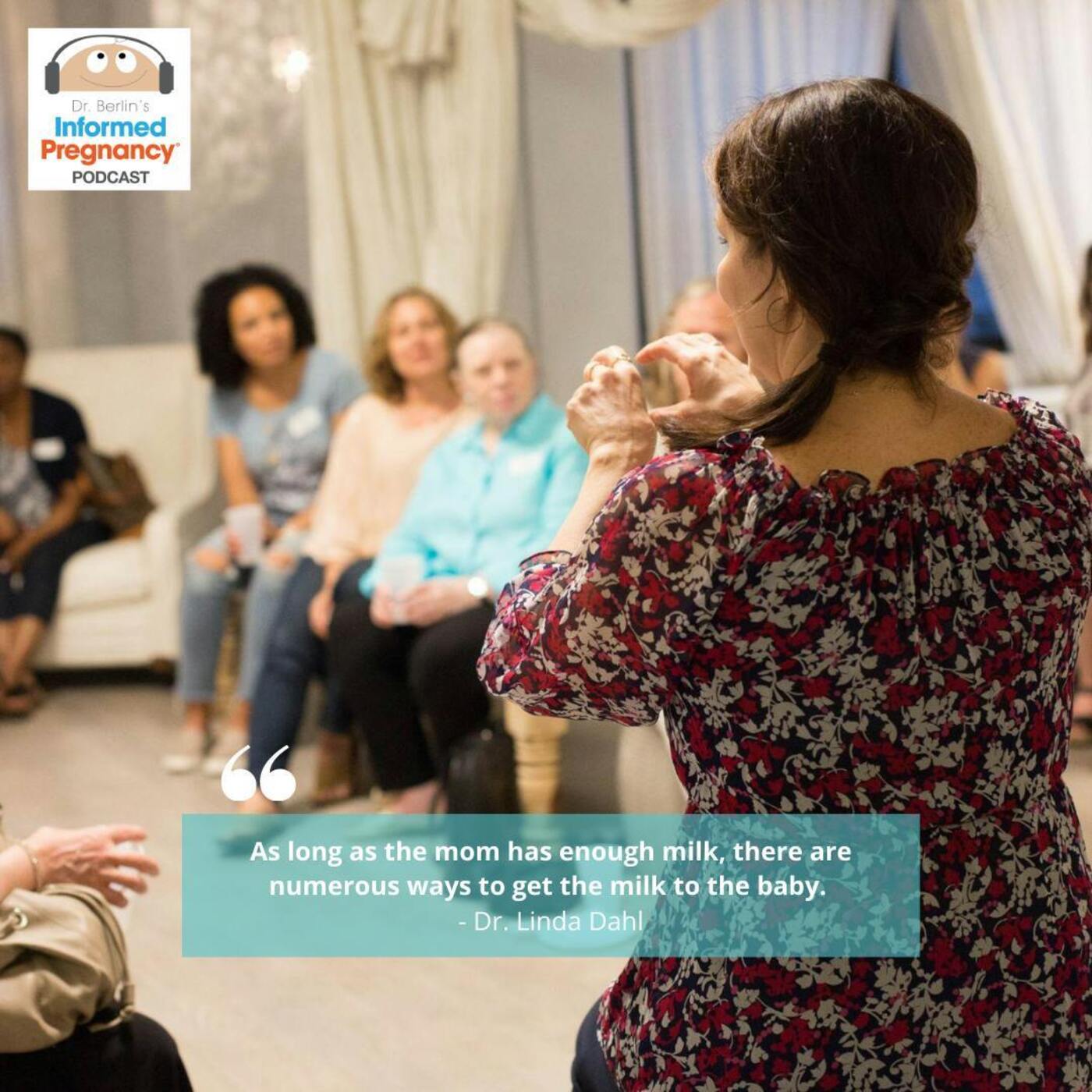
Dr. Linda Dahl[27:46] Right. Yeah. And it covers all of that, you know. But I think, you know, moms were led to believe that the vast majority of problems with breastfeeding lie with the mother, that the mother got stressed or lost her milk or it was too painful or whatever. But the truth is the opposite is true. Most of the time, if breastfeeding is not working, it's the mechanics of the baby that causes all those other things. You know, unless a mother has inherent low supply, which actually is less common than you think. It happens then, you know, as long as a mom has enough milk or robust amounts of milk, you know, there are many ways to get breast milk into the baby,
[28:24] whether or not the baby can pull out the milk. But, you know, instead of trying to pump out the milk and use like a feeder that where you tape it to the nipple, you know, like there's all these things that moms are told to do that aren't going to help the baby breastfeed, but it just kind of helps the baby get breast milk. Yeah. Yeah. You know, there's a way the mechanics are supposed to work in the mom and in the baby, and they have to work together. But the book really breaks down all of those different components. So even as moms, as parents, they can figure out what's going on so they can make choices about the way they want to feed their baby
[28:59] that works best for both of them.
Dr. Elliot Berlin, DC[29:00] It's really interesting what you're saying about the baby's anatomy, because once in a while we do have babies come into our chiropractic office. I mean, we have babies every day, but once in a while we have one that will only really eat on one side, will only feed on one side. And on the other side, they won't feed, which, sure, there's a lot of different things that can contribute to that. But once in a while, it's literally clear as day how their neck is not aligned well. And so if they're laying on one side, they're just really uncomfortable and they start to fuss and whine. And as soon as you turn to the other side, they feel good. The second we adjust that, it's over.
[29:35] It's one of those few things that we see in the office. It's just like the magic cure. It's magic, yeah. Coming in with a big problem and leave with it resolved. All right. So you must be working on something else. You sound like you never stop.
Dr. Linda Dahl[29:51] No, I don't. I actually I'm working with one of the hospitals in New York to try to develop a breastfeeding center affiliated with the hospital so that the mothers that go through there that give birth in their labor and delivery floor have a consistent message from everybody on the floor. But then also when they're discharged from the hospital, they have a place to go to for breastfeeding. So they don't have to search around for specialists, like who's going to see them. There's nobody to treat these moms. There's nobody to follow up with. So I really want to develop a comprehensive center in conjunction with a hospital because they have so many resources
[30:27] and moms have to go back anyway with the baby. So it would be great to be able to make breastfeeding one of those automatic things that they get support for.
Dr. Elliot Berlin, DC[30:36] Fantastic. All right. Well, the time went super quickly because you're a great conversationalist and a wealth of knowledge. I have a feeling that if you'll come back, we'll have you back for more specific topics in the same genre down the road.
Dr. Linda Dahl[30:50] Wonderful. I would love to.
Dr. Elliot Berlin, DC[30:51] Thank you. In the meantime, where can we find you online?
Dr. Linda Dahl[30:56] My website is www.drlindadal.com So drlindadal.com.
Dr. Elliot Berlin, DC[31:02] And Dal's D-H-L.
Dr. Linda Dahl[31:04] H-L.
Dr. Elliot Berlin, DC[31:06] All right. I will visit you online. And for our listeners, thanks for joining us. If you want to find us online for more pregnancy and parenting information, visit informedpregnancy.com.
Want more pregnancy + parenting? Start your FREE TRIAL of Informed Pregnancy+ and get access to all our curated pregnancy and parenting content — original series, iconic birth films like The Business of Being Born, prenatal workouts and more.
,,Needed is a nutrition company delivering optimal nourishment for women and their partners before, during, and after pregnancy. Needed is the #1 women’s health brand among nutritionally trained practitioners, and is backed by the recommendation of thousands of perinatal health experts. Their products and educational content are grounded in the latest clinical research and the in-practice experience of its practitioner collective. Needed delivers what you need to thrive, not just survive, along the perinatal journey and the parenting years beyond.
You likely know how important it is for women to take a prenatal vitamin before, during, and after pregnancy. After all, when it comes to building a family, a lot of the focus is put on women’s nutrition. But, did you know that MEN need prenatal nutritional support too?
That’s right! Prenatal supplements for men are needed to support libido, sperm health, brain function, hair health, and overall vitality.
The impact of men’s health
Men’s role in the perinatal stage cannot be understated, because when men don’t optimize their own health, it can impact fertility outcomes and the health of the baby for years to come.
Why? Because sperm contribute 50% of a baby’s DNA, and male factors are responsible for roughly ⅓ to ½ of all instances of infertility and pregnancy loss. The health of sperm is influenced by many factors, including the effects of our environment, diet and lifestyle. Sperm take an average of 100 days to mature, and during this time period they are especially vulnerable. The good news is it doesn’t take long to “turn over” more optimal sperm!
And it doesn’t end there
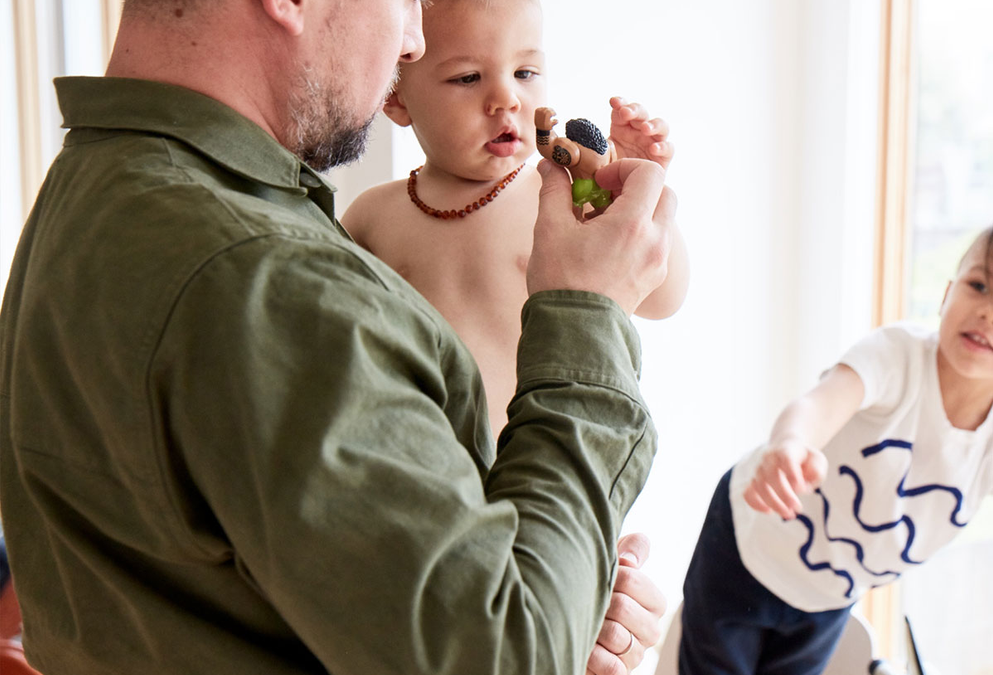
Men’s health doesn’t cease to matter after conception occurs (acknowledging that this can happen in many different ways). The dad years that follow are demanding (hello, sleepless nights and preschool germs – all while aiming for some kind of work-life balance!). So it is important to continue to support health well into the dad years that follow for optimal energy, immunity, libido, brain function, hair health, and overall vitality.
What can you do about it?
What can a man do to support his optimal health from preconception and into the dad years? It starts with supporting himself through five key diet and lifestyle factors:
Healthy diet: Include more color in your daily plates in the form of antioxidant-rich raw and cooked fruits and vegetables, and prioritize pastured eggs and poultry, grass-fed beef, and wild caught fish. Skip the processed foods, refined carbs, excess sugar, and poor quality oils (like canola and other vegetable and seed oils).
Targeted supplementation: Due to depleted soils, a disrupted food system, and busy lives, even the best diet is unable to cover everything a man needs for optimal health and fertility.
Movement: Exercise is beneficial to both physical and mental health, as well as optimal fertility and sleep.
Stress management: Some stress is inevitable, but too much can influence sperm quality, mood, and physical wellbeing.
Reduction of toxin exposure: Avoid or limit things like alcohol and other substances, as well as endocrine disrupting chemicals in plastics, household cleaners, and personal care products.
Targeted Supplementation
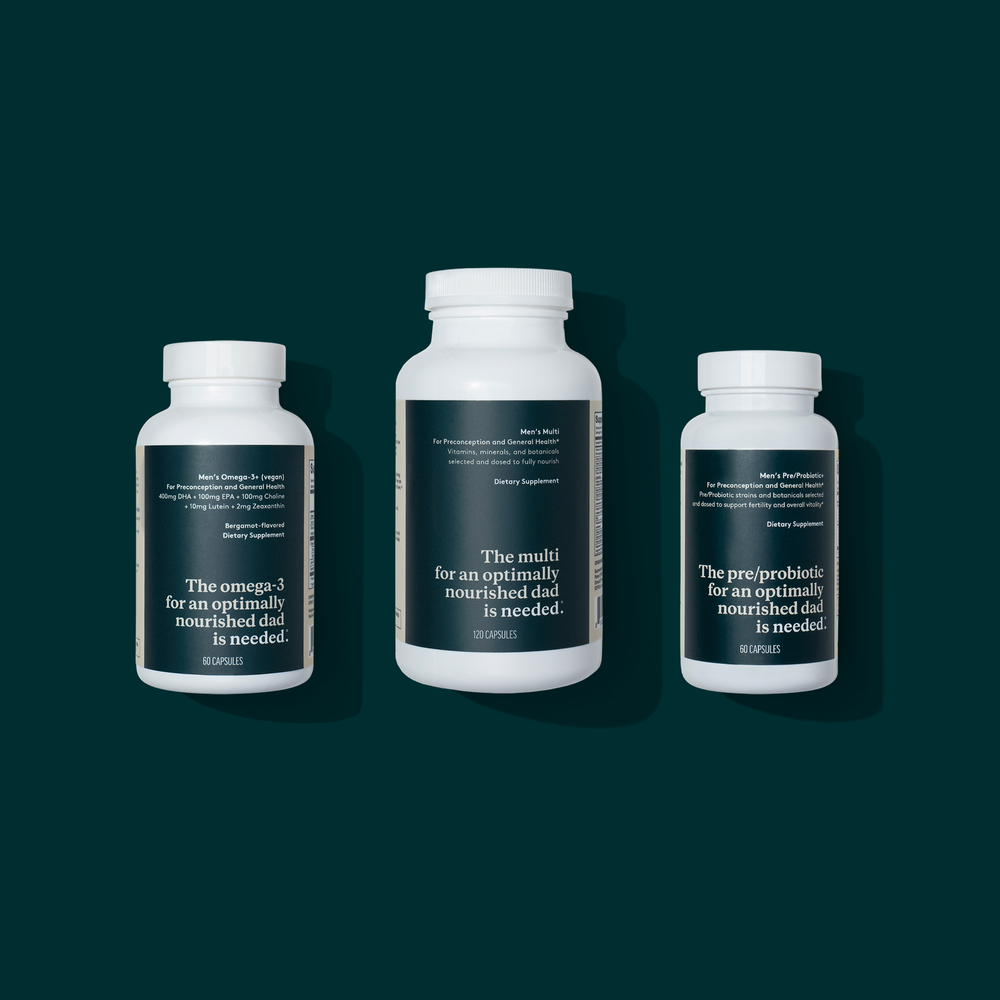
Needed’s Men’s line supports a man’s health with a comprehensive multivitamin/mineral blend, a tailored Pre/Probiotic, and a vegan and sustainably sourced Omega-3 with extra Choline, and added antioxidants.
Needed’s ,Men’s Multi contains 23 optimally dosed vitamins and minerals like B12 for energy, active Folate, Vitamin C, Vitamin E, Selenium, Zinc, and Antioxidants for sperm health, Biotin for hair health and so much more.
Needed’s ,Omega-3+ is a vegan and sustainably sourced Omega-3 with extra Choline, and added antioxidants.
Needed’s tailored ,Pre/Probiotic for men that supports an overall healthy male microbiome, especially for those wishing to conceive. The gut microbiome plays a huge role in male fertility, including sperm development and function. Sperm health impacts conception outcomes and the health of a growing baby, so supporting sperm development is key.
Needed’s ,CoQ10 supports sperm quality, energy production, metabolism, and protects cells from damage.
Needed’s ,Men’s Complete Plan includes all the nutrients men need to support optimal health, fertility, and energy when trying to conceive and all throughout the dad years to come.
The Bottom Line
We know that 1 in 8 couples find themselves having difficulty getting pregnant and 1 in 4 pregnancies ends in a loss. While much of the focus and education around fertility and perinatal health centers solely on women, men’s health plays a vital role as well.
The good news is, just as there are prenatal vitamins and ways to support a woman’s health before, during, and after pregnancy, there are ways to support and focus on men’s health during these crucial times as well. Men need high quality nutritional perinatal support, too!
Click ,,here to learn more, and use the code BERLIN20 to get 20% off your first order or the first 3 months of a Needed subscription.