
May 26, 2022 · 57 minutes · Episode 283
About this episode
Motherhood After Pregnancy Loss – Nikki Spicer

Nikki Spicer is a memoirist and mother of two. Nikki vulnerably shares her challenging journey of loss and perseverance after losing her first pregnancy at 38+ weeks.
This podcast has been brought to you in part by LMNT electrolyte drink mix. You can get a free sample pack with every order at drinklmnt.com/berlin .
Learn more about your ad choices. Visit megaphone.fm/adchoices
See Privacy Policy at https://art19.com/privacy and California Privacy Notice at https://art19.com/privacy#do-not-sell-my-info.
Key quotes
“They wrapped the baby up and showed her to me. I only saw her face and because this was my first pregnancy, I looked at her face and I thought, wow, it really was a baby in there. You don't get very many ultrasounds when it's a healthy, normal pregnancy. So I just was living with this wiggly bump for almost 40 weeks. So when I saw her, I was like, wow, it really was a baby in there. And I thought she was so”
“Well, the wrong thing to do, which I encountered, was to not speak to me at all. People didn't know what to do or what to say. They were afraid to say the wrong thing and to upset me. So then therefore they didn't call me.”
“I would say to just be there for the mother. You know, she is going to be feeling a large range of emotions, you know, anything from anger, grief, disbelief, denial, all of those type of emotions. And it's important to just be cognizant that. you may not get the emotion or the reaction from the grieving parents that you expect, you know, to just be supportive and to be there, but to just realize that everyone's grief looks different. And it may depend on the day or the hour how that grief is looking.”
“about procreation, but we had amazing intimacy as a couple. My husband was incredibly supportive. He held me every single night that I cried myself to sleep. He was there in every way that he could be. So we were very intimate as a couple, but our sexual relationship was not”
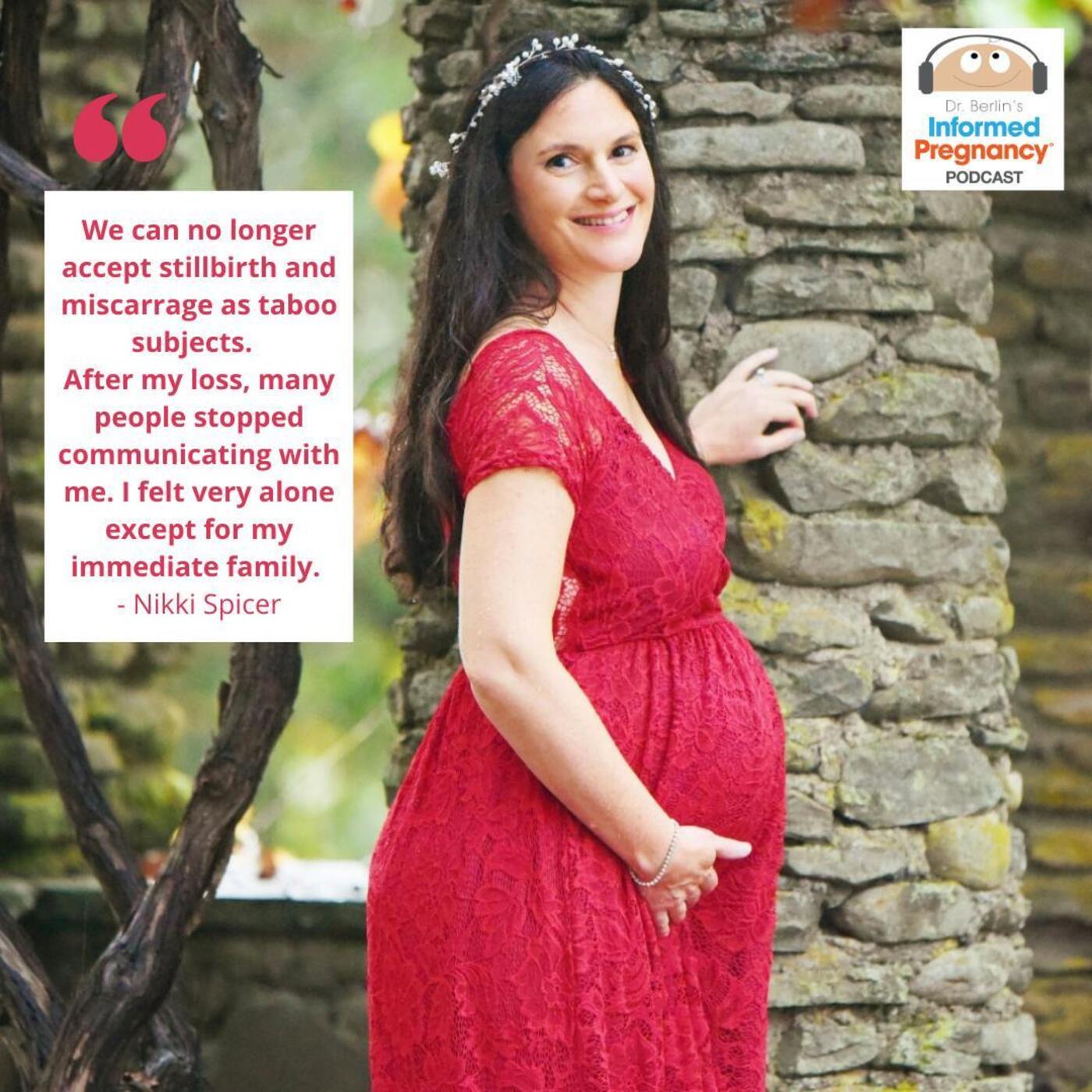
“I wrote this book because we just can no longer accept miscarriage and stillbirth as taboo subjects in America. And I really wanna give a voice to all of those silent women out there who have lost their children, yet they feel unable to say anything about it”
Related episodes
- Ep. 296 Alessandra Torresani – Before Birth
- Ep. 287 Postpartum Depression – A Personal Experience
- Ep. 279 Kayleigh Harrigan – Before Birth
- Ep. 276 Kelly Kilmartin – Before Birth
Transcript
AI-generated transcript with speaker labels — may contain errors, especially names and medical terms. Dr. Elliot Berlin, DC appears in blue; Nikki Spicer in orange.
Download PDF of the Transcript
Dr. Elliot Berlin, DC [0:55] To the informed pregnancy and parenting podcast, I'm your host, pregnancy focused chiropractor, Dr. Elliot Perlin. My guest today is a memoirist. She is a mother of two, and she has come to share her personal history with multiple pregnancies, miscarriage, pregnancy loss, and finally success in having her children. Nikki Spicer, welcome to the podcast.
Nikki Spicer [2:00] Hi, thank you for having me.
Dr. Elliot Berlin, DC [2:02] I just want to say, and I said before we started even recording, thank you so, so much for being here. Sometimes we go through a difficult period of life that is unimaginably difficult, and it knocks us down. And we have a hard time getting back up. And sometimes we get back up and we go public. We share our experience to help other people who down the road inevitably some people will experience the same thing that you did and feel alone. And not only that, for those of us who are around somebody in the circle of somebody who experiences pregnancy loss, we don't know how to deal with it. And if we're able to talk to somebody who's been there, it sometimes helps us be
[2:48] better friends. So we'll jump right in to the beginning. When did you have your first pregnancy?
Nikki Spicer [2:55] I was first pregnant six years ago.
Dr. Elliot Berlin, DC [2:58] OK, was it a pregnancy that came easy?
Nikki Spicer [3:03] No, actually, it didn't. My husband and I thought we would get pregnant very easily. I was 34 and he was 37 at the time. So we weren't super young, but we weren't on the older side either. So we thought things would come easily to us. And it ended up taking 11 months to get pregnant. We tried abulation apps, a basal thermometer and some abulation tests. And none of it was working. So I went to my OB for infertility appointment only to find out when I was there that I was pregnant. It was a complete shock.
Dr. Elliot Berlin, DC [3:46] Had you talked to your OB about it during the 11 months that you had been trying?
Nikki Spicer [3:51] No, I had moved to a new area and I hadn't had an established OB at the time. So my understanding was that due to my age, you know, we should try for a year. And if at the year market didn't happen for us, then we should go in for an appointment. So at the 11 month mark, that's when I went in to see if there was anything going on. So it was a nice surprise at the OB. It was very, very surprised.
Dr. Elliot Berlin, DC [4:19] Were you alone or were you with your husband?
Nikki Spicer [4:21] No, I was alone. I called him on the phone and he was about to go and run an errands. And I said, no, you have to stay at the house. I'm coming right there right now. And he was also very surprised when I got home and told him in person. I was dying to tell him over the phone, but I had to hold it in
Dr. Elliot Berlin, DC [4:42] during the 11 months to just start to get worried. I mean, you talk about your age, but you were below the proverbial advanced maternal age by the scary line there.
Nikki Spicer [4:52] Yeah, I was getting nervous and neither of our parents had issues getting pregnant. So we didn't. think that we would either, plus everyone tells you when you're growing up, you, you know, better take precautions. If you're going to have sex or else you will absolutely get pregnant. So, you know, it came as a bit of a surprise that, you know, neither one of us, you know, we're expecting. Yeah.
Dr. Elliot Berlin, DC [5:17] No pun intended.
Nikki Spicer [5:19] Oh, right.
Dr. Elliot Berlin, DC [5:20] There we go. How was the beginning of your pregnancy?
Nikki Spicer [5:24] Perfect. Um, everything went really well. I joined up with a smaller OB group and I saw a few of their doctors. And then, um, during my pregnancy, we ended up moving and I then needed to see a larger group because we moved about 45 minutes away. So I had to change my OB group and I saw very many doctors because they were a large group there. And each of the doctors I saw had commented on what a strong heartbeat the baby had.
Dr. Elliot Berlin, DC [5:59] And how did you feel during the pregnancy? Like first trimester or second trimester?
Nikki Spicer [6:05] Oh, sure. I felt pretty well. Uh, I did have some nausea the first trimester. Um, I had some aversions to food. I did not like meat for about a month. I couldn't stand it when my husband, you know, if he wanted to eat a hamburger for dinner, he had to eat it in a different room. But, you know, overall, I didn't have any severe nausea. And then once the second and third trimesters came, I felt really great. I was working the entire time.
Dr. Elliot Berlin, DC [6:36] Did you start to make plans for childbirth at your new OB practice?
Nikki Spicer [6:42] Well, at the new OB practice, we just talked about, you know, very vaguely having a natural birth. Like I said, they, you know, made me rotate between several different doctors. So I didn't have consistent maternity care. I felt as though, uh, but my husband and I were doing all of the things on the checklist that people generally do when they have their first baby. We made it a surprise pregnancy announcement to my family. We did a gender reveal. I spent hours researching all of the baby items, had a baby shower, did the baby moon, and we set up our nursery. We did childbirth and parenting classes. So we covered the gamut. You know, we made sure that we were really prepared for this baby.
Dr. Elliot Berlin, DC [7:27] Curious about the gender reveal on the baby moon. How did you do the gender reveal and what did you find out you were having? And where'd you go for baby?
Nikki Spicer [7:38] We found out we were having a girl and I was very excited. I was feeling fairly neutral about the sex of the baby. But then when I found out I was having a girl as the weeks went by and it sank in more and more, I became more and more excited. We set up a box and we put balloons in the box. So we had one Mylar balloon that said it's a girl. And then we had several regular helium balloons in pink and we decorated the box and we had both of our mothers open the box at the same time. The only trouble is that the weight of the lid on the box overnight weighed down the helium balloon. So when they opened up the box, nothing and the helium balloons were covering the Mylar balloon.
[8:31] So our mothers had to sort of, you know, look down and through the balloons. Then finally, the it's a girl balloon popped up. So then everyone gave a great big cheer.
Dr. Elliot Berlin, DC [8:41] OK, so you knew the sex, but everybody else was being surprised. Yes. OK. How about baby moon?
Nikki Spicer [8:48] We had just recently moved to Pennsylvania, so we were exploring the area and we went to. Funny enough, we went to Bethlehem, Pennsylvania, and it was just before Christmas time, late November. And it was a very pretty town and nice to walk around. And we went just before they get bombarded with the Christmas rush.
Dr. Elliot Berlin, DC [9:15] And how deep into the pregnancy was that?
Nikki Spicer [9:19] Oh, I'd say at the beginning of my third trimester.
Dr. Elliot Berlin, DC [9:26] OK, so fully bumped out.
Nikki Spicer [9:30] Oh, fully. Yeah, I started showing right away.
Dr. Elliot Berlin, DC [9:35] When you talked about having a plan for a natural birth, everybody defines natural a little bit differently. What does natural mean to you?
Nikki Spicer [9:44] I wanted to have the baby vaginally. I wanted to have as little intervention as possible, although I knew myself well enough to know that most likely I was going to want some kind of pain relief, possibly. in epidural, but I wanted to explore the other options before getting to that point.
Dr. Elliot Berlin, DC [10:07] Okay. At some point you found out that the pregnancy had some trouble. There was an issue. How deep into the pregnancy was that?
Nikki Spicer [10:17] I was 38 and a half weeks and I went for my 38 week appointment, just regular doctor's appointment. My mother had come with me and she had never been to any of my appointments. I had always gone to my appointments alone. My husband went with me for the anatomy scan at 20 weeks, but my OB's office was near my job. So I would just leave from work and go right to my appointment. And so my mom happened to come with me to this appointment and we met new doctor X, another new doctor I'd never met before. And the doctor started to do the Doppler. My mom had her phone out, ready to record the heartbeat. She was very excited to hear it and there was nothing, no sound. And we were wondering what was going on. And the doctor was scanning over
[11:17] here, scanning over there. She couldn't find anything. My mom asked her maybe are the batteries dying? So the doctor said, I'm going to send you to our emergency ultrasound department. And so we went over there. And even at that point, I did not think that anything could be wrong. I thought perhaps the equipment was just faulty because my entire pregnancy was
Dr. Elliot Berlin, DC [11:44] so healthy. With an extra strong heartbeat. Right. At that point, had anything felt different
Nikki Spicer [11:51] for you? No, but I should have realized that the baby hadn't moved in a while, but I was so busy working and commuting and, you know, just getting ready for her birth that I did not realize. I was not keeping track of when and how often she moved because her movements became a part of my life, a part of my daily routine. And so I was not keeping any kind of a record
Dr. Elliot Berlin, DC [12:29] of her movements. Okay. And I think that happens quite a bit, especially when you have such smooth sailing and then you're getting close at 38 plus weeks, you're very much in the zone for delivery. Right. Plus some people tell you that the baby might move less because they've run out of room. You know, I don't know if that's a medical fact or if that's an old wives tale, but that's definitely something that I have heard throughout my pregnancy journeys. So it becomes less alarming. All right. Let's take a little break and then come right back. There's a lot left to your fertility and pregnancy story. We'll be right back.

Dr. Elliot Berlin, DC [15:29] Welcome back, we're talking to Nikki Spicer and her first pregnancy wasn't easy to come by, 11 months of trying, but after that everything was really great, multiple doctors commented on the strong heartbeat and she was getting close to her due date, planning for a vaginal birth, and at 38 plus years old, she had a baby, and she had a baby, and she was at 38 plus weeks, she goes for her routine doctor appointment with mom, and they're having trouble finding a heartbeat, so they sent you to a more advanced imaging center? Is that what the emergency department is for them?
Nikki Spicer [16:13] Oh, they had sent me to their ultrasound department, initially I had been just getting a regular Doppler scan, you know, with the little wand, they do it over your belly.
Dr. Elliot Berlin, DC [16:24] Oh, so they, yeah, okay, so what kind of exam did they do at the other department?
Nikki Spicer [16:30] That was an ultrasound where they could visually see on the screen the baby.
Dr. Elliot Berlin, DC [16:34] Okay, got you, so they were just listening for sound at the first one?
Nikki Spicer [16:38] Yes, yeah, they were just listening for a heartbeat.
Dr. Elliot Berlin, DC [16:41] And then with difficulty finding sound they sent you for imaging, like where you can see?
Nikki Spicer [16:47] Yes.
Dr. Elliot Berlin, DC [16:48] Okay, and what happened in there?
Nikki Spicer [16:50] The ultrasound tech started scanning and I noticed that she subtly turned the, or angle the screen away, normally, you know, I would have to strain but I could see the screen, I could see the baby, and she angled it away, and she wasn't saying anything. She wasn't looking at me, and now my mom and I are passing looks between us, we're wondering what's going on, and I noticed her name tag and I was calling her by name, I believe her name was Stephanie, I was saying Stephanie, what's going on? Stephanie, you know, can you please talk to us? And she just wasn't saying anything, wasn't looking at us. And that's when I really started to get nervous.
[17:32] And then the doctor came in and she said, I'm sorry to have to tell you this, especially because I just met you, but your baby is dead. And I shot off that exam table faster in retrospect than I would be able to believe I could given in how pregnant I was. And I grabbed for my phone, but I was not getting any reception because I needed to call my husband, I needed to tell him what was happening. So I got my phone and I left the room and I just started running through the hallways, not knowing where I was going, having never been here in this area before, but I was just looking at the phone, trying to see my reception bars. And my mother had gathered up our coats and our purses, and this is in the middle
[18:26] at the end of January and we were in New York state and so it's freezing outside. So she is gathering up all of our things. She's running after me, the doctor's running after the both of us. And I went through this nurse's brake station and I finally found a door to the outside and I just collapsed on the ground on my knees and just did one cry, scream into the air and then got on the phone with my husband and I said to him, you have to come to the hospital right away. The baby has died and you have to come to the hospital. Now you have to leave work. And my mom and the doctor caught up with me and they're just looking down at me as I'm kneeling on this frozen cement without a coat on or anything.
Dr. Elliot Berlin, DC [19:16] Oh, um, I mean, how was he on the phone?
Nikki Spicer [19:21] Shaky, very shaky, but you know, it was a very quick conversation because I needed to go and he needed to go. I'm in shock.
Dr. Elliot Berlin, DC [19:33] Yeah. So I can't imagine what it was like for you. Did it become real in the moment?
Nikki Spicer [19:39] No, no, definitely not. It didn't become real for a few days.
Dr. Elliot Berlin, DC [19:46] So what do you do at that point? If the baby's hasn't thrived and they're still inside you, what are the options moving forward?
Nikki Spicer [19:55] She's a full term baby. So she needed to either. come out vaginally or via a C-section, you know, just like a regular baby. So my mom and the doctor got me up off the ground, got me back inside. And I said to the doctor, I want to have a C-section. I did not want to go through the emotional trauma of having this baby vaginally. So this doctor said, okay, no problem, we can do that. And she said, you need to leave and go to the hospital right now. So that's what my mom and I did. We were very numb, both of us, neither of us were crying. We just became very quiet and focused on the task at hand. She didn't know where the hospital was. I verbally directed her and we arrived at the hospital
[20:53] and they knew we were coming. So when we got to the maternity wing, they knew who we were and what was going on.
Dr. Elliot Berlin, DC [21:00] And then your plan was to go straight into a cesarean birth?
Nikki Spicer [21:05] That was my plan. However, when the OB on call spoke to me, she is a wonderful woman and she ended up becoming my OB throughout the rest of my pregnancy journeys. I love this woman. And I'm so glad that she was with me. I just happened to meet her by chance at this moment in my life. She was very willing to do a cesarean section if that's what I truly wanted. But she convinced me to do a vaginal birth because she wanted me, although it was difficult to think about future pregnancies and how future births would go.
Dr. Elliot Berlin, DC [21:48] Meaning she was thinking forward.
Nikki Spicer [21:51] Yes.
Dr. Elliot Berlin, DC [21:51] You will likely get pregnant again. You will have a healthy baby and at birth. And at that point, knowing that you had wanted a vaginal birth, you would be sort of in a position where you either have to have a repeat cesarean or a vaginal birth after cesarean, both of which are not quite as good as a vaginal birth with no previous cesarean. So is that the argument that she made?
Nikki Spicer [22:16] Yes, yeah. And she gave us time to think about it. And after thinking about it, I decided that this moment was already so terrible, I might as well just stick out the terribleness and do the vaginal birth rather than have possible issues in the future if I had a cesarean.
Dr. Elliot Berlin, DC [22:37] So challenging to think about in that moment. Then did you get induced?
Nikki Spicer [22:45] Yes. I had already started having some initial contractions on my own, but I was induced.
Dr. Elliot Berlin, DC [22:52] So you're in a labor and delivery room with your mom and your husband still there?
Nikki Spicer [22:59] My mom was with me. My husband eventually arrived. He had a commute to get there. So he got there. My father left work. Both of my brothers left work. My husband's parents who lived two and a half hours away, they drove down immediately after he called them. So everyone was there in the hospital room with me for at least part of the time. Is that something that was helpful to you? Yes and no. It was nice to have everyone rally around me, but at the same time, there wasn't anything to be done. So people were just sitting in chairs in luckily this very large labor and delivery room, staring back at me. And I decided everybody needed a job or to leave.
[23:55] So I sent my brothers back to our house to get my hospital bag because I didn't have it with me. It was actually my plan to start packing the hospital bag in the car with me that following week. My husband's parents took him down to the cafeteria to get him some food. My parents then stayed with me while my husband was out. And then when my husband came back, they rotated out to call their mothers, my grandmothers to tell them what had happened. So people were at that point starting to rotate in and out and I was feeling better that my family had something to do rather than just sit there and stare at me.
Dr. Elliot Berlin, DC [24:40] How was the support from the hospital staff?
Nikki Spicer [24:43] Excellent. They were very supportive.
Dr. Elliot Berlin, DC [24:46] So to me, as a doula, I've been a support person in that situation before and there's nothing that can prepare you for. But what I remember is an eerie sense of calm. because normally at the birth everybody's staring at the monitor, you know, how's the baby reacting to this or reacting to that? And here presumably all the focus is on you and you don't have that kind of sense of something's disturbing the baby. How long did labor take? Nine hours.
Nikki Spicer [25:20] And then you pushed? Yes, my daughter had me labor down. I had gotten an epidural because the feeling was there's no reason to try other pain prevention methods. Let's just skip right to the epidurals. So, you know, all of my well laid plans for my birth just completely went out the window. So I labor down and I just did a few pushes. The head came out and then the doctor had me pause while she was doing something, which obviously I couldn't quite see what she was doing. And then she had me push the rest of the way and my daughter was born. What happens in that moment? I mean,
Dr. Elliot Berlin, DC [26:09] what did you think would happen in that moment? And then what actually happened?
Nikki Spicer [26:15] Well, what I was expecting was I think what everybody else expects when they have their first child, the doctor saying, here's the baby. Congratulations. The husband, you know, being very excited, cutting the cord. And none of that happened. It was completely silent. The baby was silent. My husband was silent. The doctor was working to figure out what went wrong. It was just total silence.
Dr. Elliot Berlin, DC [26:43] Yeah. You're describing what you expected to happen before you got the news that there was a fetal demise, right? But while you were in labor, did you think about the moment the baby would come out, you would meet the baby?
Nikki Spicer [26:59] I was just really living moment to moment.
Dr. Elliot Berlin, DC [27:04] In total silence, can you describe what emotion you felt, if any?
Nikki Spicer [27:11] They wrapped the baby up and showed her to me. I only saw her face and because this was my first pregnancy, I looked at her face and I thought, wow, it really was a baby in there. You don't get very many ultrasounds when it's a healthy, normal pregnancy. So I just was living with this wiggly bump for almost 40 weeks. So when I saw her, I was like, wow, it really was a baby in there. And I thought she was so beautiful. She looked completely normal. Could they tell how long the baby had not been alive for? They could not, but it didn't appear that it wasn't for a very long time because like I said, she looked as if she was alive, but just sleeping.
Dr. Elliot Berlin, DC [28:09] Right. And then did they give you any instruction on what would be a good thing to do to hold the baby and get a closer look or not hold the baby? Do they weigh and measure?
Nikki Spicer [28:23] Yes, they weighed and measured the baby. She was seven and a half pounds. They asked us if we wanted to hold our daughter. We named her Charlotte Victoria. And my decision was, no, I did not want to hold her. I could not bear to bond with her in that way and then have her taken away. And my husband made the same decision, although they made it clear to us that if we made separate decisions, that was okay. And we were okay if the other partner wanted to make a separate decision, but neither one of us held her. Do they do things like fingerprinting or take pictures? They did. Initially, I didn't want any pictures of her. That was just a purely emotional
[29:20] decision. I wanted to forget the entire pregnancy happened. I was so grieved and heartbroken that I just wanted to forget the last 40 weeks at that time. But they did take pictures. They did imprints of her feet and they cut a lock of her hair.
Dr. Elliot Berlin, DC [29:43] So they gave us several keepsakes. In retrospect, is that something you're happy that you have? Yes, definitely. Okay. Did they figure out what went wrong?
Nikki Spicer [29:59] Yeah. The pause in the, when she was being born was that the cord was wrapped around her neck twice. And so she wasn't able to fully pass through the birth canal because the cord was that tight. So the doctor needed to cut the cord away from her neck before she could even be fully born. And that is the only thing that was wrong with her. She simply got tangled.
Dr. Elliot Berlin, DC [30:27] So what they would say is a fluke?
Nikki Spicer [30:30] Yes, complete freak accident.
Dr. Elliot Berlin, DC [30:34] What happens after they suddenly took her away?
Nikki Spicer [30:39] Yeah, they told us that they would place her in the next room if we changed our mind and we would be able to see her. But at that point, my husband and I were focused on getting me well again. I was having quite a lot of bleeding afterward and I also had a blood sugar drop. So, you know, I was eating slowly and they were keeping an eye on how much blood I was losing. I had a large fibroid on the outside of my uterus, which had nothing to do with the baby because it was on the outside. So it didn't affect the pregnancy. It didn't affect the baby at all. But it was affecting the way that my uterus was shrinking back down again. And it was preventing that initial shrinkage.
[31:32] They didn't have to do any kind of intervention. It did eventually right itself, but I did almost need a blood transfusion.
Dr. Elliot Berlin, DC [31:41] Aftermath, once you were healthy and came home, you have to make final arrangements for your daughter.
Nikki Spicer [31:48] Yes.
Dr. Elliot Berlin, DC [31:50] And did you decide for a burial?
Nikki Spicer [31:53] We did. We needed to start making those arrangements while we were in the hospital because they needed to know where she needed to be transported to. So as you can imagine, we were not planning for this. So it was a very quick decision that we needed to make. We decided with my mother's help to have her buried in a cemetery in New Jersey, which is about an hour and a half from our home in Pennsylvania. But I have several family members who are buried there and they had a section just for infants. And so that's where we decided to place her.
Dr. Elliot Berlin, DC [32:40] When you come home the few days the week after, I imagine your family and friends want to be supportive. Are they successful? What at that point, either in the moment you may not know, but in retrospect, what at that point can anybody do or say that might have been helpful? And what's the wrong thing to do or say?
Nikki Spicer [33:04] Well, the wrong thing to do, which I encountered, was to not speak to me at all. People didn't know what to do or what to say. They were afraid to say the wrong thing and to upset me. So then therefore they didn't call me. They sent their regrets through my mom. They sent cards in the mail, which was bizarre because I had been getting congratulations on your baby cards in the mail. And then now all of a sudden I'm getting, I'm sorry, cards in the mail. And I did not like picking up the mail. I did not want to go to the mailbox. But it just was very difficult for me because I was, except for my very immediate family, was basically left alone to process what all happened.
Dr. Elliot Berlin, DC [34:06] So not communicating with you made things worse.
Nikki Spicer [34:12] Yes.
Dr. Elliot Berlin, DC [34:13] But I imagine people didn't communicate because they really didn't know what to say.
Nikki Spicer [34:19] Correct.
Dr. Elliot Berlin, DC [34:20] And so what would you recommend to somebody who has somebody in their circle in that situation? Like obviously the recommendation is don't disappear.
Nikki Spicer [34:31] Right, yeah. I would say to just be there for the mother. You know, she is going to be feeling a large range of emotions, you know, anything from anger, grief, disbelief, denial, all of those type of emotions. And it's important to just be cognizant that. you may not get the emotion or the reaction from the grieving parents that you expect, you know, to just be supportive and to be there, but to just realize that everyone's grief looks different. And it may depend on the day or the hour how that grief is looking.
Dr. Elliot Berlin, DC [35:22] Oh, I'm truly sorry for the experience that you had. And again, so grateful for you coming to share so honestly and openly. And I know that you're going to help people in the process. This is not how your fertility journey ends. Let's take a break and come back and discuss the rest of your story. Welcome back to the Informed Pregnancy podcast. We are talking to Nikki Spicer. After Charlotte's death, did you at some point start thinking,
Nikki Spicer [36:07] we're going to do this again? Yes, I had this empty void that I desperately needed to fill. And our doctor told us that we could start trying to have another baby after three months.
Dr. Elliot Berlin, DC [36:24] And did that feel at that time you were ready?
Nikki Spicer [36:29] It did. I was supposed to be having this baby. I was supposed to be having my daughter and I was becoming determined that I will have this baby. It just felt like a gigantic delay in having my daughter. So I was desperate to just get pregnant again and to start this whole journey over again. I could not believe it took us 11 months to get pregnant. And then nearly 40 weeks of gestation only to start right back at the very beginning, trying to get pregnant again. After you know, physically recovering, right physically and otherwise, did you start naturally or were you like on a fertility kick from the beginning? I think we started off with ovulation tests right away. I was not going to mess around with
[37:28] trying to get pregnant naturally. I wanted to just do this as fast as possible. Okay. How long did it take? We got pregnant I believe three and a half months after the
Dr. Elliot Berlin, DC [37:43] birth of my daughter. I mean during that time now you're probably over the 35 advanced maternal
Nikki Spicer [37:50] age. I was. I had a birthday in between that point. So were you concerned that it's going
Dr. Elliot Berlin, DC [37:57] to take a year again? I was concerned. Yes. How does this affect your relationship
Nikki Spicer [38:05] and specifically intimacy in your relationship? It was very tough. Intimacy became solely focused on getting pregnant before we got pregnant with Charlotte. And then afterwards, once I became laser focused on getting pregnant, that's all intimacy was.
Dr. Elliot Berlin, DC [38:27] Right. But you know, normally intimacy is a very important bond and just relating to each other and staying, you know, loving and warm and close. So without
Nikki Spicer [38:39] that, does the relationship struggle? Well, I guess I should back up and say sex became about procreation, but we had amazing intimacy as a couple. My husband was incredibly supportive. He held me every single night that I cried myself to sleep. He was there in every way that he could be. So we were very intimate as a couple, but our sexual relationship was not spontaneous. It was planned. Right now. Now there's no like, oh,
Dr. Elliot Berlin, DC [39:20] we're both feeling in the mood. It's just like the test says now. Yes. Yeah. I got the test
Nikki Spicer [39:26] that had the smiley faces. So, you know, hollow circle, not ovulating, blinky smiley face, getting ready to ovulate, solid smiley face, ready to go. And I would live
Dr. Elliot Berlin, DC [39:42] for those days of solid smiley face. So you got pregnant and after three and a half months,
Nikki Spicer [39:49] how did that feel to you? That was also a surprise. I was, like I said, taking these ovulation tests and I started a new one and And it came up solid smiley face, which meant ovulation is eminent and this was confusing because I had just had a period. So I should not be getting that reading, but the ovulation tests, this particular one needed you to use it every day of your cycle so that it could track your hormones and the changes within your hormones. So I was not expecting to get this reading. I dismissed it as perhaps something went wrong with the particular strip, did it again, tested again the next morning, only to get that same eminent ovulation reading.
[40:42] I called the company and they said you might be pregnant. You should go and take a pregnancy test. So I did and it turned out I was pregnant and I made an appointment right away with my doctor.
Dr. Elliot Berlin, DC [40:55] So you had a period and then the first ovulation stick that you used was off.
Nikki Spicer [41:02] Yes.
Dr. Elliot Berlin, DC [41:03] So you were together after that period.
Nikki Spicer [41:07] Well, what had happened was when I made the appointment with my doctor, she did a urinary test at her office to confirm the pregnancy and then sent me for an ultrasound to additionally confirm the pregnancy. There was no pregnancy there. I had a miscarriage. Okay. So that's why the test was coming up as if I was ovulating because it was detecting those pregnancy hormones. So I had what I thought was a period and it was a partial miscarriage. And then after I had this ultrasound a day or two later, I began the rest of the miscarriage.
Dr. Elliot Berlin, DC [41:53] Okay. It's very early. You had no idea you were pregnant. You thought I just had a period. I'm ready to try now. Yes, I was six and a half weeks emotionally. Is that difficult? I mean, there was no chance to bond.
Nikki Spicer [42:09] No, but it was still a complete gut punch.
Dr. Elliot Berlin, DC [42:12] It's a roller coaster. You're pregnant. Oh, you're not right.
Nikki Spicer [42:15] Yes, that's how I described it a roller coaster of motion a roller coaster of hormones because then afterward, you know, they were testing my blood for pregnancy hormones to go up. And then after the miscarriage they test for your pregnancy hormones to go down.
Dr. Elliot Berlin, DC [42:32] Okay. How long after that is the next pregnancy?
Nikki Spicer [42:38] That first miscarriage I had beginning of the summer and then I became pregnant again on Thanksgiving of that year.
Dr. Elliot Berlin, DC [42:47] Okay. And then that pregnancy you're using the ovulation stick still.
Nikki Spicer [42:53] Yes.
Dr. Elliot Berlin, DC [42:54] So that one kind of fit the pattern better.
Nikki Spicer [42:57] Yes, it did.
Dr. Elliot Berlin, DC [42:58] Okay. And then I assume you went in for the same confirmation of pregnancy.
Nikki Spicer [43:04] Yeah, so I took a pregnancy test 14 days after I ovulated. It came up positive. We were very excited and the doctor confirmed the pregnancy and gave me a due date. And I began the initial stages of my pregnancy journey confirmed with like heartbeat. No confirmed with urine and blood.
Dr. Elliot Berlin, DC [43:28] Okay. And what happened with that pregnancy?
Nikki Spicer [43:32] Well, I began to have some spotting around seven and a half weeks and that very light spotting continued for about a week. We were trying not to be alarmed about it because we understood that sometimes you can have a little spotting in the initial weeks of a pregnancy. And then on New Year's Eve, I began cramping and really not feeling well. And then at three in the morning New Year's Day, I woke up and ran to the bathroom and the entire pregnancy just came gushing out. So I had lost three children in a year in a calendar year less than 365 days.
Dr. Elliot Berlin, DC [44:26] Do you start to wonder at that point? I mean, I would wonder if this is ever going to happen. I mean, do you see a specialist to see what might be going on?
Nikki Spicer [44:37] My doctor after that second miscarriage ran an entire gamut of blood work because with my daughter Charlotte, I had a very healthy pregnancy up until the point of her passing, which was just purely mechanical. You know, like you had said, a flu. freak accident, that pregnancy, you know, was fine. So my doctor said that normally, you know, medically they generally wait for three miscarriages before they start doing in depth testing. But due to my history, she wanted to do that after the second miscarriage. All of my blood work came back fine. She tested for cancer and thyroid and chromosomal issues. She tested my husband for chromosomal issues. Everything came back fine. So it was just,
[45:38] she said bad luck. Keep trying. That was her diagnosis was bad luck. Okay. Spoiler
Dr. Elliot Berlin, DC [45:43] alert that we spoiled at the very beginning is thank God you have two healthy children. So things take a turn for you for the better. We don't even normally do this, but we'll have a fourth segment with you. We'll come right back to find out about your healthy pregnancies. Welcome back. We're talking to Nikki Spicer. Okay. So all your blood work comes out clear. They're basically saying it's flukes and you keep trying, but sort of the good news is that you are getting pregnant without waiting 11 months between pregnancies. So the next pregnancy, how did you find out? And how did that go?
Nikki Spicer [46:33] The next pregnancy came very quickly after my second miscarriage and that went well. My doctor had mentioned that for whatever reason, if you have a pregnancy directly after a miscarriage, for whatever reason, those pregnancies tend to go well. And it did. I, at the 12 week mark, began seeing an MFM, a maternal fetal medicine, high risk doctor, because even though, like I've mentioned before, everything was fine with Charlotte, they wanted to keep an extra close eye on me. I mean, that's something that I would think it's comforting to have
Dr. Elliot Berlin, DC [47:15] extra care. It was. Okay. So are you going for visits more regularly than typical?
Nikki Spicer [47:23] Yes. Well, I'm going on the normal schedule with my OB. And then in addition to those OB visits, I'm going to the MFM for ultrasounds. Okay. And everything's growing good. You're feeling good, right? Everything's perfect. And we found out that this time I was having a boy.
Dr. Elliot Berlin, DC [47:43] Okay. And you almost say that with like a sort of a little bit of a let down note.
Nikki Spicer [47:49] It was, I love my son so much, but I was expecting to have a daughter. I desperately wanted another daughter because that's what I had lost. I think perhaps if I had lost a son, I would want another son, but I had lost a daughter. So that's what I was expecting.
Dr. Elliot Berlin, DC [48:10] Okay. As we're getting closer to the end, do the emotions start to come up for you? Was there extra worry?
Nikki Spicer [48:19] I was, I was nervous, but I was getting consistent care this time. And as I was getting further along in my pregnancy, we're having more ultrasounds. The ultrasounds continuously confirm that the baby is growing well and that everything was healthy.
Dr. Elliot Berlin, DC [48:37] Were you specifically looking at the cord?
Nikki Spicer [48:40] Yes. Every appointment I would ask the MFM, is the cord anywhere near the baby's neck? And it wasn't. It wasn't up until a point.
Dr. Elliot Berlin, DC [48:50] Okay. When did that change?
Nikki Spicer [48:55] Well, the baby was lying transverse towards the end of my pregnancy. And at the last appointment I had, that was going to be the decision whether to try to have this baby vaginally or have to have it a C-section dependent on the positioning of the baby because both the MFM and my OB wanted this baby out sooner. They were going to either induce me or give me C-section prior to 40 weeks. So I went in for this last ultrasound. We saw that the baby had turned and was in the head-down position. Everyone was excited. Then only to find out that this baby, when he had turned, got the cord around his neck.
Dr. Elliot Berlin, DC [49:45] One time?
Nikki Spicer [49:46] One time, yes, but nonetheless.
Dr. Elliot Berlin, DC [49:49] Yes, scary. So how do you decide what to do in terms of delivery?
Nikki Spicer [49:54] Well, I called my doctor, my OB from the MFM's office, and she said, immediately to the hospital and my mother was with me again. She was not letting me go to any ultrasound appointment by myself throughout that pregnancy. She wanted to be there for everyone and so she was with me. I called my husband. Another phone call to him. You have to leave work right now. The baby's in trouble. You have to come to the hospital right now. Another rush to the hospital but we got there. We got the baby on the monitor. They got me on pitocin but he was not moving down. I was not progressing so after you know some other interventions like breaking my water I ended up having an emergency c-section. Was that a letdown to you or was that
[50:46] like you were ready? Let's get this baby out. It was a letdown. Additionally I had been laboring for 18 hours. I hadn't had any food for you know many many hours in addition to those 18. It was four in the morning. I was exhausted and I did not have a good experience with that c-section.
Dr. Elliot Berlin, DC [51:10] How so? I felt as though that the anesthesiologist whatever drugs that he had
Nikki Spicer [51:18] used I was almost unconscious. Oh wow oh wow so then when you finally get your baby you're not super present. No I wasn't. I was expecting to do the golden hour to have the baby chest to chest to breastfeed the baby and none of that happened until I got into the recovery area and I was still a little off at that point. You know my wife and I we had miscarriages before
Dr. Elliot Berlin, DC [51:52] our first baby first trimester miscarriages but I know that it almost didn't become real for us for a few months like we were still always nervous and it's not going to work out somehow. Does that linger with you also? Was it just us? It did you know even after I had my
Nikki Spicer [52:11] son home I was reluctant to bond with him initially. I was afraid that he you know would go away that something would happen. Was there a turning point? It's just time. There wasn't a particular turning point just you know more time with him as time went on. All right and then you had another baby a pandemic baby. I didn't have a pandemic baby. We got pregnant with him before we even thought we were going to try to start getting pregnant. Oh wow that's
Dr. Elliot Berlin, DC [52:45] a nice surprise. Like it was a nice surprise. Of all your surprises I like that one. Right
Nikki Spicer [52:51] you know I had gotten my second vaccine shot and I wanted to let it settle into my system before we got pregnant. We were planning on waiting two months for that to settle but it only took one month for us to get pregnant with that baby and that pregnancy also went well. I continued to see the MFM with this baby also and this baby was also a boy.
Dr. Elliot Berlin, DC [53:21] Was that also a mixed experience for you? A mixed emotions? It was you know again I love
Nikki Spicer [53:28] my other son. My son's names are Nathan and Oliver and I love them but we had decided that this was our last pregnancy and the fact that I will never have another daughter still gets me.
Dr. Elliot Berlin, DC [53:42] Yeah it's hard to sort of put this in words but there's no less love for your boys there's just a void for your girl. Yes. And were you doing double care again
Nikki Spicer [53:55] with an MFM through the pregnancy? I was and they were keeping an eye on this pregnancy because Oliver was an overachiever. He was a big baby. He was in the 90th percentile gestationally up until the very end when he jumped to the 98th percentile. I was desperate to have a VBAC. I did not want to have another c-section so my doctor was working with me in that she was supportive but I ended up she stripped my membranes at 37 38 and 39 weeks and finally 39 weeks I went into labor and we went to the hospital only to find out that this baby although he had been head down just a few hours previous had turned his head towards my hip and his arm presented towards the birth canal and so I needed another emergency
Dr. Elliot Berlin, DC [54:53] c-section. Did you learn though from the other one like to do the drugs differently?
Nikki Spicer [54:59] Uh we were at I had a different hospital with my first son Nathan than I had had Charlotte and we went back to the hospital that I had Charlotte at for Oliver. So I had a much better experience with the C-section. I was awake and alert and I had not been laboring for 18 plus hours prior to this. The decision was made within just a short time after we had gotten to the hospital. And so a lot more present than when he came out. Yes. And it turned out it was a good thing that I had the C-section because my uterine wall was very thin and my doctor said that there could have been a risk of uterine rupture. So even though I never ever got that moment
[55:47] of having the baby vaginally and putting it on my chest that I wanted so badly with any of my children, it turned out for the best that I had this C-section with Oliver.
Dr. Elliot Berlin, DC [55:59] And how old is Oliver now?
Nikki Spicer [56:01] He is two and a half months.
Dr. Elliot Berlin, DC [56:03] Oh, wow.
Nikki Spicer [56:04] Yeah.
Dr. Elliot Berlin, DC [56:05] It's really fresh.
Nikki Spicer [56:07] Very. And we're discharged from the hospital five years to the day that I had Charlotte. We left the hospital on her five-year birthday.
Dr. Elliot Berlin, DC [56:18] It was the same hospital?
Nikki Spicer [56:19] At the same hospital. So instead of leaving with a box of a few pieces of memorabilia, I left with a baby and a balloon.
Dr. Elliot Berlin, DC [56:30] Wow. That says shivers through me. I know you wrote a memoir. Is it this experience that you focus on?
Nikki Spicer [56:41] It is. It's my pregnancies through Nathan. I did not write about Oliver because when I wrote the memoir, I was not pregnant with him at the time, but I would be happy to include him in some end chapters. But my book is called, Burying My Children, Breaking the Silence on Miscarriage and Stillbirth. The loss of a child can affect a woman's career, marriage, mental and physical health, and it can really leave a lifelong scar on her. According to the Star Legacy Foundation website, 23,000 babies were stillborn in America in 2017. That was coincidentally the year that I lost Charlotte. I wrote this book because we just can no longer accept miscarriage and stillbirth as taboo subjects in America.
[57:31] And I really wanna give a voice to all of those silent women out there who have lost their children, yet they feel unable to say anything about it out of shame or embarrassment or fear of another person's reactions. My book also highlights harassment that many pregnant women face in the workplace and in public, as well as the lack of intimate maternal healthcare that's available in America that every pregnant woman needs and desperately deserves. I'm currently seeking a publisher for my book. So if anyone is listening and they're interested, they can reach me at nickyspicerbookatgmail.com. I've received great reviews from my beta readers. I've had several strangers, not family members,
[58:17] but willing volunteers who have beta read my book and I've gotten really great reviews from them. So I'm hopeful that someone else will also be interested in my book and that I be able to help women and their families.
Dr. Elliot Berlin, DC [58:32] I know you will. You're strong and courageous and I'm just super grateful for everything that you've done, including this podcast. Nikki, if someone's listening and just has questions or wants to share with you or talk to you, how can they get in touch with you? They can email me at nickyspicerbookatgmail.com. Thank you again for sharing with us. I look forward to reading your book and I don't know that I can, like if I was a publisher, I would jump on this. But if I do, I'm all ears and eyes to help point you in the right direction.
Nikki Spicer [59:06] Thank you, I appreciate it.
Dr. Elliot Berlin, DC [59:08] You got it. At home, thanks for listening to our podcast. If you'd like to connect with us or if you're a publisher, desperately interested in getting in touch with Nikki, you can reach us at informedpregnancy.com.
Want more pregnancy + parenting? Start your FREE TRIAL of Informed Pregnancy+ and get access to all our curated pregnancy and parenting content — original series, iconic birth films like The Business of Being Born, prenatal workouts and more.
