
by Needed | Nov 30, 2022 | Fitness & Nutrition, Pregnancy
*This is a sponsored post.
“Modern food processing depletes food of naturally-occurring enzymes, and oftentimes pregnant mamas don’t produce enough themselves. That’s what taking a pregnancy-safe digestive enzyme supplement can help.”

With the holidays around the corner, digestion is on the minds of many. Being pregnant during the holidays comes with added digestive challenges, like heartburn, bloating, constipation, feelings of fullness, and more.
Plus, improper digestion can impair nutrient absorption, and pregnancy certainly isn’t the time you want to mess with nutrient depletion. Here are 7 tips to help naturally support your digestion while pregnant so that you can get through the holiday season feeling comfortable and optimally nourished.
1. Stay hydrated
Water helps to keep food moving through the digestive tract. Not drinking enough water is a common cause of constipation. Your hydration needs are elevated when pregnant, so it’s important to focus on getting enough water. Of course, water alone isn’t always enough to hydrate properly, so consider adding a pregnancy-safe electrolyte supplement like Needed’s Hydration Support.
Other ways to stay hydrated include soups, smoothies, pregnancy-safe herbal teas, and bone broth.
2. Manage stress
Pregnancy + holidays is a stressful combination. But stress has been associated with a number of digestive concerns, from nausea and ulcers to diarrhea and constipation.
Stress hormones like cortisol directly affect your digestion. When your body is in a stressed out or sympathetic state (also known as fight-or-flight mode) it directs all of its resources toward essential bodily functions like vision and cardiovascular functions, and diverts energy away from “nonessential” functions like digestion and reproduction. This means that your digestion will slow, leading to discomforts like bloating and constipation.

Some effective ways to manage stress include mindfulness activities like breathing exercises, meditation, and yoga. You can also take a pregnancy-safe supplement like Needed’s Sleep and Relaxation Support. It includes magnesium for relaxation, L-theanine which promotes alpha-wave brain activity, the brain waves that help reduce stress and anxiety, L-glycine for improved sleep quality, and chamomile which is traditionally used to promote overall relaxation.
3. Chew thoroughly
Digestion starts in your mouth, and the process of chewing helps to activate your body’s digestive enzymes which help to break down your food.
Chewing food thoroughly helps to take some burden off of the rest of your digestive system, which alleviates symptoms like indigestion, bloating, and heartburn. Try to focus on eating slowly and mindfully without distraction to support your body’s natural digestive process.
Stay informed with Dr. Berlin on Instagram!
4. Take digestive enzymes
We know that digestive enzymes are essential for healthy digestion, but sometimes, even with adequate chewing, the body isn’t able to produce enough on its own.
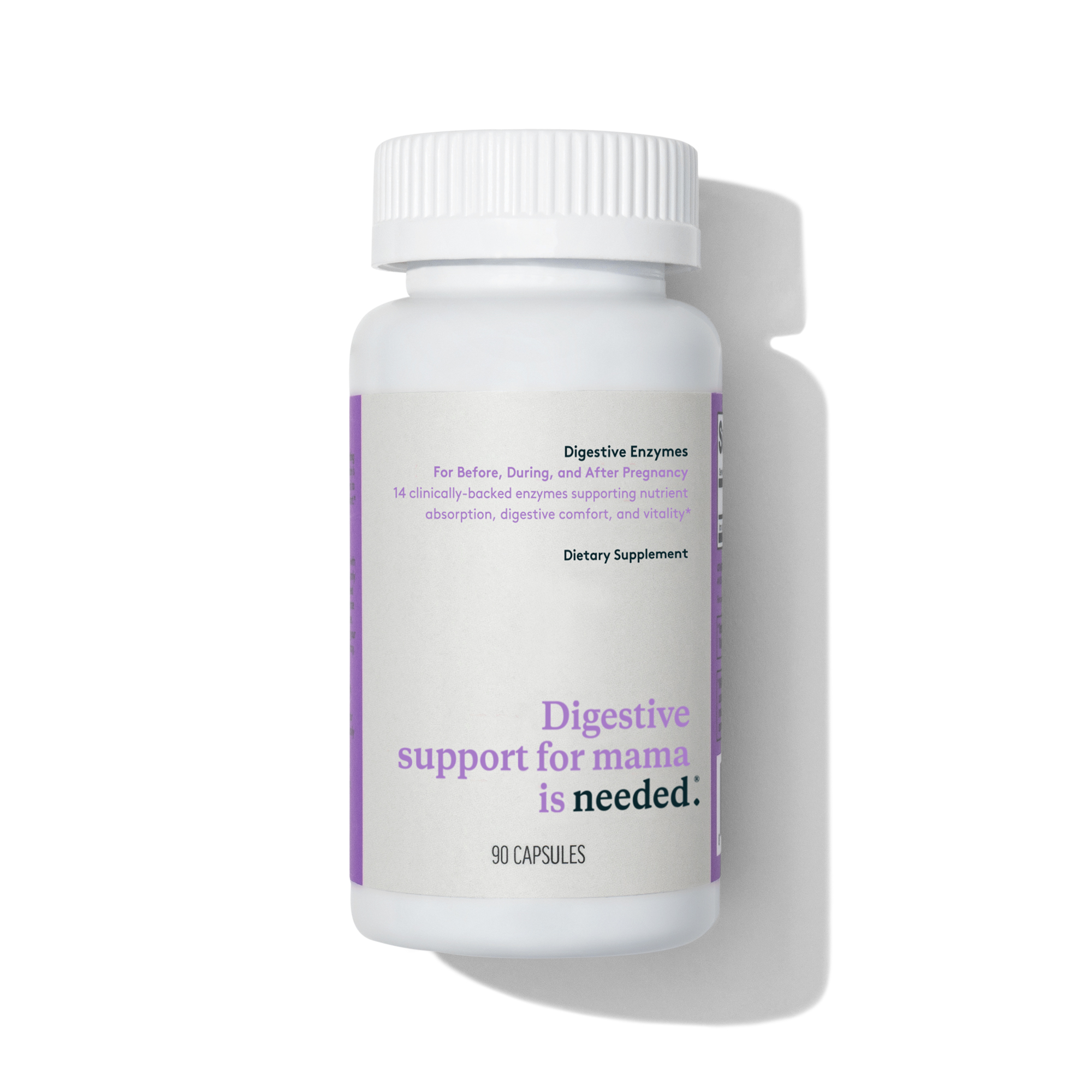
Modern food processing depletes food of naturally-occurring enzymes, and oftentimes pregnant mamas don’t produce enough themselves. That’s what taking a pregnancy-safe digestive enzyme supplement can help. Needed’s Digestive Enzymes support digestive comfort and overall gut health, plus nutrient absorption which helps immunity, energy levels, and mental alertness.
5. Introduce gentle movement
Even light exercise can help food move through your digestive system. A simple walk after your meal can help to improve digestion, reducing bloating and constipation.
6. Take a probiotic
During pregnancy, the hormones estrogen and progesterone increase, which can change the composition of gut microbiome and affect the digestive system. A recent study found that probiotics significantly improve the symptoms of pregnancy-related digestive concerns like nausea, vomiting and constipation.
Needed’s Prenatal Pre/Probiotic supports a strong and healthy microbiome, including not only your digestive tract, but also your skin, and vagina, and the gut of your baby to be.

7. Incorporate fiber
Fiber has a number of benefits during pregnancy. Fiber can help to reduce the risk of insulin resistance and glucose intolerance which can contribute to diabetes. It can also help to reduce the risk of preeclampsia and can also help support digestion and ease constipation.
There are two types of fiber – soluble and insoluble. Most plants contain both soluble and insoluble fiber, but in different amounts. Soluble fiber dissolves in water, and absorbs water in your intestine. Soluble fiber is found in oats, barley, seeds, beans, lentils, apples, and citrus. Insoluble fiber doesn’t dissolve in water, so it adds bulk to the stool making it softer and easier to pass through the stomach and intestines. As it can help food pass more quickly, insoluble fiber can support constipation. Insoluble fiber is found in cruciferous vegetables, nuts, green beans, potatoes, and whole grains.
The bottom line Pregnancy involves so many changes in the body, including digestive changes. But the good news is that many of the digestive challenges that pregnancy presents can be managed with simple tweaks and additions to your nutrition and lifestyle.
Check out IP+ the brand new pregnancy-focused streaming service from Dr. Berlin!
 Needed is a nutrition company delivering optimal nourishment for women and their partners before, during, and after pregnancy. Needed is the #1 women’s health brand among nutritionally trained practitioners, and is backed by the recommendation of thousands of perinatal health experts. Their products and educational content are grounded in the latest clinical research and the in-practice experience of its practitioner collective. Needed delivers what you need to thrive, not just survive, along the perinatal journey and the parenting years beyond.

by Jessica Martin-Weber | Nov 29, 2022 | Infant Care and Breastfeeding
**This is a repost of a classic Informed Pregnancy article.
“It is common to experience some discomfort at latch in the first few weeks of breastfeeding. It should go away as the feeding continues. If it does not end after around 30 seconds, you may need to remove your baby from the breast and reposition her. Break the suction by placing your little finger into the corner of your baby’s mouth and trying to latch again.”
 “I’m really scared of breastfeeding.” Pregnant with her first child, my friend subconsciously rubbed her 34-week belly as I made dinner. I asked her why. She said she’d Googled and learned that breastfeeding could be extremely painful, particularly if she didn’t achieve “the perfect latch.”
She went on to explain that she had read different blogs and forums about how hard it was to get a good latch, stories of women with bleeding nipples and babies who wouldn’t gain weight. She wanted to know the secret to a good latch and what would happen if it didn’t happen for her.
It’s true that many mothers experience some degree of difficulty in the early days of breastfeeding, but here she was, just weeks away from finally meeting her baby, scheduled to take a breastfeeding class and worried sick that she was facing a world of pain if she couldn’t get that elusive latch.
Earlier that same day, I’d had coffee with a good friend, an International Board Certified Lactation Consultant (IBCLC) at a local hospital. When the topic of the “perfect latch” came up, she surprised me by saying that she thought everyone made too big a deal of the latch.
Stay informed and entertained with Dr. Berlin on Instagram!
“If mom isn’t in pain and the baby has plenty of soiled and wet diapers, why do we need to mess with anything? Sure, if there’s a problem like pain or a dehydrated baby, then we need to fix what we can. But so what if that bottom lip is curled in if it’s not causing any bother?” In other words, if it’s comfortable and it’s working, it’s a good latch. There is a wide range of normal. I love this woman; she often says exactly what I’m thinking.
In general, newborn babies are ready to breastfeed and our breasts are ready to feed them. It just works, and we don’t need to mess with it – it doesn’t have to be a complicated endeavor. Yes, for some women breastfeeding is difficult, but we shouldn’t expect trouble. More often than not, moms need support simply because it isn’t all that common in our culture to see a baby at the breast – we cover up or retreat to a restroom to feed, so plenty of women don’t ever see breastfeeding “in action” until it’s their turn to try it!
Many women look online or join a breastfeeding support group for guidance – proactively seeking examples of successful breastfeeding techniques that in other cultures she might have been exposed to from the day she was born. If a new mom doesn’t seek out or have access to that help, she may not even realize that difficulty with pain, bleeding nipples or ineffective milk transfer to her baby could be related to her latch, and there might be a very simple way to “fix” it.
After I shared a few pictures of my then-newborn daughter’s latch on Facebook, I received several emails and comments from other moms stating that they had never seen what a “good latch” looked like, and had endured pain in breastfeeding because they didn’t realize something was wrong.
If you are ever experiencing pain with breastfeeding that is more than a brief moment of discomfort or lasts beyond the initial latch, please seek out help – pain is usually an indicator of a problem that can be corrected. It doesn’t mean you’re doing something wrong, it just means you might benefit from some help.
I talked with my friend Star Rodriguez, IBCLC of Lactastic Services and WIC peer counselor, for the following lists:

When do you need to consider latch issues and improving your nursling’s latch?
- When breastfeeding is painful beyond the initial latching.
- When there is tissue damage to your nipples.
- When there are weight gain issues for the baby.
What latch ‘tips’ can moms try?
- Get into a comfortable position and bring your baby to your level – don’t lean down to theirs.
- Make sure your baby’s body is facing yours, and her arms are not pushing away at you.
- It is best to let the breast fall naturally if possible.
- If you have large breasts OR when your milk first comes in, it may be helpful to hold your breast with your hand.
- Aim your baby’s nose toward the nipple; if it’s necessary to encourage a wider mouth, tickle the very top of the baby’s upper lip with your nipple.
- Your baby’s chin should touch the breast, but her nose should be unobstructed. You should not need to push your breast away from your baby’s nose with a good latch.
- You should be able to hear or see your baby swallowing – short sucks/swallows at first, then longer ones as your milk starts to let down.
- If you’re using a nipple shield, ensure that the nipple and surrounding tissue is being pulled into the shield.
What can a mom do to try to improve a painful or ineffective latch?
- If your baby isn’t opening their mouth wide enough, attempt to show her what to do by opening your own mouth wide. Many babies will subconsciously mimic you.
- Make a “breastwich” – hold your hand in a C-shape behind the areola to help your baby get a bigger mouthful.
- Get your baby as naked as possible for the inviting feeling of skin-to-skin contact.
- Hold your baby securely; a snug, close hold will help.
- Pull your baby in quickly when her mouth is open wide.
- It is common to experience some discomfort at latch in the first few weeks of breastfeeding. It should go away as the feeding continues. If it does not end after around 30 seconds, you may need to remove your baby from the breast and reposition her. Break the suction by placing your little finger into the corner of your baby’s mouth and trying to latch again. Some lactation consultants can show you ways to fix a latch without taking your baby off the breast, but those are easier to learn from being shown rather than told. You may need to put your baby in a different nursing hold or position.
When should a lactation consultant be called?
- If repositioning doesn’t work.
- If you feel sudden soreness after experiencing painless nursing.
- If you feel stabbing or burning pain in your breasts or when your baby latches.
- If you have cracked or bleeding nipples.
- If your latch is not painful, but your baby is not producing a good amount of wet and dirty diapers.
Check out this post by breastfeeding assessment expert Dr. Linda Dahl!
 Jessica Martin-Weber is a writer, speaker and creator of TheLeakyBoob.com. In just four years, The Leaky Boob has become the world’s largest online interactive breastfeeding resource, recommended to mothers by several major hospital networks and health agencies. Jessica is a mother to six fiercely independent daughters and also blogs with her husband, Jeremy, at BeyondMoi.com.

by Informed Pregnancy and Parenting Project | Nov 23, 2022 | Family and Relationships, Parenting and Child Development
“Grandparents are often enthusiastic about spending time with the kids but that doesn’t mean there aren’t limits. Make sure to keep the dynamic healthy for everyone by limiting the help you ask for to things you really need.”

Do plan gift giving
Family members that don’t live with you and your kids may not be up on what things they have and what they’re into, (it can change so fast.) You could leave your parents or in-laws to their own devices to pick out gifts but that can lead to extra stuff around the house that your kids aren’t into. It’s also a bit of a letdown for the gift-giver when the gifts are not well received so no one wins. If you know your child is due for a new stuffed animal or set of headphones, why not let your family members know ahead of time so they can “reserve” those items for gift-giving. Even better, you may want to assign gift “types” such as clothes or art supplies to one set of grandparents each so going forward they can stock up throughout the year without bugging you to ask what they should get. It might also be helpful to keep an updated list of clothing sizes for growing kids who get clothes as gifts.
Don’t ignore boundaries
Many grandparents still have full active lives outside of their parenting and grandparenting responsibilities. Just because they’re crazy about your kids it doesn’t mean they’re available at the drop of a hat. Make sure to notice and respect boundaries that may include scheduling babysitting and play dates a few weeks ahead of time, or not staying out for that second drink on date night when they’re babysitting and it’s getting late. It’s tempting to treat family with less formal respect in some situations but beware, that can breed resentment and less help in the long run.
Do respect house rules
Maybe your strict upbringing is something you’ve decided not to emulate with your kids, that’s one of the great things about being a parent – getting to do it your way – but when you’re at your parents or in-laws home make sure your kids know that the house rules are to be followed even if they’re different than your rules at home. This is a great lesson for your kids about adjusting behavior to the space and situation but it also reinforces the grandparents as authority figures who warrant respect. That is something that’s especially important for grandparents who help with regular childcare but the most important reason is that a respectful dynamic is a strong foundation for your kids’ relationship to their older family members for their entire lives.
Follow Dr. Berlin for all the Informed Pregnancy news!
Don’t over ask
Grandparents are often enthusiastic about spending time with the kids but that doesn’t mean there aren’t limits. Make sure to keep the dynamic healthy for everyone by limiting the help you ask for to things you really need. Maybe your parents are happy to babysit on a Friday night here and there – maybe it’s tempting to hit them up every weekend but doing so may wear out the favor too quickly. Play the long game and make sure you cultivate a dynamic that’s sustainable long-term.
Do acknowledge their help and effort
Grandparents get to do a lot of the fun spoiling but childcare is childcare so even if your family members are happy to help, make sure to acknowledge the time and effort that goes into that help. Not to mention, many older folks have a lot less energy than they used to, so chasing toddlers in your 70s is a lot harder than in your 30s.

Don’t undermine them in front of the kids
There’s nothing harder than caring for kids who don’t respect your authority. You may disagree with some things your parents do with your kids but barring extreme circumstances it’s best to discuss it later when the kids aren’t around. If your kids see you arguing with or disobeying your parents they are likely to assume it’s okay for them to do it as well and that may have long-term damaging effects on the grandparent/grandchild relationship.
Do communicate clearly and honestly
It’s important to cultivate honest communication. Tell your parents what you want and need and then be prepared to listen honestly to whether or not those things work for them. Having kids inevitably changes the dynamic of any family in fun and complex ways for everyone and your parents are likely thrilled to be along for the ride but also probably exhausted. They raised you, after all.
Interested in sponsorship opportunities? Message Rose for more info!

Rose Hart-Landsberg helps produce the Informed Pregnancy Podcast hosted by Dr. Elliot Berlin, DC and serves as managing editor of the new Informed Pregnancy Blog. She also spearheads podcast and blog sponsor partnerships and helps with various related content and copy writing for The Informed Pregnancy Project and Berlin Wellness Group.
In her free time she enjoys editing and writing fiction, makeup artistry, and is currently learning Turkish.

by Shannon Hernandez | Nov 22, 2022 | Infant Care and Breastfeeding
** This is a repost of a classic Informed Pregnancy article.
“Learning how to sleep is similar to teaching a child how to ride a bicycle. It’s new and challenging, for both child and parent. As a parent, you know there’s always a risk of a spill or a scraped knee – but still, you take a deep breath, make sure your child’s helmet is firmly in place, and keep pushing forward.”

With a newborn in the house, sleep becomes a precious luxury. Even a short nap feels incredible, and it’s hard to believe you ever managed to stay awake until 3am in college. With a dull headache and an overwhelming desire for anything that might offer a quick “pick-me-up,” it’s no wonder so many new parents guzzle coffee and lunge for stale donuts (carbs!) in the office break room. Yes, your joy in welcoming a new baby outweighs the pains of exhaustion, but when can you expect some relief? How do you get your baby to sleep soundly when every ‘sleep expert,’ from the authors of the ever-growing number of sleep training books to your mother-in-law, gives you contradictory advice?
As a sleep coach for new parents and new babies, I can reassure you that you are not alone; most parents I work with share the same questions and anxieties about sleep. Here are the five questions I hear most often:
When is the right time to sleep train?
Some babies can sleep through the night from a very young age, but most babies are ready for sleep training when they’re around four or five months old. By this time, they’re usually taking in most of their food during the day, making night-time weaning much easier. Your baby’s fine and gross motor skills have also usually developed enough to assist them with self-soothing.
How long will I need to keep feeding my baby at night?
Assuming you have a healthy baby who was born at term (after your 37th week of pregnancy), you can begin feeding your baby more during the day as early as six weeks after birth. As you gradually get towards the recommended 24 ounces of milk or formula during the day, night feeds can slowly be weaned out. If you’re breastfeeding, you can estimate how much milk your baby is taking in each day by pumping one morning feed and one evening feed, and using the average to estimate your milk supply. You can also use a scale to measure how many ounces your baby is eating at the breast.
Why does my baby keep waking up at night?
If your baby no longer needs night feeds and doesn’t have any medical conditions like acid reflux, teething or a virus, it’s likely she has not yet fully developed her self-soothing skills. It’s normal for all of us – babies and adults – to wake in between sleep cycles. But unlike a new baby, most adults have developed the skills to self-soothe. We roll over on our side, fluff our pillow, kick off our blanket or put another one on. Helping your child learn to self-soothe will help them (and you!) to get back to sleep quickly after waking during the night, and mastering self-soothing will also help your child to feel more confident and independent as she grows.
Stay informed with Dr. Berlin on Instagram!
If I co-sleep, will my baby have a harder time sleeping through the night?
I’ve worked with many parents who co-sleep. Some of them share a family bed for several years, while others plan to co-sleep with their new baby for a few months. Where your baby sleeps is secondary to learning to self-soothe, without interventions such as nursing or being picked up and rocked back to sleep. As your child grows older, where they sleep becomes more important; all children benefit from the security and routine of knowing where they belong when it’s time for bed. But teaching your child to self-soothe is far more vital to getting a better night’s sleep, and can be learned in bed with you.
Is it bad to let my baby cry?
This question always comes up as I work with parents. I believe the answer depends on whether your baby has had all her needs met before being put down to sleep. Learning how to sleep is similar to teaching a child how to ride a bicycle. It’s new and challenging, for both child and parent. As a parent, you know there’s always a risk of a spill or a scraped knee – but still, you take a deep breath, make sure your child’s helmet is firmly in place, and keep pushing forward. You run alongside your child until you feel ready to take the leap and let go as she finds her balance, and it feels amazing to see your child’s joy at riding a bike ‘all on her own.’

All children need to know that their parents or caregivers are there with them, and they are not alone in a new learning process – whether they’re learning to ride a bike or learning how to sleep. I suggest staying with your baby as she learns to sleep, being present and quietly supportive as she learns to self-soothe. When your baby is crying, it’s not easy to resist the urge to intervene – to keep your hands on the bike. But as long as you are there with her, I’d advise you not to hold her back from her personal achievements by interfering with something she’s capable of doing herself. For me, the ultimate answer is no, it’s not ‘bad’ to let your baby cry and fuss during the learning process, but I prefer for babies not to be alone as they struggle to learn and eventually master the skills they need to self-soothe.
I realize I’m yet another of the sleep ‘experts’ I mentioned earlier, and it’s simply not possible to give you personalized advice and work through trial-and-error to find what works for your family and your baby in one short article. Having a sleep coach who is well-educated in child development is key to successfully getting a new family back to sleep. The exhausting days and nights with a sleepless newborn will be over before you know it, but the healthy emotional development you promote will benefit your child throughout her entire life.
Check out this post on asthma and pregnancy by Dr. Nate Fox, MD!
 Shannon Hemandez is a birth coach, postpartum doula and owner of Dream Team Doulas and has served thousands of families in Los Angeles and Orange County over the past 15 years. In 2008 Shannon started sleep coaching after researching infant sleep and child development. Shannon is known as LA’s baby whisperer and she enjoys being the mother of four children that have inspired her in her work to strengthen families. For inquiries write to shannon@dreamteamdoulas.com.

by Jenna Pastuszek | Nov 16, 2022 | Fertility, Health Conditions, Pregnancy
“This isn’t part of my plan. I’m supposed to be pregnant by now!” Stubbornly, (did I mention I’m Ukrainian?) I refused to accept that I had a medical issue that I couldn’t plan to resolve on my own, so I spent the next nine months decanting smelly herbs, working with acupuncturists, and balancing my qi.”

Ever heard the saying “the best-laid plans of pregnancy can be found in hospital dumpsters”?
Well, now you know where to look for them.
Every single plan I had, from conception to birth to breastfeeding, was trashed. And as I sit here writing this postpartum, I wouldn’t have it any other way.
Prior to parenthood, I lived my life by the motto: Failing to plan, is planning to fail. At the start of 2020, I decreed that this would officially be “my year”. It would be the year that ten long years of hustle, sweat, and $400/week theater jobs turned into making my Broadway debut. I’d sign my contract, and then, I’d give myself permission to have a baby.
But no one can properly plan for a global pandemic. So after spending six months locked down in a dilapidated 1-bedroom garden level apartment in Brooklyn, my husband and I packed up our dog, our cat, and as many possessions as we could shove into our 2010 Chevy Traverse and drove across America. With a change of scenery, I planned to save my small business (a voice studio) and pivot from manifesting my Broadway debut to accepting that, for the moment, Broadway was dead.
As we hit the Great Plains, I finally had enough space to hear what my body was trying to tell me. Deep down, I knew I wanted to be a mom- I just planned on being more successful before justifying taking a break. But on a hike in Arches National Park, I heard it: a little voice whispering, “It’s time.” Set to the tune of a ticking biological clock and a giant cloudless sky, I released any hesitations I held about “perfect timing” and tossed my NuvaRing in the trash.
Check out Jenna’s other hilarious blog post here!
I planned on getting pregnant easily, like they made it seem in middle school health class. Wrong. After tossing that ring in September 2020, my period never returned. My plan to get pregnant didn’t transpire for another fourteen months.
After we arrived in LA, I met with an OBGYN who tried a few things to revive Aunt Flo – a 10-day dose of progesterone, a two-week supplement of estrogen, a daily thyroid medication – none of which spared me from her diagnosing my situation as “too problematic for regular care”. She suggested I see a fertility specialist. My mouth dropped. “This isn’t part of my plan. I’m supposed to be pregnant by now!” Stubbornly, (did I mention I’m Ukrainian?) I refused to accept that I had a medical issue that I couldn’t plan to resolve on my own, so I spent the next nine months decanting smelly herbs, working with acupuncturists, and balancing my qi.
Fourteen months later my pulses were slippery, I had given up coffee, built a yoga practice, started meditating, and still no period. I asked my acupuncturist if I should give up. Perhaps I wasn’t strong enough to get pregnant evolutionarily, and my lineage was supposed to die out. He laughed before suggesting that the universe granted me the choice: the choice to accept further medical help or not.
Plans and choices.
Hm.
This guy was good.
I could plan to make a choice.
Exactly one year after I heard the little voice on our cross-country trek, I went to the fertility specialist emboldened with the choice. I was diagnosed with hypothalamic amenorrhea. The gist: I had a ton of eggs, but my brain and ovaries weren’t speaking. So, first I needed to take a medication to help my ovary follicles grow. Once they got big enough, I’d give myself a shot to trigger release an egg, and we’d have “timed intercourse” for 3 days in a row (a big win for my husband). I felt positive about planning a September conception. Giving birth in May would give me enough time to return to work for many summer theater seasons.
My follicles grew, grew, grew, and…wilted. The attempt was deemed unsuccessful. Yet another plan had failed, and I felt discouraged.
We chose to do another round in November. Having a baby in August would thwart my potential summer plans, but I also knew waiting was pushing me further into geriatric pregnancy. Damn biological clock! This time, we added hormone injections and a low dose of progesterone. My follicles grew, and grew, and grew, and we got the go ahead to trigger three nights of marital bliss. These three nights also happened to be the same nights I was making my LA debut workshopping a new musical at Hollywood’s Bourbon Room. I’m not sure if it was the song and dance or the timed intercourse, but my plan finally worked! Two weeks later, I was in New York when the blood test revealed I was pregnant. Facetiming my husband from Times Square, I said, “Ben. I’m on Broadway, and we’re having a baby.”

Getting pregnant was one of the best choices I had ever planned to make, and it was really the only plan that didn’t drastically change throughout my pregnancy. My plan for an unmedicated birth with a lengthy active labor at home turned into a c-section. My plans to flip my breech baby using inversions, moxibustion, and swimming laps straight up failed. My plan to breastfeed was thwarted with a tongue and lip tie. My plan to exclusively pump has been challenged by an undersupply issue.
The moral of my birth story is that attempting to plan and control it has left me with the choice: Do I approach parenting as a decision that I fully control, or is it a relationship between two people (me and my baby)? I can create extensive plans, and ultimately, he will choose how to participate. In a way, by presenting him with the choice, he will help me to create the plan.
So now that Broadway’s open again, I’m still planning to make my debut. Except now, whenever it happens, my son will be there, cheering me on from the front row. On that, he has no choice.
Stay Informed and entertained – Follow Dr. Berlin on Instagram!
 Jenna Pastuszek (she/her)is a professional actor, singer, voice over artist, musical theatre educator, and voice teacher. Jenna has performed in theatres across America in a variety of mediums, including her acclaimed solo shows GET HAPPY! and ME,MYSELF & BARBRA. She is a voiceover artist, voicing household brands like Starbucks Cafe, Pepsi, Amazon, KIND Bar, Target, IKEA, Crest, Toyota and more. She is the Co-Founder of Innovative Voice Studio, where she trains Broadway performers and works with leaders across industries through Innovative Performance. Previous faculty positions include The University of the Arts, New York University, The American Academy of Dramatic Arts, The American Musical Theatre Academy, and Musical Theater College Auditions. Pastuszek received her Masters in Teaching in Elementary Education and a BA in History and minor in French from the University of Virginia and her Masters in Vocal Performance and Advanced Certificate of Vocal Pedagogy from NYU Steinhardt. She is an Estill Voice International Master Trainer and a graduate of Seth Godin’s altMBA. Learn more at www.jennap.com.
