by Informed Pregnancy and Parenting Project | Jan 31, 2023 | Labor and Delivery, Podcast Transcripts, Pregnancy
Elliot: Welcome to the Informed Pregnancy and Parenting Podcast. I’m your host, pregnancy-focused chiropractor, Dr. Elliot Berlin.
Today, we’re speaking with an operation supervisor for a biotechnology company working in biotherapeutics by day and birth work by night. And we’re going to compare her two birth experiences. Hannah Gill, welcome to the podcast.
Hannah: Hi, Dr. Berlin. How are you doing?
Elliot: I’m doing amazing. What a combination of night and day. By the way, I picture, based on my own introduction, I picture you’re going into a phone booth when somebody’s in labor and putting on a superhero outfit and flying over to save the day. But let’s talk about what you’re doing. Where are you from originally and what’s this biotech business?
Hannah: I was born in Kansas City, Missouri. But I’ve spent the majority of my life in Indiana, with a brief stint in Nebraska, and then back to Indiana.
Elliot: Okay, which part of Nebraska?
Hannah: Tekamah. Very, very —
Elliot: It sounds like not very many people.
Hannah: No. The population was less than my high school.
Elliot: Wow!
Hannah: It’s about an hour north of Omaha, so it’s very small.
Elliot: So, a gas station and a saloon?
Hannah: Basically.
Elliot: And a church?
Hannah: Everyone knows everyone and everyone’s related.
Elliot: Oh, boy. All the people know my business. Alright, and then, where did you go to school?
Hannah: So, undergrad, I went to I.U. Bloomington in Indiana. And then, for grad school, I did I.U.P.U.I., which is Indianapolis University-Purdue University.
Elliot: And you studied?
Hannah: Undergrad, human biology. And then, my master’s is in forensic biology.
Elliot: What does that mean in English? Forensic biology.
Hannah: So, forensic science, what a lot of people see on CSI, but it’s nothing like that.
Elliot: Okay, because?
Hannah: It’s very fabricated on TV.
Elliot: Oh, I see.
Hannah: And the process is taking much longer than that.
Elliot: Oh, doesn’t take 45 minutes to figure it out.
Hannah: No. And most of the time, there’s not an answer.
Elliot: Oh, that’s even worse. And no commercial breaks though, which is nice. Okay. And then, where’d you meet your hubby?
Hannah: We started dating in high school. So, we’ve been together since I was 15 and he was 17.
Elliot: Wow! Did you know?
Hannah: Did we know what?
Elliot: Like in high school? Did that feel like this was going to be a forever?
Hannah: Yeah, probably.
Elliot: Really? Wow, that’s very special. How cool. Alright. And then, kids. Was that like, “Hey, now we should have kids? Since we’ve been dating forever.”
Hannah: Yeah, we always wanted to have kids. We got married in 2016 and decided to not really start trying but not try in 2019 when I got diagnosed with PCOS.
Elliot: Were you having symptoms when you were trying to get pregnant?
Hannah: Yeah. So, I stopped birth control the year prior, and I had been on birth control since I was basically started my period like a lot of women are. And I stopped birth control in 2018 because I was just over it. I was tired of being on it so long, and I was tired of the side effects.
Elliot: THE pill?
Hannah: Yep, the pill. And then, after that, I started having two periods a month instead of one. So, then, I went to my OB-GYN because I said, “This is obviously not normal.” And they did an ultrasound and some blood testing and found like the string of pearls or whatever they call it for PCOS. And then, my testosterone levels were super, super high. So, that’s how I got diagnosed. I don’t have like the traditional PCOS symptoms besides those two things.
Elliot: Oh, so only the diagnostics. You didn’t feel PCOS?
Hannah: Right. So, I don’t have like the insulin resistance or anything like that.
Elliot: Oh, metabolic X syndrome.
Hannah: Right. And the only symptoms I was having was the two periods a month.
Elliot: Wow! With high testosterone, which is like —
Hannah: Yeah, I’ve had acne my whole life, so I just assumed it was just who I was. But it was apparently part of my PCOS. [inaudible 04:24]
Elliot: Symptoms of low testosterone. I feel like, “I’ll take some of yours.” Can we do that? Is that like a thing?
Hannah: Take it away, please.
Elliot: Yeah. Okay. So, then, PCOS, and have you treat that?
Hannah: So, I decided not to treat because they said you can get back on birth control to help. But I was like, “No, I don’t want to do that. I don’t want to be on birth control anymore.” So, my OB-GYN said, “Well, it could take you a while to get pregnant or it could be really fast, it just depends.” And we got pregnant, literally, the first time.
Elliot: The first time that you were off birth control? I mean, no.
Hannah: Like the first time not preventing.
Elliot: Okay. So, after the pill, you were doing something else to block.
Hannah: Yes.
Elliot: So, you were ready. You said, “Let’s try and see what happens.”
Hannah: Yeah, I said, “Well, it could take a while, it could be fast. So, let’s just not prevent and let’s just see what happens and –”
Elliot: Boom!
Hannah: Literally, the first time.
Elliot: How was your pregnancy?
Hannah: Awful.
Elliot: Oh, come on.
Hannah: Not awful. Not horrible, but I was sick the entire nine months for my first pregnancy.
Elliot: Sick. Nauseous, or also something –?
Hannah: As in like vomiting all day.
Elliot: So, hyperemesis?
Hannah: It was very borderline. So, it wasn’t officially hyperemesis because it wasn’t like constant all day every day. But the majority of my first trimester was constant all day. And then, the second and third trimester, it was at three to four times a day. But it never ended after the first trimester.
Elliot: That’s something hyperemesis to me. First of all, did it stop as soon as the baby was born?
Hannah: Oh, yeah.
Elliot: Yeah. So, it does sound like its hyperemesis. Because we have a couple episodes about hyperemesis. One with Amy Schumer discussing her experience with pregnancy and hyperemesis, and then one with a few doctors. But the doctor said is that they’re kind of nailing it down to hormones created by the placenta.
Hannah: Okay.
Elliot: So, [tied it to hormone 06:07] that makes you feel full all the time. So, in excess production so that anything you eat makes you feel like overfull. Like you’ve had too much like you have to get rid of it. So, it’s a little bit sounds like that. But there’s a foundation called the Her Foundation, H-E-R, and they have great resources for people who are struggling like that during pregnancy. And one of them is an app where you can kind of input your symptoms and then send it to your doctor to get a better handle on whether that’s hyperemesis or not. So, I was already grateful that you did the podcast, but now, another chance to help people who experience pregnancy like that.
Hannah: Agreed, because I was never diagnosed with it.
Elliot: Was there a plan for birth?
Hannah: Yes. So, I had planned to do an unmedicated hospital birth. And I just took the basic hospital birth class, and then an advanced labor birth class is what they called it to kind of help you get through it without medication.
Elliot: Also at the hospital?
Hannah: Yes, but it wasn’t after looking back at my experience and what I know now was not very helpful. It was a very fast, just like quick and dirty type of class on “here’s some comfort measures,” but it didn’t really help prepare me.
Elliot: Sometimes, the hospital birth class feels like how to be a good patient at our hospital.
Hannah: Oh, yes! I agree. That’s what I know now.
Elliot: I usually recommend if you want to do something that’s a little out-of-the-box for typical hospital birth to do a non-hospital birth class.
Hannah: No one I knew had ever birthed outside of a hospital, and the majority of people I knew did not birth unmedicated. So, I just thought, “Oh, you go to an OB, go to a hospital and that’s how it is.” I didn’t know what a birth center was. I had never even heard of a doula at that time, or I didn’t know anyone had a home birth. So, I just kind of took the route that I do best, and that’s what happened.
Elliot: Alright. Well, let’s take a quick little break and when we come back, we’ll see how that birth went. Don’t go anywhere. We’ll be right back.
[break]
Elliot: Welcome back to the podcast. We’re talking to Hannah Gill. Okay, so first pregnancy, boom! Right out of the gate and horrible motion vomiting all the way through. But then, you took a hospital birth course on childbirth and you did an extra class for unmedicated childbirth. And how did your labor start?
Hannah: So, I didn’t really feel like the gradual build-up a lot of people talked about. It was more of as soon as my contractions started, they were extremely intense and five minutes apart.
Elliot: Wow! Okay, what time of day was that?
Hannah: About 5:30 in the morning.
Elliot: Okay. So, boom! And so, I assume it woke you up.
Hannah: Yes. I had gotten up to go to the restroom and then try to go back to sleep, and that was not happening. So, I decided to get in the shower to see if that would calm anything and it definitely did not.
Elliot: I mean, it just progressed?
Hannah: It just kept getting worse and worse as far as the pain goes. So, my husband is already at work at this time.
Elliot: What?
Hannah: Yes. And I just called it. Yes, he leaves for work around 5:00 am.
Elliot: Holy moly. Okay.
Hannah: So, I called him —
Elliot: Before he left, nothing.
Hannah: No, it was not until he left, of course.
Elliot: And then, half an hour later, raging.
Hannah: Yeah.
Elliot: Okay. And then, he came back.
Hannah: Yeah. So, I gave him a call at work, or I actually texted him first. And I said, “Hey, I’m starting to have contractions. They’re really intense. I’m going to try to get in the shower, but I’ll let you know how things go.” And I started using that contraction timer and it said, “Go to the hospital.”
Elliot: Oh, wow.
Hannah: So, I called him on like the work line because he wasn’t answering his cell. And I told them, I said, “Get him home now, please.” And he got home and I was on the birth ball and he was like, “What am I supposed to do?” I said, “Just grab the bags. Let’s just get going.” And of course, it by this time, it was getting close to rush hour around where we are. And I was not looking forward for about 30 minutes from the hospital. I was [unintelligible 10:10].
Elliot: Oh, my.
Hannah: So, it was interestingly —
Elliot: If only you were in a small town with 200 people.
Hannah: Oh, yes. Like before.
Elliot: Yes, rush hour would be like rush minute.
Hannah: Yes. So, the drive to the hospital was pretty rough with having to wait in traffic.
Elliot: With that kind of intensity especially.
Hannah: Yeah.
Elliot: We’re you in the front seat?
Hannah: Front seat.
Elliot: Like buckled in like or on your hands and knees?
Hannah: At first, I was buckled in and then I got off buckled, took my coat off because I was sweating. Rolled the window down and mind you, this was December and it was freezing, but my husband was cold. I was like, sweating. So, no, I was buckled in at first. And then, it was just like bracing myself and holding on to the door, trying to breathe through my contractions.
Elliot: I mean, it sounds like a caged animal.
Hannah: Yes. That’s exactly how it felt.
Elliot: I’ll probably get in trouble for saying that, but that’s what it just sounds like. You need to have space and get out of there and move.
Hannah: And I was vomiting my entire labor, too.
Elliot: Oh, in the car?
Hannah: Yeah.
Elliot: What happened when you got to the hospital?
Hannah: So, they had me sign all those fun forms as I’m reading through my contractions and then got me into triage and I was only three centimeters.
Elliot: Ouch. Okay.
Hannah: Yeah.
Elliot: Have you been checked before?
Hannah: Yeah. So, my first pregnancy, I did get checked the day before I went into labor. I was 2 centimeters and I had my OB membrane sweep.
Elliot: Oh, okay. Do you think that contributed to the morning events?
Hannah: Probably, yes.
Elliot: Okay.
Hannah: I think so because it was much more intense than I had expected. So, maybe the sweep kind of escalated that.
Elliot: Was there like any blood after the sweep?
Hannah: No.
Elliot: Okay. So, 3 centimeters only. In your words, 3 centimeters?
Hannah: Yes, because [I had been to 11:59] the day before and with how intense my contractions were, I was expecting to be way further along. So, that was kind of —
Elliot: Six or something?
Hannah: Yeah. And they did check my platelets. I did not mention I had gestational thrombocytopenia, where your platelets are low.
Elliot: Oh, wow. We do have a whole episode on gestational thrombocytopenia with Dr. Nate Fox, that was triggered by Mandy Moore who had it with at least her first pregnancy. Wow. So, does that mean you were borderline epidural?
Hannah: I was borderline. So, I wasn’t as low as where you absolutely know for sure you can’t have it. It was always really borderline. And for my hospital when they checked it, it was like right at the level. So, that’s why I decided, “Okay, I’m just going to get it.” Because who knows, in a couple hours, I may not be able to anymore.” So, I just went ahead and got it because my contractions were so intense and I was right on that level. So, I got them right away.
Elliot: I mean, it also sounds like with the intensity and the progress, like your mind might have been easily persuaded anyway.
Hannah: Oh, yes, it was all mine game. Yeah, for sure.
Elliot: Okay. So, did it work?
Hannah: The epidural? Yes, it worked wonderfully. And I took a nap.
Elliot: Okay, great. And how did the rest of that labor progress?
Hannah: So, I progressed very quickly. I got my epidural around 8:00 or 9:00 o’clock, started pushing around 1:00 o’clock.
Elliot: So, four hours? And this is 1:00 pm.
Hannah: Yes.
Elliot: So, really not that long after your entire labor started.
Hannah: Right.
Elliot: Okay. So, how was pushing?
Hannah: I pushed for four hours.
Elliot: Did the epidural start to wear off? Did they turn it down?
Hannah: No. The epidural was so strong. I could not even tell I was pushing.
Elliot: Oh, wow.
Hannah: Which is part of the problem.
Elliot: Oh, four hours of that.
Hannah: Yes. So, four hours of that.
Elliot: What position?
Hannah: Just like the semi-reclined position. So, I couldn’t —
Elliot: You couldn’t get into like hands and knees or stuff like that?
Hannah: I didn’t know that was an option at the time. So, yeah.
Elliot: Well, if you could go back in time, listen to this episode.
Alright. So, pushing on your back with your pelvis closed and numb from the chest down.
Hannah: Right. And then, the whole holding your breath counting for 10 seconds. Push, push, push, push, push, that type of thing. So, the “coach pushing” that everyone hears about.
Elliot: Yeah. Okay. And in the four hours, was the baby handling it well? I assume [inaudible 14:25].
Hannah: There was one [unintelligible 14:27], but they didn’t make a big deal about it. They just had me put some oxygen on and rest for a minute.
Elliot: Okay. And then, what happened?
Hannah: So, we figured out that baby was most likely asynclitic, the way he was coming down. And we didn’t know if it was a boy or girl at this time, just a side note. So, the way the baby was coming down, just kept coming down, going back up, coming down, going back up. So, after this four hours, I opted for a cesarean.
Elliot: Okay. Asynclitic essentially means not lined up with the runway very well. So, all that pushing is not really coming down, it’s just flexing the head sideways. And then, as soon as you stop pushing, the head flexes back up. Always recommend seeing a baby chiropractor after a labor like that, by the way. Okay. So, how is the cesarean for you?
Hannah: It was not great. Like, I actually felt a lot more than I expected to. So, they gave me —
Elliot: Oh, great. You didn’t feel you’re pushing, but you felt your abdominal surgery.
Hannah: Right. So, I was like basically screaming and telling my husband like, “I need something else. This hurts really bad. I can feel a lot.” So, they gave me some additional medication through the epidural, whatever they give you that’s extra. And I kind of dozed off for a few minutes, I think. I don’t know if I fell asleep or what they gave me just kind of knocked me out a little bit, but I don’t remember my baby being born, basically.
Elliot: I was afraid you’re going to say that.
Hannah: Yeah. I don’t remember hearing him cry. The first thing I remember is my husband saying, “Babe, it’s a boy,” because we didn’t know. And I was just so out of it and so loopy that I don’t really remember much of it all.
Elliot: I’m so sorry.
Hannah: Thank you. I mean, I appreciate the sentiment there. And I know it’s hard for a lot of women who have that experience. I know a lot of people go through it, especially if they’re having to be put under general anesthesia, too. Thankfully, I didn’t have to do that.
Elliot: But it sounds like you’re pretty close.
Hannah: It was pretty close, yeah. I mean, I just had the epidural, so I didn’t need general. But they did give me, I don’t know what they gave me additional to help with the pain, but I kind of dozed off for a little bit.
Elliot: For a key moment.
Hannah: Yes.
Elliot: So, how was your recovery?
Hannah: So, in actual recovery room, I went hypotensive and I hemorrhaged really bad. So, I was like on the verge of completely passing out because my blood pressure was so low and I had a lot of blood loss. So, during that process, I was kind of out of it. But my husband was trying to help my son nurse at the same time, but I was like shaking and I couldn’t really hold him. So, he was helping him do that.
Elliot: Oh, this begs the question, did he get any pictures or video of the baby coming?
Hannah: Not of him actually coming out, but like in the operating room. We got some photos of him on, like the warmer thing.
Elliot: I was saying anything to fill in the blanks of when you were out.
Hannah: Not really. They got a picture of us all three together in the OR. But I don’t really remember that being taken. I just see the picture.
Elliot: Okay, so something.
Hannah: Yeah, something.
Elliot: That you can look at. Okay. And then, recovery at home. Wait, so did your blood transfusions?
Hannah: I did not have to get transfusions. They just said it was more than they would like to see from the cesarean, but not enough to get a transfusion.
Elliot: Related to the thrombocytopenia?
Hannah: I don’t know. I guess it could be. That would make sense. I don’t know if it was that or I know that if you, I guess pushing for a long time cause that.
Elliot: The uterus doesn’t, yeah. Okay. How was your home recovery?
Hannah: It was pretty rough. I was on quite a bit of pain postpartum at the hospital and at home, and I didn’t really feel comfortable doing much of anything for several weeks. And I think it was a lot of emotional pain as well as physical.
Elliot: So, on the physical side at the incision?
Hannah: Yeah. And in my abdomen in general.
Elliot: Are you athletically?
Hannah: I was before I got pregnant. Yeah. Not as much during my pregnancy or postpartum.
Elliot: My observation, it seems to affect people more than people who are less, you know, in tune with the body.
Hannah: Right. And I’ve heard that the like tension, if your muscles are tighter, can cause a lot of issues too. So, if you are athletic and you have really tense muscles and they’re not relaxed, they can cause some issues.
Elliot: Well, again, in my observation, clinically in the office, one of the things that we see is if you’re strong and also tight, combination of strong, tight creates a rigid environment. And if the baby’s not lined up well with the runway, then it’s a bit harder to maneuver in that static environment. And that’s where you end up spinning your wheels a lot in labor.
But the cool thing about that is if you can do something, get rid of that tension, the excess tightness, the dysfunctional shortness, and all you have is the strength, then it goes the other way. Those are like the most powerful births that I’ve ever seen.
And then, emotionally, how were you feeling? You said that was also uncomfortable.
Hannah: Yeah, it was really just kind of thrown off and shocked by my birth experience. And I ended up with postpartum depression and anxiety and had to go to therapy to help talk through that, which was extremely helpful. I recommend it to anyone that needs it. So, it was a rough postpartum, physically and mentally, for sure.
Elliot: Did lactation go well for you?
Hannah: Yeah, yeah. He actually nursed great. Breastfeeding was wonderful and we breastfed for a year.
Elliot: Oh, okay. At least, there’s some things that did go well.
Hannah: Positivity?
Elliot: Yeah. In your way that you wanted them to go. I guess looking back, would you have done anything specific differently?
Hannah: I probably would have waited on the epidural. Or if I would have known at the time, gotten a doula for that birth, but I didn’t know what a doula was. I didn’t know that was the thing. So, that’s probably what it done differently. And then, I also would have, I didn’t mention this, but they did break my water at 9 centimeters. I asked them to break it because I didn’t know any different. And I feel like he could have gotten a better position if my water wasn’t broken.
Elliot: Yeah. It’s hard to know, but one wonders for sure. And just getting ready for the hyperemesis before we move on to your next baby, was it like literally that same day that it stopped?
Hannah: Yeah. I wasn’t sick at all. I was sick all through labor, and that I wasn’t sick at all afterwards.
Elliot: Were you hungry?
Hannah: I was hungry. I think the only other thing that made me sick with my pain meds postpartum. That made me sick until they got the right one.
Elliot: This is when you start going to phone booths and helping other people in labor. Tell me about that.
Hannah: So, I started out with childbirth education first.
Elliot: Okay. Becoming a childbirth educator?
Hannah: Yes, yes.
Elliot: A specific method?
Hannah: Not a specific method. I just wanted to become an out-of-hospital specifically. Because of how my experience with my birth class and how I did not enjoy it. And I thought, “Well, there needs to be a better option for people because that wasn’t great.” So, I just started to do that first. And then, I did not get into doula work until after the birth of my second.
Elliot: Oh, wow. Okay, wow. That sounds like an excellent place to take a quick break. And let’s find out about the second pregnancy, birth, and the doula work. We’ll be right back.
[break]
Elliot: Welcome back. We’re talking to Hannah Gill. And let’s talk about baby number two. So, was that planned?
Hannah: Yes, the second was planned for sure.
Elliot: Super fast again?
Hannah: It took two cycles, but still relatively fast, yeah.
Elliot: Pretty darn fast. Especially, people get very nervous with PCOS. So, that it’s always going to take a while. How was your second pregnancy?
Hannah: So, the first trimester was extremely rough for about 17 weeks. Again, borderline. Probably, this time was actually hyperemesis again. I wasn’t diagnosed. But I did end up in the hospital with fluids because I couldn’t keep anything down, and how to take time off work. So, the first trimester was rough, but then it got better after that this time.
Elliot: Good thing about taking time off at work is usually don’t get the answer anyway.
Hannah: I know.
Elliot: So, nobody will even know you’re not there. Okay. So, wow, you said 17 weeks. Does that mean that got better?
Hannah: Yes. After 17 weeks, it got better. I was still nauseous here and there, and had random bouts of vomiting, but nothing nearly like my first.
Elliot: Right. So, it sounds like the first part of your second pregnancy was worse than the first pregnancy.
Hannah: Oh, yes.
Elliot: But then it got a lot better than the first pregnancy. So, interesting how it works. Who knows? And then, what was your plan for this one?
Hannah: So, this time, I originally wanted to do birth center, but it is illegal to VBAC in Indiana in a birth center.
Elliot: Really?
Hannah: Yes.
Elliot: It’s how they made VBAC outside the scope of practice of a birth center.
Hannah: Yes. It’s not allowed.
Elliot: That’s weird.
Hannah: I know. I didn’t know it was a thing until I looked into it.
Elliot: I could see insurance not wanting to cover it but to [outlaw 23:46] it seems strange.
Hannah: Yeah, it’s a little drastic.
Elliot: I feels like restrictive in a free country.
Hannah: Yeah.
Elliot: Okay.
Hannah: So, after figuring that out, I thought, “Well, let’s go the route of home birth.” But the closest midwife to me would not take the first VBAC after cesarean. She would only take the second VBAC after cesarean. So, the closest midwife to me that would take me on was about two hours away, and I didn’t feel comfortable driving that far for appointments. So, everywhere else was out of my service area, unfortunately. So, I decided to stay with my OB that did my cesarean because she was great as far as supporting me through that. And she was completely on board with me having a VBAC.
Elliot: That’s cool.
Hannah: And then, I hired a doula as well.
Elliot: Okay. And did you have the thrombocytopenia again?
Hannah: I did, yes.
Elliot: Okay. So, that was still a question mark in terms of how that might affect you.
Hannah: Yeah. So, I just completely plan to not have an epidural and didn’t even think of it as an option in my mind, just in case.
Elliot: I think the thrombocytopenia kind of risks you out of the out-of-hospital birth anyway.
Hannah: Yeah, it does. Depending on the level, I believe.
Elliot: Right. Yeah.
Hannah: Mine were never that low, I don’t think.
Elliot: In the second?
Hannah: Yeah. They were low in the second, but it was more of just risking you out of an epidural versus out-of-hospital.
Elliot: If you’re low enough to risk out of an epidural, you’re probably too low for a home birth.
Hannah: Yeah, potentially, I think so.
Elliot: It’s my guess. It’s not my area of expertise. But anyway, anything else that popped up during that second pregnancy?
Hannah: I had a marginal cord insertion with my placenta.
Elliot: Okay.
Hannah: And that was the only other weird thing. So, they just did a couple extra ultrasounds just to make sure baby was growing okay. But baby was always fine.
Elliot: Cool. How did that labor start?
Hannah: So, again, it was fast and furious. But when I went into the hospital, I didn’t know I was in labor. I just had some excessive bleeding. That was concerning.
Elliot: Interesting. So, where is this in relation to your due date?
Hannah: I was two days past my due date.
Elliot: Okay.
Hannah: I was a week early with my son, the first.
Elliot: Was there a sweep on the second?
Hannah: No, I did not have any cervical checks and no sweeps.
Elliot: Oh, wow. Okay. So, then, you just start bleeding a bunch, you go to the hospital.
Hannah: Yeah.
Elliot: No contractions though?
Hannah: No contractions.
Elliot: Okay.
Hannah: So, I get to the hospital and they put me on the monitor. They want to check and make sure it’s not placental abruption or anything like that. And I was 3 centimeters at that time. And they said, “Well, how about we –” Actually, probably closer to four. So, they wanted to sit me on the monitor because I wanted to labor at home as long as possible. So, I plan to go home if we could because I wasn’t having contractions. And they wanted to monitor me for about an hour just to see if I made any progress. And in that hour, I dilated another centimeter. So, we just decided to stay at the hospital at that time.
Elliot: Okay. So, now, you’re like 5-ish. No idea where that blood was coming from?
Hannah: No. They said that it just kind of trickled off. It didn’t happen a lot. They said it could have been a partial abruption. It could just have been part of like, a bloody show that was more intense.
Elliot: Yeah. Okay.
Hannah: They didn’t give me an answer on that.
Elliot: And how the labor progress?
Hannah: So, it was a whirlwind, but we got to the hospital around 8:00. I progressed extremely quickly. And my entire labor was five hours.
Elliot: Oh, wow. And how was the intensity?
Hannah: So, it was still pretty intense. But I had done a hypnobabies course. So, I was pretty good at staying relaxed. And then, my husband was very helpful as well. But they were really intense when they picked up. The first ones were very gradual. But then, right around transition, obviously they got super intense.
Elliot: Were you planning to stay unmedicated?
Hannah: Yes. Yeah. So, I was planning no epidural whatsoever. Unless, it was absolutely needed.
Elliot: And was the team around you, the hospital staff, supportive?
Hannah: Yes. So, the nurse we had was super supportive. I was up and moving. I was on the toilet and the shower. She was great about letting me do my thing. And I had wireless monitors. They tried to keep him on as best as possible, but I was moving so much it didn’t really work.
Elliot: Okay. And then, how does that birth end?
Hannah: So, my doula almost didn’t make it because it was so fast. I was texting her throughout the process on like how I was doing. And I text her around right when my water broke, which was a little after five centimeters. I was GBS-positive. So, I did have to get a round of antibiotics.
Elliot: But we should explain that. Group B Strep is a type of bacteria that can sometimes colonize in the birth canal. Generally, In the United States, everyone gets swabbed for it somewhere around 37 weeks. And if you’re positive, then the general recommended treatment is IV antibiotics during labor. Usually, every few hours.
So, you have the GBS. There’s also an episode on Group B Strep Positive with Rebecca Dekker from Evidence Based Birth. And she goes into a lot more detail about what it is, and if there is anything that you can do to prevent it and other potential treatments. Check them out.
Okay, so you have GBS. You’re getting your IV antibiotics.
Hannah: Mm-hmm. And I was up and moving after that, but my water did break around 5-ish centimeters. And right after my water broke is when things really, really picked up.
Elliot: Where were you when it broke?
Hannah: I was still in the bed because I had just got down to my antibiotics. And then, after that, I basically got up and went to the toilet and sat there for an hour.
Elliot: Was it a big old gush?
Hannah: It wasn’t a huge gush, but it was quite like it. Isn’t like obviously a gush, but it was a ton of fluid that came out. Yeah.
Elliot: Okay. It wasn’t like, “Oh, did I just pee a drop?”
Hannah: No, it was like, “This happened.”
Elliot: Okay. Alright. Sitting on the toilet with people around you or did you –?
Hannah: My husband was with me in the bathroom while I was on the toilet, getting me washcloths for my face, rubbing my shoulders, that type of thing. And so, I was on the toilet for at least an hour and that’s when I started transitioning. At the dilation station.
Elliot: What did that feel like?
Hannah: So, my contractions were on top of each other at that point. Like one, back-to-back-to-back. And that’s when my doula walked in, and I told her — her name’s Julie. I said, “Julie, I need an epidural.” She said, “Well, let’s maybe try to switch positions, get off the toilet.” So, we moved to the shower at that point, which was extremely helpful.
Elliot: Warm. Warm water?
Hannah: It was warm. At first, it was way too hot and it was really sensitive on my back, and I had to wait till it cooled down. So, I was leaning over the sink counter until I could get in.
Elliot: Was the intensity in your back? Was it like more period –?
Hannah: No. It was in my pelvis. Like I felt like I was pushing, basically. My husband got in the shower with me and I was hanging on him around his neck. And then, my doula was behind me putting the water on my back.
Elliot: Sounds streamy.
Hannah: Yeah. And I started basically bearing down and pushing in the shower.
Elliot: Grunting?
Hannah: Yeah. And the nurse was like, “Well, maybe we should move to the bed.”
Elliot: Yeah. Did you?
Hannah: We did eventually move to the bed. I was very reluctant to do so, but we moved to the bed and I got on hands and knees to start my pushing process.
Elliot: Was that instinct or was that planned?
Hannah: So, my doula suggested it because I had a partial cervical lip. So, she said with the position of the lip that being on hands and knees would kind of help push that away.
Elliot: Cervical lip, just a piece of the cervix is not quite out of the way yet for the baby to pass through more easily. Okay. And were you starting to push?
Hannah: Yes. So, I was pushing at that point. I pushed on hands and knees for about 10 minutes. And then my doula suggested switching to squat position to kind of help it become down more.
Elliot: Did you have a squat bar?
Hannah: Yes. We had a squat bar. And I was very reluctant to move to that as well because I was just exhausted, and it was great to lean on the back of the bed. And I said, “There’s no way I can hold myself up with a squat.” So, I had this squat bar and then my husband supported me as well.
Elliot: From behind you?
Hannah: Kind of on the side. Like holding my back up so I wouldn’t fall backwards a little bit.
Elliot: How long was pushing?
Hannah: So, it was a total of 15 minutes.
Elliot: Oh, my goodness!
Hannah: Yeah, hands and knees. And then, as soon as I moved to a squat position, it was maybe two contractions and the baby was out. She didn’t have any head mold or anything. She came out so fast.
Elliot: Just came right through. Did that surprise you?
Hannah: It did. Because pushing was like the one feat I wanted to get past because it was so long with my son that I was pushing. And it was intense, and I just felt like she just shot out.
Elliot: Wow! What was going through your mind at that point?
Hannah: First of all, we didn’t know if it was a girl or boy again. So, I wanted to first find out if it was a girl or boy. But it was just so intense and I thought, “Okay, just if I could just get her out, then there’s no chance I’ll have a C-section.” I just wanted to get her out. I just wanted to get past that. But yeah, the ring of fire was brutal.
Elliot: Oh, really? For how long did that last, would you say?
Hannah: Just probably 30 seconds.
Elliot: Okay, 30-second ring of fire.
Hannah: Yeah.
Elliot: How was your recovery?
Hannah: It was great. So, I just had a slight second-degree tear just because she did come out so fast and I didn’t control the pushing to slow it down much at all. But I had a little bit of a retained placenta as well. So, it took a little bit for them to really get all that out and they did an ultrasound to make sure. I actually had to get more of it removed several weeks later.
Elliot: Later? Oh, wow.
Hannah: Because it’s still there. But, overall, recovery from the VBAC was 100 times easier than C-section.
Elliot: Mind and body?
Hannah: Mind and body, yes.
Elliot: Hmm. Well, congratulations.
Hannah: Thank you.
Elliot: I know you worked hard for that. And what an intense journey from beginning to end even just finding out that you had PCOS and the question marks that that brings up. What would you do with a third pregnancy for the birth?
Hannah: One hundred percent home birth, as long as I’m able to.
Elliot: Because now you can — The second VBAC, now that you have a “proven” pelvis.
Hannah: Right. But as long as my platelet levels are fine and everything checks out, I would 100% want to have a home birth.
Elliot: We just have to do another episode in a couple of years. Before we go, tell me about your new nightlife.
Hannah: Yes. So, I am a childbirth educator, birth and postpartum doula. I am owner of Ebb and Flow Birth Co., is what my business is called. So, I do doula support for postpartum and birth, and I’m in Indianapolis in that area. So, I’m really liking it so far. I just started doula work. I’ve only had one birth for my birth support, but I have childbirth education classes lined up as well.
Elliot: Is that what you named your kids, Ebb and Flow?
Hannah: No, no. They’re Hudson and Marley.
Elliot: Oh, Hudson and Marley. I though they’re going to be like Evan and Florence.
Hannah: No.
Elliot: Hey, Hannah, I thank you so much for joining and for sharing your story. And for now, the amazing work that you do supporting others.
Hannah: Thank you.
Elliot: Tell me where we can find you online.
Hannah: So, Instagram is @ebbandflowbirthco. No underscores or anything like that. And then, my website is ebbandflowbirthco.com.
Elliot: Amazing. And we’re over there on the Instagram as well @doctorberlin, D-O-C-T-O-R-B-E-R-L-I-N.

by Rose Hart-Landsberg | Jan 25, 2023 | Mental Health, Parenting and Child Development
“Your spouse arriving home has sensed (i.e. read 18 text messages ALL IN CAPS LOCK) that you needed a little treat. He pours a glass of Sauvignon Blanc and takes a sip. He pops the toddler’s loopy straw in the bottle and hands it to you. What a catch.”

You used to be a foodie. Now when you add “ie” to the end of words it’s in a singsongy baby voice and it makes you cringe inwardly. But hey, it doesn’t have to be all or nothing. Here’s a brief list of drink pairings for foodies turned parents who definitely have given up on adult fun but haven’t admitted it yet.
1 ) Fruit and Riesling
You spent what seemed like ages lovingly chopping up beautiful fresh farmers market fruit for your little angel. He’s growing and evolving every day and as a thoughtful parent it’s your job to make sure he gets the best nutrients and develops a healthy well rounded pallet. However at the moment the little angel does not want fresh fruit. The little angel wants fruit snacks. His volume would suggest he wants them post haste. Most of the lovingly diced fresh fruit has made it to the floor. You open the cupboard, he calms knowing the fruit snack is nigh but what’s this in the corner? An unopened bottle of Riesling that footloose and kid free friend of yours brought over thinking your dinner party last month would last past 9:00 pm (haha.) You know one fruit snack packet will give you at least a few minutes of calm. You open the little plastic package and hand it over to grabbing sticky hands. You dump what’s left of the fresh fruit onto your own plate and pop the cork. You deserve lovingly chopped fresh fruit too, you know. Cheers to being a parent!
2 ) Fish and Sauvignon Blanc
The baby is crying. But only because the toddler is crying. The toddler may or may not be crying because you are as well. You wanted to teach them a valuable lesson about about life, about caring for others and responsibility. You also told the sales lady you very specifically wanted a fish tank heavy enough that a toddler could not pull it off the shelf onto the ground. “Well,” you think, “we can’t always get what we want.” That’s a good life lesson. The screaming toddler seems to have learned it in some sense. You’re a good parent after all. Your spouse arriving home has sensed (i.e. read 18 text messages ALL IN CAPS LOCK) that you needed a little treat. He pours a glass of Sauvignon Blanc and takes a sip. He pops the toddler’s loopy straw in the bottle and hands it to you. What a catch.
Check out an Informed Pregnancy Blog post on water safety for babies here!
3 ) Lamb and Merlot
Finally, tonight, it’s your partner’s turn to do bed time. The high pitched wails muffled only by a toothbrush and punctuated by a dramatic parade of angry staccato toddler stomps float down the staircase as you luxuriously sip a glass of Merlot. You notice your little one’s beloved stuffed lamb on the couch and know bedtime will be rough(er) without it. You use every last ounce of your college softball training to silently lob it up the stairs. You are not without sympathy, but you will not be pulled into the fray. A second, un touched glass of Merlot waits patiently on the coffee table for your partner. They will surely need a sip as well when the battle has been won. You’ve got a bit of work to finish up but bed is calling and you may or may not be awake by then.
4 ) Birthday Cake and Bubbly
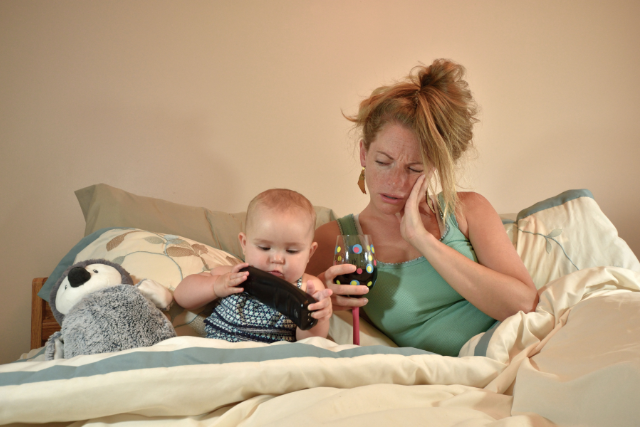
You’ve been answering e mails all day and there are so. many. more. A task much easier back when there wasn’t mysterious prehistoric reminiscent crayon drawings of what may be farm animals on your computer screen. You think about that art opening you meant to go to last night and the four – yes four – toddler birthday parties you went to all day instead. You think about champagne and little toothpicks stabbed into fancy cheese. You think about party number three when your little one was already breakdown adjacent and the piece of cake offered did not have the right color frosting. You think about how physically wondrous it is that a person that small can make noises that loud. You worry about waking her up as you slide the leftover cake from all 4 parties jammed together in one glorious frosted plateau out of the refrigerator. Each of your four mommy group friends insisted and each time you did not object. You begin to eat right from the pan in the dull comforting glow of the fridge light but as the sugar courses through your veins you realize something important is missing. The (cow?) on your computer screen glares judgmentally as you slide the hidden bubbly out of the crisper drawer. Happy Birthday to me, you think. You’re not even sure what day it is.
Don’t miss out! Follow Dr. Berlin for updates on podcasts, blog posts, streaming and more!

Rose Hart-Landsberg helps produce the Informed Pregnancy Podcast hosted by Dr. Elliot Berlin, DC and serves as managing editor of the new Informed Pregnancy Blog. She also spearheads podcast and blog sponsor partnerships and helps with various related content and copy writing for The Informed Pregnancy Project and Berlin Wellness Group.
In her free time she enjoys editing and writing fiction, makeup artistry, and is currently learning Turkish.

by Informed Pregnancy and Parenting Project | Jan 24, 2023 | Labor and Delivery, Podcast Transcripts, Pregnancy
Elliot: Welcome to the Informed Pregnancy and Parenting Podcast. I’m your host, pregnancy-focused chiropractor, Dr. Elliot Berlin.
Born in Jacksonville, Florida with modeling aspirations, my guest today graduated high school early and moved to Los Angeles at age 17 to pursue acting. Shortly thereafter, she caught a breakout role in one of the original and most popular vampire film series of all time, the “Twilight Saga.” She cemented her A-list status with starring roles in the fight film series and the rest is history.
Inspired by her personal experience of coming off hormonal birth control and in conversation with her sister-in-law, she recently expanded her creative pursuits as co-founder of Hummingway, a company aimed at generating awareness and supporting women with whole cycle wellness tips and tools, including period pain relief products. She and her husband welcomed their first child just last month. I’m ecstatic to have her as my guest as we discuss career, activism, pregnancy, and childbirth, Ashley Greene. Welcome to the podcast.
Ashley: Hi! Thank you for having me.
Elliot: Oh, my goodness! Congratulations!
Ashley: Thank you! It is crazy. Six weeks ago, my life was completely different.
Elliot: Yeah, mine was about the same.
Ashley: Yours has always been exciting, though.
Elliot: It hasn’t changed that much. But actually, working with you is pretty exciting. You’re strong, energetic, very inspiring. Just one of those people that like I’m like, “I don’t think I need my Starbucks today.”
Ashley: Oh! Well, thank you. That makes me feel really good. Especially right now, the lack of sleep is a real thing.
Elliot: It’s the real deal.
Ashley: Yeah. I always wonder like, this is probably done to say that like on all those reality TV shows, I’m like, “Why are they so emotional, and why are they so crazy? Why do they make decisions like this?” And then, I had a child and realized that sleep deprivation is and what it does to you, and how it just shifts everything. And all of a sudden, you know, I spilled breast milk the other day and actually cried about it.
Elliot: Oh.
Ashley: Now, I understand how I am…
Elliot: Aw, “don’t cry over spilled milk.”
Ashley: I’m like, “No, don’t cry over it!” It’s a horrible thing.
Elliot: I have that once also. Actually, my son spilled milk and I cried over because it was the last little bit of milk there was enough for both of us to have cereal in our bowl. And he put milk in his cereal and the whole thing spilled out, and there’s no milk for my cereal. It’s not the same, but I always need a good cry.
Ashley: It’s true. It’s a frustrating, saddening thing. Especially in the morning, that’s all that you want.
Elliot: And we had no Instacart yet at that time. It was a whole hassle.
Ashley: Remember the days before you had any kind of Instacart or Uber Eats.
Elliot: Not really, actually. It’s like you know life has changed. Okay, let’s go to you. You grew up in Florida. How was that?
Ashley: Growing up in Florida. I don’t remember much of my childhood. My teen years was in Jacksonville, but when I was much younger I was in Middleburg. And we grew up like on a dirt road, and my dad built our house and it was just a very wholesome upbringing.
Elliot: Like literally built your house?
Ashley: Yeah, he did. So needless to say, now anytime he comes to California, [unintelligible 00:03:34] in my home. But yeah, they really focused on allowing us to be kids. And we, you know, didn’t have the most money in the world, wouldn’t have known it. But when our parents really focused on giving us the attention that we needed, and I have a whole new appreciation of that now. I mean I appreciated that before. But now, I see how invaluable that is.
Elliot: I think my kids are embarrassed because I can’t even really build stuff from IKEA.
Ashley: Well, to be fair, my dad struggles with that.
Elliot: Okay. I think everybody struggles with IKEA because it’s just ridiculous. I feel like there’s like hidden cameras and they do it on purpose.
Elliot: I do feel like I’m on “Punk’d.” Good call. Acting and modeling, how did you get into that? How did you get interested in it and then go for it?
Ashley: My mom put me in some classes because I was painfully shy. And she wanted me to gain confidence and come out of my shell, and so she put me in this kind of like modeling etiquette class. I was also a very big tomboy. And through those classes, I ended up taking a commercial class versus just straight modeling and really, really enjoyed it. And then, the same person that taught that commercial class, taught an intensive acting class. And so, I ended up going into that and kind of ditch modeling and decided that acting was something that I really, really loved. And it kind of, you know, changed the trajectory of my life.
Elliot: When you were, pretty early when you moved to L.A., pretty young.
Ashley: Yeah. And looking back now, I understand why my dad had such an issue with it. Because, initially, I went to him and said, “I want to move to L.A.” I have plans originally staying in Florida and going into criminal law or psychology. And then, as soon as I took this acting classes like, “Never mind. I want to move to L.A. and be an actor.” So you can see how I think there would be a little upsetting to any parent. And it was all the way across the country because we’re Florida-based and this is California. But I kind of put all the building blocks into place and everything they asked of me, I did. And I got all my credits and I graduated early. And I found a manager before I moved to L.A., and got an agent, and kind of, you know, all the obstacles that he put in my way to hopefully deter me from going didn’t really work.
And once those things were complete, he was like well you know, “We can’t not allow you to follow your dreams, but that’s what we’ve told you to do your entire life.” And so, he gave me a year and said, “You know you can go because you graduated early. This is like you travel abroad, and if you can’t support yourself after that year, then you need to move back home.” So, you know, he let me go. But it was very clear that I had to put in a lot of work really quickly because if I didn’t or I messed around, I was going to be right back home.
Elliot: Well, I mean it sounds like you put in a lot of work before you even came out to L.A.
Ashley: Yeah, definitely. I feel like there was some [youth 06:19] who’s on my side certainly because there was no barrier for me. I was just kind of like, “This is what I want to do and I’m going to make it happen.” But a bit of naivety there that worked in my favor.
Elliot: Okay. That kind of makes sense a little bit. Because you were just saying how like you were shy, and like to move out to the other side of the country on your own and start having to talk to people and put yourself out there in auditions and things like that, that doesn’t sound like a shy person.
Ashley: Well, I think it’s something different when you’re on set or when you’re auditioning or when you’re playing a character than when you are yourself, and when it’s just actually walking into a room. And it’s still today, I’m not the most outgoing person by nature. That takes a little bit of effort for me, and I’m definitely a bit more — I need a recharge. But when I go to a work event or I’m on set, there’s something that just kind of snaps in. And all of a sudden, I’m a different version of myself, I guess.
Elliot: Yeah. I can understand that. But I’m still impressed with the 17-year-old you coming out here.
Ashley: Thanks. I am now at this time. You just kind of made sense of the adventure. But now, I don’t know how — God bless my parents because that’s terrifying.
Elliot: Yeah. Oh, yeah. I’m terrified when my kids go to 7-Eleven around the corner.
Ashley: Well, things have changed, for sure.
Elliot: True. How’d you snag “Twilight”?
Ashley: I auditioned, and I auditioned for it a couple of different times that it came through to my management team. They kind of said, “You know, this one’s important. So pay attention to it.” And I got it. And it was very vague, the breakdown. And they mentioned that there was actually a book that could give me more insight if I wanted to read it. So I went out, got the book, read it before the audition. And then, part of it, you know, I’m sure a lot of people said this, but in my mind I said, “[unintelligible 08:08] is fun and I need to get this part, and I’m going to get this part.” And it happened to be that I also looked like what Stephanie Meyer had in her head when she wrote the book.
Elliot: That’s [unintelligible 08:19]
Ashley: Yeah, yeah. So I mean, I definitely don’t take that for granted that I happen to look like Alice and what a lot of people had of Alice in their head because the fan response was really positive and it was time towards me and my character. But, you know, it was like any other audition and I just happened to get lucky.
Elliot: Or maybe you deserve it. Where did you meet your husband?
Ashley: I met Paul — he ended up moving in with one of my very good friends. So I was part of this space that’s called [unintelligible 08:50]. This friend group that still is, I mean, they’re like my family at this point. But we always hung out and did everything together, and Paul ended up moving in with one of them. And so, he kind of became a part of that crew. So Paul and I were very, very good friends for five years before we started dating. And got to kind of develop this really great foundation that worked very well into a romantic relationship. But for five years, we were just friends and nothing more. And neither of us really thought about anything other than that.
And so, he came to my house. I bought my house. God! I went through this terrible escrow process. It was the longest escrow process ever. So when I got the keys, I was like, everyone has to come over. And so, people came through kind of intermittently, and it was the first time that Paul and I think we’re really ever alone because we were always out with a group. And he and I talked for two or three hours, and it just like something kind of clicked for me, not for him. And I kind of said I think, “I want to date him.” And then, decided that he needed to date me, too. And so, I kind of pursued that for a couple of weeks until he agreed. And then, we didn’t tell anyone for months to make sure it was real thing.
Elliot: It must be very hard to hide.
Ashley: You know, it’s yes and no. It was also exciting. I think there’s something really fun about that where we’re the only ones in on the secret. But we knew that our friends would freak out when we told them, and we were right. When we told them, they were not happy about it.
Elliot: Why?
Ashley: Because everyone was — they basically said, “What happens when you break up?”
Elliot: Oh, it’s going to ruin the whole group!
Ashley: Yeah.
Elliot: They are going to have to take sides.
Ashley: Yeah. My thing was that both of us are good people, and we wouldn’t destroy our friendship. Like I didn’t think either of us would do anything that was going to be super negative. Either just would work or it wouldn’t work, it wouldn’t be something that was tumultuous. And they were not happy at first. And then, they realized it was a real deal. And then, we got married. Now, we have a kid.
Elliot: Okay. So that’s it. Finish high school early. Move across the country. Get a job. Going to get married. Have a kid. Okay, thanks for joining the podcast. Did you guys talk about kids early on?
Ashley: No. We knew we were going to get married pretty quickly, but we always knew that we wanted them. Like we had a lot of things out of the way before we got engaged and before we got married.
Elliot: Discussion-wise?
Ashley: Yeah.
Elliot: Okay.
Ashley: Yeah. We discussed a lot of the harder topics that I feel like some people just kind of feel like are going to work out once they get married. And our parents are both still married. And both sides I think gave us the same piece of advice was that we need to talk about the hard topics, you know, before we move forward. And so we did. So we kind of knew where we stood with kids, and religion, and politics, and you know, all the things.
Elliot: I don’t even know where I stand on those things.
Ashley: Well, it’s kind of a little mundane these days, to be honest.
Elliot: All right. So if you got those hard things out of the way, where’d you land on your kids?
Ashley: We knew that we both wanted to have kids, and we knew that we wanted two, three max. And then, we talked about kind of how we would like to both raise our children to make sure that we weren’t super far off in parenting styles. And then, after that, we didn’t harp too much on it. Just knowing that we both wanted a couple, was good enough.
Elliot: Okay. And so, was there a moment where you’re like, “Okay, we’re ready now.”
Ashley: Yeah. He was ready before I was. Because of my career, it’s a little bit more difficult because I’m on screen most of the time. And so, pregnancy affects me a little bit differently than the majority. And I kind of had to be ready to wrap my head around that. And so, I think probably two or three years before we got pregnant with Kingsley, he said, “Okay, I want to have a kid. I want to have a kid. When do you think you’ll be ready?” He wasn’t pushy or anything, but it was definitely no. But if I was ready, he would be ready. And then, finally, I don’t know it was like something just clicked and I said, “I think I’m ready.” And he was like, “Okay, great!” We kind of looked at each other and said, “Should we do this? Should we try?” And decided to, and then I got pregnant on the first try.
Elliot: Wow! Over [unintelligible 12:56]
Ashley: Yeah. There was no kind of buffer. And the first baby though that we got pregnant with, I miscarried. And then, waited two months I think. And then, tried again and immediately got pregnant. And then, ended up having Kingsley. So it all ended up working out. But it was a pretty quick process, which I know how lucky we are to be in that position.
Elliot: Were you nervous with the second pregnancy?
Ashley: Yeah. And it was a really mental battle to try and put that out of my head. Paul and I would have these conversations about how stress affects pregnancies, and that was the last thing that I kind of needed going into this. And so, trying not to worry about, or being too fragile around this pregnancy was a bit of a challenge for me for sure. Because I think, you know, I’m only human and you can’t help but think could I change something. And so, finally kind of letting that go was really big for me of kind of understanding that this is something that’s extremely common. More people have started to talk about it, but it was mind-blowing to know how many people around me had experienced once I said something they had experienced a miscarriage also. And so, understanding that it was likely not something that I did was helpful to kind of not worry quite as much going into the second one.
Elliot: Yeah. I mean it’s never and enjoyable experience. And it’s so under talked about that people don’t realize how common it is. And like almost just a part of parenting is that your body’s going to take some of these conceptions, give them a shot, and realize they’re no good. And reject them and starting in to get some baby that’s really healthy and compatible.
Ashley: Yeah. Ours was pretty early on. And now, I can look back at it and understand how lucky I was. And also realize with that people who go so much later in a pregnancy and realize that it’s not viable. And so, for me what is painful and emotionally terrible for a while. At least, I didn’t have to make a decision down the line. [unintelligible 14:57] made it for me.
Elliot: Did it for you, totally. All right. Let’s take a little break and find out about your pregnancy and birth. We’ll be right back.
[break]
Elliot: Welcome back! We’re talking to Ashley Greene. Okay. So you get pregnant pretty quickly. And after that miscarriage, pregnant pretty quickly again. How would you label if you had to each trimester in a word or two?
Ashley: I think the first trimester, I would label it as more fragile. The second trimester was it was vibrant.
Elliot: Okay, that’s descriptive.
Ashley: Yeah. And then, the third trimester I was impatient.
Elliot: Interesting. Okay. So did you, from the beginning, have a thought on a birth plan or birth intentions? Where you wanted to give birth and what type of provider?
Ashley: It’s interesting because I didn’t think too much about pregnancy until we started talking about kids. But I immediately knew that I was going to have a natural birth. There was never any other thought in my head. Because when I told people I wanted to do a natural birth and sans epidural, people kind of questioned like what made me make that decision. And for me, it just was something in me that said, “This is the way that it’s going to be done.” And I kind of went into my healthcare provider and said, “This is what I want and this is how I wanted to align. And I wanted everything to be as natural as possible.”
And initially decided to go to the hospital because I allowed myself to kind of feed into that year, 35 years old, maybe it’s safer to be in a hospital. And the further along I progressed in my pregnancy, the only thing that gave me anxiety was the thought of going to the hospital. Everything else I was very chill around this whole pregnancy, which I thought I would be the opposite. But I just kind of began to really trust myself and understand that my body knew what it was supposed to do.
And so, I just thought to a point where I said, “You know, this is silly. Why am I going to the hospital?” And this is the one thing that’s giving me anxiety. And so, I end up switching from my provider. She couldn’t do a home birth. And so, reached out to a group of friends, found my midwife. Her name’s Abby [unintelligible 17:17]. And then, started kind of transitioning everything over to what it would look like to birth manually at home. And as soon as I talked to her, I felt this like weight lifted off my chest and kind of knew this is what I was supposed to do. So for me, I’m really grateful that it just whatever it is inside of me, it spoke very clearly of, “This is what I want to do and everything’s going to be okay, and it’s going to work out.”
Elliot: I mean, was your husband excited about that option?
Ashley: He was actually very in line with it, which was very helpful. He and his family are very holistic and she went to her birthing center with both her kids. And my mom went to the hospital, but did everything natural at the hospital. And so, I was surrounded by people that were very supportive of the decision. My mom was a little uneasy because I’m her only daughter, and the idea of something going wrong I think was in the back of her head but ended up being really supportive. Because I’m very close to Cedars, I had a backup doctor. My pregnancy was very healthy it was very happy and so it all kind of made sense and everyone supported my decision.
Elliot: Who was going to be on your birth team? Who did you plan to have with you?
Ashley: We went back and forth on this but ended up deciding that it would be a midwife or her partner, and then ended up last minute deciding to do a photographer, and then my husband Paul. And that was it. My mom wanted to be there and in the room, and I actually felt really bad about telling her that that wasn’t going to happen. Because I went back and forth, but at the end of the day, I think you really in these situations have to listen to your instincts.
And I knew that Paul and I had a very strong, very calm energy. And the way that we interact in our everyday life was really conducive to him being the perfect partner in this process. So we ended up not doing a doula either. And I have doulas need this. But he kind of stepped into that position and was really incredible. I mean, honestly, like if you talk to the photographer and you talked to the midwife, they were like, “This was an incredible birth.” And the energy was amazing, and he was really this kind of rock for me. And we even went back and forth of doing hypnotherapy courses, and we ended up not finishing it because everything already aligned with what we were learning in these classes, and I don’t know, we were just kind of like I think we’ve got this. And there’s something to be said about not overthinking it. And so, we kind of decided to do the research we needed to do. But then let my body and the baby do what they needed to do also.
Elliot: I think you’re being pretty reasonable. Meaning it’s different for everybody. What everybody wants or needs is different. If you look at the animals, many of them do it on their own. Even they separate from the pack, go give birth and then come back. They don’t have anybody around them, not even a partner. And some people do well with more people in the room, some people don’t. Some partners are much more bonded and intuitive and hands-on. And in this case, from a holistic background, and some were, you know, faint at the sight of any type of fluid.
Ashley: He didn’t cut the umbilical cord because he doesn’t love blood. But what I say we joke that he’s my life coach or he could be a motivational speaker. And so, he stepped into that role really fantastically.
Elliot: That’s amazing. Okay. So I know you’re impatient towards the end, you wanted the baby to come out. Where, in relation to your week count, did your labor start?
Ashley: It was 40 weeks and three days.
Elliot: Did that frustrate you?
Ashley: Sure did.
Elliot: Because it was “late.”
Ashley: You know what it did? When the last two days even though we were doing everything we could to induce labor naturally, the thought started going in the back of my head like, “Oh, but that means this is actually going to happen.” Like there was a little bit of anxiety that happened at the very end, and I had to kind of keep pushing that out of my head. But it’s such a big event and one that I hadn’t experienced before. And so, I was just like, “What am I up against and what am I going to experience here?” But, yeah, I mean I saw you. I did acupuncture. I did the [unintelligible 21:16]. The day that I went into labor, I went on a full-fledged hike. And before, like you’re insane.
Elliot: Whoa! I don’t think you’re insane. I just feel bad about myself?
Ashley: About yourself?
Elliot: Yeah, because you went hiking 40 weeks, in one day, pregnant. And I can’t drag my butt to the canyon, you know, not pregnant.
Ashley: That is one of the harder things that I think I had to deal with with this pregnancy was not being able to be in the gym, or be physical the same way. I’m postpartum. Because for me, it is very mental. I say that physical fitness is like my antidepressant or anti-anxiety. And not being able to do that, it’s been a little challenging for me.
Elliot: Yeah. You’re very, very active normally. Okay, how’d your labor start?
Ashley: So I think that it started at the Grove, technically. I was having a lot of Braxton hicks but in the back of my head, “That might feel different.” And then, they were kind of just a lot more consistent. And then, I got home and then ended up kind of going back into my lair. And I didn’t say anything to my husband, didn’t say anything to my family, and just kind of felt it out. And the further along it came, I kind of fall back and I was like, “I think that I might be going into labor. I don’t want to jump the gun here, but I feel like this is different.”
But it wasn’t severely different. Like I feel like some people have the story of how they absolutely know this is different, but they weren’t extremely painful. It was just longer. And then, they kept getting closer and closer together. And for me, like instantly almost like by the time I got back to my bedroom, they were like six minutes apart. And then, they got very close very quickly. And in my head, I’m going, “Okay. Everything I’ve read all of literature says when you’re about five minutes apart, you should probably call your midwife.”
And I texted her and said, you know, again, don’t jump the gun but this is what’s happening. And her response really surprised me because she said, Okay. I’ll check on you in a couple hours.” And in my mind was like, “What? What happens if like I go into labor? Like these are super close together. What does that mean?” And of course, she knew that there’s no way you don’t just jump into 5-minute apart contractions. Generally, your body is working around something if that happens. And so, I was in labor for quite a long time longer than I would have liked to because my baby had her hand up by her head. And so that, and that’s how she came out. And so, that’s why I started having all these contractions so close together, but I wasn’t dilating.
Elliot: You weren’t progressing.
Ashley: Yeah. And so, I was like, “I’ll just chill out.” And you know, they kept getting more and more painful. And then, by the middle of the night, was probably the most frustrating for me because I couldn’t sleep. I was exhausted. And was trying, you know, everything you see says, “Try and get sleep in between to be ready for the big kind of hoorah.” And then, probably 5:00 in the morning or 6:00 in the morning, I texted her and said, “This is extremely frustrating. What is going on?” And she said, “You know, let me bring you a peanut pillow so that at least you can try and get some sleep but have as the same intensity with your contractions or have them progress too forward as much as if you were standing.” Because every time I lay down, they would space apart. And I was just ready for this to happen already.
And so, I was like, “Alright, fine.” So I remember I put on the Elvis movie because I knew it was three hours long, and I haven’t slept. And so, during my labor, I was going in and out watching “Elvis.” And then, finally, she came over. I think she got to the house around eight, and it was like clockwork. Right before she walked in the door, I had my bloody show and was like, “I think I researched a lot of things but I didn’t realize that it was like as intense.” And was like, “If she hadn’t been there, I would have thought that my [baby was dying 25:07].”
Elliot: You said the intensity of the contractions?
Ashley: No, just of the bloody show. Like there was so much.
Elliot: Oh, how much blood?
Ashley: Yeah. And I was like, “Whoa! I was not expecting that!” And so, basically, right when she got there, that happened. And so, she decided she was not in fact leaving. Because once that happened everything went at the hyperspeed.
Elliot: Oh, wow! Maybe I’ll pause for one second and give three definitions. One is Cedars is a local hospital that delivers a lot of babies. Two is the Grove is a trendy outdoor mall here in Los Angeles. And three is the peanut pillow is almost like an exercise ball, but it has like a waistband in the middle. So it looks like a peanut and you can wrap your legs around it to keep your pelvis open when you’re laying down. That’s part A.
Part B is during that whole time before your midwife came, what were the things that you did for comfort? Either physical or emotional comfort.
Ashley: I showered, and that was really helpful. Just the hot water and the shower. And I think being in an enclosed space. I think it reminded me of being an animal, honestly. And having that dark kind of closed-in space. I did that when my husband was sleeping. I didn’t want to wake him because I knew, you know, it wasn’t so terrible that I wanted to let him get some sleep. And then, after that, he woke up and he massaged his four hands off probably and did a lot of counter pressure for me. And then, I did a lot of bouncing on a yoga ball and moving around. And he did the cloth that like he pulled.
Elliot: Oh, the Rebozo.
Ashley: Yeah. Where you like pulled up on my hips to kind of relieve some of that pressure, and so there was a lot of that being done.
Elliot: Was your birth photographer somebody who does birth?
Ashley: Yes.
Elliot: Regularly.
Elliot: Okay. So, that’s also sort of like having another doula in the room, potentially.
Ashley: What’s funny is, so Abby gets there, she says, “You know what? You should get into the bathtub.” She called it an “aquadural.” It works similarly where it relieves some of your pain, and it did. It was great. But once I got in the bathtub, things really started getting real. That was kind of the transition point. And I remember just thinking, “Do I even want the photographer to come?” Because by nature, I think I don’t know I like my space and my people. And so, when I was in that headspace kind of, you know, “Do I want another person to come into the space?” I trust and know Abby so well. I trust my husband so well. And the photographer, well, she was wonderful. I had her come to the house once to meet her before. And so, thankfully my husband was talking to her and made the decision and had her come and she took photos.
Elliot: Did you get one with the hand by the face?
Ashley: I have to look back through. And if that’s what she was in all of our ultrasound, so it makes sense.
Elliot: Oh, wow! So you saw it coming. Interesting, yeah. But so sometimes, they have like a doula like present because they’re so used to being around birth and birth-giving people.
Ashley: Honestly, I barely saw her and she got the most incredible photos.
Elliot: Fly in the wall.
Ashley: Yeah.
Elliot: They’re like a fly on the wall. They know exactly how to shoot without being a presence.
Ashley: How do you make someone — it’s like knowing how to make someone not look like a monster while they’re in the middle of this birthing process is such a talent. Because they’re beautiful photos. They turned out wonderful.
Elliot: It’s a special skill. Okay. So once you’re in the water, it does help you feel better but things pick up.
Ashley: Things pick up. At one point, Abby left the room because Paul and I were kind of so walked in and he was coaching me through this that she felt like, again, knowing me that like just having him there was more comforting. So she hung out for a little while in the living room until she started hearing. I think she’s attuned to the sounds and the levels and, you know, you’re starting to sound a little pushy.
Elliot: Pushy.
Ashley: Yeah. And I was like, “Yeah, I think you’re right.” And so, we have the birthing pool blown up and moved me over.
Elliot: Oh, you were in your regular tub?
Ashley: I was in my regular bathtub.
Elliot: Oh, okay. So as soon as he got up to get out of the thing —
Ashley: My tub. We went to the birthing pool that was set up in the bedroom and got in. And I think was in and out in 45 minutes.
Elliot: With the baby?
Ashley: Uh-hm.
Elliot: Wow!
Ashley: Yeah, it was really quick. As soon as I pushed, I felt that burning. Like I was afraid of the “ring of fire” that everyone speaks about, and didn’t have that experience. It was uncomfortable. But that part was one of the most daunting things to me, and actually turned out not to be so bad. But immediately felt I was like, “This is not a progression where she’s moving down.” Like, she’s there. And pushed a couple of times. And then, she was out, and her head came out. And then, one of the most wonderful things I think they did is had me stop pushing at a moment and breathed to loosen everything up. And then, continued pushing and her head came out, and then we just kind of sat there for a couple of minutes because there wasn’t another kind of surge for me.
And my husband was looking at the midwife and her partner, Johanna. And Johanna’s going you know, “Twenty seconds,” or you know, “Sixty seconds.” We’re at two minutes, and Paul’s like, “Can she breathe?” Like, I can’t even hold my breath for that long, what’s going on? And of course, they said, you know, “She’s totally fine.” She actually hasn’t taken her first breath yet and she was in a pool of water for a very long time. But then, she kind of I felt her shimmy her shoulders, which is really one of the coolest moments I think of the birthing process for me was feeling her kind of work her way out. Because you hear that they, you know, they’ll work with you and they know what to do. And then, her shoulders came out. And then, she was in my arms. Super alert, but like super calm, wasn’t crying.
Elliot: That’s how our water baby was, too.
Ashley: Yeah.
Elliot: Just looking around like, “Oh, so you’re my dad. Alright.”
Ashley: Yeah. Like, “Hey, what’s up?”
Elliot: Cool. Wow, dreamy. That’s so dreamy.
Ashley: Honestly, I haven’t really spoken about it. Like people are going to love me or hate me. Because it was really this wonderful, beautiful experience and everything that I could have hoped that it would have been. I mean, unless, a little bit longer than I could have hoped for, but —
Elliot: What was the total, start to finish? From The Grove to the snuggle.
Ashley: I want to say it was 14 hours.
Elliot: That’s pretty good for your first baby.
Ashley: Yeah. Of course, I’m like, “But if she hadn’t had her hand up, how much quicker would that process have been?’
Elliot: Yeah. Who knows?
Ashley: I just remember getting frustrated. But I was just like, “Okay, listen. I can handle this.” Never once did I think I want a drug, but I do remember thinking like, “Alright, listen. I’ve got this, but I don’t know if I got this for two days.” It’s like, “When is this going to progress?”
Elliot: I think that’s pretty common like when your rational mind kicks in. Like, in the moment, this moment, I feel like I can tolerate what’s happening. But how much longer? And will I be able to tolerate it? And what if it gets more intense? Like, those are all the what-ifs that when your conscious mind shuts off hopefully go away.
Ashley: Yeah. I definitely at one point said, “I don’t want to do this anymore.” I didn’t say, “I can’t do this,” but I was just like “I don’t want to do this.” My husband was like, “You’ve got it. We’re going to meet her.” Maybe all the things that I had a vision board of like all the things that I would like someone to say if I needed it, and he said all the right things. But, yeah, there’s a couple of hairy moments where I was just like, “This is a lot.”
Elliot: Would you do anything different in the future?
Ashley: No, I don’t think that I would.
Elliot: Great! That’s a wonderful testament to, you know, it sounds like the vision that you had and the birth that you had were not too dissimilar.
Ashley: Yeah.
Elliot: Alright. Let’s take a little break. When we come back, we’ll talk about postpartum and Hummingway. We’ll be right back with Ashley Greene.
[break]
Elliot: Welcome back. We’re talking to Ashley Greene, new mommy. Alright. So baby comes out and then there’s that after birth stuff. Did that go well for you?
Ashley: Pregnancy was great. Delivery was great. Postpartum sucks.
Thankfully, I had someone who was a week ahead of me and we have very, very similar pregnancies and we always confided with each other. Because you almost feel bad if you have a really good pregnancy. Like I didn’t want to have a discussion with someone who was perhaps having a little more difficult at the time. And so, with — her name is Lily, it was really helpful. And so, thankfully, we had each other to kind of ping back and forth and go, “Are you experiencing this?” And we both kind of felt like we went through the ringer a little bit for postpartum because it’s just not really spoken about. I know people are starting to be a little bit more open, but there’s still this stigma around talking about it.
And there is I find that anytime I share, especially in the beginning that I was having a difficult time, people instantly were just like, “Oh my God! Are you okay?” And it made me not want to share because they instantly go to like, “Oh, well, if you’re not saying everything is beautiful and wonderful and you have this immense love for your child, and that’s all that matters. Then like something must be wrong and you must be depressed.” And like it almost, I feel like makes you want to not share which is really unfortunate. And I think it’s important for people to understand that it’s hard. No matter which way you kind of flip it, postpartum for me, it was more difficult than the labor. It’s so much —
Elliot: In what ways? First of all, I remember in pregnancy and postpartum all day long, 10 hours a day. And rarely do people say, “Oh, postpartum is a breeze.” Even people have a lot of help by the way. It’s a very difficult — I love what you’re saying because it’s so true. And I sort of giggled about it when you’re like, “This was great. This was great. And postpartum sucked.” Just because you’re delivering a pun intended, but it’s hard. It’s a really difficult transition for a lot of people. And that doesn’t make it a bad thing, right? It just makes it a hard thing. So in what ways was it a struggle for you?
Ashley: Listen. My midwife keep telling me [that I’m grade three 35:10], “I believe you have the steepest hormonal decline that you will ever experience in your life.” So that alone is just a difficult thing to go through. I mean you think of when you’re on your period and your premenstrual, the kind of kind of waves and ups and downs you go there, and then you just intensify that times a hundred. At least, that was my experience.
And I would have these moments where I struggled with breastfeeding. I was exhausted. I was trying to figure out what my baby needed and wanted. I was healing, so I couldn’t do anything for myself. And then, I had these hormones that were kind of surging through my body. And so, sometimes, I would just start sobbing. And I was like, “I’m not even sad, but I don’t know but I’m crying.” And I had to kind of release this emotion. And, you know, hats off to my poor husband for kind of walking me back from the ledge, but it was just a really difficult time for me. Because in my life, in my world, I work really hard to be able to plan, and control, and pride myself I’m not being phased by a lot of things. And in this setting, I felt like I had no control. And so, that was really difficult.
And I love my baby to pieces, but in the very beginning, you know, it was like, “Do you have to wake me up every hour, or every two hours?” And, you know, you want them to stop crying, and then you feel guilty for that. And so, I don’t know it was just a lot to take on at once. And then, as things progress, I think me being able to walk around, me being healed, and being able to actually do a couple of things for myself was helpful in setting a teensy bit of a routine for myself was helpful. But just having no control is never fun for anyone.
Elliot: I might suggest also that for you in particular, who is very active, very athletic, and who you sort of self-described as that’s almost like your drug, to have that taken away from you, even without everything else going on, would probably not have the greatest effect.
Ashley: My husband always says like 10 days without working out usually is like the mark where he’s like, “You need to go to the gym.” Like I feel different and there’s like a haze. And I’m like, “Why don’t I feel in a funk?” And then, I go work out, and then I’m totally fine. So, yeah, it was definitely confounded things a little bit for me.
Elliot: If you could go back, because we do this with pregnancy all the time, birth in particular. You had a birth you wouldn’t necessarily change anything from the plan. If you had another baby, a lot of people learn things from the birth that they didn’t realize. They couldn’t have predicted they couldn’t have really known until they went through it. Now that you’re in postpartum, but you’ve been through, hopefully, the thick of it, if you could go back and tell pre-birth Ashley a couple of things, what would you tell her?
Ashley: I don’t know what’s going to change with a second baby. But giving yourself that grace is one of the most important things you can do and it feels nearly impossible sometimes, but I think I could do with a little bit more of that. And then, I think asking for help sooner rather than at the breaking point, I think is something that I’ll take into my next pregnancy for sure.
Elliot: Did you do anything specific to plan for postpartum before you got there?
Ashley: So I ended up creating a program with there’s a company called the DB method that I started working with who are really helpful for [unintelligible 38:39] therapy. I started working with a lot of people pre-birth. I did bodywork with you. I did [unintelligible 38:44] to do pelvic floor therapy. And so, I wanted to kind of keep that going afterwards. And so, I worked with the DB methods fitness operator to create something that would allow me to start feeling like myself again without doing any damage to my body. So I created a layered system of ways to kind of engage and reactivate your pelvic floor, and your abdominals, and your glutes. You know, they’re [layers versus weekly 00:39:08] but I kind of progressed generally naturally week by week. But that was something that was really helpful for me to be able to do for sure. And then, continuing to try and give myself like even if it’s 30 minutes to center myself and meditate. That’s extremely helpful.
Elliot: But I just went in terms of also, on top of that, while you were pregnant or before you got pregnant, did you sort of — people put a lot of resources into and thought into birth. Did you really kind of try to vision what postpartum would be like or do anything to kind of prepare that landscape? Or did it just totally [unintelligible 39:46]?
Ashley: Probably not as much as I should have. I think you put a lot of focus on the baby’s birth. And I wish that I’d spend a little bit more time on, you know, sleep schedules, or like I just learned with like waking hours were, and understanding how to properly fit a flange for breastfeeding. Like all of those things I now know, which I wish that I put into postpartum. Like I tried to set myself up for understanding that like I wasn’t going to be able to completely be myself and do everything and mentally prepare myself for giving up that control. But at this point, I understand that I didn’t do nearly enough. I mean some of it I think you just kind of have to roll with the punches. I’m curious on your opinion of what are some things that are helpful. Because for me, there’s not much I can do about that. That steep hormonal drop, there’s not much I could do about healing.
Elliot: No. I think you’re right about that. But what I do find is that knowing about them ahead of time.
Ashley: Yeah.
Elliot: Knowing that this might happen. And even just knowing that that’s a normal thing, then when you’re going through it, you don’t feel like what is happening to me, right?
Ashley: Yeah.
Elliot: And also preparing for it with your partner. Just like you did for birth, which is challenging and just really nice to have support. To have both of you really understand post-birth. And what kind of support would be helpful for you there.
My wife who’s a perinatal psychologist. She has a program called the “afterbirth plan.” And her biggest mission and desire in life is to make postpartum better for people with smoother transition. And a lot of that is sort of like being able to look at the postpartum landscape as if it was a map with pitfalls, and how you just kind of fall into some of these pitfalls like everybody falls into this similar pitfalls. And if you could see them, you’d know where they are, and how to navigate around them, realize when you’re starting to fall, and pull yourself out. Realize if you’re in too deep, it needs some help to come out. And all of that is what the afterbirth plan is.
And it’s hard because during pregnancy, you feel fine, you feel great. You said the second trimester was amazing. And then, the third one, you were just impatient because you wanted your baby to come. But it’s hard at that point to say you should probably put some effort into what’s going to happen on the other side. Why fix a problem you don’t have? And it’s been hard to sort of make that pitch to people. And then, when you’re in it, it’s a little bit hard because you’re in it.
Ashley: Like helpless [animals 42:12].
Elliot: Yeah. And it’s also not a great time to start reading a manual, you know, “What do I do here?”
Ashley: Yeah. I find, to your point, that it is during the first couple weeks, I wanted to be able to make use of my time that I couldn’t really do much and wanted to be able to read. But I felt like my brain was so foggy that I couldn’t focus the things that I wanted to read. So I’ll be using this plan before my next birth. Because like I think a lot of things around postpartum are seem negative and so you don’t want to like put yourself in that headspace. But being able to look at it from like a structured way like you said, like a map of going, “Alright, we’re going to kind of plan for these things, and be ready for these things, and know what you’re up against,” would be extremely helpful.
Elliot: Yeah. I mean the great thing is during the pandemic, she made an afterbirth program that can be done online and anybody can do it from anywhere. It’s broken down into modules. It’s great to do with a partner. And, it’s not negative, it’s just realistic. And having a little preparation can go a long way. And also, just lots of ideas on how to build support for yourself before you get there where you need it.
Ashley: I remember listening to your podcast and hearing your wife came on for an episode and thinking, “I should have done this but I was so far in.” I think I’m like a week until I was due. That I was like, “Well, I missed that boat.” But if I had known about it and heard her speak about it earlier, I would certainly would have done it.
Elliot: Well, hopefully, through your openness and your sharing, and courageously so. Because like you said a lot of people don’t talk about it, and a lot of people are judgy about it for reasons I can’t fully understand. But, hopefully, you’ll help other people also have a smoother transition.
Ashley: People just don’t understand a lot of postpartum, and for some reason fear it. And I know where the judgment comes from, but it’s like it shouldn’t be spoken about.
Elliot: Yeah, like miscarriage also. Like I don’t get it. Yeah, those are two things that we should be speaking about, and you hit both of them. So thank you.
Ashley: Yeah, of course. [unintelligible 44:11], it’s so crazy. And like the more we talk about it, the less alone people feel. And the more normal it will become for everyone. And then, trust me, like when people start opening up to just not feel alone and to just not feel like it was my fault, it was huge.
Elliot: Yeah. We’re going to get a lot of that feedback. Alright, talking about hormones shooting all over the place, tell me about Hummingway.
Ashley: Yeah. So Hummingway came about because I got off hormonal birth control. This was kind of part of the discussion of like three years probably ago, maybe longer down. I’m going, “We know we want to have kids in the future, and I want to start preparing my body for that process.” I want to be as much of a kind of temple as possible and just set myself up for the best kind of potential. And so, decided you know I really want to get off every prescription that I’ve ever been put on. And that included hormone birth control.
And when I got off of it, I kind of all of a sudden started experiencing all of these symptoms that had been suppressed by birth control, which by the way were not fixed by it. And just kind of lost control of my body in my 30s, and was wildly frustrated at the kind of responses and answers that I was getting. As far as trying to understand what was happening to my body and the answers you get are you can go back on hormone birth control or you can try this other drug for this symptom. There’s never insight into why our bodies are experiencing this and how we actually fix it. There’s always just kind of a Band-Aid that’s offered. No fault of your doctor, that’s just kind of what the system is set up as. And I don’t feel they really have the resources to be able to kind of fully holistically look at you and start to break down and understand why you’re experiencing each symptom.
And so, you know, I ended up talking to my sister-in-law about this. She had her own experience, was finally diagnosed with PMDD, which is Premenstrual Dysphoric Disorder. And both of us were just kind of going, “You know, this is not right. Why is there not a better option out there for us?” Both educationally and product-wise, and solution-wise. And so, she and I decided that if it wasn’t out there, we would try and do it ourselves. And initially, what started is being kind of solution for the two of us quickly became a solution for a much larger audience because we realized that most everyone we spoke to had some sort of story of feeling alone, not understanding their body, not getting the diagnosis that they needed, or not getting the solutions that they needed.
And so, I said you know we’re going to create a company that gives you know toxic solutions for menstrual cycle symptoms, and it gives you an educational platform so you can start really learning about your body and be able to go into your doctor’s office armed with the information you need and become your own health advocate. Because no one else is going to do it for you and no one else is going to really know your body better than you do. And so, that’s kind of how it started for us, and it just became something that I felt illness don’t have a choice at that point where I was like, “This just has to be done and we’re going to be the ones to do it.”
Elliot: Wow! And the product that you have, it’s a “Cycle Soother.”
Ashley: Yeah.
Elliot: How is it administered?
Ashley: So it’s called the “Cycle Soother Patch.” It is a transdermal patch. So you put it on. All the ingredients in the patch flow directly into your bloodstream. So you bypass your digestive tract. So the reason we decided to do it that way is that we wanted something that had the most bioavailability. Meaning that whatever ingredients we put in that pouch was going to go directly into your bloodstream, and you are going to get the biggest impact from those ingredients. We also like the fact that people are taking a lot of supplements, a lot of pills. And so, we thought it would be nice to create something that was a bit innovative, and that you could just kind of stick on and get that impact relatively quickly. And so, we did some research on — My mom uses transdermal patches for back pain, and we just sort of kind of taking around reaching out figuring out who made the best tray of dermal patch. And we happened to find someone who is fantastic that also has a passion for reproductive health, and it was this really beautiful marriage.
Elliot: Wow! That sounds great. So where can we learn more about the product and how to use it or where to get it?
Ashley: Yep. So our social tag’s our @ourhummingway. Same thing on our website, www.ourhummingway.com, and the product is all DVC. So you can go on get it shipped directly to you. We would love other people to try it. We’ve gotten a really great response, which has been one of the most fulfilling things to date is knowing that something we created is actually really helping people in their day-to-day life.
Elliot: That sounds fantastic. Where’s the name from, Hummingway?
Ashley: Well, we have a really special attachment to hummingbirds out there all over the yard. And we loved the fact that this humming was kind of this like soothing factor. And the fact that hummingbirds can go up, down, back, forwards. And we kind of felt like that’s how we wanted to approach reproductive health and the menstrual cycle. To really kind of create this explosion of information because it’s such an underdeveloped space. And so, we decided “Hummingway,” which sounded great and resonated with us.
Elliot: Yeah. It’s descriptive. It creates an image. Yeah. Well, I could talk to you forever, but I know you have a kid to get to.
Ashley: It’s nothing. She’s a champion.
Elliot: I love it! She’s just so good to me. Alright, first of all, where can we find you online?
Ashley: My Instagram is @ashleygreene.
Elliot: That’s pretty easy to remember.
Ashley: I have a Twitter, but I don’t use it very often. So find me on Instagram.
Elliot: Instagram! We’ll find you over there. Ashley, I’m so glad and grateful for you to join us on share so openly on the podcast. Congratulations on your birth. I send you a lot of strength and energy and positive juju through the rest of your postpartum phase, and we’re going to visit you on Instagram, @ashleygreene.
Oh! And we’re on there, too. @doctorberlin, D-O-C-T-O-R-B-E-R-L-I-N. But we have this all-new exciting streaming platform called “Informed Pregnancy Plus,” and it’s at informedpregnancy.tv. And one of the things that’s on there is the after-birth plan. We’ll see you there.
by Informed Pregnancy and Parenting Project | Jan 18, 2023 | IP+ Filmmaker Spotlight, Labor and Delivery, Pregnancy
“I became a mother when I was twenty-one, and had a c-section with twins. I didn’t know a lot about childbirth at that time, except for the fact that I was terrified of it. I knew my life was about to change in a drastic way, and everything about that was new and scary.”
Informed Pregnancy+ is Dr. Elliot Berlin’s brand new multi platform streaming channel dedicated to pregnancy, postpartum and parenting. The Filmmakers Spotlight blog series features creators whose work is showcased on the channel. To learn more or sign up for a yearly or monthly subscription, click here!

Surrender. This is the word I associate most with childbirth. It’s an amazing and humbling experience to bring a new life into the world through my body, and one I’ve experienced five different times. Each time it’s been a whole new experience, vastly different from the one before it.
I became a mother when I was twenty-one, and had a c-section with twins. I didn’t know a lot about childbirth at that time, except for the fact that I was terrified of it. I knew my life was about to change in a drastic way, and everything about that was new and scary. My water broke spontaneously when I was 33 weeks and one day into my pregnancy. The surgery itself was painless, as I had been numbed with spinal anesthesia, but the recovery was the most painful experience of my life. My twins spent the first four weeks of their life in the NICU and I embraced my new role as “mother”.
When my twins were two weeks shy of turning two years old, I had my first VBAC (vaginal birth after cesarean). Because of my awful experience recovering from the surgery, I was determined to not have a repeat of that experience, and spent the entire pregnancy researching how to avoid another c-section. I started learning about the midwifery model of care, and reading books by Ina May Gaskin. I joined online forums and groups where people shared positive birth stories, and I began to prepare for a successful VBAC without pain medication. I was met with opposition from my care provider, who told me she’d never seen anyone give birth without an epidural. I knew having an epidural would increase my chances of having a repeat surgical birth, and I didn’t want that so I was stubborn and held strong to my convictions. I went on to have a successful and drug-free birth without Pitocin or epidural, in a hospital in the Midwest, thanks to a supportive L&D nurse who dubbed herself “the underground doula” of the hospital system. She massaged my feet, fed me, and gave me liquids during my labor, while the lights were dimmed and music from a playlist of my choosing serenaded me in the background. My child was born with ease as the song “The Night You Saved My Life” by Tonya Donnelly played, and my mother held my hand.
My second VBAC, third birth, and fourth child was a completely different experience. We had moved back to Florida during this pregnancy, and although my doctor claimed to be pro-VBAC throughout my pregnancy, when I went into labor, he pulled a bait and switch on me. Suddenly he was threatening me with a c-section if my child wasn’t born by 2:00 PM that day. My mother and one of my cousins acted as my support system through this one, and between the three of us, we managed to fight off the nurses who tried to force interventions upon me that I didn’t want. This time around I had to spend every minute of my labor fighting with hospital staff to procure the birth I wanted, and it made for a much more painful labor because I was tense and under so much stress due to the mean nursing staff. My cousin massaged my lower back to help with pain relief and my mother advocated for me when I couldn’t speak for myself. There was no music playing, and it was not a peaceful environment, but I did manage to have another drug-free, successful VBAC. However, I was left with emotional trauma due to how I was treated while in labor by the hospital staff.
When my husband and I got pregnant for a fourth and final time, I had sworn that unless it was a literal life or death situation I would never give birth in a hospital again. This time I found a freestanding birth center in Hollywood, FL and a wonderful midwife, Debbie Marin. This pregnancy and birth experience were different than any before. She listened to me and my concerns. She taught me about prenatal nutrition, something no previous care provider had done. This birth was such a beautiful experience; in water, by candle light, with music and my husband behind me in the tub. I was laughing and joking in labor. I had learned a little about self hypnosis and utilized it during contractions. I felt pressure but no pain. Debbie gently guided me through the birth of my baby, allowing me to be in full control but let me know she was there to do all the dirty work while my body did what it was designed to do.
Stay up-to-date with Informed Pregnancy+ and Dr. Berlin!
The birth of my fifth child was such a beautiful experience that it inspired me to make a documentary several years later called Beautiful Births. I wanted to educate and inform other people that they had options when it came to how and where they had their babies. I wanted to share information that I didn’t have until this pregnancy. I wanted the world to know about the Midwifery Model of Care and how it was different from the Medical Model of Care. Both have pros and cons, and I felt that every person should have the right to decide for themselves rather than be forced into a hospital birth just because it’s what their mom did, or what was considered “normal”.
I went onto study hypnotherapy and became a certified hypnotherapist, with specialization in pregnancy and childbirth. I created a whole hypnotherapy program, different from what already existed, with one on one options as well as a self study program, and coming in early 2023, also an interactive book version of the program too! My book has the full and detailed versions of all my birth stories. I wanted to work with people one on one to custom tailor my hypnotherapy for childbirth to their personal needs and regardless of how or where they chose to give birth, whether with the medical model of care or the midwifery model of care. My job is to support the parent-to-be and their wishes because I’ve experienced both and I have no judgment, only support to help people have better birth experiences.
Thirteen years after my water birth experience which inspired my documentary, I got pregnant with a surprise baby. I was now 39 years old and this time it was considered “geriatric pregnancy”. I dealt with a lot of antepartum depression the entire pregnancy, but the only thing I was looking forward to was having another water birth. I was planning for another beautiful birth experience. I imagined candles lining the tub at the birth center, while leaning on my partner in the warm water. I was curating a playlist of music to listen to while in labor. I had talked about my birth plans with my midwifery team, and with my daughter’s father. It was the one thing I was confident about. But my unborn daughter had other plans. This time, I went into labor five days before my estimated due date, and my labor was precipitous – active labor was less than three hours; from seeing bloody show at 5:30 to first hard contraction around 6:00 PM, and my daughter on my chest at 7:51PM. Nothing about this birth went the way I planned. It ended up being an unassisted birth, dry birth, on my bed with only my 15 year old son holding my hand. There was no time for anyone else to make it to me. I had to just surrender to the moment and I was able to do so without fear because of all my knowledge, research, and hypnotherapy training. I utilized my own teachings from my program and went within. The soundtrack to my daughter’s birth was my own primal growls, also referred to as “birth singing”. According to my son I hit every octave in the human vocal range, and then lifted my baby onto my chest. I couldn’t have done it so easily and effortlessly without surrendering to the moment.
Surrender. Birth is about surrender. In the moment, it is the most powerful thing we can do, and honestly, it’s the only thing we can really do. Regardless of circumstances or our plans, birth is a wildcard and sometimes it happens so fast that things are beyond our control, that all we can do is surrender to the experience and let it happen.
Check out this blog post on pediatric chiropractic by Dr. Brandie Elizabeth Keates, DC!

Jacqui Blue is a Filmmaker, Certified Hypnotherapist, and Author who created the Beautiful Hypnosis-Births program and first ever interactive hypnotherapy book due out in 2023. She is also a mother of six children and an animal rescuer, who resides in Southern California with her children and rescue pets. She enjoys painting and photography in her free time.
You can find Jacqui online at https://jacquiblue.net and https://mindmagiccoach.com

by Informed Pregnancy and Parenting Project | Jan 17, 2023 | Labor and Delivery, Podcast Transcripts
Air date 12.12.2022
Listen here!
Elliot: You have tuned into the after episode of the before and after birth story. My guest today is a nutritionist and founder of Medicinal Mushroom Focus Company, Fungirl. The last time I spoke to her was incredibly pregnant with her first child and now she’s incredibly not pregnant with her first child. Congratulations.
Isabella: Thank you, thank you.
Elliot: Isabella Zar, welcome back to the podcast.
Isabella: Thanks for having me back.
Elliot: I don’t know anything about your birth story other than that you had a baby. And, I’m excited to hear all the little details of it. Let’s start here because, I mean, I always say this like when I introduce, “Oh, she’s really, really pregnant. Could have the baby any minute.” You’re very at the end. Like where in your timeline did things start on your 40, 42-week calendar?
Isabella: So, when we spoke, I was 40 weeks. I can’t remember exactly 40 weeks and how many days. But, things started for me I think the 40-week and 3-day mark.
Elliot: Okay. So, we literally were just a few days before.
Isabella: Yeah. I think it was a day after we spoke actually, when I think about it.
Elliot: Excellent. So, with the magic of podcasting, it’s like the cooking shows. They put it in the top oven and they immediately open in the bottom oven and it’s fully cooked. So, your birth was that simple. So, okay. How did things start?
Isabella: It was so not simple. Oh, man. It was a journey. I started just having little signs and symptoms like losing a bit of my mucus plug and the Braxton Hicks were getting stronger. But, it was on Tuesday, I woke up on Tuesday morning and I felt like I’d woken up in a bit of a puddle. I hadn’t peed myself.
Elliot: Okay.
Isabella: So, I was texting my midwife. I was like, “I think my water maybe just broke, but it doesn’t feel like a lot. I’m not sure what to expect because I haven’t done this before.” And, she was like, “It was probably a bit of a hind leak. Like see how you go throughout the day.”
Elliot: I have hind leaks all the time.
Isabella: It’s not good.
Elliot: Okay.
Isabella: So, I had a totally normal day. I went and got a pedicure with my mom. We went for lunch. We went shopping. I had two of my good friends come over for dinner that night. It was a normal day. Throughout the day, I was still having a little bit of cramping and the leaking was still happening.
Elliot: Can I ask you a question about your mucus plug? What did it look like?
Isabella: It was just like — well, there was a little bit of blood but not really. It was more just like a clear kind of mucus-looking.
Elliot: Goopy?
Isabella: Yeah, a little bit. But, it was clear and it looked stringy.
Elliot: Okay. So, we’re like — oh, did you know what it was going to look like?
Isabella: I’ve seen pictures of various mucus plugs so I didn’t know what to expect.
Elliot: I have posters all over my bedroom.
Isabella: Beautiful.
Elliot: Yeah. I mean, it’s nature’s art.
Isabella: Oh, yeah. I’m sure that’s a really beautiful bedroom environment.
Elliot: I’m picturing my college dorm room.
Isabella: Yeah, just postebbrs.
Elliot: “Hey, what’s that dude?” “You don’t want to know.”
Isabella: “Don’t worry about it.” So, I knew what it was, but like it was only little bits of it. Some people, they lose the whole thing it seems like. I didn’t have that. It was just little bits here and there with the leaking. So, it wasn’t like anything was like, “Oh, it’s go time.” It was more gradual. So then, my friends left our house after dinner that night. And, my husband and I were like, “Okay, my contractions are getting stronger. Let’s just try and relax, watch a movie, had a little wine, put on a funny movie.” I was like, “Maybe we’ll just laugh the baby out.” So naive of me.
Yeah, that night I was just having contractions all night and I was basically just trying to rest in between. But, there’s only so much rest you can get in between a contraction. It’s like, oh, I’m going to have a micro sleep for like 5, 6, 10 minutes.
Elliot: Can you describe what those contractions were feeling like at that point?
Isabella: It was just like this band that was tightening around my lower belly like below my belly button. It was just this surge that would come on. It was like the whole band would really constrict, like a really intense period pain, and then ease after a little.
Elliot: Okay. I mean, now you have your whole scale. But, on a scale of 1 to 10, how intense would you say? And, 10 being the most.
Isabella: It was probably about a 5 or a 6.
Elliot: Okay. So, tolerable. What would you do when it would happen?
Isabella: Yeah. It was tolerable. In between each contraction, I could walk around and do my thing. And then, when it would come on, I’d have to stop just like brace myself. If I had a wall near me, I just lean on the wall and breathe into it. But, they were like stopping me in my tracks.
Elliot: Okay. At that point, is that exciting to you like, “Oh, this is happening?” Or, is it unsettling because it’s something you never really felt before?
Isabella: Oh, no. I felt like it was happening. I was like, “I’m going to give birth tonight, this morning, at some point in the next –”
Elliot: Game on.
Isabella: Yeah. I thought it was game on.
Elliot: Is this going all through the night?
Isabella: This is all night. I remember looking at the clock and it was 11:11, and my contractions were pretty strong and regular by that point. And, that happened all night. It was like that until the morning. And then, it was interesting. As soon as the sun started to come up, the contractions started to settle down. So, they got way longer. They became longer apart. They were like every 30 minutes now. And, I was texting my midwife the whole time and she was telling me that it’s quite common that that can happen. When the sun comes up, your hormones just relax a little, the labor will slow down.
Elliot: It does seem somehow tied into the night-day cycle.
Isabella: Yeah, I mean —
Elliot: When everybody talks about in relation to the moon, which is nighttime. And also, just at a time where you generally feel more safe and relaxed, I think. And so, your body can push things forward. Not everybody, everyone’s got their own pattern. But, that seems to be pretty prevalent. So, does that afford you the opportunity to get some rest?
Isabella: Yeah, I got a little bit of rest, which is really nice. My contractions are about 30 minutes apart like most of the day. So, I was getting some naps in between. But, you know, when I was lying on my side, that’s when my contractions were the most intense, which is really annoying because I wanted to rest so badly. But, every time I lay on my side, they were so much more intense than any other position.
Elliot: So, what would you do?
Isabella: I was walking around and moving on all fours just trying to stay somewhat active. But then, when I was trying to rest I just had to kind of rally and get through them.
Elliot: Yeah. I just wonder if it’s either a semi-reclining or sitting in one of those lazy chairs, something like that. You didn’t have the option. You just powered through your intense side lying?
Isabella: I mean, I can’t remember if I tried a semi-reclining position. I’m sure I did on the couch or something. But, I just remember them being more intense when I lay down, so it kind of deterred me from wanting to actually lie down.
Elliot: Okay.
Isabella: Hard.
Elliot: And, at this point, the only presence is you and your partner?
Isabella: Yeah. It was just me and my husband.
Elliot: And, also your doula assistant, Bubba, the Morkie.
Isabella: Of course. He was there the whole time.
Elliot: I mean, did he have a reaction to you being in labor?
Isabella: He was really chill. He was honestly such a sweet little pup that entire labor. There was a lot of it and he was by my side really sweet and calm like didn’t make a peep. He was an angel.
Elliot: Hmm, wow. They all react so differently. It’s interesting.
Isabella: Yeah, I’m sure.
Elliot: Okay. So, this whole thing started Tuesday night when you had a hind leak and you felt like you wet yourself and were having little strings of mucus plug coming out. And then, contractions all night. And then, in the morning, they space out. So, now it’s Wednesday and they’re spaced out and you’re walking around being active, trying to get a little rest. Anything change over the day?
Isabella: No, things didn’t change until that night until things got dark.
Elliot: Oh. Like dark outside or dark in your story?
Isabella: Dark outside.
Elliot: Oh. Okay, fine. I was like, “That was ominous. Halloween.” Okay. So, I did have one question. Are you still losing fluid?
Isabella: Yes. I was still just having like a little bit of leakage and little bits of mucus and blood like the whole day.
Elliot: Little drops of blood, not like soaking through pans of blood?
Isabella: No it was definitely not like soaking anything through. It was just like little bits here and there.
Elliot: Okay, alright. Great. Then things get dark outside. I don’t know. Let’s maybe take a little break and then we’re going to find out what happened after dark. We’ll be right back.
[break]
Welcome back to the Informed Pregnancy Podcast. We’re talking to Isabella Zar. And labor, you thought it was going to be quick. It was not quick I can tell already because a full day has gone by. What happens when it gets dark?
Isabella: Okay. So, it got dark and my contractions by like 10:30 went out a minute long, so it’s 3 minutes apart, so they were happening. And, it was still just me and my husband at this point. I really just wanted to have —
Elliot: And Morkie.
Isabella: And Morkie. I really wanted to have just a sacred space to kind of lean into the intensity without having anyone around watching, waiting.
Elliot: Oh. So, that’s by design it’s just you guys?
Isabella: Yeah, yeah. I didn’t want to call anyone until I felt like I really needed them and it was go time. So, that time actually was really special. It was really nice just to have the two of us, three of us. But, by 1:00 am Thursday morning, that’s when I called my mom who’s also my doula. She came over and then text my midwife Katie, and she arrived about 1:30 am. So, we had the whole team there at that point. And, the pool was up. It was partially filled. And, we were just all ready to go. And, my contractions were super strong, super regular. I was trying all the positions.
Elliot: Trying them for what?
Isabella: Just trying to progress. I was having these regular strong contractions and I was pushing, but the baby wasn’t coming down far enough.
Elliot: So, does this mean your midwife checked you already?
Isabella: She didn’t check me.
Elliot: So you’re just pushing on instinct?
Isabella: Yeah, yeah. So, she likes to go off reading the situation like where I’m at, and how my contractions are, and everything that comes with that. So, I was just pushing on instinct. It kind of got to the point where I was like I feel like I needed to push like I got that urge, so I was pushing into it.
Elliot: With the proverbial rectal pressure that everyone talks about?
Isabella: Yeah. Yeah, yeah, yeah. Very much had that.
Elliot: So, this is 1:30 in the morning?
Isabella: Yeah. This is 1:30 am on Thursday.
Elliot: So, when you started the whole thing on Tuesday night, you went to Wednesday night. Well, this is Wednesday night/very early Thursday morning?
Isabella: Yes, yes.
Elliot: Like 28 hours or something like that into it.
Isabella: Yeah.
Elliot: Okay. And, you said that the surges were closer together and lasting a bit longer. Were they more intense?
Isabella: They were more intense for sure.
Elliot: Same sensation just on steroids or was it like a different sensation entirely?
Isabella: It was different in that the constricting feeling, it felt like the surges were more of my tummy as opposed to just that lower part. Like they had spread further up my stomach. So, it felt like my whole tummy was contracting.
Elliot: Okay. Because before you said kind of belly button down. Now, like your whole uterus all the way up to underneath your ribs?
Isabella: Yeah, yeah.
Elliot: But still, all in the front?
Isabella: I had a little in the back, but not a ton.
Elliot: Okay. What kind of things were you doing for comfort?
Isabella: I was in the tub at one stage, which felt really nice. But, I felt like it was actually slowing things down for me because it felt too nice to be in there and I just felt like it was slowing them down. So, I actually didn’t stay in the tub for long.
Elliot: Okay. Was that before the midwife came?
Isabella: No. That was once midwife was there.
Elliot: So, before that, were there any other comfort measures?
Isabella: I would [indiscernible 00:15:43]. I would hang out with my husband okay he would squeeze my hips and that felt really nice. Just applying like some even pressure on my hips or even on my lower back like around my tailbone, that helped. I also was using doing the comb trick, which was —
Elliot: In your hand?
Isabella: Yeah. So, you have the little tips in like the line where your fingers in your palm meet and squeeze into that. And, I actually really liked that. It just took my mind off the pain happening anywhere else in my body.
Elliot: Yeah. Oh, that’s so cool. I’ve heard a few people now say that. I haven’t really seen it in practice. But, heard a few people say it was very helpful.
Isabella: Yeah. I definitely recommend the comb trick. I think it’s such an easy thing to do and it definitely helps.
Elliot: Yeah. I do the honeycomb trick. It’s surreal for sure. It helps. It definitely helps.
Isabella: For sure.
Elliot: Alright. So, those are your comfort measures. You got the comb trick, you got your partner. I am curious, were there any mushrooms involved at any point?
Isabella: You know what, there were no mushrooms.
Elliot: I can’t believe it.
Isabella: I couldn’t stomach the whole thing.
Elliot: Oh. You couldn’t eat anything. It wasn’t a fun birth. So, there’s that. And then, what music were you listening to? What kind of things?
Isabella: Oh. I had a playlist, which is really nice. It was a whole mix. I had Fleetwood Mac, I can’t even think. I’m blanking. But it was a nice one. It wasn’t too chanty, meditation music. It was a little more upbeat. It was just music that made me happy.
Elliot: That’s great.
Isabella: Yeah.
Elliot: Music that generally makes you happy.
Isabella: Yes, exactly.
Elliot: It makes you happy in the moment. I can kind of you’re setting a good scene here.
Isabella: Yeah. No. The setup was beautiful. The music actually was really nice because when a more upbeat song came on, I actually tried to just kind of dance through the contractions a bit as well, which is good. I just moved my hips side to side or in circles
Elliot: That felt good?
Isabella: Yeah. It did feel good.
Elliot: You didn’t end up sitting on the toilet for a long time like people do?
Isabella: I did. I tried sitting on the toilet. I tried —
Elliot: Were you facing normal or were you facing the other way?
Isabella: I was facing normal. I think I tried the other way but I didn’t like it, so I faced normal.
Elliot: Okay. But, did that give you any sense of like more opening? People sit on there because you’re used to opening up.
Isabella: Honestly, not really.
Elliot: No, okay.
Isabella: We tried that and the birthing stool and neither of them felt like they helped a ton. One thing that we did do was the peanut ball.
Elliot: Oh, yeah.
Isabella: Laying in bed was torture. I hate to say it but it was excruciating.
Elliot: Really? So, you’re like in bed laying on your side with the peanut ball between your legs?
Isabella: Yeah. Katie was like, “Do 15 minutes each side.” I did 15 minutes on one side and then about three on the other. I was like, I physically cannot. It was too much for me. It was a lot. So, at this stage, Thursday early morning, we’re doing all the tricks. It was just a whole night of that basically, and then same thing happened as the night before like the sun started to come up and things slowed down a little bit but not a ton. But, Katie was basically giving me like all her midwife tricks. So, I had my breast pump on.
Elliot: Oh, wow.
Isabella: Walking around the house. I started taking a certain herb. Every 30 minutes I’d have a dropper of this herb. I was doing the side steps. That really helped. Every time I did like the crab walking, that definitely brought on a really strong surge.
Elliot: Oh, really?
Isabella: But it was just like another day of intense active labor and she still was not progressing. I wasn’t progressing.
Elliot: So, it kind of sounds like a much more intense version of your stepping on the gas, the engine’s revving, but the gears aren’t engaged?
Isabella: Yes, exactly. Exactly.
Elliot: That seems frustrating.
Isabella: It was. I remember in the moment, well, this was a Thursday during the day. I remember just feeling so disheartened because I’d done so much work already and I was becoming really, really exhausted. I couldn’t sleep and then my husband came to me and he was like, “We need to get this baby out.” He’s like, “I’m going to help you in every way I can.” And, he was incredible. Like he was the birth partner. I honestly could not have gone through this without him. But, he just put a pep in my step and he was like, “Okay. Let’s do the pumps. Let’s do the herbs. Let’s walk around.”
He just got me doing all the things to try and bring on those contractions even stronger to get things going because that’s what I needed. I just needed to kick into another gear that I wasn’t getting to. So, he was just like, “Let’s go.” So, that whole day Thursday, we were doing all the tricks.
And then, I mean, it went into the evening again and it was about 1:00 am and I was in the bedroom at this point. I had my whole team with me and I was lying on my side. Aaron was holding up my top leg and I was pushing in that position. And, I felt like I was making progress like that, and then I just wasn’t. I could reach down. Katie, she said to me, she’s like, “See if you can feel the baby.” And, I could. I could feel the baby’s head.
Elliot: With your fingers from the outside?
Isabella: Yeah, yeah. I put my fingers inside of me and I could feel her in there, but she was still like two inches up. She wasn’t quite far enough down.
Elliot: Did you do that during a push?
Isabella: Yeah. It was during a push. She said, “Just put your fingers in.” And then, a contraction came, and then I could feel.
Elliot: It seems like sometimes that gives the person a little more perspective if you can feel what the baby’s doing in relation to your push. Okay. Well, this is not the quick birth you were hoping for. I mean, it seems like you must have had to reheat the water in your tub.
Isabella: We definitely had to reheat the water a few times.
Elliot: A couple of times, yeah.
Isabella: Yeah.
Elliot: Is there — I guess two things. One is, are you still leaking fluid and stuff? Did your water break at any point?
Isabella: No. So I was still leaking fluid. And, at this point, before I felt the baby’s head, my midwife, she checked me and she could actually feel my bag, not the baby’s head. So, she was like, “Okay. Your bag is still intact. You’re leaking. It’s just a hind leak, but your bag is still there.” So she just kept her fingers inside of me while I was going through a few surges. And, that pressure against the fingers basically burst the bag. So, she didn’t intervene, but she just applied a little pressure there for it to break.
Elliot: Okay. So, this is after? Because you said you kind of had one leg up. You sort of felt like you’re progressing, but then you weren’t. This is after that?
Isabella: Yeah, yeah.
Elliot: Okay. Great. So, my other two things is once she’s in there, is she checking your cervix at all?
Isabella: Yes. So, she was checking and I was fully dilated. She could feel a little like lip of my cervix was kind of in the way. And, she also felt that baby’s head was posterior.
Elliot: Oh.
Isabella: I know.
Elliot: The double curse. The dreaded lip and posterior baby. But, were you feeling back labor because you never mentioned it?
Isabella: I was feeling it more in my hips. And, that radiated to my back like the back of my hips as well, but I wasn’t having crazy back labor like some women experience. It really was like more in the front.
Elliot: Wow. Okay. I don’t know. I’m exhausted. I’m going to take a little break. I feel defeated. Alright. Let’s take a little break. Obviously, the baby’s out so there’s more to the story. We’ll be right back.
[break]
Welcome back to the Informed Pregnancy Podcast. I had a bread bowl so I can hear the rest of the story here. Isabella is in labor. Started on a Tuesday night with some contractions, water breaking. Not water breaking, water leaking, hind leak, and it’s a mucus plug and blood. And, that just continued all through the night. In the morning, it slowed down a little bit, then at night it picked up a lot, then no progress. Now we’re on Thursday night?
Isabella: Well, Thursday night/Friday morning.
Elliot: Oh, my gosh. Okay. Well, you’re 10 centimeters. You’re trying all sorts of things to help your baby into your pelvis and you find out two not-great pieces of information. There’s a cervical lip, a little piece of the cervix blocking the baby from coming through. And, the baby skulls against your spine, bone on bone. Alright. What happens next?
Isabella: We are in that same position, the side-lying position because I felt like I was making the most progress like that and I was just pushing and pushing and pushing. I was putting everything that I had left in my body into those pushes, but my eyes were literally starting to shut like I couldn’t keep them open. I was so exhausted. I had barely slept. I had like two slices of apple in like the past three days.
Elliot: Oh, you glutton.
Isabella: I was just a shell of a human. It was a lot.
Elliot: Did it feel different after your water broke?
Isabella: It did. It felt more intense.
Elliot: Okay. But, not more productive?
Isabella: Not really, not really. And, I think it’s a combination of things like the position, the cervix. But, also just me being so exhausted. I don’t think I had the energy behind the pushes that I really needed to bring her down.
Elliot: Out of gas.
Isabella: Yeah. I was so out of gas.
Elliot: No, I remember from the pre-birth episode you said it took you a minute to get behind home birth, and then you did. But then, along the way, I think normal natural fears bubbled up about this, that, or the other thing. And then, you went in fairly excited, confident, with a little bit of anxiousness like everyone. But, I remember you saying distinctly, which I was sort of excited about for you, that you had processed a lot and you’d come around to the fact that maybe it’ll happen at home, maybe it’ll happen at the hospital, maybe it’ll happen medicated, maybe it’ll happen unmedicated, maybe it’ll happen vaginally, maybe it’ll happen cesarean. It’s going to happen the way it needs to happen.
But, your wish, your goal, your desire, if you can pick anything, would just be have an intimate birth setting at home surrounded by your Morkie and a few other people. Are there thoughts at this point of like maybe I should go to the hospital?
Isabella: Oh, my God. Yes. I was having thoughts well before this.
Elliot: Okay.
Isabella: I even had moments where I was like, “What am I doing? Why didn’t I just go to the hospital and get an epidural?” But, they’re just moments of weakness. When you’re going through something intense, it’s only natural that those thoughts pop into your mind. But, they’re exactly that. They’re just thoughts. So, I allowed them to come in, and then I allowed them to leave. And, I didn’t think much more about them.
Elliot: Were you the only person having those thoughts?
Isabella: I was. And, my husband, when I voiced that, he would remind me that this is ultimately like what I wanted to do and that I needed to stay strong and he was really supportive. But, at this point, it’s about 2:00 am or something in the morning after laboring since Tuesday night. I just said to everyone, because everyone was with me at that point, “I physically don’t have it in me and I think I need to go to the hospital.”
I mean, personally, I was feeling a lot of guilt, and disappointment, and defeat in that moment. And, I could tell that everyone around me as well. Everyone wanted me to have the bath that I ultimately wanted, so there was definitely a bit of disappointment amongst the birth team. But, I think everyone knew that it was the right thing. That they could see what I’d gone through and the state that I was in, and that I was just physically too exhausted and mentally. And, that I just needed relief and I needed to rest.
So, once I made that call, everyone was just like up, and scrambling, and getting all the things together. And, Katie’s on the phone to the hospital. And, she notified them that we were doing a home bath and that —
Elliot: [indiscernible 00:29:07]
Isabella: Yeah, exactly. So, she was just getting everything lined up.
Elliot: I know you live very close to the hospital. Did you have a specific doctor?
Isabella: No, we didn’t have a specific doctor lined up. But, the doctor that I ended up getting, he was amazing.
Elliot: Okay. How was the drive?
Isabella: So interesting. It was a lot. I was in the front seat facing the back gripping my nails into the headrest. I thought I was going to puncture holes into that thing. My husband’s driving, my mom’s in the back, and my midwife went in her own car. And, there was just this silence in the car because it was just this intense period of trying to get somewhere, and then there was just me just going through the motions in the front just, you know, the deep groans, and the breathing.
And, as soon as we decided that I was going to the hospital, it was like everything unraveled. I felt like I became weak. So, I couldn’t stay strong for the contractions. I just felt everything, the most intensity that I had.
Elliot: But also, you’re in a very confined space in a moving vehicle.
Isabella: Not ideal.
Elliot: I mean, not ideal. On top of everything else, it’s hard to focus, concentrate, feel strong, and free, and open in that environment. So, when you got there, how was the handoff?
Isabella: It was great. It was quick. They got me in there. They had to check me.
Elliot: But, you knew you were 10.
Isabella: Yeah. I knew I was 10, but it was just protocol. They had their baseline to work from. They administered the IV really quick, and then they got the epidural in. And, that was all within like half an hour. It was quick, which is amazing.
Elliot: How was the epidural, both the placement and the effect?
Isabella: Placement was all good. There were no issues and it started to take effect within like 20 minutes. And, it was just like, “Oh, my God.” Everything started to ease and I cannot tell you the feeling that I was experiencing was just so much relief. I so badly needed that. I fell asleep immediately. As soon as they put me on the bed, they came out, the nurse put like three blankets straight from the dryer on me. They were so warm and toasty. I’ve never felt more comfortable in my life. I passed out for like six hours.
Elliot: Oh, my goodness. I can’t believe there were still six hours left here.
Isabella: It was still going.
Elliot: Okay. So, six hours later.
Isabella: Six hours later, I wake up in the hospital. I wake up, I’m having contractions.
Elliot: Is it Friday afternoon now?
Isabella: It’s Friday morning. It’s about 9:00 am now.
Elliot: So, you went in the middle of the night?
Isabella: Yeah. I went in about 2:30 am, I think.
Elliot: Okay.
Isabella: Yeah. So, I wake up. I’m not feeling the contractions, but I’m feeling the pressure. I didn’t realize, with the epidural, you don’t feel the intensity or the pain that comes with the surges, but you still feel the pressure.
Elliot: Would you say it’s like you feel muscle contracting and relaxing? Like not painful but the tightening and releasing?
Isabella: I guess that’s what it is. But, I was feeling more like a pushing down kind of —
Elliot: Like into your pelvis?
Isabella: Yeah. Into my pelvis and into my rectum as well. That whole area, I was just feeling like a downward pressure every time I had one. So, that was a good sign.
Elliot: All that pressure through the epidural?
Isabella: Yeah, yeah.
Elliot: Catheter? I assume you got a catheter too.
Isabella: I had a catheter, but I had to count that up but I was asleep when they did that. I didn’t feel a thing.
Elliot: That’s nice. Great.
Isabella: My mom said she saw them start to get it ready to put it in. And, she came over and held my hand and I was just a zombie.
Elliot: You couldn’t care less.
Isabella: I don’t remember any of that. I was fully passed out.
Elliot: That’s nice. Well, Isabella, this is what happens sometimes. The birth goes on for a long time and three segments doesn’t do it justice. So, I say we take one more little break and then find out the rest of the story. We’ll be right back.
[break]
Welcome back to the Informed Pregnancy Podcast. Believe it or not, we’re still with Isabella and her labor went at home for a very long time. They went to the hospital. Everything’s fine. Epidural, six hours of sleep, and you wake up and?
Isabella: And, I felt like a whole new human being.
Elliot: More energy. You had energy.
Isabella: More energy. I felt rested. I felt strong. I felt motivated to get this done. Yeah. So, I was having the contractions, and then my midwife arrived. And, she could see me having the contractions, but you know, they were —
Elliot: Wait, how did your midwife get in there? Oh, the hospital midwife?
Isabella: No, my —
Elliot: Your midwife?
Isabella: Yeah.
Elliot: Wait a second, how did you get extra people on there?
Isabella: I don’t know, but I think it’s because you can have family members in there. So, I had my husband and my mom. They slept on the little pull-out sofa together.
Elliot: And then, you were able to bring your midwife?
Isabella: And then, my midwife came the next day when I woke up, yeah.
Elliot: I think they lost track. Because right now, the protocol is you plus two.
Isabella: That’s what I thought. But, I don’t know. We got an extra one.
Elliot: Yeah, they probably didn’t know. Whatever. Okay. Lucky for you. So then, your midwife came. She saw you having contractions. But, you can see them on the monitor too, right?
Isabella: Yes. That’s what I mean. They could see them on the monitor, but they just needed to be a little closer together. There was too much space in between.
Elliot: I’m smelling a tiny bit of Pitocin.
Isabella: Tiny bit of Pitocin, you’re right. And honestly, that was like exactly what I needed. It just kicked them into gear and then it was happening. And then, my nurse that I had, she had the most amazing nurse. She was incredible.
Elliot: Wow. So, you had a great doctor who you never met before and a great nurse.
Isabella: I felt so lucky I had —
Elliot: A great hospital experience.
Isabella: Great experience.
Elliot: Wow. Okay. And, just to be clear, it didn’t sound like you hated the hospital from the beginning. It just sounded like for birth, you were wanting a more intimate experience. Less clinical, less random people around. And, it’s not like you were anti-hospital or anything. You were just like, “That’s not my first choice.”
Isabella: Yeah. I mean, there was totally a time and a place for the hospital, you know, all the medicines and everything that they use there. I’m definitely not against it. But yeah, as you said, it’s not my first choice. I much prefer a more intimate, natural route. But, at the end of the day, it’s like I just wanted my baby to arrive healthy and safe.
Elliot: It is for sure a part of the plan.
Isabella: Yeah.
Elliot: So, okay. Alright. So, you get a little bit of Pitocin. Things kick into gear finally, that second gear that you were looking for.
Isabella: Things kick into gear, I’m pushing, and —
Elliot: Can you feel the pushing?
Isabella: Yeah. It’s the same thing, I could feel the pressure. Can I tell you what was helpful is it was helpful that I’d also labored without epidural because I knew where to push the energy into. Like you have to push into your butt, basically, which doesn’t feel quite right.
Elliot: Not intuitive, yeah.
Isabella: Not what you want to be doing, but that’s where you’re meant to push the pressure.
Elliot: The baby does kind of back out first and then come forward.
Isabella: Yeah.
Elliot: You have to push back first.
Isabella: Exactly. So, I was doing that. Even though I couldn’t entirely feel it, that’s where I was directing my pushing energy. So, I was doing that, I was pushing with my nurse, and then my doctor came in. He saw me go through a surge and he was like, “Okay. This baby is coming. Your pushing is looking great.” He checked me. He could feel baby’s head, but he could also feel that she had her hand up —
Elliot: Oh, no. Now, you have the trifecta.
Isabella: Another thing.
Elliot: Blockages here. At this point, is the cervical lip gone?
Isabella: Yes.
Elliot: Is the baby rotated into a better position?
Isabella: No.
Elliot: So, posterior, skull against your spine, and hand up by the face.
Isabella: Yeah, yeah.
Elliot: Dreaming.
Isabella: I was like, “Great.”
Elliot: Alright. Just quickly, two thoughts that popped through my head. One is what position are you in while you’re pushing here?
Isabella: I was on my back at this point with my knees up.
Elliot: Like legs up, stirrup kind of thing.
Isabella: Very classic hospital position.
Elliot: And then, my other question was along the way, did anybody think that you were going to end up in a cesarean birth
Isabella: No one mentioned the word C-section.
Elliot: Okay. So, you never felt like this wasn’t going to be vaginal?
Isabella: No. And, I knew that if this pushing stage went on too long, that they would bring that up.
Elliot: Bring it up, yeah.
Isabella: And, I really didn’t want to because I felt like I could do it. So, I was just putting everything that I had into that pushing. I was just like, “I’m getting this baby out of me through my vagina.”
Elliot: Yeah. So, if the baby’s by the head, is there any practical advice with that?
Isabella: The doctor was amazing. He basically, while I was pushing, he was able to get in there and he basically just sort of swiped her hand down from her face to her chest. So, her head was able to just come out on its own.
Elliot: Oh, my goodness. Wow.
Isabella: So, he just maneuvered her a little.
Elliot: Oh. Okay.
Isabella: Yeah. I mean, that totally helped because then her head started coming out and I could feel it.
Elliot: Feel it with your body or feel it with your hand?
Isabella: Feel it with my body. I didn’t feel it with my hand. I was holding my knees at that point.
Elliot: Did they bring the mirror?
Isabella: I had the mirror until the doctor arrived because then it was obstructually awkward. But, I actually liked having the mirror there. It helped because I could see things happening.
Elliot: Yeah.
Isabella: Yeah, it helped me.
Elliot: The visual is important.
Isabella: Yeah, I agree. But, yeah. Once I felt her head coming out, it was strange. It was like, “Oh, this sensation…” but the sensation kept going. I was like, “Oh, my God. That’s her head.” And, everyone was excited around me and starting to cry. And, I was like, “Oh, my God, it’s happening” I could barely believe that it was happening myself because I’d been going through it for so long. And then, her head came out. And then the doctor told me to stop. And, they used some oil on you —
Elliot: To avoid tearing.
Isabella: Exactly. And then, her little body just like one more push, and then she just came out.
Elliot: Oh.
Isabella: Oh, my God. It was the most emotional thing. The nurse was crying, my midwife, my mom, Aaron, me. I was bawling. There’s the most ugly cry photos of me when she came out.
Elliot: Oh. I can’t wait to see those.
Isabella: They’re not cute.
Elliot: Who cares. It’s a cute moment.
Isabella: No. There’s nothing cute about it. It was so emotional. Oh, my gosh.
Elliot: I can feel it right now.
Isabella: Yeah, yeah. It was a lot. It was a lot.
Elliot: You worked hard for this one.
Isabella: Yeah, I know. And, you know what, the entire time the baby’s heart rate stayed around the 140s.
Elliot: Strong like mama.
Isabella: I know. I was like this strong patient baby. She wasn’t distressed. And, I think that’s why we stayed at home as long as we did. It’s like the baby was fine, absolutely fine.
Elliot: You made a prediction on size. You said 7.2.
Isabella: Yes, and I remember you said bigger.
Elliot: I said 8.
Isabella: She was 6 pounds 14 ounces.
Elliot: Dang.
Isabella: I know. I was surprised. I was like, I’m having a larger baby than I’d like to.
Elliot: I don’t think that you didn’t. I mean, I was wrong. Wow, that’s interesting because I’ve been doing this for almost 20 years and I never get the gender right and I don’t really get the size right either.
Isabella: You’re so intuitive.
Elliot: Yeah. I feel it. Alright. Well, I just guess in a quick moment, I would ask two questions. One is how is the postpartum? We started this and you were just feeding your baby. How’s the breastfeeding going? How old’s the baby now?
Isabella: She’s on day nine of life.
Elliot: Oh, wow. Okay.
Isabella: Yeah. Breastfeeding has been great. Honestly, she latched really quickly in the hospital. I went through a couple of days like day three and four like my nipples are definitely sore. My midwife also happens to be a lactation consultant.
Elliot: She’s huge on lactation.
Isabella: So nice because she helped me with any issues. She was like, “Send me photos.” I sent her the close-ups of my nipples and all the things, and she’d give me all the tips and helped me a lot. But yeah, breastfeeding has been great. Feeding on demand. She eats a lot. She’s a happy baby. She’s already like 7 pounds 8 ounces.
Elliot: Oh, wow. Still not my predicted birth weight, but still.
Isabella: She’s getting up there.
Elliot: So, my final two questions. One is, what, if anything, did you learn about you, about your partner, about life from the experience?
Isabella: I am so much stronger than I ever thought I could be. I came out of this whole experience feeling so empowered and just honestly feeling like I could do anything. Nothing phases me right now. I went through a really intense few days and I saw a side of myself that I didn’t know I had. It’s very animalistic. Like it just comes out. You’re like this mama bear and you’ll do and go through anything to get your baby here.
And then, same with my husband was just a literal angel like I could not love him more. Having him, just as he is, he’s such a good human, and was there for me, and was not grossed out by anything. He was down in the action like wanted to be there just allowed me to fully lean into it, and open up, and be myself, and not feel awkward. There was just no shame, or judgment, or anything like that. So I was yeah, it was really special definitely.
Elliot: Really beautiful. Very cool. Very cool. You said “mama bear.” It reminded me of when you said koala bear in one of our sessions. And, I was like, “Oh, koala bear.” I don’t know if you realize this, but they’re kind of mean. Most of them have chlamydia.
Isabella: Yeah. It’s true.
Elliot: Yeah. It’s cute. But, I mean — And, I was like, “Wait a second. First of all, I had no idea.” Not good for tourism. I’m just going to say right now. But also, I was trying to put that trio together because it sounds so familiar. Then I remembered, it’s all the girls from high school. So cute, but they could be so mean to me. And, I’m sure some of them have chlamydia I’m sure.
Isabella: For sure.
Elliot: Yeah. I guess the last big old question is maybe too soon nine days afterwards on round two, would you do anything different?
Isabella: Round two, I’m for sure going to go for a home birth again round two. I’m not scared of the experience. I know it’s going to go differently. I think what I’ll do differently is I don’t know. Maybe I’ll just watch my positioning throughout my pregnancy. Maybe I was — I don’t know. It’s funny, we always take the blame on ourselves and her position was her position . But, was I sitting too much? Was I slumping too much? That comes to my mind. Maybe I should have done more Spinning Babies or whatever. I don’t know. I really felt like I was doing as much as I could throughout my pregnancy.
Elliot: No, there’s like a million things about that. You definitely, from day one, the first time I met you, you have the athletic pelvis. You have a very strong musculature that was also quite tight. It takes time for babies to push through that. Even if you’re at 10 centimeters, even if your cervix is open, it takes time for your baby, a lot more time to push through that than someone who is not strong, or not tight, or weakened type. Those babies come out easier.
If your baby’s not 100% lined up with the runway, which clearly points wasn’t, then it’s a lot more effort to maneuver through you than somebody else. I mean, it’s not extremely surprising. The good news I can tell you is this. When I’ve seen this exact scenario in the past, around two-tenths ago, a heck of a lot easier.
So, I guess you have to have a baby so we can do a follow-up podcast and see if I’m at least right about that.
Isabella: You’re going to have to wait a little while.
Elliot: I’ll give you three months.
Isabella: No, oh, my God.
Elliot: Isabella, you’re an amazing person. I just noticed all the mushrooms on whatever it is that you’re wearing there.
Elliot: My mushroom robe.
Isabella: Your mushroom robe.
Elliot: And, that’s a reminder, Fungirl mushrooms. Your mushroom fanatic. And, eat, and live, and breathe the medicinal power of mushrooms, and you put them into your cool products. Where can we find you online?
Isabella: You can find me at @fungirl on Instagram, Facebook. You can find all the mushroom things there.
Elliot: Amazing. Can we find the mushroom robe there?
Isabella: Unfortunately, not.
Elliot: Not yet.
Isabella: Nope, not yet. Maybe in the pipeline.
Elliot: See what I did there? Okay. We will find you there online. And, if you’re looking for us online, the Instagram is going to be @doctorberlin, D-O-C-T-O-R-B-E-R-L-I-N. But, we are literally going live right now with our new streaming platform, Informed Pregnancy Plus, which you can find at informedpregnancy.tv. And, this week, we’re going to do a video version of your birth story. The one thing I now can’t wait to see is the little pictures of you all weepy. Tears of joy.
Isabella: They’re so ugly.
Elliot: Ugly sweater pictures. And, that is going to be at, again, informedpregnancy.tv.
