
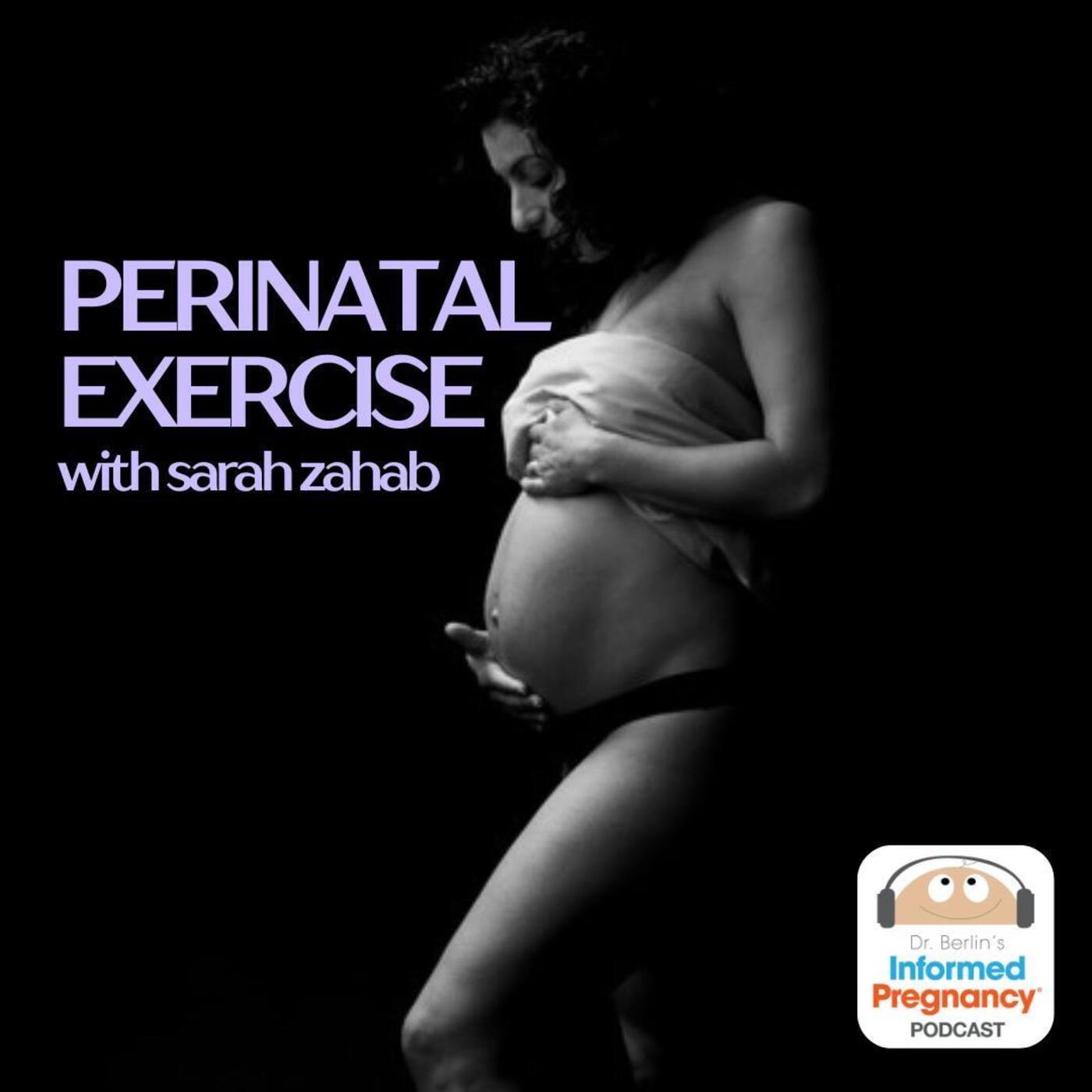
February 14, 2025 · 40 minutes · Episode 446
About this episode
Registered kinesiologist, clinical exercise physiologist, and mother of two Sarah Zahab joins the podcast to talk exercise, motherhood, and her postnatal strength workouts, now streaming on Informed Pregnancy Plus.

Connect with the guest:
Sarah’s workouts available on IP+
Key quotes
“I wasn't eating well. I was over-exercising. I was missing a lot of menstrual cycles and it was just like an overall sort of unhealthy obsession.”
“We got to the hospital around 6.30, and she was born shortly after 11, so things kind of progressed very quickly, and I was fortunate that everything went smoothly and I had that unmedicated birth that I had wanted,”
“You really have to sort of give in and surrender to the process and realize that it's not all about… You can sort of take a different path, and that's okay.”
“Certainly from a pelvic floor perspective we want to be focusing on more release and relaxation especially towards the later stages of third trimester. Strong but supple.”
“more on like how you're feeling are you healthy are you active because you want to be able to run after your kids and be there for your great”
Related episodes
- Ep. 445 Motherhood and Business with Sarah O'Leary
- Ep. 437 Preparing the Body for Birth & Postpartum with Gina Conley
- Ep. 435 Jackie Amézquita: After Birth
- Ep. 444 Motherhood from 15 to 40 with Natalie Parlett
Transcript
AI-generated transcript with speaker labels — may contain errors, especially names and medical terms. Dr. Elliot Berlin, DC appears in blue; Sarah Zahab in orange.
Download PDF of the Transcript
Dr. Elliot Berlin, DC [0:12] Welcome to the Informed Pregnancy and Parenting Podcast. I'm your host, Pregnancy Focus Chiropractor Dr. Elliott Berlin. My guest today is a registered kinesiologist and clinical exercise physiologist, as well as a mother of two and the creator of postnatal strength workout and prenatal strength workout, now streaming on Informed Pregnancy Plus. Sarah Zahab, welcome to the podcast.
Sarah Zahab [0:59] Thank you for having me.
Dr. Elliot Berlin, DC [1:00] I'm going to say for a foreigner, your English is very good.
Sarah Zahab [1:03] Why, thank you.
Dr. Elliot Berlin, DC [1:04] All the way over in Canada. Ottawa?
Sarah Zahab [1:07] Ottawa, Canada, yes.
Dr. Elliot Berlin, DC [1:08] Ottawa, Canada. Great to talk to you. You're an inspiring person and everybody who's listening will see why in just a moment. But why don't we start with what you do now? All this work, your career, tell me about it.
Sarah Zahab [1:20] Oh, well, I am a registered kinesiologist and a clinical exercise physiologist with 25 years of experience. I own a multidisciplinary clinic here in Ottawa, Canada. I've created the prenatal and postnatal strength workout videos that are available to your subscribers. And I've recently co-created a women's wellness specialist fitness and coaching certification that's available to fitness and health professionals who coach women. This was our launch year.
Dr. Elliot Berlin, DC [1:50] Wow, it sounds like you've been just laying around doing nothing. Lazy. And you have kids.
Sarah Zahab [1:57] I have two amazing kids.
Dr. Elliot Berlin, DC [1:59] Wow, they have an amazing mom. When you say I've been doing this for 25 years, it sounds like you started when you were one, because you seem like you're 26 years old.
Sarah Zahab [2:08] We started at the beginning, but that's just because you live what you preach.
Dr. Elliot Berlin, DC [2:12] So how did it all get started, fitness?
Sarah Zahab [2:15] Yeah, I mean, I was born with dislocated hips and the doctors encouraged my mom to put me in dance at a very young age. So I started dance when I was three and continued throughout my youth and adolescent and adulthood and fell in love with dance. A little bit of everything, mostly ballet, but I also did, you know, all the things as dancers do when they compete and sort of are in the life, ballet, jazz, tap, hip hop. And I did about 15 years of Middle Eastern dance as well. Yes. And then that transitioned to fitness competitions. And when it came time to sort of dive into a career, I just knew that, you know, studying kinesiology and the human body,
[3:03] it just seemed like a very natural progression and transition.
Dr. Elliot Berlin, DC [3:06] So you were a competitive dancer?
Sarah Zahab [3:08] I was a competitive dancer in my youth, and then I transitioned to fitness competitions later on.
Dr. Elliot Berlin, DC [3:15] Outside of dance, because it seems to me like a lot of people who are in dance,
Sarah Zahab [3:19] like dance is their form of fitness. Were you like separately working out? So I was teaching a lot of dance when I turned 16. I taught dance and I also became a group fitness instructor when I was 16 or 17. So I was teaching a lot of fitness classes at the same time.
Dr. Elliot Berlin, DC [3:35] OK, is Middle Eastern dance like belly dance or am I making that up?
Sarah Zahab [3:39] It's maybe a fusion between that and folklore. It's a beautiful mix.
Dr. Elliot Berlin, DC [3:43] I mean, it also just sounds like you have a wide range within dance. And in terms of fitness, what kind of fitness were you teaching? What was your focus of attention?
Sarah Zahab [3:52] Well, I was teaching group fitness classes at the time. We were running around in gymnasiums doing pilo and step classes. And then that sort of transitioned to various other forms of group fitness. There was boxing and dance based fitness classes and strength based fitness classes.
Dr. Elliot Berlin, DC [4:11] So you literally grew up moving in a very active way.
Sarah Zahab [4:14] Exactly.
Dr. Elliot Berlin, DC [4:15] And just expanded from there. Took that activity in lots of different directions. And then kinesiology. Can you explain what kinesiology is? For some people it's just a board on the scrabble board.
Sarah Zahab [4:25] Yeah, it's funny because when I first started this career in kinesiology, I spent the first 10 years of my career explaining what a kinesiologist was. No one would say I'm a kinesiologist. No one would really know what it was. But of late there seems to be a little more awareness. Kinesiologists are specialists in human movement. We coach human movement. We just have a deep understanding of the human body and physiology. And can help people improve their overall strength and endurance. Yes, we can help people move better and feel better.
Dr. Elliot Berlin, DC [4:57] In terms of training, I mean, your training physically, it seems to me like kinesiology is the more didactic part of exercise. Learning on the theories and the concepts between why we do certain things and how we do certain things and how you can use them to your advantage physically, therapeutically. Does that seem right?
Sarah Zahab [5:19] Yes.
Dr. Elliot Berlin, DC [5:21] And also, when you did fitness competitions, what are those like?
Sarah Zahab [5:25] Well, this would have been almost 20 years ago. They are an interesting blend between dance and bodybuilding perhaps. You're judged on your physique and then you're also judged on a fitness routine that includes various dance and strength elements, one-arm push-ups and gymnastics elements perhaps. Yes, it's a two-minute routine that you're judged on and you're also judged on your physique. So the goal was to get lean and fit and be judged.
Dr. Elliot Berlin, DC [5:56] Are you a very competitive person in general? You seem familiar. You seem like you'd be like, hey, you know what? My daughter played basketball and she's such a nice person. If two people are going for the ball at the same time, she's like, you know what? You take it.
Sarah Zahab [6:11] That's very interesting. Because I think at the time in my early 20s, I was very competitive. I was sort of in this fitness realm where fitness was sort of all-consuming for me in perhaps a very unhealthy setting. I wasn't eating well. I was over-exercising. I was missing a lot of menstrual cycles and it was just like an overall sort of unhealthy obsession. But I've learned over the years to find balance and I think with children you learn to change the lifestyle a little bit. So I would not describe myself as competitive right now, just enjoying life and finding that balance.
Dr. Elliot Berlin, DC [6:53] Okay, but I'd be remiss to not mention that you competed in Miss Fitness World four times.
Sarah Zahab [6:59] Yes, I did. In a previous life, yes.
Dr. Elliot Berlin, DC [7:03] Yeah. Well, look, I have never competed in Miss Fitness World. So you have me beat many times over. But one of the things that you said that's kind of interesting to me is that you learned from like over-focusing on certain elements of that. Like anything else, generally fitness is a good thing, but it could also be too much of a good thing could be harmful or detrimental and it's kind of neat that at least if you have that experience, you're able to bring it to the work that you do with other people as you guide them through fitness. I would say especially on pregnancy and postpartum where people tend to either overdo it or underdo it or just not be sure what they can do
[7:39] and having an expert like you is an incredible resource. So what I'd love to do is take a break and then come back and find out more about your pregnancy and birth experiences. And then the third segment, bring it all together and get some practical advice for people currently pregnant or who recently had a baby and ideas on how they can manage a healthy balance of fitness. We'll be right back.

Dr. Elliot Berlin, DC [8:04] Welcome back. We're talking to Sarah Zahab, who already made me feel bad about myself.
Sarah Zahab [8:19] No.
Dr. Elliot Berlin, DC [8:20] Well, I don't exercise and I should. And you know, the truth is when I talk to people like you, who are just lifelong exercisers and like it, I'm always like a little bit like, why don't I like it? Like I like Krispy Kreme.
Sarah Zahab [8:35] Do you move? Like, do you walk? Do you play with your children? Like, do you move? It doesn't have to be.
Dr. Elliot Berlin, DC [8:40] If people could see you right now, even the way you say do you move, your whole body is like moving and lit up and grooving and some kind of rhythm. And I'm like, no, not like that. I don't move like that. I need to. And actually, when I do these interviews, it generally motivates me a little bit to, I'm going to see if maybe I get started and then build up a little more and build up a little more. Maybe I could compete in the Mr. Old Guy World Competition. But I'll come to you for training.
Sarah Zahab [9:06] Please, yes.
Dr. Elliot Berlin, DC [9:07] OK, back to you. You have kids. And I was also curious what pregnancy and childbirth is like for people who are on the more fit side. Sometimes it seems to work for you. Sometimes it seems to work against you. Pros and cons to everything. What was your experience like?
Sarah Zahab [9:23] Well, yes, I think like the pregnancies in general were good. You know, I did experience some nausea and difficulty just sort of like gaining weight because I was at the time instructing a lot of fitness classes.
Dr. Elliot Berlin, DC [9:36] Oh wow, while you were pregnant. Was that hard to get nausea?
Sarah Zahab [9:40] I mean, it was OK. I really can't complain.
Dr. Elliot Berlin, DC [9:43] As a competitor who's judged on physique,
Sarah Zahab [9:46] what's it like to start developing like bumps and things? I think for many sort of competitive athletes, pregnancy can be a bit of a mental challenge where we're sort of identifying as one sort of person and then as our bodies change and we transition through the pregnancy and our identities kind of shift a little bit. So it can be sort of challenging. I really enjoyed the pregnancy and was able to remain active and felt comfortable and confident being able to continue doing my work. So I was very fortunate in that sense.
Dr. Elliot Berlin, DC [10:23] Did it take a long time for you to start showing?
Sarah Zahab [10:26] For the first pregnancy, yes, I believe so.
Dr. Elliot Berlin, DC [10:30] Because the baby's got to move through all that strength.
Sarah Zahab [10:34] Yes, I was more of like a square shape for my first pregnancy.
Dr. Elliot Berlin, DC [10:38] SpongeBob, you had a sponge baby.
Sarah Zahab [10:40] Yeah.
Dr. Elliot Berlin, DC [10:41] All right, so you taught all the way through the end of your pregnancy, fitness?
Sarah Zahab [10:45] I did, and I actually thought I was going to teach on the day I gave birth. I was getting ready to teach a class at 6 p.m. I was fairly certain I was going to teach this class. It was like 5 p.m. and I was going to teach this class at 6 p.m. and it was like 5.45 and I told my husband I'm not teaching this class. Even though throughout he's like, are you sure, are you sure? I'm like, yeah, I'm going to do it. And then it was just no. So the delivery with the first, it was a unique experience. I had lost my dad suddenly two weeks before my daughter was born.
Dr. Elliot Berlin, DC [11:18] Oh, wow.
Sarah Zahab [11:19] He died of a heart attack.
Dr. Elliot Berlin, DC [11:20] Oh, no.
Sarah Zahab [11:21] It was devastating. It was just awful. We were all just sort of reeling from it. So I gave birth.
Dr. Elliot Berlin, DC [11:29] Wow, so you were like in there 35, 36 weeks or so?
Sarah Zahab [11:32] I was 36 weeks, and so my daughter was born at 38 weeks, and I didn't really have a chance to sort of process any of it. I was just sort of living through days. It's very difficult to explain, but when we got to the hospital and the labor was progressing, people sort of talk about how giving birth can be like an out-of-body experience. That delivery was really an out-of-body experience for me. Mentally, I was really sort of shut down. I wasn't ready for it. I mean, I was in complete denial. I was going to teach this class at 6 p.m. because this was not happening, and I was not ready.
Dr. Elliot Berlin, DC [12:14] Not ready because it wasn't 40 weeks yet, or not ready because you were just getting over like drama over the news of your dad?
Sarah Zahab [12:20] Exactly. I was traumatized. I was grieving. I was in just such deep grief and despair. He was 57, and there was no warning, and this was going to be the first grandchild, and we were very close, and it was just all just devastatingly, terribly heartbreaking.
Dr. Elliot Berlin, DC [12:37] For me, that's not even my dad. Yeah. I lost my dad pretty young. I was 19. He was 48, and it was also a sudden heart attack. Was he athletic-y like you?
Sarah Zahab [12:48] I mean, he walked a dog. He lived a garden. He wasn't super athletic, but you know.
Dr. Elliot Berlin, DC [12:54] Yeah, my father just died out of nowhere, and the shock and trauma of it at the time, just being a 19-year-old kid was really heavy, and he had just a total vacuum out of nowhere and a void, and I can't imagine what that's like, not just pregnant, but at the very end of a pregnancy, right on the precipice of this transition and maybe already seeing the vision and feeling the joy of celebrating this as a family and making it a grandpa.
Sarah Zahab [13:26] Yeah, yeah.
Dr. Elliot Berlin, DC [13:28] Wow, I can feel it. I'm sorry. I'm sorry for your loss.
Sarah Zahab [13:32] No, thank you.
Dr. Elliot Berlin, DC [13:33] So the birth, partially because of that, you were just checked out in your mind.
Sarah Zahab [13:38] Yeah, my body, I guess, took over because I just was not in the right head space for this whole thing to happen. I remember putting in my birth plan, wanting an unmedicated, natural birth, but open to all possibilities, of course, wanting a healthy baby, and fortunately, it was sort of fast. We got to the hospital around 6.30, and she was born shortly after 11, so things kind of progressed very quickly, and I was fortunate that everything went smoothly and I had that unmedicated birth that I had wanted, or wanted to at least try for, but it was difficult.
Dr. Elliot Berlin, DC [14:15] How did it progress?
Sarah Zahab [14:17] So I remember when we arrived at the hospital, I had gotten checked, and I was at the four-centimeter mark, so we had gotten checked in, and I knew I wanted to get into the tub right away because it was something that I wanted to try, and I just remember that feeling of getting a little bit of comfort and a little bit of flavor a little bit in the tub, and it just sort of transitioned to things getting a little more intense. We ended up moving out of the tub, and my water broke, and things progressed quickly from there, and I think the pushing stage was maybe about 40, 45 minutes. There are a lot of details that I don't remember. They're just kind of foggy.
Dr. Elliot Berlin, DC [14:55] You weren't quite there.
Sarah Zahab [14:57] I wasn't quite there. I remember feeling my pelvis shake inside my body at one point, and hearing this, like, scream, like this awful scream, and I thought, oh, my gosh, and then realizing that it was me, you know, but, like, later, and, like, a nurse came in at one point, and she said, the woman next door opted to get the epidural after she heard you scream. Like, I guess, you know, it was just this… I didn't even realize it was coming out of my body. It was just…
Dr. Elliot Berlin, DC [15:27] Yeah, just kind of a surreal. It's kind of just primal. It doesn't seem like it's necessarily because you're in so much pain that you're screaming from pain, just like these primal noises come through because something very primal is happening,
Sarah Zahab [15:41] big and primal. Yeah, and so it was interesting because in the second delivery, we used a midwife, and I got in the tub right away, and it very much were, like, in my body. It felt more painful and more…
Dr. Elliot Berlin, DC [15:55] Do you think because you were more in touch?
Sarah Zahab [15:57] I do think so, exactly, yes.
Dr. Elliot Berlin, DC [15:59] Wow, okay. In between there, you had a postpartum, and, you know, your first opportunity to take your body from pregnancy and birth, which is a big physical thing, and to kind of… I don't know if the word recover is the best word, but it's really what happens, to recover from that. Is that when you got involved in doing postnatal and prenatal fitness specifically?
Sarah Zahab [16:23] Well, it's interesting because when I was pregnant with my first, I remember doing a lot of, like, research and looking for workout videos, and at the time, and this was, like, 2008, all I could really find was prenatal yoga, prenatal stretching, maybe prenatal cardio, but I had a very difficult time finding anything prenatal strength-related, and we know how important strength training is for a mom, you know, throughout the delivery and pregnancy and postpartum, and so that's really what sort of prompted me to create those prenatal and postnatal strength workouts. I felt like there was a gap that needed to be found.
Dr. Elliot Berlin, DC [17:03] While you were pregnant, you were doing it?
Sarah Zahab [17:05] Yes, I filmed the prenatal strength workout while I was pregnant with my first, and then the postnatal strength workout is a workout that can be done with your baby, so my youngest is… Yeah.
Dr. Elliot Berlin, DC [17:17] That's great. Okay, so I jumped around a little bit. It sounds like the second pregnancy you had was with a midwife.
Sarah Zahab [17:25] Yes, so I think the whole experience, I mean, you know, things went really well, but we really opted early on to sort of change our sort of pre and postnatal care, and I really felt strongly about trying midwifery. You know, just the care was a little bit different, and it was, you know, maybe because of the trauma, I wanted to try something a little bit different, so we were very fortunate to get a midwife early on, and really enjoyed
Dr. Elliot Berlin, DC [17:51] the whole process. Are you saying because of the emotional
Sarah Zahab [17:53] trauma? I think the emotional trauma and the care felt quite rushed. For me, personally, it felt rushed, and our postnatal sort of stay in the hospital, like the care was just kind of not what we had envisioned, and so, yeah, we wanted to try something a little bit different. Now,
Dr. Elliot Berlin, DC [18:13] is the midwifery, or, if I'm going to speak the language, midwifery care, in your area, is that in a hospital, but with midwives, or is that in, like, an external birth center or a home?
Sarah Zahab [18:25] There are options, so with the midwife, you can deliver in hospital, you can deliver at home, or in a birth center, so we had opted to deliver in a hospital with the midwife. And how
Dr. Elliot Berlin, DC [18:37] was that experience for you?
Sarah Zahab [18:39] It was wonderful. The prenatal appointments were just so much more relaxed and thorough and comfortable. We really connected with our midwife. We really enjoyed the whole experience. The care was just sort of top notch. It was incredible.
Dr. Elliot Berlin, DC [18:53] Great. I want to ask you everything I can to give the people listening good, valuable, useful information about things they can do during these important stages of life. But before we go to that break, are there things that you learned from being pregnant and giving birth that you hadn't known before, or maybe couldn't have known without going through it?
Sarah Zahab [19:17] Yes, I think there's definitely an element of letting go and sort of trusting the people around you. As a competitor and as a fitness athlete, everything was just so planned out and structured. My food was being weighed and calculated. Every minute of exercise was sort of planned out. And that really doesn't apply with labor, delivery, going through the whole process, pregnancy. You really have to sort of give in and surrender to the process and realize that it's not all about… You can sort of take a different path, and that's okay.
Dr. Elliot Berlin, DC [19:59] I love that. I would almost want to go to commercial playing Let It Go, Let It Go, but we can't afford to license it. So, we'll be right back. Welcome back. We are talking to Sarah Zahab, a lovely guest. You're a wonderful guest. Thank you. Thank you for being here with me. I want to pick your brain from the life you've lived and from the training that you've done, physical training, educational training, didactic training, and the resources that you've put together, and the work that you still do in kinesiology. And find out. I agree with you. I think that when it comes to still today, finding helpful information about working out, taking care of your body, physically,
[20:51] in all the different ways, nutritionally, in terms of exercise and movement, there's not the greatest information that makes people feel super comfortable. And then there's different kinds of people. There are people who are exercising their whole life and now want to continue to exercise in pregnancy, but aren't quite sure what to do and not do. There are people who have not really been very physically fit, and then they get pregnant, and all of a sudden it's like, oh my gosh, maybe now is a good time, but is it? And then what do you do? So, in general, let's start with pre-pregnancy. If you're trying to get your body ready for pregnancy, what kind of things
[21:21] can someone do to roll out the red carpet?
Sarah Zahab [21:23] I love that. And yes, you're right. There's so much information out there that can become very confusing and overwhelming for people. They don't know where to start. And also, the research that we've seen over the years has changed. There was a time where we were telling people not to exercise with their heart rate over 140 beats per minute, and we know that that's sort of obsolete, not really being used anymore. And then in the diastasis world, the pendulum has shifted so much where we were telling people not to do any abdominal exercises, and now it's sort of landing in the middle. But there's been a lot of…
Dr. Elliot Berlin, DC [21:59] With the diastasis, are you talking about during pregnancy or
Sarah Zahab [22:01] after? During and after. But now we have a lot more research now to support sort of sound exercise principles, like preconception. We know that physical activity is important. We know that coming into a pregnancy, you know, being the healthiest that, you know, a possible state that you are, is helpful and important. Being able to carry the pregnancy, you know, we need to be strong. Our backs need to be strong. We need to have good posture. We need to have core stability and good integrity and tension through the abdominal wall. Our pelvic floors need to be strong and stable. You know, we need to have good cardiovascular endurance. We need to be able to withstand the rigors
[22:47] of pregnancy and delivery. And I think it just depends where you're at. Like, you don't have to be a competitive fitness athlete. You can increase your walking time by 10 minutes daily. You know, you can start where you start. Like, start where you're at and work to build up to a routine that feels comfortable and reasonable and supportive.
Dr. Elliot Berlin, DC [23:11] It's kind of amazing to watch in practice people who are generally fit but don't have injuries from however they got fit. A lot of them kind of skate through the pregnancy without the benchmark signs of, you know, the new grunting. You know, they just move even though they got bigger, sometimes a lot bigger because, you know, if you're 105 pounds and you gain 35 pounds, it's a lot more percentage than if you're 200 pounds and you gain 35 pounds. So it's a big strain on the body physically that the body's meant to handle. And sometimes you just watch people who are fit. I love this also because I have patients who are in their 40s, pregnant for the first time, but they're really fit. And
[23:51] you know, they kind of get labeled as geriatric pregnancy or, you know, lovely terms like that. And sort of everybody's nervous about them. But they have sometimes the healthiest, most incredible pregnancies because they're in good shape. They've eaten well, they've exercised well, they get a lot of movement, good blood flow. They have strength. You said strong and supple about the pelvic floor, which is, I think, a brilliant way to put the goal. In fact, if I ever start a band, it might be strong and supple. Good name. Thank you. You came up with it. I just applied it. And so you see that and you realize, and then that's just for mom, you know, herself, her own
[24:27] experience with pregnancy. But then the baby that's growing in that factory, I sometimes, you know, you kind of picture like you go to hotels.com and saying, OK, I don't think I can afford that one. But, you know, and then like myself, I would be like a one-star motel, like, you know, youth hostel. But you can do things pre-pregnancy to improve your standing and your rating and make yourself a better, you know, environment for a baby to grow.
Sarah Zahab [24:51] That's it. And we always want that progression to be, you know, slow and steady and, you know, progressive. And we know that babies born to exercising mothers have healthier hearts. At birth and 30 days later, these babies are still showing signs of improved heart rate variability and heart, overall heart health. And that's just from having, you know, a mom who exercised throughout the pregnancy. Yeah.
Dr. Elliot Berlin, DC [25:21] And it makes sense that it would, you know, during those critical stages of development. Right. So then once pregnancy has arrived, are there different ideas for the different trimesters and what's good to do? Well, the
Sarah Zahab [25:33] standards for Canadian and American guidelines for exercise during pregnancy are quite similar. It's 150 minutes of moderate exercise per week. And I remember when the recommendations came in for strength training, you know, two strength sessions per week as well. Being mindful of pelvic floor. We know that in the third trimester, you know, a recent study found that 100% of women will experience diastasis in their third trimester. This is a normal response to pregnancy. The abdominal tissue is going to change and adapt.
Dr. Elliot Berlin, DC [26:09] I think not everybody knows what diastasis is. We're talking about the theoretical six-pack area, how there's a right and left muscle there, right, this abdominal muscle, connected on the inside by a connective tissue that's called the white line, the linea alba. And that line is designed, that connective tissue is designed to stretch as you grow and allow the right and left side abdominal muscles to kind of move apart from each other. Doesn't mean that they tore or there's something terribly wrong. Then after you have the baby, the idea is for them to kind of come back together and then they're lined up well. And then if they don't, you know, then
[26:47] is when you kind of have something that you need to take care of. If there's a gap.
Sarah Zahab [26:51] Well, it's interesting because, so that interecti distance, the space between the two front abdominal muscles, those recti muscles, you know, our definition of diastasis is a separation or a spacing or an interecti distance of 2.5 centimeters or more. So we don't know often what someone's interecti distance is coming into the pregnancy. What is the gap when they're starting the pregnancy or before the pregnancy? So my kids know what their interecti distance is, but most people don't know what their interecti distance is coming into a pregnancy. And we know that that spacing between the two ab muscles can vary. Some people have wider spacing, some people have
[27:31] narrower spacing. So we for many years have used the spacing as a barometer of do we have diastasis if there's a separation of the midline, right, of the abdominal musculature. But we're really starting to shift away from the actual spacing and taking a closer look at the integrity or depth of that interecti, the linea alba of the tissue, of the abdominal sort of wall. When we're palpating and we're poking and feeling in that space between the two recti muscles, is there a shallow groove? Is it quite deep? What is the integrity through that abdominal wall like? And so we're taking a closer look not just at the spacing, but at the depth, integrity,
[28:15] and tension that can be generated
Dr. Elliot Berlin, DC [28:17] in that space. I think it's incredible how much we've learned about both the pelvic floor and the core in just even the past decade alone and the research continues to go and as we continue to learn we'll be better able to help people understand the physiology and what's working and what needs help and how to help them. Okay, so that's diastasis. In the third trimester as you get close to birth, are there things that you recommend specifically to do or not to?
Sarah Zahab [28:45] It's really sort of mom dependent. Like what did they do pre-pregnancy? What did they do in their first and second trimesters? What is going to make them feel supported? What are they experiencing? Are they experiencing some SI sciatic discomfort? Do they have any pubic symphysis pain? For some moms it's really just chilling out for that last trimester and for others they're ready to sort of continue and depending on like isn't their first pregnancy their second pregnancy, we're really needing to be adaptive and not really set rigid sort of guidelines around you need to get your strength and your cardio in. We really need to be adaptable in this phase.
Dr. Elliot Berlin, DC [29:25] Is there any kind of general philosophy as you advance towards home plate? Are you wanting to strengthen or stretch or just move? Like get your heart rate up?
Sarah Zahab [29:39] Definitely continuing with cardiovascular activity can be important. Strength training helpful if that feels it is finding the right dose at that time that helps you feel that it's helpful, it's supportive, it's comfortable, it's doable, it's safe. But for many like over stretching might not be helpful because we still have that relaxing that could be circulating and affecting the tissues. Certainly from a pelvic floor perspective we want to be focusing on more release and relaxation especially towards the later stages of third trimester. Strong but supple. So that's where we want to focus on the supple stage and you know really not from an exercise standpoint in the last few
[30:25] like four to eight weeks I don't think you're going to make or break this. It's really just let's make you feel really comfortable and just honor
Dr. Elliot Berlin, DC [30:33] where you're at. Okay what about on the other side baby comes I see a lot of moms itching to get back into the shape they were beforehand literally the shape and also clothing. Sometimes it seems like they just rush it too quickly and sometimes you know it's time but they have a hard time getting their momentum back.
Sarah Zahab [30:55] Yes and I think it can be very different and this anticipatory care I mean we're having these conversations in the first trimester like we can't rush things we have to honor where you're at tissues need time to heal it's gone through a lot of trauma you know I'm really encouraging moms to take time postpartum to just rest recover we know that you know if someone has a diastasis within that first eight weeks they're likely to have diastasis one year postpartum so that first eight weeks you know for me a really critical part a time for new moms to focus on just gentle core and pelvic floor activation recruitment walking like there's so many questions
[31:39] we have to ask are you sleeping are you eating what was the birth like did you have a c-section what was the delivery like everyone is going to have a different experience and baby to baby birth to birth is going to be different as well those postpartum periods are going to be very specific to many different variables and factors.
Dr. Elliot Berlin, DC [31:59] I mean I'm generally a big believer in the voice inside that if you can clear the noise and listen the voice inside will tell you hey I'm ready to start you know getting going again and even sort of guide you into how intense or what kind of exercises are going to feel right or feel wrong to what extent do you kind of listen to that voice and you know when you hear that voice saying hey okay let's get going are there just general things people can do at home like the first one or two steps that are helpful to get the ball rolling.
Sarah Zahab [32:29] Yeah I mean it's interesting you talk about the voice I think for some women that can be like there's a lot of the external voices from social media and our sort of lived experiences that sort of impact you know what we're thinking what we're doing so for some they may feel they're ready but they may need more time they may think that they have to sort of get into it because they've hit their six week mark you know we know that the six week mark isn't just this magic green light for us to jump right back into everything we've done before it's an opportunity to have a conversation with your healthcare team and sort of assess where you're at but we really still want
[33:09] to continue to be progressive throughout that entire fourth trimester through 12 weeks and beyond but certainly walking that ambulatory movement I think could be very healing very important getting outside walking with baby just getting the fresh air getting the motion some low impact gentle activity to kind of move flush things out can be very very helpful some gentle sort of pelvic floor activations and some transverse abdominis sort of activations as well through deep breathing relaxing on inhalation and exhaling to think of a gentle sort of drawing in corseting belt tightening sensation but then always finishing that with a letting go we don't want to be
[33:55] walking around with like gripped I mean women are just like we're gripping everything we're gripping our cores our glutes or jaws or pelvic floors like we want to engage muscles need to relax in order to contract so we want to focus on the letting go element as
Dr. Elliot Berlin, DC [34:11] well yeah it's a theme that runs all the way through from fertility through postpartum
Sarah Zahab [34:17] I mean as someone who's been doing this for a long time and we now have a pattern for you know always holding your core in it's called hourglass syndrome and we know that over time this drawing in and this tightening through the core can lead to downward pressures onto the pelvic floor so I'm you know seeing women later on with these potential prolapses or pelvic floor dysfunction because of our constant need to grip our abs.
Dr. Elliot Berlin, DC [34:47] Also putting a lot of pressure on the saccharine scar if there is one. This is super helpful and also you know very helpful taking all of your expertise and putting it into something that people can access and utilize at home or your incredible videos on pregnancy training strength and postpartum strength training that just brings it all together in a very easy to follow away and we're honored and blessed that you have them streaming on informed pregnancy plus you're also working on a book tell me about the book.
Sarah Zahab [35:21] Oh yes so I just finished the writing stage of the book and we're now in full editing that's huge yeah it's really exciting and so it's with publishers human kinetics based out of Chicago area so the book is set to be released in August of 2025 and the book is on walking the benefits and the how to's and the walking programs and yes just all about walking. Good for everyone.
Dr. Elliot Berlin, DC [35:49] Good for everyone yes exactly. Incredible I could talk to you for another two hours but I really appreciate everything that you've contributed here from your background and experience I guess I do have one closing question because I get this question a lot and I don't quite know the answer you're somebody who is very fit who is you know again very focused on your physique like each line made a difference after having two kids do you feel like you were able to bring your body back there I don't know if you wanted to but if you did were you able to have like a postpartum body that was similar to your pre-pregnancy body and that's something people ask all the time will I ever be the same
[36:27] as I was and it seems like not the same but great.
Sarah Zahab [36:31] I mean I realized and learned that my pre-pregnancy shape during competition especially was very unhealthy I wasn't menstruating my hormones were out of whack I paid dearly for that intense stage of my life I still am paying for it and so
Dr. Elliot Berlin, DC [36:49] work all the time with people who are not that you know not that level of intensity but just people who are normal fit whatever that means can they get back to normal fit afterwards?
Sarah Zahab [37:01] I think so totally I just but do you want to like I think you can yes and no I mean I think it just depends like I just don't think that the aesthetic part of things is that critical I think getting your health back feeling healthy being healthy finding maybe different outcome measures versus the scale or how you close fit can be hugely impactful for people moving away from that you know can be beneficial and just focusing more on like how you're feeling are you healthy are you active because you want to be able to run after your kids and be there for your great grandchildren I think maybe shifting the conversation a little bit and that's taking me
[37:39] a while to sort of get to
Dr. Elliot Berlin, DC [37:41] I think that's also for some people you could tell like I do have patients that are very active and then for some reason during pregnancy actually become a lot less active and then afterwards they kind of feel like everything get undone but there's this analogy that pops into my head sometimes I'm like you know when you go skiing and the mountain has let's say 20 foot base of snow and then there's fresh powder on top like you might lose the fresh powder but that base is always going to be there and so with a little bit of effort you can really get back to similar shape that you were in and it's not all gone even though you don't feel it on the surface but the other thing is we
[38:21] have a friend who had six babies and she was healthy but she was not a fitness person and then after six babies started to get into bodybuilding and became a competitor and she wins in her class
Sarah Zahab [38:33] wow that's amazing and so that is yeah and I guess it is and I think just for me and the clients that I'm working with you know I do a lot of like helping identify imbalances and compensatory patterns and for me it's really about just like moving well can you move well are you moving cleanly do we have good patterns yeah but certainly for some people that's important and absolutely I think that's attainable
Dr. Elliot Berlin, DC [38:57] thank you where can we find you
Sarah Zahab [38:59] online so our website is continuumfitness.ca and I'm on Instagram at continuumfit and for the women's wellness for those who are maybe interested in those who potentially coach women we can find the information at activatefit.ca
Dr. Elliot Berlin, DC [39:19] I love all the work that you're doing I hope that you continue to help many people and I know that you will and as you continue to create and generate more materials based on the latest research hopefully we'll have you back thank you so much thank you for having me my pleasure Sarah and thanks for at home listening to our podcast for more pregnancy and parenting information just like this visit us online at informpregnancy.com
Want more pregnancy + parenting? Start your FREE TRIAL of Informed Pregnancy+ and get access to all our curated pregnancy and parenting content — original series, iconic birth films like The Business of Being Born, prenatal workouts and more.
