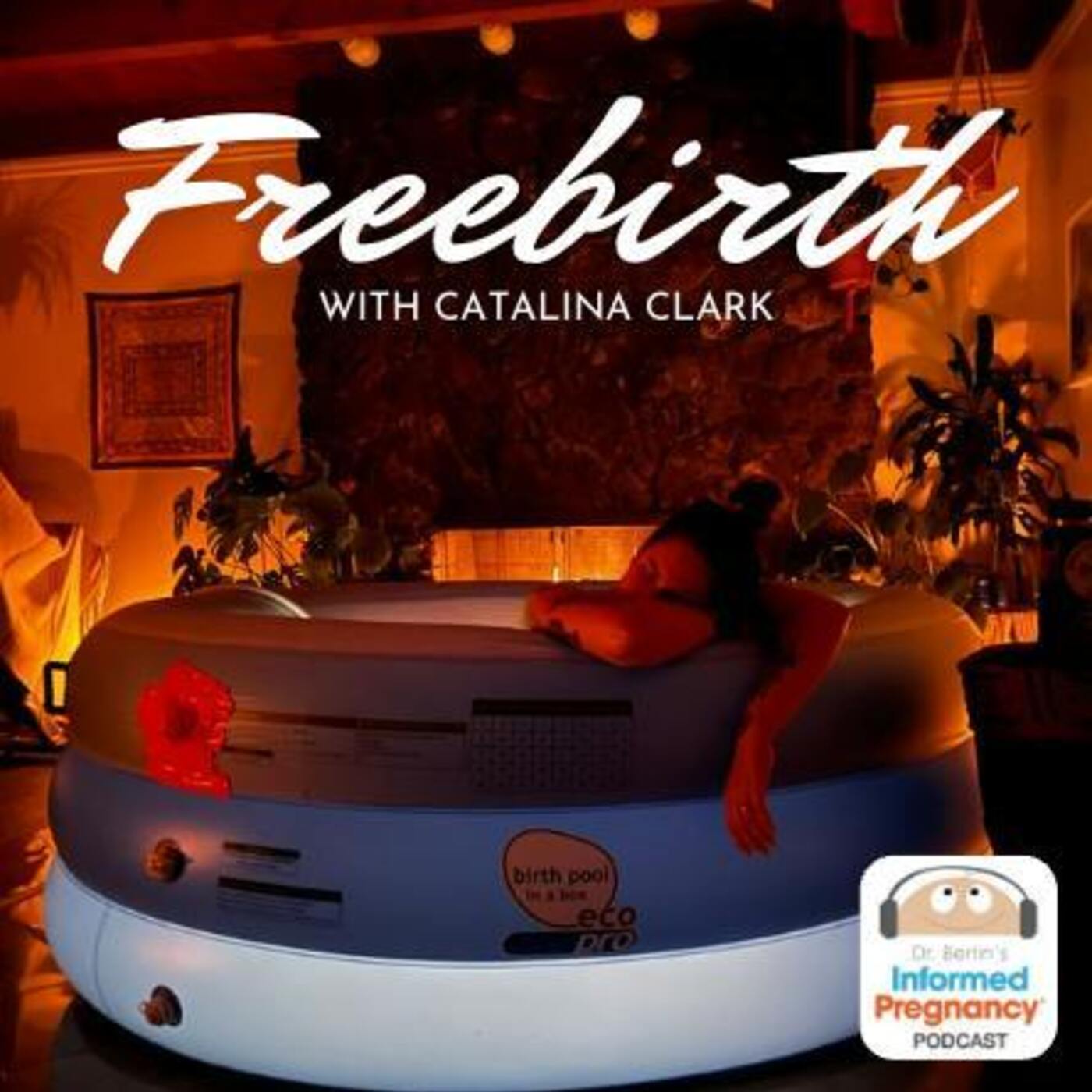
August 1, 2024 · 56 minutes · Episode 418
About this episode
Past guest Catalina Clark, a licensed midwife, returns to the podcast as a mother of two to discuss freebirth, a term describing childbirth without medical or midwifery assistance.

Connect with Catalina: @catalina.clark and catalinaclarkbirth.com
Check out Informed Pregnancy Podcast episodes 97 and 98 for Catalina’s before and after birth stories with her first child.
Key quotes
“A true wild pregnancy would be nothing. No blood work, no ultrasounds, no GBS testing, no glucose testing, no fetal heart tones, no fundal heights, no nothing.”
“Because as a midwife, I know the feeling of knowing, oh, this woman had a hemorrhage or a shoulder dystocia or a resuscitation last time or a large baby and how those fears get projected onto women for their next births or how midwives attempt to manage or actively manage the pushing and the postpartum to try to avoid what happened the last time, for example. So for me, it felt safer to not have a medical presence in the room in order to achieve the birth vision that I had.”
“And there is so much power in trusting the unknown and in trusting the biological design of birth and that we are all here on earth because our ancestors gave birth without ultrasounds and not everybody didn't die from placenta previas and our species continued.”
“The pregnancy was wonderful and I think the point is that I took full responsibility for my prenatal care. The prenatal care was the care that I gave myself during my pregnancy. The food that I ate, the movement with my body, the self care, the body work, the cup of tea with a friend, the walk to the creek in Topanga, the walks on the beach,”
“And that is my whole philosophy is that nobody needs a midwife to give birth. Nobody needs a doctor to give birth, but you can want one. That is a choice. It is a choice to choose to want a midwife. And that's a great choice when you can find a midwife or a doctor who is in alignment with what it is that you want for your birth.”
Related episodes
- Ep. 414 Aly Michalka: After Birth
- Ep. 424 Leedia Riman: After Birth
- Ep. 417 Hilary Duff: A Birth Story (Part 2)
- Ep. 416 Hilary Duff: A Birth Story (Part 1)
Transcript
AI-generated transcript with speaker labels — may contain errors, especially names and medical terms. Dr. Elliot Berlin, DC appears in blue; Catalina Clark in orange.
Download PDF of the Transcript
Dr. Elliot Berlin, DC [0:36] Welcome to the Informed Pregnancy and Parenting podcast. I'm your host, pregnancy-focused chiropractor, Dr. Elliot Brevin. My guest today previously appeared on back-to-back episodes, numbers 97 and 98, where she shared her pregnancy birth and postpartum story. In the before episode, she discussed her pregnancy and plans for birth, and in the after episode, she talked about how the birth and postpartum journey and experience actually went. Today, she's here to tell us about her second birth experience, a free birth, which is a birth without any medical or midwifery assistance, and how it has influenced her both personally and professionally. Catalina Clark, welcome back to the podcast.
Catalina Clark [1:14] Thank you so much.
Dr. Elliot Berlin, DC [1:16] Great to see you again, although you moved far away from me. By the magic of Zoom and internet, we're like in the same room once again. So I have some questions for you. First of all, where are you now in life? What's going on with you? What do you do for work, and what's your family looking like?
Catalina Clark [1:34] Well, now I am a mother of two, almost six years old and two years old. We live in the Pioneer Town Mountains, which is near Joshua Tree in the high desert of California on a 20-acre ranch out in the middle of nowhere.
Dr. Elliot Berlin, DC [1:54] Wow.
Catalina Clark [1:55] And I am still practicing midwifery, as a home Earth midwife and also coaching women who are interested in free birth and unassisted birth and sovereign birth and autonomous birth.
Dr. Elliot Berlin, DC [2:09] And we're definitely gonna get into what that means. I used to think the number of people giving birth out of the hospital is a small number, and I always thought like, well, that seems crazy. And then the more I got involved in the birth world, the more I realized that seems awesome. And so I don't know that much about free birthing and I'd love to learn from you today. And I have a feeling most of the audience is the same way, also not too familiar, even somewhat the idea or concept and also what some of the benefits are and why people might choose to do it. But your midwifery career, what was your path to midwifery? It's different. There's not only one straight way to become a midwife.
[2:51] What was yours?
Catalina Clark [2:52] So I trained as a home birth midwife apprentice via the licensed midwife, certified professional midwife route in California. So I'm not a nurse. I'm a certified professional midwife, licensed midwife who was traditionally trained in the home setting and attended midwifery school that was more holistic. But my training has changed now to the point where I realized that the midwifery training that I had was actually quite medical and that the midwifery system and the medical system are actually the same system. They are built upon one another. The midwifery system is built upon the medical system. And so when it comes to prenatal care, testing, monitoring, how birth is approached,
[3:41] I actually realized there was a lot of similarities and I really wanted to practice more holistically. So I'm currently in the process of unlearning, even that which I thought was the most holistic way to approach birth through midwifery and how my free birth, which I'll explain, helped me to understand this more and more.
Dr. Elliot Berlin, DC [4:04] So it sounds like quite a journey for you. And how did it start? How did you get interested in childbirth as a profession to begin with?
Catalina Clark [4:12] I was living in New York City and I was working in nightlife and hospitality and PR. And I actually had a pregnancy loss at that time. And I was not intending to get pregnant. I was not intending to stay pregnant. And that experience was life-changing for me. And it is what got me interested in becoming a doula and becoming more informed and helping other women. And so first I became a yoga teacher and a prenatal yoga teacher, then a doula and then a midwife.
Dr. Elliot Berlin, DC [4:47] And that is a long journey. I think a lot of people I hear all the time say, confusion, express confusion between what a midwife and a doula are. And also once they find out midwives are more medical professional than a doula, then they also then become confused between what a midwife and an OB do. And maybe to your point, there's a lot of overlap.
Catalina Clark [5:11] And there's a big difference between different types of midwives. So there are licensed midwives, there are nurse midwives, there are traditional midwives, there are unregulated midwives in states where there are no licenses. So there are professionally trained and skilled midwives who may not hold the title or the license of a midwife, however they still are. So there's also within midwifery, so many different types of midwives. Just to add more confusion.
Dr. Elliot Berlin, DC [5:41] Yeah, that's a lot of confusion. Those distinctions are not well understood. But one thing I will point out is doula training tends to be a week long, midwife training tends to be many years long.
Catalina Clark [5:51] Life long.
Dr. Elliot Berlin, DC [5:52] At least many years long before you can even start practicing. And then my career is lifelong learning. But just for an idea of the difference between doula and midwife. Okay, your first pregnancy and birth, we have those episodes all about it, 97 and 98. But let's recap, because that was quite an experience as well. You were planning for a home birth with professional midwives. And how did the birth experience go? And also how did it go compared to what you expected?
Catalina Clark [6:23] Well, I think it's great to talk about my first birth because it gives a lot of context and understanding for the difference between my first and second and why I chose free birth the second time. And for my first birth, I was a student midwife at the time. So I was in my training and I was working with my midwife and I had a really strong belief that if I did everything I told my clients to do, and if I approached pregnancy via the midwifery model, that I would have a successful birth. And I did. So at that point, a successful birth to me meant a birth at home. A successful home birth for me was, my birth went as planned. It went as intended.
[7:05] I gave birth to my baby at home. And so I had, what would be considered a pretty straightforward labor? It was 12 hours long or something overnight, 9 a.m. to around 9 p.m. However, in hindsight, looking back, even now many years later, considering my story, I was really putting a lot of responsibility on my birth team. I had this vision that I had the perfect birth team and that was gonna help me to have the perfect birth because I had the best midwife, the best doula, the best birth photographer, the best assistant midwife. And I was able to handpick these people in the community that I knew so well and that I trusted so much. And I realized that I actually was outsourcing
[7:51] a lot of my own responsibility in the birth. For example, I was in denial that I was in labor. I needed my midwife to come over and check my cervix to tell me that I was in labor. I needed an outside confirmation that that's what was happening. Even with all that I knew as a midwife, I was not experiencing common symptoms other than contractions, which of course I was in labor, but I wasn't bleeding, I wasn't spotting, I didn't lose my mucus plug. I wasn't convinced and I needed this information. Although we know that the checking of the cervix doesn't actually tell us if you are necessarily in labor or how far along you're in labor or how long labor will be when your baby will come.
Dr. Elliot Berlin, DC [8:37] Do you want me to stop there for just a second? Because it does give you some data, but if I'm hearing it correctly, if there was one of those little bars like when my computer updates and it goes from zero to a hundred percent, none of the information that you get from the cervical check is gonna tell you where you are in that bar exactly, right? So you could find out your, I don't know, six centimeters and 80% of base. It doesn't tell you how much longer you have to go. It just gives you some data.
Catalina Clark [9:04] Right, it tells you what is happening in your cervix at that exact moment. And it also has risks and it also can cause your body to shut down and close down because not only the cervix, but the vagina contains a sphincter that doesn't actually really wanna let things in that aren't supposed to be there. And we're trying to open and bring things out. So there are also risks to the vaginal exam itself that could actually cause the labor to be longer.
Dr. Elliot Berlin, DC [9:37] Where, yeah, or stall out. One can see that happening. Like the body is very deeply programmed, hardwired program to experience certain things and to react to certain things. And what you're saying makes a lot of sense to me. Something foreign entering would easily signal to the body, hold on, something's wrong here. Let's put the brakes on this. And I've talked about this on the podcast before. Even one time there was a cat giving birth in the closet and a very excited pet owner went to the capture on video. And there was a light on that camera. And the second that light hit the birthing mother cat, she looked like a deer in the headlights, literally.
[10:17] And you could see there was a kitten half out of her. You could almost see the uterus clamp down on the kitten. She got up and started walking around with half a kitten out of her and eventually went under the bed where there was no light. And then you could hear her start meowing again in the birthing rhythm. So the body definitely as an animal reacts to certain things to protect. So that makes sense to me. It's something I never really thought about until you just said it, but it makes sense to me. So the idea is there's always risk and benefit. There's always pros and cons to something that we do. And maybe we sometimes overinflate the pro of a cervical check
[10:52] and don't think about how that might create a problem. Okay, so these are some of the musons of your original birth.
Catalina Clark [11:00] And I'll just speak to the actual birth itself because I had a vision of really wanting to birth my baby on my own. I didn't want a lot of hands touching me. I wanted to catch my own baby, which is very common in midwifery care. However, my birth unfolded differently. My baby was slow to emerge and that caused fear in the room. And it caused the midwives to be more hands-on than they normally would be in a birth. Looking back now, I don't know that I would define in the past I did define the birth as a shoulder dystocia, but knowing what I know now, re-going over the video, re-going over what I felt in my body, I don't know that it was an actually
[11:42] actual true shoulder dystocia. It was a slow emergence. She was not a small baby. And so there was a lot of hands on me and there was also resuscitation. And so that created a lot of fear in the room at the birth and in the postpartum.
Dr. Elliot Berlin, DC [12:00] And just to slow down a little bit, I'm learning new things because we had two whole episodes on your birth story and I knew that you had what was originally classified as a dystocia, but for the audience to remind them what a dystocia is, is when the baby starts to come out and then sort of get stuck, a shoulder gets stuck behind the pubic bone.
Catalina Clark [12:21] Well, it's not sort of stuck. It is stuck. It is stuck on the anterior pubic bone and it cannot be born without physical manipulation, whether that's positional changes or a midwife bringing her hand actually in and up and releasing the anterior shoulder from the pubic bone. A baby with a true shoulder dystocia cannot emerge without either physical maneuvers, movement, or hands-on maneuvers.
Dr. Elliot Berlin, DC [12:49] Okay. And it generally is concerning to the people in the room because it can become dangerous for the baby. So let's just kind of go back to the end of that birth. Were you originally in the tub when that started?
Catalina Clark [13:05] I was squatting outside of the tub. Intuitively, I was squatting. I was standing. I had my knee up in a lunge, a standing lunge with my leg up on a stool or a chair. And that was how I was intuitively pushing.
Dr. Elliot Berlin, DC [13:24] Okay.
Catalina Clark [13:26] And then the baby started to emerge. And then the head started to emerge at a slower pace. What I realize now is within the range of normal, just not what maybe we are used to seeing or comfortable with seeing. And it wasn't until the head is actually born that you can even diagnose a shoulder dystocia. So it's usually when the head is born, but the head is either not born all the way, like it's stuck at the nose or stuck at the chin, or it is been born, but it does something called turtling on it. And you can see the neck rolling up into the face. And it's kind of like, you see a turtleneck around the baby's head.
Dr. Elliot Berlin, DC [14:09] Okay.
Catalina Clark [14:10] And are you saying that didn't happen? I don't think that that is what happened. No, I didn't visualize that in the video or in my intuition and my like feeling in my body was just that she was nine pounds, 12 ounces, and it was my first baby. So she just needed more time.
Dr. Elliot Berlin, DC [14:31] Okay.
Catalina Clark [14:31] So what was the reaction of the people in the room? There was a lot of hands-on support, a lot of maneuvers trying to support her to come out, and a lot of, I'm wanting to use the word aggressive because it did feel somewhat aggressive, like aggressive encouragement to push, almost like you're in a hospital. Like, okay, come on, cat. It's time to go. Plus you got to push harder. The baby needs to come out. She's ready. She needs like just sort of that approach, which we don't generally see at home or we don't generally equate to midwives, but there was definitely fear in the room. And it was heightened not only because of course, the midwives were doing their jobs,
[15:16] but also these were my friends. So there was a personal sense of also fear of this isn't just any woman, which of course any midwife would feel this way. But what I'm saying is like, these were like people who deeply knew me and loved me and were supporting me in my birth and were also doing their job and in a lot of fear. So it was complex.
Dr. Elliot Berlin, DC [15:36] And you were training with them.
Catalina Clark [15:38] Correct.
Dr. Elliot Berlin, DC [15:39] In your midwifery. So of course, yes, any midwife gets attached and does what they do from a place of love and pass for what's happening. But that was heightened here, seemingly on both sides. Like if somebody who doesn't know you very well is sort of getting a bit heightened in their approach and almost what sounds like not panic, but concern, deep concern like we need to get this done very quickly now.
Catalina Clark [16:05] And I just wanna say, I don't have any regrets from my first birth either. And something really important to notice is that I was midwifing myself through the birth. I don't actually blame or regret or anything about my midwifery care with the midwife who I chose at that time because I was the one who was midwifing myself. I was the one who was like, I need to be checked. I was the one who was like, oh, I'm nine centimeters, let's just break my water. There's no risks at this point. I wanna get this over with. I was the one who made all of these choices and also really respect the woman who I was at that time, the birth team that I chose, and how the birth unfolded was how it was meant to be
[16:47] for me at that state in consciousness in my life. And that's just where I was and that's how my birth unfolded.
Dr. Elliot Berlin, DC [16:54] That's an important note and distinction. It doesn't sound to me like regret or disdain for the team. It sounds like a learning experience for you. Like you learned something profound from the experience. And I think the second and third segments will be about what you learned and how you changed your approach both for your next birth and how you approach others. But after the baby came out, there was resuscitation, you said. So what was that related to? In your mind, what was the result of?
Catalina Clark [17:27] I do think it was a result of being slow to emerge. And also what I've learned now in terms of re-understanding newborn transition and the variation of normal of how long that transition may take while a baby is still connected to the placenta, still receiving oxygenated blood through their placenta. How long do they really have to take their first breaths to come into their body? And how often are we not giving that pause and that space and that time to actually see what unfolds? And so the resuscitation was because she was pale, she was slightly floppy and she had this long emergence or shoulder dystocia as we were classifying it at the time.
[18:17] So that was why the resuscitation was done, which was just a few ventilation breaths, right? To ventilate the lungs. So that means that all the midwife was doing was pressing air into the lungs to remove the fluid so that the lungs could inflate and that the baby could take its own deep breath. There was not any secondary forms of respiratory distress or cardiac arrest. It was a very simple, straightforward resuscitation of just simply inflating the lungs.
Dr. Elliot Berlin, DC [18:48] Okay, so some rescue breath sort of stuff and a strong heartbeat the whole time. Okay, I wanna take a little break and find out about how the postpartum experience was for you and everything that you learned and processed and how that set you up differently for both your career and your more recent births. Let's take a little break and we'll be right back.

Dr. Elliot Berlin, DC [20:49] Welcome back, we're talking to Catalina Clark. And okay, thank you for sharing your birth experience, your first birth experience. Even during the break I was talking to you, I'm like, I am learning a lot here. I've been doing this for 20 years, I've seen a lot, I've heard a lot, I've talked to a lot of people. And why I love doing the podcast is because I never stop learning. I can learn something from everybody and this is a big one. And I'll tell you what my initial thought is. Usually if someone gives birth out of the hospital and has an experience where there is a, what seems like a dystocia, where the baby comes out and gets some rescue breaths,
[21:27] even when everything turns out amazing afterwards, they tend to move the other way. Like, okay, next time I'm definitely doing this in a hospital or things like that, or having an ambulance on standby if I do it out of the hospital. You've gone in the opposite direction and I'd love to hear how you got there and how it's been, but starting from the beginning, so like the immediate postpartum, what was that experience like for you? How did you envision and process the birth in let's say the fourth trimester and beyond?
Catalina Clark [22:02] I think there was two sides to it. There was, again, my midwife side and then my mom's side. And my midwife side was like, midwives are God's gift to women because of these situations, these emergencies. Midwives save lives. These are the stories that I was telling myself about my experience. So I got on your podcast. I shared my story. I got on my pedestal about midwives and how midwives are there for these emergent situations and thank goodness that we have trained and skilled midwives in our community. So that was one side. And the other side as a mom and realizing that my midwife actually had a really hard time supporting me postpartum because she admittedly was in still a lot of fear
[22:55] of the experience and it was hard for her to process it with me. So when I came to her to process the resuscitation, to process the quote unquote shoulder dystocia and the whole experience of birth, she was emotionally unavailable. And she said she couldn't imagine a world where my daughter wasn't here and that it was too hard for her to talk about with me. And so on that side, I felt very alone and very unable to process it with anybody who was there or who truly understood the experience both as a friend and as a midwife.
Dr. Elliot Berlin, DC [23:35] Do you think that difficulty was more
Catalina Clark [23:38] because she was a friend, like too close? I do. And also I've been in that position as a midwife where I've been at a really hard birth or I've been at several hard births or I've been going to too many births or I haven't had time to process and reflect what's going on in my own life and have not been available to emotionally show up for women in the context of modern day midwifery and what it asks of us and how some women maybe get lost in that.
Dr. Elliot Berlin, DC [24:11] Getting back to you then, that kind of leaves you to process the experience on your own.
Catalina Clark [24:16] Right, so I think this does tie into my next birth because I had never planned on having a free birth and even after that birth, I had no thoughts about my next birth. I wasn't like, oh, next time I'm gonna do this way or I'm definitely always gonna have a midwife or I'm gonna free birth. I had no plans at all. But when my daughter was three years old, we were on a road trip and I was in the car with my husband and I was like, let's listen to some, it was 2021 summer. We were cruising the United States on looking for land or a place to live and we ended up still in California but out here and I was like, let's listen to some free birth podcasts.
[24:56] Next time I give birth, maybe I wanna have a free birth. I wanna learn more because I had kind of wrote it off back in 2017, 18 when I was pregnant with my daughter. I was like, this is too radical for me. I'm deep in midwifery school. I just can't get down with this right now but I was always curious. So we start listening to these free birth podcasts and I get pregnant on the road trip.
Dr. Elliot Berlin, DC [25:20] Oh wow.
Catalina Clark [25:23] And so I was like, okay, I think this is what I wanna do even though I hadn't done the research so that was planning to do before I even got pregnant but I did come back to LA and I did talk to some friends and I did talk to my previous midwife and tell her my plans and my vision for having a wild pregnancy which is a pregnancy also without any medical intervention. So without seeing any medical practitioners without formal prenatal care in the midwifery system or the medical system, it could be explained. A true wild pregnancy would be nothing. No blood work, no ultrasounds, no GBS testing, no glucose testing, no fetal heart tones, no fundal heights, no nothing.
[26:08] And also I define wild pregnancy as kind of like DIY pregnancy. Like do what you want, do what feels right. I did a blood test at one point for myself because I had the ability to do it. And so that's my current definition of wild pregnancy is like women choose what they want to do for their pregnancy and how they wanna approach it. And then my vision for a free birth was also to not have any disruption or interruption in the birth. No fetal heart tones, no vital signs, no cervical exams, no touching me or my baby. Even if there was something going on that was potentially outside of the range of normal, I was asking these midwives, will you hold space for me to handle it myself?
[26:53] And they all said, no, I don't think I can do that. I don't think that I cannot bring my fear into the room. And it was because of my last birth story, because of my last birth experience that I did not want a midwife in the room. Because as a midwife, I know the feeling of knowing, oh, this woman had a hemorrhage or a shoulder dystocia or a resuscitation last time or a large baby and how those fears get projected onto women for their next births or how midwives attempt to manage or actively manage the pushing and the postpartum to try to avoid what happened the last time, for example. So for me, it felt safer to not have a medical presence in the room
[27:42] in order to achieve the birth vision that I had.
Dr. Elliot Berlin, DC [27:46] It's interesting. We had an episode, episode number 40 about shoulder dystocia with Ashley Williams, who had also a home birth with the shoulder dystocia. And just to give a little context to how the medical system reacts to a dystocia, you could barely find an OB who didn't wanna do a C-section with her second baby because she had been labeled as dystocia with her first baby. It was several minutes of a lot of positional changes. I don't think the midwife did any manipulations internally. I think they just moved her into a bunch of different positions. And eventually the baby came through fine, healthy. And with that, she had a hard time finding a doctor
[28:30] who's like, no, you had a dystocia, we should do a C-section to be safe. And she eventually found a guy. And in the statistics that she had at the time, I haven't looked them up recently, but the statistics she had at the time are that if you have a dystocia the first time, then you have a zero to 25% chance of having it the second time, which is a wild number. Because if it's zero, then why are you doing anything at all in reaction to the original dystocia? And even at 25%, there's a, you know, okay, everything turned out well. For a lot of women, that's the number that's like, I definitely wanna do this again. But anyway, I guess my point is
[29:09] that's the medical reaction to having had a dystocia the first time. And the midwifery reaction is not that typically, but it is like extra cautionary. And I can see why, you know, from a professional standpoint, the standard of care that's baked into that system doesn't really allow you to pretend like it didn't happen. And also on a personal level for somebody who loves you and cares about you and couldn't even process the experience with you the first time, how they would be, you know, very restricted in their ability to just let go and go into it with fresh eyes. And it sounds like that's what your experience was.
Catalina Clark [29:52] Yes. And because my vision for my birth was so very clear, like I had an actual vision of myself birthing my baby alone on the earth. And this was a month before I had even gotten pregnant and what inspired me to start listening to the free birth podcast. So I guess I should have known that this was coming, but I held onto that vision and it's like, what is this supposed to mean? What am I supposed to do with this? And then the way that these midwives responded to me was actually, I had a little pity party at first. You know, I was like, I have a big community of midwives in LA. Like I should know a woman who is willing to support me this way.
[30:32] And why does this woman not exist? Then I realized that what these women were giving me was really a gift and a reflection of what it was that I was really searching for, which was full power and authority over my birth and nobody to distract or disrupt. And what I realized now is, and it's taken me almost three years process since my pregnancy, is I was wanting a true physiologic birth, just like the cat. I didn't want anybody disrupting me or disturbing me or disturbing the hormones and physiology of birth. And even a midwife who is very good at hiding in the corner and being calm and quiet and all of those things, any person, whether it's a doula or a partner
[31:24] or a family member or anyone in the room is an inherent disruption in the physiology of birth. Their energy in the room is a disruption. Even if the cat hadn't had a light shone on it, even a person walking into the room, the cat could have responded the exact same way. So-
Dr. Elliot Berlin, DC [31:41] Yeah. I remember Michelle O'Donk saying something like for every person in the room, we could have a couple of hours on to the birth experience.
Catalina Clark [31:49] And I wonder about the dystocia and about the length of time that the baby took to emerge with five people's eyes and hands on me at one time. And so that's how I really processed and unlearned and just rewrote the story of, was it a shoulder dystocia? Was it an energetic dystocia? Was it not a dystocia at all? Was it just a completely normal birth? And that's kind of the story that I told myself was like, I had a normal birth and there's no story around it. There was not an actual true emergent situation that required anything but myself. Like if I would have been alone with myself in the room, how would I have dealt with that? And then of course, when we're talking about free birth,
[32:37] we're also talking about really confronting like fear and death and ultimately the fear of death, right? Which is the fear of shoulder dystocia, which is the fear of resuscitation, which is the fear in the room with a medical provider whose responsibility, well, so-called responsibility is to save a life. Although I don't really believe that we can put that responsibility on a midwife or a doctor and that's just up to ourselves and God and the divine plan for our lives and our baby's lives. And these are the things that are really hard to talk about about free birth because nobody wants to talk about death. Nobody wants to talk about taking responsibility for death
[33:15] or for the outcome. So for me, it was like I had to try on what if my baby died? What if I had a shoulder dystocia? What if there was a resuscitation that I wasn't able to manage on my own? How would I take responsibility for that experience? And my response was, what if my baby has a genetic condition? What if my baby has a heart condition? What if my baby has six toes? Just all the things that I didn't know because I didn't check on them. And how would I respond to them? And my response always was, I believe that I gave my baby the best life possible without any stress, without any worry, without any concern, without any monitoring or interventions.
[34:03] And that if my baby were to die because I chose a free birth, that I would trust that that was the plan, that that was meant to happen and that I gave me a baby the best life it could have had. All of that baby ever would have known is me and happiness and love and care and support.
Dr. Elliot Berlin, DC [34:22] Yeah, so I'm processing that right now and it's a slow process, but in my mind, I'm sure you get these questions a lot. Like if you do a test and you realize, let's say you'll have a placenta previa and then you don't do any kind of testing, don't realize you have a placenta previa. So the placenta is sitting right over the cervix and that tends to be a pretty risky birth situation. So I go back to everything having sort of pros and cons and risks and benefits to it. That just strikes me as an example of something that somebody would say. That's a pretty simple evaluation and why not have that data and be able to plan accordingly.
Catalina Clark [35:06] People definitely ask me about the placenta previa and I think that's a common question. And I would say if someone's concerned about having a placenta previa, then by all means get a scan, but get a scan at 36 weeks or 34 or 35 weeks when it's actually diagnosable. Don't stress yourself out at 20 weeks knowing that your placenta is low and that you're so stressed and doing acupuncture and hypnosis and all these things to try to get your placenta to move with your uterus. As it doesn't really move, it just grows along the side of the uterus as it expands. So I think on one hand, women sometimes are manipulated into getting exams for this reason.
[35:45] And when doing it at 20 weeks, there's more chances of finding other findings that may lead to more testing. And that's one of the arguments for not testing in pregnancy is like at 20 weeks, if you see it, then it's like, okay, now we're gonna monitor every so many weeks to see how it's moving and if it's enough centimeters away. And in my experience with free birthers and wild pregnancies and even traditional midwives who have never seen a placenta previa in 40 years of practice, there is an increase recently in placenta previas where they're usually more correlated with fertility and things like this. And of course they can be completely random
[36:25] and happen to anyone. And also signs and symptoms of bleeding or just personal concern of the mother. But to say that every woman should rule out a placenta previa in order to have a free birth is not necessarily what you're saying, but one may argue that it's reasonable and it is a reasonable choice. And there is so much power in trusting the unknown and in trusting the biological design of birth and that we are all here on earth because our ancestors gave birth without ultrasounds and not everybody didn't die from placenta previas and our species continued. And so for the most part, birth is designed to work and that includes the placement of the placenta.
[37:12] So in most cases, the placenta is not embedding directly over the cervix or too close to the cervix.
Dr. Elliot Berlin, DC [37:19] I definitely hear what you're saying in terms of don't do it early. How many panicky people do I have in the office that really can't enjoy their pregnancy at all because half the time they're thinking, how am I gonna get this placenta to move? And A, there's little you can do about it and B, it usually moves. It doesn't move, it just, like you said, continues to grow from where it's attached. That's at the top, it moves right away. If it's attached to the middle, it's gonna take longer. Towards the bottom but not over the cervix, you're gonna be panicking until the very end and then realize there was no problem at all. I think what sort of resonates with me well
[37:52] from what you're saying is wild pregnancy as a choice. Like do your own homework, figure out what you wanna do and what you don't wanna do and then do it or don't do it. It's not like, I don't necessarily hear you saying that all of the innovation in technology and medicine and testing and interventions is bad. It's just a personal choice and some of it is definitely grossly overused and my observation is when we use these things well, they do have the ability to improve outcomes and experiences and when we overuse them, they start to go the other way. You definitely feel more strongly about it than that.
Catalina Clark [38:34] No, I actually completely agree. The point is women have the right to choose and have the right to know all of the information and when it comes to ultrasound, the thing that we're not really talking about, we talk about the risks, we talk about the benefits. The medical system doesn't really talk too much about the risks but of course, there are risks to everything but what we're not talking about is what I like to call unintended consequences. Unintended consequences of stress, of anxiety, of seeing something that may not be nothing like a low placenta or something related to growth, something related to the heart, a small hole in the heart that may derail a woman's plans
[39:18] to have a home birth because of fear that the baby may not tolerate labor and then labor goes smoothly and she ended up with a hospital birth and her birth plan was completely sabotaged by her baby having a small hole in the heart that they saw on a 20-week ultrasound. That was not anything and this has to do with individuals risk aversion in their lives. This is not for everyone, this is a choice and women should have the right to choose and do have the right to choose what they wanna engage in in and outside of the medical system in their birth and also be supported in that and have a midwife or someone to talk to without being judged or coerced or pressured into
[40:03] making the choice that the midwife feels most comfortable with.
Dr. Elliot Berlin, DC [40:08] The puzzle is becoming clearer as to how this has changed your professional approach to supporting people in pregnancy and childbirth and I definitely wanna learn about that. Before we get to that, I wanna learn how your personal second birth experience went but before we get there, we'll take one more quick break. Welcome back, we're talking to Catalina Clark. Okay, let's talk about your second birth experience. A wild pregnancy in the sense that you did very little of the traditional sort of medical care during the pregnancy but you got to pick and choose which kind of things you wanted to do and how was that pregnancy as a pregnancy and how was your birth?
Catalina Clark [41:03] The pregnancy was wonderful and I think the point is that I took full responsibility for my prenatal care. The prenatal care was the care that I gave myself during my pregnancy. The food that I ate, the movement with my body, the self care, the body work, the cup of tea with a friend, the walk to the creek in Topanga, the walks on the beach, this was my form of prenatal care. This was how I cared for myself and chose to care for myself every day of my pregnancy and I was not looking towards anyone else for outside care or validation other than the body workers and supporters and friends that I chose to surround myself with. I know that that actually set me up for my free birth
[41:51] because I wasn't looking towards anybody or anything that I needed in order to give birth and for me it was like a personal challenge as a midwife. Like could I embody the trust in birth and the trust in women that as midwives and as doulas we're all taught on our very first day of our training is that birth works, cervical exams mean nothing or don't tell us anything about the future of labor or birth and that women have everything they need to know in order to get birth and I think all of us on a very deep level we know this and then through experience, through training, through medicalization, through licensure, through policies and community standards,
[42:38] some of this gets lost along the way and I was a little lost as a new midwife as well at the same time that I was pregnant and I was practicing just like my midwife was and just like every other midwife in the community was and it felt wrong to me. So it didn't feel right in my body. There's nothing wrong about the way anyone chooses to practice but it wasn't feeling right for me and so this pregnancy was an opportunity to return and remember what it means to be a midwife and what it means to be a pregnant woman and how powerful we really are and so going into the birth, again, I had considered inviting people and nothing really felt quite right
[43:19] except for one friend who I would have this tea with and she was sort of uncalled to be there just as a support person in case my daughter was there, in case we needed some tea after the birth or anything like that but I wasn't quite sure and so I'll share the story. My water is released at one in the morning and this was part of my vision. This was my birth plan that I had written down and meditated on. For some reason, I wanted my waters to open first. I wanted this clear sign that labor was coming because I wanted to be able to manage my five-year-old and make those plans and arrangements. So my water is released at one a.m. but I had no sensations for the entire day.
[43:59] I sent my daughter off and I just had a really relaxing day. I sat in the yard, I cooked a soup, I danced and sang around my house and then around 4 p.m. I went and got my husband and I was like, I don't really need you but I just kind of want you to be close and so we went and ate some soup and laid in bed and cuddled and then my contraction started around 6 p.m. so 12 hours after my water is released and I guess I should share here just to be fully open and honest is that my husband and I and actually we did the same thing in our first birth so you'll hear this in the first birth story if you listen, we actually made love when my waters were broken
[44:53] which was another test challenge to myself of could I break past all of these stories about things that we should or shouldn't do in labor or should or shouldn't do when your water's broken? So the risk essentially is there is a chance of infection if you do vaginal exams, you put anything up inside of the ONI when the waters have released. In my situation, I was like, look, this is my second baby, my waters have been released for 12 hours, I'm gonna go into labor soon. I also didn't do GBS testing, that was an unknown for me but not a concern so I had no fear around it and there was a benefit to it because I didn't do it to start the labor but after we did, then my sensation started.
Dr. Elliot Berlin, DC [45:39] Wow, an oxytocin.
Catalina Clark [45:42] Right, exactly. So there was the benefit and the benefits outweighed the risks in my personal situation. So starting at 6 p.m., the sensation started and they were strong and I could tell that it wasn't gonna take very long for this baby to come and I just sat and meditated at my altar and I had no urge to listen to the baby's heart rate, check myself, check any vitals. I was in just full trust and acceptance that I was in labor and my baby was coming and I even de-medicalized my whole house. I took the Doppler out of the house, I took the meds out of the house, I took anything that would be considered a medical intervention that I carried in my midwifery bag out of my space
[46:28] so that it wasn't available, that it wasn't an option for me. I wanted to.
Dr. Elliot Berlin, DC [46:34] Yeah, I'm just wondering, because do I remember correctly that at your first birth, you hemorrhaged and had a shot of pitocin?
Catalina Clark [46:42] That's correct.
Dr. Elliot Berlin, DC [46:43] Okay, but on this one,
Catalina Clark [46:45] you got rid of all of that. And in my experience of re-writing my original birth story, I got a shot of pitocin but I did not have an actual hemorrhage.
Dr. Elliot Berlin, DC [46:55] Okay.
Catalina Clark [46:56] I was bleeding. My baby was having a resuscitation and it was one of those things of like, let's just do this so that it's not a problem, so that it doesn't turn into a hemorrhage potentially. So it was done preventatively.
Dr. Elliot Berlin, DC [47:10] Understood. Okay.
Catalina Clark [47:12] And so my baby emerged at 10 PM. So it was about a four hour labor and I was on my hands and knees in the exact vision that I had of my birth and it was just me. My husband wasn't nowhere near me. I didn't want him to touch me. I didn't want any support. I wanted him to hold the camera and be over here as far away as he could. And I kept asking him to step back, give me space. And it was the complete healing experience from my first birth because that was what I had wanted in my first birth. And the funny thing is, is when the head was emerging, first thing I said as the head was crowning was, why are my baby's head so big? So I was still in the story of the first birth
[47:58] and projecting that onto my current experience. And then when the head was out, I asked my husband one question. I was like, is the whole head out? Like I wanted to make sure it wasn't at the nose and it wasn't at the chin. So I was still aware of my last birth. I wasn't like just not paying attention to signs or symptoms that something could have been happening again as it did in the first birth, but it was in no way happening that way. So his head was born and he came out in one push in a very normal physiologic way after the head and the shoulders and the body. And he was only eight pounds, six ounces, and he cried right away. We were never separated.
[48:45] We laid in bed for hours and our friend did come over. She arrived as I was pushing him out. And so she just stood in the hallway and prayed and waited until I invited her into the room. And that was my vision. That was what I had wanted. I wanted to have a fully autonomous free birth. And the postpartum was very smooth. I hired a postpartum midwife. So I knew I didn't want a midwife for the birth. That was clear, but I did want postpartum support. And so I hired a traditional midwife to come two days a week to do traditional postpartum, healing, bodywork, foods, massage, robozo work, closing of the bones. So I did receive full hands-on postpartum care,
[49:35] which was what I really needed and wanted.
Dr. Elliot Berlin, DC [49:39] I'm not gonna lie, it sounds creamy.
Catalina Clark [49:42] It was, and it felt like this is how birth is supposed to be in a physiologic form. And how can I, as a midwife, support physiology and also use my skills and use my hands-on guidance to just return physiology when there is an imbalance? Like, how do we come back into if there's a stall or if there is something going on energetically or physically, how do we, as a midwife, use our skills to restore physiology instead of intervening or interrupting and disturbing the physiology of birth? And could I, as a midwife, serve women from this embodied place of truly trusting and understanding birth and also being really comfortable with allowing women to choose things like,
[50:39] I don't think I wanna do ultrasounds. I decline the GBS test. I decline this test, that test. And can I be that midwife for women? And that is sort of what has happened, is women have started to come to me with their stories of their experiences in midwifery care and not being necessarily always given full informed consent or full choice.
Dr. Elliot Berlin, DC [51:05] So how does that look now for clients? What would a typical client for you look like now?
Catalina Clark [51:11] Well, I still work with a typical, any midwifery client, and I am willing and open to meeting women where they are at on their journey throughout pregnancy and birth. And I am very clear and transparent about the way that I practice and how holistically and hands off from the birth that I am and how I'm not interested in micromanaging or telling women what to do. They tell me what they need. They tell me what to do. But if you don't need me, I'm not gonna make myself needed in the process. And that is my whole philosophy is that nobody needs a midwife to give birth. Nobody needs a doctor to give birth, but you can want one. That is a choice. It is a choice to choose to want a midwife.
[52:03] And that's a great choice when you can find a midwife or a doctor who is in alignment with what it is that you want for your birth. So there's the difference between wanting and needing, which I think is a really clear distinction when we're talking about physiologic birth is that we don't need a midwife. We don't need a medical provider. And what I see in the free birth community often is that there's many reasons why women choose free birth. I can't even begin to explain why a woman makes that choice. But some of the underlying reasons, one is like mine, just a very clear desire for that experience and curiosity and trust. And another is sometimes not being able to find
[52:50] a provider who they trust, who will support them in their decisions. Of course, when we're talking about breeches and twins, there's a lot of situations where providers are not an option. And so someone won't choose that in those situations. And then I have had women come to me in my practice who say, their midwife won't let them decline the 20-week scan and they don't want ultrasounds. So they try to find a midwife who is open. Or I remember one of my first births with Dr. Stu, he had a woman who was a perfect candidate for a midwife and she didn't wanna use the Doppler. She only wanted to use a fetoscope and she wanted no ultrasounds. And she couldn't find a midwife in LA
[53:33] at the time I was a student who would take her on as a client. Only Dr. Stu would take her on as a client. And so for me, this is not giving women choice. This is not giving women full choice over their birth. And if I am a midwife and I'm gonna say that I support all women and I support all birth choices, then that includes women who want low intervention, pregnancy and birth.
Dr. Elliot Berlin, DC [53:59] Makes sense to me. And I think that a lot of people listen to the podcast to learn what you're not seeing commonly around you to get more insight, more details, more thoughts and visions and then be able to go explore more deeply to see if these are decisions or pathways that are right for them. Along those lines, can you recommend resources where people can explore rebirth?
Catalina Clark [54:25] Yes, I can. I would just like to also say one last thing because there is another sort of community of women that come to me because they're looking for a spiritual midwife and they describe the birth that they want and what they really want is a free birth, but they're still in this place of feeling like they need a midwife, but they don't really want it or their partner or their family or they're still in that place of feeling like they need to hire a midwife. But when they describe their dream birth experience, what they're describing is a free birth. And so I also am very honest with women that it sounds like you want a free birth what you're saying to me
[55:00] and I might not be the best choice to have me in the room if what you want is really a free birth. So let's work together and what do you have to do to get to the point where you're ready to claim either I want a free birth or no, I really do want the support of a midwife and how can I help you get to that place? So also helping women to navigate these birth choices whether they're actually hiring me to attend the birth I'm no longer attached to actually attending the birth, especially when we meet early on towards the end of the pregnancy if they still feel called like they wanna invite me to their birth, then that's cool. But to hire a midwife at seven weeks
[55:38] and know that I'm the one that you still wanna invite to your birth at 37 weeks things can change a lot in that time for a woman. When it comes to free birth resources there is a lot of resources online. There is the free birth society I would say that's one of the biggest groups. There is a book called Unassisted Childbirth and there are many online communities for free birth. There's even courses for free birth childbirth education courses that are geared towards free birth.
Dr. Elliot Berlin, DC [56:13] Sounds like it's picking up and people becoming more interested in pursuing it and having free birth and wild pregnancy. Also, where can we find you online?
Catalina Clark [56:25] You can find me at catalina.clark on Instagram and catalinaclarkebirth.com.
Dr. Elliot Berlin, DC [56:33] Yeah, thank you so much for joining me. Opening my mind quite a bit and the way that you talk and share and describe your own personal journey and experiences is very easy to digest and your thought processes make a lot of sense to me and they're not ones that I have on my own. This episode is gonna leave me processing for a while and perhaps we'll have another conversation down the road.
Catalina Clark [57:00] Thank you.
Dr. Elliot Berlin, DC [57:02] I really appreciate you and at home thanks for listening to the Informed Pregnancy podcast. For more pregnancy and parenting information just like this, visit us online at informedpregnancy.com.
Want more pregnancy + parenting? Start your FREE TRIAL of Informed Pregnancy+ and get access to all our curated pregnancy and parenting content — original series, iconic birth films like The Business of Being Born, prenatal workouts and more.