August 25, 2022 · 51 minutes · Episode 299
About this episode
External Cephalic Version (ECV) is a manual technique used to help turn Breech babies’ heads down. Here to discuss the pros, cons, and different variations of ECV is award winning OBGYN / maternal fetal medicine specialist and repeat podcast guest Dr. Nate Fox.

This podcast has been brought to you in part by LMNT electrolyte drink mix. You can get a free sample pack with every order at drinklmnt.com/berlin .
Learn more about your ad choices. Visit megaphone.fm/adchoices
See Privacy Policy at https://art19.com/privacy and California Privacy Notice at https://art19.com/privacy#do-not-sell-my-info.
Key quotes
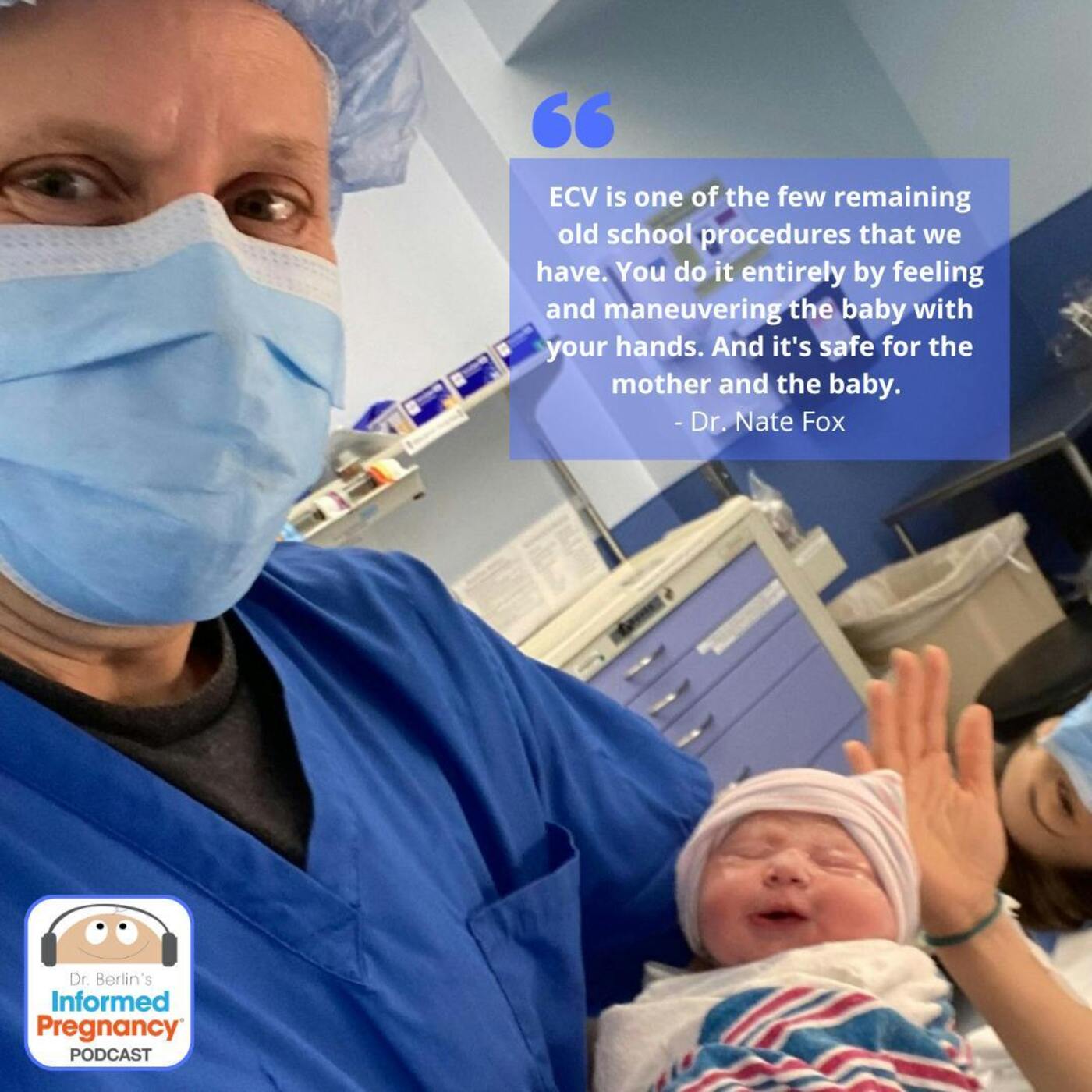
“this is one of the few remaining old school procedures that we have and it's wonderful in that sense you could do it literally with your eyes closed because it's by feel”
“how often does it work on a first time mom i would say it's probably 50-50 there's about a 50% chance it's going to work”
“i tell people like we're not going to take a jackhammer to you to move this baby like it's three minutes right it's either going to happen or it's not going to happen and then we're done”
“the ones people are usually most worried about is will it hurt the baby and again i reiterate a thousand times this is not going to hurt your baby”
“the main reason it's not done is simply because it's not offered”
Related episodes
- Ep. 295 Michele Maturo – After Birth
- Ep. 280 Kayleigh Harrigan – After Birth
- Ep. 285 Jen Lilley – Before Birth #2
- Ep. 286 Jen Lilley – After Birth (Again!)
Transcript
AI-generated transcript with speaker labels — may contain errors, especially names and medical terms. Dr. Elliot Berlin, DC appears in blue; Dr. Nate Fox in orange.
Download PDF of the Transcript
Dr. Elliot Berlin, DC [0:36] Welcome to the Informed Pregnancy and Parenting Podcast. I'm your host, pregnancy-focused chiropractor Dr. Elliot Berlin. On our show, we commonly discuss options pertaining to breach presentation when an unborn baby is not head down towards the end of pregnancy. One of the options is called the external cephalic version, which is a manual attempt to turn the baby. In today's episode, we will learn more about the external cephalic version, or ECV, and we'll discuss pros and cons of doing one or not doing one, in variations in how and when they are done. My guest today is a board-certified OBGYN with a subspecialty in maternal fetal medicine. He's a clinical professor in the Department of
[1:17] Obstetrics, Gynecology, and Reproductive Science at the Icahn School of Medicine at Mount Sinai. He's been in informed pregnancy several times in the past, giving us great insight into topics like gestational anemia, thrombocytopenia, and very helpful descriptions of the medical tests done throughout pregnancy. Dr. Nate Vox, welcome back to the podcast. Nice to be here. How you doing?
Dr. Nate Fox [1:41] I'm doing great. I was a breach baby. Fantastic.
Dr. Elliot Berlin, DC [1:46] So people sometimes ask me, how long have you been dealing with breach? And I'm like, 48 years. You should put that on your resume. Thank you for that. I'm going to write that down. Okay. So let's talk about a little bit of a background. What is the definition of breach presentation?
Dr. Nate Fox [2:04] Yeah. So breach is sort of an old term for the butt, essentially. And so when the way that we, meaning anyone, whether it's doctors, midwives, whoever's birth attendants, would diagnose the position of the baby was either done from our hands on the mother's belly or from a vaginal exam. And the thought was we would always refer to what is the first thing presenting. What's the lowest thing. So we would say breach. It meant that the butt is first. So it's head up, butt down, basically. So we still use that breach term. It sounds better than talking to a butt baby, right? That sounds a little less medical. You have a butt presentation, man. Yeah.
[2:47] And also it could be other things. So there are different types of breach presentation. Yeah. I mean, essentially, if you think about it, you're sitting on a chair, right? You can sit in what's called like a tuck position. Like you think of divers where your butt is down and like you're hugging your knees to your chest, right? Like you would if you were doing a cannon ball jumping into a pool. So that's what we call complete breach presentation. There's something what we call a Frank breach, which is sort of, if you're a diver, which is the pike position where your legs are straight, but they're bent at the hips. So like your legs are up by your head, which some of us are able to do. And some of us are unable to do,
[3:25] but fetuses are able to do that. And then there's something called the footling breach, which in fact, it's technically not the butt presenting. It's actually the feet, as if the baby's almost like standing up inside the uterus. Those are the three main ways. And you could obviously have one leg doing one thing and one leg doing another thing. That's essentially what it is. It doesn't have a huge practical implication, which one of those it is other than the footling is a little bit more complicated. Because if she goes into labor, the foot could come out, which is freaky.
Dr. Elliot Berlin, DC [3:56] And potentially complicating. Yeah. And then also there's transverse.
Dr. Nate Fox [4:01] Right. So transverse is technically not a breach presentation. That's where the baby's lying side to side across the mother's belly, left to right or right to left. Again, it has conceptually some of the same issues that breach presentation would, but we call that transverse lie, L-I-E, because it's lying transverse.
Dr. Elliot Berlin, DC [4:19] I can't believe the baby would lie. When is the right time? Because like early on, there's so much room in there and the baby's so little, they move around a lot. So when do we start caring?
Dr. Nate Fox [4:32] So it's a great question. And just to back up, the only reason we really even care that much is because at the time of delivery, the position or the presentation of the baby is going to be relevant. So it's relevant a lot nowadays because most OB-GYNs and midwives are not comfortable delivering a baby vaginally that's not head first. So that's why practically nowadays it's a very big deal because women are told that if their baby's not head first, at the time of delivery, they'll need a cesarean delivery. So that's a big deal. But even in the times when babies were routinely delivered, breach or nowadays amongst the few providers that are comfortable delivering it, it's important
[5:18] to know what the presentation is so you can sort of figure out what am I doing? What am I expecting? What types of things do I need? What should I be ready for? So that's sort of why it's an issue, so to speak. Early in pregnancy, how the baby is sort of lying means essentially nothing. When I see women in 20 weeks and 24 weeks and 28 weeks and they're like, is the baby head up? Is the baby head down? And it is what it is and it doesn't really matter for several reasons. Number one, it doesn't actually matter at that point in pregnancy what position the baby's in. It has no relevance to the baby's health or development or anything like that. Number two, the babies are rolling around all
[5:55] the time at that point because their size relative to the uterine size and the fluid is smaller so they have a lot of room to move around. And frequently I'll tell people, I could be doing your ultrasound now and 10 minutes from now the baby could be at a different position. So we don't really care in that sense because it has no practical significance and it's going to change all the time. We start to sort of think about it and talk about it as women get closer to about 36 or 37 weeks, about a month before the due date, because that's a time where number one, the likelihood the baby's going to turn on its own to head first starts to drop. Again, it doesn't reach zero. I mean, there's always
[6:32] a chance the baby could turn on its own. But as you get to 36, 37 weeks, that percent likelihood really starts going down. And number two, if we were going to do things about it, like certain maneuvers, and we'll talk about that, you would start doing it at that point. And so that's sort of the time when it comes relevant. So usually if the baby's not head first around 32, 34 weeks, I'll tell women, you know, it's still okay now, nothing to do, you know, a very good chance the baby's going to turn. But if the baby's still not head first at 36 weeks, we're going to, you know, really have a conversation about
Dr. Elliot Berlin, DC [7:04] it and what your options are moving forward. So interestingly enough, when I was doing my research, I saw Wikipedia, which is never, you know, that's gospel. I saw that they were doing ECVs, they were turn and turn babies in the times of Aristotle, a couple hundred years BC. So, you know, obviously, it was something they were thinking about that there's a benefit to delivering babies head down versus breech. And they didn't have the option to do
Dr. Nate Fox [7:32] it at that time. Yeah, I mean, the geometry is a little better for birth if the baby comes out head first, because it usually is the largest part of the baby diameter wise. And you want that part to come out because once it comes out, the rest of the body usually comes out easily. But if you're going to have a difficult delivery the head, you don't want to do it while the body is already delivered, because that can be dangerous to the baby. So if it was known that the baby was not head first, these maneuvers to turn the baby would have been employed for a very long time. But also they would be employed if women came in labor and had a really obstructed labor. And again, we're talking, you know, 100, 200,
[8:10] 300 plus years ago, when that would be literally lethal to the woman, like she would die in labor. And one of the reasons for very obstructed labor, for example, was a transverse lie. The baby can't fit if it's coming out side to side, there's no way it's going to happen. And so she'll labor forever. And so an astute midwife or obstetrician, although it's more than a, you know, 200 years ago, it was only midwives, there's no such thing as an obstetrician, they would basically realize that and try to maneuver the baby to head first, or even feet first if they had to during labor, really to save the mother's life.
Dr. Elliot Berlin, DC [8:45] Yeah. I mean, it's pretty cool to live at a time where we have advanced medical options, prefer saving moms and babies in those situations. But then on the other side, sometimes we overdo it, I think. Yeah, no, I agree. I think it's a tough
Dr. Nate Fox [8:59] balance. And I do try to keep the perspective on both ends. Number one, that the things that we do and the things that we have, there is a reason for them. It's not convenience and it's not for simplicity, you know, really bad things can happen during the delivery process. And you know, when someone says I want everything all natural, because women have been doing it for thousands of years, like, well, that's true. But women have died in labor for thousands of years. And all you have to do is go to some of the unfortunate situations there are currently in various countries around the world that don't have medical care and women still die in labor
[9:33] routinely or have horrible complications. And so that's the reason we do this. But as you said, we have to have perspective that, you know, some of the things we're doing, we're going to be doing 100 of them to save one woman or 1000 of them to save one woman. And so for those 999 women who didn't need that intervention, yeah, it's a problem for them. And so we're trying to balance doing the right thing, but not doing it too much and exactly what the right balance is people argue over, because there's no right answer. It's a difficult decision. That's
Dr. Elliot Berlin, DC [10:05] why, you know, episodes like these are designed to give people kind of more information so they could be more active participant in the decision making with their health care providers. The other thing is you said, so the numbers I have, I think, come from an older version of Williams Obstetrics, where at 32 weeks in a first pregnancy, about 90% of babies are head down, which was also interesting because at 28 weeks, it was more like 50%. So there's this huge migration between 28 and 32 weeks. And then at birth, it's only about three to four percent. So at 32 weeks, if 10% is roughly accurate, then more than half of those babies will turn by birth, but just under half of them will stay breached. So on the holistic side,
[10:52] there's a whole bunch of things that we do starting around 32 weeks, and 90% of babies are head down then to try to give the baby more natural opportunity to self-term. And then, you know, we look at kind of the ECV a bit later on, we'll talk about the timing there in just a moment, but are there identifiable reasons why babies don't turn head
Dr. Nate Fox [11:14] down? Yeah, so it's interesting just to back up. We don't exactly understand why it is that babies, for the most part, end up head first, meaning we don't quite know what the stimulus is that 97 to 98% of babies find their way to head first before birth. We don't know if it's something related to sort of the baby's brain function, that there's some signal for them to like dive down. We think there's something related to that, because interestingly, babies with very bad brain defects have a much higher chance of ending up breached. So there's probably something related to brain function. And then there's also geometry. The uterus, if you think of it simply, let's say shaped like a diamond or a triangle with a point at the bottom,
[11:58] there's this idea that, you know, when the babies are feet first, the feet are just sort of like kicking around on the bottom, this or that, and also the bulk of the baby, which is on top, is floating around. But once the baby either intentionally or randomly ends up head first, it sort of gets wedged into that point at the bottom, and it's less likely to get out. And so the first sort of reason the baby would end up head first is sort of this intention that they want to get head first. And the second is just by chance that that's how the geometry fits. It's probably a combination of both. And so some of the risk factors for being breached, you know, again, rare ones like, you know, brain issues or whatever, fine,
[12:33] but the more common ones are abnormalities of the uterus so that the uterus is not shaped typically. So there are a bunch of those, something like a septum in the uterus, which is something that comes down from the ceiling and divides a cavity in two, or something called the bicornuate uterus, where the uterus is sort of shaped like a heart. So the top is sort of indented down. And there's things like that, obviously twins and triplets, they have less room to maneuver around in there. And so that's a much higher chance of being breached. Those are the main ones. There are others that we don't, you know, if there's very low fluid, they might have less room. If there's a very short umbilical cord,
[13:10] which we wouldn't know about, that could be a reason. Sometimes you find that out after birth, or sometimes if the cord is wrapped around the neck several times, it just can't make its way down. Again, that's something we wouldn't know till after birth. But those seem to be some of the risk factors. Very big babies, interestingly, still do seem to end up getting head down. So it's not so much a function of size. And then if there's a ton of fluid, what we call polyhydramnios, the problem is they're all swimming around in there the whole pregnancy. So it sort of maintains that concept that I was talking about earlier, where there's a lot of room in the uterus. And so if you have a ton of fluid,
[13:43] at the end of pregnancy, the babies can change positions every week. It seems to be also-
Dr. Elliot Berlin, DC [13:48] Flip floppers.
Dr. Nate Fox [13:50] Yeah, it also seems to be the more babies you have. I actually don't know, I have to look on the data on this. But in my experience, the women have more babies, it's more likely to have a situation where the babies breach later in pregnancy. Meaning the same percentage of them find their way to head first. But the more babies you have, it seems to happen later. The uterus is probably a little more giving. And so they find their way at the end.
Dr. Elliot Berlin, DC [14:12] I mean, I see the same exact things that you're talking about. But it kind of makes sense if there's more room, if running out of space is a stimulus to move head down, then having lots of extra fluid and more volume space. And also a uterus that, you know, when you blow up the balloon and let the air out and blow it up again, it's easier to blow up the second time. There's less structural tension, then they'll run out of space and just turn later. So sometimes they're not really stuck. They just don't have any incentive yet to get head down. And then the one thing I would add to that on the holistic side is that we look at pelvic tension. So if the muscles and bones and
[14:51] tendons of the low back hips and pelvis are super stiff, tight, rigid, instead of having a very fluid environment, which is what the body is trying to create hormonally, you'll have a very static environment that may not be as accommodating to even incentivizing the baby to get head down or accommodating the movements once the baby tries to move. And that's what we work on more holistically. Okay, let's take a little break. When we come back, we'll talk about what you guys do medically. The external cephalic version,

Dr. Elliot Berlin, DC [16:59] Welcome back. We're talking about external cephalic version with Dr. Nate Fox. I said we were going to jump right into the ECV, but a question popped into my head that comes up all the time actually too. One is, breach a recurring event. Meaning if I have a breach baby now, am I likely to have a breach baby next time? And if I didn't have a breach baby before, does it mean I'm less likely to have a breach baby the next time?
Dr. Nate Fox [17:26] The short answer is yes. These things do tend to recur and probably because there are some reasons why babies would be breached that are related to the mother's structure, whether anatomy or uterus or pelvis. And so assuming it's the same mother, then yes, it would be linked. But again, it's not 100% because again, there's probably some reasons that are just either random or related to that specific umbilical cord or amniotic fluid. And so then it wouldn't. So I would say statistically, if the first baby you're dealing with breach, you're more likely to deal with it the second pregnancy than somebody else, but it's not 100%. So if it's 10% in the population, maybe for you, it's 20 to 30%,
Dr. Elliot Berlin, DC [18:07] but not 100. And then does that also mean that if I didn't have one with the first pregnancy, even a little less likely to have one with a subsequent? Yeah, I would say the same. Okay. And then people ask if it's familial. Like if my mother and her mother all dealt with breach, does that mean I'm more likely to have a breach as well?
Dr. Nate Fox [18:28] I think again, probably yes, but even less strong as in the same person, meaning there are probably some structural reasons why baby would be breached that would be more likely to have if your mother had it. So therefore it'd be more likely, but that's probably a little bit weaker, you know, of an association, I would say. Okay. Let's talk about the ECV. Let's start by breaking down the name. What is an external cephalic version? Right. So whenever I talk to people about an external cephalic version, I always have to start with version V E R S I O N and not V I R G I N because otherwise everyone's so confused the whole first part of the conversation why I'm talking about virginity in pregnancy.
[19:16] They're always looking to be confused. I'm like, all right, let's just put the words on paper. Fine. External cephalic version means external, my hands are outside of your body, meaning on your belly rather than doing like an internal exam or something like that. Cephalic means I'm getting the baby to a cephalic, which is the opposite of breach, a ceph is sort of the medical term for the brain or head. So cephalic means I'm getting it head first instead of butt first and version means I am changing. So I'm changing it from something that's not head first into head first. It's a fancy term for a very simple concept, right? When you tell people what I'm going to do is I'm going to put my hands on your belly.
[20:00] I'm going to feel where the baby is, and I'm going to move the baby from head first to head down by pressing on your belly. That makes a lot more sense than the term external cephalic version. And that's essentially what we do. This is one of the few remaining old school procedures that we have, and it's wonderful in that sense. You could do it literally with your eyes closed because it's by feel. You feel where the baby is, you're feeling where the head is, where the butt is, where the back is, and essentially you're trying to maneuver it from head first to head down, either rolling the baby clockwise, counterclockwise, again, depending on the position. And that's the procedure. That's what it is. Now, the upside
[20:40] to the procedure is it works. How often does it work? On a first time mom, I would say it's probably 50-50. There's about a 50% chance it's going to work. And again, we're doing this at like 36, 37 weeks, whereas if you did nothing, the chance the baby is going to turn on its own is in the order of five to 10%. So you're changing a five to 10% likelihood into a 50% likelihood. So that's good. If it's not your first baby, the chance it's going to work is probably 75 to 90%. It's much higher because the uterus is more compliant. And again, since the chance that that baby was going to turn on its own is also probably a little higher, let's say it was 20, 25% at baseline, you're increasing that to like 75 to 90%.
[21:25] So that's the upside. It's going to work. It is safe for the mother. It is safe for the baby. It does not injure the baby. They don't get born with bruises or broken bones or anything like that. It's very safe for them. The only downside is it can be painful. So we generally recommend doing it with some form of anesthesia. We usually do spinal or epidural. It's optional. It's not required, but it makes it hurt less. And also it actually increases the success rate a little bit more because we're able to do the maneuvers we need to do without someone being in terrible pain. And so, you know, pain is one potential downside. There is about a 10% chance
[22:04] of going into labor from the procedure. Like I do it, and then she goes into labor. If we were successful, fine, baby's head first, and she goes into labor. If we were unsuccessful, it means she's going to end up having a cesarean that day, not emergently, but that day. That's about 10%, give or take. And there's about a 1% or 1 to 2% chance of an emergency cesarean happening right after or during the procedure, usually because either she starts bleeding, like let's say the placenta starts separating or something like that, or potentially if the baby's heart rate drops and does not come back up. It usually drops while we're squeezing the baby and doing the procedure. But then the second we let go,
[22:45] the heart rate comes back up and it's fine. But occasionally, and by occasionally, I mean, 1 to 2% of the time, the heart rate just drops and does not come back up. And we have to do an emergency cesarean on the spot. So that's again, 1 to 2%. And for that reason, I do the procedure in the hospital, either in an operating room or right next to an operating room for that 1 to 2%, meaning I don't do it in my office. People used to do it in their office and 99% of the time, they'd get away with it. But because of that 1%, it's not worth it. That's really it in terms of risks and benefits. And most women in my practice choose to have it. And I would say the main reason women choose not to have it is because
[23:30] it's not offered to them. A lot of doctors around the country either don't do it or they don't offer it or whatever. And so women aren't given the opportunity. I would say most women given the opportunity and a discussion about it since it's really not risky and is a success rate choose to do it. In my practice, the women that choose not to do it, generally are ones who are just like, you know what? I hear you, but the whole thing just freaks me out. It doesn't sit right with me. That's okay. And I tell them, if you feel totally weirded out by this or it freaks you out or this is just scary to you, okay, then hope for the five to 10% is going to turn on its own. If not, go to C-section. And for many women,
[24:06] they're perfectly happy with that. I'm great. And then that's a fine decision.
Dr. Elliot Berlin, DC [24:09] And then I pretend for a second like I'm a woman with a breech baby and you just gave me that information and I'm going to fire all the questions at you that people tell me are on their minds about this topic. Okay. First of all, when do you do it?
Dr. Nate Fox [24:24] So we do it generally around 37 weeks with just three weeks before the due date. The reason we do 37 weeks is twofold. You don't want to do it too early because number one, there's a higher chance the baby is going to turn on its own and you don't have to do it at all. So meaning there's no reason to do to 32 weeks. Cause like you said, 50, 60% of those babies are going to turn on their own anyways. So why do a procedure? Fine. Number two, when the baby is smaller, if you do it, there's a good chance the baby's going to flip back to breach right afterwards. So it's too early. And number three, if you happen to go into labor from the procedure or need an emergency, you now delivered a premature baby. And so that's why we wait
[25:06] until at least 37 weeks. Why we don't wait longer is because as the baby gets bigger and as the baby drops deeper into the pelvis, the success rate goes down. So when I said the success rates about 50, 50 on a first time mom, and let's say 75, 25 on a second time mom, that's at 37 weeks. But if I wait till the due date, those percentages are going to be much, much lower because it's just harder to do physically to move the baby. When the baby's a pound or two bigger and the baby's deeper in the pelvis, that's actually the bigger issue is how deep the baby is in the pelvis. I would say more so than the actual weight of the baby.
Dr. Elliot Berlin, DC [25:43] Okay. So that I suppose brings me to another question about people 50, 50 overall, but personal odds with things that might make someone have as an individual a better chance of success or lesser chance of success. It sounds like the deeper they're wedged into the pelvis that seems to work against them. Yeah, I would say the biggest factor is if it's
Dr. Nate Fox [26:04] her first baby or not, meaning first baby, let's say 50, 50 second, third, fourth baby, you know, 75 plus that's a big one. Factors that make it more difficult to do is if the fluid is on the low side is one, obviously a bigger baby later in pregnancy. It's hard to sometimes give an objective gauge of how deep the baby is on the pelvis. You know, sometimes you just do it by feel and say this baby feels deep. There is actually way on ultrasound. It is actually a pretty good study that described this where we can check how much fluid there is between the baby's butt and the bottom of the uterus. And the more fluid there is, the higher the success rate, which makes sense because the more fluid there is,
[26:43] that means the baby's floating up a little bit higher in the mother. I don't use those factors as a way to discourage women from having the procedure because ultimately it's an attempt, right? If we fail, it doesn't turn okay. It didn't work, but we tried. And so I don't go too crazy into the, you know, if her baseline is 50, 50 say, oh, but the baby's a little big and oh, the baby's a little deep. You know, I don't want to, you know, 50, 50 is 50, 50. We just try in that sense, again, unless she doesn't want it. There are, again, factors like a short cord or a cord around the neck do make it less likely, but those are things we can't reliably know. And those are only things we know after the fact, I would say.
[27:24] There's also some evidence of things we can do like giving spinal slash epidural does seem to improve the success rate a little bit. Giving a uterine relaxant, what we call a tocolytic agent at the time of the procedure does tend to improve the success rate a little bit. Those are things we do to improve the success rate, not something that's sort of
Dr. Elliot Berlin, DC [27:42] inherent to the mother herself. Okay. So I'm going to keep firing away with my questions. One is about the medication that relaxes the uterus. How is that given and when is that given? There are several that are options.
Dr. Nate Fox [28:00] We usually give it literally right before, like minutes before. So we give it, if we're doing it in an operating room, in the operating room, if we're doing it in a room right next to the operating room, give it in that room, they're either given intravenously. So the mom has an IV in place or one of them can be injected under her skin, what we call subcutaneously. That's tributylene. When we do the procedure, we do recommend in our practice that you have an IV line in place. Again, we're always prepared for the worst, hope for the best. And so if there's an emergency, we don't want to be starting an IV at that time. We want to be ready to go.
[28:34] But again, you do it in 99 out of a hundred times. You don't need it, obviously. The tributylene to relax the uterus, is that to give you a better advantage or is that to try to prevent contractions or both? It's to make it easier to manipulate the baby. The more relaxed the muscle of some uterus, the easier it is to move the baby around. If the uterus is contracted and tight, it's harder to do. So yeah, that's the premise behind tributylene. The other one, the sun called nitroglycerin, which is another very strong uterine relaxants that sometimes people have used for the same reason. They're safe and they're short acting. That's tributylene. Sometimes the mom's
[29:10] heart rate gets pretty fast. And for the nitroglycerin, sometimes her blood pressure drops a little bit. Those are some side effects maybe, but they're all very short-lived because the medication clears pretty quickly.
Dr. Elliot Berlin, DC [29:20] Yeah. It's on the skippy heartbeat. It also perhaps comes along with a bit of an anxious
Dr. Nate Fox [29:25] feeling. Yeah. And there's some anxiety to begin with on this day for people, obviously, because they're about to have a procedure. We bring them into the operating room, which is a scary place, but we try to make it pretty low-key. Even though we're in an operating room, I'm not wearing a full operation gear. I'm not wearing the whole thing. I'm basically wearing just my scrubs and that's it. We have to wear a hat and we have to wear a mask in the operating room. Now we have to wear a mask everywhere, but whatever, even beforehand. But otherwise it's pretty low-key. We try to keep it calm and relaxed and light, make some jokes, try to reduce the anxiety for the procedure. And it's very
[30:00] quick. I mean, it either works or it doesn't. I tell people like, we're not going to take a jackhammer to you to move this baby. Like it's three minutes, right? It's either going to happen or it's not going to happen and then we're done. And so I think that also helps people sort of focus on the fact that this is not going to be a drawn out two-hour extravaganza to try to move this baby because it either happens or it doesn't. Without the epidural or spinal, how intensely painful would you say it is? I've never had it done to me. So hard to say for sure. You know, some of it is pain, but it's one of these things where, you know, she's awake, I'm awake and she could tell me
[30:35] like that's too much pain and I'll just stop, you know, I'll back off and that's okay. So it's not like it's automatically going to be howling pain because we gauge what we're doing to her pain level. I would not want to do a procedure where someone's screaming in pain during it. I mean, I don't think I can do that. I don't have that in me. Essentially though, when she gets that point of pain, it could limit my ability to do the procedure. Now, some people argue that you shouldn't do a spinal because maybe the pain is a good natural sort of defense against doing something wrong, doing something too much. That's not been my experience. You know, I sort of know what kind of force I'm using
[31:12] with my hands and with very equal force. Some women find that very painful. Some women don't. Some women express their pain differently than others. And so there's so much that goes into the experience of pain, obviously, that I sort of know how I do it and how hard I'm going to press and how hard I'm not going to press. And I find that if they have the spinal, A, they're generally very comfortable during the procedure. And if they don't have the spinal, they tend not to be. And B, there's this involuntary contracting of their abdominal muscles, right? Women can't choose to contract their uterus, but they can contract their abdominal muscles, right? They can squeeze their belly. And so if I'm grabbing
[31:50] their belly, they're going to do that, which also makes it harder to do the procedure because these are muscles around the muscle around the baby. And so they're all tight. It's going to make it harder for me to do. So I think that that's part of the reason it's not just pain. It actually makes it easier to maneuver the baby if her belly is quite relaxed.
Dr. Elliot Berlin, DC [32:10] So interestingly enough, it's a three minute procedure set on average. And even within that, I assume there's some trying to turn, take a little break, trying to turn maybe the other way. So the total time of pain is relatively short. And I think that's why in my patient base is a little skewed because obviously they're into things like chiropractic and acupuncture and maybe more a little holistically minded to begin with, but let's say about 90% of our patients don't opt for the anesthesia. And once in a while, I'll see them not do the anesthesia and it doesn't work and then get another shot to do
Dr. Nate Fox [32:47] with anesthesia. Yeah. I mean, again, a lot of this is just sort of practice patterns. It's certainly quite reasonable to do the procedure or attempt the procedure without anesthesia. It's totally fine. And if that's what women want, I'm happy to do that for them. It's no problem. It's just been my experience that it hurts and that also it doesn't work as well. But as you said, sometimes it's really straightforward. I mean, I had a patient about three weeks ago who I was doing the procedure on and I'm on the labor floor and for people haven't seen it before, there's two medical students who come in and there's a resident who comes in and there's
[33:18] a patient and her husband's in the room. There's like 15 people in the room and they're expecting this big thing. And literally I walk up, do a quick ultrasound, see where everything is, put my hands on and within four seconds, the baby's head first. And everyone's like, that's it. I'm like, that's it. We're done. And basically just check the heart rate and you can go home. And sometimes it works like that. And sometimes, yeah, it's like two, three minutes. We try forward, we try backward, we try forward again, take a break, do this, do that. And it just doesn't work. And there's everything in between. So again, I would agree. Where I practice, most of the women choose to get the epidural,
[33:51] but those are also 90% of them are getting epidurals and labor. And it's just sort of a different population. But if our practicing and the population is 90% of women don't want an epidural or a spinal before, fine, that's okay. You know, God bless. It's for pain relief. Again, I think it improves the success rate a little bit, but ultimately that's a choice someone's going to make and I'm fine either way.
Dr. Elliot Berlin, DC [34:12] All right. I have a few more questions. Let's take another little break. We'll be right back. Welcome back to the Informed Pregnancy Podcast. We're talking to Dr. Nate Fox. This is why I love having you on the podcast. One of my favorite guests. You are so open-minded and you take kind of complicated things and take the time to explain them so that the person who's having it done really can make an informed choice with you. I anecdotally see the ECV. This is based on feedback from lots of people who do them, who've had it done. As the blind men and the elephant, where a village of blind men is curious what an elephant is like. So they send out three guys to go find one and they all come back with
[35:05] very different reports. One says it's very hard and smooth. One says it's soft and floppy. And one says it's kind of rough. And so they were feeling different parts of the elephant and that's the feedback on the ECV that I get. Like you said, sometimes they'll go in and then be bracing for this very long, intense, painful thing. And you essentially touch the baby and they pop over to the other side and you're all done. Sometimes it's a lot of struggle. And of course there's everything in between. I will say most of my patients who have done it, whether it worked or not, don't regret having done it. Although there are a handful that do. And in all the years that I've been involved with
[35:44] Breach and the volume that we do, I've really never seen anything go terribly wrong. And, you know, once in a while, like you said, labor will start, water will break. But more than that, I think a couple of emergencies, these sections for heart rate and one partially traumatized placenta, but it was her second baby. The baby was monitored and she gave birth vaginally anyway. So a good amount of success and not that much downside, but the way risk works is the only person who could determine if it's safe or risky is the person who has to go through it. So that's why we try to get all this information for them. A question that I forgot to ask earlier is about Breach just in general. Is
[36:26] the fact that my baby is Breached towards the end of pregnancy indicative that there's
Dr. Nate Fox [36:31] something wrong with the baby? It's a really good question and it's a legitimate question. The short answer is no, but just so you know, this is where I headed with this, but it's a legitimate question because you will absolutely read this out there in the Google, of course, but even in some older, like obstetrical literature and textbooks. And the reason is twofold. Number one, like I said, there are rare instances where severe brain abnormalities are more likely to be Breached, but those abnormalities tend to be ones that we would have picked up earlier in pregnancy. Certain genetic abnormalities are severe brain anomalies. And so nowadays with a normal looking baby and all the testing is
[37:15] normal on the baby's Breach, basically, no, I tell them, no, this is just your luck of the draw. That just happens to be this way. The other reason it might be the case is in the past, there have been babies who have very difficult Breach deliveries. Again, most of the Breach deliveries that happened in the past were fine and smooth and everyone's okay, but from time to time, it wouldn't be so easy. It'd be very difficult. And the baby had issues after birth. And was it because the baby was Breached inside? No, it was a process from the delivery. And so when I see women at 36, 37 weeks, some babies Breach, and they asked me that question, I essentially reassure them, no,
[37:55] your baby's fine. Everything's looked fine until now. This is luck of the draw, and we'll figure out what to do about it. What about the hips? Oh, so babies who are Breached for the whole pregnancy, just based on the geometry of it, are more likely to have after birth, sort of either loose hips, or occasionally congenitally dislocated hips, which sounds a lot worse than it is actually, because the treatment for it is pretty straightforward and usually is not surgical or anything like that. It's just light physical therapy or harness the baby, but it is more likely that babies are Breached the whole time. Because if they're in that sort of Pike presentation, what we call the Frank
[38:35] Breach with the legs straight up, I mean, it's like, you know, you're getting a lot of stretch on those hips the whole pregnancy. Are there contraindications to doing external self valid version? So yeah, I mean, the biggest contraindications are just situations in which she shouldn't be delivering vaginally anyways. So it's more the contraindications of the vaginal delivery, not the versions. Like if there's a placenta previa, you're not going to be doing an external self valid version, but not because the procedure is specifically dangerous, but because what's the point in doing it if she shouldn't be delivering vaginally anyways. One of the biggest, I would say two of the ones
[39:10] that come up a lot that are not contraindications, but are sort of cautioned is what if her last delivery was a C-section? Does that make this procedure more risky or less successful? And the short answer is we don't know. It seems to be safe in women who had a prior C-section, but I always qualify that with seems to be right. There's a ton of data on the safety of an external subvalid version, but in almost all of that data, women with prior C-sections were not counted or included. So I can't give them the same level of certainty, but it's probably safe, but it's possible as a higher rate of complications if there's a prior C-section or two or whatever it is. So that's one thing that comes up. We still do it in
[39:54] those circumstances, we offer it, but I can't be as confident on the safety, let's say, as I would otherwise. The second is if the baby, let's say, is very small, like growth restricted or suspected growth restriction. Now you would think geometrically, make it easy to turn the baby and that might be true, but the question is, is it as safe for the baby to start doing those things? If there's some concern, maybe over the baby size, over the placental function, things like that. And again, it's a circumstance where we just don't know. And so we do those case by case, whether we offer it or don't offer it, whether we think it's safe or not to do for the baby. Does the placenta location make a difference?
[40:36] If it's anterior, which is sort of on the top meaning towards the front of her belly, excuse me, point of the uterus, it makes it a little bit harder because you're not grabbing the baby as easily. There's more layers between your hands and the baby, so it makes it maybe slightly more difficult, but it's not a contraindication or anything like that.
Dr. Elliot Berlin, DC [40:53] Is there an extent to which the placenta location may be causing the breach?
Dr. Nate Fox [40:58] Not that we know of. It would be more the cord than the placenta, but not that we know of.
Dr. Elliot Berlin, DC [41:03] Okay. And you talked about fluid volume. Can you give us a little more insight about
Dr. Nate Fox [41:08] how that's measured and what the scale looks like? Yeah, we measure fluid volume three ways. The oldest way is to just look at an ultrasound and say it's low, normal, or high, which is actually pretty irrelevant, actually. You'd be surprised how it seems so simple, but it's true. If you have someone who's experienced who looks and says your fluid's low, it's low. And if they say it's high, it's high. Numerically, there's two ways we measure it. The first way is called the amniotic fluid index or amniotic fluid volume. And essentially, it's an ultrasound procedure. We divide the mother's belly into four quadrants with the belly button as sort of like the midpoint.
[41:45] And then in each of the four quadrants, we measure the amount of fluid. We measure the deepest pocket of fluid in each of those four quadrants in centimeters. And then we add those four numbers up. So if let's say like her right upper quadrant was three centimeters and her left upper was two, and her left lower was six, and her right lower was one, three, two, six, one, that's 12. So that would be 12. So we'd say her AFI is 12. And then normal at the end of pregnancy is between five and 24. So there's a big range, right, of fluid. Under five, we call low. Over 24, we call high. And of course, there's various degrees within that as well. 24 is different from 44. And 4.9 is different from 0.9. So okay,
[42:27] the other way to do it is called just the maximum vertical pocket or the deepest vertical pocket. And that's where we look all over her belly, find the biggest pocket of fluid and just measure it. And normal is between two and eight centimeters. In our unit, we do the amniotic fluid index and the maximum vertical pocket. We do both. You might as well do all three. Yeah, we do. I mean, ultimately, you know, literally, it's fluid, right? It changes. And this is its own science. And, you know, when do you worry about it? When do you not worry about it? You know, how do you follow it? And it's literally, it's its own podcast. Literally, in our podcast, we did one about just high fluid. We didn't even do it about fluid,
[43:06] like just having high fluid is at least a 30 minute conversation about what exactly that means and when do we care? When do we not care? For turning babies, high fluid is good. It's easy to turn them. Low fluid, harder to turn them. Easier to turn them, but more likely that they'll turn back? It is. But if you're 37, 38 weeks, unless the fluid is like crazy high, like I said, a little bit high, like you'd rather like a 20, which isn't high, that's normal, but high normal is certainly better than six. If you're trying to turn the baby, if it's technically high, like it's 30, yes, you could turn it. If it's 40, it's more likely to turn back. But again, it's one of these things where each situation
[43:42] is different. And so we individualize it. But in general, if there's fluid,
Dr. Elliot Berlin, DC [43:46] it's easier to turn the baby. Okay. My last question for you is, I noticed that here in Los Angeles, there seem to be two ECV protocols, one for 37 weeks, just as you described and another one at 39 weeks. Tell me about that one. You know, we have the same thing,
Dr. Nate Fox [44:06] you know, Ryan on the East Coast, but it's the one we prefer. And the one we try to do is the 37 week one, because again, like for the reasons I said, it's more likely to work in all these things. The reason you would do it at 39 weeks usually is because you don't know the baby's breach till 39 weeks. Either the baby wasn't breached and turned on its own after 37 weeks, or for some reason it wasn't checked. Okay. And the reason you do 39 weeks is that's sort of like our magic time where we would quote unquote, electively deliver someone 39 weeks, meaning there's pluses and minuses to doing that, but there's no concern for the baby. If you say, all right, we're going to deliver you. So for example, some people will say,
[44:44] let's try to turn the baby at 39 weeks. And if we're unsuccessful, you're already in an operating room. You already have anesthesia. We'll do a C-section on the spot because that's when they would do it. And if we're successful, we'll either induce your labor or send you home again, based on the circumstances. So that's why you do it 39 weeks. Again, the problem with that is you're more likely to be unsuccessful. So you're almost, it's not that you're setting someone up for a C-section because you could be successful, but you're more likely to be setting someone up for a C-section. And so I would prefer to do it at 37 weeks. And if they're unsuccessful, send them home, wait two more weeks. And again, the baby still
[45:21] could turn on its own. We've had that. I've had situations where I could not turn the baby at 37 weeks. It did not budge, was not happening, sent them home. And two weeks later, at the time of their C-section, babies had first done. They go home. They don't have their C-section. So anything can happen. It's also not ideal to induce someone right after you turn the baby. And maybe we do it if we have to in certain circumstances, but you really, when the baby's at first, you want to give the baby some time to sort of like nestle into the pelvis properly. You're more likely to deliver if the baby can sort of negotiate some of the early geometry of the pelvis on its own, rather than just
[45:59] trying to like force it in there. And so there is pretty good data that after an external cephalic version, if there's more than like four or five days before they go into labor on their own, their chance of a vaginal delivery is higher. Meaning if you do it, and then they go into labor right away, they have a higher chance of a C-section during labor than if you do it. And a week later, they go into labor on their own.
Dr. Elliot Berlin, DC [46:21] I mean, that makes logical sense. And I sort of picture that like the last 10 minutes when they say we're making our final approach into the Los Angeles area, all those wing flap maneuvers and lining up with the runway. If that didn't have a chance to happen, I would be holding my breath even more than I normally do when the wheels touch down.
Dr. Nate Fox [46:39] All true. Definitely true. I see the 39 week here usually as a redo. So they try a 37, you know, and then at 39, they're really going in for the caesarean, but they give it one more. Yeah, we've done that. But that second hurrah, if it didn't work at 37 weeks and the baby still breach at 39 weeks, I don't know if anyone's reported what the success rate is in that circumstance. But I imagine it's really low. And even if you're successful, again, the question is, what's your chance of a c-section and labor afterwards? It's probably much higher. So, you know, yes, your chance of agile delivery goes from zero to some number greater than zero, but it may not be a huge benefit in that particular circumstance.
Dr. Elliot Berlin, DC [47:23] Okay. Is there a common question you get that I left out regarding ECV?
Dr. Nate Fox [47:28] I mean, you know, you asked all the good ones. The ones people are usually most worried about is will it hurt the baby? And again, I reiterate a thousand times, this is not going to hurt your baby. That's not the thing. And the other thing, a lot of people always ask me, why wouldn't I do this? Right? Like, why would I not do this? And I think someone who asked that question probably should have it done. Because if in their mind, they're not thinking of a like, oh, this is horrible. Like, this sounds fine, then they should do it. And like I said before, I think for people who are listening to your podcast, and the baby's breach and they're approaching 34, 35, 36 weeks. And again, if they're
[48:05] intending a breach of agile delivery with their provider, fine, then they don't necessarily have to talk about this. It's not what I do, but okay. But if no one's brought it up with them, I would say that that's the issue. Meaning the main reason it's not done is simply because it's not offered. Not everyone is providers comfortable doing this or skilled enough to do it. It's not that hard to learn. You just have to learn it again. It doesn't take great training to figure out how to do this. You're taught and you learn how compared to other things we were taught to do. But I think that just some people aren't given the opportunity for this, which I personally think is unfortunate. And so that would be a time to maybe ask, hey,
[48:41] is this something you offer? And if not, do you ever refer to people? We do it for, we have a lot of midwives in our community who don't do this procedure. But if the baby's breach, they refer them to us specifically for, we do an ultrasound, we do a consultation. If they want it, we attempt the procedure and then we send them back to the midwife. If it's unsuccessful, generally the midwife has to refer for a C section anyways, if they're not doing breach deliveries. But that's an option for people sometimes. And even if your doctor or midwife doesn't offer this and you don't want your doctor doing it, if they don't know how, obviously, you know, it's not a problem to
[49:14] not offer it yourself, but you should ask, is there someone you can send me to who might do this for me? And then I'll come back to you for delivery. Right. You know, it's sort of
Dr. Elliot Berlin, DC [49:22] like if I'm going to my GP and something comes up that requires a little expertise or specialty, then you make that referral. And so that's true during pregnancy. When you find out your breach, some of the options are only offered by certain providers. Yeah. And this is not,
Dr. Nate Fox [49:40] you know, I'm quote unquote, a high risk pregnancy doctor or maternal fetal medicine. This is not unique to us. It's not like in our high risk training, we spent all our time learning how to do this procedure. I learned how to do it in my residency, meaning it's an OB-GYN procedure. A general OB-GYN absolutely is capable of doing this if they're trained to, if you know how to do it, you know how to do it. It's like a caesarian. I'm not better at doing a caesarian because I'm a high risk doctor. I'm trained to do it because I'm trained to do it. And so it's not something you need to seek out specialty care to get it done. Just if someone knows how to do them and they're doing them,
Dr. Elliot Berlin, DC [50:11] then they should be good. All right. Dr. Fox, thank you as always for your deep insights and just your very calm way and level-headed way of explaining everything. I appreciate it. And so does our audience. And if they wanted more of you, well, number one, you have at least one podcast. We're back to one. We've combined
Dr. Nate Fox [50:29] our two podcasts into one. Make it easier. We're user-friendly now. One podcast.
Dr. Elliot Berlin, DC [50:32] And you still practice. You're practicing over in New York. How can we find you online?
Dr. Nate Fox [50:39] So online for our podcast, you can either go to wherever you get podcasts or go to the website. The podcast is called Healthful Woman. That's W-O-M-A-N. And my practice website is M-F-M-N-Y-C.com. M-F-M like maternal fetal medicine. N-Y-C like New York City.com. And I'm somewhere buried in that website as well. What about social media? There is a Healthful Woman Instagram. There is a Healthful Woman Twitter, I think. And there is a Healthful Woman Facebook account.
Dr. Elliot Berlin, DC [51:11] So I don't know. I guess search for them. I'm gonna go find it and we'll put it in the show notes. Thank you. If you're curious about us, you can always find us online at informedpregnancy.com. We're by the way, we have a brand new blog. Maybe we can get a guest blog from Dr. Nate Fox. Oh, yeah. I'd like to blog that I can do. Okay. Perfect. That goes back to your time. All right. At home, thanks for listening to us. And Dr. Fox, we hope to have you back soon.
Dr. Nate Fox [51:38] Thank you. Nice to be here.
Want more pregnancy + parenting? Start your FREE TRIAL of Informed Pregnancy+ and get access to all our curated pregnancy and parenting content — original series, iconic birth films like The Business of Being Born, prenatal workouts and more.