May 12, 2022 · 49 minutes · Episode 281
About this episode
Board certified child and adolescent psychiatrist Dr. Anjani Amladi sheds light on how to prevent, recognize, and remedy anxiety in children, especially in light of heavy world events.

This podcast has been brought to you in part by LMNT electrolyte drink mix. You can get a free sample pack with every order at drinklmnt.com/berlin .
Learn more about your ad choices. Visit megaphone.fm/adchoices
See Privacy Policy at https://art19.com/privacy and California Privacy Notice at https://art19.com/privacy#do-not-sell-my-info.
Key quotes
“Kids are worried about what might happen to my family, what might happen to our home, what happens to grandma and grandpa if I have to go to the hospital, what happens if they don't come out, what happens to me if something happens to you, i.e. primary caregivers and things like that.”
“So what I tell most of my, actually all of my parents, is the better managed you can be with regard to your anxiety, the easier it's going to be for your kid to look to you and know how to respond.”
“But the best advice that I can give you is that let's not overreact but let's not underreact either because kiddos are very, very astute observational beings.”
“But if you are a parent who's concerned about your child, you don't have to wait for that to be what is occurring to reach out for help. So when in doubt, reach out.”
“So we always talk about, yes, there is a risk to treating, but we don't really talk about the risk that presents itself by not treating either.”
Related episodes
- Ep. 290 Better Breastfeeding with Dr. Linda Dahl
- Ep. 295 Michele Maturo – After Birth
- Ep. 280 Kayleigh Harrigan – After Birth
- Ep. 277 Kelly Kilmartin – After Birth
Transcript
AI-generated transcript with speaker labels — may contain errors, especially names and medical terms. Dr. Elliot Berlin, DC appears in blue; Dr. Anjani Amladi in orange.
Download PDF of the Transcript
Dr. Elliot Berlin, DC [0:58] Income welcome to the informed pregnancy and parenting podcast. I'm your host Pregnancy-focused carpenter dr. Elliott Berlin. My guest today is a double board certified adult and child adolescent psychiatrist and the author of a children's book about how parents can help their kids and Help themselves get through this long difficult pandemic era. Dr. Anjani. I'm Lottie. Welcome to the podcast
Dr. Anjani Amladi [2:01] Thank you
Dr. Elliot Berlin, DC [2:02] Okay, you're very interesting fascinating. Let's just start at the beginning. How did you get involved in medicine and psychiatry specifically?
Dr. Anjani Amladi [2:10] So I've always been interested in science and math ever since I was a kid But I didn't really know how I wanted to apply that until I started getting older And I think the first time I really became interested in medicine Specifically was when I started volunteering at a hospital in high school I was just an extracurricular activity to learn a little bit more about the medical system and I just fell in love with medicine so when I Volunteered I knew almost immediately that that is a career path that I wanted to choose and then when I got into medical school, you're exposed to a lot of different rotations and psychiatry is the one that really matched my
[2:55] Personality, I think the best I find people's stories very fascinating and I love learning about people So it allowed for me to spend a very long time getting to know my patients over time Which is probably one of my favorite things about it
Dr. Elliot Berlin, DC [3:09] Yeah, I used to work in ambulances and what happens is an emergency room So, you know somebody comes in with something big you do your best, but that's the end of the relationship You know, you know oftentimes never find out what even happened. So Now in my current practice I get to work with people especially through a pregnancy and postpartum journey And it's really a nice way to support somebody very differently to be with them through the changes and the high points and low points You have adult psychiatry and then you also have adolescent and pediatric psychiatry and they're pretty different. Why both?
Dr. Anjani Amladi [3:45] so one of my Attendings when I was in medical school and then and again actually in residency Said that the best child psychiatrists are good adult psychiatrists first so part of the training process is that you start with adults and then when you obtain Your adult residency training You do get a little bit of exposure to child and adolescent psychiatry But if you want to specialize in children, you actually have to do an additional two years of training So during my adult residency, I actually really learned that I Enjoy very much so working with kids and families. So I applied to do the extra training and absolutely just fell in love with it
[4:33] So now do you do both? I do I do do both. I mean, are they different? Absolutely. They are very different. So Usually for Adult patients, especially if they're older you don't really get to see the whole system that they work in or live in So the adult that comes to see you it's essentially the relationship between you and them. But when you see a child or an adolescent, for example, you get to see so much more of what it's like for a child to live in a family unit or a family system. So you get to meet parents and sometimes you get to meet siblings, sometimes you get to speak to teachers, and you get such a more well rounded visual of what this child looks like in
[5:22] his system. You don't always get that with with adults.
Dr. Elliot Berlin, DC [5:26] It's kind of interesting because I also talked to some, there are doctors who do home visits, which was how doctors always did visits, and then it went completely the other way. And now there's like elements of it coming back. And one of the doctors I talked to recently just said, there's a lot more I can learn about my patient by going to their environment than when they come to me. And that's it sounds like you have that with your child patients.
Dr. Anjani Amladi [5:51] Absolutely. And I think what has been fascinating is that pre pandemic when everybody was coming into the office, you really don't get a very well rounded view of what that child looks like in their system. But with the admin at telehealth, so I do a lot of my actually almost all now because our group private practice offices are actually completely closed still because of the pandemic. And through telehealth, you actually get to see kids and even adults in different environments. So in their homes, or sometimes they take the call from school, or sometimes they take the call from family members houses. So you get to see a little bit more which can be really helpful clinically. And it's
[6:36] added a lot of more information, more data that can be helpful during visits, as opposed to patients just coming into the office. And that's the only snapshot that you see.
Dr. Elliot Berlin, DC [6:48] That's so interesting how technology reversed what I was just talking about. But it's bringing you into their home, even though you're not face to face and deeper into their world. I like that. When it comes to psychiatry, what tools do you have at your disposal to help with the problems that people come in with?
Dr. Anjani Amladi [7:12] Mostly see children. So I do see adults, but the vast majority of my practices is with children. So I think the most common reason that patients and families come to see a psychiatrist is because they are interested in medicine. So sometimes when symptoms are severe enough, and they've tried therapy, and they've tried occupational therapy or physical therapy, depending on what the ailment is, most of the time when people come to see a psychiatrist, they're expecting to be prescribed a medicine. But that's not all that we do. So we have a background in therapy, so talk therapy. So myself, for example, I have a background in cognitive behavioral
[7:58] therapy, psychodynamic psychotherapy. And although I may not be as robust of a background as, say, a psychologist, we still have tools that are non-medicine that are available to us. I think one of the greatest strengths that we have as being clinicians in an environment that we are well-versed in is that we know what our resources are. So for example, if I see a patient in a family who are either interested in a second opinion for diagnosis purposes, or maybe a second opinion about what medicine they're taking, or even a family, for example, that's not interested in medicine because that's not something that's in their value system. And then being able to tap into the resources
[8:43] that you know are available to get them to where they need to go is also a large part of what we do. So making additional consults or referrals, or helping people kind of find you in their treatment journey in a way that fits with their value system is a very large part of what we do as well.
Dr. Elliot Berlin, DC [9:04] So do you sometimes do talk therapy without pharmaceutical?
Dr. Anjani Amladi [9:10] I do. I do. It's a little bit less now than it used to be when I was, for example, in residency or fellowship. And the reason for that is because the more specialized you become, the fewer providers there are. So for example, I see adults and children, but there are many more adult psychiatrists that exist than child psychiatrists. So the more specialized you become, the fewer of us there are. So the vast majority of people that do see me are interested in medicine because they want somebody who has that experience and that training and that board certification to responsibly prescribe medicine in a population that most people, like general pediatricians or even developed
[9:57] developmental pediatricians, are just not. super comfortable with. So just by default, I think having that extra specialization, the vast majority of kids that I see are kids whose families are interested in medicine.
Dr. Elliot Berlin, DC [10:10] Right, that makes sense. As you climb the ladder of specialty, it's almost like a pyramid. There's a lot of people underneath you in training wise that can do the things that you were doing previously, but very few at your level or above who can do what you do. Okay, before we take a break, you mentioned two things, CBT and psychodynamic. Can you describe a little
Dr. Anjani Amladi [10:30] bit the difference between them? Sure. So cognitive behavioral therapy is a very interesting therapeutic modality. And it essentially, if you draw a triangle, there are three points of that triangle. So the idea is that thoughts are at one point, behaviors are at another point, and feelings are at another point. So if you think about the triangle in and of itself, if you put double headed arrows on each side, all of these things interact with each other. So when you think about cognition, behavior, it all interacts with each other, and it's all related. So when you change your thoughts, then your behaviors and your feelings by default of a piece of that system have to change. So it's a lot of fine tuning of how our thoughts affect
[11:24] our behaviors, which affect our feelings and emotions, and really refining those to make it easier for somebody to sit with the thoughts and feelings that they have and manage them in
Dr. Elliot Berlin, DC [11:37] a healthier, more positive way. I have no idea if this is an example of what you're talking about, but I wonder, I was once told like in relationships, if you're in a relationship, let's say marriage, and you drift apart a little bit, you know, feel the connection that you once had, that you should start to change your actions to things that you would do for somebody that are nice, as if you were feeling the close bond, and that over time, your chances are that your feelings are going to change because your behavior has changed.
Dr. Anjani Amladi [12:07] Absolutely. And one of the things that I tell my families and even my individual adult patients is that when you as an individual are changing a piece of the system, by nature of you changing, everything in this system has to shift somehow. So if you leave everything the same and you don't do anything different, then the system stays exactly the same. But when you start changing things and the other people around you by nature of being connected in that system have to change as well. It's usually not conscious unless, you know, somebody is actively working on changing their thoughts or their behaviors or their feelings, but everybody in that system has to adjust when one person changes.
[12:52] So you have the power to change not just your own weather, but the weather of the community around you. Absolutely. Absolutely. I mean, if you think about in a family, if one person comes home and has a terrible day, and, you know, every other word out of their mouth is how terrible and how awful things are, it affects other people in the system, right? So as opposed to that same person maybe having a great day and sharing all these really wonderful things that have happened, it changes the dynamic of the system quite drastically. So I love family systems work and systems work in general. I think it's
Dr. Elliot Berlin, DC [13:26] fascinating. Yeah. And also you could have a mediocre day and focus on either the things that were good about it or the things that were bad about it. And that makes a big difference. And then how is that different than psychodynamic? So psychodynamic therapy
Dr. Anjani Amladi [13:41] focuses more on the psychological roots of emotional suffering, essentially. So it involves a lot of self-reflection and self-examination. And it uses the relationship between the patient and the therapist as a means to kind of figure out what is problematic in relationship patterns in the patient's life. So for example, if we're talking about systems and we're talking about an individual who has a specific difficulty or multiple difficulties with relationships outside of the therapeutic venue, so outside the office, the relationship that the therapist and the individual has reverberations of the types of relationships that this person has outside of the treatment setting. So what happens is, is that eventually over time,
[14:40] when you get to know each other a little bit better, these patterns start to play out in the office. And so the idea is to work through self-reflection and self-examination and the use of that relationship to heal other relationships that exist outside of the office.
Dr. Elliot Berlin, DC [15:00] I feel steep. I hear what you're saying. Now I understand why all the training is necessary. Yeah. You did all your training speaking of which before this pandemic situation took place and then the world broke and I'm sure that affected your clientele in a deep way. Let's take a quick break and we'll be right back to discuss.

Dr. Elliot Berlin, DC [17:44] Welcome back. We're talking to Dr. Amladi. And I don't know if I ever pictured in my lifetime that something as dramatic would happen as did to the entire world. For us, it started with a bang because right when people started talking about this new bug, I got it and ended up in the ICU for a while. And they had no idea. They didn't know what it was. They had no way to treat it. They just was like, you know, if you can breathe, breathe, if not, we'll put you on a ventilator and hope for the best. And, you know, it was scary for me, but even more scary for, I think, in ways, my wife and our four young kids. That's just my own personal story. But everybody has been affected by this in
[18:34] some way, whether it's something dramatic health wise or just everything changing. I remember the first time we put on a mask to go outside and how weird it felt. And my kids were like, no, we don't have to do that, do we? I'm like, yeah, this is how it's going to be for a while. And then even at some points when, you know, the numbers spike or valley, all of a sudden you can take off your mask. And then it feels really weird not to have a mask. I have prosopagnosia. I don't recognize faces. And I spend my life trying to deal with, you know, how to interact with people with no face in my mind. But that's something that all of a sudden everybody else
[19:12] has to deal with. Like you're communicating with people, not in person. You can't see a good portion of the face. And, you know, for other people, it's losing a business or financial concerns about how to put bread on the table. There's so much. It's such a big thing. And it's something that we usually even in real life watch on TV on the news. But no matter where you are in this world, this has affected you. How has that impacted your work?
Dr. Anjani Amladi [19:41] That's a really great question. So, you know, I finished my adult psychiatry training pre pandemic. And the interesting thing about my child and adolescent psychiatry is that I finished about three quarters of it. And then the pandemic hit. So I have kind of a unique perspective in that I was seeing kids and families before the pandemic, when the pandemic first hit, and even after it's been around for quite some time. So I think it's kind of a unique perspective. So I would say that clinically what I see in my practice has always been the most common thing that I see has always been anxiety. But I think the subject matter of that anxiety is what has changed the most.
[20:32] So a lot of times pre-pandemic kids are most anxious about school and social relationships and socializing in general. That's probably where most of the anxiety comes, at least from what I see in clinical practice. But now, after the pandemic hit, anxiety is still the most common thing that I see clinically. But the flavor of it has changed quite significantly. Kids are worried about what might happen to my family, what might happen to our home, what happens to grandma and grandpa if I have to go to the hospital, what happens if they don't come out, what happens to me if something happens to you, i.e. primary caregivers and things like that. So that the flavor of the anxiety has changed quite significantly.
[21:26] And I would say for the first maybe three to six months, into the pandemic, I mean, my practice really didn't change too, too much. But I think in around the six month mark, when kiddos and families realized that this is probably not going to get any better anytime soon. That is when the mass influx of seeing more kids who had never had anxiety before, who had never had depression before, who don't have a family history of either before, started coming into my office. And that was the biggest change. So the number of people affected by anxiety also increased in addition to the type of anxiety or the source of anxiety.
Dr. Elliot Berlin, DC [22:14] Absolutely. And are there tips for parents? I mean, let's give perspective. Right now, we're at the point of the pandemic, at the time of this recording, where it seems to be shifting to an endemic. And it seems to be that the strains of the virus, the coronavirus, have become more transmissible and less dangerous. They don't really attack the lungs, or certainly not the way that they used to in large numbers. So with even more people getting infected, there's fewer people hospitalized and dying. And if that continues, that becomes something that we just get used to. And masks are sort of going away in at least, look, I'm in Los Angeles, which we're like the last to get rid of things like that.
[23:10] So even here, you can go indoors into most establishments and wear a mask if you want to and not wear a mask. If you don't want to, shutdowns are done. Schools are back in person for the most part. And even there, they're relaxing masks and there are vaccines. We've come a long way. And if people get sick, really sick, we have better therapeutic options for them. But I do think that it's kind of rocked the world and rocked our individual worlds. And I wonder how, at this point, and we don't know the future, it could go back to a strain that's very dangerous and very transmissible, which would be a disaster. But how do we move forward? Let's say you're not at the point where you need medication,
[23:54] but your kids are just anxious from living in this era. And there's lots of other junk going on in the world that's also devastating. So what do you do with your kids to sort of help them process and kind of not be afraid?
Dr. Anjani Amladi [24:13] Yeah, that's a great question. So two points that I want to make. So a lot of times, not always, but a lot of times, anxious kiddos have anxious parents. I know I'm an anxious person and I have an extraordinarily anxious pad. So I know where my anxiety comes from. So I think a lot of times when kiddos are anxious, they look to their parents or their primary caregiver at how to respond. So a lot of times when parents are not aware of the anxiety that they may be kind of projecting to their kiddos, it makes things a little bit more complicated, right? Because if you're telling your child… things are getting better, things are getting safer, this is why you're back in school,
[25:03] but you yourself are exhibiting a lot of anxiety, it creates a lot of confusion for kids, which then increases anxiety. So what I tell most of my, actually all of my parents, is the better managed you can be with regard to your anxiety, the easier it's going to be for your kid to look to you and know how to respond. So for example, if you go into a grocery store and hypothetically say, oh my goodness, this person's not wearing a mask, we have to get away from them and hold your breath when you walk past them, it's very different than, oh look, so it looks like there are quite a few people here that are not wearing masks, so maybe what we'll do is we'll come back later
[25:48] when there aren't as many people there and we can do our shopping for them. It's a very different response to the exact same situation. So the calmer and more aware of your anxiety as a parent than you can be, that translates directly to your kiddo because they're looking to you to figure out how to respond.
Dr. Elliot Berlin, DC [26:10] I don't mean to control, but just on that first point that you made, when we feel as parents anxiety about those things, should we hide them from our kids?
Dr. Anjani Amladi [26:19] That is a great question and that is going to be the second thing that I was going to say. That's the second thing that I was going to say. When there is a situation like exactly what we're talking about right now and there is a very valid reason to be nervous, the flip side is also true, how we don't want to overreact to things that are worthy of a reaction. We also don't want to underreact to situations that are worthy of a reaction. So there's a happy medium, right? So if kiddos say, I'm scared to go to school because applying these classrooms are really small and there's a lot of kids in there and not all of them are wearing masks and parents make a statement like,
[27:02] oh, it's going to be fine. Everything's going to be okay. It dismisses the concerns that are reasonable that kids have. So there is a happy medium and it's really difficult to help parents exactly walk the line because there is no right answer as to how you standard or have these discussions with kids. But the best advice that I can give you is that let's not overreact but let's not underreact either because kiddos are very, very astute observational beings. And when you tell them, oh, everything's fine, everything's okay but they don't feel fine and okay, that also creates the opportunity for confusion which then indirectly increases anxiety.
[27:53] So we want to make sure that we're validating the concerns that kiddos have. So for example, I'm nervous to go to school because not everybody in my class wears masks and opening up the discussion about what you as an individual have control over and what you don't because although you have the ability to wear your own mask, you don't have the ability to control everybody else wearing theirs. And there is a natural anxious response to that especially for kids, maybe who have asthma or have family members who are immune compromised. So my best advice is that there's a happy medium. We don't want to overreact but we don't want to underreact either.
Dr. Elliot Berlin, DC [28:40] What would be signs to look for that your kids are struggling or feeling anxious even if it's not severe?
Dr. Anjani Amladi [28:49] Sure, so for younger kids, so probably school-aged kids like elementary school, difficulty sleeping, maybe regression in the sense of behavioral regression like more meltdowns or more tantrums, bed winning is not unusual when kiddos are really struggling or having a lot of anxiety. If they're becoming more irritable, maybe they're not eating as much. So these are kind of soft signs or subtle signs when a kiddo can't tell you that they're feeling anxious because they don't have the vocabulary to explain exactly what that means to them. But those are some things that you can look for for younger kids. Older kids, oftentimes, I think older kids, maybe 12, 12 plus can tell you a lot
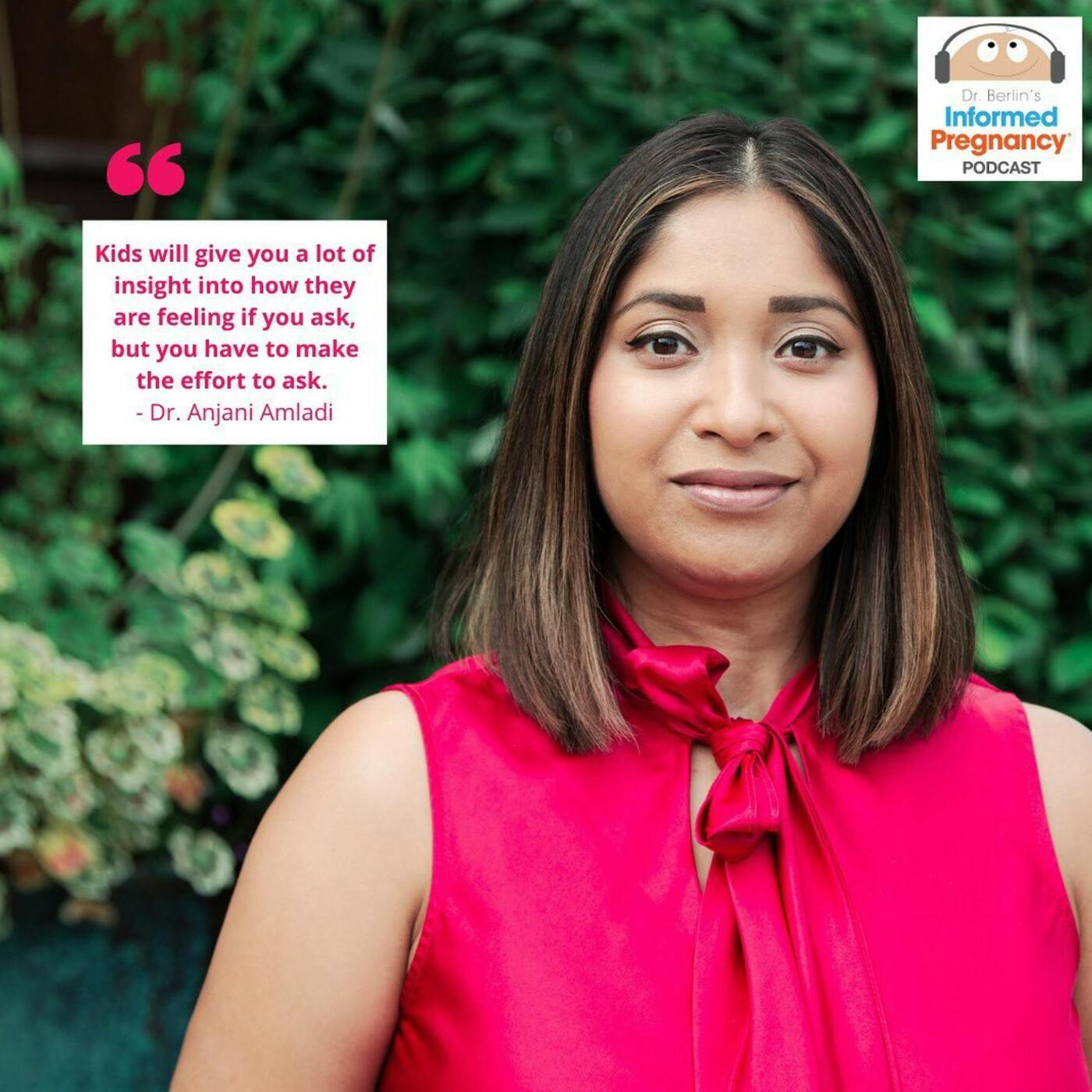
[29:44] if you ask them about how they're feeling. So one of the reasons therapy is so therapeutic for kids is because they have complete and total undivided attention from an adult. And if you think about… how often that happens in a child's life, day to day life, especially if there are multiple children in the home, the individual face time between, you know, a stable adult and a kiddo is not very much. So I think kids will say a lot of things and will give you a lot of insight into how they're feeling if you sit down and ask them, but you have to ask them because we don't get the answer to the questions that we don't ask.
Dr. Elliot Berlin, DC [30:30] It wasn't until recently, I have a young teenager, it wasn't until recently that we just started having these, she calls them DMC, deep meaningful conversations. And it really just happened because on a weekend, I'll just be resting in bed or whatever and she'll kind of come over and snuggle up and we'll just start talking. And sometimes they're very light, fun conversations, which are informative to me. I get to know more about her personality and what she likes and dislikes and what makes her tick. But sometimes we end up on these deep, real, meaningful thoughts. And she just opens up about things that I had no idea were like living in there.
[31:08] And so I do wish that I had kind of been proactive with that at a younger age, taking full advantage of what I can right now. But I think that's a great piece of advice. At which point sort of do you recommend seeking out therapy? Like when you see the signals that you just talked about, we can be more attentive, we could be more proactive, we could be more present. That might be a first line of helping the kids out. But at what point would you escalate that to you might need to see a professional?
Dr. Anjani Amladi [31:38] That's a really good question. So when we talk about seeking out services, for example, either therapy or psychiatry, we specifically look at social and occupational in the case of children, academic functioning. So we want ideally in a perfect world for our kids to be able to function optimally. So if you look at kind of pre-pandemic functioning, most kids did pretty well in school, they did pretty well socially. And then after the pandemic hit, things kind of slid downhill with the isolation and lack of contact with other kids in school being online, things like that. So if you're noticing that as things are opening again, when we're able to be helped more
[32:31] and kids are back in school in person, and it's normal to kind of have an adjustment period with any type of change, either moving from in-person school to online or online school back to in-person. But if it's been a few months, like three to six months and things are so really hard and they're not getting better or if they're getting worse and you're concerned as a parent or caregiver that this is a pretty significant deviation from baseline. So where kiddos were pre-pandemic, I would encourage you to reach out. That is not like the only threshold that I would say to reach out if your kiddo is struggling, either socially or academically. I feel like parents have a very, very good sense
[33:25] about their kids. If there's a concern about your child, you do not have to wait until there is significant impairment to reach out. So most of the time when I see kiddos and we talk about, either referring for different modalities of treatment or even talking about medicine, the two things that I look for when we're weighing as to whether or not therapy would be better or if medicine could be helpful or whatever, I look at social and occupational or academic functioning. But if you are a parent who's concerned about your child, you don't have to wait for that to be what is occurring to reach out for help. So when in doubt, reach out.
Dr. Elliot Berlin, DC [34:11] Exactly, exactly. Okay, I have so much more I wanna talk to you about. Let's take a quick break and come right back. On that we're talking to Dr. Anjane Amladi. She is a psychiatrist working both with adults and children. And we talked about signs of children starting to struggle with anxiousness and things we can do to help them and want to reach out for therapeutic help, which at the beginning is probably just therapy. At some point it turns into other tools for helping. like the pharmaceuticals, which is at this point, we're really where you come in. It's a very personal decision, right? For a parent and sometimes a challenging decision for a parent to put their kids on medication.
[35:14] What are the benchmarks? Like, how do you decide that a child would benefit? There's always a risk benefit analysis. So I kind of wonder what the risks are, but also how do you decide when the benefit outweighs that risk?
Dr. Anjani Amladi [35:26] Absolutely, that's a fantastic question. And you are absolutely 100% correct that it's an individual decision and it's made on a case-by-case basis. So, for example, not all anxious kids need medicine for anxiety. Not all depressed kids need medicine for depression. So when I have patients like those families that come into my office, we always have a discussion about what the risks are versus what the benefits are. And the main crux of whether or not I make the decision, for example, to share that medicine could potentially be helpful is often based on the severity of symptoms. So, for example, if a kiddo is really struggling because, hypothetically, let's just give an example.
[36:19] Their grandparent that they were very close to passed away recently and they're having a lot of meltdowns and a lot of big emotions and things like that. That is a natural response to loss and grief. And it is a reasonable emotion to have when we lose somebody that we care about. For example, that is not a situation that I would recommend medicine being helpful. So now let's fast forward maybe three to six months or maybe even six months to a year if that same child is still suffering emotionally like having anger or aggression or meltdowns or not eating as much or not getting out of bed and they used to be straight A students and now are failing all of their classes
[37:10] and are maybe having suicidal thoughts or whatever. In that instance, maybe it's time to have the discussion about whether or not a medicine could potentially be helpful temporarily to get kiddos back on track. And I think one of the reasons why or one of the most common reasons parents are very reluctant or anxious about starting medication is because they're afraid that kiddos are gonna have to take medicine forever. And I think that's probably one of the most common misconceptions about medicine is that once it gets started it can't be stopped, which is not true. So it's always a risk benefit kind of analysis as to whether or not medicine fits into your value system
[37:58] and whether or not it's indicated. Because if we wanna make sure that if we are prescribing a medicine that it's done responsibly, which means that it needs to be indicated for a specific condition that a parent or a kiddo is coming in and being evaluated for, and that the benefits of using that medication outweigh the potential risks of starting it. That discussion is the most important discussion to have when we talk about starting a medicine.
Dr. Elliot Berlin, DC [38:34] So it sounds like your approach is generally like somebody who enters their leg and walks with crutches until the leg is healed and then they can walk without crutches. And trying to walk without crutches on that injured leg could be detrimental in ways that could have been avoided by using crutches for a short period of time.
Dr. Anjani Amladi [38:57] Right, great analogy. I like that. I think I'm gonna use that in the future.
Dr. Elliot Berlin, DC [39:02] Sweet. What would you, aside from having to take it for life, what other downsides are we looking at? What are the risks of medication are we looking at?
Dr. Anjani Amladi [39:13] So I think some, like any medicine, and whether it's over-the-counter or prescribed, it's a potential for side effects, right? We always wanna make sure that we're keeping in mind whether or not the medicine is indicated and what are the potential side effects. So the informed consent process, so for example, if I see parents and kiddos do an evaluation, think that medicine or other interventions could be helpful, there's always a discussion about the potential risks, the potential benefits, the potential alternatives. And then at that point, whether answering any questions that parents may have, and ultimately- the decision that gets made is up to them, right?
[40:04] So a lot of times patients or families are anxious about kind of having that conversation or even coming to see a psychiatrist in the first place because they're assuming most of the time that that visit is going to end in a prescription when that's not something that they necessarily want. So, and I think it's totally fine for people to come and see a psychiatrist and not decide to start medicine. I have quite a few patients I can even think of a handful over the last few weeks or few months that have come to see me. And after having the evaluation and the discussion that they've chosen not to do medicine and that's okay.
Dr. Elliot Berlin, DC [40:44] So obviously there's a lot of conditions that you treat. We talked mostly about anxiety here, but there's many others. And with each condition, there's an array of drug choices. I don't know how you choose which medications to use for which concern and for which child, but I do know that you almost always start at a very tiny dose and slowly build up the dose to see is this having a therapeutic effect that we wanted and is this causing side effects that we didn't want and then potentially switch to a different medication if needed or altered the dose. But even within that, what are the more common side effects that happen, the unwanted side effects that could happen?
Dr. Anjani Amladi [41:23] Sure, and it really depends on the medicine that we're talking about. So just thinking about kind of medicines that we use for general medical conditions like pain medication versus antibiotics, versus over-the-counter supplements, it really depends on what medicine we're talking about to talk about side effects. So for example, the most common side effects of let's hypothetically say ADHD medication is appetite suppression. Sometimes kiddos get headaches and nausea. Sometimes you don't sleep as well. For something more over-the-counter like melatonin for example, some of the potential side effects which aren't super common, but some of the potential side effects
[42:12] are kids can have nightmares or they wake up in the morning and feel a little bit groggy, which they don't like. So the side effect profile really depends on the medicine class that we're talking about.
Dr. Elliot Berlin, DC [42:25] I might be a good example of somebody I didn't realize most of my life that I had ADHD and I sort of self-treated in a lot of different ways of them behavior or some of them otherwise, but actually once I was diagnosed I was very hesitant to go into medicine because I was worried about side effects and I never even asked what the side effects were. And then my doctor said, the number one side effect is appetite suppression. I'm like, what? That's not a negative side effect. I'm like, yeah, what else can this magical pill do? But I did it for about six months. And during that time, first of all, I'm the exception to the role. I got hungrier, but I also was able to see
[43:06] what it could be like, what my brain is capable of when it's more focused than when it's sort of not out of focus. And I trained myself to recognize when it's going out of focus and things I can do to bring it back. And I also trained myself to recognize you're beyond bringing it back. Just stop trying to get stuff done at this moment and go jump on the trampoline and enjoy your kids, focus on something else. And in that way, it was a question that I needed for a while, but it was able to get off of. But I thought it was funny that I was terribly worried about the side effects and it's kind of a side effect I was hoping I would have, but didn't.
[43:42] Yeah. Okay, it's such a vast topic. I think that we're hopefully able to scratch the surface here.
Dr. Anjani Amladi [43:51] Is it okay if I jump in and just say one more thing about-
Dr. Elliot Berlin, DC [43:53] Anything, yeah.
Dr. Anjani Amladi [43:55] Yeah, so I think a lot of times the focus is on the potential side effects of medicine. And I think to be completely open and transparent with patients and families that do come to see me, there is absolutely a risk to treating, right? If we're talking about medication, there is no medication on the face of the earth that has zero potential side effects. So we always talk about, yes, there is a risk to treating, but we don't really talk about the risk that presents itself by not treating either. And I think that is something that as providers, we don't do a very good job of talking to people about. And that's something that I really kind of wanna hit home
[44:42] is that, yes, absolutely there are potential risks to treating, but there are also risks to not treating. So for example, kids with untreated ADHD, for example, there is a lot of evidence that shows that kiddos with untreated ADHD are likely to- underperform academically, although they're capable of performing higher, but they're essentially handicapped by the difficulty with focus and concentration. They're much more likely to get in trouble at school and receive detention and miss out on their recess time as a consequence of their inability to sit still. They're much more likely to drop out of high school. They're much more likely to not graduate from college.
[45:29] They're much more likely to engage in drug and alcohol use. They are much more likely to get into high velocity car accidents. They're more likely to get into lethal car accidents if they're not medicated. And insurance companies actually interestingly have a lot of data on this as well. So there's a very strong evidence base that supports treatment of ADHD as just being one example of the many things that I see in my office. So sure, absolutely there are risks to treating ADHD with a medicine, but there are also risks to not treating, which I really think is also an important discussion to have.
Dr. Elliot Berlin, DC [46:09] Yeah, absolutely. And there's different levels of recognizing there's an issue of diagnosis and handling the issue of treatment. And some of them are more natural or behavioral, but you always have the option for medication if you want to, or if the other things aren't working. I mean, you mentioned earlier, sometimes anxiety goes on to the point where it's depression and becomes suicidal. So if you're dealing with potential suicide or taking this medication, I think that even though there's risk to the medication in that case generally clearly outweigh the risk of not taking the medication. So risk benefit analysis is always a combination of what is this medication?
[46:51] How can it help me? What are the potential side effects of taking it? And what are the other potential treatment options if I don't take it? And what are the consequences that could happen if I don't take it? That's like a well-rounded informed consent that we all do all the time when we're making decisions about things. But with the medications, generally a doctor is very helpful because that's what your training is. And you have a lot of experience both didactically learning about them and practically using them with clients. Right. You wrote a book.
Dr. Anjani Amladi [47:26] I did.
Dr. Elliot Berlin, DC [47:26] Must have been recent because it's called When the World Got Sick. And this is a picture book. What is the nature of the book?
Dr. Anjani Amladi [47:35] So when I was in fellowship, like I was telling you of my Child and Adolescent Psychiatry Fellowship, three quarters of it was completed and then the pandemic hit. So I had a lot of kiddos and well, mostly parents coming to me and asking for resources as to how to explain this essentially overnight drastic change in life as we know it as a society. And I would always find myself staying in visits. I don't know off the top of my head, but let me go and find out. So I would spend after clinic hours or weekends looking for resources to be helpful to people. And I realized very quickly that I wasn't finding anything that was all that helpful for my patients.
[48:23] So I figured who better to create a resource that is helpful for kiddos and families than me considering what I do for a living. So that's actually how the idea for the book came is because I was trying to find a way to provide resources for families and kids that I was seeing in the office that I just didn't have at my fingertips. So I wrote the book and found somebody to illustrate it for me and went the whole publishing route and it turned out so much better than I could have imagined and honestly, although it was the primary reason for creating the book was to create a resource for families and kiddos that would be helpful. It indirectly also gave me a very creative outlet
[49:15] because I was also somebody who was struggling during the pandemic with going from seeing kiddos and families in person to being 100% online. And my favorite thing about working with kids is seeing them in person. So not being able to do that, I was thinking what else can I do to kind of fuel that creative side of myself? So it was primarily for my kiddos and my families but it indirectly helped me so significantly with conceptualizing the pandemic and contributing in a positive way to my own mental health.
Dr. Elliot Berlin, DC [49:54] I love that you wrote a book for yourself. Are you planning to do more? books? Because there's so many topics. I mean, they're not world changing topics, but they're topics that we all struggle with. And, you know, you don't obviously have all this experience not
Dr. Anjani Amladi [50:09] working with other things. Yeah, so I do. I actually have a couple manuscripts written. It's just, I work full time. I have a husband who needs things. I have a lot of pets who need things. There was always coming down to, you know, the time to do those types of things. Yeah, the books are written. I just need to, you know, start getting them into motion.
Dr. Elliot Berlin, DC [50:34] Yeah, with all you're doing, I will say this, by the way, for most people trying to find a pediatric psychiatrist is not the easiest thing. There's not enough of you to go around. And therefore sometimes wait times for the initial appointment can be several months long. So your time is extremely valuable to all of us. So I appreciate you taking time to do this podcast. Where can we find your book when the world got sick and where can we find
Dr. Anjani Amladi [51:05] you online? Sure. So the book is on Amazon. And there's a paper copy. There's also a Kindle copy. And the Kindle copy purposely is only $1.99 because I wanted to make sure that anybody regardless of, you know, financial means is able to access the book and have a copy of it. But you'll be able to find that on Amazon, but you do have a choice of paperback or Kindle. And then you can also find me on my website, which is AnanayamwadiMD.com.
Dr. Elliot Berlin, DC [51:38] Dr. Ananayamwadi, thank you so much for being here and for doing this. I am going to go check out your book. At home, thanks for listening to the Informed Pregnancy podcast. You could always reach us at informedpregnancy.com or on Instagram at Dr. Berklin. D-O-C-T-O-R-B-E-R-L-I-N.
Want more pregnancy + parenting? Start your FREE TRIAL of Informed Pregnancy+ and get access to all our curated pregnancy and parenting content — original series, iconic birth films like The Business of Being Born, prenatal workouts and more.