
April 14, 2022 · 39 minutes · Episode 277
About this episode
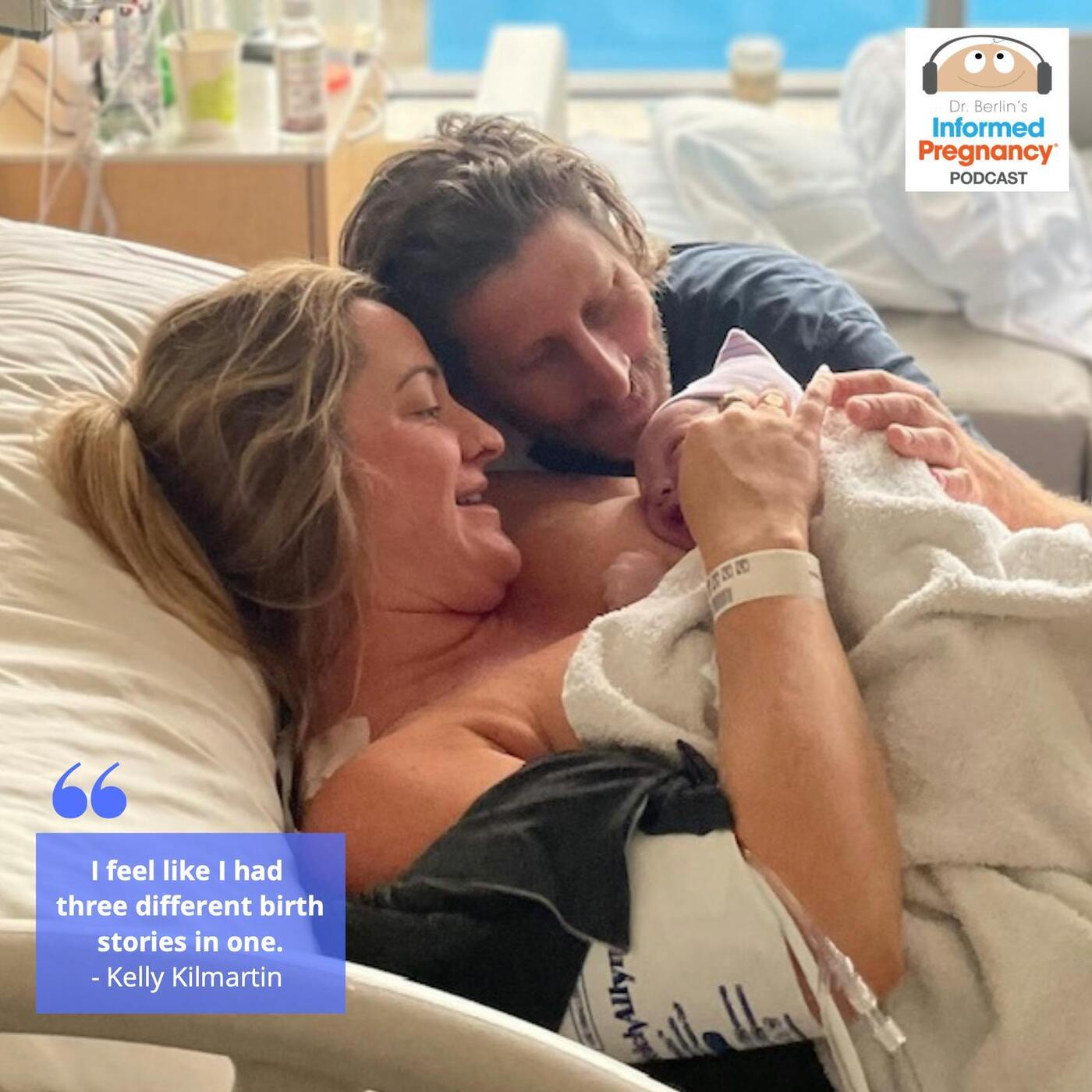
Last episode Kelly Kilmartin was planning an intervention free hospital birth. Now, 10 days after welcoming her first child Kelly returns to share her birth story.

This podcast has been brought to you in part by LMNT electrolyte drink mix. You can get a free sample pack with every order at drinklmnt.com/berlin.
Learn more about your ad choices. Visit megaphone.fm/adchoices
See Privacy Policy at https://art19.com/privacy and California Privacy Notice at https://art19.com/privacy#do-not-sell-my-info.
Key quotes
“It was about 9.45 when my water broke. I was getting ready for bed in the bathroom and I was kind of bending over, trying to get something out of the cabinet beneath the sink. And I just felt it kind of pop.”
“Yeah, of the unknown, because I didn't know exactly how things would look and how they would progress, and that's hard for me.”
“My hands and knees felt better. Um, I definitely was gravitating towards being on my hands and knees at that point, moving around, side lying, and definitely having somebody to physically push my hips together, which was something that was really helpful for me.”
“and, you know, I had heard a lot that the transition to the hospital can be hard for people and make things slow down and, you know, it's an uptight environment for somebody who's not really wanting to be in the hospital. But for me, it actually made me feel so much more comfortable and I think it was because I was in my final place. You know, I didn't have to transition anymore because we had been home and then to the office and then to the hotel.”
“I think just that being open and that it's okay when things take a different turn and I think, you know, in my before story when we were talking, it's clear that I always knew that these options were on the table and I'm sort of open to both. I have the side of me that wanted to be in the hospital and that felt really comfortable when I got to the hospital, you know, and there's also the side of me that would have loved to be at home, you know, in a tub doing it naturally, but I do know myself and I think that when it came down to it, the plan for the most natural way just wasn't the safest way to go at a certain point. And I always knew that I would do whatever was the right and safe thing to do for the baby.”
Related episodes
- Ep. 276 Kelly Kilmartin – Before Birth
- Ep. 280 Kayleigh Harrigan – After Birth
- Ep. 285 Jen Lilley – Before Birth #2
- Ep. 279 Kayleigh Harrigan – Before Birth
Transcript
AI-generated transcript with speaker labels — may contain errors, especially names and medical terms. Dr. Elliot Berlin, DC appears in blue; Kelly Kilmartin in orange.
Download PDF of the Transcript
Dr. Elliot Berlin, DC [1:13] To the informed pregnancy and parenting podcast. I'm your host. Dr. Elliott Berlin today. We have the after story We're checking back in with Kelly Kilmartin last time we spoke. She told us about her work in biotech Meeting her contractor husband on Bumble and their plans for an unmedicated hospital birth Kelly Kilmartin welcome back to the podcast. Thank you for having me back and I should say congratulations Thank you. You're a mom I've ever had. Oh, well, that's good compared to biotech. I love it How old is your baby today?
Kelly Kilmartin [2:13] a week and three days
Dr. Elliot Berlin, DC [2:17] Okay, so about a 10-day old Let's jump right into it last time I saw you you were I don't know at least 39 weeks Yes, I was how is the last couple of days weeks of your pregnancy?
Kelly Kilmartin [2:34] Um, it was not so bad. I think towards the end it was more mental than physical for me that I was just waiting and had no idea when the baby would come and it's kind of Lesson in letting go of control which I've had to do a lot of lately. I bet And when you say mental just the uncertainty the yeah the uncertainty really gets to me not knowing and Just kind of sitting I had stopped working because my brain wasn't working properly anymore but You know just sitting around kind of trying to take it easy Resting waiting for the baby just get in your head a lot So that was kind of where I was at in the final days and I went for a massage The day after my due date so I was due and you know
[3:28] Kind of every day passed the dates and the due date passed and I was thinking like I wonder how we I'm gonna go You know and I went and got a massage that day after my due date And she was like I can hit on your induction points if you'd like me to and I said yeah, I think So I was starting to you know Think about those things like what can I do to induce but not actually induce just do it naturally without having to End up going in to get induced
Dr. Elliot Berlin, DC [4:05] Just as a recap you switched in the middle of your pregnancy from obstetric care to midwife care midwifery With midwives that deliver at home or at a hospital your plan was for hospital. Yeah Okay, were there other things that you did besides the induction point massage?
Kelly Kilmartin [4:24] Trying to get the birth ball rolling. I had Jeff my husband, you know hitting the points on the feet that they say will induce I ate lots of pineapple. I was eating lots of dates kind of leading up to The end of the pregnancy just to soften the cervix. You liked it. So do you normally dates? I don't normally eat them now. So this is like a deliberate effort Yeah, there's a lot of deliberate things going on at this point I went on lots of walks and Just trying to you know, keep my body moving as much as I could in those final days and
Dr. Elliot Berlin, DC [5:00] Were you comfortable physically walking?
Kelly Kilmartin [5:02] I was, I was slow, definitely slow, but more comfortable than I think a lot of people are in the end, I felt kind of blessed. My discomfort usually came with sleep and in the night, moving around during the day wasn't as bad for me unless it was all day.
Dr. Elliot Berlin, DC [5:19] And nighttime, like the part of you that's pushing into the bed?
Kelly Kilmartin [5:22] Yeah, my hips were sore. I had a lot of pubic pain in the night with movement and just switching sides and getting out of bed. And, you know, you have to get out of bed a lot when you're peeing every five minutes, so.
Dr. Elliot Berlin, DC [5:37] Yeah, otherwise it gets really uncomfortably wet.
Kelly Kilmartin [5:40] Yeah, exactly.
Dr. Elliot Berlin, DC [5:42] So, actually- Do you feel like those things help get the situation going?
Kelly Kilmartin [5:47] I think that the massage with the induction points was what did it. Okay. Yeah, so I went on the day after my due date and got the massage. She'd been somebody I'd been seeing for prenatal massage a couple of times throughout the pregnancy and she was wonderful. And she always helped my body feel better. And I had no idea she could do induction massage, but it just so happened that she said it had worked with others and it happened to be the day after my due date. And I said, yeah, let's try it. I'll try anything at this point.
Dr. Elliot Berlin, DC [6:19] I mean, I just love for you to describe what's different about induction massage.
Kelly Kilmartin [6:24] I didn't know what was different, to be honest. Intention. Somebody said, what were the points? And I said, I don't know, cause it just felt like a normal massage, but she just must've been hitting certain points while massaging that. I didn't know where the points, but it felt great.
Dr. Elliot Berlin, DC [6:43] Good, that's important.
Kelly Kilmartin [6:44] And actually that night, my water broke. So I think it worked.
Dr. Elliot Berlin, DC [6:48] Wow, what time of night?
Kelly Kilmartin [6:51] It was about 9.45 when my water broke. I was getting ready for bed in the bathroom and I was kind of bending over, trying to get something out of the cabinet beneath the sink. And I just felt it kind of pop.
Dr. Elliot Berlin, DC [7:05] Oh, did you hear a pop?
Kelly Kilmartin [7:08] I don't think I heard it.
Dr. Elliot Berlin, DC [7:09] You felt a pop.
Kelly Kilmartin [7:10] Yeah, it felt like something broke in me and then the gush of water. And I said, Jeff, my water. And he was like, what? Like thinking I needed him to get me water. And then I was like, no. Clean up on aisle 12, Jeff. My water just broke. And then from there on, I soon after started having contractions, we called the midwives right away and they hadn't started yet. But we got on a call with Lilit, one of our midwives and she kind of talked to me through what we should do at that point. And I had read a million things and learned a million things, but in the moment you kind of forget everything. Like what should I do? Yeah.
Dr. Elliot Berlin, DC [7:54] What did they recommend at that point?
Kelly Kilmartin [7:56] At that point, she just said, now's the time to get some rest, try and sleep through the night. I hadn't started having contractions yet when we called because we called immediately. But she was like, they'll probably come on or they might not, but at least try and get in bed and get some rest while you can now. And if you can eat something and kind of just take it easy for the night, then we can reconnect in the morning. And I actually had an appointment scheduled with her the next morning. So she said, we'll see how it goes if you come here or not in the morning, but try and just rest through the night. So that's what we did.
Dr. Elliot Berlin, DC [8:33] Rested through the night. So when your contractions started, were they uncomfortable? Were they familiar?
Kelly Kilmartin [8:40] In the beginning, it was definitely not familiar. You know, I had heard people compare it to period cramps. I guess I could in the very beginning compare it to that, but it wasn't long that it switched to being a lot more intense than a period cramp to me.
Dr. Elliot Berlin, DC [8:58] Intense meaning like on a scale of one to 10, more discomfort and pain or pressure?
Kelly Kilmartin [9:03] Yeah, it was discomfort. It wasn't so much pain at this point. You know, in between I could rest a little bit, but I was definitely awake for every single one of them, but just discomfort. And I wanted Jeff to sleep at this point. So I was just kind of laying in bed, trying to quietly take them on myself and I could feel them kind of getting close together through the night, but it wasn't anything that I couldn't manage and handle. And I was just trying to get through the night when morning would come and Jeff would be awake and we could kind of take things on together.
Dr. Elliot Berlin, DC [9:37] Was your appointment with the midwife at your home or at their office?
Kelly Kilmartin [9:41] It was at their office, which is about an hour from where we live.
Dr. Elliot Berlin, DC [9:45] Right, so you have to get through the whole night, then get in the car, try for an hour. That's what you're looking at at this point. In your mind, are you excited during these contractions?
Kelly Kilmartin [9:57] I was excited that things were happening. And also just sort of scared, I think, because I didn't know exactly what-
Dr. Elliot Berlin, DC [10:04] Scared of the unknown?
Kelly Kilmartin [10:05] Yeah, of the unknown, because I didn't know exactly how things would look and how they would progress, and that's hard for me.
Dr. Elliot Berlin, DC [10:13] Okay, I feel like the unknown is a good time to take a little break.
Kelly Kilmartin [10:17] Okay.
Dr. Elliot Berlin, DC [10:18] And we'll come back and we'll find out what happened, and then we'll be known, and we'll be right back.

Dr. Elliot Berlin, DC [12:47] Welcome back to the Informed Pregnancy podcast. Back to Kelly. So your water breaks around 9.45 p.m. You're having contractions at first like period cramps, then a bit more intense than period cramps, but you want Jeff to sleep. So you're weathering them on your own, trying to make it to morning when you hop in the car and go see the midwife. Is that what actually happens?
Kelly Kilmartin [13:08] So we made it to morning. We had an early appointment scheduled and we did not go for that appointment. So we stayed at home a bit longer. But when morning came, I think I ended up kind of shaking Jeff around seven and just said, you know, I've been having contractions all night. Like this is really happening now and they're getting really close together. I can feel that they're close together. I had an app where I was kind of timing them and they did seem to be a lot more intense and a lot closer together. And I said, I think this baby's gonna come really fast. Okay. And Jeff said, okay, okay. Like, what do we do? Like I'm gonna pack the car and he got everything ready.
[13:48] We had, you know, a bag packed with snacks. He made me oatmeal and had me eat something. And we were just trying to do all the things that we had learned throughout the pregnancy that we would do when this moment happened in more of a frantic fashion than probably what we would have imagined. But he packed up the car and he brought our comforter and kind of laid it down in the back seat of the car for me to kind of sit on throughout the drive. That was about to be an hour ahead of us, maybe even more. Time was all worked for me. So I don't remember all the timing of everything, but I remember the car ride feeling very, very long. So we left the house around, I would say 8.30
[14:32] and headed towards the midwife's office. And I just kind of moved positions around in the back seat the whole way, just having contractions and Jeff calmly got us to our destination.
Dr. Elliot Berlin, DC [14:46] Did you feel like the surges were still picking up, intensifying on the car ride?
Kelly Kilmartin [14:50] I did. I was convinced that the baby was gonna come by noon at this point. They were so close together.
Dr. Elliot Berlin, DC [14:58] Were you feeling other things, like? lower body pressure?
Kelly Kilmartin [15:01] No, I wasn't.
Dr. Elliot Berlin, DC [15:03] So you're basing it on the contraction pattern.
Kelly Kilmartin [15:05] I was basing on contractions alone.
Dr. Elliot Berlin, DC [15:09] Yeah. Um, and maybe so much for thinking. Who knows? Yeah. What time did you get to the midwives?
Kelly Kilmartin [15:16] We got there around nine 30. Naomi was there and she was seeing patients. So we went into the office and just kind of waited and she came in a little while later and she was like, yeah, it seems like you're definitely having this baby today, just by the way that things were kind of looking and feeling for me. So she checked me at the office and she gave me the news that I was only one centimeter dilated.
Dr. Elliot Berlin, DC [15:47] Oh wow.
Kelly Kilmartin [15:48] That's fine in time. I was convinced that she was going to be like, okay, time to go to the hospital. Yeah. We don't have time. Just go right now.
Dr. Elliot Berlin, DC [15:56] Oh yeah. One centimeter dilated. Well, you know, it's only nine to go.
Kelly Kilmartin [16:02] The cervix is very soft, but I wasn't dilated. So that was kind of a bummer at that point in time. Cause I was convinced that I was much further along. Um,
Dr. Elliot Berlin, DC [16:14] now you're like an hour away from home.
Kelly Kilmartin [16:16] Yeah. Now I'm an hour away from home and I know that I'm not going to go back to home and we had in our plan that we may labor at a nearby hotel, so the hospital. So that was what we were figuring out at this point in time. Jeff started calling the hotel that we had in mind and, um, making a reservation and we just sat at the office and we were laboring there for a while and Naomi would come in and check on me and help me with different positions and sitting in different positions. She'd put her hands on my hips and helped me with the contractions for a little while and we were there for a couple of hours. I wasn't ready to transition again at that point.
[16:59] So she let us kind of hang out and see how things progressed and Jeff in the meantime made a reservation at a nearby hotel. And when I was finally ready, we did move to the hotel.
Dr. Elliot Berlin, DC [17:12] At this point, are there things that are helpful? Like the different positions, did anything feel particularly better than other things?
Kelly Kilmartin [17:19] My hands and knees felt better. Um, I definitely was gravitating towards being on my hands and knees at that point, moving around, side lying, and definitely having somebody to physically push my hips together, which was something that was really helpful for me. So at that point in time, Jeff and I obviously were new to the whole process and we had a Dula that we were planning to work with and then in the weeks leading up to my delivery, I kind of decided I wanted to keep it more intimate. So we had told the Dula that we were working with, that we were just going to do the birth without her. But on the day that we were in Naomi's office, it was sort of
[18:07] clear that we needed a little bit more support and I didn't really want to leave her office and I didn't want us to be alone at the hotel and Naomi said, you know, I can look for a Dula to come with you and be more support for you until things kind of move along. And it just so happened to that her assistant was there in the office Melissa and she had all the training. It was like divine timing.
Dr. Elliot Berlin, DC [18:34] Melissa came with you to the hotel.
Kelly Kilmartin [18:36] She did. She ended up coming with us. She brought us food and showed up shortly after us and she was everything to me in that day. She helped me through every single contraction. She knew different techniques to help me try and move the baby down. She walked me through the miles circuit, which was 30 minutes in three different positions that would hopefully help the baby come down and get in the right position to progress me because at this point, when we got to the hotel, the contractions were getting much further and further apart. And I don't know. Yeah. It was very discouraging. Slowed down by a lot. So some of the contractions were like eight or nine minutes apart.
[19:24] And then they'd go to six and then they'd slow down again. And there was no real rhyme or reason to them at this point, but we knew that I wasn't progressing. So we labored there until about nine PM when Naomi came to check me again. So we were there for hours and I just was sort of going backwards, even though we were doing all different things to try and get the baby down. I would go sit on the toilet a lot. That helped me to kind of have a contraction on my own. It was almost like every time I sat on the toilet, a contraction came and I could get. myself through it and that felt good to me. I hadn't heard a lot of people's stories that the toilet was a place that was comfortable for them, so I retreated to it and it was that way for me
[20:12] too. But you know, Melissa would have me come off the toilet, go on the bed, do hands and knees or sideline. She had a peanut kind of birth ball that I would use for sideline, but none of it seemed to progress me. Naomi came around 9 p.m. and at this point my water had been broken for about 24 hours. Yeah, so obviously concerning to the overseeing OB that we had, that would be seeing me at the hospital when I came and he was sort of encouraging us to come into the hospital at that point in time. So Naomi did come. She did not check me manually because the water had broken. Yeah, the water was broken, so risk for infection. So she was trying to
[21:01] minimize how many times she checked me and it was very clear that I was not progressed to the point where she needed to. So did he want you to come in for augmentation? Just to be there, I think at that point in time. Okay. And it was just kind of an encouragement. It wasn't let's get her here now. Closer monitoring, I guess. Yeah, closer monitoring. I think it just would make him feel more comfortable that I was there. And Naomi kind of talked me through what the options were at this point. I had been laboring for the 24 hours and I was exhausted and, you know, in all the different positions it was easier for me to move around a lot in the beginning and now I was slowing down and the standing positions were
[21:48] getting harder for me. I just had very little energy and I throughout the day had eaten very, very little, just enough to kind of keep myself going, but I had no interest in any food. So I was definitely losing steam and she laid out some options for me. You know, if I go to the hospital, there's the option for medication to help me sleep through the night or, you know, start progressing me. And at that point, I was still sort of trying to push for having zero medication, but it was becoming more of a reality that that might be necessary just so that I could move things along. It had been so long and the water was broken, so it was a concern for infection. So we did end up moving to the hospital around 10 p.m.
[22:38] and, you know, I had heard a lot that the transition to the hospital can be hard for people and make things slow down and, you know, it's an uptight environment for somebody who's not really wanting to be in the hospital. But for me, it actually made me feel so much more comfortable and I think it was because I was in my final place. You know, I didn't have to transition anymore because we had been home and then to the office and then to the hotel. And those transitions were all scary for me because I didn't want to be, you know, checking into the hotel and having contraction in the lobby. You know, like it was all very uncomfortable. Settling to you to be where you will be. Yeah, exactly. Okay. So I was
[23:22] happy. And a surprise, a happy surprise for you. Yeah. You know, we got a beautiful labor room, labor and delivery room, and I settled in. And at that point, you know, we met the nurse who would be on for the night who was close with Naomi. And that made me feel really comfortable. We had really great care in the hospital. And I opened up to the idea of doing something so I could get some rest. So at first, I was still trying to resist an epidural and they gave me an IV medication that would hopefully take the edge off of the contractions and allow me to sleep for the night. And it did not do that. Oh, you had a hyper reaction No, it made me loopy. And the contractions were still just as intense as they had been.
[24:19] So no therapeutic rest for you. Yeah. Around 2am, I finally gave in to getting an epidural and pitocin so that I could move things along. And then sleep once you got the Yes, I slept hard. And I didn't feel any contractions after that. So, you know, I was looking back at those 28 hours that I went feeling every single thing. And at that point had submitted to an epidural and thinking, you know, I could have done this so much earlier. But, you know, I had a rigid plan in my head and And I knew rigidity was not something that was welcome in a birth plan, but you know, you get kind of stuck on what you think could be right for you. But in this moment, I knew that I needed something to help me rest and that I needed
[25:17] to move things along.
Dr. Elliot Berlin, DC [25:18] I'd be mad at myself if I didn't share with you my thoughts on a birth plan.
Kelly Kilmartin [25:23] Go for it.
Dr. Elliot Berlin, DC [25:24] Which is that, to me, a birth plan is a flowchart, and on page one of your flowchart, you'll have the most natural birth that you can picture yourself wanting to try to experience. For some people, that's in a field squatting and eating strawberries. For other people, it's at home without a midwife or with a midwife or at a birth center. For other people, it's at a hospital with a midwife or an OB, vaginally medicated, unmedicated, surgically. Everybody's got a different starting point. Like, that's the most natural they want to be. But that's just page one of a flowchart, right? Sometimes before you even get to labor, something will come up. There'll be a placenta previa or a breech baby or some kind of infection, and you
[26:12] don't even get to start on page one. You go to the next page and the next page. And eventually, all the interventions are welcome because you're taking a detour. The road you wanted to go down as your primary choice is closed off, and so you take a different road to get to the same destination. It sounds like that's what's happening to you. I usually tell people that during pregnancy, but maybe I failed you.
Kelly Kilmartin [26:39] I like it. I think just that being open and that it's okay when things take a different turn and I think, you know, in my before story when we were talking, it's clear that I always knew that these options were on the table and I'm sort of open to both. I have the side of me that wanted to be in the hospital and that felt really comfortable when I got to the hospital, you know, and there's also the side of me that would have loved to be at home, you know, in a tub doing it naturally, but I do know myself and I think that when it came down to it, the plan for the most natural way just wasn't the safest way to go at a certain point. And I always knew that I would do whatever was the right and safe thing
[27:31] to do for the baby.
Dr. Elliot Berlin, DC [27:32] Let's take a little break and then come back and find out the rest of the story. Welcome back to the podcast. We're talking to Kelly, who had a plan for a medicated birth at the hospital with midwives. And then as things unfolded, 24 hours went by with the membranes ruptured, kind of gets the doctors nervous about infection. And he bounced around from place to place, contracting at home, contracting at your midwife, contracting at a hotel and now contracting in the hospital. Pleasant surprise for you at the hospital. You didn't feel more nervous, scared or uncomfortable. You actually felt relaxed and you had a very supportive labor staff. So you had also been pretty exhausted.
[28:59] So you tried to do therapeutic rest medication in the IV that helps you relax and maybe not feel the full intensity of your surges. That wasn't for you. You had an epidural, you got pitocin and you got a hard sleep. What happened?
Kelly Kilmartin [29:18] Naomi came to check me around 7 a.m. after my hard sleep from about probably three on or two on. And she came to check me and at that point I was seven centimeters. So finally, it was the best news ever. And she said, this is great, you know, and asked me, am I feeling any contractions? And she could see them happening. And I said, I don't feel them. I don't feel anything. And, you know, that kind of changed as we got closer and closer to me being fully dilated, I felt a little bit more, but it was, you know, still very. comfortable and a lot different from when I was without the medication. So she checked me at seven, she checked me again at nine, and I was still seven centimeters. And then by noon, I was fully
[30:14] dilated. So we were kind of prepping for pushing around noon. Jeff was taking a nap on the little couch. And Naomi was kind of getting herself prepped and getting all the things that she needed. And the staff had changed. At this point, we had a new nurse and she was wonderful as well. And our Dula Melissa was back and she came back early in the morning with breakfast and she kind of stuck around. And, you know, having the first team that I had that day, it was unbelievable. I think when it came time to actually start pushing, they all, I had Naomi, Melissa, my Dula, and then the nurse and my husband, Jeff. And it was the most incredible birth team to help me through what would be three hours of pushing.
Dr. Elliot Berlin, DC [31:11] Oh my goodness. Yeah. Wow. Okay. The three hours of pushing. I mean,
Kelly Kilmartin [31:17] you said you were starting to feel things more. I was, and they actually came back and gave me a booster of the epidural to get me through the pushing because I was starting to feel things pretty strongly right before I had to start pushing. So three hours is a long time to push. Did you sense the three hours going by? Sometimes time? No, I didn't. I didn't sense it at all. Actually. I had no idea. It felt like it could have been 10 minutes and it felt like it could have been six hours. I had no idea. But my husband, Jeff, he'd be like, you're doing great, honey. It's already been an hour. And I was like, what? It's been an hour? Don't tell me time. Please don't tell me time. But he and Melissa and our nurse,
[32:07] they would like hold me and help support my legs in different positions. And I moved around to different positions for pushing. So I was coached to kind of lay on my side and then move to the center. And I tried hands and knees that didn't really work well for me. And then moved to the other side. So Naomi had me kind of going back side to side so that I wasn't just in one position the whole time. That longer pushing phase, was there a concern that maybe it's not coming out? Not that anybody told me, which I think was good. I didn't have the concern myself. The whole labor, I was just sort of like in the moment. And like you said, time has worked and I sort of just took things as they came. If somebody
[32:57] told me I was going to labor for 28 hours with no medication, I would have looked at things a lot differently if I was told that ahead of time. And if somebody told me I was going to push for three hours, I would have been scared. But in the moment, I was just taking it on as it came and it was fine. I just kind of powered through whatever. But I remember in the beginning of pushing, I was a little bit scared and I wanted to take a contraction to push and then breathe through a contraction instead of using every contraction. And then as time went on, there was no question I needed to push with every contraction. I had that urge and it just… Oh, you felt the urge?
[33:35] Oh, I felt it, yeah. And the pressure? Uh-huh, all of it. I felt all of that, which I was glad to feel that, you know, I had it in my head that when you had an epidural, you just didn't feel anything and you could hurt yourself or do things that you wouldn't want to do or you wouldn't know to move positions if something didn't feel good. But I felt those types of things and I knew to move myself if I didn't feel it was right and I could feel the urges and the pressure. So it helped me through, you know, the pushing because I knew I needed to do it. And then as the baby started crowning, Naomi would show me a picture so that it would motivate me. We couldn't get a mirror, but I guess the hospital was the busiest it had ever
[34:20] been when we were there. So… All the mirrors were in use. I guess all the mirrors were in use, so we couldn't get one. So Naomi would take a picture of the baby crowning and then show it to me like, you're so close, you're so close, just keep going, you'll get there. I remember at one point saying like, I can't do it. And she was like, you can though, you've been doing it. You're doing it, you know? Did the pictures help? The pictures did help because after a certain amount of time and so many pushes, you're like, is this baby actually coming down or is it still like way up there, you know?
Dr. Elliot Berlin, DC [34:53] Pictures worth a million words.
Kelly Kilmartin [34:55] Yeah, it was.
Dr. Elliot Berlin, DC [34:56] Did you reach down and feel your baby?
Kelly Kilmartin [34:58] I did, yeah.
Dr. Elliot Berlin, DC [34:59] Did that help?
Kelly Kilmartin [35:00] That helped too. Yeah, for sure. And just being closer, I remember that was kind of one of my mantras, you know, each surge will bring me closer to my baby. And I had that in my head throughout my pregnancy, that that would be a mantra of mine. And that's the one that worked the most.
Dr. Elliot Berlin, DC [35:19] Oh, that's sweet. Because you were like quasi-medicated here, you're feeling some things, but not everything. Did you feel when you were crowning when the baby stretched your
Kelly Kilmartin [35:29] perineum? I did. Yeah, for sure. At that point, you know, I could feel definitely that things were stretching. I could feel that the baby was really close. And when the baby was, like the head was halfway out, we stopped, there was no contraction. So I stopped and the baby was there. And we had to wait for the next contraction. So at that point, I could really feel it. There's so much pressure and I didn't feel that I was tearing, but I did feel that pain in the perineum. But you know, it's all relative. I don't know. I've heard that expression before, I guess it could have been, I think, if it was the edge was taken off of it for the medication, but I did feel it. And then once that next contraction came at that
[36:24] next push, the baby came out. So it wasn't that I got the head out and then I needed to wait again. The head was halfway out and then the whole baby came out. Who caught? Jeffrey did. He was nervous that he was going to be squeamish for that part, but he kind of tossed himself into it and said, you know, this is my one chance to catch my baby. And he did, and it was beautiful. And he's the one that got to tell me that it was a boy. And bring it to my chest. Yeah. It was the most beautiful moment in my life. And you know, after all that pushing 42 hours later from when my water broke, it was all just like a blur at that point. None of it mattered. Like, yeah, immediately. And the baby was on my chest
[37:14] and I was like, Oh, my little boy. His coloring was off like when he was on my chest and they ended up having to take him and put him on the warmer for a minute and make sure that his oxygen was okay. So he did get taken away from me in that first few minutes, which was a bit frustrating for us because we wanted him to be on us for that first hour. But of course anything to keep the baby safe. And then once the baby was fine, Naomi advocated for me and said the mother would like the baby back on her chest now. And we were able to have our time. And it was just so, so incredible. There's nothing that can explain the feelings that go through your body after all the first 10 days of mother.
[38:06] Um, it's been a ride. We ended up staying in the hospital longer than we hoped to because they were monitoring the baby for infection because the water had been broken and then the labor was so long. So they were monitoring him for that and for jaundice. So we stayed an extra night. And then when we came home, you know, it's like relearning everything again, the hospital, you know, there's no sense of time or anything there because everybody's in and out all night long. But when we got home, it was just kind of introducing him to our pets and just really, you know, those first couple of nights having zero sleep at all, he was completely nocturnal and didn't sleep a wink. And therefore I did not sleep a wink for those
[38:54] first couple of nights, but we're getting our groove now. We're learning each other. He's teaching me something new every day. He's changing every day, but the coolest experience and you know, I'm so grateful to be a mom. It makes me emotional to even talk about, but
Dr. Elliot Berlin, DC [39:12] she's very, very special. Such a cutie. I mean, one important question are how are the pets
Kelly Kilmartin [39:20] adapting to you? Well, our dog Wiggly seems very protective of him. He'll come over and lay right next to him. And when he's crying, he'll come by and kind of just like sit there and make sure he's okay. But our cat, on the other hand, I think wants him to go away. He's not a fan. He's pretty scared of the crying. He's a skittish cat to begin with, but I think he's having a bit of trouble adjusting. And then, you know, the attention is a bit different.
Dr. Elliot Berlin, DC [40:00] soon for this question. But should you have another baby down the road? Has this experience changed what you had planned for future birth?
Kelly Kilmartin [40:13] I think so, in a way, because it was such a long labor and I didn't progress naturally on my own. Because, you know, the way we talked about it before was that I would love to do a home birth if this one goes as planned and things work out. So I guess I would question kind of my body's ability the next time around to progress naturally the way I would want it to if I were to do a home birth. But, you know, our experience in the hospital was great. I feel like I had three different birth stories because I labored at home and then I labored at the hotel and then at the hospital. I did the whole natural thing, but I just didn't finish it out that way.
Dr. Elliot Berlin, DC [41:01] How big was he at birth?
Kelly Kilmartin [41:02] He was eight, six.
Dr. Elliot Berlin, DC [41:04] Oh, that's a healthy baby.
Kelly Kilmartin [41:05] Yeah, Jeff and I were both big babies, too.
Dr. Elliot Berlin, DC [41:08] Maybe it's all those eights or, I don't know, what?
Kelly Kilmartin [41:12] The cookies and the cake, maybe.
Dr. Elliot Berlin, DC [41:15] That might have contributed. Kelly, you're amazing. Congratulations to you guys.
Kelly Kilmartin [41:20] Thank you so much. Thanks for having me on.
Dr. Elliot Berlin, DC [41:23] I'm so happy for you. My cheeks hurt just listening to you tell the story.
Kelly Kilmartin [41:26] Mine too.
Dr. Elliot Berlin, DC [41:27] That big smile meant this.
Kelly Kilmartin [41:28] Thank you.
Dr. Elliot Berlin, DC [41:28] You're an amazing person. I really feel honored to have worked with you and just got to find you employment in a field that you love.
Kelly Kilmartin [41:37] Yeah, exactly. Exactly. Thank you so much.
Dr. Elliot Berlin, DC [41:41] You're welcome. And thanks for listening to us here at Inform Pregnancy. If you want to connect, visit us online at Dr. Berlin, D-O-C-T-O-R-V-E-R-L-A-N.
Want more pregnancy + parenting? Start your FREE TRIAL of Informed Pregnancy+ and get access to all our curated pregnancy and parenting content — original series, iconic birth films like The Business of Being Born, prenatal workouts and more.
