
February 10, 2022 · 28 minutes · Episode 268
About this episode
Anastasiya has had her baby and returns to the podcast share the details of her experience planned home birth after cesarean.

Learn more about your ad choices. Visit megaphone.fm/adchoices
See Privacy Policy at https://art19.com/privacy and California Privacy Notice at https://art19.com/privacy#do-not-sell-my-info.
Key quotes
“Yes. And since I had a rehearsal, a false call alarm two weeks prior, I was actually very calm despite the broken waters and meconium. I was ready to labor, and it was a very slow start. Honestly, it was all a blur in terms of time.”
“I was like a wild animal. I was just running around the house, taking all the clothes off, asking my husband to massage me. No, don't touch me. Okay. Massage me now. I didn't know how to stop. I didn't know what position to take. It was crazy for about five minutes.”
“And I think I was so at that point aware that that was the transition I was waiting for and I have to rewrite my trauma. Like I have to accept this transition and keep going past this point. So I think I did, it was my first victory in this battle. This is how I felt. I'm like, okay, if I can get past this moment, I can do this.”
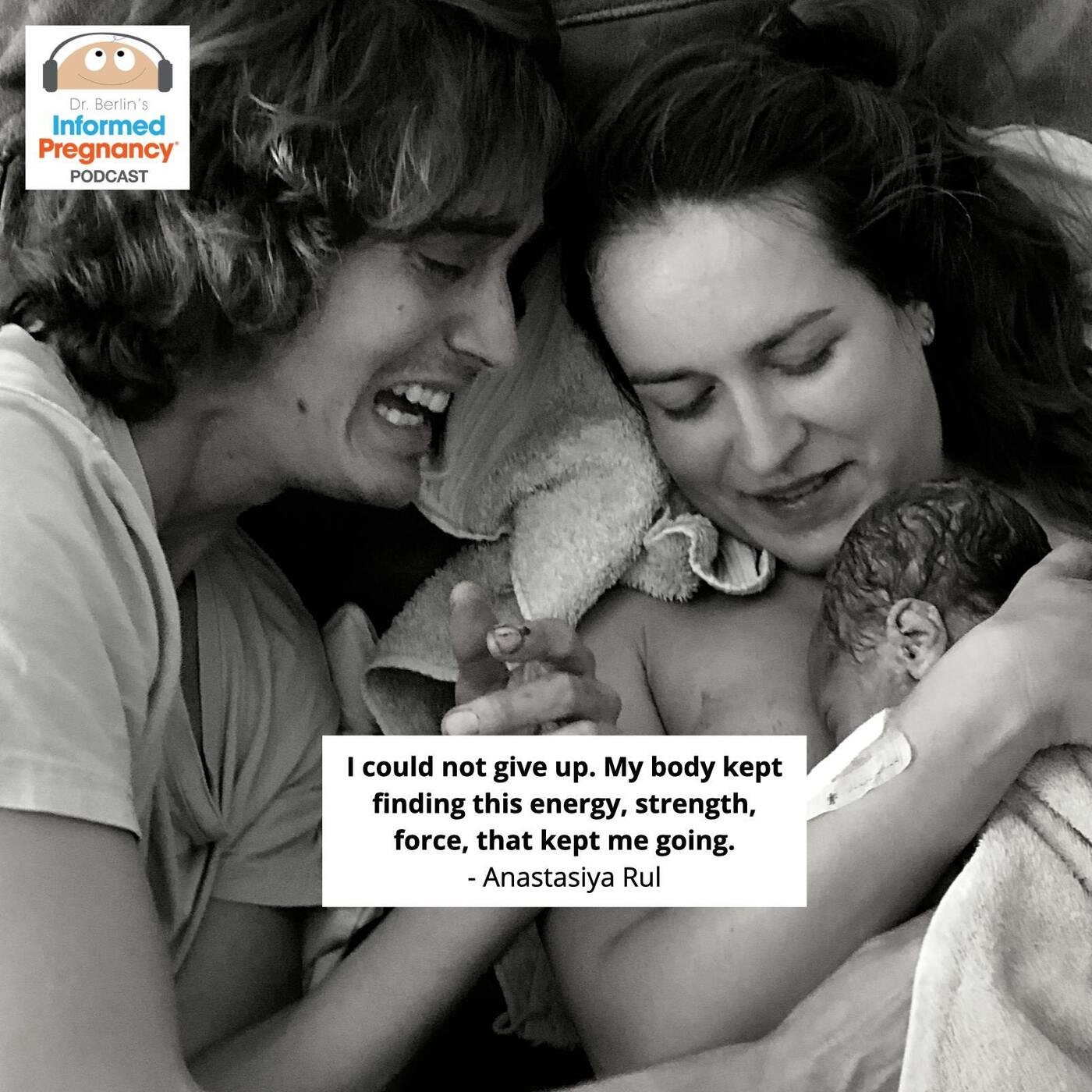
“I kept finding this energy and strength and force in me. And a few times I said, how much longer can I go? But I felt like I had to keep going and I could. And for exactly four hours, I was trying to push with little progress every time.”
“It's hard to say. I think I would get to the point of beginning to progress in one position and then I would get tired of it. Like my legs would start shaking, let's say on the birth stool and I'd have to go and change it.”
Related episodes
- Ep. 514 Before Baby #4 with Kara Sutton
- Ep. 421 Sheridan Hathaway: After Birth
- Ep. 214 Richelle Monae – After Birth
- Ep. 420 Sheridan Hathaway: Before Birth
Transcript
AI-generated transcript with speaker labels — may contain errors, especially names and medical terms. Dr. Elliot Berlin, DC appears in blue; Anastasiya Rul in orange.
Download PDF of the Transcript
Dr. Elliot Berlin, DC [1:13] Welcome to the informed pregnancy podcast You are tuning into the after episode of a before and after birth story My guest today was with us not long ago last time we spoke to her She was imminently due with her second baby And she had a difficult first birth experience and was planning to deliver her second baby as a VBAC Vaginal birth after cesarean at home. Anastasia Ruhl. Welcome back to the podcast. Thank you so much
Anastasiya Rul [2:01] Dr. Berlin, hi. Hi
Dr. Elliot Berlin, DC [2:04] Gosh great to have you again I want to jump in because I don't know your birth story as I like to do even if I see what you haven't I don't find out the birth story until we get on the podcast so we can all hear it together Last time I talked to you. You were very very close to giving birth. How did the rest of your pregnancy go?
Anastasiya Rul [2:22] Hi, it went well although so my second baby, I feel like repeated all the milestones of Pre-labor and labor as my first baby except he rewrote the story. So every milestone Just turned out to be better So the end of the pregnancy was great, but I did have a two-week for one or warm up labor again
Dr. Elliot Berlin, DC [2:49] milestone number one Exactly from the time your labor kind of starts happening. You get two weeks of Orchestra warming up
Anastasiya Rul [2:59] Intense contractions that would go on and on but not Intensify in any way So I actually did call my doula and my midwife and my cousin to come watch my baby the whole team They all showed up But nothing happened for another two weeks and then finally my waters broke So that was my second milestone same as with the first baby. What time of day? It was after 4 p.m September 23rd, what were you doing at 4 p.m. I was chopping a salad. Oh
Dr. Elliot Berlin, DC [3:35] You know what happens when that happens that becomes the next thing people are going you're not in labor go ahead and chop a salad
Anastasiya Rul [3:41] Yeah, well, I lost my appetite
Dr. Elliot Berlin, DC [3:44] So you're chopping away and your water breaks no confusion like it's definitely oh that's my water just broke
Anastasiya Rul [3:51] Definitely no confusion. It was very apparent and my baby my older one was saying Oh mommy has water between her legs A night before something popped I felt like my maybe amniotic sack ruptured a little bit But nothing happened a night before so when the waters broke I felt like oh makes sense So a little bit mccoy new came out and that's milestone number three Like that first poo of the baby Mm-hmm. It was light and this is before anybody out there Yeah, it just happened like right away with the amniotic fluid So we took photos and sent to Alex the midwife and she kind of said that it's okay It's nothing dangerous. I'm like the first time in my first labor when I had to transport to the hospital because the meconium was so
[4:45] Bad or dark. Yeah, I'm thick. So I'm like, okay, I can do this at home labor at home So that's three milestones same as the first but a little difference
Dr. Elliot Berlin, DC [4:57] Yes, exactly and the most important differences for you, I assume, is that you can stay home and continue laboring.
Anastasiya Rul [5:04] Yes. And since I had a rehearsal, a false call alarm two weeks prior, I was actually very calm despite the broken waters and meconium. I was ready to labor, and it was a very slow start. Honestly, it was all a blur in terms of time.
Dr. Elliot Berlin, DC [5:21] Well, what's the difference? Because you were having contractions for weeks. So is there something different other than your ruptured membranes, or does the pattern change?
Anastasiya Rul [5:32] For the first few hours, nothing changed. I would just have mild contractions. So I was a little bit frustrated because I was so ready to just keep going. And now my water's broke, and I kind of felt a sense of urgency to get this baby out from the start. And we were going into a night. So my team arrived, my doula, my cousin to watch my older child. And nothing was happening much until deeper into the night when my husband and I just went to the bedroom and kind of slowed down for the day. So then I felt like, okay, now I'm feeling real contractions and something is happening. But then the midwife came maybe about 1am, maybe 9pm. At that point,
[6:19] I lost track of time. And she said that I'm just beginning laboring. I'm not dilated yet. So pretty much keep doing what you're doing, try to sleep. And then I feel like my labor, after not progressing too much for the whole night, it kind of stopped in the morning. As I got busy with my regular day, I did yoga, I did meditation, whatever was happening.
Dr. Elliot Berlin, DC [6:46] Were you able to sleep overnight?
Anastasiya Rul [6:49] Yeah. Yeah, because not much was happening. Although I don't think I slept much because I was excited and nervous and I did feel contractions. They were just not picking up faster and faster and faster. So after a night of sleeping or not sleeping and waiting for contractions to pick up, I just went about my business on Friday morning. I did yoga, did meditation and everything was like in a haze. I felt very high and very confused. And I was also getting closer to the point when it would be 24 hours since my waters broke. But everything was fine. I didn't have any fever, so no signs of infection. I was given green lights to keep laboring at home. After 24 hours, somehow the contractions just picked up.
[7:45] And from what felt like zero or one, I went to maybe six or seven. And I so vividly remember this five minute long contraction that would just not stop. Yeah, I was just one like that, or they begin. Okay. Something like a switch one off. Yes. And my midwife warned me that if that was the point when I had a trauma beginning with my first labor, something will probably happen this time. So kind of like look out for that. And it did. I was like a wild animal. I was just running around the house, taking all the clothes off, asking my husband to massage me. No, don't touch me. Okay. Massage me now. I didn't know how to stop. I didn't know what position to take. It was crazy for about five
[8:35] minutes. And then Alex told me, okay, get in the tub on all fours under hot water and just wait until I get there. I think this is it. This is the transition we've been waiting for. So just survive this moment because this is when your trauma began the first time and you went to the hospital. So just hang in there. Okay. Hold on a second. I'm going to take a break

Dr. Elliot Berlin, DC [11:19] Welcome back to the Informed Pregnancy Podcast. We're talking to Anastasia Ruhl. She is at this point in the story, having a five minute long contraction. And your midwife, Alex, kind of warned you that because you had trauma last time, something like that might happen again. And to be aware of it, can you tell us just briefly, because anybody can listen to the first episode and hear the full story, but briefly, what was your trauma from last time?
Anastasiya Rul [11:48] Last time, after my waters broke and I labored at home for exactly 24 hours, that's when my baby passed my corneum and I had to transport to the hospital. And when I arrived to the hospital, I was about six, seven centimeters dilated, and this is when the nightmare began. I had a back labor, a lot of pain and pressure in my lower back and no progress, which led to a C-section and the whole traumatic experience the first time, planning a home birth. So this time I didn't know that I was dilating closer to six or seven centimeters, but all of a sudden this strong, intense contraction came and it wasn't going away, lasted for about five minutes, long enough for my
[12:35] husband to call Alex and to just have a long conversation with her about what we need to do. So after removing all the clothes while running around the house, trying to find a position and asking my partner to massage me on yelling at him not to touch me the next moment, I was advised by the midwife to just go and be on my all fours in a hot shower and try to manage like that. And I did for about an hour long until she got there.
Dr. Elliot Berlin, DC [13:06] Was that calming for you?
Anastasiya Rul [13:08] It was, it was the only thing I could do. I did not want to get out from the tub, although my body temperature was over a hundred degrees and not from a fever. I didn't feel fever, but probably because I was so overheating, I used the hottest water possible for that intense sensation in my whole body, because just think about it. I've never been there before. That was something completely new. It is my second birth, but my body's treating like the first one and I'm in complete shock what is happening. I've never felt this before. So Alex got there. Somehow they pulled me out of the tub, although I fought them so hard because I was scared, I was scared to change a position and scared
[13:55] that the intensity would increase. Yes. And that perhaps it was a back labor again, because it felt very similar, although different, different. So I mean, I really feel it as pain, as much as pressure.
Dr. Elliot Berlin, DC [14:09] Yeah, exactly.
Anastasiya Rul [14:10] And I think I was so at that point aware that that was the transition I was waiting for and I have to rewrite my trauma. Like I have to accept this transition and keep going past this point. So I think I did, it was my first victory in this battle. This is how I felt. I'm like, okay, if I can get past this moment, I can do this. And then I think all my neighbors heard me scream. I was just screaming until the baby was born from that point.
Dr. Elliot Berlin, DC [14:41] But screaming. Why? Cause you said he didn't really feel pain. So is it just natural?
Anastasiya Rul [14:47] Yeah. It was just wild and raw.
Dr. Elliot Berlin, DC [14:50] Oh my gosh. You keep using the word transition. Is that something that you felt or something that your midwife told you?
Anastasiya Rul [14:56] She did tell me. And I did feel the whole. change after that. This is when I was probably exercising any position I could think of. I was laboring by myself. I was laboring with the women in my room trying to massage me. I was calling my partner in and out. It was like a dream. I can't really recall all the sequence of events, but it was a lot of everything. And yeah, there was no pain, but I was so in this moment of wildness. It was beautiful, but also scary. So from this point forward, the labor was kind of a blur again. And we had a few moments when Alex literally was sending me to the hospital because it was taking so long. And she was already offering me
[15:45] antibiotics many times. And I think 36 hours into laboring, I said, yes, okay, give me the IV. So I got antibiotics at home. And I could not imagine me getting in the car and drive to the hospital with contractions so intense and so close together. I think I had another challenge with a baby and another milestone that I'm going to mention is that the baby's head started molding. Yeah. And that's what happened with my first baby. And I knew that I can only go and let him expand for so much before he cannot pass through my birth canal. So it was very nerve wracking moment. Plus, there was a cervix slip that would prevent my baby's head from descending the right way. And the
[16:37] midwife's assistant just kind of like went inside manually and luckily flipped that lip backwards. Yeah, and it worked. It worked. Luckily it worked because that increased the speed and the descendants of the baby's head down. So it was also a very helpful moment.
Dr. Elliot Berlin, DC [16:57] You're unmedicated. Yeah. Could you describe what that sensation felt like moving the lip out of the way?
Anastasiya Rul [17:05] I honestly didn't feel it at all.
Dr. Elliot Berlin, DC [17:07] Oh, really? Okay.
Anastasiya Rul [17:09] From what people told me afterwards is that I was very swollen down there. And I'll tell you why. So my urge to push, Alex called it a little bit premature urge to push. She let me do it at about nine centimeters because I was so ready and I pushed for four hours. So what people told me that I was so swollen that my insides were flipping out and they were all swollen and purple in color.
Dr. Elliot Berlin, DC [17:40] Oh, so you're just saying it wasn't hard to get to your cervix.
Anastasiya Rul [17:44] Well, I think the main problem was my bones. My bones were just too narrow. And what Alex was trying to do is push them apart with her hands. Oh, and I think my problem was that I so practiced to breathe my baby down with all the hypnobirthing classes I took that when she was like, okay, time to push. I was like, how do I do it? I've never had to push a baby out. And it took me a good 40 minutes, maybe to figure out what it is in general, pushing a baby. And I think it messed me up a little bit. I don't think I'm a good breather in general. And now when people say, okay, take as much breath in as you can and hold it and push with another part of your body. I was struggling. I was struggling. It took me
[18:37] so long and my white bones and just a long time for the baby to come down. But the baby was a champion. They check his heartbeat after every contraction and push. And he was very strong.
Dr. Elliot Berlin, DC [18:51] Yeah, at this point, are you just in another planet or are you still so no more like thinking maybe we're gonna not be able to have the baby at home or maybe we'll have to have another cesarean?
Anastasiya Rul [19:04] Interestingly enough, everyone else suggested that I should go to the hospital multiple times that I should take a epidural and rest and then try to push again. My partner had fears and was already ready to jump in the car, but I was the only one who probably suffered the most, or at least it looked like that to all these people, but I could not give up. I kept finding this energy and strength and force in me. And a few times I said, how much longer can I go? But I felt like I had to keep going and I could. And for exactly four hours, I was trying to push with little progress every time.
Dr. Elliot Berlin, DC [19:47] Well, let's take another little break. And then when we come back, we'll hear the rest of the story. Welcome back to the Informed Pregnancy Podcast. We're talking to Anastasia, and in her second birth story, she is now almost 40 hours into it and pushing and pushing and pushing. People around her are feeling like she looks like she's being tortured. She should go to the hospital and get an epidural and the discomfort and get some rest. But inside, she feels like she must keep going. So while you're pushing, I mean, four hours of pushing and you said your midwife Alex felt like your pelvic bones were just close together and needed to separate. Also, I think it's helpful for other people to know you're
[20:37] super athletic. Yeah, yeah. I don't know if it's a good or bad thing. Well, it's a great thing in some ways. But when you're super athletic, you just have a stronger anatomy that your body has to push your baby through. And sometimes when they're not lined up just perfect, if they are, they could slide right out. It's a lot of work on your body and baby to work together to bring the downward movement. And you said Alex kind of reached in, try to help manually create a little more space. What are some of the other things that you did as pushing just went on?
Anastasiya Rul [21:11] Well, she told me to visualize that my bones are opening up. And an interesting thing is at the end of my pregnancy, I drew a lot of art, kind of like birth and art. One is a baby inside a uterus and it's kind of encircled in the bone structure with flowers and plants. So my doula, Irina, kept whispering into my ear, imagine that the leaves are opening up and the bones are spreading. So I did that. I tried everything. I know people were praying for me and I was just trying to do my part too. There was no pain at the point of pushing. I think just the obstacles in terms of my anatomy is what kept me from reaching the success more.
Dr. Elliot Berlin, DC [21:57] Are you pushing in water or are you in bed?
Anastasiya Rul [22:00] No water because my water is broke. For too long, Irina? Yeah. And there is confection. I never had a chance.
Dr. Elliot Berlin, DC [22:09] Yeah. So are you trying different positions on land?
Anastasiya Rul [22:12] Yes, I tried the birth stool. I tried on my back in a ladybug position. I tried on top of my partner. What did I not try?
Dr. Elliot Berlin, DC [22:23] Did any of them feel more or less comfortable than the others or more or less productive?
Anastasiya Rul [22:28] It's hard to say. I think I would get to the point of beginning to progress in one position and then I would get tired of it. Like my legs would start shaking, let's say on the birth stool and I'd have to go and change it. And then by the time I get to a little progress, I get tired of this position again. So I had to change multiple times. So closer to four hours of pushing, we just decided that we need a little help. It was already Saturday morning, about 7 a.m. and Alex suggested that we call doctors too and get a little help with a vacuum from him. And just everything was working out so perfectly, like meant to be. It was the first variable that we got
[23:10] from the baby right before he walked in. And doctors too doesn't like using vacuum with babies who show any sign of variable. So it was probably our last chance. And I just kept pushing even when he got here. I just could not stop.
Dr. Elliot Berlin, DC [23:28] Let's talk about a couple of things. A variable meaning the baby's heart rate was less stable, like not just but kind of coming down a little bit or going up a little bit.
Anastasiya Rul [23:39] See, I don't even know because I found out about the first variable after the baby was born. No one told me.
Dr. Elliot Berlin, DC [23:46] And then the idea was doctors too, right? Or suction in general, vacuum sort of extractor is a little suction cup that goes on the baby's head because they could see the baby's head, right? The shoulders are having a hard time getting through the rest of the baby's head is having a hard time getting through. But you could just see the top top of the baby's head. And sometimes, like I said earlier, if it's not lined up just right, all that pushing doesn't really go anywhere. The neck is just flexing and flexing and not really moving down. So if they can put a suction cup on their little vacuum and then gently pull the head in the necessary direction while you're pushing, then oftentimes that can help bypass
[24:26] the issue or overcome the issue and have the baby come through. Okay, so Dr. Stuzer doesn't like doing the vacuum when there are variables. So did he consider not doing it?
Anastasiya Rul [24:35] No, he walked in so fast. He was like an angel, honestly. Or maybe I perceive him that way. He walked in, he looked at me down there. And he's like, this is gonna work. I was so close. Look, you could see the baby's head. It just needed exactly as you said, that little tweak to pull the baby's head in the right direction to kind of like breathing underneath the bone structure. So I think the first time popped and second time the head was born and he let us touch it and get to know our baby. It was so surreal.
Dr. Elliot Berlin, DC [25:08] What was it like to feel the baby's head out?
Anastasiya Rul [25:10] Surreal. He was like, look, this is your baby. My partner was there holding my right leg up. My doula was holding my left leg up and this head in between my legs. And then second later, the whole body was born and he sneezed. He pooped me corneum.
Dr. Elliot Berlin, DC [25:28] Oh, wow.
Anastasiya Rul [25:30] And then next moment, he was on my chest, which I've never experienced before with my first one. They never even showed my baby to me. And this is the magical moment. The baby's head is on my chest. He lifts the head up. His eyes are still closed. He opens his eyes and looks straight into my eyes as if saying, hello, I know where you are. You're my mom. And the rest was just a beautiful, magical moment with everyone in the room. And I just tangibly felt so much happiness and feeling so surreal that it actually happened. It happened at home. I did not have any tears, but this baby's on me. He's still connected with me through the umbilical cord.
[26:17] It's still pulsing. All the things I always wanted now, they're real. It's happening right now in this moment, and the rest is just history, you know.
Dr. Elliot Berlin, DC [26:30] Such a beautiful ending to an intense journey. I will just maybe to clarify, so the suction cap, the vacuum, just kind of gently attaches to the head, and it's set for a certain amount of suction that if you overcome the amount of pressure that it's set to, it just pops off so that you don't over pull on the baby. So that's what you meant when you said the vacuum popped off. And then there's protocols. You can only try it a certain number of times, and after that, you know, it's a sign that it's not going to work. You don't want to over stress the baby, so you can't keep going. So it popped off one time, you said, right? And the second time you guys were able to teamwork it out.
Anastasiya Rul [27:07] Yes, it was a lot of cheering for me. The neighbors were probably waking up, and I'm sure they all heard it. I think Dr. Stu was probably helping with some pressure on my belly, but I was pushing out of my wits. And that's another moment I do want to share with people. It's not painful to have a baby. Actually, it was so ecstatic and pleasant when that head was coming out of me that I would never have it any other way, honestly.
Dr. Elliot Berlin, DC [27:38] That's amazing. I'm glad that you didn't feel pain. It sounds like your body just cooked up some incredible medications of its own to help mitigate the pain for you and for the baby, and also to put you in that euphoric mood. And you had a great experience. Your first experience left you traumatized. And I just wondered, did this one sort of remedy some of that trauma for you?
Anastasiya Rul [28:04] Yes, I feel like it healed all of us, all of us in the room. Alex's assistant, Kayleigh, she was actually pregnant at the moment. And just hearing her saying things like, oh, you're so strong, you inspire me. And for my partner and for me, I feel like we all healed from the first experience. And my super wise, strong baby rewrote that bad experience. It's a magical story. At first sight, maybe it wasn't perfect, but actually it was. It was just perfect the way it should have happened. We had it at home and dreams and our hopes. Everything happened in that room. He was born on a couch.
Dr. Elliot Berlin, DC [28:52] He's going to end up watching a lot of TV. OK, well, thank you so much for sharing your story. It's a very personal story. You know, everybody has the different thing that makes them feel safe and comfortable, a different vision of what they want. And you really did your homework, looked out at what the options are and made it a very specific definitive choice. And then you went after it with everything you had and you got what you wanted. So congratulations to you and your partner. And now you're juggling too, baby. So I'm not going to take up any more of your time.
Anastasiya Rul [29:28] I don't have it. Yeah, I know. I look forward to seeing you soon. Coming in a couple of weeks. Yay. It wasn't easy. I had to fight for it. But be back at home is possible. You just got to work hard, do everything you can and believe and have an amazing team. My team is probably someone I am so grateful for the most. My partner, my midwife, her assistant, you, Dr. Belin, who took care of me for so long, Alisha Tambury, my… I've been a birth and therapist and many, many other people.
Dr. Elliot Berlin, DC [30:02] And Dr. Steele with the vacuum in the dustpan. Yes. Okay. All right, everyone. Thanks for listening to the Informed Pregnancy podcast. If you want to connect with us, find us on the Instagram. You've heard of it. It's Dr. Berlin, D-O-C-T-O-R-B-E-R-L-I-N.
Want more pregnancy + parenting? Start your FREE TRIAL of Informed Pregnancy+ and get access to all our curated pregnancy and parenting content — original series, iconic birth films like The Business of Being Born, prenatal workouts and more.
