
August 22, 2022 · 28 minutes · Episode 298
About this episode
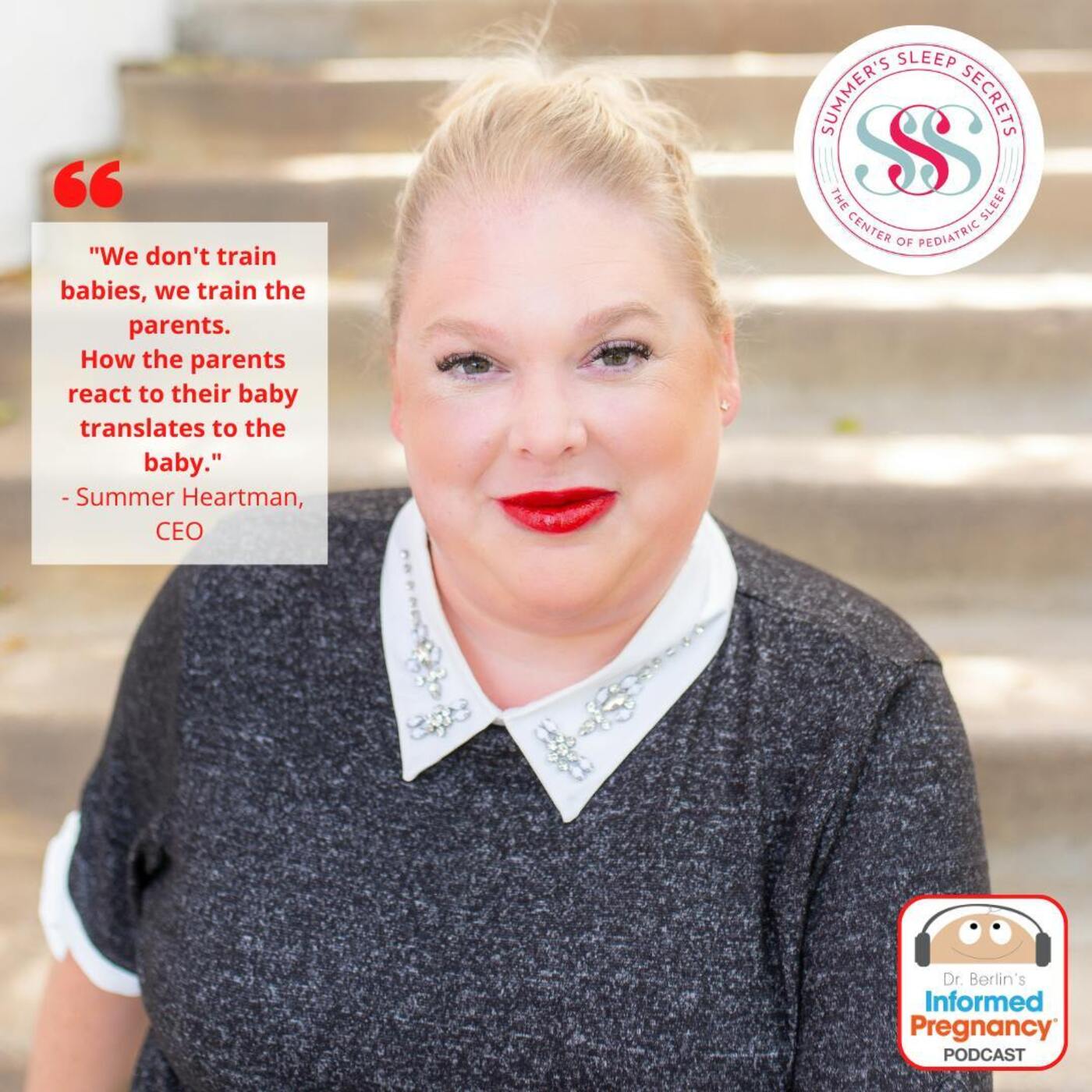
International Certified Newborn Care Specialist and Certified Sleep Consultant Summer Hartman is here to talk about all things sleep. Many new parents find themselves struggling to get their little ones to sleep. That’s where Summer’s Sleep Secrets comes in. This sleep consultation service offers training and tips for families to help get their babies and toddlers to sleep through the night.

Learn more about your ad choices. Visit megaphone.fm/adchoices
See Privacy Policy at https://art19.com/privacy and California Privacy Notice at https://art19.com/privacy#do-not-sell-my-info.
Key quotes
“And then we slowly, over three months, train the baby to actually start sleeping longer and longer stretches through a healthy approach. And we call this sleep shaping.”
“If your baby is just whimpering and like calming down, do not go in. But if your baby is escalated and is like screaming, there's something wrong. We need to check on them. So it can be timed, but it's also instinct is what we teach.”
“we're not training babies. We actually never train babies. We train parents.”
“You're all gonna get sleep. And sleep is repaired. It repairs the brain, it repairs the body, and it helps the baby grow.”
“Babies are ready for bed much sooner than you think. They are actually ready for bed by six PM to seven max. It's like six PM and seven PM are ideal times for bedtime.”
Related episodes
- Ep. 150 Healthy Little Sleepers
- Ep. 427 Birth & Baby with Elite Certified Doula Kristin Revere
- Ep. 196 Jaundice and Other Newborn Concerns – Dr. Princeton Ly
- Ep. 431 Postpartum with Emily Johnston (Part 3)
Transcript
AI-generated transcript with speaker labels — may contain errors, especially names and medical terms. Dr. Elliot Berlin, DC appears in blue; Summer Hartman in orange.
Download PDF of the Transcript
Dr. Elliot Berlin, DC [0:55] Welcome to the Informed Pregnancy and Parenting podcast. I'm your host and pregnancy focused chiropractor, Dr. Elliot Berlin. My guest today is an expert sleep consultant with years of experience working with new babies and their exhausted parents. In addition, she also trains professional sleep consultants and helps place them with families. Summer Hartman, welcome to the podcast.
Summer Hartman [1:59] Thanks for having me. I really appreciate it.
Dr. Elliot Berlin, DC [2:01] It's a pleasure, first of all, thank you so much for supporting Informed Pregnancy and being one of our sponsors, and also for the incredible work that you do. But let's start at the beginning. Where are you from?
Summer Hartman [2:15] My family and I live in Phoenix, Arizona, and yeah, that's where we're from. We've been here 15 years.
Dr. Elliot Berlin, DC [2:21] Wow. Okay. Professionally, what's your background?
Summer Hartman [2:25] So professionally, I started out working as a newborn care specialist that got me into the field of sleep consulting, and that was about 15 years ago. So I started working in home and working with families, really seeing where the issues were while I was working with them.
Dr. Elliot Berlin, DC [2:40] What does a newborn care specialist do?
Summer Hartman [2:43] A newborn care specialist is somebody that comes into your home and educate you and helps overnight so that you get rest as a new parent. I mean, the exhaustion after having a baby is intense. So we come in at 10 o'clock at night or nine o'clock at night, and we work until seven in the morning, and we take care of the feedings overnight if they're bottle fed, or if parents are nursing, then we bring the baby to the mom, she nurses, and we take care of all the aftercare. And then we slowly, over three months, train the baby to actually start sleeping longer and longer stretches through a healthy approach. And we call this sleep shaping. So sleep shaping is part of newborn care, especially.
Dr. Elliot Berlin, DC [3:24] Was that your introduction to sleep?
Summer Hartman [3:27] Absolutely. 100%. My first job was working with twins. It was kind of like a throw me in the fire. And I was like, you got to sleep. I can't, you know, the back and forth with the kids. And so I just started having a method that I would start feeding them. There were twins. I fed them at the same time. And the parents got on a schedule during the day that I set them up on. And then I started slowly offering like a passy to kind of hold them off by 30 minutes. Here 30 minutes longer and just kind of progressed. And then people started hearing, I was helping babies sleep through the night. So that's how it started.
Dr. Elliot Berlin, DC [4:03] What kind of training is there for a newborn care specialist?
Summer Hartman [4:06] You know, there are a few trainings and there's no governing body over it, but there are a few trainings around the U S that you can take. And, um, actually I have one coming out in August that will be launching along with my programs. But honestly, the best training is experience once you're in there, but I do require a lot of the people I place on jobs to have some form of education.
Dr. Elliot Berlin, DC [4:30] And so let's talk about your company as summer sleep secrets. One is for practitioners. So tell me more about that.
Summer Hartman [4:37] Yeah. So I actually wrote a program for consultants and practitioners back in 2017, and I realized that the education out there was just not extensive enough for what we were doing. And so I just started writing and it was all case studies and then the research behind it. And I'm huge on science and research, the latest studies. And so I'm always adding value to my program. And I have taught over in, like, 16 countries. I have 312 students so far. And most people are joining every other day. I'm having people join.
Dr. Elliot Berlin, DC [5:11] Wow. And those are practitioners.
Summer Hartman [5:13] They are.
Dr. Elliot Berlin, DC [5:13] They're people actually supporting families. Wow. So if you take 300 times each one and how many people that they help through the transition, you're affecting a lot of lives in a very positive way.
Summer Hartman [5:27] I keep hearing that.
Dr. Elliot Berlin, DC [5:31] Do you have kids of your own?
Summer Hartman [5:32] I do. I have a 20-year-old. And I have a 21-year-old who's getting married. So add his fiancee into it. So we have three kids is what I thought.
Dr. Elliot Berlin, DC [5:42] I guess they're going to need some help soon too.
Summer Hartman [5:44] No, let's hope not. No, no, no, no.
Dr. Elliot Berlin, DC [5:46] No?
Summer Hartman [5:47] Don't make me a grandma yet. No, no, no, mama. I'm like, have some enjoyment before you have children, like, let's.
Dr. Elliot Berlin, DC [5:54] At least they'll have the right support when the time is right.
Summer Hartman [5:57] Absolutely. Well, no, actually, I told him they're going to have to take care of your own kids. And the grandma's house will be grandma's house. But of course, I will always love my grandkids. But you say that now, but I know. You know what's going to happen. They're going to end up in my room in the bassinet. I just know it. They're going to drop them off and be like, I can't do it. I actually made my son's fiancee take my training course because I want her educated. I said, if you're going to live with my son, and actually my son works for me, I said, you're going to learn the family business. And so she did. She took it and she's learned a ton.
[6:32] And she's actually implementing it in her work now.
Dr. Elliot Berlin, DC [6:36] Are you going to be training trainers?
Summer Hartman [6:39] Yes. Well, you asked that. I mean, there will be trainers for the new program, the NCS course that I've created. Yes, I'm not going to be teaching that. It's all online right now currently. But if people want in-person trainings, I will be training those people because I don't have the time. I'm educating people so much through Zoom and through calls and stuff that I'll have people working for me.
Dr. Elliot Berlin, DC [7:03] And you have to sleep some time too.
Summer Hartman [7:07] Yeah, that's a really important part. It's funny. I just retired from working overnights in November. I had worked seven to five nights, 12-hour nights for 15 years. And when I retired in November, it was like my body didn't know what to do. It was like a total reset. And all the sleep research that I've done for my books and my courses, I logged a journal of my own journey through learning how to sleep again. And it really did come down to resetting my circadian rhythm. And I still have issues if I have a phone in front of my face in the bed. So I make sure I turn it off and leave it in the office.
Dr. Elliot Berlin, DC [7:46] I mean, honestly, I think in today's day and age, there's a whole separate field of sleep training for adults.
Summer Hartman [7:54] Oh, yeah. I have a whole section actually in my training for adults. And that came about because I actually was coaching the professionals on how important their sleep is, is why I wrote it. But it's actually turned into them using it with their clients and parents who need help with sleep. I didn't really expect that to come out of it.
Dr. Elliot Berlin, DC [8:14] Little surprises around every turn. All right, summary. I'd love to find out more about your specific services and the programs that you have that help new and expecting parents. Let's take a little break and we'll be right back.

Dr. Elliot Berlin, DC [10:50] Welcome back, we're talking to Summer Hartman from Summer's Sleep Secrets. Okay, let's talk about sleep consultants, what do they do?
Summer Hartman [11:04] So this is something that people often ask me actually. Sleep consultants are virtual support system for parents. They are usually on hand while you're training your child, and they have certain packages. Everyone's slightly different, we kind of run our companies a little differently, but most of the part we're there for that first two weeks of training. And it's all through phone, vox or email, it could be a certain app that they use, but it's all virtual.
Dr. Elliot Berlin, DC [11:31] Okay, so you're doing virtual training for two weeks.
Summer Hartman [11:36] Yeah, two to four weeks. It depends on the sleep program that they choose. So like I have several offers of like, okay, so if you want a no cry approach, that's going to be a four to six week program because we have to take away certain, I call them crutches over time. So like if you bounce on a ball with your baby, then we're going to slowly stop bouncing on the ball over a few days so that the baby gets used to a different motion. And then we're going to stand next to the crib. So those steps take time. So that program is longer. But if you're wanting more of a fervor approach and your baby is healthy, and you don't have any like concerns and that they would have any issues after training,
[12:20] then we just go with a two week approach and that's pretty quick.
Dr. Elliot Berlin, DC [12:23] Okay, so you mentioned a couple of different options, no cry and fervor. For anybody who doesn't know what fervor is, a lot of people don't. What is fervor and what other methods are there besides like no cry and fervor?
Summer Hartman [12:38] Oh my goodness. So you have the cry it out approach. Let's go ahead and go there. Let's just go to the top that people always talk about and they think sleep training is all cry it out. It is not. Cry it out is one approach that was developed in the 50s. It's where you leave your child for six hours or more without going in. You just watch the monitor or listen through the door. You would not go and attend your child. Now, I don't use that approach, but it's taught and people do it. There's the fervor, which is the time check-in. So that's like your 5, 10, 15 and I actually don't ever use 5, 10, 15. I don't see what works. Doesn't work as well.
[13:15] So it's either one minute we go in or we go in at six or seven minutes. So I kind of play with the time, but I actually teach people the fervor approach with a time to check in based also on instinct. So what is your instinct telling you? Is your baby's cry a certain cry? Like that's the really big difference. Are you in tune with your baby's cry? If your baby is just whimpering and like calming down, do not go in. But if your baby is escalated and is like screaming, there's something wrong. We need to check on them. So it can be timed, but it's also instinct is what we teach.
Dr. Elliot Berlin, DC [13:49] Yeah, that makes sense. There's no one size fits all.
Summer Hartman [13:51] Never. I mean, there's also the fade to sleep method. I feel like that one is still the timed instinct type approach where you kind of listen, but you fade out of the room. Like you could be in the room, but you slowly go out of the room. That's also called the chair method. There's a ladder approach, which is exactly the fervor approach. It's just renamed the ladder approach. I mean, there's just all sorts. I just created a new program this weekend. I just can't stop working and my brain doesn't stop. And so I created this intuitive care approach and I created it step by step. So all they have to do is just follow my step. And it's literally we don't do any times.
[14:28] We're literally listening to the child and like they're in tune with their child. So they see the pattern of the cries. They see when they're hungry. Like I'm teaching them all the cues versus watching the time on the clock, which I find people who watch the clock become very, very anxious and have anxiety. So if they're in tune with their baby, they're less to actually watch the clock.
Dr. Elliot Berlin, DC [14:51] I mean, what an incredible skill anyway, to learn to be in tune with your baby and to be more aware of their cues. and understand them, it comes supernaturally to some people and not to other people. And it just seems like being able to teach that is much bigger than just sleep, like the interaction and relationship that a parent can have with their child could be so much greater with that than without it. Well, with all these different methods to choose from, if somebody reaches out and wants to do sleep training with their baby, how does it work with you? How do you decide which method to use with clients?
Summer Hartman [15:33] That's a really good question. So what I do is I ask them, what have they read? And that is really the key, honestly, to know what parenting style they have. There's only four parenting styles in the world. If they've read Baby Wise, or if they've read Elizabeth Pantley's No Cry Sleep solution, then I know that they want the No Cry Sleep approach, but if they want the Baby Wise approach, that's the Ferber and cry it out approach. So that tells me a lot. And even in my questionnaire that I have, I have it in there specifically, those two books have you read so that they actually pick what they've read. And that really is a key to their parenting style.
Dr. Elliot Berlin, DC [16:14] And if they haven't read?
Summer Hartman [16:16] If they have read no books, then I ask them, how do they handle their baby's cries? What heart rate beat do they go to? Do they stress out? Do they sweat or are they okay? It's a personal intuitive feeling that parents have with their children. And if they're panicking and have anxiety, they're gonna tell me they want No Cry approach.
Dr. Elliot Berlin, DC [16:36] You know, if they're just totally indifferent, is there one that you think works better than others or it's really just a very individual?
Summer Hartman [16:46] Another really good question, actually. It's always based on parents. And to tell you the truth, as a sleep consultant and trainer, we're not training babies. We actually never train babies. We train parents. How the parents react to their baby is transferred to the baby. When a parent is anxious, they hold their baby in the crook of their arm, but notice that their elbow is squeezing their head because their anxiety is so high. So we have to teach that when we're sleep training, I take the parents back and I talk to them as training their baby. How do you feel? What's happening right now that you're thinking about? Why are you crying? Why is this stressing you out?
[17:27] Tell me why. Because honestly, when it comes down to sleep training in general, they just are worried their baby's being hurt. And I will say this, the most amazing thing is gonna come out of this. You're all gonna get sleep. And sleep is repaired. It repairs the brain, it repairs the body, and it helps the baby grow.
Dr. Elliot Berlin, DC [17:47] You know, maybe TMI here, but my oldest is currently 18 years old. We were kind of like the no cry people in general. I think like a more holistic approach to parenting and we resisted the sleep training for a while. We just figured it'll get easier, it'll get better. Around eight or nine months is when we realized that not only are we miserable because he was up all the time at nighttime, but he's kind of miserable. During the daytime, he's yawning and he's fussy and he's irritable. Like you could see he didn't get a great night's sleep. And because of that, we chose to sleep train at that point. We did kind of a modified Ferber approach. And it was amazing how like in less than a week,
[18:42] he was sleeping solid blocks of time at nighttime. He cut out of feeding very quickly and nighttime feeding very quickly. And he was just so cheerful and curious during the day. It was amazing to watch. And as an added bonus, we were kind of happier people too. So, I mean, I get the idea that it's different from person to person, baby to baby, family to family, but it's great that you have a whole bunch of different options that you can customize to make it right for each family.
Summer Hartman [19:17] And here's the thing too. I wanna just kind of mention this. When babies play and they go to sleep, they retain what they played while they slept. When they wake up, they can go right back to that pattern, what they learned before that nap. And so that's why sleep is so important. It's like their development is happening at a rapid rate. So we need them to sleep and actually learn. The other thing I wanna mention about sleep training too, just as an FYI for any method you choose, it's not about the method. It's never about the method. It's actually about consistency and it's actually about food. So if their baby is not eating right or getting the right amount of food…
[20:00] of food during the day, you will not be able to take away any feedings away at night. So this is where a professional who's trained to actually know the amount your child needs to eat, that's why you're hiring a sleep consultant. They should know what that looks like, and that's the only way your baby will train as long as they're being well fed.
Dr. Elliot Berlin, DC [20:18] So interesting, it's not just about what's happening at night time.
Summer Hartman [20:22] Not at all.
Dr. Elliot Berlin, DC [20:23] All right, so we're going to take another break. When we come back for our last segment, I would love to get some practical tips. Don't go anywhere, we'll be right back. Welcome back to the Informed Parenting and Pregnancy podcast. We're talking to Summer Hartman of Summer's Sleep Secrets. All right, let's get practical. Starting at the beginning, when is a good time to start considering sleep training?
Summer Hartman [20:57] So sleep training is recommended between four and six months, not any sooner. So what I would say is you would get your baby on a good routine from zero to three months, zero to four months, but those feedings still stay the same unless the baby sleeps on their own. Then you would move to four months and you consider sleep training. Now, sleep training, you really have to look at the bigger picture. You need to write down and log when your child is eating and sleeping, napping during the day. Also, the tips that I would give is the schedule during the day, you need to make sure that they're eating every two to three hours, they're getting quality feeds,
[21:36] they're not snacking, they're naps. Now, four months, they can be 30-minute naps. We all know we struggle with 30-minute naps, but what we're going to work on is the sleep insult and we work on basically connecting those sleep cycles. So anytime you're training a baby from four months on, we work on that daily routine and the nap schedule and all of that. So that's what parents need to focus on is the day. Then at night, we just put in the steps and the steps are pretty simple. I have a system, so I work them through them.
Dr. Elliot Berlin, DC [22:08] When you say get them into a good kind of pattern in the first few months, are there specific things that work better? I remember we had, you know, a very specific nighttime routine that was messed up every time we would travel or get sick or whatever, change the clock. But the nighttime, it was around the same time every night was, you know, feeding and then a bath and then sort of story time, even when they were very, very tiny, a little sing a little song with them or prayer, and then maybe a top off feeding and then bedtime. So is that like what you're talking about during the first few months,
Summer Hartman [22:46] just something, a routine or? Yeah, I know your podcast is really geared towards new moms. And one of the things that we do as newborn care specialists, this is really where the field came into like how I started learning to sleep shape. So we call it sleep shaping. It's not training, but we're shaping the child to sleep longer stretches overnight. So in order to do that, we do schedule the days from the very beginning. So for the first four weeks, it's all about bonding. FYI, I just want to say this very quickly. Not every mother knows how to bond with their baby or bonds with their baby. And that's okay. Like I am 100%. You have to learn how to be a mom. If you never held
[23:25] a baby before, it's scary. And anxiety can be high. So just know it's going to take time and give yourself grace. I will say that. But when it comes to like sleep shaping, what I do is I have them follow the baby's cue first. So we know when the baby naturally wakes up in the morning, so babies wake up between 5am and 8am. So we kind of like figure out what that pattern is. And all of a sudden, it's around 530, six o'clock, the baby wakes up for the day. Then that's the time that we start their day. But here's the cue. You have to start the day at the same time. And then your patterns during the day, their naps, their feedings falls right into place because it's predictable.
[24:05] And then bedtime is actually 12 hours from that time that they woke up. So at 6pm, they're down for bed. And then they go to bed for the night. And that routine is about we do a bath and you don't have to soak them up. You can skip the soap, but it's the warmth that we're looking for that coziness to clean off the milk spill the dirty diapers they're sitting in. Clean your baby please. It is one of the best things for them before they go down for bed. And to get them in their PJs, you cuddle, you turn the lights down low, or you turn on the red light, you nurse them, you're rocking very slowly, you swaddle and you put the baby down and it's just such a calming bedtime. And then guess what you get
[24:46] to actually go and eat your food and watch the shows you wanted or just go to bed. I worked for one client and it was just like the minute the baby was down at 7pm for bed. Everyone was in bed. Mom and dad was in bed, the toddler- was in bed and I saw them all at six 30 in the morning when I saw them.
Dr. Elliot Berlin, DC [25:04] So, yeah, the way you were describing that 12 hour sleep cycle now as a very busy adults and parent and business owner, I can't believe I resisted that at some point, I was so many people resisted and maybe actually not even resist, they just think that if they stay up till 10 o'clock at night, that the baby will sleep until six and they'll get that nice stretch. And a lot of books and a lot of people teach that, but I actually don't believe in that.
Summer Hartman [25:34] So how many of you have known the witching hour, right? The witching hour. People talk about this all the time. I owe my baby as a witching hour and the witching hour can be from four PM or it can be from seven PM till 10 PM. So here's the thing. Babies are ready for bed much sooner than you think. They are actually ready for bed by six PM to seven max. It's like six PM and seven PM are ideal times for bedtime. And that starts around four weeks old. If you implement and sleep shape from the very beginning, there is not even sleep training, even happening. I mean, I've had a thousand clients and out of that, maybe four or five had called over the years and said, okay, things kind of got wonky here.
[26:14] So can you fix what we did? We went on vacation and I just tell them over the phone, dot, dot, dot, here's what you need to fix. And so if you start from the beginning, it does really help for later.
Dr. Elliot Berlin, DC [26:25] That's good to know. And it's good to know early on. I remember our kids would wake up at five AM and, you know, it's an ungodly hour to wake up sometimes for me, but even more so for my wife, who would be up in the middle of the night too, with feeding them and whatnot. And so, you know, logically you have the idea. Well, if I put them down to sleep two hours later than the wake up at seven AM, no, they still woke up at five AM just extra cranky two hours less than sleep. So, yeah, I don't know if that trick works for anybody, but it sure is heck did not work for us. All right. So when you hit that four month period and you start to think about
[27:04] sleep training, uh, you mentioned some books, does everybody need a sleep consultant or can some people just do it on their own?
Summer Hartman [27:12] No, I mean, I think millions of people are doing it on their own. I don't think everyone needs a sleep consultant. I think the research is out there. I think if you look up and you put in the science behind sleep and you find the articles, you can do it yourself. But what happens with hiring a sleep consultant is that you get your own personal coach and then, you know, that person's trained in that field. Like, let's say you were going to go to court and you were going to represent yourself in court because, Hey, you researched it, right? You learned it online. You can do this. You weren't in the wrong. You've got this with pump. Then you go to jail, right?
[27:46] Cause you didn't represent yourself. Right. Here's the thing. We are the experts in the field. If you need us, we're absolutely going to give you the best advice we can with that baby with your child, but not everyone needs it. You can go on Instagram and find tons of feeds with tons of knowledge out there of sleep consultants that they're giving out for free, even on my own. I give free advice all the time. I don't hesitate, but I would definitely, if you're in a bad state and you're running anxious and you just feel lost, that's when you really do need to reach out for help. Never hesitate. Cause that's what you want. You need help.
Dr. Elliot Berlin, DC [28:23] Okay. So for people who are curious about help or feel like they need help, what programs you've mentioned, you have different plans and programs, what programs does summer sleep secrets offer?
Summer Hartman [28:37] We are just actually launching this week, our nap program that is going to take you from newborn to 24 months, and it's going to walk you through like the steps to train with different methods, all the different types of methods. So it's going to apply to everyone. And we also have our 40 page newborn, newborn guide. Basically, it's not just based on sleep, but we have that offer. And then we also do a one-on-ones and we also are going to be opening up group coaching sessions and that will be happening in September.
Dr. Elliot Berlin, DC [29:07] Well, that sounds fantastic. And it sounds like you're just growing and growing with more products over time.
Summer Hartman [29:14] Yeah. It's actually exploding right now. I didn't expect it, but since I'm not working nights anymore, I don't have to go to work. My brain just doesn't stop. And I've always pivoted in my career. I always know when I see and I listen, and when I see a need from a parent, I'm immediately figure out a solution for them.
Dr. Elliot Berlin, DC [29:32] All right. Summer, where can we find you online?
Summer Hartman [29:36] You can find me at www.summersleepsecrets.com a lot of S's. The summers and the secrets have an S at the end. So summer sleep secrets.com and on Instagram.
Dr. Elliot Berlin, DC [29:51] Yep.
Summer Hartman [29:51] I'm on Instagram. You can get tons of free advice on there. You can DM me for questions and I'm running it. So I'm in there. And then I'm on Facebook and I also have a private Facebook group for parents that's exclusive for any questions, it's free and it's worldwide.
Dr. Elliot Berlin, DC [30:08] Oh wow, a lot of options.
Summer Hartman [30:09] I don't mind giving away as much information as possible to help every parent.
Dr. Elliot Berlin, DC [30:13] That's amazing. Summer, it's great to talk to you. Thank you for sharing your wisdom and the fruits of all your years of studying and practical on the job training with so many babies and so many families and sharing that with new parents who could really use this kind of expertise. I really appreciate it.
Summer Hartman [30:35] Absolutely, thank you for having me on.
Dr. Elliot Berlin, DC [30:37] And at home, thanks for listening to our podcast. If you'd like to connect with us or get other information like blogs and documentaries, visit us online at informedpregnancy.com.
Want more pregnancy + parenting? Start your FREE TRIAL of Informed Pregnancy+ and get access to all our curated pregnancy and parenting content — original series, iconic birth films like The Business of Being Born, prenatal workouts and more.
