
May 18, 2023 · 33 minutes · Episode 351
About this episode
Childbirth educator, home birth mother, and experienced home birth attendant Katelyn Fusco has seen birth from every angle (literally). She knows the impact that a birth experience can have on you, your baby, and your entrance into motherhood. Katelyn shares her wealth of knowledge about pregnancy and birth and gives us insight into her own experiences as well as the upcoming home birth plan for her third child.

- Follow Katelyn Fusco on Instagram: https://www.instagram.com/happyhomebirthpodcast/
- Read about dogs and birth, “doggy doulas”, on the Informed Pregnancy blog: https://www.informedpregnancy.com/single-post/doggy-doulas-dr-elliot-berlin-dc
- Learn more about Katelyn’s ‘Happy Homebirth Fix’ community: https://www.myhappyhomebirth.com/podcast-2/
Keep up with Dr. Berlin and the Informed Pregnancy Project online!
www.instagram.com/doctorberlin/
www.facebook.com/InformedPregnancy
Learn more about your ad choices. Visit megaphone.fm/adchoices
See Privacy Policy at https://art19.com/privacy and California Privacy Notice at https://art19.com/privacy#do-not-sell-my-info.
Key quotes
“that her body didn't work.”
“baby was safe. There was nothing dangerous going on. It was just, this is how it is,”
“I'm a huge part of this.”
“I want to just be completely primal.”
“or in the hospital, it's you.”
Related episodes
- Ep. 339 Birth Work Professional Sallyann Beresford
- Ep. 350 Ciara Whaley: After Birth
- Ep. 333 Carson Meyer: A Doula's Birth Story
- Ep. 329 Valentina Trentini: After Birth
Transcript
AI-generated transcript with speaker labels — may contain errors, especially names and medical terms. Dr. Elliot Berlin, DC appears in blue; Katelyn Fusco in orange.
Download PDF of the Transcript
Dr. Elliot Berlin, DC [1:36] Welcome to the Informed Pregnancy Podcast. I'm your host, pregnancy-focused chiropractor Dr. Elliott Berlin. My guest today is a home birth mother. She's also a child birth educator and experienced home birth attendant, and she's seen birth from many angles, literally. She has also started a brand to help educate moms before they give birth, and that is called Happy Home Birth. She is currently 37 weeks pregnant and about to have her third kid, Caitlin Fusco. Welcome to the podcast.
Katelyn Fusco [2:04] Thank you so much for having me, Dr. Berlin. It is an honor to be here. I'm so excited.
Dr. Elliot Berlin, DC [2:09] I'm excited too, and I come from a very medical background. I was brought up in a medical background. I always wanted to do medicine from the time I was very young, and I worked in ambulances and emergency rooms as an EMT, and then I took a curve into more holistic health. Even when I started doing my initial work in pregnancy with chiropractic, I was still from a very medical background, so it was very eye-opening to me that people even have home birth 20 years ago and that it's not just previous driving vegan hippies who have home birth.
Katelyn Fusco [2:41] Right, the midwife coming down from the mountain on her horse, yeah.
Dr. Elliot Berlin, DC [2:44] Right, with a shaved head. I would love to learn more because now I see that there's a lot of benefit for many people on home birth, and I think a lot of benefit for many people on other types of birth, and I'd love, since you're so knee-deep and entrenched in it, to learn more from you about your experience both giving birth at home and also supporting people who are thinking about or going to give birth at home or are giving birth at home or probably have given birth at home. So, without further ado, let's start at the beginning. Where are you from originally?
Katelyn Fusco [3:13] Well, I am actually from Greenville, South Carolina. I am still here in Greenville, South Carolina. Never moved. Who does that? The small upstate area, but, well, now everybody's coming from everywhere. It's kind of crazy to be an actual local, so I'm kind of a big deal.
Dr. Elliot Berlin, DC [3:31] Big deal to me. So, at what point did you start thinking about children? Having children? Did you want children? Was it something early on for you?
Katelyn Fusco [3:41] I always knew I wanted to be a mother, but I will say that growing up I was very hesitant about giving birth. My mom had three C-sections. She always said, you know, her first, it was an, quote, I'm doing air quotes, emergency cesarean. And the doctor just said, you know, the baby's coming, but you're not dilating, which really is a fascinating idea. And so we just, you know, we have to have this C-section. And so she has always kind of carried with her this idea that her body didn't work. And, you know, that's one of those things that we can pass on. You know, oh, well, my mom's body didn't work, so my body's probably not going to work either.
[4:21] So my assumption growing up was that I would have cesarean births. It wasn't until I graduated college and just by chance, a mentor that I had told me that she had given birth in a tub and it was at a birth center. And I was like, wait, I'm sorry, what? Like, what are you talking about? That's something people do. People give birth not only not surgically, but also without like an epidural, without medication. It was a whole new world to me. And that inspired me to start doing some research. And admittedly, the first time that I decided I think I'm going to… give birth unmedicated. It was the idea of, well, if other people can do this, then I'm
[5:05] going to do it. You know, almost this like, I can do it. Yes. Yes. That's who I am to my core. But in the meantime, there's been a lot of growth and a lot of understanding as to why this can be such a beneficial entrance into motherhood and just such a beautiful experience. So that's how things started. I ended up not using my degree that I went to school for years for. What was that? American Sign Language. Oh, okay. Yeah. I was going to be an interpreter. I ended up meeting with a midwife and realized, oh my goodness, this is what I want to do. She was a home birth midwife. So I began apprenticing with her, saw my first home birth, and was absolutely
[5:50] overwhelmed at just the depth of that experience. And that changed everything for me. I became her apprentice and not too long after that became pregnant with my first. So we went the home birth route and it's been a beautiful
Dr. Elliot Berlin, DC [6:05] journey ever since. Well, what an evolution. Yeah. So it's funny, right before we came on, I was telling you that I come from a very medical background and home birth was the first time I even heard about it was a little bit brain squeezing for me. And then when I saw it, I was like, whoa, I get it. In fact, our first birth, my wife and I was a hospital birth, but she did not want any interventions or medications and was a long birth, 42 hours, totally unmedicated except for Advil, which I kept taking for my headache. So I was like, baby, I have no idea how painful this is. Anyway, this is so hard for me. So we used to tell people, oh, you know what, we had home birth at
[6:44] the hospital. And it wasn't until I was invited to support somebody during labor at a home birth that I realized you can't have home birth at the hospital. You can have a natural, beautiful, healthy birth at the hospital. But the key ingredient in home birth is home. It's the home. It's quite different. Okay, so it's also interesting that you said that your mom had three, does that mean they were all three?
Katelyn Fusco [7:05] All three cesareans. Okay. There's three of us.
Dr. Elliot Berlin, DC [7:08] Which one are you out of curiosity?
Katelyn Fusco [7:09] I'm the middle child.
Dr. Elliot Berlin, DC [7:10] Oh, okay.
Katelyn Fusco [7:11] All the baggage that goes along with that. Exactly.
Dr. Elliot Berlin, DC [7:15] Caitlin, the middle child. So the interesting thing about that is I have started to see people who kind of have those ancestral blueprints that go back even more than just your mom, like your grandmother, great grandmother. And it's interesting that you're able to sort of recognize that that was starting to become part of your operating system, and maybe took action to reverse it before it concretized.
Katelyn Fusco [7:43] You know, it's so fascinating, too, to think about that maternal lineage and how we do have what's called the red thread, females in general, you know, passing things down, mother to mother, this DNA that transfers down that path, it makes sense that, yeah, some of the things that I think are me, they're probably my grandma.
Dr. Elliot Berlin, DC [8:06] Interesting, because the mitochondrial DNA, doesn't the male mitochondrial DNA basically commit suicide right after conception. So you only get your mother's mitochondrial DNA. It's not the bulk of the DNA, the bulk of it's in the nucleus, and you get a pairing of the two. But that's really interesting. Wow, mind blown. Thank you. I need to take a break because I have to process that. But when we come back, I want to find out how your first couple of births went. And now you're planning for your third. How exciting. We'll be right back.

Dr. Elliot Berlin, DC [10:12] Welcome back. We are talking to Caitlin Fusco. Okay. So, what a journey into your interest in home birth, and then you apprenticed with a home birth midwife. Does that mean you were
Katelyn Fusco [10:23] becoming a midwife? I was. Now, it kind of, you know, all these things happen in such an interesting way. But about 10 months after I had my daughter, she was in full swing toddlerhood. I mean, you know, some kids, they just enter toddlerhood so early and with such a bank, and that is who she was. That's who she is. She is just so fiery and amazing. And it was really hard to parent her and not sleep at night and be on call. Oh, wow. You have to be so present. Right. Yeah. It's not just like, oh, I'm going to go do a quick job clock in, clock out. It's, you know, there's so much intensity with being involved in someone else's life transformation. So, my midwife ended up
[11:05] moving around that time. And it was just like, ah, this is perfect timing. I need to be home. I need to focus on my daughter. That was such beautiful time for us. And then it wasn't too much longer after that, that I did just desperately miss that connection and that ability to pour into other mothers. So that's when I realized, you know, there's not a lot of information for home birth moms out here. And it can feel really lonely. It can feel very isolating. That was one of the things that I would hear our clients speak about again and again is I'm the only one that I know. I don't know anybody else. I don't have anyone to connect with. And so that's how the Happy Home Birth podcast
[11:43] actually came to be. So that was a really beautiful way to still get to work with that community, but also not be on call, which is great for me.
Dr. Elliot Berlin, DC [11:53] But you do attend births.
Katelyn Fusco [11:54] I do still attend births occasionally, but not nearly as consistently as I used to.
Dr. Elliot Berlin, DC [12:01] It was really interesting because a couple of now it's probably a couple years ago, I was looking desperately for a doula here in Los Angeles, who also was a sign language communicator. So it seems like in some cases, your combination of two things would be invaluable.
Katelyn Fusco [12:19] Yep. And there have been a few scenarios that I haven't been involved in, but I have known of a doula who is fluent in ASL. And that has been an amazing thing.
Dr. Elliot Berlin, DC [12:28] Let's talk about your birth. So the first one, your plan was to give birth at home. What kind of support were there people on your birth team?
Katelyn Fusco [12:36] Yes. So I am a very outgoing person. I love the people that I work with. My midwife had two other apprentices beyond me, and I wanted them all at my birth. And it was going to be, this was December of 2016. So this is Christmas time. My desire was to have everyone show up to my house in their Christmas robes. I had hot chocolate on the stove. We were going to have a Christmas party. And I really expected to have a quick labor, you know, as most first time moms do. I don't know what that was about. Those births make me so nervous. That's the plan as a doula. Yes. Well, and you know, it's just so funny because I had seen birth so many times at this point. I know that it's a long process, but there were two other moms that were first
[13:26] time moms who had just given birth right before me. And we had all become friends and they both had very short labors. We had all seen the same chiropractor. We had all taken gentle birth tincture. There were like three different things that we had all done. And I was like, well, two of them have had their births. They were fast births. I'm number three. We've done the three things. We're the trifecta. I'm going to have a nice quick birth. You know, that's just how it works. Didn't happen that way. And it was such a great learning experience, though, because I did have to let go of what I believed I was going to need and actually lean into what was appropriate, which my uterus told me was not a Christmas party.
[14:11] So everyone had to leave the house after many hours. I should have been resting more when I realized that, you know, my contractions were only coming when I was standing and being active. Hey, maybe it's a great idea to go rest instead. But it took me a while to get my mind to that place. So it ended up being I went into labor on a Thursday night. I had my daughter on a Saturday morning at two thirty in the morning. So it was a long process. She was in my hip the whole time in my right hip.
Dr. Elliot Berlin, DC [14:45] Oh, wow. Is that where you felt all the intensity?
Katelyn Fusco [14:48] I felt it in other places as well, but I could tell that's where she was going. You know, I could tell that was her trajectory. So once she was actually able to get into the birth canal, she was out of the. birth canal. I mean, it was 11 minutes of pushing. It was very quick, but it was just not even enough time for eggnog. No, no eggnog, no hot chocolate, nothing. Actually, not even enough time for most of the people to get back to the birth. So which was, you know, looking back, it's like that's what was needed the whole time during that earlier phase when things weren't happening as you expected. I mean, did you have any of those twinges of like, maybe this is maybe I'm like my mom, maybe. Oh, good question. No,
[15:30] I didn't. I had seen so many births. I knew I was going to do it. I didn't have any thought of, am I going to have to go to the hospital? And is something wrong? At that point, I was very confident because I had seen so many people do it. And that's not to say that there is never an issue that arises where we do need additional support, where we do need to transport. I 100 percent understand that. But I felt very sure that my baby was safe. There was nothing dangerous going on. It was just, this is how it is, Caitlin. This is the process that it is. And there was a sense of recognizing that there was some lesson that I was going to need. And turns out, you know, all of the lessons,
[16:13] the persistence that I gained in that birth was really necessary for motherhood. That was
Dr. Elliot Berlin, DC [16:19] a great question. Oh, thanks. I've been practicing. Yeah, good job. Okay. And then you had another home birth. That one was a lot faster. Okay. Was there a theme? A theme as in? Christmas.
Katelyn Fusco [16:35] Oh, no, no, no theme this time. This baby was in June of 2019. And I wanted to believe, because my oldest was born a day before her due date. I wanted to believe that this one was going to be born around that time. And she was. It was 40 and three. It was nothing. You know, it was perfect. But darn it, if those last three days or last four days didn't feel like an eternity, just because, you know, 39 and six versus 40 and three, it felt like forever. Yeah. I mean, I guess we set ourselves up for that. Yes. The expectation and then everything after that just seems like what is wrong here. Right. And it doesn't even matter how much you know, like at this point. Well, with my first,
[17:21] I told myself I'm going to 42 weeks. I'm just going to assume that I'm going to 42 weeks. And then anything below that is going to feel awesome. Like, that's so cool. And with my second, it was like, well, I went to 39 and six. So I'll probably, you know, go to 39 and six. So this time around, no expectations at all. This third time. This third time around,
Dr. Elliot Berlin, DC [17:43] no expectations. So with our kids, the first came about two weeks before 40 weeks. So 38 weeks. And then for sure, we thought the second one come 30 weeks. It was like three days later, but also like crazy mind games. Yeah. How dare they. And then the next two after that also came about three days after the one before them. So even by the fourth one, we still hadn't hit 40 weeks, but it felt like, wow, what's wrong with this kid? Like in there forever. And so I can really commiserate with people that are, but I read an article years ago about workouts in the gym. Like if they tell you, you know, you have to do 10, let's say reps of something, by the time you get to seven,
[18:19] your mind starts to struggle. But if they told you 15, you wouldn't struggle till you were at 12. So there's a definite mind component there. Absolutely. Did you learn anything from giving birth the first time that you feel like you couldn't have learned either by watching people giving birth or until you give birth yourself? And did you bring any of that to your second
Katelyn Fusco [18:39] birth? Yeah, that's a great question. I feel like there's so much that we can do to prepare. You know, we can wrap our minds around so much of what's going on, but there is a difference between knowing something and then having experiential knowledge, you know, the actual experience of the event. So in that sense, yeah, I do feel like just going through it, it does make a bit of a difference. And then with this second birth, though, I had had a lot of time in between where I was hosting my podcast. So I am listening, I'm just inundated with birth stories, not just in my local area, but across the country of these other mothers who have given birth at home and how they did things and how they
[19:21] prepared. And there were little tidbits all along that I thought, oh, that's interesting. Oh, that's neat how she thought about that. Or, oh, I really wouldn't have considered this way. And so even though I had done hypno babies, I'd done all of these means of preparation for my first birth, there was more of a depth of connection to the process that second time around. And there was more of a desire to be mindful in the labor, to experience every single moment of giving birth, not to feel like it was happening to me, but that I was a part of it. And so that was really my goal with that second birth. And I am so pleased to say that that was what happened.
[20:02] Luckily, I had prepared that way because it was a faster birth. It was three hours start to finish. And I know that that can be very overwhelming as well. Those long births, there's a lot to that. But those short births can be so intense. And I remember at one point going from kind of 0 to 100. We were having the early labor separation phase, like kind of off and on contractions. And then all of a sudden, it was active labor. It wasn't like, oh, let's gently transition. It was, boom, we're here. And I remember thinking, oh, gosh, this is a lot. And in my mind, I thought, OK, Caitlin, if you can think to yourself right now, oh, gosh, this is a lot, you can also think, like, hey, be present.
[20:53] You can also just be here and just experience this in the moment. And that luckily changed everything for me, for that labor. I felt like I was, yeah, I felt like I was just there. Power to be able to do that. It was huge. I mean, it really, and that's what I really try to work with moms about now. It's just understanding our mindset. Oh, my gosh. I mean, and you even said it earlier when we're talking about due dates. And when we think we're going to have this baby, there's such a mind component to it. Heck, that's labor. There is so much mind component to this. So being able to wrap our minds around, hey, this isn't happening to me, I'm here.
[21:33] I'm a huge part of this. I'm co-creating. It was amazing. So I had Lillian in three hours, and it was extremely peaceful. And my oldest daughter was there. She was 2 and 1 half at the time.
Dr. Elliot Berlin, DC [21:45] I was wondering about that. Did you do anything to prepare her for anything?
Katelyn Fusco [21:48] Oh, yeah. Oh, yeah. We did a lot of practicing making noises. She listened to. I was really vocal with her. I had her listen to what I sounded like. And interestingly enough, I wasn't vocal with Lillian. But the other thing we talked about was, hey, mommies bleed after they have the baby a lot of times. There's going to be blood. That's OK. It's normal. So Lillian was born, and we're kind of sitting around enjoying her. And my oldest goes, hey, where's the blood? I'm offended that I didn't bleed enough for her.
Dr. Elliot Berlin, DC [22:25] Well, I guess you really set her up well. Right. All right, I have so many questions about what you just said. And I want to learn about your plans for your upcoming birth and more about the work that you're doing. Let's take a quick break, and we'll be right back. Welcome back. We are talking to a fascinating guest, Caitlin Fusco. I'm learning a lot from you. And it's just so incredible to learn from somebody from experience versus there's a lot you can learn didactically, which is one of the things you were saying. Now, you made a few points, and so many things rushed into my head. First of all, those short labors. Everybody who I asked, I asked them,
[23:09] how do you want your labor to go? And they go quick and easy. And I'm like, OK, but if you're climbing Mount Everest, how would you like that to go? And it's not quick and easy. And labor seems more to me from an outsider looking in like a Mount Everest situation than quick and easy situation. But when it does go quick, it tends to not be that easy. And it looks like, again, observations of a male doula. It looks like concentrated orange juice. Like you have all of that labor, that 20 hours of labor in four hours, and it just moves through you like a train, as those are sometimes the harder ones to support. And of course, in your mind, you're thinking, oh, my gosh, if it's this intense now,
[23:47] I can't do 20 more hours like that. And nobody can promise you that it won't be 20 more hours. Exactly.
Katelyn Fusco [23:52] Oh, that's so true.
Dr. Elliot Berlin, DC [23:53] For you to be able to get in the moment and take charge of staying present in the moment and just letting it unfold, that's really powerful. Another cool thing is that you wanted to feel everything. I think that the general sentiment around childbirth is that I want to feel nothing. And in our podcast, we had one time Hilary Duff before and after her second birth. In the first one, she was hoping for a C-section, decided to just do a medicated birth and not want to feel anything. And she had a great experience. But it was five years later that she realized, maybe I do want to feel that. And so she decided to do an unmedicated birth, eventually home birth.
[24:29] And it was just that she wanted to be present. She wanted to feel everything. And maybe towards the end of this segment, we'll talk about how someone can get from point A to point B, like the fear versus the embracing. And then the last thing you said was that your toddler was at birth with you and you were very vocal with her. And you went through the vocalizations. We have a fascinating Japanese documentary on our platform and Foreign Pregnancy Plus that is this Dr. Ikagawa from Japan who's been studying for decades. kids, what babies remember from their time in the womb and possibly before. It's mind-blowing. I'm still processing it from having watched it and to see how it affects different things,
[25:11] you know, our connections with baby while they're in the womb, baby's connection with us once they come out. But I have to wonder, your toddler probably already knew about those noises.
Katelyn Fusco [25:20] That's such a good point. That just opens up so much because there is so much to that experience of birth. I believe in it and I know that science is showing the same thing, you know, how we experience birth, what our baby experiences in our pregnancy and then as they are being born and how that really imprints on them. And I've seen that with both of my daughters, you know, how was I feeling during pregnancy versus what are the tendencies that they have that we work through, like nervous system wise and things like that. I will be watching that documentary is what I'm saying here.
Dr. Elliot Berlin, DC [25:52] Mine will be blown. OK, so now you're pregnant again, just a couple who knows. Now, let's not put dates in there, but towards the end, sometime soon. Yeah. And is there anything different for this birth that you're planning? Are both kids going to be there?
Katelyn Fusco [26:07] The plan is for both kids to be there, you know, assuming that they want to be there. Now, my oldest is six and a half. My youngest is almost four. The oldest, she wants to be there. I mean, there's no question about it. The youngest wants to as well, but she's more sensitive. So I'm very interested to see how she feels during the birthing experience. It's not like I'm going to say you're going to sit here and watch this. You know, it's like as long as she wants to be there, as long as she feels good about it, I would love to have the girls there for it.
Dr. Elliot Berlin, DC [26:37] I remember I was at a home birth and this is a mom who had several babies at the hospital and then the last baby at home. And she kind of prepared her kids a little bit and said, if you want to come, you can come if you don't want to, you don't. And she had people there just in case they came and needed to leave. And I remember she was making all this noise. And I don't think from a place of fear, just from a place of, I don't know, that's the primal noises that people make when they're in labor. And as soon as he walked in, her son walked in, she was like, ah, ah, and she was like, Oh, Oliver, sweetie, mommy's okay. Mommy's okay. Mommy's doing great.
[27:10] And from that point, she didn't make any noise and she still wasn't fearful or anything like that. But it sort of reminded me in a very not powerful way, how I'm terrified of roller coasters, but I don't want my kids to be fearful of roller coasters. So I would go on them with them and be like, well, we're having a great time, even though inside I was sort of like, so I don't know. Do you feel like the second time you were less vocal because she was there?
Katelyn Fusco [27:34] Or, you know, it's interesting a little bit. It could be, but I don't think so. I think it was more of a, I was just so tuned inward and I was so focused on having this peaceful birth, which is something that is a little different this time around, you know, at that point, I'd heard about these beautiful, peaceful births and I wanted one. Like I want to have the beautiful, peaceful, calm, quiet birth. And there's nothing wrong with that. That's amazing. And it really was such a gift at the same time. This time around, I don't care if I'm quiet or loud. I couldn't care less. I want to just be completely primal. It really, it's kind of like, I would just want a blend of the two
[28:14] birth experiences that I've had where I was vocal with the first one and there was nothing stopping that. I mean, it was fetal ejection reflex. Like I said, she came from the top of my pelvis to the bottom of my pelvis in like 11 minutes. It was intense.
Dr. Elliot Berlin, DC [28:28] Are you in water or on land?
Katelyn Fusco [28:29] Yes. Yes. In water for both of them.
Dr. Elliot Berlin, DC [28:32] Okay.
Katelyn Fusco [28:32] And that's the plan for this one too. I guess, you know, maybe so we'll see. We've got a birth pool. We'll find out. Yeah, exactly. But in the meantime, I feel like I've gone more from feeling like I want to give birth and I want it to be beautiful. And it doesn't have to be painful, which is true. Those things are all so true too. I don't really care if it's painful. I just want it to be powerful. So yeah, I might be a little louder this time. We'll find out and we'll tell.
Dr. Elliot Berlin, DC [29:01] Are you recording it?
Katelyn Fusco [29:02] I plan to have some recording stuff set up, but we're not having a birth photographer this time, which we did the previous time. So that'll be interesting.
Dr. Elliot Berlin, DC [29:09] Well, we could do the volume meter. There you go. Ooh, that'd be fun for your podcast. Speaking of which you have this whole brand now to support people on home birth, it's called happy home birth. You have the happy home birth podcast, the happy home birth Academy, the happy home birth collective, or is it just the home birth collective? Tell me about these.
Katelyn Fusco [29:28] Yeah. So the happy home with Academy. Well, the podcast, of course that started in January of 2019. So been here for a while, hit a million downloads last year. That was exciting. And then once I had my second daughter, once I had Lillian, all of the things that I had learned, I felt like, Oh, I can teach this to people. This is really powerful stuff. You know, this idea of mindfulness and being present, being in the moment and enjoying it. So I decided to create a childbirth education program. specifically for home birth mothers, because there are so many awesome natural birth courses. There's so many, but even those really are geared towards the hospital
[30:10] for the most part. And there is something so different about giving birth at home. And that's what you had said at the beginning, thinking, oh, we can have a home birth in the hospital. Well, no, it's just totally different. So truly preparing these mothers for home birth, using that word, even just getting your mind around the idea of I'm giving birth at home, and I'm doing this very intentionally. So created this curriculum and it's been fantastic. It's been such a joy to teach, to show these techniques. Then last year, I just had this awakening, this realization of how sacred birth is and how sacred this transformation from maiden to motherhood
[30:51] or the re-entrance into motherhood, this depth the rite of passage is. And as wonderful as childbirth education is, we don't usually go there. We don't usually talk about that. And I feel like that's the whole thing. So the Home Birth Collective is a much deeper foundational approach to not only making birth sacred again, but making motherhood sacred again, using the powerful experience of birth as a catalyst into this next phase of life or your re-entrance into this phase of life through motherhood. So that's where my heart really is.
Dr. Elliot Berlin, DC [31:26] Wow, that's such important work. And first of all, congratulations on a million downloads. I think that sometimes we sit and we're in our, wherever we are talking into a microphone and you can't see the audience and you can't hear the audience. And then when you see that a million people are interested or at least a million times, people are interested in what you've got to say that it's gratifying and it's powerful and it's a message to you that you're doing important work. And then the courses and the workshops, the empowerment of mothers, I say it all the time now, I didn't realize earlier on, but the more I work with moms, the more I realize how I underappreciated mine.
[32:06] And I'm trying to make up for it now, thank God she's still here. And she's still my mom and that way she's such a rock for me and my wife, the mother of our kids and all the other mothers. And when you zoom out a little bit and you look how the institution sort of treats motherhood, the journey to motherhood, birth, postpartum, it's just so clear that we need to do more in terms of informing and empowering. And in that regard, I'm honored to be on your team.
Katelyn Fusco [32:33] I appreciate that. And I do feel like that is one of the big benefits in my opinion of giving birth at home is taking on and not just giving birth at home, it doesn't mean, oh, well, now that I've made this choice, I am taking responsibility. There's more to it than that. But when we kind of go outside of the system, we have the opportunity to really take responsibility in a beautiful way and make decisions for ourselves and not feel like I need someone else to do this for me. Because I do feel like the hospital system in general can lend itself to, okay, well, I'm the doctor. I'm gonna take care of this for you. I'm gonna get your baby out. It's me, I'm delivering it.
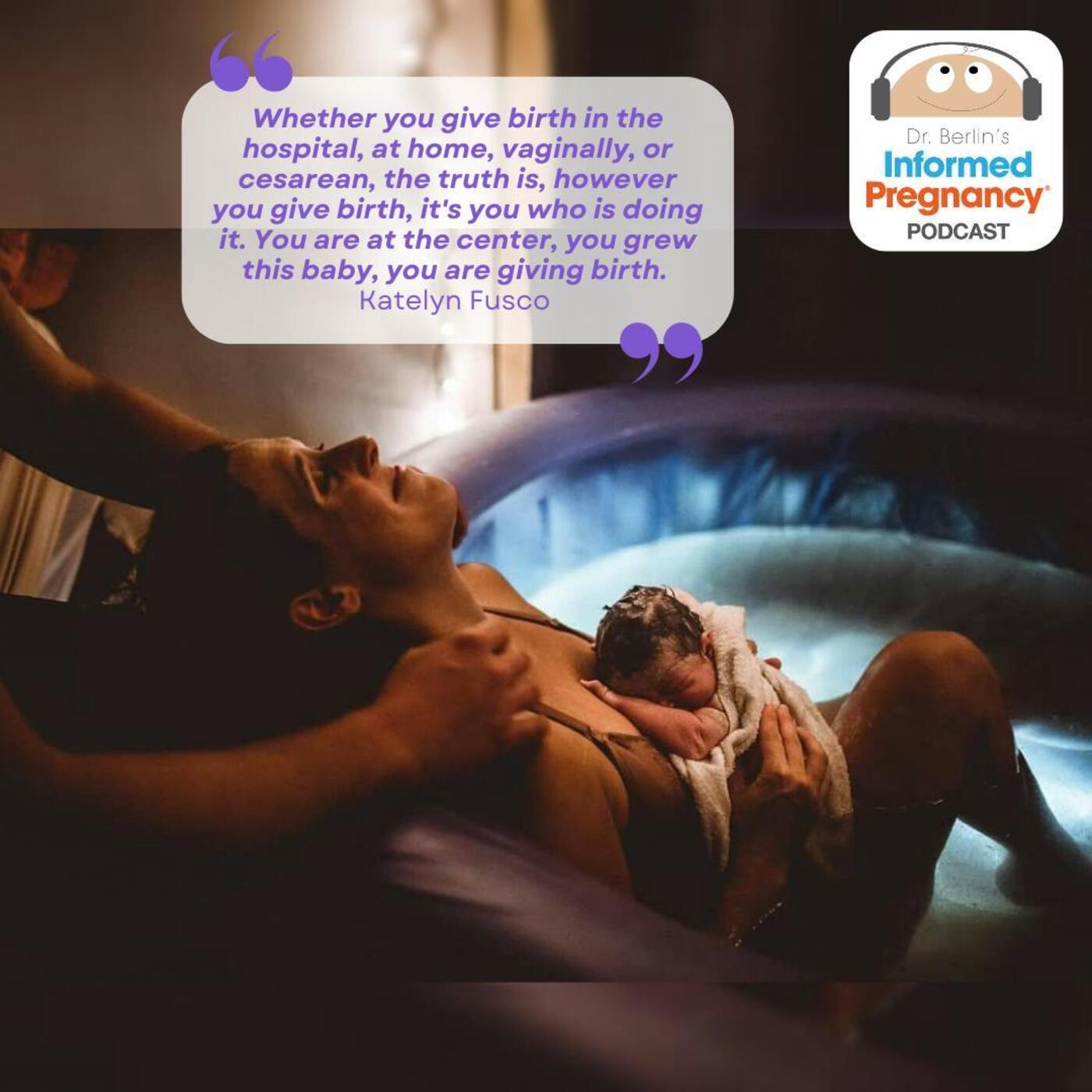
[33:14] And how disempowering that can be through that lens of, oh, well, I need somebody else. Whereas the truth is, whether you're giving birth at home or in the hospital, it's you. It's you doing it. You grew this baby. You are giving birth to this baby, however it unfolds, whether that is vaginally through cesarean, it's still you. You are the one. This is your birth. This is your baby. Nobody knows your body better than you do. Nobody is more important in this scenario. And so understanding that, I do feel like in my experience, sometimes home birth lends itself to that in a really beautiful way. But that's a message that we can all take however we're choosing to give birth.
Dr. Elliot Berlin, DC [33:55] Amen. Caitlin, thanks for joining me and sharing your experiences and your work with me. Where can we find you online?
Katelyn Fusco [34:02] Yeah, just happy home birth is on all the podcast platforms. So just type in that and you'll find me. Myhappyhomebirth.com is my website. I'm pretty active on Instagram, happy home birth podcast. I'm happy to chat in any of those locations.
Dr. Elliot Berlin, DC [34:18] And I will definitely be checking it out. And to our listeners, I will see you there. And if you want more information about informed pregnancy, visit informedpregnancy.com.
Want more pregnancy + parenting? Start your FREE TRIAL of Informed Pregnancy+ and get access to all our curated pregnancy and parenting content — original series, iconic birth films like The Business of Being Born, prenatal workouts and more.
