
August 17, 2023 · 33 minutes · Episode 368
About this episode
Maryn Green, mother of 10, Indie Birth Association co-founder, and host of the podcast Taking Back Birth talks about her journey to becoming a midwife, her personal approach to midwifery, and her views on the medical model of birth vs. the midwifery model.

- Connect with Maryn online: https://www.instagram.com/magicalmamaorg/
- Check out Maryn’s podcast Taking Back Birth here: https://indiebirth.org/podcastarchive/
- Learn more about the Indie Birth Association: https://www.instagram.com/indiebirth/ and https://indiebirth.org/
- Read about freezing your breast milk on the Informed Pregnancy Blog: https://www.informedpregnancy.com/single-post/everything-you-need-to-know-about-freeze-drying-your-breastmilk-kayleigh-harrigan
Keep up with Dr. Berlin and the Informed Pregnancy Project online!www.informedpregnancy.comwww.instagram.com/doctorberlin/www.facebook.com/InformedPregnancywww.twitter.com/doctorberlin
Learn more about your ad choices. Visit megaphone.fm/adchoices
See Privacy Policy at https://art19.com/privacy and California Privacy Notice at https://art19.com/privacy#do-not-sell-my-info.
Key quotes
“I ended up giving my license back to the state of Arizona when I really realized that I was selling my soul, so to speak.”
“But women that are really understanding that for them to feel safe, they need to be in their environment. And that's where they and their babies are the safest.”
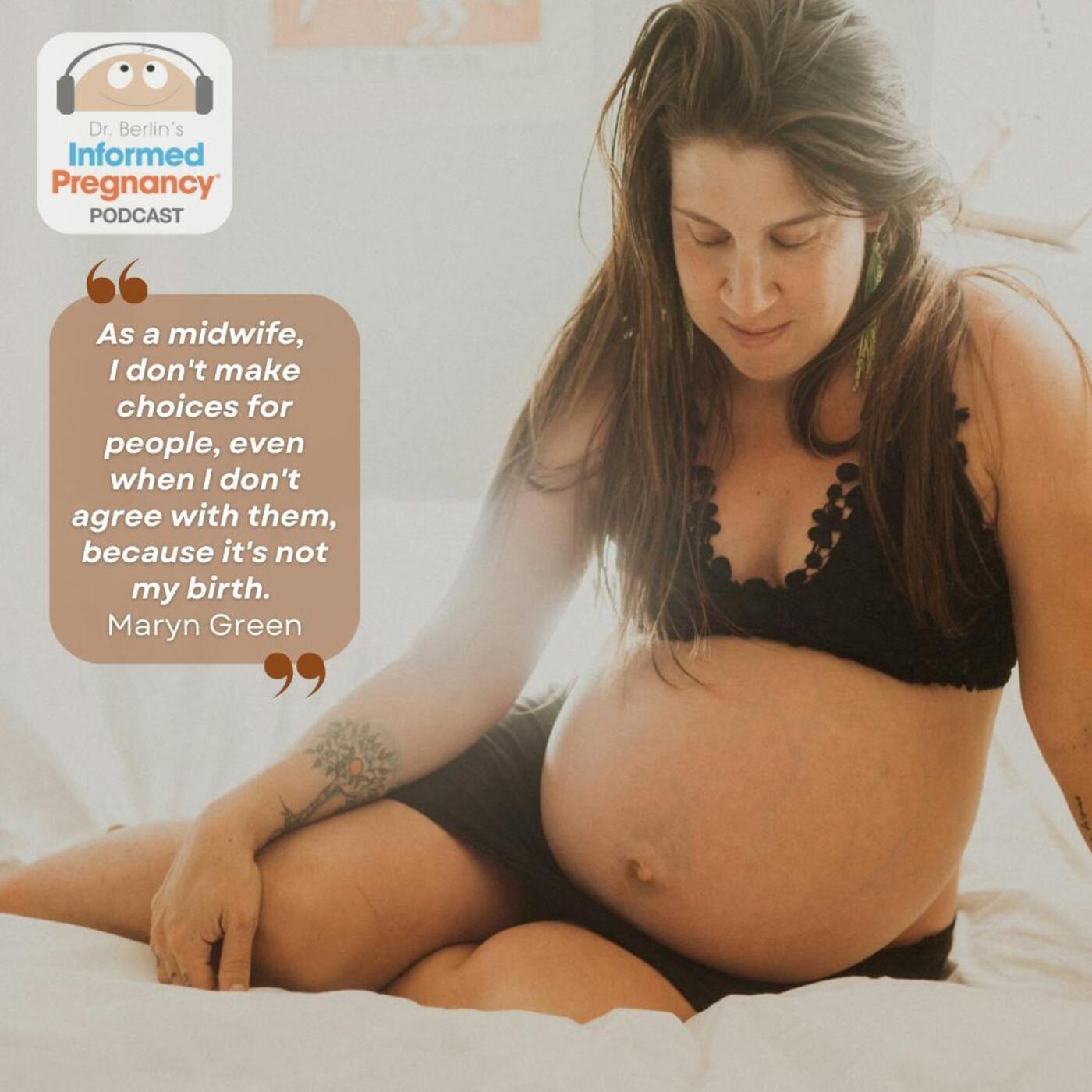
“But in the way that I work as a midwife, the woman is the center of her experience. I am being hired to consult with, to help educate, to support, to guide, but I don't make choices for people, even when I don't agree with them.”
“So I think learning the science, surprisingly, of birth can really help women hone in on what they want.”
“So the more we look to the outside, the more confused we get, the more scared we can become. And the more we tune into our own internal wisdom, the more happy we usually are with the choices we've made.”
Related episodes
- Ep. 361 Rachel Mans: A Mother's Journey Through Pregnancy, Adoption, and Birth Work
- Ep. 350 Ciara Whaley: After Birth
- Ep. 372 The Business of Birthwork with Kyleigh Banks
- Ep. 369 Jill Magoffin: Plus Size Birth and Doula Insight
Transcript
AI-generated transcript with speaker labels — may contain errors, especially names and medical terms. Dr. Elliot Berlin, DC appears in blue; Maryn Green in orange.
Download PDF of the Transcript
Dr. Elliot Berlin, DC [0:12] Welcome to the Informed Pregnancy and Parenting podcast. I'm your host, pregnancy-focused chiropractor, Dr. Elliot Berlin. My guest today is Indie Birth Association co-founder, radical midwife, mother of 10, and host of the Taking Back Birth podcast, Marin Green. Welcome to the podcast.
Maryn Green [0:54] Thank you, Dr. Berlin. I'm so glad this worked out.
Dr. Elliot Berlin, DC [0:57] 10 kids, we're going to need two episodes.
Maryn Green [0:59] Yeah, you might.
Dr. Elliot Berlin, DC [1:02] Let's start at the beginning. Where are you from originally and where do you now?
Maryn Green [1:05] I am originally from Long Island, New York, and having lived many other places in between, I'm currently in Kentucky, but soon to be Hawaii.
Dr. Elliot Berlin, DC [1:17] Wait, Hawaii for like long term?
Maryn Green [1:19] I don't know. We're going to take the kids there for eight months or maybe longer. We'll see.
Dr. Elliot Berlin, DC [1:26] Always on the move.
Maryn Green [1:28] Always on the move. I want to explore the world and get out of here during the winter. That's the main idea there.
Dr. Elliot Berlin, DC [1:33] That makes sense. Okay, so what do you do for a living?
Maryn Green [1:37] Well, I'm a mom and I am a midwife and I also lead women's circles and I also have a midwifery school with my co-founder, Margo. So lots of online projects and in-person local projects, kind of all over the place.
Dr. Elliot Berlin, DC [1:56] How did you get into the midwifery?
Maryn Green [1:59] Well, the short version is our first baby was born in the hospital, just typical hospital birth. We didn't know we had any other options at the time. And then with my second, we became aware of home birth as an option and switched from hospital staff personnel to a home birth midwife at about 37 weeks of pregnancy. And that was an amazing birth. And after he was born, I just couldn't put down the idea of experiencing that on the other side. So seeing my midwife and seeing how compassionate and smart she was, it really inspired me to want to pursue midwifery. And that baby is nearly 19.
Dr. Elliot Berlin, DC [2:45] Oh, I like my oldest. Was there a different career path before that?
Maryn Green [2:51] I was a professional musician. So I went to college for classical music and I was a performer. So yeah, I had a radically different path. And when I started my midwifery apprenticeship, when my son was only four months old, I was totally green. I remember saying to the midwife, I have no idea how to do any of this. And she said, it's okay. That's what an apprenticeship is for. What was your midwifery training like? My midwifery training consisted of two different apprenticeships. So I started in Chicago and did a couple of years with an underground midwife there. And then I decided with my husband and my family to move to Arizona. It felt really important at that time to pursue a midwifery license,
[3:41] which ended up being kind of ironic when you hear the rest of the story. But at that time, I thought that a license was the best way to go. And so we moved our whole family. I did another apprenticeship and then began working as a licensed midwife in Arizona.
Dr. Elliot Berlin, DC [3:56] So how did the apprenticeship work? Is that separate from your didactic learning?
Maryn Green [4:01] Exactly. Yeah, I did an online program for the didactic learning, but the apprenticeship is old school learning, you know, how people used to learn crafts. So following a midwife around, getting to know the families, getting to participate in some of the hands-on skills. And basically it was five years of my life where I really lived the life of whatever midwife I was working with. You just kind of tag along and eventually become more involved until you're at the point where you could be the primary midwife. Did you have any surprises along the way? The biggest surprise was probably in learning about the politics of midwifery. The midwife I apprenticed with in Chicago was not licensed. That wasn't even possible back then.
[4:50] And she eventually got a cease and desist in the state of Illinois and then another one in Ohio and decided to leave. country. And that was really shocking and hard and really traumatic, actually, for me as a student midwife, but ultimately shaped a lot of my own path. But that was very surprising. I had no idea that midwives were in that situation and, you know, still are in many places.
Dr. Elliot Berlin, DC [5:18] Yeah, so this is not that long ago in the big picture. And so at the time, Illinois had no licensure for midwives?
Maryn Green [5:26] They had no licensing. The only quote-unquote legal midwife for a home birth would be a CNM or certified nurse midwife. And it's only in the last year, I believe, that CPMs, home birth midwives, essentially have become legalized there.
Dr. Elliot Berlin, DC [5:41] And the difference is nurse midwives start off as registered nurses and then specialize, more of a hospital training.
Maryn Green [5:48] Exactly. Yeah, there are nurse midwives that go on to do home births, but typically they don't have that experience. They aren't trained in that at all. So my understanding is they have to kind of pursue that afterwards. But most of them work in the hospital, so that's relevant.
Dr. Elliot Berlin, DC [6:05] And you use the term radical midwife. What does that mean?
Maryn Green [6:10] I choose to not have a license. I went through a battle with the state of Arizona about 10 years ago to keep a license that I realized I didn't even want. And so rather than call myself an unlicensed midwife and imply that I'm hiding or I use the term underground, I'm not. I'm very much out in the open. And I don't think licensing is the standard, so I think radical is probably the best word at this time.
Dr. Elliot Berlin, DC [6:39] Okay, so you thought the license was important at the very beginning.
Maryn Green [6:43] Yeah.
Dr. Elliot Berlin, DC [6:44] Went and uprooted your whole family to get it and dedicated years of your life to getting it. And then did you find it was too restrictive or limiting?
Maryn Green [6:55] It was very restrictive and limiting, and I didn't understand that until I was in the position of being the midwife and having to tell families, hey, you know, you're this much past your due date. I can't be your midwife anymore, or your baby is a breach. I'm not allowed to be your midwife anymore, or you've been pushing too long at home now. We have to transport. I didn't know the truth of that until I was in it. And once I was in it, as a woman myself, as a mother myself, I could not agree with that. I could not treat everybody like they were just on an assembly line and not as individuals. So ultimately, like I shared, I ended up giving my license back to the state of Arizona when I really realized that I was
[7:46] selling my soul, so to speak. But it felt very real to me, and it still does. I would never choose to serve the government over the family in front of me.
Dr. Elliot Berlin, DC [7:56] And then without a license, how does that work? So there's not a governing body.
Maryn Green [8:02] There's not a governing body. And of course, it does depend what state one is in. So in Arizona, licensing is mandatory. And I eventually just found another lawful way of practicing, which is the private membership association, which people seem to know more about these days. I mean, this was 10 years ago, and I was probably the first to do that as a midwife. People have heard that term now. There are chiropractors using it. There are medical doctors using it. And there's a lot to say about that. I wouldn't want to give anyone the impression that it's this magical bullet, but it does afford me protection that I resonate with, and in 10 years has allowed me to work the way I want to, both in Arizona and here in
[8:46] Kentucky, without anybody bothering me, basically. Do you want to give a quick synopsis of what that means, how it works? The quick synopsis is that by creating a private contract between you and the family you're working with, you're both agreeing that you don't agree that the public laws are applied to you. So if I say I'm a licensed midwife, I'm serving the public. And the laws that have been made for the public, for the licensed midwives, are something that I have to follow. But if I'm not serving the public and I'm only working with people privately, and again, this is all transparent, this is all clear to them, nothing is hidden. Many families, and more and more over the years,
[9:30] are choosing an option like this. And is that something you can do in any state? It's something you can set up in any state. And my understanding is in other countries as well, Canada being one of them. Hey. Yeah.
Dr. Elliot Berlin, DC [9:48] All right. An interesting career path. But also, it's funny when I asked you what you do, you said mother first. So you have a bunch of kids, and I want to learn more about that journey. Let's take a quick break, and we'll be right back.

Dr. Elliot Berlin, DC [11:37] Welcome back. We're talking to Marin Green, no longer Green, by the way, as a midwife, a lot of experience there, and a mom with a whole bunch of kids. So you mentioned that your first baby, pre-midwifery, was in the hospital. How was that experience for you?
Maryn Green [11:55] It was typical. My waters opened early after a doctor visit where they did a vaginal exam, and I labored for quite some time before receiving pitocin, and then I pushed my baby out. But she was tiny, she was a little bit early, she went to the NICU. So all in all, you know, it was okay, but it wasn't fabulous, and it left me just wondering if that was how it was really supposed to go.
Dr. Elliot Berlin, DC [12:26] And then by your second baby, you had discovered midwifery and home birth.
Maryn Green [12:31] Right, I discovered that at the very end of my pregnancy with my second, and honestly, I realized in hindsight how traumatized I had been with the first birth. So I told you just now it was okay, and you know, it's been 21 years almost, so that's how I feel now. But I was traumatized. My baby had been taken from me for no good reason. You know, I was exhausted, and when it came time for the second to almost be at his due date, I just broke down in tears with my doula. I had planned to go to the hospital again, so I hadn't really digested in a sense how traumatic it was until I got close to giving birth again. And I sat there with her and I cried because my birth plan was laughable.
[13:23] It was like, you know, many pages long. And I remember her looking at me and saying, if all of these things are really important to you, you should think about having your baby at home. And it was like, the sky opened and, you know, the light came streaming down and exactly, exactly. I was so grateful and I still am so grateful to that woman, Gail, who was my doula. So she gave me a couple of names of home birth midwives in Chicago, and within a couple of days, we had found somebody and that changed the course of my life just so entirely.
Dr. Elliot Berlin, DC [14:01] How was that birth different?
Maryn Green [14:04] Oh, man. It was intense for sure, because it was so much faster as second births typically are. So in some ways, I thought, there's no way I could be close to having a baby. Like last time I did this for three days. So it was really intense. It was a little dramatic. The water birth pool that I birthed in was super hot. My husband, you know, kind of was frantic and filling this pool with super hot water. He had no idea that I was that close to having a baby. So the midwife was on her way from another birth. I mean, it was all a little chaotic, but it was beautiful. And he was born into the birth pool. And like I said, I kind of never looked back.
[14:50] It was so influential on me as a woman.
Dr. Elliot Berlin, DC [14:55] Did you know you wanted a lot of kids at this point?
Maryn Green [14:59] You know. people asked me, did you plan to have 10 kids? And the truth is, at that time, no. But after his birth, I really did catch the birth bug. And from then on, you know, we had babies really every two years. And that was welcome. And they were all, you know, planned in the ways that we can do that. But it was the birth experience totally that had me coming back, you know, just to keep enjoying that. I really am someone that enjoys birth and being in it. It always felt like such a great challenge, and all of their births were really just so great.
Dr. Elliot Berlin, DC [15:39] I mean, the life of a midwife, as it appears to me, is so unpredictable and a little bit chaotic. And I see that it's hard to do with one or two kids. Was that a challenge for you? Has
Maryn Green [15:55] that been a challenge for you? It would be if we lived a more typical life, but my husband has always been really supportive. He's always worked from home. So truly, he's the one that's been the more stable one. He's the one that's always home. Our children have never gone to school. They're all homeschooled. So we've never had the pressures of getting them to school or picking them up or activities. So I mean, it hasn't been stressful in the ways it is for lots of midwives, but my kids have obviously grown up with sort of a strange way of living that they're not even quite aware of because it's just always been in place. So they know that if we have plans, they might get canceled or, you know, I might not be
[16:40] there in the morning when they wake up. But other than that, it's just kind of fit in,
Dr. Elliot Berlin, DC [16:45] really, to the life that we already have. I like the homeschool model for a lot of different reasons. But one of my favorite things about homeschool is you get to take vacation when everybody else is in school. Yeah. Everything is easy, accessible, not crowded, inexpensive. We homeschooled for a couple of years. I liked a lot of things about it. That was one of my highlights. Definitely. So then you had eight more kids. So any multiples in there? No, surprisingly. Ten singletons. And then how were the other births?
Maryn Green [17:20] They were all great. Some of them had a couple of eventful stories. So if anybody wants to read all of those, we actually have a book called Indie Birth, a Story of Radical Birth Love, and that's on Amazon. And some of their birth stories are in there, but mostly they were all seamless and beautiful. I did have, let's see, my fourth baby was transported after birth because he wasn't breathing well. And that all worked out. He's 13 or 14 actually now. And actually my last birth, my 10th baby was kind of a surprise in the way that he came in. He was obviously planned to be born at home. It was kind of a wonky labor, kind of on and off. And with a 10th baby, you know, who knows what to expect really. But by the time I got to
[18:06] pushing, I knew something was wrong for me. Like I have birthed a lot myself, and this just was not normal. It did not feel normal. So I had my best friend, Margo, who's also a midwife, call 911. And we went into the hospital and I was pushing all the way there, extremely painful. And when I got there, the doctor was like, you know, can I help you kind of thing? And I was like, whatever you have to do. And the baby came out within minutes of being there, the hospital ride had jiggled him into place somehow. So that was surprising, but also really cool. They did not touch me. I don't know that they even put me into the system, to be honest. Nobody even came near me. I just birthed my baby, birthed the placenta a few
[18:55] minutes later. My husband drove up and I went home. And it was really amazing in a way to have experienced that in the hospital when that was not my experience the first time. And of course, as a midwife, that's never been my experience going in with people to the hospital. And this hospital in particular, I had never expected that to happen because it was a very conservative hospital at one time. So medically conservative, the doctors at that hospital were mean to midwives, like straight out mean. But as it turns out, the OB on call was a traveling doctor. I had no idea who he was. I need to hunt him down actually, two years or two and a half years later now and send him a thank you note because he was amazing.
[19:44] He just stood in the back of the room and minded his own business.
Dr. Elliot Berlin, DC [19:48] Wow. At 10, does your family feel complete?
Maryn Green [19:52] Honestly, I think there's one more, but I'm not sure what the universe has in store for us, but we'd be open to that.
Dr. Elliot Berlin, DC [20:00] the twins. Yeah, right. No, no, it could be. Wow. Okay. I have more questions about the work that you do and the different services that you offer. I'm going to take one more break and we'll be right back. Welcome back. We're talking to radical midwife Marin Green, soon to be in Hawaii. Okay. So you have a lot of things going on. You're still
Maryn Green [20:36] midwifery. I am taking a break. I am taking a sabbatical, so to speak, after many years of being on call, hence the Hawaii trip. So I was wondering if you're going to midwife in Hawaii or not. Well, never say never, but that's not the plan for the next bunch of months, at least. Got it. Okay. And then you have a midwifery school. We do. It is called Indy birth midwifery school, and we train midwives all over the world. You know, in this model, we believe that midwives should be smart and intelligent and skilled, but also intuitive and connected to the sacred nature of birth. And so our 20 month program prepares them to a certain extent. They still need to find hands on training,
[21:24] but many of our students have done that and they are actively serving as radical midwives in their communities, which is really, really cool.
Dr. Elliot Berlin, DC [21:31] Wait, so is your online program, the more didactic part?
Maryn Green [21:35] Yes. The online program has everything they need to learn in their heads, but then hands on apprenticeship is that second piece.
Dr. Elliot Berlin, DC [21:45] Right. Okay. So that's where you pick up all your practical skills.
Maryn Green [21:50] Exactly. And, you know, learn the life of a midwife and learn how to talk with people and all of that good stuff.
Dr. Elliot Berlin, DC [21:58] Yeah. And then you also have a podcast.
Maryn Green [22:02] I do. I've had my podcast for about 10 years. It's called taking back birth. And I have so many episodes about everything from, you know, the spiritual journey of birth to midwifery politics to mothering. There's everything imaginable there.
Dr. Elliot Berlin, DC [22:18] Are they with guests?
Maryn Green [22:21] They are primarily alone. I do have some guests here and there, but they're more introspective. I did a lot of them through my own pregnancies. And then I think a lot of them would be considered kind of like free instruction to a point for aspiring midwives and maybe even doulas.
Dr. Elliot Berlin, DC [22:41] And what about just people who want to learn more about birth, either before they give birth or along their journey?
Maryn Green [22:50] Definitely. I think the podcast has been very influential with this more radical view. And truly, I don't consider it radical necessarily, but just really having women understand some of these topics, you know, like transparency around hiring a midwife and what to look for, or, you know, why vaginal exams aren't generally necessary. So there are things that are kind of out of the box, but I really believe there are topics that women should understand if they'd like to because these kind of things really influence birth if we don't quite know where we are or where we're coming from.
Dr. Elliot Berlin, DC [23:28] Do you think that there's a particular type of person who would be better suited for home birth or better suited for a hospital birth?
Maryn Green [23:39] Sure, I definitely don't think home birth is for everyone. But in my years as a midwife, and with my own experience, I'd say that the women that are attracted to home birth, aren't just looking to, you know, not be messed with, I think that is a percentage of women, especially when they've been traumatized. But women that are really understanding that for them to feel safe, they need to be in their environment. And that's where they and their babies are the safest. And they're usually women that care about working on some of the inner journey of pregnancy. So rather than saying like, Oh, you know, my doctor will take care of that for me. These are
[24:23] women that kind of want to investigate things for themselves. They want to work through their own fears, their own blocks. And they really take that on as like a spiritual journey almost.
Dr. Elliot Berlin, DC [24:35] And you have a book because I'm trying to wonder what you would recommend for somebody who thinks maybe that's for me, what would be the next step for them to sort of look at and learn the differences between the midwiffic model and the medical model?
Maryn Green [24:49] Right? Well, again, I think my podcast is a great place to start because I talk about all of those things. Through Indie Birth, we do have courses that are suited for beginners. So, we have one called The Beginner's Guide to Radical Midwifery, and tons of women have taken that just to understand this landscape, just to understand the things we've been talking about here in more detail. So that's probably a great recommendation for people that are wanting to go that route.
Dr. Elliot Berlin, DC [25:17] And do you have a book?
Maryn Green [25:19] We do. Our book is called Indie Birth, A Story of Radical Birth Love, and Margo and I wrote it together. And it's kind of a compilation of these philosophies and our experiences, midwives, along with some birth stories of our clients, like a breech birth and a twin birth and, you know, the real fun stuff.
Dr. Elliot Berlin, DC [25:37] Is there a nutshell description of what you would say the differences between those two models, midwifery and medical, when it comes to obstetrics?
Maryn Green [25:47] Yeah, definitely. I think the medical model puts the care provider generally in the center, meaning they're the most important and they're the authority and they know everything. And the woman is just kind of like on the outside looking in. And the midwifery model, although there are nuances to this for sure, their midwives are not all the same. But in the way that I work as a midwife, the woman is the center of her experience. I am being hired to consult with, to help educate, to support, to guide, but I don't make choices for people, even when I don't agree with them. So, you know, if that were to happen, I may not work with someone, but it's not me
[26:28] saying like, it's the highway. If you don't agree with me, it's not my birth. And again, as a woman, I would never agree to that in my own life. So I can't work that way as a midwife.
Dr. Elliot Berlin, DC [26:38] Yeah. Have you in the midwifery setting had surprises along the way?
Maryn Green [26:44] Definitely. Definitely. Yeah. They happen all of the time, you know, birth is not predictable. So sometimes babies do things we don't expect. You know, I have been lucky throughout my time as a midwife. I haven't had many traumas, but certainly this happens in birth all of the time. And, you know, most midwives have the experience of a death of a baby or, you know, something that not only feels surprising, but is just really, really difficult. So I feel blessed. I've had a really, really awesome time as a midwife.
Dr. Elliot Berlin, DC [27:19] And I guess, you know, just like you were sort of almost triggered into midwifery by your own experience, what would you say that someone who's curious about becoming a midwife?
Maryn Green [27:30] Well, they could come hang out with me in Hawaii for a retreat that we're doing in October about becoming a midwife.
Dr. Elliot Berlin, DC [27:36] Oh, tell me more about that.
Maryn Green [27:38] So that's called answering the call to radical midwifery. It's a two day retreat. I'll be leading on Oahu in October. We've done this retreat before in different locations, and I think it's been hugely helpful for women that are pondering this path. So for two days, they get to sit in a retreat setting in a circle and, you know, learn more about what it means to be a midwife and do their own soul searching, because this isn't a job, you know, this isn't something that I think you typically do if you have nothing else to do, like, you know, this has to be something that your soul really is calling you for. So I love sitting with women in that circle and just hearing more
[28:21] about their fears and their blocks. So that would be one way. And yeah, another way, if you've had babies and you're considering midwifery would be to just start with your own experience. Like I shared about mine, we either get into birth because we typically have horrible births and we want to save women from a bad experience, which is so normal. Or, you know, we have really great births and we want to see other women have the same. So wherever you're coming from, just kind of like being honest with yourself and dealing with your own traumas so that you can really be clear to how you want to show up, because all midwives are different. We're all in it for different reasons, but you know,
[29:02] we have to start with that.
Dr. Elliot Berlin, DC [29:03] You have a lot of accomplishments already, aside from all your kids and your work as a midwife and your midwifery school and your book and your retreat and your online resources. It would not surprise me if you had more things in the hopper. Are you working on anything for the near future?
Maryn Green [29:24] Yeah, funny. You should ask. I just launched a mama's circle online, so that's separate from indie birth because it's just me, not Margo, but that's magicalmama.org. And so with this virtual women's circle, the intention is to gather women who are mothers all over the world and to meet, you know, in circle as we possibly would in person, but of course online and guide and lead these women as a midwife for a long time in this same kind of like soul searching and finding our path. So So that's a new offering, and if women are interested, they'll be able to enroll and be part of the circle at any point. So no matter when you listen to this podcast, you could go check it out.
Dr. Elliot Berlin, DC [30:11] Your philosophy sounds empowering, you know, for a woman taking charge of her pregnancy or birth or postpartum, but not everybody can do home birth for various reasons or work with midwives for various reasons. Do you have any resources or tools to support somebody who wants that kind of, you know, empowerment and connection with her body and her baby, but isn't able to work with midwives?
Maryn Green [30:40] Sure, I think one of the most powerful resources outside of all of the stuff we've made is Sarah Buckley's book, Gentle Birth, Gentle Mothering, and that would be a must read for anybody and partners included, dads for sure. That want to understand how the process of birth actually works, like as a mammal, because I think we get too into the weeds in a sense, like, oh, I don't want the epidural or I do want the epidural. And it's like, wait, wait, wait. Birth works a certain way, no matter where you birth in the hospital or at home, our bodies were made to do this thing, just like a cat, just like a dog. So that's what we offer women, even locally, like in free workshops is
[31:23] just the hormone blueprint. How does labor work? How does the body work? And once women learn that, then they start to make different choices possibly because something doesn't add up in their brain. So even if they're still going to go with the hospital, understanding that, you know, induction isn't always the best and safest idea, especially for no reason and so on and so forth. So I think learning the science, surprisingly, of birth can really help women hone in on what they want.
Dr. Elliot Berlin, DC [31:53] And that was gentle birth, gentle mothering.
Maryn Green [31:55] Yeah.
Dr. Elliot Berlin, DC [31:56] It's a great book. All right. As we wind down two more questions, one is, do you have any other top book reads for expecting parents?
Maryn Green [32:05] Hmm. Well, I can't say I've read any myself lately. I read all kinds of stuff, but it's hardly ever a birth book because that's not relaxing to me.
Dr. Elliot Berlin, DC [32:14] That's the whole rest of your life.
Maryn Green [32:16] Yeah. So sadly, no.
Dr. Elliot Berlin, DC [32:18] Do you like any of the documentaries?
Maryn Green [32:20] Well, I've seen yours, of course. And I think it's awesome. Um, yeah, you're welcome. Uh, these are my hours is a great documentary with a friend of mine named Emily, and she's kind of like the star of the film. Yeah. I don't know that I'm like totally up on media culture, but I'd start with those. Yeah.
Dr. Elliot Berlin, DC [32:40] These are my hours. It was powerful. And then my last question is any final thoughts, things that I didn't bring up that you would like to share.
Maryn Green [32:49] I always like to just end with encouragement for women listening because I feel like there is so much information out there and, you know, even us both having a podcast, like, great. There's so much for women to listen to, but I really believe that we know as women, so that doesn't mean, you know, again, like you're saying everyone has to have a home birth or everything always turns out perfectly. I don't mean that I just mean, we know, we know what we need to know as women and we have that wisdom inside of us. So if that was somebody's intention with their pregnancy, just to go deeper with that knowing and to connect with their body more, to connect with their baby more, to invite those tools in, I think
[33:31] their birth is probably going to be amazing because that's really the key and that's the key to mothering as well is that we do know. So the more we look to the outside, the more confused we get, the more scared we can become. And the more we tune into our own internal wisdom, the more happy we usually are with the choices we've made.
Dr. Elliot Berlin, DC [33:49] Well said. Maren Green, thank you very much for joining us. Where can we find you online?
Maryn Green [33:56] You can find me at IndieBirth.org, IndieBirthMidwiferySchool.org, MagicalMama.org and on Instagram as IndieBirth.
Dr. Elliot Berlin, DC [34:05] Amazing. Thanks for all the information and for sharing your personal story about your 10 kids. And for listeners, thanks for listening to us. If you'd like more information about pregnancy and parenting, visit us online at informedpregnancy.com.
Want more pregnancy + parenting? Start your FREE TRIAL of Informed Pregnancy+ and get access to all our curated pregnancy and parenting content — original series, iconic birth films like The Business of Being Born, prenatal workouts and more.
