
June 29, 2023 · 34 minutes · Episode 361
About this episode
Birth educator and doula, mother of five, and host of The Natural Birth podcast Rachel Mans talks about becoming deeply involved in the birth world, her personal birth experiences, adoption, and all the lessons she’s learned along the way.

- Connect with Rachel Mans online: https://www.instagram.com/thenaturalbirthsite/
- Check out The Natural Birth podcast online: https://podcasts.apple.com/us/podcast/the-naturalbirth-talk/id1597027882
- Read about life after a miscarriage on the Informed Pregnancy Blog: https://www.informedpregnancy.com/single-post/ip-filmmaker-spotlight-lyndal-redman
- Interested in more birth stories? Start your FREE TRIAL of Informed Pregnancy+ and watch exclusive content here: https://www.informedpregnancy.tv/
Keep up with Dr. Berlin and the Informed Pregnancy Project online!
www.instagram.com/doctorberlin/
www.facebook.com/InformedPregnancy
Learn more about your ad choices. Visit megaphone.fm/adchoices
See Privacy Policy at https://art19.com/privacy and California Privacy Notice at https://art19.com/privacy#do-not-sell-my-info.
Key quotes
“Hey, we just go with the flow over here and we just make it work as best as we can.”
“I learned that just because your care provider is on board doesn't mean that as soon as they leave, your hospital staff will be on board.”
“It's so good, and especially if you feel really driven or called to do that, you should definitely do that work, but it is hard.”
“But in my opinion and in my experience, labor is a mind game and largely a mind game. And so much of it is the mental prep that's going into the labor, preparing for everything and just getting in the right head space for that.”
“So I more so encourage the parents and teach the parents how to become advocates. I want them to be able to speak up for themselves.”
Related episodes
- Ep. 362 Filmmaker Rani Khanna: More Than Blood
- Ep. 350 Ciara Whaley: After Birth
- Ep. 342 Debra Flashenberg: Yoga, Birth, and Babies
- Ep. 354 Madison Young: After Birth
Transcript
AI-generated transcript with speaker labels — may contain errors, especially names and medical terms. Dr. Elliot Berlin, DC appears in blue; Rachel Mans in orange.
Download PDF of the Transcript
Dr. Elliot Berlin, DC [0:36] Welcome to the Informed Pregnancy and Parenting Podcast. I'm your host, pregnancy focused chiropractor, Dr. Elliot Berlin. My guest today is a birth doula, childbirth educator, spinning babies certified parent educator, mom to five kids, and host of the Natural Birth Podcast. Rachel Manz, welcome to the podcast.
Rachel Mans [0:57] Hello. Thanks for having me.
Dr. Elliot Berlin, DC [0:59] How did you even find a minute to talk to me?
Rachel Mans [1:01] That is a really good question.
Dr. Elliot Berlin, DC [1:05] Holy moly, your hands are full. I though I was busy.
Rachel Mans [1:08] Hey, we just go with the flow over here and we just make it work as best as we can.
Dr. Elliot Berlin, DC [1:13] Okay. Let's start at the beginning. Where are you from originally?
Rachel Mans [1:17] I am from the St. Louis, Missouri area, but actually in a suburb of St. Louis on the Illinois side.
Dr. Elliot Berlin, DC [1:24] Oh, so not Missouri.
Rachel Mans [1:26] Right. I know. It's kind of weird.
Dr. Elliot Berlin, DC [1:28] It is kind of weird, but you explained it well. And where are you now?
Rachel Mans [1:34] We are still in that same area.
Dr. Elliot Berlin, DC [1:36] Oh, you haven't migrated very far?
Rachel Mans [1:38] Nope.
Dr. Elliot Berlin, DC [1:39] Okay. And as I mentioned in the intro, you do a lot of birthy stuff, for one thing. I do. You're a birth doula, you're a birth educator, you do spinning babies, which I'd love to learn more about. You birth a bunch of kids and you have the birth podcast.
Rachel Mans [1:54] Yeah.
Dr. Elliot Berlin, DC [1:55] Is birth something that always stuck out as what you wanted your life to be surrounded with?
Rachel Mans [2:02] That's actually a really good question, and I probably have to say no, because up until I was an adult, I didn't even want to birth my own children. I wanted to adopt.
Dr. Elliot Berlin, DC [2:13] Oh, really? What's specifically behind that? Was it just the whole, how is that going to work or?
Rachel Mans [2:20] Jesus or maybe just God and just feeling that calling. And I really liked the movie Annie as a child, so maybe that motivated it.
Dr. Elliot Berlin, DC [2:31] Oh, interesting. Okay. And then when did things change?
Rachel Mans [2:34] Probably when I met my husband. He wanted biological kids. I wasn't totally against it, but I watched some movie while we were dating and it made me somehow, I won't tell the whole story, but it made me want biological children too.
Dr. Elliot Berlin, DC [2:49] Okay. And you did it.
Rachel Mans [2:51] And we did it. And we have both now, so we have birth children and adopted children.
Dr. Elliot Berlin, DC [2:56] Amazing. So you kind of fulfilled both parts of that dream.
Rachel Mans [3:00] Yep.
Dr. Elliot Berlin, DC [3:00] Before we get into your kids, I mean, interesting that you didn't even want to birth kids, but now your whole life is birth oriented.
Rachel Mans [3:08] Isn't that crazy? How did that happen?
Dr. Elliot Berlin, DC [3:09] Yeah.
Rachel Mans [3:11] I don't know if I could pinpoint exactly how that happened, but I remember when we were pregnant with our first child and we were some of the first of our friends to be pregnant, but we did have one other couple that was pregnant about six weeks ahead of me. And she was really into the idea of having a natural birth. And my mom had natural births. My mom always talked about how she had natural births. So I think the combination between my mom having natural births and my friend being into that idea, I just started down a rabbit hole and I started researching natural birth and researching all my options. And oh man, I thought I knew it all with my first birth.
[3:50] Turns out I didn't.
Dr. Elliot Berlin, DC [3:52] Okay, you thought you thought.
Rachel Mans [3:54] Turns out I didn't, but I think that's where it kind of spiraled is once I started doing that research for my first pregnancy, then I spiraled into more and more information. And then one day someone said, "You should be a doula." And I said, "A what?" And they explained it and I'm like, "I should be a doula."
Dr. Elliot Berlin, DC [4:14] Yeah. Okay. And here you are, you're a doula. Yeah. So with your first baby, how did you meet your partner?
Rachel Mans [4:22] We met at a young adults group through church, and that's kind of a fun story. I worked in a bank and there was this guy who would come in, and one day he walked out and I looked at my fellow bank tellers, and I was only 17. I was the youngest one there. I looked at the bank tellers and I'm like, "Man, he was cute." So the next time he walked in, they all flocked to the back and made me wait on him. And I did, and I sheepishly was like, "Oh, do you have a girlfriend?" And he was like, "Yeah, I do." But this is not my husband. This is someone I flirted with, but he invited me to young adults group, and at that young adults group is where I met my husband.
Dr. Elliot Berlin, DC [5:02] Oh, no kidding. Okay.
Rachel Mans [5:04] Yeah.
Dr. Elliot Berlin, DC [5:04] Match made in banking heaven.
Rachel Mans [5:07] I guess so.
Dr. Elliot Berlin, DC [5:09] Okay. So that's how you met. And so you were 17 when you met?
Rachel Mans [5:14] Yes. He's a few years older than me, but yeah.
Dr. Elliot Berlin, DC [5:17] Okay. And did the relationship progress at a fast pace?
Rachel Mans [5:23] He drove me nuts actually.
Dr. Elliot Berlin, DC [5:26] Oh, so it was like you've been married for a while.
Rachel Mans [5:29] Yeah. No, the first time I met him at the adults group was a Valentine's Day, what they called a stoplight party. So if you were taken, you wore red. If it was complicated, you wore yellow, and if you were single, you wore green.
Dr. Elliot Berlin, DC [5:40] That's cute.
Rachel Mans [5:41] So it was kind of cute. So we were both in green, but I was very uninterested. He was driving me crazy. I thought he was really annoying, but somehow he talked me into what I thought was just hanging out. And so we were hanging out. By the end of the whole thing, it had turned into a date and we just kind of took off from there. We were engaged just about a year later and married 10 months after that.
Dr. Elliot Berlin, DC [6:05] Wow. So you went in green. It sounded like you came out sort of yellow.
Rachel Mans [6:09] Yeah, I left the party yellow, I guess. Yeah.
Dr. Elliot Berlin, DC [6:12] And then before you know it, hot red.
Rachel Mans [6:15] Yep.
Dr. Elliot Berlin, DC [6:16] And then was it during the dating that you already were talking about kids?
Rachel Mans [6:21] I don't remember. That was so long ago.
Dr. Elliot Berlin, DC [6:23] It was so forever ago. I just wonder – It's been a
Rachel Mans [6:25] While.
Dr. Elliot Berlin, DC [6:27] Yeah, I just wondered because again, you didn't want biological kids, so I wonder if that's something that came up earlier or before you were deeper in the relationship.
Rachel Mans [6:35] We were definitely still dating. I think it was probably at least several months into the relationship probably.
Dr. Elliot Berlin, DC [6:43] All right. And then you got married. Even though you decided to have biological kids, was that still part of your mind frame, I'm going to do both?
Rachel Mans [6:50] Yes.
Dr. Elliot Berlin, DC [6:51] Okay. And was both of you on the same page with that?
Rachel Mans [6:54] He was.
Dr. Elliot Berlin, DC [6:56] Okay.
Rachel Mans [6:57] Well, he still is.
Dr. Elliot Berlin, DC [6:58] Yeah.
Rachel Mans [6:58] I convinced him.
Dr. Elliot Berlin, DC [6:59] I hope so now.
Rachel Mans [7:00] I convinced him.
Dr. Elliot Berlin, DC [7:02] And did you go with a pregnancy first?
Rachel Mans [7:04] We did. We had pregnancy first. Our first was a surprise, so that was interesting, but good. And then we had our second biological child, and it was when he was maybe four that we decided to start becoming foster parents to adopt through foster care.
Dr. Elliot Berlin, DC [7:21] Okay. So with your first is when you started to do all the research?
Rachel Mans [7:26] Yes.
Dr. Elliot Berlin, DC [7:26] And you thought you knew everything. What did you find out? What was your plan for birth?
Rachel Mans [7:31] So I was 20 years old, thought I knew everything or thought I knew enough, had a supportive midwife, had planned to go in, have a natural birth. I was denying a lot of the standard care procedures for myself and for the newborn, and my midwife was completely on board with that. We had talked about it in depth.
Dr. Elliot Berlin, DC [7:50] Can you just elaborate? What do you mean by standard care things at birth?
Rachel Mans [7:54] Oh, let me think. I denied the dating ultrasound, the eight week ultrasound. I didn't want that. I denied that. I did get a 20-week. That's the only one I had. I wouldn't have any others. Let's see what else. I was denying some of the standard procedures that they offer you, like the Tdap and whatever. I don't even remember. I do remember, but I don't want to go into all that.
Dr. Elliot Berlin, DC [8:18] Okay. And what was motivating them?
Rachel Mans [8:20] I don't totally remember. I just remember thinking I don't need that. And I had researched it and I had talked to people about it and I was just like, I really just, I guess maybe instinct, mama instinct, intuition, just for myself. I was like, I just don't believe that I need these things.
Dr. Elliot Berlin, DC [8:39] And you had a midwife, but at a hospital?
Rachel Mans [8:42] Yes.
Dr. Elliot Berlin, DC [8:43] Okay. And midwife was on board with your choices?
Rachel Mans [8:45] Absolutely. Yep.
Dr. Elliot Berlin, DC [8:47] Okay. And then for birth, when you said you wanted a natural birth, does that mean vaginal? Does that mean unmedicated? What does that mean to you?
Rachel Mans [8:55] I wanted no interventions, although I will say at the time I did not consider a membrane sweep to be an intervention. So I did opt for a membrane sweep in a visit and I chose that. It wasn't forced on me. And then the only other, I guess, intervention I would say I really had would've been, I did let them break my water at one point because I though I knew everything, but I didn't. But it turned out really well. I didn't want anything, so I didn't want any pain meds. I didn't want an epidural. I didn't want to be stuck in the bed. I wanted to be able to move around and obviously have a vaginal birth.
Dr. Elliot Berlin, DC [9:31] Yeah. Okay. So if you had a membrane sweep, was that past your due date or approaching your due date?
Rachel Mans [9:36] That was at 38 weeks.
Dr. Elliot Berlin, DC [9:38] Oh.
Rachel Mans [9:39] Yeah. So I would never recommend that to somebody unless they were approaching a medical induction for some serious reason. I don't recommend that ever as a doula, but at the time that's what I chose.
Dr. Elliot Berlin, DC [9:50] Sure. Okay. And then did your labor start spontaneously?
Rachel Mans [9:55] After that, yeah. So it started the next day, the next morning.
Dr. Elliot Berlin, DC [9:59] And what was it like for you?
Rachel Mans [10:01] Oh, with the first one, I was emotional because I didn't know what was going on. Typical first mom, feeling overwhelmed, having contractions, couldn't get ahold of my midwife right away. She had given me her pager number and I tried to page her and then I was crying because I was like, "I don't know how to use a pager."
Dr. Elliot Berlin, DC [10:23] Who's with you?
Rachel Mans [10:24] I think at that moment, I think I was by myself, but I had been talking to my husband. He did end up coming home.
Dr. Elliot Berlin, DC [10:32] Oh, that guy from the party.
Rachel Mans [10:34] Yeah, the guy from the party. The one that drove me nuts.
Dr. Elliot Berlin, DC [10:38] Right.
Rachel Mans [10:40] And yeah, I did get ahold of her. I talked to her. She calmed me down. Maybe five hours later, I went into the hospital and I had my son, I don't know, five hours after that.
Dr. Elliot Berlin, DC [10:51] Oh, wow. So things moved pretty swiftly.
Rachel Mans [10:54] For a first time labor, yeah.
Dr. Elliot Berlin, DC [10:56] Yeah. Now you said you learned a lot. Let's take a little break. When we come back, we'll find out what you learned so we can learn too.

Dr. Elliot Berlin, DC [12:36] Welcome back. We're talking to Rachel Mance. Okay, so you go from not wanting any biological babies to agreeing and then a surprise pregnancy and some surprises along the way, and then you have your birth. But then you said, "I learned a lot from the experience." What kind of things did you learn?
Rachel Mans [12:58] I learned that just because your care provider is on board doesn't mean that as soon as they leave, your hospital staff will be on board.
Dr. Elliot Berlin, DC [13:06] Oh, that kind of learning.
Rachel Mans [13:07] That kind of learning, yeah. I learned what transition was in labor, so over here, thought I knew it all, thought I had it under control, hit transition, lose my mind, have no idea what's going on, learned about that the hard way.
Dr. Elliot Berlin, DC [13:23] And still didn't want medication while you were having that lesson?
Rachel Mans [13:27] So at that point, I actually had asked for an epidural and I did have IV fluids, but I remember being in the bed, this was right after she broke my water. Anyway, it hit me like a ton of bricks. I was told an hour per centimeter and an hour pushing. That's what the nurse told me, which I now know is not true at all. So I'm thinking I've got five, six hours left of this. So I asked for an epidural and about 30 minutes later, I don't even know how long, I remember saying, "When am I getting my epidural?" And there looked at me with this look of panic on her face and she was like, "Oh honey, your midwife's on her way back."
Dr. Elliot Berlin, DC [14:09] Oh, wow.
Rachel Mans [14:11] And so yeah, I'd asked for it, but then I had the baby before I was even able to get it.
Dr. Elliot Berlin, DC [14:17] So with everything that you learned from your first experience, first of all, was your second one you said is also biological, was that planned?
Rachel Mans [14:26] Yes, he was planned. I left my first birth swearing up and down I was not having another biological child.
Dr. Elliot Berlin, DC [14:32] Okay, but that's not the first time.
Rachel Mans [14:35] Yeah. But my husband was instantly like, "Oh, I really want a second one." And I'm like, "Yeah, you didn't just push him out."
Dr. Elliot Berlin, DC [14:42] But somehow he convinced you again.
Rachel Mans [14:44] He did. I just remember one day sitting there thinking, or I said out loud, I looked at him and I said, "Let's do this now before I change my mind."
Dr. Elliot Berlin, DC [14:53] Oh, wow. Okay. I like the way you move.
Rachel Mans [14:56] Yeah. So we were pregnant very quickly after that.
Dr. Elliot Berlin, DC [15:00] Taking into account what you learned from your first experience, did you do things differently?
Rachel Mans [15:04] I did. I had the same midwife because I adored her, and she suggested I use the other hospital that she attended births at, and she had a tub there. So she suggested I use the tub and have a water birth, and I did.
Dr. Elliot Berlin, DC [15:20] Oh, how was that in comparison?
Rachel Mans [15:22] Amazing.
Dr. Elliot Berlin, DC [15:23] What did you like about it?
Rachel Mans [15:25] First of all, I knew what was going on. I knew what my body was going through, so I think that helped a lot. But the birth itself, even though it was in a hospital, it was set up so much more like a birth center where the nurses, I got there, they did the standard kind of hospital stuff, but they did it quickly. They had the tub, they filled up the tub for me, I got in the tub, and I mean, I just felt so much better getting in the tub, and then recovery was so much better too. And I think part of that's just knowing what to expect, but part of it was just having a less stressful birth in the first place.
Dr. Elliot Berlin, DC [16:04] Where along the line here did you start to do things like do the work and childbirth educator?
Rachel Mans [16:10] So my second biological child would've been maybe around three years old when I started getting into that kind of stuff, getting into the work I do now.
Dr. Elliot Berlin, DC [16:22] And had you sworn off having another biological child again?
Rachel Mans [16:26] Oh, I had. Definitely had sworn it off and were actively preventing, but I now have a three-year-old, so she just turned three, a biological three-year-old.
Dr. Elliot Berlin, DC [16:36] Happy birthday. Yeah,
Rachel Mans [16:38] Thank
Dr. Elliot Berlin, DC [16:38] You. So in between, you adopted through the foster care program, right?
Rachel Mans [16:42] Yes.
Dr. Elliot Berlin, DC [16:43] What was that experience like for you?
Rachel Mans [16:46] A mess.
Dr. Elliot Berlin, DC [16:47] Tell me more.
Rachel Mans [16:49] Foster care is hard, guys. I mean, it's worth it. It's so good, and especially if you feel really driven or called to do that, you should definitely do that work, but it is hard. It's a lot of rules, a lot of appointments, a lot of people just checking in on everything you do, a lot of sadness, a lot of struggle just when kids come in and out of your home and hearing different stories. It's hard. But if you remember, I said earlier in the episode that Annie was my favorite movie as a child, and out of foster care, we adopted a little curly redhead.
Dr. Elliot Berlin, DC [17:27] Oh, you're kidding.
Rachel Mans [17:28] Not kidding at all. It was totally a fluke. I did not know what she looked like when we accepted that placement. And I just remember the first time I saw her in my head, I was just having this party of like, "Oh my gosh, she has curly red hair. That's crazy."
Dr. Elliot Berlin, DC [17:43] Wow. It seems to me like, and I don't know enough about the whole program for fostering and adoption, but it seems to me that with fostering humans, you're trying to get them back to their family.
Rachel Mans [17:57] Yes, that is the ultimate goal.
Dr. Elliot Berlin, DC [17:59] The primary goal. And then sometimes it's not possible and then adoption happens?
Rachel Mans [18:05] Yes.
Dr. Elliot Berlin, DC [18:06] Okay. So how old was your curly redhead when you met?
Rachel Mans [18:11] We brought her into our home shortly before she turned five, so she was four.
Dr. Elliot Berlin, DC [18:17] Okay. As a foster?
Rachel Mans [18:19] Yes.
Dr. Elliot Berlin, DC [18:20] Okay. And then how long before you realized this could be adoption?
Rachel Mans [18:26] So we originally accepted her. There's what's called respite care, and so that's a temporary placement where you just take them for a week while the family is out of town. So that was the first time we met her. We met her first for the respite placement. So we had taken her for a week, and then she went back to the other foster family. So that's when we met her. And then it was maybe a month later where she was moved back in with us permanently because the previous family was not wanting to pursue adoption, but they knew we were and we had a previous relationship. So that's when she moved in with us and we knew that it would likely lead to adoption.
Dr. Elliot Berlin, DC [19:06] How did the other kids take… Because seemingly the natural order of things is the one that comes in is the youngest.
Rachel Mans [19:15] Yeah, so that's the smart way to do it, and that's not how we did it. So the child that was entering our home fit right in between our two biological children. So the oldest was still the oldest, and the youngest was still the youngest, but the newest was not the youngest.
Dr. Elliot Berlin, DC [19:33] Was not the youngest, right.
Rachel Mans [19:34] Yeah. It was good overall. I mean, obviously there was a learning curve, but it was good.
Dr. Elliot Berlin, DC [19:39] Great. And so if there was somebody pursuing fostering, I know you said it's really hard, are there things that someone can do to learn more or to get a sense of what it might be like before jumping in? Because my understanding is that there's a lot of kids that need good homes right now.
Rachel Mans [19:59] There really are. There's so many. There's some things you can do. So just like birth, you can't really know what it's going to be like before you go through it. You can't really know what it's truly going to be like before you go through it, but you can always reach out to your local Child Protective Services agency and just ask them for more information. In a lot of areas, like in the area we live in, there's a huge foster parent support group that is run through churches, but you don't have to be a Christian to use their services. It's just run through a church, a series set of churches, and they're really great. They do classes for new foster parents or for people thinking about foster care.
[20:37] They have support group nights. They have all kinds of resources. So a lot of areas have that available, not all areas, but that can be a good way if your area has something like that, to reach out and talk to them about that too.
Dr. Elliot Berlin, DC [20:50] That sounds like it'd be a great resource.
Rachel Mans [20:53] Yeah, it helped a lot.
Dr. Elliot Berlin, DC [20:56] Okay. And then you had sworn off having any more biological children, and now you had three children in the home, but then you had another biological child.
Rachel Mans [21:06] Yeah, so we were still foster parents. We had gone through several placements because I had wanted a fourth. I always wanted a fourth, but I wanted to adopt our fourth, and then we were pregnant and God was like, "No, you're going to have a fourth." So that was a big surprise for me.
Dr. Elliot Berlin, DC [21:25] Oh, another surprise.
Rachel Mans [21:27] This was another surprise. I sometimes hesitate to say this because I know some people struggle with fertility and that's really hard, but I did not want to be pregnant. I cried for nine weeks.
Dr. Elliot Berlin, DC [21:37] We do quite a bit of fertility work, and I've definitely seen people crying equally hard who are not pregnant that want to be, and the people who are pregnant that don't want to be, and they're just totally different challenges, but both very intense.
Rachel Mans [21:52] Yeah, it was a big shock because like I said, we were actively preventing, but after I calmed down from morning sickness, I also calmed down from the emotional struggle of being pregnant again. And the one thing that I just kept reminding myself, number one, that children are a blessing, but two, so the two things was that I get to have my home birth this time.
Dr. Elliot Berlin, DC [22:18] Oh, and how did that go?
Rachel Mans [22:20] That was crazy because I had a precipitous birth, so I had the baby very quickly.
Dr. Elliot Berlin, DC [22:26] Anybody make it? Was anybody supposed to make it?
Rachel Mans [22:28] My husband made it by five minutes, and the neighbor came in to take pictures.
Dr. Elliot Berlin, DC [22:32] Oh, wow.
Rachel Mans [22:33] And my children.
Dr. Elliot Berlin, DC [22:34] Was there supposed to be a midwife?
Rachel Mans [22:36] Yes, and doulas.
Dr. Elliot Berlin, DC [22:38] Oh, so they just came later?
Rachel Mans [22:40] After the baby. They just came after the baby was born.
Dr. Elliot Berlin, DC [22:43] Was that scary for you at all?
Rachel Mans [22:45] No.
Dr. Elliot Berlin, DC [22:46] You felt confident?
Rachel Mans [22:48] Yeah, but I'm a doula.
Dr. Elliot Berlin, DC [22:50] Yeah, I don't know, but you're the one in the hot seat with no doula around you.
Rachel Mans [22:54] Yeah. So I have to be honest, I actually toyed with the idea of having an unassisted birth because I'm a doula, because I've had two natural births before, because my previous birth was quick also, not this quick, but was quick, and I just wondered if I would even have time to have a midwife team make it. And I really, truly, I chose the midwife route because I wanted postpartum care.
Dr. Elliot Berlin, DC [23:20] Ah, interesting. When you say precipitous, how long from start to finish?
Rachel Mans [23:25] At 10:30 AM, I had a little bit of pink on my toilet paper, but I was not contracting, and I had my baby at 1:08. So 10:30 AM, sorry. 10:30 AM, little bit of pink, had her at 1:08 PM, so two and a half hours later.
Dr. Elliot Berlin, DC [23:39] Very, very quick. Okay.
Rachel Mans [23:40] Yeah.
Dr. Elliot Berlin, DC [23:41] And then did you swear off having more biological children?
Rachel Mans [23:45] Yes, we are definitely not having any more biological children.
Dr. Elliot Berlin, DC [23:50] We'll see if I have a follow-up podcast with you in a year or so. But you did adopt another?
Rachel Mans [23:56] Yeah.
Dr. Elliot Berlin, DC [23:57] How was that experience compared to the other adoption experience?
Rachel Mans [24:01] Interesting. So it's a story a little bit. Our fifth child was actually also kind of our third child because she was our very first foster care placement.
Dr. Elliot Berlin, DC [24:12] Oh, how old was she then?
Rachel Mans [24:14] She was 13 then.
Dr. Elliot Berlin, DC [24:16] Okay. And the goal was to get her back to her family, which you did?
Rachel Mans [24:20] Yep. She went home to her biological family, and she stayed there until she turned 18, and she would sneak contact with us whenever she could. Her biological family did not allow it, but every once in a while she'd be able to contact us. And then when she turned 18, she said, "Come get me."
Dr. Elliot Berlin, DC [24:35] Oh, really?
Rachel Mans [24:36] Wow. And so we did, and that's been just over a year now. So she's 19 now.
Dr. Elliot Berlin, DC [24:42] Wow. So interesting. All of your kids, just very interesting different journeys for how you ended up mom-child relationship, parent-child relationship with them. Very interesting. Okay. I want to find out more specifically about the work that you do and about your podcast. Let's take one more break and we'll be right back. Welcome back. We are talking to Rachel Manz. Okay, so you're a doula, and you're a childbirth educator, and you do spinning babies, and you have a podcast. Let's talk about each one of these separately. So what do you see your role as as a doula?
Rachel Mans [25:31] So I'm a birth doula specifically. I do not do postpartum care because I don't want to go do the same work I do at home all day in somebody else's house.
Dr. Elliot Berlin, DC [25:38] That makes sense.
Rachel Mans [25:39] But as a birth doula, one of my biggest goals is educating moms leading up to the birth. So I do that through two prenatal visits. I do have an online at your own pace natural birth education class through my website that I give all of my clients. That can be bought separately too, but I give that to all of my clients and I heavily focus on education and specifically all of the ins and outs of labor, how that might work, all of the variations of normal, things like that. But then I heavily focus on mental preparation for birth with my clients. Mental prep is huge. You always hear learn the comfort measures, learn hip squeezes, whatever, and those are great and those are so, so helpful.
[26:19] But in my opinion and in my experience, labor is a mind game and largely a mind game. And so much of it is the mental prep that's going into the labor, preparing for everything and just getting in the right head space for that. And then we do the physical prep also. So we do the hip squeezes, we do all of those different techniques that you can learn for physical comfort measures. And then I also go through a lot of the spinning babies stuff. I always tell them that in these modern day lives, we don't live in a way that's conducive to good pelvic health really. We sit a lot, we're stagnant so often, and so a lot of the exercises and movements that I teach them help with a lot of that too and can really then help their birth to go a little bit better, maybe help avoid a C-section, maybe help avoid an epidural, maybe just help make them a little bit more comfortable, things like that.
Dr. Elliot Berlin, DC [27:13] And how about if they want those things?
Rachel Mans [27:17] I rarely get someone to hire me specifically who does want those things. I think just because of the way I advertise, I guess. I mean, I think it's more common for people to hire doulas if they want a natural birth, but I do sometimes have people hire me if they do want an epidural or they do want a C-section. And then again, it's the mental prep for all of that because there's a whole other side of things that we have to prepare for mentally. It's making sure they have all the education they need, potential side effects, potential options, potential risks and things like that. And then still a lot of it is also preparing for postpartum, which no matter what kind of birth you have, you have a postpartum period that you need to prepare for.
Dr. Elliot Berlin, DC [27:55] Since your clients tend to lean more natural, do you find yourself taking on an advocacy role?
Rachel Mans [28:02] I do, yes. So I try not to be the direct advocate because I have no relationship to that baby, no legal relationship to that baby. So I more so encourage the parents and teach the parents how to become advocates. I want them to be able to speak up for themselves. So we do practice scenarios in prenatal visits also, how to say no to a care provider or how to ask more questions, anything like that. And then in the moment I prep my clients to speak for themselves. So usually it's dad. It's been very rare that I've had to specifically speak up for a client because again, I try not to do that.
Dr. Elliot Berlin, DC [28:40] You help them have their own voice?
Rachel Mans [28:43] Yes.
Dr. Elliot Berlin, DC [28:44] Okay. You do Spinning Babies. Tell me about what Spinning Babies is and what's your role with it?
Rachel Mans [28:53] Spinning Babies is a wonderful system. It's a series of movements that help create comfort in pregnancy and ease in labor is their kind of slogan, I guess you would call it. It's exercises and movements. There's daily movements that you can learn, and there's the three balances, which are three specific movements, two of which are developed by a chiropractor, and then one of which I can't remember who it's developed by, but they create balance within the body and they help your body to be balanced and nicely aligned so that your baby has plenty of space to get into their best position for birth. And when baby's in a good position for birth, it helps the birth to have what they call ease.
[29:34] We're not promising an easy labor, we're not promising a quick labor, but we are saying that usually these movements have been shown to help the labor be maybe easier than it would've been if you weren't using them.
Dr. Elliot Berlin, DC [29:48] Yeah. I mean, it makes sense if you have a more functional space, then you'll have a more functional experience.
Rachel Mans [29:54] Yeah.
Dr. Elliot Berlin, DC [29:56] So is that something you do separate from doula and childbirth education? Or do you incorporate Spinning Babies?
Rachel Mans [30:03] For the most part, I incorporate it, but I do sometimes teach a three-hour Spinning Babies parent education class for in-person usually.
Dr. Elliot Berlin, DC [30:12] All right. And finally, you have your own podcast, The Natural Birth Podcast. When did you start that? What's your mission with it? And what are the episodes like?
Rachel Mans [30:24] So it's the Natural Birth Talk. I wanted to call it the Natural Birth Podcast, but there's actually a podcast called that already.
Dr. Elliot Berlin, DC [30:30] Oh, really? Okay. It's the Natural Birth Talk.
Rachel Mans [30:34] Yes. But we talk about all things. We largely focus on natural birth, but we do natural pregnancy topics, natural postpartum topics. The goal is to just make sure that women have all of the information available to them. So we do a lot of evidence-based information and talk about that, but we also talk about a lot of traditional topics or maybe topics that haven't been studied very often, but there's anecdotal type evidence or there's historical or traditional evidence. Maybe it's something that's been used for centuries but just hasn't been studied, things like that. And so I try to get on experts and people who have used whatever topic is or know a lot about the topic, and we just chat for 20 to 30 minutes in hopes that we get to empower a lot of women and help them to know all of their options.
[31:23] Because Dr. Berlin, I'm sure you know that a lot of care providers only like to give the options they're comfortable with.
Dr. Elliot Berlin, DC [31:31] Sure. It's somewhat human. We all have choices to make, and I think as anybody in healthcare wants to do the best for their clients, but also sometimes you, just like driving, have to practice defensive medicine and other things like that. And there's reasons sometimes choices are not fully put on display the way they could be.
Rachel Mans [31:54] Yeah. Well, and I think there's a lot of lack of knowledge out there too. I like to say moms give birth in huts every day. And that's not to say that I think you should go give birth in a hut, but it's just to allude to the fact that there are a lot of cultures out there that are very comfortable with birth. Maybe the children grow up around birth because it's kind of a village affair or a neighborhood affair. And a lot of cultures, the young women are there helping and support the mom in birth. And when that happens, there's a lot more knowledge around birth, there's a lot less fear around birth. But then when birth is moved into a hospital like it was over a hundred years ago, we lost a lot of that learning, that life experience.
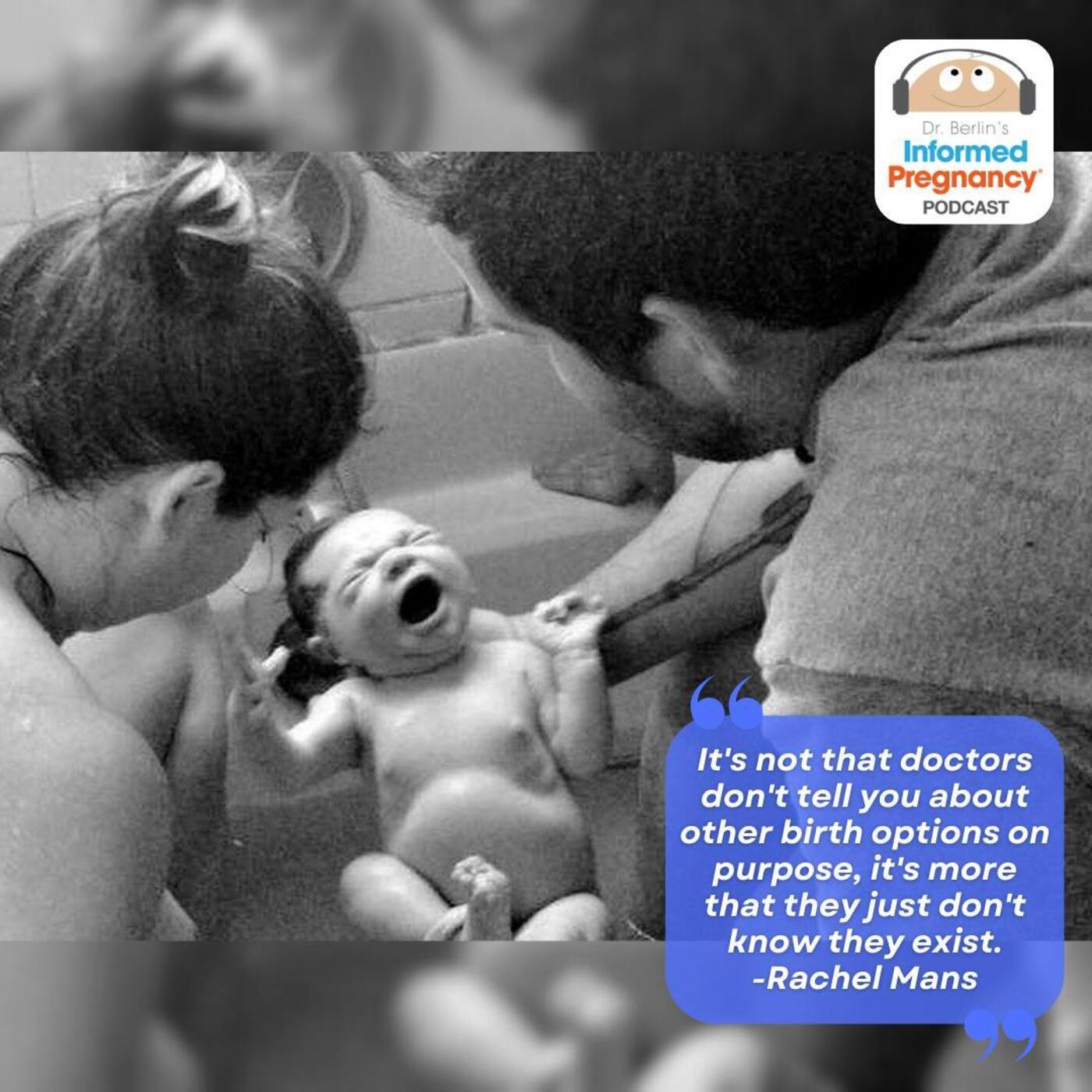
[32:37] And I think when we lost that, we lost a lot of that knowledge. A lot of care providers, they're trained with what their college trains them, their university trains them, and they're not necessarily trained or aware of a lot of the other options out there. And so sometimes it's not that they don't tell you about it because they're trying to hold it back. Sometimes they just really don't know.
Dr. Elliot Berlin, DC [33:01] Yeah, truth. I mean, it's amazing that you're out there educating not just your local community, but the sort of parenting community worldwide.
Rachel Mans [33:12] Trying.
Dr. Elliot Berlin, DC [33:13] Rachel, thank you so much for joining me today and for sharing your many personal parenting stories. They're all quite interesting and I'm sure you learned a lot from each one and now we have two.
Rachel Mans [33:25] Yeah.
Dr. Elliot Berlin, DC [33:26] And for all the resources that you have available, you mentioned you have childbirth education online and obviously the Natural Birth Talk podcast. So where can we find you online?
Rachel Mans [33:39] On Instagram @thenaturalbirthsite and on Facebook at the Natural Birthsite. But my website is thenaturalbirthsite. com, so it's super simple.
Dr. Elliot Berlin, DC [33:49] Perfect.
Rachel Mans [33:50] Yeah, it's super simple. It's super straightforward, kind of like my personality. And then I do have a YouTube channel also. It's at the Natural Birth Show on YouTube, and it has a lot of birth videos and birth pictures and things like that and birth stories that can be really inspiring also.
Dr. Elliot Berlin, DC [34:07] Oh, it's nice. I find people don't usually have any exposure until they're giving birth themselves.
Rachel Mans [34:12] Yeah, I was one of them.
Dr. Elliot Berlin, DC [34:14] Yeah. So it's nice that there's slices you can go see what birth looks like that's not overly dramatized for a TV or a movie or a newspaper headline. Thanks again, and to our listeners, thanks for listening. And if you'd like to find us online, visit informedpregnancy. com.
Want more pregnancy + parenting? Start your FREE TRIAL of Informed Pregnancy+ and get access to all our curated pregnancy and parenting content — original series, iconic birth films like The Business of Being Born, prenatal workouts and more.
