
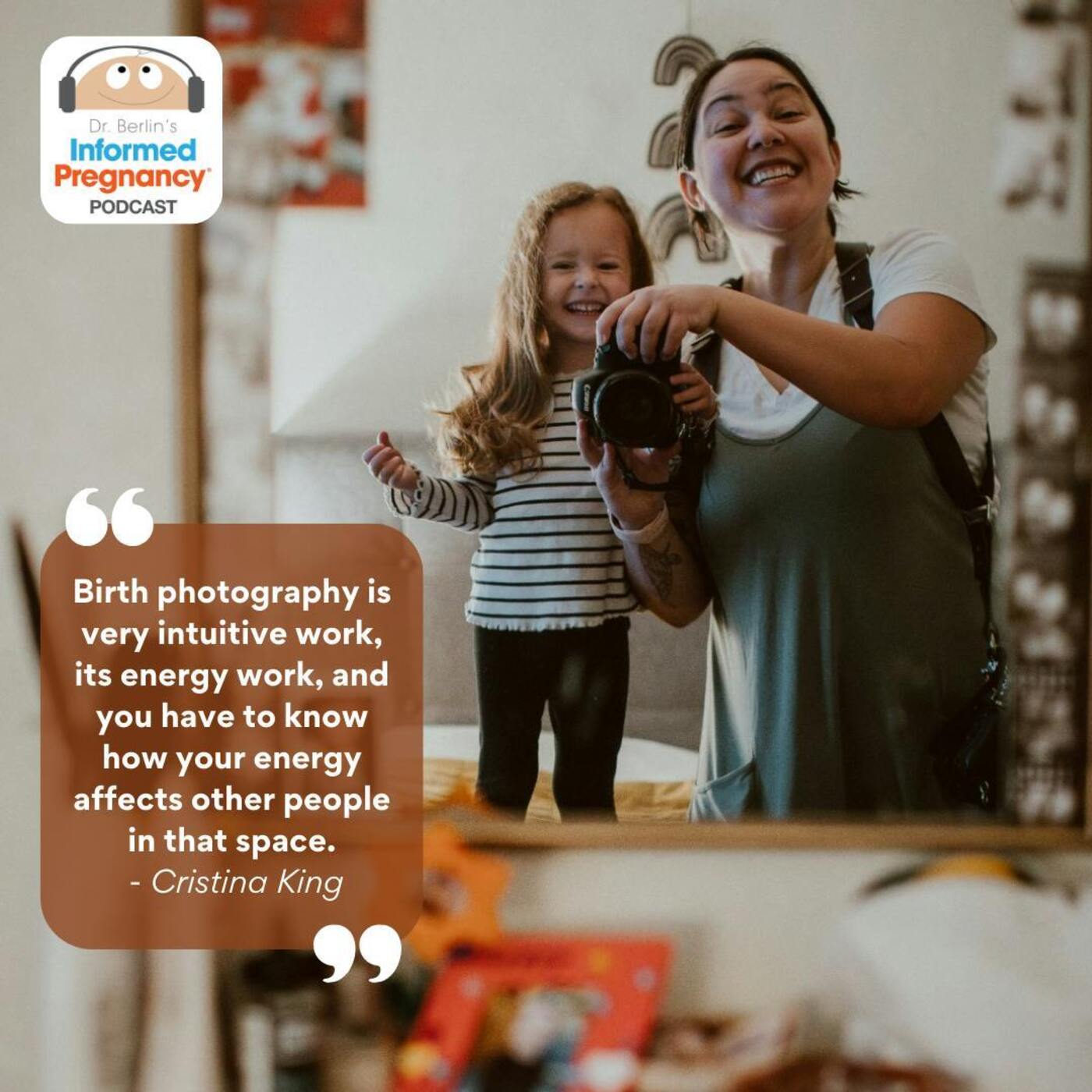
October 12, 2023 · 30 minutes · Episode 376
About this episode
Photographer and former TV producer Cristina King discusses her extensive work as a birth photographer and what it’s like to be a fly on the wall in many intimate life settings.

Connect with the guest!
- Check out Cristina’s website: https://www.cristinakingphotography.com/
- Connect with Cristina online: https://www.instagram.com/cristinakingbirth/
For more about pregnancy and parenting, check out the Informed Pregnancy Blog!
Read about postpartum depression on the Informed Pregnancy Blog: https://informedpregnancy.com/single-post/so-i-had-postpartum-depression/
Keep up with Dr. Berlin and the Informed Pregnancy Project online!
- www.informedpregnancy.com
- www.instagram.com/doctorberlin/
- www.facebook.com/InformedPregnancy
- www.twitter.com/doctorberlin
Learn more about your ad choices. Visit megaphone.fm/adchoices
See Privacy Policy at https://art19.com/privacy and California Privacy Notice at https://art19.com/privacy#do-not-sell-my-info.
Key quotes
“And it was literally just as simple as one day I came across birth photography on Instagram and I didn't know it was a thing and I'd never seen photos of birth before at all.”
“never gotten married. Like, I don't know why I need that to qualify to do the job. So I've successfully crawled out of my own head with that.”
“That could mean I'm photographing a wedding, that could mean I'm photographing a birthday, friendships, you name it.”
“And people are in there watching TV, eating food, and I go inside and there's more food being cooked and more people in the living room. And I'm like, whoa, this is like a party.”
“But this was someone that felt really empowered having her whole family there. And I thought that was so cool, like to each their own, clearly.”
Related episodes
- Ep. 382 Caitlin Wilder: Before Birth
- Ep. 369 Jill Magoffin: Plus Size Birth and Doula Insight
- Ep. 378 Traci Burk: After Birth
- Ep. 377 Traci Burk: Before Birth
Transcript
AI-generated transcript with speaker labels — may contain errors, especially names and medical terms. Dr. Elliot Berlin, DC appears in blue; Cristina King in orange.
Download PDF of the Transcript
Dr. Elliot Berlin, DC [0:12] Welcome to the Informed Pregnancy and Parenting Podcast. I'm your host, pregnancy-focused chiropractor Dr. Elliott Berlin. My guest today is a former TV producer and now a highly sought-after birth, family, and love photographer based in Los Angeles and Seattle. Her emotionally evocative work has graced our Instagram feed several times alongside birth story episodes of this very podcast. We will discuss some of the fascinating details and elements of birth photography and what it's like to be a fly on the wall in various settings. Christina King, welcome to the podcast.
Cristina King [1:12] Thank you for having me.
Dr. Elliot Berlin, DC [1:13] Oh, it's such an honor. Gosh, your artwork is incredible. Your photography work is incredible. It has kind of a stylistic look of its own. It's one of those things you could look at it and be like, I bet that's Christina's work.
Cristina King [1:25] My gosh. Thank you. Thank you so much.
Dr. Elliot Berlin, DC [1:27] For sure. And, you know, as a result, people are seeking your left and right. I know a bunch of celebrity birth photography is done by you and then also us regular everyday people as well. But, you know, when someone can bring their business anywhere and they bring it to you, it's generally a sign that you're doing something right.
Cristina King [1:46] Yeah, I'd say so.
Dr. Elliot Berlin, DC [1:48] All right. Let's start at the beginning. Where are you from originally?
Cristina King [1:51] I'm born and raised Los Angeles. Yeah. And what was that like growing up in La La Land? Kind of surreal. It was kind of strange growing up watching movies and being like, Oh my gosh, that's my house. That's where I live. And then meeting people that aren't from LA. Everyone thinks you live next to a celebrity, which might be true depending on where you live. But yeah, I enjoyed it.
Dr. Elliot Berlin, DC [2:13] It could be true. And you sometimes see them out and about, which is also just kind of interesting. But I would say for me, I'm face blind. I have no face recognition. OK. And so when we first moved here, we thought we were going to see celebrities everywhere. And then my wife's not face blind and we never saw celebrities anywhere. So we just made it up. We'd pull up to a red line and be like, Oh, look, there's Britney Spears. But it wasn't. But, you know, it worked for us. OK, moving on to less weird things. So you had a career in television production. Yes. Was that what you like early on said, that's what I want to do?
Cristina King [2:48] Yeah. You know, I went to college for creative writing and I've always really loved storytelling. I mean, I grew up watching anything and everything. And I just thought, OK, well, that's one form of storytelling. And I wanted to pursue it. And it wasn't quite for me.
Dr. Elliot Berlin, DC [3:07] What was the progression, meaning you wanted to do storytelling and you started to have a career in television?
Cristina King [3:13] What changed? It was a lot of time devoted to a craft that wasn't fulfilling me the way I was seeking to be fulfilled. I was spending 10 plus hour days in front of a screen working for someone else, building other stories that I was being told to be built, so to speak. And I don't know, I just wanted more.
Dr. Elliot Berlin, DC [3:35] Were you able to get any of that creative expression out?
Cristina King [3:41] I was. I was. Some of it was fun and satisfactory and interesting and exciting. But I don't know, it was in the year 2019 or just like something kind of started screaming with inside of me. That was like, this is not it. This is not enough.
Dr. Elliot Berlin, DC [4:00] Now you do photography. How did that transition take place?
Cristina King [4:05] I was someone that photographed everything growing up. Like in college, I was the girl that would go to parties with a point and shoot on her wrist. And then the next day I'd get together with my girlfriends and be like, let's see what I photographed. And it was a lot of fun and I loved the documentary aspect of that. And so when I reached the point in my reality TV career to do something else, I was like, well, I do love taking photos. Let me just see what this is about. And, you know, I did my research online and I took a lot of advice from strangers and I didn't know that were like, well, you should be niched and you should be this and that.
[4:41] And so I was trying to figure out what I wanted to photograph. And it was literally just as simple as one day I came across birth photography on Instagram and I didn't know it was a thing and I'd never seen photos of birth before at all. And initially I was like, oh, my God, like, this is so graphic. What? Oh, my goodness. And then. when that initial reaction wore off I was like oh my goodness like I'd never seen imagery that you know was so powerful and emotional and vulnerable and beautiful and I also just didn't know birth could be anything other than how it's depicted in the media you know I thought birth was screaming your head off and blood everywhere and yeah sure sometimes it can be
[5:23] that but I was really just entranced with how different birth can be for each person.
Dr. Elliot Berlin, DC [5:30] I mean everything you said absolutely you know the first time anyone I think sees birth it's like wow and then when you see it sort of a more undisturbed sort of unintervented birth just nature doing its thing that's even more mind-boggling and just fascinating and beautifully dramatic right so the question is how do you go from seeing that to then you know going to birth to take pictures? I mean literally what I did was I went on
Cristina King [6:00] Facebook groups and I put out like a little ad for myself and said hey I'm an aspiring birth photographer if you invite me into your birth space I'll photograph it for free I just want to see if I'm good at this how it feels for me and I got some good responses from that I shot about three births for free and I was hooked after the first birth like completely hooked. Yeah tell me how that goes down how's your first birth I mean being at someone else's birth and also the responsibility of capturing it all those things. Yeah so with my first birth I ever photographed you know I don't think we even got on the phone because she was due that week and it was an induction so it was a bit more planned
[6:40] which was helpful for me at the time just being so so new to it and so I showed up and I can't explain it other than like I feel like I engaged my intuition as soon as I stepped into that space like you know I feel like I'm someone that's like a spiritual person and I just walked in and was like okay I need to follow my gut like if I feel like I need to take a step back if I need to leave the room if I sense any kind of discomfort with me being there then I'm the one that needs to read that and do something about it although I'd let them know ahead of time too like hey if you want me to leave the room I tell all my clients like if you want me to leave the room please tell me to leave the room.
[7:18] Kick me out yeah. Yeah kick me out you can say something you know like this is your space and so yeah I haven't been kicked out of a room yet but I'm sure it'll happen. What did you learn from the first couple of births? I learned it's for me at least it's very intuitive work it's energy work and I can't help but feel like if you don't understand your own energy and what kind of energy you show up with in different spaces around different people how your energy reacts and heightened scenarios and stressful scenarios like if you don't have a harness on your own energy and understand how your energy makes people feel I feel like it's going to be difficult for someone to step into that space and have it be cohesive
[8:01] or have the birthing person feel comfortable around you. I don't know if I even answered your
Dr. Elliot Berlin, DC [8:05] question. Well I mean there's lots of different elements right so from a photography standpoint there is you know what can I learn about shooting a birth I mean I imagine in some ways it's like a wedding like there are key points that you absolutely don't want to miss yes and then other things that are just sort of almost b-roll and then at the same token you know being at a birth yes you answered it from an energy perspective which is I think Michel Odant the French obstetrician once said you know for each extra person in the room you can add another hour or two onto the labor especially if it's somebody who doesn't have a real role for you there and so bringing energy into somebody's birth space you know are they
[8:49] under the influence of oxytocin and it's dreamy and they have all those positive vibes going on with their mind body and spirit are they fearful is their adrenaline you know are they in fight or flight mode and do you kind of play a role in shifting that either one way or the other just with your presence alone even unintended uh are there things that you can do to mitigate that so like obviously people want to be photographed otherwise they don't invite a birth photographer but then also it's kind of a vulnerable setting and you know I find the birth photographers have a way of being there literally like a fly on the wall almost like nobody knows that you're there but you are so to break that down into
[9:32] components let's start first with technique like when you're taking pictures and you're in the setting now where it's important to be subtle but you want to get up in there and get those shots how do you do that either from a little further away or in a dim setting without
Cristina King [9:47] a bright flash things like that sure well I shoot with two cameras I have one lens that's a wide and I have one that's a 50 millimeter which really gives me reach and I specifically chose both of those lenses as well as my camera bodies because I did some research and they're fantastic in low light they're really great and I shoot with Canon and there's other you know companies that also shoot in low light like Nikon I heard is amazing but I specifically chose those lenses because of their ability to shoot in low light and are
Dr. Elliot Berlin, DC [10:21] there specific almost universal shots from a labor and delivery journey and the immediate postpartum that kind of everybody wants and if there are how do you ensure that you get those
Cristina King [10:32] because you never know when they're going to happen sometimes yeah I mean I'm listening to the conversations happening around me you know I think it's important to note too before I officially launched my business as a birth photographer I took a doula training course I'm not a doula but I wanted to educate myself on the flow of birth like what happens when what certain you know key phrases mean so that way I'm constantly keeping an ear out you know constantly listening to key terms key things to know what to expect the next thing is going to be but as far as like non-repeatable moments like the birth of the child you know first latch first skin to skin I'm constantly moving I'm literally like a fly in the room where I'm just
[11:18] kind of like buzzing and hovering around and tiptoeing and stepping out of people's ways and I'm constantly looking for a better shot I think where my gear is limited because even though my gear is made for low light it is still limited when it comes to certain low light conditions like candles and tea lights things like that I get the results I'm looking for based on creativity so you know if it's super shadowy in the room and all I have are silhouettes I'm going to tell the story through silhouettes you know if there's shadows on the wall or if it's super dark and grungy I look for wherever the light's going to be like even if it's by a computer screen and I angle myself in a way where I'm still able to tell
[11:57] the story of what's going on but creatively it kind of feels like a challenge every time
Dr. Elliot Berlin, DC [12:02] I step into a birth space I would imagine so all right I want to learn a lot more from you more about birth photography more about your own approach specifically and then also especially family photography and love photography yeah whatever that is don't go anywhere we'll be right

Dr. Elliot Berlin, DC [15:00] to photographer, birth, family, and love, Christina King. Welcome back. All right, Christina, so it's kind of an interesting journey. You went from unscripted television to photography to birth photography and also family and love photography, which we're going to talk about in a moment. Question for you. You don't have kids at this moment. Is it something that you consider?
Cristina King [15:25] Uh, sure. You know, my husband and I talk about it often, but I'd say overall, we don't plan to have children for choosing not to. And I know you want to know the why. No, no,
Dr. Elliot Berlin, DC [15:38] I don't have to. It's as much as you want to share as little. It's totally up to
Cristina King [15:42] you. Oh, I'm comfortable. I'm an open book. I don't mind at all. I love children. I mean, I work with children and I just think they're incredible humans that, you know, oftentimes know more than what we know ourselves. I think children are born with a heap of knowledge, but I've never felt the drive, I guess, to become a mother. And I used to think there was something wrong with me, you know, having my friends growing up around me talking about like they've dreamt of being a mother since they were kids. And maybe it's also my own childhood experience, but I've never felt the drive. Although I will say, like I have friends that are mothers and
[16:21] I always tell them like, I wish we lived together so I can raise your children. And I don't know what that's about. Oh, yeah. That's ultimate auntie. Yeah. Interesting. Does being at birth reflect upon influence your thoughts about motherhood? Oh, for sure. Oh, yeah. I get baby fever, especially when I'm out of birth and the partnership is just so it's so evident that they have a healthy partnership, you know, the birthing person and the support person. I can't help but think of like my own partner and wonder like, oh my gosh, how would we be in this space? I want to know what kind of support he'd give me. You know, of course I get curious about all of that.
Dr. Elliot Berlin, DC [17:01] And then it kind of fades. Do you think that going to a birth setting, yourself not having had babies yet, or at this point, do you think that influences your relationship to the birth industry?
Cristina King [17:19] You know, I used to be insecure that it did. I mean, I've only been in this business for three years. And I'd say the first two and a half, I felt like an imposter. Like I'm someone that's never given birth. I'm someone that doesn't have like the complete desire to give birth. What am I doing in this space? Why am I here? But then, you know, with many conversations with friends and realizing, well, there's wedding photographers that have never gotten married. Like, I don't know why I need that to qualify to do the job. So I've successfully crawled out of my own head with that.
Dr. Elliot Berlin, DC [17:52] Yeah. Impostor syndrome is real. Do you know, by the way, what you call a fake noodle? Impostor.
Cristina King [18:02] Dang. I wanted to guess it.
Dr. Elliot Berlin, DC [18:03] So sorry. Dad jokes. Okay. Let's talk about the on-call life. I lived that life for a while as a doula and as a birth body worker. And it's an interesting way to go in life. How is being on call for you?
Cristina King [18:22] It feels different with every, not every client, but depending on the season in my life, I guess, you know, sometimes I'm on call during the season in my life. I'm like, I don't mind, you know, staying at home and sticking by my phone. That sounds good and great. And I mean, there's other times I'm like, okay, like I actually, I want to see people. It's a balance. I'm still striking. Yeah. I mean, I take it with every client, not day by day, but I guess like month by month, depending on when I'm on call.
Dr. Elliot Berlin, DC [18:51] Yeah, it's just a lot of, I've always felt a lot of pressure. Like you have a specific role and then for somehow you don't hear the phone, get up, get there in time, you know, something you can't just reenact it for the camera. And, you know, once you miss it, you miss it. I always felt like being on call was hard because I had to plan vacations or anything that I wanted to go out of town for way ahead of time. And also I didn't realize until I was fully off call, like till I retired that part of my career entirely, how much I wasn't really sleeping with both eyes shut whenever I was on call, which was almost always. And then all of a sudden, like to turn the ringer off and go to sleep is just a different level of sleep.
[19:41] So yeah, I mean, for me, it was always that I loved doing it and there's elements of it that are amazing and incredible. And then I miss still now, but for me, there's always that pressure. And that always like, your mind never gets to fully reboot because you're always wondering.
Cristina King [19:58] Yeah. I mean, I have some things. in place that helped me like I got an Apple watch. So now if I get a text, I just kind of have it on my wrist. I have certain things in place to where I like have I don't know if you did this, but I had like a favorites list on my cell phone and I add my clients to my favorites. So they're the only ones that go through. Sleep is different. Like as soon as I'm off call, I turn my phone off right away. Like that feeling is incredible. But I wondered too, if I don't feel this like overwhelming sense of pressure when I'm on call for a birth. Sometimes I do, but the way I get myself out of it is for me. I'm like, well, I'm going to have fun.
[20:36] Really, I'm going to go photograph, you know, because it photographing really is just a lot of fun for me. And so even when I get the call at like at three in the morning and I'm feeling inconvenienced and like, oh, I got to get up and get alert. I'm just like, I get to go photograph a birth like that always just shoes out any kind of like other like static energy or frustrating energy. Yeah.
Dr. Elliot Berlin, DC [20:57] Have you missed the birth?
Cristina King [20:59] One, and it was one of the earlier ones, but it was kind of meant to be missed. Like, it was for a client who actually turned into one of my really good friends, which tends to happen in birth, I guess. It was her third baby. And she really wanted to birth at home after I believe she had a cesarean and then a hospital birth and those births, they didn't go as she was hoping that they'd go. And so she really was looking forward for her third and last child to birth at home. And she really wanted a free birth and she wanted to feel empowered by it. And so I get the call and I'm on a group chat as I'm driving over. And you know, her husband's texting
[21:40] the birth team like updates, like, please hurry, the baby's coming. And I'm the first person there. And she's holding her babies like, and I was like, you were meant to give birth alone. Like, this is exactly how it's supposed to happen. She was like, absolutely. Like, absolutely. I was like, no one was there for it, except her and her husband. And she couldn't be happier about that. I guess the baby. Yeah.
Dr. Elliot Berlin, DC [22:01] Yeah. And the baby. Okay. Any close calls where you're like, hustling
Cristina King [22:08] through traffic? Oh, my gosh. Yes. This one other time. I was driving, it was a second time birth and everybody was anticipating this birth to come rather quickly. And my client was, I believe, like 30 minutes away from me. She was deep in the valley and I was in Pasadena. And yeah, I actually it was her doula, Stacey Blackwell that told me I should start heading over. She just had like doula intuition, I guess. And I'm driving over and I start getting these frantic text messages from her being like, she's pushing. Like what? And so I'm just like, oh, my gosh. So like, every time my car was stopped, I was pulling out my gear. I was assembling things like, as
[22:50] safely as I could. And she's sending me photos of like, these are the doors you're going to walk through, you're going to run into these doors, turn left, fourth door on the right, you're going to open that like very specific instructions. Like, it felt like I was like in a drama. TV drama. Yes. Like an episode of 24. Yeah, it was so intense. She was even saying like, I suggest that you just pull up at the front park on the fire lane, put your hazards on. I'm like, okay, I'm going to do all of this. And yeah, no, that was really close call. The baby was born 15 minutes after I got there. Wow. My heart was racing. Yeah.
Dr. Elliot Berlin, DC [23:25] That's what I'm talking about. That's that's okay. Intense, dramatic. Before we go to break, and don't worry, we are going to talk about love photography. But before we go to break, I know that you've photographed in several settings, right? Sometimes in the hospital, sometimes out of the hospital, even a cesarean birth. Yes. I'm curious what photographing a cesarean birth was like, and just in general, the different vibes in different settings.
Cristina King [23:51] Yeah, I mean, start with cesarean. Um, cesarean was a very controlled environment. You know, the anesthesiologist was like, you're not going to pass out, right? I'm like, nope. Like, you're staying here. You can't move. I'm like, got it, got it, got it. And was it scheduled? It was scheduled. It was actually was a planned cesarean. Yes. So yeah, no surprises or anything like that. And I mean, I hate to use the word cool, but it just felt cool. Like I was like, whoa, it was really, I don't know, incredible, a bit out of body to witness that to photograph that and moments like that. I had to remind myself to like keep photographing because it's just
[24:30] awe striking. You're like, oh my gosh, like, witnessing birth that way is super incredible. Yeah. And the change in environment. I mean, of course, home births are more comfortable. The vibe is different. It's just a lot chiller. You know, there's more food for the birth team there at home births. Yes. It feels like a sleepover, you know. And if like the birthing person needs space, there's usually a bedroom that everyone can huddle in and everyone checks in on each other and then And things just get a little more serious, like the closer you get to it resembling a hospital. Like birthing centers are also very comfortable and cozy, not as cozy as home, but still comfortable and cozy.
[25:11] And then the hospital, you know, it's super sterile, very bright lights. You're very limited to where you can go. And I'm kind of like in my client's face the whole time. So I really, really have to be tapped into my intuition with hospital births. Like, okay, like should I give them some space? Should I go nap in my car? Like, yeah.
Dr. Elliot Berlin, DC [25:33] But even though you're not a doula with your doula training and kind of your awareness and your energy, sometimes having you in their face is probably helping to mitigate having that sterile environment that you mentioned in their face. Yes. And so you could have a doula like effect sometimes. All right, very interesting. Let's take a little break. We come back, I want to find out about the other things you do, family photography and love photography. We'll be right back. We are back with Christina King photography of all things family. I know you also do postpartum photography and then do you do babies, like the newborn shoots?
Cristina King [26:50] Yeah, newborn, whatever people want.
Dr. Elliot Berlin, DC [26:52] You just put them in whatever position you want and they just don't move and you can get great- Yeah, that's exactly how I run it. But then you, and then family. I mean, I think what I see is oftentimes once you have a birth photographer who does family work, you're just like they're documentarian of the whole evolution of their family, the growth of the family. Tell me about the photography. I don't even know why I say it that way. It just sounds interesting.
Cristina King [27:18] You gotta love. Honestly, I mean, I feel like when I started my photography business, I got very niched right away. I was like, boom, birth, you know, like very niched part of photography. I say love because I just feel like love is everywhere. That could mean I'm photographing a wedding, that could mean I'm photographing a birthday, friendships, you name it. I'm still learning what I do and don't like to photograph and so I don't want to corner myself anymore than I already have with birth. So I say love because I'm just kind of like, whatever that means to you, you tell me.
Dr. Elliot Berlin, DC [27:54] That's fair. I mean, I imagine because it means different things to different people, you have to kind of, if they tell you what it means to them, then you sort of have to adapt how you're going to do that shoot, how you're going to capture that love.
Cristina King [28:08] Yes. I mean, even people reaching out, you know, they want portraits done for their business. Like that's their love, you know? Like they love their business and so it's really fun to get creative too and try and figure out like, how can I harness this love of theirs, this love for their business or their craft or their animals, I don't know.
Dr. Elliot Berlin, DC [28:26] Oh, so you're catching like the passionate affection on camera, on film. Yeah. Do you also do, at a birth, do you take video?
Cristina King [28:37] I just started to actually, yes.
Dr. Elliot Berlin, DC [28:40] That must be also interesting.
Cristina King [28:42] Yeah. I did that a couple of times for free to make sure I could pull it off because I don't know how other people can do it. You know, I've reached out and asked and I've heard people say like, yep, I just have one camera and one hand recording and the other taking photos and the other, so. Is that what you do? I just successfully did that at a birth recently. I had my wide camera on record and my right hand was photographing.
Dr. Elliot Berlin, DC [29:08] Oh, wow. I sometimes see people set up a wide shot that just is there going the whole time. Yeah, that's a smart idea. And then just once in a while use the juggle to get a more close-up moment. Well, quite interesting. All right, I guess maybe we can close if you have like an interesting birth that you were flying the wall at, one that sticks out in your mind as, I don't know, different or. Okay, I have one. Share with the group.
Cristina King [29:40] Yes, okay. So this birth sticks out to me and I love talking about it with different people because when I'm in conversation with whoever wants to listen about birth and I tell them, you know, like birth can look at however you want it to look, I use this example because it's just such a good one. I was at a birth. And I showed up to this birthday, it was in the middle of the night, and there was a trailer in the driveway, like a camping trailer. And people are in there watching TV, eating food, and I go inside and there's more food being cooked and more people in the living room. And I'm like, whoa, this is like a party. And so I go into the room with the birthing person,
[30:19] the baby's born, I'm photographing it, and the birthing person's like, tell everyone to come in. And it's literally this person's extended family, like aunts, uncles, just like flowing into the room one by one, you know, congratulating her, kissing her, looking at the baby, and they just all hung out and like, not partied, partied, but I mean, there was like a big stew on the stove, people were having beverages, like kids were awake. It was literally a party. And I've talked to some people where they're like, no, no, no, when I give birth, I wanna be able to count everyone on the room with like one hand, you know, I want minimal bodies. But this was someone that felt really empowered
[30:56] having her whole family there. And I thought that was so cool, like to each their own, clearly.
Dr. Elliot Berlin, DC [31:01] Totally, I mean, very interesting. And that's absolutely what you see. Everybody has something different that they want that experience to be like. And that sounds like a really tight family. And by the end of it, a slightly larger family. Christina, thank you so much for sharing your beautiful photos with us when our clients are lucky enough to have your shots. And for joining me today and sharing your insights into birth and family photography. Where can we find you online?
Cristina King [31:36] You can find me at christinakingbirth.com and that's Christina without the H.
Dr. Elliot Berlin, DC [31:41] Just the C.
Cristina King [31:42] Just the C, C-R. So Christina King Birth on social media
Dr. Elliot Berlin, DC [31:46] and on the interwebs. Wow, you got all of them at Christina King Birth?
Cristina King [31:51] I snagged them all.
Dr. Elliot Berlin, DC [31:52] Dang, good for you. Thanks again for joining me on the home. Thanks for listening to Informed Pregnancy. If you would like more Informed Pregnancy media, like our blog, more podcasts and the almost streaming site, Informed Pregnancy Plus, visit informedpregnancy.com.
Want more pregnancy + parenting? Start your FREE TRIAL of Informed Pregnancy+ and get access to all our curated pregnancy and parenting content — original series, iconic birth films like The Business of Being Born, prenatal workouts and more.
