
February 22, 2024 · 46 minutes · Episode 395
About this episode
Doula and entrepreneur Dawn Thompson discusses her path to becoming a birth worker and advocate, the creation of her perinatal support platform Birthify, and life as a mother of 6.

Connect with Dawn online: @birthify_ and birthify.net
Key quotes
“And I said, oh, that's easy. I'd be a midwife.”
“that's the thing about Dulas is that Dulas are literally the only ones who see birth in every location. In home birth, they see birth center birth, they see hospital birth and all the different hospitals in their communities. They see all the different nurses, all the different doctors, right?”
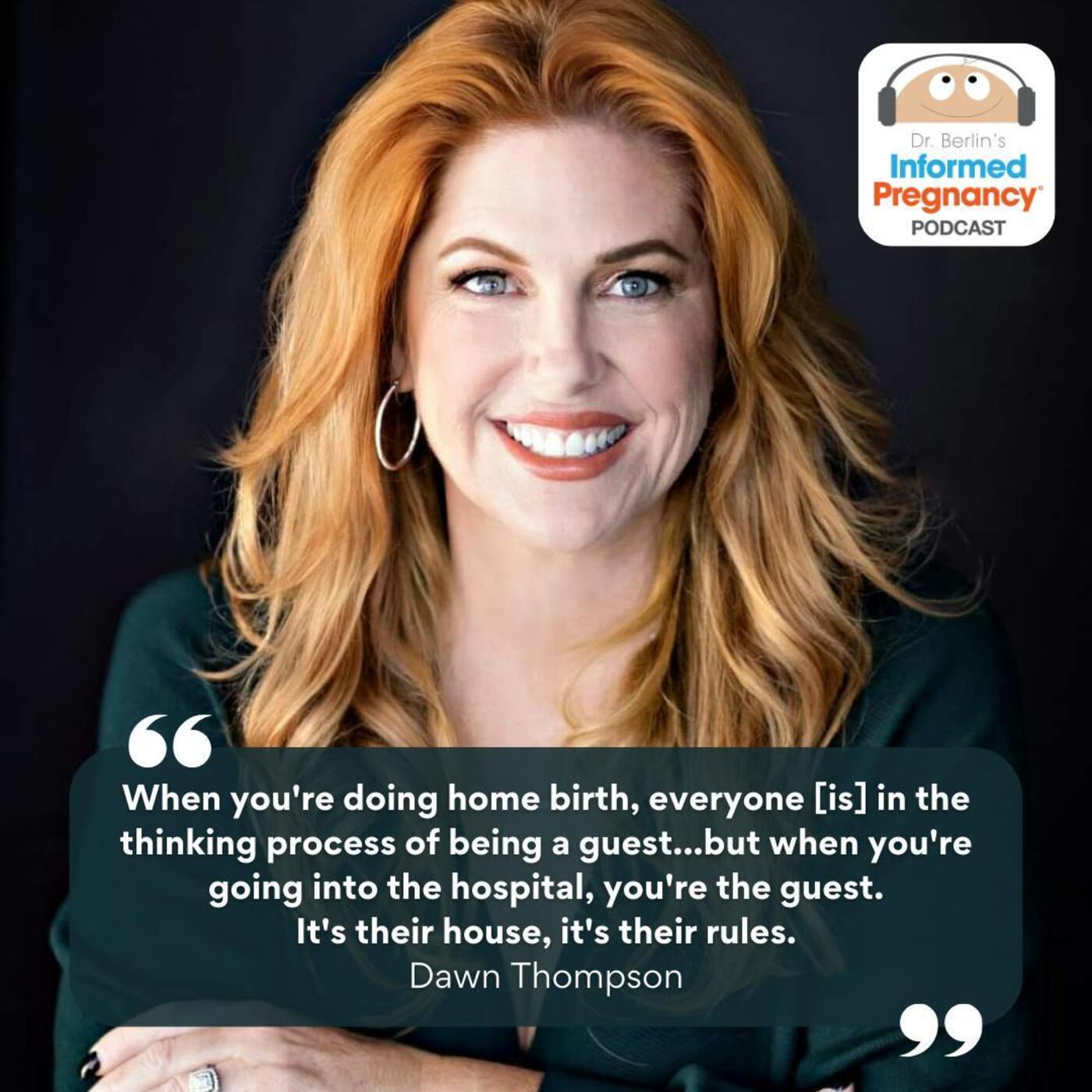
“you're the guest. It's their house. It's their rules. And we automatically just conform because that's what we've all been taught to do.”
“This is not my space. And that's what became ultimately what drove me out of the hospital”
“like, Hey, do you want to meet your baby today? Great. Go over to the hospital and we'll go ahead and induce you. And they're not saying like, okay, guess what? There's a risk when you do an induction, there's a pretty significant risk that it's going to end in C section. Okay. Nobody's telling them that, right? Nobody's talking about the risks and benefits”
Related episodes
- Ep. 396 First Baby After 40 with Rachel Gerrol
- Ep. 393 Directing Your Own Birth with Rylee Ebsen
- Ep. 394 Radical Love with Alexis Jones
- Ep. 392 Transformational Birth with Adriana Lozada
Transcript
AI-generated transcript with speaker labels — may contain errors, especially names and medical terms. Dr. Elliot Berlin, DC appears in blue; Dawn Thompson in orange.
Download PDF of the Transcript
Dr. Elliot Berlin, DC [0:12] Welcome to the Informed Pregnancy and Parenting Podcast. I'm your host, pregnancy-focused chiropractor, Dr. Elliott Berlin. My guest today is a doula advocate and activist, founder of ImprovingBirth.org, and more recently, the online perinatal support platform, Birthify. She's also a mother to six. Dawn Thompson, welcome to the podcast. Thank you. Lord only knows how I got a moment of your time. I'm not going to waste it. I want to know everything. Let's jump right into the beginning. Where are you from originally? Los Angeles. I've heard of it. Yeah, I think so. Is there anybody really from Los Angeles?
Dawn Thompson [1:16] Now there are. There is. We've been here long enough that there's, you know, there's enough people actually from here. But yeah, I was born in Van Nuys, California. Oh, keys on Van Nuys.
Dr. Elliot Berlin, DC [1:31] And then how was growing up in LA, Walla Land?
Dawn Thompson [1:35] Uh, you know, I didn't do it for a whole long time. I migrated south and first to Orange County and then made a little left there to Temecula and then eventually to San Diego, where I have been since my very early twenties. I went to high school in Anaheim. So.
Dr. Elliot Berlin, DC [1:53] Oh, wow. Like Southern California is your playground. Yeah. My stomping grounds. I've pretty much moved through most of it. Okay. And then right now you have Birthify, which we'll get to, but there's a big journey between stomping around Southern California and now let's start with career. What was your original intention for career as a kid? You probably didn't say, I want to start Birthify.
Dawn Thompson [2:17] No. In fact, when I was a kid, I was going to be Julie McCoy from the Love Boat.
Dr. Elliot Berlin, DC [2:22] The Love Boat.
Dawn Thompson [2:24] Oh, which is funny because of course I joke that I'm kind of the master coordinator, right? And like here, I really did become Julie McCoy, just not on a cruise ship, really.
Dr. Elliot Berlin, DC [2:34] Right. The birth ship, the mothership.
Dawn Thompson [2:37] Yeah. But I mean, ultimately, you know, I kind of fumbled around. I didn't understand that I was an entrepreneur actually, but of course, now I can look back. I never described myself as that, but I got my real estate license when I was 19. Right. And then I bought a brick and mortar business when I was 23. It was a flower shop. Yeah. I was in sales, floral company that sold to flower shops, right? So wholesale flowers. And one of my customers was selling their business. And I decided that that was a great idea. And of course it wasn't. It was a terrible idea. I was 23 years old and I didn't know what the heck I was doing. And I was, I mean, about as wet
[3:19] behind the ears as you get, but when you're young and dumb, you just think you're invincible. So it lasted about a year and a half.
Dr. Elliot Berlin, DC [3:28] Okay. At least you could buy and sell with your real estate license. But the cool thing to me about a flower shop is that green, like sort of wettish green brick that everything gets stuck into. Oasis. Yeah. I love playing with that. I would have bought the flower shop just for that.
Dawn Thompson [3:42] Yeah. It's pretty fun.
Dr. Elliot Berlin, DC [3:44] All right. So then they sell that and then still we're not at birth stuff.
Dawn Thompson [3:49] No. And then I got into public relations and marketing by accident. It turned out I was actually pretty good at it. And so I was in private aviation there in Orange County. So I got to rub elbows with the very rich and famous folks. And eventually I was working in a cubicle in a marketing department and I absolutely hated it. I hated just being in a cubicle. I hated to be in an in the office environment with all the drama and like, you know, anyways, you know, it's probably about 30 by then. And I just was convinced that I was supposed to be doing something more than working in cubicle, dealing with a bunch of, yeah, people anyways. That's telling.
Dr. Elliot Berlin, DC [4:31] Yeah. Okay. So you weren't loving the cubicle.
Dawn Thompson [4:35] No. So I quit my job and it was the first time I'd ever done that since I was 15. I'd had a job since I was 15 and I just up and quit. And I was just like, I need to make space for what I'm supposed to be doing. And I didn't know anything about birth or doulas. I'd never even heard of a doula at that point, but I had had two children by then. and neither of which were very positive experiences. My first child was a typical snowball effect of the US maternity care system that ended in a cesarean. And then my second child, I attempted to be back, but didn't have any real support in that. And then my baby was posterior and blah, blah, blah. And that ended in a second cesarean.
[5:26] Anyway, so I really didn't have much I had attended one of my girlfriend's births and she had a really super fast, precipitous birth and gave birth unmedicated, not intentionally, but she did. And it was with a midwife. And that birth really had an impact on me. Cause right, I'd had just two horrendous births experiences and seeing her and my husband asked me after about three months of now not working, my husband was like, so we're gonna figure this out. Cause I could really use some financial support here. And he said to me one night laying in bed, he just said, okay, if you could do anything and time and money wasn't an issue, what would you do?
[6:12] And I said, oh, that's easy. I'd be a midwife. And my husband was like, what? Like, for him that seemed like it came out of left field. But by this time, this was a new marriage for me. We'd only been married for about a year and he had two children and I had two children. So now we had four small children all under the age of eight and who he also had majority custody of his children. So we had four kids. And I, so I said, but like going to midwifery school, that's like a six year process, you know, like that's not a let's get money in the bank kind of moment, you know? And I'm not sure that's the smartest thing to do with four little kids. And he basically said, well,
[6:55] what about being like a birth coach? And this will tell you that I married an entrepreneur as well because he said, I think some, I think people would pay for that. Like having somebody go with them to the hospital. And if that doesn't exist, you should start it.
Dr. Elliot Berlin, DC [7:12] Wow.
Dawn Thompson [7:13] That was my husband.
Dr. Elliot Berlin, DC [7:14] That's insight.
Dawn Thompson [7:15] I'm telling you, yeah. And so, you know, just a few weeks later, I had a situation come up that made me run to my computer and look up birth coach and up came back then. And I think maybe Donna still does this, but Donna required that you write an essay and Donna is that doula certification organization.
Dr. Elliot Berlin, DC [7:36] Doulas of North America.
Dawn Thompson [7:38] Yes. And one of the requirements to get your certification was that you had to write an essay about what a doula is. And mind you, this is pre-Google again, aging myself real quick, but I'm pretty sure we were just still dialing it up with AOL there. Beep, beep, beep, beep, beep. Right?
Dr. Elliot Berlin, DC [7:59] My apologies for anybody who's wearing headphones right now.
Dawn Thompson [8:01] Sorry. Anyways, and so in my dial up, I went and looked and there was this essay that I read. And I swear that angels started singing the bright light shown behind my head. It was like a moment where I was like, that's me. You know?
Dr. Elliot Berlin, DC [8:21] Oh, wow. And-
Dawn Thompson [8:23] The minute, the moment, the reveal. It was like a moment of like, oh my God, that's it. And so of course that led me from one thing to the next and it led me to the Donna website, which then led me to like look up what classes, what you had to do, how you became a doula. And it turns out this was on a Sunday and I found a class that turned out to be starting in five days. At that point, there was only two trainings a year in San Diego County.
Dr. Elliot Berlin, DC [8:55] Oh, wow.
Dawn Thompson [8:56] For doula.
Dr. Elliot Berlin, DC [8:56] Things have changed.
Dawn Thompson [8:57] Oh, just a little bit. Yeah. But it just happened to be starting in whatever, this was Sunday and it was starting on Friday, the following Friday. And I called and it was on a Sunday and I was expecting I was just gonna like leave a message or something, right? And the woman answered her phone.
Dr. Elliot Berlin, DC [9:12] Oh.
Dawn Thompson [9:13] You know, I was like, oh, oh, you know. And she said, well, actually we were sold out but somebody canceled yesterday and we have one spot. Would you believe it? Yours if you want it. And I was like, no question. And I took it and four days later, my entire doula training that first weekend wound up being the most eye-opening, sobering, traumatic experience because I didn't know that I had just been a victim of the medical system. And it was why I'd had a C-section in the first place. I didn't know. And in fact, my doctor, after I had my first kiddo, sat on the edge of my. bed and he actually said to me you're so lucky you were here because back in the day you probably
[10:06] would have been somebody who died in childbirth. Oh my gosh. And I loved that story Elliot. I loved it. I loved the drama of that story and I told it so many times like oh I would have died you know and of course like I didn't understand why he said that because I did have an emergency section but it was that my baby was in distress like after I got this training I went and requested my medical records because I wanted to see and the heart tracing record was in there and anyways it was clear to me like now that I've known what I know there was a couple of little d-cells but it was realistically because of the pitocin they were pumping in me at a very high rate
[10:52] because I was at the max you know it was a full pit to distress moment and nobody said like oh well actually your baby was in distress because of all the stuff that we've been doing to you for the last 12 hours you know and so it was kind of this aha moment I literally cried I can't even tell you how much I cried through my doula training that realization of like knowing the truth you know of what really happened. You know it's so interesting because my wife
Dr. Elliot Berlin, DC [11:20] and I did doula training and I was one of only two dudes in the class the other one was mostly breastfeeding throughout the class and it was really interesting to watch as our teacher Ana Paula Markel just went through a lot of the different things in the normal course of educating doulas and how people got really emotional you know about their own births as they're going through it and there's there's no real like deep conspiracy things here it's just like natural every day the system the system is what it is and it doesn't put you in the driver's seat oftentimes and you don't realize that you could have been in the driver's seat or that there were even turns that you could have made along your journey right until after
[12:10] you don't know what you don't know sure well you know I think that history that birth history together with the universe pushing you in this direction and then you having that moment you know really set a fire under a rocket and you've done a lot since then you have more kids Welcome back. We're talking to Dawn Thompson. So you know to this point you've had some kids and you've had some marriages and one came with more kids. Right. And then you have this sort of big pivot in life from you know work work work to take a little break and realize you want to get into birth work and then you get into it and have this big epiphany that your whole journey without a doula might have been very different. For sure. There's no question about
Dawn Thompson [14:41] it. Yeah and I think the thing that I know about myself now you know you can always understand is that I can't stand injustice in any way shape or form. If I see something that feels like it's an injustice I'm that person who's going to stand up. You know I'm the person that runs towards. a car accident. I'm the person, you know what I mean? Like, I'm just that person. I'm the one running towards a fire. You know, I mean, I think over the years through my doula work, even then I still believed in it. And when I came out of my training, I still believed in the butterflies and rainbows that I was going to experience with attending women's births. And, you know, you realize pretty quickly that like, holy mackerel, like
[15:26] I was reading so much of evidence based care. I was reading so many studies and ACOG guidelines and all that. And so then when I got into the hospital and realized like, holy mackerel, they are not following evidence based care, not entirely, but they just weren't really even following ACOG guidelines, you know, like, in a lot of situations. And, you know, it just fired me up because it just was an injustice. And after about probably, I think, six years or seven years of being a doula full time, and then discovering Facebook, right, which then now connected all of these doulas from across the nation and realizing that it wasn't just my community that was having these issues. It was really an
[16:15] epidemic that the C-section weight was out of control and people were just being induced left and right. You know, like, there was just all of these unnecessary interventions, which I saw happening with my clients. They were just being regularly encouraged to do all of these interventions, and they didn't need them. And it was so difficult to combat that doctor knows best mentality. And like being able to say to my clients, like, wait a minute, is that what you really want to do? Like, do you know? And then watching them just end up in cesarean so frequently. I mean, ultimately, it became where if a client got through an induction without a cesarean, I was shocked.
Dr. Elliot Berlin, DC [16:55] Well, it's not supposed to be that way.
Dawn Thompson [16:58] No, it's not. And of course, there were some that had, you know, like, developed severe preeclampsia and like, oh, my gosh, absolutely, we need to be inducing those labors, you know, right. But I mean, how many times do my clients get in for an induction for a big baby or low amniotic fluid, and out comes an eight pound baby, you know, or their water breaks, and that's like a flood. And yet here we were, we were here because there was low amniotic fluid. And so you can't keep seeing that stuff with your own eyes over and over again. And then, by the way, I'm the one that's meeting them at home after they get home after a couple of days, and they're traumatized, right,
[17:37] they're broken, they're distraught, because they felt like their birth was awful. And you can only be a witness to that so many times, at least me, because I'm an advocate, I recognize that I'm an activist at heart. I didn't know that then. But you can only watch it so many times without having to feel like you've got to do something. And that's ultimately what led to improving birth.
Dr. Elliot Berlin, DC [18:02] So tell me about improving birth. What was the mission? And how did you execute it?
Dawn Thompson [18:07] Well, I have to go back a little bit, because there was a situation here in San Diego, where a nurse leaked a report about the cesarean rate at a local hospital that showed 70 to 80% C section rate on Thursdays and Fridays, on Thursdays and Fridays,
Dr. Elliot Berlin, DC [18:26] Thursdays and Fridays versus what on the other days?
Dawn Thompson [18:30] Um, I don't recall that this was many years ago. But the highlight was that it was 70 to 80% on a Thursday and a Friday, meaning, you know, like before the weekend, yeah, you know,
Dr. Elliot Berlin, DC [18:40] I get it. I'm sure the contrast was really high. I just wondered.
Dawn Thompson [18:44] I'm sure I don't know. I'm sure it was in that 20 to 30% because that is still the national average. So I would assume it was somewhere. Wow, okay. So actually, there was a group of us here that had planned a protest in front of the hospital. And unfortunately, three days before the event, the tsunami in Sri Lanka happened. And we decided nobody's really going to care about the C section rate in this moment. And so we canceled the event. But interestingly enough, fast forward a couple years later, maybe a year later, I got a call from a journalist who'd been referred to me asking about the C section rate at the same hospital. And it turns out that
[19:25] the editor of the paper, that it was a local paper, the San Diego reader, the editor of that was having his baby there, or his wife was and the doctor came in and said, Oh, you're lucky your doctor wasn't on today. Because if he was, it would have definitely been a C section by now. And of course, the dad is like, why, you know, what is going on? Like, by the way, she hasn't delivered yet. And so he's like, Is there something wrong? Like, do we need a C section? He said, Oh, no, it's just because it's after five o'clock. And this triggered the editor of the paper to go, wait a minute, like what are you talking about? Someone's doing c-sections just because it's after five o'clock? And so when he got back from paternity leave,
[20:10] he put a journalist on it and he said, I want you to do a story about this hospital c-section rate. Anyways, and so they did, and I know this is not for visual, but I have the cover of it. Can you see what it says? Yeah, the unkindest cut. Yeah, it wound up being their cover story. Wow. And they wound up doing a five page spread, which included us taking a photo in front of the hospital with a sign. And anyways, they were given opportunity to participate in the article, but they declined, not understanding what was coming their way. Anyways, I tapped into my marketing and public relations background and I waited for that article to come out. They gave us a heads up a few days before. And so I organized a rally.
[20:59] The first rally to improve birth was in front of their hospital on the 15th of December. So just a few days before Christmas, because of course we'd done the story in like summer, but it was just now finally coming out. And I just rallied the birth community and we had about 75 people show up with signs and every news outlet in town showed up to do story. That's huge. It was huge, yeah. And obviously they had to be back on their heels and respond. And during that planning process, my girlfriend, she said, wouldn't this be amazing if we could do this all across the country on the same day? And I thought that would be amazing. And I know there's a lot of doulas out there who
[21:44] are really frustrated and they would probably participate. I think they would. And so I started thinking like that, man, I could use social media and these groups and Facebook. This is before all the algorithms destroyed groups and business pages, but I could utilize that and I could organize. And she suggested, well, maybe we could do it like on Mother's Day, right? And I'm like, well, this is December to May. I couldn't possibly organize it that fast. But what about Labor Day? I know that's not what Labor Day stands for, but it's a good-
Dr. Elliot Berlin, DC [22:15] It seems appropriate.
Dawn Thompson [22:17] Right. It's a good hook. And so there was, I just started organizing. And remember the Julie McCoy comment at the beginning, right? So I-
Dr. Elliot Berlin, DC [22:26] Yeah. You drew into your previous director role.
Dawn Thompson [22:29] So it's definitely one of my superpowers. And I started organizing and I used social media and I literally just made up a website in 24 hours, like a web page. And like I just figured it out. And we wound up organizing 110 cities in 46 states.
Dr. Elliot Berlin, DC [22:48] Holy moly. You see, there you go, Julie.
Dawn Thompson [22:52] That was our first year and we had about 10,000 people come out across the country.
Dr. Elliot Berlin, DC [22:57] I hate to say it, but you are the real McCoy.
Dawn Thompson [23:00] Thank you. Proud of it now. I used to be very humble about it, but I'm like, no, I've worked my butt off.
Dr. Elliot Berlin, DC [23:07] Seriously, to do one or two is a massive accomplishment.
Dawn Thompson [23:11] But we couldn't have done it without, I mean, there was so many people, right? I mean, there's just so many people. In fact, Rebecca Decker, you know, of Evidence Space Birth, she went up, she was a huge part of that. Kristen Pascucci, who by the way was just in PR and was like, you know, suddenly thrust into the birth world. And now she has gone on to start birth monopoly. And, you know, like it's amazing how far all of us have come in this industry. But I mean, there was no way. And Kitty Ernst, daughter Rosie, I don't know if Rosemary Senjem, they're really a big part of the American Academy of Birth Centers. And really, I mean, I just gave everybody's energy a place to focus.
[23:52] Like everybody across the nation was frustrated, right? Dulas, midwives, childbirth educators, you know, we all saw what was happening and it was incredibly frustrating because we know it's like, you know, that's the thing about Dulas is that Dulas are literally the only ones who see birth in every location. In home birth, they see birth center birth, they see hospital birth and all the different hospitals in their communities. They see all the different nurses, all the different doctors, right? And that was the thing that was frustrating is like, even if we're talking doctor to doctor or nurse to nurse, I mean, sometimes it was a dramatic difference and you could see that how that one person could make a
[24:36] tremendous difference on whether or not this person had a positive birth experience or a negative birth experience. And it had nothing to do with the position of the baby or the situation with the mom. It was absolutely sometimes dependent on the people around them and who were serving them. And it was really difficult to sit still and be quiet when you could see one doctor's doing it. amazing, being respectful, giving informed consent, even when something was going awry, they still were loving and supportive, you know what I mean? They gave of themselves versus the next guy who was just awful and not giving informed consent, you know, all those things. And so then you think like, you know, your liability and your management
[25:23] of your life and all of that, like when we talk about what's wrong with the system, well that provider can do it. There's zero excuse why you can't.
Dr. Elliot Berlin, DC [25:32] It's really interesting to me how many people, since I stopped doing doula work, people sometimes ask me for a referral and I'll send them to some of my favorite doulas and they'll come back to me and be like, oh yeah, they don't do hospital birth anymore. And it's amazing how many come back and say, oh, they don't do hospital birth anymore.
Dawn Thompson [25:51] Yeah.
Dr. Elliot Berlin, DC [25:51] And, you know, I talked to some of them and look, I've been there. I see, I think some people go into a hospital and have a really great experience. You know, that ride is the ride that they're interested in. But I know that sometimes you get in there and you just like, as a patient, everybody in the medical establishment works for you. But in that setting, everything is set up to make it feel the opposite. Like you sort of work for them. You know, sometimes it feels like, I don't know, like you're in school again and there's all these rules and you have to ask permission for everything.
Dawn Thompson [26:27] Well, I have a theory about that actually.
Dr. Elliot Berlin, DC [26:29] Tell me.
Dawn Thompson [26:30] Many years ago. So I didn't actually experience my first home birth until I was probably about four years into my doula career. And when I did the home birth, I cried all the way home because I thought, how in the heck do I go back to the hospital after I just witnessed that? It was so dramatically different from the reverence of the family. And that was the thing. Like after several years after that and doing many home births after that, I saw what the difference was. And some of it is so subconscious, not some of it, all of it. It's subconscious. When you're doing home birth, everyone walks into your home automatically in the thinking process of being a guest. So that you, as the leader of that
[27:24] household and that they are a guest. And so there's just that mentality even like just subconsciously that they are the guest. But when you're going into the hospital, you're the guest. It's their house. It's their rules. And we automatically just conform because that's what we've all been taught to do.
Dr. Elliot Berlin, DC [27:43] Right. The questioning as a person laboring at a hospital. Oh, can I eat this? Can I drink this? I walk over there. Yeah. Can I go pee? Is that okay with you? And then at home, if there's anybody talking at all, the questions are the exact opposite. It's like, Oh, do you mind if we use this towel for your birth? It's just like until you see that contrast, it's hard to, I think, fully appreciate.
Dawn Thompson [28:09] Well, the other thing that was so incredible to me was the fact that when that baby was born, all my experience has been before that was how much everybody else in the room made it about them. And like the nurse would be like, congratulations. Oh, my God, you know, right. And everybody and the doctor is talking and doing their thing. And they're asking for stuff and they're, you know, and everybody's bustling around and doing some stuff. Right. And in the home birth, the midwives literally almost became wallflowers, but they were doing everything they needed to do. But in almost nearly silence. Like a fire in the wall. Yes. They were quiet. They were reaching in and checking
[28:54] the baby's respirations and all of those things and not saying anything while the mom and dad are just sitting there glowing and like absolutely over the top and falling in love with their baby without interference, even though there was interference, but it was so gentle and it was so like sidelined. And it taught me something because I was just as guilty as those nurses before that. I'd be like, oh, my God, it's a girl, you know, and I would like be in it and realizing like I realized in that moment and that first home birth, like, oh, my gosh, this is not the space I'm supposed to be in in this moment. This is not my space. And that's what became ultimately what drove me out of the hospital
[29:39] because, you know, I was doing so much more work with improving birth and doing births was just not really an option after a while. But every time I would go back, I would just be so frustrated and annoyed at the smallest things because I would just be like, God, you didn't need to do that. Like, why are you doing that? You know what I mean? And I really I was just angry. Yeah. Angry. I was angry at the system. I was angry that they just don't know any better. They don't know what they don't know. And I just think I wish that every labor and delivery nurse, every obstetrician, every pediatrician that comes in those rooms was required to go to a home birth to understand. Oh, how cool would that be? And you know, I sometimes do
[30:25] see OBs who've been to home birth. Right. Well, we talk about Milo did the same. You're like, I mean, I think it's why he is the way he is because he worked with midwives, you know, and we have a Dr. Kapitanakis here too. And he's worked with so many midwives and like, he's fantastic and he gets it, you know, but I think it's just a different perspective that anybody who is dealing with birth should witness and experience. Let's take a break.
Dr. Elliot Berlin, DC [30:51] We still have a lot to talk about. I know. Sorry. Including the most current project that you worked on. We'll be right back.

Dr. Elliot Berlin, DC [31:10] Welcome back. We're talking to Don Thompson. And boy, do we have some more questions for you. In this segment, I'd like to catch up on the fact that during this time, you have two more babies and to see how those experiences are through your new lens and Birthify. Well, Birthify is your current platform. And I'm very excited to talk about that and how and why improving birth evolved. Those are my three things. Where do you want to
Dawn Thompson [31:36] start? Oh gosh. Okay. Well, that's a lot. Just so you know, there's a lot of history there, but I'll try to keep it brief. Before I started improving birth, I had two more babies. And really it was because I just couldn't stand the fact that I had had two c-sections and I desperately wanted to have the experience that I'd been helping other families with through VBAC. I was kind of nicknamed the VBAC queen. Oh, that's a great nickname. Yeah. So, and VBAC just for those who don't know, it's vaginal birth after cesarean. So as you can imagine, I'd been very engaged. I had become the vice president of the San Diego birth network here and ran that for six or seven years. So I was very
[32:17] connected in the local community here in San Diego and I wanted to have more babies. And so I did. And I attempted a home birth with my third child, which was a VBAC after two c-sections. And unfortunately that did not go as planned. I thought for sure it would. I was convinced. I knew everything I needed to know now, but the thing that I did not bet on or understand was that I would have a tremendous amount of scar tissue left in my body from the previous two cesareans. And apparently I'm an overachiever when it comes to scar tissue as well. Not just in my life, but in scar tissue development. And I had so much of it that it was impeding my daughter's ability to get into the pelvis. And I'm one
[33:09] of those stories where people hear about the cervix going backwards. Mine actually did that. Oh really? You started to dilate and then came down? And I was eight centimeters for many, many hours with an urge to push and it didn't work. And then the next time I got checked, I was suddenly three centimeters and the baby was no longer. I was at like a one to zero station in the pelvis. And then now I was now three centimeters and the baby was blottable. So the baby had even gone back up. And needless to say, we transferred to the hospital, tried with an epidural for another six hours and there was zero change. Nothing happened anymore. And so I had a repeat cesarean, which was devastating. As you can imagine,
[33:55] I felt so much shame and like, how does the VBAC queen not get her VBAC? Right. But it turns out that when again, that Dr. Capitanakis here in San Diego was just my gem. He did backup for my home birth. And I went and saw him and when he opened me up, he actually like gasped. It was like, whoa. And he said, I'd never seen that much scar tissue before. Wow. He said it was literally like I'd had a box of melted crayons in my belly. Oh my. And so he was the one who said, he said, you know, he spent an extra 45 minutes and cleaned it all out for me. And he said, you know, if you want to try again, you can, I think you're going to be successful. Really VBAC after three. Yeah. And around here,
[34:42] I don't know if there's any doctors that entertain that he probably wouldn't be thrilled to know that I just had probably probably get himself in trouble. Oops. But anyways, so, you know, he was a cheerleader for me and little did I know that I would get pregnant very short. after my children are only 13 months apart oh yeah nobody plans that by the way and so I thought that meant it was too close together and that there was just no way you know because there's the recommendation of 18 months but both he and my midwife are like I don't know about that it's like if a scar heals it heals like 18 months is not gonna change whether or not it's healed you
[35:26] so they both encouraged me to go for it and so I did and miraculously I had the exact same labor I mean it started the same way lasted the same amount of time the time that I transferred was around 930 in the morning could transfer to the hospital with my daughter to have a cesarean and I gave birth at 930 in the morning to my next son but it was exactly the same Wow yeah but what was that like emotionally um I mean like in the moment I couldn't even process it it was a really difficult labor you know like I'm not one of those laboring women I took hypnobirthing like I'm just not one of those women who can manage it very well but I was determined enough so I
[36:12] think I was a little beat up by the time it actually happened but I mean sitting here now he's almost 14 years old now and I can't even tell you how much I mean I think it's why I started improving birth you know what I mean like it's my whole view of myself because you can imagine how I thought maybe my body was just broken right and that maybe my two c-sections were necessary you know and by the way my last son was a full two pounds bigger than my last cesarean wow so for the people yeah I have ten pounds and he was my only vaginal delivery so well big baby thing didn't die because that's what they told me with my first was like oh she was just too big
[36:56] she was eight pounds 13 ounces they just said she was just too big for
Dr. Elliot Berlin, DC [36:59] you Wow I just see so many of those I see all the time you know so regular either that they say the baby's gonna be too big and they just do a scheduled cesarean and the baby comes out medium-sized or smaller or you know you have a baby that's in the eight or nine pound range and it ends up in the cesarean and like oh yeah the baby was just too big your pelvis could never possibly handle that and then they have a feedback with a same size or bigger baby you know I mean this goes to the conversation about
Dawn Thompson [37:29] well I won't even go there but I want to talk about birth a fight but before we get there improving birth how did that evolve and change and lead you to move on to birthify yeah I mean I think there was some things that happen when I set out with improving birth our original mission statement was reduce the unnecessary c-section and induction rate right because I just felt like that was the biggest issue that our health care system was facing and that's how we launched and we did our rally each year but then we got this case the Kimberly Turbin case which landed in our laps and this sweet girl she needed some help she had been assaulted by her
[38:10] obstetrician and it was caught on video and she was desperate for people to hear her because she kept asking people like is this normal like I'm pretty sure this wasn't okay like he was going to cut an episiotomy on her and she was begging him not to and she was saying I just started pushing like please don't please don't cut me and she must have asked him I don't know six eight times during the film the video and she posted this video online because her family was just telling her like get over it but she was still in pain a full year and a half later because he wound up punitively because he was just flat out abusive the video is still available on YouTube
[38:55] that's probably forced to episiotomy but I have to warn anybody who goes and watches it it's a horrendous video to watch and really listen to because although you can't see it you can hear him cutting her 12 times and she was desperate to make sure it didn't happen to anybody else and she wanted to file a lawsuit but the problem is nobody wanted to take the case because it was not considered malpractice because malpractice suits really are I hate to say it this way but somebody's got to be dead or seriously injured and she couldn't prove that she was seriously injured because visibly she looked fine but she wasn't able to have intercourse without pain she wasn't able to sit without discomfort and we took on her
[39:37] case to help her and like we had a couple of lawyers that joined our team and it took us a year and a half to find her a lawyer even though she had video evidence of the assault most lawyers laughed at us and said there's no money in this we can't take the case and some of them were like this is not a malpractice suit and we knew that we knew it was an assault case but there had never been an assault case against an obstetrician before in the United States. And so we brought the very first assault case against an obstetrician here in California. And it took another two years, probably after that, it was a very long, I mean, man, the legal system is something else.
[40:18] But it took us 80 lawyers to finally find one. Whoa, California. Yeah. And we finally found a human rights lawyer, Mark Marin, who finally took the case. And he just did it as a favor for his niece, because his niece was one of our followers. And I think she might have even been a doula. And she begged him to take the case. And so we did. That turned our organization into though, an obstetric violence organization. Different than what you started. Totally. And we did a lot. We had an incredible Break the Silence campaign, which was a visual campaign of women telling their stories of abuse, and not being listened to and coercion and all of those things. I'm literally doing a TV interview tomorrow in LA, I'm going
[41:00] to be in LA tomorrow about misogyny and obstetrics. And Kimberly is actually being interviewed for it as well. And, you know, it just turns into this thing, which I love, and I'm so proud of. But I was having a really hard time communicating that it wasn't what I had envisioned. And I was really struggling with that. And every time I tried to steer it back to where my purpose was, the system was like, oh, that's boring in comparison. You know, it was kind of, I hate to say this, but we'd kind of become the car accident that everybody's got to, you know, look at. Right? Everybody liked the drama. But the reality was, it's like, you know, the women who are experiencing the real,
[41:40] like what Kimberly experienced, that really terrible, obvious obstetric violence was not what most people are experiencing, right? Most people are experiencing with incredible kindness. I call it kind, compassionate bulls**t. Right?
Dr. Elliot Berlin, DC [41:56] There's the first bleep. I mean, very important work from the beginning to the end, even a change in direction, but still important work, but no longer, you know, what you were really passionate about focusing on in your everyday. So now you have Birthify. Tell me what it is. How does it work? You know, I joke and say it's like talk
Dawn Thompson [42:18] space and better help is for therapy, online therapy. Birthify is for pregnancy and postpartum. So, you know, we're revolutionizing the idea of how people get support because the number one thing that I heard as a doula over the last 20 years and an advocate is so many women would say after their first birth, if I would have known this, I wouldn't have done that. And I mean, the number of times that I saw women go in making these decisions about their care, that they really didn't have all the information, right? They didn't know the risks, the benefits and alternatives. And, you know, providers are just like, Hey, do you want to meet your baby today? Great. Go over to the hospital and
[42:58] we'll go ahead and induce you. And they're not saying like, okay, guess what? There's a risk when you do an induction, there's a pretty significant risk that it's going to end in C section. Okay. Nobody's telling them that, right? Nobody's talking about the risks and benefits and like, Oh, and what's the risk of a C section? What's the short-term risk? What the long-term risks are? And even something as basic as a vaginal exam, people don't even recognize they're just like, everybody just does it. So they do it, but they don't understand that it comes with nothing but risks. There is zero benefit to doing a vaginal exam before labor. And so what birthify is meant to be is a true informed consent conversation,
[43:37] right? They come on to get matched with the coach, someone like myself, who is a full spectrum trained doula. So that means they have experience with lactation, postpartum, infant care, birth, pregnancy, right? They're kind of, you know, a jack of all traits, which most of us are become eventually. And it's someone who's a sounding board, a real time lifeline, somebody that they can video chat with them each week and they can text unlimitedly. And it's just having a person that is just there for them and no other agenda, but to give them as much information and guidance as possible.
Dr. Elliot Berlin, DC [44:13] Where along the journey is a good time for someone to initiate this?
Dawn Thompson [44:19] Well, I mean, the sooner the better, right? Just because then, you know, it's a little more casual, but I think ideally at the latest, we'd love for them to come in around that third trimester right at the beginning of the third trimester is the most ideal.
Dr. Elliot Berlin, DC [44:32] Is there an element of it that's accessible during the birth?
Dawn Thompson [44:35] Yeah. So that's an actually added. So right now it's a subscription model. So it's a flat fee per week that's charged monthly. And then if they want virtual labor support, they can have that. And that's an add on item. But then their doula is on call for them basically. And then does the subscription element continue post nightly? Correct. Does there's so much more to that? No, there's so much more. Yeah. No. So. breastfeeding support. I mean, I can tell you how many nipples I've seen through video chat. It works pretty good. You know, I mean, listen, we did a beta test and we had 20 women through our beta test. We had a single cesarean, one cesarean and it was maternal
[45:14] choice. Wow. And we had one induction and again, maternal choice. She chose it, but not until she was nearly 42 weeks after she fired her doctor who continuously pressured her to do an induction when she didn't want one. And so 36 weeks, 37 weeks, fired her doctor and hired a new one and went on and did an induction still, but not until nearly 42 weeks. So, you know, compared to the national average of one in three, having a cesarean and 70% of labor is being induced or sped up in the nation. You know, those statistics are pretty. Yeah. One in 20. If that kept up, improving birth would be out of what to do. Yeah. So that's our goal. You know, it's still my goal from the very beginning of the mission statement of reducing the
[45:56] unnecessary C-section and induction rate. And we just want people to feel supported because it's severely lacking. People aren't doing enough childbirth education,
Dr. Elliot Berlin, DC [46:06] all of those things. So I really love that you make it so accessible. Hey, look, I mean, we're both in Southern California where there's a lot of choices, but you go to parts of the country where there are not really classes and doulas and community for pregnancy and postpartum. And I love that you make it accessible to anybody, anyplace. Dawn, thank you so much for joining me. Every time I talk to you, I learn a bunch. And this is no exception. You know, your passion and your own personal journey and the work that you're doing is really valuable. And I can't even count how many families and babies and soon grandbabies your fingerprints will be on in terms of making it
[46:47] a better experience. Thank you for that. Thank you. I appreciate it.
Dawn Thompson [46:50] Where can we find you online? birthfi.net. And then we're on TikTok too. I've got a TikTok for Birthify Official where we're constantly giving tips and tricks. Oh, cool. Little freebies. Yeah, a bunch of freebies. Yeah, probably a little too much actually.
Dr. Elliot Berlin, DC [47:08] There's the Julie McCoy again. Thank you again for joining me on At Home. Thanks for listening to our podcast. For more pregnancy and parenting information, visit us online at informedpregnancy.com.
Want more pregnancy + parenting? Start your FREE TRIAL of Informed Pregnancy+ and get access to all our curated pregnancy and parenting content — original series, iconic birth films like The Business of Being Born, prenatal workouts and more.
