
June 6, 2024 · 35 minutes · Episode 410
About this episode
New York based visual artist, educator, and mother Corinne Botz discusses her internationally acclaimed work in the women’s health space as well as her powerful project Milk Factory, which offers a poignant look at lactation spaces across the nation. The short film, available on Informed Pregnancy Plus, takes us behind the scenes in a lactation suite at U.S. House of Representatives and uncovers the intimate realities of pumping in the work place.

Connect with the guest online:
- Corinne Botz: @corinnebotz and corinnebotz.com
Milk Factory is available to stream now exclusively on Informed Pregnancy Plus!
Key quotes
“I think that's also how this project did come from anger for me. Like, you know, milk factory came from anger. The fact that like the U S is the only high income country that doesn't have mandated family leave and lactation rooms are really just a bandaid solution to that.”
“I'm like, sure, that would be great. But actually, I just think they shouldn't exist. People should be able to, you know, everyone should have a family leave.”
“I feel like the story doesn't exist without the room itself and the space and you never ever leave that room within the film. So the entire film takes place within that lactation room.”
“Again, this underlying theme of like making something visible visible of milk production and how this is unseen and unacknowledged in our culture.”
“and the way that this is so valuable and there's such an intense pressure for women to breastfeed their children. And yet we're lacking this cultural support for it. And that's what I'd like to draw attention to the need for that.”
Related episodes
- Ep. 414 Aly Michalka: After Birth
- Ep. 415 From Addiction to Motherhood
- Ep. 409 The Face of Birth with Kate and Gavin
- Ep. 424 Leedia Riman: After Birth
Transcript
AI-generated transcript with speaker labels — may contain errors, especially names and medical terms. Dr. Elliot Berlin, DC appears in blue; Corinne Botz in orange.
Download PDF of the Transcript
Dr. Elliot Berlin, DC [0:12] Welcome to the Informed Pregnancy and Parenting Podcast. I'm your host, pregnancy-focused chiropractor Dr. Elliot Berlin. My guest today is a visual artist, educator, and mom based in New York. Her work includes photography, writing, and filmmaking. With a keen focus on space, gender, and the body, particularly in relation to women's experiences, her impactful projects have garnered international acclaim. Her powerful project Milk Factory offers a poignant exploration of lactation spaces across the United States. From behind the scenes in a lactation suite at the U.S. House of Representatives to various workplaces nationwide, her lens uncovers the intimate realities of pumping in the workplace.
[1:16] In this episode, we'll delve into the making of Milk Factory, including a short film currently streaming on Informed Pregnancy Plus, shedding light on the societal complexities surrounding lactation, paid family leave policies, and workplace support for new mothers. Join us as we explore the profound implications of her work in shaping a more equitable future for families everywhere. Corinne Botts, welcome to the podcast.
Corinne Botz [1:39] Thank you so much. Thanks for that great introduction. I'm happy to be here.
Dr. Elliot Berlin, DC [1:43] I want to know everything. First, where are you from and what do you do?
Corinne Botz [1:47] Well, I live in upstate New York at the moment, near Catskill, New York. I'm in the city for 20 years and then the pandemic brought my family and I upstate. I still go to the city a fair bit for teaching and so forth. But now we have bees and a garden and, you know, well, isn't it a long commute? Well, I don't go in like that regularly. So it's a beautiful train ride. Three hours on the Amtrak. No kidding. OK, I guess it could be productive. Mm hmm.
Dr. Elliot Berlin, DC [2:16] What do you teach? So I teach photography and yeah, how did you get started in photography?
Corinne Botz [2:24] How did I get started? Well, I grew up in northern New Jersey and I loved art from a young age. Photography, especially when I was in high school, I was really interested in Deanne Arbus and her work. I ended up setting up a dark room so I could print independently. I would go into the city on weekends to see art exhibitions and take photography classes. So it was really given for me that I would go to school for photography college. My parents are obviously very supportive because all three girls went to art school and I went to the Maryland Institute College of Art in Baltimore and then I moved to New York City after that. I was always making my own artwork and projects,
[3:04] but I was also doing some commercial photography as well. And then I ended up going to Bard College for my MFA. And yeah, at this point I would say like teaching, motherhood, caretaking, art making, they're all kind of part of the same intertwined, all part of my life in a great way. Yeah, it sounds like a great mix. How was your journey to motherhood? Yeah, I'm not sure exactly how to answer that. I knew I wanted to be a mom. I met my husband and we got pregnant pretty quickly. I was around 36 and have a great daughter, Echo, who's now 10 years old. Echo. What a great name. I thought it was going to be Lens or something like that. And then has becoming a mom changed
[3:51] your work at all? Yeah, I mean, I think the Milk Factory project would just not exist if it weren't for my daughter. In fact, before I had a kid, I didn't even know what a lactation room was. Like someone told me when I was like, what am I going to do when I have to go to work and pump? And someone's like, well, they're the lactation room, you know, because they are this like blind spot. So yeah, I mean, that project came out of having my daughter and actually going back to John Jay College of Criminal Justice, where I teach, and there's this very weird, sparse lactation room. And I initially just recorded it, brought in my film camera, plus my pump that day for work and recorded it just as a record
[4:27] for myself. And it wasn't until like a little bit later, because I was too in the thick of things, you know, that I looked at the contact sheets and realized the correlation with my other bodies of work is an exploration of space. So that's how that project came about. And then also, for me, it was connecting with all these other women who are going back to work. I don't know if you want to go into that yet, but sure, anything wherever the conversation takes us. I mean, I think it's obviously pretty interesting. So were you not exploring space before then? Like was this your foray into spaces? Oh, no, not at all. So all my work. So this year, it's 20 years since I published my first book, the nutshell studies of unexplained
[5:06] death. And it's probably my most well-known work. It's a collection of crime scene dollhouses that were made in the 1940s and 50s after actual cases by a female criminologist. So I draw the writing and the photography in that book. So from there, I did a project photographing domestic spaces around the country with those stories that are connected to them. I photographed the homes of agoraphobics, personal belongings left in cars after car accidents, which I mean, people think of cars as almost like a house. What else? Hoarding, I did a project exploring hoarding a little bit, objectophilia, medical simulations. When I got pregnant, I was working on bedside matter, and that was my first film. It's also a
[5:48] photography and film project, but it was about bedside matter, empathy, and medical simulations. See, I've always been interested in space, especially, I always think domestic space is the most powerful domain. I think as a woman, I'm interested in that gendered history within the home. But lactation rooms, like I said, I never would have thought of that if it weren't for becoming a mother. I think a lot of artists, there's so much bias against women and mothers in the art world, so they don't want to make work about motherhood. I think things are starting to shift. But for me, I was always interested in representations and motherhood, even before I had a kid. So it's not like I'm doing this to make a lot of money. Anyhow,
[6:27] I had no problem with going in that direction after I had my daughter.
Dr. Elliot Berlin, DC [6:32] AC Yeah. Okay. So hearing you talk triggers a strong sort of recollection of mine, which is I used to work in ambulances and emergency rooms in New York City. And I made this observation that the more densely crowded an emergency room was, for sure the more uptight, anxious, snappy people were, as a general observation. And you would go into these big emergency rooms in different cities or towns, and there was just wider hallways, and every patient had their own space. Every practitioner in there had their own space, and they're just so much warmer, kinder, and gentler. And then after living in several different cities, I almost felt like there was a mirror there when you're in a very
[7:22] densely packed city. Sometimes people are just very on edge. And when you're in a more loosely packed city, just a more relaxed atmosphere. I don't know if there's any science behind that, or if you've seen that either, but I just remember having that aha moment. Because growing up in New York City, and then let's say moving to Atlanta, Georgia, or Lincoln, Nebraska, just reminded me so much of the difference between people's almost like nervous system, based on how crowded or not crowded or spaced out things are. It's interesting. Yeah, I feel very attuned to spaces, but any hospital or emergency room I'm going to be anxious in. Yeah, for sure. But in my case, I'm not there as the patient,
[8:04] so it's a different type of observation. All right, we touched on it a little bit, how this project got started for you. I want to jump into it and learn everything. Let's take a quick break. When we come back, we will talk about Milk Factory. We'll be right back.

Dr. Elliot Berlin, DC [9:50] times. Welcome back. We're talking to Corinne Botts, an artist and also filmmaker. And I really want to get into your film, Milk Factory. Before we jump into how that came about, you had a baby and then you had your own lactation experience. What was that like for you?
Corinne Botz [10:14] Yeah, I would say I had a long recovery from having my daughter, because there's a lot of complications. She was very healthy, but I had a lot of health problems stemming from the birth. And my mom like breastfed my sisters and I, so she was a big advocate. And that was one thing that really came easily for me in comparison to everything else was nursing. I nursed my daughter until she was three and I just had to like stop at that point. And she was really mad about it. She, I don't think we ever would have stopped if I left it up to her. Oh, really? Well, she loved it. I had a really great breastfeeding journey. But early on when my daughter was two
[10:49] months, I had to go in for open surgery again, stemming from the birth and I had to leave my daughter. So I got upset about how it would work if I was in the hospital for up to a week. And the surgeon said to me, well, that really doesn't matter. Your daughter would rather have a mother than, you know, yeah, yeah. But he did give me the NYU lactation support service and they told me about having to up your supply and sort of pump around the clock. So by the time I left, because it was about two weeks before I had to get the surgery, I had a whole like freezer full of milk, which I took a picture of again, just for myself. And it just lasted in time. I don't think they had to supplement,
[11:30] which of course it would have been fine if they did. But any case, I think that does connect to the project. You know, when you think about women pumping at work, they're separated from their child. So it has to do with the autonomy of the mother and separation of mother and child for various reasons. And then I think a deeper reason, I mean, you have for me was like, what will happen at the surgery with my daughter? You know, she was so little, I was like providing her main source of food at the time, which is so crazy to think about.
Dr. Elliot Berlin, DC [11:57] Had you already been pumping in addition to breastfeeding?
Corinne Botz [12:01] Not that much. I maybe pumped like just one or two times at work,
Dr. Elliot Berlin, DC [12:04] you know, I hadn't been back at work that long. So you really started for this purpose for the surgery?
Corinne Botz [12:10] Yeah. And then of course I continued at work when I was working.
Dr. Elliot Berlin, DC [12:15] Yeah. So I wonder if that experience being away made it harder or easier to at work, you know, to be away from your baby pumping rather than feeding directly.
Corinne Botz [12:28] It was really sweet days. I had to teach. My mom would drive in from New Jersey to watch my daughter and I would call them with my hands free pumping bra and talk to my mom and see my daughter and FaceTime and like eat my lunch and then run back to teach. So I never really had any problem with like milk supply, you know, but I think it was more on that deeper level the way that, yeah, when you have a child, you can be like closer to life and death. I mean, I actually even felt that during my birth experience. This is crazy because I'm not even someone who I did a book about haunted houses. I don't necessarily even believe in ghosts, but I actually had this like spirit presence when I was like going through labor.
[13:04] I had the strongest sense of like someone else being there and it was so peaceful and it was like so spiritual for me. And then of course, I actually almost did diet later on in that experience after giving birth. So I don't know. The whole thing was just, you know, it's very intense.
Dr. Elliot Berlin, DC [13:21] You talking about being on FaceTime and eating and pumping and your baby's getting fed. It kind of reminds me. I used to work on TV sets and do body work for my clients when they had like a break between filming. And it reminds me of this one mom who had like side by side, you know, dressing rooms, one for her and one where they set up a little nursery for her baby and the baby would hang out and sat with her mom or with the nanny. And when lunch happened, sometimes just 45 minutes of lunch, she literally would multitask in a way I've never seen or thought possible. She would feed the baby while getting a massage, eating her lunch and having hair and makeup done for the next part of
[14:07] the shoot. And I was like, wow, blown away. Even just the choreography among the people working on her so that we can be out of each other's way and accessing parts that we can
Corinne Botz [14:17] work on. Women really are like superheroes. And I did feel that about all the women that I met who were pumping at work, having a newborn baby at home. And, you know, I mean, it's also, I guess, like something that's frustrating, just the expectation that you're going to be highly productive at work. And then you're also going to be like giving, you know, all the love to your child and also feeding them. I mean, it just feels like untenable for so many women and so challenging at the same time. I mean, women are superheroes could not be overstated.
Dr. Elliot Berlin, DC [14:50] And I have this theory, which is not always the most popular, but it's a generalization surely doesn't apply to everyone. But I think many women after they have a baby do feel pulled towards the nest. And many men after having a baby feel pulled towards the outside of the nest to go hunt and gather and support more. Like in the immediate aftermath? Yeah, let's say the three months, six months, a year, whatever it is, I think that for many women, there's an instinctual pull to be home with the baby around the baby, taking care of the baby, guarding the nest. And for a lot of men, they have the opposite pull to go outside and hunt and gather and feed the growing family more. And for those people in today's environment,
[15:37] the men who go out and work more get rewarded for that because, yeah, you did more. And then the women sometimes end up really pulled in two very different directions, you know, having to, for those who have to or want to go out to work and also being pulled towards the nest at the same time. What I've observed in my practice is it leaves a lot of people feeling like they're not doing great at either one. And I think part of postpartum being so challenging is related to that. Like you're having to really pull yourself into two directions and apply yourself wholeheartedly in two different arenas. And that's hard to do. It's draining. And even if you're great at both of them,
[16:21] it means you don't have much left over for yourself.
Corinne Botz [16:24] Yeah, I think that's true. And I also think it's so cultural where I have had some friends of mine who are male who took paternity leave who were able to, and they describe it as like the best time in their life. You know, in other countries, it would be like, you know, in Sweden where, you know, the women and men both have these great policies. I mean, it's just so beneficial to the whole ongoing health of the family to have that time off in the beginning.
Dr. Elliot Berlin, DC [16:50] Yeah. We don't do a great job with it in America. And the societal forces really push in a direction that makes it hard to feel supported, be supported, and, you know, have a smooth transition.
Corinne Botz [17:04] Yeah. Our life would have been so different if my husband had had leave. Yeah. I mean, it would have been so different. I mean, I think that's also how this project did come from anger for me. Like, you know, milk factory came from anger. The fact that like the U S is the only high income country that doesn't have mandated family leave and lactation rooms are really just a bandaid solution to that.
Dr. Elliot Berlin, DC [17:27] Yeah. So tell me more about that. You went to work and you took a picture of
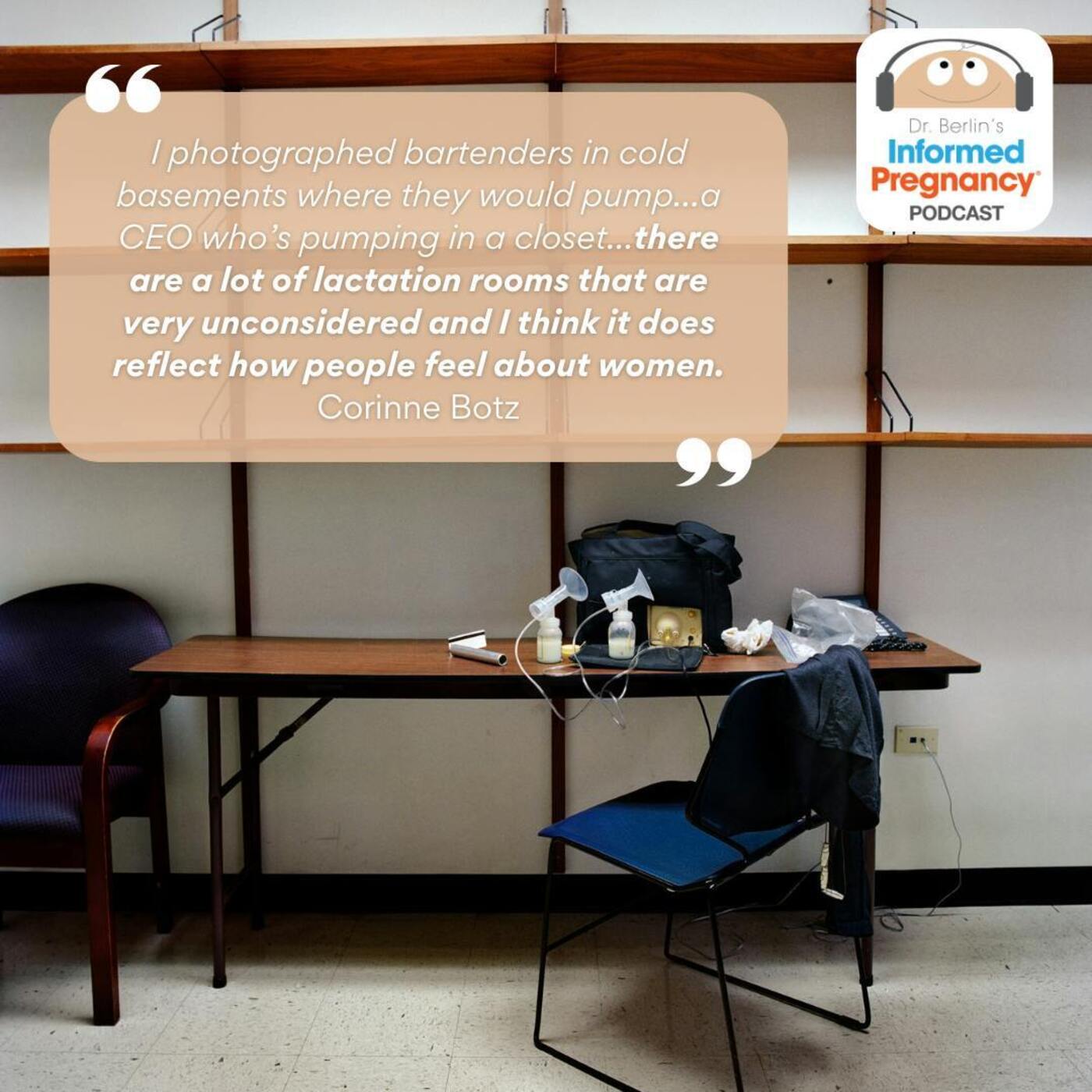
Corinne Botz [17:34] the lactation space that was made available to you. Really big, much bigger than the adjunct office, lots of barren shelves. I was like, this is just so odd. I have to record it. So I recorded it with my milk and my, you know, the key and whatever I had out. And yeah, like, what was your feeling in there? Just feeling like this is not conducive. This is not warm. I should be with in a larger sense. Like, I mean, first of all, I had, aside from the fact of my husband not having leave at that time in my teaching schedule is pretty flexible. So I feel pretty privileged overall with how much time I was able to spend with my daughter and maintain teaching.
[18:14] So the room was really strange in a way that I liked because I like weird spaces. Yeah. I told her your other books. Yeah. I was like, Oh, I get this room is odd. Like there's a weird plan. So anyway, I think in a larger sense than I started accompany other women to the workplace. And, you know, it was like a real privilege to get to know them. I mean, it's a very intense period where you were leaving this young baby at home, going back to pump. So even if I only met them for however long we would have to talk, there would be some exchange of like what it's like for them in the workplace now or their birthing experience. So we would talk the way that I think once you have a kid, you enter this
[18:51] tribe of motherhood where you become part of this community. So it felt like this immediate connection and the women were all really happy that I was like taking a picture to highlight this unspoken truth of what it feels like to go back to work. So I photographed bartenders in cold basements where they would pump, you know, fancy people who can pump on their own terms who are like the head of a company, someone who's a CEO who's pumping in a closet. So there are a lot of lactation rooms that are very unconsidered. And I think it does reflect how people feel about women. I think it does reflect people's, Oh, they can just pump anywhere up. The affordable care act came about all of a sudden.
[19:28] You had to find a pumping space. You had a certain amount of employees in the workplace. Now you have spaces designed with a lactation room in mind. But before that, people were just finding like the worst places in the school for the people to pump, you know?
Dr. Elliot Berlin, DC [19:43] Well, especially depending on the size of the company, space can be at a premium.
Corinne Botz [19:48] So it's actually near the city where I was photographing. Oh yeah. Their space is an incredible premium. So the space that a company might find to make available for lactation is generally I'm assuming space that's otherwise unused for a reason. It's not a great space. Yeah, exactly. It's like, Oh yeah, we could stick her in there. It's always like weird pillows are stacked up. People like try to shove other things in that room or, you know, I'm trying to think of other examples. I mean, sometimes they just feel like hospital spaces. They feel very much like sterile. There's like nothing on the wall. Zaina Gilbert, a curator at MoMA when she was at MoMA,
[20:33] sort of noticed there was art all over the museum, but not in the employee lactation room. So she started curating art exhibitions, mostly by artists who work there. And she had my photographs up at some point, because actually, you know, for me, it was easy to have let down and produce a film. But, you know, for some people, it's hard for them to pump. And actually the space is important, right? One of the spaces actually does make a difference. You feel comfortable if you have a certain amount of time to pump.
Dr. Elliot Berlin, DC [21:03] Yeah, I mean, I can't know what it would be like. It just feels to me like, it seems like maybe it's me and maybe it's that I can't really relate, but it just seems like something that would sort of feel awkward. Pumping in general, pumping in like a public area, leaving to go pump and everybody knows you're going to pump and then coming back. It almost reminds me of walking through the doctor's office with my urine cup. Where do I put this? And just not being the most comfortable thing. So, yeah.
Corinne Botz [21:30] Well, it was interesting when I was in Canada, showing my work to some curators there, they were like, oh, you know, there's no lactation rooms here. And that's such a great leave policy. But by the time people return to work, they're not really pumping at that point. There's no need for them. So people ask me like, oh, do you think they should design the rooms better? I'm like, sure, that would be great. But actually, I just think they shouldn't exist. People should be able to, you know, everyone should have a family leave.
Dr. Elliot Berlin, DC [21:55] Yeah. I mean, that sounds like a bigger takeaway. Yeah. That, okay, on a micro level, the bare minimum is to make a space available. Perhaps the next level is to make it a really warm, conducive, inviting, comfortable space. And then on a bigger level, let that space be home with your baby. And we'll see you later. I don't know how our country gets there. Maybe you have thoughts on that, but we seem to be very far away.
Corinne Botz [22:20] Sadly, I would agree with that. But I think the money's there. There's no reason why we can't do this, you know?
Dr. Elliot Berlin, DC [22:27] The collection of photos that you have, is that accessible to people?
Corinne Botz [22:32] Yeah, they're accessible on my website, but also I'm working on a book with St. Lucie Press where I'll have them included along with some texts. I'm super excited about that. It's coming out soon. By the time you're listening to this, hopefully it's already out and available to you.
Dr. Elliot Berlin, DC [22:49] Amazing. I can't wait to get my hands on a copy and put it on our little wedding room table here at the office. All right, you also have the film, Milk Factory. Let's take a little break and when we come back, we'll find out more about the film. We'll be right back. Welcome back. We are talking to Corinne Botts from Milk Factory. And I'm excited, as we mentioned in the last segment, that your book is gonna be coming out and the photos will be available there. Let's talk about the film. So Milk Factory, the film, it's a short. How did that come to be?
Corinne Botz [23:35] Well, when I was researching for the photographic component of the project, I learned about the US House of Representatives lactation room. And it's this bipartisan space. Also, unlike all the single use lactation rooms that I photographed, this was a communal lactation room. So I immediately thought I have to make a film here. I mean, part of it is this, the symbolism of the location. Like here's this place where laws are decided that change our lives. And possibly women from across the aisles could come together to enact legislation that would benefit women and children. So to me, it was like this combination of labor, motherhood, and politics
[24:14] that could intersect within the film.
Dr. Elliot Berlin, DC [24:17] I mean, I didn't even think about it that way. But yeah, first of all, coming together, that would be nice about any issue at this point. But what greater cause to do it and maybe what greater incentive to do it than taking care of our families, or our mommies and babies. Small glimmer of hope. Small, but it's there. Yeah, so was it hard to get into it?
Corinne Botz [24:44] Yeah, access is really hard. So part of my work, I'm always interested in like using the camera as a license to get access to spaces that would otherwise be impossible for me to say like, oh, I want to look at simulations and medical school training. Like no one let me in. But with the camera, sometimes you can. And so part of my work is getting access to places and seeing how I can. But this was especially hard. And I did have to get the help of my friend who worked for a magazine to get press credentials.
Dr. Elliot Berlin, DC [25:10] Why the resistance to getting in there? Is it a security issue?
Corinne Botz [25:15] No, it was just like, if you don't have press credentials, there's no way you can get access at all. You have to have press credentials to even get your foot in the door to that room.
Dr. Elliot Berlin, DC [25:23] That's interesting. So pretty guarded. Yeah.
Corinne Botz [25:26] But then, you know, how things always are, with a lot of projects, things start out with a no, and then they turn into a yes. And I'm interested in that whole process actually of how that happens and all the emails and finding the right person who believes in the project.
Dr. Elliot Berlin, DC [25:44] Who believes in the project? Did you have like a cheerleader there?
Corinne Botz [25:48] Some of the people working in the office that I was communicating with were helpful. And then the women who knew a video camera was going to be in the room and they came into pump. Like they believed in the project.
Dr. Elliot Berlin, DC [25:58] Oh, okay. So that was my next question. How do you film in a place where people are pumping? So I guess…
Corinne Botz [26:04] They had to know. They had to know that they were going to walk in and there was going to be a camera. I mean, I think no matter what, I wanted to film it in this more anonymous manner that was part of the concept of the film, where there are all these curtains and they're talking to each other and they're communicating to each other. They sometimes know each other by the shoes they're wearing or then they're holding out their phone to take a picture of their kid from their phone between these curtains. I feel like the story doesn't exist without the room itself and the space and you never ever leave that room within the film. So the entire film takes place within that lactation room.
[26:38] So I really wanted to talk to people when I did scouting visits about how the room was used. So I could think about how I could film it and use the camera. You know, you look out the window at one point and all these guys are like leaving to go out for lunch. It's like my favorite shot in the film. And they're just like jumping over some curb and they're all just like going out some side door and then it's sort of a stark contrast to the women in the pumping room. Filming the men outside was because I wanted to reference this like public private nature of lactation rooms, right? By showing the view out the window and also by showing the live feed of congresses
[27:17] or different ways that I wanted to like bring the larger symbolism of the space into the piece.
Dr. Elliot Berlin, DC [27:24] Tell me more about the public private. Are you suggesting that the lactation area should be more public?
Corinne Botz [27:31] Well, you know, I mean, I have a friend who's a lactivist, my friend, Matilda Cohen, who I've collaborated with and she would be rushing to teach at University of Connecticut and pump for her class. And when she had her second kid, she was like, this is ridiculous. Like I'm just gonna pump on the Amtrakterine and publicly pump. Like, why am I making my life so difficult? So there are just assumptions that people make. Like whoever designed that lactation rooms, assuming that women will not want to pump in front of each other. So there's curtains, right? You know, there is the cultural norms. Maybe most people would want to pump in a private place.
[28:02] I probably would, but I'm just saying these are all just like assumptions that we have, you know, and people's own discomfort with the lactating body. And also, you know, these rooms are always, you're like sequestered away in some corner. Again, it's like this invisible labor. So it goes back for me to like, you know, the viewer is like listening to kind of intimate conversations. And at the same time, there's like a feeling of voyeurism that I wanted to like embed in the film where you're like part of something that's intimate, but you're maybe not supposed to be there, but you can't get a completely unobstructed view. Again, this underlying theme of like making something
[28:37] visible visible of milk production and how this is unseen and unacknowledged in our culture. So I don't know if that's like, people might not come away with that. It's really some film where it's not didactic. I'm not telling people what to think. It's really important for me that you're experiencing something, but these are ideas that I had when I was making it. Yeah.
Dr. Elliot Berlin, DC [28:56] I mean, I think that little voyeuristic element comes through like, you know, we're in here. Yeah. You know, in this very guarded space. Something else you said, I guess adding to the list of assumptions was me making the assumption that having a lactation space or a lactation room or even curtained off areas within more communal lactation room was to give people options if they wanted them rather than like, oh, if you're going to breastfeed, you have to do it in here.
Corinne Botz [29:31] Well, I mean, it wasn't until like, I wish I knew the date, but like when was it legal to publicly nurse your child in all of the states? I mean, it wasn't even until like really recent. So that's crazy. Yeah. All the laws around it are really interesting.
Dr. Elliot Berlin, DC [29:44] Yeah. Look, I live in Los Angeles, California, and I've been online at Starbucks and the person behind me is breastfeeding her baby in a little baby carrier. And I only remember that because I'm from New York where we didn't see that very often. And right when I realized that that's that she was even feeding her baby, the barista was like, what kind of milk you want with that? I'm like, oh, me. So it was just like a little funny memory in my mind, but because that's where we are. And I think that in Los Angeles, people feel comfortable, you know, who want to feel comfortable breastfeeding wherever. I think in New York now too. Okay. Yeah, it just never even occurred to me
[30:27] like a lactation room might be someplace where people feel like they have to breastfeed rather than an option if they want to.
Corinne Botz [30:34] Yeah. Yeah. Well, I mean, I think there are just certain assumptions that we have culturally that are embedded in that space.
Dr. Elliot Berlin, DC [30:41] How was the film received?
Corinne Botz [30:43] Because of the pandemic, I made the decision to like release it on Time magazine, like as part of a story featuring the photographs. And I really felt at the time that because the pandemic sort of showed us all these issues with care and how we need to pay like teachers better and how difficult it was for women leaving the workforce during the pandemic. I really felt like the film, it was a good time for it to come out because we could sort of imagine these new possibilities maybe. And also people working from home remotely. So it was a different release for me because my other film came out and kind of played the film festival circuit and it was more of like a public release.
[31:21] But yeah, it wasn't a film festival, actually one best short and people were like super excited about it. And that was like, you know, a few months ago, so more recently. So it seems like the film continues to be like super relevant. It's just the, how you look at it can change. I mean, one thing that I was thinking about I was editing it in 2021 when this violent mob breached the Capitol and they were specifically targeting like women in politics, Nancy Pelosi's office, which is just down the hallway from this lactation room that I filmed in. So for me, I was thinking, wow, like here the Capitol is so, you know, we're seeing it as such a place of violence
[31:57] and here's what it should be, a place to like support women and children. And here's another counter narrative. So for me, throughout all these different time periods, I guess, like with the pandemic, there's been different ways that I've been able to look at the film that have been interesting. I'm in touch with some of the women who are pictured in it. And they told me one woman in particular said it was important for her. She said putting herself out there more in terms of unapologetically being a whole person, being a professional and also a mom. So she was really grateful to be in the film because it helped for her to get to that place. So that was really nice feedback.
Dr. Elliot Berlin, DC [32:32] That's very cool, therapeutic. Yeah, I think the film's unfortunately gonna remain relevant for a long time.
Corinne Botz [32:39] Yeah, unfortunately, it's true. Just like lactation room photographs, it'd be like, cool, what are these weird old, these pieces they used to have? It's so strange.
Dr. Elliot Berlin, DC [32:48] Yeah, look, I think it's a little small but mighty film, powerful. It's very beautifully made, well done. And we're so honored to be able to host it on Informed Pregnancy Plus and also that you joined us on the podcast to tell us more about you and your work in general and this important project in particular.
Corinne Botz [33:11] Well, thank you. Thank you for all your great questions and for putting the film out there and to another audience. It'd be great to hear what people think about it. I don't know if there's any sort of like that's part of Informed Pregnancy where people can write in. I'd love to get feedback.
Dr. Elliot Berlin, DC [33:28] People do sometimes share feedback most commonly either by email or on Instagram and for sure we'll pass anything along that comes directly through us. However, my last question is where can we find you online?
Corinne Botz [33:43] You can find me at my website at karenbots.com or on Instagram.
Dr. Elliot Berlin, DC [33:49] At karenbots?
Corinne Botz [33:50] Yep.
Dr. Elliot Berlin, DC [33:51] Amazing. Well, I'm gonna go check out your other work on there as well. I'm looking forward to your book coming out and maybe we'll make an announcement and then I'm gonna rewatch after we talk about it. Gonna rewatch Milk Factory, the film.
Corinne Botz [34:06] Why?
Dr. Elliot Berlin, DC [34:07] It's so nice. Yeah. I wanna see it now that I have more insight behind you and the story. Yeah.
Corinne Botz [34:13] I mean, I think one other thing that I'll just say is the support and like information sharing that existed amongst the women in the room. That was something that came through in the conversations I ever heard when I was filming and I feel like there is this lack of positive depictions of women connecting in mainstream media. So it felt important to like represent that from the film.
Dr. Elliot Berlin, DC [34:34] But there is the community. Yeah. Yeah. Where did the name come from? Milk Factory.
Corinne Botz [34:40] Actually, the nickname that women who pump in there have given that room. Oh, in the room at Congress? Oh. I heard that. I was like, that's so perfect because one, you kind of do you feel like just like a factory sometimes pumping out this milk for your kid. But then also it kind of ties into this idea of like labor of something. The labor, again, the anonymous unseen quality of like the people who are in there pumping. So just sort of tied everything together again. And again, bring it back to like economics and the way that this is so valuable and there's such an intense pressure for women to breastfeed their children. And yet we're lacking this cultural support for it.
[35:21] And that's what I'd like to draw attention to the need for that.
Dr. Elliot Berlin, DC [35:25] Well, you certainly found powerful ways to get that conversation going. All right.
Corinne Botz [35:30] Well, thank you so much. I really appreciate you and all of your work. And it was fun to talk to you.
Dr. Elliot Berlin, DC [35:35] Same. Everything that you had just said, I agree with wholeheartedly. It was really great to meet you, learn from you and talk with you. And I thank you. And at home, thank you for listening to our podcast for more pregnancy and parenting information. Just like this, visit us online at informpregnancy.com.
Want more pregnancy + parenting? Start your FREE TRIAL of Informed Pregnancy+ and get access to all our curated pregnancy and parenting content — original series, iconic birth films like The Business of Being Born, prenatal workouts and more.
