
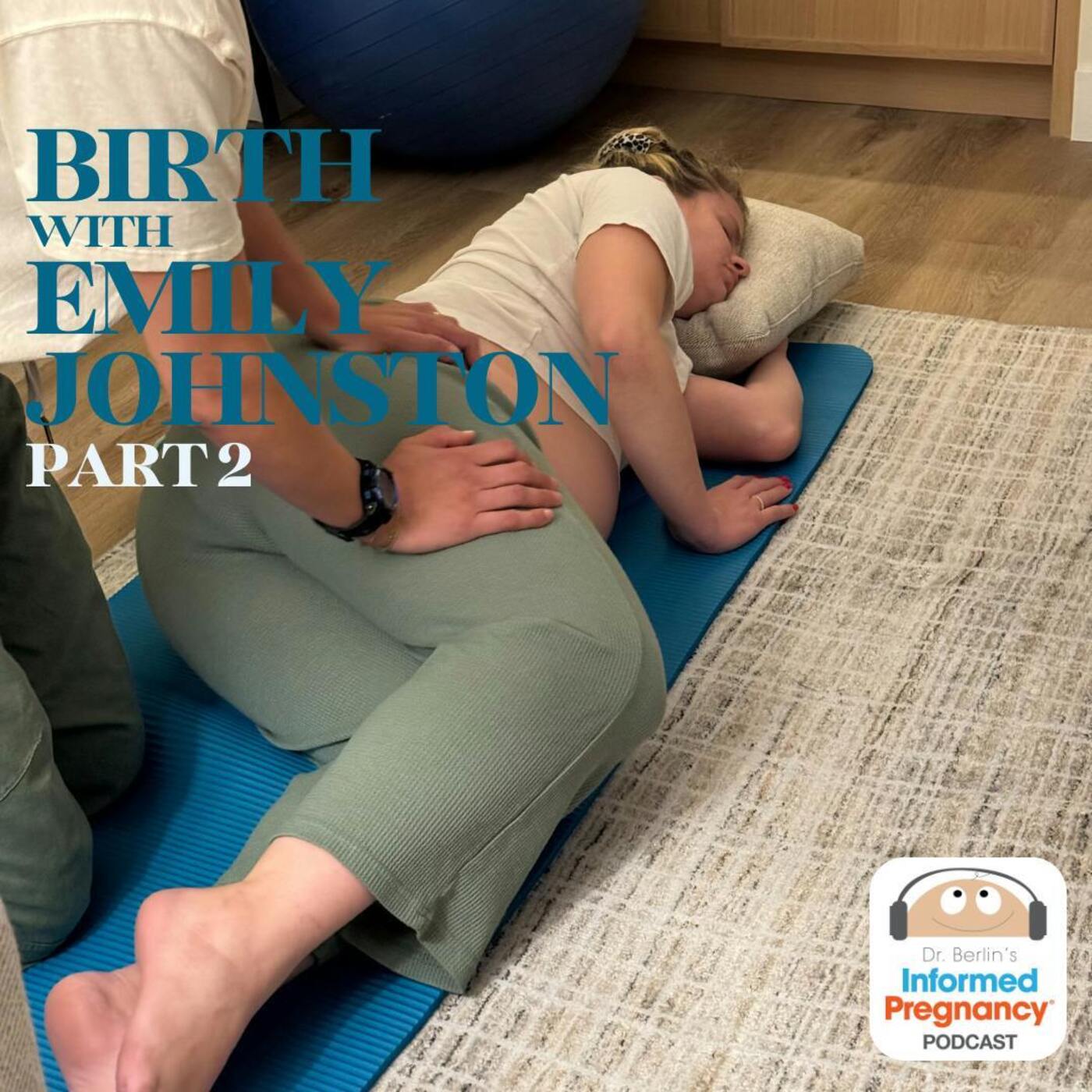
October 24, 2024 · 61 minutes · Episode 430
About this episode
In the second of this three part series, labor and delivery nurse Emily Johnston discusses her experience with birth. She’s also a birth and postpartum doula and an IBCLC (International Board Certified Lactation Consultant) with an interesting fertility journey to share.

Connect with Emily: @littleloomrn and littleloomrn.com
Key quotes
“And I was suffering and tapping out at like two centimeters made me feel like a complete and utter failure in myself and also for my child. And it was a really, really hard pill to swallow. And it's still a hard pill to swallow for me. But I'm coming around to this idea that this was just like what I was handed, you know, these are the cards that I was dealt and there's no shame in that.”
“And that is the precise reason why you give a test dose. The irony of the situation being that I even asked if he had done the test dose. And he said, we don't do that here, which I don't know if that's true. They don't do that there or if that's just his practice, but something like that would have been avoided if I'd gotten a test dose.”
“And I will say my birth was extremely traumatic but I had an empowering moment of my birth which was that I got to reach down and grab her and pull her to my chest. And after like three days of hell it's just like a moment I'll never forget.”
“And now you're laying there incapacitated in a hospital room and there's a different team working on your child and you feel so helpless and out of control. And it's a really terrible feeling. I wouldn't wish it on my worst enemy.”
“But I think it's important to also, you know, give a voice to those that aren't as positive. And so I appreciate that your podcast does that and I appreciate you letting me just say it the way it was, the way that I experienced it.”
Related episodes
- Ep. 429 Pregnancy with Emily Johnston (Part 1)
- Ep. 431 Postpartum with Emily Johnston (Part 3)
- Ep. 435 Jackie Amézquita: After Birth
- Ep. 449 Birthwork & Motherhood with Jennifer Campbell
Transcript
AI-generated transcript with speaker labels — may contain errors, especially names and medical terms. Dr. Elliot Berlin, DC appears in blue; Emily Johnston in orange.
Download PDF of the Transcript
Dr. Elliot Berlin, DC [0:36] Welcome to the Informed Pregnancy Podcast. I'm your host, pregnancy-focused chiropractor Dr. Elliott Berlin. In today's episode, we're joined once again by Emily Johnston, labor and delivery nurse, IBCLC doula, and now a new mother. This is the second episode of a two-part before and after birth series. If you listen to part one, you'll remember that in my last conversation, Emily was 39 weeks pregnant, reflecting on her fertility journey, pregnancy experience, and plans for a birth center delivery. Since then, she's welcomed her baby into the world, and today we'll talk about how her birth unfolded, the challenges she faced, and her postpartum experience. Emily Johnston, welcome back to
[1:18] the podcast. Thank you for having me back. I appreciate it. Always an honor. I've been waiting to talk to you, and I just want to shout out to the listeners that, it's a little editorial note. Here at Informed Pregnancy Media, we try very hard to offer a space for learning and support, and we try not to dramatize or sugarcoat people's personal stories. Emily's birth was traumatic, and we'll be discussing some of the difficult moments. So, especially if you're pregnant and you feel like this may not be the right time for you to listen, I encourage you to pause and come back to this episode when you're ready. Okay, Emily, let's start at the beginning. How did labor begin for you?
Emily Johnston [1:59] We may have discussed this with the last episode. I've been having Braxton Hicks for weeks at night, you know, that was very common for me, and I would have them during the day. Occasionally, it had been very hot here in LA, so a lot of my daytime Braxton Hicks were with the heat or bending down or, you know, position changes. So, my due date was on a Wednesday. So, Tuesday, I'm going to say I went to bed Monday night, and I woke up Tuesday morning, and that would be the last time that I had sleep until Saturday, and we will get to that. But that's the teaser for the end, right? So, Tuesday morning, I woke up, and I was having regular Braxton Hicks all day on a schedule, every six to seven minutes apart. And they were
[2:38] not painful, but they were very uncomfortable. And I was able to go about my life, like I went, got my nails done, I went to Trader Joe's, I did all the things, but they were uncomfortable. And I thought to myself, because I hadn't really been having Braxton Hicks during the day this frequently, and on a schedule, I was like, this is probably me warming up. And I went home in the afternoon, and I really tried to nap, and I couldn't, they were really uncomfortable. I couldn't be in like a laid down position. It was just too much, like it was better for me to just be upright. I tried getting on like the birthing ball, and then like leaning over on something to try to rest, but it wasn't really
[3:11] working. But I knew from my knowledge that I was probably in early labor, just because there was such a pattern. So, I contacted the Burr Center at some point that day, and I contacted my doula. My doula was sick. So-
Dr. Elliot Berlin, DC [3:24] Do you have two doulas?
Emily Johnston [3:26] No. Oh, I was going to have a student there, yes. But my main doula that I called, just to let her know I was warming up, she was sick. So, then I knew that I was going to have this backup doula, Brenda, and I'd met her a couple weeks prior on FaceTime. So, that was already like a little bit of, I had to shift who was going to be in my birthing space kind of right away. So, that night I got in touch with the Burr Center, and kind of told them what was going on. And Dr. Kaiser said, you know, take 50 milligrams of Benadryl, which is common to do that, especially for a first-time mom. So, you can try to go to sleep, and kind of sleep through early labor. So,
[3:56] I took the 50 milligrams of Benadryl, and I still couldn't sleep. They were strong and very uncomfortable.
Dr. Elliot Berlin, DC [4:03] Oh my god, do you say 50 milligrams of Benadryl? My eyes start closing.
Emily Johnston [4:08] Exactly.
Dr. Elliot Berlin, DC [4:11] Okay, back to you.
Emily Johnston [4:14] So, it was so uncomfortable. It was in my back. It was in my pubic bone. It was like in my hips, like my groin area. It was just so uncomfortable, and I couldn't sleep. I was so drowsy, and nothing was really working. And around midnight, I got up, and I decided to like sit on the toilet and lean over the side of the toilet, like with my backwards on a toilet with a pillow, hoping I could sleep, but I couldn't. And I was going through this pattern of like closing my eyes, but then a contraction would come, and I would have to jump out of bed to cope with it, because it was very uncomfortable. I guess I wouldn't describe pain necessarily at this point, but like extremely uncomfortable
[4:48] to the point that I couldn't ignore them. So, Wednesday comes around. I haven't really slept at all Tuesday night. I've closed my eyes to be like in a light sleep in between these like every six to seven minute contractions. And somewhere in there, we did a bunch of spinning babies. I had Tyler get me an inversion. I wanted to make sure the baby was well aligned. So, Wednesday, during the day, the same pattern kind of continued. There were periods of the day where contractions kind of simmered out, but then they came back. And this was the day that I saw you, because I knew I was in early labor, and I wanted to make sure the baby was well aligned. So, we drove to you,
[5:20] got an adjustment, and you know, I was so curious, and this is where I have knowledge, and it's not always for my benefit, but I just wanted to be checked, because at this point, I was going on like 24 hours of contractions every six to seven minutes, for the most part. Do we talk about this? Do you check yourself? I did not check myself, no. But have you checked? Can you? Do you? Would you? I did it like 38 weeks, but it was very hard to reach the cervix,
Dr. Elliot Berlin, DC [5:44] and also around the belly. It's hard as well. Yeah, that's the same reason I can't adjust
Emily Johnston [5:48] myself. Anyway, back to you. So, I'm going to see Dr. Kaiser after I saw you. I just wanted to be checked. You know, she's very like, are you sure you want to be checked? You sure? Because then you get in your head, and I was like, yeah, I do. So, she checked me, and I was like one centimeter, and I was like 70 percent of faced, and the baby was really low, like zero minus one station, for those that know what that means. But that's really low, especially for a first-time mom. So, in one way, I wasn't surprised. I was only one centimeter at all, but I was surprised I was that thinned out, and I was surprised that the baby was so low, but also was like, okay, she's getting
[6:20] ready to come. And Kaiser was like, you really need sleep tonight. Again, I'd been going on 30-some hours now with no sleep. She's like, I'm going to prescribe you Ambien, so you can try to rest tonight, because that's really what you need. So, I went and picked up the Ambien, and at this point, I'm in my head a little bit. I mean, I've had a day and a half of just being so uncomfortable, and I called my doula mentor that I worked for years ago, and she really was encouraging. I called the backup doula, and I just needed somebody to come and kind of help me get in my head, or get out of my head, I should say. So, Brenda, the backup doula, she came over. We did some stretching together. I took the Ambien. She
[6:58] tried to get me tucked into bed, and then she took off. So, keep in mind, I'd had 15 milligrams of Benadryl, no sleep, and then took an Ambien. So, I was extremely groggy, to say the least, and I still was not able to sleep at all. The contractions got very painful, and I'm using that term painful now, very, very painful, very quickly. And I was trying to lay in bed, even to close my eyes in between, and I couldn't. I was jerking up. I was trying to get in all different positions. Keep in mind, I would practice hypno babies for the last four months of my pregnancy, so I'm listening to that, but it wasn't really helping in any way. It was so intense. I tried a lot of different things, and all I wanted was just to sleep. I
[7:42] mean, I was so, so groggy. So, at about, I want to say a little bit after midnight, we called the doula again, because I was like, this is not early labor anymore. And I think she was surprised to hear from me because she thought I was just going to knock out and then wake up in the morning at some point in active labor. So, she comes over around 2 a.m. My contractions are about three to five minutes apart. I got in the shower here. We did hip squeezes. We did all the things. And for all intents and purposes, if you're a birth worker and you were looking at me, you would say she's in active labor. Very, very painful contractions. I was doing all of the things, and I was under the influence of Ambien and Benadryl. So,
[8:21] I was just so completely out of it. So, around 5 30, I ran to the doula called Dr. Kaiser. And I found this out later because I was in labor land. My mind was somewhere else, but Kaiser listened to some contractions on the phone and she said, you should come in. And I was like, somewhere else, like I said. And we left the house and the doula was like, this is it. She's like, I think you're in transition. She's like, you're going to meet your baby soon. All this stuff. I mean, I could barely get in the car. So, we get to the birth center. Everybody's at the birth center. And I get in the shower, the bed. I do peanut ball for a little bit. They were trying to get me in a position where
[8:53] I could rest. And I was there for a couple hours. Again, I found out later in my mind, I was there like 10 minutes. Oh, it's a big warp. I mean, labor land, I feel like people have been through. It's like, you're just somewhere else. Like time
Dr. Elliot Berlin, DC [9:05] is different when you're in labor. Yeah. You said that last time. I forgot the exact
Emily Johnston [9:11] quote, but you said something last time about labor just having its own timeframes. It does. It does. It's very different. I think for even the people that are in it, or that are witnessing it sometimes, it travels differently too.
Dr. Elliot Berlin, DC [9:23] Oh, you said birth is intoxicating. There's a nuclear energy to it. Time travels differently in a birth room. And it's so true. It is true. I don't know after my birth, but I still feel that way. I mean, nuclear sounds right, but let's see how it kept going. So we've been at Moxie for a bit now.
Emily Johnston [9:45] We've been doing all these things. Tyler got in the shower and was squeezing my hips and all of the things. And at some point when the midwife says, I think this is a good time to check you. And she checks me. I said that was fine. You know, she says, okay, that's fine. She checked me and I was two centimeters. No. And at that point for the previous seven or eight hours, I've been contracting like every three to five minutes. And later when I recounted my birth experience with Brenda, my doula, she said something that I think is important to mention is she said, did you notice? And I was like, no, I didn't notice anything. But she said, after they told you you were two centimeters, your contraction spaced way out.
[10:22] So at this point I had bed and drill at Ambien. I hadn't slept in over two days. So my labor had started on- You want to add some NyQuil?
Dr. Elliot Berlin, DC [10:29] And I don't know. Wow. Okay. Two centimeters. I mean, that's a shock to my system right now.
Emily Johnston [10:36] It was a shock to me because my behavior, and this is going for Brenda, who's a midwife's assistant. So she's seen a lot of birth too. And again, you know, it was really therapeutic for me to recount my birth experience after the fact. I've had everybody over since then that was involved in my birth, but she was just like, all your behavior was like you were in transition, like all of it. So I was two centimeters. And you know, when she told me later, when she came over to my house, she's like, did you notice that then your contractions just spaced way out? Cause it was like a mental thing. That was on Thursday. So my labor had started Tuesday morning. If you're counting like these regular Braxton
Dr. Elliot Berlin, DC [11:06] Hicks that were uncomfortable. And this is Thursday roughly at what time?
Emily Johnston [11:10] In the morning around. Okay. So yeah.
Dr. Elliot Berlin, DC [11:13] Tuesday to Wednesday, Wednesday to Thursday, 48 hours. 48 hours. Yeah. 48 hours seems like a great place to take a little break. We'll be right back.

Dr. Elliot Berlin, DC [12:56] Welcome back to the podcast. We're talking to Emily Johnston, 48 hours into her labor story after contracting madly. For two days and feeling and looking like she was in transition, midwives checked her at the birth center and found that she was a whopping two centimeters
Emily Johnston [13:15] dilated. What happens after that? I think there were a few themes in my birth. And one of the themes that will make more sense when I get into later my birth was that I didn't always feel heard. And that started a little bit at the birth center, to no fault of anybody. But a huge part of my pain, and I spoke about this, I should have mentioned this a few minutes ago when I was speaking about when the contractions got painful, but a huge part of my pain when I spoke about this last time on the podcast was a lot of this pain was like similar to that pain that I was having in pregnancy at 28 weeks when I was hospitalized. This tearing, this pulling, this ripping sensation. I'm a first
[13:54] time mom. I've never been through labor. So I had prepared in pregnancy for this contraction pain. And you can prepare, but you can't always know what that's going to feel like. And it wasn't really until Sarah, one of my midwives, came for the home visit that I was talking about this. And she's like, that's not contraction pain. We don't hear that something feels like it's tearing or it's ripping. And so looking back, I think one of the difficult things was that some people in my care team didn't realize or understand that this pain that I was having was probably not even from the contractions. It was from the same pain that I had at 28 weeks
[14:26] pregnant. And so hearing that I was two centimeters and in this excruciating pain, I think this is when I started to feel a little bit like I wasn't being heard and to no fault of their own. Not that I wasn't being heard, but that no one understood my pain. I think that's what it came down to. So I'm two centimeters. And honestly, I think it was a shock to everybody there. I wasn't acting like I was two centimeters. I was acting like I was in transition. So they said, why don't you get into the bath? And why don't you just try to relax? And they said, try to just breathe through. Next to these contractions, you cannot tense up. Now from being a labor nurse, from being a doula, I've seen crazy
[14:59] things. Sometimes once you can really, truly relax, your body will go from two centimeters to 10 in an hour, half hour, whatever. So I think that's what they were thinking needed to happen because my behavior was not matching my cervical dilation. So I got in the bath. And again, from my knowledge, the bath is like, people think they can't do it anymore. And they get in the bath and they have this sense of, ah, like they got a little bit of relief. That didn't happen for me. There was no position in that bath that would have made me able to cope. And I was done. I tapped out. I was 48 hours, no sleep. I was in this bath. Everybody was like, just try to relax, try to relax, try to relax. And I was like,
[15:39] I am trying to relax, but like, I can't do any position. And I kept just thinking to myself, if I could get a nap, I could probably keep doing this. And that's what I kept thinking was like, if I can go to the hospital and get like therapeutic rest, like some hospital scleromorphine or fentanyl, I was like, I could just take a nap and I could maybe continue.
Dr. Elliot Berlin, DC [15:56] Not that it's in the same league, just out of curiosity. Don't they have a nitrous there?
Emily Johnston [16:00] Did you try it? I didn't even try nitrous. No, maybe in hindsight, but I needed to sleep is really what it came down to. Oh, you didn't need a tooth pulled? No, I did not. Not this time. So no nitrous? No nitrous. And you know, the thing with an out of hospital birth is they can't take the baby back, you know, because once the baby's been exposed to fentanyl or morphine, they can't take the baby back because that becomes a risk for respiratory depression at birth.
Dr. Elliot Berlin, DC [16:25] Just to be super clear about that, that means if you transfer from the birth center to the hospital, get like therapeutic rests with drugs, then you can't go back to the birth center to have the baby because they're not set up for the postpartum care that might be required for the baby, the neonatal care. Yeah, which birth centers are, you know, set up for a lot of things that can happen to a baby at birth, but being exposed to, you know, that makes you a more, not a high risk situation, but increases the risk of your delivery. Right, right. So because of that,
Emily Johnston [16:56] you kind of risk out of the birth center. That's correct. So at two centimeters, 48 hours into my labor, looking and acting like I was in transition. And now my contractions had spaced out a little bit more, like five to seven minutes. I was like, I'm done. I was done. And I was like, I need to transfer to the hospital. And I just broke down and I'm crying now thinking about it because I felt like such a failure. And coming on this podcast, my initial feelings about my birth were so much embarrassment for this decision that I made at two centimeters. And I'm choosing to be like very open and honest because like, this was my lived experience and there's gotta be other people who have this experience as
[17:35] well. And part of the embarrassment came from that. I prepared over nine months for this unmedicated birth. I had done all the right things. You know, I went to acupuncture, I moved my body, I came to see you. I was doing all these things to prepare for what I hoped for would not necessarily be a short labor, but a linear labor, right? Where you have an early labor, then you have an active labor, then you deliver, not like 48 hours to get to two centimeters and 48 hours of no sleep and 48 hours of having benadryl ambient in my system. And there's a difference between pain and there's a difference between suffering. And I was suffering and tapping out at like two centimeters made me
[18:16] feel like a complete and utter failure in myself and also for my child. And it was a really, really hard pill to swallow. And it's still a hard pill to swallow for me. But I'm coming around to this idea that this was just like what I was handed, you know, these are the cards that I was dealt and there's no shame in that.
Dr. Elliot Berlin, DC [18:35] You never get to pick the cards you're dealt.
Emily Johnston [18:36] You don't.
Dr. Elliot Berlin, DC [18:38] And I feel so sad that you feel and felt embarrassed or shame or failure. Like the women in general and you in particular are so strong and tough. Like you were acting like you're in transition because that's the cards you had. Your body felt like it was in transition, even though you were two centimeters. And I act like I'm in transition when I just have to get my blood drawn. You know, stupid blood test. I go complaining like crazy. I mean, everything that you endured up until this point, I don't know what comes next is so intense. And, you know, you're in the birth world and you see more holistic and you see more medical and you know that medical is overutilized. And you also know that,
[19:22] you know, like what I always say is I think from my observations, observations of musings of a male doula is that modern medical interventions in birth, one of the only things worse than forcing them on someone who doesn't need them is not having them accessible to someone who does.
Emily Johnston [19:40] You're right. That's a really fantastic way to think about that. Yeah, you're right.
Dr. Elliot Berlin, DC [19:45] Thanks. I'm going to start listening to this podcast. But anyway, I feel you are such a beast of a warrior. And I don't know where this goes, but I know the cards you got are not the ones that most humans can plow through and you're human.
Emily Johnston [20:03] I appreciate that. I am human. If any birth and post-partum taught me anything,
Dr. Elliot Berlin, DC [20:07] it's taught me that we're very human. Oh, don't forget about conception.
Emily Johnston [20:12] Yeah, conception too.
Dr. Elliot Berlin, DC [20:13] They have not made it easy on you any step of the way.
Emily Johnston [20:16] That's true.
Dr. Elliot Berlin, DC [20:18] So you're embarrassed and deflated and ashamed and you make the decision to get some therapeutic rest.
Emily Johnston [20:24] Yes. A couple of years ago, I worked at a small community hospital and I made a really good friend there named Emmy. And Emmy, it was another nurse and she and I connected because we shared the same perspective on birth. And almost the same name. And almost the same name, in fact. We shared that we think birth is over medicalized. We both shared our desires in the future for unmedicated out of hospital birth and we just kind of had the same philosophy on birth. Moxie's Transfer Hospital where Dr. Kaiser has Povich's is at Huntington Hospital. And actually like a year ago or nine months ago when I was very, very newly pregnant or I was undergoing IVF and Emmy and I connected
[21:05] and I had said how I was thinking about going with Moxie birth. And she was like, oh yeah, they transferred our hospital because Emmy now works at Huntington, which is where they transfer. And I had said to Emmy, if you want to come to my birth, you can, because she had not been to an out of hospital birth. And she's like, I would love that. And then, you know, I mean, I talk every couple of months and then I hadn't talked to her for a little bit. So we're at Moxie. I told them I want to transfer. And I said, is Emmy working? And Dr. Kaiser got her phone out and she said, she is. And she made a phone call. And just a really wonderful thing is that the charge nurse changed
[21:41] Emmy's assignment completely so that Emmy could be there waiting for me as my nurse when I arrived at the hospital.
Dr. Elliot Berlin, DC [21:47] That's so nice.
Emily Johnston [21:48] It was really nice because I felt like I was going in now. My plans had completely changed and I felt like I was going to have to forfeit a lot of the desires I had for my birth. And so knowing that my nurse was not just a friend, but somebody that had the same philosophy on birth, I felt safe walking into the hospital. And that was huge for me. I could not have asked for anything more positive in that moment. So we get to Huntington and Emmy's there. She gives me this huge hug. I decided not to get like therapeutic rest. I decided to go right for the epidural because I knew that I wasn't going to be able to go back to the birth center. And so for me, I was like, I'm just going to get the epidural.
[22:29] Like I knew that was where I was headed. Even if I got therapeutic rest and slept for four hours, I didn't foresee myself having a positive unmedicated experience in the hospital, to be honest. So I get the epidural and I'm still contracting. I'm in excruciating pain. It's not a fun environment for anybody there. One of the midwives, Glancy, transferred with us. I sent the doula home because she had been with me for a while overnight. I was like, just go home, get rest. We'll talk in a little bit. So I'm there getting the epidural. And as he's doing the epidural, I said to the anesthesiologist, have you done the test dose yet? Now, for those that don't know, when you get an epidural, it's typical,
[23:08] at least in facilities that I've worked in where an anesthesiologist gives a very small dose of medication to ensure that the epidural is in the right space. I said that while I was getting the epidural. And the anesthesiologist said to me, oh, we don't do test doses here. And I didn't think anything of it because he's a professional. So I get this epidural. I'm still in excruciating pain. Everybody was trying to calm me down, get me through this epidural process that I'm contracting and saying, these are the last few contractions you're going to feel. You're going to have so much relief soon. And I felt zero relief. And now I'm stuck in this bed where they don't want me to get out of bed
[23:48] to cope with the contractions because I've, quote unquote, had an epidural. And I'm telling them, I feel everything. And just give it a little bit more time, a little more time. And I'm like, no, I literally feel everything. Like I can go get up right now and walk. Like I feel everything.
Dr. Elliot Berlin, DC [24:02] That is terrifying.
Emily Johnston [24:04] It was terrifying. So this was also where I started to spiral. Now I keep saying this, I'm going to say it again. I've been on two OAs with no sleep and Ambien and two Benadryl. And now I'm being told with these painful, painful contractions that I had to stay in bed. And they didn't even want me getting on my hands and knees at this point because again, I had an epidural, right? So I'm being confined to this bed in excruciating pain. It was horrific. And I kept just saying like that I was feeling everything and the anesthesiologist was like, we just gotta get a little bit more time, a little bit more time. And Emmy and Clancy, the midwife and anesthesiologist were like,
[24:40] we really need to know if this epidural is working. So why don't you lay flat so we can at least know because I was kind of sitting up in bed because that was the best way I could try to cope with these contractions. And it was torture. It was absolute torture. And the anesthesiologist wanted me to lay flat so he could get this idea if it was working. And I kept being like, I'm telling you, I know enough about epidurals to know I should feel something. Even if I'm sitting upright, I should still feel something that the epidural is working. And so I said, if you're going to force me to be flat on my back to see if this is working. I mean, it was like getting an arm cut off without anything.
[25:13] I was like, I need to get fentanyl. And initially, he didn't want to give me fentanyl. And eventually he did. And it was about an hour, I believe, because I was talking to Emmy about it. It was about an hour. I got two doses of fentanyl. I was able to get in a position where, I guess the anesthesiologist then believed me that the epidural wasn't working. And Emmy and Clancy were great advocates for me. We were like, she needs a new epidural. She needs to get epidural. And the gentleman came back in the anesthesiologist. And he said, I'm going to give you a medication in your epidural that we give to people that are going to surgery. And we'll see if this epidural is working.
[25:48] And the gentleman came in and injected a very large dose of an anesthetic into my epidural. And I immediately lost my hearing. I lost my sight. I had this metallic taste in my mouth. And I felt like my whole body went numb. And I felt like I couldn't breathe. It was a complete out of body experience over the course of like two seconds. Like I actually feel like I died and came back. Like I do not know how to describe this feeling.
Dr. Elliot Berlin, DC [26:20] My word. I thought it was terrifying before. That's because I hadn't heard this part yet. It just keeps escalating.
Emily Johnston [26:28] Wow. I'm laughing now because I don't know.
Dr. Elliot Berlin, DC [26:30] Well, because you can hear and see.
Emily Johnston [26:34] I guess. And he pushes this med and then just like walks out of the room. And I let out this like how like this like scream of sorts. And then I'm sitting upright, right? Because I'm still trying to deal with these contractions that I'm feeling. And me and Clancy are like, lay down, lay down. Because I said like, I can't breathe or whatever. And then I was like, well, no, you can't force me to lay down because I'm in so much pain. So there's a spiral of torture. It was terrible. And in those two seconds that I, you know, left Earth and came back, I literally was like, oh, they're going to intubate me and I'm, they're probably going to about to code
[27:10] me like that. That's what was happening in my brain because in my brain, I wasn't breathing. I couldn't see and I couldn't hear. So I was like, oh, they're going to code me. They did not code me. But I know now after that, they really demanded like you have to replace the epidural and he came in and he replaced it. And it wasn't until there was the night anesthesiologist that said, yeah, that epidural was in your intravascular space. It was incorrectly placed. And that is the precise reason why you give a test dose. The irony of the situation being that I even asked if he had done the test dose. And he said, we don't do that here, which I don't know
[27:48] if that's true. They don't do that there or if that's just his practice, but something like that would have been avoided if I'd gotten a test dose. Because with the test dose, they give a very small amount to see if you react to it. And that would tell you if it's in the wrong space. So keep in mind, this guy gave me a whole bolus dose and I had this reaction. So I get the second epidural. I eventually get comfortable. And I was able to sleep about an hour and a half, two hours, which was glorious.
Dr. Elliot Berlin, DC [28:16] That sounds heaven.
Emily Johnston [28:18] It was heaven at that point. I knew being two centimeters, I'm not considered in labor yet. And I knew that one of the risks of going to the hospital was that my labor could just stall. I mean, in theory at two centimeters, I mean, in theory any dilation, but at two centimeters, your labor could just stop altogether and come back in a week or a couple of days. And I was worried about that happening. So in my head, I was worried that perhaps this wasn't actually my labor. My body wasn't ready, which is why I wasn't dilating after 48 hours or whatnot. And so after I woke up from the nap, my contractions had gone from every three to five minutes or whatever to every seven, every eight.
[28:56] And so they had to start Pitocin, which again was something I was really against. I wanted to just have this very like physiologic labor when my body did the work. So that was another feeling of huge defeat for me was that I needed Pitocin. But I, of course, just went with the flow at this point and we started Pitocin. And honestly, the rest of that day was pretty uneventful.
Dr. Elliot Berlin, DC [29:22] We're waiting for it, ain't it?
Emily Johnston [29:24] We are nowhere in like-
Dr. Elliot Berlin, DC [29:25] I'm still on Thursday night?
Emily Johnston [29:26] Yeah, like Thursday afternoon evening. The rest of the day was pretty uneventful. At some point, Emmy checked me. I was four centimeters. And then I was checked again. That evening, I was-
Dr. Elliot Berlin, DC [29:36] Wait a second. You just glossed over four centimeters. It was twice as much dilation.
Emily Johnston [29:40] You're right. It was twice as much dilation. And honestly, going from two to four, it was like a little pick-me-up I needed after like a morning of hell. Like I was like, okay, you know, I'm getting somewhere. My body's doing work. I'm dilating. Like there's something happening. And then when I was six centimeters that evening, I was like, okay, I accepted at that point, which made me feel good. I was like, this is my labor. My body was intending to go in labor at this time because I'm making progress. Because I was just so worried I was going to stall. And at six centimeters, my water broke on its own, which also made me feel really good because I was like, okay, you know, again,
[30:14] my body is doing its work. I didn't have to have it artificially ruptured. I was so hopeful I was going to deliver that day for Emmy. She was just such an incredible support for me and was so in support of like everything that I wanted that I felt like I had to give up by coming to the hospital. But alas, she had to leave at seven 30 because that's how it works when you're a nurse. I got a new nurse at night who was also lovely. She had taken a doula training herself. So I also felt very lucky. She was very in support of the things that I wanted. And then again, the night was relatively like uneventful. Like we watched the Olympics. I wasn't able to sleep a lot really that day.
[30:53] I would take little cat naps of 10 or 15 minutes, but I was moving a lot side to side to make progress. And you just don't really get rest in a hospital because everybody's running in. It was hard for me to turn off the LND nurse in me a little bit. I asked them to turn down the baby's heart tones so I wasn't like listening to it. But generally speaking, I was able to kind of relax. But in the night towards the early morning of Friday, the baby started to have some decelerations of her heart rate. And that's when it was really hard for me to turn off the LND nurse in me. It was really hard for me not to say like, should we turn off the TOSIN? Should I turn this way?
[31:25] Should I turn that way? Should I give me a bolus of fluids? All these things that you normally do. And also over the course of the night, I should note my pain was coming back in waves. And so I was getting several boluses by anesthesia and the pain was still pretty much focused kind of in that area where I'd had that pain at 28 weeks. But I was hitting like the epidural button, which gives you these little doses and they weren't really doing much. Then periodically they would call back anesthesia to give me more and give me more. It was never to the point where it was excruciating again, but it was extremely painful, I will say that. So at about 5 a.m., we had a prolonged deceleration.
[32:04] My baby's heart rate went way down and stayed there for over two minutes, which is normal. I mean, it does happen in most labors that babies are not going to tolerate every aspect of it. And that's when I called the doula back in because I really needed support. It's just jarring and I've been on the other side of this. But when you're in a hospital room and a bunch of people run in because your baby's heart rate's low, it's scary. I've been that nurse in that situation and I've always been the one that's reassuring the mother, the patient, and then it's me and I'm the patient. And I was trying to tell myself all the things I normally would tell somebody
[32:32] in that situation and it's still scary, right? So my doula came back and she was a really good comfort and they checked me when I had that prolonged deceleration and I was eight centimeters. So I was finally in transition.
Dr. Elliot Berlin, DC [32:46] You know on the SATs when they have you continue the pattern? Well, they do like one, three, five, seven. What's the next one? Oh, yes, two, four, six, eight. We went two, four, six, eight. I'm getting kind of excited here but I feel like we should take a break. So we'll be right back. Welcome back. We're talking to Emily still in her birth story. Eight centimeters. Does that at least feel good to hear? I mean, I know the big D cell and the scariness, but like…
Emily Johnston [33:21] I was like, I think when I hit eight centimeters, I was like, I'm having a baby. This is happening is what I felt.
Dr. Elliot Berlin, DC [33:26] So like the marathon, the last two miles for themselves?
Emily Johnston [33:29] Yeah.
Dr. Elliot Berlin, DC [33:29] Okay.
Emily Johnston [33:32] So at this point, Brenda's there, the doula. She has huge support. Poor Tyler hadn't even really slept at all either because I was just a wreck all night and I started getting really emotional at eight centimeters. I was so exhausted to recap Benadryl Ambien and I had two doses of fentanyl when I was waiting in that hour for that so-called epidural that was not actually in the epidural space to work. So I really felt like I was not in my body and I don't know how to describe that. I've never ever done shrugs in my life. I imagine it's something like taking some sort of drug that would send you on a really nice trip in a club or something. I mean, it was really trippy.
[34:11] I was not feeling present and I'd not had enough sleep to really get anything out of my system. And so this whole time, I just felt really groggy and out of it and almost like I was living in some sort of simulation and it was very strange. And then once I got to eight centimeters, I was just so emotional. I was like, this is actually happening and I was like, I don't even feel in my body and I'm about to have this baby. And that was really like sad and scary for me because I felt so detached from my body and so detached from the present. And I kind of had a meltdown starting at eight centimeters, like a true breakdown of just like everything not going even remotely to how I wanted it to be.
[34:53] Also not feeling present. I didn't even feel like safe to welcome my baby at that point because I was so like not even knowing where I was. And in the moment, I felt very out of it. What really proved to me how out of it it was is over the course of the last several weeks since my daughter's been born, Sarah came, the midwife came over and I recounted my birth experience with her. And then we had Emmy over, my nurse, we had our doula Brenda over and talking with everybody who was at my birth, they were telling me things that I didn't even remember. And that also made it really hard because I was like, wow, I really was out of it, like not fully present in that room
[35:29] when all this was happening. So I had this meltdown at eight centimeters. Then sometime after eight centimeters, I had, and it's funny because the night nurse was like, you're going to deliver for me, you're going to deliver for me. And then I had another prolonged V cell somewhere in there and Dr. Kaiser was still on premises and she came back into the room and she checked me and I was 10 centimeters. I was plus. I knew it. The baby was right there. So I went from like eight to 10 in like an hour and a half. And I had a lovely night shift nurse, but I feel like I'll get into pushing, but I felt like my body needed safety and Emmy was coming back for day shift,
[36:09] which also felt very like serendipitous that this really good friend of mine happened to be working two days in a row on these two days that I would be laboring at the hospital. And I was complete 10 centimeters at 7, 10 AM and she had like just walked in the room to get report on me. And it felt very like that was meant to be, that she was going to be there to begin pushing with me. And so I was just so overwhelmed and Dr. Kaiser was like, okay, we're going to start pushing. And I was just like, oh my gosh. And I felt like I didn't prepare and I thought like maybe I'd labor down a little bit, but I was plus three and the baby was like right there.
[36:39] And I made some joke. Okay, I'm going to push two times and I was in excruciating pain at this point. I had been since about eight centimeters and that had kind of contributed to the smell.
Dr. Elliot Berlin, DC [36:48] At the little spot or in general?
Emily Johnston [36:51] It's like in my hips, right where you've worked on me, like where my legs meet my hips. Like hip flexors and Dr. Kaiser was like, you know, it's 10 centimeters and she was like, let's push. And then I was like, I'm in so much pain. And she said something like, maybe we should just turn your epidural off, like just so you can push. Cause like the baby was right there. And I was like, no, I can't, I can't. Like that's not happening. So I started to push and the pain was out of this world. Tyler said it was like watching somebody get surgery with no anesthesia. I was going through these periods of like crying and negotiating and begging for a bolus.
[37:30] But I was also pushing very poorly and it's a very strange because the epidural was so heavy. You could have cut off my legs and I wouldn't have felt it. But the pain in like those hips was this tearing, tearing of my body and my pubic bone was like ripping in half. Honestly, like my legs were so numb. You could have done anything with my legs. And yet that pain was so present. And I knew Dr. Kaiser wanted to turn down the epidural turn off. So I pushed better, but I couldn't and I'd had no sleep and I did all these drugs and I was so done. And this is where I was like negotiating. I need to get an epidural bolus because if I can get this hip pain under control,
[38:15] I can at least push hard. I'm not saying I know where to push because I couldn't feel anything, but I can at least push hard. But pushing hard with that pain was like not going to happen. So the anesthesiologist came in and he gave me a bolus and we went through these periods of like, it would mute the pain. It wouldn't really take it away, but enough to let me like push. But I was pushing like crap. I was so numb and we tried like everything like on the side, we did tug of war, we did the birthing ball. And at some point after like an hour of pushing, I was like having a meltdown. I was having this like trauma response of like everybody was watching me.
[38:54] I had everybody around me and I felt like I was this object. And again, I wasn't in my right mind. I felt so removed from this experience, but I was just like, everybody's watching me. I just need a moment. This is too overwhelming. I was having like sensory overload. I don't know how to describe it. And so Kaiser was great. She's like, okay. She's like, you're not an object. Like we're gonna raise you in bed. We're gonna take a break. And so I like sat up in bed for like 20, 30 minutes and we all just like hung out for a bit. And I don't know how many times I asked her a vacuum delivery throughout my pushing time. And I at some point asked for a C-section
[39:28] because having a C-section sounded like a fantastic idea so many times because the pain was so out of this world. And I ended up pushing for three and a half hours and I think over that three and a half hours I had four boluses of the epidural. And that was just to try to keep that hip pain that tearing, that ripping sensation like muted enough to allow me to push. And I was just like begging so many times for something and I kept just yelling and crying and saying like, I'm done. Like I'm done. Like I had nothing else to give and I don't know how to express that in words now. I was tapped out and I just was like this baby needs to come out. My daughter was actually very tolerant
[40:10] through most of labor, except for some of those D-cells. Yeah. But she had had a really great reactive tracing. She'd shown signs of oxygenation and the last like 45 minutes or so and Kaiser was very encouraging. She was like, you're not going to have a C-section. The baby's right there. And I was just so far removed. I mean, I was in this different mental and emotional mindset. And if anybody hadn't slept for three days you would be at a certain level of delusional and then add on, you know, some benadryl some ambient and some fentanyl and like then you got a really different cocktail. So it was just terrible. So I think the last 45 minutes or so
[40:47] my daughter started D-selling and I felt like I didn't have the tools to like get her out because I couldn't push. I couldn't feel anything and my pubic bone was ripping and my hips were ripping. And I kept thinking like I'm never going to walk after this is what I was thinking. And I felt so helpless and it was terrible. And here I've been begging for a vacuum for a while. And then after 45 minutes of my daughter D-selling with every contraction, Kaiser was like this baby needs to come out. This baby needs to come out. She's like, you really got to give it your all. And I was pushing so hard. I mean, Tyler was like she's going to blow her like blood vessels in her eyes.
[41:19] I was pushing so hard this whole time. And finally, I don't really know what changed but Kaiser went from like this baby needs to come out. This baby needs to come out. You got to push harder, harder, harder to like this baby needs to come out now. And it was like serious like right now. And I had been asking for a vacuum like the whole pushing experience but I've been asking for a vacuum because I was tapped out. Now we needed this vacuum to get the baby out. So she was in this deep cell and she said like when I apply this vacuum like you need to give this everything you have. You need to push harder than you've been pushing. And I had been pushing my absolute maximum.
[41:58] So that to me, I was just like I don't know what else I have to give. And I knew it was a very serious situation. And for those that don't know a vacuum is like a little suction cup on the baby's head and the baby has to be low enough for a doctor to apply it. And then what happens is the doctor pulls with that suction cup on the baby's head while you're pushing during a contraction. There's some variations in hospitals and doctors throughout the country and the world but generally speaking you get three pop-offs of a vacuum. So the vacuum goes on, you push and the doctor's pulling. And then if it pops off that's one pop-off. You generally get three pop-offs
[42:33] before you go to C-section.
Dr. Elliot Berlin, DC [42:36] They're designed for safety. So they only allow so much pressure before they come off. They pop off and you can try again but it's still going to come off at that same amount of pressure and then you can try one more time after that.
Emily Johnston [42:47] And there's risk to this vacuum and that's important to say that too. It's not like it's this benign procedure. I mean, there's risks that a baby can have a brain bleed. I mean, that's really like what the greatest risk is of this vacuum. When you think about the effects for the baby. And again, that was really hard. You know, before she put it on she's like, I need consent. I need consent. And of course, like she said to me like you know the risk, Emily. Like, you know the risk. I mean, when I had been begging for a vacuum two hours earlier she said the same thing to me. You don't want a vacuum. You know the risks of that. Now all of a sudden it turns into
[43:14] we need this vacuum. And she's like, you know the risk, Emily. And Tyler, poor Tyler is like is it less risk than a C-section? He's trying to ask these questions kind of in the moment. And Kaiser was like, I need consent. And I was like, Tyler, it's fine. Like we give consent. We're doing this vacuum. So she applied this vacuum and she was like you have to give everything you have. And I like closed my eyes and I prayed to God like you need to work through this body of mine because I had no efforts left. And I pushed like everything in the most excruciating pain of my life. And I feel like you could hear like a needle drop in that room when that was happening.
[43:50] And I opened my eyes because I was like, what's going on? Is somebody going to say something? And Tyler was like, the head is out. And I saw my daughter's head and I said, what about the body? And I will say my birth was extremely traumatic but I had an empowering moment of my birth which was that I got to reach down and grab her and pull her to my chest. And after like three days of hell it's just like a moment I'll never forget. It's like looking down and seeing her head and then like her little arms come out and like me being able to like grab her and pull her to my chest. And I think everybody in the room thought that once she came out she would be fine
[44:27] because a lot of babies are fine. You know, even if they've been de-selling and they come up with a vacuum they come out, dry them you stimulate them a little bit and they cry. I think everybody was expecting that. So my daughter is on my chest and I'm drying and I'm stimulating her which is the first step of the neonatal resuscitation protocol which is like, you know a protocol you go through with every baby and she's not responding really at all to me drying and stimulating her. She just had this like very vacant look on her face. Her tone wasn't very good. She wasn't trying to breathe. I think it's important to note too this is, I forgot a very key part of this
[45:04] is my fluid had been clear when my water broke and Sophia, my daughter, her head came out and then her body followed and there was like this, oh, in the room of voices and it's because when her body came out there was very, very thick meconium after her body and her head had been like a plug for the meconium, the whole labor since my water broke. So we didn't have really any clue that there was meconium in her waters. Now, for those that don't know meconium can be normal after 40 weeks but it can mean the baby has been in distress and utero. So we had had no warning of that and then all of a sudden I'm pulling my daughter up and the nurse and doula and Kaiser are like,
[45:54] oh, as this like thick meconium comes out. So she's on my chest, I'm drawing, I'm simulating her. So she's not breathing. She's not breathing, no.
Dr. Elliot Berlin, DC [46:04] But she has a heartbeat, a strong heartbeat.
Emily Johnston [46:07] Not strong.
Dr. Elliot Berlin, DC [46:08] We'll find out later.
Emily Johnston [46:09] Her heart's beating but she's not breathing and she's, I guess she's probably pretty. She was in distress, yeah. And I'm drawing and I'm simulating her and I know also from like homers that I've been to that a lot of babies just like need a second. I think in the hospital setting, we're so used to like dry, stimulate and get that cry right away. So I also was keeping this in mind as I was drawing and stimulating her was like, maybe she just needs a second. Give her a minute. But she wasn't showing any sort of response or irritation to being dried and stimulated. Even if a baby needs in it to come along, you can usually tell when they're like ticked off
[46:45] at you because they like kind of fight, they fight it and don't like it. And she was nothing.
Dr. Elliot Berlin, DC [46:49] They jerk away from you.
Emily Johnston [46:51] Yeah, exactly. And she wasn't like that at all. And I just had this like vision of my daughter on my chest and me like really vigorously stimulating her and she just was like nothing. And I really wanted delayed cord clamping. Like I really wanted that. And I said, she needs to be taken to the warmer. She needs to be taken to the warmer. And Dr. Kaiser said, be sure that's what you want. Which I also feel like was like really empowering and I'm thankful for her for like giving me that autonomy in that situation of like trusting my judgment. And I said, yes, that's what I want. And in any other situation, I feel like with most doctors, they would clamp, clamp, cut
[47:25] and just like take the baby away. And she clamped, she clamped, and she handed Tyler the scissors and she said, cut this cord fast, which was also really sweet that like she still gave him that opportunity. And they brought Sophia over to the warmer and her heart rate was 70, which a normal heart rate for a newborn is 110 to 160. And with the neonatal resuscitation protocol, you want the baby's heart rate over 100. And with the neonatal resuscitation, you start compressions on a baby when their heart rate is under 60. So she was at 70. And when a baby doesn't breathe or is not getting oxygen, I should say their heart rate will continue to decline.
[47:59] So there was some urgency with like getting her to breathe. So the NICU team was in there and they worked on her. I mean, they suctioned her. They started breathing for her with a bag mask called positive pressure ventilation because she still wasn't making ton of effort.
Dr. Elliot Berlin, DC [48:14] Were they just in there or did they called in?
Emily Johnston [48:18] Oh, they were in there for the vacuum anyway. Yes. So they were walking in as everything was happening. So it wasn't like we were making a separate phone call because of this.
Dr. Elliot Berlin, DC [48:25] This definitely is one of those episodes that has one extra commercial on it. We'll be right back. Okay, we're back. I'm just even thinking fertility, you know, telling you guys how it's not even worth doing IVF. You don't have what to work with. And then going to Mexico and doing IVF and getting pregnant and pregnancy in our first episode that we did, you said, I've seen a lot and I have a lot of book knowledge, but nothing really prepared me for my own pregnancy. It's changed me in ways I never expected. And as a birth worker and as a podcast host, I've seen and heard a lot, but so far nothing can really prepare me for your experience. You had a hard conception, a hard pregnancy,
[49:26] hard getting your baby head down and ready for birth, hard labor, hard pushing, hard immediate postpartum. Golden hour sounds like a different metal. So the NICU team is in the room with you because you're doing the vacuums just as a precaution and the baby comes out with a heartbeat, but not really making an effort to breathe. Early interventions don't seem to help. And now they're suctioning out the baby's lungs. There's a bunch of meconium that nobody knew about. They're suctioning out the baby's lungs and doing rescue breathing with an oxygenated bag or just plain air?
Emily Johnston [50:03] Oxygenated, yeah.
Dr. Elliot Berlin, DC [50:05] Okay.
Emily Johnston [50:05] And again, being no sleep and a bunch of drugs in my system and it being my child, I've tried to like separate like, was this traumatic because I'm her mom or traumatic because, you know, objectively traumatic as well. I think there was a combination to be honest. I mean, Kaiser later was like, oh, I thought she had some tone, but then like my nurse was like, that baby didn't look good. I mean, so I think there's a combination of factors, but I think everybody in the room would agree like she needed a lot of help. Like she wasn't going to start breathing on my chest, especially on the heart rate of 70. But I want to acknowledge, I think there was like a combination of things,
[50:42] but also, you know, I've worked in high-risk obstetrics. Like I have initiated that protocol on a lot of babies. I've done a lot of resuscitations and my daughter did not look good, you know, and she just looked pretty floppy and out of it. So the baby's at the warmer and I was like completely dissociating. Like I was screaming first of all and I told somebody in the room, like you need to go and narrate this for me. I was telling Tyler like, go talk out loud to her. But then of course they were like, Tyler, you need to go sit down. I was just like speaking out loud to my daughter. I was saying her name. I was telling her she needed to start breathing
[51:20] and I kept saying like, I need her to be okay. I need her to be okay. And I'm in this situation where like, I would know what to do in that situation, right? Like I'm a nurse. I've resuscitated babies. And now you're laying there incapacitated in a hospital room and there's a different team working on your child and you feel so helpless and out of control. And it's a really terrible feeling. I wouldn't wish it on my worst enemy. And we heard like some squeak from her at like maybe four minutes ish, like a little like, but like not a cry. And it was minute seven of life when she finally cried and like took her own breath. And it was just scary.
[52:06] It was like the longest seven minutes of my life. I just kept saying, I need her to be okay. I need her to be okay. And everybody that was around me was like, she's going to be okay. And I was like, you don't know that, you know, I was like, I mean, I know they meant in a good way, but I was just thinking to myself, like we don't know if she's going to be okay. And in those first couple of minutes of her not crying, I was like, this baby's going to Nick you is what I was thinking. I was like, she's going to Nick you. And when I was talking to Emmy after the fact, my nurse, it was validating to hear that she felt the same way. She's like, I looked at your daughter
[52:35] and I was like, she's going to Nick you. And she said it was really hard for her to be my friend and also be my nurse because she was a part of this like very traumatic. And you know, she's the one who brought the baby to the warmer and initiated some of the stuff. And she's like, now all of a sudden I'm initiating this on my friend's daughter. And anyway, at minute 10, you know, the really lovely Nick you nurse had said, you know, she's going to be fine. You got to get her back on mom. I get her back on mom. And at minute 10, she came back to me and she was breathing on her own. And the respiratory therapist, the Nick you nurse were like, she's fine.
[53:10] I think she's going to be fine. We just got to bring her to mom. And she was fine on me and they left. They like literally like they left. And like right before they brought her to me, you know, I looked over and I had the warmer and I could see her heart rate was normal and I could see her oxygen was like 99%. And in my tears, I was like, how much oxygen is she on? You know, thinking they were going to say how many liters and the respiratory therapist was like, she's not anything. Those are her stats. She's breathing on her own. Like she's maintaining. And I was like, oh, I didn't even know. So they brought her to me at 10 minutes and she was fine.
[53:43] Thank God. And we had like a very broken, but we had a little golden hour. And she was healthy. I mean, afterwards, you know, they weighed her and did all the things and she was fine. Thank God. I'm still shocked she didn't go to NICU. Emmy said that she was shocked she didn't go to NICU. And I was really beating myself up. I'm like not having this like blissful golden hour. It was just like chaotic. She kind of lashed in the golden hour, but not really. And I was so out of it. I didn't even feel safe holding her. I wanted somebody else to have their hand on her because I felt so out of it with the drugs and the hormones and what I've been through
[54:20] that I felt like I was living somewhere else. Like it was just terrible. And that was hard for me too is I felt so out of control because I was just having under the influence of so much. And as far as like the birth room, like that's kind of the end of that. We went to postpartum and about four hours of life is when she had like her first really true good latch and she ate really well. And I had harvested a bunch of colostrum, not a bunch I shouldn't say. It wasn't really that much but the last couple of weeks of pregnancy. And I was also hand expressing a lot in the postpartum unit because I knew she was at risk for jaundice because of the vacuum babies will break down more blood.
[55:00] And she just ate so much. She did really, really well. Like really honestly, like very uneventful after that. We went home a day afterwards and she continued to eat well and her weight gain was never really too much. Her jaundice levels were fine. Her bilirubin levels, I felt broken. Like my body felt physically broken. When I got out of bed for the first time after delivery, my hips and my pubic bone, I was like, I think I got run over by a car. Like the pain is like terrible. And I also started having this like spiraling another like mental health breakdown in the postpartum unit over pain. I started to fear pain. And I got this like very benign headache in postpartum
[55:41] where I just like felt like a little bit headache and I started having this meltdown. And I was saying this to Tyler. I was like, I have this headache. I'm worried that the medicine they give me for the headache won't work. I'm worried no one's gonna believe me that I have this headache. And I realized there was like a real trauma that happened with my birth and feeling like I wasn't heard and also feeling like nothing was working to treat my pain. And here I just had this headache and I was spiraling that the Tylenol they gave me was not going to take my headache away and that I wasn't gonna be believed that I had a headache. And I realized like how much
[56:09] there was a lot, a lot of trauma. Tyler was also very, very traumatized. And we didn't even like wanna talk to anybody on the phone. And we were like in this middle ground of like having been so traumatized by the birth and also like being so overjoyed. And you know, when the doula came over a couple of weeks ago, Brenda, she said like it was the number two hardest birth she'd been to. And she's like, you were suffering and it's like no one knew what to do to help you and none of the tools that we had could help you. So you're just watching somebody literally suffer and be tortured is what it was.
Dr. Elliot Berlin, DC [56:47] Well, that's what it first felt terrifying to me that you had endured so much and finally got to a point where you couldn't take it anymore. And then, you know, at least you expect to see that wave of relief as the epidural kicks in and it didn't. And then you had that weird other drug that made things even worse. And that's a terrifying moment like where we don't even have anything to help you. That is sheer terror.
Emily Johnston [57:12] And pushing for three and a half hours, I feel like that's where maybe I traumatize everybody in the room because I was like, I can't do this. And they're telling me to push harder and I couldn't push harder and the pain. And I had these ice packs in my hand and I was holding these ice packs and my pubic bone and my hips for dear life. Like I was holding them on there squeezing them against there because it's the only thing that would numb that pain a little bit.
Dr. Elliot Berlin, DC [57:32] I can't believe you're the second most traumatizing. Like you got the silver.
Emily Johnston [57:36] She told me the first traumatizing which I think was traumatizing.
Dr. Elliot Berlin, DC [57:39] Oh really?
Emily Johnston [57:40] Honest judging?
Dr. Elliot Berlin, DC [57:41] I don't even want to hear that one.
Emily Johnston [57:43] Wow.
Dr. Elliot Berlin, DC [57:43] I still have a million questions for you and I wonder maybe after a little time goes by if it'll be good to do another session on your postpartum processing because I'm sure you're still in it.
Emily Johnston [57:58] I want to say one more thing physical that happened to me because I feel like maybe other women need to hear this. The baby had been so low from Tuesday or whenever I got checked till Friday when she was born. And when they put the catheter in my bladder which is common when you get an epidural I had had bloody urine which is not uncommon. Sometimes when the head is really low it's sitting on your bladder. So I'd had this bloody urine for like 24 hours to the best of my knowledge which didn't think anything of it. The catheter was removed before I started pushing so I wasn't pushing on any sort of pressure there. But I was incontinent completely of urine
[58:32] for a full week after I gave birth.
Dr. Elliot Berlin, DC [58:34] Oh my.
Emily Johnston [58:35] And by incontinent I mean like I had no sensation of having to urinate or urinating. It was just coming out which is also very embarrassing to admit but I'm being very, very raw. I had never heard of this happening like in my years of a doula like never heard of this. And it was also very scary. I'm like I'm 32 years old and this is like my future. And it's just from the baby's head being low and from pushing for almost four hours and probably from a little bit of having like a pretty long labor of a baby being so low. And that was really scary. So I'm saying that in case anybody else has experienced that it was terrible. And I contacted Dr. Kaiser
[59:12] but she was like let's give us some time. And around a week is when I started gaining some sensation back in that area. But that was just like a little cherry on top of-
Dr. Elliot Berlin, DC [59:22] Just a little parting gift.
Emily Johnston [59:23] A little parting gift to this-
Dr. Elliot Berlin, DC [59:25] A little post parting gift.
Emily Johnston [59:27] Which was really hard but I would love to talk more. I've sought a lot of resources to process this postpartum which has been really helpful. And I'd love to share them and talk about it because there's a lot of things out there. I didn't even as a doula or nurse know existed for support for postpartum and for trauma.
Dr. Elliot Berlin, DC [59:43] Absolutely 100%. We are definitely going to schedule another episode part three of your journey because first of all you're one of those people that you bump into them once in a while where you go through something really challenging and then you make it your mission to pick up other people and not let them go through that or prepare them for that or help the world in a way that other people don't have to suffer the way you did. And you're one of those people so the idea that you even came on and shared so raw and open and honest in ways that were so vulnerable and real has already been incredibly kind of you and helpful to others. And this postpartum journey
[60:24] wherever you are now is not over.
Emily Johnston [60:27] I'm hopefully only getting better and better but I'll probably go to sleep needing to process a little bit.
Dr. Elliot Berlin, DC [60:33] Did I give you third-party trauma as well? I might need some of your resources. But one amazing thing about you always is your sense of humor and I don't know if it quieted up while you were going through this or not but I bet there were times where you were able to laugh.
Emily Johnston [60:47] I laughed after the fact.
Dr. Elliot Berlin, DC [60:49] For sure afterwards but I remember when I was in the ICU with COVID and it was terrifying. Nothing like this actually. But now in retrospect scary things were happening. At one point I made a joke and the nurse was like, you know, Elliot, you're one of the only few people in here that's making jokes and asking for food all the time. Well, if either of those two stop just pull the plug. Anyway, so your sense of humor is you know, it's part of what makes you so incredible. I would say thank you again for joining me here and we're going to be back shortly with the rest of your postpartum journey and processing and experience.
Emily Johnston [61:29] Thanks for allowing me a platform to share my story. I feel like it's been therapeutic for me but also just, I think it's like important to hear like a myriad of stories if you're, you know, and not everything is like daisies and rainbows. I know a lot of people have trauma but I felt, you know, prenatally I was listening to all these positive birth stories as a way to prepare for my own experience and I'm not saying I should have heard my story when I was pregnant because I wouldn't have wanted to hear it. But I think it's important to also, you know, give a voice to those that aren't as positive. And so I appreciate that your podcast does that
[61:58] and I appreciate you letting me just say it the way it was, the way that I experienced it.
Dr. Elliot Berlin, DC [62:02] Thank you, Emily. At home, thanks for listening to the Informed Pregnancy podcast. For more pregnancy and parenting information just like this, visit us online at informedpregnancy.com.
Want more pregnancy + parenting? Start your FREE TRIAL of Informed Pregnancy+ and get access to all our curated pregnancy and parenting content — original series, iconic birth films like The Business of Being Born, prenatal workouts and more.
