
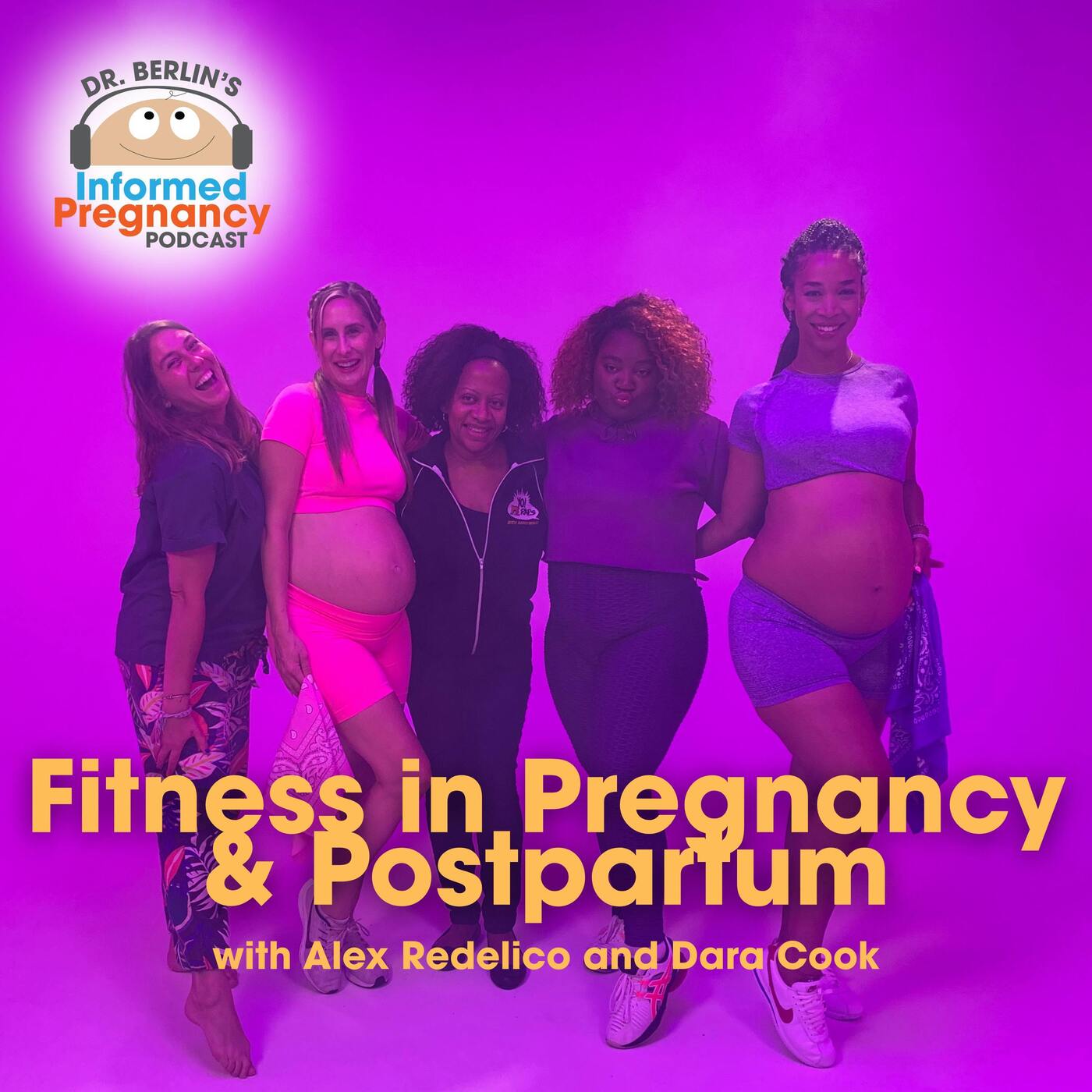
February 5, 2026 · 45 minutes · Episode 497
About this episode
What if the way we prepare women for pregnancy, birth, and recovery is fundamentally broken? Alex Redelico and Dara Cook come together from two high performance worlds to challenge fear based narratives around perinatal fitness.

Connect with the guests:
Grow with us on IP+! Informed Pregnancy Media presents two all new intimate short-form video series following Garrett and HeHe’s real-time pregnancy journeys as they prepare for an empowered birth and postpartum experience. Each episode features weekly updates with personal photos and videos to help bring these raw stories to life, a visually dynamic guide through each mother’s emotional and physical experiences.
Keep up with Dr. Berlin and Informed Pregnancy Media online!
Learn more about your ad choices. Visit megaphone.fm/adchoices
See Privacy Policy at https://art19.com/privacy and California Privacy Notice at https://art19.com/privacy#do-not-sell-my-info.
Key quotes
“Reduces the risk of everything from premature birth to postpartum depression by double digit percentages.”
“I really went for it and felt, honestly, during both second trimesters and into the third even, I felt like a superhero.”
“But my ultimate plan was whatever happens, happens. As long as me and baby are safe.”
“Your heart is pumping up to 50% more blood. And when you're thinking about training for a marathon, yoga wouldn't cut it.”
“Makes everything better. I always say movement is magic, and especially through pregnancy.”
Related episodes
- Ep. 495 Postpartum with Amanda Nordelius & John Russell
- Ep. 493 In Conversation with Esther Friedman Schwartz
- Ep. 514 Before Baby #4 with Kara Sutton
- Ep. 500 The Unexpected with Dr. Elliot Berlin Part 1
Transcript
AI-generated transcript with speaker labels — may contain errors, especially names and medical terms. Dr. Elliot Berlin, DC appears in blue; Dara Cook in orange; Alex Redelico in teal.
Download PDF of the Transcript
Dr. Elliot Berlin, DC [0:00] What if the way we prepare women for pregnancy, birth, and recovery is fundamentally broken, not because of bad intentions, but because we've underestimated what pregnant and postpartum bodies are actually capable of? Today's guests come from two high performance worlds that rarely collide, elite entertainment production and elite strength training. One helped shape some of the biggest moments in pop culture history, and the other built her body and her career through professional dance, strength training, pregnancy, loss, and recovery. Together, they're challenging fear-based narratives and redefining what prenatal and postnatal fitness can look like when it's medically informed, emotionally intelligent, and genuinely empowering.
[0:51] And now you can watch some of the select workouts from their platform on our Informed Pregnancy Plus streaming channel, because the way we support movement in pregnancy has lasting effects on birth, recovery, and the entire postpartum experience. I'm Pregnancy Focused chiropractor, Dr. Elliot Berlin, and you're listening to the Informed Pregnancy Podcast. Alex Radelico and Dura Cook, welcome to the podcast.
Dara Cook [1:20] Thank you so much for having us.
Alex Redelico [1:22] Thank you. So happy to be here.
Dr. Elliot Berlin, DC [1:25] I'm super excited about what you're doing. I have a practice all day every day full of patients who are pregnant or recently had a baby. And during pregnancy, one of the most common frustrations I see is I don't know what I can do workout-wise when I'm pregnant. I want to exercise, even if I'm not really an exercise person or even if I am an exercise person, then I want to work out even more while I'm pregnant. But I see all the time I'm not really sure what I can do, what I can't do. If you go online, you read all sorts of things. You can't even look north if you look online because who knows what that could do. And so when it comes to exercise, I see the frustration because my patients tell me if I could afford a prenatal trainer a few times a week, I would go get one, but I can't do that either.
[2:09] So I end up under exercising or being afraid to exercise at all. And you guys are changing all of that. I want to get into the programming that you're doing and how you came to it and how people can find it. But let's start at the beginning with your backgrounds. Durah, you are not a parent, but you're deeply invested in maternal health. What drew you into this space?
Dara Cook [2:30] Yeah, so it was really three things that came together, my professional life, my passion, and my personal life. So on the professional life side, I started my career at MTV. So yes, I went from MTV to maternal health. And at MTV, I was a producer on the original TRL with Carson Daly. I'm aging myself. I was head creative of the MTV Video Music Awards for years, including many of the iconic moments there. I was brand manager of Nick Cannon's Wild N Out, and I learned how to produce great content there. And then my passion was fitness. So at one point pre-pandemic, I was a member of five different gyms. And what I was seeing in those gyms and those span from high-end like Equinox all the way down to YMCAs and community health centers was all of a sudden around 2015, I started to see a bunch of pregnant women in group fitness classes.
[3:27] And I noticed that across the board they were being underserved. So I would see in Equinox where people paying hundreds of dollars a month, a group fitness instructor say in the middle of a class, oh no, you in the third trimester, you shouldn't be doing this. I'm going to come up with something else for you, et cetera. So I realized that there was a gap between what pregnant women were seeking and the solutions that were out there. And then in my personal life, my sister was pregnant with her first child over the age of 35, which we all know increases.
Dr. Elliot Berlin, DC [4:06] The horror.
Dara Cook [4:07] Yes, the horror. The old geriatric pregnancy as they used to call it. And her OB – GYN said to her, "You need to exercise to reduce your risk factors." And my sister listened to her doctor and she exercised throughout her pregnancy. And I was there the night that she went into labor and it was so fast, her husband could barely park the car. The OB – GYN on call was in the room for 15 minutes. When she walked out, she looked back at my sister and she said, "Did you exercise?" And my sister said, "Yes, my doctor told me to." And the physician said, "I noticed that women who exercise have labors like this." And that's when everything came together.
[4:54] And I realized at that point that that labor had defied my expectations, pun intended, of what a labor of someone who was 35 plus with their first child would be. I thought that I would be able to go home, go to sleep and come back and she'd still be in labor. That wasn't the case. And when I got home after our whole family enjoyed my beautiful niece, who's now eight years old, I looked at the research and saw that what the OB – GYN on call said was not anecdotal, that there have been years and years of research that show that maternal fitness, which means exercising in pregnancy and postnatal, reduces the risk of everything from premature birth to postpartum depression by double digit percentages.
[5:47] And I realized at that moment that it was going to be my life's mission to make it easy, safe, and fun for women and their babies to reap the vast benefits of maternal fitness. And that led me to bring my professional life of creating content, my passion for gyms, and the story of my sister and my personal life as a beacon to create Expect, which is now the only prenatal, postnatal, and pelvic floor fitness platform where every workout has been approved for safety by practicing physicians.
Dr. Elliot Berlin, DC [6:24] Well, that's quite a trifecta of different points coming together to lead you to this one spot, very specific spot. Maternal training is so important. Like you said, I was a doula for a long time and I love that.
Dara Cook [6:38] That's awesome.
Dr. Elliot Berlin, DC [6:39] If you Google doula, my face never shows up even on the last O. I'm not the poster child for doula. But you do, you see, I think a combination of people who are pretty fit, as long as they're not too tight, you generally have a great birth experience or at least they're set up for a much better birth experience. And again, the problem is where can you get the training? Even people are very comfortable working out, sort of get nervous the way we treat pregnancy is such a delicate thing, even if you're under the 35-year-old age. Also there, I love the pun intended. You're speaking to me as a dad now. I can relate to –
Alex Redelico [7:17] Dad jokes. Mom good.
Dr. Elliot Berlin, DC [7:18] Dad jokes.
Dara Cook [7:19] I have auntie jokes.
Dr. Elliot Berlin, DC [7:21] Auntie jokes,
Dara Cook [7:21] Yeah.
Dr. Elliot Berlin, DC [7:22] My kids have recently told me one in 300 lands and then I got to start again.
Dara Cook [7:28] Well, at least that's one.
Dr. Elliot Berlin, DC [7:29] It's 299 eye rolls for one lap.
Alex Redelico [7:31] Better than one in 500,
Dr. Elliot Berlin, DC [7:34] I guess. I actually think there should be almost a governmental agency in maternal fitness. And if there is, we should call it the maternal training board and you should be the president of it. And it'll be MTB, MTB.
Dara Cook [7:47] Yes.
Dr. Elliot Berlin, DC [7:48] We can have the MTB awards every year.
Dara Cook [7:50] I love it. I love it. Yes. Oh, I love that. I think you're onto something. Love
Alex Redelico [7:56] This.
Dr. Elliot Berlin, DC [7:57] Love
Dara Cook [7:57] This.
Dr. Elliot Berlin, DC [7:57] All right. Alex, your roots are totally different. Professional dance and then strength training. And how did that come together with your passion for pregnancy?
Alex Redelico [8:07] Well, passion for pregnancy. I actually am very lucky to love being pregnant and having been pregnant. I will hope to be pregnant for a third and final time, but it really did become a passion from my passion for dance, which led into me recognizing that in order to stay healthy in my dance career and injury free or at least heal from injuries at a more rapid rate, I had to maintain a strong body and build my muscle mass. And I needed to cross train, if you will. A lot of dancers only dance and that's fine, but at some point you realize that you get injured doing very dance specific things. And if you cross train and add in strength training, lifting weights, a little bit of hit and power training, that is not the case.
[8:52] And that definitely goes, your rate of injury gets much less. And I experienced that personally. And so once I sort of phased out of my professional dance career after I did a few tours and a bunch of regional work, I sort of made my way into the fitness. There was a slight transition time, but I made my way into the fitness realm and really fell in love with helping myself, helping others that were dancers. And then eventually it took me some time actually to get into the prenatal postpartum world of fitness. I was training moms and moms to be before I even got pregnant myself.
Dr. Elliot Berlin, DC [9:30] Well, that's cool.
Alex Redelico [9:31] Yeah, it was awesome. I had certifications, which was great, but it also, you can't really understand what it's like, even though I had all the… No, this is safe. Or no, try this or adapt this. Or until you feel it yourself, there really is nothing that compares to the knowledge that you gained from the experience of being pregnant.
Dr. Elliot Berlin, DC [9:50] It's interesting to say that. I have a new series that we have on Informed Pregnancy Plus right now, the Growing Series, and we follow women through their pregnancy week by week that each have an interesting story. And one of them is called Growing with Heehe, and her name is Haley Stewart. Her nickname is Hee. And she was a doula for 10 years before she had her first baby. Oh,
Dara Cook [10:09] Wow.
Dr. Elliot Berlin, DC [10:10] And so we track her through the entire pregnancy week by week. And it's really interesting to watch her experience for the first time firsthand everything that she's been coaching people through for 10 years and how it's like, well, I've seen this in my clients dozens and dozens of times, but to feel it is totally different. So what you're saying makes a lot of
Alex Redelico [10:28] Sense. 100%.
Dr. Elliot Berlin, DC [10:30] What type of dance? How old were you when you got into dance in the first place?
Alex Redelico [10:34] I was like 10 probably. Oh, late. I was really into… Yeah, super late.
Dr. Elliot Berlin, DC [10:40] Geriatric dance kid.
Alex Redelico [10:41] Geriatric dancer. But in the grand scheme of the dance world, I wasn't a kid who was like, "Oh, my mom had me in dance from the age of three." I did take a little bit longer to fall in love with it. I did gymnastics for a long time growing up. I tried every hobby, horseback riding, all these things. And then I really landed, I fought my mother because my mother was a dancer, and so she kept pushing me to be… And I was like, "Now." And then finally I was like, "Okay, fine." So I started dancing more seriously around 12, 13, and then I really fell in love with it around, it took a few years, like 16, 17, and I was like, "Oh, I think this is what I want to do with my life."
Dr. Elliot Berlin, DC [11:16] Was there a particular genre you were focused on?
Alex Redelico [11:19] Yes. I started in concert dance, like ballet, modern, contemporary. And then once I moved to New York and realized there was not a lot of job opportunities, especially ones that could afford me the lifestyle to live in New York and actually pay for my rent, I quickly switched. I also sang a little bit and wasn't as strong of a singer as a dancer, but I worked on it and I became more of a singer so that I could audition to more musical theater. And so I wound up being more in the musical theater field. I was privileged enough to tour with West Side Story a few times, which was the dream. Yeah, it was awesome, internationally and nationally.
Dr. Elliot Berlin, DC [11:56] Wow. There's two things you probably don't know about me. Number one, I'm a theater major.
Alex Redelico [12:00] Yes, that's awesome.
Dr. Elliot Berlin, DC [12:02] And number two, I used to be a big dancer. Ooh,
Alex Redelico [12:05] What type?
Dr. Elliot Berlin, DC [12:06] Well, I've only danced probably three times in my whole life, but I felt big all three times.
Alex Redelico [12:12] I mean, that is what's important. As long as you feel –
Dr. Elliot Berlin, DC [12:14] My wife likes to dance, so we did a salsa class one time, and then with the kids, we homeschooled for a year. So we did a hip hop class one time, but literally three times in my whole life that I can remember dancing, but I did feel big. Okay.
Alex Redelico [12:26] Yeah, and that's what's important.
Dr. Elliot Berlin, DC [12:29] But I think maybe what I hear you saying is something I also hear from other dancers is that their workout was dance rather than dancing and also working out some other way.
Alex Redelico [12:41] Yeah. So what I feel is that it's like a lot of professional athletes. I mean, dancers are professional athletes if you're a professional dancer, but any type of athleticism, if you do it all the time, it kind of becomes your baseline. And so it's always a necessity, in my opinion, to, no matter what your field is, to strength train on top of that intentionally. With dance, with athletics, you're always kind of single-sided. You're never training, oh, I did all this on the right, so I'm going to do all this on the left. Maybe if you take a ballet class, that is true. But in any type of choreography or any type of sports, look at pictures, they're always using the same mechanics of one side of their body, which is why they're always ending with crazy injuries on one specific side and very specific injuries.
[13:27] And that dictates itself to every type of athlete across the board. And moms are kind of very much lumped into this prenatal, being pregnant is very much lumped into this because you are very much adapting on one side, like your pelvis is shifting, all these things, like your round ligament. I had a ton of round ligament pain, so all these very sport specific, because being pregnant is a little bit of a sport, injuries can come into play, and so you have to train intentionally to avoid those injuries or at least deal with them better if they do come into your path.
Dr. Elliot Berlin, DC [14:00] Yeah, that makes a lot of sense to me. All right. I'm already learning. I'm about to learn a lot more. Let's take a little break. When we come back, I want to find out how these two powerhouses came together and what it is that you built once you got there. We'll be right back.

Dr. Elliot Berlin, DC [15:51] Welcome back. We're talking to Dara Cook and Alex Perdelego. Okay, how did you guys meet?
Dara Cook [15:58] Alex and I met really through MTV. So I shared with a good friend of mine from MTV that I was looking to apply what I had learned at MTV and how to create amazing compelling content and bring that into the maternal fitness space. She said, "You have to speak to Jillian Turnosky who, like me, got her start at MTV and then she went on to the MSG network where she won an Emmy and Jillian really made her name also in producing fitness content, which is a different mindset than some of the things that I was used to producing. And you're still in a studio, but we would produce events that had dance in it. But fitness is a different animal altogether, and Jillian had that expertise.
[16:49] So she was a producer for live fitness classes on ClassPass and other major platforms. And she said when we started working together, we have to get Alex in. And what was fantastic is that Alex was actually pregnant at the time. So Alex became such a star of our platform. And she's really telling a story because we see Alex pregnant and then she comes back postnatal to teach additional classes. And me coming from the world of media, storytelling is very important. Even if you're doing it through disparate fitness videos, you get to see the journey, and that's what Alex brings.
Dr. Elliot Berlin, DC [17:34] All right.
Alex Redelico [17:35] Thank you.
Dr. Elliot Berlin, DC [17:37] That first pregnancy for you was unexpected. Are we back with the puns?
Alex Redelico [17:45] Yes, the puns all day. I'll take them. It was. I'd say my very first pregnancy was unexpected. I got pregnant in August of 2020, and it was the thrust of the pandemic, and my partner and I lived in a very interesting New York style railroad apartment, and I was like, "Wait, we can't have a baby in this apartment. We'll kill each other. This is no space to… We have a dog." There was just too many things. And so it gave us an opportunity to be like, "Is this what we want? Are we ready to move forward in this way?" I was 36 at the time, and we decided this is… Or I was 35. If that pregnancy had been viable, I would've been 36 that I had the baby.
[18:27] But I wound up miscarrying, and it actually was very sad and very upsetting, but it also was a blessing in disguise because it gave us an opportunity to wrap our minds around the idea of growing our family and if we were really ready for it. And I found out about six weeks in that I had miscarried, and after that, we decided, "Let's do this. Let's actually try. Let's go for this." I knew that recurrent miscarriages could be an issue. I have a gene mutation called Factor V. It just makes me have a higher rate of clotting.
Dr. Elliot Berlin, DC [19:03] You knew that already?
Alex Redelico [19:04] I did know that because I was very lucky to… Years previously when I was 25 or 26, I started losing vision in my left eye, and I thought at first that I just had scratched my cornea or something. And so I went to my ophthalmologist and he's like, "Oh, actually, you have elevation in your optic nerve and you have a lot of weird things happening." Do you know how doctors like to really, just with no emotion at all, just say, "You might have a brain tumor." He said to me, I was like, "Oh, okay." He's like, "Let's schedule an MRI." I'm bawling in his office. He's like, "No, it might not be that." And I was like, "Well, that was a real aggressive conclusion to jump to."
[19:43] So it wound up being that I have this genetic mutation, and I wound up with a blood clot in my retinal artery called a CR, a central retinal vein occlusion. And it was because I had been on hormonal birth control for a couple years of my life, and with the Factor V gene mutation, women really shouldn't be on a hormonal birth control. Yo should be on a non-hormonal or super low hormone birth control. So I found that out the hard way. But yes, definitely an important blood test to get young women to find out if and when they should be on birth control. But that is the way that I found out that I had this gene mutation. And I also, when reading about it and learning more about it as a 20-something year old, I found out that recurrent miscarriages were a part of what could happen if and when I decided to grow our family or become a mom.
[20:32] So when I found out I was pregnant, I kind of had this feeling of like, oh, I need to keep this in mind going forward. So then when I did miscarry, of course I was sad, but I was kind of like, okay, this is potentially par for the course. We just keep trying. And it was a nice soft opening, if you will, into the conversation of, okay, let's actually try for this. I wound up having an additional miscarriage from November to December. I miscarried in early December 2020. But by that time, we'd been like, let's get out of this apartment. We found a new apartment, we moved, we got nice pandemic pricing on our apartment, which was a beautiful thing.
[21:10] I mean, for New York, it was still absurd, but it's better than it was. And then we got pregnant officially in January of 2021. I found out late January, and then I had my first official prenatal appointment in March of 2021. Nope, 2022, sorry, I'm lying about timelines. 2021, and then I wound up having Benny in 2022. Yeah, I'm a year behind, but in November of 2022, I had our first son on November 1st.
Dr. Elliot Berlin, DC [21:35] It's amazing how you could tell that story in two minutes and just thinking about all the different stops along the way and emotions, even just the first one, finding out you're pregnant when you weren't expecting it.
Alex Redelico [21:46] Oh yes, that was a shock.
Dr. Elliot Berlin, DC [21:48] Might not have been ready for it, what emotion that is, and then maybe we are ready for it and then you lose it. It's just a roller coaster.
Alex Redelico [21:54] Yeah, it really was.
Dr. Elliot Berlin, DC [21:56] Did you end up having to take blood thinners during your pregnancy?
Alex Redelico [21:59] Not during, which is a perfect lead too. The reason I didn't have to take blood thinners, even at the extremely old age of 36, because I was fit and in generally good health, they did not recommend, even with the genetic mutation, that I take it. All of my numbers were really good. My blood pressure was low, if anything, lower than average. And so they said, "Unless we see a reason to, we don't think you need to be on blood thinners." Postnatal, I was. I was on a blood thinner for six weeks, and I got to learn how to use a subcutaneous injection on myself, which was fun, but I did not have to. I just took a single baby aspirin, and that wasn't even necessarily for a blood thinning, it was to help prevent preeclampsia.
[22:43] So that was on one a day.
Dr. Elliot Berlin, DC [22:45] After a couple of miscarriages, for some women, I think they'd be more nervous to exercise during a future pregnancy.
Alex Redelico [22:52] Absolutely, yeah. I was, I say, more careful my first trimester until I got the go ahead. But even so, I think because the one thing with pregnancy and information that's out there that I think is worth listening to for sure is that whatever baseline you're at already, I think unless a doctor says otherwise, that it is safe to continue and expand on your baseline once you are pregnant. So I felt really strong. Maybe I scaled back the weights I was lifting. I scaled back the intensity a little bit, especially in the first trimester. Also, just not to mention anybody who's been pregnant out there knows that the first trimester is rough. So it was a very come as you are and do what you can do basis.
[23:33] Some days I was like, "I need a nap instead of a workout," and so I would take a two-hour nap. You have that luxury when you're pregnant with your first baby. The second baby, not so much. So I would definitely listen to that. I would just listen to my body, and if I felt like I could handle a workout or it was what my body needed, then I would do that. And then if not, I would take rest or eat a delicious meal or whatever. I just listened to what I felt I needed in that moment. And then once I felt better in the second trimester and was less nauseous and less exhausted and less just… The fatigue and exhaustion was my most intense symptom of pregnancy, especially in the first trimester.
[24:15] And I got very, very short of breath too, so it was very bizarre. And funny story, actually, that is how I found out I was pregnant the second time. We live in a fourth floor walk-up, and I was like, "I think I'm pregnant again," because I would walk up the stairs and be like, "You have to catch my breath." And that was my symptom of how I found out I was… We weren't officially trying with our second. We were like, "Oh, we're not trying and we're not trying." But definitely that was my first inkling that I was pregnant with my second, was that I could barely walk up our four flights of stairs. So once those had subsided, those symptoms, and I felt stronger my second trimester, I really went for it and felt, honestly, during both second trimesters and into the third even, I felt like a superhero.
[25:04] I was lifting really easily, felt super strong. I would get out of breath more easily, obviously, but I just felt so connected to my body and to my little baby that was growing inside me. It was a really beautiful thing. Yeah.
Dr. Elliot Berlin, DC [25:18] Oh, that's pretty cool. Okay, so for that first birth, did you have sort of a mindset on what you wanted the birth to be like and did it follow that plan?
Alex Redelico [25:31] Yes, of course. Everyone has their birth plan, their loose birth plan that they… It's an LOL to think that you can have a birth plan. But my birth plan was, "Hey, this is what I would like to do. I would like to be intervention free. I would like to have a vaginal birth. I would like to create some sort of ambiance in the hospital room that feels more like an at-home birth because I was way too nervous to have an at-home birth and a birthing tub in our very small New York apartment would be hilarious." I was delivering at North Shore University, it's called, it's in Long Island, in Great Neck. So I knew that I would have my own personal room, which was really important to me, postpartum.
[26:14] I had all these plans for… And within even the delivery room, I brought electric candles and had a playlist and all this stuff, and I got induced, and I was two weeks post my due date, and I had all these plans in place for just taking my time and easing in. And even though I was being forced to be induced, just listening to my body and trying my best not to get any intervention of any kind, and I did not go as planned. I wound up being induced. My body took well to the induction at first, and then I had my water broken, which probably in hindsight was something I should not have done, but hindsight is twenty twenty, so I kind of rushed my body into something it wasn't ready for.
[26:58] And in that time, I wound up getting an infection into 28 hours of labor. I wound up getting an infection called chorio, and I had to be put on Tylenol, and I had to get an epidural to ease the pain because with that infection, the pain of the contraction is just like your uterus becomes so tender that it just skyrockets. So my contractions felt like they were a 30 instead of a two. So yeah, it did not go as planned, but my plan was to be super woo-woo within a hospital, and that's not the way it went. And it's okay, I've come to terms with it, but definitely I had a very loose plan, but my ultimate plan was whatever happens, happens. As long as me and baby are safe, as long as we're supported and come out of this on the other side, it's okay.
[27:46] I was leaving it in the hands of the professionals and whoever could get my baby to earth side safely, but it was definitely a little traumatizing at first. I will not lie.
Dr. Elliot Berlin, DC [27:57] Right. I mean that oftentimes, especially I think when you are strong and fit and healthy and you push your body to perform in all sorts of ways that a lot of us can't, then it seems to be a letdown when it doesn't do what you're wanting it to do.
Alex Redelico [28:15] Yes. I kept saying that it was an event I was training for. I was like, "I got this." I'm like, "I'm literally training for this. I'm doing all of the right things," whatever that means, and it's going to be great. And then people on the outside are like, "Oh, it's going to take you 10 seconds to give birth. You're so stressful." And so you get these things, you're like, "Yeah, it's going to be great. It's going to be smooth, the easiest birth ever, and it's okay. It's just a very humbling experience, and I'm human. Who knew?"
Dr. Elliot Berlin, DC [28:43] I have two pregnancy books for you to write. One of them is going to be called Not Not Trying.
Alex Redelico [28:49] Exactly.
Dr. Elliot Berlin, DC [28:50] There's old colleges of children.
Alex Redelico [28:53] Yes, correct. Correct.
Dr. Elliot Berlin, DC [28:54] From that method. And the other one is Hindsight is 2022.
Alex Redelico [28:58] Yeah, I love that. I love that.
Dr. Elliot Berlin, DC [29:01] Thank you very much. All right, let's take a break. When we come back, we'll find out how round two went for you, but then also the Expect app and everything that goes into it and how we can benefit from it. We'll be right back. Welcome back. We're talking to Dora and Alex. Alex, I think it's a very unfortunately common birth story that you have where you have this vision and you do all sorts of prep, and then you get there and it goes a different way. Everybody grateful that you and the baby are healthy on the other end, but there's also some sort of loss of an experience that you wanted to have to mourn, and I see frequently people feeling let down.
[29:49] How was postpartum for you, post-cesarean?
Alex Redelico [29:53] Post-Cesarean was definitely easier because I was… So even though my fitness and all of the Things that I did to prepare for the birth of my dreams didn't pan out. All the work and training that I did prenatal and before prenatal in my non-pregnant life really helped me recover much quicker, especially from a first cesarean section. I know people kind of just brush it off because it's such a common thing these days to get a C-section, but it is major abdominal surgery and it is a doozy especially if it's not what you thought was going to happen. In my brain, there was no way I was getting a C-section. So I didn't even really have the chance to wrap my mind around how I would handle it if it did happen because I just had put it out of my mind.
[30:40] But my strength and my muscle mass that I had and my movement abilities while being pregnant in every trimester, through every trimester, all of the work that I did definitely helped me postpartum in recovering much faster. And even though I still had to move much slower, I was much more capable than I expected to be and that traditionally people are when they experience and have a C-section. So I felt very lucky and very in tune with my body still, even though so many things had happened in my abdomen, I still felt connected to it. I felt like I could still pick up my baby safely and get up out of the bed safely in the middle of the night to feed him.
[31:22] And so I was very grateful for all the work that I had done, even though it didn't necessarily help me in my labor and delivery, it definitely helped me on the other side.
Dr. Elliot Berlin, DC [31:33] Very cool. And I'm sometimes blown away by how quickly people do recover from cesarean birth, and especially if there's a fitness level, how eager they are to get back walking at first and then exercising more. And actually there's a good number of practitioners here who will check before six weeks to see if there's readiness to get back into exercise because not everybody needs six weeks. And I just see some people so eager to get back into their fitness.
Alex Redelico [32:01] Too eager sometimes.
Dr. Elliot Berlin, DC [32:03] Sometimes too eager, but sometimes – Okay,
Alex Redelico [32:04] Calm down.
Dr. Elliot Berlin, DC [32:06] A healthy eager. Yeah, because my wife insisted on getting pregnant again our second time before I lost all the weight from the first baby and then I gave up on it. But she got right back into fitness and was super healthy and ready for that second baby. All right, so during that pregnancy and again during postpartum, you guys were feverishly working on putting together fitness programs for the Expect app. What was the process of putting together those programs?
Dara Cook [32:38] The process started with talking to the experts in maternal fitness. So we spoke with initially Dr. Ayman Lee at Harvard Medical School, who is now our medical advisor. And Dr. Lee co-authored the biggest studies on the impact of prenatal fitness on preeclampsia and gestational diabetes. And we told her, "This is what we're looking to do. We'd love your input." And she said, "I'm so glad that someone is finally putting the science to work." And she recommended we speak with the head of the American College of Sports Medicine, who thankfully because of the recommendation from Dr. Lee, took our call and we asked him, "So Dr. Berlin, you talked about what you see in your practice so often is that you see pregnant women who want to work out, whose doctors have told them to work out, but they don't know what's safe to do."
[33:36] And these are rightful concerns. So the head of the American College of Sports Medicine talked about the changes that happen in the body in pregnancy where you would really want to do modifications on your previous fitness programs. And he shared that with us. We realized that there was a there there. So we created a process, a medical review process that no other platform has. One of our concerns, and we understand why people are in this space of not knowing what is safe, because most of the maternal fitness protocols don't go under medical review. So every workout in Expect goes through an independent review by practicing OB-GYNs from different hospital systems so we can get a variety of perspectives.
[34:27] And so the physicians include OB-GYNs, maternal fetal medicine doctors, urogynecologists for the pelvic floor workouts that we have. And these physicians, they're brutal. And so they get paid to review. So they're getting paid the same amount, whether they say no to a workout or they say yes. And when we started Expect, very beginning, even before we started shooting original content with Alex and all the other incredible trainers is that we actually licensed some of the best prenatal fitness content out there. And we found that 50% of it was flagged by our OB-GYNs. What a lot of it was flagged for with this is not actually really good in the third trimester.
[35:15] That was one of the number one things that came up because of the shifts in the center of gravity. And that's what the head of American College of Sports Medicine talked about. The shift in the center of gravity and pregnancy, that can increase fall risk. And people have asked us, why did we work with OB-GYNs? Well, the OB – GYN becomes that first call that you make. So if there's something untoward that happens in your pregnancy, so our OB-GYNs were very sensitive to anything that may cause someone to call their OB – GYN for an issue. So that's the process. So every workout goes under review by the OB-GYNs. We have gotten rid of entire exercises because of them.
[36:03] We have edited things out. We have added instruction in. We shoot our workouts live. Someone asked me once, "Oh, you have so many workouts. Did you make them on ChatGPT?" I thought that was hilarious. I was like, "No, they're actual humans in a studio and they're pregnant and they're postnatal." So Expect has humans in the app and we thought it was really important for us to cast. And so we have obviously fitness professionals like Alex who were teaching the classes, but we have everyday women who are working out to inspire moms. And we have an array, a broad array of fitness programs. So whether you're focused on cardio, strength, dance, pelvic floor, we have walking workouts.
[36:52] I know Dr. Berlin, you talked about women looking to get back, especially walking after a C-section and we're rolling out that whole program. We have what we believe is the best pelvic floor program. It's called Pelvic Floor Rescue, designed by a board certified pelvic floor physical therapist approved by a urogynecologist. And women are using that in particular postnatal to prevent symptoms of incontinence. So that's the app in a nutshell. And we looked at some of the really big fitness platforms. I'm not going to name the one in particular, but we have three times the prenatal fitness content of that. And just being a small company, and we were really able to do it, the shooting of it and make it so great because of Jillian Turnosky and instructors like Alex who has made it so easy and fun.
Dr. Elliot Berlin, DC [37:50] And I think what you're describing, the expertise that goes into it and the medical guidance that goes into it kind of helps you take a deep breath and relax and feel confident that this is going to do all the good things you want without doing the bad things you don't want.
Dara Cook [38:04] Correct.
Dr. Elliot Berlin, DC [38:04] I don't know, you probably don't know this, but around 12 years ago, I think, I tried to find the solution for my patients who were so frustrated not knowing what kinds of workouts they could do. And I teamed up with a fitness expert and we started a program called Gaga Fit.
Dara Cook [38:20] Oh wow.
Dr. Elliot Berlin, DC [38:21] And the idea was to do group workouts that we could modify depending on your level of fitness and depending on where you were in the pregnancy, the various trimesters or postpartum. And it was coming together really nicely until we got a cease and desist letter from –
Dara Cook [38:38] Lady Gaga.
Alex Redelico [38:39] Oh my God.
Dr. Elliot Berlin, DC [38:40] I was like, "You own Gaga?" I think it was around before you. Goodness. Referred to babies. Anyway, that whole thing fell apart. We didn't have the oomph to pick up the pieces and rebrand and do it all over again. So I'm really glad that you have come along and put this together with the Expect. I know you're going to help myriads of people. And is it available around the world?
Dara Cook [39:03] It is. So Expect is –
Dr. Elliot Berlin, DC [39:05] You know what that means? Your pelvic floor program is available incontinence.
Dara Cook [39:09] Yes, it is. It is. I know. I love that. Oh, the dad joke. I love that one. 272. We're going to use that. We actually just got an email from a woman in Italy who is using Expect for pelvic floor rescue. So yes, Expect is available in the Apple store, the App Store. It's available in the Google Play Store, and it includes pelvic floor rescue. So you see our hundreds of prenatal fitness. And I'm someone who, myself, I like variety. So before Expect, the vast majority of prenatal fitness focused on yoga. And to zoom out, pregnancy has a similar impact and the body is running a marathon. Your heart is pumping up to 50% more blood. And when you're thinking about training for a marathon, yoga wouldn't cut it.
[39:58] So a variety of exercise, including cardio, including strength, especially when you're thinking about reducing your risk of gestational diabetes, that's really, really important. So that exists on the app and you can download it immediately from the app store. And we intentionally have it available as an app because we know the challenges of being pregnant or being a young mom, that transportation and childcare become issues. And we worked with University of Alabama at Birmingham. We actually have a study ongoing with the University of Alabama at Birmingham. And they have at their facility, and it's one of the greatest academic medical centers in the country, they have a full exercise and pregnancy clinic there.
[40:49] It's got treadmills with extra bars on it to help with balance, et cetera. But they wanted to work with us because they said the women who need to be here the most, who at the highest risk of complications, they can't get here because they have to work or they have childcare issues, transportation, et cetera. They said in the summers in Birmingham, as you can imagine, it's too hot to walk in the street. And they say, "Well, at least you can walk for exercise." Well, not when it's 90 degrees and you've got that advisory on your phone. So what they loved is an opportunity for people to have access to on-demand, medical grade, entertaining, beautifully shot fitness that they can stream on their phones as easy as YouTube.
[41:40] You can play a video on YouTube, you can play Expect, and you can cast it to your screen. So if you have 10 minutes at five in the morning, you can work out with us. Whenever you can fit us in, and our pelvic floor rescue is audio-based, so you can be… I actually use pelvic floor rescue myself and I use it on the subway and no one knows what I'm doing. No one can see that I'm engaging my pelvic floor.
Dr. Elliot Berlin, DC [42:09] Well, it could be weird if I see you on the subway.
Dara Cook [42:11] Yes, I know. Yes. I have on my headphones so you know I'm listening to pelvic floor rescue.
Alex Redelico [42:17] You're doing it wrong if they can see you doing pelvic floor.
Dr. Elliot Berlin, DC [42:20] I'm doing eagles right now.
Dara Cook [42:22] Right, exactly.
Dr. Elliot Berlin, DC [42:24] Well, I am very impressed by, and we're so honored to host some of the videos on Informed Pregnancy Plus. Grateful that you shared them with us in our audience so they can get a taste for it and then shift over and get the full program through your Expect app. But when we watched the content originally when we were looking at working together, I was super impressed. And also the feedback already coming in from our subscribers is that the quality is really wonderful. They're fun to do because of just the whole thing, the look, the feel, the music, the instructors, the passion from the instructors, and also the people in the background who maybe they can relate to more than the instructors and feel like they can do these workouts and succeed.
[43:06] It's all very, very well done. And your two strengths that each of you bring to it shine and really work well together. And I would say peanut butter and chocolate, but I don't know if that's the right thing for a fitness app.
Dara Cook [43:20] That is, actually.
Dr. Elliot Berlin, DC [43:21] Okay, perfect.
Dara Cook [43:22] Yes.
Dr. Elliot Berlin, DC [43:24] Do you have a final thought, either one of you, that you'd like to share?
Alex Redelico [43:28] I just want pregnant women across the board to feel empowered to move, and I hope that this app really helps them be inspired and feel comfortable moving in their pregnant body and in their postpartum body because it's a truly new space that you're going to be moving in. All these women say, "Oh, I want to get back to how I was," and that's just not realistic. No one will ever get back to how you were. And that's not necessarily a bad thing. That is the beautiful thing. We evolve as humans mentally and physically after we have a baby, and it's a really magical experience. It can be a very scary experience as well for a lot of people, but moving makes everything better.
[44:09] I always say movement is magic, and especially through pregnancy, it is what kept me mentally sane through pregnancy, through all the hard times, especially my second pregnancy with a toddler running around. It was like my respite in having a second to regroup and just focus on myself. I hope that women award themselves that opportunity either pre-pregnancy, thinking about getting pregnant while they are pregnant and postpartum. It is so important and I think it's not the best thing you can do, one of the best things you can do whether you're pregnant or not, but especially throughout pregnancy and postpartum.
Dr. Elliot Berlin, DC [44:48] Well said. I really appreciate both of you for coming on and sharing your backgrounds and sharing your personal stories and what led you to make this wonderful app. Where can we find everything online?
Dara Cook [45:02] So our website is expect. fit, F-I-T. So instead of. Com, it's F-I-T, and you can type into the app store or the Google Play Store, Expect Fitness, and you will find us there.
Dr. Elliot Berlin, DC [45:18] I am a New Yorker. I don't really talk like that anymore, but I am a New Yorker. When I go back home and visit New York, I'm going to have a whole new respect for what people are doing on the subway. Thank you for that. And again, thanks for sharing the Expect app and for making this great resource available to pregnant and postpartum people around the world. And at home, thanks for listening to the Informed Pregnancy Podcast. For more pregnancy and parenting information just like this, visit us online at informedpregnancy. com.
Want more pregnancy + parenting? Start your FREE TRIAL of Informed Pregnancy+ and get access to all our curated pregnancy and parenting content — original series, iconic birth films like The Business of Being Born, prenatal workouts and more.
