by Rose Hart-Landsberg | Oct 26, 2022 | Parenting and Child Development
” This is a great tool for creating a sense of ownership in your kids from a young age and it also will hopefully save you some time and effort. If your kids aren’t the cleanup-with-a-smile type you may want to try making a game out of the process like competing to see who can clear their bedroom floor more quickly or cleaning up the items by color type.”
Parenting is a lot of work. As your kids get older they’re able to help with tasks around the house but sometimes getting them to help becomes a chore unto itself. One idea to combat this is to start them off helping around the house from the very beginning so it becomes a part of the everyday routine. Here are some simple ideas to incorporate into your kids daily activities:
Meal planning
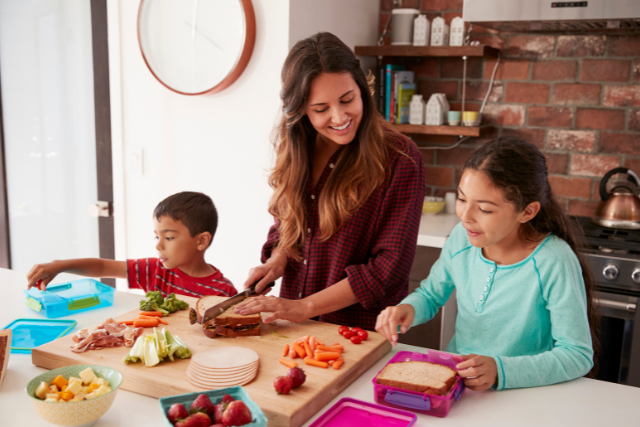
Meal prep can be a pain and it gets even worse when you put all that time and effort into food your family doesn’t end up eating. Kids can be fickle when it comes to what food they like, sometimes it changes by the day or even meal but one trick you may want to test is including your kids in the meal planning and prep process. When you’re writing your shopping list, ask your little ones which veggies they’re craving or what kind of sandwich they want for lunch. This is also a great opportunity to talk about what goes into feeding a family so your kids grow up learning about the steps that go into shopping and cooking.
Check out this blog post on pregnancy and skincare!
Toy pick-up
Whether your kids are the play-with-one-toy obsessively until it’s broken or used up or the move-from-one-thing-to-the-next-at-lightning-speed type every parent knows the pain of stepping on a toy or rummaging through piles of clutter trying to find the item you need. Rather than swoop in at the end of an exhausting day to pick toys up on your own after your kids are in bed, incorporate cleanup into your kiddos bedtime routine to make sure there’s enough time and to ensure that everyone helps clear up the mess they made. This is a great tool for creating a sense of ownership in your kids from a young age and it also will hopefully save you some time and effort. If your kids aren’t the cleanup-with-a-smile type you may want to try making a game out of the process like competing to see who can clear their bedroom floor more quickly or cleaning up the items by color type.

Sweeping and mopping
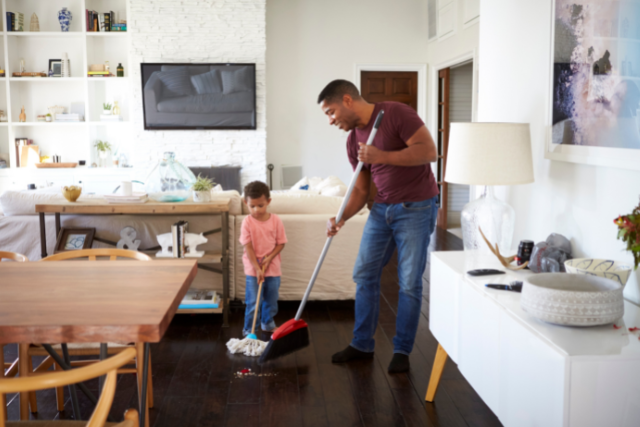
Sweeping and mopping are great tasks to give to a child because they’re relatively simple as well as tactile in a satisfying way. It’s true that a very young child with a wet mop may make things worse rather than better but with some practice and supervision (and patience) you may just get a clean floor and a worn out kid by the end of the day.
Feeding the pets
Different pets have different needs when it comes to mealtime but depending on your setup it might be easy to store your dog or cat food in a plastic or metal canister with a scoop that your kids are able to access and open easily. If your kids are older you can write the feeding schedule and amounts on the fridge or even put a sign on the food canister and keep an eye on the clock for when a reminder is needed (though dogs and cats are pretty good at mealtime reminders on their own.) For younger kids, you may need to do the task with them but it’s a great way to start them out and teach them about what goes into keeping a pet and caring for an animal.
Dusting
A strong way to teach your kids how to care for their possessions is dusting. An old rag and a bit of patience is all they need for this task and it’s perfect for a chilly inside-day especially as it’s quiet and easily supervised. Dusting teaches a light touch and attention to detail and a bit of pretend play while they get the job done can make it into an enjoyable time.
Keep in mind
When supervising and assigning your kids chores, remember not to insist on perfection. The idea is to create a feeling of accomplishment that encourages them to participate willingly. When they’re angsty teenagers you’ll get fewer eyerolls and groans if you set the precedent early. Praise for a job well-done (or sometimes just done) is always a smart approach and just as with everything else, consistency is important for building skills and expectations.
Listen to the Informed Pregnancy Podcast featuring Anna Malaika Tubbs!
Rose Hart-Landsberg helps produce the Informed Pregnancy Podcast hosted by Dr. Elliot Berlin, DC and serves as managing editor of the new Informed Pregnancy Blog. She also spearheads podcast and blog sponsor partnerships and helps with various related content and copy writing for The Informed Pregnancy Project and Berlin Wellness Group.
In her free time she enjoys editing and writing fiction, makeup artistry, and is currently learning Turkish.
by Dr. Alyssa Berlin | Oct 25, 2022 | Family and Relationships, Mental Health
“Let’s all agree that unilaterally, parents typically mean well and truly have your best interests at heart. That being said, after having a baby, chances are that your parents fit into one of two categories: there is the “I love you…you are amazing…I could not have done it without you” (we will call that category A), and then there is the “I love you, but you are making me crazy, and if you don’t get out of my face and give me some space I am going to scream” (category B). ”
The old saying: “You can’t live with ’em, you can’t live without ’em” must have been referring to parents/in-laws. Nothing challenges your relationship with your parents more than joining the ranks and becoming parents! Yikes! I am one of them.
Having a child often shines a spotlight on both the positive and negative experiences and feelings that you have towards your own parents. Becoming a parent can serve as catalyst for bonding with your parents in a new way, or it can serve as a direct reminder of the ways that mom and dad may have neglected to be the parent you were wanting.
The postpartum period, however, is not a good time to remind mom and dad about all the ways they may have failed you and how you are going to do better with your child. So if you are noticing some of those feelings come to the surface, pregnancy is a wonderful time to explore and work through those experiences before your baby arrives.
Let’s all agree that unilaterally, parents typically mean well and truly have your best interests at heart. That being said, after having a baby, chances are that your parents fit into one of two categories: there is the “I love you…you are amazing…I could not have done it without you” (we will call that category A), and then there is the “I love you, but you are making me crazy, and if you don’t get out of my face and give me some space I am going to scream” (category B).

The problem is that oftentimes you will not know which category your parents belong to until after your baby is born. Then it might be too late – you already committed yourself to having your mom move in with you, sleep on the couch, and be there 24/7 for the first 6 weeks of your baby’s life. (Insert scream here).
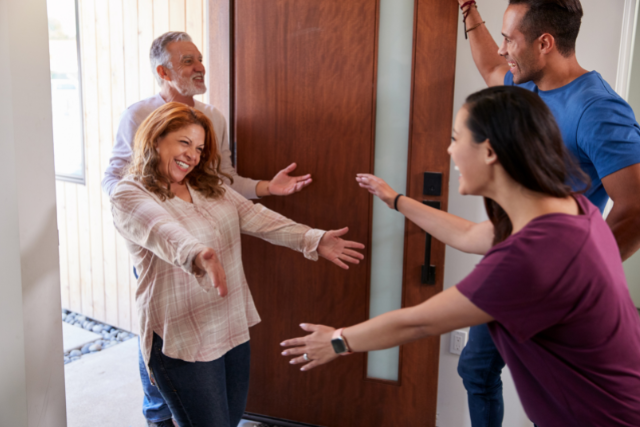
When you find yourself with category A parents – you are in luck. Embrace them and revel in the support they can offer you as you adjust to motherhood. Remember that there is nothing wrong with accepting help. In my opinion, it is the strong women that can utilize help from others, recognize that they are a part of a village, and do not have to do it all alone. There is not a special award given out to women who feel a need to prove that one day post delivery they can be superwoman. It doesn’t exist, so relax and enjoy the helping hands around you.
There are usually clues along the way that you may have a category B parent on your hands. I want you to remember that right after you have a baby, you are feeling vulnerable and emotional. You will likely not be feeling your best or in the mood to entertain any high maintenance, not self-sufficient guests. You will probably be looking to surround yourself with safe people who won’t take your mood changes, pointed comments, or emotional moments personally and will be empathic of your need to recover from birth and appreciate the emotional magnitude of your journey to parenthood.
Follow Dr. Alyssa Berlin, PsyD on Instagram!
So, if your parents are typically high maintenance, needy people who like to be catered to, chances are they are going to fall in the latter category and might not be an optimal choice to play a major role on your postpartum care team. Situations tend to get more stressful after having a baby, not less. So, if under the best of situations, an evening out with the folks usually results in you needing a stiff drink and an ice pack, then….you guessed it – great contenders for category B and an awful contender for a long-term post birth houseguest.
That doesn’t mean that mom and dad don’t have a role in the process. It simply means you want to think about the situation more strategically and please, I am begging you, don’t have them sleep on your couch or in a second bedroom in your house. There are wonderful hotels/motels or awesome friends that would be happy to host your parents so that you can enjoy the best of both worlds: quiet time alone as well as nice visits with mom and dad.
They may, however, make great people to run errands, do the food shopping, pick up dry cleaning, and other valuable contributions to your postpartum experience in a less hands-on way. As you envision your postpartum experience, it is advisable to think about everyone’s strengths and how they will be most helpful to you during this special time. Yup, you guessed it; this time is all about you and what you need in the moment to ensure that you have the best possible start to motherhood.

If one parent has a particular skill in cooking, assign them to cooking duty. If another parent enjoys shopping, they get shopping duty and everyone can pick straws for cleaning duty. Sit down with your partner while you are still pregnant and jot down a list of daily activities/errands that have to get done as well as some of your favorite recipes. You can disseminate the various tasks to different people or leave the list on the refrigerator. And in the absence of parents or in-laws, there are other wonderful people: doulas, nurses and professional services, drop off and delivery services, and cleaning services around you that will be happy to be a part of your village and postpartum team.
One last note: if during the pregnancy, you already have strong thoughts regarding what you may or may not want from your parents or what role you may or may not want them to play, I strongly recommend you share it with them before the baby’s birth. This will alleviate a lot of stress on you after the birth and will likely give them a better chance to honor your requests.
You have a plan for birth, now make sure you plan for what comes after. Click for more info!
Dr. Alyssa Berlin is a clinical psychologist specializing in pregnancy, postpartum, and parenting. She offers private counseling for women individually and with their partners. Dr. Berlin is the creator of The AfterBirth Plan™, a program that prepares couples for what to expect after a baby is born. The workshop teaches couples how to prepare for a healthy postpartum transition for the baby, for each partner, and for the evolving relationship. She combines her psychological background and her doula training to help women and their partners feel empowered and comfortable in the labor and delivery process, both on a physical and emotional level. Dr. Berlin has specific expertise addressing fear and anxiety that may arise before, during, or after birth.
Dr. Berlin is on the Board of Advisors for the International Cesarean Awareness Network (ICAN) and is a faculty member of Maternal Mental Health NOW Training Institute. She conducts live pregnancy and parenting workshops throughout Southern California and online. You can read Dr. Alyssa’s blogs on the Huffington Post where she contributes to PBS’s ‘This Emotional Life” project. Dr. Berlin received her doctorate degree at Argosy University in Atlanta, GA and went on to become a certified Gottman educator. She is a member of the American Psychological Association. She and her husband, prenatal chiropractor Dr. Elliot Berlin, live in Los Angeles and are the proud parents of four amazing children.
by Keira Moré | Oct 19, 2022 | Health Conditions, Labor and Delivery
Once we received news of the surgery, the rest was an agonizing blur. We were pushed upstairs to sign paper after paper with the anesthesiologist, releasing them of responsibility if they accidentally killed my baby. Having my newborn go through invasive surgery at only days old was one of the scariest things I have ever experienced.
A premonition
The sterile stillness of the hospital swallows me as I peer into the box. My newborn daughter is in the incubator, and there is something wrong. I feel powerless. As I reach over to grab her, I am jolted from my sleep and I wake up. During my pregnancy, this eerie nightmare plagued my sleep. I woke up unsettled and terrified each time. I prayed for a boy to prevent the unsettling nightmare from turning into a premonition. Little did I know, the birth of my first child would forever change my life in more ways than one.
My husband and I kept the gender of our child a surprise, planning to find out at birth. At 39 weeks, I was induced since I had signs of preeclampsia. After 24 hours of labor, my daughter arrived eagerly into this world. I was exhausted, but our first few moments together were magical. Once we were in the recovery room, I placed Valentina into the bassinet for a brief moment. When I looked over, I was paralyzed with fear. She had turned completely blue. As I shouted for the nurse, an eerie feeling of deja-vu washed over me.
The nurse struck the code-blue button on the wall, and Valentina was rushed to the nurse’s station. Since my daughter arrived quickly, she had an unsafe amount of amniotic fluid coating her lungs. I watched as the nurses struggled to put a tube down her tiny throat to suck out the remaining liquid. I have the gift of remaining calm and cool-headed during high-stress situations, but watching the hospital staff struggle was incredibly painful. It felt as if a part of me was now outside of myself, and I had no control over anything that happened. The nurses assured me that this was a relatively common procedure for babies who are born quickly, as the speed does not allow the pressure from the vaginal canal to drain the baby of the remaining fluid. Thankfully, our baby made a quick recovery. Later that day we were released from the hospital and were ecstatic to finally go home with our sweet Valentina.
Home from the hospital
Our time at home together was short-lived. Soon after we arrived, I was called and told to bring Valentina back to the hospital as she had jaundice. Much later I learned that jaundice can be treated from home. Returning to the hospital was disorienting. Valentina was placed in an incubator for over 16 hours under blinding lights. At the same time, my milk had started to come in. I had to pump, but I was not allowed to feed her. At a time when all I wanted to do was hold her, I could only watch. Finally, we were told that we could go home again, and I was grateful to finally be able to just be with my daughter.
My relief was temporary. The next day, every time I tried to feed Valentina she vomited green. I was terrified, and quickly contacted my pediatrician and talked to my night nurse. My pediatrician claimed I had probably overfed her, while my night nurse reassured me that it was the green juice I had earlier which could affect the color of breast milk. I was confused and exhausted, but I placed my faith in their expertise. Valentina continued to vomit green over the next few days every time I tried to feed her. The more I desperately sought answers, the more I only received questions. I grew exceedingly nervous and restless. At the same time, I noticed she was sleeping in longer intervals, which did not seem normal to me. I could no longer take it, and on the fifth day, I called my pediatrician. I told him I was either bringing Valentina directly to him or back to the hospital.
When we arrived at the pediatrician’s office, the doctor noted her belly was distended, and confirmed she was lethargic. My pediatrician told my husband and me to take Valentina to the ER with a request to run a specific test. Being back at the hospital again and on the ER floor with Valentina was traumatizing. It was the last place I ever imagined I would be with my less-than-a-week-old daughter. My autonomy over myself and my daughter had been ripped away from me. My interactions with hospital staff were strained. The more I advocated for my daughter and myself, the more I was met with resistance and judgment. My anxiety peaked as the hospital ran test after test with no results, every test except the one my pediatrician had requested. Finally, after exhausting all other test options, they ran that one.
The test revealed that Valentina had an obstruction between her esophagus and stomach, known as duodenal atresia. The obstruction was just big enough to let in a drop of liquid at a time, which is why once my milk changed from colostrum to mature milk, she was unable to take it and instead, threw everything up. We were told that the only way to treat duodenal atresia was surgery. She would be cut open and they would have to create a bypass, creating a bigger opening inside her tiny body. There was a 15% chance that she would eventually need a second surgery.
Get the latest Informed Pregnancy news on Instagram!
A three hour surgery
Once we received news of the surgery, the rest was an agonizing blur. We were pushed upstairs to sign paper after paper with the anesthesiologist, releasing them of responsibility if they accidentally killed my baby. Having my newborn go through invasive surgery at only days old was one of the scariest things I have ever experienced. After a three-hour surgery, the surgeon stepped out to give us an update. He told me that they had cut open Valentina’s tiny body and removed her appendix. The surgeon had to rearrange her organs. I was livid. The surgeon had never asked my permission, and now all I could do was listen to what had happened to her. The pain was unbearable. He told us that Valentia had been admitted to the NICU.
While Valentina was in the NICU for recovery during the next few weeks I hated to be pulled away from her side. As a full-term baby, having her in the NICU amongst premature babies was unsettling. The recovery was painful. Due to the intensity of the surgery, I could not hold or feed her. The only thing I could do was watch. I felt helpless and powerless. For five days she received her nutrients from an IV. We would spend 14-16 hours a day at the NICU, leaving only to sleep because it was not allowed there. Despite the supportiveness of my family and friends, I perceived any attempt at asking me to leave the hospital as taking me away from my daughter. My time in the NICU was isolating, as I could not communicate my experience to others who had never felt the pain of such a quick separation from their newborn child.
A healthy daughter and a new career
Today, I am grateful that Valentina is a happy and healthy four-year-old. She has not needed a second surgery but her birth changed my experience not just as a mother, but as an advocate for others. Long after the surgery, I learned that duodenal atresia was a condition that should have been caught during my pregnancy as it is often a marker for chromosomal issues and Down’s Syndrome but my doctor made a mistake. He missed it entirely. While knowing in advance would not necessarily have made my experience easier, the shock and pain I experienced at finding out immediately after Valentina’s birth was scarring. In addition, I eventually learned the reason her vomit was green was due to bile, which as a new parent experiencing heightened emotions I did not realize at the time. There was so much information I didn’t know. I was so focused on advocating for my daughter, that I did not realize no one was advocating for me. The impact of Valentina’s surgery on my health embedded itself in my existence for a long time. After her birth, I needed to attend therapy and started medication for anxiety. I lived in constant fear and anxiety for my daughter, that anything could happen to her.
While a birth journey is wildly beautiful, it can at the same time be scary, intense, and a road riddled with unknowns. My journey with Valentina changed me. I realized that you have to be your best advocate, but that you should not have to do it alone. Our medical system does not present options to expectant parents, often diminishing their judgment and intuition about their own children. Oftentimes, expecting parents are unaware of all the choices they can make. Thus with the birth of Valentina, my dream to be a doula was also born. The isolation and pain I experienced after Valentina’s birth is something I never want another parent to experience. My connection with my daughter is one of the most magical and beautiful things I have in my life. As a doula, I want to help parents trust their connections with their children. My mission is to educate and empower other expectant parents so that they have the wealth of knowledge and tools to make the best decisions for themselves and their families. My long-term hope is to create an empowered, informed, supportive loving community
Learn how to get your breast pump covered by insurance on this popular episode of The Informed Pregnancy Podcast!
Keira Morè is a doula, childbirth educator, lactation educator, NICU peer mentor, wife, and mother to two beautiful children. Pivoting from a career in the fashion industry, her powerful experiences with the birth of her first child inspired her to become a doula. Experiencing firsthand the inequities and limitations of the medical system as a parent transformed Keira’s perspective of parenthood. With her work as a doula, Keira infuses compassion and integrity to empower birthing people and their families. She centers her work on informing and educating expectant parents so that each family can make decisions that best serve them. Currently, Keira resides in Los Angeles with her lovely family. During her downtime, she is building a beautiful garden with the help of two very avid little gardeners. Connect with Keira through her Instagram – @noa.doula
by Allison Sowers | Oct 18, 2022 | Labor and Delivery, Pregnancy
**This is a repost of a classic Informed Pregnancy article.
“For a few weeks before my son Levi was born, I experienced prodromal labor nightly. I’d go to bed hoping to be awoken by ‘the real thing,’ only to wake up the next morning still pregnant and disappointed. Our due date came and went like any other day and before I knew it, I was officially a week ‘overdue’. I found myself battling old anxieties about my body’s ability to give birth naturally. Was there something wrong with me?”
When I became pregnant for the first time, I knew from very early on that I wanted to bring my baby into the world naturally. I loved learning about birth, and couldn’t get enough of the stories and videos. My husband Josh and I took a natural childbirth class, and I remember thinking I wouldn’t need any of the medical interventions we were being warned about; my sister had all three of her kids naturally (including twins!) and my mother had accepted drugs with us, but still had fast, uneventful vaginal deliveries. I assumed I would experience the same.
I didn’t think too much about the journey of labor, I just fantasized about the end result – the birth of my baby. I couldn’t wait for that big cinematic moment where I would give one last push and we would hear the baby’s sex shouted out. I couldn’t wait to nurse and feel my baby in my arms. I had it all staged perfectly in my mind.
That was not what happened.
At around 7am a few days before my due date, my water broke. My husband Josh and I drove to the hospital, and a check confirmed that my water had broken, but I was only dilated 1cm. I still felt really positive; we settled into our room and were laughing and having a good time. After taking a walk to try and get things moving, we returned to our room, where our nurse informed us that because my water had broken I needed to progress and have my baby within 24 hours, and I was already running out of time. That was when the party ended.
I began feeling deflated and didn’t feel like doing anything I had learned in my birth class. The day passed by in a blur. That evening, they checked me again, and I was only at 1.5cm. My heart sank. Even though my birth plan said NO DRUGS, my nurse gave her best pitch for Pitocin – she said it would help me progress and get me to my vaginal delivery before my 24-hour deadline. I remember her saying something about not wanting me to lose the chance of a vaginal delivery altogether. Until that moment, I had never considered a caesarean as a real possibility. I gave in and said yes.
Looking for birth documentaries? Look no further!
As the Pitocin dripped away, strong labor contractions finally made their appearance. It didn’t take long for them to take over my body, and each contraction felt like it was happening right on top of the next. I felt scared and then guilty, but I needed help. I needed the epidural. Josh was kind and supportive, but I couldn’t shake the feeling that I’d let him down. I was horrified and in tears as they placed it in my back, but grateful once it began to give my body some relief. I was even more grateful when the next few checks revealed I was dilating – soon I was at 5-6cm, then 7, then 8. But then everything stopped. I remained at 8cm for hours and hours.
I spent the next day working on progressing those last centimeters (My OB overruled the 24-hour ‘deadline’ because our vitals looked great.) My epidural wasn’t giving me relief on both sides of my body so they kept turning it up. At around 2pm, I reached 10cm and was ready to push. Yes! Finally! So I pushed, and pushed, and pushed… I couldn’t believe it when someone told me I’d been pushing for almost four hours. Somewhere in that fourth hour I got the baby down so far that her head was right there, but she just wouldn’t come out. My OB tried the vacuum twice, but with no luck.
By this point the room was crowded with a NICU team and people were saying things like “shoulder dystocia.” My OB decided to call the head physician from her practice, the one doctor I did not like and did NOT want attending my delivery. From the first touch I was reminded why I did not want him near my body. He was so hard on me I couldn’t help but scream. Then he declared that the baby would pass vaginally, and turned off my epidural in favor of a local anesthetic; my birth was now his show. The local was terrible. I could no longer connect my brain with my body to push effectively. When he said, “I was wrong, the baby won’t pass, these pushes aren’t getting us there,” I began to cry. Then he told me I couldn’t try squatting or another position, because I had accepted the epidural. He said I needed a cesarean.
I felt completely scared and helpless, exhausted from two days of labor. Everyone in the room was working to convince me to have the cesarean. I remember my mother looking at me and tearfully saying, “We need to get this baby out safely honey, take the c-section.” Josh was also crying and terrified. I remember thinking ‘I failed… It’s over.’
So into the OR I went.
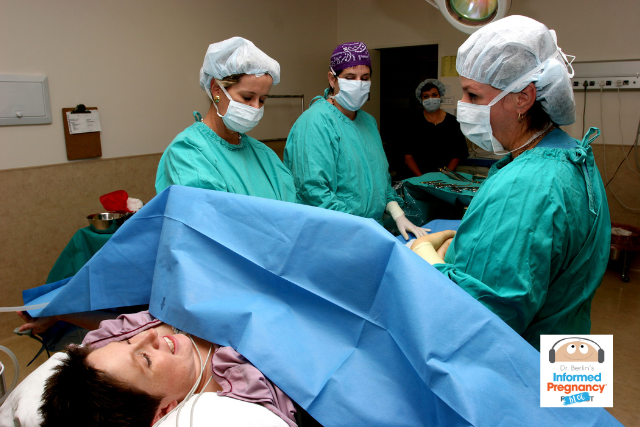
They doped me up and laid me out and cut my baby out. Exhaustion and morphine meant I was in and out of consciousness and have zero recollection of my baby’s birth. I did not hear my baby’s first cry. I did not hear the sex announced. I missed my precious daughter Quinn D’arasay being born. I missed it. I woke up alone in recovery, and when they finally brought Quinn to me for skin-to-skin, I was still so out of it from morphine that I couldn’t see straight, and was terrified that she would fall off my chest. I didn’t get to nurse her; I could barely hold her. Later, I was told she had an infection and needed NICU time. I had failed her.
Every time I think about all this I cry. I feel so horrible that Quinn came into the world the way she did. No one understands what the whole experience did to me – everyone just says, “at least you had a healthy baby.” Of course I feel grateful my daughter is healthy and beautiful, but those comments don’t help. They make me feel worse, like my emotions were wrong or selfish.
I still don’t understand why it all happened. I tried so hard. I felt so cheated. I felt like I let everyone down – Josh, myself, but especially Quinn.
And then came Levi.
Quinn’s birth had left me feeling empty and scared. I felt very torn in the beginning of my pregnancy with Levi, because while I wanted a healthy baby first and foremost, I also wanted to rewrite my birthing history. Two obstetricians told me that I was an “undesirable candidate for a VBAC,” because of Quinn’s “failure to descend.” I initially went with an OB who claimed to be VBAC-friendly, but only made me feel more anxious and confused with how he spoke about the risk of uterine rupture. Since Quinn was 9 lbs 6 oz at birth, he wanted a late-term ultrasound to detect size, and then wanted to discuss a repeat cesarean if the baby was “too big for my pelvis.” It became clear the stars were going to have to align perfectly if I was going to birth Levi vaginally. How in the world could I guarantee that? I didn’t want a repeat cesarean, but I also didn’t want another traumatic birth. Then I found www.vbacfacts.com, and everything began falling into place; finally I had real information at my fingertips.
Thanks to the members of the www.vbacfacts.com Facebook community, I became convinced I needed a doula to attend my next birth. That doula search led me to the Sanctuary webpage, and then to a free Q&A for expecting parents. That night that I met members of the Sanctuary birth community, and it changed everything. Listening to Dr. Stuart Fischbein and midwife Aleks Evangueldi speak about birth compelled me to share my story, and everyone who listened echoed the same words: “Of course you can do it! You are a great candidate for a VBAC. You are not broken.” I finally understood that I needed to take control of this birth, and manually align the stars myself. I left my supposedly ‘VBAC-friendly’ doctor who had only filled me with doubt for a team of hospital midwives, who welcomed my pregnancy and cheered on my VBAC hopes from day one. I hired a homebirth midwife to act as a monitrice, instead of a doula – I needed her support and wisdom to help me labor at home as long as possible. I took a birth class that taught me new ways to connect with my body and trust in the birth process. I began seeing Dr. Berlin for weekly chiropractic adjustments and massage. I found ICAN. I took spin classes and did yoga twice each week, and even put myself on a low-carb diet to try to keep the baby’s size down! I was a woman on a mission…
For a few weeks before my son Levi was born, I experienced prodromal labor nightly. I’d go to bed hoping to be awoken by ‘the real thing,’ only to wake up the next morning still pregnant and disappointed. Our due date came and went like any other day and before I knew it, I was officially a week ‘overdue’. I found myself battling old anxieties about my body’s ability to give birth naturally. Was there something wrong with me? Once I hit 41 weeks, I began to undergo NSTs with fluid checks and membrane sweeps at the hospital. When I went in for my second NST and membrane sweep, my midwife told me she was comfortable letting me go until 42 weeks as long as the baby and I were fine, but once I hit that magic number we’d need to introduce something to get labor going – hospital policy.
Fortunately, after my second sweep things began to get moving! That night, under the light of a blue moon, I began to contract regularly. My contractions kept me up through that evening and into the next day, and when I went to the bathroom at around 8am, I saw bright red blood. It kept coming, so much that I started to feel anxious – my husband and I drove to the hospital, even though I was in constant contact with my monitrice and she was confident it was just my ‘bloody show.’
My monitrice was right, but I was grateful to know the bleeding was normal. We also found out that I was 4cm dilated! The hospital was willing to admit me, but we declined the offer.

Back at home, my contractions petered out. I just wanted to be alone in our bedroom with Josh. My monitrice hung out with my family, staying close in case I needed her. I was feeling low, and needed space. I felt like this baby was never going to come out. But then came sunset, and my labor returned, only this time with more intensity. I felt strong back pain and knew my baby was moving lower. It was only a few hours before I began to feel shaky. My monitrice offered to check me, and suggested we should head to the hospital – it was time to have this baby. HURRAH! I kissed now two-year-old Quinn, and off we went.
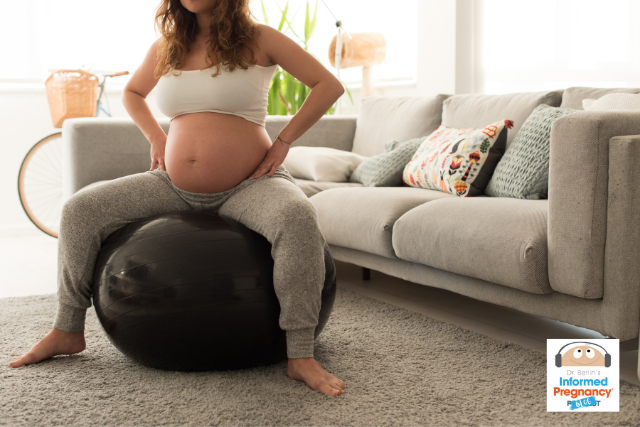
We were greeted by the midwife on call, and settled into our labor and delivery room. A check revealed I was 5-6cm dilated. I labored for a while on my yoga ball, until my midwife offered to break my water. I was torn; with Quinn, my water broke before labor began, which led to a flood of interventions and eventually my traumatic caesarean. My midwife and monitrice both assured me this was a new baby, a new labor, and I was already almost 6cm – I couldn’t let Quinn’s journey decide what journey was best for Levi.
I agreed, and they broke my bag. My midwife suggested heading into the shower, but as I walked I felt a huge gush of fluid and my labor took off like a speeding freight train! I could barely walk. I could actually feel my pelvis widening. Within minutes I climbed onto the bed completely naked, and squatted facing backward so I could hold onto the back of the bed for support, breathing through each contraction with Josh by my side. One more check – I was 9cm dilated!
From there my body completely took over. I had to push. There was no controlling it. I turned around on the bed and sunk down into my squat, leaning my back against the bed as I pushed. Never in my life had I felt such a sensation. I didn’t think I’d be able to make it through the pain, but I had my support team surrounding me, pouring their love and energy into my labor and my body. I can still hear my amazing husband shouting in my ear as Levi was crowning. “He’s being born RIGHT NOW! Our son, he’s coming, I can SEE him, you’re doing it, Allison, YOU ARE DOING IT!” as I pushed out my sweet baby boy – all 9lbs, 2oz of him – in only 20 minutes! Immediately after his birth, he was placed on my chest, warm and slippery and beyond beautiful, as my husband huddled beside us.
Levi’s size at birth was almost identical to his sister’s, the size I was told I was physically unable to birth myself. I had proven them all wrong. I really wasn’t broken. Actually, I was a freaking rock star! I carry this new confidence with me daily. It’s in everything I do – the way I walk, talk, and love, the way I mother and the example I set for my own daughter. Two lives came into the world that morning – both that of my precious son Levi Zephyr, and a new life of my own as a stronger and more self-assured mother-of-two.
Stay up-to-date on Dr. Berlin’s Informed Pregnancy Project!
 Allison Sowers-Altman is currently hitting the pause button on her career as a freelance television producer to stay home with her two beautiful children, Quinn and Levi Zephyr. Along with her husband of 7 years, Joshua Altman, they live happily in Venice Beach, CA.
by Jenna Pastuszek | Oct 12, 2022 | Family and Relationships, Infant Care and Breastfeeding, Mental Health
” I assumed that since my body had chosen when to eject its womb occupant, it would also do its job to produce milk on time. You know what they say about assuming.”
I’ve never liked my boobs.
I remember learning about breasts in sixth-grade health class, hearing that as soon as a girl got her period, she’d get boobs to go with it. Yes, you now have bloody underwear once a month, but in exchange, you get nice round melons! Sounded like a good trade to me!
When I eventually got my period two years later, no boobs came with it. The bloody gift continued to show up, but my melons never got round. They looked more like pointy pyramids wearing mosquito bite hats.
In college, I did everything I could to make it seem like I had bigger boobs. I wore push up bras. I wore two bras at once. I even wore these giant silicone inserts that my roommates and I lovingly referred to as “the chicken cutlets” until one night I got too drunk, went home with the captain of the swim team, and woke up to see the chicken cutlets prominently displayed in broad daylight. That was the last time for me and him AND for me and the chicken cutlets.
Need more info? Listen to The Informed Pregnancy Podcast here!
In my 20s, I learned to cope with the hand (boob) I’d been given. I accepted that I’d always need to have clothes tailored to adjust for my unproportioned mounds. I found sticky circular cups to peel on underneath bralettes to give my body a more feminine silhouette while foregoing underwire. I even learned to laugh at how small they were alongside other people, like the time I was doing a musical and the sexagenarian male artistic director presented me with a giant pink push up bra to wear under my costume. “Don’t worry, Jenna. My wife tried this on for me last night, and it’ll help you get into character.” Fantastic.
These are not mine
Before getting pregnant, I found it easier to simply pretend that they weren’t there. I felt so ashamed of their pathetic presence that I even told my husband to stop asking me to take my shirt off when we had sex. It didn’t matter to me that he thought they were nice. To cope, I had written them off as dead.
When I got pregnant, one of the first symptoms I had was rapid breast growth. The skin pulled painfully taught and tingled and was sensitive to the touch. My nipples were so itchy, and when I looked down at my chest, I was convinced that I was staring at someone else’s areolas. Who’s missing a pair of boobs, I thought, because these are not mine.

Nursing wasn’t something I was super enthusiastic about given my lifelong breast trauma, but I was set to do it for the added health benefits for me and my baby. So I was disappointed when at 35-weeks, my OBGYN told me that my baby was Frank breech, and if he or she did not flip, I was going to have a c-section. I was nervous that scheduling the arrival of my child would affect breastfeeding if my milk didn’t come in quickly enough. After trying everything to get the baby to flip (spoiler alert- he didn’t…#Leo), I accepted my fate and scheduled my operation. As luck would have it, I went into labor spontaneously four days prior at 39w1d. I assumed that since my body had chosen when to eject its womb occupant, it would also do its job to produce milk on time. You know what they say about assuming.
Squishy and unreliable
My boobs continued to betray me into postpartum. My milk didn’t come in fast enough to prevent my son from losing over 10% of his birth weight in the hospital, so on day 3, we had to supplement with formula. It turned out that he was born with an upper lip and a posterior tongue tie, so latching was a frustrating experience for all: he, because he was working too hard to get the meager sustenance that was there, and me because he was gnawing like a weasel at my sore cracked nipples.

By the time we got the ties and latch sorted out, my child had made up his mind:
Why go back to something soft and squishy with unreliable output when a plentiful plastic bottle is an option?! He even faked falling asleep to get out of breastfeeding! Multiple times! Whether it was the hormones or not, this was the most painful rejection I had ever experienced- even worse than my sixth-grade crush Jason Miran rejecting me and my mosquito bites at the school dance.
Befriending my boobs
On the drive home from the hospital, I realized I had to befriend my boobs. It was as if they were on strike because of my reluctance to accept them for what they are. I sat down at my breast pump and decided that unlike middle school, I refused to let my son’s rejection define me. My breasts are a [small] part of my motherhood experience, but they are not all of it. Whether round or pointy, on display or hidden, elastic or inverted, over full or empty, I will still be a good mother. A good mother with a great set of tits.
Follow Dr. Berlin (on Instagram, not in real life…) for all the latest Informed Pregnancy content!

Jenna Pastuszek (she/her)is a professional actor, singer, voice over artist, musical theatre educator, and voice teacher. Jenna has performed in theatres across America in a variety of mediums, including her acclaimed solo shows GET HAPPY! and ME,MYSELF & BARBRA. She is a voiceover artist, voicing household brands like Starbucks Cafe, Pepsi, Amazon, KIND Bar, Target, IKEA, Crest, Toyota and more. She is the Co-Founder of Innovative Voice Studio, where she trains Broadway performers and works with leaders across industries through Innovative Performance. Previous faculty positions include The University of the Arts, New York University, The American Academy of Dramatic Arts, The American Musical Theatre Academy, and Musical Theater College Auditions. Pastuszek received her Masters in Teaching in Elementary Education and a BA in History and minor in French from the University of Virginia and her Masters in Vocal Performance and Advanced Certificate of Vocal Pedagogy from NYU Steinhardt. She is an Estill Voice International Master Trainer and a graduate of Seth Godin’s altMBA. Learn more at www.jennap.com.
