
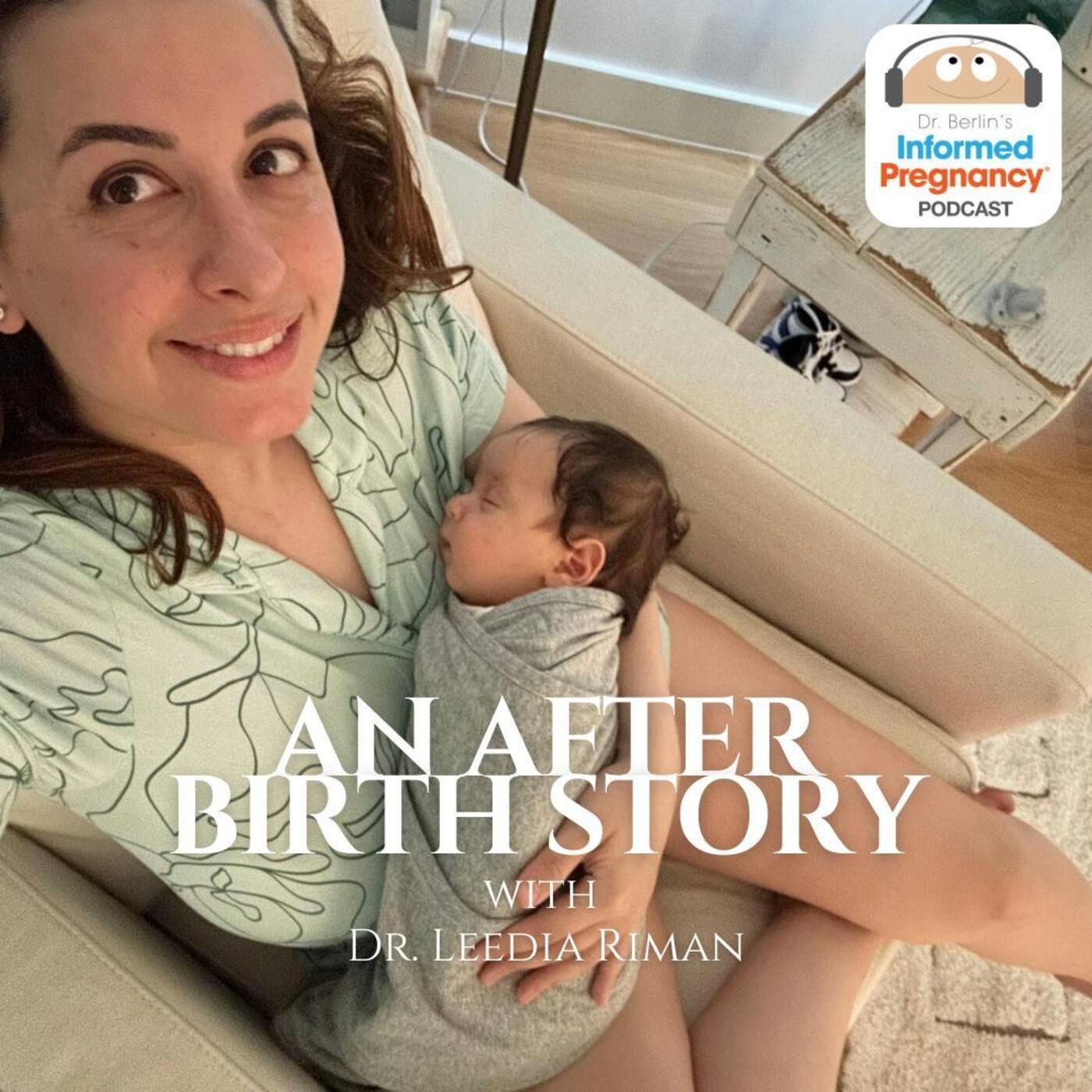
September 12, 2024 · 37 minutes · Episode 424
About this episode
Holistic dentist Dr. Leedia Riman returns to tell the birth story of her third child after a traumatic first birth and an experience with postpartum depression.

Connect with the guest: @drleedia and rdentalgroup.com
Key quotes
“It's very difficult mentally when you're waiting for nature to take its course, you got to lean into the trust, you got to lean into your faith, you got to lean into God. And you got to learn and you got to open up your heart and mind and just trust the process and trust nature.”
“I felt like I died and I came back to life. I felt like I went and I got him. And it was very magical, very magical.”
“So instead of baby showers, people need to have like a night nurse fund or like, you know, night help fund because moms need to sleep, period.”
“If you're healthy, your heart's beating, you're able to breathe, you're able to consume food and feel good about it. Life's a blessing.”
“Holistic dentistry honors the whole body as a whole and integrates your mouth into your body and looks at everything as a whole instead of just looking at a tooth with a cavity or not and drill and fill dentistry.”
Related episodes
- Ep. 423 Leedia Riman: Before Birth
- Ep. 414 Aly Michalka: After Birth
- Ep. 443 Jessica Zadeh: After Birth
- Ep. 418 Exploring Freebirth with Catalina Clark
Transcript
AI-generated transcript with speaker labels — may contain errors, especially names and medical terms. Dr. Elliot Berlin, DC appears in blue; Leedia Riman in orange.
Download PDF of the Transcript
Dr. Elliot Berlin, DC [0:12] Welcome to the Informed Pregnancy and Parenting podcast. I'm your host, pregnancy-focused chiropractor Dr. Elliott Berlin. Today, we have a follow-up episode with Dr. Lydia Ryman, who recently gave birth to her third child. Dr. Ryman, a holistic dentist, joined us previously to share her compelling journey through her pregnancies and birth experiences. And today, she's back to share the rest of her story. Lydia Ryman, welcome back to the podcast.
Leedia Riman [1:01] Thank you for having me.
Dr. Elliot Berlin, DC [1:03] I can't wait to hear the rest of the story. Just as a recap for anybody who didn't listen to the first episode, you had two challenging pregnancy birth experiences. You got the awful hyperemesis, nausea, vomiting all through the pregnancy. You had not the greatest support. And then even in your second birth, not in love with the level of informed consent. And then you assembled yourself an amazing care team. And last time we talked, you were about to set sail for a much more empowered experience. Let's start with the end of your pregnancy. How was the last bit of pregnancy for you?
Leedia Riman [1:38] The weight was very challenging. So after we spoke, I was having inconsistent contractions and I gave birth, I think a week later. So like a week of on and off. A week of on and off. Yes. How do you get through that mentally and physically? It's very difficult mentally when you're waiting for nature to take its course, you got to lean into the trust, you got to lean into your faith, you got to lean into God. And you got to learn and you got to open up your heart and mind and just trust the process and trust nature. And I think that's something that we've steered very far away from trusting nature, trusting the process in our bodies as women. And I can say this
[2:22] really wholeheartedly because I didn't trust my body the first couple of times during the delivery portion. And this time I trusted and having that support system, like I had my doula, Laurie Bregman was an angel throughout the process because I knew I had someone to resort to. I can express to her all my full emotions. There was one day she actually physically came to me and met with me. She's like, I feel like your anxiety levels right now needs me physically next to you. And she came and just having that level of support. And it doesn't have to be a doula, it could be a friend, it can be your mom, it can be your grandma, it can be anyone, but someone who really understands what
[3:02] trusting the process really means, someone wise, because our bodies are magical and they really, really, really, really are. So yeah.
Dr. Elliot Berlin, DC [3:11] Aside from that, are there other things that you did to find trust in your body?
Leedia Riman [3:15] You know, I meditated a lot. I got acupuncture at home. I visited you quite a bit right before, I think the last couple of weeks, I didn't leave the house. So I didn't see you, but I had an amazing chiropractor on board that knew how to deal with a pregnant woman's body. And I got my teeth cleaned and that always makes me feel better too.
Dr. Elliot Berlin, DC [3:37] Right? Doesn't teeth cleanings make you feel better?
Leedia Riman [3:39] It's when it's over. When it's over. Yeah. But the process is just knowing what the crap that they're getting off your teeth. I did a lot of self care and a lot of self love. I ate very well. I really focused in on my nutrition. I paid attention to how I was feeling and I wouldn't allow myself to be around anybody that didn't make me feel good. Like I really paid attention to the frequency that was surrounding. Like I tapped into my source. I really listened to every gut feeling that came my way because when you're nine plus months pregnant, it's on another level.
Dr. Elliot Berlin, DC [4:15] Yeah. It's amazing that you were able to hear the messages and to adhere to the messages. Those are both not always present. I don't always hear the messages so that you can hear them and that you can take action. I mean, we're animals. We respond to the stimuli around us. And so if your body is telling you what it wants and what it needs to be able to hear that and comply is powerful. I will say because you mentioned how much better you felt after you had your teeth cleaned that in our third segment today, in this episode of the podcast, we're going to talk hardcore about holistic dentistry and dentistry during pregnancy. So before we get to that, I really want to get into your birth
[4:55] story because I'm excited to know how it went for you. It sounds like you really were in a different place going in. How did labor start and how did you know that was labor compared to the week of contractions leading up to it?
Leedia Riman [5:05] So labor never started full force. I was walking around town, six centimeters dilated on the Monday that I gave birth. So I got checked that Friday and the doctor was like, and him and Laurie, based on all my symptoms, my mucus plug was completely out. They're like, this girl is having her baby this weekend for sure. 100%. I'm like, okay, sure. I'm ready. And the weekend passed and I was still getting those like contractions here and there, nothing consistent. I was doing my warm baths. I was doing my walks, everything. And I was like, okay, I'm ready to go into labor anytime. So Monday morning, he texts my doctor test story. He's like, did you have a home birth and not tell me?
[5:46] And Laurie was like, did you have a home birth and not tell me? I'm like, no, I'm pregnant. And she started laughing. She's like, I think Dr. Katz wants to see you. I'm like, yeah. I mean, I'm like, you know, I was feeling anxious. Like what you do, like you tap into, like, you calm down, you meditate, you listen to your gut. And then you're like, oh my God, like, I still haven't had this baby. So I'd go into the anxiety and then I'd calm down, go into the anxiety and calm down. So that morning, I told my husband, he's coming with me to the doctor. I had a feeling that was it. And he was an eclipse baby on April 8th. Yes. I'm like, another magical thing is happening.
Dr. Elliot Berlin, DC [6:25] That's so interesting. Cause this started as a twin pregnancy. Yes. I don't know. There seems to be some metaphorical eclipsing of the celestial bodies. Cause one of the babies diminished early on.
Leedia Riman [6:39] Yes. So at 10 weeks, one decided to continue on his spirit journey. I think he's a boy, but it was very divine. He was born on a divine day and he was born in a divine manner. And it was so beautiful. I never thought I'd be saying that about birth because pre this Lydia was like, oh, I can't wait till it's over. But the eclipse, I don't know, something in there
Dr. Elliot Berlin, DC [7:04] is lighting up in my head about the eclipse and the original twin pregnancy. Yes. We'll keep going. But where in relation to the 40 week mark is this? I was 41 weeks. And up until then, I mean, walking around at six centimeters, had you done anything to try to move things
Leedia Riman [7:21] forward? I tried everything. Okay. Medical things like sleeping, sleeping. So no, we did not sleep. Okay. So just more natural things. I really wanted to do au naturel as much as possible. So I'm like, okay, I think it was 40 and a half weeks, not 41 quite yet, but I was four to five centimeters the prior week when he checked me. He's like, you're having this baby like this week for sure. And then the weekend for sure. So Monday came, eclipse day came in my head. I was like, okay, if I'm more than five centimeters, I'm okay with whatever. Cause I was that patient that was not fighting back the system. But like I said, I wanted nature to take its full course. I didn't want toson. I didn't want the after all. I didn't
[8:07] want any of that jazz that they give you that sometimes needed, but I didn't feel like I needed it anyways. Long story short, I was six centimeters. He's like, Lydia, you got to go to the hospital. Like you're having this baby today. And I'm like, you know what? I surrender to that. I feel good about that. Like something in my heart felt good. He's like, go have lunch. So my husband and I go to air one right next to Cedars and we're hanging out and we're eating lunch. And the doctor calls me. He's like, where are you? I'm like, I'm having lunch. He's like, can you finish your lunch? I'm like, I'm really enjoying my burger, but sure. I'll head on over. And we checked into the hospital at two 30. As soon as I checked in to the
[8:50] hospital, my husband's like, Oh, I need a nap. Are you serious? I want to write a book, like men say in the labor room that they should never say. Oh yeah. All throughout pregnancy. I think you could have a multiple volumes there. It's a hundred percent. And so two 30 we checked in and then like, I was getting contractions, but I was able to talk through them. I was feeling really good, like excellent. And then he came in, he's like, I think we are body needs a little bit of help. I think I was like almost seven centimeters and I was not wow. Fracting. And so I got a woof of pitocin and then my body started contracting, but I was still comfortable. Like I was feeling the discomfort, but I was very
[9:35] comfortable with the discomfort. I was still talking and joking around with all the nurses, et cetera. And then they checked me again, by the way, midwives, God bless midwives. I did a midwife there. There was a midwife there. I was very, so at Cedars, they have a midwife team, a midwifery team, and they come and they do the checks. And man does a check by a female midwife. Does it feel different than any other person? They're like very, very, very gentle, like very sweet, very kind and gentle. Then we decided that it was time to break my water. When we broke my water, the amount of amniotic fluid that came out of that was definitely made for twins. So
[10:19] this little guy was very comfortable in there. The amount of water, they were shocked by how much water. So he was very comfortable swimming in there.
Dr. Elliot Berlin, DC [10:26] The Olympic swimming pool.
Leedia Riman [10:28] Yeah, exactly.
Dr. Elliot Berlin, DC [10:29] But also not so much pressure on your cervix then.
Leedia Riman [10:32] Not so much pressure on my cervix, but-
Dr. Elliot Berlin, DC [10:34] Like from the head pushing and stretching your cervix, releasing oxytocin and big doses.
Leedia Riman [10:39] Exactly. Yeah, that wasn't happening. So after that, I felt the contractions. And after that, I felt the most amount of pain I've ever felt in my life.
Dr. Elliot Berlin, DC [10:51] Where?
Leedia Riman [10:51] Everywhere.
Dr. Elliot Berlin, DC [10:53] During the surges or even in between?
Leedia Riman [10:55] Oh, no, during the surges. Yeah, during the surges.
Dr. Elliot Berlin, DC [10:59] So like everywhere front and back?
Leedia Riman [11:01] Everywhere front and back. Like the contractions were very, very, very hard after the water broke. But they lasted for about like I think an hour and a half. It wasn't that long compared to my other pregnancies. And I breathed through it and Lori was there. And my husband, thank God he lifts weights. He was like literally bless his heart. It was really beautiful how we like came together to have the baby. And I asked for the epidural at the very end. I was like, I can't do this. The anesthesiologist came in. He's like, I'm not going to give you the epidural. I think you can do it. And I yelled at him. I'm like, no, I can't. I was like literally screaming at him. And my doctor was like smiling.
[11:38] And Lori's like, you're about to meet your baby. You're about to meet your baby. And then I pushed three pushes and he came out.
Dr. Elliot Berlin, DC [11:45] Wow.
Leedia Riman [11:47] I felt like I died and I came back to life. I felt like I went and I got him. And it was very magical, very magical. The worst part was delivering the placenta. Other than the contractions. So when you have your epidural, after you get your baby, everything happens. You don't feel it. I didn't know that there was another semi-delivery that's happening after the baby comes out. But yeah, it was really nice not to be numbed. The pain's now talking to you three months postpartum. It feels so insignificant, the pain in the big picture. And just the attachment that I had to this baby right away. I can't say that there was an immediate level of attachment with my other children,
[12:30] you know, for various reasons. But it was a very, very, very magical bonding with this baby that I hadn't experienced before.
Dr. Elliot Berlin, DC [12:39] Well, I'm so happy for you.
Leedia Riman [12:41] Thank you.
Dr. Elliot Berlin, DC [12:42] You certainly put in a lot of precursor to this ending. Yes. With the other babies and just a lot of effort to surround yourself with the things that you needed.
Leedia Riman [12:53] Yeah, you know, I wish I knew what I knew now at the beginning. And that's why I love what you're doing is that, you know, a first-time mom can hear this. And if I'm a first-time mom hearing podcasts like this, I definitely like double down to rest as much. I didn't rest in my first, like I did not take care of my mind and soul. Like that's more important than your body almost. Because when you're at ease mentally, things flow more beautifully. And having the right team and speaking up for yourself. And when you can't speak up for yourself, at least having someone who knows your desires, like your doula or your midwife or your partner. Like my husband, bless his heart.
[13:32] I wanted him to be the one who's physically holding me. He doesn't know my needs the way my doula did. He's not made of that cloth. Is that what they say in English? I don't know. Yeah, something like that. He's not cut from that cloth. From that cloth. Like utilize everyone around you to make them shine in the ways that they can. And I think I put a lot of pressure on him the first two times because I didn't know what the hell I was doing. And he didn't know what the hell I was doing. And no one knew about what anyone was doing. So I think it was really good for our marriage. It was really good for our pregnancy. It was really good for like he knew what he needed to do to support
[14:12] and his capacity that he could. Laurie was an amazing support to him as well because she explained things differently than I. So having someone external I think is something I highly recommend for every single pregnancy. Because the options are very high during that phase of your life.
Dr. Elliot Berlin, DC [14:29] I would say my wife is a trained doula and used to practice as a doula. She's a psychologist, but she would go to birth oftentimes with people who needed more of a specialty psychologist if they have extra anxiety or OCD in a hospital, things like that. I'm a doula. I did a lot of birth. And we still had a doula at every one of our births because I think the partner and the doula play wildly different roles.
Leedia Riman [14:56] I love that. Wow.
Dr. Elliot Berlin, DC [14:57] And anybody could be the doula. I mean, you want a good one. So when you really connect with and relate to. But only one person can be that partner for you. And I wanted to be the partner. And she wanted me to be the partner. So it worked out really well.
Leedia Riman [15:11] Beautifully said. Because I allowed my husband to be the partner and I had my doula. And if it's anything that I want to hit the point home for your listeners is to really honor that. Allow your partner to be your partner in the capacity that they're able to. And then your doula will be your doula.
Dr. Elliot Berlin, DC [15:29] Yeah. When all the puzzle pieces come together the right way, it's a beautiful picture.
Leedia Riman [15:35] Yes.
Dr. Elliot Berlin, DC [15:35] When you try to force a piece where it sort of may fit, but you can tell it doesn't really go there. It's not going to be the right picture.
Leedia Riman [15:42] Yes.
Dr. Elliot Berlin, DC [15:43] All right. Let's take a little break. When we come back, we'll find out about postpartum. Don't go anywhere. We'll be right back.

Dr. Elliot Berlin, DC [17:25] Welcome back. We're talking to mom of three, holistic dentist, Dr. Lydia Ryman. Okay. Amazing birth. How is postpartum after that journey?
Leedia Riman [17:34] So also my best postpartum, because once you start doing something right and you're consistent, it usually ends right. And I'm not saying like, oh, there weren't hiccups along the way, or there weren't moments where I was like, but tired, or like feeling a little sad or the blues, but nothing like before. So instead of baby showers, people need to have like a night nurse fund or like, you know, night help fund because moms need to sleep, period. If you're not sleeping, you can't breastfeed the way that you want to. At least for me, I'm talking my own story. So I really want to breastfeed my son for a minimum of a year, exclusively breastfeed. And of course, once he starts solids, he can eat what he eats.
[18:19] With my daughters, I stopped breastfeeding at around three months. Then I went to pumping and then slowly switched to goat formula, which fine, it worked out. They're great. They're wonderful. They're healthy. But I really wanted that rest so I can breastfeed comfortably. So I did hire a night nurse this time around. So I'm grateful that, yeah, we can afford it, but it doesn't have to be like a specific night nurse. It doesn't have to be every single night. So instead of buying toys and crap that moms are not going to use, like the only toys really kids need are leaves and rocks and sand and dirt. Like they don't need all the toys and the crap,
[18:54] the plastic crap that we buy them. So make a night nurse fund, even if it's a few nights a week or one night a week or with your husband, like work it out. Because when you're rested, it makes a world of a difference. I encapsulated my placenta. I didn't need to take too much of it, but I did consume some, especially at the beginning. So I have it for later. I know some people are weirded out by it, but look into it. I'm not the expert on placental encapsulation, but my doula, she took my placenta, one of her friends encapsulated it, and she delivered it to my house.
Dr. Elliot Berlin, DC [19:25] We have a whole episode all about it.
Leedia Riman [19:28] Love it. Perfect. I got proper lactation support. So I had two lactation consultants come to my home after, because unfortunately the lactation consultants in the hospital seem to always be in a rush, get you really comfortable with lactation with like a million pillows that you can never reproduce at home. And I just haven't had the best experience with lactation consultants in the hospital. That's something that I would give feedback to the hospital, you know, like hire people that really care. So I hired two lactation consultants. I had my prenatal masseuse who was doing body work on me the entire time come to the hospital the day I gave birth
[20:06] or the day after I gave birth to just help with the flow and the lymph. So I did a lot of body work and she came almost every other day for a good two weeks.
Dr. Elliot Berlin, DC [20:15] Wow.
Leedia Riman [20:17] Yes.
Dr. Elliot Berlin, DC [20:17] That's nice.
Leedia Riman [20:19] It was really, really nice. Yes. I felt a huge difference. I felt less bloating. Like I just felt better. Like my body was feeling good. The worst part was the hemorrhoids. That was the worst part of them. So I was suffering for about two weeks after, but Laurie told me about this amazing ointment that you need to share with everybody.
Dr. Elliot Berlin, DC [20:39] Oh yeah. They have it on Amazon.
Leedia Riman [20:41] Yes. Oh, you told me about it too. Cause I had messaged you were like, how are you? I'm like minus the hemorrhoids. I think you're like, you better get this. And I did get it.
Dr. Elliot Berlin, DC [20:48] I'll put a link in the show notes.
Leedia Riman [20:50] Please. Oh my God. It was incredible. And what else did I do? And I ate and I didn't leave my house for 40 days. I honored that in our culture. A woman stays home for 40 and like a lot of cultures, 40 days. I did not leave my room. Like I'd walk around kind of to my daughter's rooms, but they knew that I was with their baby brother and I was resting and I needed to rest in order to be healthy for them in 40 days. So they'd count down the days. It was really cute, but I really honored the first 40 days where I was consuming a lot of soups and broths and organ meats. And I just really focused on nutrition as well. And also I was eating more comfortably
[21:33] because I wasn't nauseous anymore. I was like pretty nauseous until the day I gave birth. So I was really enjoying the non-nausea life and enjoying my food. And also I said no visitors. In our culture, people love to visit. And I said no. And it felt really good to say no.
Dr. Elliot Berlin, DC [21:52] You had baked in support. Like sometimes people need those visitors because they'll come and be helpful.
Leedia Riman [21:57] Yeah, I baked in shows who the visitors are, but I didn't want visitors to come to just see the baby.
Dr. Elliot Berlin, DC [22:04] Right, that's a different story.
Leedia Riman [22:06] That's a different story.
Dr. Elliot Berlin, DC [22:07] Yeah, that doesn't help you.
Leedia Riman [22:09] Yeah. So I had friends that would come. They'd hold the baby while I shower. Those types of friends are of course are welcome. You want light people, people that'll bring you a meal, people that are coming to support you. And anyone who's listening, if they know someone who's pregnant about a good birth, focus on her. The baby's going to be okay because she's going to do everything in her power to make sure the baby's okay. It's the mom that usually is not as well right away postpartum.
Dr. Elliot Berlin, DC [22:34] Right, and if you take care of mom,
Leedia Riman [22:36] you're taking care of baby.
Dr. Elliot Berlin, DC [22:37] Exactly, exactly. But if you're taking care of baby, that doesn't actually help mom. Yeah. So you had a hyper-emesis with all three?
Leedia Riman [22:45] Yes.
Dr. Elliot Berlin, DC [22:46] Some version of it?
Leedia Riman [22:47] Some version of it. So the first one, it was like hardcore hyper-emesis where I was actually vomiting a lot. Seven to 14 times a day, every day for about seven months.
Dr. Elliot Berlin, DC [22:57] Yeah. How do you have a second baby?
Leedia Riman [23:00] You know, it wasn't planned. And God was like, okay, you're going to do this again.
Dr. Elliot Berlin, DC [23:05] And then the second time it was a little less intense?
Leedia Riman [23:08] It was a little less intense. But the third time the nausea was very intense where I couldn't leave the house without vomiting. I was on bed rest for, I was bedridden, not on bed rest. I didn't need to be on bed rest, but I couldn't leave because any smell would instigate. And it's funny because we live a pretty low-tox life, like the stuff that we wash our laundry with, like vinegar, air purifiers everywhere, humidifiers, no fragrances, no perfumes, none of that crap. And now I'm even more sensitive to it. So air fresheners, and like I was at my office this morning, I took my baby. So I started going to the office like two to three times a week.
[23:46] I'm not seeing patients yet, but I take him aside, nurse him, and I have a pack of play for him. He's sleeping. I go to the bathroom. I was about to vomit in the bathroom because of the air freshener. So I'm more sensitive to toxic fragrances in the world, but that's okay. I'll survive that.
Dr. Elliot Berlin, DC [24:03] Yeah. I can't imagine after feeling nauseous for nine months, after throwing up for prolonged periods of time, the relief that must be like, I think I would gain a hundred pounds just eating everything under the sun.
Leedia Riman [24:15] Huge relief. Yes. I was eating very well. I was eating very, very well. And I was enjoying it. I was enjoying every minute of it. And you know, when you're in bed for six months, five to six months, you reflect a lot and you reflect on your life and you reflect on your experiences and what you want your life to be like. And the amount of gratitude that came after having Thomas on that day and just being able to get up and move around without being nauseous. Like I was just so grateful to not be nauseous. Like I was beyond grateful to be able to eat and not vomit. It just shifted like my perspective completely of health as well. If you're healthy, your heart's beating,
[24:57] you're able to breathe, you're able to consume food and feel good about it. Life's a blessing. Yeah.
Dr. Elliot Berlin, DC [25:04] I mean, it changes your paradigm.
Leedia Riman [25:06] Yes.
Dr. Elliot Berlin, DC [25:07] Okay. I want to because you have a wealth of knowledge about a topic I don't know too much about, holistic dentistry, and about a topic that's really important to our listeners, which is dentistry during pregnancy. I want to pick your brain on all of that. Let's take a little break and we'll be right back. Welcome back. We are talking to Dr. Lydia Ryman. Okay. What is holistic dentistry?
Leedia Riman [25:42] Love it. Holistic dentistry honors the whole body as a whole and integrates your mouth into your body and looks at everything as a whole instead of just looking at a tooth with a cavity or not and drill and fill dentistry.
Dr. Elliot Berlin, DC [25:57] So how does that play out practically speaking? Like different than when I go to my regular dentist, watch Netflix while they're doing all sorts of things in the mouth.
Leedia Riman [26:05] So holistic dentistry. So when you have a cavity, so a child has a cavity or a patient has a cavity, you got to understand why they got the cavity in the first place. Very important. Are they breathing right? If they're mouth breathing. I'm giving kids, for example, like kids, the amount of ADD and ADHD diagnoses is through the roof. A lot of that is worsened by mouth breathing. So when you're mouth breathing, you're not getting properly oxygenated. Your body isn't creating the right amount of nitric oxide. You're drying out your mouth and increasing the amount of gum disease and dental decay and bad breath and tonsil stones. So a lot of things manifest in the mouth
[26:49] where it's actually something else that's going on in the body. So if you're chronically mouth breathing, if you're malnutritioned, just because you live in a first world country and you have access to all sorts of food doesn't mean you're getting the proper nutrition diet. And we know in this country, the focus isn't on that. Just the food that they brought in the hospital to me was pretty crazy. That's another podcast.
Dr. Elliot Berlin, DC [27:12] That's another five podcasts.
Leedia Riman [27:13] But what type of food are you eating? What's your hygiene like at home? What's your relationship like with your dentist? Because if you do not have a good relationship with your dentist, I guarantee you're going to have dental issues because you're going to avoid the dentist. It's funny because people, when they don't avoid the dentist and they continuously go to the dentist, they have a lot less issues.
Dr. Elliot Berlin, DC [27:33] I heard that makes sense.
Leedia Riman [27:35] So that's a lot less money spent. That's a lot of less time. It's a lot of energy and finances saved. And I focus a lot on women's dental health because hormones matter and hormones don't discriminate. And a man and a woman aren't the same dentally. So we have estrogen, progesterone receptors in our mouth. So our oral tissues are very similar to vaginal tissues. I think embryonic, not think. I know embryonic they stem from the same tissue, the same cell. So we have estrogen receptors, progesterone receptors in our mouth. We even have. So one of the things I'm sure you're familiar with the hormone relaxin, that relaxes all your joints in preparation for childbirth.
[28:14] We have relaxin. We have ligaments around each one of our teeth. And these ligaments, like all the other ligaments in our body, they have relaxin receptors. So a lot of times during pregnancy and after vaginal delivery occurs, and even if it's a C-section, teeth shift and move because of these relaxin receptors. The periodontal ligaments, they're stimulated because of the increase of relaxin hormone in the body during delivery. And also your mouth is the number one source of infection to your body. They found direct links between periodontal disease and gum disease and Alzheimer's, dementia, infertility, lower birth weights, premature labor, joint issues.
[28:59] And if someone who has any predisposed condition or has any condition, localized infection in your mouth where it's making your body fight an infection over here, it's taking away energy from the rest of your body. And I've had patients in my clinic that have had severely infected root canals. After we removed the root canals, certain symptoms in their entire physical body have improved significantly. We had a patient recently who had blood work before and after a deep cleaning. She needed a legitimate deep cleaning because her gums were so inflamed, so, so inflamed. And her C-reactive protein levels dropped significantly after we got rid of the source of infection in her mouth.
[29:42] So I can go on forever talking about this, but your mouth is very linked to your body.
Dr. Elliot Berlin, DC [29:47] Yeah, I guess in general, we don't think about it that way. We just think about, you know, you go to the ear guy for your ear stuff, you go to the dentist for your mouth stuff, but it's such a source. It's the guardian of most things that enter your body.
Leedia Riman [29:59] It's your portal of digestion. So if your salivary glands aren't working well for whatever reason, so it can be a medication that you're taking, can be diabetes, it can be an autoimmune condition, shrogens, et cetera. So if your salivary glands aren't working because of an autoimmune condition, for example, you're going to start getting a lot of decay, and you're going to start getting bad breath, and you're going to start getting gum disease. So it's super duper linked. So we look at the body as a wholesome body and address that. And a lot of people talk about, like for example, ask me all the time about recession and gum health. So the way your teeth fit together,
[30:37] I'm all for braces and Visalign and straightening your teeth. But not only should we straighten your teeth, we should also pay attention to our airway, our tongue positioning. The way the teeth come together is very important because when you have a good functional bite where both sides hit evenly, just think about it. The dental apparatus is honored because it's symmetrical. But if you're hitting your teeth constantly on one side a lot harder than the other, and you have something called malocclusion, it's going to hurt the side that you're occluding on heavily.
Dr. Elliot Berlin, DC [31:09] No, you're speaking my language. I went to an airway course once and three chiropractors spoke. We're on the same team. Yeah, we think similarly. I mean, we look at the spine and the nerves, but we're looking also at the holistic. When I was in school, they used to say all the time that when you step on a dog's tail, it barks. And the idea is allopathic medicine oftentimes looks at symptoms, like really zeros in on a particular area or symptom. And even if you just look at medicine as a whole, it used to be you had one family doctor and they would come to you. And now we go to them and there's a special test and specialties for all the different parts of the body.
[31:52] And they keep becoming more and more highly specialized. You have an orthopedist and there's the upper body, lower body, arm, hand. Now there's just a thumb doctor, only just thumbs. But if you're just looking at the thumb and not the whole body, you're going to miss stuff. So, you know, if the symptom is the dog is barking, then you might look at the vocal cords and anesthetize them. The barking stops, but somebody's still stepping on that dog's tail. Unless you zoom out and look at the whole picture, you're going to miss that. And it sounds like that's what you do through dentistry. And it's pretty cool. I never thought about it that way.
Leedia Riman [32:25] Yeah, it's beautiful when you help somebody. In our office, we're usually like the final opinion or like the second, third, fourth opinion where like something isn't fitting or wasn't working elsewhere. The most recent story I can tell you, and this will hit the point home, someone was having chronic sinus infections and they put them on every single medicine. They had two sinus surgeries and these sinus infections were coming on and on and on. They wouldn't stop. So the source of it was three infected root canals. And the only way we were able to find out, if you have root canals, we always recommend to take CTs because that's the only way that we can see
[33:02] if the root canals are infected or not truly. And we saw massive infection. We removed them and the sinus infections resolved.
Dr. Elliot Berlin, DC [33:10] Wow, that's incredible. Well, you've opened my mind quite a bit. Thank you for that. Before we wind down, I want to find out from your perspective as a mother and as a dentist and as a holistic dentist, are there specific things during pregnancy that people should do either before the pregnancy, during the pregnancy, or after the pregnancy regarding oral health?
Leedia Riman [33:32] Great question. So let's start before pregnancy. In an ideal world, you have a very clean mouth before you conceive for multiple reasons. And so I get your teeth checked, your gum checked, everything. A whole comprehensive exam for you and your partner because our periodontal health has been linked to infertility in two ways. So it increases your CRP, your inflammation in your body. For in men, it increases apoptosis and that's a self-destructive sperm. They've seen that with men with high levels of periodontal disease and can cause lower motility like of sperm. So it takes a sperm and egg to conceive. So we got to look at both and how it impacts both.
[34:16] It's not just always on the woman. Then as a woman, when you have a clean mouth and your baseline is very healthy. So my baseline was very healthy and I suffered hyperemesis, gravidarum and nausea. So I wasn't eating very well. I was vomiting. The acidity levels in my mouth were very high. I couldn't floss my teeth for four months.
Dr. Elliot Berlin, DC [34:37] Oh, wow.
Leedia Riman [34:38] Thank God I had a great baseline. I don't have any cavities, nothing. The only thing that I did develop this pregnancy was two areas of recession because I was grinding a lot every time I vomited and at night. When you're pregnant, you're tired. You're lethargic. Your home care isn't as high. Your brushing and flossing isn't as high. Tongue scraping may not happen as frequently because you are gagging. You're nauseous. Morning sickness isn't stuck to only morning. You have morning sickness throughout the day. So a lot of things change while you're pregnant and things slow down and your level of self-care isn't as high, especially if you're having a hard time with nausea.
[35:12] So during pregnancy, it's important to do your best. Use a baby toothbrush if you're a gagger. That will save you. That saved me.
Dr. Elliot Berlin, DC [35:20] Oh, that's a great tip.
Leedia Riman [35:21] Yes, like go to the children's section and get a soft baby toothbrush. And there's a company that makes flavorless toothpaste. So if you hate mint or you hate strawberry or whatever you don't like, try other flavors and just try your best to get in there as much as possible and get frequent cleanings during your pregnancy. So minimum once at the end of your first trimester and once at the end of your second trimester. And that nips things in the butt if anything is developing. So prevention's truly worth an ounce of cure. But if there is something that's already there, keeping the bacterial load in check will make it not worsen quicker.
Dr. Elliot Berlin, DC [35:55] That's really great. What about afterwards? Any special considerations afterwards?
Leedia Riman [36:00] So as soon as I could, I think it was six weeks postpartum. I got my first cleaning, a very thorough, great cleaning. I got some x-rays done just to make sure I didn't develop any cavities because I was freaking out about that, even though I felt like I didn't have. I'm a dentist, I'm anal about that. I pride myself that I don't have any cavities. And right now I'm getting cleanings every two months. And that's just postpartum, I'm breastfeeding. So a lot of nutrients are coming out of my bones, out of my teeth. I'm trying to focus on nutrition and supplementation. That's very, very, very important because it's depletion that gets us to get depressed
[36:40] and it's depletion that causes us to crash in the postpartum phase. So double down on that because that's going to help your teeth as well. And I feel a difference in my teeth. I was very sensitive the first two months and then now I'm feeling a lot better. I'm not as sensitive anymore.
Dr. Elliot Berlin, DC [36:58] I'm still sensitive, but not just my teeth. It's the way I was made. So thank you so much for joining, for sharing your story in both episodes. I'm really grateful that you had a wonderful experience with this third birth. And postpartum and also informed thanks to you. And I'm going to look at my oral health differently.
Leedia Riman [37:21] Thank you for having me. And you're a part of that, making it amazing. And just your support. You're just so supportive and wonderful. I thank you, Dr. Berlin.
Dr. Elliot Berlin, DC [37:29] My pleasure.
Leedia Riman [37:30] Before we go, where can we find you online? I am on Instagram. It's at Dr. Lydia, L-E-E-D-I-A. That's the main place or drlidia.com, but we're revamping that website. So I'm not sure how soon this will be out, but Instagram is the best way to go.
Dr. Elliot Berlin, DC [37:47] Perfect. Thanks again for joining me. And at home, thanks for listening to the informed pregnancy podcast. For more pregnancy and parenting information, just like this, visit us online at informedpregnancy.com.
Want more pregnancy + parenting? Start your FREE TRIAL of Informed Pregnancy+ and get access to all our curated pregnancy and parenting content — original series, iconic birth films like The Business of Being Born, prenatal workouts and more.
