
January 25, 2024 · 38 minutes · Episode 391
About this episode
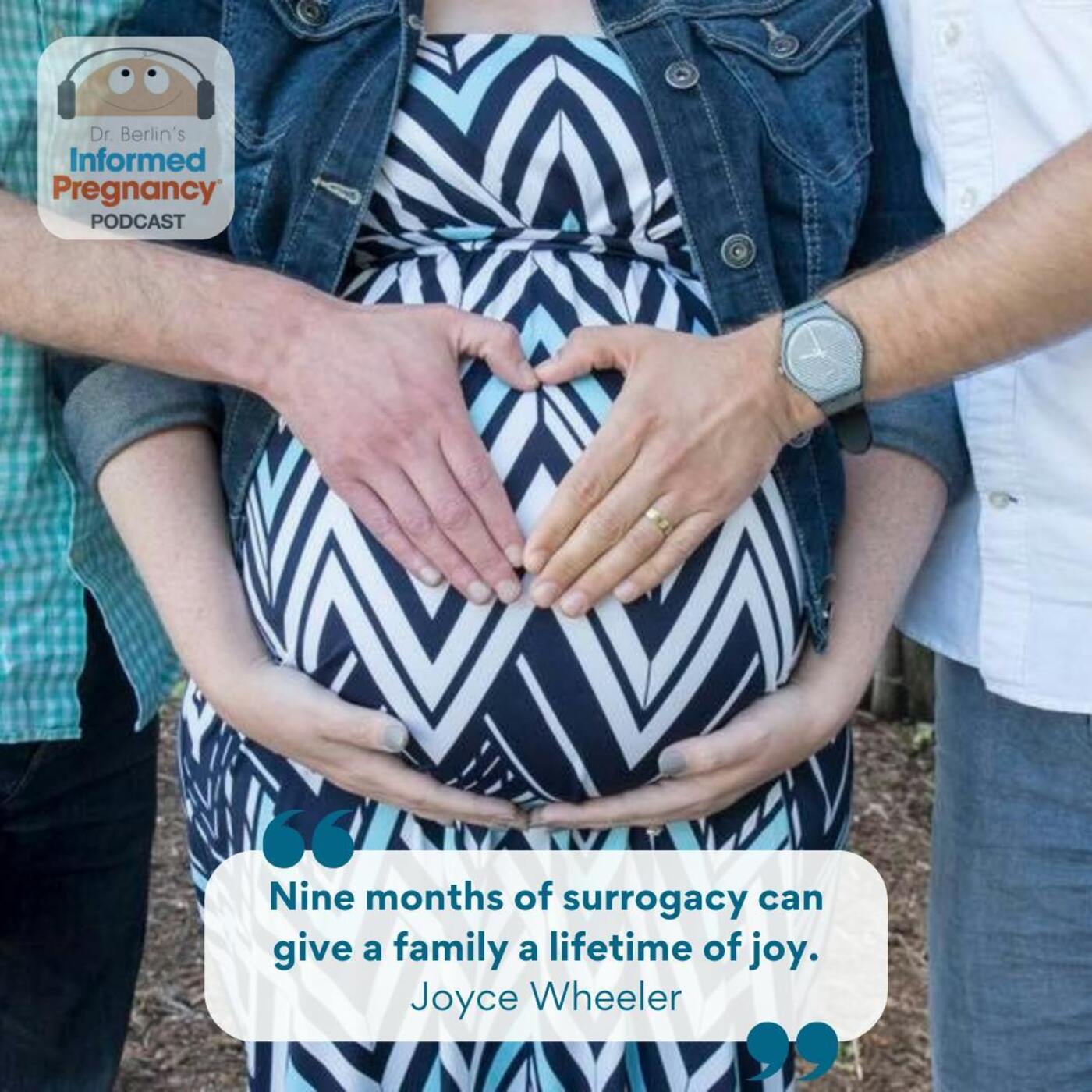
Missouri mother of 3 Joyce Wheeler joins the podcast for a conversation on surrogacy. As a case manager for gestational surrogacy and an experienced surrogate herself, Joyce shares her wealth of knowledge gathered over the years including how she got into the field and her personal surrogacy experiences.

Connect with Joyce online: @fairfaxsurrogacy and www.fairfaxsurrogacy.com
Start your FREE TRIAL of Informed Pregnancy+ and get access to all our curated pregnancy and parenting content: https://www.informedpregnancy.tv/
Informed Pregnancy Media Spotlight: watch The Business of Being Born on IP+ now!
Keep up with Dr. Berlin and the Informed Pregnancy Project online!
www.instagram.com/doctorberlin/
www.facebook.com/InformedPregnancy
Learn more about your ad choices. Visit megaphone.fm/adchoices
See Privacy Policy at https://art19.com/privacy and California Privacy Notice at https://art19.com/privacy#do-not-sell-my-info.
Key quotes
“We have very thoughtful, very caring, very responsible children. And honestly, having children be on me in life, I'm grateful that I got to meet them so early.”
“how did I make it through that? But living through it was completely different. It was, again, you only know what you know.”
“these two beautiful babies were growing inside of me and I was updating their parents every step of the way.”
“That is a battle between the body and the mind.”
“I carry these babies because their mom needed my help. Their dad needed my help.”
Related episodes
- Ep. 390 Dr. Nathan Riley and Low Intervention Birth
- Ep. 422 Pregnancy & Yoga with Caroline Bagga
- Ep. 392 Transformational Birth with Adriana Lozada
- Ep. 389 Kara Sutton: After Birth
Transcript
AI-generated transcript with speaker labels — may contain errors, especially names and medical terms. Dr. Elliot Berlin, DC appears in blue; Joyce Wheeler in orange.
Download PDF of the Transcript
Dr. Elliot Berlin, DC [0:12] To the Informed Pregnancy and Parenting podcast, I'm your host, pregnancy-focused chiropractor Dr. Elliot Berlin. My guest today is a mother of three and birther of six. She now works as a surrogacy case manager. We'll discuss her experience as a two-time surrogate and how nine months of pregnancy can gift a family a lifetime of joy. Joyce Wheeler, welcome to the podcast.
Joyce Wheeler [1:01] Thanks so much for having me. I'm excited to be here.
Dr. Elliot Berlin, DC [1:04] I'm excited to have you here. Surrogacy is picking up and becoming an option for people when it wasn't in the past. More and more people have the option to start a family this way. And there's a lot of curiosity and not all that much information going around. So as somebody who's lived it and now works in it, I would love to learn with you and share with our audience. Let's start with the beginning. Where are you from originally, Joyce?
Joyce Wheeler [1:27] Originally, I'm here from the Midwest. Kansas City is my hometown, born and raised. Kansas City Chiefs and the Royals, I'm sure you've heard of them.
Dr. Elliot Berlin, DC [1:37] Yes. So Kansas City, Kansas?
Joyce Wheeler [1:39] Kansas City and Missouri, the other side.
Dr. Elliot Berlin, DC [1:42] Correct. Yes. The original side. I see there's a rival going on there. All right. So you grew up in Kansas City. Are you still there?
Joyce Wheeler [1:51] I am. I live about 15 minutes from where I was born, from the hospital I was born in.
Dr. Elliot Berlin, DC [1:56] Wow. Didn't go too far.
Joyce Wheeler [1:58] Nope, not far.
Dr. Elliot Berlin, DC [2:00] And then right now, what do you do for work?
Joyce Wheeler [2:02] So now I am a case manager. I oversee gestational surrogacy journeys from the intimate parents, the gestational surrogate. I lead them through their entire journey in that whole process.
Dr. Elliot Berlin, DC [2:16] Okay. There must be a way you got into this. Let's start with your own fertility experiences. From the time you were little, was pregnancy on your mind? Was being a mother something you thought about?
Joyce Wheeler [2:30] I think the evolution of motherhood came to be not initially as a child. I was very much focused on being a kid and enjoying life. But as I got older, I actually met my husband in middle school. We definitely weren't thinking about children in middle school. But evolution, of course, of our relationship, we did get pregnant young right out of high school. And I don't like to use the word in error or by accident. It was absolutely not prevented, if you will. So we took it. We took it as it was. We settled down and we started our family early in life, around the age of 18.
Dr. Elliot Berlin, DC [3:06] Okay. That is kind of really special in today's day and age. Terminology goes over my head. Are you saying not intentional, but not unintentional?
Joyce Wheeler [3:15] I would say not planned, but also not prevented.
Dr. Elliot Berlin, DC [3:19] Okay. Deliberately not prevented.
Joyce Wheeler [3:21] Exactly.
Dr. Elliot Berlin, DC [3:23] Not like one slipped through the cracks.
Joyce Wheeler [3:25] Yeah, definitely.
Dr. Elliot Berlin, DC [3:27] So, I mean, we could go there first. What is parenthood like as a teenager, like a late teenager?
Joyce Wheeler [3:33] Yeah, it was an adventure. I think parenting at any age doesn't come with a book. I mean, lots of books have been written, but none of them are very specific to your journey in parenthood. And so we were young and we made lots of mistakes, as every young parent does, as every parent does. But to see our children 10 years later, to see their growing into who they are as people, we get glimpses of the right decisions that we made. We have very thoughtful, very caring, very responsible children. And honestly, having children be on me in life, I'm grateful that I got to meet them so early. I'm grateful that we got to grow up to an extent together.
[4:12] Lots of trials and tribulations, but I'm forever grateful for that. You know, for that we chose to do that.
Dr. Elliot Berlin, DC [4:18] I don't know how it is in Kansas City, Missouri, but here in Los Angeles, most people I think are starting to have kids when you already have a teenager.
Joyce Wheeler [4:27] That is definitely a trend here as well. I'm noticing several people in our community have a high schooler, but also have a kindergartner coming in. So we don't have that. Our children are all about two years apart, with our youngest being 10. And so we experienced all of the chaos all kind of at once, being all two years apart. I don't know if I could imagine going backwards and having a newborn open again.
Dr. Elliot Berlin, DC [4:54] What were your pregnancies like and your birth experiences?
Joyce Wheeler [4:58] My pregnancy… were textbook, honestly. I did have morning sickness with all pregnancies. I thought that was what everyone experienced and I was really blindsided when I found out my siblings didn't have it. I was pretty grumpy about that. Yeah, the morning sickness lasted about until like the maybe 18th to 20th week of pregnancy. Then it subsided and I got that second trimester glow and ambition and nesting. Third trimester rolled around and I was, we have a wobble and it didn't fall down and just kind of moseyed everywhere that I need to go. Labor came as normal as natural. My first birth itself, my water broke at home straight out of a movie.
[5:42] I saw how all of them were going to go. It wasn't.
Dr. Elliot Berlin, DC [5:46] That was the first sign of labor or you were?
Joyce Wheeler [5:47] Yeah, yeah, I had no signs of labor. Looking back, I probably had contracted that whole day but just kind of brushed it off, full sleeper. My water broke shortly after watching an episode of The Bachelor. It got my emotions all kind of raveled up and I went to go get up off of the couch and when I did, I felt a popping sensation internally and next thing I know, I'm gushing water everywhere. I said, okay, I guess it's time we go to the hospital. So yeah, about four hours later, he was born.
Dr. Elliot Berlin, DC [6:20] Four?
Joyce Wheeler [6:21] Four.
Dr. Elliot Berlin, DC [6:22] Wow, so super quick. Did you have any intentions for birth? Had you done any research or like, I would like it to do it this way or that way.
Joyce Wheeler [6:31] I had gained some insight from friends and family who had already given birth in the past. I knew I wanted to attempt a non-medicated birth but I had no perception of what those contractions would feel like and so going into it, my water broke and that kind of gave way for that cushion in early labor. That water, that bag of water, there's that almost protection against those painful contractions and when that gave way, 20 minutes later, I was feeling very, very intense waves of contractions and I think I asked for an epidural the moment I walked into that hospital. So it was medicated, the first go-around.
Dr. Elliot Berlin, DC [7:11] How was the postpartum and taking home a child? It seems like a big responsibility for anybody. Again, it just seems in my mind that it's like a big responsibility and I feel like it'd be even bigger being so young.
Joyce Wheeler [7:27] It was, but you only know what you know. So postpartum to me, I listened to my body, I listened to my emotions. I was told by the staff at the hospital that I would probably experience highs and lows to validate each emotion and just go with it. So for me, I did. I had postpartum sadness, I had postpartum fatigue, and eventually we found our rhythm. I'd say it took about six weeks to kind of get back my emotional stability and then we just kind of went with it. We had my husband and I, we had a kid and we just lived life. We traveled still, we bought our first home and we just settled down with our toddler in tow at that point.
Dr. Elliot Berlin, DC [8:11] Well, let's take a little break and find out about your other pregnancies of your children and birth experiences and then how you got into surrogacy. We'll be right back.

Dr. Elliot Berlin, DC [9:56] Welcome back, we're checking the choice. All right, so your first pregnancy, other than nausea and early first-premester sickness, pretty smooth pregnancy, watched The Bachelor. People always ask me, what can I do to get my baby out? I never thought of watching The Bachelor. The Bachelors is a foolproof way to go into pregnancy. Will you take this rose? Did you name the baby Rose?
Joyce Wheeler [10:19] No, I didn't name the baby Rose, but that would have been a really good spin-off to that. Ah, had we.
Dr. Elliot Berlin, DC [10:26] Okay. How did we talk earlier? And then, labor, you thought about unmedicated, and then water broke, got to the hospital with pretty intense things happening, and also the whole thing was only a four-hour ride. So it sounds pretty concentrated, like you had a lot of labor over a short period of time, and you had your epidural, and you brought home a healthy baby, and went through that awkward transition we all go through. How were your other two pregnancies and birth experiences of your children?
Joyce Wheeler [10:55] The second pregnancy was very similar to the first. My body was very, there was no, there was no tell, I had no idea that I was actually in labor while walking around Target, joking, and I told my husband, I'm feeling a little contraction, and he said, I don't know if that's a real word. I said, well, I'm using it. So we get to the hospital just to get, you know, checked out, and feeling these, these waves, and they're very similar to the first go-around. Sure enough, I was dialed to a seven, so it was time, and they got me hooked up to everything, and they said, do you want an epidural? And I said, yes, I had it with my first, so they started the epidural, but by the time
[11:33] the epidural had kicked in, I was holding my baby. So he'd be very two hours for that labor at that point. Kind of the worst of both worlds there. A little bit, I couldn't get out, I couldn't move around after he was here, but.
Dr. Elliot Berlin, DC [11:46] And the numbness didn't help you with the birth.
Joyce Wheeler [11:48] Yeah, the numbness, it took about five hours to wear off all together, which to me was kind of funny, because all I could think about was, why did I even get this? He's already here. I felt everything.
Dr. Elliot Berlin, DC [11:58] So, yeah, that's what I'm saying. It is. You don't get the benefit of the epidural, but you're stuck there anyway. Okay. Lessons learned from your first postpartum experience. Did you take some lessons from that to help with your second?
Joyce Wheeler [12:11] I did. The second time around, I had learned from my first pregnancy that I don't have to accomplish it all, that I don't have to do it all. I think I heavily thought in my first postpartum experience that the house had to be in perfect condition for guests that would come over, I had to look nice. Then all of these, like what you see on TV, postpartum experiences, the second time around, I didn't put makeup on, I let the laundry kind of go. At that point, I had a two-year-old and a newborn, and I had to set my expectations back to reality. And we were called through the chaos of it all, and we got into a rhythm. My second born was very, very good at sleeping and just kind of go
[12:55] with the flow, middle child to this day. He is very much who he was since birth. So second time around was almost easier in an aspect because we just, we knew what to expect, but we also knew to set different expectations.
Dr. Elliot Berlin, DC [13:10] Interesting. And some people struggle with the serving two needy customers at the
Joyce Wheeler [13:14] same time after the second baby comes. There was a level of balance that my husband and I both had to focus on. We had a family, not me. I'm going through postpartum, but so is he. He is a dad. He's experiencing emotion. And I remember after our son was born, we were a little bit sleep deprived in those first few days. And we were trying to remember, we're trying to think two hours ahead. Look at the clock, look at the clock and say, we need to be baby in two hours. What time will that be? Well, it was 10 o'clock PM and we needed to feed the baby at midnight. And neither one of us could come up at the time. We couldn't think straight. And my husband ended up drawing a clock on a piece of paper while
[13:56] looking at the clock on the wall. And still we've still went like just set a timer for two hours. I don't know. So we leaned on each other very much so in the second and even through the third pregnancy and delivery. And that one was vastly different than.
Dr. Elliot Berlin, DC [14:14] Oh, tell me about that one. That sounds juicy.
Joyce Wheeler [14:17] So after the epidural incident with my second birth, I figured why even look at epidurals. Well, that rabbit hole turned into a more holistic approach to pregnancy. And I inquired about a doula. So I had a doula at my birth. We looked into placenta encapsulation. We looked into the first breastfeeding crawl. We did all of this research and all of that really came down to just trusting my instincts. I have two children that have given birth twice before. Let's just see where this goes. And that road was long. My first two labors were four hours and two hours. My third on the clock. was 21 and a half dollars and oh wow so they average out more normal yeah that's when it
[15:06] it kind of you know made a how did that one start that one started at home i was doing laundry watching my four-year-old and my two-year-old run around and just be crazy contractions started to build my husband was about an hour away and so with my previous birthing experience i assumed it'd be a 45-minute birth and so i said you got to get home get home now and we got the kids in the car we got them to the sitter got to the hospital and they said oh you're at about a five and i said that's fine get back here in 10 minutes she'll be here well it wasn't that and they asked if i wanted an epidural and i said no thank you i think i'm going to try this unmedicated and so my body just took its time that i had you know
[15:51] that 2020 vision i probably would have stayed at home a little bit longer and labored at home a little bit longer yeah but i had no idea right and based on your history you know unless
Dr. Elliot Berlin, DC [16:02] you have a very comfortable car yeah it wasn't the best at that point i don't know in an
Joyce Wheeler [16:08] equinox is is highly recommended so oh it's sporty so in the end was the doula there with you i mean were things comforting to you do you have a sense of why it took so much longer i think it took longer because i allowed my body to work through each phase of each of the labor so my doula was there i had asked that the lights be dimmed i had fleetwood mac playing in the background and i was just enjoying the experience i had the doctor dancing and the nurses were in there and i honestly think it took as long as it did because my body was relaxed i was relaxed i wasn't tense i wasn't worried about this giant epidural going in my back i was just doing what my body was made to do and allowing my daughter to come into the
[16:59] world how she wanted to so had i been at home i wouldn't even looked at the clock and i actual total physical labor so maybe transition or when it got complicated it was closer to an hour and a half so the clock may have said 21 and a half hours but i really felt that last hour of everything and that's when it became intense and beautiful at the same time because at that point without any medication my body was doing everything i wasn't pushing my body was pushing and i was following suit i would stop and pause when my body would stop and pause i break when my body said okay we're done for now she came into this world very peacefully very beautifully they laid her on my lower stomach and we waited we waited to cut the
[17:47] cord at that moment within five minutes of her being born she started to scooch her way up and start to breastfeed and that was the most beautiful experience i could have ever imagined having her exactly how i wanted to no it's so beautiful and also i imagine different to just be able to get up and walk around when you want to you know yeah the experience afterwards with no medication no time to wear off i thought myself helping the nurses pick up and it was instinctual i got up the baby was on my husband's chest and i was tidying up because i wasn't in pain i had felt better than i had had in years it was what i assumed to be the birth time you are on cloud nine you had just experienced something phenomenal
Dr. Elliot Berlin, DC [18:36] yeah that sounds beautiful month nine okay so you're young you're healthy you have three very healthy pregnancies and birth experiences great candidate to be a surrogate but how do you get into surrogacy so everyone's path to surrogacy looks a little bit different
Joyce Wheeler [18:55] my path to surrogacy was during my healthy pregnancies during my healthy births and my beautiful children i was almost surrounded by those facing infertility specifically my aunt my mother's sister who had been in the room the day that my son was born and i remember celebrating in that moment but also seeing my aunt in a way that i had not seen her before she was vulnerable i could tell that she wanted that experience i could feel it but she knew due to life itself due to unforeseen circumstances and the diseases that she had had she's not able to carry so i remember thinking the day my first born came into this world i remember thinking i could do this specifically for her at that
[19:43] moment but life took her in another direction and she became a parent through step-pairing adoption but that thought was planted that seed was planted and i wanted to give someone else something that my body was capable of doing in a nine-month period so i it. I found the surrogacy through that. So did you want to become a surrogate so you can carry a baby for your aunt? Initially, yes. My intro into surrogacy was looking at my aunt that day and realizing that she wanted to be a parent and how could I help? I just gave birth. I'm capable of this. Why can't I do this for her? And so that started my path into surrogacy. But you didn't carry for your aunt? I did not. Fate would have it that she was in a relationship. She had
[20:31] started a relationship at that point. He had children and she became a stepparent. And so that conversation kind of fizzled when she got her wish of becoming a parent. But the thought of doing something like that, carrying a baby for someone, the emotion that I felt the day my son was born towards my aunt was just as high as ever. I wanted to do that and so it never left my mind. It just was no longer geared towards that family member. But I still had several family members and friends who were facing infertility, unexplained infertility even.
Dr. Elliot Berlin, DC [21:04] Yeah. I mean, we struggled with that for a few years before kids started popping out.
Joyce Wheeler [21:09] And I wonder for you, did you and your partner decide three is our family unit, five people, three kids? We did. Honestly, that conversation was right after our daughter was born. Before my daughter was born, I had this sense, and it's so silly, but sitting around the dinner table, I remember before my daughter was born, before she was ever, before I was ever even pregnant with her, I remember always having this feeling like there's someone else. I feel like we're missing someone. And it wasn't like the traditional, oh, who's missing? Let me count kids. I just had this presence that I felt I needed one more. And I didn't care if it was a boy or girl. We never did. But it was kind of a bonus that we had had two boys and our third and final
[21:53] was a girl. And that was kind of the universe's way of saying, okay, I think we're done. And it felt complete. She came into our world just as perfect as ever. And it very much felt complete. And we were done. Three and through. Beautiful. So you had a surrogate pregnancy after your three. How did you match with that family? So again, the universe works in very fun ways at times. And I had just gone public, public as in Facebook, as one does with news that I had been considering surrogacy for quite a while. And I was hoping that friends and family would send good wishes and good vibes and just hope that we found someone. And also, if anyone knows of anyone looking for a surrogate, then to reach out. And so
[22:42] that was late at night, about 30 minutes after that post was made, my husband's aunt reached out to us. And she had shared that her husband had attempted to build a family and were facing many roadblocks. And they had just started considering a surrogate. But there were some apprehensions to their thoughts. And that was, how do we trust a stranger to carry our baby? And I mirrored those apprehensions. My thoughts were, how do I carry a baby for a total stranger? How does this work? And so we continued that conversation over dinner. And a few short months later, I was headed to their clinic for medical screening to establish care at their fertility center and to make sure that my body was where it
Dr. Elliot Berlin, DC [23:30] needed to be to carry a pregnancy rhythm. Wow. I mean, to me, it's such a huge commitment to even consider. And now I kind of feel the energy where, at this point in your story, you're on the path. Let's take a little break. When we come back, we'll find out about your surrogate pregnancies and the work that you're doing now. We'll be right back. Welcome back. We are talking with Joyce. So here's the thing. Now you're on the path to surrogacy. What is the process like for you to find out if you're qualified, if you're, I don't know what you would say, cleared to be a surrogate?
Joyce Wheeler [24:18] So the path to find out if I'm clear to be a surrogate or any woman who's interested in surrogacy, it's a pretty strenuous journey, but those that are capable and willing get through it pretty quickly. So the first step is typically an evaluation by the clinic. And that fertility clinic, those the intimate parents are connected to, is the one that's going to do the evaluation. They're going to do a physical. They're going to check your BMI. They're going to check your pregnancy history and overall health. And then they're going to do a series of tests of their self. So they're going to do lab work. They might do a saline ultrasound, which checks for any sort of blockages in the uterine cavity.
[25:00] to do what's called an ERA. So that's going to test the activity of the urine lining. Each clinic has their own protocol, but that's typically the first step is to get medically cleared. You're also going to get psychologically cleared because they wanna be sure that we're of sound mind and that we're capable of any hurdles that might come up that we can communicate those hurdles with our intimate parents and be okay to go through it, to go through the whole process. So once you're medically cleared and psychologically cleared, then you're looking at the legal clearance of things. So there is a legal contract with the surrogacy. The attorneys, you'll have one
[25:40] and your intimate parents have one. They work together with your surrogate and with yourself to make sure that the contract is beneficial for both sides. That's going to go over parentage and different aspects of the surrogacy journey to make sure everything is done legally as well.
Dr. Elliot Berlin, DC [25:59] I guess there are preferences, right? How do you line up the preferences of the person who is carrying the baby and has a very physical role that involves their health and their comfort and how they've birthed in the past and maybe how they wish to birth together with preferences that the intended family might have.
Joyce Wheeler [26:21] So the matching preferences are incredibly important because you are entering into a commitment with each other and you want it to be good. You want it to be beneficial for both sides. And so things like location might be important. Where are you located in comparison to your intended parents? Things like how is your support system? How is their support system? We want to be sure that the intended parents have a good support system to go through the journey with them. We want to make sure that that surrogate has someone that she can lean on throughout the pregnancy. Pregnancy can be tough at times. And so whether that's a spouse or a family member,
[26:58] they have to have that supportive role. Things like termination stands. We don't want to think about termination when we think about surrogacy. We don't want to think about the negatives that could potentially happen. But the truth of the matter is pregnancy in general can be hard and there can be decisions that come up during the utero that need to be decided upon. Who makes that decision? Is it the surrogate? Is it her body, her choice 100% or is there room for the parents to also make decisions when it comes to their child? So all of those factors play into matching and we expect total honesty and sometimes it's brutal honesty because life is full of brutal honesty
[27:36] and you want to be sure that we're making the right choice.
Dr. Elliot Berlin, DC [27:39] And it just sounds like there's a lot that can come up for just opinion. If you think about all the choices that someone might have to make just in their own birth or their own pregnancy, what if the babies breach or do we want to try to turn the baby or just have a cesarean or give birth to a breached baby vaginally if the placenta doesn't fully clear the cervix? If you go past your due date, do you want to get induced or wait? Or there's so many different choices to make that affect both the host and the child. And it's a lot to consider at the beginning even if those things never come up. I want to get back to you for a minute. So how was your first surrogate pregnancy?
Joyce Wheeler [28:19] Well, my first journey was eventful but beautiful all at the same time. I had been used to carrying one child at a time and surrogacy allowed me to carry two. So I was pregnant with my husband's aunt's twins.
Dr. Elliot Berlin, DC [28:34] Oh wow.
Joyce Wheeler [28:35] Yep.
Dr. Elliot Berlin, DC [28:35] Meaning identical twins
Joyce Wheeler [28:36] or did you put more than one embryo? We did, we put more than one embryo. So they were fraternal twins, siblings born on the same day. The embryos were not selected based off of sex but more so the grading, how they were, the genetic makeup, things like that that were important to us. And so when we did the anatomy scan, we found out we were carrying one boy, one girl. So it couldn't have been more perfect. And it couldn't have been identical. And they definitely couldn't have been identical. So I did get that question often even after I said it was one boy, one girl.
Dr. Elliot Berlin, DC [29:10] Okay.
Joyce Wheeler [29:11] Got some anatomy lessons in there along the way. But at that point, my kids were two, four, and six years old and I was carrying twins. So thinking back to it, how did I make it through that? But living through it was completely different. It was, again, you only know what you know. And so I got my oldest off to school, the other two were home. We did activities, we hung out, we played. And all the while, these two beautiful babies were growing inside of me and I was updating their parents every step of the way. And before I knew it, it was time for them to come into this world and the intended parents were in the room. They got to witness the moment
[29:50] that their babies took their first breath. They had this moment that so many wish and hope for. And I got to be front and center, literally right there. to watch everything and be part of everything.
Dr. Elliot Berlin, DC [30:03] Oh my. Wow. Yeah, that is an insane sort of gift. And just, you know, for them, I can't imagine all the tears in the room at that point.
Joyce Wheeler [30:13] There are a lot of tears, cause there were a lot of people in that room that day. When you think of twins, you think delivering in the OR, it's not common to deliver outside of the OR because in the event that a C section is needed, whatever it may be. So I delivered in the OR. I did deliver both.
Dr. Elliot Berlin, DC [30:28] Yeah, just to be clear. Right. That's the thing. Even if you're delivering vaginally, you're still delivering the OR just in case is fairly typical. Okay. So you were planning for a vaginal birth. Were they both head down?
Joyce Wheeler [30:39] Uh, baby A was head down. Baby B was breach. So we did risk a potential C section. One-on-one. Yeah. We had no idea what was going to happen, but I trusted my doctors. I trusted their advocating for everything. No one jumped to a C section. They just said, let's see what your body does. Let's see what these babies do.
Dr. Elliot Berlin, DC [30:58] What did they do?
Joyce Wheeler [31:00] So baby A came out perfect. He was ready to go prepared. He had a plan came right out. No problems. Baby B got really excited about how much room she had all of a sudden. So she turned a little and she did scooch down a little bit, but she also kind of just turned her body in a way that made it a little bit difficult to come out. And so at one point, one doctor said, okay, we're going to prep for a C section. And then the other doctor in the room said, well, let's try this first. So they did an internal turn of her contraction. I did have an epidural. I did have one place just to be safe, but with that slight adjustment with my contraction, she came right out and both babies were
[31:41] there from start to finish from when the contractions really started to pick up and we were in the OR to birth in 22 minutes.
Dr. Elliot Berlin, DC [31:47] I do have a million questions, but it was so much to cover. I'll just ask one of my burning questions, which is how was part of for you without coming home with the babies, meaning it just seems like your body, you had been through it three times and your mind and body are used to that whole pregnancy birth, in this case, double birth, and then coming home without a baby. What's that like?
Joyce Wheeler [32:10] That is a battle between the body and the mind. And so my body was reactive to just getting birth. My body started to produce milk. My hormones were fluctuating. I was having night sweats, all of these different things. My body would wake me up because it assumed I needed to be feeding these babies that just came out of me. And I had to remind myself that they were home and that they were happy and I had to really talk myself back down like, Hey, everything's good. It was an internal struggle for the first few weeks.
Dr. Elliot Berlin, DC [32:41] What about for your kids? Especially that's your six-year-old who had seen you be pregnant twice and come home with a baby.
Joyce Wheeler [32:47] So it was very important for us to show our children with the baby's work, especially our six-year-old, especially the four. The two-year-old was still a little in her own world. She wasn't really concerned. Didn't really think a lot about it and really couldn't connect the dots even after seeing the baby's home with their parents. But my four and my six-year-old, they saw the twins at home with their parents, we went over, we visited, we used that opportunity to say, okay, this is what surrogacy is. I carry these babies because their mom needed my help. Their dad needed my help. They're here and now they're home. They didn't ask that they were their brother and sister actually gave us
[33:24] an opportunity to have, you know, the dreaded sex talk at such a young age with them, because we really talked about genetics, we really talked about these babies don't look like you guys. Let's talk a little bit about that. You know, they actually look like their mom and dad and here's why. So I think my kids, honestly, out of everyone who experienced my journey with me, were the most receptive kids go with what we get. They had questions, but they understood too.
Dr. Elliot Berlin, DC [33:49] Oh, I have questions. You had another surrogate pregnancy after that.
Joyce Wheeler [33:54] Yep. My sixth and final, sixth and final baby, fifth pregnancy.
Dr. Elliot Berlin, DC [33:59] Everything goes smoothly there.
Joyce Wheeler [34:01] It did. It was a little bit different because I matched with intended parents. So I never knew before it was a match call with strangers. So it's a little bit nerve wracking, some butterflies and who are these people and how's this going to work? And by the end of the call, that first initial call with them, I felt so at peace with them. And so that the universe had sent us directly to each other. Five and a half years later, I get to watch them as a family with their daughter and again, one of the greatest gifts to really watch a family grow and know that I got to be part of that and it was absolutely amazing. Everything was perfect. So grateful for that as well.
Dr. Elliot Berlin, DC [34:40] Uh, why'd you stop at six?
Joyce Wheeler [34:43] I'm listening to my body. Okay. You know, I go back and forth. I think most surrogates who have gone on to have more than one journey, we have this constant thought process that if my body allows, I will do it again. So it's not off the table.
Dr. Elliot Berlin, DC [35:00] But it's not something you're pursuing.
Joyce Wheeler [35:03] You know, it is what it is. And if the universe allows, potentially, but I would follow my doctor, I follow my doctor's guidance, I'd listen to my body, because I would never want to jeopardize embryos or anyone's ability to build their family, just because I want to be a surrogate.
Dr. Elliot Berlin, DC [35:17] Or, yeah, or your body or, you know, and your family loves you and needs you. So, but I have heard surrogates say a little bit, it's like getting a tattoo, maybe I'll just get this one little butterfly. And then before you know, you're like, I want to get another one. All right. You are now a case manager at Fairfax Surrogacy. And I would love to know a tiny bit about both. What does a case manager do and what is Fairfax
Joyce Wheeler [35:44] Surrogacy? Awesome. So a case manager essentially is your guide from start to finish. Our process is that I'm working with intended parents first. They're going to come to us. They're curious. They want to know how our process works. Maybe they're just starting out. Maybe they have a clinic. Maybe they even have embryos. They're just looking for that perfect supportive agency. So I'm meeting with the families first. Once they decide to move forward with us, I'm going to help them build their profile. Once their profile is built, we start circulating that into our potential surrogates based off those matching criteria that we work so hard to make sure we want. Once they're matched, I'm guiding them through the entire
[36:23] process from medical screening to legal contracts to pregnancy to postpartum. And I get updates on first birthdays. Today is actually a first birthday for a few of my surrogate babies. It's the gift that keeps on giving. Are you the case managers only for the intended parents or do you also work with the surrogate? I work with both. So I would work with the intended parents and then I will help them with the matching process. Once they're matched, I will work with both the intended parent and the surrogate throughout the entire process. So they always have that one point of contact because you are introduced to quite a bit of people during the journey from the attorneys to the counselors to the medical staff. And
[37:04] it's nice to have that one constant. And that's in essence what an agency is. It's your point of contact, someone to guide you through the process entirely.
Dr. Elliot Berlin, DC [37:13] Where is Fairfax Surrogacy located and do you have to be there to utilize the services?
Joyce Wheeler [37:20] So Fairfax is located in Maryland. Our entire team is remote. We do have our founder of the growth and development on the East Coast, but I'm in the Midwest. We have someone in Hawaii, Texas. I mean we're kind of all over the place. So you definitely don't have to be in the area because you don't typically visit our headquarters. So any parent anywhere, I'm friends all over the world at this point, which I'm eternally grateful for because I feel so blessed to have so many different people from all over the world and all of the different backgrounds and lifestyles, but now anywhere and everywhere that surrogacy is practiced, I
Dr. Elliot Berlin, DC [37:58] guess. Well, Joyce, thank you so much for joining me on the podcast, sharing your own personal story and your two personal surrogate stories firsthand and sharing with me and our audience a bit more about how surrogacy works. Where can we find you online? Super simple.
Joyce Wheeler [38:17] We're at FairfaxSurrogacy.com and email me too at info at FairfaxSurrogacy.com.
Dr. Elliot Berlin, DC [38:24] Any one of us can answer any questions and get you connected. Amazing. Thank you again for joining me on At Home. Thanks for listening to our podcast. For more pregnancy and parenting information, visit us online at informedpregnancy.com.
Want more pregnancy + parenting? Start your FREE TRIAL of Informed Pregnancy+ and get access to all our curated pregnancy and parenting content — original series, iconic birth films like The Business of Being Born, prenatal workouts and more.
