
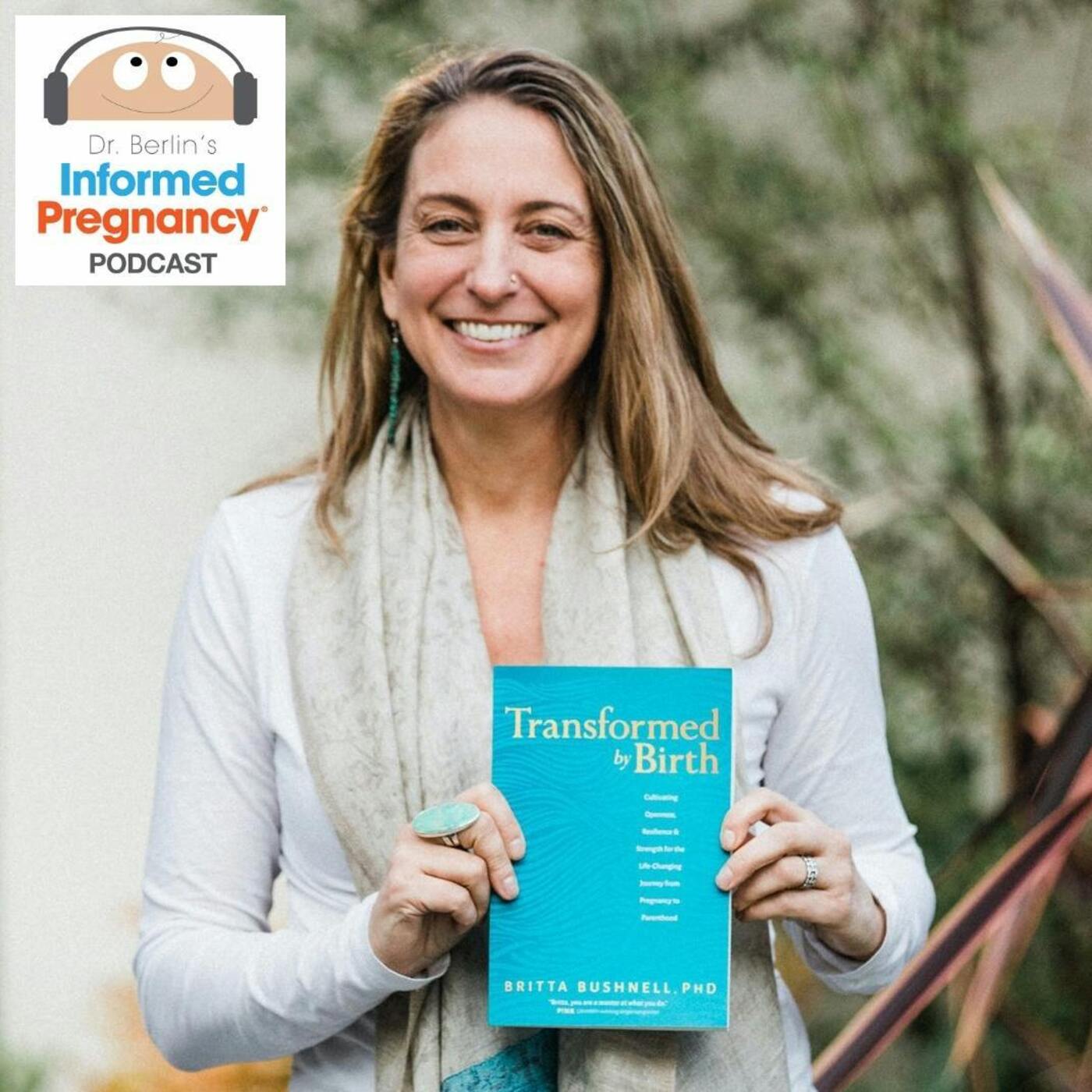
February 6, 2020 · 41 minutes · Episode 161
About this episode
Britta Bushnell combines her unique background in mythology, psychology and education to challenge hidden preconceptions and help individuals, couples, and birth professionals prepare for life’s most important transitions with a fresh transformative approach. Her book ‘TRANSFORMED BY BIRTH’ cultivates openness, strength, and resilience for the Life-Changing Journey from Pregnancy to Parenthood.

Learn more about your ad choices. Visit megaphone.fm/adchoices
See Privacy Policy at https://art19.com/privacy and California Privacy Notice at https://art19.com/privacy#do-not-sell-my-info.
Key quotes
“We need courage in the face of intensity, not just hopeful platitudes.”
“the idea of being open to the unbidden and that parenthood tests that on a daily basis.”
“and information is not synonymous with preparation.”
“that ability to kind of pause, drop in, feel into what the animal of our body wants.”
“I really see birth as an opportunity for profound growth, transformation.”
Related episodes
- Ep. 182 Randi Wood – Birth Story
- Ep. 188 Joanna Bavero – Birth Story
- Ep. 50 The Real Midwives – Megan B. Post-Birth Journey
- Ep. 158 Lillian's Birth Trilogy
Transcript
AI-generated transcript with speaker labels — may contain errors, especially names and medical terms. Dr. Elliot Berlin, DC appears in blue; Britta Bushnell in orange.
Download PDF of the Transcript
Dr. Elliot Berlin, DC [1:13] Welcome to the informed pregnancy and parenting podcast. I'm your host. Dr. Elliott Berlin our guest today combines her unique backgrounds in mythology psychology and education To challenge hidden preconceptions and help individuals couples and birth professionals prepare for life's most important transitions with a fresh Transformative approach although she's based in Southern, California Her work in wisdom are now available to the masses through transformed by birth a new book about cultivating openness strength and resilience for the Life-changing journey from pregnancy to parenthood. Dr. Britta Bush not welcome back to the podcast. Thank you
[2:12] I'm so happy to be here. You had a baby indeed and what a labor it was
Britta Bushnell [2:18] It always is a book I mean people who've written a book and had a baby in the same year talk about the parallels yes, I feel like I used so many of the metaphors and Mythology that I use to talk about the journey of going through pregnancy birth and new parenthood with myself through the process of writing and publishing this book just
Dr. Elliot Berlin, DC [2:41] Idea light bulb popped off in my head that after all the years you've spent helping people through childbirth education. You can now help authors with child book education
Britta Bushnell [2:52] Education yes, you can be not what I'm gonna spend my time and energy doing but yes, it's an idea
Dr. Elliot Berlin, DC [2:59] Let's let's remind people that we have an episode that's roughly named mythologies metaphors in childbirth It is one of our most popular episodes both in terms of downloads and in terms of feedback when people listen to it, they give a strong feedback about how Your perspective and approach and tools that you provide in that episode Really give them confidence before they go into labor It's just things that they can hold on to and confidence that before they go into labor I think that most people in my observation experience some combination of anxiousness and excitement before they have a baby Especially the first and the feedback is that your style your information your materials push them into more excited less anxious
Britta Bushnell [3:40] Hmm. Well, that's very gratifying to hear because my purpose in my work is all of those things that you just mentioned That it helps with I should accomplish. Yeah Off to some place wonderful to know I don't feel like I'm retiring Quite the opposite lucky for us Yeah I really I really enjoy working with couples and with parents as they go through that rite of passage into parenthood And I think it's a big change. It's a big transition and I want to support them
Dr. Elliot Berlin, DC [4:09] I want to help it's a huge transition and I know you're supporting them and locally people have had access to you They can take your classes Everybody who I know that takes your class really with no exceptions comes back Transformed totally like an experience that they can't even put into words. All they could say is it should have been sponsored by Kleenex Whatever not because they're sneezing but because they're crying their eyes out whatever it is that you're doing in there You are like bringing stuff out that has been locked and buried for years and just what an amazing time to do that
Britta Bushnell [4:41] Before going to this new chapter. Yeah. Well emotion is an important Lubricant for birth and we need to release it if we hold emotion back we're actually closing and for labor and birth to be effective we have to open and that sometimes includes letting go of pent-up emotion. And so yeah, there tends to be some tears that release and some joy that's expressed and some deep connection between partners and it's really unbelievably beautiful to witness and to get to hold space for.
Dr. Elliot Berlin, DC [5:21] Yeah. When they come out and talk about that, I'm like, why do you have to have a baby to have that class? I want that class.
Britta Bushnell [5:27] I know. The work that I'm really called to do is deep, transformative work. It's just that people come and pay for a childbirth class and then I get to do that work. My children are now in college and older and I'm not really drawn to birth from like a birth and babies perspective. I'm really drawn to work in birth because of the openness to transformation that parents feel as they stand perched on the edge of that big rite of passage. So I get excited because I feel like childbirth classes give an opportunity to get some of the life skills and the transformation skills that we don't get just generally in our lives. I mean, people often leave my classes saying this was life 101, not just childbirth classes.
Dr. Elliot Berlin, DC [6:27] Right. And your book is called Transformed by Birth, but I feel like it could easily just be called Transformed by Brita.
Britta Bushnell [6:34] It's transformed by life. It's transformed by big events and I have two other books kind of waiting in the wings in my mind. We'll see. We'll see.
Dr. Elliot Berlin, DC [6:45] Twins on the horizon.
Britta Bushnell [6:46] Well, yeah, twins on the horizon, exactly. I'm not sure I can birth twins right now, but we'll see. I mean, because I really do feel like these big events change us and to have something to hold us through that transformation, through that transit into a new part of our lives is helpful. And a lot of the cultural ideals that I talk about in part two of Transformed by Birth are really applicable across a lot of areas in our life. So we'll see. I mean, I have a Transformed by Parenthood book perhaps in my head. And my husband and I have talked about a Transformed by Relationship book co-authoring that.
Dr. Elliot Berlin, DC [7:35] Together?
Britta Bushnell [7:36] Together. He's an author as well.
Dr. Elliot Berlin, DC [7:38] Oh, kidding.
Britta Bushnell [7:39] Yeah. He wrote a book about money, so it's a very different field. I don't see it transformed by cash. Well, his was, it's not about the money, and it's really kind of a spiritual look at how we relate to our money. So in some ways, there's similarities and some very big differences.
Dr. Elliot Berlin, DC [7:58] You're very descriptive, even when you talk about standing on the perch. I'm afraid of heights, but my heart started beating faster. You have a way.
Britta Bushnell [8:06] Yeah, well, standing on that precipice, that heart beating faster, is often how parents feel. Standing on the precipice, that edge of birth, knowing that big change is coming. Big change. And rather than pushing that aside and just saying, oh, you know, your body is made to birth or whatever kind of wrapped up statements to just make it seem easier, I think we should be honoring the fact that parents feel that transformative energy. They feel themselves on that precipice, and I want to honor that. I want to connect with them in that place and say, yeah, it's big, and you can do it. We need courage in the face of intensity, not just hopeful platitudes.
Dr. Elliot Berlin, DC [9:02] That's powerful, too. I want to get into a little bit more about the meat of your book and the structure of the book, but as a reminder, you kind of have a rich background where this is all drawing from.
Britta Bushnell [9:14] I do. I have kind of an interesting path that led me here, and it's connected between being a prenatal yoga instructor back 20 years ago. I can't even believe it was 20 years ago, but it was 20 years ago, and that led me into childbirth, teaching childbirth education classes with birthing from within, which led me to be a partner and co-owner of birthing from within for several years, as well as a trainer for them. Then after I finished with birthing from within, I decided that mythology was really a direction I wanted to keep going with because that's peppered into the birthing from within approach, but I was like, that really inspires me. So, I went and got a PhD in mythology, and then I ended up writing my dissertation for
[10:07] my doctorate about childbirth and cultural ideals or cultural myths that we tell ourselves that impact how we give birth, which ended up really being the research phase of this book.
Dr. Elliot Berlin, DC [10:23] Mm. I love how you say, yeah, I really got into the mythology part, so I got a PhD in mythology as if it was like, yeah, I was kind of hungry, so I got a pizza.
Britta Bushnell [10:32] Yeah. I had to be really hungry because it was a six-year journey, and I actually ate a lot of pizza. Oh, I see. Oh, yeah, especially during dissertation writing phase. I find eating a lot of pizza to be transformative, so in its own way.
Dr. Elliot Berlin, DC [10:48] I did a lot of solo time, and I find that when I'm by myself while I'm writing, a pizza just fits the bill. Mm. Yeah. I'm with you. I can relate. All right. We're going to get into the meteor book in just a moment.
Britta Bushnell [11:03] Yeah.
Dr. Elliot Berlin, DC [11:04] We're going to take a quick break. Don't go anywhere. We'll be right back.

Dr. Elliot Berlin, DC [13:23] Welcome back to the Informed Pregnancy and Parenting Podcast. We are talking to Dr. Britta Bushnell, author of the book, Transformed by Birth. So the book's broken down into three parts, preparing for the journey, cultural ideals, and on the other side. What's roughly going on in each part?
Britta Bushnell [13:44] So part one is setting up the book. It's the introduction, it's chapter one, and it's the introduction, it's chapter book. It's the introduction, it's chapter one, and it's speaking about what is it you need to know to really get what it is I'm talking about in the book. One of the things that I talk about is storytelling. Like why have a PhD in mythology and talk about childbirth? Like how do those make sense? What's the connection? What's the connection? And why does it matter? I teach in my book and in my classes a lot through storytelling. But there's reason for that. There's method behind that. And I, in part one, talk about why that is and how the brain actually, in labor
[14:34] especially, is able to retrieve information that has been received through imagery and storytelling. And then there's also a lot of research that says that if you've been marinating in a particular hormone and then you're later in that same state, you're going to have better recall of what you learned. And storytelling, guess what hormone? hormone is released when you receive story.
Dr. Elliot Berlin, DC [15:02] I'm going to say oxytocin.
Britta Bushnell [15:03] You got it.
Dr. Elliot Berlin, DC [15:04] Wow. Gold star for me.
Britta Bushnell [15:06] Gold star for Dr. Berlin. Yeah. And so when you have a state where your body is releasing oxytocin and then later you're in labor and you've got oxytocin going and your rational, your linear brain is more subdued, the part of the brain that is more active is the more ancient part, the part that connects to storytelling. And so writing and teaching through story is accessible when you're in the hormonally saturated brain of labor.
Dr. Elliot Berlin, DC [15:41] I think because on the surface it sounds, like you said, what's the connection, like why do I need metaphors or mythology and mythology sounds like something you have to learn in college or if you want to do well on Jeopardy. But what you're saying makes a lot of sense. It's just story. It's just creating imagery that your brain can attach to and can remember. And also, I mean, my observation is a picture is worth a million words, right? So I can sometimes say something with a lot of words and try to describe it, but then all of a sudden if I can create a little picture, whoa, now I get it. This happened recently where I was trying to help somebody understand that a
[16:21] birth plan, she was like, should I have a birth plan? Should I not have a birth plan? I don't want to make a birth plan and then fail. And then on the other side of things, I don't want none to have a plan at all. And so just in the moment, this is what popped into my head. I was like, look, there's a million ways to get from point A to point B. Point A is healthy woman with healthy baby inside. That's what you're going to be. Point B is healthy woman with a healthy baby on the outside. There's a lot of ways to get from point A to point B. There's a million different roads you can take to get there, but each road has different pros and cons to it.
[16:50] Some people like the fastest route. Some people like the most scenic route. I always make sure to pass by a Krispy Kreme donut on my route. So you have to kind of pick what's important to you and to the extent that you can, you kind of want to steer on that route. Now if you're driving down that path and there's a detour, you may have to take a different route, which is okay. There's a lot of great routes to get from point A to point B. And what popped into my head was the image of steering that vehicle is a little bit more like steering a hot air balloon than a car.
Britta Bushnell [17:19] Yes.
Dr. Elliot Berlin, DC [17:20] And I don't know why that came out, but as soon as I said it, she was like, that makes sense to me. So somehow that picture, even though I've never been in a hot air balloon, that picture kind of came to me and I was able to give it over. And just that was enough. I could have just said that from the beginning and saved a lot of words.
Britta Bushnell [17:36] Yeah. Yeah. Yeah. I mean, I think that birth plans as a tool for education and as a tool for communication with providers to make sure that what you are hungry for, I kind of like to use it as a menu metaphor, that you want to find out what is on the menu where you want to give birth. What's on the regular menu? Not what are specials, okay? Because on the day you go into labor, you don't know if that special is going to be available. So you want to make sure that what you're hungry for is available. On the everyday menu. On the everyday menu. Now, once you're there, you know, they might be out of cilantro or the black beans might not be done and they have to replace those with something else.
[18:27] But you want to know that what you're interested in, what you're hungry for in labor is on the regular menu where you intend to give birth and with whom you wish to be supported for that birth. Then you have to also be able to flow with the unexpected, to be open to the unbidden is the term that I like to use. That means, yeah, there are sometimes situations where you don't get to control all things in birth. Now control and consent are two different things and we have to tease those apart because consent is something that is incredibly important and should be valued. But control in this culture is really about that I'm driving the car and I'm going to drive it in this particular way.
[19:20] But sometimes there's traffic. It's like, what do you do when there's traffic? You might have to take a detour. You can map out your path or get in an air balloon. But you have to be available for the fact that sometimes the unexpected happens and how do you keep going even when the unexpected happens?
Dr. Elliot Berlin, DC [19:43] I like the menu analogy, except for the air balloon. Pretty much every one of my analogies is food-based. So now I'm speaking in your language, now I'm in your wheelhouse there.
Britta Bushnell [19:55] Exactly. Even in the air balloon we're eating, we're having a buffet with some champagne.
Dr. Elliot Berlin, DC [19:59] Absolutely. Sure. I saw a map somewhere and it was helpful when I was teaching male partners in particular trying to get them to understand dilation in centimeters, you know, that one is like a Cheerio, three is around a Ritz cracker, seven kind of like the diameter of a can of beer and ten is like a bagel. And then my kids would call me sometimes at a birth and they'd be like, Dad, are you coming home soon? I'm like, yeah, we're between the Ritz cracker and the beer. And they knew exactly what I was talking about.
Britta Bushnell [20:26] So you're giving visuals.
Dr. Elliot Berlin, DC [20:27] Exactly. You're giving visuals. And as we hit transition, I'm so hungry for carbs.
Britta Bushnell [20:32] Yeah. Yeah. Well, yes. Back to pizza.
Dr. Elliot Berlin, DC [20:36] Back to pizza. Seven centimeters stretch. So part one, preparing for the journey then is all the tools and…
Britta Bushnell [20:44] Yeah. It's explaining how it is that the book can be useful. And then it also goes into what do you need to do to take inventory of where you are already. One of the things that I sometimes think is missed in modern birth culture is acknowledging what parents already know, acknowledging the experiences that they've had coming into pregnancy and birth, whether it's pregnancy loss or infertility challenges or were they raised with a parent who delivered babies or was a doula, were their siblings born and they were there. These types of experiences impact how we feel and prepare about birth.
Dr. Elliot Berlin, DC [21:32] Would it be even not so personal, just experiences in terms of seeing things on television and movies or hearing people tell their birth stories?
Britta Bushnell [21:40] Absolutely. So there's a lot of that going on. So chapter two is really about unpacking that, looking at what are we coming into this experience already holding, already experiencing? For some people it will be a previous birth experience. Absolutely. Yeah. Absolutely. And then part two of the book is looking at the eight cultural ideals that I identify and I have to tell you that I probably could have made 15 but I had to consolidate. So I looked at eight, just eight. And the way that the ideal is reached for, for example, the first one that I look at is the illusion of control and certainty. And instead of holding out for how do I control and how do I make certain
[22:33] that my birth goes a particular way, it's how can we open to the unexpected, open to the unbidden? And here's why I think that's important. It's not just about birth. Birth is the rite of passage that most often leads us into parenthood. And parenthood is full of experiences of being out of control and having a lack of certainty. We need to expand our capacity to be in wonder, to be in the mystery of not knowing. And so in chapter three, the first chapter of the second part, I really talk about how do we begin to expand our expectations rather than narrowing them into a single direction that birth absolutely has to follow. So that's kind of an example of one of the ideals.
[23:29] And then I go into seven more.
Dr. Elliot Berlin, DC [23:31] I mean, that is probably just by itself one of the most powerful things about childbirth is that I think some people don't care that much. They just want a healthy baby and so it's sort of like I'll pick a doctor or midwife who I trust and whatever they tell me to do, I'm just gonna do that. And not really be that involved in decision making and setting the course through which we go. And for a lot of people, that works fine, that's great. But then I think a lot of people want to be a little bit more proactive, more involved, more of the decision maker or at least being co-decision making with their providers. But they sometimes end up in this path where it's sort of like even for
[24:13] planning for a wedding, you do all the planning, lots of details. And then on the day of, you just have to take a deep breath, relax and go with the flow.
Britta Bushnell [24:19] Absolutely.
Dr. Elliot Berlin, DC [24:20] And so the illusion that's really sticking in my head has a very powerful term, cuz if you get lost, the illusion of control. Yes, it's the illusion of control and the need for certainty. And the need for certainty, and it is an illusion. So what's really striking me is how powerful that is for everything in life. We don't really control that many things in life. Even when I'm driving my car, I think I'm in control. But I cannot control the cars around me. I cannot control a lot of things about the road, for example. But I feel confident somehow, and it's just occurring to me now that that is an illusion of control. I think I'm in control. I don't love airplanes.
[25:00] But I think part of that is because there is no illusion of control. I know I'm not in control. And I don't even believe that my seat cushion floats. So …
Britta Bushnell [25:07] Danielle Pletka I'm with you there. I'm not a huge fan of flying, although you wouldn't know it with my travel schedule.
Dr. Elliot Berlin, DC [25:15] Alan Wilson Now, yeah.
Britta Bushnell [25:16] Danielle Pletka I'm constantly on the go. But yeah, I think that we are steeped in a culture that values the illusion of control and says, yes, we have to control and things are controllable. And then we get in airplanes and we go, I'm not in control. How do I do with this?
Dr. Elliot Berlin, DC [25:33] Alan Wilson Right. We're at 35,000 feet above the earth in a metal capsule upon which I have no control whatsoever. I mean, I do have control. I can order that little tiny bottle of scotch and hope for the best. But that's about it.
Britta Bushnell [25:43] Danielle Pletka Right.
Dr. Elliot Berlin, DC [25:44] Alan Wilson So …
Britta Bushnell [25:45] Danielle Pletka And so it's how do we begin to hold ourselves in the space. So each of the ideals that I name and that I lay out, I talk about what the balancing side is that's needed to help meet that ideal that can throw us off. And so with the desire for control and the illusion for control, what the balancing energy is an openness to the unbidden. And this is a term that comes from a theologian, William F. May. And when I read this quote, it just stopped me in my tracks. I found it so powerful. the idea of being open to the unbidden and that parenthood tests that on a daily basis.
Dr. Elliot Berlin, DC [26:28] Alan Wilson Okay. Pause for a second.
Britta Bushnell [26:30] Danielle Pletka Yes.
Dr. Elliot Berlin, DC [26:31] Alan Wilson This is big and powerful. So much is going off inside me right now and I'm not about to have a kid, but I do have four kids.
Britta Bushnell [26:37] Danielle Pletka Yes, you do.
Dr. Elliot Berlin, DC [26:39] Alan Wilson Yeah. This is going to be an explosive third segment. Don't go anywhere. We'll be right back. Welcome back to the Informed Parenting and Pregnancy Podcast. We are talking to Dr. Britta Bushnell. My life is being transformed right here on the podcast because we've got to talk about the unbidden. But before we get there, what I'm realizing is all the things in life that I'm afraid of, I have, you know, like, dewy anxiety. All the things that I'm anxious about, I could say it because I'm dewy. All the things I'm anxious about, we even had a dog, by the way. We fostered a dog.
Britta Bushnell [27:20] Danielle Pletka Yeah.
Dr. Elliot Berlin, DC [27:21] Was he cute? Alan Wilson No. She was by far the ugliest dog you ever met. Sweet, big-hearted dog. Sadly, I think had a checkered past. And there were some problems with her. Number one, you could never leave the house. She needed to be around people. And if you leave the house, she would, like, bust out of her crate and just tear up the house. And so the organization was like, okay, she's got to take this medication. We put it in peanut butter. Every little ounce of peanut butter was gone, but not the medication. She's so smart and so sweet, but just needed to be around people. I'm like, what's going on? And they're like, she has severe separation anxiety.
[27:55] I'm like, okay, well, can we get a dog that's not Jewish? And they took her back. Because she needed to be around people. So they found a farm for her. She had a good life. She has a good life now. We can go visit her if we want to. So there's this anxiety, this sense of anxiety. And for me, what it is, is I feel like, well, what if? What if this happens? Or what if that happens? Like, I don't feel like I'm in control of this. But you just, like, blew the cap on it because I'm not really ever in control of stuff. And how come those what ifs are not preventing me from just driving to work?
Britta Bushnell [28:27] Right. Well, and that's what, when I work with parents, I want them to connect with, is not just the desire to control things or that illusion of control, but the how do you keep going? So how do you keep going when you feel out of control?
Dr. Elliot Berlin, DC [28:43] Yeah, how do you do that? How do you do that?
Britta Bushnell [28:46] Well, I want people to explore it for themselves because I don't think it's a one-size-fits-all. I mean, I think that there's a lot of ways we can build our resilience for facing the unknown. And one of the things that one of my teachers talks about is that the fear often is hungry for information. And so when we feel out of control, we go and try and we're hungry for information, so we go hunting for information. But then that leads us to my second ideal, which is the veneration of information and technology, the idea that actual answers exist that are universally true for all of us. And that's an illusion. That's another myth, another ideal that has false basis.
[29:40] And so what we need to meet that veneration of information and technology is to reconnect with wonder. And if you think about it, in today's culture that lives with cell phones in our back pocket, pretty much 24-7, we don't sit. with wonder at all. If somebody at a dinner table says, you know, I wonder, what year was that concert that, you know, we went to, do you remember, you're sitting around with old friends and you're trying to remember what year it was, you don't engage in the curious exploration. Somebody pulls out their phone. Hey, Siri. Yeah. Somebody Googles it. Right. Somebody asks Siri. Look, we got both the…
Dr. Elliot Berlin, DC [30:25] Yeah, a couple hits there.
Britta Bushnell [30:26] We got everybody covered. And we don't sit in that place of not knowing for very long, which I like to think is not just not knowing, but it's the place of curiosity. It's the place of wonder. And I think that's a really powerful place to develop the skill of settling in there, especially in new parenthood, because concrete answers in parenthood, they just don't exist.
Dr. Elliot Berlin, DC [30:57] That is true, but that seems to be like what all the information explosion is about. Here's what you should know. You gotta know this, you gotta know this. This is how it's gonna be. And it's sort of interesting because when you compare and contrast to animals, there's this animal elephant birth on, I don't know if you've seen it on YouTube called Risky Business, and she just off all by herself on this reserve in Bali and they just go out and they see her giving birth, so they film it and she is doing this dance and this movement and then she squats it looks like and she delivers this 275 pound baby, she gently kind of steps over it to turn around
[31:31] and the baby's not breathing, so she does all this prenatal, like perinatal care, like this neonatal care really, where she's using her trunk to sniff and kind of diagnose and she kicks the baby and the baby's still not breathing and eventually she wraps her trunk around the baby's little trunk, she lifts the head up and pulls on it and all of a sudden after that maneuver, the baby starts breathing and the elephant literally smiles. She's super pleased and happy with herself. Okay, in my mind I'm like, how does she even know there's a problem and certainly how does she know solutions? It looked like she did a chiropractic adjustment but she didn't even go to chiropractic school.
[32:03] And I'm like.
Britta Bushnell [32:04] Your chiropractor brain came out, didn't it?
Dr. Elliot Berlin, DC [32:06] Seriously, I mean it's just incredible to watch how much she knows and I'm thinking, wow, she doesn't even have a podcast to listen to, she didn't do childbirth education, she didn't take a class, she didn't read a book, how does that happen? And so on the one hand I think people end up underprepared for birth, for parenting, for postpartum, for relationship after baby and I think on the other hand the solution that we're trying to do is give you more information, more information, more information but now when I hear you talking it's sort of like.
Britta Bushnell [32:37] Information is one piece of a many pieced puzzle. There's a lot of parts and information is not synonymous with preparation. Just because we fill our brain full of information doesn't mean we're ready. And often what we need to really be ready for the rite of passage of birth and the journey into parenthood is being prepared to feel what it feels like to be a little out of control, to not know all the answers. In this modern culture we're used to having things well organized and planned out and linear and organized but birth and parenthood don't always work that way.
Dr. Elliot Berlin, DC [33:27] Oh they're sloppy sometimes.
Britta Bushnell [33:28] They can get really sloppy and so I want people to know how to move forward in the sloppiness. How do they keep going even when they don't know what to do next? That to me is the big part of preparation.
Dr. Elliot Berlin, DC [33:45] But is it because it feels like if I'm looking at the elephant, her name is Risky, if I'm looking at Risky, she knows what to do next because it's hardwired inside her. She has very powerful instincts that tell her what to do next even though she had no idea any of that was gonna happen and no educational training on how to respond to it.
Britta Bushnell [34:03] Right. We might have some of that information and some of those skills and some of that instinct inside of us but instinct rarely sounds certain when we have an instinctual impulse. It rarely is like, this is absolutely what you should do. It tends to be like, hey, have you thought about? And if we aren't used to being a little bit in the place of not knowing, then when instinct starts to talk to us, we aren't well versed at listening. So we have to insert the pause rather than immediately going for a Google search or an internet search or a Siri search or whatever it is to find answers. We have to pause and let ourselves go, huh, okay, what kind of information am I interested in?
[35:00] what am I hungry for? What is, another food analogy for you there, where would the best place be for me to get the information that I'm needing right now? Would my mom be a good person to reach out to? How about my friend who just had two kids? What about my doctor? Or is an internet search the best choice? Or is that book that is sitting on my shelf that I haven't cracked open yet, is that a place? And if we take a moment and we pause, I think that that gives us a moment to go, okay, huh, how do I feel? And we start to listen to our own inner wisdom, our own inner guide that sometimes is actually telling us we need more information, or we need more practice,
[35:51] or we need more strength, then we can start hunting for that. The inner voice is asking for. But very first thing we have to do is to give ourselves the ability to sit with uncertainty, because the internal voice rarely sounds clear and definitive, it often just is a little fuzzier.
Dr. Elliot Berlin, DC [36:14] So maybe this is related, maybe it isn't. An image is coming up of contrasting births, one where she kind of blew me away, we have an episode with her too, it's called Miss America Home Birth, or Miss USA Home Birth, I get them mixed up, I'm a horrible person, but her name's Shandi, and she had this incredible first birth experience with what appeared to be no fear. And I was like, where did you get that confidence? And the interesting thing was nobody really, she had a great midwife and a great doula, her husband was incredible, she was the most amazing, and even her dog was like this little five pound dog licking her face was so comforting, you could tell to her.
[36:50] The interesting thing is nobody really ever said anything in terms of do this now, or even maybe like, maybe you wanna do this now, it was just, she kind of seemed to be very in touch with her inner voice, she was reacting to it, and it was guiding her, and she was connected to it. In contrast to other types of birth where there's sometimes 10 voices, even with pushing, just how to push and when to push and how many times to push in that minute and take the breath, and sometimes it just seems like if there wasn't so much cloudy noise from the outside, then if we had that pause, then we would actually get instructions from the inside where there's so many more sensors,
[37:29] like you said, there's no one size fits all, everybody's a little different, so what position to get into or anything like that, none of us have the sensors, no matter how many births you've attended, witnessed, helped, facilitated, you don't have the sensors that she has inside, and if we are not able to give her that chance to pause and listen to the inner voice, then we might be doing more harm than good.
Britta Bushnell [37:52] And for many, many birthing people, if they haven't practiced listening to that inner voice, this woman that you speak about, she might just be one of those people who always listens inside. So in labor, that was a natural place for her to be because she could just respond. But for a lot of us that live in what I call in my book a very Apollonian society, which is a whole myth thing which probably don't have time to go into, but it's where I compare and contrast the Greek gods Artemis and Apollo, and our culture is one that is very Apollonian, very linear, very directed, and we like schedules, we like time, all kinds of these things, but is less connected to the animal nature of our bodies.
[38:45] So if we haven't spent any time in that animal nature of our bodies, which is what I refer to as the Artemisian side, as she's the goddess of the wilderness, whereas Apollo is more the goddess of order and society and culture, that if we've completely marinated in Apollo's realm, we then when we're in labor and we're more in that Artemisian place, we don't know how to listen to that animal side of us. So we have to practice ahead of time if we don't have an intuitive ability to do that naturally, and I agree with you that some people do. Some people, that's just a part of how they operate already, but I'm noticing even in the 20 years that I've been in this field,
[39:35] that more and more people are in that Apollonian place, less connected to their animal side, more connected to their intellect, and less connected to that bodily response. And I think we need to be supporting that more animalistic connection that is that animal, that elephant that you described. that ability to kind of pause, drop in, feel into what the animal of our body wants. I'm grateful that we live in an Apollonian culture because that means in an Apollonian world we have tools in birth that save lives. And birth itself is still a very wild, untamed process. So we need both. And for most of us it's an imbalance and we need more of what the wilderness, what that
[40:35] Artemisian side, that animalistic side offers.
Dr. Elliot Berlin, DC [40:39] I think the strongest animalistic response I've had, the clearest, like yes right now is the pizza response. It's never like maybe we should get a pizza.
Britta Bushnell [40:49] Yeah. Yeah. Well I could go into Artemis and Apollo ad nauseam. I love them. I use them throughout my classes to create really a balanced understanding of the values that we have in this overculture as well as what's needed in birth and how they're like two sides of the same coin and each has a value. One's not better than the other. They're just different.
Dr. Elliot Berlin, DC [41:15] Right. Yeah. Well this has been just a little appetizer. There's a lot more in the book. Going to my food analogies of what's in this book. We can't get away from the food analogies, can we? And also we said at the beginning, like you even talked about transformed by could be related to lots of other things. I'm dying to read the book in its entirety because the things that you're saying, my mind is just spinning hard right now and I think probably everybody who reads it will tag on to different things but you make a lot of sense and it's sort of like this deep wisdom that you bring out about how we fit into the world and how we need to fit into the world or feel like we need to fit into the world.
[41:58] And if you can change that perspective a little bit, then you can open up doors to that you didn't know were accessible.
Britta Bushnell [42:05] Yeah. I really see birth as an opportunity for profound growth, transformation. And really that can happen in a lot of different times in our lives and lots of different moments. It just so happens that the moment that I'm really passionate about working with is around birth, but the lessons and the wisdom around growth and transformation are really universal.
Dr. Elliot Berlin, DC [42:33] Where can we find you online?
Britta Bushnell [42:35] You can find me online at my website, which is brittabuschnell.com and my handles, I guess on Instagram, I think that's what they're called, handles on Instagram and Facebook are Britta Bushnell PhD. So I got that little doctor part put on there. And I have a transformed by birth Facebook community that people can join as well.
Dr. Elliot Berlin, DC [43:00] Fantastic. The book is called transformed by birth and I'm grateful that you came back to tell us more about it.
Britta Bushnell [43:06] I'm so grateful to be here. I loved the first time I came. It was so much fun. And I always love sitting with you or being at births with you.
Dr. Elliot Berlin, DC [43:14] Yeah, thank you. I always learn from you when I'm around you, even when I'm around people who've been around you. Secondhand smoke. It's wonderful. Hopefully a lot better than secondhand smoke.
Britta Bushnell [43:25] Well, OK. In a positive way. Yes, in a positive way. Thank you so much. Pleasure.
Dr. Elliot Berlin, DC [43:33] And at home, thanks for listening to our podcast. If you like our program, share us with your friends, leave us some feedback in your podcast app. And if you have a suggestion, write to us at info and inform pregnancy dot com. Anybody who's done it knows you get a response. And lots of our great topics come from you. Info at inform pregnancy dot com.
Want more pregnancy + parenting? Start your FREE TRIAL of Informed Pregnancy+ and get access to all our curated pregnancy and parenting content — original series, iconic birth films like The Business of Being Born, prenatal workouts and more.
