
April 7, 2022 · 45 minutes · Episode 276
About this episode
Biotech marketing manager Kelly Kilmartin is in the final weeks before the birth of her first child. She is planning an intervention free hospital birth merging her two passions: science and holistic wellness.

This podcast has been brought to you in part by LMNT electrolyte drink mix. You can get a free sample pack with every order at drinklmnt.com/berlin .
Learn more about your ad choices. Visit megaphone.fm/adchoices
See Privacy Policy at https://art19.com/privacy and California Privacy Notice at https://art19.com/privacy#do-not-sell-my-info.
Key quotes
“And being science adjacent is something that I really enjoy. You know, I'm not a scientific brain, but I like being close to it, but not needing to know it all. So that was my way of doing so.”
“I never knew that time would come for me. There were times in my life where I didn't even know if I wanted to have kids. I love children and I've worked with children and I just didn't know if I wanted that for myself. I was in that kind of selfish phase of life. And, you know, finding my partner and really settling down made me realize I really did want that.”
“I get exactly what I'm looking for from the midwife appointments. They're so hands on. It's like, I guess I was sort of looking more for a warm hug, you know, than I was able to get from the OB care that I had before.”
“It's definitely a new skill for me, you know, and I credit the baby because I'm making decisions for more than just me now. And, you know, I went through a couple of experiences during the pregnancy where you can ask a million people for an answer or some help with a decision, but really it comes down to trusting your gut.”
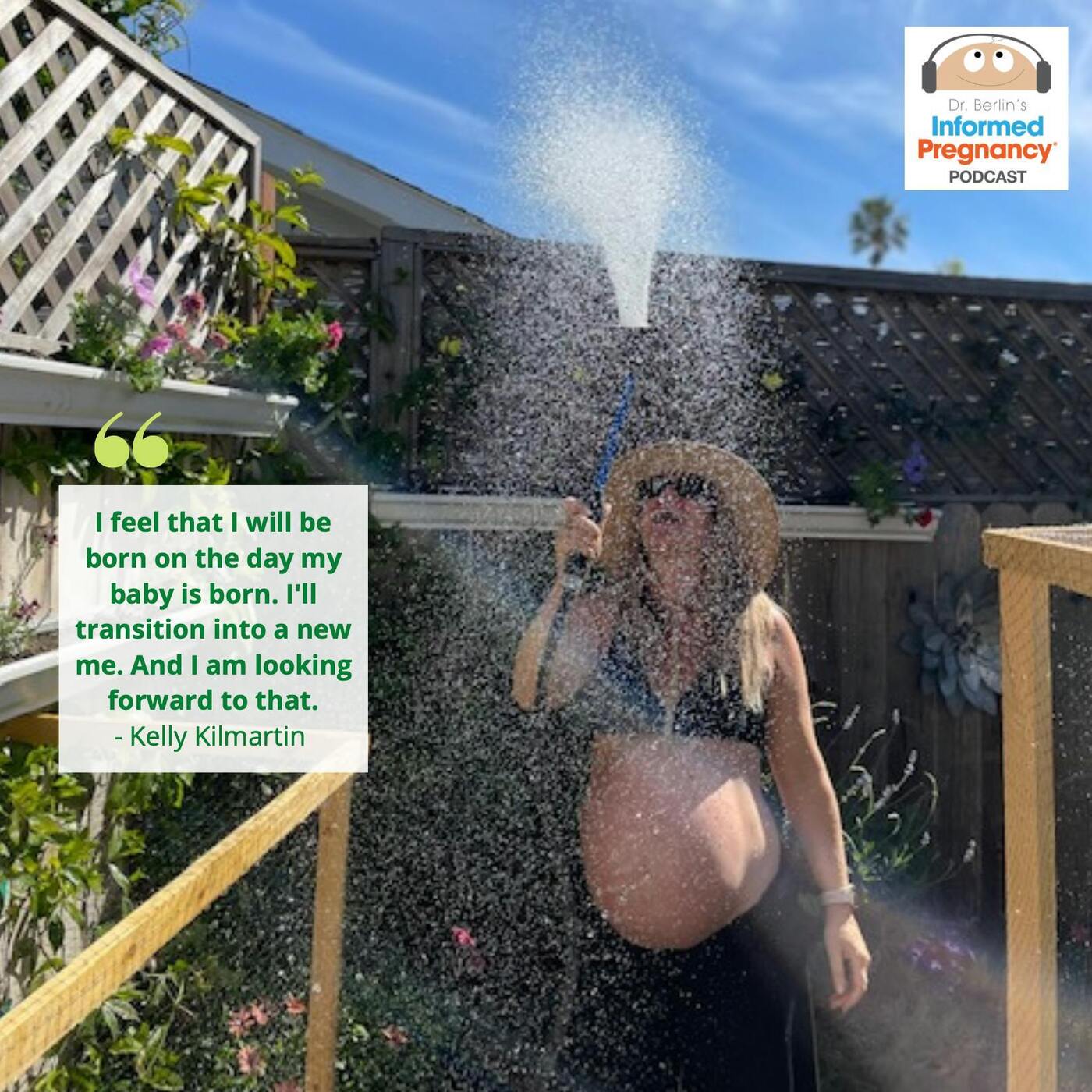
“I will be born on the day my baby's born into this new me, you know, a mother and a caretaker.”
Related episodes
- Ep. 277 Kelly Kilmartin – After Birth
- Ep. 280 Kayleigh Harrigan – After Birth
- Ep. 283 Motherhood After Pregnancy Loss – Nikki Spicer
- Ep. 291 Jenna Ushkowitz – Before Birth
Transcript
AI-generated transcript with speaker labels — may contain errors, especially names and medical terms. Dr. Elliot Berlin, DC appears in blue; Kelly Kilmartin in orange.
Download PDF of the Transcript
Dr. Elliot Berlin, DC [1:13] The informed pregnancy and parenting podcast. I'm your host. Dr. Elliot Berlin My guest today is a marketing manager who works in the field of biotechnology She is in her final days of her first pregnancy and as someone who honors both science and a natural preventative lifestyle She's planning an intervention free hospital birth. Kelly Kilmartin. Welcome to the podcast. Thank you so much for having me Oh my goodness, first of all, it's late at night and pregnant people are usually asleep Thank you for being here. And then also like how far are you into your pregnancy?
Kelly Kilmartin [2:11] I'm almost 38 weeks Wednesday I'll be 38 weeks. So you're in the zone. I'm in the zone that they call term
Dr. Elliot Berlin, DC [2:20] Sleep is no longer happening. So we don't have to think about me being up. Oh great
Kelly Kilmartin [2:25] Yes
Dr. Elliot Berlin, DC [2:26] Yes, your background actually has a lot to do with your birth plan. So let's start at the beginning. Where are you from originally?
Kelly Kilmartin [2:32] I'm from Rhode Island
Dr. Elliot Berlin, DC [2:34] What was it like growing up in Rhode Island? I maybe know one other person from Rhode Island. I
Kelly Kilmartin [2:40] Loved it. It was beautiful beautiful summers. You get all four seasons, which I love and I actually missed very much being out here in California it's kind of one of those places where everybody will say oh you're from Rhode Island Do you know so-and-so because everybody thinks of it as being so small You know, it's not really how it goes, but usually just a couple of degrees of separation
Dr. Elliot Berlin, DC [3:02] No, it is that's where all the credit card companies are. Are they in Delaware?
Kelly Kilmartin [3:08] Yeah, they must be in Delaware
Dr. Elliot Berlin, DC [3:10] Do you know discover? Okay, so you grew up over there and what'd you study? I
Kelly Kilmartin [3:17] Actually went to school for human development and family studies at Yukon and then I got a master's in counseling and really wanted to kind of pursue mental health as my career and I did start doing that and had a few great years in that industry. It's just a little bit Difficult to kind of get where you want without going through the very very difficult Very low-paying jobs. So in order to get hours or in order to get hours and Kind of get the experience Because I was working towards licensure and that was sort of my goal I was seeing a therapist and I wanted to be just like her and kind of help people get to a space of really Enjoying their lives and living in the healthiest way possible
[4:10] But you know as I was doing that I was also nannying for a family to make ends meet and the father of the family I was nannying for happened to be working at a Biotech company that was hiring people with counseling backgrounds Yeah, it was for cystic fibrosis patients So they wanted people with counseling experience to help patients with access and staying on therapy and things like that So that was sort of my transition into the field Never really expected it to take off But it kind of gave me wings and taught me a new side of business and you know It was a quick learning experience switching from the mental health field to biotech field. I'm not a scientist at all
Dr. Elliot Berlin, DC [5:00] Well, I mean, a lot of people work for Google that are not computer coders. Everybody's an important part of the team. And if people don't have access to the medication, it doesn't matter that they made a great one, right? True.
Kelly Kilmartin [5:16] And being science adjacent is something that I really enjoy. You know, I'm not a scientific brain, but I like being close to it, but not needing to know it all. So that was my way of doing so.
Dr. Elliot Berlin, DC [5:30] And did that make you ever look back and say, maybe I won't finish where I was headed with council?
Kelly Kilmartin [5:36] Yeah. So when I took that role, I dropped out of my licensure program and moved to Boston. So it was kind of a big decision to make, but it felt like the right one at the time and I never looked back. I really, really loved my job that I took in Boston. It kind of got me on my own feet and had me living on my own finally for the first time. And I really enjoyed the work and the people I worked with and working with patients. You know, it gave me the best of both worlds. So only recently have I looked back and said, I kind of missed the counseling aspect of things. So I try and get that in, in different ways too.
Dr. Elliot Berlin, DC [6:19] How did you end up in California?
Kelly Kilmartin [6:21] A job moved me out here.
Dr. Elliot Berlin, DC [6:23] In the industry?
Kelly Kilmartin [6:24] In the industry. And by the way, we mean biotech, not the industry, not the Hollywood industry, very different job that was working with a new cancer therapy and immunotherapy moves me out to California. And, you know, I had wanted to live in California for a really long time and tried to make it work when I was doing mental health actually, and looked for jobs all the time, but it just didn't work out. And then of course, as soon as I was really settled and super happy with my life in Boston, I had a knock on the door and they wanted to move me to California. And that was one of those decisions that I think for the first time in my life, I didn't really consult with too many
[7:08] people on it. And I just kind of made the decision myself really quickly. I had to kind of agree to interview and then move out all within a month.
Dr. Elliot Berlin, DC [7:18] Wow. And how long ago was that?
Kelly Kilmartin [7:21] That was almost five years ago. It'll be five years in May that I moved out.
Dr. Elliot Berlin, DC [7:26] Well, welcome to Southern California. Yeah. Do you miss the seasons that you love so much?
Kelly Kilmartin [7:32] I miss the seasons. I miss snow. Everybody always says when there's snow back, you still, you must be so happy you're here. And I'm like, actually, I'd kind of rather be experiencing the snow or something really peaceful and quiet and comforting about a snowstorm that I miss. But you can drive from here to snow in like 40 minutes. That's the thing. That's why we're so lucky here, because we have access to it, but we have this beautiful, sunshiny weather most of the time.
Dr. Elliot Berlin, DC [8:00] So, yeah, it's a good night, especially raising kids. I think kids like to be outdoors and not zipped up in 18 layers of snow suit. All right. So then you, uh, you met this guy.
Kelly Kilmartin [8:14] I did.
Dr. Elliot Berlin, DC [8:15] How did you meet?
Kelly Kilmartin [8:16] We actually met on a dating app and yeah.
Dr. Elliot Berlin, DC [8:21] Had you been using the dating app for a while?
Kelly Kilmartin [8:24] I had been on it since I moved out.
Dr. Elliot Berlin, DC [8:27] And how long after that? Did you meet him?
Kelly Kilmartin [8:29] It was about six months later.
Dr. Elliot Berlin, DC [8:31] Oh, wow. Okay.
Kelly Kilmartin [8:32] And he was actually the first person I actually went out with because I found that most people just kind of wanted to chat and text and never really asked me out. So, um, I was doing it more, you know, to meet people. I was new and I didn't really know what I was looking for. I had been single for so long that I was so used to that. So when Jeff and I met, it was sort of like, neither of us knew what we wanted out of it, but we were enjoying each other's company. He was fresh out of a long relationship and I was just new.
Dr. Elliot Berlin, DC [9:07] And you were long out of a fresh relationship.
Kelly Kilmartin [9:12] So we kind of dated for a while. And I think after about nine months of dating and coming back to each other, we said, maybe this is something that's going to last, so we decided that it was. And I think it really became real for us when the pandemic hit. And, you know, I think at that time, relationships could go either way. You either realize you really don't want to be that person that you're stuck in quarantine with or the opposite and you realize you have something really special and that's sort of how it went for us. We had a lot more time together. We went on walks every morning and every evening with our dog.
Dr. Elliot Berlin, DC [9:54] And were you working from home?
Kelly Kilmartin [9:56] I began working from home and that's kind of what pushed us in that. direction because they didn't have the commute anymore and we just had a lot more time together and you know he credits that and says you know it really just made me see that you were the person I wanted to spend my life with and it pushed us along further quickly in our relationship because of that. So it was special for us you know people look back on these quarantine days as being sort of negative but for us it was really positive we ended up getting engaged in April of 2020. It was shocking to me I didn't know it was coming they had never talked about it. I wasn't like pushing for it at all you know I kind of felt
[10:36] like maybe that would happen but I didn't know if he was thinking about it any of it.
Dr. Elliot Berlin, DC [10:41] So well okay first of all that is literally in the initial spike of the pandemic I mean we're still not quite sure how this virus works with testing is hard to come by there's no vaccine people are just getting sick and dying where we have like no treatments for it no therapeutics. So you guys decide to get engaged is there a unique pandemic engagement approach?
Kelly Kilmartin [11:05] Well we were supposed to be in Hawaii actually we had a trip planned with some of our close friends and he was planning to do it there and of course we had to cancel our trip so he ended up doing it here on the beach which actually felt a lot more special to me because it's a beach that is part of our community and it's just a special place for us because it's where we've developed a lot of our relationship so I think it ended up being a lot more special here than it could have been anywhere else you know and we celebrated on the beach with veggie dogs and a bonfire and it was really really nice it was actually such a windy day and he was saying like we had plans to make a fire and then we had plans to make a dinner and
[11:52] he kept trying to come up with all these special things and I had no clue it was happening but looking back I should have pieced it together because there were so many funny things happening we like ran into a friend who was going down to like hide to take pictures of us and he was so awkward and then we got down there and it was so windy and I'm thinking like maybe we shouldn't be building a fire on the beach in this wind and he would usually be like okay this isn't happening you know let's go up this is not a good idea like I'm done with this I'm not going to try anymore but he was so determined to get this fire going and then you know it turns out he had a reason for that sounds like you said yes
[12:35] I said yes and we had like a couple family members that were watching from afar when it happened like zoom watching no in person but okay from the top of the cliff and then they ran down and it was like that weird time where you didn't know if you could hug people so everybody's like hi I'm so excited for you but I like can't hug you so like air high five from six feet away yeah we want to have champagne but you know it was just a little bit awkward how do you all get married in that part of the pandemic too so we started planning and of course at that time we didn't know how long this was going to last people were saying a couple more months you don't know and I was like maybe
[13:19] we choose April of next year to get married and we started planning this big wedding where I could have all my family from back east come out and all my friends and they could see my life here and then it just started feeling like that wasn't the right thing to do and we didn't have any answers and I sort of never really wanted a big wedding I didn't even feel like I needed I wanted a long-term commitment but I didn't feel like a wedding is what committed you to somebody so my true feelings started coming through because I started getting really anxious about planning this big wedding and I said to Jeff one night at dinner maybe we should just call this off and do it alone and that ended up being what we did
[14:02] we had our families kind of send us things to be a part of our day from afar and we ended up eloping alone not totally alone not totally alone we had our dog Wrigley as our ring bear and then we had an officiant and a photographer and we had somebody cook us like a special dinner we did it at this beautiful ranch in Malibu that our friends own and it was the most beautiful day I'm actually looking at a picture of it right now I wouldn't want it any other way as much as I wanted our families to be there we were able to look in each other's eyes and smile and laugh all day long and you know I get nervous in front of crowds of people I would have never been able to say my vows the way it did with just him
[14:50] and I so it was a very very special day beautiful it sounds like this virus really worked out well for you yeah so I've had now an engagement a marriage conception, and probably, well, definitely two more weeks, all within this pandemic. So it hasn't been so bad for me.
Dr. Elliot Berlin, DC [15:10] All right. We're going to get into pregnancy next segment. Let's take a quick break, and we'll be right back with Kelly.

Dr. Elliot Berlin, DC [17:35] Welcome back to the Informed Pregnancy Podcast. We're talking to Kelly Kilmartin. Okay, so, pandemic comes along, you're working in biotech, you find a guy in a dating app, you get engaged in an awkward but beautiful engagement ceremony. You get married with Wrigley the dog. And how soon after that, pregnancy?
Kelly Kilmartin [18:02] So, I would say it was about almost a year later that I ended up getting pregnant.
Dr. Elliot Berlin, DC [18:08] Okay, was it a conscious decision?
Kelly Kilmartin [18:11] It was a conscious decision. We tried for about nine months.
Dr. Elliot Berlin, DC [18:16] Oh, wow. So, after the intimate eloping wedding, you were just ready to go.
Kelly Kilmartin [18:23] Jeff definitely was. I kept saying, you know, maybe we should wait a little while. There's still a lot we can do. But, you know, we planned for all that to be traveling around. And it was not the time for travel. So, you know, we kind of were thinking what better time to start trying because there's nothing really holding us back now. We were committed to each other and Jeff was feeling so ready to be a dad. And everybody around us, our friends and family members were having babies. So, it just felt right, you know. I never knew that time would come for me. There were times in my life where I didn't even know if I wanted to have kids. I love children and I've worked with children and I just didn't know if I
[19:11] wanted that for myself. I was in that kind of selfish phase of life. And, you know, finding my partner and really settling down made me realize I really did want that. And especially being with a partner that was really, really ready to be a dad. So, we decided to start trying. But, you know, I thought it would come quickly and easily like a lot of people in my life. And I'm very lucky that it did happen for me. But it wasn't as soon as I thought it would be.
Dr. Elliot Berlin, DC [19:39] You know, did nine months become stressful? Sometimes when you make that decision, you're ready, you're ready right away. And then you wait for the better part of a year.
Kelly Kilmartin [19:48] Yeah, you know, it's hard to plan anything. And with it being the pandemic, too, I was afraid of traveling to see my family for the holidays and things like that. I was thinking, you know, what if I get pregnant and then I'm not going to want to travel pregnant because of the pandemic. And there were a lot of decisions that kind of got put on hold because we had made the decision to try and have a family. And yeah, it did get stressful when it doesn't happen. You look at the test every month or, you know, you're trying, it can be discouraging and you start wondering like, is there something I need to do? Am I doing something wrong? Should I, you know, and of course sex becomes less sexy. And you're just kind of,
[20:33] you know, it's like, it's today, let's do it. And it was a strange time and I didn't know what to attribute it to. But if it's not too much information, were you having regular cycles? Yeah, always my whole life. I was regular. I felt very healthy. There was nothing medically that I thought could have happened. I think right before I got pregnant though, I was going to start going to get tested and things like that. And actually the month I got pregnant, I had talked to the doctor about coming in to do just regular testing to make sure I was in good standing to become pregnant, I guess. And that happened to be the month that I got pregnant. But I had started acupuncture. I changed my diet to be
[21:24] like on an anti-inflammatory diet, cut out a lot of things. So I was doing a lot of things to make myself healthier. I changed my job to a much less stressful role. And I think that had a lot to do with it. I had a lot of stress when we first started trying. So who knows what actually did it? I think it was just, I never really got nervous that it wasn't going to happen for us. I kind of thought, you know, it'll happen when the timing is right for the baby. And I kept trying to think that in my brain, like this soul will come to me when it's ready. Yeah. How did you find out that you were pregnant? So we finally, I think June rolled around and we had just planned a honeymoon to Costa Rica
[22:12] for July. And I said to Jeff, why don't we skip trying this month so we can go enjoy our honeymoon and not be stressed about trying and we can enjoy, and then we'll come back and we'll jump back in. And of course, that's when I got pregnant, when we decided not to try.
Dr. Elliot Berlin, DC [22:32] You must have not tried too hard not to try.
Kelly Kilmartin [22:35] Yeah, right. Well, it wasn't, you know, the planning and timing and all that, but it happened to be on Father's Day. My mom had flown in the day before and she was here for a week long visit and her and I were going down to the beach and I sort of felt a little bit funny. My boobs were really sore, but I was also just thinking I was expecting my period. And I had been trying, so I didn't think anything of it. I went to the beach with my mom for the day and we came back and I fell asleep on the couch, which is not something that I do during the day. I actually hate napping. That's changed a bit now. I never napped. And, you know, I was sort of like, that was weird that I napped. And
[23:28] I was just feeling a little bit off. So actually Jeff and my mom had both been napping too. So we all kind of fell asleep. It was like a Sunday afternoon, Father's Day. And I went and took a shower to just kind of wake myself up while they were still napping. And I was like, I'm just going to take a test just to make sure. Cause I was taking my mom to wineries and doing all kinds of things that week. I was like, I should just find out. You need to know. So I took a pregnancy test. I peed on the stick and then I got right in the shower and I left it on the counter and I was in the shower. And I remember like clearing the glass and looking out at it. It already said pregnant.
[24:08] And it was one of those ones that said pregnant reading the line and I was just shaking in the shower and I jumped out and I had to finish getting the soap off of me out of the shower. And I had gotten a book for Jeff that said it was like a funny parody book called the dad manual for whenever it did happen. Cause it showed up for me on my Instagram feed because it was around Father's Day. So it was just one of those ads that popped up and I was like, Oh, I'll get this for whenever it does happen. And it had showed up like three days before this. And I got out of the shower and I decided I'd put that in a bag with the pregnancy test. And I called Jeff into the
[24:50] bedroom because my mom was here. So I needed to kind of do it secretly to tell him first. And so I called him in and he opened the bag and he was sort of like just waking up from a nap. I remember I have a video of him. He was like so out of it and opening this bag and he was like, why'd you get me a Father's Day gift? And I was like, you know, from the dogs, it's the dog and the cat. And he was like, okay. And he's like opening it and he pulls out the dad manual book. And then he pulls out the pregnancy test and he kind of like looks at me and he's like, are you serious? I was like, I'm serious. I'm shaking. We're both like whispering, like wanting to scream. Your mom's right there. And so of course
[25:37] we were both like in tears, like so excited. And then I have to go out and face my mom. I'm like, I gotta tell her I can't just like not tell her, you know. And you know, we were in that. I was sort of like didn't know how to approach telling people in the beginning. I didn't feel comfortable talking about it and telling people even close family. I was like, I want to wait. I want to make sure it's real. But with my mom being here, and of course, I want to tell my mom everything. So I did the same thing to her. Her birthday was coming. So I just put the I put the test in a bag for her. And we did the same thing.
Dr. Elliot Berlin, DC [26:14] Wow, you got a lot of mileage out of that test. What'd you do with it for Christmas? Oh, you did? Yeah. Oh, that's hilarious. They all got a test. Made the rounds. How's your pregnancy been?
Kelly Kilmartin [26:29] It's been pretty good. I would say minor symptoms throughout that have all been sort of surprising, I would say. You never know what your body's gonna do. Early on, I think around eight weeks, I started getting a strange dermatitis around my eyes. And I went to a dermatologist for it. And he was kind of like, I can't really treat you while you're pregnant. It's just one of those things that's hormonal. And it'll probably go away after you're not pregnant anymore. And it's traveled around my whole face and then moved from one eye to the other and now down around my nose and around my mouth. So nobody can see most of it because we're still in the pandemic, you're messed up.
[27:13] If I'm out, it's covered by a mask. And usually I'm just home. So it's no big deal. And the other, I would say, my worst symptom, but the biggest blessing was some very early low back pain that was like in my sacrum or SI joint that happened, I would say, starting around nine weeks, and then just progressively got worse for about five weeks. And as I talked to people about it, you know, I was kind of hobbling around on walks in my neighborhood, and I'd run into people. And I think every time I told somebody that I had back pain, they said, You have to go to Dr. Berlin. So it ended up being the biggest blessing that I had that back pain because it led me to you. And I would say that you've been the
[28:07] biggest blessing in my pregnancy. So
Dr. Elliot Berlin, DC [28:10] I feel like the universe did me a favor because you're awesome to work with. And I'm so glad that the work that we do is helpful for you and the conversations that we have are helpful for you. Did you have thoughts going into the pregnancy about pregnancy and about birth? And how did they change along the way?
Kelly Kilmartin [28:29] Yeah, so I guess I never really had thoughts about the pregnancy because as it progressed, and I was faced with different things or decisions, I really didn't know what I felt or kind of it's been such a learning experience for me to kind of feel my way through pregnancy. Seen so many people in my life be pregnant and have babies. But I never really got intimate with them about the experience that they were having, and how they're making decisions and things like that. But for me, you know, from practitioners to dealing with anything that came up throughout the pregnancy as far as symptoms or needing to have whatever proper care I thought I needed. It's been such a learning experience. I
[29:19] didn't know that I wanted a natural birth. I've always leaned towards natural practices.
Dr. Elliot Berlin, DC [29:25] Like what?
Kelly Kilmartin [29:27] Like just eating in a more holistic natural way. I became vegetarian a long time ago for different reasons. And, you know, I always practiced yoga and a lot of different practices, Ayurveda and things that I wanted to incorporate into my lifestyle that I liked their philosophies, but also how they made me feel. And, you know, people kind of looked to me as being kind of more holistic and ask me questions about that. I studied counseling, so a lot of like the mental wellness stuff, I always went towards a more holistic way than a medicated way. Medicated.
Dr. Elliot Berlin, DC [30:12] Yeah. But then you work for a drug company.
Kelly Kilmartin [30:14] I do. So that's kind of the dichotomy of my life. It's that science versus holistic and being able to balance it. I grew up in a family where both of my parents are nurses and my dad and stepmom are both anesthetists. And my mom was a nurse, just retired for many, many years. And I sat at the dinner table and listened to those scientific medical conversations. And then at the same time, I was always teaching myself these holistic ways of living that were more preventative care than reactive care. And being in biotech has kind of been a funny thing for me because of that, where, you know, I believe in science, but it doesn't always resonate with me. So I have to kind of find that middle ground
[31:06] for myself and really look for practices outside of just my work to make me feel fulfilled.
Dr. Elliot Berlin, DC [31:13] Yeah. Yeah. You sound like you have very healthy respect for both.
Kelly Kilmartin [31:16] Yeah.
Dr. Elliot Berlin, DC [31:17] And I always felt like, because I was headed down a path of medicine to practice medicine. And it wasn't until we had like a sort of a bad medical mix-up that really made me take a step back from drugs and surgery as the primary form of healthcare. I think they're extremely important and grateful to have them, grateful for the people who spend like literally a decade perfecting, learning the techniques and things like that. But it's not a good primary form of healthcare. Like, you know, I think my opinion a lot better to eat well and exercise to keep your blood pressure down than to take medication to keep your blood pressure down. If that fails,
[32:00] or you're not able to stick with it and your blood pressure is creeping up, then if you don't have something to bring your blood pressure down, you're going to do too much damage to your vessels and you'll have major consequences So I think it's a great form of healthcare, just not a great primary form of healthcare. In fact, I think it's more of a great form of disease care. When you're starting to show signs of disease, that's when you want to get into if you're not able to do it with the natural practices. Anyway, that's just me and my soapbox. You have a plan for your birth and I want to know what it is. We're going to take a quick break and be
[32:30] right back. Welcome back to the important pregnancy podcast. We're talking to Kelly. She's 38 weeks pregnant-ish and about to have her first kid. You now have a pretty good vision of the birth that you're planning. Yes. And it was a bit of an evolution, it sounds like. We were just talking about you sort of trying to balance in life in general, you know, the more holistic lifestyle with an appreciation for medicine and doctors and interventions. How did that form into a plan for you for birth?
Kelly Kilmartin [33:13] Yeah. So I sort of went into the birth, like I said, without a plan. I had been seeing an OB just for birth control and regular checkups that I thought was great. He was, you know, I connected with him. He was funny and we had a good connection and I went to him for my first few visits and I sort of started feeling like not everything was aligned. Maybe he was too scientific or too Western, I guess you could say, but I don't know if it ended up really being that or just wanting a bit more time-wise than the Western medicine model allows for with OB care sometimes. So I first tried to switch to a different OB to see if maybe it just wasn't the best match for me with that one person. So I switched to a new OB and
[34:06] went to visit with her and sort of left feeling the same way. That's kind of a feeling of that's not exactly what I thought that appointment would be like, or I don't feel like I got enough out of that that, you know, I was hoping for. And I don't even know what I was really looking for, but I remember coming to you and you were sort of like, well, they're doing your care properly and maybe you're just looking for a different model of care. And that's when you and I talked about possible midwifery care. And I was like, I always thought about that, but I do want to have a hospital birth. And you were like, but you could do both. So that sort of opened my eyes to this world that I hadn't really
[34:56] thought about yet. And I was introduced to the midwives. that I have now been with since a little after my 20-week appointment. I switched to the midwifery model. I'm working with L.A. midwives. Naomi and Lilit, they're amazing.
Dr. Elliot Berlin, DC [35:13] And they deliver at home. They deliver at birth centers. They deliver at the hospitals. You have so many choices. And of course, you can labor at home under their care as well, even if you're planning to deliver at the hospital. So it's a unique option here.
Kelly Kilmartin [35:25] Right. And it's exactly what I think fits into what my husband and I wanted for this birth. We live pretty far from the closest hospital, and it just feels like the right option for us is a hospital birth for our first child. And, you know, I do dream about a home birth now and again, but I think for this first round, we wanted to try hospital birth, but having the option for midwifery care and going to a hospital is just that. The best of both worlds, the science and the holistic kind of coming together, it really speaks to me.
Dr. Elliot Berlin, DC [36:03] So it's the Kelly model.
Kelly Kilmartin [36:05] It's the Kelly model. Yeah. And we feel very comfortable now. I get exactly what I'm looking for from the midwife appointments. They're so hands on. It's like, I guess I was sort of looking more for a warm hug, you know, than I was able to get from the OB care that I had before.
Dr. Elliot Berlin, DC [36:24] And that does boil down into a totally different model. Medicine is not the warm, huggy type. Midwifery is the warm, huggy type.
Kelly Kilmartin [36:34] And they have been so supportive and they do, you know, a home visit where they see you and your space and kind of what the baby will be living in. And there's so much more to it that, you know, you get the postpartum care with them and they look at it as more of a holistic non-medical experience. And that's exactly how I want to feel that, you know, I have the backup of being in a medical facility, but I don't want it to feel like a medical experience.
Dr. Elliot Berlin, DC [37:07] So I just say throughout this entire episode, how I think it's just very cool that you start doing something and then you have these, it sounds like conversations with yourself about what about this is fulfilling the needs that I have and what isn't and where should I turn the wheel a little bit to change course. And then you make that decision and you turn the wheel and change course. And it's very cool. I'm a little jealous of it because I hardly ever talk to myself. And I think sometimes almost like your engagement, the signs are there. I'm just not putting them together. And then, you know, I go way past my exit and have to, you know, go really circuitous in the route
[37:52] to get back to where I want to be. So I love listening to you and I'm probably gonna listen to this one night as I'm just meditating before I go to sleep because I want to pick up that skill from you, that quality from you. It's amazing.
Kelly Kilmartin [38:03] It's definitely a new skill for me, you know, and I credit the baby because I'm making decisions for more than just me now. And, you know, I went through a couple of experiences during the pregnancy where you can ask a million people for an answer or some help with a decision, but really it comes down to trusting your gut. I remember it was time for me to get the vaccine booster and here I am at this crossroads of science and holistic and I could not make the decision to save my life. I was like, I don't know what it wasn't intended to be, but I couldn't figure out if I wanted to take that step while I was pregnant. And I asked every practitioner that I saw and talked to
[38:53] and everybody was kind of like, there's good things about either way and there's, you know, the unknown about doing it. And I inevitably ended up, I waited a long time and didn't make the decision right away, but then one day decided I was going to do it. And with tears in my eyes, lots of tears went to the office and talked to the sweetest man who gave me the shot and talked to me through all my fears and my apprehension about it. And he was like an angel that day just telling me he had just gone through it and his partner just had a child too and they went through the same feelings and now he's very happy that she did it and looking back, I think I'm very happy
[39:38] that I've now done it too, but it was one of those decisions like you have to follow your gut. And I never had that muscle before, like you're saying, until I was pregnant. And I, you know, it's been not only a learning experience but a growth experience. And I just imagine that motherhood will intensify that a lot.
Dr. Elliot Berlin, DC [39:56] Probably so. I mean, but that's a great example. because you have two camps there that are diametrically opposed and thought. You know, one saying you've got to get this vaccine or you're going to be in great danger and your baby's going to be in great danger and your neighbors are going to be in great danger because you didn't get it or you didn't get the booster. And then this other camp that's like that is not tested and it's probably dangerous and people are getting sick and symptoms from it. Why would you want to give that to your baby? And truthfully, the science is not quite there yet to prove one way or the other. I think only history will tell us. And so the great news is
[40:32] with vaccines in general, I find this, you know, at this point in the pandemic, especially, you're probably not a great risk if you don't get the vaccine unless you have pre-existing conditions or, you know, chronic issues or age is working against you. And then you're also probably not at much risk getting the vaccine and seemingly even during pregnancy, but we don't know. So go with your gut is I'm like, go with your gut. Yeah. The doctor inside you is much more wise than all of us combined. All right. Two more questions for you. Number one, are there things about the birth itself that you're either excited or anxious about?
Kelly Kilmartin [41:13] Yes, to both. Obviously now we're in this waiting game where it could happen any day. I'm excited to kind of go through this experience and, you know, I know it's going to be very, very intense, but I feel because I've grown so much throughout the pregnancy and I've, yes, they have, but also just, you know, being able to put myself in a situation I've never been in and cross this threshold into motherhood, you know, I feel like I will be born on the day my baby's born into this new me, you know, a mother and a caretaker. And I'm very excited for that. But also, of course, anxious about all of the unknowns, when it's going to happen, what it's going to feel like. I know it doesn't feel good.
[42:12] So that's scary. And then I have a baby to take care of for its life. And that's overwhelming, too. But it's also very exciting. And I think both Jeff and I are very ready and I'm excited to see him as a father. And I'm excited to see us both go through the labor and delivery experience together. I feel like it'll make us closer. And we studied hypnowarthing with Nina Phelan, who I love so much. And she gave us so many, the two of us, I think we both grew so much just from taking that class, even if I don't remember all of the little bits and pieces of how to bring it forward. I think we both are looking forward to kind of testing the techniques and really trying to have a natural birth. But I'm also open to anything that needs
Dr. Elliot Berlin, DC [43:03] to be done. Oh, you segued into my last question. So you're on this kind of fence between natural and hospital. You said you're open, but are you open and comfortable with one of two things happening? Either let's say you're laboring at a hotel very near your hospital, only because you live far away, or if you're laboring at home, and things just pick up real quick and your midwife's there and, you know, birth becomes imminent. Will you be freaked out by that? Or, okay, just switching gears and using your same midwife but delivering at home? And obviously, the other side of that coin, if you're in the hospital and things become what feels like too
[43:43] intense for you, or something comes up that's a pink flag or more, and they're recommending interventions, are you prepared and ready for that? I think my answer to both of those
Kelly Kilmartin [43:55] questions is whatever is going to be best for this baby, and to keep this baby safe. Yeah, right now when my brain is functioning, I don't know how I'll be during labor, but I think we both want the safety, I guess, of the hospital. But if the safety happens to be at home, then that's fine with me. You know, I would be very open to it as long as I feel safe and I feel like the baby will be safe. But of course, our plan is to be at a hospital, and if there are interventions introduced to me, I want it to be only because of the safety of the baby. So I've asked, you know, I've written birth preferences, and I've asked my care team to really just try and stick to this natural way of birth, unless there's something-
Dr. Elliot Berlin, DC [44:47] That leads me to an obvious question, like, what if you feel like labor is overwhelming you, physically, emotionally, and then they sometimes say, hey, you know- a little pain relief or a little sleep or something like that could be helpful for you. Yeah. Would you consider that for the safety of the baby or would you be resistant to that?
Kelly Kilmartin [45:09] I think I might be a bit resistant, but it's really hard to say how I'll be in the moment because I've never felt through this before. Jeff and I were just talking the other day about how will he know if I'm really serious, like that I need medicine if all of a sudden I'm saying it and he knows for so long my plan has been not to. You don't have a code word? We need to think of one. I think we haven't done that yet, but that's like the one part of the plan that we hadn't really thought of until about last week when we were in a birth class. And so I'm thinking I am open to whatever may come up during the labor and delivery. And I'm just going to leave it at that because I think if I put too
[45:53] much pressure on myself that it has to be this natural birth and I don't say to myself, whatever happens, I'll be okay. Then it's more overwhelming to think about that day.
Dr. Elliot Berlin, DC [46:04] I mean, for what it's worth, your hospital is the one that has the walk-in material. You like have other options between besides like total numb and total active feeling and participating. And then also for what it's worth, I think that Penny Simkin talks about this idea of the difference between pain and suffering. Pain is ouch and suffering is a negative emotional response to ouch. And sometimes even though you're on the more holistic lifestyle side of things, when you're feeling negative emotional response to ouch, there's things you can do to try to mitigate that naturally. But at some point, if they're not working, it's hard to, it takes strength to be able to say I don't
[46:48] want to suffer in my childbirth. And if that's your plan to go unmedicated, it takes strength, I think, to stand up and say, I want the epidural now.
Kelly Kilmartin [46:56] Yeah, it does. And, you know, I try and think of…
Dr. Elliot Berlin, DC [47:00] I wanted it when my wife was giving birth, just for me.
Kelly Kilmartin [47:04] You wanted it?
Dr. Elliot Berlin, DC [47:05] Yeah, because it looked intense and I was like uncomfortable. This is why, I don't know, most men can't have babies because there'd be like three people in the world.
Kelly Kilmartin [47:14] Yeah, I feel like my husband.
Dr. Elliot Berlin, DC [47:19] All right, Kelly, you're amazing for sharing. Where can we find you online?
Kelly Kilmartin [47:23] You can find me on Instagram as Kelkilla.
Dr. Elliot Berlin, DC [47:27] Kelkilla?
Kelly Kilmartin [47:28] Yeah, it's my first and last name. Well, it's a play on it. K-E-L-K-I-L-L-A.
Dr. Elliot Berlin, DC [47:37] Okay. K-E-L-K-I-L-L-A. And we'll be able to probably follow your story long beyond the podcast on Instagram. Okay. And we're going to see you in the very near future to find out the rest of this story. I'm sending you beautiful, positive birth vibes. I know it's going to be amazing no matter how it goes. And I'm leaving my ring around. Okay.
Kelly Kilmartin [48:03] Sounds good. Thank you.
Dr. Elliot Berlin, DC [48:05] And we're on that Instagram too, at Dr. Berlin. D-O-C-G-O-R-B-E-R-L-I-N.
Want more pregnancy + parenting? Start your FREE TRIAL of Informed Pregnancy+ and get access to all our curated pregnancy and parenting content — original series, iconic birth films like The Business of Being Born, prenatal workouts and more.
