
October 13, 2022 · 57 minutes · Episode 306
About this episode
After experiencing 3 miscarriages, IVF, a traumatic first birth, and challenges brought on by Ehlers-Danlos syndrome, Lexi Barry decided to have her second child via surrogate. Lexi shares the ups and downs of her first pregnancy, birth, and finding a surrogate in this unique birth journey.

Learn more about your ad choices. Visit megaphone.fm/adchoices
See Privacy Policy at https://art19.com/privacy and California Privacy Notice at https://art19.com/privacy#do-not-sell-my-info.
Key quotes
“Yeah. So the crazy story about the third one, I had become so numb and I felt so sort of resolved to the fact that this happened. I'm strong. I'm resilient. I can move on. We're going to figure this out.”
“I only considered me doing it again because I tend to drift into the, I want to control things realm. And this is what I meant to do. This is what I'm supposed to do.”
“I was a wife, I was a mom, and my life was not my own to risk.”
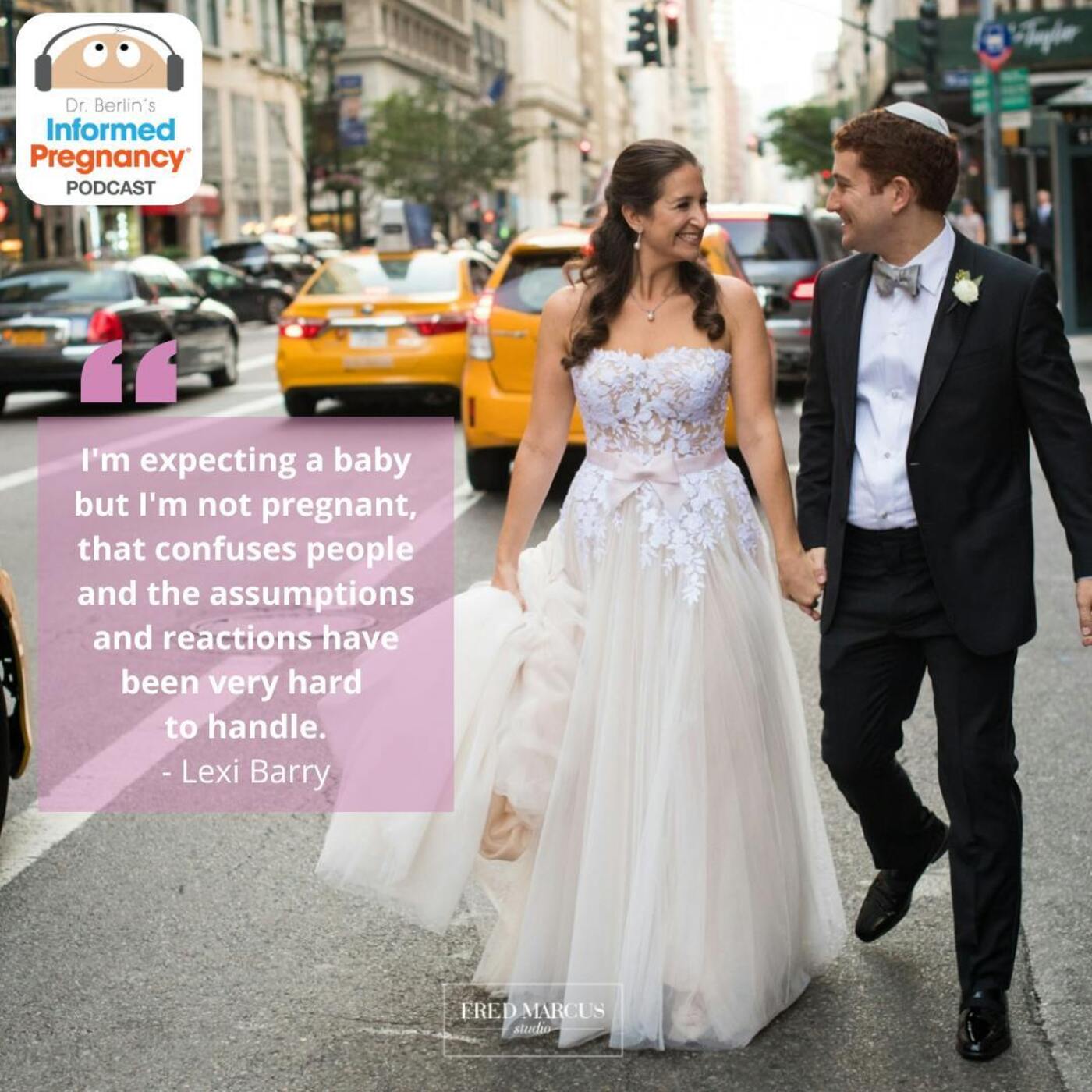
“Truthfully, the hardest part for me is telling people I'm expecting a baby and having somebody say, you don't look pregnant”
“I truly think this is the first time I've gotten the whole story out without crying and I'm owning it. And I felt like this was a big step that I needed to take to own my story.”
Related episodes
- Ep. 182 Randi Wood – Birth Story
- Ep. 475 An Empowered Birth in Lockdown with Natalie Richeimer
- Ep. 307 Lexi Barry – After Birth
- Ep. 188 Joanna Bavero – Birth Story
Transcript
AI-generated transcript with speaker labels — may contain errors, especially names and medical terms. Dr. Elliot Berlin, DC appears in blue; Lexi Barry in orange.
Download PDF of the Transcript
Dr. Elliot Berlin, DC [1:36] Welcome to the informed pregnancy and parenting podcast. I'm your host dr Elliot Berlin my guest today is about to become a mother for the second time She has a connective tissue condition called Ehlers-Danlos syndrome where tissues that hold the body together become weak or loose and She's experienced miscarriage IVF preeclampsia Emergency birth and as a result is having her current baby through surrogacy We have a lot to talk about Lexi Barry, welcome to the podcast. Thank you. Dr. Berlin. Happy to be here. I'm always happy when you're near
Lexi Barry [2:11] It's been a journey for both of us. Yes, it's been quite a journey and there's so much to talk about
Dr. Elliot Berlin, DC [2:16] I'm gonna jump right in briefly. Let's start at the beginning. Where are you from originally?
Lexi Barry [2:20] I grew up in Westchester, New York just outside New York City
Dr. Elliot Berlin, DC [2:24] Westchester does anybody in Westchester have an accent? Do I know anybody like do Westchester Ian's have any kind of accent?
Lexi Barry [2:34] It's like a New York accent sort of it's not Long Island. It's like a little miles. I think it's like a little miles New York ish. I don't know. I went to college in the south and then I lived in California So I don't know where I get the whatever it is. You don't have it. Okay, so what'd you study in college? I Went to Vanderbilt and studied human and organizational development. Oh
Dr. Elliot Berlin, DC [2:58] Human and organizational. Yeah, that sounds like big words for something
Lexi Barry [3:03] It's big words for Think of it like a pre-mbA program Think about a lot of people going into HR a lot of people going into management We had a lot of people go into the public sector working in public policy and health care and education Oh, so first age oh and then HR What did you do with it Wow, so I moved out to Los Angeles and went to work for an architecture planning and design firm and we do consulting strategic planning so Think of it as all the pre-designed services that lead to a project So helping clients figure out what they should do with their space with an office or a real estate portfolio Change management communications and it's grown significantly since then so I started there and the punchline as I boomerang back
[4:02] About four and a half years ago. Oh They always come back. Yes
Dr. Elliot Berlin, DC [4:07] Well, you must have done a great job originally if it's grown that much
Lexi Barry [4:10] It's exciting. We're sort of getting back to the roots of my education with Organizational strategy and culture consulting and ESG and really starting to help companies figure out Who they want to be and how to align that with their mission and putting their Vigils, I'm happy to consult with you And then Jeff you met your husband where do you meet Jeff so I met Jeff on Bumble he was living in Ohio I was living in New York and He was in New York for one day on a business trip and we connected he flew out of New York the next day, so we started talking at first and didn't meet in person for a couple of weeks and then after we met, it was one of us on a plane every other week for 13 months until we got engaged.
[5:07] Oh, back and forth from Ohio to New York? Yep. Oh, wow. That's a lot of travel. I guess you like peanuts. We do. I don't know if they give them out anymore, but back in the day. Yeah. So the other piece of it is, you know, we met on Bumble and Jeff is a big dog lover. So of course, when we got married and got settled out here in Los Angeles, we got a dog naturally and named the dog Bumble. Oh, that's so cute. Oh, that's wonderful. Okay. So I guess other people have to name their dog, you know, like frat party or I don't know. I know because
Dr. Elliot Berlin, DC [5:42] we tell the story. Somebody named their dog Tinder. Oh, Tinder. Which is worse. Okay.
Lexi Barry [5:48] Different. Okay. Is kids something you talked about early on? Yeah, very early. You both wanted kids? Both wanted kids. I think we were together maybe six months. Had a pretty drunken night at dinner out in Westchester at a restaurant. And we wrote down in an email that Jeff sent to me, our children's names. And I will tell you that we've boomeranged that email multiple times. And our son was on the list and our future child is likely on that
Dr. Elliot Berlin, DC [6:25] list. Oh, wow. Geez. Cause I just shake the magic eight ball, but we're not that risky. Well, no, really you got drunk and wrote down a whole bunch of names. So curious. Okay. But we're going to get back to that. So how long into your relationship did you start
Lexi Barry [6:44] trying to have kids? So we met in the fall of 2015. We got engaged the fall of 2016. We got married in August, 2017 in September. I was living in Columbus. I moved to Columbus, but kept my job and my apartment in New York. So I was back and forth and, you know, really felt that Columbus was not going to be our home long-term. Our entire family was out in Los Angeles. We knew we wanted to raise our family near family. Your Westchester family moved to LA? Yeah. My brother lives here. My parents moved here and my husband's from here. Oh, well, okay. There it is. So we knew that we wanted to think about timing our future family with a move back to California. So once we decided to move, it took a couple of months,
[7:34] you know, we had bought a house, we were looking for jobs. So we went on our delayed honeymoon in June, 2018. And then pretty much started trying immediately. I mean, were you deliberately trying not to move before that? Yeah. Okay. So when you start trying, how does it go? We got pregnant within a month. First try. Does that mean? Yep. Well, yeah, with the first month, we know that we got pregnant. Yeah. Okay. So first cycle, what were you doing to prevent pregnancy? I have been on birth control pills since I was 16 for PCOS, which I think I grew out of, but I just stayed on it because it made periods light and it was predictable and it was easy and there was no reason not to. Oh my God. I
[8:23] want to go on it. That sounds dreamy. Okay. Wow. So you stopped birth control and boom, you know, so I go right away and got pregnant. The craziest part of this story is we found out that I was pregnant on day three of me starting my new job, which is my old job. So I basically started a new job pregnant and nobody knows the first time anybody's hearing it right now, you heard it here first. Okay. But were you surprised? Shocked. You were shocked. Did you feel changes or did you just skip a period? No, I took a test because I was like, this can't be real. And we were having people over and I took a test and we had like half an hour. We saw it was positive and then there was. Wow. Okay. So how did that pregnancy go?
[9:19] So I had a positive pregnancy test probably in about four or five weeks and you know, thought I was pregnant. I was at work and I went to go see my doctor a couple of days later because I had started to spot. So I had the positive pregnancy test and I was spotting and the doctor informed me that it was considered a chemical pregnancy. Okay. So super early miscarriage. Super early miscarriage. Essentially. If I hadn't taken the pregnancy test, I would have thought that my period was a week late. Okay. Had you felt pregnancy symptoms? Not really. at the time, not that I would have noticed. Okay. Um, not at the time.
Dr. Elliot Berlin, DC [10:05] Now, when you found out you're pregnant that time, were you excited about it? Were you surprised by
Lexi Barry [10:12] it? I was in shock thinking, how could this happen in one month? I was a little scared. I had just gone back to a former company in a new job and it was week one. We were about to embark on a renovation of our house. So the timing was a little daunting.
Dr. Elliot Berlin, DC [10:29] Does that mean that when you found out the pregnancy wasn't moving forward, was there a degree of relief there or was that sort of all bummer?
Lexi Barry [10:38] I have this memory of feeling like I wanted a do-over to have a different reaction. Okay. Fair enough. I wanted my do-over. Did you get a do-over? Did you start turning
Dr. Elliot Berlin, DC [10:49] right away for room two? And then some, we got many do-overs.
Lexi Barry [10:54] So we started trying, you know, the next month and we waited the one month and we got pregnant within a month again. Okay. And now did you have the reaction you wanted for your do-over? Yeah, this time we were super excited and I felt pregnant. I knew sort of what I was looking for that the first time around, I didn't really know what it was. What kind of things, you know, my breasts were hurting me. I was exhausted. Those are probably the two big things. Very nauseous. So a lot more than you had in your pregnancy. So did you take a test to confirm it? So I had taken a test and it was a positive pregnancy test and reached out to my OB and scheduled my eight week ultrasound to confirm and see if there was a heartbeat or anything.
[11:44] And we were told there was no heartbeat. So this was at eight weeks and given the timing and where it was, it was a week before Thanksgiving and I was flying back to the East coast. So because of it, the doctor recommended a DNC just to help things along. So I wasn't struggling while I was, you know, on a plane or out of state. So did you do it? We did a DNC. What was it like? Where did you do it? We did it in the office. The doctor performed it. They gave me the option of putting me out. I did not. I have a very high pain tolerance and it was just something I didn't want to be
Dr. Elliot Berlin, DC [12:21] numb for. Honestly, when you said that there was no heartbeat, it took me down for a moment. Like I felt a skip in my own heartbeat and I didn't feel that when you said you had a chemical pregnancy. So, and of course you got further along and started to feel the pregnancy this time. So it feels to me like this was heavier for you.
Lexi Barry [12:41] This was definitely heavier. It was brutal being in the room. And now that I've been around the lock a couple of times, I know that when the technician doesn't say anything and then leaves the room and the doctor walks in, it's not good. So that was the first sign of
Dr. Elliot Berlin, DC [13:00] something's wrong. And then for the DNC, you're awake. Is there some sort of numbing?
Lexi Barry [13:07] No, it was more like an uncomfortable pap smear for me at least. I just was expecting it. The pain does not bother me in this sense. So at that point, the DNC, I just wanted to schedule it as soon as possible. The wait for me was having to wait to do it. So I think I did it the next day. Oh, okay. And then what did you feel like afterwards? So that was in November. We went into the holidays. I felt sad. I will say that we did the chromosomal testing. So Jeff and I are both Ashkenazi Jewish and did all the paneling and we knew genetically, we had no concerns, but that doesn't impact your chromosomes and how an embryo is formed. So we did the testing and found out that it was a chromosomal abnormality that caused
[13:58] the embryo to stop growing. So that gave me comfort in knowing that it wasn't my body. It was random. Okay. So that helps. And did you go for round three?
Dr. Elliot Berlin, DC [14:10] If you can believe it, we did. You know, there's that saying, if you try something over and over again and expect different results, it's the definition of insanity. But you know,
Lexi Barry [14:19] that was us at the time. But they also say the third time's a charm. Oh, well, yeah, that didn't work for us. They sometimes lie. That didn't work for you. I mean, did you get pregnant again? So, yeah, so I did get pregnant again. I think it was after two months, maybe three months this time. And, you know, similarly to the second one, I had all the symptoms. I felt everything. And, you know, we unfortunately had another chromosomal abnormality. This time it was a little bit later in the pregnancy. It was closer to 20 weeks. And, you know, that was the end of the third and final try for ourselves without assistance. after losing three pregnancies, you know, when the third time wasn't the charm.
[15:05] Right. And it was three within a year of our first year living in Los Angeles and our first year
Dr. Elliot Berlin, DC [15:12] each at a new job. No one knows that. Well, now they do. Like I said, the first time they're like, oh, that's whatever, chemical pregnancy. The second time my heart skipped a beat and on that third one, two beats. So I can't imagine what it was like for you.
Lexi Barry [15:27] Yeah. So the crazy story about the third one, I had become so numb and I felt so sort of resolved to the fact that this happened. I'm strong. I'm resilient. I can move on. We're going to figure this out. And I had the procedure on, I think it was a Thursday or Friday. And I came back to work on a Monday and I'm sitting in a meeting with a couple of people and there was a woman in another office on the phone and she announced on that call that she was pregnant. And I broke down, went to my mentor who's still my mentor with no words, no ability to speak and just left. And I spent a week in bed and felt all the feelings I was trying not to
Dr. Elliot Berlin, DC [16:19] feel so sorry. Well, it sounds like that was the end of a chapter and then a new chapter began. So it seems like a natural place to take a little break. And when we come back, we'll find out how you ended up having a little one you have.

Dr. Elliot Berlin, DC [19:01] Welcome back to the Informed Pregnancy Podcast. We're talking about Lexi Berry. Okay. Dating went well. Marriage, good. Having kids, which is something you guys talked about early, even picked out the names really early, is strike one, strike two, strike three. In just such a dramatic way. And you're so strong, like even to just be awake, forget about the physical discomfort of a DNC, to be awake and for the emotional discomfort is just such an incredible thing to take so much strength. So then, thankfully, we have reproductive and chronology. Yes, we do. Filled with medicine where endocrinologists help you figure out what the issues are and how to have a pregnancy with a baby that does not have chromosomal abnormalities.
[19:46] How did that go for you?
Lexi Barry [19:48] Went great. We got Louie. So straight to the punchline. We have a little Louie. You have a little Louie.
Dr. Elliot Berlin, DC [19:54] We have them. I mean, was it straightforward? No more roadblocks?
Lexi Barry [19:58] For us, it was pretty. straightforward for a while, and then things took a turn. But finding our reproductive care team was pretty easy through recommendations and friends of friends. We went in, we met with the team, they agreed, they did the assessment of me physically, and the agreement was we had crappy luck three times around, but there's nothing leading the team to think that my body can't carry a child. So we went down the road of, let's ensure that the embryo is viable, and then let's go from there.
Dr. Elliot Berlin, DC [20:37] Okay, so you did IVF. Yep. Your egg and your husband's sperm. Yep. And then there's like that whole, you have to take out all the eggs, and then the numbers, it's the numbers game, how many eggs do you get, how many of them are good, how many of them fertilized. Let's see if I can remember the numbers game.
Lexi Barry [20:59] So they got 16. Wow. Yeah, we got 16. We went down to nine that were fertilized. Then we sent six for genetic testing, and we got back four that were cleared. Okay. And the funny part of the story is I'm with a coworker having drinks when all of this was happening, and the doctor called me and said, congratulations, you have four. He said, do you wanna know the genders? And I said, well, I don't wanna know. I just wanna know, is there at least one of each? And he said, nope, they're all the same.
Dr. Elliot Berlin, DC [21:39] Wow, okay.
Lexi Barry [21:41] We had four of the same.
Dr. Elliot Berlin, DC [21:43] Okay, but you didn't know which one?
Lexi Barry [21:46] No, we caved when I was about 20 weeks pregnant and found out.
Dr. Elliot Berlin, DC [21:51] But still, I guess you were hoping for at least one of each. We're coping. First choice, but still. It's always interesting when you harvest those 16 eggs. My first thought is, wow, that's quite a family. I mean, when you think about college tuition. Yeah. Hey, my cousin got 44.
Lexi Barry [22:12] Oh my goodness, that's hyper stimulation. It must have been uncomfortable.
Dr. Elliot Berlin, DC [22:16] Yeah, it was tough. It was really tough. 44?
Lexi Barry [22:19] Yeah. That's a village.
Dr. Elliot Berlin, DC [22:20] Yep.
Lexi Barry [22:22] There are towns that have less than 44 people.
Dr. Elliot Berlin, DC [22:24] Yep, exactly. Holy moly, okay. So, four good embryos. Do you think about just putting in one embryo at a time? Or is there even a thought?
Lexi Barry [22:33] Absolutely. There was never a thought of two. My brother has four children. The first two are boy-girl twins. Love them dearly. Wasn't for me. Got you.
Dr. Elliot Berlin, DC [22:43] By choice. Yeah, and so did it take?
Lexi Barry [22:47] It did.
Dr. Elliot Berlin, DC [22:48] Okay, so one shot, three on ice.
Lexi Barry [22:52] First time around, I was very sick up until week 20, throwing up every day, which was a great thing.
Dr. Elliot Berlin, DC [23:00] I mean, now that you knew that the chromosomes, they do genetic testing. So they take cells, or a cell at least, out of your embryo and check the chromosomes to make sure they're totally normal. Yep. So knowing that, did you feel more confident that the pregnancy would thrive?
Lexi Barry [23:17] I think, yes, I was confident that the pregnancy was going to thrive. The idea of it not working truly didn't cross my mind because my experience had been something that was not gonna be replicated with this one. And that was an abnormality.
Dr. Elliot Berlin, DC [23:33] Right, okay, so you feel confident. Look, I just got back from a cruise to Alaska, and on day two, our first full day at sea, there were very stormy seas, like 15-foot waves and stuff. This giant 20-story boat was just bouncing around. Wow. And I had not felt nausea like that, really in a very, very long time. Even the crew was green, you know. And I just had this moment where I was so seasick, and I felt to myself, this is like what they talk about in the first trimester. I was like, I can't take six hours of this. I took some, I mean, and went to bed. Yeah. And it's like my first little glimpse of what it might be like to have like a moderate
[24:19] or worse nausea during pregnancy. And, you know, I never could relate. 20 weeks seems brutal.
Lexi Barry [24:26] Yeah, I mean, for me, I always was a nauseous, motion sickness type of kid. I would throw up in the car. I throw up in the stroller as a baby. Motion sickness is in my sort of, you know, system. So add on a pregnancy to that. And I'm still doing the IBF injections until week 13. So I'm still adding all of the hormones until that point.
Dr. Elliot Berlin, DC [24:49] Oh, you're like progesterone?
Lexi Barry [24:51] Progesterone. I was still doing progesterone until week, and S-trace for a while.
Dr. Elliot Berlin, DC [24:55] Every week?
Lexi Barry [24:56] Daily.
Dr. Elliot Berlin, DC [24:57] Oh, every day?
Lexi Barry [24:58] Daily. The progesterone. So this is my second trimester nausea story, I was up in Santa Barbara for work, I was alone in a hotel room doing my injections, nauseous beyond all compare. And I was doing interviews for a client. And we're driving from one client to the next. And nobody knows I'm pregnant because at that point, it's like week 1415, and I wasn't showing. So nobody knew we were driving to a client. And I turned to my colleague and I said, we need to pull over and we're in the middle of nowhere. The only thing that was there was a church. So we pull into the church parking lot. I vomit as much as I can. And my love him, but my male colleague who does not have children or any nieces
[25:51] or nephews asked if I had a stomach bug and would I be contagious? And my female colleague who is only a couple of years younger than me, kindly said, I don't think that's what's going on. So things leveled out at about week 20.
Dr. Elliot Berlin, DC [26:12] And your male colleague didn't end up accidentally pregnant. He did not. Okay, good. So 20 started to feel better. Did you enjoy some of the pregnancy at that point?
Lexi Barry [26:21] No pregnancy for me, I was still not feeling great and I was very anxious. And I didn't have a ton of movement. Like I didn't have a ton of kicks. I had a lot of little flutters and we now know why that is. But at the time, if I didn't feel anything for a couple of hours, my anxiety and panic would set in. So I was on edge quite a bit.
Dr. Elliot Berlin, DC [26:49] What was your plan for birth?
Lexi Barry [26:52] My plan for birth because of the elders, Danlos was going to be a scheduled C-section.
Dr. Elliot Berlin, DC [26:59] So I mentioned elders, Danlos in the opening, but tell us a little bit more about it.
Lexi Barry [27:04] Sure. So I was diagnosed with elders, Danlos in my early twenties, around the same time my mom was diagnosed with elders, Danlos, it is a connective tissue disorder, hypermobile. Neither of us have the kind that can affect your heart, your vascular system. Ours is generally related to excess joint mobility, laxicity of ligaments, tendons, things like that. So we tend to not recover easily from injury. So I've had multiple hip surgeries as a result of it. I've had multiple wrist surgeries as a result of it. I've dislocated my hip. So because of all of these connective tissue concerns, we had decided that the plan would be to schedule a C-section out of concern that I
[27:55] might dislocate a hip or have other things that we can't control during a natural birth. Okay.
Dr. Elliot Berlin, DC [28:03] And was that going to be like a 38 weeks or something like that? Okay. Exactly. So leading up to that.
Lexi Barry [28:09] Well, we didn't make it to 38 weeks and we didn't make it to our scheduled C-section instead at week 30, I was at the doctor for a checkup and my blood pressure was through the roof. So we sent me to the emergency room and we did the, I think it's just the urine test for preeclampsia and it came back positive. So I was in 30 weeks, it's severe preeclampsia and it's very early. And the baby was measuring very small, hence why I didn't feel so many kicks because the baby was really small, super small. Wasn't growing on schedule. Right. So at that point, between 30 and 34 weeks, I was put on bed rest. I had to stop working two months before I had planned to, and was in
[29:02] and out of the hospital, I think four times with rising and elevating blood pressure level. So we ended up doing the magnesium thing and then the injection for the steroids for the lungs. Okay.
Dr. Elliot Berlin, DC [29:17] So magnesium for you to help with your blood pressure. To prevent stroke. Yeah. And steroids for the baby. So that being born early, you know, to improve lung function. Right.
Lexi Barry [29:28] And if you remember, this is March, 2020.
Dr. Elliot Berlin, DC [29:32] I remember something happening around March, 2020. Indeed. Were we at the hospital at the same time? It's quite possible. Okay. So my question is the magnesium people say awful things about it.
Lexi Barry [29:45] It was horrendous for me. It was a really rough experience. I had to do it twice. The second time I did it was while I was delivering, but we'll get to that when we get to that part of the story, because the second round. was significantly worse for me than the first.
Dr. Elliot Berlin, DC [30:03] What did you feel?
Lexi Barry [30:05] I felt very weak. I was having vision challenges. I was very nauseous and dizzy. Yeah.
Dr. Elliot Berlin, DC [30:12] That sounds terrible. You didn't catch a break here with the babies.
Lexi Barry [30:15] Nope. Everything else is pretty good. I mean, so I assume forgetting the steroids are getting rid of to get the baby out. Yeah. So at week 30, we were prepared for week 32, hoping for week 34, and fingers crossed for 35. We got to 34 and a half. Okay.
Dr. Elliot Berlin, DC [30:33] Which was a win. And it was going to be a cesarean still.
Lexi Barry [30:36] It was going to be a planned cesarean. Yeah. Okay.
Dr. Elliot Berlin, DC [30:40] So do you just go in at a scheduled time?
Lexi Barry [30:43] So the decision was at 34 weeks, the preeclampsia had gotten so bad that I was having blinding headaches that the medication was not controlling. So at that point, the benefit of keeping the baby in was more harmful to me than having the baby come out at 34 and a half weeks. Oh, was detrimental. Yeah. So the NICU was prepared. The NICU made me feel very comfortable. But at that point, the headaches, they couldn't control. So they were done.
Dr. Elliot Berlin, DC [31:13] Okay. So you didn't make it to a scheduled cesarean? No. Okay. Were you awake for your C-section?
Lexi Barry [31:20] I was awake for the C-section. Jeff was in the room. It was the week that CEDARS was allowing people in the room. I think the week before they weren't. Wow. Yeah. So we got one break. So the baby was born, Louis, Louis Harper. Louis Harper was born at 2 0 1 p.m. on April 21st and he was three pounds, 15 ounces. Yeah.
Dr. Elliot Berlin, DC [31:45] That's when I was in there too. We were there together. Wow. Now that I think about it, I had a better experience than you did. And I was in the ICU. Okay. So did the surgery go well?
Lexi Barry [31:58] Yeah. So I remember the doctor holding him up. He was teeny tiny. And then they immediately took him away. And Jeff, you know, he said, do I stay here or do I go with the baby? I said, you go with the baby. So they left. The baby was not just small, but the baby was underweight. So we were hoping the baby would be like four and a half pounds. And he came out at 3 15. So the baby I was told was breathing on his own. There was no concern. So the baby was taken and I had a clean bill of health. It was successful. Everything went exactly the way it was supposed to. I was still hooked up to the magnesium. So I was brought back to the room and we were told, you know, Louis doing great.
[32:43] Everything was normal with me.
Dr. Elliot Berlin, DC [32:45] Finally. So we thought. But there's always a twist with you. So Louis, like I said, he was breathing on his own.
Lexi Barry [32:53] He was feeding on his own. He was doing great. There was no concerns with him. The magnesium for me this time around was much more severe. I couldn't open one eye and I couldn't put any weight on my legs. And at the time we were told it's the magnesium. It's magnesium. When I went off the magnesium after the 24 hours, I didn't recover as quickly as I did the first magnesium cycle. And again, everyone said, let's just wait and see what happens. So the next night in the middle of the night, like four a.m., we were woken up by the doctors and nurses coming in and turning all the lights on. So after the doctors came in and opened the doors and brought in the
[33:39] ultrasound machine, we were told that my hemoglobin levels had dropped. Down to believe it was a six or a seven and that I would be having a blood transfusion immediately. But first they needed to do an ultrasound because it meant if my levels would drop that much, there was bleeding somewhere. I was losing blood fast. Okay.
Dr. Elliot Berlin, DC [33:59] What's normal.
Lexi Barry [34:00] I believe it's 12 to 15.
Dr. Elliot Berlin, DC [34:02] So like you're dangerously low.
Lexi Barry [34:04] Cause that's one point.
Dr. Elliot Berlin, DC [34:06] It goes so low that you're just at risk of organ shutting down. I believe so. I was so out of it and not really understanding. I think in hindsight, everything that happened next,
Lexi Barry [34:16] my husband and I are grateful that, you know, we were sort of oblivious to the severity of it. You know, we see it in hindsight, but not in the moment.
Dr. Elliot Berlin, DC [34:25] Where was the bleeding?
Lexi Barry [34:26] I don't know. I don't know. I don't know. I don't know. I don't know. I don't know. So it was dry. They closed me up dry.
Dr. Elliot Berlin, DC [34:35] And. 24 hours later. There was a bleed. Oh, wow. So how did they repair that?
Lexi Barry [34:41] So we immediately did the blood transfusion. We did two units. To put back what I had lost. And then we did. Said we would. It still hurts. It hurts. It hurts so much. That they locked me up, Look. The Safe Spa from the ride and The switch. It hurts so much. a CT scan to determine exactly where it was bleeding and what the flow was so they could Yeah, I mean, So it's it's difficult actually to close. have a course of action. So the most severe course of action, thankfully we didn't need, would have been some sort I've been away for a long. A long time. All right. Put you through. of removal of the uterus, we didn't have to go that route. Of getting to it.
[35:18] So for me, I was taken down to interventional radiology, where they cauterized the blood vessels with like a gel to prevent the bleed from continuing.
Dr. Elliot Berlin, DC [35:31] Vaginally?
Lexi Barry [35:32] No, this is the crazy part. So because I had had a C-section and I was given local anesthesia and I had had a block, they couldn't put me out. So I was not out. They go through a spot in your groin and it's done arthroscopically. I was awake. I could smell it. When they sealed your vessels, it was like I could smell the burning. And I'm still hooked up to the unit of blood. My son is in the NICU. I've yet to hold him and I have no idea what's happening. No idea. So we were told it was successful. They brought me up to the room and that's when I lost it. I was like, what is going on? What has just happened? We were assured that I was stabilized.
[36:27] My levels were going back up. We were out of the clear. And of course, the first question I asked my doctor is, what do we do next time? And she said, we don't talk about this for six months.
Dr. Elliot Berlin, DC [36:37] The next baby? Next baby. You're crazy. I know. I know. You are crazy. So, okay, but I mean, after that, you and Louie were okay.
Lexi Barry [36:52] Nope, no more twists. Louie and I have both been perfect since then. He is a thriving 27-month-old who has caught up and all of his things he needed to catch up on, you know, I'm still dealing with some of those connective tissue results from the pregnancy, but all in all, we're doing great.
Dr. Elliot Berlin, DC [37:13] Well, I love to hear that. Okay. Now you're yet another chapter, expecting another baby very soon. Time for another natural break. And we'll be right back. Welcome back to the Informed Pregnancy podcast, where twists and turns never end. We're talking to Lexi Berry. Okay. So it just was a crazy journey. I mean, one of the craziest to having your first child and then in the hospital while you're still going through what seems to me like intense medical drama, but not watching it, living it, you're already asking about the next one. When it was time, what was the answer to that question?
Lexi Barry [38:03] The answer was a very clear and compassionate. I don't think this is your future to do it yourself. It was too scary. At that point, I had not realized the severity of what had happened. And my doctor with a lot of fear conveyed to me how scared she was, and that got to me. And she is the one, my OB, who I adore, who for the first time has ever said the words to me, will you consider a surrogate up until that point?
Dr. Elliot Berlin, DC [38:36] Had your mind even gone there? Were you like, how do I make this pregnancy safer for my body?
Lexi Barry [38:41] I only considered me doing it again because I tend to drift into the, I want to control things realm. And this is what I meant to do. This is what I'm supposed to do. And I didn't care about me. I will tell you that my husband and my parents apparently had all said to each other, she's not doing this again. And they gave me the time to get there.
Dr. Elliot Berlin, DC [39:07] What was that like the time to get there? Was there anything specific process or things that were helpful?
Lexi Barry [39:15] So we spoke to a specialist who reviewed my case and I at the time was still convinced that we could do it. And we started the dialogue with him. And this must've been Louis was born in August, 2020. So this was January, 2021. We spoke with him and he said at the onset, I don't know if a surrogate is something you need. And then after we went through the whole story, he said a surrogate is absolutely what you need. I would not recommend you get pregnant.
Dr. Elliot Berlin, DC [39:46] So now there's your doctor, the specialist, your husband, your parents.
Lexi Barry [39:50] Yeah. And then after that, that was sort of the, okay, that door is closing for me. So what do I do to mentally prepare to open? the other door. And I went back to my old therapist and spent a lot of time with her processing what had happened. And she helped me recognize that it wasn't just me anymore. I was a wife, I was a mom, and my life was not my own to risk.
Dr. Elliot Berlin, DC [40:17] Stop riding motorcycles? Yeah, exactly. What is it about your body? Does it have to do with the Ehlers-Danlos or is it something else? What is it that made the specialist, I know your husband and family love you and never want to see you in a dangerous situation. What is it about your body that they're pointing to to say this is not a good idea?
Lexi Barry [40:41] So there's very, very little research out there on Ehlers-Danlos and pregnancy. So that in and of itself is sort of a black hole. The second piece of it is the preeclampsia of once you have severe preeclampsia, so diagnosed before 35, 36 weeks, super early, my doctor explained to me the likelihood of it happening again goes up. And the long-term damage of severe preeclampsia on my heart is something they didn't want to risk. So it was a combination of a second time around of severe preeclampsia and the unknown of Ehlers-Danlos, plus the fact that it had happened once already, that nobody was willing to risk it again.
Dr. Elliot Berlin, DC [41:27] I mean, was there a mourning process for you?
Lexi Barry [41:30] For sure. I kept my maternity clothes in my pump and I didn't let go of that stuff for a very, very long time, even though I hated being pregnant.
Dr. Elliot Berlin, DC [41:40] Right. The surrogacy process you eventually signed on.
Lexi Barry [41:44] I did.
Dr. Elliot Berlin, DC [41:45] I know it can be a long process filled with its own challenges. What was the process like of finding a surrogate?
Lexi Barry [41:52] So for us, we initially met with one of the well-known agencies and felt like it was a little too impersonal, a little too salesy, a little too slick. So that wasn't going to be our route. So our reproductive team had what's called their third party surrogacy concierge, where they would pre-vet surrogates medically before bringing them to our attention, which I have a newborn. I have a full-time job and that sounded great to me. Sure. So we went through the process. We went through all of the things of what we want, what we don't want, what's important to us, what's not, and we got matched.
Dr. Elliot Berlin, DC [42:38] How long did that take?
Lexi Barry [42:39] Not as long as I thought it would. I think it was about three months.
Dr. Elliot Berlin, DC [42:43] OK, that seems pretty quick compared to…
Lexi Barry [42:45] It was pretty quick. We got matched pretty quickly.
Dr. Elliot Berlin, DC [42:47] OK, and then what's the next step? Were you using an embryo you already had?
Lexi Barry [42:52] So good reminder. So a couple of months earlier, my IVF doctor recommended that I do another round, knowing that if we are going to be using a surrogate or there's other factors that could come into play of me getting older and he wasn't entirely sure about the quality of two of the three embryos that we had recommended another round. OK. So that part was easy for me. That's your thing.
Dr. Elliot Berlin, DC [43:18] You're a pro at the IVF.
Lexi Barry [43:20] It's 11 days. It's four injections in my stomach. I get a long sleep. I wake up and carry some eggs. OK.
Dr. Elliot Berlin, DC [43:28] Did you get the embryos?
Lexi Barry [43:29] So we started with nine eggs this time, but we got three embryos of which we had both genders. Oh, OK.
Dr. Elliot Berlin, DC [43:38] So now you have three and three, three embryos and three embryos, six embryos total and at least one of each gender. OK, so what's the process now that you have the embryos and you have a surrogate? What's the process to get the surrogate ready for your embryo?
Lexi Barry [43:57] So we on our side of it had to hire a lawyer. So we did that. We had to open up an escrow account for all expenses that would be going through the escrow account. So working with our attorney and the surrogate's agency, their attorney, you know, we drafted up our contract. What are the must-haves, can't-dos conditions of the arrangement?
Dr. Elliot Berlin, DC [44:24] This is on both sides? On both sides. To make sure that you're lined up with each other. Correct. OK. That seems intense. Did you find common ground? Yeah, this part was easy.
Lexi Barry [44:35] I mean, you know, we had most of the questions that we had were already agreed to before. So things like the surrogate would deliver with my OB at Cedars because of what I went through. I wanted my team. The surrogate will get vaccinated, you know, for COVID-19. Like all of this stuff was already spelled out. So by the time it was up for the legal stuff. We'll stop. It was just paperwork. Okay. So what happens? Yeah. I mean, you got all the things lined up. It seems like it should be easy from here. Shut up. Shut up. But it's us. It's Lexi world. So we had a zoom meeting with the surrogate. She lives a couple of hours away. Everything seemed great. We are two weeks away from transfer. And I am in my office working
[45:25] and I get a call from the third party concierge. She said very emotionally, I don't know how to have this conversation with you. But the surrogate who has been a surrogate twice before we were told as a star is pregnant with her own child. Yep. Aren't they supposed to not they're supposed to be on the pill the month before to prep their body. And the kicker is that her levels were so high that the only justification because they had scanned her a couple of weeks earlier and she was not pregnant was that she had to be pregnant with twins. Oh my goodness. Wow. Like the universe just loves to like not just kick you a little bit but like double kick. So there. Oh my gosh, that must have been devastating after everything.
[46:14] Oh, it was devastating. It was devastating. And the agency was so upset. And you know, everybody, that's your star. It was hard. It was really, really hard. I have to give the agency credit though, they went into immediate action. And I don't know, they found some other stars somewhere and brought her down to earth, who the story we were told was that she was about to move forward in two weeks with a family. But that family put a pause because they wanted to try themselves one more round. So as you know, my husband Jeff likes to say, we are both left at the altar. So we found each other. Okay. Yeah. Sometimes that works.
Dr. Elliot Berlin, DC [46:55] I mean, same thing. Did you have to go now with the lawyer, go through all the different.
Lexi Barry [46:59] So this was much quicker because she was with the same agency. So everything went, you know, paperwork done within a day. She was already taking the birth control to prep herself. So it was, you know, a matter of she came down to LA, Jeff and I met her in person. What's that meeting like? So interesting. So we took her to a diner after her appointment. We met her at the diner. We had Louie, her sister was driving around the block. And I can't even begin to describe. It was like, do we hug each other? I mean, I hugged her when I saw her. Like, I didn't know what else to do. And it was very casual. We didn't really talk about the surrogacy. We talked about her life. We wanted to get to
[47:43] know her as a person. She got to see us as parents with Louie. And I left that brunch feeling like I'm okay. I'm going to do this. Cool. She had never been a surrogate before. No, she's very young. She has two children of her own and she had never been a surrogate. And did she seem excited about it also? Yeah, it's super cool about her and she's not married. Her support system was her family. The reason she was doing surrogacy is she was in property management. She wanted to invest in a building and own it and build a foundation for her children's future and work for herself. And I said, you're my girl. That's what I want.
Dr. Elliot Berlin, DC [48:22] Oh, wow. Organizational planning. Yeah. Okay. So then she's already in process. So, I mean, then you do an embryo transfer. We did the transfer a week later. How involved are you with things like doctor's visits and things that you would normally be doing yourself, right?
Lexi Barry [48:41] Right. So I went into it feeling like I needed to be removed. I felt very strongly that I wasn't going to be there for the transfer. I didn't want to be in the room for the doctor's appointments. And the day we scheduled the transfer, I remember thinking, I just want to be in the office. I just want to be there in case something happens. And she was in the room before and, you know, they give them a valium, so they're starting to calm down. I remember I went through this. She had never done this. And I went in to see her before they did the transfer and I couldn't leave the room and she was alone and she was getting loopy and she had questions
[49:26] and I could sit there and say, here's what to expect. I did it. Here's how it was for me. And that changed everything for me. I was in the room and I watched it happen.
Dr. Elliot Berlin, DC [49:37] Wow. That seems surreal.
Lexi Barry [49:39] It's completely surreal.
Dr. Elliot Berlin, DC [49:41] How has the pregnancy been for her and for you?
Lexi Barry [49:44] Yeah. I mean, so she lives about four hours north of here. So she was coming down for the major appointments in the beginning. And then once she graduated to the regular OB, we had somebody monitoring up there, but we brought her down to LA at week 20 for or you know, the structural ultrasound, and we were told that there was something called voluminous cord insertion into the placenta. Right. So the umbilical cord is not directly into the placenta, it's more off to the side or.
Dr. Elliot Berlin, DC [50:17] Okay, yeah, it's an anomaly in how the cord is attached to the placenta. So they just monitor more for that, not a real.
Lexi Barry [50:25] Well, I got very scared and I, you know, my head went all kinds of places. So what we had to do, we've had a very unique situation with our surrogate where originally in the contract, she was gonna move down to LA into an Airbnb at 36 weeks to be nearby for the birth because of this condition. And she lives in a very remote part of the state where the healthcare is not as significant as it is here. So there was nobody to monitor her. Oh, extra monitoring.
Dr. Elliot Berlin, DC [50:59] Extra monitoring because of the condition.
Lexi Barry [51:02] Right. So we asked her and she agreed, she moved down to LA into an Airbnb at 30 weeks with her two children.
Dr. Elliot Berlin, DC [51:10] Oh, wow. She's been here. How many weeks now are you guys?
Lexi Barry [51:14] 35 and a half. Okay. 36. And what's the plan for birth? So our birth plan right now, and we're working out the details. So this is sort of live information of what we're working on. The plan is she's going to have a natural birth unless this condition causes her to need a C-section. It's going to be at Cedars.
Dr. Elliot Berlin, DC [51:39] Is that scary for her?
Lexi Barry [51:41] She's pretty calm about it. Okay. I know she's having a little bit of a rough patch being away from her family and it's third trimester. I'd expect all of this, this is all normal. So the plan is we have a support person for her and the idea as of now is once she goes into labor, this person will take her to the hospital. We have somebody who has been babysitting to care for her children. This support person is going to be in the room with her. We are going to get a call an hour before we think it's gonna happen. Jeff and I come to Cedars and the idea is when the baby is close to being born because of COVID, you only can have two people. This woman will leave the room.
[52:26] Jeff and I will walk into the room and Jeff and I will be there for the birth. Wow.
Dr. Elliot Berlin, DC [52:31] The support person, is it someone like a doula?
Lexi Barry [52:34] Well, no, it's through the agency. She is more like, I believe her background is in nursing. She's been an emotional support. She does the surrogacy placements. Unfortunately, our surrogate's family couldn't be there to be her personal support. So this person is stepping into that role.
Dr. Elliot Berlin, DC [52:54] Okay. So that's something that you're all comfortable with, like when the baby's about to come, you guys.
Lexi Barry [53:00] Yeah, so that's the plan. We literally worked out the details yesterday that Jeff and I will both be in the room. The baby is going to be delivered and then cleaned off, put into one of the like bassinet things, warmers, and then wheeled directly into an adjacent room with me and Jeff. And then that is where Jeff and I will have our moments do skin to skin and be kind of separated. And that's when this woman will come back and be with the surrogate. The support person. The support person. So the idea is that we've worked through all of this and we have our own room separate from the surrogates. And the one outstanding piece, which I don't think any of us have decided
[53:43] is if she's going to meet the baby. That's, wow.
Dr. Elliot Berlin, DC [53:48] Yeah.
Lexi Barry [53:49] I mean, decisions aside, have you talked about it at all? We've talked about it. Jeff and I want her to have closure. And she has been so incredible throughout this whole pregnancy. You know, whenever there was a bump at the road, she would say, I am just praying for the day that I can give this baby to you. I'm praying for the day this baby's in your arms. So there's never been an attachment piece of it. So Jeff and I want her to feel comfortable. And we've made that clear that if this is something she wants for closure, we're okay with it. She pretty much said the same thing. She said she'll do whatever we're comfortable with, but I think it would help her.
[54:28] And then we said six months, whatever, send a picture because her boys, her children have been along for this journey.
Dr. Elliot Berlin, DC [54:36] Oh yeah. I'm just curious about so many things. We've kind of gone really long on this. This is like two episodes in one. Sorry. No, no, no. It's a big story. Your life is a big story here. And then hopefully we'll come back on the other side and talk about it as well. So four episodes. Sure. One question in my mind is milk. Is there a milk provision here?
Lexi Barry [54:57] It's a great question because again, this was… something we talked about last night trying to figure out. So I know that our surrogate is very interested in getting back to her life. And I know that she's going through a rough time right now sort of handling the pressure of all of us. So my request as of yesterday was to have her pump in the hospital and then nothing after that. She came back last night and said she's already producing milk and she'd be happy to pump for longer. So that's something I have to think about. I will say that she did get her booster shot this trimester. So there's a benefit of the COVID booster if she does pump from her milk.
[55:38] Louis, because of all the trauma that he and I went through together and because he was a preemie, I couldn't really breastfeed. I couldn't really pump. It just didn't work for us. And he was on a special formula for a long time and he's great. So I'm not committed to breast milk. I think there was definitely going to be formula involved in the beginning. So I think that's still a detail over the next week or two will work out.
Dr. Elliot Berlin, DC [56:06] Is there a thought of stimulating lactation in you?
Lexi Barry [56:10] I just heard about this recently because I couldn't really do it for Louis. I had a really tough time. I got mastitis. I just got fevers. Like it really didn't work for me. I don't end because I didn't have the bond with him of breastfeeding. It doesn't feel like something I need.
Dr. Elliot Berlin, DC [56:31] Okay, a couple more questions. One is how is it expecting a baby very soon but not being pregnant?
Lexi Barry [56:39] You know, I think the hardest part, I have a lot of friends. I don't know how this happened who are all due within a couple of weeks of us. I think I know five women who are due within a couple of weeks of us all gonna be delivering at Cedars and I see them pregnant and I don't have that longing. So that piece of it I don't have. Truthfully, the hardest part for me is telling people I'm expecting a baby and having somebody say, you don't look pregnant or I'm on Zoom for work and people say, oh, you hide it so well cause I can only see you from the head up. So the assumption that because I did it once and we're expecting the assumptions that I'm pregnant this time,
[57:22] that explaining and then having people feel badly because they assumed has been the most difficult piece for me. Being at work, walking around the office, not pregnant and then telling somebody, oh, by the way, I'm gonna be on leave in four weeks. I keep forgetting to tell you because there's no visual reminder. Right. So that piece has been hard.
Dr. Elliot Berlin, DC [57:43] Yeah, I can't imagine that. There's so many things you don't think about and surrogacy is not all that common still.
Lexi Barry [57:49] No, it's ironic though. I've got three friends that I've become friends with in the last few years who are all expecting a baby with a surrogate this fall.
Dr. Elliot Berlin, DC [57:57] Oh, really?
Lexi Barry [57:58] For different reasons.
Dr. Elliot Berlin, DC [57:59] Yeah, it's gaining speed, it's picking up but I thought it was a lot more common than it is. So a lot of people don't know anybody who's been a surrogate or who's had a baby with a surrogate. Lexi, before we close this little chapter and meet you next with your little baby in your arms, hopefully with no twists and turns, any final thoughts?
Lexi Barry [58:21] I want to thank you for suggesting this, for offering this up as a platform. And when you and I talked about doing this the first time I was struggling to process this, I truly think this is the first time I've gotten the whole story out without crying and I'm owning it. And I felt like this was a big step that I needed to take to own my story. So thank you for giving me the opportunity and the platform to do that.
Dr. Elliot Berlin, DC [58:49] No, I was honored. And also, well, reciprocate, thank you, because all of the different things, like I said, this could have been multiple episodes but all of the different things that you've struggled with are things that people individually will struggle with and find comfort in listening to you sharing. So genuine.
Lexi Barry [59:07] I hope so.
Dr. Elliot Berlin, DC [59:08] So thank you. All right, next time I see you we're gonna have the rest of the story. And I already have a million questions for that episode.
Lexi Barry [59:17] Well, we have a name, so we're good.
Dr. Elliot Berlin, DC [59:19] You have a name, but you've had a name for a long time.
Lexi Barry [59:22] We've had it.
Dr. Elliot Berlin, DC [59:23] Yeah. I mean, if like magically two babies pop out of there my yarmulke is gonna fall off but it wouldn't surprise me that much. Do you imagine? It's possible. All right. I look forward to seeing you soon at home. Thanks for listening to us. And you know what? We're probably gonna put some cool stuff about this journey and surrogacy in general on our blog. You can check it out at informedpregnancy.com.
Want more pregnancy + parenting? Start your FREE TRIAL of Informed Pregnancy+ and get access to all our curated pregnancy and parenting content — original series, iconic birth films like The Business of Being Born, prenatal workouts and more.
