
October 20, 2022 · 63 minutes · Episode 307
About this episode
Just weeks after welcoming her second child via surrogate, Lexi Barry tells us about her surrogacy experience, the final weeks, what happens in the delivery room, and the unique decisions made during the process.

Learn more about your ad choices. Visit megaphone.fm/adchoices
See Privacy Policy at https://art19.com/privacy and California Privacy Notice at https://art19.com/privacy#do-not-sell-my-info.
Key quotes
“Was reminded by some people in my life that wasn't really my choice anymore. I was now a mom and Putting my life at risk was not an option that anybody was going to support when we had alternatives”
“Every single step along the way, you have to relinquish control.”
“So what happened with our surrogate, and I must say these women are superhuman, superhuman emotionally, physically. I have so much respect and love for her.”
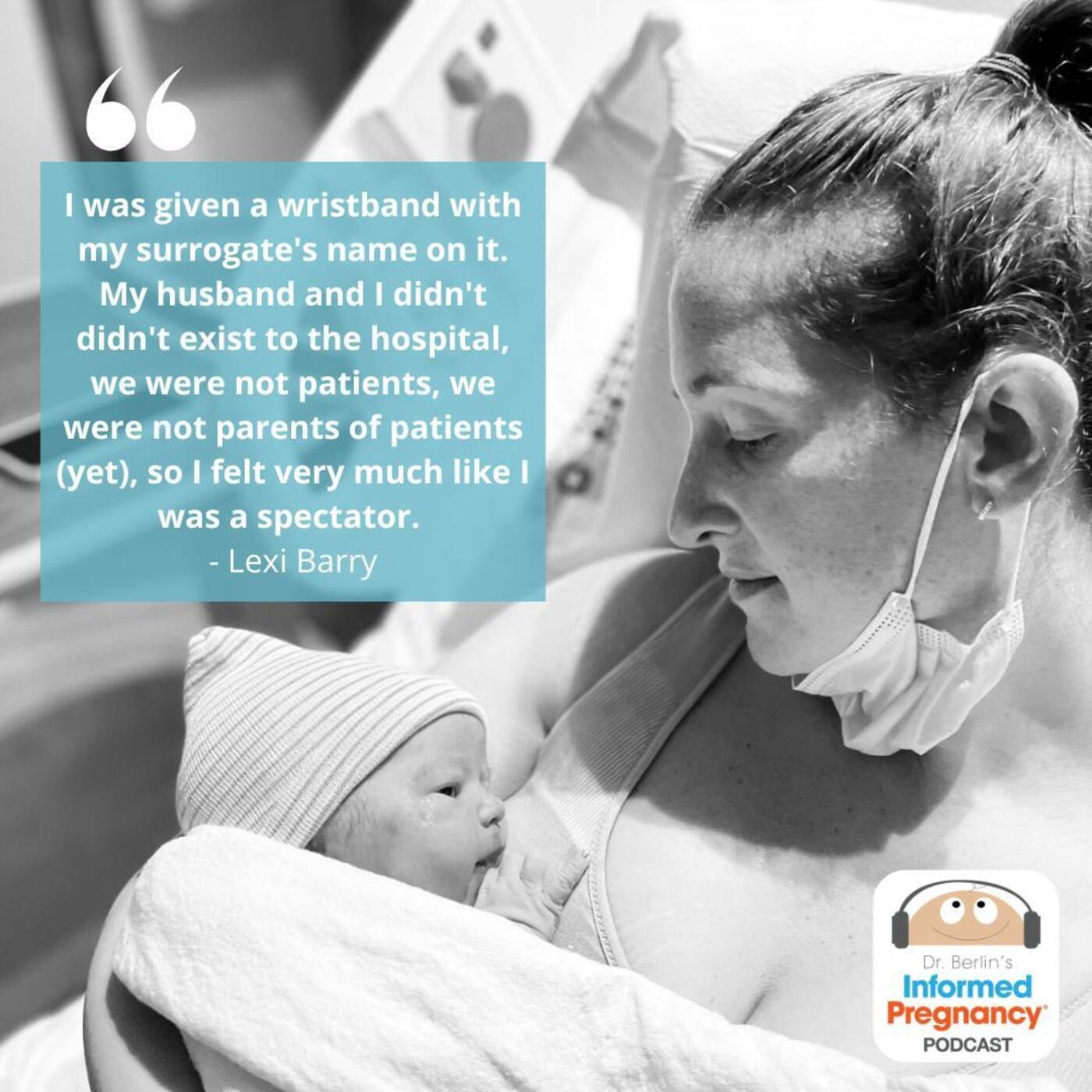
“We were not parents of patients. So I felt very much like I'm a spectator watching this, and it's not my show yet.”
“but I would strongly recommend that people make sure that they understand what the support network looks like for a surrogate and make sure that it's strong and consistent and stable and that they've got access to healthcare where they live. I think that's critical.”
Related episodes
- Ep. 306 Lexi Barry – Before Birth
- Ep. 190 Julie Sawaya – After Birth
- Ep. 378 Traci Burk: After Birth
- Ep. 203 Tamara Rey – After Birth
Transcript
AI-generated transcript with speaker labels — may contain errors, especially names and medical terms. Dr. Elliot Berlin, DC appears in blue; Lexi Barry in orange.
Download PDF of the Transcript
Dr. Elliot Berlin, DC [1:36] Welcome to the informed pregnancy and parenting podcast. I'm your host pregnancy focus car director. Dr. Elliott Berlin You've tuned into the after episode of a before-and-after birth story my guest today Lexi Barry has just had her second baby this time via surrogate. Let's see. Welcome back to the podcast
Lexi Barry [1:55] Thank you. Very excited to be back a little more tired this time around. Yeah
Dr. Elliot Berlin, DC [2:01] I imagine an incredibly different experience and I want to get all the details But first give us a gentle reminder. You already had a son. I do so Louie is
Lexi Barry [2:10] two years and four months and We just had our daughter who is three weeks today
Dr. Elliot Berlin, DC [2:18] Congratulations. Thank you and Louie's birth was a bit traumatic and Cracked the aftermath was a bit traumatic Cracked
Lexi Barry [2:29] Give us a brief synopsis. Sure. So leading up to Louie's birth I was diagnosed with preeclampsia at 30 weeks pretty much put on bed rest had to stop work Delivered him at 34 and a half weeks emergency c-section he was Three pounds 15 ounces brought straight to the NICU He did great. He just was tiny and grew I on the other hand had some more severe complications that resulted in post c-section blood transfusion and uterine embolization to sort of stop some bleeding so We had some pretty scary times in the first weeks of our son's life So we decided not to do that again. I mean there's an excellent summary, but it's also after a whole slew of Rollercoastered trying to get pregnant the first time. Yeah, absolutely. So we had three miscarriages leading up to
[3:27] The pregnancy with Louie and Louie. We ended up going the route of IVF To ensure that we had a viable pregnancy Which were our challenges the first couple of times around so we knew Going into it that I could get pregnant It was making sure that the embryo was a viable and then subsequently found out that Medically my body was not the best place to house the next embryo
Dr. Elliot Berlin, DC [3:56] Then it was your doctor who suggested. I'm sorry. Is that right?
Lexi Barry [4:00] correct, so it was six months after our son was born and I went into the office and you know, very frankly said what do we do to prevent this from happening next time and My doctor sat me down and said I don't think you understand the severity of what we went through you shouldn't be doing this again and It was a very frank conversation that resulted in a few conversations with some specialists Just to sort of dig deeper into what that meant. You know, I'm a little hard-headed so I wanted to push through and do it again myself anyway and Was reminded by some people in my life that wasn't really my choice anymore. I was now a mom and Putting my life at risk was not an option that anybody was going to support when we had alternatives
Dr. Elliot Berlin, DC [4:52] Yeah, and then of course if it could be complicated for you, why not? It's the process of finding a surrogate is not the easiest And, uh, when you finally got your great match and were all ready to do your cycle, she did get pregnant with her own child.
Lexi Barry [5:07] That is the kicker. Yep. She got pregnant and we think it was twins. Yes. So a lot of success for someone else.
Dr. Elliot Berlin, DC [5:16] Correct. All right. So then you did get a surrogate and you were matched and it was good match. And then there was maybe a minor complication or just an observation with the villain at this court insertion.
Lexi Barry [5:29] Yeah, my understanding of that condition was diagnosed at week 20 with the high def ultrasound showing that the umbilical cord was attaching not in the exact place it was supposed to in the placenta, which we were told could have caused issues with the baby's growth, could have also caused potential complications during a delivery. So immediately my heart sank and I said, here we go again. This was what we were trying to prevent and it was a little bit of a dagger. I think that we thought it was more severe. It turned out to be nothing. Thank God it was nothing at all for us except a little bit of extra monitoring.
Dr. Elliot Berlin, DC [6:13] I mean, with your heart sinking, I just wonder if there's extra complexity with it being a surrogate. So you know, the baby's not in you.
Lexi Barry [6:23] Absolutely. Every single step along the way, you have to relinquish control. I'm not choosing what she's eating. I'm not choosing if she's walking. I'm not choosing if her life and children and work are giving her stress. And being a mom, having gone through that, I knew what it felt like to do it. And then I knew what it felt like to not do it. So I have friends who are men who have used a surrogate, but because they had never gone through it, it's a completely different level of understanding of what it means to give up control.
Dr. Elliot Berlin, DC [7:03] Right. There's a physical control that you had in your first pregnancy that you did not in the second. And then towards the end, because she wasn't super close to you, towards the end geographically, she came in closer.
Lexi Barry [7:17] Yeah. So what happened with our surrogate, and I must say these women are superhuman, superhuman emotionally, physically. I have so much respect and love for her. We ended up relocating her and her two young children to Los Angeles at about week 30 because of the condition needing extra monitoring. So originally in our contract, she was going to move down at week 36. Because of what I went through, I was adamant that she see my doctors and deliver at Cedars because they saved my life. And that was non-negotiable. So when we heard about this condition and that she might have to go into delivery early, we relocated her here at week 30, got her childcare and support for herself
[8:05] and for her children, and had her nearby to see the doctors every week.
Dr. Elliot Berlin, DC [8:10] Your plan for birth, and I imagine all plans for birth are tentative.
Lexi Barry [8:17] Yep.
Dr. Elliot Berlin, DC [8:17] No matter how you do it, your plan for birth was what?
Lexi Barry [8:21] So the plan was once we knew the condition was not a factor any longer, once we knew the baby was growing on target and she could have a regular birth, we scheduled a C-section at 39 weeks. So the Tuesday of 39 weeks. And the plan was, and this was all done with Cedars. We were pre-registered. She had her room. We were supposed to have our room. And when we got there, when we would have arrived, we had somebody that was going to meet the surrogate and they would go to the hospital. We would be in contact and we were told when it got progressed enough along the way, we should come and be ready and be there. So the idea was we would be in the hospital probably the last three or four hours.
[9:18] And my husband and I would both be in the delivery room. And the idea was as soon as the baby was born, we would immediately take her into our room. And our surrogate would be able to recover and have her care and attention. And we would have the baby in our room. And in our discussions with the surrogate leading up to it, I know everybody's different. We talked about having her meet the baby the following morning and let her see her, maybe hold her. We were going to kind of play that by ear before we went on our way. So that was our plan.
Dr. Elliot Berlin, DC [9:57] Okay. it any trickier because we're still sort of hopefully in the tail end of the COVID era?
Lexi Barry [10:05] No, luckily not. The way it was my husband and I could both be in the room and she could have one support person. So they checked vaccination status. If we were vaccinated, we did not have to do a test. I believe if we were not vaccinated, we would have had to very
Dr. Elliot Berlin, DC [10:20] different from the first time. Yes. So just for the process, this is sort of new. There's not that many surrogates every year. The numbers are climbing, but not that established. So two questions regarding that. One is in the discussions, you know, it kind of sounds like any negotiations. Were there obstacles that you had to overcome things that you guys wanted or that she wanted? It's all very sensitive that you kind of had to negotiate through. That's part A and then part B. Did the hospital seem to have experience with surrogates and
Lexi Barry [10:57] were they able to guide you at all? Two great questions. To answer the first one, we had a first time surrogate. She was very young and very flexible and eager. So in figuring out how we wanted this to work, first of all, everything is written into a contract. Nothing is up for debate. We've got lawyers involved. You've got funds in escrow and this is about as buttoned up as it can be. If you go through an agency, you choose that route. The only hiccup we had with her was when the condition was discovered and we knew that she might go early. Her children were still in school and she didn't have a strong support network personally that she had requested that we have her deliver up near Fresno,
[11:50] which was about two hours from where she lived so she could be close to her children and not disrupt their lives. Very quickly we got that call and said that was not what we agreed to and she understood and did what we had agreed to and it was comfortable. It was fine. So we got very lucky with her. There are situations that I've heard of where towards the end, things can get a little dicier. But I think because she hadn't done it before and she was young and it was new to both of us, we just kind of worked our way through it together. The hospital was interesting. So between our OBGYN's office, the third party concierge that we worked with for the surrogate and the admissions office with Cedars, we tried
[12:46] to be as prepared as possible. If you know my husband at all, you know that he wanted everything done ahead of time so when we got there, there were no questions. So in terms of the preparation date going into the day of, we had her pre-registered. We had email confirmations that we had our room and the surrogate's room. We had confirmation that we could be in the room, both of us. So everything lined up going into the day of that made us think it was going
Dr. Elliot Berlin, DC [13:21] to go smoothly. Okay. Yeah. That seems like an appropriate place to take a quick break and then find out what actually happened. So we'll be right back.

Dr. Elliot Berlin, DC [15:56] Welcome back to the Informed Pregnancy and Parenting podcast. We're talking to Lexi Barry, who is now a mom of two little kiddies. And all the plans and details are worked out from literally every step. And every I is dotted, every T is crossed and codified into a contract as is always the case with surrogacy. So, you know, the plan is that you're going to have an induction. And from that point forward, every little detail is planned out. How did things go?
Lexi Barry [16:28] Things changed. Things changed. But I would expect that with a pregnancy. So instead of waiting till the date of induction, our surrogate went into labor about three days before that. So she started to have early contractions. I think it was like on a Saturday afternoon and she, you know, made it through the night. We knew that it wasn't going to happen then. So everybody kind of took a breath and said, let's reevaluate in the morning. This is very slow moving.
Dr. Elliot Berlin, DC [17:00] Okay, hold on a second. There's already so many questions. First question is, did you make a plan for the possibility that she could go into labor before the induction date?
Lexi Barry [17:10] We did. So the plan was that if she went into labor, the first call is to the woman who works with the agency that was really going to be her support person because she was down here without any family members or support for herself. So this person is also the person that was going to be in the delivery room with her and has the relationship with childcare for her children. So the first call was to her and the next call was going to be to the doctor. And then a third call was going to be to us. That's how it played out.
Dr. Elliot Berlin, DC [17:46] Cool. And so then eventually that support person went to the home, your surrogate's home?
Lexi Barry [17:53] She did. And then she called us and gave us updates on how far apart the contractions were. And she kept us up to date on what the timing might look like over the next few hours so we could be prepared because we had childcare as well.
Dr. Elliot Berlin, DC [18:08] Oh, right. Everybody needed childcare. Also, this is going to be her third birth, right? So it's not her first time around the block. She has some experience with this already and she must also have just some internal signs and sense of where she's at in the spectrum of labor starting at birth.
Lexi Barry [18:26] Absolutely. That was what was so fascinating because with Louie, I never went into labor. So she had Braxton Hicks, maybe at 36 weeks. And she knew she's like, Oh, I'll go check with the doctor, but it's Braxton Hicks, it's fine. And she told us sort of how it played out with her last couple of children. And, you know, she was the expert at this point. It was sort of like, I was out of my depth because I had never experienced what she was about to experience and she had, and she had her body.
Dr. Elliot Berlin, DC [18:57] Yeah. And even if she hadn't, she has the billions of sensors that nobody else has. So she's got the intel in real time. Okay. So, you know, with her experience and with the support person now with her, you get the sense that nothing's happening very quickly. Go take a nap, go get some sleep.
Lexi Barry [19:15] Right. We all slept a little bit that night. I think we were pretty convinced it was going to happen the next morning. So we mobilized, we got my parents ready for the handoff of Louie. We got the childcare for her ready to come over to her place. And we knew once these contractions hit five minutes, everybody mobilized it.
Dr. Elliot Berlin, DC [19:38] And at what point did that happen?
Lexi Barry [19:41] It happened around seven or 8am the next morning.
Dr. Elliot Berlin, DC [19:44] So they went separately to the hospital?
Lexi Barry [19:47] They went separately first. Originally, in part of the plan, Jeff and I were going to give her much more time at the hospital because if she was going to be induced, it would have likely taken a lot longer. to get her to those five minute contractions, but knowing now that she was going to the hospital much further along, we wanted to get there quickly.
Dr. Elliot Berlin, DC [20:11] Was that okay with her?
Lexi Barry [20:12] Absolutely. So we were probably an hour or two behind her. We wanted to make sure that she was in a room. So we were in touch with this support person who kept us up to speed. And when she was through triage and there was a guarantee of her being admitted, that's when we came to the hospital.
Dr. Elliot Berlin, DC [20:30] Are you guys talking at all during this time directly? The surrogate?
Lexi Barry [20:35] Yeah. Occasionally, leading up until this point, we would text sort of, how are you feeling? How are things going? But when it got to the hospital, I was not bothering her. I was bothering this other person.
Dr. Elliot Berlin, DC [20:51] Okay, I see. My guess is you weren't bothering anybody. But you were talking through an intermediary.
Lexi Barry [20:57] Yeah, exactly.
Dr. Elliot Berlin, DC [20:59] Okay, so how was your greeting when you got to the hospital? Also, did you get information from her triage?
Lexi Barry [21:06] Through this third party because she's in the room for the whole thing. So we knew at that point that she was two centimeters, 100% effaced, baby's head was down. So the contractions were five minutes apart and it became clear that she was in labor and she was going to be admitted. So at that point, we did the handoff. My parents took Louie and we got in the car and we went to Cedars and I walked in holding my own bag and ready to go have a baby.
Dr. Elliot Berlin, DC [21:39] Okay, first of all, the handoff of Louie sounds like a movie or a book or something like that. I couldn't get over that. Okay, so I mean, what is going through you emotionally and psychologically walking into labor and delivery to have a baby not pregnant?
Lexi Barry [21:56] The experience of walking in and getting registered and figuring all of that out, I think I was too tactical to feel anything yet. When I felt something was we saw her being walked from triage to her labor and delivery room with this giant smile on her face, so happy and excited and I don't know how she's human and we go to registration and we hear our room is not available, hospital is completely booked. So we are gonna have to wait in the waiting room. So at that point, we had time. So we're sitting in the waiting room with time and the only people I see are fathers and that's when it kind of hit me.
Dr. Elliot Berlin, DC [22:45] Wow, yeah, like you're in the waiting room essentially at your own birth.
Lexi Barry [22:51] Yeah, so we were told that we should have had a room available to us so we can wait in the room but it was a crazy day at the hospital. They had more births than they could have ever predicted which impacted us down the road.
Dr. Elliot Berlin, DC [23:07] You know, I don't know your story. We deliberately don't talk much before we record so I can find out at the same time as everybody else but I'm already thinking you had said the plan was to have your own room so that when the baby is born, you could bring the baby into your room.
Lexi Barry [23:21] Exactly.
Dr. Elliot Berlin, DC [23:22] But you can't bring the baby into the waiting room so hashtag question mark right over there. How did things progress and how did you get information? And there is a time where we're all agreed that you are both gonna go into labor and delivery with her.
Lexi Barry [23:36] Yes, so what happened was we're waiting and we are in the waiting room and we're told that she was getting prepped for an epidural and it was gonna be a little bit of time. Once she had the epidural and she was comfortable, we were gonna go into labor and delivery, see her, check in with her, see how they're doing. So at this point, you know, Jeff said, we don't know when we're gonna eat again. Why don't we go downstairs, get some food, get some waters. And I'm like walking around the hospital, like a visitor. And we had our-
Dr. Elliot Berlin, DC [24:07] You probably even had your visitor little heart.
Lexi Barry [24:09] I was just gonna say, we had visitor signs. We had visitor passes. Well, there's more to that that I'll get to when we get a little bit further along. So, you know, we went back up to the waiting room and once we heard from the support person that she had the epidural and she's comfortable, that's when we went back to the room to go and see her and really just, you know, we're here, how are you doing? And at this point, it's probably around one or two o'clock in the afternoon.
Dr. Elliot Berlin, DC [24:42] Okay, so maybe just over 12 hours since labor started?
Lexi Barry [24:46] Yeah, she got to the hospital at 9 a.m. We got there at like 11. We saw her at around one or two. So it's still pretty short period of time.
Dr. Elliot Berlin, DC [24:55] I mean, if you remember, what is it like to walk into somebody else in- labor, I mean, for you, and I imagine even more so for your husband, like somebody else in labor, but with your baby.
Lexi Barry [25:08] I still felt very disconnected. And there'll be more on this when the baby's born about that connection piece of it. But at this point, I was given a wristband that had my surrogate name on it. My husband and I did not exist to the hospital. We were not patients until the baby was born. We were not parents of patients. So I felt very much like I'm a spectator watching this, and it's not my show yet. And it really wasn't. It really wasn't mine until the end. So there was a lot of walking a lot of pacing, a lot of feeling like, okay, I just have to be in the background.
Dr. Elliot Berlin, DC [25:54] I was socially awkward. I won't come out and say that. So even just on a regular interaction with somebody that's socially normal and regular, it happens every day. I'm still anxious. I'm like that weirdo in the elevator that when somebody else comes in, I panic. I'm like, am I supposed to talk to you? Elevators are the worst. I force myself to say, Oh, have a good day. But I'm looking down at my phone, even though it's off. Anyway, this is not a social interaction that I think anybody can really prepare for. I'm just talking about not even the baby at this moment, just you and the person who's in labor with your baby.
Lexi Barry [26:27] Yeah, so I will tell you, you know, we're sitting in the waiting room at one point, and I get a text that they had to reposition her. And I shouldn't come back just yet. So I get nervous. I'm thinking, oh, god, the baby's turned, they have to reposition the baby. I'm thinking all this. And then I get the text, okay, you can come back and I come back. And they meant that the surrogate had to move from her left side to her right side. So I am so concerned about the surrogate. And then throughout this entire process, she's 23, just turned 24. I felt like her mom. So I felt like in a weird way, like I was taking care of her. And I was concerned about her and
[27:12] her feelings. And how she was managing through this, you know, are you in any pain? Can I get you any water? What do you need? A lot of that. So the point where Jeff and I are sitting in the waiting room ordering pizza for her kids, because we realized she's still going to be in the hospital. And we don't want her to have to worry about what her kids are going to do for dinner that night. So we're ordering pizza to her house. So the only thing that I knew how to do was to take care of this 24 year olds and her two children, because I could do that.
Dr. Elliot Berlin, DC [27:43] So not just a mom, you're also a grandma.
Lexi Barry [27:45] Exactly.
Dr. Elliot Berlin, DC [27:47] I mean, is Jeff in the same mind frame?
Lexi Barry [27:48] Absolutely. Absolutely.
Dr. Elliot Berlin, DC [27:50] All right. How do things progress?
Lexi Barry [27:53] So after the epidural, and you know, we progressed a couple of hours, you know, we're ordering pizza for the children. And we're making sure that Louie's got what he needs. We're still in the waiting room. We keep checking in with reception. Where are we with this room? You know, we need to have this room. So we get to a point where we're sitting there, and we're told, it could be close. We're talking like maybe within the next 45 minutes to an hour. At this point, the head nurse comes out and finds Jeff and I sitting in the waiting room. And she sits us down and said, I don't know what's going on. We don't have a room. And we said, What do you mean you don't have a
[28:35] room? This was arranged. She said, every single bed is taken by a patient. And what happened was, because we had a scheduled induction, we had the room reserved. Well, this was not planned. So we were told very quickly and very kindly, this nurse was amazing and incredibly apologetic for the situation that we were in, that we had a couple of options at that point. The first option was babies born in labor and delivery. We bond with the baby in that room with the surrogate, surrogate goes to her room, baby goes to the nursery, we go to a hotel or the lobby. Well, that was option one. Option two, when this has happened in the past, she has been able to offer up an unused labor and
[29:29] delivery room to intended parents to receive the baby bond with the baby and spend the night while they were too busy. That was not available to us. The third option. So that wasn't an option for you. It wasn't an option. That sounds like the option that you had planned for. The option we had planned for was our own room, like recovery postpartum room, postpartum room. Okay, but if they had a labor and delivery room, oh, it was the postpartum rooms that were
Dr. Elliot Berlin, DC [29:57] full. Yes, the postpartum
Lexi Barry [30:00] So they had nowhere to put us.
Dr. Elliot Berlin, DC [30:02] Got you, okay. And that still wasn't available to you because everybody was in labor that day, okay.
Lexi Barry [30:07] And again, I'm wearing a bracelet that doesn't have my name on it. So they're not giving me a room, I'm not a patient. So the baby had a spot in the nursery and the surrogate had a postpartum room. That was a guarantee from the hospital. Okay. Third option, you can buy the private room. It's available. So we went through the conversation with the nurse and said, okay, so our options are we bond in the room with our surrogate, put the baby in the nursery and we leave the hospital. Or we can do our plan if we pay for it. Which our plan was the original of baby born, baby come to us, we go into our room. Okay. That's what we had to do. Jeff was so adamant that because of what happened
[30:56] with Louie and the delivery, and I'm so grateful for him in that moment to have that clarity. Because of what happened with Louie of me being emergency C-section, hooked up to IVs, Louie rushed to the NICU, I never got that moment. And Jeff was adamant that I get that moment of getting into a hospital bed and getting this baby on my chest. So we just did it.
Dr. Elliot Berlin, DC [31:20] Wow. First of all, it's important to note, I don't know how many labor and delivery rooms that they have there, but it's a lot. I would guess around 30. They said it was really, really, really unusual. That's a lot of babies all at the same time. And a piece of me is like, okay, but given the predicament, can't we just get that private room?
Lexi Barry [31:40] So conversation for another day and what we do about that. But it was a room at the hour I needed the room. So we took it. I mean. I'm grateful that we could have.
Dr. Elliot Berlin, DC [31:51] I don't know what you worked out, but are you able to say what the normal price tag is for a room, a private room?
Lexi Barry [31:56] Oh, I know what it is. Okay.
Dr. Elliot Berlin, DC [31:59] Can you share with the group?
Lexi Barry [32:00] It's $5,000.
Dr. Elliot Berlin, DC [32:00] That's what I thought. Okay. All right. Let's take a little break and find out how the rest of this birth story ends. Welcome back to the informed pregnancy podcast. We're talking to Alexi Berry and things as birth will be birth. She's proven over and over again that she is unpredictable. I'm talking about birth now. And no matter how you do it, there's always some unknown that you need to surrender to. So in your case, plan was your surrogate would give birth or you would very quickly move the baby into your separate room.
Lexi Barry [32:40] Yep.
Dr. Elliot Berlin, DC [32:41] I mean, as if you had literally just given birth from that point, everything would be similar.
Lexi Barry [32:46] Yep.
Dr. Elliot Berlin, DC [32:46] But there is no room available except one option, the private room. The $5,000 private room. In addition to privacy, there's more to it, right? It's really two rooms, sort of.
Lexi Barry [32:59] Right. I mean, it's a regular hospital room with a little sitting side room to it, but they also give you a dedicated doula while you're in the room to help care for the newborn, which understandably, that's kind of where a price tag might come from.
Dr. Elliot Berlin, DC [33:16] I mean, also, I feel like that sitting room has the nicest TV in the whole hospital.
Lexi Barry [33:21] You know what about that sitting room? Unlike the hospital bed, the sound comes out of the television, not out of that little thing, the clicker, the remote.
Dr. Elliot Berlin, DC [33:29] It's like being in a real living room or whatever. So there's that for what it's worth. Okay, so you have this talk, I mean, a very powerful decision based on your previous birth and moments lost, transitions, rough transition, and one of the most important transitions. So you guys decide we're gonna bond with our baby, we're gonna stay with our baby, we'll go for the extra room. But the fact that you're having this must mean that she's very close to delivering.
Lexi Barry [33:57] Yeah, so this happened very quickly at this point by the time we signed the paperwork, ran to the car, got our luggage, put it in the room and went back to labor and delivery. We were told Dr. Katz is here and we are gonna all go in the room. It's gonna happen soon. So exciting moment. Yeah, the adrenaline is going for sure. At this point, everybody knew us. We had two or three doctors, the head nurse, she's like, I don't wanna miss this. So she joins us. We had found out a little bit before that the baby had pooped before she came out. So we had the mercodium challenge. So we were told, don't worry, there are gonna be NICU doctors here. We might have to do some extra suction
[34:41] to clear things out. So we were told in preparation, and again, the doctors and the nurses were phenomenal in what they could help us with. So this was in preparing me to know that the baby might be in the room for an extra five minutes to clear things before we can go to our private room. So I. you to expect that. Okay.
Dr. Elliot Berlin, DC [35:02] Is there a sense of what's going through your surrogate's mind at that point?
Lexi Barry [35:06] This surrogate, I got to tell you, she is joking with the doctor. She has not broken a sweat. She is lying in this hospital, but saying, now I remember why I missed being pregnant and labor. She's like, I love doing this. Oh, well, everybody's head exploded.
Dr. Elliot Berlin, DC [35:23] I already broke a sweat. Just listening to the story.
Lexi Barry [35:26] It was, I'll tell you. So with the Marconium, you know, the doctor sort of takes a pause right before it's time gives the announcement of the situation. And as he's telling the room, you know, he said, she pooped. Our surrogate raises her hand and said, excuse me, excuse me. It wasn't me. It was the baby joking in the middle of labor. Wow. I mean, at the end of labor, at the end of labor to the point where she kept the room light, she truly kept the room light. It was incredibly emotional. Everybody was there. I mean, there must have been 12 people in that room.
Dr. Elliot Berlin, DC [36:04] Wow. I mean, keeping in mind that it's apparently the busiest labor and delivery day for the hospital, like setting a record. They still found 12 people to come hang out with you.
Lexi Barry [36:15] Absolutely. So we got to the point where we had a little lull. So she pushed once and the doctor said, okay, we're not quite there yet. Take a break. We'll come back in 10 minutes. So we were all in the room. We had 10 minutes. And we look at the clock and we're like, okay, it's five, 10, five, 15. And then somebody said, is the pizza there for the kids? Now we're saying, well, let's take that. So what's going to come first, the pizza for the children or the baby. So we're tracking the delivery driver as we're counting her contraction timing. You're tracking two deliveries, two deliveries. This is the mood of the room. And if the baby doesn't confess, I'll forget a free baby. Exactly.
Dr. Elliot Berlin, DC [36:57] Is that how it works with the pizza? I don't remember.
Lexi Barry [37:00] I don't know, but it was a light hearted, joyful, shockingly comfortable room.
Dr. Elliot Berlin, DC [37:06] That's really special. I mean, you could almost feel what the drama could have been in the air, most sliceable, like a frozen pie. Absolutely. And also, you know, Dr. Katz famously keeps things light anyway. So it sounds like a good chemistry. Oh, the two of them, they were just jabbing for like 20 minutes. Open mic night. Exactly. I don't know if this is TMI, but like, what is your vantage point?
Lexi Barry [37:35] So after we got our room, before we went into the labor and delivery room, the support person came out and spoke to me and Jeff and said, the only thing Amelia has asked is that Jeff stay above her head until her legs are down. She said, I can go anywhere I want. Okay. So I was kind of at her like four or five o'clock and Jeff was at her like one o'clock. Okay. Seemingly the most comfortable arrangement for all. Absolutely. Absolutely.
Dr. Elliot Berlin, DC [38:05] I mean, there was no need for him to be anywhere else. Did you have a discussion? Again, curious mind, but did you have a discussion early on about if there would be any pictures or things like that?
Lexi Barry [38:16] We didn't, but the support person truly during delivery, when the baby was like out, Jeff cut the umbilical cord and the support person like handed me her phone and she said, you have to take pictures of this. Oh, okay. So yes, we took pictures.
Dr. Elliot Berlin, DC [38:38] Okay. Amazing. So there's a little gap between where we just were and
Lexi Barry [38:43] where we just got to. So what happens? I'll fill you in. Yeah, fill us in. Okay. So when it was time for her to really push, I was still kind of off to the side a little bit. I didn't have a full view. I was kind of trying to stay off a little bit. So she was pushing and then there was another doctor with Dr. Katz who was kind of like front and center. And as they said, they were starting to see the head. He kept saying to me, get in here, get in here. You have to see this. Get in here. So I saw her being born from a vantage point that is almost unheard of for a mother. Oh, true.
Dr. Elliot Berlin, DC [39:21] I never thought about that. Like you could only see it with a mirror or something like that.
Lexi Barry [39:25] Or if you're the world's best yogi. Yeah. I mean, scared the hell out of me. I don't really need to do that again, but it was really scary. But I watched her be born. Wow. I mean, there was a lot of hair and her skin was kind of purple, but, you know, are you talking about your baby now? The baby? Yeah. Sarah gets still smiling and laughing. Oh, that's amazing.
Dr. Elliot Berlin, DC [39:49] Oh, that's so sweet. OK. I mean, it sounds like smooth pushing, smooth pushing.
Lexi Barry [39:53] She had no complications. I think she had maybe 20 minutes of pushing. I mean, it's her third baby. she's young and it was an uncomplicated pregnancy. So that's why you use a surrogate.
Dr. Elliot Berlin, DC [40:04] She makes a great surrogate.
Lexi Barry [40:05] Yeah.
Dr. Elliot Berlin, DC [40:05] Totally. And then Jeff cuts the cord, Jeff cuts the cord.
Lexi Barry [40:09] I get the picture and then they immediately bring her over to get checked out and this is when I walked away because they put the tubes down her throat to clean it out because of the Marconium suction, the suction. And I couldn't watch that happening. That was too much for me. So once they were sort of done with that, it took a while. They kind of shake her to get rid of the purple, bring color into her body. We finally got Jeff around. So there we are. We're with her and for some reason the room got really quiet. And aside from the fact that like half the room is crying and we had a couple of moments where it was the surrogate, the support person, me,
[40:54] Jeff, the baby and the pediatric nurse. And it was just silence. And I kept thinking, why haven't we left the room? Why are we still in here? But they still had to weigh her. They still had a few things to do before they could relinquish her from that one. You know, they had to put the stuff on the eyes. They had a few things to do and we're sitting there and the surrogate is sitting in her bed and she's looking over at the baby and she's like, oh, she's so beautiful. She said, look at her long fingers. And I'm thinking, what must this be for her, you know, in that moment? Cause we're about to take this baby out of this room and she's ours. Everybody knows that this is our baby, but she just delivered her.
[41:39] And it was a very, that was the strangest emotion that I couldn't really put my finger on here. Not fear. Like I'd be afraid. Are you bonding with our baby? It wasn't that I've been asked that question a lot over the last year. Am I worried that this surrogate is going to bond with my child that knowing the surrogate never crossed my mind that was never a concern of mine. It was almost a feeling of that. I felt bad for her, but I know that this was the job.
Dr. Elliot Berlin, DC [42:18] And also she didn't show really any signs of remorse on the job. We're like, what did I just do? It was, it sounds like the exact opposite, like the exact opposite.
Lexi Barry [42:30] So when the baby was cleared, we put her in the clear bassinet to roll her into our room. We sort of said, okay, so we'll talk this afternoon. We'll see you in the morning. That kind of thing. And we kind of left. And to wrap up the surrogate piece of this, she texted me that night. How's the baby? How's everything? And, you know, I asked her, she was, and we had been joking earlier in the day that all she wanted was this large, special Starbucks drink that Jeff wrote down every ingredient of, and we knew we'd bring it to her in the morning. So we said, okay, we're going to bring you the Starbucks coffee in the morning and you'll meet the baby.
[43:08] So the next morning we get a text from the support person who said, the surrogate feels like she's gotten the closure that she needed in this process, and she doesn't feel like it's necessary to meet the baby today.
Dr. Elliot Berlin, DC [43:26] I don't even know what that means emotionally again, but I feel like since you graciously agreed to do the podcast, I now know personally, a host of other people who are delivering with surrogates in the near future. So I would love to, and I know this is your mission, you know, learn as much as we can from your experience and your process. So I think it's important that we do a fourth segment, if you have a little time to see if there's anything to process about what you just said. And then also what happens next and reflections on the past. So we'll take a quick break and we'll be right back for bonus segment number four. Welcome back to the informed pregnancy podcast.
[44:21] We're talking to Lexi Barry. Just had, you know, our story, a baby with a surrogate and the plan is to go bring a giant Starbucks drink custom crafted and have the surrogate kind of meet the baby before your goodbyes. And then you got a call from the support person saying she has closure already doesn't need to meet the baby. Is that translate doesn't want to meet the baby and less importantly, is she going to get the Starbucks drink either way?
Lexi Barry [44:51] Exactly. Good question. So of course she's getting the Starbucks. There's no question about that. So we have a. and a family friend who used a surrogate a couple of years ago, who walked me through the process leading up to this, making the decision to use one. And this person's story of delivery and being in the room and introducing the baby to the surrogate and showing me the photo of them with the surrogate and the baby is like their treasure of the journey. If you asked me a year ago, I was very disconnected from the idea of being in the room, being emotionally connected to the surrogate, having photos, any of that, that changed. And I said to Jeff that night,
[45:42] I want a photo tomorrow morning of me, the surrogate and the baby. So I had in my head that that's what was gonna happen. When we got the call that she didn't wanna meet the baby, I was mourning that photo for me and for the baby, but I understood where she was coming from. It was so mature of her because in her mind, and she kept saying this throughout the pregnancy, I can't wait till this baby is in your arms. I can't wait till you have your baby home. I can't wait till Luis meets his baby sister. So I knew for her, there was no emotional attachment that why would she risk it by meeting the baby the next morning? And that was my takeaway. I don't know if that was her takeaway,
[46:31] but that's how I read that.
Dr. Elliot Berlin, DC [46:34] Did she know that you wanted that picture?
Lexi Barry [46:36] No. I would never have told her that. Because if we got in the room and she didn't wanna do it, I wouldn't have done it.
Dr. Elliot Berlin, DC [46:43] Sure.
Lexi Barry [46:44] So once I found that out, I said, okay, well, I've got some time. The baby was with Jeff, sleeping. And he said, I'm going to Starbucks. So I went downstairs, I got the coffee, but I stopped myself. I said, if she doesn't wanna meet the baby, I don't think I should see her. So I went to the nurse's station and talk about being socially awkward. I went up to the nurse and I said, hi, I have a baby, but I didn't deliver her. And this name is not mine on my bracelet, but our surrogate is down the hall and she's in this room. And the nurse is looking at me like, can I help you? And I was like, this is her coffee. I know she really wants it, but I don't wanna disturb her by going.
[47:29] She's like, are you asking me to deliver a coffee to a patient? I said, yes, please. So she texted me. She said I had tears of joy when I saw it. She left the hospital that afternoon. She got home to her boys. The next day she drove home and her kids started school the following Monday. She had her life. She had a lot going on.
Dr. Elliot Berlin, DC [47:51] She had her life. Hopefully there was at least some leftover pizza. Yeah, right. When she got home. Wow, that's incredible. First of all, your story sounds a little bit like our Shabbat story whenever we accidentally leave the lights on in the bedroom or whatever. And you go out and you try to find somebody who's not Jewish to turn it on, but you can't say, could you turn off my light? Can you point? Yeah, one time we moved into a new apartment complex. We were very young and the light was on our bedroom. And yeah, I went down and this random neighbor kind of walked by and I was like, hi, I sort of was hoping you can come up to my apartment because the lights on in the bedroom
[48:30] and I prefer it dark. And she's like, oh my God. And she ran away. I'm like, oh baby. I went up to my wife. I'm like, I think you have to come with me. It can't be you. Yeah, but that's kind of what it reminded me of. You're just like, I have coffee. And there was somebody who would like coffee. Yeah. You know, again, straight to the end, the humor. Yes. How was that point forward experience? And also out of curiosity, how was it compared to how you had thought it might be?
Lexi Barry [49:02] So the first night was incredible. We had the surrogate do the first pump so we could get the colostrum. So the first feeding was the colostrum for the baby. So I did that. I was in a hospital bed and a gown holding her and it's what we hoped for. And Jeff got into the bed and held her and the three of us just laid together and we got that experience. And we kept her in our room most of the night. And I think around two or three in the morning, we let her go to the nursery so we could get a couple of hours of sleep. And because nothing's in a straight line with us, the next morning, you know, back to the point of the benefits of the room, there was a doula who brought the baby back
[49:52] into our room from the nursery and she wouldn't stop coughing and she had trouble breathing. So we let her go back. the nursery to get checked out. Our pediatrician came at that point and they believed that she had something called TTN, transient tachypnea of the newborn. So transient meaning that it's temporary and it has to do with having extra fluid in the lungs. So the idea is that when a baby's in the womb, their lungs are full of fluid and sort of upon delivery, it expresses itself and your lungs get filled with air. Part of this was because of the marconium. So we were told it's not a problem. She might just need some additional oxygen, additional support, breathing support for
[50:41] a couple of days to assist with getting rid of all the fluid. So what does that mean? We're
Dr. Elliot Berlin, DC [50:47] going back to the NICU. So well, okay, going back to the NICU seems like it could bring stuff up from last time, but then also the word transient generally, you know, because it means this is just has to play out and it will go away. Seems like on the other hand, it could be relieving. I don't want to put emotions into your soul. What was it like? My emotions were,
Lexi Barry [51:10] so we walked up with her, you know, Jeff went up with Louie last time. This time I went up, I watched the intake, I answered the questions from the nurses and both of us had so much comfort of her being in the care of the NICU. The head NICU doctor came over to me, very frankly said, she's good. This is precautionary. We're going to give her a little bit of oxygen. Think of this as high-class babysitting. You'll have her home in two days. That's what she said. And I said, okay. So, you know, we immediately went downstairs and released the $5,000 a night room. So we don't need it for the second night. Get rid of it. And we put our bags on the car and went up to the NICU and spent the day there. But we went
[51:55] home that night. You know, there was no reason for us to sleep or stay at the hospital. So she was there for two days. She had the CPAP machine to help regulate her oxygen. It took two days. Jeff was more upset about it than I was because he had this vision of us leaving together the way we did it the first time and us being able to bring her home with us. That didn't really bother me that much. I was sort of okay. It was two days and it was something that was going to resolve itself
Dr. Elliot Berlin, DC [52:27] immediately. Just okay. Or is there like a little bit of a, this might help us transition?
Lexi Barry [52:35] I'm not sure what I'm picking up from you. Maybe, maybe that because all we knew was the NICU with Louie. And it allowed us to come home, get a night sleep, see Louie, have breakfast with him. To me, there's something comforting knowing that my baby has been checked out by the doctors in the NICU. She had a chest x-ray. She was monitored for two days. Her oxygen levels are being taken care of. She's being fed perfectly. I'm one of those like, I want the attention. I want the medical support. So I knew coming home that she was, she was good. She was ready to go. So I was almost relieved. That's what it sounds like to get that care.
Dr. Elliot Berlin, DC [53:15] Very understandable. I love to fly in the airplane that has been recently serviced by exactly all the technicians. You mentioned the surrogate pump, some colostrum for you. Yep. Was there more to the plan? No, the plan was always to have one pump in the hospital
Lexi Barry [53:33] and then let her go back to her life. Louie was a formula baby because he couldn't digest it. I couldn't produce it. So we just didn't try for very long. The formula was great. It worked for us. I just didn't want to go down the road of freezing, shipping, unfreezing. It was a headache I didn't need. Yeah. Was there ever talk about trying to stimulate you to produce milk? In discussions, you mean it was brought up as something that people have done in the past and it's possible. Yes. Is it something I considered? Not a chance.
Dr. Elliot Berlin, DC [54:07] Okay. Yeah. All right. So in retrospect on the entire process, looking back, if you could have done things differently or looking forward, if you were to do this again, would there be lessons learned and things you would want to change?
Lexi Barry [54:24] You're making me go really deep on this. So the baby's three weeks old today. The last couple of days, weeks, I have something like six new babies in my neighborhood, a lot of friends who have been pregnant and are postpartum right now. And I've had guilt of feeling like two days after she was born, I went on like an hour walk by myself because I didn't know what to do. I didn't know where to put myself. You know, I'm not in bed taking care of myself physically. I'm not producing milk. There was a little bit of guilt that I feel so physically fine right now. You know, Jeff's point of view of that is, well, look where you were the first time. There shouldn't be any guilt.
[55:15] This is the way it's supposed to be.
Dr. Elliot Berlin, DC [55:17] Not true, yes. I'm not even sure if I fully understand guilt towards who, meaning guilt generally is the assumption that I should have done something that I didn't do or something like that towards the baby. Like you didn't do something for the baby that you could have done or towards the other women because they're also new mommies and they have so much extra work to do or?
Lexi Barry [55:39] Yeah. I mean, it goes back to I wanted to carry. I was told I shouldn't, but I still have this guilt that I didn't and I feel fine and you know, people were out. Jeff and I went to dinner. Oh, we have a new baby. Oh, you look amazing. You know, you've got to be prepared for that. You've got to be prepared for, oh, you know, wow, like you had a baby two days ago. Like, no, I didn't have a baby two days ago. And then it's the constant explanation. So there's a little bit of that feeling of, not that I didn't earn this baby and this mat leave because that's where I am right now, but there's a little bit of like, I didn't put in the hard work to be where I am.
[56:28] I think that's a better way of putting it. I feel like I didn't do the hard work, even though, yes, it was hard work in a different way, but that's the emotion that I'm feeling.
Dr. Elliot Berlin, DC [56:38] And over the three weeks, do you feel that emotion changing at all? Was stay the same, get a little better, get a little worse shift. It sounds like on the border of guilt and sadness.
Lexi Barry [56:50] Yeah. I think it's still there. I think it's gonna change over time, I hope. It's sadness and mourning for, there are things I got with her and I'm in the hospital and things I'm going to have with her now because I didn't carry her and go through labor that I didn't have with Louis. I carried Louis, but then I couldn't enjoy him when he was born. This time around, I didn't carry her, but I'm fully able and capable and physically able to enjoy her right now and take care of her.
Dr. Elliot Berlin, DC [57:21] And on the flip side of that, he couldn't enjoy you right away and she can. I mean, all that goodness doesn't take away from the human nature of mourning the loss of an experience that you lost. And I think it's probably really important that you're in touch with that.
Lexi Barry [57:40] Yeah, I think I had it labeled it really until we started talking, but I've got friends who are breastfeeding right now and I couldn't breastfeed with Louis, but at least I tried. There was no trying here. There's no physical recovery of like, I did it. I earned this baby. Look what my body did. Like good, bad, or whatever, that's just where I'm at three weeks after the baby's born.
Dr. Elliot Berlin, DC [58:07] Yeah, it's fair. I think it's really important to process. It's a really different experience. I mean, I have no doubt that when you look in her eyes, you realize that you gave her life and you had to put an effort in other ways that nobody else does that other people generally don't.
Lexi Barry [58:26] Well, that part's really interesting because I recognized her face and her features and bonded with her so much faster than I did with Louis. And I knew that was gonna happen for some reason. I don't know if it's because she's a girl. I don't know if it's because I wasn't drugged up and cut open and I could see her and feel her or it's the second time around and I'm more confident and not scared or she's twice the size that he was. There's a lot of factors, but I feel much more bonded to her at three weeks than I did to Louis at three weeks.
Dr. Elliot Berlin, DC [59:05] I mean, it makes sense. The transition was quite different. Also, I've been doing this for a long time. I rarely ever, I think I can remember one time where someone said, you know, Dr. B, the second pregnancy is so much more comfortable than the first or I have so much more energy than I did last time. Some of that is because you're older, but some of that is because you're chasing around a toddler and raising a toddler. And then some of that is because you're doing that pregnant and there's not really time for self-care and there's your body's being strained in a lot of different ways. And when that baby comes, there's just a different level of exhaustion
[59:39] and you might've been more mentally exhausted, but physically able.
Lexi Barry [59:44] So, yeah, I'm present. Yeah, I'm present.
Dr. Elliot Berlin, DC [59:46] A very, very, very interesting journey. You still didn't answer my question though if you had to do it again.
Lexi Barry [59:52] Oh, great. If I had to do it again, would I do it differently? Here's what's interesting. I admire the hell out of our Sarah. for her being single and doing this for herself and for her children. Her support network was on shaky ground to begin with. And we ended up having to support her by providing people. And she also lived in an area that did not have specialists, did not have a top rated NICU. She was two hours from Fresno, which was the closest. And we did not do a site visit. It was COVID, we did not meet her in person, we met her over Zoom. The end of the day, I think that she was phenomenal because of who she was, but I would strongly recommend that people make sure
[60:46] that they understand what the support network looks like for a surrogate and make sure that it's strong and consistent and stable and that they've got access to healthcare where they live. I think that's critical. I also personally, I think I adjusted. Like I said, I wasn't gonna be in the room for transfer than I was. I said, I wasn't gonna be in the delivery room than I was. I feel like those transitions I made on the fly, but I do think making sure that the surrogate has the stability of support is critical.
Dr. Elliot Berlin, DC [61:22] Makes sense. You've said that in order to qualify as a surrogate through an agency, at least you have to have kids of your own, at least one. And in this case, your surrogate had a couple of kids. So one wonders, what do they think is going on where mommy is pregnant, goes through all the phases of growing and then comes home without a baby?
Lexi Barry [61:45] Yeah, absolutely. So our surrogate has two young boys, I think three and a half and six. And when we met her for the transfer, I asked her that question. I said, what do your boys know about what you're doing? And she said the agency helped her explain to the children, I mean, mostly the six-year-old that mommy's friend has a broken tummy and mommy is gonna help her to have a baby. So before she got pregnant, the children were told that mommy's going to be growing a baby, but it's not theirs. So I think it was a mature and smart way to approach it. I don't know how it played out with the three and a half-year-olds. Louie thinks babies come from the hospital.
Dr. Elliot Berlin, DC [62:34] Oh, so nothing changed.
Lexi Barry [62:36] So there's the flip side of it when we've got friends of the neighborhood who are pregnant and their toddlers are pointing to their bellies and saying, baby. And we say, Louie, where do babies come from? The hospital. So for our family, it's a story that we'll tell down the road to the children. It was easy because he was little. He was little to explain, we get the room ready. A baby's gonna come to live with us.
Dr. Elliot Berlin, DC [63:00] I mean, I was told stork, so.
Lexi Barry [63:03] Yeah, yeah.
Dr. Elliot Berlin, DC [63:03] I think I was dropped off by an alien with an egg or something when I was a kid.
Lexi Barry [63:07] That makes so much sense.
Dr. Elliot Berlin, DC [63:08] Exactly. All right. Just a crazy journey with another human being. Are you and your surrogate, is there still any communication between you?
Lexi Barry [63:21] So we heard from her that she got back home and the drive was fine and everything was okay. She asked how the baby's doing and how Louie's adjusting. So I sent her a text back with a photo. So we told her we would give her a photo of the baby and Louie as well. And that's been it since then. I think that for Jeff and I, Christmas gifts for her boys every year with a photo of the baby growing up. I think that's kind of where we're at. I think if she ever comes down to LA for any reason and she wants to grab lunch, that would be fine with me. I think time will tell with where she wants to be. There's not gonna be a close relationship. There's gonna be a mutual respect
[64:10] and I wanna see her do well in life. I wanna see her boys do well in life. And that's kind of where we're at.
Dr. Elliot Berlin, DC [64:16] Sounds really mutual. Yeah. Lexi, you're right. It sounds like your surrogate is an amazing human and it's also true that you're an amazing human to do everything that you've done and then also kind of as a pioneer, one of the pioneers in this area and then to also come share such personal details. And again, I know a hundred percent there's one reason you're doing it, which is to help other people.
Lexi Barry [64:42] Yes.
Dr. Elliot Berlin, DC [64:43] And I'm grateful and they're grateful and we appreciate you.
Lexi Barry [64:47] I appreciate you. You've repaired my body after Louie and continue to. So thank you for that and for always being a support and a listener and an encourager. I know. you see it all, and this is a little unique of a situation. So as you said, part of my purpose in processing what I went through is getting it out of my heart, out of my head, so others can hear it and learn from it.
Dr. Elliot Berlin, DC [65:17] Thank you. I don't know. Maybe we'll also follow up with a follow-up story of where are they now, either in the podcast or in our blog, but for this moment, Mauseltov, congratulations.
Lexi Barry [65:30] Thank you.
Dr. Elliot Berlin, DC [65:30] And again, thanks for sharing your story. If you would like to connect with us listeners at home, you can visit us on Instagram at drverlindi, O-C-T-O-R-B-E-R-L-I-N, or check out the new blog at informedpregnancy.com.
Want more pregnancy + parenting? Start your FREE TRIAL of Informed Pregnancy+ and get access to all our curated pregnancy and parenting content — original series, iconic birth films like The Business of Being Born, prenatal workouts and more.
